35
SLOT-MACHINE PREFERENCES AND SELF-RULES
Terje Fredheim, Kai-Ove Ottersen, & Erik Arntzen
Akershus University College
The present studywas a replication and extension of Zlomke and Dixon (2006)
investigation of the impact of contextually trained discriminations on slot-machine gambling. In each of two experiments, 20 participants were exposed to two concurrently available slot-machines differing only in color. Thus, Experi-ment 1 was a replication, while in ExperiExperi-ment 2 we included an instruction to ensure that the participants attended to all of the onscreen stimuli. Following a pretest of slot machine preferences, a nonarbitrary relational training and testing procedure was used to establish contextual functions of MORE-THAN and LESS-THAN for two cues. After relational training the participants were ex-posed to a posttest identical to the pretest. The results of Experiment 1 showed that only a small number of the participants allocated their posttest responses to the slot machine that shared nonarbitrary properties with the contextual cue for MORE-THAN. In Experiment 2, the posttest showed that an increased number of participants who reported having attended to the contextual stimulus in-creased their preference to gamble on the yellow slot machine.
Keywords: Gambling, slot-machines, non-arbitrary relational training, self-rules, transformation of functions, instructions.
_____________________
There has been an increase in gambling related problems over the last decade. The literature describes a prevalence of pathologi-cal gambling usually between 1-3%, but some studies report prevalence rates up to 10% (e.g., Petry, 2005). Oren and Bakken (2007) found that about 0.7% of people aged be-tween 16 and 75 years in Norway reported gambling problems. However, it is important to be aware that there are no casinos in Nor-way. Thus, Norwegian gamblers may partici-pate in different betting games hosted by Norsk Tipping, a governmental company that control gambling in Norway. A Norwegian study showed that slot-machines were a high-ly preferred form of gambling: 61% of the total amount of money spent on gambling was related to slot machines (Oren & Bakken, __________
Address Correspondence to: Erik Arntzen
Akershus University College P.O. Box 423, 2001
Lillstrom, Norway
Email: [email protected]
2007; Stiftelsestilsynet, 2006).
The behavior analytic approach to under-standing gambling is a growing field. Thus, many authors have argued that a behavioral model of gambling would extend and help us to understand variables related to gambling. Furthermore, such an approach would make possible effective treatment for pathological gamblers (Dixon, 2007; Ghezzi, Lyons, Di-xon, & Wilson, 2006). There are several va-riables that seem to be important for the un-derstanding and analysis of gambling beha-vior. For example, gambling behavior will occasionally lead to reinforcement. A well-known fact is that behavior maintained by in-termittent reinforcement is known to have a high, stable response rate and resistance to __________
The two first authors are now affiliated at Hedmark Habilitation Services.
___________ Acknowledgements
The current study was a part of the two first authors’ Master’s theses. We are very thankful to Simon Dy-mond and to two anonymous reviewers for comments on an earlier version of the manuscript
extinction (Ferster & Skinner, 1957). Inter-mittent reinforcement can be one of several reasons why people continue gambling and it seems important to find out why people choose to gamble on specific slot machines or other games. Factors like stimulus control, contextual control by sound, light or colors and verbal behavior must be manipulated and analyzed to see if these factors can control and predict gambling behavior.
Gambling behavior leads to many prob-lems and therefore, it is important to find out more about the variables that lead to or main-tain gambling and pathological gambling in order to help people suffering from problems related to gambling. Experiments with people in real gambling environments could, of course, give us relevant knowledge, but it is difficult to conduct experiments with partici-pants’ own money, mainly for ethical reasons. With respect to problems with generalization, we might simulate gambling in controlled set-tings, using technological solutions and artifi-cial reinforcers, even though this is far from a real gambling situation (Weatherly & Meier, 2007; Weatherly & Phelps, 2006). By using recreational gamblers as participants, experi-ments with simulated gambling have been conducted by some researchers (e.g., Daugh-erty & MacLin, 2007; Dixon & Schreiber, 2002; MacLin, Dixon, & Hayes, 1999; Wea-therly, Austin, & Farwell, 2007).
For instance, Zlomke and Dixon (2006) conducted an experiment showing that slot-machine gambling can come under contextual control by using conditional discrimination training. First, the participants gambled on simulated slot-machines on a PC (MacLin, Dixon, Robinson, & Daugherty, 2006). Nine participants could chose between two concur-rently available slot-machines differing only in the colors, yellow and blue. After playing the slot-machines, the participants were trained to choose a comparison stimulus greater than the sample stimulus with a yel-low contextual cue present, and to choose a
comparison stimulus less than the sample sti-mulus with a blue contextual cue present. Lastly, the participants were presented with the same simulated slot-machines. The results showed that eight of nine participants allo-cated most of their responses to the yellow slot machine after conditional discrimination training.
Recently, two studies have tried to replicate Zlomke and Dixon’s (2006) findings. The first study by Hoon, Dymond, Jackson, and Dixon (2007) reported mixed success with several variations of the original training pro-cedure. The second study by Hoon, Dymond, Jackson, and Dixon (2008) replicated Zlomke and Dixon (2006), although the change in pre-ferences was not as strong. Despite the small differences in subsequent replications and ex-tensions, Zlomke and Dixon (2006) argued that self-rules acquired through conditional discrimination training can maintain certain responses related to slot machine gambling. Their explanation was related to transforma-tion of functransforma-tions (see Dymond & Rehfeldt, 2000), which is said to occur when the func-tions of one stimulus are altered or trans-formed by virtue of the derived relation be-tween it and another stimulus. The differing procedures employed and results obtained from the Hoon et al. (2007, 2008) studies in-dicates that more research needs to be con-ducted to contribute to a better understanding of transformation of functions related to gam-bling behavior.
The purpose of the current study was to run two experiments with a Norwegian sam-ple of participants by manipulating two con-textual cues. In the first experiment, we wanted to replicate and further extend the study of Zlomke and Dixon (2006). In the second experiment, we introduced an instruc-tion to ensure that the participants attended to all the stimuli on the screen.
EXPERIMENT 1
METHOD
Participants
Twelve women and eight men over 18 years old, all students or fulltime workers, participated in this experiment. Everyone ported knowledge of slot machines. None re-ported any gambling problems. The two first authors recruited participants, and participa-tion was voluntary. Everyone was told that they could withdraw from the experiment whenever they wanted to do so. After the ex-perimental session, participants received a booklet about behavior analysis.
Apparatus and setting
The experimental sessions took place in small rooms (3.5 meters by 4 meters) contain-ing a chair, a desk, office equipment and a computer. Participants were alone in the room during the experiment, but one or both of the two first authors were available for questions in the room next door. A computer controlled presentation of stimuli and data collection. The software program was made by Mark Di-xon and coworkers in Microsoft® Visual Ba-sic 6.0, but we used Microsoft® Visual BaBa-sic 2008 Express Edition to run it. Three IBM-compatible laptops, one containing an Intel® Pentium® M 1,73 GHz processor and 512 MB RAM, and two containing an Intel® Pen-tium® 1.66 GHz processor and 512 MB RAM ran the Microsoft Windows XP Professional operating system, version 2002 with Service Pack 2 were used in the experiment.
Procedure
Slot-Machine Task Pretest. The purpose of
this pretest was to acquire baseline data on participants’ response allocation toward two simulated slot-machines that were equal con-cerning pay-off probability and reinforcement magnitude, but differed in color. One of the machines was yellow, and the other slot-machine was blue. This phase of the experi-ment started with the following instructions
displayed on the computer screen (the text in Norwegian was available on the table beside the PC):
On the following screen you will see a but-ton in the middle of the screen. When you click on the button with your mouse, two slot machines will be revealed. Click your mouse on the slot machine you would like to play and earn as many points as possible.
The experimenter answered any questions by repeating the instructions in Norwegian and then left the room. Then, two buttons were presented on the screen. One of the but-tons was blue with the text “Slot Machine 1”, and the other button was yellow with the text “Slot Machine 2”. The buttons were approx-imately 4 x 8 cm. A mouse click on either button resulted in the presentation of a slot-machine with the same color as the button selected. Each participant started a trial by clicking a button with the text “Spin”. Click-ing the spin-button resulted in spinnClick-ing the machine reels for approximately 3s and one credit being subtracted from the participants “cumulative credits” (initially set at 100). Three identical symbols on the payoff line resulted in two credits added to “cumulative credits” and the text “AWESOME… YOU WIN!!” presented on the screen. Any other variation on the pay-off line resulted in re-moval of the initially bet credit.
A button with the text “Press HERE to continue” was presented on the screen, and by clicking this button trials were repeated as described above. To avoid the possibility for position bias, the blue and yellow buttons were randomly positioned on either side of the screen across trials. In addition, an ob-server response was instated between all tri-als, by the presentation of a button with the text “Click here”.
Each slot-machine was programmed on a RR schedule of reinforcement with a proba-bility of reinforcement of .5 and the magni-tude of reinforcement was held constant. The RR sequence was generated by the program,
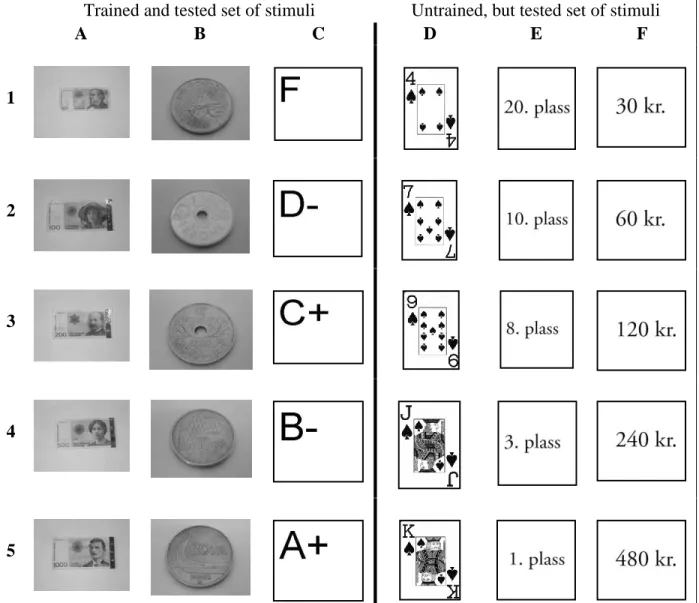
Trained and tested set of stimuli Untrained, but tested set of stimuli A B C D E F 1 2 3 4 5
Figure 1. Overview of the stimuli sets which were used in the conditional discrimination training and tests.
and resulted in identical sequences and densi-ty of trial outcomes for each participant, as well as identical amount of reinforcers ob-tained. Each participant ended this task after 50 trials with 100 credits.
Conditional Discrimination Training.
Fol-lowing the slot-machine pretest, conditional discrimination training was conducted to es-tablish the relations of less than (blue) and greater than (yellow). In this condition, the participants were instructed to choose one of three comparisons presented below a single
sample stimulus, by mouse clicking one of the comparisons (i.e., only one of the three com-parisons would be the correct one in presence of a sample stimulus). There was never two comparisons worth “more than” sample if the contextual cue indicated more than. Similarly, there was never two comparison worth “less than” the sample if the contextual cue indi-cated less than. Six sets of five stimuli and two contextual cues were used during this procedure. Each of the six sets contained five images or words, and the contextual cue was
presented as a blue or yellow rectangle behind the comparisons.
As shown in Figure 1, each of the six sets represented a continuum from least to most. Three of the sets was stimuli related to gam-bling (playing cards, bills, and coins), while three of the sets not was related to gambling (letter grades on universities, placement in competitions, and written amounts). For ex-ample, Set B included pictures of a Norwe-gian ”50-oring” coin, ”1-krone” coin, ”5-krone” coin, ”10-”5-krone” coin and ”20-”5-krone” coin. The pictures were approximately 5 x 5 cm. The contextual cue was approximately 20 x 8 cm.
At the beginning of the conditional dis-crimination training condition, the following instructions were presented on the screen (the text in Norwegian was available on the table beside the PC):
You are going to see five images presented on your screen: one image on top, three on the bottom, and one larger image surround-ing the three on the bottom. Your job is to choose one of the three images on the bot-tom of your screen by clicking on it with the mouse. When you are correct, you will re-ceive one point. Incorrect responses will not result in awarded points. Please try to earn as many points as you can. The more points you earn, the quicker you will finish. There will be parts of the experiment where feed-back is not given. The computer is still keeping track of your responses so continue to do your best. Do you have any questions?
The experimenter answered any questions by repeating the relevant part of the instruc-tions in Norwegian and then left the room. During the training phases, a point counter was visible. The counter displayed the cumu-lative points earned by each correct choice. In addition, a correct answer resulted in the text “Correct” and a 1 s chime. Incorrect choices resulted in the text “wrong” and a 1 s chord. The relations of greater than and less than were trained in three separate phases using three sets of stimuli. Number of trials to
crite-rion in training and test phase was pre-programmed by Dixon and coworkers. There were no limits for number of trials for each participant, and participants were requested to leave if they did not reach mastery criterion.
Less than. The purpose of this phase was
to train the relation of less than. When the sample stimulus was presented, comparisons were presented with a blue contextual cue. A click on the comparison less than sample sti-mulus resulted in the programmed positive consequence. A click on any other compari-son resulted in the programmed negative con-sequence. For example, when the ”5-krone” coin was shown as sample, with the ”1-krone” coin, the ”10-krone” coin and the ”20-krone” coin as comparisons, clicking the ”1-krone” coin would be the correct response in Phase 1. Stimuli from sets A, B, and C were randomly presented. Each block consisted of 30 trials, and 27 correct answers resulted in advance to the next phase. If this criterion was not met, the block of 30 trials was re-presented.
Greater than. The purpose of this phase
was to train the relation of greater than. When the sample stimulus was presented, compari-sons were presented with a yellow contextual cue. A click on the comparison greater than sample stimulus resulted in the programmed positive consequence. A click on any other comparison resulted in the programmed nega-tive consequence. For example, when the ”10-krone” coin was shown as sample, with the ”1-krone” coin, the ”5-krone” coin and the ”20-krone” coin as comparisons, a click on the ”20-krone” coin would be the correct re-sponse in Phase 2. Stimuli from sets A, B, and C were randomly presented. Each block con-sisted of 30 trials, and 27 correct answers re-sulted in advance to the next phase. If this cri-terion was not met, the block of 30 trials was re-presented.
Mixed less than and greater than. During
this phase, blue and yellow contextual cues were presented randomly 30 times each in a 60-trial block. A correct answer had to meet
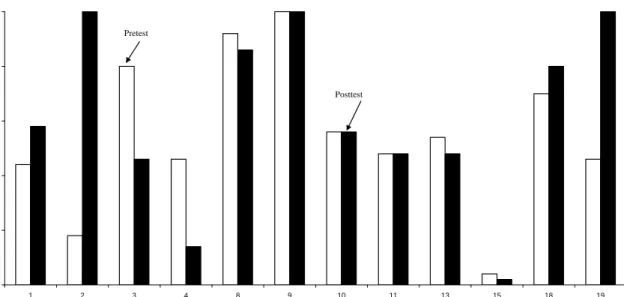
Figure 2. Percent of responses on the yellow slot machine in pre- and posttest in Experiment 1.
the criterion described in Phase 1 and 2. The same stimulus sets as used in Phase 1 and 2 were used. Each block consisted of 60 trials, and 55 correct answers resulted in advance to the next phase. If this criterion was not met, the block of 60 trials was re-presented.
Test. This phase consisted of 120 trials.
In addition to stimulus sets A, B, and C, the novel stimulus sets D, E, and F were used to test if the trained relations between contextual cue and comparisons are applied to novel sti-muli. The criterion for correct and incorrect choices was the same as in the past phases. Before the first trial in Phase 4, the following text was displayed on the screen: “You will no longer receive feedback following your responses. Continue to do the best you can. The computer is recording your score” (Available on the table was a Norwegian translation). No feedback or points were pro-vided at any time during this test. The crite-rion for completion of Phase 4 was 103 cor-rect answers in a block of 120 trials. If this criterion was not met, Phase 3 (Mixed train-ing) was re-presented. Completion of Phase 3 then resulted in presentation of a 120-trial
block in Phase 4, and so one until participants met criterion.
Slot-Machine Task Posttest
The purpose of this task was to determine whether the participants had changed their preferences and allocated their responses dif-ferently than in the pretest. Participants were re-exposed to the exact same slot-machines and conditions as in the pretest.
EXPERIMENT 1
RESULTS & DISCUSSION
Twelve participants reached the trials to criterion and finished Experiment 1 (see Fig-ure 2). At pretest, participants chose the yel-low slot-machine between 4% and 100% (M = 55%, SD = 27.9). The blue slot-machine was chosen between 0% and 96% (M = 45%, SD = 27.9) at pretest. These findings indicate that some of the participants showed a preference for one of the two slot-machines before condi-tional discrimination training. Twelve partici-pants who completed conditional discrimina-tion training in Phase 1 took between one and seven blocks to meet criteria (M = 2), in Phase 2 from one to three blocks (M = 2), and
0 20 40 60 80 100 1 2 3 4 8 9 10 11 13 15 18 19 Participant Number Percen tag e o f res p o n ses t o t h e y el lo w (mo re-t h an ) s lo t mach in e . . Pretest Posttest
Table 1
Data from participants who failed to complete the experiment
Experiment Participant Quit During
Phase Number of training blocks in final phase Number of training trials in final phase Variation in number of correct responses in final
phase Total num-ber of min-utes before re-questing to leave Lowest - highest Mastery criteria 1 5 3 11 644 32-40 55 101 6 3 21 1240 37-48 55 136 7 3 12 737 14-29 55 72 12 2 13 397 10-20 27 69 14 3 21 1272 30-40 55 121 16 3 16 918 19-33 55 85 17 4 3 349 87-97 103 120 20 3 27 1611 20-34 55 176 2 23 3 6 389 31-48 55 92 28 4 2 909 39-60 103 133
in Phase 3 between one to four blocks (M = 2). All twelve participants reached the crite-rion in Phase 4 in one block. Only four of the twelve participants played more on the yellow slot-machine in the posttest; three participants gambled equally on the slot-machines in pre- and posttest, and five participants gambled less on the yellow slot-machine during post-test, as shown in Figure 2. On average, the participants chose to play 55% on the yellow slot-machine in the pretest and 62% on the yellow slot-machine in the posttest. A t-test indicated that the difference between pre- and posttest was not statistically significant (t (11) = 0.49, (α = 0.05)).
Table 1 shows data for eight participants who chose to withdraw from the experiment before they had completed discrimination training. Session-length for these 8 partici-pants ranged between 69 to 176 minutes (M = 110 minutes), while the participants who completed the conditional discrimination training phase took only 35 minutes on aver-age. In summary, 12 out of 20 participants completed all phases of the Experiment 1, but only 4 showed an increase in preference for the yellow slot machine at posttest.
The results from Experiment 1 did not rep-licate the findings of the Zlomke and Dixon
(2006) study. The participants in the current study showed much more variation in their allocation of responses between the slot- machines than participants in Zlomke and Di-xon (2006). Our findings from the 12 partici-pants who completed the experiment show an average increase in preference of 7% for the yellow slot-machine, while Zlomke and Di-xon (2006) reported a 32% increase. There are several possible explanations for this. First, we used another version of the simu-lated slot-machines. Our participants choose slot-machines by clicking yellow or blue qua-drangle with the written words ”Slot Machine 1” or ”Slot Machine 2”. Participants in Zlomke and Dixon (2006) choose between two concurrently slot-machines, and clicked the one they wanted to continue with for the gambling. The differences in procedures may not be essential since the total number of clicking-responses to access the preferred slot-machine were the same in both experi-ments. Second, the version we used required at least 240 trials during conditional discrimi-nation training. Zlomke and Dixon’s (2006) version required at least 136 trials. This indi-cates that the participants in the current study were exposed to more trials in the conditional discrimination training in training yellow
col-or to “mcol-ore-than” than the participants in Zlomke and Dixon (2006). Nevertheless, the participants in the current study showed a lesser change in preference than in Zlomke and Dixon (2006). Third, we replaced the US training stimuli (pictures of money) with Norwegian training stimuli, we translated written words to Norwegian, and amount of money (US $) was calculated to Norwegian kroner (NOK). We did this to avoid unfami-liarity with the training stimuli from influen-cing the results. Fourth, verbal reports from at least one participant told us that it was possi-ble for the participants to reach trials to crite-rion for all phases in conditional discrimina-tion training without paying attendiscrimina-tion to the contextual cue. This is possible because to avoid that more than one comparison stimulus could be “the right one” at the same time, on-ly one of three comparisons would be “more-than” or “less-“more-than” sample stimulus, as pointed out in Hoon et al. (2007). Two com-parisons would always be “the wrong ones”. Participants could choose the comparison that was the only one “more-than” or the only one “less-than” sample stimulus and receive feed-back, and reach trials to criterion in all phas-es, without noticing the color of the contex-tual cue. Eight of twenty participants did not continue with the experiment after struggling to reach trials to criterion in the conditional discrimination training. In contrast, all nine participants in Zlomke and Dixon’s (2006) study met the criterion for conditional dis-crimination training and finished the experi-ment.
It is possible that instructions could influ-ence different types of attending behavior. Some studies have discussed the influence of general and specific instructions in condition-al discrimination procedures (Arntzen, Vaidya, & Halstadtro, in press; Pilgrim, Jack-son, & Galizio, 2000; Smyth, Barnes-Holmes, & Barnes-Holmes, 2008) and there is need for further research. Therefore, the purpose of Experiment 2 was to study the effects of extra
instructions on the importance of attending to all stimuli on the screen. The instruction was given to the participants who did not reached trial to criterion within a time limit in training conditional discrimination. A short post-experimental interview was conducted to de-termine if participants noticed the contextual cue during the conditional discrimination training.
EXPERIMENT 2
METHOD
Participants
In the current experiment twenty adults participated, eleven women and nine men. Everyone was more than eighteen years old and had a full time job. All the participants said they had knowledge about slot machines, but no one reported when asked to have any gambling problems. The participants partici-pated voluntarily and were recruited by the two first authors. Before the experimental ses-sion started, everyone was told that they could withdraw from the session at any time. After the experiment, all participants received a booklet about applied behavior analysis.
Procedure
The procedure was the same as in Experi-ment 1 except for two important differences. First, if a participant had not finished the ex-periment after sixty minutes, the exex-perimenter interrupted the study, repeated the start in-struction and emphasized to the participant that they should attend to all the five different images on the screen. The experimenter pointed to the image on top of the screen, the three below and the large image that encom-passed the three below to draw participants’ attention to the contextual cue of the back-ground color. Second, we conducted a brief interview with every participant who finished the experiment. The following question was asked: “How did you solve the task where you were going to choose between three im-ages?” We asked the question to determine if
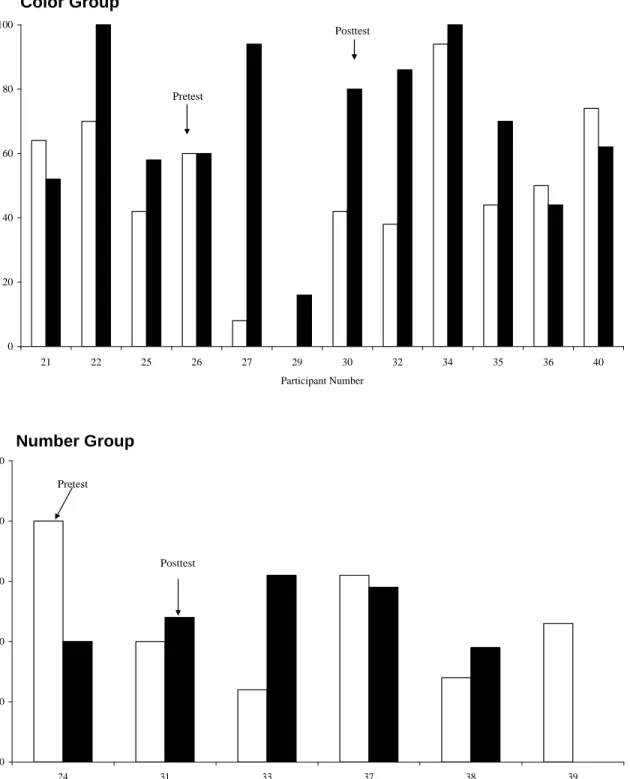
Figure 3. The upper panel shows the percent of responses on the yellow slot machine in pre- and posttest for the Color Group (the participants that reported to have attended to the contextual stimulus in the training phase) in Experiment 2. The lower panel shows the percent of responses on the yellow slot machine in p and posttest for the Number Group (the participants that re-ported not to have attended to the contextual stimulus in the training phase) in Experiment 2.
0 20 40 60 80 100 21 22 25 26 27 29 30 32 34 35 36 40 Participant Number P er ce nt age of re spons es t o the ye ll ow . (m ore-than) slo t m ac hi ne . Pretest Posttest Color Group 0 20 40 60 80 100 24 31 33 37 38 39 Participant Number Pe rce nta ge o f re s po ns e s to th e y e ll ow . (m ore -th a n) s lo t m a c hi ne Pretest Posttest Number Group
the participants had attended to the color of the contextual stimulus or the number of comparison stimuli.
EXPERIMENT 2
RESULTS AND DISCUSSION
Eighteen participants finished Experiment 2. In the pretest, the choices for the yellow slot machine were from 0% to 94 % (M = 48%, SD = 24.3), while the blue slot machine was chosen from 6% to 100% (M = 52%, SD
= 24.3). This finding indicates that some of the participants had a preference for one of the slot machines before the conditional dis-crimination training was introduced. Thus, the finding is also in accordance with the results in Experiment 1.
The eighteen participants who finished the conditional discrimination training in Phase 1 took between one and nine sessions (M = 3 sessions), between one and five sessions (M = 2 sessions) in Phase 2, and between one and fifteen sessions (M = 3 sessions) in Phase 3. All participants, except for one, finished Phase 4 in one session. Participant #40 fi-nished Phase 4 in two sessions. In Experiment 1, twelve of twenty participants (60%) fi-nished the experiment, while eighteen of twenty participants (90%) finished Experi-ment 2 (see Table 1). Therefore, it seems rea-sonable to presume that the detailed instruc-tion was effective. Two of the participants in Experiment 2 did not finish the conditional discrimination training and were not exposed to the post-test. Participant #28 reached the criterion in Phase 3 two times, but did not reach the criterion in Phase 4. Thus, the par-ticipant was not re-exposed to Phase 3 and did not finish the experiment.
In the analysis of the results, the partici-pants were divided into two groups dependent on the answers in the post-experimental inter-view. That is, one group consisted of the par-ticipants who reported that they had chosen the comparison stimulus by looking at the color of the contextual stimulus (Color
Group), while the other group consisted of the participants who reported to have chosen the one comparison stimulus that was either greater or smaller than the sample stimulus, independent of the color of the contextual stimulus (Number Group). The Color Group consisted of twelve participants, eight of whom gambled more on the yellow slot ma-chine in the posttest than in the pretest, as shown in Figure 3. One of the twelve partici-pants gambled the same on the yellow and the blue slot machine in pretest and posttest. Fur-thermore, three of the twelve participants gambled less on the yellow slot machine in the posttest. Participants # 21, 22, and 25 re-ceived the detailed instruction. Participants in the Color Group gambled a mean of 49% of their responses on the yellow slot machine in the pretest and 69% on the yellow slot ma-chine in the posttest. A t-test indicated a sta-tistically significant difference: t (11) = 0.04 (α = 0.05). This indicates that the procedure was effective in increasing preferences for the yellow slot machine, providing that the color of the contextual stimulus had been attended to.
The Number Group consisted of six partici-pants, two of whom gambled more on the yel-low slot machine in the posttest than in the pretest, while four gambled less on the yellow slot machine. It is important to notice that par-ticipants # 37, 38, and 39 were given detailed instruction and reported to have solved the task by looking at the comparison stimuli. Since the detailed instruction did not include information about attending to changes in the color of the contextual stimulus, it is possible that the instruction functioned as input to con-tinue the experiment. The Number Group gambled with a mean of 47% of responses allocated to the yellow slot machine in the pretest and 41% in the post-test, as shown in Figure 3. A t-test indicated that the difference was not statistically significant: t (5) = 0.72 (α
=0.05).
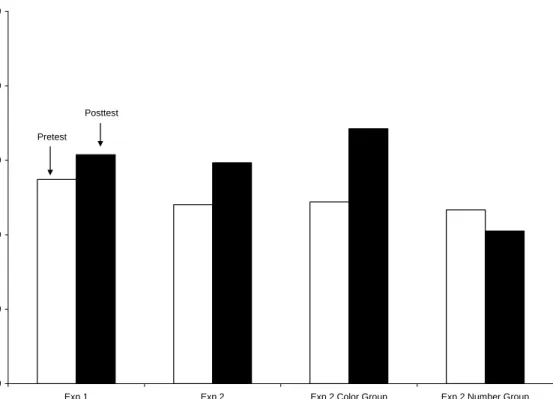
Figure 4. The Figure shows the mean number of responses to the yellow slot machine in pre-and posttest for both Experiment 1 and 2. Furthermore, the results are divided into Color Group and Number Group.
to investigate the possible implication that some of the participants did not attend to the colors. We replicated the findings from Expe-riment 1 as we did find a greater variation than Zlomke and Dixon (2006) in responding to the yellow slot machine in the pretest. The posttest shows that eight of twelve partici-pants (Color Group) who reported to have at-tended to the contextual stimulus increased their preference to gamble on the yellow slot machine (one participant responded the same in pre and posttest, while three participants gambled less on the yellow slot machine). As a group, these participants had the largest in-crease in preference from pre- to posttest (see Figure 4) and nearly three times as great an increase in preference change as in Experi-ment 1.
GENERAL DISCUSSION
We sought to replicate Zlomke and Dixon (2006) and also to expand the knowledge about instructional control in the gambling literature. The results from Experiment 1 in the current study did not replicate all of the findings from Zlomke and Dixon (2006). First, during the pretest we found more varia-bility among participants’ preferences for the slot machines. In the study by Zlomke and Dixon (2006), the greatest shift in preference was 20% for the yellow slot machine (M = 49%). Thus, in the current study the shift in preferences ranged from 0% to 100% for the yellow slot machine (M = 51%). Second, the data from the posttest show that eight of the participant in the Zlomke and Dixon (2006) study played more on the yellow slot machine compared to the pretest. The participants in the current study did not show the same con-sistency in change of preference. Only four of
0 20 40 60 80 100
Exp 1 Exp 2 Exp 2 Color Group Exp 2 Number Group
Me an p er ce n tage of r es p o n se s to t h e y ell o w ( mo re-t h an) sl o t machin e . Pretest Posttest
the twelve participants who finished Experi-ment 1 had an increase in preference for the yellow slot machine, and five participants showed a reduced preference for the yellow slot machine after the conditional discrimina-tion training. Some of the participants re-ported that they had not attended to the con-textual stimulus, even if they finished the training and test phase. We think that this finding could be important since it might be that the participants had not conditioned the yellow color to the contextual stimulus “more than”. Furthermore, it could have implications for the interpretation of the results of Experi-ment 1. One could not account for an increase in preferences on the yellow slot machine for the participants who have not attended to the contextual stimulus (i.e., if the color on the slot machines was not of importance, then the choices in both pre- and posttest will be large-ly random).
The change in preference for the Color Group is remarkably lower than in the Zlomke and Dixon (2006) study. One impli-cation from the current study seems to be that it is important to find out if the participants are attending to the contextual stimulus or not. The group (Number Group) that had been looking at or attending to comparison stimuli showed a small reduction in change in prefe-rence to the yellow slot machine after train-ing.
The results from the current study are in accordance with the results of Hoon et al. (2007), even if in the current study the changes in preferences were greater. Hoon et al. (2007) presented three experiments with six participants in each experiment. Group data from Experiment 1 showed 18% reduc-tion in gambling on the yellow slot machine, while group data from Experiment 2 and Ex-periment 3 showed a small increase of 4%. In an another study by Hoon et al. (2008), they showed that when we just look at group data an increase in preferences of 20% is ob-served. They argued that establishment of
non-arbitrary contextual control is most effi-cient with two comparisons and gambling re-lated stimuli. The results from Experiment 2 in the current study, albeit with three compar-isons, are in accord with this notion providing that we exclude the participants who reported not to have been attending to the contextual stimulus.
Hoon et al. (2007) reported that 13 of 18 participants finished the experiments. In the current study, all of the participants that fi-nished both experiments showed one self-generated rule that was important in the test phase in which three new stimulus sets were introduced. Therefore, we will argue that the rule about the five stimuli on the screen in training phase was controlling the partici-pants’ behavior in the test phase. Further-more, the self-generated rule was probably also used during the post-test for those who gambled more on the yellow slot machine in the pretest even if it did not produce more reinforcers. Thus, there are some problems with self-report data (e.g., Critchfield & Ept-ing, 1998; Holth & Arntzen, 1998), such as the fact that participants’ self-generated rules are asked about in a post-experimental inter-view and the questioning by itself could influ-ence the self-reports. Therefore, we suggest that future research should include talk aloud procedures (e.g., Cabello & O'Hora, 2002; Rehfeldt & Dixon, 2000). The focus on self-generated rules will be in accordance with researchers who have pointed out that analys-es of different verbal behavior are important in understanding gambling behavior (Brandt & Pietras, 2008; Dixon & Delaney, 2006). Thus, it seems important to increase the un-derstanding of self-generated rules in gam-bling behavior since such rules like “play the yellow slot machines, and you will win more”. Such a rule may make individuals gamble more on yellow machines than ma-chines with other colors. Thus, it could be that the gambler thinks he or she can control or have influence on the outcome of gambling
(e.g., Ladouceur, Sylvain, Boutin, & Doucet, 2002; Petry, 2005).
There are several limitations to the present findings. First, a potential threat to the validi-ty of the findings is the relatively low re-quirement of 50 slot machine trials in the pretest, which could be too few responses for the participants to show a stable preference. Also, the participants may have determined the schedules of reinforcement in the pretest and therefore have no reason for gambling more on the yellow slot machine in the post-test. Second, although open-ended questions were used during the post-experimental inter-view in Experiment 2, participants’ responses were readily assigned to one of two catego-ries. This made it clear for the experimenter how to score the answers, but had all verbali-zations been audio recorded and later tran-scribed it would have allowed for reliability testing to be undertaken. Third, we did not use a standardized measure for screening gambling problems. All the participants were given some formal written information about the experiment and they had to answer two questions about gambling. All participants reported knowledge of slot-machines, but no one reported problems with gambling. By this we concluded that the participants may best be described as “non-gamblers” or recreation-al gamblers. A standardized measure like South Oaks Gambling Screen (SOGS) (Le-sieur & Blume, 1987) may be better to screen and categorize participants. Fourth, employ-ing a research design other than the pretest-posttest design, such as a multiple baseline design, is important for future research, as is targeting the least preferred color slot ma-chine from the pretest as the subsequent more-than contextual cue. Finally, it would be helpful to replicate the present procedures with gamblers.
In conclusion, the current study showed that preferences for gambling on one of two slot machines could come under contextual control by two different colors. The results
support the studies by Zlomke and Dixon (2006) and Hoon et al. (2007). There is a need for more replications since the results are not quite unambiguous. In any case, the results show that preference for slot machines can be established and transformed to other stimuli. Furthermore, the results showed that self-generated rules can lead to responding in a special pattern even if the reinforcement for such responses is very lean and could be the reason for the choice of some responses and not other even if the contingencies of rein-forcement are the same.
REFERENCES
Arntzen, E., Vaidya, M., & Halstadtro, L. B. (in press). On the role of instruction in conditional
discrimination training. Experimental Analysis of
Human Behavior Bulletin.
Brandt, A. E., & Pietras, C. J. (2008). Gambling on a simulated slot machine under conditions of
repeated play. The Psychological Record, 58,
405-426.
Cabello, F., & O'Hora, D. (2002). Addressing the limitations of protocol analysis in the study of
complex human behavior. International Journal of
Psychology and Psychological Therapy, 2, 115-130.
Critchfield, T. S., & Epting, L. K. (1998). The trouble with babies and the value of bathwater: Complexities in the use of verbal reports as data.
The Analysis of Verbal Behavior, 15, 65-74. Daugherty, D., & MacLin, O. H. (2007). Perceptions of
luck: Near wins and near loss experiences. Analysis
of Gambling Behavior, 1, 123-132.
Dixon, M. R. (2007). Why behavior analysts should
study gambling behavior. Analysis of Gambling
Behavior, 1, 1-3.
Dixon, M. R., & Delaney, J. (2006). The impact of verbal behavior on gambling behavior. In P. M. Ghezzi, C. A. Lyons, M. R. Dixon & G. R. Wilson
(Eds.), Gambling: Behavior Theory, Research, and
Application (pp. 127-154). Reno, NV: Context Press.
Dixon, M. R., & Schreiber, J. B. (2002). Utilizing a computerized video poker simulation for the
collection of data on gambling behavior. The
Psychological Record, 52, 417-428.
Dymond, S., & Rehfeldt, R. A. (2000). Understanding complex behavior: The transformation of stimulus
functions. The Behavior Analyst, 23, 239-254.
Ferster, C. B., & Skinner, B. F. (1957). Schedules of
Ghezzi, P., Lyons, C. A., Dixon, M. R., & Wilson, G.
R. (2006). Gambling: Behavior Theory, Research,
and Application. Reno, NV: Context Press
Holth, P., & Arntzen, E. (1998). Symmetry versus sequentiality related to prior training, sequential
dependency of stimuli, and verbal labeling. The
Psychological Record, 48, 293-315.
Hoon, A., Dymond, S., Jackson, J. W., & Dixon, M. R. (2007). Manipulating contextual control over
simulated slot machine gambling. Analysis of
Gambling Behavior, 1, 109-122.
Hoon, A., Dymond, S., Jackson, J. W., & Dixon, M. R. (2008). Contextual control of slot machine
gambling: Replication and extension. Journal of
Applied Behavior Analysis, 41, 467-470.
Ladouceur, R., Sylvain, C., Boutin, C., & Doucet, C. (2002). Understanding and treating the pathological
gambler: Book review. Cognitive Behaviour
Therapy, 31, 191.
Lesieur, H. R., & Blume, S. B. (1987). The South Oaks Gambling Screen (The SOGS): a new instrument for the identification of pathological gamblers.
American Journal of Psychiatry, 144, 1184-1188. MacLin, O. H., Dixon, M. R., & Hayes, L. J. (1999). A
computerized slot machine simulation to investigate the variables involved in gambling behavior.
Behavior Research Methods, Instruments & Computers, 31, 731-734.
MacLin, O. H., Dixon, M. R., Robinson, A., & Daugherty, D. (2006). Writing a simple slot machine simulation program. In P. M. Ghezzi, C. A. Lyons, M. R. Dixon & G. R. Wilson (Eds.),
Gambling: Behavior Theory, Research, and Application (pp. 127-154). Reno, NV: Context Press.
Oren, A., & Bakken, I. J. (2007). Pengespill og
pengespillproblem i Norge 2007. SINTEF Helse,
avdeling for epidemologi, from
http://www.sintef.no
Petry, N. M. (2005). Pathological Gambling: Etiology,
Comorbidity, and Treatment. Washington, DC: American Psychological Association American Psychological Association.
Pilgrim, C., Jackson, J., & Galizio, M. (2000).
Acquisition of arbitrarily conditional
discriminations by young normally developing
children. Journal of the Experimental Analysis of
Behavior, 73, 177-193.
Rehfeldt, R. A., & Dixon, M. R. (2000). Investigating the relation between self-talk and emergent
stimulus relations. Experimental Analysis of Human
Behavior Bulletin, 18, 28-29.
Smyth, S., Barnes-Holmes, D., & Barnes-Holmes, Y.
(2008). Acquired equivalence in human
discrimination learning: The role of propositional
knowledge. Journal of Experimental Psychology:
Animal Behavior Processes, 34, 167-177.
Stiftelsestilsynet, L.-o. (2006). Norske pengespel: Statistikk over norske pengespel og lotteri, from http://www.lottstift.no <http://www.lottstift.no> Weatherly, J. N., Austin, D. P., & Farwell, K. (2007).
The role of “experience” when people gamble on
three different video-poker games. Analysis of
Gambling Behavior, 1, 34-43.
Weatherly, J. N., & Meier, E. (2007). Studying gambling experimentally: The value of money.
Analysis of Gambling Behavior, 1, 133-140. Weatherly, J. N., & Phelps, B. J. (2006). The Pitfalls of
Studying Gambling Behavior in a Laboratory Situation. In P. M. Ghezzi, C. A. Lyons, M. R.
Dixon & G. R. Wilson (Eds.), Gambling: Behavior
Theory, Research, and Application (pp. 19-43). Reno, NV: Context Press.
Zlomke, K. R., & Dixon, M. R. (2006). Modification of slot-machine preferences through the use of a
conditional discrimination paradigm. Journal of
Applied Behavior Analysis, 39, 351-361.