BIOLOGY
Assessment Guide
August 2012
Louisiana State Board of Elementary and Secondary Education Ms. Penny Dastugue Ms. Kira Orange Jones Ms. Holly Boffy
President Second BESE District Seventh BESE District
Member-at-Large
Ms. Lottie P. Beebe Ms. Carolyn Hill Mr. Charles E. Roemer Third BESE District Eighth BESE District
Vice President
Sixth BESE District Mr. Walter Lee Mr. John L. Bennett Fourth BESE District Member-at-Large Mr. James D. Garvey, Jr.
Secretary/Treasurer Mr. Jay Guillot Ms. Connie Bradford
First BESE District Fifth BESE District Member-at-Large Ms. Catherine Pozniak
Executive Director
The mission of the Louisiana Department of Education (LDOE) is to ensure equal access to education and to promote equal excellence throughout the state. The LDOE is committed to providing Equal Employment Opportunities and is committed to ensuring that all its programs and facilities are accessible to all members of the public. The LDOE does not discriminate on the basis of age, color, disability, national origin, race, religion, sex, or genetic information. Inquiries concerning the LDOE’s
compliance with Title IX and other civil rights laws may be directed to the Attorney, LDOE, Office of the General Counsel,
P.O. Box 94064, Baton Rouge, LA 70804-9064; 877-453-2721 or [email protected]. Information about the federal civil rights
laws that apply to the LDOE and other educational institutions is available on the website for the Office of Civil Rights, USDOE, at http://www.ed.gov/about/offices/list/ocr/.
This project is made possible through a grant awarded by the State Board of Elementary and Secondary Education from the Louisiana Quality Education Support Fund—8(g).
This public document was published at a total cost of $6,000.00. This web-only document was published for the Louisiana Department
of Education, Office of Standards, Assessments, and Accountability, Division of Assessments and Accountability, P.O. Box 94064, Baton Rouge, LA 70804-9064, by Pacific Metrics Corporation, 1 Lower Ragsdale Drive, Building 1, Suite 150, Monterey, CA 93940.
This material was published in accordance with the standards for printing by state agencies established pursuant to R.S. 43:31 and in accordance with the provisions of Title 43 of the Louisiana Revised Statutes.
For further information, contact: Louisiana Department of Education’s Help Desk
1-877-453-2721 Ask LDOE?
Table of Contents
PrefaceWhat Is End-of-Course Testing? ... iii
What Is the Purpose of theAssessment Guide? ... iii
What Does the Assessment Guide Include? ... iii
Who Takes the Biology EOC Test and When Is It Administered? ... iii
How Is the Biology EOC Test Related to theLouisiana Comprehensive Curriculum? ... iv
Where May I Find Additional Information about the Biology EOC Test? ... iv
Additional Resources ... iv
The Biology EOC Test Test Design ... 1
Characteristics of Test Items ... 1
Coverage by Strand and Component ... 2
Biology EOC Test Tools ... 2
Biology EOC Test Typing Help Information ... 2
Biology Grade-Level Expectations (GLEs) Eligible GLEs for the Biology EOC Test ... 3
Sample Items for the Biology EOC Test Sample Multiple-Choice Items ... 9
Sample Constructed-Response Item and Scoring Rubric ... 14
Appendix Item Development Process ... 16
Test Accommodations ... 16
Technology Requirements ... 17
Biology EOC Test Glossary ... 17
Biology EOC Test Typing Help ... 18
List of Tables Table 1: Suggested Testing Times ... 1
Table 2: Biology EOC Coverage by Strands and Components ... 2
Table 3: Life Science Component GLEs ... 3
Table 4: Earth and Space Science Component GLEs ... 6
Table 5: Science as Inquiry Component GLEs ... 7
Table 6: Science as Inquiry Component GLEs Excluded from the EOC Biology Test ... 8
Preface
Louisiana Believes embraces the principle that all children can achieve at high levels. Louisiana Believes also promotes the idea that Louisiana’s educators should be
empowered to make decisions to support the success of their students. In keeping with these values, the Department has created assessment guides to help prepare teachers and students for the EOC tests. These guides reflect the State’s commitment to consistent and rigorous assessments and provide educators and families with clear information about expectations for student performance.
What Is End-of-Course Testing?
End-of-course (EOC) testing, a recommendation of the Louisiana High School Redesign Commission, is an increasingly common practice nationwide. Beginning with first-time 9th graders in the 2010–2011 school year, EOC tests replaced the Graduation Exit
Examination (GEE) as an assessment requirement for graduation. For further information, see chapter 23 of Bulletin 741.
What Is the Purpose of the Assessment Guide?
The Assessment Guide provides an overview of the Biology EOC test. In addition to providing teachers with a description of the overall design of the test, this guide presents sample test items and suggested informational resources. Teachers should use this guide to
• become familiar with the Biology EOC test format,
• include similar item formats in classroom instruction and assessments,
• align instruction and assessment with the Louisiana Comprehensive Curriculum and Grade-Level Expectations (GLEs), and
• provide appropriate test accommodations. What Does the Assessment Guide Include? This guide includes information about
• test design (format and test blueprint), • test content (GLEs covered),
• test scoring,
• sample test items, and • test accommodations.
Who Takes the Biology EOC Test and When Is It Administered?
The Biology EOC test is an online assessment that is administered to all public school students upon their completion of the Biology course (course code 150301). Administration of the Biology EOC test began in the 2010–2011 school year. The test is administered each May to students on traditional schedules, each December and May to students on block schedules, and each June to students who need to retest. Exact dates for the administration are published in the EOCTest Administration Manual as well as on the homepage for End-of-Course testing, www.louisianaeoc.org.
How Is the Biology EOC Test Related to the Louisiana Comprehensive Curriculum? The Louisiana Comprehensive Curriculum was used as a resource to determine the appropriate content and coverage for the test. However, other curricula developed by local districts and approved by the state that address all GLEs at the appropriate level of rigor will also suitably prepare students for the test. Tables of GLEs eligible for testing are included on pages 3 through 8.
Where May I Find Additional Information about the Biology EOC Test? Information about the Biology EOC test can be found on the EOC homepage,
www.louisianaeoc.org. Questions or requests for more information should be addressed to the Louisiana Department of Education (LDOE), Division of Assessments and Accountability by calling toll-free at 877-453-2721.
Additional Resources
The LDOE has developed several resources to assist educators as they prepare students for the Biology EOC test. The following materials are available on the LDOE website, www.louisianaschools.net, or on the EOC Tests homepage, www.louisianaeoc.org: • Grade-Level Expectations (GLEs)for Biology
www.doe.state.la.us/topics/gle.html • Louisiana Comprehensive Curriculum
www.doe.state.la.us/topics/comprehensive_curriculum.html • EOC online demonstration site and tutorials
www.louisianaeoc.org (demo site under Login drop-down menu; tutorials under Technology Resources drop-down menu)
• Enhanced Assessment of Grade-Level Expectations (EAGLE) www.louisianaeagle.org/pma/orca2/diag.htm
• EOC Tests: Frequently Asked Questions (FAQs)
The Biology EOC Test
Test DesignThe Biology EOC test includes three sessions, all of which are administered online: • a 25-item multiple-choice session
• a 3-item constructed-response session • a 25-item multiple-choice session
Forty-six multiple-choice items and two constructed-response items are operational. The remaining five items are embedded field test items, which are used to develop new test forms.
The suggested testing times for the Biology EOC test listed in Table 1 are estimates only. There are no strict time limits for the EOC tests.
Table 1: Suggested Testing Times
Session Description Number of Items Testing Time
1 Multiple Choice 25 0040 minutes
2 Constructed Response 3 0020 minutes
3 Multiple Choice 25 0040 minutes
TOTAL 53 0100 minutes
Information about additional time needed to prepare computers for testing, to read test directions to students, to assist students with the log-in process, and to accomplish other activities related to test administration is included in the Test Administration Manual. Characteristics of Test Items
Multiple-choice items assess knowledge, conceptual understanding, and application of skills from the Life Science, Earth and Space Science, and Science as Inquiry GLEs. The items consist of an interrogatory stem followed by four response options (A, B, C, D) and are scored as correct or incorrect.
The Biology EOC test will also include constructed-response items from the Life Science strand. Constructed-response items require students to compose an answer and generally necessitate higher order thinking. A typical constructed-response item may require students to develop an idea, demonstrate a problem-solving strategy, or justify an answer based on reasoning or evidence. The items are scored on a 0–2 point scale using an item-specific rubric.
Coverage by Strand and Component
While all Biology GLEs have items developed for assessment, some strands and components receive more emphasis. Table 2 illustrates the emphasis of the strands and components.
The components of the Life Science strand are assessed using both multiple-choice and constructed-response items. The Earth and Space Science strand and the Science as Inquiry strand are assessed through multiple-choice items only.
Table 2: Biology EOC Test Coverage by Strands and Components Strand or Component Percentage by Approximate
Component Approximate Percentage by Strand Life Science 00 70 1. The Cell 11
2. The Molecular Basis of Heredity 11
3. Biological Evolution 11
4. Interdependence of Organisms 8
5. Matter, Energy, and Organization of Living
Systems 8
6. Systems and the Behavior of Organisms 11 7. Personal and Community Health 10
Earth and Space Science 0012
Science as Inquiry 0018
TOTAL 0100
Biology EOC Test Tools
Students are given only scratch paper and pencils to use during the Biology EOC test. There are no other materials allowed unless a student has an approved Assistive Technology accommodation and is allowed the use of a calculator.
Biology EOC Test Typing Help Information
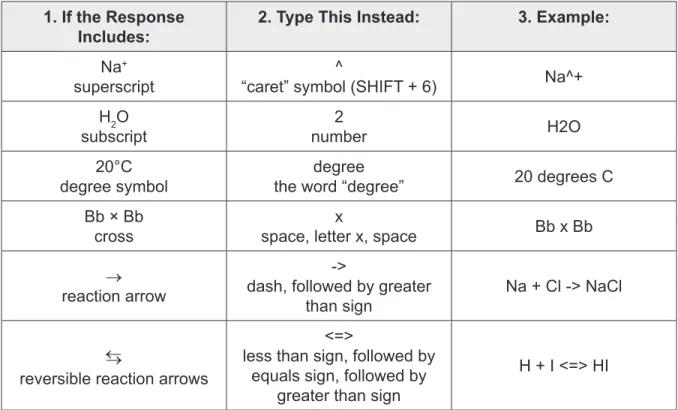
To assist students in typing special symbols and other elements in their constructed-response items, the Biology EOC test includes a Typing Help pop-up window (see Table 7 in the appendix for more information). Print copies of the Typing Help may be provided to students during the test.
Biology Grade-Level Expectations (GLEs)
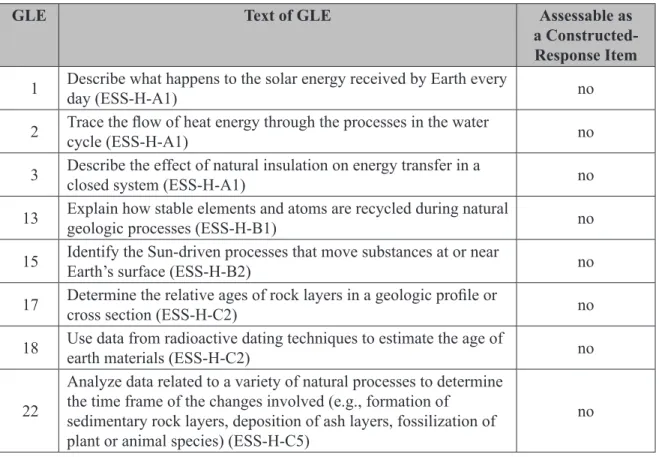
Eligible GLEs for the Biology EOC TestThe Biology EOC test measures what students are expected to know and be able to do according to Louisiana’s Grade-Level Expectations as listed in the Biology course section of the Louisiana Comprehensive Curriculum. Table 3 lists the GLEs for the Life Science components, Table 4 lists the GLEs for the Earth and Space Science component, and Table 5 lists the GLEs for the Science as Inquiry component.
Sixty-three of these GLEs are eligible for testing as multiple-choice items; however, a given test form will not cover all GLEs. In addition, only certain GLEs, as specified in Table 3, will be available for constructed-response (CR) items.
Table 3: Life Science Component GLEs
GLE Text of GLE Assessable as
a Constructed-Response Item The Cell
01 Compare prokaryotic and eukaryotic cells (LS-H-A1) no
02 Identify and describe structural and functional differences among organelles (LS-H-A1) yes
03 Investigate and describe the role of enzymes in the function of a cell (LS-H-A1) yes
04 Compare active and passive cellular transport (LS-H-A2) yes
05 Analyze the movement of water across a cell membrane in hypotonic, isotonic, and hypertonic solutions (LS-H-A2) yes
06 Analyze a diagram of a developing zygote to determine when cell differentiation occurs (LS-H-A3) no The Molecular Basis of Heredity
07 Identify the basic structure and function of nucleic acids (e.g., DNA, RNA) (LS-H-B1) yes
08 Describe the relationships among DNA, genes, chromosomes, and proteins (LS-H-B1) yes
09 Compare mitosis and meiosis (LS-H-B2) yes
010 Analyze pedigrees to identify patterns of inheritance for common genetic disorders (LS-H-B3) yes
011 Calculate the probability of genotypes and phenotypes of offspring given the parental genotypes (LS-H-B3) yes 12 Describe the processes used in modern biotechnology related to genetic engineering (LS-H-B4) (LS-H-B1) no 13 Identify possible positive and negative effects of advances in biotechnology (LS-H-B4) (LS-H-B1) no
Table 3: Life Science Component GLEs (continued) Biological Evolution
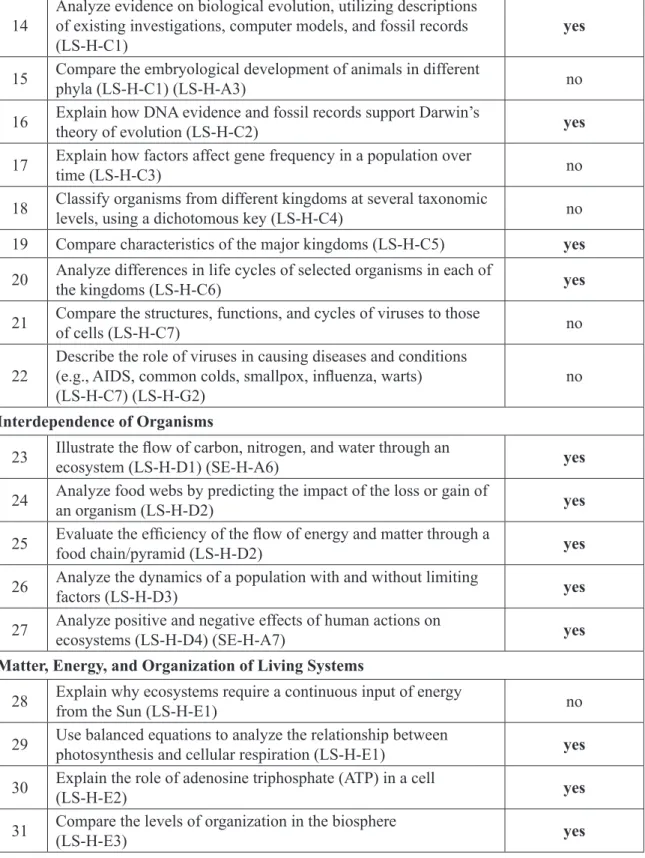
14 Analyze evidence on biological evolution, utilizing descriptions of existing investigations, computer models, and fossil records
(LS-H-C1) yes
15 Compare the embryological development of animals in different phyla (LS-H-C1) (LS-H-A3) no 16 Explain how DNA evidence and fossil records support Darwin’s theory of evolution (LS-H-C2) yes 17 Explain how factors affect gene frequency in a population over time (LS-H-C3) no 18 Classify organisms from different kingdoms at several taxonomic levels, using a dichotomous key (LS-H-C4) no 19 Compare characteristics of the major kingdoms (LS-H-C5) yes 20 Analyze differences in life cycles of selected organisms in each of the kingdoms (LS-H-C6) yes 21 Compare the structures, functions, and cycles of viruses to those of cells (LS-H-C7) no 22 Describe the role of viruses in causing diseases and conditions (e.g., AIDS, common colds, smallpox, influenza, warts)
(LS-H-C7) (LS-H-G2) no
Interdependence of Organisms
23 Illustrate the flow of carbon, nitrogen, and water through an ecosystem (LS-H-D1) (SE-H-A6) yes 24 Analyze food webs by predicting the impact of the loss or gain of an organism (LS-H-D2) yes 25 Evaluate the efficiency of the flow of energy and matter through a food chain/pyramid (LS-H-D2) yes 26 Analyze the dynamics of a population with and without limiting factors (LS-H-D3) yes 27 Analyze positive and negative effects of human actions on ecosystems (LS-H-D4) (SE-H-A7) yes Matter, Energy, and Organization of Living Systems
28 Explain why ecosystems require a continuous input of energy from the Sun (LS-H-E1) no 29 Use balanced equations to analyze the relationship between photosynthesis and cellular respiration (LS-H-E1) yes 30 Explain the role of adenosine triphosphate (ATP) in a cell (LS-H-E2) yes 31 Compare the levels of organization in the biosphere (LS-H-E3) yes
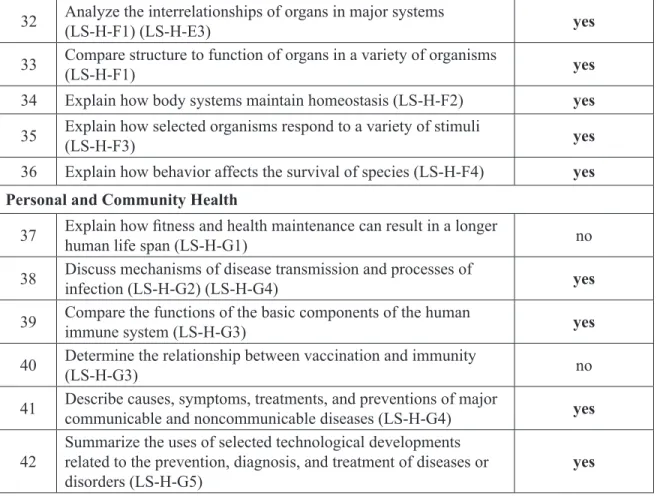
Table 3: Life Science Component GLEs (continued) Systems and the Behavior of Organisms
32 Analyze the interrelationships of organs in major systems (LS-H-F1) (LS-H-E3) yes 33 Compare structure to function of organs in a variety of organisms (LS-H-F1) yes 34 Explain how body systems maintain homeostasis (LS-H-F2) yes 35 Explain how selected organisms respond to a variety of stimuli (LS-H-F3) yes 36 Explain how behavior affects the survival of species (LS-H-F4) yes Personal and Community Health
37 Explain how fitness and health maintenance can result in a longer human life span (LS-H-G1) no 38 Discuss mechanisms of disease transmission and processes of infection (LS-H-G2) (LS-H-G4) yes 39 Compare the functions of the basic components of the human immune system (LS-H-G3) yes 40 Determine the relationship between vaccination and immunity (LS-H-G3) no 41 Describe causes, symptoms, treatments, and preventions of major communicable and noncommunicable diseases (LS-H-G4) yes 42 Summarize the uses of selected technological developments related to the prevention, diagnosis, and treatment of diseases or
Table 4: Earth and Space Science Component GLEs
GLE Text of GLE Assessable as
a Constructed-Response Item 1 Describe what happens to the solar energy received by Earth every day (ESS-H-A1) no 2 Trace the flow of heat energy through the processes in the water cycle (ESS-H-A1) no 3 Describe the effect of natural insulation on energy transfer in a closed system (ESS-H-A1) no 13 Explain how stable elements and atoms are recycled during natural geologic processes (ESS-H-B1) no 15 Identify the Sun-driven processes that move substances at or near Earth’s surface (ESS-H-B2) no 17 Determine the relative ages of rock layers in a geologic profile or cross section (ESS-H-C2) no 18 Use data from radioactive dating techniques to estimate the age of earth materials (ESS-H-C2) no 22
Analyze data related to a variety of natural processes to determine the time frame of the changes involved (e.g., formation of
sedimentary rock layers, deposition of ash layers, fossilization of plant or animal species) (ESS-H-C5)
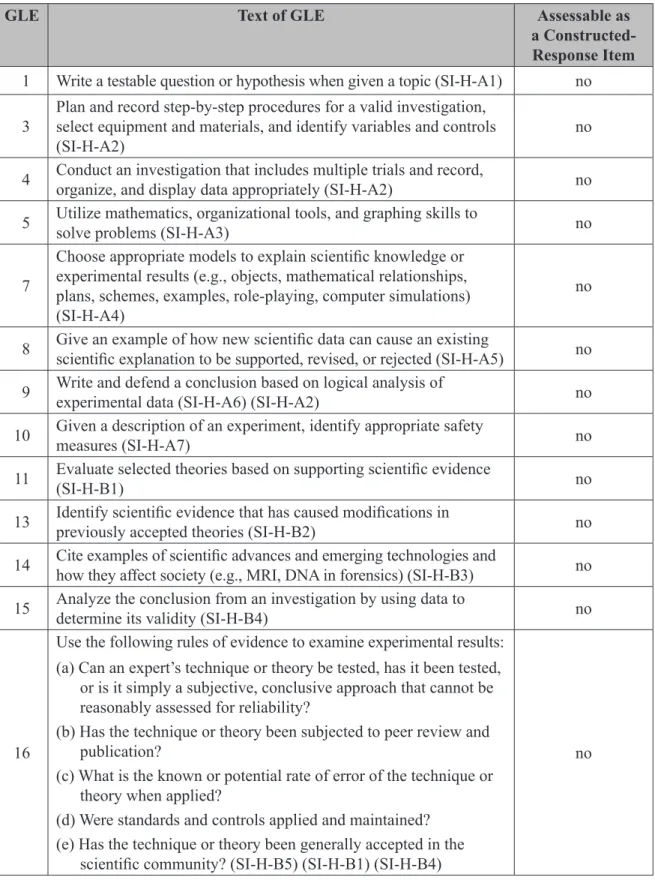
Table 5: Science as Inquiry Component GLEs
GLE Text of GLE Assessable as
a Constructed-Response Item
01 Write a testable question or hypothesis when given a topic (SI-H-A1) no
03 Plan and record step-by-step procedures for a valid investigation, select equipment and materials, and identify variables and controls
(SI-H-A2) no
04 Conduct an investigation that includes multiple trials and record, organize, and display data appropriately (SI-H-A2) no
05 Utilize mathematics, organizational tools, and graphing skills to solve problems (SI-H-A3) no
07
Choose appropriate models to explain scientific knowledge or experimental results (e.g., objects, mathematical relationships, plans, schemes, examples, role-playing, computer simulations) (SI-H-A4)
no
08 Give an example of how new scientific data can cause an existing scientific explanation to be supported, revised, or rejected (SI-H-A5) no
09 Write and defend a conclusion based on logical analysis of experimental data (SI-H-A6) (SI-H-A2) no 10 Given a description of an experiment, identify appropriate safety measures (SI-H-A7) no 11 Evaluate selected theories based on supporting scientific evidence (SI-H-B1) no 13 Identify scientific evidence that has caused modifications in previously accepted theories (SI-H-B2) no 14 Cite examples of scientific advances and emerging technologies and how they affect society (e.g., MRI, DNA in forensics) (SI-H-B3) no 15 Analyze the conclusion from an investigation by using data to determine its validity (SI-H-B4) no
16
Use the following rules of evidence to examine experimental results: (a) Can an expert’s technique or theory be tested, has it been tested, or is it simply a subjective, conclusive approach that cannot be reasonably assessed for reliability?
(b) Has the technique or theory been subjected to peer review and publication?
(c) What is the known or potential rate of error of the technique or theory when applied?
(d) Were standards and controls applied and maintained? (e) Has the technique or theory been generally accepted in the
scientific community? (SI-H-B5) (SI-H-B1) (SI-H-B4)
Some GLEs do not readily lend themselves to inclusion in an on-demand statewide assessment. Table 6 lists the GLEs that are not assessed on the Biology EOC test. While these have been identified as not appropriate for the statewide assessment, these GLEs reflect content that is important for both classroom instruction and assessment.
Table 6: Science as Inquiry Component GLEs Excluded from the EOC Biology Test
GLE Text of GLE
02 Describe how investigations can be observation, description, literature survey, classification, or experimentation (SI-H-A2)
06 Use technology when appropriate to enhance laboratory investigations and presentations of findings (SI-H-A3)
Sample Items for the Biology EOC Test
Sample Multiple-Choice ItemsSeven sample multiple-choice items follow. The content and format of these items are similar to actual items that are included on the Biology EOC test. Correct responses are indicated by an asterisk (*).
This item measures aspects of Life Science GLE 4—Compare active and passive cellular transport (LS-H-A2).
In which situation would passive transport most likely be used to remove a substance from inside a cell?
A. when the substance is composed of positive ions
B. when the substance is composed of large protein molecules
*C. when the concentration of the substance is lower outside the cell than inside the cell
D. when the concentration of the substance is higher outside the cell than inside the cell
This item measures aspects of Life Science GLE 16—Explain how DNA evidence and fossil records support Darwin’s theory of evolution (LS-H-C2).
Which is the best evidence that two species have a common ancestor? A. The two species have the same diet.
B. The two species live in the same habitat.
*C. The two species’ DNA sequences are 90% identical. D. The two species’ skeletal structures are 90% identical.
This item measures aspects of Life Science GLE 23—Illustrate the flow of carbon,
nitrogen, and water through an ecosystem (LS-H-D1) (SE-H-A6).
Which two processes both increase the amount of carbon dioxide in the atmosphere?
A. photosynthesis and volcanic activity B. photosynthesis and burning fossil fuels
C. cellular respiration and deposition of sediments
*D. cellular respiration and decomposition of organic matter
This item measures aspects of Life Science GLE 30—Explain the role of adenosine triphosphate (ATP) in a cell (LS-H-E2).
Photosynthesis includes processes that require light and processes that do not. Which statement best explains why adenosine triphosphate (ATP) is used in both processes?
A. ATP is a building block of sugars and stores energy in plant cells.
B. ATP collects chemical energy from plant cells and produces light energy to build sugars.
*C. ATP stores energy that plant cells absorb from light and releases the energy when it is needed to produce sugars.
D. ATP is an enzyme that increases the rate at which sugars are made and reduces the amount of energy that plant cells need.
This item measures aspects of Life Science GLE 34—Explain how body systems
maintain homeostasis (LS-H-F2).
The graph below compares the body temperatures of two organisms in relation to different environmental temperatures.
30 25 35 40 45 Body Temperature (°C) Environmental Temperature (°C) 45 40 35 30 25 Key organism 1 organism 2 0
Which statement best predicts how each organism will respond to environmental temperatures below 30°C?
*A. Organism 1 will increase muscular activity to maintain
homeostasis, and organism 2 will decrease muscular activity because it is cold-blooded.
B. Organism 1 will decrease muscular activity to maintain homeostasis, and organism 2 will increase muscular activity because it is cold-blooded.
C. Organism 1 will increase digestive activity to maintain
homeostasis, and organism 2 will decrease digestive activity because it is warm-blooded.
D. Organism 1 will decrease digestive activity to maintain homeostasis, and organism 2 will increase digestive activity because it is warm-blooded.
This item measures aspects of Earth and Space Science GLE 22—Analyze data related to a variety of natural processes to determine the time frame of the changes involved (e.g., formation of sedimentary rock layers, deposition of ash layers, fossilization of plant or animal species) (ESS-H-C5).
A scientist observes several different fossils in a rock layer. Based on this observation, which is the best conclusion?
A. The fossils are composed of lava that cooled around several organisms. *B. The fossils formed about the same time as the rock layer in which they
were found.
C. The fossils formed after heat and pressure changed the type of rock in the rock layer.
D. The fossils are composed of the same material as the organisms from which they formed.
This item measures aspects of Science as Inquiry GLE 3—Plan and record step-by-step
procedures for a valid investigation, select equipment and materials, and identify
variables and controls (SI-H-A2).
Students studying the plant Brassica rapa want to know at what percent of carbon dioxide (CO2 ) in the air Brassica rapa plants will grow fastest. Which table shows an experimental design that will best answer the question?
A. 1 2 3 0.03 0.03 0.03 12 12 12 50 50 50 0.5 0.6 0.7 Plant (% in air)CO2 (hrs/day)Light (mL/day)Water Initial mass(kg)
B. 1 2 3 0.03 0.03 0.03 8 10 12 50 50 50 0.5 0.6 0.7 Plant (% in air)CO2 (hrs/day)Light (mL/day)Water Initial mass(kg)
*C. 1 2 3 0.03 0.04 0.05 12 12 12 50 50 50 0.5 0.5 0.5 Plant (% in air)CO2 (hrs/day)Light (mL/day)Water Initial mass(kg)
D. 1 2 3 0.03 0.04 0.05 8 10 12 50 50 50 0.5 0.5 0.5 Plant (% in air)CO2 (hrs/day)Light (mL/day)Water Initial mass(kg)
Sample Constructed-Response Item and Scoring Rubric
A sample constructed-response (CR) item follows, along with its scoring rubric. A maximum of 2 points is possible for constructed-response items on the Biology EOC test. The content and format of this item is similar to actual constructed-response items that are included on the Biology EOC test.
This item measures aspects of Life Science GLE 11—Calculate the probability of
genotypes and phenotypes of offspring given the parental genotypes (LS-H-B3).
Cross-pollination of plants is used to develop hybrids with desirable traits. One desirable trait is frost resistance. If the genotypes of hybrids are all heterozygous for frost resistance, they will all be frost-resistant.
Determine the phenotypes of two parent plants that would have only heterozygous offspring (Ff).
(student enters response in text box)
Determine the genotypes of two parent plants that have only heterozygous offspring (Ff).
(student enters response in text box)
Sample Responses
• 2 Points:
One parent plant is frost-resistant and one parent plant is not frost-resistant. One parent is FF and one parent is ff.
• 1 Point:
Scoring Rubric
Score Description
2 The student correctly determines the phenotypes and genotypes of two parent plants that would have only heterozygous offspring. There are no errors.
1 The student correctly determines the phenotypes or genotypes of two parent plants that would have only heterozygous offspring. There may be one or more errors. 0 The student’s response is incorrect, irrelevant, or too brief to
Appendix
Item Development ProcessTest items for the Biology EOC test are developed by professional test developers under contract with the state.
Items are reviewed and approved by Louisiana educators through state-level item review committees. All EOC test items are developed to align with the GLEs from the Louisiana Comprehensive Curriculum for the Biology course, which include forty-two Life Science GLEs, eight Earth and Space Science GLEs, and thirteen Science as Inquiry GLEs.
Test Accommodations
Accommodations are available to qualifying students who are classified as IDEA Special Education, Section 504, and Limited English Proficient (LEP). Test accommodations should not be different from or in addition to the accommodations provided in the classroom during instruction and as indicated on the student’s Individualized Education Program (IEP), Section 504 Individual Accommodation Plan (IAP), or LEP accommodation plan. Testing and
instructional accommodations must be based on each student’s needs as documented in the student’s IEP, IAP, or LEP plan.
For students with disabilities, test accommodations are provided to minimize the effects of a disability to ensure that a student can demonstrate the degree of achievement he or she actually possesses. An accommodation is a change in the setting of the test administration, the timing, scheduling, presentation format, and/or method of response to the assessment. Not all students with disabilities will need test accommodations, but many will need them to provide a valid and accurate measure of their abilities. The goal in using accommodations is to give students with disabilities an equal opportunity in assessment, not to give students with disabilities an unfair advantage over other students or to subvert or invalidate the purpose of the test. The accommodation should allow the test score to reflect a student’s proficiency in the area tested, without the interference of his or her disability.
Students classified as LEP may receive LEP accommodations if they are used regularly in the student’s classroom instruction and assessment. LEP accommodations are provided for these students to aid them in accessing the content.
Special online test forms are available to students who are assigned Large Print or Tests Read Aloud accommodations. Braille test forms also are available. Other allowed accommodations for students with IEPs or Section 504 IAPs are Assistive Technology, Communication Assistance, Individual/Small Group Administration, and Extended Time. Use of the following LEP accommodations will be determined by the classroom teacher and ESL teacher or other individual providing language services: Extended Time, Individual/Small Group Administration, Provision of English/Native Language
Word-to-Word Dictionary (No Definitions), Test Administered by ESL Teacher or by Individual
Providing Language Services, and Tests Read Aloud.
For a list of approved test accommodations that may be used for students with disabilities or LEP students and suggestions for implementing accommodations during assessment, refer to the EOC Test Administration Manual,which will be available approximately two weeks prior to testing, and the Guidelines for Test Accommodations posted on the LDOE website,
www.louisianaschools.net. Technology Requirements
The Biology test is administered online only, with the exception of the braille test; therefore, schools will need to ensure that appropriate technology requirements are met. The EOC Test Administration Manual provides general information on how to prepare for online testing. For more specific technology information, refer to the EOC Tests Technology Guidelines, which are posted on the EOC Tests homepage.
Biology EOC Test Glossary
This brief glossary includes definitions of specialized vocabulary associated with the Biology EOC assessments.
• accommodation: a change in the setting of the test administration, the timing, scheduling, presentation format, and/or method of response to the assessment
• assessment: a test designed to measure knowledge, skills, or abilities
• blueprint: a table or chart that identifies how items on an assessment will be distributed across strands/standards or Grade-Level Expectations
• constructed-response (CR) item: an open-ended item in which students write their own responses that are scored against a rubric
• item: a question or prompt that is designed to measure particular knowledge, skills, or abilities • multiple-choice (MC) item: an item in which students select a correct answer from among more
than one response option
• response options: answer choices in a multiple-choice test item
Biology EOC Test Typing Help
On the constructed-response portion of the Biology EOC test, students may need to use the following keystrokes to enter special symbols within their responses. Table 7 shows the shortcuts that students will have available for their use during the Biology EOC test.
Table 7: Keystrokes for Special Symbols
1. If the Response
Includes: 2. Type This Instead: 3. Example:
Na+
superscript “caret” symbol (SHIFT + 6)^ Na^+
H2O
subscript number2 H2O
20°C
degree symbol the word “degree”degree 20 degrees C
Bb × Bb
cross space, letter x, spacex Bb x Bb
→
reaction arrow
->
dash, followed by greater
than sign Na + Cl -> NaCl
← →
reversible reaction arrows
<=>
less than sign, followed by equals sign, followed by
greater than sign