PENSIONS AND FIRM PERFORMANCE
Steven G. Allen Robert L. Clark
Working Paper No. 2266
NATIONAL BUREAU OF ECONOMIC RESEARCH 1050 Massachusetts Avenue
Cambridge, MA 02138 May 1987
Final draft of chapter for the 1987 Research Volume of the Industrial Relations Research Association titled Human Resources and Firm Performance, edited by Morris Kleiner, Richard Block, Myron Roomkin, and Sidney Salsburg. Stan Leibowitz gave us useful advice on the measurement of profit rates. We have received helpful comments from Richard Ippolito and the University of North Carolina Human Resource Economics Workshop and excellent research assistance from Linda Shumaker and Myra Ragland. The research reported here is part of the NBER's research program in Labor Studies. Any opinions expressed are those of the authors and not those of the National Bureau of Economic Research.
May 1987
Pensions and Firm Performance ABSTRACT
This paper examines how pension plans affect employee behavior and firm performance. Theoretically, the impact of pensions on firm performance cannot be predicted. Firms with pensions should have lower turnover rates and more efficient retirement decisions; their employees will be less likely to shirk. On the other hand, pension compensation is not very closely linked to worker performance and there is some risk that turnover may fall too much. The evidence indicates that although wages do not seem to fall with pension
compensation, profit rates are not affected by pension coverage. This suggests that pension coverage is associated with higher productivity, a proposition that is supported by indirect evidence on pensions, turnover, and productivity but not by direct tests of how pension coverage and productivity are
correlated.
Steven IL Allen Robert L. Clark
Department of Economics Department of Economics
and Business and Business
Box 8110 Box 8110
North Carolina State University North Carolina State University
I. Introduction
Pension benefits represent a form of deferred compensation that a worker receives after he retires from a firm, provided he has met certain age and service requirements. The magnitude of these benefits depends on the nature of the employment contract and whether the worker and the firm have fulfilled the obligations of that contract. This chapter examines the role of pensions as a form of compensation and how pensions are used as a component of personnel policy. Such a review requires a clear understanding of how future pension benefits are evaluated by workers and financed by firms. Having determined these concepts, we can assess the influence of pensions on firm performance. Pensions are strictly regulated by the federal government and so our
examination will include a brief review of current regulations and how they temper the impact of pensions on firm performance.
Our examination of pensions begins with a brief overview of the growth and development of the employer pension system in the United States. This includes a discussion of the distribution of pensions by worker and firm
characteristics. In section II, specific plan characteristics are described and their importance is discussed. Next, we present several alternative rationales for why workers and unions want pensions as part of their
compensation. Section IV presents competing models of the pension contract and develops predictions for the effect of pensions on compensation and
performance. The impact of pensions on employee behavior is considered from a theoretical perspective in section V; section VI assesses the evidence
reports our conclusions and discusses some areas where further research would be useful.
Growth and Development of Employer Pensions
While public pensions in the United States are as old as the republic (dating to benefits for Revolutionary War veterans), private pensions first appeared in the late nineteenth century. Greenough and King (1976) credit the American Express Company with establishing the first formal employer pension in 1875. Early pensions were generally found in railroads, banking, and public utilities. Prior to World War II, growth in pension coverage was slow;
however, in the immediate post-war period there was a rapid increase in
the number of employers offering pensions and the number of workers covered by a pension. The proportion of wage and salary workers in the private sector covered by an employer pension grew from 25 percent in 1950 to over 50 percent
in 1984. Most of this growth occurred prior to 1975. In the last decade, coverage rates have changed only modestly. The proportion of covered workers
actually fell from 56 to 52 percent between 1979 and 1983 (Andrews, 1985). Growth in coverage and increases in benefits raised the percentage of payroll
going to pensions from 1 percent in 1950 to 6 percent in 1980 (Fields and Mitchell, 1984).
Ippolito (1986a) estimates that in 1984 there were 788,000 pension plans, of which 744,000 covered fewer than 100 participants. Allowing for duplicate
coverage, these plans contained 57.5 million active participants and 8 million annuitants. Public employees have always been more likely to be covered by an employer pension than private sector workers. Currently, over 90 percent of state and local workers and all federal workers are covered by an employer pension (Munnell, 1979).
How can the observed pattern of development of pensions be explained? Several factors may have stimulated the surge in pension coverage after World War II. A comprehensive assessment of the economic rationale for the existence of pensions is provided in subsequent sections of this chapter. However, it is useful to point to several changes that occurred during the 1940s which may have provided the impetus to increased pension coverage. First, the 1942
amendments to the Internal Revenue Code clarified and expanded tax treatment of pensions and precluded the establishment of pension funds limited to corporate officers (Creenough and King, 1976). Second, wartime stabilization policy made it easier to increase fringe benefits than cash wages. Third, in 1949 the National Labor Relations Board ruled in the Inland Steel decision that pensions were a proper subject for collective bargaining. This action removed a
constraint that limited unions' ability to achieve pension coverage for their members and may have altered union attitudes toward seeking pension benefits
(Allen, Melone, and Rosenbloom, 1984).
Are there similar specific events that might explain the slowdown in the growth of the coverage rate in the last decade? In 1974, the Employee
Retirement Income Security Act (ERISA) was enacted. This legislation imposed a sweeping new set of regulations on the use and funding of pensions. In the last decade, a number of additional modifications to the pension laws have been instituted. These regulations have raised the administrative costs of pensions and reduced the range of permitted pension contracts. Some have speculated that restrictions on the use of pensions may partially explain the slowing in the growth of pensions. However, Ippolito (1986b) concludes that ERISA had only a small effect on plan terminations.
In
addition to the new regulations, the growth in pension coverage may have slowed simply because workers who were most likely to desire pensions werealready covered. Relatively high current coverage rates among high wage workers, unionized workers, and employees in large firms imply that further extension of pension coverage may proceed more slowly in the future.
Patterns of Pension Coverage
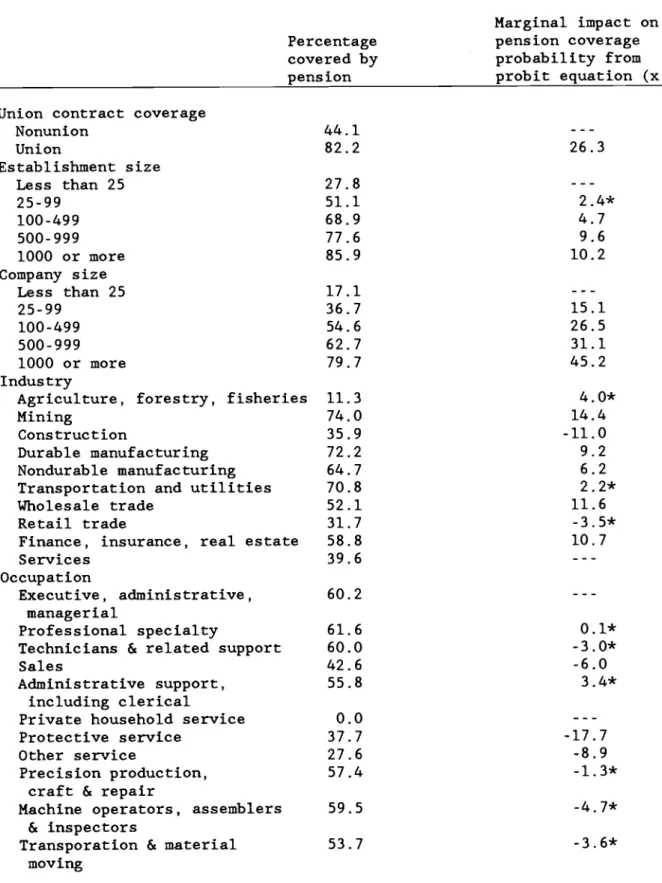
The odds that any individual will be covered by a pension plan on his job vary tremendously with both personal and job characteristics. The most up-to-date information is reported in the pension supplement to the May 1983 Current Population Survey (CPS). We restrict the sample to full-time private wage and salary workers. Those who have jobs which are covered by collective bargaining agreements are much more likely to be included in a pension plan than nonunion workers. The coverage rate for private sector workers is 82 percent for union versus only 44 percent for nonunion workers, as shown in Table 1. Union
contract coverage is correlated with a number of other personal and job
characteristics which in turn are also highly correlated with pension coverage (e.g., wages, industry). In order to estimate the net effect of union contract coverage, we estimated a probit equation for pension coverage which included all of the variables in Table 1. The probit results showed that, other things equal, those covered by union contracts have a 26.3 percentage point higher probability of being covered by a pension than nonunion workers.
The size of the workplace (establishment) and the size of the company, especially the latter, are also important correlates of pension coverage. In establishments with fewer than 25 workers, only 28 percent of the work force is covered by a pension plan. Coverage rates jump to 51 percent in establishments
with 25 to 99 workers and reach 86 percent in establishments with 1,000 or more workers. The share of workers covered by a pension in companies with fewer
than 25 workers is a paltry 17 percent. This percentage also rises with size, reaching 80 percent in firms with 1,000 or more employees.
These two size measures are obviously correlated, so it is reasonable to ask which matters the most. According to the probit analysis, the resounding
answer is company size. Other things equal (including company size), there is only a 10 percentage point difference between pension coverage probability in the smallest and largest establishment size categories. In contrast, there is a 15 percentage point difference between companies with fewer than 25 employees and those with 25 to 99 employees. This widens to a 45 percentage point
difference between companies with fewer than 25 employees and those with 1,000 or more.
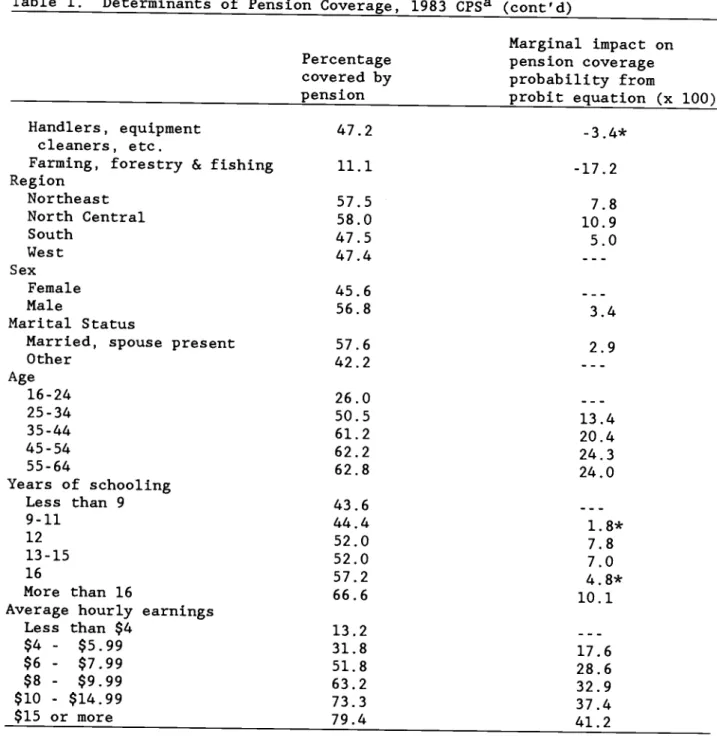
The pattern of pension coverage across different age groups suggests that workers gradually sort themselves into jobs with pensions over time. Only about a quarter of workers between 16 and 24 are covered by pensions. Pension coverage rises to 50 percent for those between 25 and 34; it is slightly above 60 percent for all older workers. Other things equal, the odds of being
covered are 13 percentage points higher for 25 to 34 year olds and 20 to 24 percentage points higher for 35 to 64 year olds than for 16 to 24 year olds. Although patterns within a cohort over time may be quite different from the across cohort patterns, they suggest the possibility that if a worker is not covered by a pension by the time he reaches the 35 to 44 age group, given the low turnover rates among older workers, there is a good chance he never will be covered.
Because of the favorable tax treatment of pensions, it should come as no surprise that pension coverage is also strongly correlated with average hourly earnings. The coverage rate for workers earning less than $4 an hour is a mere 13 percent in contrast to coverage rates above 70 percent for those earning $10 an hour or more. Most of this difference cannot be explained by other factors, as indicated by the probit results.
Workers with jobs in mining, manufacturing, and transportation and utilities have higher pension coverage rates than those in other industries. However, much of the difference in coverage rates across industries can be explained in
terms of other factors such as firm size, earnings, and collective bargaining coverage. For instance, the probit results show that workers in wholesale trade have a 12 percentage point greater probability of being covered by a pension than service industry workers, holding all other factors constant. The
difference between workers in durable manufacturing and services turns out to be even smaller (9 percentage points), despite the fact that the raw,
unadjusted coverage rate for durable manufacturing (72 percent) is much higher than that for wholesale trade (52 percent).
Table 1 also indicates that pension coverage rates are lower for persons in service occupations (compared to blue or white collar occupations), lower for those living in the West, higher for men, higher for married workers, and higher for high school and college graduates. The magnitude of these
differences is relatively small in relation to the differences in pension coverage associated with union contract coverage, company size, age, average hourly earnings, and industry.
Significance of Pension Benefits and Funds
The growth of pensions over the past four decades has increased their importance in a number of areas. First, pensions have grown as a source of income to older Americans. Ippolito (1986a) estimates that the mean initial pension annuity for 1984 beneficiaries was $6,360 representing 23 percent of
their final earnings. A U.S. Department of Labor Study (1985) reports that the replacement rate rises with the level of final earnings. Replacement rates for 1978 retirees rose from 14 percent for those with earnings less than $6,000 to 20 percent for those with earnings between $10,000 and $11,999 to 25 percent for retirees with $14,000 to $19,999 in final earnings. A total of $70 billion was paid to retirees in pension benefits in 1984. Over the past quarter
century, pension benefits have come to represent an increasing proportion of retiree income.
Second, pension funds represent a growing proportion of invested funds in the United States. Ippolito (1986a) estimates that 1984 pension assets totaled one trillion dollars. These funds represented 22.8 percent of all corporate equity and 49.9 percent of all corporate bonds. The dramatic rise in pension funds is shown by comparing these values to their 1950 rates. In 1950,
pensions held less than 1 percent of corporate equity and only 13.1 percent of all corporate bonds. Another measure of the size of pension assets is that in 1981 pension assets per worker were equal to $10,907 which represented 75 percent of annual earnings.
II. Pension Plan Characteristics
Pension plans are of two basic types: defined contribution and defined benefit. Within a particular plan type, pensions differ in their plan
formulas, vesting requirements, maximum benefit provisions, social security integration, age of normal and early retirement, reductions for early
retirement, and benefit increases associated with delayed retirement. This section examines these diverse characteristics among pensions and indicates how these differences affect behavior at the workplace.
Types of Pension Plans
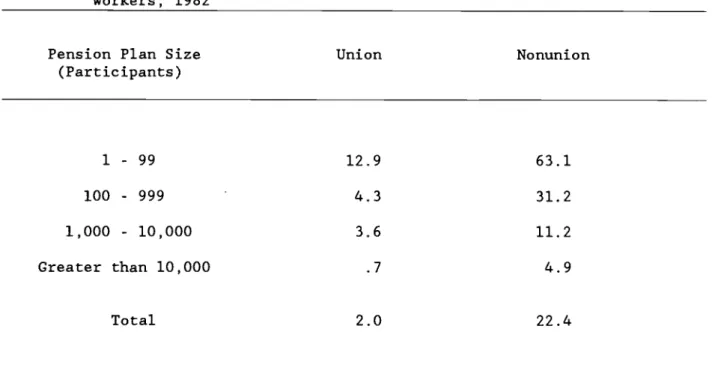
Defined contribution and defined benefit plans are the two basic types of pension plans. Defined contribution plans are by far the most common type of plan representing 71 percent of all plans in 1984. However, these plans tend to be provided by relatively small employers. As a result, less than 20 percent of all pension participants are covered by defined contribution plans. Table 2 shows the greater incidence ofcoverage by defined contribution plans among small employers. Sixty-three percent of pension participants in nonunion plans covering less than 100 participants are in defined contribution plans. This compares to a defined contributioncoverage rate of only 12.9 percent for small union plans and 0.7 percent for large union plans. The greater use of defined contribution plans among small employers is attributable to lower administrative costs, plus the tremendous costs of compliance with government regulations of defined benefit plans for small firms (Smeeding 1983; Mitchell and Andrews 1981).
In a defined contribution plan, the firm promises to contribute each period a fixed amount of money to an individual's pension account. In some plans
workers will also be allowed or even required to make contributions. The funds are invested by the plan and accumulate throughout the worker's life. The benefit at retirement is determined by the size of the individual's pension fund at that time. The worker bears all of the risk concerning the rate of
return on the invested funds. However, the worker does not risk losing pension benefits if he leaves the firm prior to retirement or if the company goes out
of business, terminates the pension, or fires the worker. Property rights are clearly defined; the funds in defined contribution plans belong to the worker. These plans have no impact on turnover, except for the simple fact that
workers covered by such plans have more total compensation than other workers if all other variables (including cash earnings) are held constant. They also have no effect on retirement decisions, except to the extent that workers
face liquidity constraints and are unable to use their benefits as collateral (in which case they may have to postpone retirement). The key factor to
recognize is that there are no bonuses or penalties associated with the choice of retirement age in defined contribution plans.
Defined benefit plans are much more common among large employers and as a result, almost 80 percent of pension participants are covered by defined
benefit plans. These plans are more complex than defined contribution plans and federal regulations tend to be more restrictive. In a defined benefit plan, the worker is promised a benefit upon retirement based on plan
generosity, years of service, and in some cases earnings. The firm must set aside sufficient dollars to provide for these future benefits. The rate of firm contributions is regulated by the government. As we will explain in detail below, a worker who leaves prior to the retirement age will lose benefits relative to the worker who remains with the firm. Thus in these
plans, the worker bears risks associated with plan termination, his own desire to quit, and potential firing by the firm. However, the firm bears all risks concerning the rate of return on the pension fund. The use of these plans to influence turnover and retirement is explored in sections IV and V.
Plan Characteristics
Several plan characteristics play a critical role in determining benefit levels, along with any loss of benefits associated with leaving the job. Much of this discussion is relevant only to defined benefit plans. Theprimary plan characteristics are reviewed below along with a discussion of economic effects and the frequency of their use.
Benefit Formula. Defined benefit plans typically use one of three formula types. The most frequently used formula type is the terminal earnings formula which determines benefits by multiplying years of service by an average of the
final three or five years earnings and a generosity parameter. In the 1983 Employee Benefit Survey of Medium and Large Firms (EBS), plans using these formulas cover 54 percent of all participants. The career earnings formula is similar, except that the salary average is based on all earnings with the firm instead of just the final three or five final years. These plan formulas cover 14 percent of participants. Dollar amount formulas provide a fixed dollar amount to all retirees or multiply years of service times a fixed dollar amount. These formula types cover 28 percent of participants.
Earnings based formulas are used more frequently by plans covering
professional workers and in noncollectively bargained plans. Obviously, these plans allow for a variance in pension benefits that reflects earnings. Dollar amount formulas are used more frequently in plans covering production workers and unionized workers. These formulas tend to reduce the variance of the benefit distribution relative to the earnings distribution and to flatten the age-compensation profile of union workers relative to nonunion workers (Allen and Clark, 1986).
Vesting. Vesting pertains to the portion of a worker's specified benefit to which he is legally entitled upon leaving the firm. Prior to 1987,
regulations allowed firms to select one of three vesting rules. These were 100 percent vesting of accrued benefits after 10 years of service, 25 percent
vesting of accrued benefits after 5 years of service with additional vesting accruing each year until the worker is 100 percent vested after 15 years, and 50 percent vesting of accrued benefits when age and service add up to 45 with 100 percent vesting 5 years later. Almost all companies adopted the 10 year, 100 percent vesting rule (Schulz, 1985). Tax legislation in 1986 altered vesting standards to be either 100 percent vested after 5 years or graded vesting with a worker being 50 percent vested after 3 years and accruing
additional vesting each year until he is 100 percent vested after 7 years. If a worker leaves prior to being vested, he will receive no retirement benefits. Even if the worker achieves 100 percent vesting, there is still a penalty for leaving the firm, which we will describe in detail below.
Post-retirement Increases. If pension benefits are not increased after retirement, their real value will decline in the presence of inflation. Until recently, it was widely believed that pension benefits were fixed in nominal terms. Surveys of large firms indicate that less than 5 percent of private plans automatically increase benefits in response to inflation. The lack of automatic adjustments does not necessarily imply that no post-retirement
increases are granted. Approximately two-thirds of large plans provided one or more ad hoc increases during the last half of the 1970s (King, 1982). Allen, Clark, and Sumner (1986) report that between 1973 and 1979 average benefits for persons already receiving benefits in 1973 increased by 24 percent during a period when the Consumer Price Index rose by 63 percent.
Table 3 shows that benefit increases were larger and more prevalent in collectively bargained plans. The method of benefit increase also variedby collective bargaining status (Allen and Clark, 1986) with bargained plans being more likely to use methods that provide the largest percentage increases to
those with the lowest benefits.
Maximum Benefit Provisions. Some pensions incorporate specific plan rules in order to set a maximum pension benefit. Some type of maximum benefit
provision is incorporated into pension plans covering 42 percent of participants represented in the 1983 EBS. The most prevalent form of
limitation to benefits is to limit credited service to a specific number of years. This type of limitation is used in plans covering 31 percent of
participants. This limit is usually 30 years or more. Terminal earnings plans are much more likely to include such limits than plans with other types of benefit formulas. Eleven percent of participants are in plans that limit benefits to either a maximum percent of terminal or career earnings or to a maximum flat dollar amount.
Social Security Integration. Firms are permitted to reduce pension benefits by including the worker's Social Security benefit as part of total pension
benefits or costs. Just over half of all participants in the EBS were in plans that integrated pension benefits with Social Security benefits. Smaller plans are more likely to be integrated (President's Commission on Pension Policy, 1980). Until 1987, the Internal Revenue Service regulations allowed two types of integration: the excess method and the offset method. The excess method allows firms to provide greater benefits based on earnings above the Social Security taxable earnings limit than on earnings below this limit. In an excess plan which does not consider years of service, the pension benefit
based on earnings above the specified limit could not exceed 37.5 percent of the plan benefits based on earnings below that level. Plans couldset this compensation limit no higher than the current year's Social Security taxable earnings limit. Most plans set the limit well below the allowable amount and tended not to have adjusted this earnings amount as the Social
Security earning limit rose (Urban Institute, 1982).
The offset method allows a certain portion of the retiree's
primary insurance amount (PIA) to be subtracted from the pension benefit. Prior to 1987, the offset could not exceed 83.33 percent of the worker's PIA. Most surveys indicate that integrated plans did not use the maximum possible
offsets. In offset plans, the most frequently used percentage is 50 percent of the PIA. It remains to be seen how plans will adjust to the 1986tax changes governing Social Security integration.
Retirement Age and Gains From Continued Employment. Pension plans
specify an age of normal retirement, which is the time that a worker can retire and receive full pension benefits as provided by the pension formula. Inrecent years the age of normal retirement has been lowered in many plans. In the EBS
sample, only 36 percent of the participants were covered by plans using 65 as the normal retirement age. Another 33 percent were in plans that specified ages between 60 and 64 and 11 percent were in plans with ages between 55 and 59. Approximately 18 percent of plans had no age requirement at all;
eligibility in these plans depends solely on length of service.
Virtually all defined benefit plans allow for retirement prior to the normal retirement age at reduced benefits. In most plans, the reduction in benefits is less than the actuarial equivalent of the normal retirement benefit.
have not been able to mandatorily retire workers prior to the age of 70. Thus, workers may continue to work past the normal retirement age. Firms can erect strong pension incentives for older workers to retire at the normal retirement age. First, relatively few firms provide any actuarial increase in benefits for work past the normal retirement age and as a result pension wealth may fall after this point. Second, in 1985 approximately half of all participants were covered by plans that did not continue to credit years of service and earnings after the date of normal retirement. Thus, the pension is fixed in nominal terms at the normal retirement age. The worker can continue on the job but will lose that year's pension benefits.
Legislation enacted in 1986 has altered both the mandatory retirement and the pension accrual regulations. For most firms, mandatory retirement is now entirely forbidden as a firm personnel policy regardless of the age of the worker. In addition, firms providing a pension cannot discontinue wage and service
accruals
at a specified age. These changes reduce the ability of firms to provide incentives to older workers to retire.III. Why Do Workers and Unions Want Pensions?
Pension coverage has expanded through the labor force and the magnitude of pension benefits has increased in response to the actions of various labor market agents striving to maximize their objective functions. To understand the development of the pension system, we must determine who the players are, what their objectives are, and how pensions can help them achieve their objectives. These negotiations are conducted in a changing regulatory
The primary agents in bargaining concerning pensions are workers, firms and unions. Workers seek to maximize total compensation for a given amount
of labor supply or effort. Firms seek to maximize profits. The objectives of unions tend to be more complex and may include reducing income inequality, providing economic security for workers and retirees, and raising wages and benefits. The remainder of this section examines how pensions help workers and
unions achieve their primary objectives. Sections IV and V analyze how pensions affect firm performance.
Worker Utility and the Desire for Pensions
Economic theory assumes that individual workers attempt to maximize utility subject to their personal budget constraint. A simplified version of this
maximization process has the worker's utility as a function of total
compensation and the amount of labor supplied. For a given amount of labor supplied, the worker seeks to maximize total compensation. Compensationmay come in many forms other than current cash such as job safety, comfort on the job, and all types of employee benefits including pensions.
For the purposes of this part of the discussion, assume that the firm is a neutral agent and is willing to sell the worker any type of benefit at a price
that is equal to the firm's cost of acquiring this benefit. The worker pays for each benefit by receiving less in cash compensation. Theoretically this compensating differential would allow the worker to buy the desired amount of any benefit offered by the firm. The worker would purchase benefits until the marginal utility of this benefit was equal to marginal value of a dollar of cash spent on other goods and services (Rosen 1974). With no taxes or other governmental interference, benefits would be bought only if the firm can buy
these goods at a lower cost than the worker could purchase them in the market or if the benefit is tied to the job and can only be bought from the firm.
Neither of these explanations for the existence of fringe benefits seem to apply in the case of pensions. Today, there are financial intermediaries which give individuals access to a wide spectrum of investment opportunities; workers are not required to save through a pension to gain access to financial
markets. The diversity of investment opportunities available to individuals also makes it unlikely that the expected rate of return to pension funds is greater than the expected rate of return that an individual investor could receive.
During the early development of the pension system these conditions may not have prevailed. Prior to the development of large mutual funds, small
investors may have been unable to obtain widespread diversification.
Therefore, capital market regulations and institutions may have played a role in the initial growth of pensions. Even today there may remain differences in transactions costs associated with individual investments versus investment through a pension fund. Despite this potential offset, it seems highly unlikely that the widespread pension coverage in today's economy can be
explained in terms of lower transactions costs.
A much more convincing rationale is the tax status of pensions in comparison to current earnings. Firms with qualified plans make tax deductible
contributions to a pension fund that is used to provide future benefits to current workers. The value of these contributions is not viewed as current compensation to the worker and therefore is not subject to the individual income tax in the current period. The return to assets in these funds is also not taxable. Instead, benefits are taxed when they are received and the
expectation is that the worker will be in a lower tax bracket at that time. Prior to the advent of Individual Retirement Accounts, workers had no other form of savings that received such preferential tax treatment.
Pension contributions by firms are also exempt from Social Security and Unemployment Insurance payroll taxes. For the worker the value of pension contributions permanently escapes the employee's share of the Social Security tax, although the resulting lower earnings means that future Social Security benefits will also be lower. Given today's benefit structure, the expected
loss in benefits will be less than the savings from reduced taxes and the worker's lifetime income will rise.
As a result of the differential tax treatment, workers could increase total compensation by agreeing with the firm
to
establish a pension plan. The value of a pension plan is dependent on the prevailing tax rate. Thus, as tax rates rise, more workers would be expected to request their firms to institute a pension. The tax effect is also an important determinant of the distributionof plans across workers in any given year. High wage workers are much more likely to be covered by a plan than low wage workers, as shown in Table 1.
Union Objectives and the Use of Pensions
Unions have played an important independent role in the expansion of pension coverage and the development of certain pension characteristics. Historically, unions have consistently exerted pressure on both employers and governments to provide economic security for older workers through both private pensions and
Social Security. Private pension plans became much more widespread after the Inland Steel decision made pensions a permissible topic for collective
agreements are much more likely than other workers to receive a pension when they retire.
Despite the difficulties associated with defining union objectives in precise terms, it is quite clear that pensions can help achieve many possible union objectives. First, the preferences of older, more senior workers receive much more weight in determining the terms of the employment contract under unionism. These workers prefer a compensation package with lower wages and higher retirement income, holding the cost of the package constant. As a result of the greater weight given to their preferences, the package becomes more likely to contain a pension along with other provisions which increase the
income and economic security of older workers. Second, pensions can be used to compress the distribution of total compensation among union members. Allen and Clark (1986) show how the choice of benefit parameters can reduce pension
inequality among workers.
Third, pensions can serve the interests of union officers. Albert Rees (1962) argued that by obtaining a new benefit for their members, union leaders can gain much more credit for innovation than they would if they had obtained a wage increase of equal value. In cases where the union has some control over the pension plan, the scope of authority of the leadership is significantly greater as well. Fourth, unions have an organizational advantage in certain aspects of pension administration. For instance unions often administer plans in industries with small employers or short job durations. Without unions there probably would not be very many workers covered by private pensions in the construction industry. Unions also monitor plan behavior so that employers do not renege on explicit or implicit contracts.
union members in higher marginal tax brackets, thereby increasing the demand for all forms of tax-free or tax-deferred compensation, including pensions.
IV. What Is The Pension Contract?
The influence of pension plans on firm performance depends on the nature of the pension contract and how this contract is evaluated by the worker and the firm. Two models of pension contracts have been developed in the economics literature. The first is primarily based on the work of Bulow (1982) who derived the value of pensions under a strict legal or explicit contract. This model assumes that a worker considers only the value of benefits that a firm is legally required to pay if the worker were to leave the firm at the end of the current period. This model clearly applies to defined contribution plans and many contend that it applies to defined benefit plans as well. The second model, developed in recent work by Ippolito (l985a, l986a) and others, allows for the existence of implicit long term employment contracts and focuses on the role of defined benefit plans in such contracts. This model assumes that a. worker views the employment contract as an implicit promise by the firm to retain the worker (subject to performance requirements) until retirement and to pay a benefit based on final pay.
These models yield different predictions concerning incentives for the worker to quit and incentives for the worker to provide a high level of job
performance to minimize risks of being fired. In addition, these theories of the pension contract predict alternative patterns of life cycle compensation. In this section, each of these models is examined in detail and the
objective of this section is to analyze the role of collective
bargaining in models of the pension contract.
The Extlicit Contract View of Pensions
The basic premise of the explicit contract model is that workers act as if the employment contract is for only one period. Of course, if both parties are agreeable employment may be continued on a period by period basis. Since the worker knows that he may be terminated at the end of the current period, he is unwilling to accept any compensation that is contingent on his remaining with the firm for an extended period of time. This
type of contract implies that the worker will value future retirement benefits on the basis of work to date and will consider only benefits that the firm is legally required to pay.
Under explicit employment contracts, workers face no loss in future benefits if they quit their current job. As a result, pensions cannot be used to reduce turnover or encourage a higher level of job performance. Despite the lack of a capital loss associated with leaving a job, pensions still represent an
important component of compensation and will affect the growth rate of
earnings of a worker covered by a pension. In addition,
coverage by a pension alters the cash wage offer necessary to entice a worker to leave his present job. To understand these effects, a brief discussion of the evaluation of pension wealth is necessary along with the related concept of annual pension compensation.
The expected present value of future pension benefits, pension wealth, is determined by finding the discounted value of a life annuity beginning at retirement. The magnitude of the annual flow is governed by the pension formula and the individual's own work history. The most frequent form of
benefit formula is one where the benefit is determined by multiplying the number of years of service by a fixed percentage of the worker's average
earnings during the final years of employment. Pension wealth is calculated by using the worker's current years of service and salary average along with the prevailing benefit formula. These values, along with assumptions concerning survival probabilities and the market interest rate, are sufficient to
calculate pension wealth for any worker.
Pension compensation is the change in pension wealth resulting from continued employment. From the above discussion, one can see that pension wealth rises due to an additional year of service and to any increase in
earnings. Mathematical derivations of pension compensation are found in Bulow (1982), Clark and McDermed (1986a) and Kotlikoff and Wise (1985). These papers illustrate that if earnings are rising with tenure, pension compensation grows more rapidly than earnings.
The explicit contract literature assumes that in each year a worker is paid total compensation equal to the value of his output. With perfect capital
markets, the cost to the firm of funding pension benefits is the same as the value that the worker places on these benefits. If there are no other forms of compensation, the wage plus pension compensation will equal the worker's
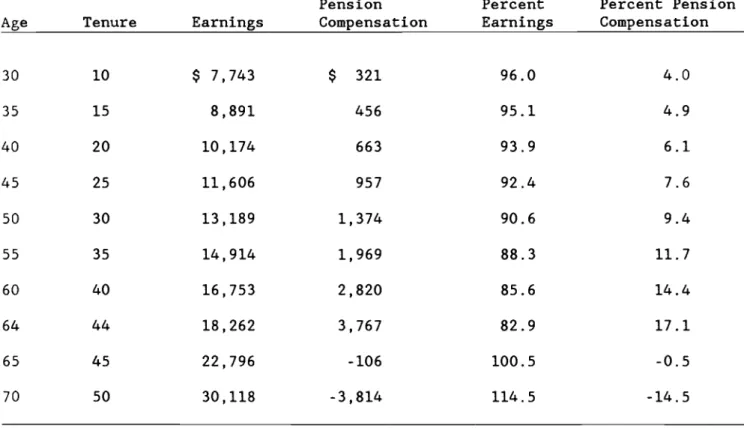
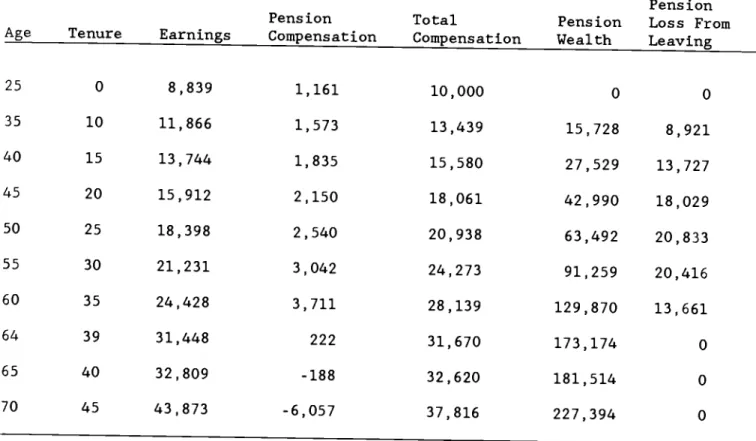
output. With pension compensation growing more rapidly than earnings, pension compensation will increase as a proportion of total compensation as the worker continues on the job. This lifetime pattern of compensation is shown in Table 4.
Under the explicit contract model, pension wealth and pension compensation are zero until the worker is vested in the pension plan. After vesting but still during the early working years, pension compensation is small both in
absolute terms and as a percentage of total compensation. If the worker remains on the job, pension compensation grows rapidly and may reach 30 to 50 percent of total compensation during the final working years prior to
retirement. This increase in pension compensation produces a
corresponding growth in pension wealth to which the worker is legally entitled.
Although there is no loss in pension wealth if the worker leaves his job, pensions still affect the wage offer from a competing firm that is necessary to entice the worker to leave his current job. A competing firm that has no
pension must offer a cash wage equal to the worker's current earnings plus pension compensation. Even if the competing firm has a pension that is identical to the one on the worker's current job, the wage offer must exceed current earnings. This follows because pension compensation will be lower on the new job, either because the worker will not be vested or because he will have fewer years of service on the new job.
This discussion would seem to indicate that under the explicit contract model pensions would tend to reduce turnover by raising the reservation wage at other firms. This is an incorrect inference. Since the model assumes a spot market with all firms willing to pay total compensation equal to the worker's marginal product, competing firms are willing to pay the higher cash wage solely because they are not providing as much pension compensation.
Several important predictions can be derived from this model. First, there is no pension loss from leaving the job so pensions should not reduce quit
rates. For the same reason, pensions cannot be used as a personnel policy to encourage reduced worker malfeasance. Second, workers covered by pensions should have a flatter age-earnings profile than workers who receive their entire compensation in cash. In addition, Bulow (1982) has shown that
should exhibit discrete jumps at several times associated with large changes in pension compensation. For instance at vesting, pension compensation goes from zero to hundreds of dollars. Assuming no similar increase in the value of the worker's output takes place, wages must adjust in the opposite direction.
There should be no ad hoc post-retirement increases in benefits for workers covered by an explicit contract. For the most part, these predictions are contradicted by the available evidence.
The Inrnlicit Contract View of Pensions
An alternative to the single period contract described above is a long term employment contract which requires future payment for current labor services. Terms of such contracts may be either explicit as in formal contracts or
implicit. Recently, a series of papers by Lazear (1979, 1981, 1983, 1986) and Malcolmson (1984) have pointed out how Implicit labor contracts can be used to modify worker behavior and improve firm performance. Pensions can be an
important component of these contracts. The key factor in the use of pensions in an implicit contract is the difference in the implied value of pension wealth if the worker remains with the firm until retirement and the actual value of the pension if the worker leaves prior to fulfilling the terms of the contract.
Firms and workers may enter into an implicit contract in order to reduce labor turnover and increase the level of worker productivity. These objectives are accomplished by imposing a wealth loss on workers who quit the firm prior to the end of the contract or who are fired due to shirking on the job. The wealth loss is produced by assuming that the worker is paid each period total
compensation equal to his output; however, the value of the compensation is conditional on the worker continuing to meet the terms of the contract.
Pension compensation comprises the conditional component of total compensation. In this model, pension wealth is based on the worker's
expectation that he will remain with the firm until he retires. As such, the expected pension benefit is based on his projected final earnings. The difference between the calculation of pension wealth using the implicit
contract method and the explicit contract model is the use of projected final earnings instead of current earnings to determine the value of current pension wealth. The use of projected earnings will produce a higher estimate of
pension wealth.
In an implicit contract, the worker receives pension compeiisation based on the change in pension wealth as calculated using projected earnings. In this case, pension wealth increases only because of additional years of service. Pension compensation will be greater than under the explicit contract early in life, but will not rise as rapidly with years of service. Ippolito (l985a) has shown that under certain conditions pension compensation will represent a constant proportion of total compensation throughout work life.
The worker is assumed to pay for a pension conditional on remaining with the firm until retirement. If he leaves the firm, his actual pension will be
considerably smaller than the pension he was paying for in the form of reduced earnings. Thus, termination of the employment contract imposes a capital loss on the worker. This capital loss equals the difference between pension wealth based on projected earnings and pension wealth under the legal method.
Formulas for calculating the capital loss are reported in Ippolito (1985a) and Allen, Clark, and McDermed (1986).
The existence of this potential loss will make the worker less likely to quit and more likely to perform at a level that will not tempt the firm to fire him. The value of this capital loss rises during the early work years and then begins to decline as the worker approaches the age of retirement. An example of this effect is shown in Table 5. For many workers, the loss in pension wealth associated with quitting may represent half of annual earnings or with high rates of inflation perhaps as much as a full year's earnings (Ippolito,
(l985b, 1987), Allen, Clark and McDermed, (1986)).
The implicit contract model generates several predictions concerning
earnings and worker performance. First, workers covered by a pension should be less likely to quit and should be more willing to provide a high level of
effort to reduce the probability of being fired. Second, the rate of growth of earnings for workers covered by a pension should be approximately the same as the growth of earnings of similar workers not covered by a pension.
Available evidence seems to support the latter prediction (Clark and McDermed, l986b; Mitchell and Pozzebon 1986: Ippolito, l985a): evidence on turnover is examined in detail in Section VI.
The Pension Contract under Collective Bargaining
The impact of unionism on any pension contract, whether explicit or implicit, hinges on the decision making process within the union and how various groups exert their influence on the determination of the bargaining agreement. In the simple "monopoly union" framework, there is only one prediction about union impact: pension plans should be more generous in all respects. This means higher initial benefits, larger increases in benefits
after retirement, earlier eligibility for benefits, and fewer restrictions on participation and vesting.
Public choice models recognize the conflicts within the union concerning the division of monopoly rents. Despite the well known difficulties involved with specifying the political mechanisms at work, two of the most tractable public choice approaches yield the prediction that the pension contract will be tilted in favor of older workers. Freeman (1985) has shown formally that in a median voter approach, the pension contract will be written to match the preferences of inframarginal workers, whereas in a nonunion setting, it will be written to match the preferences of the marginal worker.
The inframarginal worker is likely to be older and more attached to the firm than the marginal worker. As a result, the union firm is more likely to have a pension plan and that plan is likely to have provisions which older, less mobile workers will find attractive. In particular, Freeman argues that unions are more likely to adopt a defined benefit rather than a defined contribution plan and that union plans will have stricter provisions for eligibility and portability. Under both of these provisions, persons who leave the firm subsidize those who stay. The political dominance of older workers in union politics need not result from median voter characteristics; autocracy rather
than democracy may very well be a better rationale. This approach still yields the same answer to pension issues as the median voter approach -
- more
pensions under unionism and the adoption of pension contract provisions favorable to older workers.Unions can also change the terms of the pension contract so as to redistribute income within and across cohorts of workers. This objective serves union interests by promoting worker solidarity and eliminating
compen-sation cost differences as a basis for competition among employers. Standard wage rate policies help reduce income differences between older and younger workers and between skilled and unskilled workers. Their counterparts in the pension contract is the use of benefit formulas which give all workers either
the same flat benefit or the same dollar amount of benefits for each year of service. Pension benefits are very rarely based on earnings in a plan covered by collective bargaining. Allen and Clark (1986) show that the impact of both earnings and years of service on pension benefits within a cohort of retirees
is much smaller for union than nonunion beneficiaries. In addition, unions equalize pension wealth across cohorts by giving proportionally larger post-retirement increases to those who have been retired the longest.
Regardless of whether the pension contract is implicit or explicit, these considerations lead us to expect that collectively bargained plans will differ
from nonbargained plans. A difficulty which arises in many types of implicit contracts is that in certain situations one party stands to gain from violating the contract. For instance post-retirement adjustments seem to be part of an implicit contract under which firms reduce uncertainty about the plan's rate of return and the impact of inflation in return for lower wages or lower
benefits. Firms have an incentive to renege on such a contract because the worker pays for the insurance but has no legal title to claim post-retirement
increases promised by the firm. In general, one would expect that firms would weigh the short-term gains from breaking the agreement against the reputational
costs. Even if a firm currently faces large reputational costs for breaking implicit contracts, there still is a chance that the reputational costs will become smaller at some point in the future.
These difficulties decrease the probability that certain types of implicit contracts will be written without some form of outside enforcement. Unions can play an important role in this regard. As long as it is in the interests of the union, it can raise the cost of violating such implicit agreements well above the cost of a diminished reputation. Since both sides recognize this, it becomes easier to write such contracts in a collective bargaining situation.
Ippolito (1985c) has argued that the pension contract plays a completely different role under collective bargaining -
- that
of a bond which the union posts to guarantee the survival of the firm. With fixed investments in physical and human capital, the firm faces the risk of a "holdup" by the union (in the form of higher wage demands or lower productivity) when it starts to receive the returns from those investments. Without some insurance against this possibility, the firm will be unable to attract capital and provide jobs for union members. Ippolito claims that underfunded pension plans provide thisinsurance. Under this setup, should the union ever decide to stage a holdup, its members lose the portion of their pensions which has not been funded and which is not insured by the PBGC. All parties gain from such an arrangement because holdups become unlikely, allowing the firm to make profits and the union members to collect rents.
Ippolito's model predicts that union members are more likely to be covered by pension plans than nonunion workers and that such plans are more likely to be underfunded than nonunion plans. This also means that defined contribution plans will not be adopted under unionism because such plans are by definition always fully funded. The role of past service credits for older workers in this framework is to make them more concerned about the financial wellbeing of
the firm. The prediction about underfunding is the distinctive feature of this model.
In a subsequent paper, Ippolito (1986b) argues that virtually all systematic underfunding in private pension plans in the United States is attributable to underfunded plans covering unionized participants. He argues that the union tendency to "holdup" firms and the response of firms to underfund plans was one of the principal reasons for organized labor's support for passage of ERISA, including the insuring of pension benefits through the PBGC. He concludes that the resulting system provided large transfers to unionized workers. This follows from the tendency toward underfunding and the fact that the overall probability of plan sponsor failure during 1978 through 1983 was 1.4 percent while the probability for firms that were 100 percent unionized was almost 200 percent higher. PBGC data shows that almost 95 percent of the monies
transferred through the pension insurance system have been claimed by union participants. Participants covered by the United Automobile Workers and the Steelworkers of America received 63 percent of these transfers.
V. Pensions and Employee Behavior
The characteristics of the pension contract outlined above have predict-able consequences for certain types of employee behavior. It has long been recognized that pensions should and do reduce employee turnover. In the
explicit contract framework, the observed correlation between pension coverage and low turnover occurs because workers who are vested in their pension receive more compensation than other workers, other things equal. In the implicit
leave the firm. This tax can be imposed through vesting rules which prevent workers who leave the firm before a given number of years from receiving a pension. It can also be imposed through benefit formulas based on final
earnings. For instance, consider a case where a worker earns $20,000 after 20 years and $40,000 after 40 years in the labor market and is covered by a
pension plan which will annually pay him 1.5 percent of final earnings for each year of service when he retires. If he stays at the same job throughout this period, his annual benefit will be $24,000 (.015 x 40 x 40,000). However if he switches jobs after his 20th year, his benefit will be only $18,000 (.015 x 20 x 20,000 +
.015
x 20 x 40,000). Recognizing this, the worker becomes less likely to leave the firm because the benefit formula rewards those whostay. The incentive to stay is even greater in periods of rapid inflation because benefits are based on historical earnings unadjusted for inflation.
In addition to the direct incentives which vesting and earnings-based benefit formulas provide for any employee to stay with the firm, these pension
characteristics will also influence the type of employee which the firm is able to attract. Consider the following simple example. Suppose there are two types of workers with quit probabilities p and q respectively, with p >
q.
These differences could arise from expected differences in the value of nonmarket time over the life cycle or differences in mobility costs. A firm which must invest a great deal in worker-specific training will want to attract the worker with the lower quit probability. This can be done by setting up a compensation schedule which includes a pension with delayedvesting and an earnings based formula. This will simultaneously discourage the p-applicants and encourage the q-applicants. The result is a set of employees with lower initial odds of leaving the firm. post whenever these employees
consider leaving the firm, the financial incentives created by vesting and the benefit formula will discourage many of them from doing so. This argument is presented formally and with several interesting extensions in Viscusi (1980,
1985).
As a form of deferred compensation, pensions can also be used as part of a scheme to discourage workers from shirking. Lazear (1979, 1981) has showed how deferred compensation results in workers being paid less than their
marginal product during their initial years with the firm and more than their marginal product in their final years. The underpayment in the initial years
is equivalent to the posting of a bond for good performance. Workers who shirk must forfeit the bond as well as the ability to collect the returns to the bond in the future. This compensation scheme benefits workers because they end up with higher productivity over their lifetime and thus with more
income. Lazear shows how the combination of a pension payable upon retirement and an age-earnings profile which is steeper than the age-productivity profile produces this result.
One problem which arises when firms adopt payment systems where workers receive more than their marginal product in their later years is that they have an incentive to stay with the firm too long. "Too long" in this context means that if the worker was actually paid his marginal product rather than a premium above his marginal product, he would choose to retire or work else-where. Lazear (1979) shows that mandatory retirement results in more efficient separation decisions by removing this adverse incentive. Pensions can also be used to encourage workers to make efficient separation decisions by acting as a form of severance pay, as shown in Lazear (1983). If the provisions for early retirement benefits are sufficiently generous, pension compensation (the
change in pension wealth attributable to staying an extra year with the firm) becomes negative, making total compensation (earnings plus pension compensa-tion) equal marginal product and thereby eliminating the incentive to stay "too long."
This
can explain the frequent use of "sweetened" early retirement benefits in companies which must reduce employment, especially if the cost of thesweeter benefits is less than the cost of layoffs (e.g., difficulties in
attracting workers in the future, higher payroll taxes). Typically, firms will offer a retirement "window", i.e. a short time period during which workers can retire under special terms. These programs often add years to a person's age and job tenure for the purpose of calculating pension benefits.
Pensions also encourage certain types of behavior which are detrimental to the firm. It is not inconceivable that pensions may reduce turnover too much. The pension loss associated with leaving a firm will keep some workers
in jobs that they do not like and for which they are not well suited. This is especially likely in companies where opportunities for individual advancement turn out to be less than what employees expected.
There is also usually very little connection between pension benefits and worker performance. Pension wealth depends either on length of service or
length of service and earnings. In the former case, performance affects
pension wealth only to the extent that the pension discouraged the worker from engaging in behavior for which he would have been dismissed. In the latter case, the pension-performance connection depends entirely upon the linkages between earnings and performance. Unless those linkages are quite strong, the rational worker will regard pension compensation as a fixed element in the compensation package, just like health insurance and paid holidays.
By reducing the pay differentials across different jobs within an organization, pensions limit the ability of managers to use those differen-tials to obtain skills needed for advancement or to use the pay system to award certain types of behavior. For instance, Allen (1981) uses a simple labor
supply model to show how an increased share of employee benefits in the compensation package creates an incentive for excessive absenteeism.
Thus, the overall impact of pensions on employee behavior has both desirable and undesirable consequences for the firm. Firms with pensions should have
lower turnover rates, which will save them the costs of finding and training replacements. Early retirement benefits can also be used to encourage people to leave the firm when their marginal product has fallen below their
earnings. There is some risk, however, that turnover may fall too much and that many workers in the middle of their careers may stay in jobs which they do not
like for fear of losing future pension benefits. Workers covered by pensions will be less likely to shirk, for fear of getting fired and losing some of the
pension wealth they would have received if they had not lost their job. This is offset by the fact that the risk of getting fired is about the only linkage between pension compensation and worker performance.
Regulatory Environment
The overall impact of pensions on firm performance will be influenced by regulation. Most pension regulations deal with purely financial matters which can be ignored in the present context. Nonetheless certain pension regulations constrain the choices made by workers and firms and thus influence outcomes. At the most obvious level, pensions would be a much less popular form of compensa-tion if they were not tax-exempt. Beyond that, the Employee Retirement Income
Security Act of 1974 (ERISA) contains certain provisions which are likely to be relevant. First, ERISA sets minimum vesting standards. Under past
regulations, most firms choose to provide complete vesting after 10 years of service. It is doubtful that this has much effect on turnover in light of the very low rates of turnover among workers with 10 or more years of service who are not covered by pensions (Allen, Clark, and McDermed (1986)). Second, ERISA makes it difficult for firms to restrict pension coverage to particular
individuals. This probably has some impact on firms which are just on the margin of having a pension plan. Third, ERISA imposes limits on underfunding of pension plans and requires firms to pay for plan termination insurance. This would limit the ability of firms to use pensions to stop union holdups.
VI. Evidence on Pensions and Firm Performance
Pensions are most likely to influence employee behavior by raising
productivity and by influencing labor mobility. The impact of pensions on the overall financial well-being of the firm depends on the monetary value of these effects. It also depends upon how pensions affect the overall size of the compensation package. If there is not a dollar for dollar tradeoff (after taxes) between pensions and other forms of compensation; then firms with pensions will have higher labor costs than firms without pensions and firms with pensions will be at a competitive disadvantage, unless there is some
offsetting productivity or cost differential in their favor. This section begins by summarizing previous evidence and reporting some new evidence on compensating wage differentials for pensions. The first evidence regarding the impact of pensions on productivity levels, productivity growth rates, and
profitability is then reported. This direct evidence is inconclusive. To gain further insights, the final part of this section summarizes evidence on
indirect mechanisms through which pensions can affect productivity such as turnover, retirement, and absenteeism.
Compensating Wage Differentials for Pensions
Testing for wage-pension tradeoffs has always been a very tricky busi-ness. The data sets which are usually employed by economists report wages or earnings, but they do not report pension compensation. This latter variable can be reported only by employers and even here it is not clear theoretically which concept (legal or projected earnings) of pension compensation should be used. There is a further problem with reverse causality. Workers with high
earnings are also in high tax brackets and thus should want a larger share of their income in the form of pension compensation. Anyone who puts wages on the left hand side and estimated pension compensation on the right hand side of an OLS equation should not expect glowing referee reports. This problem is further exacerbated by the fact that in defined benefit plans with
earnings-based formulas, pension compensation is a direct function of earnings. Lastly, it is very difficult to hold all other relevant factors constant. The critical omitted variables include other forms of compensation as well as a set of variables which will in effect hold either employee
utility or firm profitability constant so that a true wage-pension tradeoff can be estimated.
A few studies have developed procedures which overcome some of these problems; their estimates are summarized in Table 6. Out of the six studies, only two contain any evidence that wages drop by the amount of pension
group in a 1969 sample which matched a Labor Department file of pension plan characteristics (including benefit formulas) with a Social Security earnings history file for males in those companies whose benefits were vested and Smith (1981) estimated a compensating differential for non-uniformed
government workers in a sample of 58 cities and counties in Pennsylvania in 1976. The results in Schiller and Weiss for other age groups provide little in the way of additional confirmation. They find a weak negative tradeoff between wages and pensions for the 26-34 and 35-39 age groups, a weak positive tradeoff for the 40-44 age group, and no tradeoff for the 55-64 age group; all of these estimates are very imprecise. The only other study to directly test for
compensating wage differentials by putting pension compensation on the
right-hand side of the equation is Smith and Ehrenberg (1983), which found no evidence of a wage-pension tradeoff. The other three studies tested for such a tradeoff by using proxies for pension compensation; they also found no evidence that pensions reduce wages.
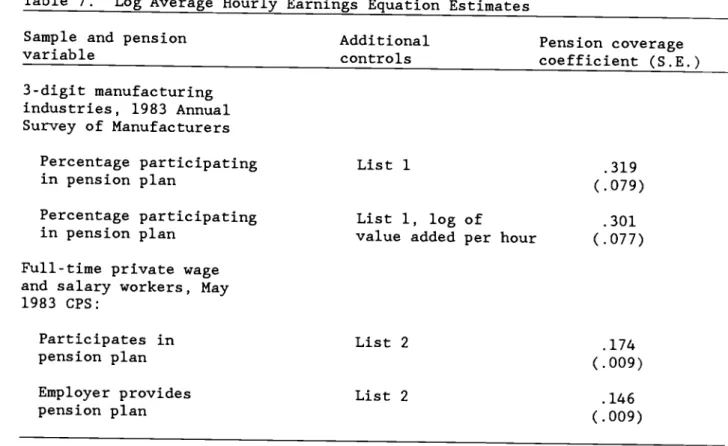
One limitation which all of these studies face is that they use indivi-dual characteristics as proxies for worker productivity. With industry data, one can include productivity directly as a right-hand side variable. This is done in Table 7, where the log of average hourly earnings for workers in
3-digit manufacturing industries in the May 1983 CPS are regressed on a set of standard control variables (hours, age, schooling, union, establishment size, tenure, marital status, race, and sex) and then a productivity measure (value added per hour) is added to the equation. In the first model, average hourly earnings are 38 percent higher in industries where all workers are covered by pensions than in industries where no workers are covered by pensions. This earnings difference drops to 35 percent when the productivity variable is
added to the model. Thus, adding productivity to the set of right-hand side variables does not shed any new insights. Equations estimated over full time private wage and salary workers in the May 1983 CPS produce sharply lower estimates of the wage premium which workers with pensions receive (16 to 19 percent) This suggests that aggregation may be contaminating the estimates obtained from industry data, but it is clearly not creating enough bias to reverse the direction of the estimate.
In summary, the empirical evidence on wage-pension tradeoffs is quite clear. Most estimates of compensating wage differentials for pension coverage show that wages do not drop dollar-for-dollar with increases in pension
compensation. Firms with pensions pay higher compensation to their current workers. Thus, the empirical studies suggest that firms must have higher
productivity or receive some cost savings elsewhere in order to survive in markets with firms which do not have pensions. Of course, another plausible explanation is that these studies have been unable to accurately estimate the true pension compensating wage differential. A final conclusion on the
magnitude of any compensating differential awaits better theory or better data.
Pensions. Productivity and Profits
As pointed out in Section V, pensions can potentially increase productiv-ity by reducing turnover and shirking and by producing efficient retirement decisions. These positive effects may be offset by excessively low turnover rates, higher absenteeism, and the weaker linkage between performance and pay that is generated by many pension plans. To determine whether pensions do have any impact on productivity, we merged data for 3-digit manufacturing industries from the 1983 Annual Survey of Manufacturers (ASM) with pension
coverage data for those industries from the May 1983 CPS. The production function is assumed to be Cobb-Douglas with constant returns to scale. The productivity measure is the log of value added per hour. It is regressed on
the log of the capital-labor ratio and the fraction of workers in each industry who participate in an employer or union sponsored pension plan, along with a
set of 20 binary variables indicating 2-digit industry. We also included a set of six additional control variables: ratio covered by union contracts, ratio
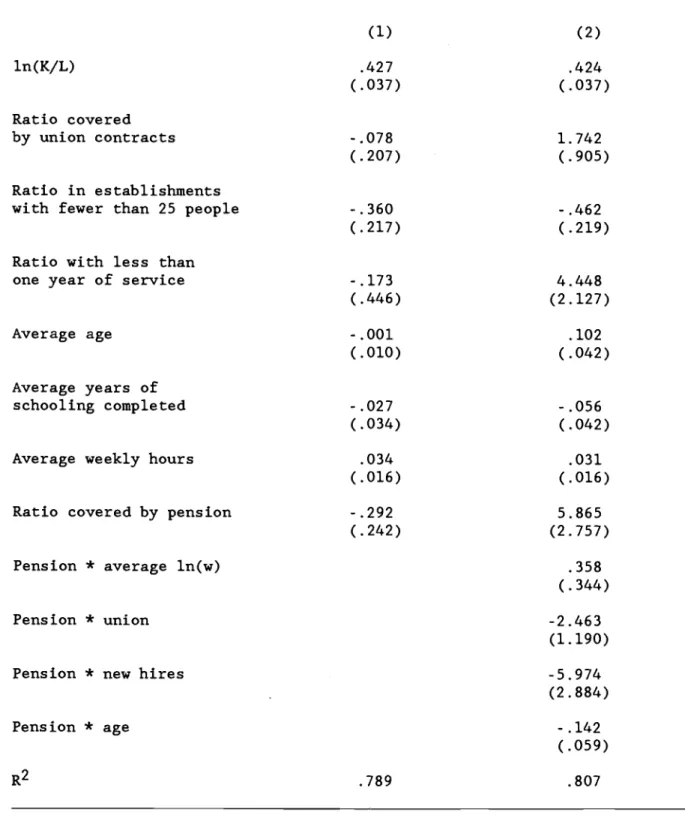
in establishments with fewer than 25 employees, ratio with less than one year of service with their employer (new hires), average years of schooling, and average age. After experimenting with a variety of specifications, we found that the impact of pension coverage on productivity varied with union contract coverage, average age, and the share of employees who are new hires. Thus, we added interaction terms between each of these variables and pension coverage. To estimate the impact of the size of pension benefits on productivity, we also included an interaction term between pension coverage and the log of average hourly earnings. The results are reported in Table 8 with and without the interaction terms.
In the specification without interaction terms (column 1 in Table 8), productivity is 25.3 percent lower in industries with high pension coverage
rates, but the impact of pension coverage is not statistically different from zero. In fact, productivity is uncorrelated with most variables in the model, except for the capital-labor ratio and average weekly hours.
The results for the specification containing the interaction terms show a much more complex relationship between productivity, pension coverage, and the other right hand side variables. The impact of pension coverage on
coverage, average age of workers, and the share of workers who are new hires. Pensions are more likely to have a positive impact on productivity in
industries with high earnings, a small share of workers covered by union
contracts, a small ratio of new hires to employment, or a large share of young workers. At the across-industry means of these variables, productivity is
35.3 percent lower in industries where all workers are covered by pensions than in industries where no workers are covered. Pension coverage is correlated with greater productivity in industries where union contract coverage is below
12.6 percent, where fewer than 6.8 percent of all employees are new hires and where coverage age is below 35.4 percent. (The across-industry means of these variables are 30.5 percent, 14.1 percent, and 38.5 percent). On balance, these results show that in the average industry pensions have no effect on
productivity, but pensions are associated with hither productivity in nonunion industries with low new hire rates, high wages, and younger workers.
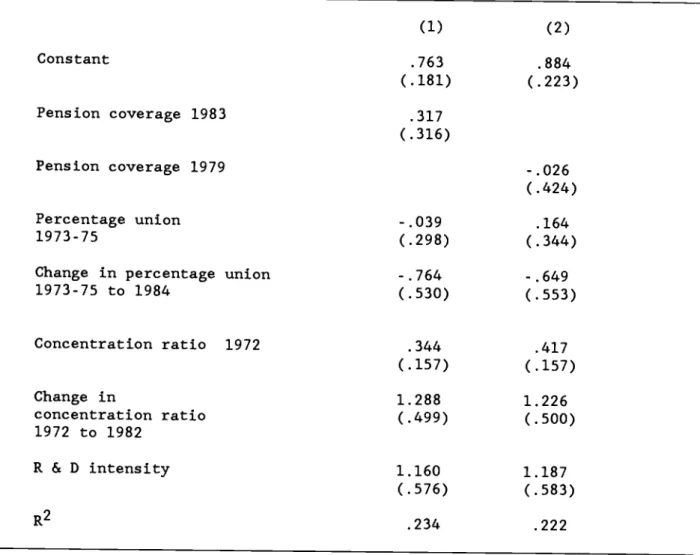
A related measure of firm performance is productivity growth. In most studies of productivity growth done by economists, the focus is usually on the impact of such variables as research intensity, concentration ratios, and collective bargaining. The impact of human resources policies on innovative activity has not been carefully explored. To the extent that pensions help mold long terni economic security among the workforce, they may also encourage innovation.
The Labor Department calculates productivity growth indexes for a set of 4-digit industries where output can be measured in physical units. The ratio of the 1983 to the 1972 values of the productivity index was regressed on pension coverage to estimate the impact of pension coverage on productivity growth and the results are shown in Table 9. Pension coverage data from the