Georgia State University Georgia State University
ScholarWorks @ Georgia State University
ScholarWorks @ Georgia State University
CSLF Working Papers Center for State and Local Finance
2-1-2019
Preparing Local Tax Expenditure Reports: A Practical Guide for
Preparing Local Tax Expenditure Reports: A Practical Guide for
Local Governments
Local Governments
Laura WheelerGeorgia State University Per Johnson
Georgia State University
Follow this and additional works at: https://scholarworks.gsu.edu/ays_cslf_workingpapers
Recommended Citation Recommended Citation
Wheeler, Laura and Johnson, Per, "Preparing Local Tax Expenditure Reports: A Practical Guide for Local Governments" (2019). CSLF Working Papers. 13.
https://scholarworks.gsu.edu/ays_cslf_workingpapers/13
This Article is brought to you for free and open access by the Center for State and Local Finance at ScholarWorks @ Georgia State University. It has been accepted for inclusion in CSLF Working Papers by an authorized
administrator of ScholarWorks @ Georgia State University. For more information, please contact
Preparing Local Tax
Expenditure Reports: A
Practical Guide for
Local Governments
Per Johnson and Laura Wheeler
FEBRUARY 2019
cslf.gsu.edu Preparing Local Tax Expenditure Reports:
The Center for State and Local Finance
WORKING PAPER 19-01
Preparing Local Tax Expenditure Reports:
A Practical Guide for Local Governments
PER JOHNSON AND LAUR A WHEELER
February 2019
Note: This paper was previously published by CSLF as a policy report in December 2018 and was revised with minor edits in March 2019.
The Center for State and Local Finance Andrew Young School of Policy Studies Georgia State University
Atlanta, Georgia 30303 United States of America Phone: (404) 413-0137 Fax: (404) 413-0248
Email: [email protected] Website: cslf.gsu.edu
Copyright 2019, the Andrew Young School of Policy Studies, Georgia State University. No part of the material protected by this copyright notice may be reproduced or utilized in any form or by any means without prior written permission from the copyright owner.
cslf.gsu.edu Preparing Local Tax Expenditure Reports;
The Center for State and Local Finance
Andrew Young School of Policy Studies
The Center for State and Local Finance’s (CSLF) mission is to develop the people and ideas for next generation public finance by bringing together the Andrew Young School’s nationally ranked faculty and the broader public finance community. CSLF conducts innovative, nonpartisan research on tax policy and reform, budget and financial management, education finance, and economic development and urban policy. Additionally, it provides premier executive education in public finance for state and local finance officials and works with local and state partners on technical assistance projects on fiscal and economic policy.
CSLF Reports, Policy Briefs, and other publications maintain a position of neutrality on public policy issues in order to safeguard the academic freedom of the authors. Thus, interpretations or conclusions in CSLF publications should be understood to be solely those of the author(s).
cslf.gsu.edu Preparing Local Tax Expenditure Reports;
Table of Contents
Introduction
1
What is a Local Tax Expenditure Report?
2
GASB 77
3
Understanding and Interpreting Tax Expenditure Estimates
4
Preparing a Local Tax Expenditure Report
4
Step 1: Define Tax Expenditure
4
Step 2: Identify Tax Expenditures
5
Step 3: Collect Data
6
Step 4: Organize Data
8
Step 5: Estimate Tax Expenditures – Example Methods
8
Property Tax Exemptions
8
Special Assessments
11
Property Tax Abatements
12
Tax Increment Finance (TIF)
13
Sales and Use Tax Exemptions
14
Step 6: Report Tax Expenditure Estimates
16
Conclusion
18
About the Authors
19
1
cslf.gsu.edu Preparing Local Tax Expenditure Reports:
Introduction
Tax expenditures are provisions in the tax code that allow for special treatment of some properties or a certain type of expense when computing the tax liability. Such treatment usually results in a reduction in tax liability for the taxpayer. Policymakers use tax expenditures as tax incentives for economic
development or to provide tax relief to taxpayers among many other reasons.1 Often these are in the
form of sales or property tax exemptions that reduce and sometime eliminate the tax liability for some taxpayers. Common tax expenditures at the local government level include sales exemptions for nonprofit organizations, property tax exemptions for senior homeowners, and tax increment finance (TIF) districts2.
In principle, these tax benefits could be provided by direct budget appropriations, thus these provisions are referred to as tax expenditures. They represent tax revenues that would have been otherwise collected if not for this preferential treatment in the tax code. Like direct government expenditures, tax expenditures are an allocation of government revenue that are intended to support a particular policy outcome or encourage some type of activity. The value of a tax expenditure can be thought of as
representing the amount of money that would be necessary to provide the same level of financial support in the form of a government grant instead of through the tax code.
The presence of tax expenditures is not suggestive of bad tax policy and tax expenditures have long been part of our tax system. The District of Columbia (D.C.) notes a property tax exemption for nonprofits dating back to 1902. However, it is important to monitor the estimated current and future values associated with these tax provisions as they are reductions in tax revenue and their presence results in special treatment for some taxpayers relative to others.
Furthermore, a tax expenditure report provides the ability to gauge the taxing autonomy of a local government – that is, the degree to which it has control over the exemptions against its own tax base. According to the 2012 U.S. Census of Governments, there were 90,056 local governments in the United States, with 43 percent designated as general-purpose governments and 57 percent as special-purpose districts3. The taxing authority of these many local governments share the same tax base, and create a
complex jurisdictional and taxing landscape where decisions of one jurisdiction can directly affect the revenue of other jurisdictions.
The aim of this “how to” document is to assist local governments who choose to prepare a tax
expenditure report themselves by providing them the practical resources and example methods to begin the process. Therefore, this document gives a general overview and theoretical background for preparing
1 Center for State and Local Finance, June 29, 2018. Local Tax Incentives: Examples from Metropolitan Counties. Georgia State
University. Andrew Young School of Policy Studies. Retrieved from https://cslf.gsu.edu/download/local-tax-incentives-examples-from-metropolitan-counties/?wpdmdl=6494960&refresh=5c069428044881543935016
2 Although a TIF designation does not result in a reduction in property tax liability to the homeowner, it does limit the amount of
revenue flowing to a local government. Therefore, from the perspective of a local government, this is a tax expenditure.
3 U.S. Census Bureau. 2013. Individual state descriptions: 2012. 2012 Census of Governments. U.S. Government Printing Office.
2
cslf.gsu.edu Preparing Local Tax Expenditure Reports:
a local tax expenditure report with specific and practical examples drawn from the preparation of a local tax expenditure report for Fulton County, Georgia4.
WHAT IS A LOCAL TAX EXPENDITURE REPORT?
Direct expenditures are presented annually as part of the local government’s annual budget document. However, tax expenditures are not usually subject to such periodic review or reporting leading some to consider tax expenditures as spending by another name or “disguised spending.5” A local tax expenditure
report improves fiscal transparency by allowing local governments and policymakers to better understand the localized revenue effects of these tax provisions and consider them during the budget-making
process. Further, it provides an estimate of the degree to which the local government’s revenue is impacted by the decisions of other overlapping jurisdictions and taxing districts which share the tax base and the degree to which their locally-authorized tax expenditures impact the revenues of others. Through this tax expenditure reporting, both policymakers and the public can be better informed, allowing for improved policy-making and fiscal coordination among overlapping tax districts.
The federal government and many states regularly prepare a tax expenditure report.6 However, only a
few sub-state governments are known to have completed tax expenditure reports at the time of writing. D.C. is mandated within the Tax Expenditure Budget Review Act of 2000 to prepare a biennial report. Philadelphia’s city council unanimously adopted legislation in 2017 to regularly assess economic development tax expenditures following a 2016 tax expenditure report of its business-related taxes,7
although Philadelphia’s legislation also requires the report to analyze the effectiveness of each tax expenditure.8 NYC is required within its charter to produce a tax expenditure report annually. In addition,
the NYC city council recently adopted legislation to provide greater oversight of economic development tax expenditures implemented through its economic development agency.9 Finally, Montgomery County,
Maryland prepares a tax expenditure report for those relevant tax provisions that impact the county’s
4 Center for State and Local Finance November, 2018. Fulton County Tax Expenditure Report for Fiscal Year 2019. Georgia State
University. Andrew Young School of Policy Studies.
5 District of Columbia, November 2016. District of Columbia Tax Expenditure Report Revised. Produced by the Office Revenue
Analysis. Retrieved from
https://cfo.dc.gov/sites/default/files/dc/sites/ocfo/publication/attachments/2016%20Revised%20Tax%20Expenditure%20Repor t%20110816.pdf
6 Institute of Taxation and Economic Policy, January 31, 2017. State-by-State Tax Expenditure Reports website. Retrieved from
https://itep.org/state-by-state-tax-expenditure-reports
7 Philadelphia City Council, March 17, 2017. City Council Passes Legislation to Require Review of Tax Benefit Programs. Retrieved
from http://phlcouncil.com/city-council-passes-legislation-to-require-review-tax-benefit-programs
8 Philadelphia City Council, March 16, 2017. Bill No. 161015. Retrieved from
https://phila.legistar.com/LegislationDetail.aspx?ID=2892216&GUID=156A70E5-4B55-4129-8547-4F6E30278A0D&Options=ID%7cText%7c&Search=161015&
9 Khurshid, Samar. October 31, 2017. City Council Passes Bills Expanding Oversight of Economic Development Spending. Gotham
Gazette. Retrieved from http://www.gothamgazette.com/city/7284-city-council-to-pass-bills-expanding-oversight-of-economic-development-spending
3
cslf.gsu.edu Preparing Local Tax Expenditure Reports:
property tax base10. Despite these four examples being large metropolitan jurisdictions, the benefits of a
tax expenditure report apply to local governments of all size – especially given the increasing presence of and complex relationship between overlapping tax districts.
Some jurisdictions have used the tax expenditure report as a document to evaluate programs or tax provisions. While such a document is important, a tax expenditure report as described herein is intended to report an estimate of current and future revenue foregone due to such tax expenditures and does not address the effectiveness tax preference provisions.
GASB 77
Because of the widespread use of tax incentives, the Government Accounting Standards Board (GASB) issued Statement No. 77 in August 2015. This rule requires local governments to report the value of their tax abatement agreements as part of their annual end-of-year financial reports.11 The standard, referred
to as GASB 77, applies to certain tax abatement agreements that affect their tax collections for accounting periods beginning after December 15, 2015.
Specifically, GASB 77 requires governments to provide information on the purpose of the abatement, the value of the abatement and the tax being abated, any recapture provisions, commitments made by the abatement recipient, and any other commitments made by the abating government, such as
commitments to provide infrastructure assets. Although some governments may have provided this information before this requirement, the standard was introduced because generally few governments did so regularly. In addition, abatements entered into by other governments that result in a reduction of their revenues must also be disclosed. The latter are referred to as passive abatements and highlight the impact of overlapping districts.
The GASB 77 standard does not require the disclosure of all tax expenditures, though. For instance, tax incentives referred to as “as-of-right” are not subject to disclosure under this rule. These are incentives that are provided to any entity that meets a specific criterion, such as a homestead exemption or an exemption for qualifying nonprofit organizations. Furthermore, most sales tax exemptions or tax increment financing (TIF) arrangements are not subject to reporting under this rule. Furthermore, the standard does not require an estimate of the future tax liability loss for the government. Only the revenue effect for the year for which the CAFR applies is required to be reported. While a local tax expenditure report could provide the analysis to comply with GASB 77, it is intended to be more comprehensive than those currently required by GASB.
10 Montgomery County, October 2017. Tax Expenditure Report. Property Tax Credits, Tax Deferral, and Tax Exemptions.
Department of Finance. Retrieved from
https://www.montgomerycountymd.gov/Finance/Resources/Files/TaxExpenditureReportFY17.pdf
11 Government Accounting Standards Board, August 2015. Statement No. 77 of the Government Accounting Standards Board, Tax
Abatement Disclosures, Retrieved from
4
cslf.gsu.edu Preparing Local Tax Expenditure Reports:
UNDERSTANDING AND INTERPRETING TAX EXPENDITURE ESTIMATES
As noted above, the purpose of a local tax expenditure report is to estimate the revenue impact of tax expenditures to a local government but the estimates associated with an individual tax expenditure provision do not necessarily represent the revenue that would be gained from the repeal of the tax preference. Instead, the tax expenditure estimate represents the value of the deduction or credit taken via the provision.
There are two ways in which the expenditure deviates from a revenue estimate. First, tax expenditures are estimated as independent provisions. Therefore, any effect that the presence of one expenditure may have on the use of another expenditure is not accounted for in the estimate. It is conceivable that
elimination of one tax expenditure provision may result in increased usage of another tax expenditure provision with little change in total revenue to the local government. Second, tax expenditure estimates are not adjusted for behavioral changes. Instead, tax expenditure estimates are designed to present information on the steady state trend of usage of the provision. Thus, tax expenditure estimates can only act as an indication of the revenue effect that would occur if the provision were eliminated or modified.
Preparing a Local Tax Expenditure Report
The steps described below are presented to assist local governments in the development of a
comprehensive tax expenditure report. Because this is a generalized guide, any specific local government will have to adapt the list of expenditures and perhaps some data requirements to reflect their own tax structure. Further, specific examples and challenges encountered during the development of the Fulton County Tax Expenditure Report for Fiscal year 2019 are provided to give practical context.
STEP 1: DEFINE TAX E XPENDITURE
Before data can be collected and any analysis performed, there must be a working agreement of the definition of a tax expenditure.
Tax expenditures are deviations or special exceptions from the generally defined tax base. In most cases, identifying a tax expenditure is straightforward, such as a sales tax exemption or a property tax
abatement. However, for local governments which have not previously considered this question, there may be some discussion and perhaps philosophical disagreement on what constitutes the standard tax base and a tax expenditure. Even at the federal level, the list of tax expenditure items included by the executive branch differs from the list estimated by legislative branch because each works from a different definition of the standard tax base. The appropriate norm against which tax expenditures are defined is somewhat subjective and may, in some cases, be driven by the intent of the policy underlying the legislation.
For instance, some localities impose an assessment rate of less than 100 percent. This decision serves to reduce tax liabilities from that which would otherwise occur and from this perspective it can be
5
cslf.gsu.edu Preparing Local Tax Expenditure Reports:
considered a tax expenditure. On the other hand, since this is the statutory ratio and is used by all localities, this may also be viewed as the normal level of assessment and as such not viewed as a tax expenditure. While both can be viewed as acceptable responses, it is important to have agreement in these decisions and to be consistent with these classifications over time. Nevertheless, establishing a definition from which to start will serve as a useful guide to define the programs and policies which represent a deviation or special exception from the tax base.
In developing a definition of a tax expenditure, it may be useful to review what other state and local governments have done. The Institute of Taxation and Economic Policy has compiled list of local tax expenditure reports12. Furthermore, reviewing the definitions that your state uses may be a good place to
start. Some states, like Minnesota and Connecticut, include a rubric within their tax expenditure reports that generally defines when a provision qualifies as a tax expenditure. For example, Connecticut has adopted a six-criteria test to determine whether a provision is an expenditure. In general, a provision is considered a tax expenditure if it:13
1. Impacts a statewide tax; 2. Results in reduced tax revenue; 3. Is not an appropriation;
4. Is included in the definition of the tax base; 5. Is not subject to an alternative tax; and
6. Can be amended or repealed by a change in state law alone.
STEP 2: IDENTIFY TAX EXPENDITURES
Tax expenditures can take many different forms. The most common are homestead exemptions, property tax assessment limitations, special rates, commercial property tax abatements, and sales tax exemptions. In addition, some localities may allow tax deferrals to some taxpayers.14 The list will vary by jurisdiction
depending on their local tax laws and by which taxes are imposed. At the local level, some tax
expenditures may be authorized through ordinances, approved by voters, authorized by an overlapping tax district (e.g., water district, park district, school district, etc.), or negotiated between the government or its conduit economic development agency and a private entity. Therefore, identifying and itemizing all tax expenditures can be challenging. In all likelihood, the list of tax expenditures will evolve over time as policymakers become more familiar with this concept. It is important to start the process though, even if the initial list is not comprehensive. The act of providing the list is an important piece of information for policymakers.
12 Institute of Taxation and Economic Policy, January 31, 2017. State-by-State Tax Expenditure Reports website. Retrieved from:
https://itep.org/state-by-state-tax-expenditure-reports
13 Connecticut Fiscal Analysis Office. February 13, 2018. Connecticut Tax Expenditure Report. Retrieved from:
https://www.cga.ct.gov/ofa/Documents/year/TER/2018TER-20180201_Tax%20Expenditure%20Report%20FY%2018.pdf
14 Some jurisdictions may offer a tax deferral to senior homestead property as a type of property tax relief. Information
regarding this type of tax expenditure may only be available from the office responsible for billing and not the office responsible for tax assessments.
6
cslf.gsu.edu Preparing Local Tax Expenditure Reports:
A good place to start is with the state tax expenditure report (if available) which should identify and estimate the revenue effect from both state and federal tax expenditures. Some may also include an estimate of the revenue effect of individual provisions to local governments. Common tax expenditures that may be encountered in local governments are described within Local Tax Incentives: Examples from Metropolitan Counties15 while others may be found within the Fulton County Tax Expenditure Report for
Fiscal year 2019. A generalized list of common tax expenditures and practical estimating methodologies for reach are also provided in Section 2.5 (Step 5) below.
Another practical challenge to identifying tax expenditures includes identifying the authorizing legislation associated with some tax expenditures depending upon how powers are given to the local government by the state. For example, Fulton County, Georgia does not have the power to create a property tax
exemption through local ordinance. Instead, homestead exemptions passed prior to 1983 required a constitutional amendment. After passage of a new constitution, enacting homestead exemptions by local governments could be done through voter-approved referendum. Although all provisions are considered state law, provisions applying only in certain jurisdictions may not be found in the general law volumes. Instead, these may only be found in the full compendium of state law. Nonetheless, understanding how and where to find the authorizing legislation of these tax expenditures is important to understand how they work and effect the tax base.
STEP 3: COLLECT DATA
In order to identify the appropriate data necessary to estimate the impact on revenue from each tax expenditure, it is necessary to understand how each tax expenditure impacts the tax base. For example, a property tax abatement may be a parcel-by-parcel negotiated agreement between a conduit economic development authority, a TIF program likely applies to all properties within a specified geography, and a homestead exemption or deduction applies to a unique class of taxpayers. Therefore, each tax
expenditure will require different data to produce the estimates.
When compiling data, it is important to note the varying level of reliability among different sources. In most cases, more reliable data produces a more reliable estimate and fewer additional assumptions have to be incorporated into the estimate. Wherever possible, actual data (e.g., property tax records, income tax filings, sales tax receipts) provide the best data for estimating. However, even this data can have its limitations. In some cases, the necessary data is not collected. In this case secondary data sources are used to form the basis of the estimate. While this may not provide an exact accounting of the
expenditure, it can serve to provide an estimate of its value. This is particularly true in the case of sales tax exemptions, as discussed further in the Sales and Use Tax Exemptions estimate example in Step 5 below. In short, it is important to set the correct expectations for the information presented in this type of document. A tax expenditure report is intended to provide estimates, past and future, of these items.
15 Center for State and Local Finance, June 29, 2018. Local Tax Incentives: Examples from Metropolitan Counties. Retrieved from
7
cslf.gsu.edu Preparing Local Tax Expenditure Reports:
As such, these estimates will differ from the actuals that become available at a later date. Over time, as better information becomes available and as the analysts gain experience, it is likely that these gaps between the two will diminish but may never vanish completely. The advantage of the tax expenditure report is that it provides information that can be used for future planning. The cost is that the figures contained in the report are estimates.
Because the property tax is a significant revenue source for most local governments, property tax records from the local tax assessor will likely be key data to completing a local tax expenditure report. For local governments with tax expenditures applied towards a local income tax, the state department of revenue will likely have the appropriate data. This data is generally considered reliable and may be publicly available. However, it may not be easily interpreted without some assistance from the collecting agency. For example, property tax records are usually available within an electronic spreadsheet and coded with multiple fields used to calculate the taxes required for each property owner. But the meaning of the codes may not be well-known outside of the administering agency. Establish good relationships and lines communication with the administering agency to obtain this information.
Local governments may face numerous practical challenges in data collection, as encountered during the development of the Fulton County Tax Expenditure Report for Fiscal year 2019. Such challenges include:
Data Availability: Some tax expenditures may not have data available or be suitable to estimate its revenue effect. However, this itself is important data to note and can help identify needs and improvements in data collection techniques by the agency(ies) responsible for implementing the tax expenditure. By sharing this information with the agency(ies), changes in data collection may be possible and estimates refined in future tax expenditure estimates.
Government to Government: The local government preparing the tax expenditure report may be outside the revenue collecting agency. The collecting agency may not be able or prepared to coordinate with the local government preparing the report, for many legitimate reasons. In this instance, good communication between the collecting agency and the agency preparing the report is critical. Take time to explain the desired objective to the collecting agencyrepresentative. It is likely that they will be able to provide additional insight. In addition, don’t assume that all information is easily available. Be sure to provide adequate time for your data requests to be answered.
Government to Contractor: Property taxes are often assessed and collected by a localgovernment. However, the property assessor data file management system is often managed through a proprietary system by a contactor with limited editing and query building capabilities available to the local government. Therefore, the property assessor data file may not have the data necessary to estimate tax expenditures. In this case, it may be necessary to engage with the data manager to obtain the appropriate data in its most useful form.
If possible, include the authorizing legislation for each provision. This legislation provides a valuable information and may provide insight into the initial purpose of the provision. It is also important to
8
cslf.gsu.edu Preparing Local Tax Expenditure Reports:
understand the structure and interactions with other provisions that may exist. Often, there are
substantial relationships between provisions in the tax code. Although a tax expenditure report considers each item in isolation, this document may be the only vehicle in which there is an opportunity to remind policymakers of these important interactions. Consider this information when identifying tax
expenditures and collecting data.
Further, in order to maximize the use of a local tax expenditure report as a fiscal policy tool, also include a forecasted estimate for each expenditure provision. Many tax expenditures can be forecasted using a simple trend analysis for three to five years into the future based on the historical values of the expenditure estimates. Consider this as data is collected.
STEP 4: ORGANIZE DAT A
Data organization and structure is highly customizable depending upon personal preferences, institutional standards, software access and proficiency, and data formats. While advanced analytical software may be useful in some fiscal analyses, an electronic spreadsheet format like Microsoft Excel is likely more than adequate for estimating tax expenditures.
To create a clean and expandable template to perform estimates for the current year and beyond, relevant data can be compiled into a Microsoft Excel workbook for each tax expenditure and organized with multiple spreadsheets where the estimate calculation and each year of raw data is in its own spreadsheet. Detailed notes are included with the estimate spreadsheet that define the data source, applicable personal communication, data field definitions, assumptions, and any other relevant data necessary for others to reproduce the estimate in the future.
STEP 5: ESTIMATE TAX EXPENDITURES – EXAMPLE METHODS
While local governments will often have their own tax expenditures comprised of federal, state, and local provisions impacting its local tax base, there are some provisions that have significant similarities across local governments. Below are several examples of common tax expenditures and the methodology used to estimate them. These are provided to serve as illustrations of how the actual estimates may be computed in a tax expenditure report.
Property Tax Exemptions
Local governments typically offer multiple property tax exemptions. Typically, these exemptions are applied differently based on the property’s ownership or use. For example, most states provide a 100 percent exemption for federally-qualified charitable nonprofits under Section 501(c)3 of the Internal Revenue Code. Additionally, local governments frequently enact homestead exemptions or other reductions intended to provide tax relief.
It is not uncommon for a local government to have multiple homestead exemptions or reductions. For example, a local government may have a regular homestead exemption, senior homestead exemption(s), and homestead exemption(s) for disabled persons where a property owner may qualify for more than one of these. This interaction and stacking of homestead exemptions exemplifies the problem with
9
cslf.gsu.edu Preparing Local Tax Expenditure Reports:
interpreting tax expenditure estimates similar to revenue estimates as discussed above in Understanding and Interpreting Tax Expenditure Estimates.
Calculating the annual foregone revenue for a homestead exemption depends on the structure of the homestead exemption. As an example, consider a basic homestead exemption that exempts $30,000 of assessed value from ad valorem property taxes applied to the primary residence of all property owners within the given jurisdiction.
This homestead exemption estimate captures the value of property tax foregone by qualified homeowners taking this exemption. Qualified parcels receiving the basic homestead exemption are typically identified within the local property tax records according to exemption codes, allowing them to be filtered from the raw data. Using this filtered parcel data, the steps to estimate the foregone revenue from this basic homestead exemption are as follows:
Step 1. Sum the total assessed value (TAV) of all qualified parcels for the current year.
Step 2. Subtract $30,000 from the assessed value for each qualified parcel to calculate the adjusted assessed value for each parcel. Note that the assessed value for some parcels may be less than $30,000 and therefore be fully exempted by such a homestead exemption. Therefore, resulting negative values should be set to zero.16
Step 3. Sum the adjusted assessed value from Step 2 for all qualified parcels to calculate the adjusted TAV.
Step 4. Multiply the difference of the TAV for the current year and the adjusted assessed value for all qualified parcels by the local millage rate.
Step 5. If necessary, adjust the resulting estimate to reflect the time period used for the jurisdiction’s budget year. If the jurisdiction adheres to a calendar year budget period, then no adjustment may be required. If, instead, the jurisdiction uses a different accounting period, the expenditure estimate should be adjusted to match.17The steps to calculate this basic homestead exemption are shown in Table 1.
16 It is advisable to compute the value of the expenditure on a property by property basis, if possible. Alternatively, the estimate
could be computed as the product of the value of the exemption and the number of properties receiving the exemption but this will likely lead to a higher expenditure estimate because some properties may have an assessed value less than the value of the exemption and will not be able to fully utilize the exemption.
17 For instance, if the budget year runs from July 1 through June 30, the fiscal year estimate can be computed as 50 percent of
10
cslf.gsu.edu Preparing Local Tax Expenditure Reports:
Table 1. Estimating Value of a Local Homestead Exemption Tax Expenditure
Step 1 Step 3* Millage Rate Step 4 TAV of qualified parcels Adjusted TAV of qualified parcels
Estimate of foregone revenue from basic homestead exemption
$12,500,000,000 $8,500,000,000 0.010 ($12,500,000,000 - $8,500,000,000) * 0.010 = $40,000,000
* Step 2 not shown.
Another common type of real property tax exemption enacted by most local governments is the 100 percent tax exemption for charitable nonprofit property. Charity properties may be identified within the local property tax records as a specific type of exempt class, along with other exempt property classes - government, public housing, education, charitable hospitals, religious properties - thus, these properties can be filtered from the data and their assessed values summed.
The intent of the estimate is to capture the value of property tax foregone by qualified nonprofits. The same estimate can be replicated for other exempted classes of property, such as commercially-abated property. Using the filtered parcel data of properties classified as charitable nonprofit, the steps to estimate the foregone revenue from the nonprofit exemption are as follows:
Step 1. Sum the TAV of all parcels classified as charitable nonprofit for the current year.
Step 2. Multiply the TAV for the current year for all qualified parcels by the local millage rate. The steps to calculate this nonprofit exemption are shown in Table 2.Table 2. Estimating Value of a Nonprofit Exemptions Tax Expenditure
Step 1
Millage Rate
Step 2
TAV of qualified parcels Estimate of foregone revenue from charitable nonprofit exemption
$500,000,000 0.010 $500,000,000 * 0.010 = $5,000,000
Because nonprofit property is tax exempt for typically the duration of its nonprofit ownership period, the assessed values of such properties may not be up to date. That is, the tax assessor may not reassess these properties as frequently because they do not add value to the jurisdictions’ property tax base. In some cases, these properties may not be assessed at all. If that is the case, using the recorded assessed values may understate the true value of the exemption. An alternative estimate could be constructed by using the TAV for the previous year and applying the average growth rate of assessed values for the property surrounding the nonprofit property. Assuming that the assessed value of the nonprofit property grows at
11
cslf.gsu.edu Preparing Local Tax Expenditure Reports:
the same rate as other property, this method will provide an estimate of the value of the nonprofit exemption and can serve as an upper bound of the value of the exemption. If there does not exist a reliable prior year assessment of the nonprofit property, then an estimate can be constructed by
estimating the TAV per square foot or acre of the closely surrounding properties and applying that figure to the total square footage or acreage of the nonprofit property.
Special Assessments
Similar to property tax exemptions are special assessments. Special assessments may be administered through preferred rates applied for specific land use designations (e.g., conservation, forest, timber, or agriculture). In addition, a property assessment freeze may be used to incentivize a variety of real property improvements (e.g., brownfield cleanup or preservation of historic properties) or provide homestead property tax relief.
As an example, consider a special assessment for agricultural property where qualified agricultural properties are taxed based on the assessed value of their property’s current use, rather than the FMV. Qualified parcels receiving this special assessment may be identified within the local property tax records with a unique exempt or class code, allowing these parcels to be filtered from the raw data. The
assessor’s data should include both the FMV for the property and the assessed value, reflecting the reduced assessment value which taxes are applied towards.
The purpose of the tax expenditure estimate for specially assessed properties reflects the revenue difference between the standard assessed value and the special assessment given to the qualified property. The steps to estimate the foregone revenue from the special assessment for qualified agricultural properties are as follows:
Step 1. Compute the sum of the TAV for all qualified parcels using the standard assessment ratio.
Step 2. Sum the current assessed value of all qualified parcels, which represents the special assessment for the properties based on their current use.
Step 3. Multiply the difference in the calculated TAVs by the local millage rate.The steps to calculate the foregone revenue from the special assessment for qualified agricultural properties are shown in Table 3.
Table 3. Estimating the Value of Qualified Agricultural Properties Receiving a Special Assessment
Step 1 Step 2
Millage Rate
Step 3 Sum of TAV of all qualified
parcels based on standard assessment
Sum of assessed value for qualified
parcels based on special assessment
Estimate of foregone revenue from special assessment
$500,000,000 $400,000,000 0.010 ($500,000,000 - $400,000,000) * 0.010 = $1,000,000
12
cslf.gsu.edu Preparing Local Tax Expenditure Reports:
A common property tax relief mechanism for homeowners is a property tax assessment freeze. In addition, this type of exemption may also be applied in the case of historic property undergoing
rehabilitation. Parcels receiving a historic property tax freeze may be flagged within the local property tax records with a unique exempt or class code, allowing these parcels to be filtered from the raw data. With this historic property tax freeze special assessment example, the estimate represents the value of property tax foregone as a result of the freeze in the assessed value. Using this filtered parcel data, the steps to estimate the foregone revenue from historic property tax freezes are as follows:
Step 1. Sum the TAV of all historic parcels for the current year applying standard assessments.
Step 2. Sum the current assessed value, which represents frozen base year assessed value for those properties
Step 3. Compute the difference in value between the standard assessment and the current assessment and multiply the difference by the local millage rate.The steps to calculate the foregone revenue from the historic property tax freeze are shown in Table 4. Table 4. Estimating the Value of Historic Property Tax Freeze
Step 1 Step 2
Millage Rate
Step 3 Current year TAV for
historic tax freeze parcels based on standard assessment
practice
TAV for historic tax freeze parcels based on historic property
freeze
Estimate of foregone revenue from historic property tax
freeze
$47,000,000 $35,000,000 0.010 ($47,000,000 - $35,000,000) * 0.010 = $120,000
Property Tax Abatements
Local governments and their economic development agencies often use property tax abatements as a means of attracting and retaining business, building affordable housing, or incentivizing development. Typically, the local government or development agency retains the title of the property and remains property owner throughout the duration of the abatement. The property is then leased back to the business or developer at a significantly reduced rate as part of the development arrangement. Less frequently, the local government or development agency seeks a Payment in Lieu of Taxes (PILOT) from the business or developer in order to help offset the lost tax revenue.
For example, Fulton County offers a property tax abatement program whereby the qualifying property receives a 10-year property tax abatement. The abatement ramps down in value over the 10-year period, beginning at 50 abatement of Fair Market Value (FMV) at Year 1 with 5 percent increases in the taxable percentage annually until the abatement period expires.
13
cslf.gsu.edu Preparing Local Tax Expenditure Reports:
Data to estimate the value of the abatement is usually included as part of the local property tax records, although perhaps not the publicly available property tax records and additional coordination with the local assessor’s office may be required. Properties receiving this abatement may be identified by an abatement code. Alternatively, these properties can be identified because they are associated with a reduced assessment ratio.
The expenditure estimate represents the value of property tax foregone from all properties receiving a property tax abatement. For the purposes of this example, assume the FMV of a parcel is $250,000, the standard assessment ratio is 40 percent of FMV, the percent abated is 35 percent, and the millage rate is 10 mills. The steps are as follows:
Step 1. Calculate the standard TAV of Parcel A by multiplying the FMV by 40 percent or the standard assessment ratio for the jurisdiction.
Step 2. Calculate the abatement value for Parcel A by multiplying the TAV for parcel A by the applicable abatement percentage.
Step 3. Multiply the difference between the TAV in Step 1 and the TAV in Step 2 by the local millage rate to calculate the estimated value of the property tax abatement for Parcel A.
Step 4. Sum the estimated abated assessed values for all qualified parcels to estimate the total abatement value for the current year.The steps in this example are applied in Table 5.
Table 5. Estimating Value of a Local Property Tax Abatement
Step 1 Step 2
Millage Rate
Step 3 Step 4
Calculate TAV based on the standard assessment ratio Calculate abated value of property using appropriate abatement percentage
Estimate of property tax abatement for Parcel A
Sum of property tax abatement for all
qualified parcels $100,000 $100,000 * 0.35
= 35,000 0.010
($100,000 - $35,000) * .010 = $650
If PILOTs are received for any parcel as part of any of these property tax abatements, the value of these PILOTs should be subtracted from the abatement estimate to reflect the true value of the foregone revenue associated with that provision.
Tax Increment Finance (TIF)
TIF has become a widely used financing method to facilitate economic development and infrastructure projects. This is usually applied in the case of property taxes, but can also apply to sales tax or less commonly to income taxes. Some may believe philosophically that TIF is not a tax expenditure because it does not result in a reduction in taxes to the property owner. However, as TIF represents a change in the
14
cslf.gsu.edu Preparing Local Tax Expenditure Reports:
local government’s tax base and the allocation and use of those funds are outside the local government’s general fund, it is classified here as a tax expenditure.
Data to estimate the value of the TIF tax expenditure is included as part of the local property tax records and can also be found in the authorizing legislation of the TIF district. Within the property tax records, parcel data typically includes the tax district in which the parcel is located. All parcels within the TIF’s tax district are aggregated and their TAV summed. A TIF’s base year TAV value is calculated at the creation of the TIF district and is typically included within the authorizing legislation. If not in the authorizing
legislation, local governments should be able to obtain this value from the tax administrator for the local government.
The tax expenditure estimate of a TIF represents the value of the tax increment which is disbursed to the TIF district and which is not available for use by the general fund of the local government. In this example, assume the base TIF TAV was $550 million when the TIF was created, the current year TIF TAV is $2 billion, and the local millage rate is 10 mills. The steps are as follows:
Step 1. Obtain the value for the TIF TAV Base = Value of TAV for the TIF at the year of creation
Step 2. Sum the TAV for the TIF for the current year = Value of TAV for the TIF for current year
Step 3. Multiply the difference between the TAV for the current year and base year by the millage rate. If the resulting value is negative, then there is no incremental revenue from the TAD and the value of the tax expenditure is zero. Expenditure estimates in this case will only exist when the assessed value of the TAD exceeds the assessed base value.The steps in this example are shown in Table 6.
Table 6. Estimating Value of a Local TIF Tax Expenditure
Step 1 Step 2
Millage Rate
Step 3
TIF TAV base year TAV of parcels in TIF TIF tax expenditure estimate
$550,000,000 $2,000,000,000 0.010
($2,000,000,000- $550,000,000) * 0.010 =
$14,500,000
If the data is available, the estimated tax expenditure value calculated in the example above (Table 3) can be refined by removing exempt properties from the TAV for the current year (Step 2).
Sales and Use Tax Exemptions
Sales tax exemptions are commonly enacted by states and frequently flow through to the local governments because they share the same sales tax base. They are usually targeted towards specific products or industries. In all cases, there is a deviation from the sales tax base.
15
cslf.gsu.edu Preparing Local Tax Expenditure Reports:
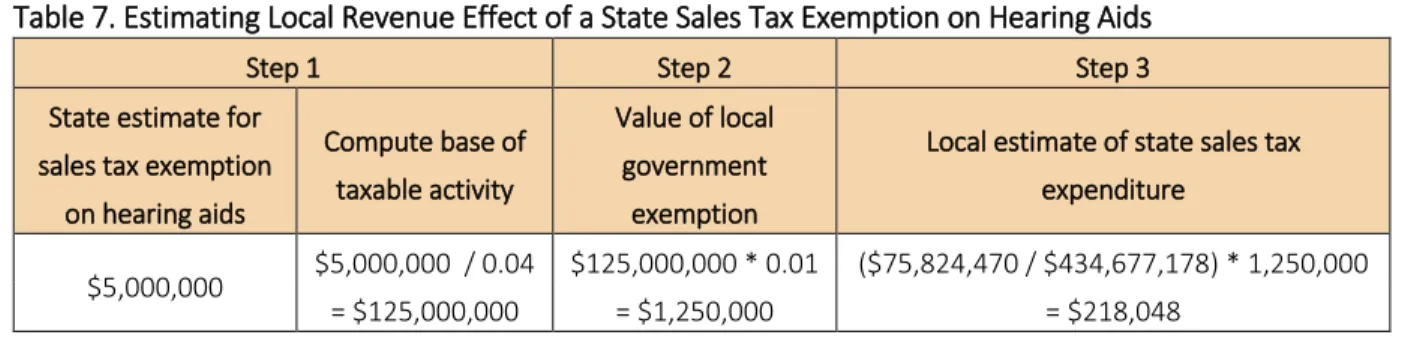
Because states rarely track items that are exempt from sales tax, valuing these exemptions can be challenging and their estimation typically requires the use of additional data sources. Many states which produce tax expenditure reports include the value of sales tax exemptions at the state level. It is often possible to adjust the state estimate of a sales tax exemption to reflect the local value by pro-rating the state estimate to the local government of interest. This is shown in the example below for the exemption of sales tax on hearing aids.
In this example, assume the value of the state exemption is $5 million, the state sales tax rate is 4 percent, and the local sales tax rate is 1 percent. The steps are as follows:
Step 1. Convert the state estimate to reflect the base of taxable activity = Value of state estimate/state sales tax rate
Step 2. Compute the combined local government sales tax estimate = tax base*local tax rate
Step 3. Allocate the local government value to reflect the specific county impact = (Personal income in the county of interest / state personal income)*local government sales tax estimate, where county and state personal income figures are available from the Bureau of Economic Analysis Regional Data website.18 Alternatively, the estimate may be allocated to a local
government using another factor, such as population. The steps in this example are shown in Table 7 below.
Table 7. Estimating Local Revenue Effect of a State Sales Tax Exemption on Hearing Aids
Step 1 Step 2 Step 3
State estimate for sales tax exemption
on hearing aids Compute base of taxable activity Value of local government exemption
Local estimate of state sales tax expenditure
$5,000,000 $5,000,000 / 0.04 $125,000,000 * 0.01 ($75,824,470 / $434,677,178) * 1,250,000 = $125,000,000 = $1,250,000 = $218,048
If an estimate of an expenditure is not available at the state level, then the original base of taxable activity must be estimated using other data sources. In this case, an internet search provides helpful articles from reputable news sources of the rise in the cost of hearing aids and the population using these devices. Based on these sources or data on medical expenditures provided by the federal government, one can determine a base of sales that would be taxable in the absence of the exemption at the state level. This can then be used to compute the value of the local government exemption and then shared to represent the cost to a specific county. Sometimes data may only be available at the national level. If that is the case, then the national data may need to be shared down to represent a population applicable at the local government level.
18 Bureau of Economic Analysis, 2018. GDP & Personal Income website. Retrieved from
https://apps.bea.gov/iTable/index_regional.cfm. These figures are specific to Fulton County and the state of Georgia and will not be applicable to other counties.
16
cslf.gsu.edu Preparing Local Tax Expenditure Reports:
STEP 6: REPORT TAX EXPENDITU RE ESTIMATES
The National Conference of State Legislatures (NCSL) has prepared a document entitled Tax Expenditure Budgets and Reports: Best Practices to provide some uniformity in state tax expenditure reports.19 These
best practices developed for states may be a useful guide for local governments preparing to report local tax expenditures. As summarized from the NCSL best practices, state tax expenditure reports should, at a minimum:
Be publicly available and easily accessibility on-line.
Updated on a schedule which allow for use in budget development and policy decision-making.
Define the normal tax structure for each tax included and identify all deviations.
Disclose the methodology used and limitations of the estimates included within the report. In addition to these NCSL best practices, a review of several state and local tax expenditure reports identified practical similarities and notable differences which may be useful when tailoring a tax expenditure report for a local government. These include the following fields:
The date of enactment for the tax expenditure
The statutory citation
An estimate of the revenue impact (positive or negative) from each tax expenditure.
Category of tax expenditures, both tax type and budget type as appropriate.
Any sunset dates associated with the provision.
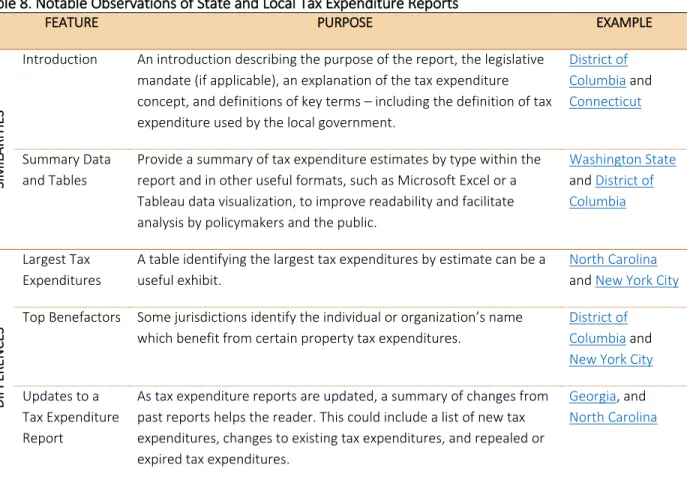
These best practices have been incorporated into state and local tax expenditure reports in different ways. In addition to these fields provided by NCSL, other useful fields could be included, as other states and local governments have, including data source(s) and reliability of the expenditure estimate. Other notable similarities and differences observed among many local and state tax expenditure reports are provided in Table 8:
19 National Conference of State Legislatures, August 18, 2014. Tax Expenditure Budgets and Reports: Best Practices. Retrieved
17
cslf.gsu.edu Preparing Local Tax Expenditure Reports:
Table 8. Notable Observations of State and Local Tax Expenditure Reports
FEATURE PURPOSE EXAMPLE
SI
MILAR
IT
IES
Introduction An introduction describing the purpose of the report, the legislative mandate (if applicable), an explanation of the tax expenditure concept, and definitions of key terms – including the definition of tax expenditure used by the local government.
District of Columbia and
Connecticut
Summary Data and Tables
Provide a summary of tax expenditure estimates by type within the report and in other useful formats, such as Microsoft Excel or a Tableau data visualization, to improve readability and facilitate analysis by policymakers and the public.
Washington State and District of Columbia DIFFE R EN CE S Largest Tax Expenditures
A table identifying the largest tax expenditures by estimate can be a useful exhibit.
North Carolina
and New York City
Top Benefactors Some jurisdictions identify the individual or organization’s name which benefit from certain property tax expenditures.
District of Columbia and
New York City
Updates to a Tax Expenditure Report
As tax expenditure reports are updated, a summary of changes from past reports helps the reader. This could include a list of new tax expenditures, changes to existing tax expenditures, and repealed or expired tax expenditures.
Georgia, and
18
cslf.gsu.edu Preparing Local Tax Expenditure Reports:
Conclusion
Unlike direct expenditures, tax expenditures are often not part of a local government’s annual budget process and escape review or reporting, leading some to consider them spending by another name or “disguised spending.” The federal government, many states, and a few municipalities regularly prepare tax expenditure reports to allow greater disclosure and analysis of these tax provisions by both the public and policymakers. For local governments, which are often vying for economic development projects and whose tax base is often shared among multiple overlapping tax districts, tax revenues are becoming increasingly scarce or strained.
This “How-To” guide provides a resource for local governments to use to prepare a local tax expenditure report. Some limited disclosure of specific tax expenditures has become required with GASB 77. However, a local tax expenditure report provides a more comprehensive review of tax expenditures to better inform the public and policymakers. Through the development of such a report, local governments are better able to identify all tax expenditures and interactions between other tax provisions enacted by one or more taxing district. This level of tax expenditure reporting is sound fiscal policy to improve local government revenues, taxing efficiency, and coordination among overlapping tax districts.
19
cslf.gsu.edu Preparing Local Tax Expenditure Reports:
About the Authors
Laura Wheeler is a senior research associate at the Center for State and Local Finance at Georgia State University. During her time at Georgia State University, Wheeler has worked on many issues related to state and local governments, such as forecasting revenue effects of proposed legislation, local
government structure and finances, and evaluating tax credits and incentives. She received her doctorate in economics from the Maxwell School at Syracuse University. Previously, she worked for several years with the Joint Committee on Taxation for Congress and as an independent tax policy consultant.
Wheeler’s other research interests include state and local taxation, corporate taxation and welfare policy.
Per Johnson is a public finance fellow at the Center for State and Local Finance and Fiscal Research Center. Johnson earned his bachelor of science degree in environmental science from Western
Washington University and previously had a 13-year career in environmental consulting. More recently, Johnson completed a planning and economic development internship with Central Atlanta Progress. He is currently pursuing a master’s degree in public administration at the Andrew Young School of Policy Studies at Georgia State University with a concentration in planning and economic development.
About the Center for State and Local Finance
The Center for State and Local Finance’s (CSLF) mission is to develop the people and ideas for next generation public finance by bringing together the Andrew Young School’s nationally-ranked faculty and the broader public finance community. CSLF conducts innovative, nonpartisan research on tax policy and reform, budget and financial management, education finance, and economic development and urban policy. Additionally, it provides premier executive education in public finance for state and local finance officials and works with local and state partners on technical assistance projects on fiscal and economic policy.
CSLF maintains a position of neutrality on public policy issues. However, in order to protect their
academic freedom, authors may express a wide range of viewpoints in CSLF’s publications. The research, interpretations or conclusions in CSLF publications should be understood to be solely those of the author(s).