ADBI Working Paper Series
Managing Multinational
Infrastructure: An Analysis of
European Union Institutional
Structures and Best Practice
Willem van der Geest and
Jorge Núñez-Ferrer
No. 296
July 2011
The Working Paper series is a continuation of the formerly named Discussion Paper series; the numbering of the papers continued without interruption or change. ADBI’s working papers reflect initial ideas on a topic and are posted online for discussion. ADBI encourages readers to post their comments on the main page for each working paper (given in the citation below). Some working papers may develop into other forms of publication.
Suggested citation:
Van der Geest, W., and J. Nunez-Ferrer. 2011. Managing Multinational Infrastructure: An Analysis of European Union Institutional Structures and Best Practice. ADBI Working Paper 296. Tokyo: Asian Development Bank Institute. Available: http://www.adbi.org/working-paper/2011/07/15/4645.managing.multinational.infrastructure.eu/
Please contact the author(s) for information about this paper. Email:
researcher with the Centre for European Policy Studies. This is a revised version of a background paper prepared for ADB/ADBI's Flagship study on Infrastructure and Regional Cooperation and the book ”Infrastructure for a Seamless Asia”.
The views expressed in this paper are the views of the authors and do not necessarily reflect the views or policies of ADBI, the Asian Development Bank (ADB), its Board of Directors, or the governments they represent. ADBI does not guarantee the accuracy of the data included in this paper and accepts no responsibility for any consequences of their use. Terminology used may not necessarily be consistent with ADB official terms.
Asian Development Bank Institute Kasumigaseki Building 8F 3-2-5 Kasumigaseki, Chiyoda-ku Tokyo 100-6008, Japan Tel: +81-3-3593-5500 Fax: +81-3-3593-5571 URL: www.adbi.org E-mail: [email protected]
Abstract
Creating the framework for cross-border infrastructure cooperation often requires the active role of a third party, an “honest broker”, to forge convergence of interests. It is often argued that “deep” European Union (EU)-style integration is a necessary, though not sufficient, condition for successful cross-border infrastructural cooperation. The EU institutions, in particular the European Commission and the European Investment Bank (EIB), have performed such a facilitating and enabling role, though not without encountering challenges along the way. However, this paper argues that the EU experience underscores the vital importance of national governments and good governance in the context of cross-border multinational infrastructure. Hence, the authors argue that “deep” EU-style integration is an enabling but not a strictly necessary condition for successful implementation of cross-border infrastructure projects. The authors take issue with the myth that transnational cross-border infrastructure cooperation is the result of supra-national decision-making at the EU level. For a particular cross-border infrastructure project to succeed requires tri-partite and multilateral initiatives. These may take the form of “coordinators” (akin to the European Coordinators for TEN-T projects) or special-purpose state-owned companies alongside the Asian (and/or other) Development Banks as co-owners.
The second myth which this paper seeks to address is that the management of trans- national and cross-border infrastructure is primarily supra-national. Although additional co-financing may be sought from the European Community budget and/or the European Investment Bank, these resources always complement national budgetary allocations and private funding. Contingent liabilities always remain at the national and sub-national levels and never at the supra-national EU level.
The implications for management of cross-border multinational infrastructure in Asia, where the framework for regional cooperation is not yet well articulated, are to some extent positive. Within the Asian context, the need for an honest broker can be fulfilled by multi-lateral institutions such as the Asian Development Bank and the United Nations Economic and Social Commission for Asia and the Pacific (UN ESCAP). They can appoint “coordinators” drawing on the growing pool of top-level decision makers in Asia. Most importantly, these initiatives can be realized within the present-day context of Asia’s “shallow” integration.
Contents
1. Introduction ... 3
2. The Evolution of Multinational Infrastructure in the EU’s History ... 3
2.1 Origins and Priorities of the EU ... 3
2.2 Emergence and principles of EU regional policy ... 5
2.3 The creation of specific Trans-European Networks ... 6
3. TEN-T, From a Sluggish Start to a Central Policy ... 8
3.1 Decision-making and management of Trans-European Networks ... 8
3.2 The European Coordinators ... 12
3.3 Financial aspects of TEN-T infrastructure ... 23
3.4 Project appraisal ... 24
3.5 Mini case study of multinational infrastructure: Thalys International ... 25
4. The TEN-E Development ... 28
4.1 The first liberalization package ... 28
4.2 The second liberalization package ... 29
4.3 The third liberalization package ... 29
4.4 Infrastructure and electricity exchange markets ... 30
5. The E-TEN... 34
6. Conclusions and Lessons from the EU ... 34
Bibliography ... 36
3
1.
INTRODUCTION
The European Union (EU) has accumulated much of its power in an ad hoc and pragmatic way. This pragmatism was found in the earliest statements by one of its founders, Jean Monnet, who famously argued that the “union between individuals or communities is not natural; it can only be the result of an intellectual process … having as a starting point … the need for change. Its driving force must be the common interests between individuals or communities”. This “neo-functionalist” thinking prompted the well-known Schuman declaration that “Europe … will be built through concrete achievements which first create a de facto solidarity”. In the words of Moussis, a long term observer of European integration, the neo-functionalist assumptions have “proved correct by European experience”.1
This pragmatic way of proceeding has also characterized the distribution of functions in economic integration between different types of actors with different levels of competence and authority. As Molle has argued, “neither the optimum mix of union and national measures nor the areas where further integration will be most beneficial can be determined a priori on theoretical grounds”.
2
For our investigation, these theoretical perspectives imply that the path of integration that may be followed in Asia (and elsewhere), and in particular the role of cross-border infrastructure may differ fundamentally from the European experience. This discussion paper will argue that the creation of cross-border infrastructure can be realized with a limited number of specific process and project innovations, facilitating regional cooperation and the capturing of positive spill-over effects from this. These do not necessarily require the deep integration which characterizes the European Union today.
2.
THE EVOLUTION OF MULTINATIONAL
INFRASTRUCTURE IN THE EU’S HISTORY
2.1
Origins and Priorities of the EU
Multinational infrastructure and Trans-European Networks are late entrants to the kaleidoscope of the EU’s common policymaking and implementation. One of the earliest concerns of the European Community, once the basic issues of security and stability had been addressed, was the need of a structural development of the agricultural sector. As will be demonstrated below, infrastructure is only a relatively recent addition to the EU’s work programs and responds to specific demands to underpin the single and integrated European market.
The origins of the EU can be traced to three different organizations established under the first European Treaty establishing the European Coal and Steel Community (ECSC) in 1951 and the Treaties of Rome in 1957 establishing the European Economic Community (EEC) and the European Atomic Energy Community (EAEC commonly known as EURATOM). These three organizations formed the European Communities, as the institution was called since the Merger Treaty of 8 April 1965 which established a single Council and a single Commission with effect from 1 July
1
See Moussis 2007, p.7. 2
4
1967. These were merged into a single body, the European Union, with the ratification of the Maastricht Treaty in 1992. 3
The main purpose of the ECSC in 1952 had been the avoidance of military conflict by putting under joint management the coal and steel resources under the ECSC.4
The creation of these bodies followed the need to find a successor to the Organization for European Economic Cooperation (OEEC) which coordinated the Marshall plan after the Second World War. The OEEC had been established in 1948 and sponsored by the United States, which invested $17 billion in the reconstruction of Europe over four years. Hence, the ECSC was created in the same year the OEEC ceased its operations. The hallmark of the ECSC was specific and focused functional cooperation.
In 1957 the EEC and the EURATOM were founded, with the EEC having a broader mandate to develop a Common Market in Europe.
The ECSC was made up of only six countries (France, Germany, Belgium, the Netherlands, Luxembourg, and Italy) brought together with the aim of having a common body controlling the coal and steel industries, so as to avoid the uncontrolled re-armament of any country, notably Germany. Therefore, the ECSC did not merely replace the OEEC, which in fact had comprised 18 countries, but initiated a new form of functional regional cooperation5
The period from 1952 to 1957 was characterized by deep and divisive political disagreement over loss of sovereignty and failed to develop any genuine economic cooperation. In 1957, the Treaties of Rome created the European Economic Community (EEC) with the overarching aim of creating a common market, going beyond a simple free trade system and aiming at the creation of a single market based on four fundamental freedoms: freedom of movement of goods, persons, services, and capital.
.
Seven states antagonistic to relinquishing any national sovereignty created the European Free Trade Agreement in 1960. These countries were the joined by Finland and Iceland. With the increasing success of the European Community, however, most countries left EFTA and joined the European Economic Community. Today, only Switzerland, Iceland, Lichtenstein and Norway remain in EFTA. Moreover, these EFTA countries have adopted large parts of the European Union rules and are part of the European Economic Area EEA, which ensures free trade, free movement of labor, and, to some extent, the free movement of capital. One of the first priorities of the European Community was structural development of agriculture through increased farm productivity. Rural poverty, the need to manage population movement to urban and industrial areas and the need to increase agricultural production fast led to the creation of the first common policy, the Common Agricultural Policy (CAP) in 1962. This policy guaranteed prices for farmers and created a stable common market in those products. The policy was very successful in increasing production but led to market distortions and other negative effects, some of which are still being corrected today.
3
See Moussis 2007, pp. 21–23. 4
A detailed analysis of the origins of the Coal and Steel Community is provided by Gillingham (1991). 5
Austria, Belgium, Denmark, France, Greece, Iceland, Ireland, Italy, Luxembourg, Netherlands, Norway, Portugal, Sweden, Switzerland, Turkey, United Kingdom, and Western Germany (originally represented by both the combined American and British occupation zones (The Bizone) and the French occupation zone). The Anglo-American zone of the Free Territory of Trieste was also a participant in the OEEC until it returned to Italian sovereignty.
5
2.2
Emergence and principles of EU regional policy
By 1961 some elements of a regional development policy had emerged, but these were confined to programs to help the unemployed people. The ECSC offered concessional loans to regions affected by the restructuring of the mining sector and the European Investment Bank (EIB) (founded in 1958) granted loans for specific regional projects. However, the funds involved were limited and not based on any well defined strategy or eligibility criteria.
The first enlargement of the European Community in 1973 to include the UK, Ireland and Denmark accentuated regional disparities, disparities which were further heightened by the oil crisis of 1973. In 1975 the European Regional Development Fund was established with the aim of investing in infrastructure but its effectiveness was highly questionable (Martin, 1988). Funds were allocated nationally based on a quota, recipient member states deciding their use in projects co-financed by national budgets. It was in practice not regional and just transferred funds from wealthier to poorer member states with few conditions.
It was only in 1988 that a fully-fledged regional policy emerged, creating the foundation of the present system. An important driver for this development was the entry of Spain and Portugal, which—together with Greece, Southern Italy, and Ireland —created a wide area with per capita incomes considerably below those of the richer member states. Under the leadership of the European Commission’s President, Jacques Delors, important reforms of the Common EC budget took place, which boosted the role of the EU in regional development. This package of reforms, called the Delors I package, created an automatic system of budget resources and introduced multi-annual financial frameworks, which in turn allowed longer term regional development strategies. A large part of the support was directed towards infrastructure development. The package also markedly increased budget allocations for regional development and introduced guiding principles that are still in force today, in particular the shared management of funds between the Commission and national authorities. The development of these instruments was an attempted policy formulation of a number of theoretical writings on the impacts of economic integration on weaker regions (see Núñez-Ferrer, 2008).
Contrary to the previous system of transferring funds to countries (which in practice provided budgetary support to member states), the new system was project-based. EU funds are co-financing specific projects, thus member states do not have the freedom to use the funds arbitrarily. Accounting rules allow member states to include the funds de facto flowing through national budgetary systems in their balance sheets, but at the end of financial timescales all monies have to be used or returned and are then deducted from member states’ contributions to the EU.
The disbursement of funds was based on five principles which still apply today: concentration, programming, partnership, additionality 6 , and monitoring and evaluation of programs and projects. Concentration means that interventions have to focus on areas in need, i.e., low-income regions where GDP per capita is less than 75% of the EU average or areas in industrial decline. Programming—as opposed to single project financing—calls for coordinated medium-term plans with overall objectives. Partnership imposes a shared responsibility for the preparation and implementation of programs between national and regional authorities and the European Commission. 7
6
Additionality means that the funds add to possible funding from national sources and is not a substitute for these.
A rather radical innovation for many countries—which was bound to affect the governance structures of regions—has been the application of the
7
6
principle of “subsidiarity”, i.e., the role of regions in determining their own development programs. 8
One of the most important decisions affecting regional development funds was the creation of specific regional policy objectives and the establishment of clear eligibility criteria. Originally, any region which was nationally eligible for regional funds could be a beneficiary. This caused an allocation of funds based on inconsistent eligibility criteria, as member states could change the level of support received by altering national eligibility parameters.
The new objectives of regional development included:
1) Development and structural adjustment of poorer regions (as indicated above based on the GDP per capita criteria of below 75% of EU average);
2) Conversion of regions or parts of regions seriously affected by industrial decline; 3) Combating long-term unemployment;
4) Job and career integration of young people; 5a) Accelerated reform of agricultural structures; 5b) Development of rural areas.
While objectives 1, 2, and 5b were territorially determined, funds earmarked for objectives 3, 4 and 5a could support programs not limited to particular areas.
The Community institutions did not have any powers in the field of trans-European networks in transport, energy, or telecommunications. However, the European Commission created a Transport Infrastructure Committee and a consultation procedure with the member states in 1978. The role of the European institutions, including the EIB, in approving funding for regional infrastructure conferred a capacity to influence their development, without by-passing the strong institutional co-operation of the Commission with member states.
In energy and telecommunications the influence of the European Commission was smaller. The proper functioning of the internal market is in the remit of the European Commission and it increased its power and influence through its competition policy and its powers in facilitating cross-border mergers and acquisitions, as well as eliminating indirect trade barriers.
2.3
The creation of specific Trans-European Networks
The emergence of a policy towards intraregional and transnational infrastructure started properly with the Delors II package, which allocated new albeit modest spending for the 1994–1999 budget period. This package was a response to the Maastricht Treaty signed in 1992, which established the EU and clearly established the single market. The package addressed fears of increasing regional divergence created by the single market and the potential negative impact of the foreseeable introduction of a single currency. It doubled the assistance given to regional development and also created cohesion funds for trans-national transport corridors and other infrastructure in countries with a GDP per capita below 90% of the EU average, i.e. the cohesion group of countries (Spain, Portugal, Ireland, and Greece).
8
Armstrong and Wells (2006, pp. 855–876) argue that the evaluation of Structural Funds program has “systematically underplayed the effect of governance on both program design and implementation”. In order to evaluate these programs properly, formal partnership and management arrangements as well as wider governance structures and the importance of informal policy networks need to be taken into account.
7
This transnational infrastructure also included their connection to the Trans-European Networks.
The Maastricht Treaty provided the legal basis for the Trans-European Networks (TENs). It was felt that the integration of the internal market was hampered by the lack of well-integrated transport, energy, and telecommunications infrastructure between member states. The single market had as an aim to reduce the costs of having different national markets characterized by oligopolistic structures, with “a considerable non competitive segmentation of the market” (Emerson et al. 1988). The hugely influential Cecchini report (1988) calculated the costs for Europe of no integration, which was considerable in terms of GDP growth. The EU recognized that a large number of direct and indirect barriers to trade, labor and capital mobility were jeopardizing the benefits of integration and that this included a deficit in appropriate cross-border infrastructure.
More specifically, transport costs could act as a major barrier to trade. At the time, the road sector accounted for 80% of freight transport. Significant parts of road transport were subject to national authorizations and licenses and the terms and rules varied across the member states. The burden of taxation and the level of charges for road users differed significantly across member states, in effect creating non-tariff barriers to trade and undermining the single market.9 Combined rail-road transport was practically non-existent. It was recognized that coordination of investment decisions could “open the way to the economies of scale offered by the wider internal market”. 10
Under the terms of the 1992 Maastricht Treaty
11
, the EU must aim to promote the development of Trans-European Networks as a key element the creation of the Internal Market and the reinforcement of economic and social cohesion, including the
interconnection and
networks. Trans-European Networks are in fact recognized as an important factor for growth and their planning and financing are, according to the subsidiarity principles, better dealt with at a supranational level (Núñez-Ferrer, 2007a and 2007b).
Three classes of network were defined by the treaty:
9
For a further analysis, see Pelkmans 2006, pp 145–149.
10
Moussis 2007, pp. 112–113; pp. 414–415.
11
Treaty of Maastricht, Treaty Terms Chapter XV of the Treaty (Articles 154, 155 and 156). Article 155 states:
1. In order to achieve the objectives referred to in Article 154, the Community:
- shall establish a series of guidelines covering the objectives, priorities and broad lines of measures envisaged in the sphere of trans-European networks; these guidelines shall identify projects of common interest,
- shall implement any measures that may prove necessary to ensure the interoperability of the networks, in particular in the field of technical standardization,
- may support projects of common interest supported by member states, which are identified in the framework of the guidelines referred to in the first indent, particularly through feasibility studies, loan guarantees or interest-rate subsidies; the Community may also contribute, through the Cohesion Fund set up pursuant to Article 161, to the financing of specific projects in member states in the area of transport infrastructure.
The Community's activities shall take into account the potential economic viability of the projects. 2. Member states shall, in liaison with the Commission, coordinate among themselves the policies
pursued at national level which may have a significant impact on the achievement of the objectives referred to in Article 154. The Commission may, in close cooperation with the member state, take any useful initiative to promote such coordination.
3. The Community may decide to cooperate with third countries to promote projects of mutual interest and to ensure the interoperability of networks.
8
Article 155 defines the responsibilities of Community:
establish guidelines identifying projects of common interest; implement measures necessary for interoperability of networks;
support projects of common interest e.g. through feasibility studies, loan guarantees or interest-rate subsidies;
contribute to financing through the Cohesion Fund; promoting coordination between member states.
Article 156 clearly states that the Community does not have the final word in the appraisal of the TEN:
“Guidelines and projects of common interest which relate to the territory of a Member State shall require the approval of the Member State concerned.”
In 1996, based on a proposal by the European Commission, the EU agreed on guidelines for the development of the TENs12
As the telecommunications industry does not suffer from lack of infrastructure and connectivity, telecommunications ceased to be part of the TENs in 2006. All European countries adopted the GSM standard, which created immediate interconnectivity. The policy aims have rather been on ensuring liberalization of the sector, the breaking up of national monopolies, ensuring the elimination of interconnectivity barriers, reaching remote areas and improving e-services. The lack of hard infrastructure barriers was reflected in the rather modest budget of €175 million for the period (2003–2006). Most of the aims are pursued by a new program, i2020, which is not part of the TENs.
. Initially the main thrust of the strategy was on transport, primarily because for member states the possible economic benefits of increased trade and mobility are clear, while energy and telecommunications are often controlled by public companies or powerful national champions. The opening of the telecommunications sector to competition and the increase in interoperability is slowly being achieved. For energy, the creation of trans-European networks also required the opening of national markets to competition. The basic requirement of privatizing and unbundling the energy sector was only completed with difficulty in 2008, and many member states hold significant shares of ownership in the energy sector, considered of national importance to ensure energy security.
3.
TEN-T, FROM A SLUGGISH START TO A CENTRAL
POLICY
3.1
Decision-making and management of Trans-European
Networks
The role of the EU institutions in the development of the TENs has been one of facilitator rather than developer or manager. The European Commission is not
12
Decision No. 1692/96/EC of the European Parliament and of the Council of 23 July 1996 on Community guidelines for the development of the trans-European transport network.
9
mandated to manage the TEN projects, but it is responsible for defending the interests of the EU and ensuring that the Treaties are implemented. The EU proposed the creation of trans-European infrastructure to member states and convinced them of the importance of the 1992 Treaty of Maastricht..
The creation of the TENs presented four major challenges: (i) achieving agreement on priorities, (ii) enforcement of commitments, (iii) streamlining management structures across member states; and (iv) finding formulae for cost burden sharing.
3.1.1 Achieving agreement on infrastructure priorities
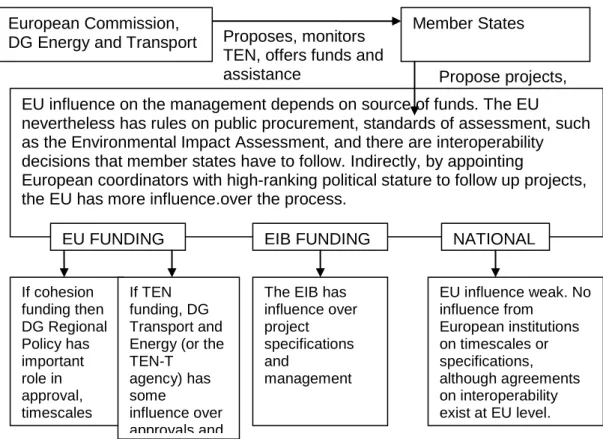
The European Commission cannot compel the building of infrastructure on the territory of member states. The Commission may suggest and only has some power over member states if EU funding is involved. Thus the first task is making member states agree on a set of priority Trans-European projects. Figure 1 presents the role of the European Commission in guiding the TEN developments.
10
Figure 1: Role of EU Institutions in Decision-making and Management
Source: Authors’ compilation.
3.1.2 Enforcement of infrastructure commitments
The European Commission cannot compel member states to build infrastructure It can only exert influence on projects in receipt of significant EU funding. This means that it is easier for the EU to ensure that the TENs are developed in poorer member states which rely on EU cohesion funding rather than wealthier member states which do not need comprehensive EU-funded development strategies. As already mentioned, the appointment of European coordinators introduces implicit pressure to foster the development of the TENs.
3.1.3 Streamlining of management structures and obligations
Member states have their own assessment techniques and administrative procedures, making the development of infrastructure projects at border areas particularly cumbersome. The European institutions are, however, proactive in supporting the establishment of joint-management mechanisms. EU legislation also includes the possibility for any company to establish a so-called “European Company”. This “European Company” statute was created to facilitate the single market and the legal base is a 2001 regulation13, which entered into force in 2004. This is an important piece of legislation which was first proposed thirty years before its final adoption. Even today, there are some complications remaining as employment and tax obligations differ across countries. Some clarification has been provided by a subsequent Directive14
. (SE) 14
Council Directive 2001/86/EC of 8 October 2001 supplementing the Statute for a European company with regard to the involvement of employees
European Commission, DG Energy and Transport
Member States Proposes, monitors
TEN, offers funds and
assistance Propose projects, Agree on TEN lists EU influence on the management depends on source of funds. The EU
nevertheless has rules on public procurement, standards of assessment, such as the Environmental Impact Assessment, and there are interoperability decisions that member states have to follow. Indirectly, by appointing
European coordinators with high-ranking political stature to follow up projects, the EU has more influence.over the process.
EU FUNDING If cohesion funding then DG Regional Policy has important role in approval, timescales If TEN funding, DG Transport and Energy (or the TEN-T agency) has some influence over approvals and EIB FUNDING
The EIB has influence over project specifications and management NATIONAL EU influence weak. No influence from European institutions on timescales or specifications, although agreements on interoperability exist at EU level.
11
The European Company statute is for larger pan-European operations. It requires a minimum capital of €120,000 and is applicable to four cases of company formation: a) Merger: available only to public limited companies from different member states; b) Formation of a Societas Europaea holding company: is available to public and private limited companies with their registered offices in different member states or having subsidiaries or branches in member states other than that of their registered office;
c) Formation of a joint subsidiary is available under the same circumstances to any legal entities governed by public or private law;
d) Conversion of a public limited company previously formed under national law. In any case, the possibility of creating a European Company has greatly facilitated cross-border co-operation. The legislation is quite precise on the management structures and obligations, eliminating many possible ambiguities.
3.1.4 Cost burden sharing
Cross-border infrastructure projects can have asymmetric impacts on the countries concerned with the share of costs on the national territory not proportional to the benefits. Similarly, the extent of other negative factors, such as the creation of pollution in transit countries, may considerably reduce the benefits.
The main role of the EU is as facilitator. It also proposes legislation to guarantee “intermodality”, which is an important aspect for such infrastructure. The EU has agreed on rail and road rules to facilitate the creation of multinational transport infrastructure. After the 2003 decision to accelerate the development of the TENs, several actions have been taken, such as the creation of a European Railway Agency to implement various EU Directives for rail network interoperability, which includes common rules on design, construction, commissioning, upgrading, renewal, operation, and maintenance of the parts of this system placed in service after the entry into force of the directive, as well as the qualifications and health and safety conditions of the staff who contribute to its operation. Similarly, the EU has adopted a number of other directives on road and air transport.
Due to the difficulties in coordinating the response of member states in the area of transport, the EU created a Transport Executive Agency in 2006 to assist in the development of the TENs. In 2008 the Transport Executive Agency took over responsibility for the entire management of the TEN-T projects, which had previously been under the control of the European Commission. The projects will still be the responsibility of member states, but the executive agency will monitor and assist for their implementation. The European Coordinators will also facilitate the realization of complex areas of projects, by bringing political weight to the process. The tasks allocated to the agency are:
ensuring the technical and financial management of projects and events co-financed under the trans-European transport networks' budget;
collecting, analyzing and transmitting to the Commission all information required for the implementation of the trans-European transport network, as well as assisting the Commission with TEN-T network programming;
providing technical support to project promoters and the financial institutions responsible for managing the loan guarantee instruments for the TEN-T projects; providing any technical and administrative support requested by the
Commission;
12
The agency supports member states in the development of the TENs, assists in setting up Public-Private Partnerships (PPPs) and making EU grants or obtaining EIB support. Priority projects are followed by the European coordinators. Annual reports on progress are presented by them.15
For Energy, the European Commission has also set up European coordinators, but no separate agency, and the projects are still followed from within the Commission.
Political aspects of the TENs remain in the hands of the European Commission’s Directorate General for Energy and Transport.
In all cases, member states are responsible for implementing the projects planned and are eligible for support from EU funds under various aid systems. Hence there is no unified management system.
3.2
The European Coordinators
Given the rather weak progress in the development of the Trans-European Networks, the European Commission adopted in July 2005 a decision (No C (2005) 2754 of 20 July 2005) establishing a procedure to appoint European Coordinators in charge of specific priority projects, for individual cross-border sections, for groups of projects located in the same priority axis, or for a whole axis. These appointments are for four years. The European Commissioner in charge of Energy and Transport thus appoints high-level political figures to mediate between countries and push forward the TEN agenda. The Commission correctly assessed that coordinators would introduce the necessary political impetus to deal with difficult cross-border operations, that require international collaboration. In addition, these coordinators would promote the projects to private investors and financial institutions. The Coordinators regularly report to the European Commission. The first and second reports were published in July and September 2007 and are available online from the site of the Trans European Transport Networks16
Coordinators are not remunerated for this service: only costs incurred for the performance of their duties are reimbursed. For the TEN-T projects, the following political figures were appointed:
.
15
http://ec.europa.eu/ten/transport/coordinators/index_en.htm (accessed 30 July, 2008)
13
Relevant positions Assigned to:
Karel Van Miert
Belgian politician; Former European Commissioner from 1989 to 1999. Chairman of the Van Miert group assessing the TEN-T progress in 2003.
Priority Project 1: Berlin- Verona/Milan-Bologna-Naples-Messina-Palermo rail link
Etienne Davignon
Belgian politician, Former vice president of the European Commission 1977–1985
Priority Project 3: South-west European high-speed rail link
Laurens Jan Brinkhorst
Dutch politician; Twice minister, for agriculture and economic affairs, EU ambassador to Japan 1983–1987, Member of the European Parliament 1994-1999
Priority Project 6:
Lyon-Trieste-Divača/Koper-Divača - Ljubljana-Budapest-Ukrainian frontier rail link Péter Balázs Hungarian diplomat; Former
European Commissioner for Regional Policy, Former state secretary,
ambassador to the EU
Priority Project 17: Paris- Strasbourg-Stuttgart-Vienna-Bratislava rail link Pavel Telicka Czech Diplomat; Former chief
negotiator for accession negotiations, former European Commissioner
Priority Project 27: “Rail Baltica” Warsaw- Kaunas-Riga-Tallinn-Helsinki rail link Karel Vinck Belgian businessman; Chairman and
member of several boards of directors in the energy and transport sectors. Former president and chief executive officer of Belgian Railways.
ERTMS project, the European Rail Traffic Management System
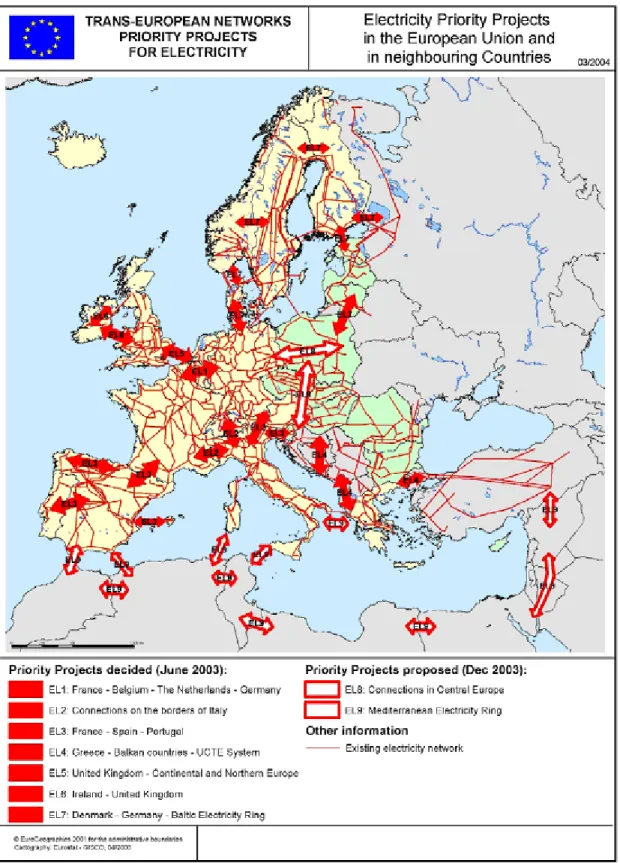
Similarly, for the energy projects, the Commissioner for Energy, Andris Pielbags, appointed in 2007 four project coordinators for the TEN-E projects. The coordinators have the mandate to facilitate the development of a high-voltage connection between France and Spain (transnational part of project EL3); offshore connections in the Baltic and North Sea areas (transnational part of project No.EL7); the NABUCCO Germany, Poland and Lithuania (EL8).
14 The political figures appointed as coordinators are:
Relevant positions Assigned to: Mario Monti Italian academic and politician,
Former Commissioner for the
Internal Market and later
Competition, presently
President of Bocconi
University in Milan, Italy
Transnational part of project EL3. Electricity
connection between France and Spain. This line
is central to link the isolated Iberian energy
sector to the core energy sources of the
European Union.
Georg Wilhelm
Adamowitsch
German politician, State
secretary, Federal Ministry of
Economics and Technology
Transnational part of project No.EL7
Offshore wind connections in the Baltic and
North Sea areas (Denmark, Norway, Germany
and Poland). This project aims to integrate of
the offshore wind energy produced in the Baltic
Sea and North Sea with the continental grid.
Jozias Johannes
van Aartsen
Dutch politician, Former
Minister of Foreign Affairs
NABUCCO natural gas connection (NG3)
Project linking Turkey and Austria through
Romania, Bulgaria and Hungary. This link
should connect the gas resources of Central
Asia, the Caspian region and the Middle East
with central Europe.
Wladyslaw
Mielczarski
Life Professor in Electric
Power Engineering
(EL8) Power connections between Germany,
Poland and Lithuania. Reinforcing the Nordic
Power exchange (Nord Pool) and linking the
Baltic grid to the continental network (Germany
and Poland).
The declarations of the Treaty of Maastricht were followed by a European Council declaration in 1994 which presented 14 priority transport projects, named as the “Essen Projects” based on the city where the declaration was agreed. These 14 projects were based on the recommendations of the Christophersen group, formed of representatives of heads of state or governments, which identified the priority projects for transport and energy. The 14 were drawn from a list of 34 projects.
The project selection was based on the following criteria which stipulated that projects had to:
(i) be in accordance with Community guidelines for the development of a trans-European transport network;
15
(ii) be of exceptional size, bearing in mind the type of project and the relative size of the member states directly concerned;
(iii) pass the economic viability test, including improvements of competitiveness and the technological performance of the Union;
(iv) allow for the possibility of private financing;
(v) be mature enough in order to be carried out quickly;
(vi) avoid the use of public finance for infrastructure which would lead to distortions of competition contrary to the common interest;
(vii) respect Community legislation, in particular concerning environmental protection. In 1995 a budget line for the TEN was created to supplement the cohesion funds and regional funds allocated to poorer member states and regions. The funds allocated to the Trans-European Networks for transport energy and telecommunications was very limited, a total of €2,345 million for the period 1995–99. This, however, was for aid to wealthy member states. Poorer member states were able to use higher support from funding from the cohesion policy. The total allocation depended on national strategy. In 1996 European Council Decision 1692/96 set clearer reference criteria for each mode of transport. The decision included a larger list of priority projects to be completed by2010. The end of Soviet influence in eastern Europe and the prospects of enlargement of the EU to the east created the need for an expansion of the TENs. The Transport Infrastructure Needs Assessment (TINA) was released with an additional ten priority land and sea corridors.
For eastern European Countries the EU offered different financial support for the TENs: €1.8 billion from the Programme of Community aid to the countries of Central and Eastern Europe (PHARE) program; €1bn from the Instrument for Structural Policies for Pre-Accession (ISPA) program; €4.8bn through the EIB, and technical support through the Technical Assistance to the Commonwealth of Independent States (TACIS) program. This was combined and coordinated with EBRD and World Bank loans.
Despite declarations to the contrary, member states did not whole-heartedly embrace the idea of investing in trans-European networks, except for very specific transport projects, in particular high-speed trains. An underlying commitment to the strategy in the interest of the EU was missing. By 2001 only three priority projects had been completed (see Table 3 in the section “Financial Aspects”).
The European Commission accordingly released in 2001 a white paper analyzing the reasons for the sluggish development of transport infrastructure and suggested some solutions. That same year EU heads of state agreed on the need to focus more on the environmental needs of policies and to concentrate on railways, inland waterways, sea shipping, intermodal operations and effective interconnections between modes of transport.
Member states, however, were unable to agree on a revision of the 1996 decision, as promoted by the white paper. Given the impasse, in 2003 a High-Level Group (HLG) was set up to carry out a comprehensive review of TEN-T progress. This group was chaired by the European transport commissioner and composed of representatives of member states and candidate countries for EU membership. The EIB also participated in the meetings.
The HLG presented a report which criticized the TEN-T projects as lacking coherence. It criticized the fact that planned projects (the Essen projects and those added later) had been selected on the basis of their importance for member states rather than in the interest of creating a coherent EU network. It also said that there
16
appeared to be project packages composed of a number of disparate projects. The HLG thus developed a methodology for choosing the projects avoiding the pitfalls of the first plans. They introduced the concept of major “trans-European axes” linking all projects into a more coherent web. The report introduces the concept of Community Added Value to the selection criteria. Nevertheless, the report does integrate all 14 initial Essen projects into the new list. This seems to contradict the statement on lack of coherence and there is probably an underlying political reason for adding the 14 Essen projects to the new list. There is no clear interpretation in the literature reviewed.
The group evaluated projects in a two-stage process. Projects were first screened on a number of basic criteria. Those which did not meet them were eliminated. The criteria are the following:
– Being on a main trans-European axis pertinent to the internal market of the enlarged Europe, taking in particular into account projects crossing natural barriers, solving congestion problems or corresponding to missing links; – Having a European dimension in particular by meeting a threshold of €500
million for infrastructure;
– The existence of evidence showing potential economic viability, other socioeconomic benefits (e.g., social, environmental), and firm commitments from the concerned Member states to carry out the required impact assessments with a view to completing the project within an agreed timeframe.
(HLG, 2003, p.25)
The remaining projects then were evaluated according to a second group of criteria: – The European added value of the project, in terms of importance for
facilitating exchanges between member states, for instance improving interconnections and interoperability between national networks;
– The strengthening of cohesion, either by better incorporating the future member states into an enlarged Europe, or by connecting the main peripheral areas and the least developed regions to the rest of Europe;
– The contribution to the sustainable development of transport while tackling the problems of safety and of environmental protection and by promoting modal transfer.
(HLG, 2003, p.25)
Based on this process, in addition to the Essen group of projects, the HLG selected 22 from more than 100 projects nominated by member states. All delegations, except those from Greece, Belgium, and Luxembourg accepted the new list.
The projects were divided into the following categories:
List 0: Essen projects completed or expected to be completed before 2010; List 1: Essen projects with a firm commitment to completion before 2010; List 2: Longer-term Essen projects;
List 3: Other important projects, but not priority projects, which are important for territorial cohesion.
The projects chosen fulfilled a requirement to increase intermodality and shift transport to rail and away from roads, reflecting the need to reduce the negative environmental effects of transport. The heavy road bias of the first projects was thus counterbalanced.
17
However, road and rail are not the only concerns of the TEN-T plans. Motorways of the sea, coordination with air transport and the Galileo project for an EU satellite navigation system, all are part of the plan.
The HLG report requested that the following requirements be taken into account in the development of the TEN-T network:
• Motorways of the sea should complement mainland axes;
• National rail networks should be more interoperable, specifically with respect to signaling and telecoms;
• Part of the rail network should be dedicated to freight; • Air traffic management should be integrated;
• A river information system should be established;
• A vessel traffic management and information centre should be created; • Existing airports should be better managed;
• Main European axes should be identified; • Acceding countries should be integrated; • Community aid should be increased. (European Commission, 2005)
The report also suggested a new financing approach, as the costs of the TEN-T projects cannot be shouldered by normal public procurement alone. The cost of the whole network has been estimated at over €500 billion. The report calls for innovative systems of PPP financing and the use of modern toll systems for motorways to recover investment and maintenance costs.
In addition the report calls for a standardized approach to the development of infrastructure, with better coordination, common impact assessments and the creation of transnational legal entities.
In 2003 the European Commission published new guidelines and financial rules and performed an extended impact assessment to assess the impact of the new plans compared with taking no action, the completion of the 2001 proposed white paper plans, and the completion of the new structures based on the HLG results.
The results showed an important improvement in the EU’s transport, environment and growth performance (Table 1). The table shows the possible impact of two different scenarios of the TEN-T development compared to no development. The European scenario shows the results of implementing all priority projects agreed before 2001 and half of those in accession countries. The European+ scenario assumes the development of further infrastructure, which were agreed in 2003 and the completion of eastern European transport infrastructure projects.
18
Table 1: The Results of the European Commission’s Extended Impact Assessment
Category European European+
Economic
Potential travel time savings €4.4 billion €7.7 billion Cost €113 billion €196 billion Effects on internal market
dynamics
Small increase of international traffic
Increase of international traffic particularly important for acceding countries Reduction in road
congestion delays
3% 14%
Sustainable Development
Model rebalancing Reduction of road growth on international market segments
Stabilisation of modal split at European level, reduction of road growth on
international market segments and in 12cc Emission reduction €0.4 billion €0.7 billion
Impact on nature Risks to be further assessed at local level in particular for inland waterway projects
Risks to be further assessed at local level in particular for inland waterway projects
Social
Accidents Fewer accidents due to modal shift and better quality infrastructure
Fewer accidents due to modal shift and better quality infrastructure Balanced territorial
development
Relative accessibility to improve for peripheral countries
Relative accessibility to improve most for peripheral and acceding countries Higher GDP growth and
employment
n.a. Welfare 0.23 % GDP or one million permanent jobs
Source: European Commission (2003a). p. 50
The revised guidelines and financial rules were adopted in 2004 by European Council Decision 884/2004 and Regulation 807/2004. The guidelines are now as follows:
(a) the establishment and development of the key links and interconnections needed to eliminate bottlenecks, fill in missing sections and complete the main routes, especially their cross-border sections, crossings of natural barriers, and improve interoperability on major routes;
(b )the establishment and development of infrastructure which promotes the interconnection of national networks in order to facilitate the linkage of islands, or areas similar to islands, and landlocked, peripheral and outermost regions on the one hand and the central regions of the Community on the other, in particular to reduce the high transport costs of these areas;
(c) the necessary measures for the gradual achievement of an interoperable rail network, including, where feasible, routes adapted for freight transport;
19
(e) the necessary measures to integrate rail and air transport, especially through rail access to airports, whenever appropriate, and the infrastructure and installations needed;
(f) optimization of the capacity and efficiency of existing and new infrastructure, promotion of intermodality and improvement of the safety and reliability of the network by establishing and improving inter-modal terminals and their access infrastructure and/or by deploying intelligent systems;
(g) the integration of safety and environmental concerns in the design and implementation of the trans- European transport network;
(h) development of sustainable mobility of persons and goods in accordance with the objectives of the European Union on sustainable development.
Source: Article 19 in Decision 884/2004
As requested by the HLG, priority projects need to be selected on clear criteria. The new decision presented the following list of criteria to be used:
(a) are intended to eliminate a bottleneck or complete a missing link on a major route of the trans- European network, in particular projects which are cross-border projects, cross natural barriers or have a cross-border section;
(b) are on such a scale that long-term planning at European level will help significantly;
(c) present, overall, potential socio-economic net benefits and other socioeconomic advantages;
(d) significantly improve the mobility of goods and persons between member states and thus also contribute to the interoperability of national networks;
(e) contribute to the territorial cohesion of the European Union by integrating the networks of the new member states and improving connections with peripheral and island regions;
(f) contribute to the sustainable development of transport by improving safety and reducing environmental damage caused by transport, in particular by promoting a modal shift towards railways, inter-modal transport, inland waterways and maritime transport;
(g) demonstrate commitment on the part of the member states concerned to carrying out studies and evaluation procedures in time to complete the work in accordance with a date agreed in advance, based upon national plans or any other equivalent document relating to the project in question.
20
The guidelines also revised the TEN-T network and presented a list of 30 priority projects.
The regulation calls for the designation of European Coordinators appointed by the European Commission to co-ordinate and develop complex sections of the priority projects or exceptionally an entire major axis.
In 2006 the EU established the Trans European Network Executive Agency to manage EU funds for the realization of the TEN-T projects. These coordinators act on behalf of the European Commission. Their tasks are defined in the decision as: (a) to promote, in cooperation with the member states concerned, joint methods for the evaluation of projects and, where appropriate, advise project promoters on the financial package for projects;
(b) to draw up a report every year for the European Parliament, the Commission and the member states concerned on progress achieved in the implementation of the project(s) for which he/she is responsible, new regulatory or other developments which could affect the characteristics of the projects and any difficulties and obstacles which may result in a significant delay in relation to the dates indicated in Annex III;
Trans-European transport network (TEN-T) Priority axes and projects
1. Railway axis Berlin–Verona/Milan–Bologna–Naples–Messina–Palermo 2. High-speed railway axis Paris–Brussels–Cologne–Amsterdam–London 3. High-speed railway axis of south-west Europe
4. High-speed railway axis east 5. Betuwe line
6. Railway axis Lyons–Trieste–Divaca/
Koper–Divaca–Ljubljana–Budapest–Ukrainian border
7. Motorway axis Igoumenitsa/Patras–Athens–Sofia–Budapest 8. Multimodal axis Portugal/Spain–rest of Europe
9. Railway axis Cork–Dublin–Belfast–Stranraer 10. Malpensa airport
11. Øresund fixed link
12. Nordic triangle railway/road axis
13. United Kingdom/Ireland/Benelux road axis 14. West coast main line
15. Galileo
16. Freight railway axis Sines/Algeciras-Madrid-Paris
17. Railway axis Paris–Strasbourg–Stuttgart–Vienna–Bratislava 18. Rhine/Meuse–Main–Danube inland waterway axis
19. High-speed rail interoperability on the Iberian peninsula 20. Fehmarn belt railway axis
21. Motorways of the sea
22. Railway axis Athens–Sofia–Budapest–Vienna–Prague–Nuremberg/Dresden 23. Railway axis Gdansk–Warsaw–Brno/Bratislava–Vienna
24. Railway axis Lyons/Genoa–Basle–Duisburg–Rotterdam/Antwerp 25. Motorway axis Gdansk–Brno/Bratislava–Vienna
26. Railway/road axis Ireland/United Kingdom/ continental Europe 27. ‘Rail Baltica’ axis Warsaw–Kaunas–Riga–Tallinn–Helsinki
28. ‘Eurocaprail’ on the Brussels–Luxembourg–Strasbourg railway axis 29. Railway axis of the Ionian/Adriatic intermodal corridor
21
(c) to consult, together with the member states concerned, regional and local authorities, operators, transport users, and representatives of civil society with a view to gaining fuller knowledge of the demand for transport services, the possibilities of investment funding and the type of services that must be provided in order to facilitate access to such funding.
Source: Article 7 (5) in Decision 884/2004
Given the delays to projects, it was decided that the 2010 target for completion be put forward to 2020. Projects that are not developed under the agreed deadlines may lose the support of EU funds.
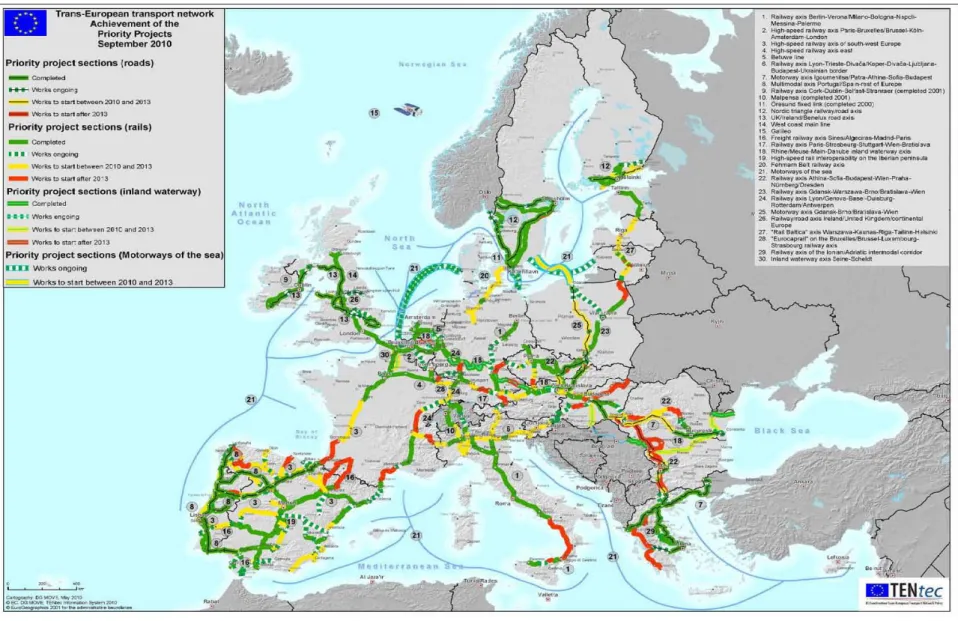
Work in recent years has been accelerating, and despite the Commission’s concern that the 2020 deadline will not be reached, many projects are on track. A 2010 detailed analysis and progress report from the Commission’s Directorate-General for Mobility and Transport on TEN–T notes considerable progress.
Figure 2: TEN-T Priority Projects—A Detailed Analysis
3.3
Financial aspects of TEN-T infrastructure
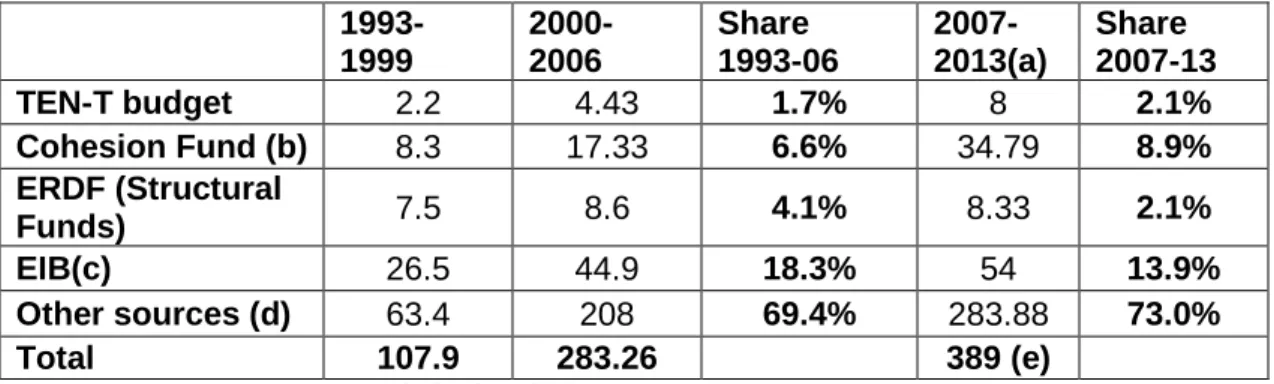
The most significant barrier to the development of the TEN-T projects in addition to the political, legal, and administrative barriers has been financing. The financial demands are significant as the use of traditional public procurement is limited as is obtaining the necessary financial input from commercial banks. The latest total estimates in 2007 for the construction of the overall network has been of €900 billion, €250 billion for the priority projects alone, and €112 billion for the Essen projects still to be carried out.
To have an idea of the challenge ahead, expenditure over the first nine years 1996 to 2005 on the TEN-T projects was approximately €75 billion. To complete the project over the next 15 years investment effort needs to increase more then fivefold. At the present rate of investment, however, it needs only a doubling of financial effort, as the first five years were particularly uneventful and expenditure only really started to increase after 2001.
So far the main sources of funding have been national public funds. The EU offers some co-financing support through the TEN-T and structural and cohesion funds. Due to budget limitations, these have only contributed a very small share: total funds contributed from 2000 to 2006 were approximately €30 billion. Most of these funds are allocated to poorer member states and regions. The EIB’s Structured Finance Facility also played a significant role. The national and private financing contributions (private being rather limited) were €208 billion.
Table 2: Community Financing of TEN-T (EUR billion) 1993-1999 2000-2006 Share 1993-06 2007-2013(a) Share 2007-13 TEN-T budget 2.2 4.43 1.7% 8 2.1% Cohesion Fund (b) 8.3 17.33 6.6% 34.79 8.9% ERDF (Structural Funds) 7.5 8.6 4.1% 8.33 2.1% EIB(c) 26.5 44.9 18.3% 54 13.9% Other sources (d) 63.4 208 69.4% 283.88 73.0% Total 107.9 283.26 389 (e)
Source: European Commission (2008)
Notes: (a) Indicative figures; (b) Including the Pre-Accession Structural Instrument (ISPA); (c) Between 1993–1999 loans for EU15. From 2000 loans in EU-27; (d) Public budgets and private financing; (e) Total investment needs from Implementation Report 2004–2005
Member states have had difficulties in raising the finance required from government budgets. It is interesting to note that the member states (EU15) spent 1.5% of EU GDP in transport infrastructure in 1980, and that this fell to less than 1% in 2010. New member states spent 1.5% of their GDP on transport infrastructure, but these countries also obtain support from the EU budget and even for this level of expenditure there have been issues about the absorption capacity of funds.
Progress on priority projects is described in Annex 1. While a number of projects are nearing completion, no more have been completed than the three which were closed before 2001. European grant funding has its limitations. In poorer regions of the EU up to 85% of costs can be covered (2007–2013), for other areas the only funds available are those dedicated to TEN-T which finance 50% of cost of studies and priority projects (including the satellite positioning system Galileo), 30% for cross-border projects and 10% for non-priority projects. Particularly important is the clause which states that unreasonable delays will cause projects to lose EU financial support.
24
The EU’s budget also provides for EIB loan guarantees, the LGTT (Loan Guarantee instrument for Trans-European Transport network projects). This is an instrument developed jointly between the European Commission and the European Investment Fund. Each year the EU transfers a given sum to the EIB in the form of loan guarantees. This is then used to cover part of the risk of projects, improving the viability of projects and their attractiveness for private investors. LGTT is financed with a capital contribution of €1 billion (€500 million each from the Commission under the TEN-T budget and the EIB) which is intended to support up to €20 billion of senior loans. The amount of guarantee never exceeds more than a €200 million, while the EIB is expected to offer €50 billion in loans over the next decade (EIB 2006a, EIB 2008).
The EIB itself offers loan guarantees through the European Investment Fund and has created a new financial instrument, the Transport Investment Facility (TIF). This consists of loans with maturities of up to 35 years and covering up to 75% of cost. The role of the EIB is explained in more detailed in a joint paper by Van der Geest and Núñez-Ferrer.17
The European Commission’s proposed level of funding in the TEN-T network was not approved by the budget authorities and was considerably reduced for the period 2007–13 requiring the need to find alternative solutions.
PPPs have been increasingly and successfully used to finance the development of the TENs, reducing overall costs and increasing efficiency. However, the use of user fees has been very limited and ultimately the main bulk of the risks and costs have fallen on national governments. The attempt of the European Commission to introduce road charges with a “Eurovignette” has not been successful, although the Commission has not abandoned the idea and still presses in this direction. The mechanism is described in more detail in a document on innovative financing methods (European Commission, 2003b). Only some countries use this to cover road infrastructural costs. A detailed analysis of the use of PPPs is presented in a twin paper by Van der Geest and Núñez-Ferrer.
In addition to core infrastructure projects, support is given to the create European management systems for transport, support for road, air, maritime and coastal management systems or the important European Rail Traffic Management System (ERTMS), as rail has particular interoperability needs.
3.4
Project appraisal
The increased involvement of new funding schemes and the use of PPPs require a thorough review of project appraisal techniques. Member states have different traditions of project appraisal and many are not well-suited to private finance. Project evaluation has been of variable quality in the member states. The European Commission itself has had to develop and is still reinforcing evaluation techniques. Cost-benefit analyses and long-term investment returns from complex infrastructure projects are difficult to calculate and often under or over-estimate user demand and final costs.
The evaluation of public projects also needs to asses social benefits, not just financial costs. For the TENs the Europe-wide benefits are often used as a central reason for the existence of the TENs (see HLG, 2003). However, the benefits of a project may well be very different at national level. There are complex issues surrounding the national analysis of the TENs projects and the EU’s position. There is a need to clarify whether for transport infrastructure is a responsibility of national or supranational bodies. Member states finance the bulk of projects and national appraisal of the value of a project is a key element in decision-making. The EU’s appraisal system combines a Cost Benefit Analysis (CBA) combined with a Multi-Criteria Assessment (MCA) in which a wider set of objectives are incorporated in the
17
Appropriate Financial Instruments for Public Private Partnership to boost Asia’s cross-border Infrastructural Development, Van der Geest, W., and Núñez-Ferrer J. ADBI Discussion Paper.
25
valuation in addition to those directly involved in a pure CBA (European Commission, 2005). In the end, however, projects need to be commercially viable, in particular when private finance is involved. The EU and member states have developed different project appraisal systems. What is clear is that regardless of the wider goals and social benefits, projects which are deemed not commercially viable on the basis of a formal CBA will not be successful in attracting private funding, at least not without public support to mitigate risks. Where the EIB is involved, the EIB’s project appraisal process has had a very strong influence in the selection process of contractors and the kind of co-financing system, national or private. The EIB plays a strong role in the public procurement procedures and imposes strict rules to protect its investment (EIB, 2004, 2005, 2006b).
3.5
Mini case study of multinational infrastructure: Thalys
International
A classic example of multinational cross-border regional infrastructure within the EU is the provider of rail-services Thalys International, a limited liability cooperative jointly-owned by the French, Belgian and German railways.18
Thalys International meets all of the Kawai criteria
The company’s capital base is divided between the three companies with the French SNCF holding 62%, 28% held by the Belgian SNCB/NMBS and 10% held by the German DB.
19
(i) physical infrastructure developed across four countries (Belgium, France, Germany, Netherlands);
as it is a “regional infrastructure project” with:
(ii) significant cross-border sales;
(iii) a technically and financially indivisible project involving several independent national railways working together in a unified program;
(iv) project implementation is carried out in four countries; the service is offered on behalf of the four companies mentioned above in the different locations.
It is worth emphasizing that the relative importance of the four operators varies a great deal. First and foremost, the French national railways SNCF play a dominating role: in addition to being the majority shareholder SNCF also has a good deal of technical know-how. The Thalys rolling stock is an advanced model of the French TGV, developed by Alstom.20
The two minority shareholders provide a smaller share of services, with the Belgian SNCB/NMBS providing the operational hub of the network in Brussels.
Senior staff and the CEO of the company are French and the language culture in the company combines French and English, even though Thalys is incorporated in Belgium.
18
Operating since June 1996, it provides services between Paris, Brussels, Amsterdam and Cologne, using newly-constructed high-speed rail lines. the travel time between Brussels and Paris is 1hr 22 minutes for a 300 km journey. As of 2009, after much delay, the opening of a new dedicated high-speed rail link between Amsterdam and Brussels reduced travel time between those cities by just under an hour, from 2h37 to 1hr44.
19
Professor Kawai defined ”transnational infrastructure” as multi-country, cross-border infrastructure managed by several separate national authorities or companies.
20
Thalys uses two models of trains, both of which are part of t speed trains built by T the Thalys trains are only single deck. These units are quadri-current, and can operate to four destinations (Amsterdam, Brussels, Cologne and Paris). Source: Wikipedia, July, 2008)