Oxidation behaviour of Ti
3
SiC
2
-based ceramic at
900±1300
°
C in air
Zhimei Sun
a, Yanchun Zhou
a,*, Meishuan Li
baDepartment of Ceramic and Composite, Institute of Metal Research, Chinese Academy of Sciences, 72 Wenhua Road, Shenyang 110015, People's Republic of China
bInstitute of Corrosion and Protection of Metals, Chinese Academy of Sciences, 62 Wencui Road, Shenyang 110015, People's Republic of China
Received 10 January 2000; accepted 17 July 2000
Abstract
The isothermal oxidation behaviour of Ti3SiC2-based ceramic containing 7 wt.% TiC at
900±1300°C in air has been investigated. The growth of the oxide scales on Ti3SiC2 from
900°C to 1100°C obeyed a parabolic law, whereas at 1200°C and 1300°C, it was a two-step parabolic oxidation process. The scale was composed of an outer layer of coarse-grained TiO2
(rutile), an inner layer of a mixture of ®ne-grained TiO2 and SiO2 (tridymite). Furthermore,
the oxide scale at 1100°C contained a discontinuous SiO2 ``barrier'' sandwiched in the outer
TiO2layer. The scales formed on Ti3SiC2 were dense, adhesive and have good adhesion with
the substrate during the cyclic oxidation. Ó 2001 Elsevier Science Ltd. All rights reserved.
Keywords:Ti3SiC2-based ceramic; Oxidation behaviour; Air; Parabolic; SiO2barrier
1. Introduction
Titanium silicon carbide (Ti3SiC2), which was identi®ed about 30 years ago [1],
has recently attracted the attention of physicists as well as material scientists because it oers a unique combination of the merits of both metals and ceramics. The high
*Corresponding author. Tel.: +86-24-2384-3531, ext.: 55180; fax: +86-24-2389-1320. E-mail address:[email protected] (Y. Zhou).
0010-938X/01/$ - see front matterÓ 2001 Elsevier Science Ltd. All rights reserved. PII: S0010-938X(00)00142-6
melting point and low density [2], high strength at elevated temperatures [3], excel-lent thermal shock resistance, good thermal conductivity and machinability with
conventional tools [2], to name a few, suggest that Ti3SiC2 and Ti3SiC2-based
ceramic materials be good candidates for high temperature applications. As a struc-tural ceramic for high temperature applications, it should embody the properties of oxidation resistance, chemical stability, low volatility, resistance to creep deforma-tion, sucient toughness at ambient temperature, and thermal shock resistance [4]. Therefore, considering Ti3SiC2 as a high temperature structural material, the ability
to resist oxidation is the primary criteria.
Although the oxidation behaviour of Ti3SiC2or Ti3SiC2-based material has been
investigated by a number of researchers, there are scatters in the reported data [5±9].
Racault et al. [5] studied the oxidation of Ti3SiC2 powders under ¯owing oxygen.
They showed that the oxidation rate for Ti3SiC2was slower than that for TiC, and
the Ti3SiC2powder almost totally oxidised to TiO2(rutile) and SiO2(cristobalite) at
the temperatures between 1050°C and 1250°C. Tong et al. [6] investigated the
oxi-dation of monolithic Ti3SiC2and Ti3SiC2=SiC composite at 1000°C in ¯owing air for
10 h. They demonstrated that the oxidation resistance of Ti3SiC2=SiC composite was
better than that of monolithic Ti3SiC2. Barsoum and El-Raghy [7] reported
para-bolic oxidation behaviour of Ti3SiC2 bulk samples consisted of 2 vol% TiC during
the oxidation at 900±1400°C in air for 500 min. The calculated activation energy is
320 and 370 kJ mol 1. The oxide scale formed at above 1000°C consisted of two
layers: an outer layer of pure TiO2(rutile) and the inner layer of a mixture of SiO2
and TiO2. Feng et al. [8] investigated the oxidation of polycrystalline Ti3SiC2 bulk
material (containing 2 mol% TiC) at temperatures between 800°C and 1100°C for
100 min. They reported a parabolic oxidation in the temperature of 800±950°C and
non-parabolic oxidation from 950°C to 1100°C with corresponding calculated
ac-tivation energies of 137.7 and 312.5 kJ mol 1, respectively. Radhakrishnan et al. [9]
investigated the oxidation behaviour for polycrystalline Ti3SiC2 (containing 2 vol%
TiSi2) at 1000°C in air for 50 h. They demonstrated that the oxidation obeyed a
paralinear law and Ti3SiC2was not a good oxidation-resistance material at 1000°C.
The discrepancy between the reported oxidation behaviour mentioned above is probably attributed to the dierent impurities and manufacturing techniques, and thus dierent microstructures. In addition, the oxidation conditions varied for dif-ferent investigators.
In the present work, we investigated the isothermal oxidation of Ti3SiC2 ceramic
prepared by the in situ hot pressing/solid±liquid reaction process in the temperature range of 900±1300°C up to 20 h. In addition, the cyclic oxidation at 1100°C was also performed to investigate the adherence of the scale with the substrate. The signi®-cance of this work is as follows. Firstly, at 1100°C, a discontinuous SiO2barrier layer
sandwiched in the coarse-grained TiO2 was observed, which inhibited the further
oxidation of Ti3SiC2. Secondly, a two-step parabolic oxidation process was revealed
at 1200°C and 1300°C. Finally, the diusion-controlling oxidation process is not a
simple mode of the inward diusion of oxygen and the simultaneous outward dif-fusion of titanium and carbon, but a complex one. It might be the inward diusion of oxygen and simultaneous outward diusion of Ti and carbonaceous species (CO), as
well as SiO. The results are bene®cial to understanding the high-temperature oxi-dation behaviour of this technically important material.
2. Experimental method
2.1. Specimen preparation
The material used in this work was Ti3SiC2, TSCZS510, which was fabricated by the
in situ hot pressing/solid±liquid reaction process [10]. Brie¯y, the material was made according to the following procedure. Ti, Si, and graphite powders were mixed and milled in a polypropylene jar for 10 h. After ball milling, the mixture was cold pressed in a graphite die with the diameter of 50 mm. The in situ hot pressing/solid± liquid reaction was conducted under a ¯owing argon atmosphere in a furnace using
graphite as heating element. The furnace temperature was rapidly reached to 1550°C
at the rate of 40°C min 1, then the sample was held at that temperature for 1 h under
a pressure of 40 MPa and then cooled down with the pressure removed.
The Ti3SiC2 content in the hot pressed material is 93 wt.% calculated by the
Rietveld method [11] in CERIUSCERIUS2 computational program for material research
(MSI, USA) and the major impurity is TiC. The Rietveld method involves ®tting the entire observed X-ray diraction (XRD) pattern, step by step, to a pattern calculated using models for the crystal structure and diraction peak pro®les, which therefore provides estimates of phase proportions that are less aected by sample aberrations, such as preferred orientation. All the peaks in the observed diraction pattern contribute to the estimate of phase content, therefore, the accuracy of measurement is greatly improved and sensitivity is signi®cantly increased over the traditional methods of quantitative XRD analysis.
For the oxidation experiments, rectangular bars with the dimensions of 1034
mm3were cut by the electrical-discharge method. The surfaces were ground down to
1000 SiC paper and polished using diamond paste. All the samples were chamfered at the edges to reduce thermal stress.
2.2. Specimen examination
The continuous-isothermal-mass-change measurements were performed from
900°C to 1300°C in air for 20 h. The sample was suspended in a thermobalance (mtb
10-8, Setakam, France) with a Pt wire when the temperature reached to the required temperature. The cyclic oxidation experiments were performed in a furnace
con-trolled automatically. The samples were hold at 1100°C in a furnace for one hour
and then cooled down to room temperature in air for 10 min, which was de®ned as one cycle.
After the oxidation tests, the samples were characterised by XRD (Rigaku D/ max-rA diractometer, Japan) to determine the phase composition of the oxide scale. The surface morphology was investigated by an S-360 scanning electron
microscope (SEM) (Cambridge Instruments, Ltd., UK) equipped with an energy dispersive spectroscopy (EDS) system. Subsequently, the oxidised samples were cross-sectioned without polishing for further SEM analysis. In SEM analysis, a thin ®lm of Au was coated on the oxide scale in order to get better observation. 3. Experimental results and discussion
3.1. Oxidation kinetics
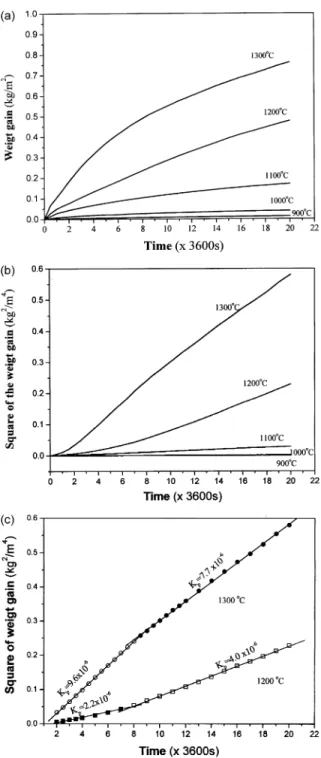
The results of the isothermal oxidation at 900±1300°C in air for 20 h are
sum-marised in Fig. 1(a). The corresponding square of weight gain per unit area as a function of time is shown in Fig. 1(b). It is seen that the speci®c weight gain is relatively small from 900°C to 1100°C and the curve is in agreement with a parabolic
rate law. There is almost no dierence for the weight gain between 900°C and 1000°C
in Fig. 1(b). The parabolic rate constant,Kp, increases from 2:410 9kg2m 4s 1at
900°C to 410 7 kg2m 4s 1 at 1100°C, which is in agreement with the previous
observations [7,8]. The oxidation kinetics at 1200°C and 1300°C, however, followed
a complex law. Carefully analysing the square of speci®c weight gain versus time curves for the samples oxidised at 1200°C and 1300°C (as was shown in Fig. 1(c)), we obtained a two-step parabolic oxidation process. In the ®rst oxidation stage, i.e., from 2 to 9 h, the parabolic rate constants at 1200°C and 1300°C are 2:210 6and
9:610 6 kg2m 4s 1, respectively. Whereas in the second stage of oxidation, i.e.
from 9 to 20 h, the parabolic rate constants are 410 6and 7:710 6kg2m 4s 1,
respectively. This two-step oxidation mechanism, or two oxidation stages at 1200°C
and 1300°C have not been reported in previous works, which is not surprising
considering the relatively short oxidation time in the early works.
It is also interesting to note that the parabolic constant changes in dierent ways
for the samples oxidised at 1200°C and 1300°C. The parabolic rate constant became
lower at the second stage of oxidation when oxidised at 1300°C, which suggests that
protect scale or layer that inhibits further oxidation might be formed. Contrary to
the phenomenon at 1300°C, the parabolic constant became higher at the second
stage of oxidation when exposured at 1200°C.
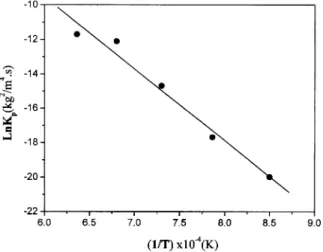
The temperature dependence of the parabolic rate constants for Ti3SiC2is shown
in Fig. 2. The curve of lnKpversus 1=Tis near linearity, from which we obtained the
activation energy of 350 kJ mol 1for the oxidation process from 900°C to 1300°C.
The result is in agreement with the result of Barsoum and El-Raghy [7], 320±370 kJ mol 1and that of Feng et al. [8], 312.5 kJ mol 1in the temperature of 950±1100°C.
To study spallation resistance of the oxide scale, the cyclic oxidation was con-ducted at the condition of 1 h furnace heating and 10 min air cooling. The
ac-cumulative time at 1100°C is 88 h. Fig. 3 shows the weight gain as a function of
oxidation time for the cyclic oxidation of Ti3SiC2 at 1100°C. No mass loss was
detected and the mass gain would simply increase if the experiment were not be
interrupted. It is therefore concluded that the oxide scale formed on Ti3SiC2 is
Fig. 1. (a) Weight gain per unit area versus time for Ti3SiC2oxidised at dierent temperatures. The de-pendence of the square of the speci®c weight gain with time for Ti3SiC2 oxidised (b) at dierent tem-peratures, (c) at 1200°C and 1300°C, respectively.
3.2. Microstructure observations
In Section 3.1, we demonstrated that Ti3SiC2was a material with good oxidation
resistance below 1100°C. To understand the oxidation process, the surface
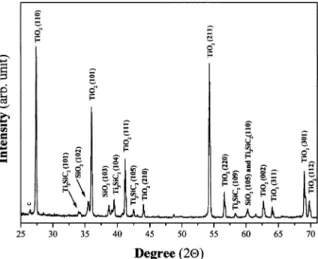
mor-phology and phase composition of the oxide scales were analysed by SEM and XRD analysis, respectively. Fig. 4 shows the XRD pattern of the surface of the sample
oxidised at 900°C for 20 h, where peaks from re¯ections of TiO2 (rutile), SiO2
(tridymite), and Ti3SiC2 can be seen. The presence of Ti3SiC2 was due to the very
Fig. 2. The temperature dependence of the parabolic rate constant for the oxidation of Ti3SiC2.
Fig. 3. Weight gain per unit area versus time for Ti3SiC2cycled from 1100°C to room temperature 88 times. The total time for the cyclic oxidation is 102.7 h.
thin layer of the oxide scale (little speci®c weight gain was observed). The presence of graphite in Fig. 4 was due to contamination. The oxide products were then
deter-mined to be TiO2 with minor amount of SiO2. When the temperature increases to
1000°C, no peaks from Ti3SiC2 could be detected (not shown here), indicating the
thickness of the oxide scale increased with temperature. The main phase of the oxide
product was TiO2 with trace of SiO2. Above 1100°C, only TiO2 was observed.
Therefore, at the present oxidation conditions, the oxide products on the Ti3SiC2
surface developed from TiO2 and SiO2 at low temperature (900°C) to rather pure
TiO2at high temperatures (above 1100°C). To con®rm the above results, the surface
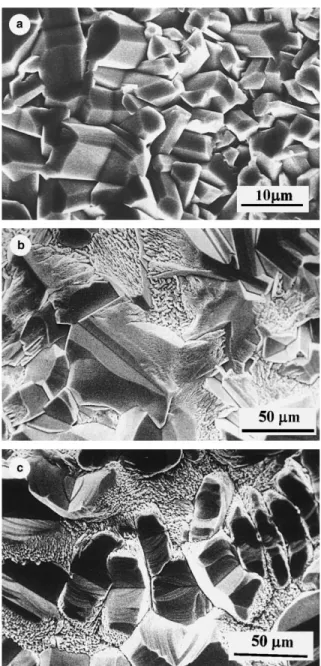
morphology and the cross-section of the oxide layer was investigated by SEM. According to SEM investigation, the morphology of the surface scale can be divided into two groups:
(1) Well-shaped crystals were formed on Ti3SiC2 at 900°C and 1000°C, Fig. 5(a)
shows the surface morphology of the sample oxidised at 900°C. The crystal
mor-phology of the sample oxidised at 1000°C is similar to that of 900°C, it is therefore not shown here for briefness. The crystal size increased with increasing oxidation temperature and scale thickness.
(2) The Ti3SiC2samples oxidised from 1100°C to 1300°C revealed rather dierent
morphology, which were shown in Fig. 5(b)±(d). The scale consisted of two parts, i.e. large crystallites with well-shaped facets and small grains embedded in them.
Fur-thermore, some surfaces of TiO2of the samples oxidised at 1100°C and 1200°C were
covered with bubbles, a typical morphology at 1100°C was shown in Fig. 5(e). Large
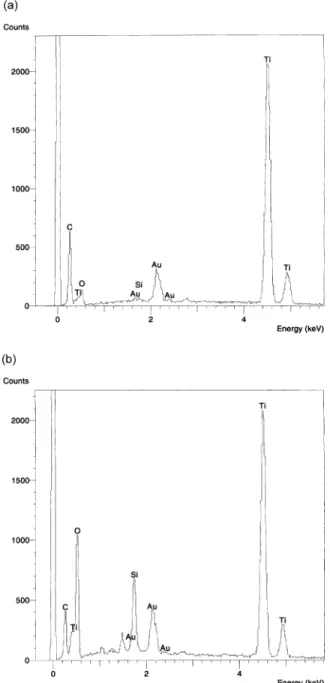
crystallite (as marked B) contained Ti and O, while both the bubbles (as marked A) and the small grains in Fig. 5(b)±(d) all contained Ti, Si and O. The corresponding EDS X-ray spectra were shown in Fig. 6(a)±(c) respectively. The presence of C was again due to contamination. Comparing the data from XRD and EDS X-ray
microanalysis, a discrepancy existed between the two results, i.e. it is free of SiO2in
the XRD patterns for samples oxidised at 1100°C and above, however, the EDS
X-ray microanalysis did con®rm the presence of Si. It might be attributed to the fact
that the SiO2 content is very low so that XRD did not detect it.
Fig. 5. Surface morphology of oxide scale after Ti3SiC2samples exposure in air at (a) 1000°C, (b) 1100°C, (c) 1200°C, (d) 1300°C, and (e) at 1100°C showing bubbles enriched in Si on the SiO2surface.
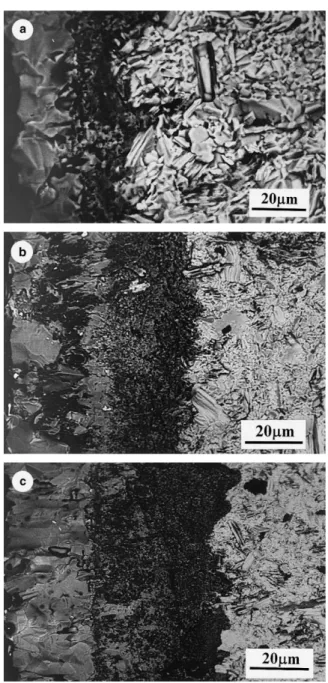
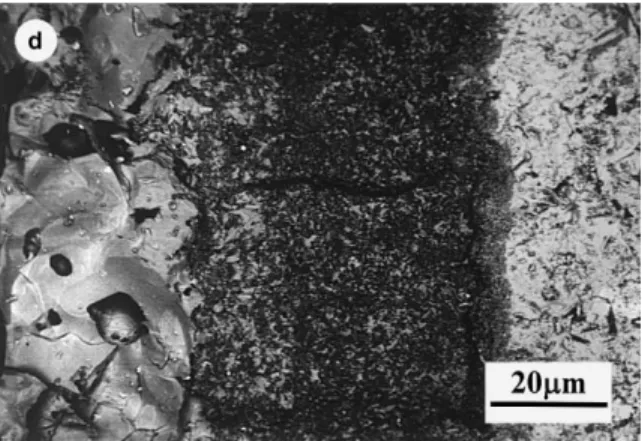
Typical back-scattered electron image of the cross-section scale for the samples
oxidised from 1000°C to 1300°C in air for 20 h are shown in Fig. 7(a)±(d). With the
X-ray microanalysis, the coarse-grained bright layers on the left of the micrographs
were identi®ed as TiO2 and the dark grey layers in the middle of the micrographs
were recognised as mixtures of TiO2 and SiO2. The bright parts on the right were
Ti3SiC2 matrix. Therefore, the scale generally consists of an outer part of
coarse-grained TiO2and an inner part of a ®ne-grained mixture of TiO2and SiO2as shown
in Fig. 7(a), (c) and (d). Whereas in Fig. 7(b) for the oxide scale produced at 1100°C,
a discontinuous sandwich layer of SiO2 was observed in the outer layer of
coarse-grained TiO2. This sandwiched-in layer formed an intermediate barrier for the
dif-fusion of the oxidation species. This phenomenon is similar to the oxidation of TiAl at 900°C [12], in which an Al2O3barrier formed in the border region of the outer and
the inner layer and good oxidation resistance was observed. This SiO2 barrier was
also helpful to the oxidation resistance of Ti3SiC2. The discontinuous character of
SiO2 barrier might be attributed to the TiC content in the matrix. Thus the oxide
layer of the Ti3SiC2samples oxidised at 1100°C can be described as an outer part of
coarse-grained TiO2 sandwiched by rather pure discontinuous coarse-grained silica
barrier, and an inner layer of a mixture of ®ne-grained TiO2 and SiO2. This
distri-bution of oxides was further con®rmed by X-ray dot maps shown in Fig. 8.
Fig. 6. EDS X-ray spectra from (a) large crystallite marked as B in Fig. 5(e), (b) bubbles marked as A in Fig. 5(e), (c) small grains in Fig. 5(c).
3.3. Transport process in the scale
As discussed above, the oxidation of Ti3SiC2 was a diusion-controlled process.
The marker experiment in our previous work [13] showed that the oxidation of
Ti3SiC2 was mainly controlled by the outward diusion of titanium and inward
diusion of oxygen. In the previous works by Barsoum and EI-Raghy [7] and Feng et al. [8], this process was controlled by the inward diusion of oxygen and outward diusion of titanium and carbon, and the Si sublattice was essentially immobile. We
here proposed a dierent mode to explain the oxidation of Ti3SiC2and the formation
of SiO2 barrier and SiO2 bubbles on the TiO2 surface.
At initial oxidation stage, the in situ oxidation of Ti3SiC2occurred, TiO2and SiO2
formed, and CO gas left away from the surface. The total reaction is
Ti3SiC25O2 g !3TiO2SiO22CO g 1
Further oxidation continued by the outward diusion of titanium and inward
diusion of oxygen. After certain time, a continuous TiO2 ®lm formed on the
sur-face, and SiO2was wrapped under TiO2. After transient oxidation, a two layer scale
is formed: the inner layer consists of a mixture of TiO2and SiO2, and the outer layer
is rather pure TiO2. Due to the SiO2 precipitates, the oxygen pressure in the inner
layer is much lower than that in the outer layer. Low oxygen pressure supported the
formation of SiO rather than SiO2, and the formed SiO2 turned into SiO [14],
therefore, the oxidation takes place by the following total reaction:
Ti3SiC2SiO24O2 g !3TiO22SiO g 2CO g 2
The oxidation was then controlled by the outward diusion of titanium, SiO and
CO gas, and inward diusion of oxygen at high temperatures, such as at 1100°C and
Fig. 7. Back scattered image of cross-section of the oxide scales after exposure in air at (a) 1000°C, (b) 1100°C, (c) 1200°C, and (d) 1300°C for 20 h.
1200°C. During the outward diusion process, SiO gas will turn into solid SiO2
where the oxygen pressure is high enough to support the following reaction, such as
in the outer coarse-grained TiO2 layer.
SiO g 12O2 g !SiO2 3
SiO2 was therefore precipitated in the outer coarse-grained TiO2 layer, forming a
SiO2barrier. If the SiO gas diused outward the TiO2surface along certain diusion
channel, SiO turned into SiO2according to Eq. (3) forming bubbles rich in Si on the
Fig. 8. Typical X-ray dot maps of the oxide cross-section of Ti3SiC2at 1100°C for 20 h. Fig. 7 (continued)
TiO2surface, as shown in Fig. 5(e). At low temperatures, such as 900°C and 1000°C,
the oxidation rate is very low, and the oxide scale is thin, therefore, the concentration gradient of oxygen in the scale was not steep, therefore the oxidation process
fol-lowed Eq. (1) and no SiO2 bubbles or barrier was observed. At very high
tem-peratures, such as 1300°C, the oxidation rate was high, and pores and cracks might
form, thus the diusion process along these channels was too quick to form SiO2
barrier or bubbles. In addition, the small grains might form as follows. When
out-ward diusion of CO or SiO came out of some TiO2 planes, they destroyed the
original well-shaped grains and left holes behind them. These holes developed with time forming the morphology of small grains on the large grains. Further work is required to study the mechanism of the formation of the small grains.
4. Conclusions
The oxidation kinetics of Ti3SiC2polycrystalline samples containing 7 wt.% TiC
from 900°C to 1300°C in air are parabolic with an activation energy of 350 kJ mol 1.
Furthermore, the oxidation at 1200°C and 1300°C can be considered as a two-step
parabolic oxidation process. The oxide scale is dense and adherent, resistant to cyclic oxidation. The scale was generally composed of an outer layer of coarse-grained
TiO2 and an inner layer of ®ne-grained mixture of TiO2 and SiO2. The oxide scale
formed at 1100°C contained a discontinuous SiO2barrier sandwiched in the
coarse-grained TiO2. Bubbles enriched in Si were also observed forming on some surface of
TiO2 at 1100°C and 1200°C. The parabolic oxidation, combining with marker
ex-periment, supported a diusion-controlled process that was the inward diusion of oxygen and outward diusion of titanium and carbonaceous species (CO). In
ad-dition, this process at high temperatures, especially at 1100°C, might also be
con-trolled by the outward diusion of SiO to the oxide surface. Acknowledgements
This work was supported by National Outstanding Young Scientist Foundation under grant no. 59925208, the National Sciences Foundation of China under grant no. 59772021 and the 863 program.
References
[1] W. Jeitschko, H. Nowotny, F. Benesovsky, Monatash Chem. 98 (1967) 329. [2] M.W. Barsoum, T. El-Raghy, J. Am. Ceram. Soc. 79 (1996) 1953.
[3] Z. Sun, Y. Zhou, J. Zhou, Phil. Mag. Lett. 80 (2000) 289. [4] R. Raj, J. Am. Ceram. Soc. 76 (1993) 2147.
[5] C. Racault, F. Langlais, R. Naslain, J. Mater. Sci. 29 (1994) 3384. [6] X. Tong, T. Okano, T. Iseki, T. Yano, J. Mater. Sci. 30 (1995) 3087. [7] M.W. Barsoum, T. El-Raghy, J. Electrochem. Soc. 144 (1997) 2508.
[8] A. Feng, T. Orling, Z.A. Munir, J. Mater. Res. 14 (1999) 925.
[9] R. Radhakrishnan, J.J. Williams, M. Akinc, J. Alloy. Comp. 286 (1999) 85. [10] Y. Zhou, Z. Sun, S. Chen, Y. Zhang, Mat. Res. Innovat. 2 (1998) 142. [11] R.A. Young, The Rietveld Method, Oxford University Press, Oxford, 1993. [12] S. Becker, A. Rahmel, M. Schorr, M. Schutze, Oxidat. Metals 38 (1992) 425. [13] Z. Sun, Y. Zhou, unpublished work.