Sterilization
Part 4: Operational management
(New edition)
with
Part 6: Testing and validation
protocols
Health Technical Memorandum 2010
© Crown copyright 1997. Published with permission of NHS Estates, an Executive Agency of the Department of Health,
on behalf of the Controller of Her Majesty’s Stationery Office. Applications for reproduction should be made in writing to The Copyright Unit, Her Majesty’s Stationery Office, St Clements House, 2–16 Colegate, Norwich NR3 1BQ. First published 1997
ISBN 0-11-322031-6
Standing order service
Are you making full use of The Stationery Office’s Standing Order Service?
The Standing Order Service is a free monitoring of the publications of your choice from over 4000 classifications in 30 major subject areas. We send you your books as they are published, along with an invoice.
With a standing order for class 14.02.017 you can be supplied automatically with further titles in this series as they are published.
The benefits to you are:
• automatic supply of your choice of classification on publication;
• no need for time-consuming and costly research,
• saving on the need and the costs of placing individual orders.
We can supply a wide range of publications on standing order, from individual annual publications to all
publications on a selected subject. If you do not already use this free service, or think you are not using it to its full capacity, why not contact us and discuss your requirements?
You can contact us at:
The Stationery Office Standing Order Department PO Box 276
London SW8 5DT
Tel: 0171-873 8466; fax 0171-873 8222
About this publication
Health Technical Memoranda (HTMs)
give comprehensive advice and
guidance on the design, installation and
operation of specialised building and
engineering technology used in the
delivery of healthcare.
They are applicable to new and existing
sites, and are for use at various stages
during the inception, design,
construction, refurbishment and
maintenance of a building.
HTM 2010 is published in five volumes:
•
Part 1 –
Management policy
–
is a summary of the information
required by non-technical personnel
responsible for the management of
sterilization services. It discusses the
various types of sterilizer, for both
clinical and laboratory use, and also
contains guidance on legal and
policy matters, and on the
appointment and responsibilities of
personnel. It should be read by
anyone consulting this
memorandum for the first time;
•
Part 2 –
Design considerations
–
contains information relevant to the
specification and installation of new
sterilizing equipment. It discusses
the requirements for each type of
sterilizer and outlines the
specifications to be included in any
contract. Practical considerations for
the installation of sterilizers are
discussed, including siting, heat
emission, ventilation, noise and
vibration, and mains services with
an emphasis on steam quality;
•
Part 3 –
Validation and
verification
– covers all aspects of
validation and periodic testing of
sterilizers. It includes detailed
schedules and procedures for tests
and checks to be carried out for
commissioning and performance
qualification and for subsequent
periodic testing;
•
this volume includes Part 4 –
Operational management
–
which covers all aspects of the
routine operation and maintenance
of sterilizers, stressing the need for
a planned maintenance programme
along with the type of records to be
kept. Advice on the safe and
efficient operation of sterilizers is
given, as well as procedures for
reporting defects and accidents;
and Part 6 –
Testing and
validation protocols
– which
provides step-by-step guidance on
testing and validation of processes;
•
Part 5 –
Good practice guide
–
provides supplementary advice on a
number of matters concerned with
the effective usage of sterilizers.
The contents of this HTM in terms of
management policy and operational
policy are endorsed by:
a.
the Welsh Office for NHS Wales;
b. Health Estates for Northern
Ireland;
c.
the NHS in Scotland Estates
Environment Forum.
References to legislation appearing in
the main text of this guidance apply to
the United Kingdom as a whole, except
where marginal notes indicate variations
for Scotland or Northern Ireland. Where
appropriate, marginal notes are also
used to amplify the text.
Executive summary
HTM 2010 gives guidance on the choice, specification, purchase, installation, validation, periodic testing, operation and maintenance of the following types of sterilizer in use in the National Health Service:
a. clinical sterilizers:
(i) high-temperature steam sterilizers used for processing porous loads (including instruments and utensils wrapped in porous materials);
(ii) high-temperature steam sterilizers used for processing aqueous fluids in sealed containers;
(iii) high-temperature steam sterilizers used for processing unwrapped solid instruments and utensils;
(iv) dry-heat sterilizers (hot-air sterilizers);
(v) low-temperature steam (LTS) disinfectors and low-temperature steam and formaldehyde (LTSF) sterilizers;
(vi) ethylene oxide (EO) sterilizers; b. laboratory sterilizers:
(i) high-temperature steam sterilizers used with one or more specialised operating cycles;
(ii) culture media preparators.
Users who wish to employ processes not included here bear the responsibility of ensuring that the validation procedures comply with the principles outlined in Part 3 of this HTM and that the intended operating procedures will ensure an efficacious process for the different types of load.
This HTM is intended primarily as a guide for technical personnel, whether specialists in sterilizers and sterilization procedures or those responsible for maintenance and testing. It is also intended for those responsible for the day-to-day running of sterilizers, and will also be of interest to microbiologists, infection control officers, supplies officers, architects, estates managers and others in both the public and private sectors.
Detailed information on the planning and design of a sterile services department, including the level of provision of sterilizers, is given in HBN 13 – ‘Sterile services department’. Guidance for laboratory installations can be found in HBN 15 – ‘Accommodation for pathology services’.
Although this edition of HTM 2010 reflects established sterilizer technology, it is recognised that considerable scope exists for the utilisation of emerging technology in the management of sterilizers. This will be kept under review with the aim of introducing recommendations for such technology at the earliest opportunity so that the procedures essential for the efficient, safe and effective operation of sterilizers can be optimised.
Scottish Health Planning Notes 13 – ‘Sterile services department’, and 15 – ‘Accommodation for pathology services’, apply in Scotland In Scotland LTSF sterilizers are considered to be disinfectors
Most of the British Standards for sterilizers which were applicable at the time of HTM 10 ‘Sterilizers’ (1980), have been either withdrawn or radically revised. Some of them, in turn, are being replaced by European Standards which will be published during the currency of this edition of HTM 2010. Some of these European Standards support new European Union Directives on medical devices which are having a major impact on sterilization. Where practicable, the information in this HTM has been aligned with existing or anticipated standards and advice is offered where no standard has yet been formulated. The sterilizers described in this HTM may not be suitable, without
modification, for safely processing articles infected with Hazard Group 4 pathogens. Design considerations for sterilizers intended to process articles infected with such organisms are discussed in Part 2.
The agents associated with transmissible spongiform encephalopathies (TSEs) are unusually resistant to sterilization and cannot be reliably inactivated by the standard procedures described here. Advice on the sterilization of items contaminated with TSE agents can be found in Appendix 2.
This volume (Parts 4 and 6) substantially revises previous editions of Part 4 and includes guidance on testing and validation of sterilization processes.
Information about TSEs may be found in the HSE document ‘Precautions for work with human and animal Transmissible Spongiform
Encephalopathies’, compiled by the Advisory Committee on Dangerous Pathogens
Information about Hazard Groups may be found in the HSC document ‘Categorisation of pathogens according to hazard and categories of
containment’ (second edition 1990) compiled by the Advisory Committee on Dangerous Pathogens
Contents
About this publication Preface
PART 4 – OPERATIONAL MANAGEMENT 1. General page 5
1.1 Introduction
1.4 Legal frameworks for sterilization 1.8 Medicinal products 1.12 Medical devices 1.23 Quality systems 1.25 Personnel 1.44 Safety 2. Operational management – an overview page 11 2.1 Introduction 2.3 Maintenance 2.5 Safety precautions
2.10 Hazards associated with sterilization 2.12 Safety of pressure vessels
2.13 Unloading
2.14 Personal protective equipment 2.16 Compatibility of load and process
2.20 Process development 2.22 “Single-use” medical devices 2.26 Cleaning
2.28 Packaging
2.34 Performance qualification 2.42 Position of PQ sensors 2.43 Cycle variables
2.56 Cycle monitoring and documentation 2.64 Process indicators
2.66 Product release
2.71 Master process record 2.74 Rejected loads 2.77 Storage
3. Record-keeping page 27
3.1 Introduction 3.9 Plant history file 3.10 Sterilizer process log
4. Maintenance page 31
4.1 Introduction 4.5 Maintenance Person
4.9 Planned maintenance programme 4.10 Design of a PM programme 4.15 Review of the PM programme 4.17 Inspection of pressure vessels 4.20 Modifications
4.21 Routine housekeeping 4.22 Maintenance of laboratory sterilizers 4.25 Features requiring special attention
4.26 Stainless steel chambers 4.32 Air-tightness of the chamber 4.34 Door-locking mechanisms 4.37 Air detector
4.40 Instruments 4.45 Ancillary equipment 4.48 Returning a sterilizer to service
5. Operation of porous load sterilizers page 40
5.1 Introduction 5.3 The process
5.6 Product compatibility
5.9 Items that should not be processed in a porous load sterilizer
5.10 Design of the load 5.13 Air removal
5.17 Handling of condensate 5.25 Packaging materials 5.29 Performance qualification 5.32 Selection of cycle variables
5.33 Cycle monitoring and documentation 5.38 Product release
5.39 Troubleshooting 5.39 Air detector fault 5.41 Wet loads 5.47 Superheating
5.51 Spontaneous combustion
6. Operation of fluid sterilizers page 48
6.1 Introduction 6.3 The process 6.6 Safety precautions 6.10 Product compatibility
6.11 Items that should not be processed in a fluid sterilizer
6.12 Design of the load 6.14 Bottles 6.17 Plastic bags 6.18 Vials and ampoules 6.20 Closure systems 6.26 Performance qualification 6.29 Selection of cycle variables
6.31 Cycle monitoring and documentation 6.35 Product release
7. Operation of sterilizers for unwrapped instruments and utensils page 55
7.1 Introduction 7.3 The process
7.7 Water supply 7.10 Safety precautions 7.12 Product compatibility
7.14 Items that should not be processed 7.15 Design of the load
7.18 Selection of cycle variables
7.22 Cycle monitoring and documentation 7.25 Product release
8. Operation of dry-heat sterilizers page 60
8.1 Introduction 8.3 The process 8.5 Safety precautions 8.7 Product compatibility
8.9 Items that should not be processed by dry heat
8.11 Design of the load
8.14 Load preparation and packaging 8.22 Arrangement of load items 8.26 Performance qualification 8.28 Selection of cycle variables
8.30 Cycle monitoring and documentation 8.34 Product release
9. Operation of LTS disinfectors page 65
9.1 Introduction 9.4 The process 9.8 Safety precautions 9.9 Product compatibility
9.11 Items which should not be processed by LTS 9.12 Design of the load
9.13 Air removal
9.15 Handling of condensate 9.16 Packaging materials 9.17 Selection of cycle variables
9.18 Cycle monitoring and documentation 9.20 Product release
10. Operation of LTSF sterilizers page 68
10.1 Introduction 10.5 The process 10.9 Formaldehyde solution 10.12 Polymerisation 10.15 Safety precautions 10.17 Effects on health
10.21 Replenishing the formalin supply 10.25 Product compatibility
10.29 Items which should not be processed by LTSF 10.30 Design of the load
10.31 Air removal
10.32 Handling of condensate 10.38 Packaging materials 10.44 Performance qualification 10.45 Selection of cycle variables
10.47 Cycle monitoring and documentation 10.51 Product release and storage
10.56 Troubleshooting
10.58 Failure of the routine microbiological test 10.59 Polymerisation of formaldehyde
11. Operation of ethylene oxide sterilizers page 77
11.1 Introduction 11.4 The process 11.11 Safety precautions 11.12 Product compatibility
11.18 Items that should not be processed by ethylene oxide
11.19 Design of the load 11.28 Performance qualification 11.31 Preconditioning
11.40 Selection of cycle variables
11.42 Cycle monitoring and documentation 11.45 Chamber humidity
11.47 EO concentration 11.50 Product release 11.52 Degassing 11.59 Troubleshooting
11.59 Failure of the routine microbiological test
12. Operation of laboratory sterilizers page 86
12.1 Introduction 12.3 Sterilization conditions 12.7 Safety precautions 12.9 Hazards 12.13 Operating procedures 12.16 Operating cycles
12.21 Make-safe of small plastic discard 12.30 Make-safe of contained fluid discard 12.35 Sterilization of culture media (preset or
variable cycle) 12.44 Disinfection of fabrics
12.48 Sterilization of glassware and equipment 12.50 Free steaming
12.51 Culture media preparator 12.53 Performance qualification 12.54 Product release
12.59 Troubleshooting
12.59 Faults on make-safe cycles
13. Reporting of incidents page 94
13.1 Introduction
13.8 Department of Health reporting procedures 13.14 Statutory reporting procedure
Glossary page 97
Abbreviations page 103
Bibliography page 105
Appendix 1 – Useful addresses page 112
Appendix 2 – Sterilization of items contaminated with TSE agents page 114
A2.1 Introduction A2.7 Sterilization
Appendix 3 – Safety of EO sterilization page 116
A3.1 Introduction
A3.7 Fire and explosion hazards A3.14Polymerisation A3.16 Toxicity hazards
A3.16Vapour toxicity
A3.21Effects of liquid EO on skin and eyes A3.23 Workplace monitoring and recording
A3.29Personal sampling A3.32Environmental monitoring A3.35 Personal protective equipment
A3.40Respiratory protective equipment A3.48Protective clothing
A3.49 Emergency procedures A3.53Leaking cylinder A3.54Fire fighting advice A3.57Spillage
A3.60First aid advice
A3.67 Control and handling of cylinders A3.72 Information and training
A3.76 Maintenance
Appendix 4 – Guidance to management on the appointment of an Authorised Person
page 126
A4.1 Introduction
A4.7 Contractual arrangements A4.13 Core responsibilities
A4.14General advice A4.15Validation programmes
A4.16Auditing of validation and yearly tests A4.22Test and maintenance programmes A4.23Operational procedures
A4.24 Additional services
PART 6 – TESTING AND VALIDATION PROTOCOLS Appendix 5 – Sample log book for porous load sterilizers page 132
Appendix 6 – Operational procedures page 157
About NHS Estates page 242
1.0
General
Introduction
1.1 This Part of HTM 2010 covers the maintenance and operation of the various types of sterilizer used in hospitals, laboratories and other healthcare facilities.
1.2 Terminology used in sterilization has long been inconsistent and occasionally ambiguous. This HTM introduces a set of terms consistent with new European Standards (see paragraph 1.18) which, it is hoped, will in time be adopted by sterilization workers in the NHS. The Glossary contains definitions referred to in this Part.
1.3 The Bibliography contains full references for all the documents referred to in this Part and for selected documents of which the reader should be aware.
Legal frameworks for sterilization
1.4 There are now two legal frameworks governing the manufacture of sterile products. The long-standing legislation on medicinal products has now joined by new European Union (EU) Directives on medical devices.
1.5 Users should be clear as to whether the load items they intend to process in a sterilizer are classified as medicinal products or medical devices. Definitions for both may be found in the Glossary. While the practical requirements have much in common, their implementation is very different.
1.6 For the guidance given in this HTM, the various types of sterilizer are presumed to be used primarily as follows (though there are exceptions):
a. for medicinal products:fluid sterilizers, dry-heat sterilizers;
b. for medical devices:porous load sterilizers, sterilizers for unwrapped instruments and utensils, dry-heat sterilizers, LTS disinfectors, LTSF sterilizers, EO sterilizers.
1.7 Where a sterilizer is purchased with the intention of processing both medicinal products and medical devices, Users should ensure that the requirements for both types of product are met.
Medicinal products
1.8 The manufacture and supply of medicinal products are controlled by a large body of legislation stemming from the EU Directives on medicinal products and enacted by the UK Medicines Acts and numerous Regulations. Further details can be found in Part 1 of this HTM.
In Scotland, LTSF Sterilizers are considered to be disinfectors
1.9 The requirements for the manufacture of medicinal products are set out in the ‘Guide to good manufacturing practice for medicinal products’ published in volume IV of ‘The rules governing medicinal products in the European Community’. This document is referred to as the “GGMP” in this HTM.
1.10 The GGMP contains an Annex on the ‘Manufacture of sterile medicinal products’ which has considerable implications for the operation of sterilizers. Users considering using a sterilizer for the processing of medicinal products should consult the GGMP at an early stage.
1.11 Guidance on the application of medicines legislation to particular cases is beyond the scope of this HTM and advice should be sought from the
Medicines Control Agency (MCA) whose address may be found in Appendix 1.
Medical devices
1.12 Part 1 of this HTM discusses the three EU Directives on the manufacture and supply of medical devices, active implantable medical devices and in-vitro diagnostic medical devices. The first two directives are implemented in the UK by The Active Medical Devices Regulations 1992 and The Medical Devices Regulations 1994. (The directive on in-vitro diagnostic medical devices is yet to be published.) General guidance on these directives and regulations may be found in MDA Directives Bulletin 8.
1.13 Annex I of the Medical Devices Directive lists a number of “essential requirements”, among which the following are relevant to sterilization.
a. Section 7.2 requires that devices are “designed, manufactured and packaged in such a way as to minimise the risk posed by contaminants and residues to the persons involved in the transport, storage and use of the devices and to the patients, taking account of the intended purpose of the product.” This has implications for the quality of steam used in sterilization processes, and for the efficacy of removal of gas residuals in LTSF and EO sterilization.
b. Sections 8.3 and 8.4 require that devices delivered in a sterile state: (i) “must be designed, manufactured and packed in a non-reusable
pack and/or according to appropriate procedures to ensure that they are sterile when placed on the market and remain sterile, under the storage and transport conditions laid down, until the protective packaging is damaged or opened”;
(ii) “must have been manufactured and sterilized by an appropriate, validated method.”
c. Section 8.7 requires that the “packaging and/or label of the device must distinguish between identical or similar products sold in both sterile and non-sterile condition.”
d. Section 13.3 sets out the requirements for the labelling of sterile packs. e. Section 13.6 sets out requirements for the instructions for use which
must accompany each device, including instructions in the event of the sterile pack being damaged.
1.14 Requirements for active implantable medical devices are similar, and Users should consult the appropriate Directive and Regulations for details.
1.15 It is likely that all or most products for clinical use that are not classified as medicinal products will be classified as medical devices. Whether such medical devices are subject to the Regulations is a complex issue turning on the relationship between the producer and the end-user of the devices and is discussed in MDA Directives Bulletin 18.
1.16 Certain sterilizers used in a “medical environment” are regarded as “accessories” to medical devices, with the consequence that they are to be treated as medical devices in their own right. These machines, which are often (but not necessarily) transportable sterilizers designed for processing
unwrapped instruments and utensils, are intended by their manufacturer for use with specific medical devices (such as surgical instruments or endoscopes) in accordance with the manufacturer’s instructions for such devices.
1.17 The European Committee for Standardisation (Comité Européen de Normalisation, CEN) has prepared a number of European Standards on the manufacture of medical devices. These are known as “harmonised” standards. Compliance with a harmonised standard is considered to bring with it a legal presumption of compliance with the essential requirements of the Directive it supports. Official notification of European Standards
supporting EU Directives is published in the Official Journal of the European Communitiesand in the London, Edinburgh and Belfast Gazettes. European Standards are published in the UK by the British Standards Institution with “BS EN” prefixes.
1.18 Although compliance with a harmonised standard is not the only way of complying with the directives, it is the simplest. Purchasers intending to process sterile medical devices in compliance with the directives should therefore ensure that their processes conform with one of the harmonised standards. The following harmonised standards on the validation and control of sterilization processes are discussed in this Part of this HTM:
a. EN 556 covering the requirements for a medical device to be labelled “sterile”;
b. EN 554 covering sterilization by “moist heat” (i.e. steam); c. EN 550 covering sterilization by ethylene oxide.
1.19 These standards are themselves supported by the following standards for the specification of sterilizers which are discussed in Part 2 of this HTM:
a. EN 285 covering “large” porous load sterilizers; b. EN 1422 covering ethylene oxide sterilizers.
1.20 There are no European Standards, as yet, for fluid sterilizers, sterilizers for unwrapped instruments and utensils, dry-heat sterilizers, low-temperature steam disinfectors, low-temperature steam and formaldehyde sterilizers or laboratory sterilizers. CEN technical committee TC102 is developing standards for “small” steam sterilizers which will cover certain porous load sterilizers and also sterilizers for unwrapped instruments and utensils. A list of European Standards specific to sterilization is given in the Bibliography.
1.21 This edition of HTM 2010 has been written while the new standards are in the course of development. While the guidance given here is designed to be broadly consistent with the emerging standards, HTM 2010 should not be regarded as a substitute for the standards themselves when ascertaining compliance with EU Directives and the UK Regulations that implement them.
1.22 Guidance on the application of medical devices legislation to particular cases is beyond the scope of this HTM and advice should be sought from the Medical Devices Agency (MDA) whose address may be found in Appendix 1.
Quality systems
1.23 The European Standards referred to in this HTM may be used alongside a quality system for the supply of sterile medical devices based upon the EN ISO 9000 series:
a. EN ISO 9001 and 9002 (formerly EN 29001 and 29002) describe the basic requirements for a quality system;
b. EN 46001 and 46002 describe particular requirements for the suppliers of medical devices.
1.24 Appendix 6 contains written procedures for the procurement, validation and management of sterilizers designed to support a quality system for the production of sterile goods. Further guidance may be found in the ‘Guide to good manufacturing practice for National Health Service sterile services departments’ published by the Institute of Sterile Services Management and issued to the NHS as EL89(P)136.
Personnel
1.25 The following personnel are referred to in this Part of HTM 2010. Further information, including qualifications and areas of responsibility, can be found in Part 1.
1.26 Managementis defined as the person with ultimate management responsibility, including allocation of resources and the appointment of personnel, for the organisation in which the sterilizer is employed.
1.27 Depending on the nature of the organisation, this role may be filled by the general manager, chief executive, laboratory director or other person of similar authority. In small, autonomous installations the User may take on this function.
1.28 The Useris defined as the person designated by Management to be responsible for the management of the sterilizer.
1.29 In a hospital the User could be a sterile services department manager, laboratory manager or theatre manager; in primary care he or she could be a general practitioner, dentist, or other health professional. Where a sterilizer is used to process medicinal products, the User is normally the Production Manager (see paragraph 1.37) in charge of the entire manufacturing process.
1.30 The Competent Person (Pressure Vessels)is defined as a person or organisation designated by Management to exercise certain legal responsibilities with regard to the written scheme of examination of any pressure vessel associated with a sterilizer described in the Pressure Systems and Transportable Gas Containers Regulations 1989 (see Part 1). The shorter term “Competent Person” is used in this HTM.
The Pressure Systems and Transportable Gas Containers Regulations (Northern Ireland) 1991 apply in Northern Ireland
1.31 The Authorised Person (Sterilizers)is defined as a person designated by Management to provide independent auditing and advice on sterilizers and sterilization and to review and witness documentation on validation. The shorter term “Authorised Person” is used in this HTM.
1.32 The Institute of Healthcare Engineering and Estate Management (formerly the Institute of Hospital Engineering) is the registration authority for Authorised Persons. The address is given in Appendix 1.
1.33 Guidance on the appointment of an Authorised Person is given in Appendix 4.
1.34 The Test Person (Sterilizers)is defined as a person designated by Management to carry out validation and periodic testing of sterilizers. The shorter term “Test Person” is used in this HTM.
1.35 The Maintenance Person (Sterilizers)is defined as a person
designated by Management to carry out maintenance duties on sterilizers. The shorter term “Maintenance Person” is used in this HTM. See paragraphs 4.5 – 4.8 for more information.
1.36 The Microbiologist (Sterilizers)is defined as a person designated by Management to be responsible for advising the User on microbiological aspects of the sterilization of non-medicinal products. The shorter term “Microbiologist” is used in this HTM.
1.37 The Production Manageris defined as a person designated by Management to be responsible for the production of medicinal products.
1.38 The Quality Controlleris defined as a person designated by
Management to be responsible for quality control of medicinal products with authority to establish, verify and implement all quality control and quality assurance procedures. (A similar role may be defined for the manufacture of medical devices, but this is rarely the practice in hospitals.)
1.39 The Laboratory Safety Officeris defined as a person designated by Management to be responsible for all aspects of laboratory safety including equipment, personnel and training relating to safety issues, and ensuring compliance with safety legislation and guidelines.
1.40 An operatoris defined as any person with the authority to operate a sterilizer, including the noting of sterilizer instrument readings and simple housekeeping duties.
1.41 The manufactureris defined as a person or organisation responsible for the manufacture of a sterilizer.
1.42 The contractoris defined as a person or organisation designated by Management to be responsible for the supply and installation of the sterilizer, and for the conduct of the installation checks and tests. The contractor is commonly the manufacturer of the sterilizer.
Safety
1.44 Guidance on the safe operation of the various types of sterilizer is given in Chapters 5 to 12. Guidance on safe practices in the testing of sterilizers is given in Part 3 of this HTM.
1.45 Low-temperature steam and formaldehyde (LTSF) sterilizers and ethylene oxide (EO) sterilizers both use toxic gases in the sterilization process.
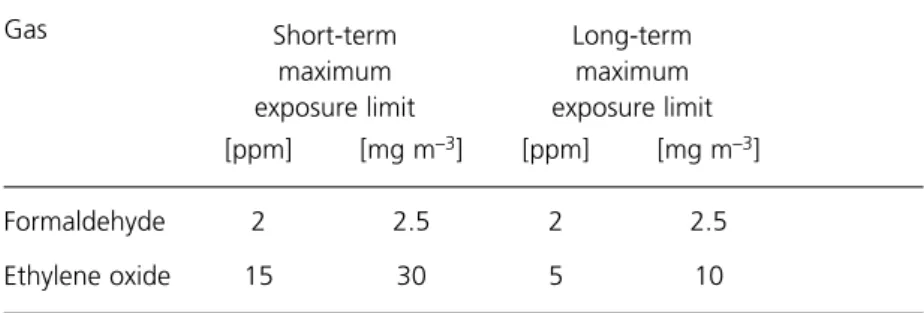
Occupational exposure to formaldehyde and EO is controlled by the Control of Substances Hazardous to Health Regulations 1994. Maximum exposure limits are set out in the annual Guidance Note EH40, ‘Occupational exposure limits’, published by the Health and Safety Executive (see Bibliography). At the time of writing (1996) the limits are as shown in Table 1. These limits are statutory maxima but should not be regarded as representing a safe working exposure; employers have a legal obligation to ensure that the level of exposure is reduced so far as is reasonably practicable and in any case below the maximum exposure limit.
Table 1 Maximum exposure limits for atmospheric formaldehyde and ethylene oxide
Gas
[ppm] [mg m–3] [ppm] [mg m–3]
Formaldehyde 2 2.5 2 2.5
Ethylene oxide 15 30 5 10
The short-term maximum exposure limit (STMEL) is the average exposure over any 15-min period. The long-term maximum exposure limit (LTMEL) is the exposure over any 24-h period expressed as a single uniform exposure over an 8-h period.
COSHH does not specify a STMEL for EO. In the above table the STMEL is deemed to be three times the LTMEL in accordance with the recommendations of the Health and Safety Executive.
Source: COSHH Regulations 1994, HSE Guidance Note EH40 (1995).
1.46 The COSHH Regulations 1994 also introduce new controls on biological agents which are of relevance to Users of laboratory sterilizers.
Long-term maximum exposure limit Short-term maximum exposure limit 1.0 General
2.0
Operational management –
an overview
Introduction
2.1 Quality control and safety of a sterilization process are ultimately dependent upon untiring vigilance. The type of process, and the details of the operating cycle, should be selected with due regard to the nature of the product. Items for sterilization should be properly cleaned, packaged and assembled in accordance with procedures established during performance qualification. Every production cycle should be monitored and carefully documented. Products should not be released until predetermined conditions have been met. The sterilizer itself should be subject to preventative
maintenance and periodic testing. In these areas vigilance will necessitate skilful personnel, fully trained in the operation of sterilizers.
2.2 For assurance on these points, responsibility rests ultimately with the User, supported by the Authorised Person, the Competent Person, the Test Person, the Maintenance Person and the Microbiologist.
Maintenance
2.3 EN 554 (steam sterilization) and EN 550 (EO sterilization) make the following requirements for the maintenance of sterilizers:
a. preventative maintenance shall be planned and performed in accordance with documented procedures;
b. the procedure for each planned task and the frequency at which it is carried out shall be specified and documented;
c. the sterilizer shall not be used to process medical devices until all maintenance tasks have been satisfactorily completed and recorded; d. records of maintenance shall be retained as specified in 4.16 of EN ISO
9001 or in 4.15 of EN ISO 9002;
e. the maintenance scheme, maintenance procedures and maintenance records shall be reviewed periodically by persons designated by management.
2.4 The guidance in Chapter 4 puts these requirements into practice.
Safety precautions
2.5 Part 1 of this HTM discusses the principal health and safety legislation applying to sterilization.
2.6 HSE guidance note PM73, ‘Safety at autoclaves’, applies to steam sterilizers and emphasises the guidance contained in this memorandum.
2.7 Any equipment issued to operators should comply with the Provision and Use of Work Equipment Regulations 1992. Guidance may be found in the HSE document ‘Work equipment’ (L22).
The Provision and Use of Work Equipment Regulations (Northern Ireland) 1993 apply in Northern
2.8 Users should note the requirements of The Manual Handling Operations Regulations 1992 with regard to loading and unloading sterilizers. Guidance may be found in the HSE document ‘Manual handling’ (L23).
2.9 Access to sterilizer loading areas, plant rooms and equipment should be restricted to those entitled to be there.
Hazards associated with sterilization
2.10 Attention is drawn to the following hazards which may be encountered in the practice of sterilization:
a. the hazard of scalding from escaping steam;
b. the high temperatures (up to 200°C) at which sterilizers are operated; c. the stored energy hazards associated with the operation of pressure
vessels contained within steam and EO sterilizers;
d. the stored energy hazards associated with the pressurised containers in which EO gas is transported;
e. the explosive hazards associated with the sterilization of fluids in sealed glass containers;
f. the toxic properties of formaldehyde gas used in LTSF sterilizers; g. the toxic and explosive properties of ethylene oxide gas used in EO
sterilizers;
h. the infection hazard associated with pathogens that may be handled by personnel using certain laboratory sterilizers;
j. the hazard of infection to patients and staff by the inadvertent release of an unsterile load due to inadequate quality control;
k. the hazard to patients arising from residual ethylene oxide or formaldehyde present in the product;
l. the hazards associated with the handling of heavy and hot loads while loading and unloading sterilizers.
2.11 More detailed information about each process is given in Chapters 5 to 12.
Safety of pressure vessels
2.12 The majority of sterilizers discussed in this HTM contain pressure vessels that are subject to the Pressure Systems and Transportable Gas Containers Regulations 1989. Users are reminded of the following safety measures:
a. door interlocking safety devicesare designed to prevent:
(i) the pressurisation of the chamber before the door is secured; (ii) the uncontrolled release of chamber contents while the chamber is
under pressure;
b. any escape of steamshould be reported immediately and appropriate action taken;
c. arrangements for regular systematic inspection and maintenancemust be adhered to;
The Pressure Systems and Transportable Gas Containers Regulations (Northern Ireland) 1991 apply in Northern Ireland
The Manual Handling Operations Regulations (Northern Ireland) 1992 apply in Northern Ireland
d. all operators must be adequately trained and supervisedfor their allotted tasks;
e. documented operating proceduresmust be followed at all times.
Unloading
2.13 During the cooling stage the temperature of the load may be much higher than that in the chamber. Containers of liquid could be pressurised and may explode; liquids spilled on unloading may cause scalding. Users should take note of the following safety measures:
a. thermal door-locksare fitted to sterilizers designed to process fluids, to prevent the door mechanism being released while the temperature of the fluid is too high;
b. a cooling timermay be used in addition to a thermal door-lock; c. adequate trainingshould ensure that the operator is aware of the
nature of the load and any hazards associated with it;
d. operators should wear appropriate personal protective equipmentin addition to their normal working clothes (see paragraph 2.14);
e. reaching into a hot sterilizer can be hazardous; consideration should be given to the provision of a load transfersystem such as sliding shelves or a carriage and trolley.
Personal protective equipment
2.14Operators and maintenance personnel should be issued with appropriate personal protective equipment (PPE) complying with the Personal Protective Equipment at Work Regulations 1992 (see Part 1 of this HTM). The choice of PPE should follow a suitable assessment of risk for each type of sterilizer. Examples of PPE that may be required, in addition to normal working clothes, include:
a. impervious apron to protect against liquid spills; b. heat-resistant gloves for handling hot loads;
c. protective gloves for handling potentially infected material; d. safety shoes for use when loading and unloading sterilizers;
e. eye and face protection for use when removing glass containers from a sterilizer;
f. respiratory protective equipment and protective clothing for emergency use with EO sterilizers (see paragraphs A3.35–A3.48).
2.15 PPE should always be regarded as a “last resort” to protect against risks to health and safety; engineering controls and safe systems of work should always be considered first. Guidance on the selection of PPE may be found in ‘Personal protective equipment: guidance on regulations’ (L25) published by HSE.
Compatibility of load and process
2.16 The User should ensure that the load is suitable for the process to which it is to be exposed.
The Personal Protective Equipment at Work Regulations (Northern Ireland) 1993 apply in Northern Ireland
2.17 When selecting a process for a given item, the User should consider the following questions in conjunction with the advice of the manufacturer of the item.
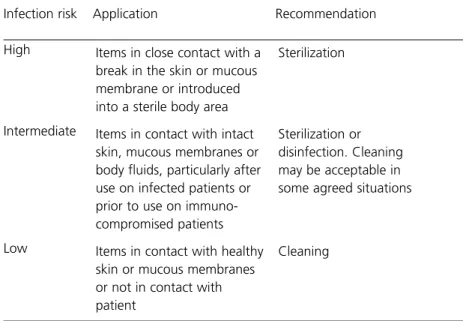
a. Is sterilization required?In some cases, where the infection risk is intermediate to low, disinfection or cleaning may be sufficient . The guidance in Table 2 should be followed.
b. Will the item be damaged by exposure to the process?Several common items cannot withstand the moisture of steam sterilization or the high temperatures of dry-heat sterilization.
c. Will the item fail to be sterilized by exposure to the process?Even if an item can withstand the process it may not be sterilized if, for example, steam cannot penetrate narrow tubing.
d. Is the process excluded by health and safety considerations?Some medical devices should not be exposed to formaldehyde or ethylene oxide.
Table 2 Recommended processes for the decontamination of medical devices according to risk of infection
Infection risk Application Recommendation
High
Intermediate
Low
Adapted from: ‘Sterilization, disinfection and cleaning of medical equipment’, MDA 1993.
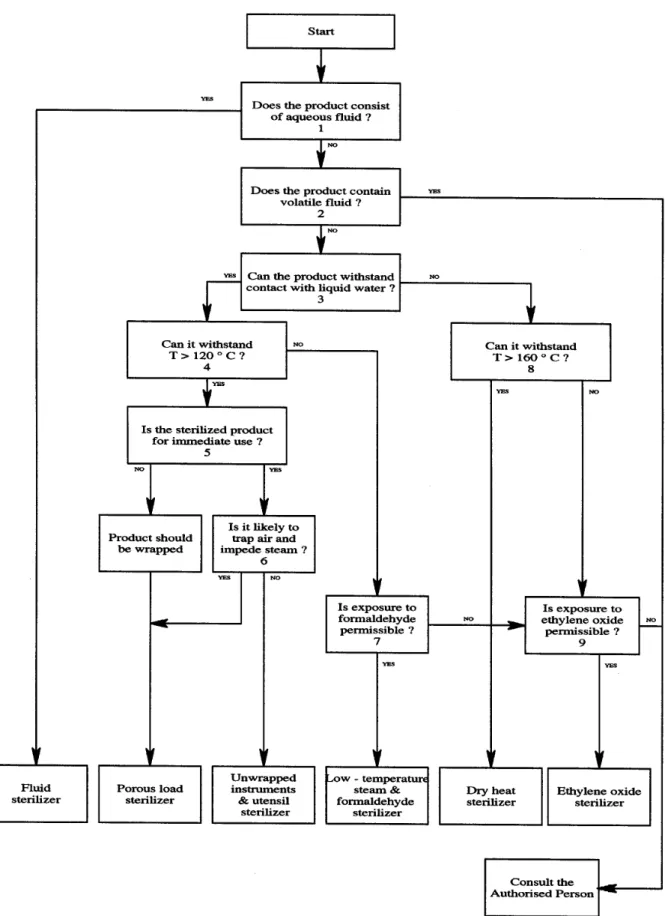
2.18 The flow-chart in Figure 1 will assist Users in selecting an appropriate sterilization process. The Authorised Person should be consulted in cases of doubt.
Cleaning Items in contact with healthy
skin or mucous membranes or not in contact with patient
Sterilization or disinfection. Cleaning may be acceptable in some agreed situations Items in contact with intact
skin, mucous membranes or body fluids, particularly after use on infected patients or prior to use on immuno-compromised patients
Sterilization Items in close contact with a
break in the skin or mucous membrane or introduced into a sterile body area
2.0 Operational management – an overview
Notes to Figure 1
Figures refer to boxes on the flow chart.
1 Does the product consist of aqueous fluid?
If the product is a water solution, then it must be processed in a fluid sterilizer. Bottles or other containers holding aqueous fluids must not be placed in any other kind of sterilizer.
2 Does the product contain volatile liquid?
None of the processes discussed in this HTM are suitable for volatile liquids other than water.
3 Can the product withstand contact with liquid water?
All steam sterilizers produce condensate on any surface which is in contact with steam. Water will therefore condense inside hollow items, within unsealed containers and inside porous packaging. Porous packaging is likely to become saturated. Packaging designed for steam sterilizers will not be damaged by such exposure.
4 Can it withstand temperatures in excess of 120ºC?
High-temperature steam sterilizers operate at sterilization temperatures of 121ºC, 126ºC or 134ºC, with the highest temperature preferred. Most items of glass or metal will withstand such temperatures, but items with plastic components may not. Some items constructed of two or more different metals may distort at these temperatures and some medicinal products may be damaged. In exceptional cases lower temperatures may be used provided the bioburden and the required sterility assurance level are known.
5 Is the sterilized product for immediate use?
If the product is to be used in a controlled medical environment immediately after the chamber door has been opened, then it need not be wrapped and a sterilizer for unwrapped instruments and utensils is acceptable. Otherwise the item should be wrapped and processed in a porous load sterilizer.
6 Is it likely to trap air and impede steam?
Items which are for immediate use may nevertheless require a porous-load sterilizer if they are likely to trap air and impede the penetration of steam. See paragraph 7.13 for further guidance.
7 Is exposure to formaldehyde permissible?
Certain items should not be processed by LTSF for reasons of health and safety. See paragraph 10.29.
8 Can it withstand temperatures in excess of 160ºC?
Products that cannot withstand contact with liquid water may be processed in a dry-heat sterilizer if they can withstand the high temperatures and prolonged holding times.
9 Is exposure to ethylene oxide permissible?
Certain items should not be processed by EO for reasons of health and safety. See paragraph 11.18.
2.19 Processes using toxic gases (LTSF and EO) are a last resort and should not be used for items which could be sterilized or disinfected by another method. Many heat-sensitive items are currently processed by LTSF or EO where LTS disinfection would have been adequate and safer.
Process development
2.20 Once a basic process has been selected, Users should consider whether the standard operating cycle needs to be modified to cope with specific load items. For example, delicate items may not be able to withstand the rapid pressure changes that take place in the chamber of a porous load sterilizer and the rate of change of pressure may need to be reduced.
2.21 If the cycle variables are modified from the values used during validation, revalidation (and possibly repeat validation) will be necessary (see Part 3 of this HTM).
“Single-use” medical devices
2.22 Many medical devices are intended by their manufacturers to be used once only and then discarded. However, it is not uncommon for hospitals to clean, sterilize and reuse the more expensive of these devices (such as cardiac catheters) where it is considered safe and economical to do so.
2.23 Users considering reprocessing single-use items should note the following points:
a. the construction of many such devices, often with long and narrow lumens, makes them difficult to clean with any degree of confidence; b. if the efficacy of cleaning procedures cannot be assured then neither
can the sterilization process;
c. where devices have been sterilized by radiation, subsequent sterilization by EO can lead to structural weakening of certain plastic components; d. the User will have no redress from the manufacturer for any
subsequent failure of the device, whatever the cause.
2.24 The MDA gives the following advice on reprocessing.
An organisation that reprocesses a single-use device for reuse against the instructions of the original manufacturer, and then supplies it to other organisations, will be returning the device to the market and it is likely to be regarded as a manufacturer in its own right, with all of the obligations that entails. This is because the organisation is considered to be placing a new device on the market under its own name and must therefore meet the full obligations of the Medical Devices Directive. If single-use devices are reprocessed for use solely within the organisation, this would not be seen as placement upon the market. Hence the requirements of the Directive, so far as they relate to manufacture, would not apply.
2.25 Further information may be found in MDA Device Bulletin 9501.
Cleaning
2.26 Cleaning and drying of reusable load items before packaging and sterilization are essential, since the efficacy of the process will be reduced if soiling protects micro-organisms from exposure to the sterilant. All items should therefore be scrupulously clean. Washer-disinfectors are suitable for preparing many such items for sterilization and guidance may be found in
Packaging
2.28 ENs 550 and 554 require the packaging specification to be part of the definition and documentation of the of the sterilization process. The User should therefore ensure that each load is packaged and assembled in accordance with documented procedures validated during performance qualification.
2.29 When handled in accordance with instructions the packaging should protect the product from physical damage and maintain the sterility of the product up to the point of use.
2.30 The packaging should not inhibit the efficacy of the process by, for example, hindering the removal of air or the penetration of steam, impeding the conduction of heat to the load, outgassing, altering the humidity in the chamber, or absorbing chemical sterilants
2.31 The packaging should be able to withstand the sterilization process. It may be necessary to carry out preliminary tests on the product and its
packaging in order to determine the levels and rates of change of temperature, pressure and other cycle variables which start to cause unacceptable changes in the performance qualities of the product or its packaging.
2.32 Packaging materials should be stored in the conditions recommended by the manufacturer. Packaging material that has become dehydrated, for example, may adversely affect the efficacy of an EO sterilization process.
2.33 Specifications for packaging materials may be found in EN 868. Extensive guidance on packaging is given in Part 5 of this HTM, with a brief summary in Chapters 5 to 12 of this Part.
Performance qualification
2.34 Performance qualification (PQ) is defined as the process of obtaining and documenting evidence that the sterilizer, as commissioned, will produce acceptable goods when operated in accordance with the process specification.
2.35 A loading condition is a specified combination of the nature and number of load items, the items of chamber furniture, and their distribution within the chamber. For example, a load placed on the top shelf of the chamber
constitutes a different loading condition from an identical load placed on the bottom shelf. The specification is part of the PQ report for that loading condition. Note that the specification may require load items to be arranged in precise positions or permit them to be placed randomly in the chamber.
2.36 The extent of the PQ required will depend on the type of sterilizer and the nature of the load. All Users should adopt the following procedure for every sterilizer.
a. Establish a list of the distinct loading conditions to be processed in the sterilizer. Each production load should correspond to one of the listed loading conditions.
b. Determine whether each loading condition presents a greater or lesser challenge to the process than the small and full loads used in the thermometric tests carried out during commissioning (see Part 3 of this HTM).
c. Where the loading condition is a lesser challenge than the
commissioning loads, the results of the commissioning tests may be used as PQ data.
d. Where the loading condition is a greater challenge than the
commissioning loads, PQ tests will be required as specified in Part 3 of this HTM.
2.37 The User is responsible for deciding which loading conditions require PQ tests. The User is recommended to seek advice as follows:
a. sterilizers to be used for medicinal products – from the Quality Controller and the Test Person;
b. LTSF and EO sterilizers – from the Microbiologist and the Test Person; c. all other sterilizers – from the Test Person.
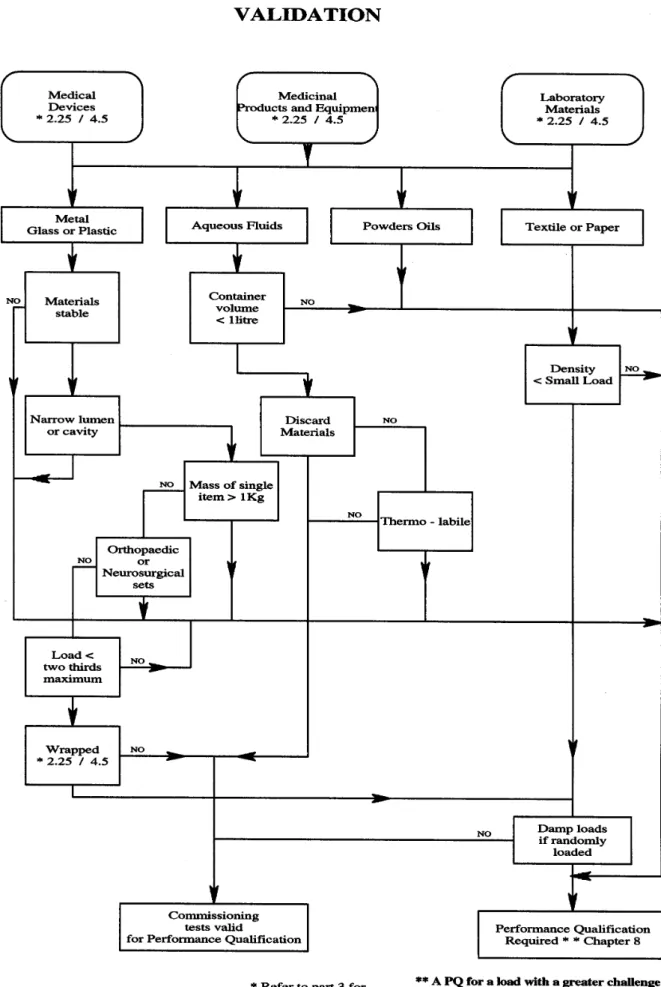
2.38 The flow chart in Figure 2 will assist Users in determining whether PQ tests are required or whether data from the commissioning tests will be sufficient. In cases of doubt, advice should be sought from the Authorised Person.
2.39 PQ tests are normally performed as part of the initial validation
procedure, as part of any repeat validation procedure, and whenever the User judges that a new loading condition calls for a new PQ test. Detailed
instructions for carrying out PQ tests are given in Part 3 of this HTM.
2.40 In some cases a new load may be adequately represented by one of the existing loading conditions for which a PQ report exists. Further PQ tests will not then be necessary. Where a new load is not covered by an existing PQ report, full PQ tests as specified in Part 3 should be conducted.
2.41 When designing a new loading condition, it is important that the correct packaging is selected and specified along with the load itself. The packaging specification should not then be altered in subsequent production cycles without repeating the PQ procedure unless the loading condition with new packaging can be demonstrated to be equivalent to one covered by an existing PQ report.
Position of PQ sensors
2.42 Temperature sensors should be placed as described in Chapter 8 of Part 3 of this HTM. In selecting which load items require sensors, the following observations should be noted:
a. small load items will heat up and cool down faster than large items; b. load items placed near the steam inlet port will heat up faster than
those placed further away.
Cycle variables
2.43 For the purposes of this HTM the following definitions have been adopted.
2.44 The cycle variablesare the physical properties, such as time,
temperature, pressure, humidity and sterilant gas concentration, that influence
2.0 Operational management – an overview
2.45 Most operating cycles have a stage in which the load is exposed to the sterilization (or disinfection) conditions for a specified length of time. This period is known as the holding time.
2.46 The sterilization conditionsare the ranges of the cycle variables which may prevail throughout the chamber and load during the holding time.
2.47 The holding time is preceded by a period in which the sterilization conditions are present in the chamber but not yet present throughout the load. This is known as the equilibration time.
2.48 Together, the equilibration time and the holding time constitute the
plateau period. While the duration of the plateau period can always be determined from the recorded chamber temperature, the equilibration and holding times cannot be distinguished unless the temperature in the part of the load that is slowest to reach the sterilization temperature is also being recorded or measured.
2.49 Certain LTSF sterilizers may achieve sterilization by exposing the load to a series of pulses of formaldehyde rather than a continuous holding time.
2.50 For EO sterilizers the plateau period is equivalent to the gas exposure time. The holding time cannot be determined by thermometry alone.
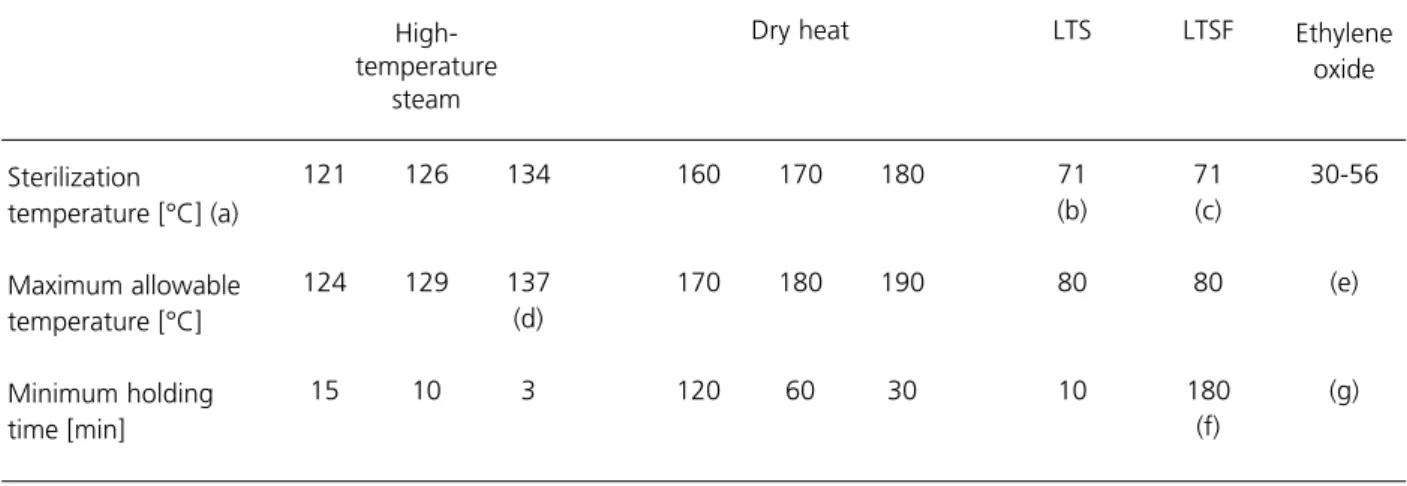
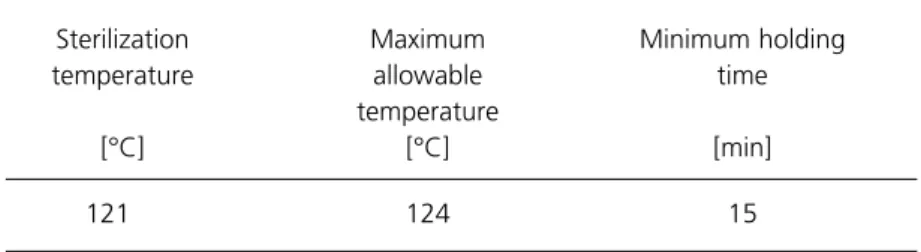
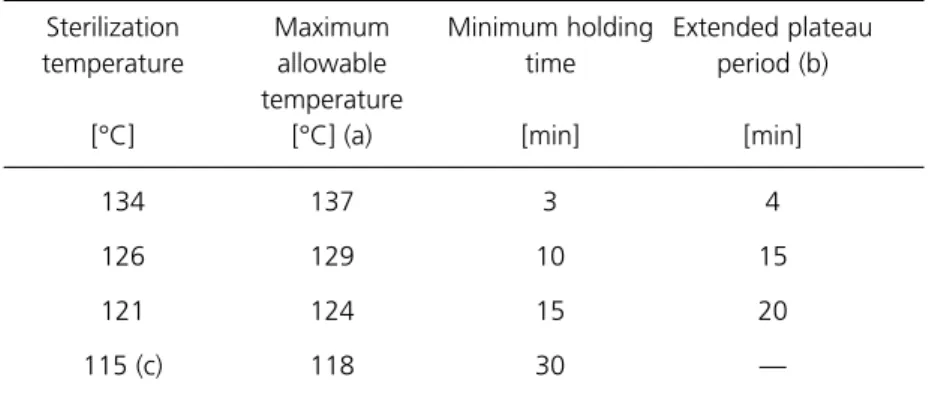
2.51 For steam and dry-heat sterilizers, the sterilization conditions are specified by a sterilization temperature band, defined by a minimum acceptable temperature, known as the sterilization temperature, and a maximum allowable temperature. The higher the sterilization temperature the shorter the holding time and the more rapidly the cycle is completed. A sterilization temperature band can also be quoted for LTSF and EO sterilizers, but since these processes depend primarily upon chemical action such a band is only a partial specification of the sterilization conditions. Bands for the different types of process are listed in Table 3. See Table 9 (Chapter 12) for recommendations for laboratory sterilizers.
Table 3 Recommended sterilization temperature bands
Dry heat LTS LTSF 121 126 134 160 170 180 71 71 30-56 (b) (c) 124 129 137 170 180 190 80 80 (e) (d) 15 10 3 120 60 30 10 180 (g) (f)
a. The temperature setting on the automatic controller will not generally be the sterilization temperature, but a higher temperature within the sterilization temperature band. b. Disinfection temperature.
c. This temperature is conventional but others may be used. d. See paragraph 2.52.
e. For EO, the maximum allowable temperature will normally be 4°C above the sterilization temperature.
f. For LTSF, the sterilization conditions may specify either a continuous holding time or the Minimum holding time [min] Maximum allowable temperature [°C] Sterilization temperature [°C] (a) Ethylene oxide High-temperature steam
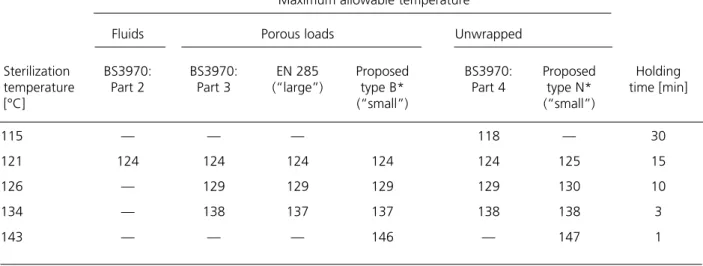
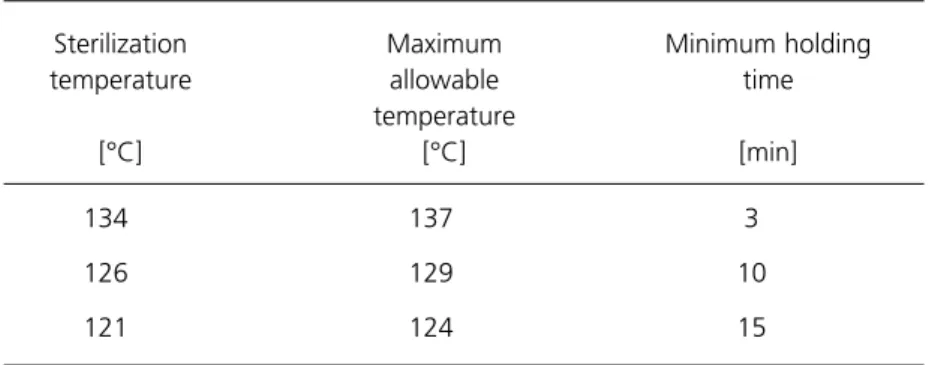
2.52 Whereas the bands for high-temperature steam are normally 3°C wide, the 134°C band is anomalous in that the maximum allowable temperature may be either 137°C or 138°C. In BS3970, 138°C is cited both for porous-load sterilizers (Part 3) and transportable sterilizers for unwrapped instruments and utensils (Part 4). At the time of writing these Parts are still current and existing sterilizers are largely designed to operate with a maximum allowable
temperature of 138°C.
2.53 However, EN 285, which is to replace BS3970: Part 3, specifies that for “large” porous-load sterilizers all bands should be 3°C wide, implying a maximum allowable temperature of 137°C. This is the temperature adopted in this HTM. Unfortunately, the proposed EN on “small” sterilizers (essentially transportables) permits a width of 4°C for all bands where unwrapped instruments and utensils are to be processed. The existing and proposed requirements are summarised in Table 4. The recommendation of this HTM is that a width of 3°C should be adopted for all sterilization bands.
2.54 The 143°C band listed in Table 4 has been rarely used in the NHS because any time advantage offered by the short holding time is outweighed by the longer heating and cooling times.
2.55 Settings for the automatic controller will be determined during performance qualification. Generally these will consist of a chamber temperature within the sterilization temperature band and a plateau period designed to accommodate the equilibration time and the holding time. Guidance on the setting of the cycle variables will be found in chapters 5 to 12.
Table 4 Sterilization temperature bands for high-temperature steam specified by British and European Standards
Maximum allowable temperature
Fluids Porous loads Unwrapped
115 — — — 118 — 30
121 124 124 124 124 124 125 15
126 — 129 129 129 129 130 10
134 — 138 137 137 138 138 3
143 — — — 146 — 147 1
* Proposed European Standard under discussion by CEN
Holding time [min] Proposed type N* (“small”) BS3970: Part 4 Proposed type B* (“small”) EN 285 (“large”) BS3970: Part 3 BS3970: Part 2 Sterilization temperature [°C]
Cycle monitoring and documentation
2.56 It is vital that every production cycle is monitored and documented and that records are kept securely. Guidance on record-keeping is given in Chapter 3.
2.57 Except for the simpler processes (specified in the relevant chapter) documentation noted in the sterilizer process log for each sterilized load should include:
a. sufficient information to identify the sterilizer uniquely (by a unique reference number; by the name of the manufacturer, the model of sterilizer and the serial number; or by any sufficient combination of these);
b. a specification of the loading condition (defined either by the nature and number of load items, items of chamber furniture, and their distribution in the chamber, or by a coded reference to a detailed specification held elsewhere);
c. a specification of the operating cycle (defined either by the settings for the cycle variables or by a coded reference to a detailed specification held elsewhere);
d. a reference to the result of any routine pre-production test, such as a Bowie-Dick test;
e. the batch process record from the recorder fitted to the sterilizer marked with the reference number of the master process record used to validate it;
f. any deviations from the PQ specification in terms of loading condition and settings of cycle variables whether or not these result in an acceptable cycle;
g. the date and time of the start of the operating cycle; h. the cycle number as indicated on the cycle counter; j. the name or other identification of the operator; k. any other records specified in Chapters 5 to 12.
2.58 The batch process record obtained from the sterilizer recorder should be sufficiently detailed to confirm that the requirements for critical parts of the operating cycle are met. This is best achieved by ensuring that a continuous graph is plotted as the cycle progresses and, for a digital system, that the values of all samples are retained for later inspection.
2.59 Biological indicators are not required for monitoring of steam or dry-heat processes, though they may occasionally be necessary for performance qualification of unusual loads (see Part 3 of this HTM). See Chapters 10 and 11 about the use of biological indicators in LTSF and EO sterilizers.
2.60 If in doubt as to which records are required, the User should consult the Authorised Person. As a rule, it should be possible to trace any sterilized goods from the point of use back through the supply chain to the specific sterilizer and cycle in which they were processed and establish the precise values of the cycle variables throughout the cycle. A bar code attached to each load item is a practical way of keeping track of sterilized goods.
2.61 Cycles abandoned for any reason should be noted in the sterilizer process log along with any remedial action taken. Operators should be encouraged to note and report any observations which suggest that the sterilizer may not be working as it should be.
2.62 Where a load has been reprocessed following the failure of an earlier cycle, records of the original cycle should be readily traceable from the reprocessing records.
2.63 Further guidance on documentation is given in Chapters 5 to 12.
Process indicators
2.64 A foolproof system to differentiate between processed and unprocessed load items should be used to prevent an unprocessed item being mistaken for one that has been sterilized. A convenient method is to use chemical indicators which change colour on exposure to the sterilization process. Such “process indicators” are available in a variety of forms including adhesive tape, labels and preprinted panels on sterilization packaging. Process indicators should conform to the specifications for Class A indicators given in EN 867: Part 2.
2.65 Users should note that process indicators demonstrate only that the load item has been exposed to an operating cycle. They offer no assurance that the load item is sterile and can play no part in the validation and monitoring of the process.
Product release
2.66 The User, in consultation with the Authorised Person, should establish and document procedures to ensure that loads are not released for use until the User is satisfied that the operating cycle has been reproduced within the permitted tolerances established during performance qualification.
2.67 For medicinal products, the Quality Controller will establish the procedures for product release.
2.68 The procedures should confirm the following:
a. that the load has been packaged and assembled in accordance with the PQ specification;
b. that the settings for the operating cycle are in accordance with the PQ specification;
c. that the batch process record for the cycle conforms with the relevant master process record within the permitted tolerances (see paragraph 2.71);
d. that any indicated readings required to be noted during the cycle have been noted and are in accordance with the PQ specification;
e. that the sterilized load shows no obvious anomalies, such as damaged packaging or leaking containers, that may suggest a faulty cycle. (If any degree of deterioration is acceptable this should be part of the PQ specification.)
2.69 Loads processed in LTSF or EO sterilizers should not be released until the results of the routine microbiological tests are known (see Chapters 10 and 11).
2.70 Regardless of the above procedure, whenever an operator has cause to suspect that the load may not have been properly sterilized the load must not be released. The User should be informed immediately.
Master process record
2.71 A master process record (MPR) is a record of the values and permitted tolerances of cycle variables (normally time, temperature and pressure) for a correctly functioning operating cycle against which production cycles can be checked. (The term “master temperature record” was used in earlier editions of HTM 10.) It is derived either from the batch process record (BPR) obtained during a thermometric PQ test or, if no PQ test has been deemed necessary, from the BPR obtained from a full-load thermometric test carried out during commissioning. It may be a one-to-one transparent copy of the BPR, a “template” derived from the BPR, or data stored in a computer control system and compared automatically. See Part 3 of this HTM for further information on MPRs.
2.72 Cycle variables recorded on the MPR may include chamber temperature, chamber pressure and the temperature inside one or more load containers as a function of time.
2.73 When a BPR from a production cycle is compared with the appropriate MPR, the value of the cycle variables on the BPR should be contained within the limits shown on the MPR for the entire cycle.
Rejected loads
2.74 Failure to meet any of the product release requirements should lead to the load being placed in quarantine and the cause of the failure investigated. The investigation should be documented and the handling of the product should be in accordance with the procedures for control of non-conforming product required by EN ISO 9001 or 9002.
2.75Documented procedures for dealing with rejected loads should be agreed between the User and the Authorised Person. There are basically three options:
a. the load may be reprocessed; this should only be permitted if the nature of the load and its packaging is such that they will not be unacceptably degraded by a second exposure to the sterilization process;
b. the load may be “reworked”, i.e. dismantled, repackaged and then reprocessed;
c. the load may be discarded; in this case, procedures should ensure that load items are permanently marked as rejected, removed from the supply chain and that there is no risk of them being mistaken for correctly processed items.
2.76 Procedures for the disposal of a discarded load should ensure that no hazard is caused either to personnel or to the environment.
In Scotland, the management of clinical waste and heat treatment processes, published by the Scottish Centre for Infection and
Environmental Health, Aug 1994, ISBN 1 873772106, should be referred to
Storage
2.77 After sterilization and before product release, conditions for product storage and handling should not compromise the qualities of the product.
2.78 Detailed guidance on storage and distribution of sterile goods can be found in Part 5 of this HTM.
3.0
Record-keeping
Introduction
3.1 The importance of maintaining careful records cannot be stressed too highly. Complete and accurate records are an essential element in ensuring the safe and efficient functioning of sterilizers and compliance with regulatory requirements.
3.2 The following principles, based upon those issued by the World Health Organisation for the processing of blood products, apply equally to quality control of sterilization processes. Records should:
a. be original (not a transcription), indelible, legible and dated;
b. be made concurrently with the performance of each operation and test; c. identify the person recording the data as well as the person checking
the data or authorising continuation of processing;
d. be detailed enough to allow a clear reconstruction and understanding of all relevant procedures performed;
e. allow tracing of all successive steps and identify the inter-relationships of dependent procedures, products and waste materials;
f. be maintained in an orderly fashion permitting the retrieval of data for a period consistent with dating periods (shelf life) and legal
requirements;
g. indicate that processing and testing were carried out in accordance with procedures established and approved by management; h. if necessary, allow a prompt and complete recall of any particular
batch;
j. show the lot numbers of materials used for making up specified batches of products.
3.3 The requirements for record-keeping in ENs 550 and 554 are the same as ENs 46001 and 46002, namely that the supplier should retain the quality records for a period of time at least equivalent to the lifetime of the medical device defined by the supplier, but not less that two years from the date of dispatch from the supplier. The supplier should establish a record for each batch of medical devices that provides traceability and identifies the quantity manufactured and quantity released for distribution. The batch record should be verified and the load authorised for release by the User.
3.4 For medicinal products, the record-keeping principles outlined in the GGMP should be followed.
3.5 The system recommended in this HTM requires two sets of records to be kept for each sterilizer:
a. a plant history file; b. a sterilizer process log. The collection, fractionation, quality
control and uses of blood and blood products, World Health Organisation 1981
3.6 Both of these are the responsibility of the User. They should be made available to any other personnel who need to use them. This will include the Authorised Person, Test Person, Maintenance Person, Microbiologist, Competent Person and operators.
3.7 In the case of sterilizers used for processing medicinal products, the form of these records should be approved by both the Production Manager and the Quality Controller.
3.8 Log books for recording data obtained from periodic tests are available from NHS Estates. An example of a log book for a porous load sterilizer is given in Appendix 5. The log book is regarded as part of the plant history file.
Plant history file
3.9 The plant history file contains engineering records of the sterilizer installation. It should be kept throughout the life of the sterilizer (see paragraph 3.3). Examples of the information that should be kept in the plant history file include:
• identification of the sterilizer;
• names, addresses and telephone numbers of the sterilizer manufacturer, owner and key personnel (User, Authorised Person, Test Person, Maintenance Person, Competent Person, Microbiologist); • dates of installation and commissioning;
• validation procedures;
• validation reports (including PQ reports for each loading condition); • copies of validation summary sheets;
• copy of any maintenance contract;
• planned maintenance programme including detailed procedures for all maintenance tasks;.
• records of maintenance, both scheduled and unscheduled, sufficient to show that all examinations, tests and checks have been carried out; • manuals supplied by the manufacturer;
• documentation for any software used for control or instrumentation (including the name of an agent where the source codes may be obtained should the manufacturer cease trading);
• the written scheme of examination for any pressure vessel; • reports by the Competent Person in respect of pressure vessels; • data from periodic tests carried out by the Test Person or the
Maintenance Person;
• copies of data from the periodic tests carried out by the User (kept in the sterilizer process log);
• records of any defects found on the sterilizer and corrective action taken;
• records of any modification made to the sterilizer;
• references to the plant history files for the test instruments used in the validation and periodic tests;
In Scotland, log books are available from Scottish Healthcare Supplies
• specifications for the operating cycles.
Sterilizer process log
3.10 The sterilizer process log contains information required for routine operation of the sterilizer and records relevant to each cycle. I