Co-funded by the European Union
Commercial
warranties
Commercial
warranties
Legal guarantees
and commercial
warranties on
consumer goods
in the EU, Iceland
and Norway
pixelio.de - © Rainer Sturm
© gpointstudio - Shutterstock.com
© Dragon Images - Shutterstock.com
ARE THEY WORTH
THE MONEY?
pixelio.de - © Rainer SturmDragon_Images- © Shutterstock.com
© gpointstudio - Shutterstock.com
Objective of the joint project
Direct liability of the seller
Vocabulary: Why differentiate between the legal guarantee and a commercial warranty?
Duration of the legal guarantee on consumer goods
Deadline for the consumer to notify the seller of a defect or non-conformity
Administration of proof of non-conformity / reversal of burden of proof
Solutions and remedies to the lack of conformity The duration of the legal guarantee after repair or replacement
Possibility for the seller to claim compensation for the time during which the consumer had use of the item before it was found to be faulty
The prescription period for actions linked to the legal guarantee of conformity
Possibility for the seller applying the legal guarantee to take action against the importer, or any other intermediary in the sale chain up to and including the producer
Possibility for the consumer to take action against the importer, or any intermediary in the sale chain up to and including the producer for application of rights under the legal guarantee
4 13 7 16 19 22 27 37 39 41 43 44
Introduction
Summary
Legal guarantees
Directive 1999/44/EC on certain aspects of the sale of consumer goods and associated guarantees
Other legal guarantees foreseen by national
law coexisting with the legal guarantee of
non-conformity introduced by Directive
1999/44/EC
Commercial warranties
Special focus
Appendix
The ECC-NET
Information obligation Timing of information Formal requirements Language requirements Content of the warrantyNames given to commercial warranties in the Member States Duration of commercial warranties in the Member States Costs involved
Information or misinformation
Pros and cons of commercial warranties
The new and second-hand vehicle sector
Geographical restrictions to territorial coverage of commercial warranties
Purchase of animals
Binding force of the commercial warranty Cancellation of a sale based on lack of consent or “error”
47
52
Legal guarantee against hidden defects
84
92
Legal guarantee for immovable property or construction work
48
Mandatory legal guarantees in Hungary 49
Mandatory Slovenian legal guarantee for specific technical products
Other legal guarantee foreseen by the EU:
Liability for defective products causing an
economic or bodily harm
47 49 52 53 54 55 56 59 61 64 67 73 88
4
Introduction
The European
Consumer Centres
Network
Background
1Annual report of the ECC-Net : http://ec.europa.eu/consumers/ecc/docs/report_ecc-net_2013_en.pdf 2Press release, 19 February 2014, http://europa.eu/rapid/press-release_IP-14-162_en.htm - All statistical data are based on data gathered by the local ECC offices and registered in the ECC-Net database, the IT-Tool. The IT-Tool is used to collect and handle the necessary data and cases. It is operated by the European Commission 3 The problems that arise in the case of contracts for air travel services are the focus of the ECC-Net reports on air passenger rights and are covered by Regulation (EC) No 261/2004 of the European Parliament and of the Council of 11 February 2004 establishing common rules on compensation and assistance to passengers in the event of denied boarding and of cancellation or long delay of flights, Regulation (EC) no 1107/2006 of the European Parliament and of the Council of 5 July 2006 concerning the rights of disabled persons and persons with reduced mobility when travelling by air, Convention for the Unification of Certain Rules for International Carriage by Air (the Montreal Convention), case law of the Court of Justice of the European Union, etc.
pixelio.de - © Lupo
The European Consumer Centre Network (ECC-Net) consists
of 30 centres (one in each European Union (EU) Member
State, Norway and Iceland). It is co-financed by the EU and by each of the participating states.
The aim of the Network is to increase consumer confidence
in the European Internal Market by providing consumers with
information on their rights under European consumer
legis-lation, and by giving them advice on, and assistance with
the resolution of their cross-border complaints. As the
ECC-Net deals with cross-border consumer complaints and disputes, it is in a unique position to document the problems consumers face when shopping within the EU.
The ECC-Net deals with a large number of cross-border consu-mer complaints each year. Out of the 80 272 contacts from consumers received by the ECC-Net in 2013, 32 522 were actual complaints1 (an increase of 9% compared to 20122). Between
1/4 and 1/3 of these complaints concerned guarantee is-sues (the product or service turned out to be defective, did not conform to the order or caused damage).
Although a substantial number of guarantee- and non-conformity-related complaints reported by the ECCs involve service contracts, especially in the transport sector (36% of all complaints are in this sector with 80% of those related to passenger transport by air), this report only covers guarantees for goods as the main legal rules for guarantees do not cover service contracts which are regulated by specific legislation3.
Hence, this report deals exclusively with business-to-consumer situations and focuses on consumer goods (there is however limited reference to real estate, which in most countries is covered by specific or supplementary legal guarantees).
5
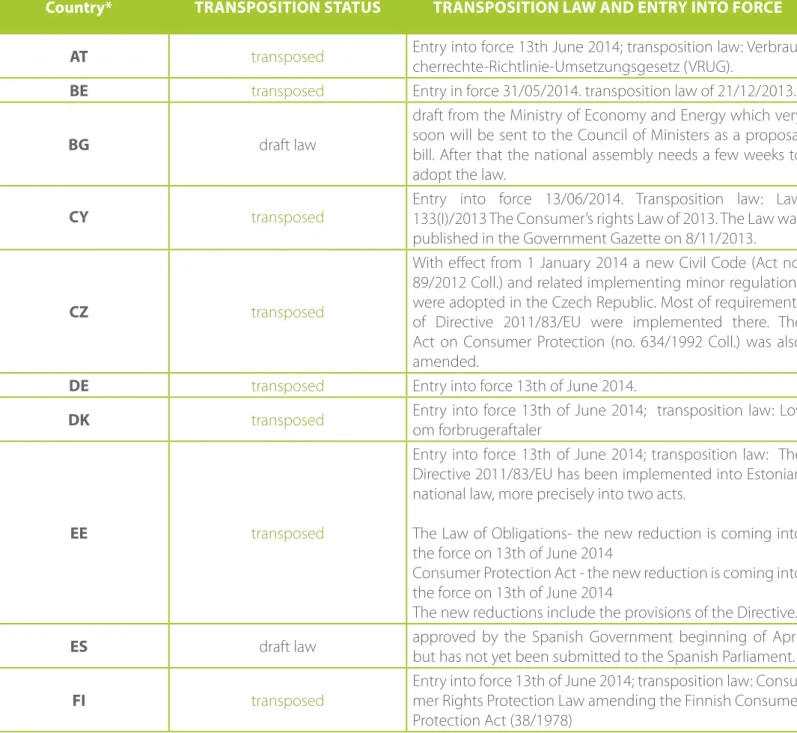
Directive 1999/44/EC on certain aspects of the sale of consu-mer goods and associated guarantees (“the Consuconsu-mer Sales and Guarantees Directive”)4defines consumer goods as “any tangible
movable item, with the exception of: goods sold by way of execution or otherwise by authority of law;
water and gas where they are
not put up for sale in a limited volume or set quantity; electricity” 5.
The consumer movement would define consumer goods as all end products of a production cycle, also called final products, which a consumer can find in a store to purchase. Consumer products cover a wide range of items including food, clothing, electronic items and household appliances, cars, to a certain extent pets6, etc., but not real estate.7
About 1/5 of complaints registered by the ECC-Net relate to pro-ducts for recreation and culture, as well as information proces-sing equipment and equipment for the reception, recording and reproduction of sound and pictures, as such products account for a large share of cross-border online purchases of goods.
A product is considered faulty if it does not comply with the given description or if it cannot be used for normal pur-poses or the specific purpur-poses requested by the consumer. The product is also faulty if it is not of normal quality and does not perform as can be reasonably expected.
Consumers all over the EU, Iceland and Norway enjoy seve-ral levels of protection against the delivery of goods which
are not in conformity with requirements: along with
manda-tory protection by law prohibiting the sale of goods which do not conform to their description, legal guarantees apply to faulty products and private initiatives from business such as commer-cial warranties have become more and more frequent.
4 Official Journal L 171, 07/07/1999 P. 0012 – 0016 5 According to Article 1.2 (b) of the Consumer Sales and Guarantee Directive, Member States may exclude from this definition second-hand goods sold at public auction where consumers have the opportunity of attending the sale in person. http://europa.eu/legislation_summaries/consumers/protection_of_consumers/l32022_en.htm 6 See the special focus on the purchase of animals/pets on page 92 7 However, the Directive applies to contracts for the supply of consumer goods to be manufactured or produced.
The European Consumer Centre France has led this project in close cooperation with the ECCs of Belgium, Denmark and Germany which formed the working group for this project. All 30 ECCs participated in the compilation of this report.
The views and interpretations reflected in this report are not those of the European Commission or the national funding bodies. They are solely those of the working group based on conclusions in the reports cited and on the data and questionnaire answers submitted to the working group by all project participants. This document is intended to present the legislation and situation regarding legal guarantees and commercial warranties in the various European countries at the moment of publication and in the most user-friendly manner possible. It has no legal value however and the working group will not be held liable for any loss or cost incurred by reason of any person using or relying on the information in this publication.
6
Objective
of the joint
project
The main objective of this report was to compare the legal guarantee and commercial warranty schemes in the EU Member States, Iceland and Norway and to analyse whether commercial warranties really keep their promises and are worth the additional cost.
ECCs carried out checks online and on sellers’ premises8 and
studied accounts from consumers to get an insight into how well consumers are protected by EU law and/or commercial warranties when they discover that goods they have pur-chased are not in conformity to their expectations or have defects.
From 29 October to 14 November 2014, the ECC-Net conducted a total of 342 checks in 25 countries (Belgium, Bulgaria, Czech Republic, Denmark, Germany, Estonia, Spain, France, Croatia, Italy, Latvia, Lithuania, Luxembourg, Hungary, Malta, the Netherlands, Norway, Austria, Poland, Portugal, Romania, Slovenia, Slovakia, Finland and Sweden)
for 3 product categories (photo camera, TV, washing machine) for a total of 79 product references from 9 brands. 104 websites were screened and 127 shops contacted (covering 151 trading names, some of which were present in several EU Member States). During these checks the ECCs looked into:
The after-sales service of 72 shops: During “check n° 1” the investigation focused on whether the seller would accept having the defective goods returned to him/her or redirect the consumer to the producer.
The possibility of having easy access to an independent expert opinion: “check n° 2”
The importance of commercial warranties in the sales process: “check n° 3”
Whether and how consumers are informed about the legal guarantee and the commercial warranty and if there are any geographical restrictions: “check n° 4”
The names given to commercial warranties in the Member States: “check n° 5”
The duration of commercial warranties: “check n° 6” The costs involved: “check n° 7”
The checks by the ECC-Net were supplemented by a survey led by ECC Belgium from 15 July to 5 October 2014, to which 543 consumers responded9.
When purchasing an item, it is usual for the seller to propose a specific commercial warranty, sometimes referred to as an extension of the legal guarantee. This is particularly the case for fragile or valuable items (e.g. watches, cars, fridges or was-hing machines). It can be included in the price of the goods (and in such cases it is often referred to as a specific produ-cer’s or seller’s warranty) but in many Member states the consumer will have to pay an extra cost depending on the coverage and duration of the additional service proposed. But are commercial warranties worth the money? Do they really add anything to the protection already offered by law in the EU, Iceland and Norway?
8 The details of the ECC-Net checks can be seen on page 109. 9 The details of the study let by ECC Belgium can be seen on page 119.
7
In September 2012, a Slovenian consumer bought a notebook
from an Austrian online store. After 3 months, problems
with the screen occurred. Following the instructions in the
documentation provided, the consumer sent the notebook
to the authorised service centre in Slovenia 5 times, but
the problem was never solved. The consumer contacted
the seller in Austria and was informed that the notebook
was covered by an end-user-direct repair service under
which the warranty process is applied directly between
the customer and the producer (or their service centre).
The seller claimed that he was only responsible during the
first 6-12 months, after which time the application of the
warranty process was only possible by using the producer’s
services, whereas in fact, the seller was still responsible for
providing a remedy under the legal guarantee.
When contacted by the ECC-Net, the seller agreed to repair the notebook as required under the legal guarantee.
Practical example:
case received by the ECC-Net
The legal guarantee10 is mandatory under EU consumer law:
The commercial warranty is a
voluntary service offered by the
seller or the producer,
some-times even by a third party. It
can be included in the price of the goods (and in such cases it is often referred to as a spe-cific producer’s or seller’s warranty) but in many Member
States the consumer will have to pay an extra cost
de-pending on the coverage and duration of the additional ser-vice proposed. This extra serser-vice can be called an “extended guarantee”. More information on commercial warranties in Europe is provided in the second part of this report.
It is important to note that a commercial warranty cannot affect the consumer’s rights under the EU legal guarantee
12. The warranty, as a sort of additional service, should upgrade
the consumer’s rights, for example, for a longer time period or situations not covered by the legal guarantee, e.g. warranties offering additional services such as repair at home.
Vocabulary:
why differentiate
between the legal
guarantee and a
commercial
warranty?
“The seller shall be liable to
the consumer for any lack
of conformity which exists
at the time the goods were
delivered”
11.
10 The concept of the legal guarantee of conformity exists in all EU Member States, Iceland and Norway. Although in the national languages of Denmark and Iceland for example, the term “LEGAL GUA-RANTEE of conformity” does not exist as such, consumers in those countries have a legal right to complain. 11 Article 3 (1) of Directive 99/44/EC on Consumer Sales and Guarantees. 12 Article 6 (2) of Directive 99/44/EC on Consumer Sales and Guarantees and Article 2 (14) of Directive 2011/83/EU on Consumer Rights.
8
Legal guarantees
What is a
«directive»?
A directive is a legal text which ap-plies to the countries of the Euro-pean Union (EU) and of the EuroEuro-pean Economic Area (the EU plus Norway, Iceland and Lichtenstein). It is pro-posed by the European Commission for adoption by the European Parlia-ment and the Council of the European Union. It is published in the Official Journal of the European Union15.A directive sets out harmonisation rules, which EU Member States will have to transpose in their national
legislation. According to Article 288
of the Treaty on the Functioning of the European Union, “A directive shall be binding, as to the result to be achieved, upon each Member State to which it is addressed, but shall leave to the national authorities the choice of
form and methods.” So it is up to each Member State to decide on how to reach the goals set in the directive. It may be necessary to create new dispositions, change existing ones and/or abrogate others according to the countries’ specific situations. A directive usually contains a transposition period between 6 months and 2 years from its publication. Certain directives may permit
EU Member States to go beyond its provisions (they
must never stop short of the provisions). They are refer-red to as providing «minimum harmonisation».
Aim of Directive
1999/44/EC on
certain aspects
of the sale of
consumer goods
and associated
guarantees
The legal guarantee of
confor-mity to which every European
consumer is entitled was
intro-duced by Directive 1999/44/
EC on certain aspects of the
sale of consumer goods and
as-sociated guarantees of 25 May
1999 (“the Consumer Sales
and Guarantees Directive”)
13
.
Directive 2011/83/EU
on
Consumer Rights (“the
Consu-mer Rights Directive”), which
Member States had to
trans-pose by 13 December 2013 and
which entered into application
on 13 June 2014
14, also
intro-duced some specific rules
rela-ting to the pre-contractual
in-formation of consumers on the
existence of the legal guarantee.
The Consumer Sales and Guarantees Directive aims at providing an effective legal guarantee-scheme for the benefit of consumers by:
Ensuring that the different national legal traditions encompass the principle of confor-mity with the contract and in a common manner across the EU16: The legislator
indi-cated that the main source of disputes between consumers and sellers was non-conformity of goods with contracts and therefore stated that goods purchased by a consumer must, above all, meet the contractual specifications.
Facilitating the application of the principle of conformity through a presumption of conformity with the contract under certain conditions17. © pexels.com
13 Official Journal L 171, 07/07/1999 P. 0012 – 0016 14 See the table of transposition measures on page 106. 15 In most cases both Institutions have to agree jointly on EU Directives. For more infor-mation: http://www.europarl.europa.eu/aboutparliament/en/0081f4b3c7/Law-making-procedures-in-detail.html 16 7th recital in the preamble of the Consumer Sales and Guarantees Directive 17 8th recital in the preamble of the Consumer Sales and Guarantees Directive
9
Providing a common definition of conformity: The criteria set by the text are the quality and per-formance consumers can reasonably expect from the goods. The Directive allows it to be taken into ac-count whether the goods are new or second-hand18.
Explaining the responsibility of the seller: The Directive provides for direct liability of the seller for conformity of the goods. It also gives the seller the possibility to pursue remedies against the produ-cer, a previous seller in the sale chain or any other intermediary19.
Providing remedies for consumers: If the goods are not in conformity with the contract, consumers should be entitled to have the goods restored to conformity free of charge, by either repair or repla-cement, or, failing this, to have the price reduced or the contract cancelled20
. The text of the
Direc-tive considers the proportionality of the solution to the problem encountered21.
Setting a period of responsibility and deadline for action: One of the main aims of the Directive is to set a common minimum period of 2 years du-ring which the seller is responsible for any lack of conformity which exists at the time the goods are delivered.22Member States may choose a longer
pe-riod but cannot opt for a shorter one. Unless proven otherwise, any lack of conformity which becomes apparent within 6 months of delivery of the goods shall be presumed to have existed at the time of de-livery unless this presumption is incompatible with the nature of the goods or the nature of the lack of conformity. During this period it will be up to the seller to demonstrate that the defect was not present at the time of delivery (this period can be longer in national legislation but not shorter).
Regulating commercial warranties: For certain categories of goods, it is current practice for sel-lers and producers to offer commercial warranties against any defect which becomes apparent within a certain period. This practice can stimulate com-petition and be a legitimate marketing tool, but should never mislead consumers. Therefore, com-mercial warranties should contain certain informa-tion, including a statement that the warranty does not affect the consumer’s rights23 under the legal
guarante24.
18 8th recital in the preamble of the Consumer Sales and Guarantees Directive 19 9th re-cital in the preamble of the Consumer Sales and Guarantees Directive 20 10th rere-cital in the preamble of the Consumer Sales and Guarantees Directive 21 11th recital in the preamble of the Consumer Sales and Guarantees Directive 22 17th recital in the preamble and Article 5 of the Consumer Sales and Guarantees Directive 23 21st and 22nd recital in the preamble of the Consumer Sales and Guarantees Directive 24 Article 6 (2) of the Consumer Sales and Guarantee Directive and Articles 5 (1) (e) and 6 (1) (l) of the Consumer Rights Directive.
10
According to Article 2 of the Consumer Sales and Guarantees Directive, the legal guarantee is applicable wherever a lack of conformity with the contract of sale becomes apparent within 2 years of delivery of the goods. Article 2 of the Direc-tive lists a number of situations in which consumer goods are presumed to be in conformity with the contract. From this Article it can be deduced that the legal guarantee will apply, inter alia, in the following situations: The goods
do not correspond to the description given by the
seller and do not have thequalities of the sample or mo-del which the seller presented to the consumer;
are not fit for the specific purpose required by the
consumer, of which he/she informed the seller at the moment of conclusion of the contract, and which the seller accepted;
are not fit for the usual purpose of goods of the same
type;
do not have the qualities and attributes of other goods of the same type which the consumer can
rea-sonably expect regarding their nature and any public
de-clarations made about the characteristics of the goods by the seller, the producer or his/her representative, especially in publicity or labelling.
The goods conform (in accordance with the text of the Di-rective25), if at the moment of conclusion of the contract, the
consumer was informed of any defect or could not
reaso-nably have been unaware of it26. This is also the case if the
defect is caused by materials supplied by the consumer.
The Member States transposed this provision into their na-tional law and the legal guarantee cannot be invoked in the following cases:
If the consumer knew about the default before pur-chasing the goods (Belgium, Czech Republic, Germany, Estonia, Ireland, Spain, France, Italy, Cyprus, Luxem-bourg, Latvia, Hungary, Netherlands, Portugal, Slove-nia and Slovakia).
If the defect is due to the consumer (Czech Republic, Denmark, Germany, Spain, Netherlands and Slovakia)
or materials the consumer provided (Belgium, Denmark, Spain, France, Netherlands, Portugal and Slovakia);
If the defect is due to wear and tear (Czech Republic, Denmark, Germany and Slovakia).
In some Member States, recourse under non-conformity rules might be limited in the event of damage during transport.
In France, the seller is responsible for execution of
the contract which also includes operations performed by all intermediaries. Transport is thus also the seller’s responsibility. However, a specific rule exists with regard to damage during transport; the seller has to inform the
Scope of Directive
1999/44/EC on sale
of consumer goods
and associated
guarantees
Particular
exceptions to the
application of the
legal guarantee
provisions
25 Article 2 paragraph3 indicates that “There shall be deemed not to be a lack of conformity (…) if, at the time the contract was concluded, the consumer was aware, or could not reasonably be unaware of, the lack of conformity, or if the lack of conformity has its origin in materials supplied by the consumer.” 26 For further information on national guarantee regimes for hidden defects, see page 47.
11
transport company of any damage within 3 days27.
As the consumer is in a position to identify such damage upon delivery he/she has the same obli-gation. It is therefore very common to see in the general terms and conditions of distance selling contracts that the consumer has to check the item upon delivery and inform the transport company right away and at the latest within
3 days of any transport damage. It is also
re-commended to inform the seller in writing. If the consumer is not able to check the item upon receipt, the deadline is extended to 10 days
(by the “consumer” law of 17 March 2014)28. If the
consumer does not fulfil this obligation, the seller will lose his/her action against the transport com-pany. A seller will therefore not usually be inclined to satisfy any complaint from a consumer regar-ding transport damage after this deadline, even though the legal guarantee of conformity remains applicable.
A Hungarian consumer ordered a TV from a Slovak web
shop. Upon delivery, the consumer checked - in the presence
of the representative of the transport company - that the
parcel and protective foil were intact and no damage to the
TV was visible. However, when the consumer switched on
the TV he noticed a crack in one corner of the screen. As
the TV had been delivered on a public holiday, the seller
could not be reached by phone. The following day the
consumer informed the seller who instructed the consumer
to take the TV to one of the producer’s service centres. The
service centre concluded that the TV was unrepairable and
that replacement of the screen would be uneconomical.
The seller finally rejected the consumers claim, stating that
upon delivery the consumer signed a declaration to the
effect that he had received the TV without any damage.
In spite of the intervention of the ECC-Net, it was not possible to reach an amicable solution and the consumer was therefore advised to take legal action based on the applicable Hunga-rian law. According to this legislation, a consumer can make a claim under the legal guarantee within reasonable time of the discovery of the defect. Reporting the damage within 2 months is considered reasonable and since the consumer notified the seller the day after delivery, this condition was met.
Practical example:
case received by the ECC-Net
In Italy, to be on the safe side, the consumer
should accept the delivery but specify that the goods are unchecked. If transport damage has occurred, the consumer should report the
da-mage within 8 days of delivery if it is not
imme-diately visible.
If the consumer accepts the item on delivery,
without making any remarks (this exclusion is
applicable only for visible defects), the
applica-tion of the legal guarantee for damages due
to transport is excluded inRomania.
Even in Member States where no such rules exist, it can become difficult for a consumer to make a claim under the legal guarantee if transport damage occurs. Checks carried out by the ECCs participating in this report revealed that a Swedish webshop informed customers that they needed to report visible defects to the delivery person or to the cashier at the post office within 3 days and refused the package as it was returned without the consumer having made these notifications.
12
Article 8 shows that the Consumer Sales and Guarantees Di-rective is a minimum harmonisation diDi-rective which takes into account pre-existing rules in several Member States pro-viding a higher level of protection for consumers with regard to the non-conformity of goods.
In 2007, the European Commission published a Communica-tion29 on the transposition of the Directive which highlighted
which Member States have more stringent provisions. Understanding these differences is important when it
co-mes to cross-border trade as sellers will tend to apply the
legislation of their country, unless they target specific coun-tries through online sales or other distance-selling means and have developed country-specific after-sales services.
This report summarises the main differences in the appli-cation of Directive 1999/44/EC in the various EU between
the Member States, Iceland and Norway which mainly
concern:
The direct liability of the seller, The duration of the legal guarantee, Deadline for the consumer to notify the seller of a defect or non-conformity
The burden of proof of the existence of a defect, The duration of the legal guarantee after repair or replacement,
The hierarchy of remedies to which the consumer is entitled,
The possibility for the seller to claim compensation
A minimum
harmonisation
directive
29 Communication from the Commission to the Council and the European Parliament of 24 April 2007 on the implementation of Directive 1999/44/CE of the European Parliament and of the Council of 25 May 1999 on certain aspects of the sale of consumer goods and associated guarantees including analysis of the case for introducing direct producers’ liability COM(2007) 210
1
13
According to Article 2.1 of the Consumer Sales and Guarantees Directive,
However, the ECC-Net, when conducting check n° 1
30 found that on many occasions the seller redirected
the consumer to the producer, even for application of the legal guarantee.31 The investigation carried out
in the after-sales services of 72 shops in 21 countries (the total number of checks amounted to 9732)
focused on whether the seller would accept having the defective good returned to him/her or would redirect the consumer to the producer.
In the 1st scenario, ECCs enquired how the seller would react if a consumer contacted him/her about an item alleged to be defective which was purchased a little less than 6 months ago33 and without a commercial
warranty.
Nevertheless, many of the sellers strongly suggested
that consumers should contact the producer directly
as this would be faster (the seller would, in any case,
send the defective item to the producer for repair).
In 9 out of the 53 cases (17%) the
consumer would be referred to
the producer or one of the brand’s
official repair centres.
In 44 out of the 53 cases
(83%) the seller would
accept having the item
returned to him/her.
30 See page 110 for further details 31 One ECC contacted a repair shop not a reseller. Therefore this check has not been taken into consideration for the analysis as the repair centre correctly indicated that the consumer should contact the seller first. 32 53 for the 1st scenario and 44 for the 2nd scenario 33 The deadline of 6 months has been chosen in order to verify whether consumers really benefit from the reversal of burden of proof during the first 6 months after delivery, see also page 22.
© Shutter_M - shutterstock.com
«The seller must deliver goods to the
consumer which are in conformity with
the contract of sale.»
1st scenario:
«The seller shall be liable to the
consumer for any lack of conformity
which exists at the time the goods were
delivered.»
14
In one instance, the seller informed the consumer that he/she could only return an item (TV) within 2 weeks of purchase34.
After these 2 weeks, the consumer would need to contact the manufacturer.
When consumers asserted their rights under the legal gua-rantee only 3 sellers changed their attitude:
After insisting on and referring to the terms of the legal guarantee, the seller asked for the product to be brought to the shop and an email to be sent to him ex-plaining the rights under the legal guarantee.
The seller admitted that the item could be returned to him. At the same time he insisted that the item would
only be sent to a repair centre if many other similarly
defective goods were returned. He thus took no
ac-count of the reasonable time frame within which a repair must be carried out or a replacement provided.
The seller admitted the existence of a legal guarantee but still encouraged the consumer to use the commercial warranty instead of the legal guarantee, stating that un-der the legal guarantee the consumer has to prove that the defect has been there since the date of purchase35. The
salesperson insisted that it is always the consumer who has to prove this fact and never the seller.
In several cases it was obvious that, even though the seller knew about the legal guarantee, he/she would make enqui-ries with the producer and follow the producer’s procedure and opinion stating for example: “The producer is the one to decide whether to agree to meet the consumer’s claim or not. The producer has the last word”.
In the 2nd scenario, ECCs enquired about what would hap-pen if an item which had been purchased without a com-mercial warranty a little less than 16 months ago turned out to be defective. In this scenario the consumer would still be within the 2-year minimum duration of the EU legal gua-rantee36, but in most countries would no longer be able to
benefit from the period during which there is a presumption of conformity (6 months from delivery as a minimum). The burden of proof would thus be on the consumer37.
In 32 out of the 44 cases
(73%) the seller would accept
having the item returned to
him/her. In 12 out of the 44
cases (27%) they would not.
34 The seller seems to be trying to confuse the consumer by offering a cooling off period during which the consumer can withdraw from a contract. 35 In Germany, the rule on the reversal of bur-den of proof has been implemented and all defects occurring during the first 6 months after delivery are presumed to have existed upon delivery. The seller would have to prove that the item was not defective, see also page 17. 36 The deadline of 16 months has been chosen as, in most of the countries, the duration of the legal guarantee is 2 years, see also page 23. 37 Only in Portugal would the reversal of burden of proof still be applicable, as it applies for the 2 years of the legal guarantee, see also page 22.
15
In May 2013 an Irish consumer purchased a laptop from a
UK-based online retailer. The item had developed a fault
on a number of occasions and each time the seller insisted
on the repair being carried out by the manufacturer.
After two unsuccessful repairs, the consumer said he
had lost confidence in the product and asked the seller to
refund the amount paid. The seller insisted on having the
manufacturer repair the item. The consumer contacted his
local ECC-Net office and the case was shared with UK ECC.
The trader was contacted and eventually replied asking for copies of technical reports issued by the manufacturer after each unsuccessful repair attempt. Once those were provided, the trader agreed that the consumer could send the item back to them for a full refund.
Practical example:
2
16
The Consumer Sales and Guarantees Directive provides
for a 2-year legal guarantee of conformity38, from
the date of delivery of the item to the consumer39. As
Directive 1999/44/EC is a minimum harmonisation directive, Member States were allowed to apply longer time periods than the 2 years foreseen by the Directive.
The 2-year duration for common consumer goods has
been transposed into national law in the majority of EU
Member States (Austria, Belgium, Bulgaria, Croatia,
Cyprus, Czech Republic, Denmark, Estonia, France40,
Germany, Greece, Hungary, Italy, Latvia, Lithuania, Luxembourg, Malta, Poland, Portugal, Romania,
Slovenia, Slovakia and Spain) as well as in Iceland
and Norway.
The product is faulty if its lifespan is shorter than could reasonably be expected. On the other hand, 2 coun-tries provide for a shorter legal guarantee period for goods with a shorter expected lifespan.
Sweden has extended its legal guarantee
pe-riod for all types of goods to 3 years.
Ireland did not introduce this particular
provi-sion. Instead the general limitation period for taking legal action for breach of contract is 6 years as per the Statute of Limitations 1957. This 6-year period is not a legal guarantee period or a duration requi-rement but the time limit in which consumers may be able to exercise their rights.
The majority of
countries have
implemented a
2-years guaranty
of conformity
Countries with a
longer legal
guarantee duration on
all consumer goods
38 Article 5 of the Consumer Sales and Guarantees Directive 39 Delivery should be understood as receipt of the item by the consumer (or at least the possibility the consumer would have had to take possession of the item if he/she had been in the shop or at home, in cases where an item is collected on behalf of the consumer). 40 In France, in the course of the preparatory phase for the recent consumer law (loi « consommation » du 17 mars 2014) an amendment was proposed to progressively extend the current LEGAL guarantee of 2 years to 3 years by 1 January 2014, to 4 years by 1 January 2015 and to 5 years by 1 January 2016. This amendment has not been retained in the final text.
17
In Norway and Iceland, consumers benefit from a 5-year legal guarantee for goods meant to last longer than 2 years.
In Iceland, goods such as expensive furniture, cars, some household appliances, etc. are estimated to last considerably longer than most other items. Consumers therefore have a legal right to complain about a faulty item within 5 years of delivery.
Even though Finland has not adopted any specific time limits, according to the “Consumer Protection Act”, a product is defective if it does not last as long as can ordinarily be expected. So the seller is considered res-ponsible in the event of lack of conformity even if the de-fect appears more than 2 years after delivery (depending on the type of goods).
The assessment of the lifespan of the goods must take into account the expected lifespanfor goods of the same category. It may also take into account the price of the goods and the usual frequency of use. These are general standards, not based on individual expectations that consumers may have. The national legislator does not have an exhaustive list of goods’ expected lifespans for each category. It is up to the Finnish Consumer Dis-putes Board, when a claim is raised, to indicate the expec-ted lifespan of a product as is necessary to determine the duration of the seller’s liability. The Board makes non-bin-ding decisions but through its decision-making, provides guidance on application of consumer legislation and pu-blishes decisions that are important for the interpretation of the law. Most products have a lifespan of between 2.5 and 3.5 years but for vehicles, for example, the lifespan is longer.
In the Netherlands, Article 7:17 of paragraph 1 of the Civil Code states that a consumer has the right to take delivery of goods which are in conformity with the agree-ment. It does not mention any time limit for claiming ap-plication of the legal guarantee. This means a defect or non-conformity detected more than 2 years after delivery is covered. As in Finland, the expected lifespan of the goods must be taken into account, as must the price, the type of store selling the product, statements from the sel-ler and information from the producer. So the legal gua-rantee might be longer for vehicles, washing-machines, boats, etc. For example, the Dutch trade association for installers and electrical contractors, UNETO-VNI, issued guidelines41 for white goods42 and electronic goods and
a code of conduct in accordance with the applicable consumer laws. A chart gives the expected lifespan for 7 product categories. A distinction is made on grounds of quality (high, average and low quality). These guidelines can help to determine whether a consumer can still claim for application of the legal guarantee from the seller, but the final decision rests with a judge or an Alternative Dis-pute Resolution (ADR) body.
Countries with a
longer duration
taking into account
a longer expected
lifespan of certain
goods
The United Kingdom decided to apply the existing limitation periods, i.e. 6 years (5 years in Scotland). The application of this is similar to that in Ireland: these are the time limits for making claims for non-conformity and such claims need to be assessed on their individual me-rits.
41 http://www.uneto-vni.nl/consumenten/over-uneto-vni/garantie-en-kwaliteit/ge-bruiksduurverwachting-uneto-vni (in Dutch) 42 Major household appliances such as refrigerators, cookers, washing machines, air conditioners, etc., which used to be painted only in white enamel finish are considered white goods. Televisions, radios and video players were often categorised as brown goods. IT and computer equipment are known as grey goods.
7 countries apply a longer duration and
4 of them take into account the expected
lifespan of the product.
Iceland Nether-The
lands Norway
Finland
18
All countries have specific durations for perishable goods
such as flowers and food, or goods with a marked “use by” date such as canned or packaged food or drugs, etc.43.
Also, Romania for example adopted the 2-year duration, but explicitly foresees that for goods with a shorter expected lifespan, the compulsory liability period may be reduced to be equal to that expected lifespan.
The Consumer Sales and Guarantees Directive foresees a possibility to reduce the duration of the legal guarantee period for second-hand goods. Article 7 of this Directive sti-pulates that “Member States may provide that, in the case of second-hand goods, the seller and consumer may agree contractual terms or agreements which have a shorter time period for the liability of the seller than that set down in Ar-ticle 5(1). Such period may not be less than one year.”
Countries with a
shorter duration for
specific goods
Duration for
second-hand goods
Not all countries have implemented this and the du-ration is the same for new and second-hand goods in 15 countries (Bulgaria, Denmark, Estonia, Finland, France, Greece, Iceland, Ireland, Latvia, Lithuania, Malta, Netherlands, Norway, Spain, Sweden and United King-dom). However, the assessment of what is to be considered a lack of conformity will differ between second-hand goods and brand new products.
(Austria, Belgium, Croatia, Cyprus, Czech Republic, Germany, Hungary,
Ita-ly, Luxembourg, Poland, Portugal, Romania, Slovenia and Slovakia)
the time
li-mit can be reduced but not to less than 1 year and requires agreement by the
consu-mer according to Article 7 of the Directive. In most cases, this reduction is foreseen
by the seller in the contract or general terms and conditions. However in Austria
and Portugal, for example, the limitation of the duration to 1 year for
second-hand goods needs to be specifically negotiated on a case-by-case basis.
in 14
43 This does not arise from the transposition laws concerning legal guarantees but from compulsory labeling rules.
countries
pixelio.de - ©Alexander Klaus
3
19
When a defect or non-conformity is discovered by the consumer, according to Article 5.2 of the Consumer Sales and Guarantees Directive, the seller must be no-tified within at least 2 months44.
countries
(Bulgaria, Croatia, Cyprus,
Estonia, Italy, Latvia, Malta,
Poland
45, Portugal, Romania,
Slovenia and Spain) have
transposed this provision
into their national law.
countries
the consumer should act within a
reasonable time frame of noticing
the lack of conformity
(Austria,
Belgium, Czech Republic
46, Denmark, Finland, Greece,
Iceland, Ireland, Lithuania,
Luxembourg, Netherlands,
Norway, Slovakia, Sweden and
United Kingdom)
. In Belgium,
the seller may impose a 2-month
deadline for notification of the
existence of any defect.
countries
decided not to adopt a firm
time limit of 2 months.
44 See also the 19th recital of the preamble of the Directive “Whereas Member States should be al-lowed to set a period within which the consumer must inform the seller of any lack of conformity; whereas Member States may ensure a higher level of protection for the consumer by not introducing such an obli-gation; whereas in any case consumers throughout the Community should have at least two months in which to inform the seller that a lack of conformity exists;” 45 With the entry into force of the new Polish consumer law on 25 December 2014, consumers will no longer need to contact the seller within two months to notify them of a defect. 46 The Czech law indicates “the consumer has to contact the trader without undue delay after discovery of the defect “. In such cases, only a judge or an ADR body can clarify what is an “undue” or “reasonable” delay.
12
18
in
15
20
In December 2012 a consumer from Slovakia purchased a
digital camera from a UK-based trader. The item developed
a fault and the consumer tried resolving the problem
by taking it for repair to the local representative of the
manufacturer. They advised her that as the warranty card
was not date stamped and signed by the seller, the warranty
would not be honoured. When the consumer asked the
seller to endorse the warranty, he asked the consumer
to send the item back for repair which the consumer
was reluctant to do. The consumer contacted her local
ECC-Net office and the case was shared with UK ECC.
Practical example:
case received by the ECC-Net
The trader was contacted, but as their attempts to endorse the warranty card were not satis-factory for the manufacturer, they insisted on arranging the camera repair themselves, which the consumer eventually accepted.
In Finland, Iceland and Norway, the reasonable deadline
within which to notify the seller of a defect can never be shorter than 2 months. In Denmark, Netherlands and Swe-den, a complaint made within 2 months is always conside-red to have been made within reasonable time.
In France and Germany, no deadline for notifying the seller
of a defect other than the legal prescription period of 2 years has been set.
It is recommended that the consumer contacts the seller as soon as possible after noticing the defect – for example, in
Slovakia, this is compulsory – as continuing to use a
pro-duct after discovering a defect might worsen its condition and lead the seller to reject the claim.
In Hungary, the consumer must inform the seller about the
defect without delay. 2 months after detection is acceptable. The consumer is liable for any damage originating from a de-lay in informing the seller.
21
A Croatian consumer bought a pair of swimming trunks in
Italy. After having returned to Croatia the consumer discovered
that they could not be machine washed and he hand-washed
them in warm water with hand wash laundry detergent. The
printed design lost its colour and he complained to the seller
but didn’t receive an answer. The consumer returned to the
seller´s store and was informed that the seller would only accept
claims for replacement or refund within 3 days of purchase
47.
Practical example:
case received by the ECC-Net
When contacted by the ECC-Net, the seller agreed to refund the consumer.
47 The seller seems to be trying to confuse the consumer with a commercial practice allowing cancellation of the contract only within 3 days. See also footnote 34.
pixelio.de - © Pascua Theus
4
22
In principle, in any legal dispute, the party who claims the application of a right must prove its case. Exceptio-nally, this burden of proof can be reversed. According to Article 5.3 of the Consumer Sales and Guarantees Directive,
So the seller48 is automatically
considered liable, unless he/
she can produce proof that the item was not defective at the time of delivery49. All Member
States introduced this reversal of
burden of proof in favour of the consumer in their national law. 5 of them went further by
exten-ding the normal 6-months
du-ration of this reversal.
In Portugal, the reversal of burden of proof is
appli-cable throughout the legal guarantee period of 2
years. This will also be the case in France from 2016.
The new consumer law50, effective from 18 March 2016,
extends the period of presumption of non-conformity
to 24 months from delivery of the goods51. Only for
se-cond-hand goods will the reversal of burden of proof period remain 6 months.
In Slovakia, the Consumer Protection Act 250/2007
Z.z. extends the reversal of burden of proof period to
12 months and within that period, proof that the item
was not defective must be provided by an expert at
the seller’s expense. In Poland, the new Article 556 of
the Polish Civil Code which comes into force on 25 De-cember 201452 provides for a 1-year period of reversal
of burden of proof.
In Sweden, the period of reversal of burden of proof is
generally 6 months, with one exception: For building elements intended to constitute a major part of a single or dual family dwelling, the provisions of reversal of burden of proof apply to any defect which manifests itself within 2 yearsof delivery.
Reversal of burden
of proof: the seller
is presumed
responsible
«Unless proved
otherwise, any
lack of conformity
which becomes
apparent
within six
months of delivery
of the goods shall be
presumed to have
existed at the time
of delivery.»
48 See page 13 on the direct liability of the seller. 49 See also page 24. 50 The “loi « consomma-tion » du 17 mars 2014” transposes the Consumer Rights Directive into French law, but as a horizontal instrument it also contains many other dispositions. 51 Article L211-7 of the French consumer code 52 Entry into force of the new Polish consumer law
23
In Spain, once an item is repaired, the guarantee period
continues until its original expiry date. In the first 6 months
from the moment the repaired product is delivered to the consumer, the reversal of burden of proof is applicable. In the case of a replacement, a new 2-year guarantee pe-riod starts from delivery of the replacement item. During the first 6 months from delivery of the replacement, the rever-sal of burden of proof in favour of the consumer is also ap-plicable.
Reversal of burden of
proof in Spanish law
after repair or
replacement
When asked if the seller’s
answer was in
accor-dance with the law in
terms of reversal of
bur-den of proof, hierarchies
of remedies, etc., in 18
out of 53 cases (33.96%)
ECCs considered the
seller’s answer not to be in
line with consumer law.
This was due to:
• Ignorance by the sellers of the legal
guarantee provisions and/or insistence
on using the commercial warranty rules;
• Redirection of the consumer to the
manufacturer even though the seller
is responsible for the application
of the legal guarantee;
• Failure to adhere to specific
national provisions
56;
• In one case the consumer would
be charged EUR 40 to have the
item inspected first
57.
53 For further information on this point see also page 16. 54 See page 13 55 See page22 56 See also page 49 57 The application of the legal guarantee must be free for the consumer, see also page 34.
In some cases, however, the reversal of burden of proof pe-riod might be shorter. Even though in Belgium, Finland, Germany, Hungary, Sweden and United Kingdom, for
example, the reversal of burden of proof lasts for 6 months,
this time limit is not applied if it is incompatible with the
nature of the goods or the nature of the defect (for example,
the goods have an expected lifespan of less than 6 months)53.
During check n° 154 ECCs also investigated if consumers can
really benefit from the reversal of burden of proof. In the 1st scenario, ECCs enquired how the seller would react if a consumer were to contact him/her about an item purchased a little under 6 months previously (without a commercial warranty) which turned out to be defective. The deadline of 6 months was chosen in order to verify whether consumers really benefit from the reversal of burden of proof during the first 6 months from delivery. Only 3 countries provide for a longer reversal of burden of proof. For example, in Slovakia the duration is 1 year, in Portugal it is 2 years55. In 9 out of the
53 cases (16.98%) the seller would refuse the returned item. The consumer would be redirected to the producer or one of the brand’s official repair centres, and his/her complaint based on the legal guarantee would be refused.
© pexels.com
24
According to Article 5.3 of the Consumer Sales and Gua-rantees Directive, the seller shall be automatically held liable This rule has also been trans-posed in countries with a lon-ger reversal of burden of proof period, such as Portugal58.
As the Consumer Sales and Guarantees Directive is a mini-mum harmonisation directive not all Member States have implemented this rule and Estonia, Ireland, Poland and
Sloveniado not provide any specific possibility for the
seller to reverse the burden of proof onto the consumer.
Several countries include provisions related to misuse by the consumer (i.e. negligence, abnormal use or handling). In the
Czech Republic, Denmark, Spain, Luxembourg, Romania
and Sweden, the seller may try to prove that the consumer
misused the goods. Whilst the legislation applicable in many other European countries such as in the United Kingdom do not have outright provisions for this, it is not unreasonable for the seller to argue that the consumer has misused the goods if this can be reasonably ascertained. It is considered to be good practice to inform consumers about the possibility of such an argument being made in some cases.
Knowing who bears the burden of proof is the first step in the application of the legal guarantee, especially considering the imbalance between professional sellers who have easy ac-cess to means of proof such as expert opinions and consu-mers who do not. Once the period of reversal of burden of proof is over, the consumer will have to prove that the
defect existed upon delivery and, in most countries, this
makes making a claim problematic if a defect appears more than 6 months after delivery.
It is the ECC-Net’s experience that practices in the Member States vary considerably and the actual possibility for a consu-mer to prove the existence of a defect depends on the avai-lability of independent expert opinions and on their accep-tance by the sellers concerned.
Big retailers can often easily provide an expert opinion from a technical service with which they work stating that the de-fect is due to misuse by the consumer. The consumer might question the independence and objectivity of such a state-ment, but it will be difficult for a consumer to find an inde-pendent repairer willing to give a counter expertise and even if he/she finds one, the costs involved are often
dis-proportionate to the price of the item. Also, while this
coun-ter expertise might corroborate the consumer’s story, unless it is requested by a judge, it has no legal value as such and the trader may simply disregard it. So when advising consumers, ECCs inform them of the possibility of proving non-confor-mity, while stressing that if possible they should try to reach agreement with the seller first. This is likely to allow consu-mers to avoid incurring significant costs which traders may be reluctant to reimburse, unless ordered to do so in court.
Possibilities for the
seller to reverse the
presumption of a
defect
Means of proof of
existence of a defect
or non-conformity
“unless this presumption is
incompatible with the nature
of the goods or the nature of
the lack of conformity.”
25
A Czech consumer purchased a waterproof camera from a
French seller in July 2012. Shortly after the first use, the camera
stopped working and the consumer immediately complained
to the seller. The seller’s inspection revealed oxidation but the
camera passed the waterproofing test. The seller concluded
that the consumer did not properly close the camera when
using it under water. The consumer disagreed strongly
sta-ting that he is a long time user of under-water photographic
equipment. Also, the defect appeared within six months of
pur-chase so the reversal of burden of proof was still applicable.
When the ECC-Net contacted the seller, they provided the original quote, which clearly stated that the item was waterproof when correctly used. They also added a photo.
The consumer agreed to have a counter expertise performed in the Czech Republic and nee-ded the seller to return the camera. They were willing to do so but wanted to charge him for shipping costs of 700 CZK, whereas normal shipping costs would amount to 282 CZK. It turned out that the 700 CZK covered shipping and the issuing of the quote by their technical service. The seller indicated they would provide a refund if the counter expertise proved the item to be unfit for purpose. The seller was informed that this was illegal under Czech case law as han-dling a product liability claim is a legal obligation under §19 of the Consumer Protection Act. Also, the application of the legal guarantee is free of charge for the consumer (see also page 24). The seller finally agreed to return the item free of charge so that it could undergo the counter expertise.
Practical example:
case received by the ECC-Net
In check n° 259 ECCs investigated a total of 42 (repair)shops in 17 countries to see whether consumers have
easy access to independent expert opinions. 43%
of the requests were rejected for the following
rea-sons:
For 2 repair shops it was the first time that they had been confronted with such a request and they did not know how to handle it (camera).
1 repair shop said that they did not have the necessary technical expertise for the specific pro-duct (camera).
1 repair shop redirected the ECC to the
produ-cer’s after-sales service (camera).
3 other repair shops refused, arguing that the product was under warranty: 2 answered that the
consumer had to call the producer if the seller
refused a repair, the other did not want to open
the product because it could invalidate the exis-ting warranty.
1 repair shop refused, arguing that a repair by them would invalidate the legal guarantee as
they were not a brand representative (TV).
2 repair shops informed the consumer that
only licensed experts can make repairs (TV and
washing machine).
In 4 instances, the shops would only agree to analyse the defect if the product had been bought in their shop (camera and TV).
In 1 case, the repair shop refused because they were afraid of being “prosecuted” in the future (washing machine).
26
The Consumer Sales and Guarantees Directive does not im-pose any form of proof on the consumer or on the seller. The relevant country’s national rules apply:
In Slovakia, during the 12 months of reversal of burden of
proof, the seller can reject a claim with an expert opinion showing that the defect was caused by the consumer. The
expert opinion must be provided to the consumer at the
seller’s expense. It is then up to the consumer to prove that
he/she did not misuse the item. In most countries, the consu-mer can prove the existence of a defect by “any legal means”, but as soon as the seller has provided an expert opinion, the consumer may need a counter expertise. In some Member States, such as Greece, Slovakia or Finland, it is quite easy to get an expert opinion, but the fees are relatively high.
Many Danish ADRs have their own experts who can provide an opinion where necessary.
In Poland, consumers can get assistance from regional trade inspec-torates which provide lists of experts. Courts also have such lists.
In Malta, an expert can be appointed by the Consumer Claims
Tribunal.
In the Czech Republic, Hungary and Slovenia the Ministries of Justice have an official list of independent experts whom consumers and sellers can contact.
In Bulgaria, in the event of a court procedure,
an expert is appointed by the judge from a list.
In Latvia, if the seller refuses the consumer’s
claim, the consumer has the right to request an independent expert opinion. The proce-dure is regulated by Cabinet Regulations ac-cording to which the consumer is entitled to select an expert listed in the Latvian Consu-mer Rights Protection Centre database. If the expert confirms the product’s lack of confor-mity, the seller must reimburse the expert’s costs, as well as satisfying the consumer’s claim.
In Lithuania, national institutions might
as-sist with providing proof (ex. State Non-Food Products Inspectorate).
In the United Kingdom there is a limited number of sec-tor-specific ADR bodies (e.g. The Furniture Ombudsman) with the expertise to produce such reports. These can be fairly costly and consumers may be required to pay upfront, although in most cases the ‘loser’ in the argument is meant to end up paying. That said, consumers seem to struggle to find an appropriate source of expertise for electronic goods, etc.
pixelio.de - © Siegfried Fries
60 Article 3.2 states that “In the case of a lack of conformity, the consumer shall be entitled to have the goods brought into conformity free of charge by repair or replacement,” but “The terms «free of charge» in paragraphs 2 and 3 refer to the necessary costs incurred to bring the goods into conformity, particularly the cost of postage, labour and materials.” So there is no reference to any prior action to establish the existence of the defect.
Many consumers shy away given the
costs, especially as they are not technical
experts themselves and so are not sure of
the outcome and whether the seller will
foot the bill
60and apply the legal guarantee.
In this regard, countries with third party
testing bodies to assist consumers with
providing proof are interesting.
31See above and also under « hotlines »
5
27
In the event of non-conformity of the purchased goods, Article 3.3 of the Consumer Sales and Guarantees Directive provides a clear indication of the remedies from which the consumer can choose. The same article indicates a hierarchy of remedies:
“In the first place, the consumer may
require the seller to repair the goods or he
may require the seller to replace them, in
either case free of charge
61, unless this is
impossible or disproportionate. A remedy
shall be deemed to be disproportionate
if it imposes costs on the seller which, in
comparison with the alternative remedy,
are unreasonable, taking into account:
the value the goods would have if
there were no lack of conformity,
the significance of the lack of
conformity, and
whether the alternative remedy
could be completed without
signifi-cant inconvenience to the consumer.”
“Any repair or replacement shall be
completed within a
reasonable time
and
without any significant inconvenience
to
the consumer, taking account of the nature
of the goods and the purpose for which the
consumer required the goods.”
“The consumer may require an
appropriate reduction of the price
or have the
contract rescinded:
if the consumer is entitled to
neither repair nor replacement, or
if the seller has not completed the
remedy within a reasonable time, or
if the seller has not completed the
remedy without significant
inconvenience to the consumer.”
pixelio.de - © Corinna Dumat
28
According to the Consumer Sales and Guarantees Directive, at the first stage the consumer has the choice between repair and replacement. However, the seller may object if the solution chosen by the consumer is impossible to provide or disproportionate and so the final choice is usually with the seller.
Who has the choice
of remedies: the
consumer or the
seller?
In October 2012 a Danish consumer purchased a lamp from
a UK-based trader. Upon delivery, the consumer asked a
local electrician to fit the lamp at her house. At that point, it
became apparent that the item was incorrectly wired, which
caused the whole circuit to malfunction. The consumer
wrote to the trader in December 2012 asking them to
cover the cost of re-wiring the lamp locally but to no avail.
The consumer contacted her local ECC-Net office in the second half of 2014 who contacted the trader to point out their legal obligations to them. The trader agreed to pay the cost of re-wiring the item locally.
Practical example:
29
The Consumer Sales and Guarantees Directive foresees a hie-rarchy of remedies, and most countries follow this ranking:
Repair of the goods or replacement,
and only if impossible or not possible within a certain time frame or without significant inconvenience to the consumer,
Adequate price reduction or cancellation of the contract (and refund).
There are some exceptions to this rule.
In Greece, Portugal and Slovenia,national law does not
provide for a hierarchy of remedies. It is up to the consumer
to choose the remedy unless it is disproportionate. InGreece, the body (Court or ADR) before which the consumer brings the claim decides on the best solution, on a case-by-case basis.
In Ireland, a dual policy exists. The national legislation (which
pre-dated the Directive) foresees a “right to reject” which means that the consumer can refuse an item which turns out to be faulty when used for the first time. He/she can then ask for a refund and the contract is terminated.
When this right is lost because the consumer accepts the item, uses it for some time, and it then turns out to be faulty, the consumer may claim repair, replacement or price reduction. Most often, the seller will offer repair first. The defect should not then reoccur, otherwise the consumer is entitled to replacement or refund. The dispositions transposing the Consumer Sales and Guarantees Directive thus give priority to repair or replacement and allow the termination of a contract only if the consumer is not entitled to these remedies or if the seller cannot perform them within a reasonable time or without significant inconvenience to the consumer.
In the United Kingdom, consumers can insist on rejecting
the item if it can be argued that they have not ‘accepted’ it
by the time the problem occurs and is reported to the trader. The acceptance of goods is understood as letting the seller know that the goods have been accepted or doing anything ‘inconsistent with the ownership of the seller’. The buyer is also deemed to have accepted the goods if ‘after the lapse of a reasonable time he retains the goods without intimating to the seller that he has rejected them’. Generally speaking, however, the law states that the buyer should expect the seller to repair or replace the item in the first instance in most cases. The exceptions are when these cannot be provided without causing the consumer significant inconvenience, etc. (consumer detriment) or when they are considered disproportionate to the value of goods or impossible (trader detriment).
In Denmark, the consumer may claim a refund right away, if the defect is significant. However, the consumer cannot ask for a refund if the seller offers to repair or replace the product.
In Latvia62, during the first 6 months the consumer can choose
between any of the four remedies: repair, replacement or
par-tial or total refund. After the first 6 months the consumer is, in the first instance, only entitled to request repair or replace-ment. Only if this is not possible or cannot be done within a reasonable time frame, can the consumer request a partial or total refund.
A hierarchy of
remedies
62 In Latvia, the hierarchy of remedies foreseen by the Directive should be applicable from Summer 2015, with the entry into force of the new consumer law.