No. 2004–123
RECENT DEVELOPMENTS IN GERMAN CORPORATE
GOVERNANCE
By M. Goergen, M.C. Manjon, L.D.R. Renneboog
November 2004
Recent Developments in German Corporate Governance
*Marc Goergen♣♣♣♣
School of Management,
University of Manchester Institute of Science and Technology (UMIST) and ECGI
Miguel C. Manjon
Department of Economics, Rovira i Virgili University and
Luc Renneboog
Department of Finance and CentER for Economic Research, Tilburg University and ECGI
Abstract
We contrast the features of the German corporate governance system with those of other systems and discuss the recent regulatory initiatives. For example, the rules on insider trading and anti-trust have been strengthened. The Restructuring Act has been revised to prevent minority shareholders from stalling corporate restructuring via legal actions. The Takeover Act now prescribes a tender offer as soon as an investor acquires at least 30% of a firm’s equity. However, the Act also allows anti-takeover devices. Despite the recent, substantial changes, we conclude that the main characteristics of the German system are still in place.
JEL codes: G32, G34, G38
Keywords: Corporate governance, ownership structure, co-determination, mergers and acquisitions, board of directors
* Acknowledgements: We are grateful to Rafel Crespi, Arif Khurshed, Erik Lehmann, Marina Martynova, Joe McCahery and Christiane Schmetterling for valuable comments on an earlier draft. We acknowledge support from the Netherlands Organization for Scientific Research (Goergen and Renneboog) and the DURSI of the “Generalitat de Catalunya” (Manjon).
♣ Corresponding author: Marc Goergen, Manchester School of Management, UMIST, PO Box 88, Manchester M60 1QD, email: [email protected]
1. Introduction
A corporate governance regime is usually defined as the amalgam of mechanisms which ensure that the agent (the management of a corporation) runs the firm for the benefit of one or multiple principals (shareholders, creditors, suppliers, clients, employees and other parties with whom the firm conducts its business). The mechanisms available to ensure economic efficiency are manifold and comprise: (i) the market for corporate control (both the hostile takeover market and the market for partial control), (ii) large shareholder and creditor (in particular bank) monitoring, (iii) internal control mechanisms such as the board of directors, various non-executive committees and the design of executive compensation contracts, and (iv) external mechanisms such as product-market competition, external auditors and the regulatory framework of the corporate law regime and stock exchanges.1 Within this analytical framework the German regime is characterised by the existence of a market for partial corporate control, large shareholders, cross-holdings and bank/creditor monitoring, a two-tier (management and supervisory) board with co-determination between shareholders and employees on the supervisory board, a non-negligible sensitivity of managerial compensation to performance, competitive product markets, and corporate governance regulations largely based on EU directives but with deep roots in the German legal doctrine. A key characteristic of German business is its consensus-oriented egalitarian approach (Soziale
Marktwirtschaft), often called ‘Rhineland capitalism’ (Schmid and Wahrenburg 2003). Another important
feature of the German regime is the efficiency criterion that corporate governance is to uphold. Whereas in Germany (and in many other Continental European countries) the definition of corporate governance explicitly mentions stakeholder value maximization, the Anglo-American system mostly focuses on generating a fair return for investors.2
These concepts are currently under debate in Germany, as shown in the contributions of a recent special issue of the Journal of Institutional and Theoretical Economics (159, 20003). Given the importance of the German economy and of the economic policy implications of this debate it seems interesting to provide an up to date overview of the German corporate governance system. This is the aim of this paper. We describe the main theoretical models on the various alternative mechanisms and summarise the relevant empirical evidence on Germany. We also compare Germany to other countries to illustrate the peculiarities of the German case. We have made an effort to review all the relevant literature. However, we do not claim that this survey is exhaustive. As a caveat it is important to notice that, although we have included some references to the legal framework, our approach is essentially based on economics.3
The picture that emerges from our analysis is not far from what is known as “the stereotypical view of German finance”, (Jenkinson and Ljungqvist 2001: 397). However, we also find that some of the features that shape this view do not apply anymore (like e.g. the positive monitoring role of large banks and shareholders), whereas new trends seem to be developing (specially in the legal framework). We think it is
1 Another important corporate governance device is the dividend policy (Correia da Silva, Goergen and Renneboog, 2004): a high payout policy precommits managers to generate sufficient cash flows and to pay them out to the shareholders. As such, a dividend payout policy can be a substitute governance mechanism to the ones listed above. However, in this paper, it is not our intention to give an exhaustive account of all the possible governance mechanisms as we want to focus on the main devices applicable to German firms. For a more exhaustive overview of corporate governance devices, see, e.g. Becht et al. (2002). McCahery et al. (2002) review the debate on the optimal corporate governance system and the convergence of corporate governance regimes.
2 However, shareholder-value principles are progressively being introduced in German listed firms –see, e.g. Tuschke and Sanders (2003).
3 A discussion of the different legal approaches to corporate governance can be found in e.g. Blair (1995) and Hopt et al. (1998).
sensible to conclude that the German system of corporate governance is experimenting a process of transformations. Whether this process will lead to a convergence towards a market-oriented system remains to be seen, although it is doubtful that such converge ever occurs completely in light of the “off-hands approach” to corporate governance that is currently predominant in Germany (Gehrig 2003).4 In any case, for the moment the differences are important enough as to claim that “the stereotypical view” is still a valid paradigm (Hackethal et al. 2003, Terberger 2003).
The structure of the paper is as follows. Section 2 discusses the patterns of ownership and control and shows that control is not necessarily the same as ownership, as there are several mechanisms which cause deviations from the one-share-one-vote principle. In this section, we focus on large blockholder monitoring and the nature of control by different types of shareholders, paying special attention to industrial companies and banks. In section 3, we address other internal mechanisms, namely the board of directors and managerial remuneration. Section 4 deals with external mechanisms, i.e. the market for corporate control, changes in control concentration, creditor monitoring, and product-market competition. The recent regulatory evolution is presented in Section 5. Section 6 concludes.
2. Ownership and control
2.1 When is control different from ownership
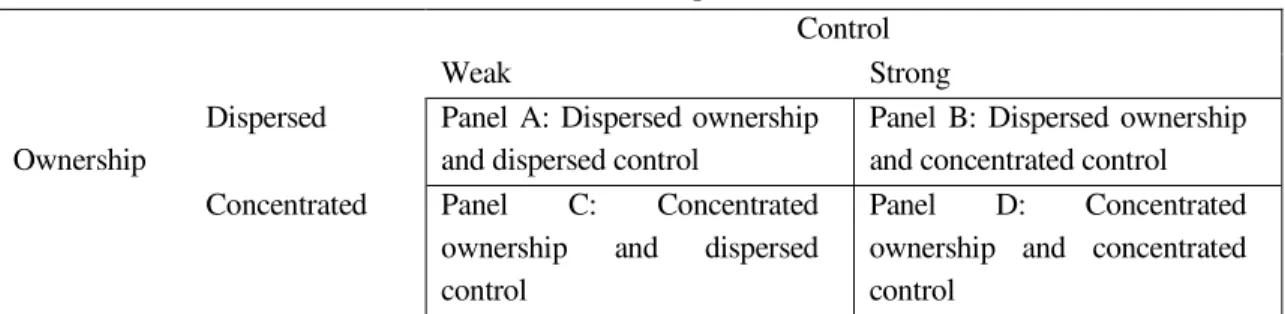
The potential agency problems in large joint-stock corporations will be different depending on whether the one-share-one-vote principle is upheld or not. Table 1 summarises these cases. When diffuse ownership coincides with weak shareholder voting power, as in Panel A, there may be serious agency conflicts between the management and the shareholders (Berle and Means 1932). Monitoring the management may be prohibitively expensive for small shareholders as the monitor bears all the costs from his control efforts but benefits only in proportion to his shareholding (Grossman and Hart 1980, 1988; Demsetz 1983). As a consequence, only a large share stake provides sufficient incentives to monitor a company. On the one hand, diffuse control improves the liquidity of the stock and increases the company’s exposure to the disciplining role of the market for corporate control. On the other hand, strong ownership and voting power come with low liquidity, but a large controlling shareholder reduces the likelihood that the managers will deviate from the maximisation of shareholder wealth. Given this trade-off, the question is whether either the voting power of large shareholders should be limited to avoid the expropriation of minority shareholder or, whether concentrated voting power should be encouraged to curb managerial discretion (Shleifer and Vishny 1997, La Porta et al. 1998).
[INSERT TABLE 1 ABOUT HERE]
The two basic cases where ownership and control coincide are represented by panels A (dispersed ownership and control) and D (concentrated ownership and control) of Table 1. Most Anglo-American companies fall under panel A whereas most German firms fall under panel D. Firms from most other Continental European and Japanese firms tend to fall under panel B. Table 2 provides a summary of recent evidence on control and ownership of German firms.
Edwards and Nibler (2000) and Franks and Mayer (2001) report that more than half of the listed German firms in their samples have an owner holding more than 50% of the equity (see also Edwards and Fischer
4 Gehrig (2003: 159) argues: “[the German] stakeholder-oriented system patching corporate governance problems as they arise (…) tends to give away innovative ideas, human capital, and jobs too easily to competitors in global markets”
(1994) and Lehmann and Weigand (2000), Goergen, Renneboog and Correia da Silva (2004) and Correia da Silva et al. (2004)).5 Furthermore, Edwards and Weichenrieder (1999) show that the actual proportion of voting rights exercised by the largest shareholder of listed German firms at the annual general meetings gives them a comfortable majority (54.84%). Control concentration is also very high when measured by using an ultimate control criterion which tracks control throughout chains of direct stakes (Gorton and Schmid 2000a, 2000b) and by the Cubbin and Leech (1983) index (as applied by Köke (2001)). Ultimate control concentration is even higher in unlisted firms (see also Edwards and Nibler (2000) and Köke (2004)).6
Becht and Boehmer (2001, 2003) show that not only is there a high concentration of voting power in listed companies (82% of them have a large blockholder controlling ultimately more than 25% of the voting rights), but the largest shareholder often does not face other large shareholders (only 20% of these companies have more than two registered blockholders) and the average size of the second largest block (7.4%) is small (see also Edwards and Fischer (1994) and Edwards and Nibler (2000)). As many important decisions, such as modifications to the firm’s charter, mergers, and changes in the firm’s capital usually require a super-majority of 75% of the votes, a shareholder with more than 25% of the votes has a blocking minority. Becht and Boehmer (2003: 10) look at the frequency of voting blocks in terms of their size and conclude that “voting blocks are clustered at 25, 50, and 75%. [This] suggest[s] that block sizes are carefully chosen and control is an important issue for blockholders”.
[INSERT TABLE 2 ABOUT HERE]
In practice, however, a number of large German companies do not fit into panel D of Table 1, but fit into panels C and B. One reason for this is that the one-share-one-vote principle (Grossman and Hart 1988, Harris and Raviv 1988) is not necessarily upheld. In fact, as Table 3 shows, some German companies do not even have “shares that are legal evidence of ownership” (Edwards and Nibler 2000: 241). This is the case for the Gesellschaft mit beschränkter Haftung (GmbH), a private company with limited liability, the legal form of 15% of the German firms in 1994 (Van der Elst 2002). According to Köke (2001), the average size of the largest shareholder in these companies is 89% and only 4% of GmbHs (approximately 400,000 in 1994) have dispersed ownership. As for those legal forms that allow the issue of shares and can therefore be listed, about 0.1% of the German companies in 1994 were public companies with limited liability (AGs) and 3.2% where partnerships with shares (Kommanditgesellschaft auf Aktien, KGaA), a legal form with at least one fully liable general partner (Komplementär) and a number of limited partners (Kommanditisten) whose liability is confined to their contribution.
Panel C of Table 1 represents the case where the concentration of voting power is lower than that of ownership. In this case, the deviation from the one-share-one-vote principle is caused by the use of voting caps designed to prevent large shareholders from exercising control. Voting caps may improve the protection of small shareholders against expropriation by large shareholders, but they certainly also entrench the management. Some examples of German firms that, until recently, had such voting caps in place are BASF (5%), Bayer (5%), Deutsche Bank (5%), Linde (10%), Mannesmann (5%), Phoenix (10%),
5 Van der Elst (2002) reports a slightly smaller figure of 48.5%. The difference in results may be due to the fact that Van der Elst looks at ultimate voting blocks rather than direct stakes.
6 Incidentally, shareholdings are also geographically concentrated: “The four core Länder of North-Rhine Westphalia, Bavaria, Baden-Württemberg and Hesse accounted for almost 90% of the market capitalization of the (….) companies in both 1997 and 2001. (...) In terms of cities, München, Hamburg and Frankfurt were decidedly in the lead“, (Wöjcik 2002: 889).
Schering (3.51%), and Volkswagen (20%).7 In the past, voting caps have been used in some cases to fend off a hostile raider. For example, Franks and Mayer (1998) show that in each of the three hostile takeover battles in Germany since WWII – this excludes the recent hostile bid of Vodafone plc for Mannesmann AG – voting rights restrictions were used. As a consequence, the voting power of several large share stakes was reduced from for instance 30 per cent to 5 per cent. In the cases of Feldmühle Nobel and Continental, the use of voting caps contributed to the failure of the takeover bid (see below). However, such voting-right limits are now prohibited (see sections 4 and 5.1.4).
[INSERT TABLE 3 ABOUT HERE]
Finally, Panel B of Table 1 shows that it is possible to have dispersed ownership with concentrated voting power. Although such a situation combines the benefits of control – increased monitoring – with those of dispersed ownership – risk diversification –, there is also a danger that concentrated control will be exercised to extract private benefits from minority shareholders (Bebchuk et al., 2000). The corporate law regimes in most Continental European countries include a number of mechanisms that allow controlling shareholders to obtain a return on their investments that exceeds the financial return via private benefits of control (La Porta et al., 1999). The mechanisms we consider are: (i) ownership pyramids, (ii) proxy votes, (iii) voting pacts, and (iv) dual class shares.
The most widely-used mechanism to obtain control with a limited investment is ownership pyramids or cascades. These mechanisms enable shareholders to maintain control throughout multiple tiers of ownership while sharing the cash flow rights with other (minority) shareholders at each intermediate ownership tier. Thus, ownership pyramids reduce the liquidity constraints that large shareholders face while allowing them to retain substantial voting power.8 Franks and Mayer (2001) and Köke (2001) show that German corporations are often controlled via such pyramids (see also Gorton and Schmid (2000a) and Faccio and Lang (2002)). However, their samples and definitions differ and so do some of their conclusions. Franks and Mayer (2001) find 33 pyramids in a sample of 38 firms (87%), of which 10 seem to be purely motivated by control because they involve a significant violation of the one-share-one-vote principle. Banks and families prevail at the top of these structures (with an average of 2.2 layers), which were defined on the basis of the presence of “at least one large shareholder holding more than 10% of shares indirectly through another company”. Köke (2001) reports that 45% cases of pyramids in a large sample of about 1500 firms (4638 observations), but the threshold that defines the chains or tiers is 50%. Following this criterion almost 1 out of 2 firms in the sample have a non-financial firm at the ultimate (second or third) level of the pyramid.9 This supports our previous claim that a large part of the German business sector belongs to Panel B. Interestingly, the GmbH is the most frequent legal form in the Köke sample (around 82% of the firms). Moreover, many of these GmbHs are part of groups of companies dominated by an AG: the so-called Konzerns.10
7 These examples are taken from Faccio and Lang (2002). See also Gorton and Schmid (2000a) for more examples from the 1970s and the 1980s.
8 For instance, if shareholder X owns 51 per cent of the voting equity of firm Y which in turn owns 51 per cent of the voting equity of firm Z, there is an uninterrupted control chain which gives shareholder X absolute majority control at each tier. Still, the cash flow rights of shareholder X in firm Z amount to only 26 per cent.
9 It is important to bear in mind that Köke (2001) uses the Cubbin and Leech (1983) index to define ultimate control. 10 “The general characteristic of a Konzern is that at least one legally independent company is under centralized control exerted by the parent company. The law distinguishes between three Konzern categories: (1) integration, where the dominating company holds 100% of the integrated dependent company’s shares; (2) contractual groups of companies (Vertragskonzern), where dominating and dependent companies enter into a contract of domination (Beherrschungsvertrag), in most cases in connection with a profit transfer agreement (Gewinn-abführungsvertrag); and (3) groups of companies based on actual dependence (Faktischer Konzern), where the relation between dominating and dependent companies is not subject to one of the types of contracts mentioned above. The faktische
As mentioned above, it is possible that pyramids can lead to the expropriation of minority shareholders. Let us consider the examples. If a car producer requires car seats from a subcontractor, a large shareholding in the subcontractor can yield an important (strategic) advantage. The large shareholder will usually be represented on the subcontractor’s board and will thus be able to obtain private information on the firm’s cost structure or on supply contracts with competitors. The large shareholder could, for example, after obtaining such strategic information, renew negotiations about the price charged by the subcontractor for the car seats. Consequently, such transactions can lead to the creation of another kind of agency conflict, namely the oppression of minority shareholder rights. Let us consider one more example. Suppose that a shareholder owns 51 per cent of the voting shares in firm A and that he also owns 100 percent of the equity of another firm, firm B. If firm A is a supplier to firm B, the controlling shareholder may be tempted to reduce the transfer price of goods sold to firm B. Profits are then maximized at the level of firm B which is fully controlled and owned by the large shareholder. At the same time, profits are not maximized at the level of firm A, which directly harms its minority shareholders.
Johnson et al. (2000) and Buysschaert, Deloof and Jegers (2003) provide examples of these practices in France, Italy and Belgium. The former study argues that the use of a number of mechanisms to separate ownership and control may also have facilitated the expropriation of minority shareholder rights in Germany. Edwards and Weichenrieder (1999), for example, show that an increase in the largest shareholder’s control rights effectively harms minority shareholders. However, they claim that these negative effects may be somewhat compensated by the benefits obtained from greater monitoring of management when the largest shareholder is a non-bank firm or a public-sector body. Köke (2001) argues that in 10 percent of his sample, given that the cash flow rights of the largest shareholders amount to only 25 percent or less of their control rights, the ultimate shareholder “could hinder efficient monitoring”. The second mechanism which gives control with limited cash flow rights is proxy votes. In the US and the UK, the management when making proposals to be considered at the annual general meeting normally solicit proxy votes for their support. In Germany, banks are the main exercisers of proxy votes because, as most shares are in the form of unregistered bearer shares, holders normally deposit them with their banks, and banks are allowed to cast the votes from these shares (conditional upon the bank announcing how it will vote on specific resolutions at the general meeting and upon the lack of receiving alternative instructions by the depositors). Fore example, in the above-mentioned failed, hostile bid for Feldmühle Nobel by the Flick brothers, voting restrictions were imposed thanks to a resolution supported by Deutsche Bank that eventually passed with 55% of the shares voted. However, Deutsche Bank only held a direct share stake of about 8%; the rest were proxy votes (Franks and Mayer 1998).11 Edwards and Nibler (2000) provide further evidence on banks proxy votes for a sample of 156 listed and non-listed German companies in 1992. Their data show that banks typically control more voting rights via proxy votes than via their own stakes.12 Moreover, they note that banks’ proxy votes only affect the governance of AGs and KGaAs but not that of GmbHs. All in all, proxy votes seem to provide effective voting power to German banks (especially to the three largest ones: Deutsche Bank, Dresdner Bank and Commerzbank) mainly in large listed companies (see also Prigge (1998) and Franks and Mayer (2001)).
Konzern is the clearly predominating category, and the GmbH is the most common legal form of business organization
for dependent companies” (Prigger 1998: 952-953).
11 Edwards and Fischer (1994) argue that banks have traditionally supported voting restrictions in Germany because their access to proxy votes made them more powerful in the general meetings as the voting restrictions did not apply to proxy votes.
The third mechanism is voting pacts. Voting pacts enable shareholders to exert a much higher degree of control as a group than the members of the pact could individually. As pointed out by Franks and Mayer (2001), for example, in many German corporations a (hypothetical) coalition formed by the two or three largest shareholders could easily gain control;13 see also Leech and Manjon (2002) and Leech (2003) for Spanish and British evidence on this, respectively. However, apart from the notable exception of Crespi and Renneboog (2002), there is little empirical evidence that long-term shareholder coalitions are formed in Europe because such coalitions may bring about substantial costs. For example, the regulatory authorities in the UK consider a long-term shareholder coalition as a single shareholder and, as a consequence, the coalition has to comply with all the regulations concerning information disclosure, mandatory tender offer, disclosure of strategic intent, etc. According to Jenkinson and Ljungqvist (2001), corporate governance regimes like the German one in which multiple large shareholders exist, are both “unpredictable and lacking in transparency”. [Control] [b]attles often involve a protracted, and clandestine, shuffling of stakes between rival coalitions and the revising of pooling agreements [(voting agreements)]. Even large blockholders can find themselves, apparently without warning, as members of the suppressed minorities.” Most coalitions are usually formed on an ad hoc basis with a specific aim, such as the removal of badly performing management.
The fourth mechanism to separate ownership and control is dual class shares. Under a dual class regime, one class (B-shares) has fewer voting rights than the other one (A-shares). In the US, dual class shares have become an increasingly important concern to investors since the 1980s, when stock exchanges liberalized the originally restrictive policy on multiple and dual class shares. These shares are also commonly issued by European firms (from e.g. Italy, Scandinavia, and Switzerland),but with large differences across EU member states both in terms of their use and the rights attached.14 Non-voting shares are used by German firms, although they may not exceed 50% of the stock capital. Faccio and Lang (2002) estimate that the proportion of firms with dual class shares outstanding is 18% in Germany. Goergen and Renneboog (2003) demonstrate that the issuance of non-voting shares is very effective to forestall any change in control. However, the issuing of multiple voting shares was outlawed in Germany as of May 1998 and the grandfather clause was phased out on 1 June 2003 (Beinert 2001: §70). In addition, German firms, as well as firms from certain other countries, can issue preference shares (Vorzugsaktien). This is risk-bearing capital without votes, but with special dividend rights (Goergen and Renneboog 2003).15
2.2 Monitoring by blockholders
In the previous section, we have shown that most German companies have large controlling blockholders. The key question is: do blockholders enhance firm value? Value is expected to be created by the increased monitoring of the management by the large blockholders (see, amongst others, Stiglitz (1985), Shleifer and Vishny (1986), Admati et al. (1994), Maug (1998), and Kahn and Winton (1998), Renneboog (2000), Franks, Mayer and Renneboog (2001)). There is an extensive literature investigating whether blockholders take corporate governance actions when increased monitoring is necessary (e.g. in the case of poor corporate performance or financial distress).16 In addition, the incentives to correct managerial failure
13 Edwards and Nibler (2000), however, argue that it is unlikely to happen if these large shareholders are banks. 14 As shown by Goergen and Renneboog (2001) for example, they no longer exist in listed UK companies as the result of an active dissuasive policy by the London Stock Exchange during the early 1990s.
15 A special case of a multiple voting share is the so-called “golden share”, which gives one or more shareholders (e.g. the government) a veto right in certain clearly defined situations. The Italian and Spanish governments, for example, hold golden shares in firms privatised during the early 1990s (e.g. Telecom Italia and Repsol). However, the Treuhand (the privatisation agency) does not seem to have employed them in the privatisation of Eastern German firms (Dyck 1997, Hau 1998).
16 Even in the context of managerial compensation schemes, the role of blockholders is apparent. For example, Mehran (1995) shows that equity-based compensation is used less extensively in US firms with stronger outside blockholders suggesting that blockholder monitoring is a substitute for equity-based compensation contracts. In contrast, Crespi,
depend not only on the concentration of ownership or control, but also on its nature as specific classes of shareholders may value control differently.17
It should be noted, however, that concentrated ownership may also generate substantial costs. First, Demsetz and Lehn (1985), Admati et al. (1994) and Manjon (2004) claim that control by a large shareholder may result in reduced risk sharing. Second, as shown above, ownership concentration may reduce the market liquidity of all the shares (Bolton and Thadden 1998, Becht 1999). Third, in highly leveraged companies, a large blockholder may push management to take excessive risks – especially if the company is performing poorly and the bankruptcy costs are high. In this case, risk increasing investment projects may lead to the expropriation of debtholder wealth (Jensen and Meckling 1976; Coffee 1991). Fourth, Burkart et al. (1997) and Pagano and Röell (1998) point out that even when tight control by shareholders is efficient ex post, ex ante it may constitute an expropriation threat that reduces managerial incentives to exert effort and to undertake value maximizing strategies (the so-called ‘over-monitoring’ effect). Fifth, although blockholdings are meant to mitigate the agency costs resulting from excessive managerial discretion, they can induce their own types of agency costs as the private benefits usually come at the expense of other shareholders or stakeholders.18 These private benefits can, for example, be in the form of the squeeze-out of minority shareholders at a price below the value of their shares in a tender offer and the diversion of resources from security holders to entities controlled by a blockholder (Johnson et al. 2000).
In fact, in the empirical literature, there is little evidence on the benefits from having large blockholders (Short 1994; Gugler 2001). Franks, Mayer and Renneboog (2001), for example, investigate whether the presence of blockholders in poorly performing British companies is related to increased board restructuring. They find no evidence of increased managerial disciplining in the wake of poor performance when large outside shareholders are present. The only consistent and significantly finding relates to managerial entrenchment as managers with a substantial degree of control are able to ward off any attempts to remove them. Banerjee, Leleux and Vermaelen (1997) investigate the governance role of French holding companies which constitute the dominant shareholder category in France and conclude that the presence of holding companies as major shareholders seems to reduce corporate performance and firm value. Similarly, Renneboog (2000) fails to find a monitoring role for blockholders in firms listed on the Brussels stock exchange, with the exception of controlling industrial and commercial companies which initiate board restructuring when the firm’s accounting and share price performance declines.
[INSERT TABLE 4]
Gispert and Renneboog (2002) find managerial compensation contracts related to share price performance are complementary to outside blockholdings in Spanish firms. In other words, it seems that in Spain one needs a strong blockholder to impose such contracts. In companies without outside blockholders, the managerial compensation contracts are based on accounting performance (which is subject to managerial control and can thus be manipulated). A similar result is reached by Renneboog and Trojanowski (2003) for the UK in a simultaneous equation system on managerial compensation and turnover.
17 See e.g. Jensen and Meckling (1976). The thesis that different classes of shareholders have different abilities to extract control rents is empirically supported for the US by e.g. Demsetz and Lehn (1985), Barclay and Holderness (1989, 1991) and Holderness and Sheehan (1988).
18 Zwiebel (1995) argues that private benefits of control can be extracted even if a company has multiple large shareholders. He claims that these benefits may be divisible and that parties can enjoy them accordingly to their relative control. Beyond some threshold, the control by large blockholders will not be challenged as it may be difficult to build up share blocks of a similar size. Unchallenged control may encourage the extraction of private benefits of control at the expense of dispersed small shareholders.
There have been a number of specific studies on the role of large shareholders in German firms (summarized in Table 4). The evidence is inconclusive. In a pioneering study on listed companies, Thonet and Poensgen (1979) conclude that management-controlled firms outperform those controlled by outsiders in terms of the return on equity (ROE). Similarly, Edwards and Weichenrieder (1999), using a sample of quoted companies, and Lehmann and Weigand (2000), using a sample of both quoted and unquoted companies, find a significant negative relation between on one side control concentration and on the other side the market-to-book ratio and the return on assets (ROA). However, Kaplan (1994b), Goergen (1998) and Franks and Mayer (2001) find no significant impact of control on corporate performance and on board turnover in listed firms. Weigand (1999) and Edwards (1999) show that firms with high control concentration outperform more dispersed firms in terms of the ROA. However, Gedajlovic and Shapiro (1998) find inclusive results, using the return on assets (ROA) as their measure of performance. They find a non-linear relationship between ROA and control (which is negative at low levels of control but positive at high levels) and a positive impact on ROA from a reduction in strong managerial control (entrenchment). Köke and Renneboog (2003) conclude that the relation between strong ultimate blockholders and productivity growth is very limited. Strong blockholders reduce the negative effect of weak product market competition, but only in profitable large firms controlled by banks, insurance firms and the government. Finally, Cable (1985) and Gorton and Schmid (2000a, 2000b) – focusing on bank control – seem to be the only studies reporting a consistently positive control-performance relationship. In contrast, Edwards and Nibler (2000) find such a positive relation only for individuals holding a minority stake and for foreign firms (see also Edwards and Weichenrieder (1999)).
Some studies focus on the monitoring effects of banks as large shareholders (Emmons and Schmid 1998). Cable (1985), Gorton and Schmid (2000a, 2000b), Lehmann and Weigand (2000) and Köke and Renneboog (2003), for example, find that banks as large shareholders improve corporate profitability. However, Edwards and Nibler (2000) report this effect only for the “3 big banks”. Interestingly, bank-controlled firms (or banks strongly influenced by other banks through e.g. board representation) also seem to have higher survival rates (Elston 2004). Conversely, Agarwal and Elston (2001) and Chirinko and Elston (1998) do no find statistically significant differences between the profitability of bank- and non-bank controlled firms. In fact, firms whose ultimate owner is a bank or another financial institution appear to have lower productivity growth (Januszewski et al. 2002).19
An important caveat that applies to most of these studies is the implicit assumption that it is control or ownership that influences corporate performance and not vice-versa (Demsetz and Lehn 1985; Himmelberg et al. 1999).20 Goergen (1998), who reviews the studies that explicitly address the direction of causality, shows that this conclusion may be premature and there may be a need for a reversal of the direction of causality between firm value and ownership or control in line with Kole (1996). However, most German studies claim that the characteristics of the German governance system make ownership and control exogenous (see, among others, Edwards and Nibler (2000), Gorton and Schmid (2000), Lehmann and Weigand (2000) and Gugler and Weigand (2003)).
It is apparent that control is valuable in Germany; controlling shareholders are likely to derive private benefits of control from large share stakes. Schmid and Wahrenburg (2003) show that the premium of
19 Moreover, “acquisitions do not increase bidders’ firm value more when financial institutions have partial control over the bidder group, but do decrease firm value when they have full control. [Therefore], there is little empirical support for the widespread contention that German banks provide efficient monitoring. [More precisely, b]ank involvement is beneficial if the institution holds the second- or third-largest stake, but not if it holds the largest stake” (Boehmer, 2000: 137, 145).
20 Recent studies by Bhagat and Jefferis (2002), Köke and Borsch-Supan (2002), Coles et al (2003) and Manjon (2003) discuss at length the econometric problems that arise in the estimation of these models.
voting over non-voting shares in Volkswagen hovered between 30 percent (1999) and 76 percent (2000). Nenova (2003) and Dyck and Zingales (2001) find that private benefits of control are significant for German firms. Edwards and Weichenrieder (2001) provide some empirical evidence that large blockholders enjoy private benefits of control (at the expense of minority shareholders). They show that the more control rights the largest shareholder holds, the lower is the firm’s market value. Conversely, firm value increases with the proportion of control rights held by the second-largest shareholder. This suggests that the largest shareholder is able to extract private benefits of control when his control is uncontested whereas the presence of a second large shareholder redirects the focus of the firm towards the creation of firm value. A similar idea is put forward by Gugler and Yurtoglu (2003) in the context of dividend payout policies. In German firms, characterised by high control concentration, the conflict between the large controlling shareholder and the small minority shareholders is one of the main corporate governance issues. An increase in dividends reduces the funds at the disposal of the large shareholder and increases the market value of the firm. A decrease in dividends implies potentially more severe rent extraction and expropriation of small shareholders. Gugler and Yurtoglu find that the negative price reaction to dividend decreases is much more severe in firms with one controlling shareholder than in firms with several large blockholders. To conclude, the German evidence on the link between corporate performance and control or ownership is inconclusive. Frick and Lehmann (2003) state that the relationship between ownership or control concentration and profitability has changed over time. In the 1970s and 1980s, there seemed to be a positive relation, which vanished or even turned negative in the 1990s.
2.3 The nature of control
Not only does the degree of control matter, but so does the type of the controlling shareholder (Cubbin and Leech 1983). As shown by Jensen and Meckling (1976), some types of shareholders may be better at monitoring poorly performing companies given their incentives and/or abilities. Similarly, different types of shareholders may be subject to different types of agency costs (Zwiebel 1995; Pagano and Röell 1998). Empirical evidence on the differences in incentives, abilities and costs in the governance of German firms can be found in e.g. Gorton and Schmid (2000b), Lehmann and Weigand (2000), Januszewski et al. (2002), Köke and Renneboog (2003), Edwards and Nibler (2000) and Franks and Mayer (2001).
[INSERT TABLE 5 ABOUT HERE]
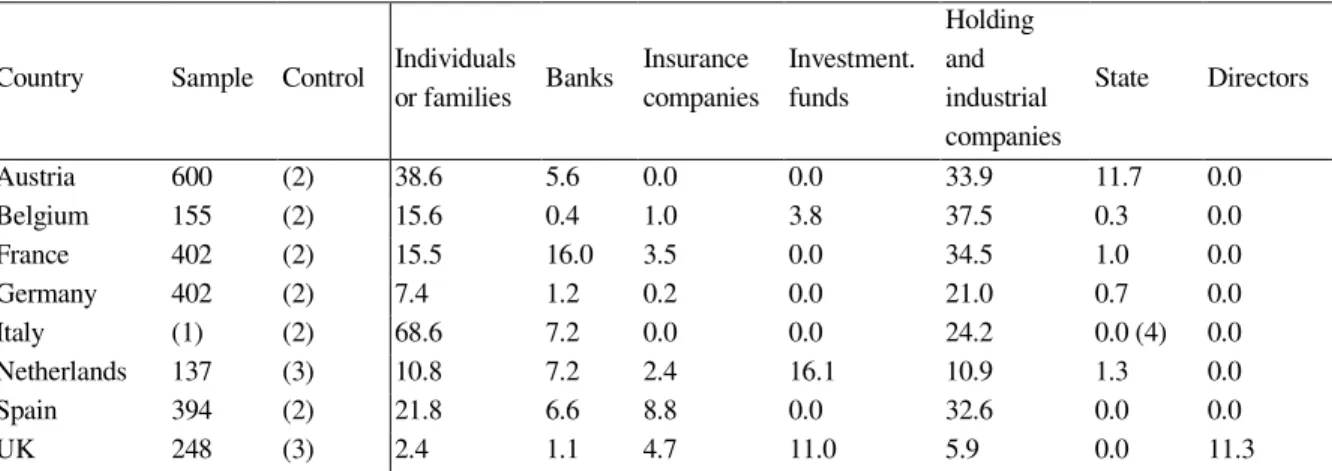
Table 5 compares the average sizes of the stakes held by the different types of shareholders in German firms to that in other European countries. The types of shareholders are: (i) institutional investors (banks, insurance companies, investment and pension funds), (ii) individuals or families, (iii) directors and their families and trusts, (iv) industrial and holding companies, and (v) the federal or regional governments. Germany is similar to most other Continental European countries in the sense that the most important type of shareholder is holding and industrial companies, followed by individuals or families. In detail, in Germany the principal investors are, in order of importance, i) holding and industrial companies, ii) individuals and families, iii) banks (although, as pointed out in the previous section, proxy votes can make them very powerful in the general meetings) and other institutional shareholders, and iv) public authorities. We now turn to discussing each of these types in more detail.
2.3.1 Industrial and holding companies
The existence of share blocks held by other industrial companies is a documented feature of the German corporate governance regime (Prigge 1998). In fact, about 80 percent of direct equity stakes in firms listed on the official market belongs other firms (industrial firms, holding companies, investment firms and financial firms) (Becht and Boehmer 2003). Moreover, there is evidence that German firms controlled by
other companies tend to have higher levels of productivity (Januszewski et al. 2002) and are less likely to be acquired if they are public corporations (Köke 2002).21
Faccio and Lang (2002) show that Germany is the European country with the largest percentage of companies controlled by other firms. This phenomenon is also prominent in the German financial sector.22 Table 5 shows that German holding companies and industrial companies control an average stake of 21 per cent in other German listed firms, which is largely corroborated by Emmons and Schmid (1998) and Gorton and Schmid (2000b).23 These large industrial shareholders may obtain substantial private benefits at the expense of other shareholders or stakeholders (Grossman and Hart 1988) and cross-holdings may have an important negative impact on competition (Canoy et al. 2001).
2.3.2 Families or individuals
Table 5 also shows that individuals or families are one of the main shareholder categories in Continental Europe (see also La Porta et al. (1999)).24 In particular, Franks and Mayer (2001) have found that large-scale family control is especially pronounced in the largest German firms. This finding was also documented by Edwards and Nibler (2000) and Becht and Boehmer (2001). In 40 and 37 percent of their samples individuals or families control blocks of on average 57 and 20 per cent (respectively) of the voting rights. In general, however, they are much more commonly found among small and medium-sized non-financial companies (Köke 2001, Faccio and Lang 2002).
2.3.3 Directors
A particular category of individuals controlling share stakes is that of the directors, who are insiders and therefore possess superior information on the firms’ prospects. However, Table 5 suggests that Continental European managers are not shareholders of the firms they manage. Actually, hardly any information is known about directors’ control in Continental Europe for the following reasons: (i) the shareholdings of most directors are below the disclosure thresholds, (ii) although large family blockholders frequently appoint their representatives (which can be family members) to the board, the origin of board representation does not need to be disclosed publicly, and (iii) the use of intermediate investment companies further obscures directors’ control. Whatever the reasons, we have found only two German studies presenting data referred to this category. First, Gorton and Schmid (2000b) show that the management owns at least 50% of the control rights in 8 per cent of the firms in their 1992 sample. Moreover, 15 percent of the firms have a member of the management team as the largest shareholder. Second, Köke (2004) reports ultimate control measures for a sample of listed and unlisted firms for the years 1987-1994. The average stake of the (executive and non-executive) directors and their families is 22.5 percent for the quoted firms and 12 percent for unquoted firms. These figures suggest that in a non-negligible number of German companies there is no separation between ownership and control because “managers own” and “owners manage”.
2.3.4 Banks and other institutional shareholders
There is an extensive theoretical literature on the role and incentives of bank monitoring. Diamond (1984), for example, formulates a model that shows that delegation of monitoring to banks is efficient as
21 However, Köke (2004) “finds no evidence that complex ownership structures deter control purchases”.
22 This kind of relationships has also been observed in other European countries and seems to be related to the consolidation trend affecting the financial services industry all over the world (Goldman Sachs 2000, Walter and Smith 2000).
23 The average of 21% hides the fact that the ownership stakes are high: industrial shareholders hold average share stakes of 40 per cent or more in 52 per cent of the German companies.
24 The higher importance of family control in Austria and Italy (see Table 5) can be explained by the fact that the samples for the two countries consist of both listed and unlisted companies. Still, even after excluding the unlisted Italian firms, a majority of the listed Italian companies is family-controlled.
duplication of monitoring by small investors (creditors) can be avoided, provided the bank’s lending portfolio is sufficiently diversified.25 Krasa and Villamil (1992) study delegated monitoring by considering the role of the intermediary who is to satisfy the different portfolio preferences of both borrowers and lenders. They model the incentive structure of the monitor by determining what intermediary portfolio accomplishes optimal asset transformation between borrowers and lenders. Rajan and Diamond (2000) review the assumptions of Diamond (1984) and show that the bank’s incentives to monitor are preserved provided that there is no deposit insurance and that the first-come first-serve feature of bank deposit contracts is maintained. In other words, it is the possibility of a bank-run that preserves the banks’ incentive to monitor the firms.
However, as shown in Table 5, bank shareholdings in German – as well as other Continental European – companies are generally small.26 One reason for this may be the avoidance of potential conflicts of interest (Canoy et al. 2001, Goergen and Renneboog 2001). In Germany, for example, only 5.8 percent of the large voting stakes of 5 percent and more are held (directly as well as indirectly) by banks, resulting in an average of 1.2 percent of the votes (see Table 5). However, from what we have said above, it is clear that the influence of banks is understated if one just looks at their direct and indirect stakes and ignores their proxy votes.
Weigand (1999) shows that over the long run, firms controlled by universal banks outperform management-controlled firms. Other evidence on the impact of banks is given by Goergen, Correia da Silva and Renneboog (2004) who examine the flexibility of the dividend policy of German corporations. They find that bank control is associated with a higher likelihood to omit the dividend when the firm suffers a loss. This suggests that bank control mitigates informational asymmetry and reduces agency costs. In contrast, control by other types of shareholders does not influence the dividend decision. In widely-held loss-incurring firms there is even a reluctance to cut the dividend which suggests that these firms are more prone to agency costs than firms with a controlling shareholder and therefore rely more heavily on dividend policy as a corporate governance mechanism.
As for the other types of institutional shareholders, insurance companies also seem to be important.27 In sharp contrast with the UK and the US, however, other institutional investors (notably investment funds) do not hold significant stakes in German companies (O’Sullivan 2000, Davis and Steil 2001).28 Empirical evidence from the firms listed on the German official market (Amtlicher Handel) shows that whereas 20 insurance companies hold shares representing around 17% of the market capitalization, the rest of the institutional investors (excluding banks) barely reach 0.5% (Wöjcik 2002). Given the close links between insurance firms and banks in Germany, the importance of the former further reinforces the role of banks as controlling shareholders (Goldman Sachs 2000, Canoy et al. 2001).
In general, the lack of institutional blockholders (apart from banks) in Germany as well as of most Continental European countries suggests that, in contrast to the Anglo-American countries, little
25 Hellwig (2000) generalizes Diamond’s results by allowing for risk averse banks.
26 It is interesting to note, however, that the German data analysed by Gorton and Schmid (2000) from the 1970s and 1980s suggest that bank shareholdings were not that small in the past.
27 Köke (2001) shows that institutional investors have a strong preference for listed firms. See also Deeg (1998) and Vitols 1998) on the role of German banks in small and medium-sized firms.
28 Pension funds are largely lacking as institutional investors; the reason may be that “[t]he German pension system currently does not involve public funds but rather leaves pension contributions under control of either the government or the employer” (Boehmer, 2000: 121).
shareholder activism is to be expected from these institutions.29 Even in Anglo-American countries, there is not much evidence of monitoring by institutional shareholders and any monitoring seems to be limited to just a few large funds because most institutions prefer to avoid monitoring firms and gathering non-public information. If they were to possess such information, the insider trading legislation would curb their trading such that the liquidity of their investment portfolio would be reduced. Furthermore, the costs of actively monitoring the many firms included in the institutions’ portfolios may also be prohibitive (Stapledon 1996; Stapledon and Bates 2002).
2.3.5 Public authorities
Despite the large-scale privatisation programmes that occurred in Europe over the last decades (starting with the UK in the 1980s), 30 in many listed European firms the state is still one of the largest shareholders (La Porta et al. 1999). In this respect, one has to take into account the privatisation of East German firms during the early 1990s (Dyck 1997, Hau 1998). Even when controlling for this specific privatisation process, the importance of public authorities as shareholders remains considerable, especially in large (GmbH and unlisted AG) firms (Köke 2001; Faccio and Lang 2002). As an illustration, in 1997 the value of their holdings in the firms listed on the official market or Amtlicher Handel was about 21 percent of the total market capitalization. In 2001 the public investments represented only 14 percent of the market capitalization (Wöjcik 2002).31 In terms of the number of firms in which the government was the largest shareholder, figures range from 6 percent (Franks and Mayer 2001; Emmons and Schmid 1998) to 8 percent (Edwards and Nibler 2000; Gorton and Schmid 2000b).
In the next section we review the evidence on the other internal mechanisms of corporate governance: the supervisory board, management board turnover in the wake of poor performance and managerial remuneration.
3 Internal corporate governance mechanisms 3.1 Supervisory boards
To the opposite of most western economies, Germany has a two-tier board with a management board (Vorstand) and a supervisory board (Aufsichtsrat).32 The supervisory board represents the shareholders and employees. Baums (2000) compares the fiduciary duties (duty of care and loyalty) in German and UK corporate law and concludes that ‘the range of fiduciary duties in the English law system seems wider and more developed than in its German counterpart’ (p.8). The German supervisory boards are dominated by representatives for the large shareholders. In large firms with more than 2000 employees, the 1976 Codetermination act has created a system of quasi-parity co-determination. Employee representatives make up half of the supervisory board but the chairman who is a shareholder representative has a casting vote in case of a stale-mate. Bankers are frequently elected to the supervisory board (even as chairmen) (Edwards
29 Bratton and McCahery (1999) question whether the Anglo-American style of institutional shareholder activism would lead to improved corporate results in Continental Europe because, in their opinion, a minimum level of takeover activity is a precondition of relational engagement between institutional shareholders and managers.
30 Gorton and Schmid (2000a), for example, show the decline in the participation of German and foreign governments as (largest) ultimate owners of German firms between the 1970’s and the 1980’s.
31 Becht and Boehmer (2003), in contrast, report that the government holds only 2.35 percent of the votes on the official market during 1996-1998.
32 The Netherlands also has a two-tier system with a Raad van Bestuur (management board) and a Raad van
Commissarissen (supervisory board). In France, corporations have the choice between a one-tier board and a two-tier
system; but more than 95% of the listed companies has opted for a unitary board (Dherment-Ferere and Renneboog, 2002).
and Nibler 2000: 241). In small companies with more than 500 but less than 2000 employees, one third of the supervisory board consists of employee representatives. Finally, full-parity co-determination by the shareholders and employees is limited to the steel and coal sector only (which are subject to the 1951 Montan Codetermination Act). The role of this co-determination system is currently the object of a debate in Germany. The only companies that are exempt from having a supervisory board with co-determination are those who can appeal to the constitutional freedoms of faith and free press (e.g. the publishing company Springer). The directors of German firms are usually appointed for a term covering the legal maximum of 5 years, although reappointment at the end of the term is possible.
There is little evidence that the co-determination system leads to superior corporate governance (Franks and Mayer 2001). Firms with workers’ councils have a lower employee departure rate (by 2.4%), pay significantly higher wages (Jifjan and Klodt 1999) and have a lower wage differential between skilled and unskilled labourers (Hübler and Meyer 2000). All in all, there is evidence that workers’ councils and employee representatives on the supervisory board unilaterally favour the interests of the incumbent workforce (Frick and Lehmann 2001).
3.2 Management board turnover in the wake of poor performance
The disciplining of top management (and in particular of the CEO) has received considerable empirical attention.33 The reason is that such disciplining is one of the few observable corporate governance actions by the board of directors. Most other governance actions or discussions by directors are not directly observable, as the minutes of the board meetings are not publicly available. However, good corporate governance cannot simply be equated to the dismissal of badly performing managers from the board for the following two reasons. First, poor (industry-corrected or business-cycle adjusted) corporate performance leading to managerial disciplining may be protracted past poor performance and hence also the result of failed past corporate governance. As such, the dismissal of poorly performing management may come too late.34 Second, the success of the removal of the underperforming management should be considered along with the managerial alternative. For instance, Dherment and Renneboog (2002) study how the French stock market reacts to the appointment of CEOs with different backgrounds. They find that whereas voluntary resignations do not cause share price reactions, the nomination of an external manager following the performance-related forced resignation of a CEO causes a strong significant increase in abnormal returns of more than 2 percent. The abnormal return at the promotion of an internal candidate to the post of CEO in a poorly performing firm is negative (1 percent on the day of the announcement), which presumably occurs because the internal candidate is held (partially) responsible for past poor performance.
For Germany, Kaplan (1994a) presents evidence that management board turnover is closely related to poor stock performance and earnings losses, but not to sales and earnings growth. In contrast, the turnover of the chairman of the supervisory board is more likely to happen when the firm’s net income falls. In addition, poor stock performance also causes supervisory board dismissals. Three additional results are worth mentioning. First, the evidence is consistent with the view that the German corporate governance regime is based on a long-term perspective of the firm (Porter 1992). Second, the sensitivity of executive turnover to firm performance in Germany is comparable to that in Japan and the US (Kaplan 1994b; Kaplan and Minton 1994). Third, neither large shareholders nor bank control seem to protect managers from the
33 Several papers examine whether top management dismissal is followed by improvements in corporate performance. Denis and Denis (1995) document performance increases following forced CEO turnover in the US. However, Renneboog (2000) and Franks et al. (2001) do not find evidence of a significant improvement over the two-year period following the CEO’s replacement for Belgian and British firms, respectively.
34 In fact, there is evidence on the UK that managerial disciplining only takes place when firms are in the lowest quintile of stock price performance and are incurring accounting losses (Franks et al. 2001).
possibility of being dismissed when their companies perform poorly. These results call into question the view that in bank-based regimes, such as the German one, managers may be entrenched at the expense of minority shareholders (Coffee 1991, Roe 1993). The results in the Kaplan studies are not entirely supported by the Franks and Mayer study (2001). The latter documents that supervisory board turnover depends on corporate performance but only when there is a change in control. Supervisory turnover of firms which are incurring losses is not statistically different from that of firms generating profits although it is significantly higher when new blockholders acquire stakes in the poorly performing firms. The level of management board turnover provides a similar picture. Board turnover is higher for loss makers than for non-loss makers, but it is only statistically significant in the subsample for firms with stable holdings. These results suggest that block sales are not disciplinary in nature.
3.3 Managerial remuneration
Perhaps the simplest economic device to align managers’ actions with the interests of shareholders (or more generally, stakeholders) is a compensation contract that specifies the tasks and rewards of the executive directors for each outcome of corporate performance. However, an important limitation to the use of contracts as an internal governance mechanism is that they are necessarily incomplete (Tirole 1999, 2001). In addition, managerial effort is unobservable such that a number of moral hazard problems may arise. The fact that managers are underperforming may remain undetected for some time whereas, in contrast, good managers may be paid less than they deserve (Holmstrom 1979, Grossman and Hart 1983). Fortunately, the optimal compensation scheme may be relatively straightforward to implement because, as shown by Holmstrom and Milgrom (1987), under certain conditions it simply boils down to a linear function of aggregate measures of firm performance (output, profits, etc.).35
[INSERT TABLE 6 ABOUT HERE]
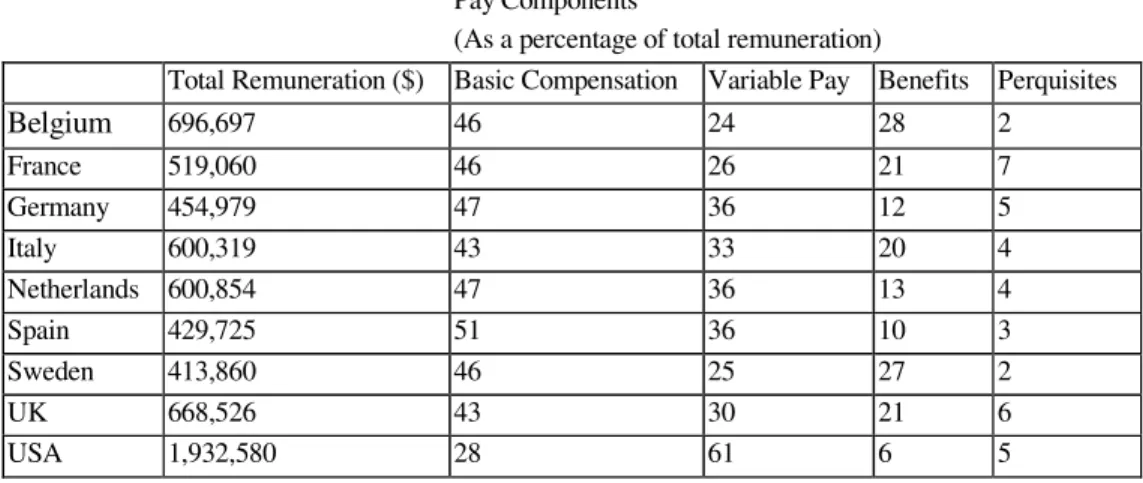
Table 6 compares CEO remuneration in Germany to the rest of Europe and the US. German CEOs are among the lowest paid not in Europe. German CEOs earn on average a total remuneration of only $454,979 as compared to $696,697 for Belgian CEOs. Conyon and Schwalbach (1999, 2000a) show that when differences in tax rates are taken into account the variation across Europe is even larger. The pay package of German CEOs looks even more meagre when compared to their US counterparts. In terms of the importance of the basic compensation in the total pay package (47%), German CEOs are no different to their European counterparts, but are substantially different when compared to US CEOs (28%). In particular, German CEOs appear to have the highest total cash pay in Europe but have the lowest non-cash remuneration. This may explain why the total remuneration package of German executives is low compared to other European executives (Conyon and Schwalbach 1999, 2000a). In the mean time, variable payment is increasingly adopted by large German firms (Tuschke and Sanders 2003).
The influence of remuneration policies on the behaviour of German managers has recently been a matter of further systematic research (see e.g. Kraft and Niederprüm (1999)). Elston and Goldberg (2003) investigate the monetary compensation of the members of the management and supervisory boards of German firms and confirm the results of Schmid (1997). First, although the size effect (positively) dominates the compensation equation, there exists a positive sensitivity of managerial pay to company performance in Germany. This relation is confirmed by Conyon and Schwalbach (2000b). Second, the Elston and Goldberg (2003) study shows that managers and directors of widely-held firms receive a substantially higher monetary compensation than those of firms with large blockholders. Third, firms with monitoring house
35 Supportive evidence of the Holmstrom-Milgrom model can be found in Garen (1994) and Kraft and Niederprüm (1999).
banks (which own an equity stake, are major providers of loan capital and frequently have board representation) generally pay managers and directors comparatively less than widely held firms. The adoption of stock-based compensation is investigated by Tuschke and Sanders (2003). They show that the relationship between the likelihood of adopting stock-based incentives and control concentration in listed German firms has an inverted-U shape with a maximum in the first quartile of control concentration. In the next section, we review evidence on the external corporate governance mechanisms: the market for corporate control, block trades, creditor monitoring and product market competition.
4 External corporate governance mechanisms 4.1 The market for corporate control
The role of hostile takeovers is controversial. On the one hand, hostile takeovers are considered to be a device to keep managerial autonomy under check and to impose discipline by enabling the acquirer to reallocate the target’s resources more profitably (Grossman and Hart 1980; Burkart 1999). On the other hand, there is little evidence that, in practice, the market for corporate control assumes these tasks. While poor performance only slightly affects the probability of a takeover, the main determining factor is size (see Morck et al. (1988), Martin and McConnell (1991), Comment and Schwert (1995), Schwert (2000) for the US, and Franks and Mayer (1996) for the UK). In contrast, Franks et al. (2001) show that poorly performing UK companies are frequently drastically restructured via mergers and acquisitions which lead to the replacement of most of the directors.
Still, the role of the market for corporate control may be rather indirect. First, it is possible that the mere threat of a takeover raises efficiency ex ante (Scharfstein 1988; Shleifer and Vishny 1986). Second, companies shielded from the takeover market have lower share prices. The setting up of anti-takeover devices generally coincides with a reduction in share value (Karpoff and Malatesta 1989; Ryngaert 1988; Jarrell and Poulsen 1989). This negative impact can be interpreted as evidence that shareholders fear that managers may take advantage of the increased lack of control by not maximizing shareholder value. The fall in the share price may also reflect the reduction in the probability of the shareholders receiving a takeover premium.
In a survey paper on the economics of mergers and acquisitions, Burkart (1999) concludes that although managers shielded from the takeover threat do not behave like empire-builders they tend to become sluggish. For example, Bertrand and Mullainathan (2003) and Borokhovich et al. (1997) show that increased insulation from takeovers increases managerial salaries and lowers total factor productivity in US corporations. In addition, Garvey and Hanka (1999) provide evidence that anti-takeover legislation leads to fewer new investments and fewer disinvestments. All in all, it seems that the existence of an active market for corporate control is material.
A recent study of the European domestic and cross-border mergers and acquisitions market shows that the market for corporate control in Germany is very limited (Goergen and Renneboog 2003). The main reason is that, as shown in previous sections, the vast majority of firms have a large controlling shareholder. In addition, pyramiding (with multiple layers of financial holdings sandwiched between the ultimate investor and the target firm) and cross-shareholdings36 hinder takeover attempts (Prigge 1998, Jenkinson and Ljungqvist 2001). Another reason is that the legal and regulatory corporate governance framework in
36 If the mutual equity stakes exceed 25%, restrictions will be applied on the votes cast at the annual meeting: see Beinert (2000: §382).
Germany has been lagging behind that of other countries in terms of disclosure, transparency and shareholder protection (see McCahery and Renneboog 2003 and section 5 of this paper).37 Finally, the following takeover codes and legislation have created further barriers to takeover activity:
a. Taxation:
Prior to 2002, the capital gains resulting from sales of equity stakes by corporations and financial institutions were taxed at the corporate tax rate (see section 5).
b. Court actions by dissenting shareholders
Prior to 2002, (minority) shareholders disagreeing with decisions taken at the annual general meeting could block these decisions, even though they had been approved by a qualified majority of 75% of the votes,38 for long periods of time.
c. Board entrenchment:
The management board is legally entrenched: only the supervisory board (balanced by the co-determination of shareholders and employee representatives) can remove the members of the management board who are usually appointed for a term covering the legal maximum of 5 years (Beinert 2000: § 373). In other words, a new large (controlling) shareholder cannot remove the management board instantaneously (unless their contract comes to expiration). Furthermore, the supervisory board is also legally entrenched: the representatives of shareholders and employees have contracts for up to 5 years (with the option of renewing them). Consequently, a new controlling shareholder may not be able to obtain immediate control over the supervisory board. Whereas in some countries, staggered boards are common, this practice is infrequently used in Germany.
d. Proxy voting:
Shareholders depositing their shares with their bank frequently grant permission to the bank to exercise their votes. Although, in principle, banks have to ask permission and state how they intend to vote on specific proposals, this was not common practice prior to KonTraG of 1998. The importance of proxy voting is confirmed by Schmid and Wahrenburg (2003) who claim that in German quoted corporations with a dispersed ownership structure, the large German universal banks (taken together) control the majority of the votes on the annual meetings.
e. Registered shares
Whereas most shares in German firms are bearer shares, some firms (mainly in the insurance industry) have issued registered shares (vinkulierte Namensaktien). Such shares are a very effective anti-takeover device as they can only be transferred with the approval of the directors.
f. Voting restrictions, multiple votes and non-voting shares
Voting restrictions could cap the percentage of voting rights any one shareholder could exercise. However, the Third Act on the Promotion of Financial Markets (Drittes Finanzmarktförderungsgesetz) of 1998 put a stop to the introduction of such voting restrictions. The grandfather clause for existing restrictions ended on 1 June 2000. The 1998 law also banned the issue of multiple voting rights, although a grandfather clause was created for such shares outstanding. The grandfather clause ended on 1 June 2003. However, German firms are still allowed to issue non-voting shares, but only for a maximum of 50 percent of the total equity issued.
37 For a discussion of the recently proposed takeover legislation by the European Commission, see McCahery and Renneboog (2003)and Berglöf and Burkart (2003).
38 Schmid and Wahrenburg (2003) state that, whereas the decisions at shareholder meetings are usually taken with a simple majority, qualified majorities of 75% of the voting capital are needed for: amendments to the articles of association, removal of shareholder representatives form the supervisory board, control agreements and profit transfer agreements, and mergers or acquisitions. In addition, such a qualified majority is needed for granting the management full discretion to take anti-takeover measures for a period of 18 months. A supermajority of 75% of the voting capital is also needed to cancel the pre-emptive rights with which shareholders are endowed when the firm does a seasoned equity offering (Beinert 2000: § 365)