A joint initiative of the Queensland Major Contractors Association and Construction Skills Queensland
2015
Major Projects Report
Queensland Engineering Construction Outlook
Executive summary
...6
1. Queensland Major Projects
...11
2. International & Australian economy – setting the stage
...21
3. Queensland economy
...26
4. Queensland construction review
...30
5. Key implications, challenges, and risks
...35
Appendix - 2015 Major Projects List
...48
Table of Contents
© February 2015 QMCA & CSQ
The copyright of this document belongs to the Queensland Major Contractors Association (QMCA) and Construction Skills Queensland (CSQ).
All rights reserved.
No part of this document may be reproduced or transmitted in any form or by any means, including photocopying, without the prior written permission of the QMCA. All requests to be directed to the QMCA.
Exclusion of Liability
This document is strictly provided on the basis that, to the extent permissible by law, neither the QMCA, CSQ or BIS Shrapnel nor any person involved in the production of this document: (1) warrants in any way the reliability or accuracy of any representation herein; (2) assumes any duty of care or other legal duty to any person who may use or rely on this document and persons using or relying on this document do so entirely at their own risk; (3) shall have any liability to any person with respect to any loss or damage howsoever arising, including in contract, tort or under statute, or otherwise from the use of or reliance upon this document.
Acknowledgement
This report has been prepared by Iain Ward, Fernando Fajardo, Alex Stanojevic, Jemina Dunn (QMCA); Brett Schimming, Kylie Long, Andrew McDougall (CSQ); and Adrian Hart, Aleck Schoevers (BIS Schrapnel).
Note: Although great care has been taken to ensure accuracy and completeness of this report, BIS Shrapnel Pty Ltd does not accept responsibility for the completeness and accuracy of the factual information on which its opinions and assumptions are based.
QMCA contact:
Queensland Major Contractors Association GPO Box 3254 Brisbane QLD 4001 Australia T: +61 (0)7 3900 9005 F: +61 (0)7 3211 4900 E: [email protected] CSQ contact:
Construction Skills Queensland PO Box 3294 South Brisbane QLD 4101 Australia T: 1800 798 488 F: +61 (0)7 3846 5067 E: [email protected] BIS Shrapnel contact: Adrian Hart
Senior Manager – Infrastructure & Mining BIS Shrapnel Pty Limited
Level 8, 99 Walker Street North Sydney NSW 2060 Australia
T: +61 (0)2 8458 4200 F: +61 (0)2 9959 5795 E: [email protected]
This is the seventh edition of the Major Projects Report. Since the mid 2000s, this report has become the leading strategic policy document for the Queensland construction industry and an important, independent voice for its stakeholders across business, government and labour.
A strong Queensland economy depends on a strong, innovative and highly skilled construction industry. Over the past decade, annual
construction work done in Queensland has grown from $22 billion to $58 billion in real terms and the industry directly employs around 230,000 people. Within this, engineering construction activity has experienced an unprecedented expansion, booming more than fivefold from $8 billion in 2004 to $42 billion in 2014, through investment in resources and public infrastructure.
However, as outlined in this report, both the
Queensland economy and the state’s construction
industry face a challenging future. Engineering construction activity has already fallen sharply in line with declining resources investment and capital spending on public infrastructure, with a further 55% decline in major project work anticipated over the
next two years. In turn, Queensland’s rate of economic
growth has also slowed sharply, and there are concerns
over State and Federal Government finances and falling
commodity prices. Now it is time to consider how Queensland can adapt and evolve in the current climate.
projects, and how we sustain and enhance our
industry’s skills. In this respect, this report is distinctive
in the way it outlines the key issues and provides recommendations to steer us in the right direction. The Queensland Major Contractors Association and Construction Skills Queensland commend this report to you, and look forward to working with you as we meet the challenges and opportunities ahead.
While the state economy is currently transitioning from the record peak of a “once in a generation” investment boom, it rests on strong fundamental economic drivers: our growing interconnectedness with fast growing Asian economies, our abundant natural resources, and rising demand for infrastructure to satisfy a growing, skilled, population. Consequently, once the current adjustment returns us to more normal conditions, it can be expected that further investment cycles will play out in the future. The major projects market will likely become more volatile and cyclical from here, not less. The challenge for all stakeholders is to learn from past experience, look through the short term malaise and implement transformational change for the construction industry and economy over the long term; to make it more productive, sustainable and predictable, so that
we can plan effectively for the future.
This will require a coordinated and consultative approach between industry, government and labour. While we should not expect governments to maintain activity at unusual, boom-time levels, there is a role for governments to bring forward investment in public infrastructure to soften the impact of the sharp downturn in private investment and sustain the
industry’s ability to respond once private investment
does return. In other words, what is required is a smoothing of the cycle, with governments investing in projects that make economic sense. In turn, this requires a fundamental re-thinking of how we assess, rank, fund, procure and deliver major infrastructure
Foreword
We are proud to introduce the 2015 Major Projects Report — an important
partnership between the Queensland Major Contractors Association and
Construction Skills Queensland.
Fernando Fajardo
Acting President
Queensland Major Contractors Association
March 2015
Graham Carpenter
Chairman
For many contractors and suppliers to the construction industry, the downturn in Major Project work is
already well known. Falling coal prices have affected
coal-related Major Project work since mid-2012 and, combined with falling public infrastructure investment in Queensland since 2010, this has been a key driver of the downturn. While LNG-related investment helped drive a peak in Major Project work in 2012/13, it is now also turning down and will, almost single-handedly, drive much weaker levels of total investment and Major Project work compared with the last few years.
This is the challenge now facing the Queensland construction industry, and the broader economy. It demands that governments and industry work harder together to tackle productivity and competitiveness pressures facing Major Project development in Queensland; that sensible plans and processes are adopted to ensure that public infrastructure is
delivered timely and efficiently to meet the needs of a growing state; that contractors can exhibit flexibility
and innovation to meet demand; and that appropriate investment is made now to ensure that skills and competencies are developed and retained in the construction industry to meet the demands of future investment cycles.
The transition away from the boom times of resources investment is not just a physical one; it also represents an adjustment of expectations. In the decade between 2003 and 2013, many had become used to a world where the construction industry grew faster than the rest of the economy, where employment grew faster than the working population, where incomes and revenues from construction activity grew much faster than the rate we were improving productivity, and where tax revenues grew faster than expenses and public investment. To many, this became thought of as normal.
But it would be wrong to believe that adjusting to a “new normal” level of activity and heightened uncertainty about the future necessarily means accepting limited prospects for growth, employment and future opportunities
in Queensland.
In summary, the key findings from the 2014 Major
Projects Report are as follows:
• As projected in previous eports, a sharp drop in Major Project work occurred in 2013/14, with employment demand also following suit.
Queensland engineering construction for Major Projects fell 22% in 2013/14, from a record $18 billion in 2012/13 to $14.7 billion, as Major Projects fell across all sectors. Similarly, workforce demand also fell 23% in 2013/14, from a record 23,500 positions in 2012/13 to 18,100 positions, in line with the decline in Major Project work (see Figure A).
• The current downturn has only just begun, with Major Project work now forecast to reach a trough of just $6.3 billion in 2015/16. In all, activity
is forecast to fall a further 55% over the next two years (from current levels), with the trough in work done resting 65% below the 2012/13 peak. This is a steeper decline than previously projected as low
commodity prices and tight government finances
stymie the development of unfunded projects (see Figure B).
• An upswing in Major Project work is now expected from 2016/17, rising further through to 2018/19.
However, much of the next cycle of work is currently unfunded and subject to risk.
• Resources projects are still important in
generating Major Project work. Mining investment,
though lower, will still drive more than half of all Major Project work done through the forecast period, with (albeit risky) projects such as the Galilee Basin and LNG projects key drivers.
• Public infrastructure investment will be a key driver of growth in Major Project work from 2016/17, led by transport projects, particularly roads and railways. However, increasing public
sector investment is highly dependent on the successful funding of projects in the short term and
reforms to public sector financing and procurement
in the medium term.
• In line with shifts in the type of projects proceeding, there will also be shifts in regional demand for skilled construction labour, with
demand moving away from the Gladstone region and
the Bowen Basin coalfields to South East Queensland
and the Galilee Basin (see Figure C).
• The next upswing in Major Project work in Queensland is likely to coincide with increasing demand for infrastructure investment from other Australian states as well as globally through the G20 Brisbane Action Plan. Given this, there is a
lot which could (and should) be done to ensure the Queensland construction industry and economy is productive and globally competitive.
Rather, the Queensland economy rests on strong fundamentals which will support an ongoing and growing investment requirement over the decades ahead. These fundamentals include:
• Increasing interconnectedness with the fast-growing Asian economies such as China and India
• Relatively fast population growth and infrastructure requirements
• Large endowments of high-quality natural resources
• A highly skilled workforce.
So while the industry is in a sharp contraction phase now, further investment cycles will continue to play out in the future: the Major Projects market will likely become more volatile and cyclical from here, not less.
The challenge for all participants is to make it more productive, sustainable, and predictable, so that industry can plan effectively for the challenges ahead.
Key findings
With the recent boom in Major Project work now fading, Queensland faces a new series of challenges and opportunities. The aim of this report is to provide a reasoned and thoughtful perspective on the outlook for major engineering construction activity in Queensland, the workforce resourcing requirements this necessitates for contractors and government agencies, and the implications for the industry as
a result of these findings. Consequently, the report
focuses on major engineering construction projects,
funded and unfunded, and which are defined as those
exceeding $100 million. A complete list of Major Projects considered for this analysis, and the explicit assumptions for each project regarding work done and construction workforces employed each year, are provided in the Appendix at the end of this report.
Executive summary
Queensland’s seventh Major Projects Report since 2006 marks a significant shift in
the state’s recent boom cycle with Major Project work declining in aggregate terms
during 2013/14, the first downturn reported in the series.
Figure A
Challenges and recommendations
Overall, the Queensland Major Projects industry is likely
to experience a volatile cycle over the next five years.
However, while the private sector is still expected to
play a significant role, much of the “heavy lifting” in
terms of infrastructure provision is expected to return to the public sector. In this respect, it is crucial that governments undertake this task transparently and
efficiently, and finance infrastructure in a way which provides greatest economic benefit.
Fundamentally, governments should not fall into the trap of thinking that they must maintain the recent extraordinary levels of Major Project work at all costs
– that they should completely fill the hole left by the
mining investment boom. As outlined in this report (as well as previous reports) the recent resources boom drove Major Project work to unsustainably high levels, creating myriad challenges for the industry along the way. Part of the adjustment to the “new normal” is recognising that this phase of activity was highly unusual. To sustain activity at those levels would very likely involve investing in projects with very
low economic benefits or “white elephants”, as well
as further exacerbating costs and competitiveness pressures. However, there remains a strong role for governments to get on with the job of picking up their investment to soften the impact of the sharp downturn
in private investment and sustain the industry’s ability
to respond once private investment does return. What is required is a smoothing of the cycle, with governments investing in projects that make economic sense. Adopting sensible public infrastructure investment plans and processes entails:
• Choosing projects with the greatest net economic
benefits
• Finding sustainable mechanisms to fund infrastructure provision for the long term
• Ensuring efficient processes are in place for the
procurement of services.
Meanwhile, governments, labour, and industry should work together to promote policies which:
• Support private infrastructure investment
• Streamline procurement processes
• Improve industry competitiveness and flexibility, and
• Invest in skills and competencies.
In this respect, this report issues the following recommendations:
• That public sector infrastructure investment plans are fundamentally supported by proper and
transparent cost benefit analyses (CBA) to ensure
that the projects are selected on strong net economic
benefit criteria.
• Governments should not rule out privatising assets (as part of a suite of funding solutions for new infrastructure) but only where it can be
demonstrated that the assets will be run more
efficiently by the private sector, that any resultant
monopolistic price-setting behaviour can be
effectively regulated to protect consumers of the
asset, and that the resultant new infrastructure investment is based on rigorous and
transparent CBA.
• That the public sector fundamentally reforms funding arrangements for the roads sector.
Currently, fuel excises do not go near to covering the long run costs of road construction and maintenance and there is a limit to the funds that can be raised through capital recycling. Ultimately, more sustainable funding measures will need to be found. This may include broadening the tax base or introducing forms of roads pricing (outside of existing toll roads). Overall, capital recycling may not be appropriate for many road projects as there
is no effective price mechanism for roads which can efficiently capture value for private ownership.
• That governments continue to encourage greater private investment in infrastructure through streamlined administrative and approval processes, for example through Projects Queensland, the State Assessment and Referral Agency (SARA), and the proposed Building Queensland. These agencies should implement full CBA for proposed infrastructure projects, quickly assess unsolicited development proposals, and consider “seed” funding of major infrastructure projects where it can be shown there is a gap between commercial returns and
the broader economic benefit. Again, the decision
to provide funding support and the size of the subsidy should be based on a transparent CBA process.
• That State and Federal Governments reform the procurement process to help reduce bid costs
which can be significant in the context of overall
construction costs for public infrastructure. This
includes governments taking more responsibility for the initial design, providing CBA to all bidders, leaving more of the detailed design work to the preferred tenderer rather than imposing on all bidders, and relaxing requirements on local content as well as other measures.
Executive summary
Figure B
Total work done forecast – 2014/15 forecasts vs 2013/14 forecasts
Figure C
Total Major Projects outlook and
employment demand
Figure 1.1 highlights the current activity and projections for Major Project work and employment demand for the period 2014/15 to 2018/19 based on the 2015 Major Projects list, as well as historical data to 2010/11. Key points from this analysis are:
• As forecast, a sharp slowdown in Major Project work occurred in 2013/14, with employment demand also following suit. Queensland
engineering construction for Major Projects fell 22% in 2013/14, from a record $18 billion in 2012/13 to $14.7 billion, as activity fell across all sectors. Similarly, workforce demand also fell 23% in 2013/14, from a record 23,500 positions in 2012/13 to 18,100 positions, in line with the decline in Major Project work. Despite the widely publicised decline in mining and heavy industry investment,
non-mining investment also weakened significantly in 2013/14 as public finances remained stretched.
Accordingly, the mining and heavy industry share of total Major Project work remained largely unchanged in 2013/14, representing 74% of work done and 58% of the workforce, with both measures only slightly down on last year.
• A sharp contraction in Major Project work is forecast to continue over the next two years.
In aggregate, Major Project work done is forecast to decline nearly 65% from the 2012/13 peak to a trough of $6.4 billion in 2015/16. Furthermore, Major Project activity will be lower in 2015/16 than
2010/11 reflecting the push back in a number of
major mining and mining-related projects.
• Most engineering segments are expected to contribute to declining activity, but mining and heavy industry construction will continue to dominate the overall shape of activity going forward. The completion of three major Liquefied
Natural Gas (LNG) projects on Curtis Island and in the Surat Basin, and the substantial retreat in coal and coal related works, will drive a collective 73% decline in Major Project work done between 2012/13 and 2015/16. In terms of the construction workforce, mining and heavy industry alone is anticipated to shed over 9,500 full time workers over the same period. This could be higher if new projects do not proceed.
• An upswing in Major Project work is expected from 2016/17, but growth will plateau from 2017/18, with work done forecast to rise back above $11.5 billion. However, this recovery
is predicated on currently unfunded projects proceeding, including large public sector road and rail projects, as well as another round of resources investment focused on Galilee Basin coal. Without these unfunded projects, the outlook will be closer to
the flatter “Funded” projection illustrated in Figures A
and B, with no upward cycle during the forecast period.
• The cycles in Major Project work will also see shifts in employment demand through the next
five years. From the peak in 2012/13, workforce
demand is expected to fall 50% to around 8,500 people by 2015/16, before recovering back above 15,000 people in 2017/18 and 2018/19. As shown in Figure 1.2, there is also a sectoral shift in employment demand, with oil and gas demand falling as a share of total workforce demand after 2014/15.
1. Queensland Major Projects
Executive summary
• That industry and governments continue to tackle risks to productivity and competitiveness,
through appropriate skills and training packages, creating incentives for productivity-enhancing capital investment, penalising uncompetitive behaviour by labour or industry, and encouraging research, development and commercialisation of new construction techniques and practices through industry/university cooperation.
• That industry and governments support research to identify potential skills mismatches and gaps
through the forecast period, particularly given
current demographic shifts affecting professions in
the construction industry. Ideally, this requires more detailed analysis of both demand and supply for key occupations in the industry and will become highly relevant in future cycles.
• That improvements are made by governments and statistical agencies to improve the depth and quality of data pertaining to the construction industry, particularly surrounding employment by
detailed occupation, productivity, and construction costs for major infrastructure segments including roads and bridges, railways, ports, electricity, water, gas, and social building (i.e. education and health). This data will be vital for benchmarking Major Projects, as well as better assessing costs and
benefits for rigorous Major Project selection.
Risks to the outlook
A key feature of the outlook for Major Projects work in this report is its increasing volatility and risk. While activity is falling sharply now and over the next two years as the Queensland economy transitions away from the resources investment boom, there is also reasonable
prospects for further cycles ahead given Queensland’s
natural strengths and advantages. However, the timing
and strength of the next upturn is difficult to gauge, as many of the Major Projects identified in this report
which are timed to start after 2016 are currently unfunded.
The key risks which will affect the Major Project outlook, as identified in this report, are:
• The economic outlook for key trading partners, the strategic decisions they make in achieving sustainable growth, and how this will impact on the
global trade of resources for which Queensland has a strong supply position, particularly coking coal, thermal coal, and gas.
• The trajectory of commodity prices, particularly for
coal (both thermal and coking), as well as oil prices
(which can influence returns to LNG projects).
• Movements in the value of the Australian dollar, which not only affect the profitability and
competitiveness of resources projects but also help drive investment in other tradeables sectors of the Queensland economy, including tourism, agriculture, education, and manufacturing.
• The substantial impact of two resources Major Projects on overall work – in particular, the Galilee
Basin Coal Projects and brownfield expansions
to existing LNG capacity. In this report, it has been
assumed that Galilee Basin-related construction will begin as early as 2015/16, and expansions to
Queensland’s LNG production trains by 2016/17. However there remain significant risks that these
projects alone, comprising over $14.2 billion in Major Project work through the forecast period, will be delayed.
• Revenue risks to the Federal and Queensland Governments, and how this may play out in terms
of funding public infrastructure projects through the forecast period. This not only includes the risk that policies linked to investment programmes (e.g. capital recycling) do not proceed, but also that a weaker phase of economic growth in Australia (and falling income growth through declining terms of trade) will impact on tax revenues.
While most of these risks are outside of the control of the Major Projects industry, it remains important that governments and industry participants focus on what can be controlled to ensure that the industry and economy remains on a sustainable footing. This includes taking on the recommendations in this report with the long term aim of mitigating the volatility of the boom/bust investment cycle and achieving high quality, predictable and sustainable outcomes, safe workplaces and decent working conditions.
Maintaining a healthy Queensland economy depends on sustaining an innovative construction industry which is flexible in responding to the challenges ahead, and has the right mix of skills and competencies to meet future demand.
The 2015 Major Projects list is presented in the Appendix of this report. The Major
Projects list is for projects in excess of $100 million and was developed by BIS
Shrapnel in coordination with QMCA member input from November 2014 through to
January 2015.
Towards an addressable market for local
contractors
Given the high import content of materials, equipment, buildings and structures attached to LNG projects and the use of direct labour employment contracts in assembling downstream LNG components on site, BIS Shrapnel has produced an alternative measure of Major Projects work, which better captures the (smaller)
market for which local contractors can effectively
compete. This analysis is based on discussions with major contractors regarding the approximate percentage of LNG Major Project value year-by-year (both upstream and downstream, which are quite
different) that tends to be imported, offered through
direct labour employment contracts, or tendered as packages of work to local contractors.
Figure 1.3 shows BIS Shrapnel’s estimates of local work done versus offshore (imported) LNG. In 2011/12, the
expansion of the contractor market was likely not as steep as indicated by the total value of Major Project
work alone (and official ABS engineering construction
data, which includes the value of imported LNG components).
During this period, the three major Gladstone-based LNG projects began to ramp up construction considerably, but this period coincided with a large increase in imports. However, the analysis shows, the local contract market continued to grow into 2012/13, corresponding well with construction employment which also rose during the same year.
A downturn in local contractor work occurred in 2013/14, with a further decline forecast for 2014/15 and stabilising in 2015/16.
By contrast, after 2015/16 it is assumed a much greater proportion of Major Project work will be won by local contractors, including upstream related LNG work, other inland resources projects (such as Galilee Basin thermal coal mines and railways), and public infrastructure.
Funded versus unfunded projects
This report’s projection of Major Project work isbased on a considered view of both funded and unfunded projects. Consequently, it is likely to provide a more realistic outlook of Major Projects activity in Queensland, and illustrate how the workforce requirement is likely to develop over the forecast period.
If the projection considered only those projects which currently had funding approval, then Major Projects activity would experience a more rapid decrease in activity. However, this is not the most likely scenario for activity given the reasonable probability that many (currently unfunded) projects will eventually be funded and committed to within the forecast horizon. Therefore, the unfunded forecast view is closer to a “worst case scenario” outlook, should international developments
or public sector finances deteriorate significantly
further, or the combination of threats to the Queensland construction industry remain unaddressed.
1. Queensland Major Projects
Figure 1.1
Major projects work done & workforce demand – all segments
Figure 1.2
Share of total workforce demand – oil & gas, mining ex oil & gas, and non-mining sectors
Figure 1.3
Roads and bridges
Major Project work for roads and bridges is expected to remain weak in 2014/15, but is projected to pick up sharply from 2015/16.
Constrained Federal and State Government funding and the absence of major toll road projects are the primary reasons for the initial weakness. However, with the next round of the Infrastructure Investment Program (IIP) starting from 2014/15 road construction is set for a strong period ahead if a number of projects are given the green light including the Toowoomba Second Range Crossing, Gateway Upgrade North (GUN), the Kingsford Smith Drive, and Caloundra to Sunshine
Motorway upgrades.
Major Projects work on Queensland roads and bridges is expected to surge in 2016/17 and edge slightly higher in 2017/18 to just short of $2.5 billion, a new peak for Queensland roads and bridges.
We note, flood-related reconstruction funding was
broken down into smaller packages of less than $100 million, and therefore did not impact the Major Projects data presented here. It does, however,
influence the overall level of civil construction activity
within the state, and the ability of the State and Federal Governments to source labour and fund Major Projects into the future.
1. Queensland Major Projects
Figure 1.4 shows Major Project road and bridge construction work done is expected to contract by nearly 65% by 2014/15 compared with the peak of 2010/11. Major Project workforce demand is expect to decline by a similar proportion over the same period. The next round of IIP projects is expected to trigger the next upswing in 2015/16, with work done climbing by over 250% collectively from trough to peak.
For contractors in this segment, a positive development has been the outsourcing of road maintenance
arrangements in Brisbane, the Gold Coast, and Sunshine
Coast. As with flood-related works, this activity has not
been considered in this report given that the ultimate packages of work will likely be well under the
$100 million threshold, and the focus is on maintenance as opposed to construction work.
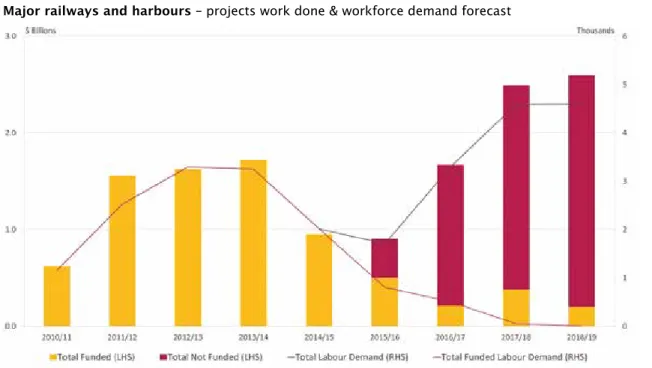
Railways and harbours
Major Project work across railways and harbours in
Queensland has increased significantly over recent
years, with work done peaking in 2013/14 at over $1.6 billion. Workforce demand requirements mirror
the work done profile, with major railways and harbours
construction employment having grown to 3,300 people in 2012/13 and remaining at this level in 2013/14.
Major Project construction work on harbours has been driven predominantly by the demands of the resources
sector, but across railways there are also significant
contributions from the public sector, notably the
$1.15 billion Moreton Bay Rail Link (which finishes in
2016). In aggregate, the pause in new resource project commencements during the second half of calendar year 2012 is driving a lower volume of Major Project work across railways and harbours through 2014/15 and 2015/16. Activity remains relatively high in 2014/15, but this is mainly due to two very large ports projects: the $2.5 billion Hay Point Stage 3 expansion (scheduled to complete in 2014/15) and the $2.4 billion Wiggins Island Stage 1 (which will be mostly complete by 2014/15).
From 2015/16, however, we have timed the start of preliminary works on the,as yet unfunded, Brisbane Bus & Train Tunnel (BAT) project and the Galilee Basin rail project. We also expect other projects to start around this time, including the Gold Coast Light Rail Stage 2 in 2015/16 and the Varsity Lakes to Elanora Extension in 2017/18. Altogether, these projects are expected to drive Major Project work done to over $2.5 billion by 2018/19.
The key risk to the railways and harbours Major Project forecast concerns the future of the Galilee Basin – this is, essentially, the “non-funded” category of work shown in Figure 1.5. Should the development of the Galilee Basin take place (located further north and west of existing coal infrastructure in the Bowen Basin), this will necessitate a massive construction program involving over 400 kilometres of new rail and up to 120 million tonnes per annum of new coal port capacity.
For this report, it has been assumed that major construction will begin on one Galilee Basin coal mine in 2015/16, along with associated infrastructure. This will be followed by a second project from 2016/17, as
well as a spur line. However, there remains significant
risk that the cost of developing these projects, relative to current and expected coal prices, may see activity delayed beyond the current timeframe.
Water and sewerage
Water and sewerage work done and workforce demand for Major Projects both climbed strongly in 2011/12 and surged into 2012/13, to settle at just over $1.4 billion and employing around 1,050 people. This rapid growth was largely underpinned by new water treatment facilities and pipeline construction projects supporting upstream Coal Seam Gas (CSG)
field development in the Surat Basin. However, as these
projects move towards completion, work done and employment weakened substantially, falling to just over $800 million and 600 positions.
This trend is set to continue as these projects finish, with activity anticipated to decline sharply, bottoming out at just over $100 million and 75 people in 2015/16.
Figure 1.4
Major roads and bridges – projects work done & workforce demand forecast
Figure 1.5
1. Queensland Major Projects
By 2016/17, activity is expected to be rising strongly again due to stronger pipeline work and the beginning
of the new projects that will provide flood mitigation benefits as well as additional water supplies for new coal and CSG fields, as well as potential agricultural
food-bowl opportunities. With regards to the latter, the establishment of a Commonwealth water infrastructure ministerial working group in 2014 could
help accelerate the identification and development
of water infrastructure projects with the potential for Commonwealth involvement. Taken together, work done is expected to reach a new cyclical peak of $1 billion by 2018/19, employing over 1,100 people (see Figure 1.6).
There are significant risks with the water and sewerage
Major Projects outlook. Also, as many of the projects driving work done and workforce demand are coal related (Galilee Basin) pipeline work that are not yet
funded, they retain plenty of start date flexibility. If
conditions do not prove ideal for these projects, they could be further delayed or pushed out beyond the forecast horizon, considerably weakening the industry
growth profile.
In the short term, Major Project electricity, pipelines and telecoms work done is expected to contract sharply, settling at under $300 million in 2014/15 as Major Projects wind up. From here, we are forecasting work done to shift higher, climbing back above $800 million by 2017/18, before softening slightly in 2018/19 (see Figure 1.7). The increase to 2017/18 includes another, as yet unfunded, export gas pipeline projected to be constructed alongside Galilee Basin transmission works
to support a brownfield LNG expansion, plus a further
roll out of the National Broadband Network (NBN), before softening slightly in 2018/19.
Over the medium to long term, the picture is much
different sector by sector. With regards to electricity,
weaker forecasts of demand from the Australian Energy Market Operator (AEMO) suggest that new baseload generation capacity will not be required until the mid
to late 2020s. Ongoing development of the CSG fields
to feed the LNG trains once they are built will require continual upstream investment in pipelines (and other infrastructure) over the long term. Finally, Major Project telecoms activity is assumed to remain consistent from
here as the fibre to the node NBN network is rolled out
progressively across Queensland, although there may be scope for NBN activity to pick up if the roll out were to be accelerated by NBN Co.
Mining and heavy industry
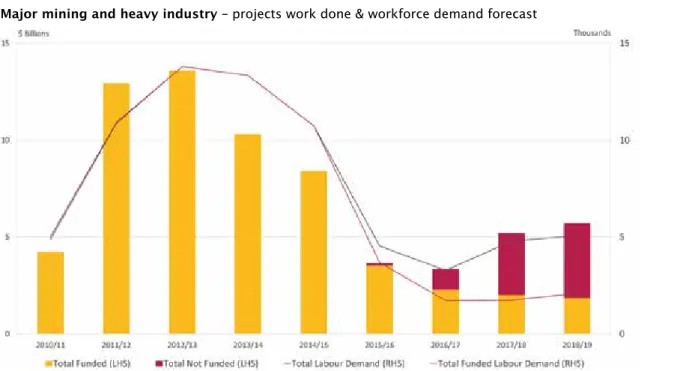
Mining and heavy industry Major Project work experienced a period of unprecedented expansion between 2010/11 to 2012/13, increasing collectively by over 200% to a new peak of $14.6 billion. From a Major Project workforce perspective, the number of people
employed in Queensland’s mining and heavy industry
sector doubled over the same period to 14,000.
Queensland’s LNG projects were the key driver of
growth (although as mentioned, many of these positions
may have been effectively offshored) while coal projects
(now completed), such as the Broadmeadow, Caval Ridge, Daunia and Grosvenor coking coal mines, also sustained a high level of work.
While Major Project work done peaked in 2012/13, measured labour demand remained steady
in 2013/14 despite sharp falls in work done. However, this is mostly driven by peak phases of downstream activity on LNG projects which may not be contestable by local contractors.
By contrast, labour demand for major coal projects slipped by one quarter in 2013/14 (to 1,850 people), while a 75% decline is expected for other minerals projects (to just 325 people).
Electricity, pipelines and telecoms
Electricity, pipelines and telecoms Major Project work employed more than 3,000 people in 2012/13, two thirds of whom were involved in (non-water) pipelines work. In aggregate, electricity, pipelines and telecoms work done reached nearly $1.6 billion in 2012/13, a new record.
Growth in 2012/13 was achieved by a
simultaneous increase in activity in the electricity and pipeline segments including a host of new Powerlink distribution and supply projects, the South West Queensland Pipeline, and a series of CSG pipelines.
Figure 1.6
Major water and sewerage – projects work done & workforce demand forecast
Figure 1.7
Figure 1.8 shows further declines in work done and workforce demand are forecast in subsequent years, with funded activity dipping below 2010/11 levels in 2015/16 and 2016/17, as current projects are completed. Thereafter, investment is forecast to move higher as Galilee Basin projects get underway alongside the next round of LNG expansions at Gladstone and Rio
Tinto’s South of Embley project.
However, assuming Queensland can meet challenges on costs and competitiveness, and is supported by strengthening global demand, a range of mining and heavy industry projects that are currently unfunded could feasibly come back late in the forecast period. Most of these are coal projects (in the Bowen and Galilee Basins), but there are also other resources developments such as, the Paradise phosphate project and ethanol projects in North Queensland.
Regarding LNG, it is now confirmed that a Shell LNG
train will not proceed, but it is assumed that the
upstream CSG fields will be developed to support one brownfield expansion of the existing projects by
2016/17. Nonetheless, ongoing development of CSG
fields over the operational life of LNG facilities (at least
two decades) will require continual investment in related
field infrastructure, including roads, pipelines and gas
facilities, and water. Again, while not Major Projects in their own right, in aggregate, they will lift the volume of sector activity compared with the pre-CSG era.
As major LNG projects in Gladstone wind down, the workforce shift that took place will reverse, with other regions such as the Galilee Basin and South East Queensland picking up the slack. While the pace of this change will be slower than that which occurred in Gladstone, both regions will have their own challenges to overcome. The regional towns that will inevitably service Galilee Basin projects will undertake a number of social and economic changes similar to Moranbah. This will require detailed planning by Federal, State, and
Local Governments in conjunction with the project’s
proponents in order to maintain harmonious and sustainable communities.
As history has proven, the South East Queensland
region has experience handling significant shifts in
Major Project work and employment, such as those forecasts in this report. However, the current forecast upswing will occur at a time when other Australian states and cities (particularly Sydney), as well as other global cities, will also be under going increasing levels of Major Project investment. This will likely to see competition for labour, plant and equipment intensify and will be a challenging period for procurement.
Queensland regional focus
Figures 1.9 and 1.10 show significant shifts in Major
Project work and employment are expected at the regional level over the forecast period. While Major Project activity will be declining in aggregate terms, a greater share of this work is expected to be focused in the Gladstone and Surat Basin regions over the next twelve months. Later, activity is expected to switch back to South East Queensland, the Bowen Basin, and the Galilee Basin. The LNG investment boom continues to be the key driver of this switch, which once completed, gives way to a potential upswing in coal-related work in the Galilee Basin. Meanwhile, a broader based recovery in South East Queensland is dependent on investment decisions by State and Federal governments, particularly regarding new transport infrastructure. Rising residential and commercial building activity (not considered as major engineering projects for this report) are also adding to construction labour demand in South East Queensland, and this trend is expected to continue during the forecast period.
The initial shift of labour and capital to Gladstone and the Surat Basin, in a very concentrated period of time, continues to present challenges to local communities and projects. The construction workforce more than doubled here to meet the construction schedule of the LNG projects.
1. Queensland Major Projects
Figure 1.8
Major mining and heavy industry – projects work done & workforce demand forecast
Figure 1.9
Major projects workforce demand – all segments by region (share LHS, employment by column)
Figure 1.10
The key points:
• Global growth is improving in aggregate, however
the story differs by region. The unbalanced growth
profile reflects various policy settings and stimulus
measures being implemented. While there are positive signs for growth in the US, UK and China, prospects for Japan and the Euro Zone economies are not looking bright.
• Growth is necessary for higher commodity prices.
Queensland’s abundance of natural resources
means the outlook for the global economy and, more importantly, industrial production has a strong bearing on future levels of investment activity and Major Project work.
• Commodity prices have fallen, impacting the viability of some domestic mining operations.
Commodity prices are falling due to significant
volumes of supply reaching the market. High local costs, unless corrected by domestic actions and a fall in the Australian dollar, are placing the next round of major resource projects in Queensland at risk.
• Weakness for commodity prices is expected to linger. Price weakness for a number of commodities
is expected to continue in the short term. While prices are expected to recover gradually during 2015 and 2016, they will not return to previously high levels. In combination with strengthening consumption, the recovery will be led by higher cost producers closing mines and cutting back production as the global economy gradually picks up.
• The Australian economy is operating below trend. The Australian economy is struggling with the
transition from the mining investment boom as non-mining investment has been slow to recover despite
significant monetary stimulus and a falling
Australian dollar.
Outlook for the global economy
Global economic prospects are improving. However,
as seen in Figure 2.1, the story is markedly different
across regions. While there are positive signs for growth in the US, UK and China, prospects for Japan and the Euro Zone economies are not looking bright. Geopolitical tensions in Russia and the Middle East have led to trade restrictions and volatility in energy
prices. The unbalanced growth profile reflects various
policy settings and stimulus measures (including unconventional monetary policy) being implemented. Overall, the world economy is projected to expand by 3.6% during calendar year 2014, and accelerate to 4.1% during 2015.
The United States continues its recovery after a patchy
start to the year. Employment growth has defied
expectations and taken the unemployment rate below
6% for the first time since 2008. Growth over the past
year or two has been driven by the private sector, with residential construction and consumer expenditure remaining solid, despite cuts to public spending. Growth is expected to accelerate from 2015, driven by low interest rates, internationally cheap energy due to the shale gas boom, and ongoing employment growth. On some measures, China is now regarded as the
world’s largest economy. Slower growth in the first
quarter is likely to lead to annual growth falling below
the Chinese Government’s announced target of 7.5%
for 2014. Activity in the real estate sector has been sluggish with prices and new housing starts falling. The real estate sector has been an important part of
China’s economic growth over recent years, and further
easing will put pressure on other areas of the economy. To counter the slowdown in economic activity, the Government has introduced stimulus measures
including lower taxes for small businesses, further fiscal
and infrastructure spending, and cuts to the benchmark lending rates.
2. International & Australian
economy
– setting the stage
1. Queensland Major Projects
Strengths, weaknesses, threats by region
South East QueenslandPublicly-funded infrastructure works are the key driver in South East Queensland, with roads and railways work likely to remain the principal source of Major Project activity. In this sense, the projection of declining levels of public investment and Major Project works in this
region places local contractors at significant risk. A
turnaround in public investment is expected to come through after 2015/16, supporting Major Project activity in South East Queensland. However, conditions will
remain difficult until then, with only a handful of major
road and rail projects in the near term.
Gladstone
The strengths, weaknesses and threats to the Gladstone region are shaped by the outlook for LNG and coal, the
latter affecting the staged development of the Wiggins
Island Coal Export Terminal (WICET). Major Project demands are expected to have peaked in 2013/14 in this region, and are then expected to decline sharply given the completion of various LNG jetty projects and the impending completion of the $2.4 billion
first stage of WICET. Whether the decline becomes
more substantial later on depends on whether further stages of existing LNG projects, or new LNG projects commence during the forecast period, or are delayed by high cost pressures and the emergence of competitive threats such as from US shale gas. This report assumes
the region will see one brownfield LNG expansion and
a new major pipeline which, in conjunction with water, road and feeder/gather pipeline works, will lead to a recovery late in the forecast period.
Bowen Basin
Coal related Major Projects shape the Bowen Basin region. A substantial portion of these projects are either underway and heading to completion, or unfunded. Given weakness in thermal coal prices and falling coking coal prices the next round of Major Projects remains under threat. In particular, a number of producers with allocations to the Wiggins Island Coal Terminal remain
unable to access finance and, as a consequence, further
delays or cancellations cannot be ruled out. In this report, it is assumed that several of the delayed coal projects will be revived late in the forecast period under more favourable Australian dollar prices and local cost structures, but it is not guaranteed.
Galilee Basin
The Galilee basin remains a key downside threat to our forecasts. As indicated in the Major Projects list, two major coal projects have been assumed for the Galilee
Basin. The first mine is expected to begin construction
in 2015/16 while the second will follow in 2016/17, alongside supporting rail and port infrastructure. However, these projects could easily be pushed back by a lack of funding or low coal prices.
Surat Basin
Upstream CSG LNG work is currently driving robust
activity in the Surat Basin. Given the region’s significant
thermal coal resources (which are expected to remain unrealised for now) there is substantial upside
opportunities to the forecast. For example, if economic conditions permit the Wandoan Coal Project to proceed, this could start a chain reaction of development as other mines are developed to piggy back on related infrastructure such as the Southern Missing Link rail
project. In addition, a number of CSG-fired electricity
generators are currently proposed in the region
meaning further upside potential exists. However, there
is a low probability of this occurring in the next five
years given the outlook for electricity demand.
North Queensland
The North West Province in Queensland could stand
to benefit from multiple major base minerals projects
covering bauxite, phosphates, silver-lead-zinc, copper, tin and nickel. Timing of the global economic recovery and demand for metals and minerals will be the key factor underwriting the next round of minerals investment in this region. While dominated by the sheer scale of the coal and LNG investments further south, base metals and minerals projects in this region may
still be substantial over the next three to five years.
The Queensland economy is closely tied to the prospects for the global economy.
Queensland’s natural abundance of high-quality mineral deposits means rising
metal and energy consumption in the East Asian region, particularly China, has a
2. International and Australian economy – setting the stage
The Euro area expanded over the final quarters of
2013, moving the region out of recession. However,
growth stalled over the first half of 2014, and this has finally prompted the European Central Bank (ECB)
to take proactive steps by introducing a range of stimulus measures. The ECB has introduced a negative
deposit rate, an unconventional tool aimed firmly at
encouraging spending and discouraging saving. In
addition, the bank offers low-cost loans to businesses
and has commenced a program to purchase covered bonds and asset-backed securities for at least two years. This commenced in the fourth quarter of 2014. These policy measures should support weak growth across the Euro zone, particularly through
private investment.
Outlook for commodity prices
The long lead times between executing investment decisions and the period when new production reaches the market means commodity prices will always contain
a natural element of volatility. For Australia’s key bulk
commodity exports, the supply/demand balance saw prices peak during 2011 (in US dollar terms) before sliding back over the subsequent years toward levels that appeared to be sustainable over the long term.
However, Australia’s key commodity exports have suffered a large drop in prices over the past year. Amid
a backdrop of slowing consumption growth in China along with ongoing weakness in the major European and Japanese markets, major international suppliers of iron ore, thermal coal and metallurgical coal have
significantly increased production.
For Queensland, the prices for coal (both thermal and coking) are particularly relevant for driving new resources investment. Coking coal prices gradually declined in 2014 in response to an oversupplied market and reduced import demand from Chinese steel producers as the real estate sector in the country experienced a sustained downturn. For 2014 as a whole contract prices averaged US$107/t. The outlook for coking coal demand is expected to strengthen — driven by developments in steel consumption among the developing economies, primarily in China and also in India. The price gains during 2015 are expected to be
minimal, rising to US$130/t. From 2016, China’s real
estate sector is expected to recover, driving demand for steel. This increase in coking coal consumption is forecast to soak up excess supply. The anticipated closure of high cost mines is also expected to place some upward pressure on prices during the period taking prices to US$152/t.
Thermal coal prices have fallen significantly in the past
year, with contracts supplying Japanese energy utilities settling at US$82/t for the 2014 Japanese Fiscal Year (JFY) — a reduction of 14% on the previous year. This
decline is reflective of an overabundance of supply and
reduced import demand from major global consumers.
With a significant decline in prices, producers will be
increasingly reliant on the lower Australian dollar to mitigate some of the losses incurred at current prices. However for some producers, the fall in price has lasted far too long and is at too low a level resulting in the suspension of some operations. Supply overhang in the thermal coal market is forecast to persist throughout 2015, leading to further declines in prices to US$73/t for the 2015 JFY. During 2016, thermal coal price contracts are forecast to rise to US$78/t helped by growing Indian and other Asian demand, and the potential construction of an extra 70 gigawatts of coal
fired power generation capacity in China.
Japan has been running strong stimulus measures
aimed at eliminating persistent deflation to help spur
growth. The expansionary policy had been gaining traction, but an increase to the sales tax has unwound some of the gains for the economy. Once the shock of
the sales tax erodes, the combination of free-flowing
monetary stimulus and a weakened yen should see a pick up in economic growth in Japan over the next two years.
Much of this new supply has been due to a massive program of resource investment which was committed to during the peak in commodity prices. Major global producers have also ramped up output in order to lower overall unit costs. A consolation has been the decline in the Australian dollar, particularly over the past six months, which has softened the impact of commodity price falls for domestic producers, whose revenues are denominated in Australian dollar terms.
Even so, as shown in Figures 2.2. and 2.3, further price weakness for a number of commodities is expected in the short term before recovering somewhat over 2015 and 2016. A key element of the predicted recovery will be producers reacting to weak prices and oversupply by closing mines and/or cutting back production, particularly at uneconomic mines. The second driver will be strengthening demand for commodities as global economic growth gradually picks up. The key to this prognosis is the continued strengthening of the US economy and a stabilisation in Chinese economic growth.
Figure 2.1
Economic growth by region and country
Year Ended December
Real GDP/GNP Forecasts
OECD US Japan Euro Area China India East AsiaSouth ZealandNew World GDP
2012 1.5 2.8 1.4 -0.7 7.7 4.7 4.0 2.6 3.2
2013 1.3 1.9 1.5 -0.4 7.7 5.0 4.0 2.7 3.0
2014 2.0 2.2 1.4 1.1 7.4 5.3 4.3 3.3 3.6
2014 2.6 3.2 1.8 1.6 7.3 6.3 4.6 3.1 4.1
Source: OECD, IMF, National Government Sources, BIS Shrapnel
(1) Organisation for Economic Co-operation and Development: Australia, Austria, Belgium, Canada, Denmark, Finland, France, Germany, Greece, Iceland, Italy, Japan, Luxembourg, Netherlands, New Zealand, Norway, Portugal, Spain, Sweden, Switzerland, Turkey, United Kingdom, United States.
(2) Euro area: Cyprus, Estonia, Ireland, Malta, Slovakia, Slovenia, France, Germany, Italy, Spain, Portugal, Austria, Belgium, Netherlands, Luxembourg, Finland, Greece.
(3) South East Asia: Indonesia, South Korea, Malaysia, Philippines, Singapore, Taiwan, Thailand, Vietnam.
10 20 40 80 160 320 94 96 98 00 02 04 06 08 10 12 14 16 Forecast
As At June Source: BIS Shrapnel, ABARE data Quarterly Average Prices
Crude Oil (US$/bbl) US$/A$ (Cents) Coking Coal (US$/t) Thermal Coal (US$/t) Iron Ore (US$/t) 500 1,000 2,000 4,000 8,000 16,000 32,000 64,000 94 96 98 00 02 04 06 08 10 12 14 16 Forecast
As At June Source: BIS Shrapnel, ABARE data Quarterly Average Prices (US$/t)
Copper Lead (x10) Nickel Gold (x10) (US$/oz) Aluminium Zinc Figure 2.2
Commodity prices ($US)
Figure 2.3
Commodity prices ($US)
2. International and Australian economy – setting the stage
Outlook for the Australian economy
There are positive signs for the economy, but it remains stuck below trend (see Figure 2.4). The Australian
economy faces a difficult balancing act as the mining
investment boom recedes and non-mining investment
has been slow to recover despite significant monetary
stimulus and a falling dollar. While leading indicators of business investment are somewhat encouraging, the momentum necessary to absorb some of the slack in the economy is still missing. Commodity prices have fallen sharply which has resulted in a weaker terms of trade, reducing Australian incomes, and weighing on household and business spending. Low commodity
prices for coal, iron ore, and oil are also affecting
exploration activity and threatening the next round of investment.
On the flip side, the significant fall in oil prices, which are
now at their lowest level since 2009, will assist industry via lower costs of production and improve real household incomes. The lower dollar also assists exporting
businesses via higher export incomes (denominated in Australian dollars), while domestic trade-exposed
industries benefit from improved competitiveness with
the relative higher costs of imports.
In the short term, economic activity is expected to remain below trend. Structural change takes time, and we are witnessing an economy transition from a high exchange rate and high commodity prices setting to broader based industry growth. Non-mining businesses are still reluctant to commit to new investment until there are clear signals of a sustained pick-up in demand. Meanwhile, the timing of weaker levels of public sector investment will also be a drag on growth over the next year.
Despite the economy currently running below capacity, drivers are in place for stronger growth from 2016. Net exports will be a key element of the economic story going forward. The increased capacity in the mining sector will see a rapid escalation in resource exports, particularly from LNG. Meanwhile, imports will be soft in the near term consistent with the mining investment boom having peaked as well as weaker levels of domestic demand. We anticipate net exports will add at least one per cent to growth over each of the next four years. Residential housing construction activity is gaining momentum with the prospect of low interest rates for an extended period combined with a substantial
deficiency in residential stock. However, this upturn
will not be uniform between regions, with sizeable
stock deficiencies set to drive the markets in parts
of Queensland and New South Wales in particular. Private non-dwelling building should also post, albeit moderate, growth over the next few years with Major Projects in retail, warehouses and accommodation
sectors offset by declines after the current boom in
hospital building.
Figure 2.4
Australia GNE and GDP: moving annual total, annual % change
The key to the broad growth story will be the recovery in non-mining business investment. However, this could take some time. Ever since the Global Financial Crisis (GFC) hit, most non-mining business enterprises
have been facing weak demand, weak profits and weak confidence, and have responded by cutting costs and
deferring all non-essential spending.
Until capacity utilisation rises to a level which can underwrite a new wave of broad-based non-mining investment, we expect to see below trend growth rates. BIS Shrapnel believes this will come through during 2016, triggered by the weaker value of the dollar. Structural change occurs slowly and the transition back towards the trade-exposed industries will take a period of adjustment. In some cases the loss of industry will be irreversible (as in the case of the car manufacturing industry). However, the lower dollar will improve the competitiveness of agriculture, trade-exposed
manufacturing, mining, tourism, education, finance, and
business services.
While growth will be boosted by stronger levels of minerals production, the overall labour market will remain weak in the near-term. This is due to the high labour intensity of mine and infrastructure construction activity compared with mining operation activities. With the weak labour market, interest rates will remain at low levels for some time yet.
-4 -2 0 2 4 6 8 88 90 92 94 96 98 00 02 04 06 08 10 12 14 16
Year Ended June Source: BIS Shrapnel, ABS data
Per Cent Forecast
External Contribution
Real GNE
Real GDP
The key points:
• The Queensland economy is slowing. The
combination of weaker public spending (both consumption and investment) and lower private investment expenditures has dragged the pace of growth in Queensland below that of the national economy during 2013/14.
• The economy is undergoing transition. Investment
in the resources sector remains at a high level but is falling sharply as new Major Project commencements are failing to come through to replenish the existing pipeline of work. The transition from investment to strong export growth will present broad challenges to the Queensland economy and industry. In the meantime, a housing upswing and a lower Australian
dollar supporting trade exposed industries offer
some opportunities.
• There is reason for optimism. Queensland has a
diversified economy. Prior to the mining boom, the
state experienced an extended period of strong
growth. As the economy adjusts to significantly
lower levels of mining investment and a depreciating
Australian dollar, the state’s trade-exposed
industries are expected to take up the slack and shift some of the focus away from mining.
• The slowdown in state final demand has impacted
the labour market — the unemployment rate
has climbed in recent quarters. As the economy progresses from the highly labour-intensive mining construction phase to the less labour-intensive operations phase, the labour market will not grow as fast as growth in output (Gross State Product).
The current economic conditions
The pace of growth in the Queensland economy has
slowed over the past two years, and for the first time
since 2010/11, it dipped below the national average during 2013/14 (see Figures 3.1 and 3.2). Growth in State Final Demand (SFD), which measures direct expenditure in the state economy from households, businesses and governments, has dropped from an exceptionally strong 8.3% in 2011/12 to just 0.4% in 2013/14. Similarly, growth in Gross State Product (GSP), which measures the value of production, has slowed from a rate of 4.8% in 2011/12 to 2.3% in 2013/14. Although domestic demand (SFD) has softened considerably, strong export growth from the mining sector helped put
a floor under economic growth. Despite the economy
slowing, employment growth was surprisingly healthy during 2013/14, averaging 1.6% for the year to May 2014.
These dynamics reflect the overall story of a mining
investment boom passing through its peak along with continued contractions in public and business investment. While investment in the resources sector remains at a high level for now, new Major Project commencements are failing to come through to replenish the existing pipeline of work. Major resources projects have been delayed, postponed or abandoned, following sharp falls in commodity prices. Total mining and heavy industry investment has now peaked and is declining. Meanwhile, as private investment has weakened, so too has public sector investment. In the decade to 2009/10, Queensland saw very strong increases in
publicly-financed construction activity. However, with the deterioration in state finances and the end of stimulus and flood rebuilding works, public investment has
declined 18% since 2010/11.
In contrast, housing investment picked up during 2013/14, following several very weak years. Supported by sustained low interest rates and high levels of underlying demand, annual total dwelling approvals rose 27% during 2013/14 which fed into stronger levels of dwelling construction — up by 7% over the same period, with further growth expected still.
3. Queensland economy
The Queensland economy has been
one of the best performers in Australia.
Considered a “resources” state, the
region is a heavy exporter of black coal
and soon will be a major exporter of
gas. Despite the resources label, the
state economy is quite diversified and
increasingly linked into global trade
networks through tourism, agriculture,
and education industries.
Figure 3.2
Queensland SFD and Australia GNE: year ended June, annual % change
Figure 3.1