An attempt to define an evaluation methodology and a
quantitative metric system aiming to evaluate the corporate
shareholder “true value” using SD modelling.
Habib Sedehi E-mail [email protected]
Nicola Vaccaro E-mail [email protected] HELP S.p.A. Via Antonio D'Achiardi, 31 00158 Rome (ITALY )
Tel. +39 06 41733360/ Fax +39 06 41733406
ABSTRACT
The company economic value is traditionally processed by evaluating different business areas and hence summing up the calculated results. This is often done without having enough knowledge of specific firm system complexity. In addition the corporate evaluation process often supplies different results according to the evaluator’s point of view and its information about the firm and the market.
Even though the “algebraic” and “static” company evaluation approach, calculated through a quantitative estimation of assets, liabilities and other more sophisticated indicators can supply, in different simple circumstances, useful and sufficient reliable results, in more complex situation, such as company re-engineering, changing organisation, firm cession and so on, the result of evaluation seems to be not realistic at all.
The aim of this work consists in an attempt to define a methodology and a quantitative metric system able to achieve, by means of a systemic approach reproducing the dynamics of the corporate economic and financial variables, an objective evaluation of the corporate shareholder value (true value), independently of the stakeholders individual interests and expectations.
INTRODUCTION
The shareholder value evaluation process is part of the investment evaluation issue and it aims to estimate the corporate performance over a medium time.
The shareholder value estimation can be defined both inside of the firm, by using the information available to the management, and outside, making use of the information available on the market. But on imperfect financial market, where information are asymmetrically distributed among all operators, internal and external methods carry out to different shareholder values.
We believe that the reckoning of a general and impartial corporate shareholder value, or “true value”, should represent the main goal the evaluation process has to point to. The true value represents the capital value baseline over which carrying out all adaptations necessary to conform the corporate value to the evaluator’s expectations. The aim of this work consists in an attempt to define a methodology and a quantitative metric system able to achieve, by means of a systemic approach reproducing the dynamics of the corporate economic and financial variables, an
objective evaluation of the corporate shareholder value (true value), independently of the stakeholders individual interests and expectations.
At the present our research is at the initial stage. The scope of this paper consists in presenting an idea not yet supported by validated results
SHAREHOLDER VALUE AND RELATIVE EVALUATION PROCESS THROUGH THE “TRUE VALUE” LENS
The shareholder value reveals the firm value looked as a simple object to negotiate. In other words, it declares the presumable exchange value of a working firm observed from its potentialities point of view.
But the firm’s economic potential evaluation can differ according both to the different evaluators point of view and to their information about firm strategies and market. The shareholder value evaluation process, observed through the “true value” lens, has to satisfy the following requirements:
• Generality;
• Demonstrability;
• Stability
Shareholder value is “general” if the relative evaluation process aims to objectively quantify the firm value, i.e. aside from the evaluator’s utilitarian perspective.
From our point of view a “general” shareholder value derives from an evaluation process based on the forward projection of the past corporate process, only updated by the information (concerning the firm’s future dynamic) available to the majority of stakeholders.
The shareholder value “demonstrability” requires the supposed corporate future process (from which derive the economic and financial flow to evaluate) are reliable. Obviously the more regular result the corporate process the more demonstrable will be the shareholder value because it’s easy to elaborate their future dynamics.
Bearing in mind all that, we should try to normalise the business process dynamics in order to determine the shareholder true value.
With reference to the “stability” requirement, Business Management literature assets the firm evaluation process has to ignore all contingent circumstances temporarily magnifying or depressing the corporate shareholder value.
We believe the shareholder value evaluation process cannot ignore the analysis of the circumstances above described, because, although for a short time, they affect the corporate value. On the other hand, the neutralisation of the circumstances disturbing the evaluation process should be limited only to ones imperfectly knowledge (i.e unknown to some stakeholder category).
A METHODOLOGY AND A QUANTITATIVE METRIC SYSTEM SUPPORTING THE SHAREHOLDER TRUE VALUE EVALUATION PROCESS; OUR PROPOSAL.
The corporate shareholder true value represents the price that each investor, knowing all management information, is disposed to supply in order to negotiate the corporate capital, for the sake of efficiently composing his financial assets portfolio.
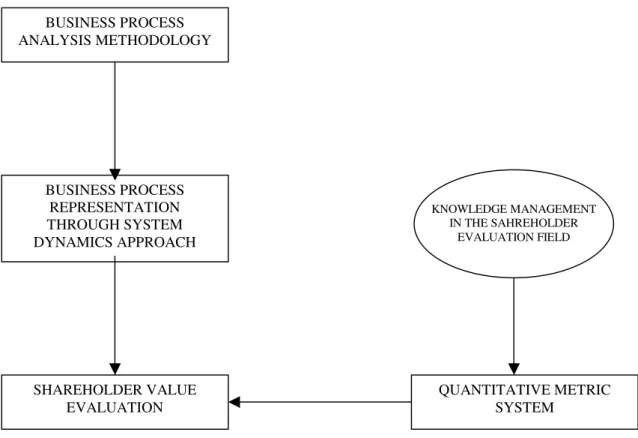
As stated at the beginning, this work seeks to perform an evaluation methodology and a quantitative metric system able to objectively estimate the corporate shareholder value. In order to achieve this goal, we are approaching the process through three modules as showed in figure 1
Figure 1: The activities to determine the shareholder true value according to our approach
In particular the “Business process analysis methodology” establishes the rules to observe in order to quantify the corporate economic and financial flow to put on the shareholder evaluation process.
The “Corporate process representation” we believe should be usefully effected having recourse to System Dynamics modelling. Indeed System Dynamics models are able to accurately represent business process evaluation without ignoring important management aspects such as the corporate self-financing process.
The corporate economic and financial quantities, deriving from the business process above described, have to be evaluated by means of a quantitative metric system
BUSINESS PROCESS ANALYSIS METHODOLOGY BUSINESS PROCESS REPRESENTATION THROUGH SYSTEM DYNAMICS APPROACH SHAREHOLDER VALUE EVALUATION QUANTITATIVE METRIC SYSTEM KNOWLEDGE MANAGEMENT IN THE SAHREHOLDER EVALUATION FIELD
aiming to determine, by using for instances Evaluation Points (EP), a general, demonstrable and stable corporate shareholder value.
This approach should determine an “unique” corporate shareholder value, independently to evaluator’s point of view and/or to the economic or financial nature of the flow put on the shareholder evaluation process.
DYNAMICS MODELS AS TOOLS SUPPORTING THE REPRESENTATION OF THE CORPORATE BUSINESS PROCESS
Corporate process can be analysed both from an economic and a financial point of view.
The analysis of the corporate process, through the economic and financial lenses, allows to identify respectively a “cycle of economic replenishment” and a “cycle of financial replenishment”.
The first one consists in the refund dynamic of production factor purchasing costs by means of the consequent revenues deriving from the employment of the production factors purchased.
Figure 2: The “cycle of economic replenishment”
With reference to the “cycle of financial replenishment”, it consists in the dynamic of re-monetization of the financial resources frozen in the production factors.
Figure 3: The “cycle of financial replenishment”
Investments Costs + Revenues + Economic Results -+ + Financial results Frozen financial resources Re-monetization of frozen financial resources + + -+
It’s clear that both the economic and the financial cycles are reinforcing cycles, indeed the higher the corporate economic and financial results the higher will be the corporate investment capacity.
From our point of view the use of the systemic approach in the corporate shareholder value evaluation process results very useful. Indeed, dynamic simulation models let us to forward project the dynamics of the corporate cycles, underlining the cause-effect relationships existing between economic and financial managerial aspects.
Figure 4: The representation of economic and financial cycles
The simulation models, reproducing the future corporate process, will give us over time the values of the economic and financial variables to employ in the evaluation process.
For instance, if we choose to evaluate the firm’s shareholder value on the base of its future profitability, the simulation process should give us the probable future economic results (Rx) the firm will be able to produce over time on the base of the
hypothesised future business process.
Figure 5: The simulated corporate future economic results to put on the shareholder evaluation process
Hence the use of dynamic models allows to obtain economic and financial variable values more reliable than ones obtained having recourse to average future values of
Financial resources investments Revenues + Costs + Economic Results + -+ Re-monetization of frozen financial resources + Financial resources + + -Time 0 Evaluation moment 1 2 n-1 n R1 R2 Rn-1 Rn
corporate economic and financial flows. Dynamic models also allow to take into account the impact on future corporate results deriving from different balance policies, self-financing policies and so on.
OUR ANALYSIS TASKS
In the previous sections we stated that the goal of this work consists in performing a “business process analysis methodology” and a “quantitative metric system” aiming together to determine, by using simulation models representing the dynamic of corporate process, the firm shareholder true value.
In order to achieve these goals, we will carry out the following tasks. TASK 1: “Business process analysis methodology” definition
The activities of the present task aim to define the rules to observe in order to represent, by means of system dynamics models, the business process. In other words this task activities point to define the guidelines to follow during the model implementation phase in order to obtain quantities able to determine the shareholder true value.
TASK 2: Building of Cases study
The activities of this task aim to elaborate some cases study through the representation of the process of medium size firms, operating in different sectors, by using system dynamics models.
Obviously the representation of the corporate process have to be performed by looking closely at the principles stated by the “business process analysis methodology”.
TASK 3: Definition of a Quantitative metric system
The activities of this task point to perform the principles of a quantitative metric system aiming to determine, by using Evaluation Points, the corporate shareholder true value. We will apply these principles to the above identified cases study.
TASK 4: Generalisation of the proposed approach
The activities of this task consist in an attempt to generalise the shareholder value evaluation process proposed, in order to apply it, in an economic and timely manner, to different enterprise under estimation process.
Reference
Sorci C., Vergara C. (1987). Elementi di Economia d’Azienda . CELUP Guatri L. (1990). La valutazione delle aziende. EGEA Milano