Chapman University Digital Commons
Business Faculty Articles and Research Business
12-5-2018
Corporate Entrepreneurship in the Digital Era: The
Cascading Effect through Operations
Maheshkumar P. Joshi Ravi Kathuria
Sidhartha Das
Follow this and additional works at:https://digitalcommons.chapman.edu/business_articles Part of theBusiness Administration, Management, and Operations Commons,Organizational Behavior and Theory Commons, and theOther Business Commons
through Operations
Comments
This is a pre-copy-editing, author-produced PDF of an article accepted for publication inThe Journal of Entrepreneurship, volume 28, issue 1, in 2018 following peer review. The definitive publisher-authenticated version is available online atDOI:10.1177/0971355718810554.
Copyright
Corporate Entrepreneurship in Digital Era: The Cascading Effect Through Operations Dr. Maheshkumar P. Joshi
Associate Professor
Director of Research & Practice, Centre for Innovation & Entrepreneurship
School of Business George Mason University
Fairfax VA 22030 Tel: 703 993 1761 Fax: 703 993 1870 email: [email protected] Dr. Ravi Kathuria* Professor
James L. and Lynne P Doti Chair in Operations Management
Argyros School of Business and Economics Chapman University
One University Drive Orange, CA 92866 Tel: 714 628 2703 Fax: 714 532 6081 email: [email protected] Dr. Sidhartha das Professor School of Business George Mason University
Enterprise Hall 136 Fairfax VA 22030 Tel: 703 993 1790 Fax: 703 993 1870 email: [email protected] * Corresponding author
Submitted to The Journal of Entrepreneurship June 24, 2018
Corporate Entrepreneurship in Digital Era: The Cascading Effect Through Operations
ABSTRACT
This study examines a firm’s response to perceived changes in the environment, such as the growth of the digital era, at different levels of a firm—beginning with the adoption of corporate entrepreneurship (CE) down to process renewal. We further explore if the technological intensity of a firm, high-tech or low-tech, influences its choice of mode for organisational renewal—use of internal competence or outside acquisition—to exploit the opportunities created by the digital era. Using survey data from 170 firms, we test a sequential relationship between environmental change (growth of the digital era), corporate entrepreneurship, organisational renewal, and finally process renewal that involves operating procedures at the functional level. We conclude by identifying the study’s interdisciplinary contributions, which open new research avenues in the field of corporate entrepreneurship.
Keywords: Process renewal, Organisation renewal, Corporate entrepreneurship, Interdisciplinary research, and Digital era.
INTRODUCTION
As rapid changes in the digital era take place due to growth in the information and communication technology (ICT), successful organisations will use the context of growth in the digital era and the related advances to recreate themselves to survive and thrive in this changing environment (Doyle, 2013; Tu, Vonderembse, Ragu-Nathan, and Sharkey, 2006). Specifically, as products become smaller, perform faster and offer multi-functionality, operations managers (among others) must embrace organisational changes and consequently renew their operations, processes, and systems through adoption of innovativeness (Das and Joshi, 2007). The operational activities such as process/product development are critical to firms, but managers will need to have an entrepreneurial mindset to carry out such activities in a changing environment (Newey and Zahra, 2009).
Changes in terms of product/services offered, and customers served, are part of organisational renewal (OR), which is achieved through learning as well as creation and adoption of appropriate internal (operational) processes (Burgelman, 1991), and by changing the scope of the firm (Zahra, 1996; Teng, 2007). These changes can be accomplished by combining existing resources with new resources, or new technologies with existing resources to create new products or services (Guth and Ginsberg, 1990). Therefore, it is inferred that OR is based on new ways of operating an existing business or by venturing into and managing the operations of a new business (Floyd and Lane, 2000). One of the benefits of OR is that it allows a firm to survive through changed environmental conditions (Barr, Stimpert and Huff, 1992).
Since OR is considered essential to respond to a changing environment, it would be prudent to study this phenomenon, including its antecedents. An entrepreneurial mindset among an organisation’s managers, as well as rank and file, is essential for OR (Chakravarthy and
Lorange, 2008; Taylor, 2001). Among existing firms, this entrepreneurial mindset is captured by the concept of corporate entrepreneurship or entrepreneurial orientation (Joshi, 2016). Corporate entrepreneurship (CE) is defined as a process that enables an existing business to create a new business within an existing organisation (Dess, Lumpkin, and McGee, 1999). A firm’s adoption of CE is reflected in it being aggressive with its competitors; allowing its employees to be innovative; allowing its managers to be proactive in responding to the environment; allowing higher levels of autonomy in the organisation; and/or inspiring risk-taking behaviour within the realm of the firm (Lumpkin and Dess, 1996).
Several researchers treat CE as an antecedent to OR (Teng, 2007; Hoy, 2006; Zahra, 1996) and observe that OR leads to the survival of a firm under changing environmental conditions (Barr et al., 1992). This leads us to infer that CE precedes OR, which, in turn, brings about changes in the organisation’s products and processes. The empirical evidence to support this chain of events is, however, lacking even though the conceptual linkage is argued in the literature. Hence, there is a need to examine this relationship empirically. Further, there is a need to examine how these constructs that are well defined and understood in the field of entrepreneurship and strategy can be applied in the operations milieu.
The concepts presented above prompt us to ask two specific research questions. First, does CE indeed lead to OR? If this is true, how are they linked? Second, how does OR, a firm level construct, be translated to the functional level, such as operations? What, if any, lessons are to be drawn from the entrepreneurship and strategic management literature that can be applied in the operations management (OM) field? To examine these questions, we draw from the entrepreneurship and strategic management literature that links environmental change and the subsequent organisational response.
This paper is developed in the context of a major environmental shift that has occurred in the last two decades due to the growth of the digital era. We use spread of the Internet technology as a surrogate for growth of digital era and examine its impact on organisations in terms of developing corporate entrepreneurship (CE) and undergoing organisational renewal (OR). We apply a sequential approach to our research model to examine: (a) if changes in the environment lead to adoption of CE in organisations, (b) if CE promotes OR, and if so by what processes, and c) does OR, in turn, have an impact on operational processes, leading to process renewal (PR).
While conceptually, the entrepreneurship and strategy literature has linked CE to OR, it seems that this linkage has been treated as a “black-box” in the literature (Joshi, Das and Mouri, 2015). We investigate this link by examining two separate modes of OR. We assert that to achieve OR, a firm can: a) create new internal start-ups to attain the ability to use new knowledge or technology, or b) acquire other firms to gain access to new knowledge or technology. Finally, as an exploration, we examine if this chain reaction of organisational responses emanating in response to the changes in the environment (followed by adoption of CE and adoption of OR) differ based on the technology level of these firms. Our exploration indicating our interest in examining the level of technology is due the fact that impact of the spread of the Internet technologies might be perceived differently by firms based on their current proficiency in technology. Figure 1 depicts our sequential model.
Insert Figure 1 Here
This study adds to the literature in the following ways. First, from a general literature perspective, it focuses on the growth of digital era as a trigger for environmental change, linking it to the adoption of entrepreneurial behaviour (or CE) and subsequent achieving of OR. In the
process, it explores the black box and proposes two different modes for firms that have adopted CE to achieve organisational renewal (OR). The second and more critical contribution is from the OM literature perspective because we link the CE and OR to process renewal, an OM construct. As stated earlier, based on our literature review of the OM field, the construct process renewal is neither linked to OR nor CE.
The remainder of the paper is organized as follows. First, we discuss environmental changes in the context of the growth of digital era that we capture through the spread of the Internet technologies. Second, we examine the related literature to develop three hypotheses. Third, we provide details about the sample and methodology used in the paper. Fourth, we discuss the data analysis techniques and results. Finally, we discuss these results from an academic research as well as a managerial perspective, and share the implications of our results for managers.
Context: The growth of digital era
It is argued that with the advent of the Internet, growth in the information and communication technologies, organisational functions such as Marketing have been redefined and redesigned. For instance, as the Internet was adopted by commercial firms in the early 1990s the focus was on website development for providing information about products and services to the customers and later the idea of e-Commerce was introduced. In the new millennia, social media and social commerce became a key part of marketing (Leeflang, Verhoef, Dahlström and Freundt, 2014).
Similarly, operations managers find value in adopting the Internet and communication technologies (ICT) (Loebbecke and Powell, 2002) because these ICT are now crucial to managing organisational operations and improving organisational performance (Schlemmer and
Webb, 2009; Rajendran and Vivekanandan, 2008; Porter, 2001). For long-term success, firms utilizing ICT may need to adopt new strategies and structures to deal with changes in the environment (Ganesh, Madanmohan, Jose, and Seshadri, 2004; Joshi and Yermish, 2001). In near future, managers and organisations will have to change their processes due to the new phase of digital era – Internet of Things (IoT) – and the growth of new platforms related to IoT, such as
the cloud-centric approach for data on demand (Gubbi, Buyya, Marusic, and Palaniswami, 2013).
Researchers have argued that as firms adopt ICT to manage their operations, they will have to create or develop dynamic processes that focus on rapid product development and cultivate direct relationships with users; with related business strategies that require frequent partnering (Shapiro and Varian, 1998). This reformation or reorientation of strategies is necessary because the adoption of ICT allows firms to offer new products/services (or modify their existing products/services) to their customers, as well as become more responsive to their competitive environments. Thus, with the spread of the ICT, responsiveness to customers and proactiveness in competitive behaviour become critical components of a firm’s arsenal.
By being an enabling technology, the Internet leads to transformation of firms and industries (Kathuria and Joshi, 2007; Gopalakrishnan and Damanpour, 1997). In addition to improving a firm’s efficiencies, the Internet provides the ability to reduce the cost of executing transactions and internal coordination, suggesting that Internet-based commerce has a potential for continued growth (Schlemmer and Webb, 2009; Rajendran and Vivekanandan, 2008). While the Internet’s importance for firms is established in the literature, only a few OM researchers have focused on the changes in the environment due to the Internet and its effect on a firm’s operations (cf. Rabinovich, Rungtusanatham, and Laseter, 2008; Mollenkopf, Rabinovich, Laseter, and Boyer, 2007; Boyer and Hult, 2006). Based on our literature review, we ascertain
that the adoption of CE by firms due to environmental change emanating from the growth of digital era, especially the Internet, and its subsequent linkage to organisational renewal (OR), are research areas that are yet to be explored. In the OM literature, there is a gap in empirical findings concerning the process renewal and OR/CE. Thus, our research focuses on the environmental context presented by the growth of digital era, and the subsequent responses by organisations.
LITERATURE REVIEW AND HYPOTHESES DEVELOPMENT Contingency Theory
Researchers have affirmed the importance of viewing the organisational adoption of CE and/or OR and its relationship with organisational performance through a contingency framework (Lumpkin and Dess, 1996). The concept of “alignment,” “fit,” or “consistency,” is a core concept in both the entrepreneurship and strategic management fields. It draws from the contingency theory, which postulates that to achieve “fit,” organisations will adjust their structure and processes to align with their environment (Joshi, Kathuria and Porth, 2003; Donaldson, 2001). Specifically, when firms facing a changed environment align organisational processes, systems or scope to the changed environment by adopting highly innovative, risk taking, and proactive approaches in their organisations, their performance improves (Naman and Slevin, 1993).
Changes in the Environment and Corporate Entrepreneurship
To remain competitive, firms operating in a blustery environment need to engage in environmental scanning to spot a change, and then exploit it to their benefit. Milliken (1990) suggests that managers carry out three tasks related to “sense-making” in a changing environment. The first task is scanning; wherein managers must scrutinize their environment to recognize
anticipated or realized changes in it. The second task is interpretation; the manager must analyse and understand the scanned information and interpret the changes and its likely causes on the organisation. The third task is action; based on the sense making and interpretations of the changed environment, managers must execute relevant actions to respond to these changes. Thus, we assert that monitoring environmental change would allow a firm to be proactive and convert a potential threat into a potential opportunity (Barringer and Bluedorn, 1999).
At times, perception of changes in the environment (i.e., subjective interpretations) influences managerial behaviour (Schneider and De Meyer, 1991; Thomas and McDaniel, 1990). The survival maybe at stake unless the organisation adapts to changes in its environment. Therefore, as the perception of environmental change is established, organisations change their structure, strategy and processes (Veenker, Sijde, During, and Nijhof, 2008; Danneels, 2002). That is, they become entrepreneurial as they face increased global competition or experience technological changes in the environment (Chakravarthy and Lorange, 2008). Similarly, Zahra (1993) observed that firms embraced CE when they perceived their environment to be dynamic. Firms that adopted e-commerce, were more likely to identify the Internet as an originator of new opportunities, and as such were more proactive to exploit the opportunities (Ramsey and McCole, 2005). Proactiveness is expected of firms adopting CE (Lumpkin and Dess, 1996).
When examining environmental changes in relationship to technology, a careful assessment of technological changes leading to a changed environment becomes critical Das and Joshi, 2012). This is because established firms are likely to be victimized by “familiarity” and “maturity” traps (Ahuja and Lampert, 2001) with regards to their response (or lack of it) to these changes. These traps, however, can be overcome by exploring and experimenting with novel,
emerging and pioneering ideas (Ahuja and Lampert, 2001), thus leading to an entrepreneurial mindset within the organisation. Thus:
H1: Firms that perceive a higher level of change in their industry environment
are more likely to adopt corporate entrepreneurship to exploit the opportunities afforded by the growth of digital era.
Corporate Entrepreneurship (CE) and Organisational Renewal (OR)
Changes in organisational scope and processes constitute a part of organisational renewal (Teng 2007; Zahra, 1996; Burgelman, 1991). Typically changes in scope are accomplished by recombining existing resources with new resources (Guth and Ginsberg, 1990) or new knowledge (Floyd and Lane, 2000), such as adoption of Internet technologies (Joshi and Yermish, 2000). Therefore, the underlying focal point of OR becomes new ways of operating an existing business, or venturing into and managing the operations of a new business.
Understanding changes in the environment that leads the adoption of CE, helps a firm identify new opportunities. This, in turn, allows a firm to re-orient its corporate focus (Bhardwaj, Camillus and Hounshell, 2006) by offering new products/services, operating in new geographic markets or identifying new set of customers (Joshi, 2016). However, there is a scarcity of research focusing on the adoption of CE by firms as a response to environmental changes, and its effect on organisational renewal. We emphasize that the process of understanding and monitoring environmental change, and the subsequent identification of a threat or an opportunity, leads to reshaping of the long-term orientation (missions and goals) of a firm. This re-orientation in turn reshapes the products/services offered as well as the customers served. Our assertion is aptly supported in the two examples of Nokia and Wipro—both firms evolved from agriculture-based products to technological products and services (Bhardwaj et al., 2006).
Thus, to attain organisational renewal in a firm one must examine its new set of customers, new offerings of products/service and new markets or geographical regions in which it operates. The heterogeneity of productive resources available to a firm forms the basis for developing specialized knowledge that can widen business opportunities and thus provide competitive advantage to the corporation. As per the resource-based view (RBV) of the firm, established organisations have two alternatives to build their knowledge base (a source of competitive advantage), internal investments or external acquisitions (Cohen and Levinthal, 1990). Both these alternatives enable organisations to shape new capabilities, which, in turn, permit it to compete in a changing environment (Eisenhardt and Martin, 2000).
Applying the RBV perspective, we argue that CE is an approach for acquiring, processing, and leveraging resources for competitiveness. CE provides changes in the organisation that in turn either rejuvenate or redefine (or both) a firm that is facing a changed environment (Dess et al., 2003). The process of CE, and a firm’s focus on internal or external venture creation (Sharma and Chrisman, 1999), may lead to development or acquisition of new resources (Kazanjian, Drazin and Glynn, 2001) or repositioning of existing resources through reconfiguration and modification (Dess et al., 2003).
Using the RBV arguments for development of new competencies, new start-ups by existing firms could be either internally or externally focused. For instance, in the early days of the growth of the Internet, to respond to the growth of Amazon.com, Barnes & Noble created Barnesandnoble.com, which was entirely internal and under its direct ownership. On the other hand, in the early days of personal computing, IBM launched their PC division in response to Apple, by creating an autonomous division far away from its headquarters in New York. In both these instances, internal or external ventures, the firms maintained direct control when creating
the new venture. Alternative resources (and subsequently competitive advantages) are gained when firms acquire innovative start-ups in their industries. In the present paper, the measurement of organisational renewal (OR) or change in the scope of operations of the firm, the key issue to focus on relates to the choice of the mode of renewal—either by building internal competencies or acquiring external ones. Due to the rapid advancement of the digital era, the chosen path (internal or external) must allow a firm to change its scope of operations quickly and successfully.
Strategy research suggests that firms find it difficult to embrace new technologies because they are unable to obtain key assets, both physical and human (Holbrook, Cohen, Hounshell and Klepper, 2000; Leonard-Barton, 1994). If the core competencies needed for organisational change are radically different from the current resource-base of the firm, then the firm is likely to engage in an external business undertaking (Nagarajan and Mitchell, 1998). For example, breakthrough inventions have necessitated firms to go past local hunt to explore new, emerging and ground-breaking technologies (Ahuja and Lampert (2001). Time, or speed of response, becomes of essence because the firms expect to see the implementation and results quickly, as in the case of DuPont when it moved into Organic Chemistry (Bhardwaj, et al., 2006).
It must be noted that because of adopting CE to create new products and/or services, the level of entrepreneurial activity is likely to be dependent on firm capabilities (Helfat and Petraf, 2003). However, developing a capability in new or emerging technology demands time and capital if the established firms lack such knowledge (Dosi, 1988). In such events, it is likely that focal firms may acquire target firms to absorb the new skill sets to respond to the changed environment. This dependence on outside resources (by way of acquisitions) would allow the m
to better understand and absorb the new phenomenon (Ahuja and Katila, 2001), or create innovations (Stuart and Podolny, 1996).
Researchers have suggested that firms differ in their resource set to develop new capabilities because this process is path dependent and over time the choice of the initial path leads to persistent differences between firms (Holbrook et al., 2000; Raff, 2000). Hence given their existing set of capabilities and the extent of severity of environmental changes, firms will either create new internal start-ups or acquire firms to achieve organisational renewal. Thus, in the context of growth of the Internet:
H2a. The adoption of CE is positively related to the use of new start-ups by
existing firms. Additionally, the use of new start-ups is positively related to OR.
H2b. The adoption of CE is positively related to the use of acquisitions by
existing firms. In addition, the use of acquisitions is positively related to OR.
Linking Organisational Renewal to Process Renewal
While the strategy literature has focused quite extensively on the topic of renewal, the OM literature has not addressed this topic in depth. Our aim is to address this gap in the OM field by our present research. We derive the basic concepts of renewal from entrepreneurship and strategy literature to further the idea of renewal at the operational level. Because renewal is an evolutionary activity and may require acquisition and use of new information (Floyd and Lane, 2000), we build arguments to support that OR is associated with renewal of operational processes, which we term as “process renewal.” We contend that OR can be translated at the functional (operations) level as renewal of operational processes when firms use new knowledge and innovative behaviour for improving or finding new ways of performing operations.
Our assertion is based on the model proposed by Roth and Menor (2003) that focused on delivery systems in service firms. This model suggests that strategic design choices based on
structural, infrastructural, and integration approaches lead to a delivery system. Further, their model focuses on three activities related to delivery systems that eventually lead to value for customers. These include service execution, assessment of gaps in services, and service renewal (Roth and Menor, 2003). As renewal of the delivery system is essential for firms striving for world-class operations (Roth and Menor, 2003), we address this specific gap in the literature.
The concept of OR in the strategy literature matches the OM issue of renewal of the processes. Both are compatible and meaningful to the OM field, since renewal of processes is a phenomenon of interest to OM. Finally, the underlying assumption in the strategy area that OR leads to a competitive advantage (Teng, 2007), matches the underlying assumption that process renewal permits the operations function to contribute to a firm’s competitive advantage, as attested by other OM researchers (Hayes, Pisano, Upton and Wheelwright, 2005).
Thus, while affirming the value of good execution and continuous assessment of gaps, we argue that in a rapidly changing environment caused by the growth of digital era, especially an evolving and fast-moving technology such as the Internet, firms must continuously renew their processes to remain aligned with changing organisational objectives. Further, Newey and Zahra (2009) have observed that operational activities such as process/product development are critical to firms, but managers must have an entrepreneurial mindset to carry out such activities in a changing environment. In the present study, the organisational objectives are adoption of corporate entrepreneurship due to changes in the environment, and renewal of the organisation, by way of new product/service offerings, customers served, and geographic scope.
Such an organisational renewal would prompt changes at the operational level, including changes in systems, business processes, and operating procedures. If the organisational renewal is not followed by process renewal then firms may face certain opportunity costs (Li and
Rajagopalan, 2008). The consequences of not extending the entrepreneurial activity to the operational level, by way of process renewal, have also been underscored by Knight (1989) and MacMillan et al. (1986). Thus:
H3: Organisational renewal is positively associated with process renewal.
RESEARCH METHODS Sample
We are interested in examining the relationship of changes in the business environment due to the growth of the digital era and the adoption of CE that leads to organisational renewal. This renewal may be achieved via two different modes. We assert that regardless of the mode used, eventually OR will spur PR. To test our hypotheses, we collected survey-based data. A questionnaire was mailed to top managers of 1,100 firms. After two follow-ups, we received 173 responses, of which 170 were usable. The remaining three responses were unusable because of missing data. A majority (55% percent) of the survey respondents were at senior level, such as
owner, CEO or CFO, where firm-wide decisions could be made. The average respondent for this
survey was 43 years old with over 20 years of experience at work. Twenty-six percent of the
respondents were females, and thirty-six percent had a graduate degree. The data was collected
from the Mid-Atlantic region of the USA using the membership of Eastern Technology Council (ETC). Employing such a targeted and narrow approach is consistent with research in management when total population is inaccessible (cf. Parkhe, 1993).
Variables and Measures
The data collection was conducted with a questionnaire (see Appendix). With our study’s focus on the downstream effects of technological change, all the variables were measured in the overall context of growth of the Internet. By explicitly stating this context, we hoped to
reduce (if not exclude) alternative explanations for the strength of the relationships in our proposed model. The variable ‘BUSINESS ENVIRONMENT’ was created with a four-item scale to assess perceived changes in the industry environment of the responding firm. The objective was to assess changes in the environment due to the growth of the digital era, especially that of the Internet, as perceived by the respondents. The Variable ‘CORPORATE ENTREPRENEURSHIP’ which is the likelihood of a firm adopting corporate entrepreneurship, was measured using a five-item scale (please see Appendix). The five items were based on the five dimensions of entrepreneurial orientation as in Lumpkin and Dess (1996). The variable ‘ORGANISATIONAL RENEWAL’ was obtained using a four-item scale. The focus of the items was whether changes in the environment due to the Internet altered the firm’s offerings of products, services, customers and markets. The ‘MODES OF ORGANISATIONAL RENEWAL’ was operationalized by asking the respondents if their businesses were likely to acquire an Internet firm or acquire a competitor actively involved in the use of the Internet technologies. Additionally, respondents were asked if their businesses wanted to create new start-ups to exploit the opportunities afforded by the Internet. Finally, ‘PROCESS RENEWAL’ used the description of process renewal from operations related concepts, and a three-item scale was used. The focus of the items was whether changes in the environment due to the Internet altered the firm’s business processes, operating systems, and operating procedures.
Threat of Common Method Variance and Mono Respondent Bias
We tried to overcome the potential of such bias by collecting data from key informants. The use of high ranking officials (CEOs, Senior VPs, etc.) helps moderate the problem of mono-respondent bias, as they are more likely to provide reliable information concerning the strategic issues faced by the firm (Kathuria, 2000).
We also followed some procedural and statistical remedies to reduce the mono-method bias. For instance, while designing the survey, we provided a separation in the instrument by stating that we were simply interested in their firm’s behaviour, rather than any connection among environment change, adoption of CE and growth strategies. Further, we promised and kept anonymity of the respondents.
We further conducted some post-hoc and statistical remedies to deal with the issues of artificial covariance. For example, we used the Harman (1967) test, as done in recent management studies (cf., Kathuria and Davis 2001), to test for the incidence of common methods variance (CMV). Secondly, we conducted T-tests and found no significant differences between the first sets of respondents and late respondents. Thus, we checked and mitigated the effects of non-response bias, if any.
ANALYSIS AND RESULTS Measurement model and reliability analysis
We considered three measures in evaluating convergent validity. All standardized factor loadings on their respective constructs were acceptable (≥ 0.50), and significant (t >2). We present these results in Table 1. The composite reliabilities of scales were all greater than 0.70, as shown in Table 2. The average variance extracted (AVE) was above the critical value of 0.5 for all constructs.
Insert Tables 1 and 2 here
The correlations between the constructs are shown in Table 3. We tested for the discriminant validity by comparing the square of the correlations between two constructs to AVE. All tests were supportive.
Structural model and test of hypotheses
A partial least square (PLS) latent path approach is used to estimate the path model in Figure 2. Our six latent variables are modelled in the reflective mode. For example, corporate entrepreneurship is reflected by the five indicator items shown in the Appendix.
Insert Figure 2 here
To test the study hypotheses, we used standardized path coefficients as in Table 4. These coefficients are indicative of the strength of relationships between constructs. These are displayed in Table 4, along with the t-values of the path coefficients and their significance levels.
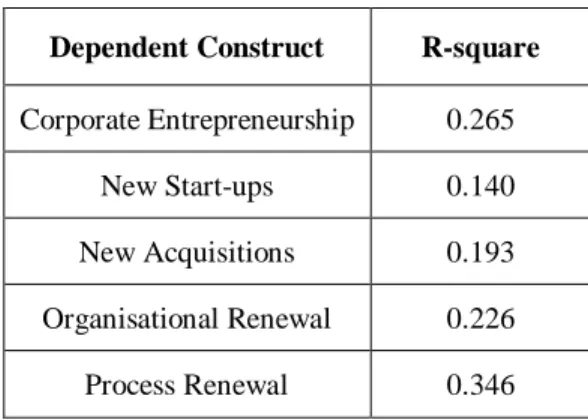
In Table 5. We report the amount of variance explained (R2) for the dependent constructs.
Insert Tables 4 & 5 here
The intent of this research was to examine a sequential relationship that shows progression from the adoption of corporate entrepreneurship to subsequent adoption in changes of processes at operational level. Hypothesis 1 proposed that in the context of growth of the digital era, when firms perceive change in their business environment, they will adopt corporate entrepreneurship to exploit the opportunities afforded by the changes in the environment. This relationship was positive and significant, based on the path loading (b = 0.515, t = 8.673, p < 0.000). The results in Figure 2 support our contention that a firm’s drive/desire to become more entrepreneurial is related with perceived changes in their business environment associated with the growth of the digital era. Thus, Hypothesis 1 was supported.
The linkage between adoption of CE and organisational renewal was examined by Hypothesis 2. We argued and expected that the firms adopting CE will show OR by way of new customers or new products and services. We further contended that this could be achieved via two separate modes. Hence, Hypothesis 2 was tested for each path. Hypothesis 2a tested the path
that focused on internal start-ups (exploiting internal competencies) and Hypothesis 2b focused on acquisitions by way of assimilating competencies from external sources. The paths from CE to adoption of internal start-ups (b = 0.375, t = 6.166, p < 0.000), and adoption of internal start-ups to OR (b =0.203, t = 3.076, p < 0.005) were both significant. This supported Hypothesis H2a. Similarly, the paths from CE to acquisitions (b = 0.439, t = 7.116, p < 0.000), and from acquisitions to OR (b = 0.343, t = 4.959, p < 0.000) were supported. Hypothesis H3 predicted a positive relationship between OR and PR, and that path was also significant (b = 0.588, t = 9.411, p < 0.000). Hence H3 was also supported.
Exploratory Data Analysis: The Role of Level of Technology
With our focus on the downstream effects of technological change, resulting in a significant shift in the firm’s business environment, we wanted to explore if the technology level of a firm may differentiate their adoption of corporate entrepreneurship with a concomitant effect on organisational and process renewal. We asked our respondents to assess the technology level of their firm’s primary industry in which they competed (details in the next section). For convenience, we consider firms as “high-tech,” when competing primarily in an industry that is assessed as being “high-technology,” and as “low-tech” when competing primarily in an industry that is not assessed as being “high-technology.”
Since cognitive constraints affect managers’ perceptions of the environment and subsequent actions by a firm (Stopford and Baden-Fuller, 1994), it is likely that high-tech and low-tech firms may respond differently to environmental changes caused by the growth of the digital era. A firm identified as high-tech would use a higher level of theoretical and practical knowledge as compared to a firm labelled as low-tech to conceptualize, develop, create and deliver its products/services. In other words, for a high-tech firm it would be necessary to seek
higher levels of knowledge, skills and artefacts in its inputs, outputs and processes as compared to a low-tech firm. Perceptions play a critical role in the environmental sense-making process (Volberda et al., 2001). Therefore, managers from high-tech service firms may perceive the environment from which they derive and apply technology driven knowledge to be quite different from managers working in low-tech firms. If high-tech firms are likely to perceive higher levels of changes in their environment, then they are also likely to become more entrepreneurial as compared to low-tech firms that do not share the same perception (Kuratko, Ireland and Hornsby; 2001).
Empirically, environmental turbulence has been found to have a substantial causal impact on the levels of entrepreneurial behaviour in a firm (cf., Davis, Morris and Allen, 1991). These changes towards adoption of entrepreneurial behaviour, and subsequently in the scope of the firm, due to perceived turbulence in the environment would allow firms to explore products/services tailored to its new customer set (Bitner, Ostorm and Meuter, 2002). Firms with a business domain dominated by high-technology can find an opportunity as technology changes rapidly, because their services are now available to a larger variety of customers through new channels or modified delivery mechanisms. While changes due to the growth of the digital era may offer many opportunities, it may present some negative aspects too. For instance, rapidly changing technology may lead products and services to have shorter life cycles, potential for cannibalistic actions and higher levels of incidences of obsolescence (Song and Montoya-Weiss, 2001; Harpaz and Meshoulam, 1997). Specifically, about the Internet, many rules of business regarding customer behaviour, competitors, as well as the internal processes of a firm may change (Boyer, 2001; Joshi and Yermish, 2000). In addition, based on RBV arguments, if top managers of high-tech firms perceive that the competencies for a new venture due to the growth
of digital era are similar and complementary to the resources housed in the firm, then it is likely that they will favour an internal start-up vis-a-vis an external venture (Nagarajan and Mitchell, 1998). Managers might consider overcoming obstacles in developing internal ventures by being entrepreneurial. Thus:
Exploratory Proposition 1: For Hi-Tech firms adopting corporate entrepreneurship, the use of start-ups and the presence of organisational renewal
are positively related.
For low-tech firms, however, the growth of digital era may create resource acquisition challenges because their current resource base might be too far from the new technology needs that arise from such a growth. Therefore, adoption of Internet technologies might be more of a breakthrough event for low-tech firms when compared to high-tech firms. Ahuja and Lampert (2001) found that firms facing these breakthrough inventions need to explore new, emerging and ground-breaking technologies. Due to the rapid growth of digital era, the choice between new internal start-ups or external acquisition would depend upon the need for the firm to quickly and successfully adopt new technology and change its business scope. Hence, low-tech firms lacking basic technological building blocks may find the absorption of new technology to be challenging (Holbrook, Cohen, Hounshell and Klepper 2000).
If a change in the environment requires drastically different competencies compared to the current resources available in the firm, then managers might favour an external venture (Nagarajan and Mitchell, 1998). Since high-tech firms may have the necessary human skills and flexibility due to higher level needs for knowledge to manage their business domain (Song and Montoya-Weiss, 2001), they might be more comfortable with internal ventures. On the other hand, low-tech service firms may find that pursuing internal ventures can delay their chances to exploit the opportunities afforded by the change, as this path might be too slow given their
current resource base for new break-through inventions (Ahuja and Lampert (2001). At the same time competitively, they may be disadvantaged if they do not respond with speed by not adopting the new technology fast enough (Bhardwaj et al., 2006). This may lead to their favouring the use of new acquisitions for organisational renewal. Thus:
Exploratory Proposition 2: For Lo-Tech firms adopting corporate entrepreneurship, the use of acquisitions and organisational renewal are
positively related.
MEASURES OF HIGH AND LOW-TECHNOLOGY FIRMS (for exploratory analysis only): A questionnaire item was used (please see Appendix) to assess whether the primary industry in which the firm competes is considered a high-technology industry, with a seven-point Likert scale where 1 is a complete disagreement with the statement, to 7 a complete agreement. Firms responding with either 1, 2 or 3 on that scale were considered in a low-tech industry, whereas those indicating high level of agreement (5, 6 or 7) were in a high-tech industry. Fourteen firms with a response in the middle (mid-point 4) were dropped from exploratory analysis. Using this approach, we received 54 firms identifying themselves as low-tech service firms and 102 as high-tech firms.
In our exploratory analysis, we find that both propositions were partially supported. We had argued that in high-tech firms, start-ups were related to OR, whereas in low-tech firms, acquisitions were related to OR. The results (see Figures 3 and 4) show that in both high-tech and low-tech firms, acquisitions were significantly related to OR (b = 0.313, p < 0.00; and b = 0.395, p < 0.025 respectively). Though as per our arguments, internal start-ups in high-tech firms were related to organisational renewal (b = 0.198, p < 0.025), interestingly, the relationship between acquisitions and OR was stronger than that between new internal start-ups and OR in these firms. No relationship was found between new start-ups and OR in low-tech firms. Finally,
the relationship between organisational renewal and process renewal was stronger in low tech than in hi-tech firms. These results are discussed further in the following section.
Insert Figures 3 & 4 about here
DISCUSSION, IMPLICATIONS AND CONCLUSION Discussion of Results
Our results affirm earlier findings in the literature about changes in a firm’s external environment (cf., Joshi, 2016; Chattopadhyay, Glick and Huber, 2001), that to survive and thrive, firms need to adapt to these changes. Specifically, our study examines how firms respond to changes in external environment due the growth of digital era. Our research also goes a step further and examines the process of responding to these changes at the functional (operations) level, by proposing and testing a sequential model linking the assessment of environmental changes all the way to changes in operational processes.
Our analysis finds support for all hypotheses and some of our exploratory propositions, summarized in Table 4. We find support for our hypothesis that changes in the business environment due growth of digital era is related to the adoption of corporate entrepreneurship. Further, corporate entrepreneurship is related to organisational renewal by two different modes – internal start-ups and acquisitions. Finally, organisational renewal is related to process renewal. Based on the “explained variance” of each of the stages, we show that our results are robust with R2 varying from 14% to 35% (see Table 5), and the corresponding hypothesized paths being significant.
In our exploratory analysis, we found that firms differ in their emphasis on the choice of mode leading to organisational renewal based on their technological orientation: high-tech versus
low-tech. While in both high-tech and low-tech firms, acquisitions are related to organisational renewal, we find that only in high-tech firms are new start-ups related to organisational renewal. Implications, Contributions and Future Directions
Based on our findings, we assert that academic implications of this study are multifold. First, we have linked a corporate level construct “adoption of corporate entrepreneurship (CE)” to “organisational renewal (OR).” More importantly, we link OR to an operational level construct “process renewal.” Our findings are also consistent with contingency theorists, who suggest that firms need to make changes at all organisational levels to achieve an alignment with the external environment (Joshi, Kathuria and Porth, 2003; Donaldson, 2001; Jain, Ramamurthy, Ryu and Yasai-Ardekani, 1998; Venkatraman, 1989).
Secondly, we are opening new research frontiers by building linkages between corporate entrepreneurship and operations management. Research on the interface between OM and entrepreneurship in general (and OM and CE in particular) is at a nascent stage, and our research pushes it forward. Our sequential model with environmental changes leading all the way to process renewal can be viewed as a link between OM and new venture creation, supporting Ireland and Webb’s (2007) work that links entrepreneurship across many disciplines.
Third, we have empirically examined the “black box” nature of the relationships among constructs such as environmental change and organisational processes (Joshi, Das and Mouri, 2015). Further, in examining this black box, we applied an integrative approach by drawing from the field of corporate entrepreneurship, strategic management, and operations management. As stated earlier, in examining the concepts of CE and OR (from entrepreneurship and strategy literature) we have adhered to Amundson’s (1998) criteria for importing concepts from other fields.
The study’s results also have implications for managers. They help managers understand why corporations need to adopt CE to achieve organisational renewal, and that in turn may lead to process renewal for a firm’s long-term survival in an ever-changing business environment. Based on our findings, managers may want to monitor, predict or anticipate other technologies that are new on the horizon and respond accordingly by allocating resources that would enable them to adopt new technology via internal start-ups as well as external acquisitions.
Our results suggest that operations managers may need to be proactive when they notice that the corporate team is facing the challenges of environmental change. Specifically, operations managers may prepare to initiate changes in processes to meet the revised corporate objectives that may ensue. Further, operations managers may prepare for these changes based on whether the firm is pursuing internal development or external acquisition of technology.
Based on our exploratory results about a firm’s technology level, our findings suggest that managers of firms primarily in low-tech industries may want to pay specific attention to changes in their external environment and monitor organisational responses proactively. Since our findings indicate that low-tech firms tend to engage in external technology acquisitions, being prepared to change processes to absorb new technology from external sources becomes critical for managers. On the other hand, managers from firms primarily in high-tech industries
must cope with simultaneous internal development of products and services and the acquisition
of firms that may allow them to cope with fast changing, new technologies such as ICT that may require adjustments to corporate objectives as well as operational processes.
This study has limitations that present opportunities for future researchers. First, the high-tech and low-high-tech classification used in our exploratory analysis is based on respondents’ self-assessments on a single-item measure. Future research should aim at developing multiple-item
scales for the purpose. Secondly, each of the five dimensions of entrepreneurial orientation can be further developed and operationalized through multiple items.
Conclusion
This research set out to examine the adoption of corporate entrepreneurship by a firm as well as the adoption of a set of responses constituting organisational and process renewal to cope with changes in the environment due growth of the digital era. We further ascertained the likelihood of high-tech firms behaving differently from low-tech firms in their approaches to exploiting opportunities afforded by such changes in the environment. We found that in the context of growth of the digital era, positing and testing a sequential relationship between environmental change, adoption of corporate entrepreneurship, achieving organisational renewal, and finally process renewal helps in understanding the interface between entrepreneurship and the operations function of a firm.
REFERENCES
Ahuja, G. & Katila, R. (2001). Technological acquisitions and the innovation performance of acquiring firms: A longitudinal study. Strategic Management Journal, 22: 197-220.
Ahuja, G. & Lampert, C. (2001). Entrepreneurship in the large corporation. Strategic Management Journal, 22: 521-543.
Amundson, S.D. (1998). Relationships between theory-driven empirical research in operations management and other disciplines. Journal of Operations Management, 16(4): 341-359.
Barr, P.S., Stimpert, J. L. & Huff, A.S. (1992). Cognitive change, strategic action, and organisational renewal. Strategic Management Journal, Special Issue, 13: 15-36.
Barringer, B.R. & Bluedorn, A.C. (1999). The relationship between corporate entrepreneurship and strategic management. Strategic Management Journal, 20(5): 421-444.
Bhardwaj, G., Camillus, J.C. & Hounshell, D.A. (2006). Continual corporate entrepreneurial search for long-term growth. Management Science, 52(2): 248-261.
Bitner, M. J., Ostrom, A.L. & Meuter, M.L. (2002). Implementing successful self-service technologies.
Academy of Management Executive, 16(4): 96-109.
Boyer, K. (2001). E-Operations: A guide to streamlining with the Internet. Business Horizons, January-February: 47-54.
Boyer, K. & Hult, G. (2006). Customer behavioural intentions for online purchases: An examination of fulfilment method and customer experience level. Journal of Operations Management, 24(2): 124-127.
Burgelman, R.A. (1991). Intraorganisational ecology of strategy making and organisational adaptation: Theory and field research. Organisational Science, 2: 239-262.
Chakravarthy, B. & Lorange, P. (2008). Driving renewal: the entrepreneur-manager. The Journal of Business Strategy, 29(2): 14-21.
Chattopadhyay, P., Glick, W.H. & Huber, G.P. (2001). Organisational actions in response to threats and opportunities. Academy of Management Journal, 44(5): 937-955.
Cohen, W.M. & Levinthal, D.A. (1990). Absorptive capacity: a new perspective on learning and innovation. Administrative Science Quarterly, 35: 128–152.
Danneels, E. (2002). The dynamics of product innovation and firm competencies. Strategic Management Journal, 23: 1095-1121.
Davis, D., Morris, M. & Allen, J. (1991). Perceived environmental turbulence and its effect on selected entrepreneurship, marketing, and organisational characteristics in industrial firms. Academy of Marketing Science Journal, 19(1): 43-51.
Das, S. R. & Joshi, M. P. (2012). Process Innovativeness and Firm Performance in Technology Service Firms: The Effect of External and Internal Contingencies. IEEE Transactions on Engineering Management, 59(3): 401-414.
Das, S. R. & Joshi, M. P. (2007). Process Innovativeness in Technology Services Organizations: Roles of Differentiation Strategy, Operational Autonomy and Risk-taking Propensity. Journal of
Operations Management, 25(3): 643-660.
Dess, G.G., Ireland, R.D., Zahra, S.A., Floyd, S.W., Jane, J.J. & Lane, P.J. (2003). Emerging issues in corporate entrepreneurship. Journal of Management, 29(3): 351-378.
Dess, G.G., Lumpkin, G.T. & McGee, J.E. (1999). Linking corporate entrepreneurship to strategy, structure, and process: Suggested research directions. Entrepreneurship Theory and Practice, 23: 85-103.
Donaldson, L. (2001). The Contingency Theory of Organizations. Thousand Oaks, CA: Sage Publications, Inc.
Dosi, G. (1988). Sources, procedures and microeconomic effects of innovation. Journal of Economic Literature, 26: 1120-1171.
Doyle, G. (2013). Re-invention and Survival: Newspapers in the Era of Digital Multiplatform Delivery.
Eisenhardt, K.M. & Martin, J.A. (2000). Dynamic capabilities: What are they? Strategic Management Journal, 21(10/11): 1105-1121.
Floyd, S.W. & Lane, P.J. (2000). Strategizing throughout the organisation: Managing role conflict in strategic renewal. Academy of Management Review, 25(1): 154-177.
Ganesh, J., Madanmohan, T.R., Jose, P.D. & Seshadri, S. (2004). Adaptive strategies of firms in high-velocity environments: The case of B2B electronic marketplaces. Journal of Global Information Management, 12(1): 41-59.
Gopalakrishnan S. & Damanpour F. (1997). A review of innovation research in economics, sociology and technology management. Omega, 25(1): 15-28.
Gubbi, J., Buyya, R., Marusic, S. & Palaniswami, M. (2013). Internet of Things (IoT): A Vision, Architectural Elements, and Future Directions. Future Generation Computer Systems, 29(7): 1645-1660.
Guth W. & Ginsberg, A. (1990). Guest editors’ introduction: Corporate entrepreneurship. Strategic Management Journal, 11(5): 5-15.
Harman, H.H. (1967). Modern Factor Analysis. University of Chicago Press, Chicago, Illinois. Harpaz, I. & Meshoulam, I. (1997). Intraorganisational power in high-technology organisations. The
Journal of High-technology Management Research, 8: 107-128.
Hayes, R.H., Pisano, G., Upton, D. & Wheelwright, S.C. (2005). Operations, Strategy, and Technology: Pursuing the Competitive Edge. Wiley: Hoboken, New Jersey.
Helfat, C. & Peteraf, M. (2003). The dynamic resource-based view: Capability lifecycles. Strategic Management Journal, 24(10): 997-1010.
Holbrook, D., Cohen, W.M., Hounshell, D.A. & Klepper, S. (2000). The nature, sources, and consequences of firm differences in the early history of the semiconductor industry. Strategic Management Journal, 21(10/11):1017-1041.
Hoy, F. (2006). The complicating factor of life cycles in corporate venturing. Entrepreneurship Theory and Practice, 30(6): 831-836.
Ireland, R.D. & Webb, J.W. (2007). A cross-disciplinary exploration of entrepreneurship research.
Journal of Management, 33: 891-927.
Jain, H., Ramamurthy, K., Ryu, H.S. & Yasai-Ardekani, M. (1998). Success of data resource management in distributed environments: An empirical investigation. MIS Quarterly, 22: 1-29.
Joshi, M.P. (2016). Adoption of Corporate Entrepreneurship: Managing Domestic and Global Competitiveness Through the Lens of Entrepreneurial Orientation. International Journal of Business and Emerging Markets, 8(3): 307-323.
Joshi, M.P., Das, S. & Mouri, N. (2015). Antecedents of Innovativeness in Technology Based Services (TBS): Peering into the Black Box of Entrepreneurial Orientation. Decision Sciences, 46(2): 367-402.
Joshi, M. P., Kathuria, R. & Porth, S. J. (2003). Alignment of Strategic Priorities and Performance: An Integration of Operations and Strategic Management Perspectives. Journal of Operations Management, 21(3): 353-369.
Joshi, M.P & Yermish, I. (2000). The digital economy: a golden opportunity for entrepreneurs? New England Journal of Entrepreneurship, 3(1): 15-22.
Kathuria, R. (2000). Competitive priorities and managerial performance: a taxonomy of small manufacturers. Journal of Operations Management, 18(6): 627-641,
Kathuria, R. & Davis, E.B. (2001). Quality and work force management practices: The managerial performance implication. Production and Operations Management, 10(4): 460-477.
Kathuria, R. & Joshi, M. P. (2007). Environmental Influences on Corporate Entrepreneurship: Executive Perspectives on the Internet. International Entrepreneurship and Management Journal, 3(2): 127-144.
Kazanjian, R.K., Drazin, R. & Glynn, M. (2001). Implementing strategies for corporate entrepreneurship: A knowledge-based perspective. In M. A. Hitt, R. D. Ireland, S. M. Camp & D. L. Sexton (Eds.),
Knight R.M. (1989). Technological innovation in Canada: A comparison of independent entrepreneurs and corporate innovators. Journal of Business Venturing, 4(4): 281-288.
Kuratko, D.F., Ireland, R.D. & Hornsby, J.S. (2001). Improving firm performance through entrepreneurial actions: Acordia's corporate entrepreneurship strategy. Academy of Management Executive, 15(4): 60-571.
Leeflang, P. S., Verhoef, P. C., Dahlström, P. & Freundt, T. (2014). Challenges and Solutions for Marketing in a Digital Era. European Management Journal, 32(1): 1-12.
Leonard-Barton D. (1994). Core capabilities and core rigidities: a paradox in managing new product development. Strategic Management Journal, 13: 111-125.
Li, G. & Rajagopalan, S. (2008). Process improvement, learning, and real options. Production and Operations Management, 17(1): 61-74.
Loebbecke, C. & Powell, P. (2002). E-business in the entertainment sector: The Egmont case.
International Journal of Information Management, 22(4): 307-322.
Lumpkin, G.T. & Dess, G.G. (1996). Clarifying the entrepreneurial orientation construct and linking it to performance. Academy of Management Review, 21: 135-172.
MacMillan, I.C., Block, Z. & Narasimha, P.N.S. (1986). Corporate venturing: alternatives, obstacles encountered, and experience effects. Journal of Business Venturing, 1(2): 177-191.
Milliken, F.J. (1990). Perceiving and interpreting environmental change: An examination of college administrator's interpretation of changing demographics. Academy of Management Journal, 33(1): 42-63.
Mollenkopf, D.A., Rabinovich, E., Laseter, T.M. & Boyer, K. (2007). Managing Internet product returns: a focus on effective service operations. Decision Sciences, 38(2): 215-250.
Nagarajan, A. & Mitchell, W. (1998). Evolutionary, diffusion: internal and external methods used to acquire encompassing, complimentary, and incremental technological changes in the lithotripsy industry. Strategic Management Journal, 19: 1063-1077.
Naman, J.L. & Slevin, D.P. (1993). Entrepreneurship and the concept of fit: A model and empirical tests.
Strategic Management Journal, 14(2): 137-153.
Newey, L.R. & Zahra, S. (2009). The evolving firm: How dynamic and operating capabilities interact to enable entrepreneurship. British Journal of Management, 20: S81-S100.
Parkhe, A. (1993). Strategic alliance structuring: A game theoretic and transaction cost examination of interfirm cooperation. Academy of Management Journal, 36(4): 794-829.
Porter, M. E. (2001). Strategy and the Internet. Harvard Business Review, 79(3): 63-78.
Rabinovich, E., Rungtusanatham, M. & Laseter, T.M. (2008). Physical distribution service performance and Internet retailer margins: The drop-shipping context. Journal of Operations Management, 26(6): 767-780.
Raff, D. M. G. (2000). Superstores and the evolution of the firm capabilities in American bookselling.
Strategic Management Journal, 21(10/11): 1043-59.
Rajendran, R. & Vivekanandan, K. (2008). Exploring relationship between information systems strategic orientation and small business performance. International Journal of E-Business Research, 4(2): 14-28.
Ramsey, E. & McCole, P. (2005). E-business in professional SMEs: The case of New Zealand. Journal of Small Business and Enterprise Development, 12(4): 528-544
Roth, A.V. & Menor, L.J. (2003). Insights into service operations management: A research agenda.
Production and Operations Management, 12: 145-164.
Schlemmer, F. & Webb, B. (2009). The Internet as a complementary resource for SMEs: The interaction effect of strategic assets and the Internet. International Journal of E-Business Research, 5(1): 1-24.
Schneider, S.C. & De Meyer, A. (1991). Interpreting and responding to strategic issues: Impact of national culture. Strategic Management Journal, 12(4): 307-320.
Shapiro, C. & Varian, H.R. (1998). Information Rules: A Strategic Guide to the Network Economy. Boston, Mass: Harvard Business School Press.
Sharma, P. & Chrisman, J.J. (1999). Towards a reconciliation of the definitional issues in the field of the corporate entrepreneurship. Entrepreneurship Theory and Practice, Spring: 11-27.
Song, M. & Montoya-Weiss, M.M. (2001). The effect of perceived technological uncertainty on Japanese new product development. Academy of Management Journal, 44: 61-80.
Stopford, J.M. & Baden-Fuller, C.W.F. (1994). Creating corporate entrepreneurship. Strategic Management Journal, 15(7): 521-536.
Stuart, T. E. & Podolny, J.M. (1996). Local search and the evolution of technological capabilities.
Strategic Management Journal, 17: 21–38.
Taylor, B. (2001). From corporate governance to corporate entrepreneurship. Journal of Change Management, 2: 128-147.
Teng, B. (2007). Corporate entrepreneurship activities through strategic alliances: A resource-based approach toward competitive advantage. Journal of Management Studies, 44(1): 119–142.
Thomas, J.B. & McDaniel, R.R. (1990). Interpreting strategic issues: Effects of strategy and information-processing of top management teams. Academy of Management Journal, 33(2): 286-306.
Tu Q., Vonderembse M., Ragu-Nathan T. & Sharkey T. (2006). Absorptive capacity: Enhancing the assimilation of time-based manufacturing practices. Journal of Operations Management, 24(5): 692-710.
Veenker, S., Sijde, P., During, W. & Nijhof, A. (2008). Organisational conditions for corporate entrepreneurship in Dutch organisations. The Journal of Entrepreneurship, 17(1): 49-58.
Venkatraman, N., 1989. The concept of fit in strategy research: Toward verbal and statistical correspondence. Academy of Management Review, 14: 423-444.
Volberda, H.W., Baden-Fuller, C. & Bosch, F. (2001). Mastering strategic renewal: Mobilising renewal journeys in multi-unit firms. Long Range Planning, 34(2): 159-178.
Zahra, S.A. (1996). Technology strategy and financial performance: Examining the moderating role of the firm’s competitive environment. Journal of Business Venturing, 11: 189-219.
Zahra, S.A. (1993). Environment, corporate entrepreneurship and financial performance; a taxonomic approach. Journal of Business Venturing, 8: 319-340.
Appendix
Questionnaire Items
1. Environmental Change
The impact of growth in the Internet on:
(Scale: 1- Very low; 7- Extremely High)
- Your firm - Your competitors - Your suppliers - Your customers
2. Corporate Entrepreneurship (CE)
To exploit the opportunities afforded by the Internet, is your firm likely to:
(Scale: 1- Not likely at all; 7- Extremely Likely)
- become more innovative - become more risk-taking
- become more aggressive with the competition - become more proactive
- offer more autonomy to its employees
3. Modes of Renewal
To exploit the opportunities afforded by the Internet, is your firm likely to:
(Scale: 1- Not likely at all; 7- Extremely Likely)
- acquire an Internet firm
- acquire a competitor actively using the Internet - create an internal (in-house) start-up
- create an external start-up – external to the bounds of your existing company
4. Organisational Renewal (OR)
In response to change in the environment due to growth of the Internet, the extent of changes made by your firm in:
(Scale: 1- Negligible Change; 7- Tremendous Change)
- Products offered - Services offered
- Geographic markets served - Customers served
5. Process Renewal
In response to change in the environment due to growth in the Internet, the extent of changes made by your firm in:
(Scale: 1- Negligible Change; 7- Tremendous Change)
- Business processes - Operating Systems - Operating procedures
6. Technology Level
The primary industry in which your firm competes can be considered a high-technology industry: (Scale: 1- Completely disagree; 7- Completely agree)
Table 1
Factor Loadings and Cross-Loadings
Scale Items Organisation Renewal
Corporate
Entrepreneurship New Start-ups
New Acquisitions Process Renewal Environment OrgRen-1 0.7958 0.5137 0.3426 0.3647 0.4341 0.3899 OrgRen-2 0.8648 0.5722 0.3102 0.3815 0.5035 0.4588 OrgRen-3 0.8111 0.5130 0.2830 0.3503 0.4410 0.5090 OrgRen-4 0.8101 0.5538 0.2578 0.3345 0.5457 0.4228 CE-1 0.6128 0.8534 0.3115 0.3676 0.5896 0.5198 CE-2 0.5563 0.8596 0.3750 0.3858 0.4979 0.3881 CE-3 0.5701 0.8545 0.2604 0.3404 0.4497 0.4487 CE-4 0.5221 0.8807 0.2865 0.3036 0.5167 0.4443 CE-5 0.4671 0.7307 0.3292 0.4226 0.4401 0.3288 NewStr-1 0.3662 0.3492 0.8551 0.3701 0.2910 0.1745 NewStr-2 0.2515 0.2810 0.8547 0.5014 0.2348 0.2316 NewAcq-1 0.3498 0.3592 0.5302 0.9235 0.3873 0.2870 NewAcq-2 0.4552 0.4385 0.4042 0.9227 0.4077 0.3476 Proc Ren-1 0.5375 0.5267 0.2800 0.3606 0.9012 0.5263 Proc Ren-2 0.5150 0.5300 0.3335 0.3989 0.9175 0.5170 Proc Ren-3 0.5632 0.5873 0.2340 0.4128 0.9305 0.5692 Env-1 0.5178 0.5075 0.2564 0.2963 0.6149 0.8863 Env-2 0.4453 0.4255 0.1815 0.2865 0.4561 0.8800 Env-3 0.3802 0.3080 0.1648 0.3008 0.3228 0.7182 Env-4 0.4481 0.4305 0.1792 0.2511 0.5072 0.8061
Table 2
Descriptive Statistics and Reliability Measures
Construct Mean Standard
Deviation Composite Reliability AVE Organisational Renewal 4.223 2.094 0.890014 0.669432 Corporate Entrepreneurship 4.604 1.605 0.919341 0.695946 New Start-ups 2.461 1.855 0.842326 0.727602 New Acquisitions 2.461 1.769 0.917274 0.84719 Process Renewal 4.794 1.776 0.938445 0.8356 Environment 5.380 1.393 0.892641 0.676661 Table 3 Correlations of Constructs Organisation Renewal Corporate
Entrepreneurship New Start-ups
New Acquisitions Process Renewal Environment Organisational Renewal 1 Corporate Entrepreneurship 0.652 1 New Start-ups 0.361 0.367 1 New Acquisitions 0.435 0.431 0.505 1 Process Renewal 0.586 0.596 0.305 0.426 1 Environment 0.541 0.509 0.236 0.342 0.582 1
Table 4
Path Coefficients and Significance levels for the model
Path Path
Coefficient t-value Hypotheses
Changes in the Environment to Corporate Entrepreneurship 0.515 8.673 (p < 0.000)
H1 Supported
Corporate Entrepreneurship to Internal Start-ups 0.375
6.165
(p < 0.000) H2a Supported
New Start-ups to Organisational Renewal 0.203 3.076 (p < 0.005)
H2a Supported
Corporate Entrepreneurship to Acquisitions 0.439 7.116 (p < 0.000)
H2b Supported
Acquisitions to Organisational Renewal 0.343 4.959 (p < 0.000)
H2b Supported
Organisational Renewal to Process Renewal 0.588 9.411
(p < 0.000) H3 Supported
Table 5 Variance Explained
Dependent Construct R-square
Corporate Entrepreneurship 0.265 New Start-ups 0.140 New Acquisitions 0.193 Organisational Renewal 0.226 Process Renewal 0.346