ENHANCED NETWORK CONNECTIVITY AND NODE
LIFETIME TECHNIQUES IN WIRELESS SENSOR NETWORKS
by
ALI SHANON AIYAL AL-SAIDI
Thesis submitted in fulfillment of the requirements
for the degree of
Doctor of philosophy
ii
PREFACE
All praise is due to Allah
And they ask you, [O Muhammad], about the soul. Say, "The soul is of
the affair of my Lord. And mankind have not been given of knowledge
except a little
."
translation of the meaning of Verse 85, Sura Al-Israa, Chapter 15,
Quran
iii
ACKNOWLEDGMENTS
All praise is due to Allah who has power over everything. May His blessing be upon the holy Prophet Muhammad, his family, and his faithful companions.
First and foremost, I would like to express my deep gratitude to my supervisor, Associate Professor Dr. Wan Tat Chee, who provided me with the opportunity to become the researcher I am today. He is always available whenever I need his guidance in overcoming challenging problems in my research. I would also like to thank Professor Dr. Sureswaran Ramadass, Director of NAv6 Center, for his encouragement and support.
I want to thank my parents for their endless support and love. I would also like to gratefully acknowledge the financial support from my father, mother, and sister-in-law: Nassar Obeed, Mahasen Hanoosh, and Wafaa Obeed. Without you, I would not have been able to achieve this accomplishment. I am very grateful to you, and will always remember you in my prayers.
Finally, my most sincere thanks go to my beloved wife, Safa Obeed, for her love, support, and patience, especially during the course of my study.
iv
TABLE OF CONTENTS
PREFACE ii
ACKNOWLEDGEMENTS iii
TABLE OF CONTENTS iv
LIST OF TABLES viii
LIST OF FIGURES ix
LIST OF ABBREVIATIONS xiv
ABSTRAK xv
ABSTRACT xvii
CHAPTER 1: INTRODUCTION
1.1 Overview and Motivation 2
1.2 Research Background 4 1.3 Problem Statement 8 1.4 Research Objectives 9 1.5 Research Scope 9 1.6 Research Framework 10 1.7 Overview of Dissertation 12
CHAPTER 2: LITERATURE REVIEW
2.1 Introduction 13
2.2 Fundamentals of WSNs 13
2.2.1 WSN Architecture 15
2.2.2 Protocol Stack 17
2.2.3 Network Connectivity and Deployment 19
2.2.4 Network Lifetime Based on Connectivity 21
2.3 Strategies for WSNs 22
2.3.1 Physical Layer Modeling 23
2.3.2 Channel Access Technology 26
2.3.3 Routing Protocol 27
v
2.3.5 Energy Management Strategy 36
2.3.6 Connectivity - Energy Management Strategy 37
2.3.6.1 Cooperative Communication Strategy 37
2.3.6.1.1 Cluster-Based Cooperative Transmission
Strategy 40
2.3.6.2 Cross Layer Strategy with Cooperative
Communication 48
2.3.7 Synchronisation Methods for Coherent Cooperative
Transmission WSNs 50
2.4 Markov Decision Process (MDP) 52
2.4.1 Solution of Average Cost MDP 55
2.4.2 Reinforcement Learning (RL) 56
2.4.3 Actor-Critic Algorithim (AC) 57
2.5 Harmony Search Algorithm (HSA) in WSNs 59
2.6 Summary 61
CHAPTER 3: METHODOLOGY
3.1 Introduction 63
3.2 Overview of Proposed Framework 63
3.3 Hardware Requirements 67
3.4 System Model 67
3.4.1 Spatial Node Distribution Model and Connectivity
Condition 67
3.4.2 Connectivity and Lifetime Measurement 68
3.5 The Multi-Hop Cluster Transmission of Information (MHCTI)
Protocol 69
3.5.1 Clustering Algorithm 70
3.5.2 Propagation Model 79
3.6 IMHCTI Protocol 80
3.6.1 Mathematical Stochastic Cross-Layer Model (MSCL) 81
3.6.2 Cross-Layer Optimisation Structure 83
3.6.3 Field Strength Maximisation and Energy Aware in
Cooperative Multi-to-One Node WSN 85
vi
3.6.3.2 Adaptive Actor-Critic Algorithm (AACA) to
Solve MDP 89
3.6.3.3 Best Transmission Power Using AACA 93
3.7 Optimisation Model and Harmony Search Algorithm (HSA) 95
3.7.1 Problem Formulation 95
3.7.2 Optimisation Model 96
3.7.3 HSA for the Combined of the Total Field for
Radiating System Model 96
3.8 Summary 101
CHAPTER 4: SYSTEM IMPLEMENTATION AND SIMULATION DETAILS
4.1 Introduction 102
4.2 Testing Environment 102
4.3 Simulation Aim 103
4.4 Protocol and Model Design 103
4.5 Simulation Design of MHCTI Protocol 105
4.5.1 Network Connectivity 106
4.5.2 Network Lifetime 107
4.6 Simulation Design of IMHCTI Protocol 109
4.6.1 Simulation Design of MSCL Model 109
4.6.2 Network Connectivity 112
4.6.3 Network Lifetime 113
4.7 HSA for IMHCTI Protocol 114
4.7.1 Network Connectivity 115
4.7.2 Network Lifetime 116
4.8 Connectivity and Energy Model for Hybrid Multi-Hop Cooperative
Transmission Protocol 116
4.9 Chapter Summary 117
CHAPTER 5: RESULTS, ANALYSIS AND DISCUSSIONS
5.1 Introduction 118
vii
5.3 The MHCTI Protocol Results 118
5.3.1 Connectivity of Network Results 119
5.3.2 Network Lifetime Results 120
5.4 Results of IMHCTI Protocol 123
5.4.1 Results of the MSCL Model 123
5.4.1.1 Results of the CMOT Scenario 123
5.4.2 Results of Network Connectivity 128
5.4.3 Network Lifetime Results 131
5.5 Results of HSA for IMHCTI Protocol 134
5.5.1 Results of HSA Parameters 134
5.5.2 Results of Network Connectivity 138
5.5.3 Results of Network Lifetime 142
5.6 Overall Network Connectivity and Lifetime Performance 145
5.7 Summary 147
CHAPTER 6: CONCLUSION AND FUTURE WORK
6.1 Conclusion 150
6.2 Contributions 150
6.2 Future Work 152
REFERENCES 154
LIST OF PUBLICATIONS 169
APPENDIX A : RADIO WAVE PROPAGATION MODELING, GROUND SURFACE INFLUENCE
170
APPENDIX B : NETWORK SIMULATION ENVIRONMENT 191
APPENDIX C : DETAILS OF CONCENTRATED DISTRIBUTED CLUSTERING ENERGY EFFICIENT ALGORITHM (CDCEEA) DICTIONARY
viii
LIST OF TABLES Page
Table 2.1 Comprehensive comparision for clustering schemes 35
Table 4.1 Simulation parameters of network connectivity for MHCTI scenario
107
Table 4.2 Parameters model of network lifetime for MHCTI scenario 109
Table 4.3 Simulation parameters of MSCL model 112
Table 4.4 Simulation parameters of network connectivity for IMHCTI scenario
112
Table 4.5 Parameters model of network lifetime for IMHCTI scenario 114
Table 4.6 Parameters for HSA 115
Table 5.1 Distance between the nodes and the clusterhead inside the cluster for all nine convergence cases
135
Table 5.2 Performance network connectivity and lifetime for all protocols
ix
LIST OF FIGURES Page
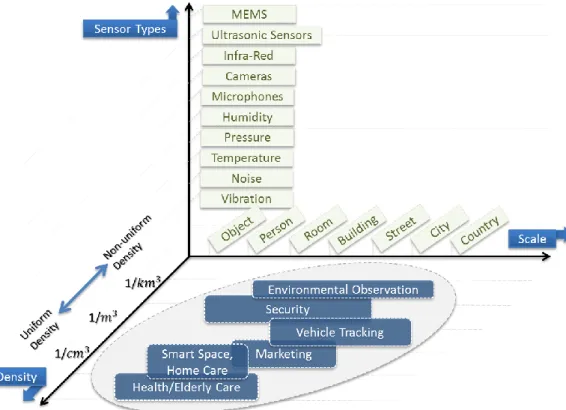
Figure 1.1 Application space 2
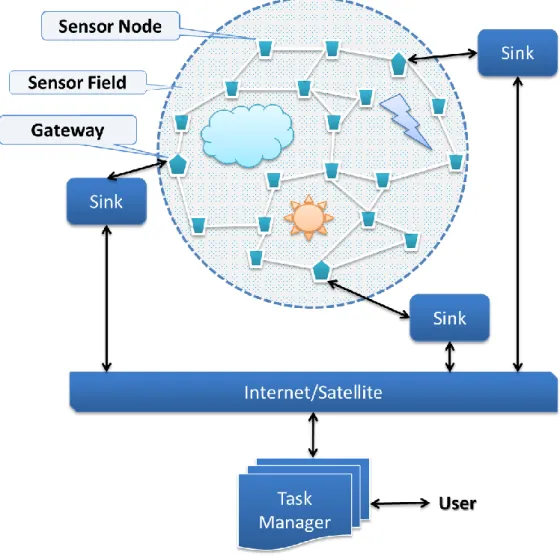
Figure 1.2 Typical sensor network configuration 3
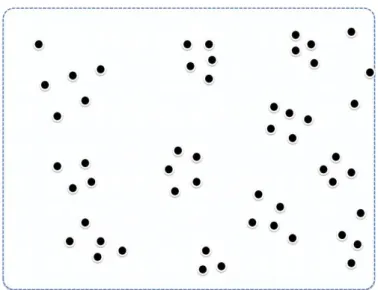
Figure 1.3 Sparsely dense node topology 5
Figure 1.4 Research framework 11
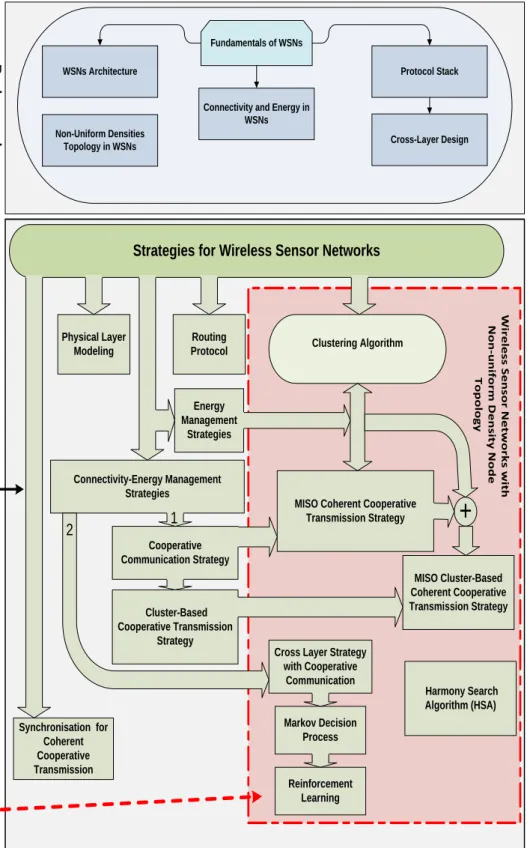
Figure 2.1 Dissertation interest and boundary 14
Figure 2.2 A wireless sensor network 15
Figure 2.3 The components of a sensor node 16
Figure 2.4 Sensor network protocol stack 18
Figure 2.5 Main strategies for WSNs 23
Figure 2.6 Radiating dipole orientation 25
Figure 2.7
Taxonomy of the number of hop and overlapping attributes
of clustering of WSN 33
Figure 2.8
The taxonomy of cluster-based cooperative transmission
strategy 40
Figure 2.9 One –hop cluster-based cooperative transmission strategy 41
Figure 2.10 One –hop cluster-based coherent cooperative transmission
strategy 43
Figure 2.11 Multi-hop cluster-based cooperative MIMO transmission strategy with data exchange
45
Figure 2.12 Multi-hop cluster-based cooperative transmission without
data exchange 46
Figure 2.13 Multi-hop cluster-based cooperative MISO transmission 47
Figure 2.14 Interaction between agent and environment in MDP 53
x
Figure 3.1 IMHCTI proposed framework 64
Figure 3.2 Electromagnetic waves from three transmitting nodes that
combine coherently at the receiving node 70
Figure 3.3 The MHCTI protocol structure 71
Figure 3.4 Channel access frame within a cluster 72
Figure 3.5 Concentrated Distributed Clustering Energy Efficient
Algorithm(CDCEEA) 75
Figure 3.6 Flowchart of CDCEEA 76
Figure 3.7 Formation table of node number 4 77
Figure 3.10 Field region of cluster 80
Figure 3.11 The structure of MSCL model 82
Figure 3.12 Cross-layer optimisation structure 85
Figure 3.13 Cooperative Multi-to-One Node Transmission(CMOT)
scenario 86
Figure 3.14 Adaptive Actor-critic algorithm 92
Figure 3.15 Adaptive Actor-Critic architecture 93
Figure 3.16 The steps of harmony search algorithm 97
Figure 4.1 The overall system design 104
Figure 4.2 The MHCTI protocol scenario 106
Figure 4.3 CMOT Scenario 109
Figure 5.1
Dependence of network connectivity on the total number of
nodes for the MHCTI and Hybrid protocols 120
Figure 5.2
Energy degradation of a sparsely dense node sensor network using the MHCTI protocol and the hybrid multi-hop cooperative transmission protocol
122
Figure 5.3 Average field strength per energy corresponding to the
xi
Figure 5.4 Average field strength per energy corresponding to different
packet arrival loads 127
Figure 5.5 Dependence of network connectivity on the total number of
nodes for the MHCTI protocol and IMHCTI protocol 128
Figure 5.6 Dependence of network connectivity on the total number of
nodes for IMHCTI protocol and a hybrid protocol 130
Figure 5.7 Energy degradation of a sparsely dense node sensor network
using IMHCTI protocol and the MHCTI protocol 131
Figure 5.8
Energy degradation of a sparsely dense node sensor network using IMHCTI protocol and the hybrid multi-hop
cooperative transmission protocol 133
Figure 5.9
Results of HSA phase shift convergence (n=2 through n=7) 136 Figure 5.10 Total field value of the combined radiating system per
cluster for all nine convergence cases 138
Figure 5.11
Dependence of network connectivity on the total number of nodes for IMHCTI protocol and HSA with IMHCTI
protocol 139
Figure 5.12
Dependence of network connectivity on the total number of nodes for the MHCTI protocol and the HSA with IMHCTI
protocol 140
Figure 5.13
Dependence of network connectivity on the total number of nodes for the HSA with IMHCTI protocol and the hybrid
protocol 141
Figure 5.14 Energy degradation of a sparsely dense node sensor network
using HSA with IMHCTI protocol and IMHCTI protocol 143
Figure 5.15
Energy degradation of a sparsely dense node sensor network using the HSA with IMHCTI protocol and the hybrid multi-hop cooperative transmission protocol
xii
LIST OF ABBREVIATIONS
AACA Adapted Actor-Critic Algorithm
AC Actor-Critic
ACA Adaptive Clustering Algorithm
ACK Acknowledgment
BEB Binary Exponential Backoff
BTMA Busy-Tony Multiple Access
CDCEEA Concentrated Distributed Clustering Energy Efficient Algorithm
CDMA Code-Division Multiple Access
CDS Connected Dominating Set
CID Cluster Identification
CMOT Cooperative Multi-to-One node Transmission
CSMA Carrier Sense Multiple Access
DD Directed Diffusion
DP Dynamic Programming
DSR Dynamic Source Routing
FDMA Frequency- Division Multiple Access
FLOC Fast Local Clustering
HM Harmony memory
HMCR Harmony Memory Considering Rate
HMS Harmony Memory Size
HSA Harmony Search Algorithm
IMHCTI Intelligent Multi-Hop Cluster Transmission of Information
LEACH Low Energy Adaptive Clustering Hierarchy
MAC Medium Access Control
xiii
MDP Markov Decision Process
MEMS Micro-Electro-Mechanism System
MHCTI Multi-Hop Cluster Transmission of Information
MILD Multiplicative Increase Linear Decrease
MISO Multiple- Input Single-Output
MSAP Mini-Slotted Alternating Priorities
MSCL Mathematical Stochastic Cross-Layer
NACK Negative-Acknowledgment
OSI Open System Interconnection
PAR Pitch Adjusting Rate
PEACH Power- Efficient and Adaptive Clustering Hierarchy
RF Radio Frequency
RHS Right-Hand Side
RL Reinforcement Learning
RTS-CTS Request To Send / Clear To Send
SDMA Space-Division Multiple Access
SISO Single- Input Single- Output
SRMA Split channel Reservation Multiple Access
TD Temporal Difference
TDMA Time-Division Multiple Access
TORA Temporally Ordered Routing Algorithm
xiv
TEKNIK PENAMBAHBAIKAN SAMBUNGAN RANGKAIAN DAN JANGKAUHAYAT NOD DALAM RANGKAIAN PENDERIA TANPA
WAYAR
ABSTRAK
Penderia kos-rendah yang boleh disepadu untuk membentuk Rangkaian Penderia Wayarles (Wireless Sensor Networks, WSN) menjadi tumpuan kebanyakan penyelidkan kerana penggunaannya yang berpotensi dalam pemantauan alam sekitar, penjagaan kesihatan, dan pertahanan.
Keterhubungan adalah faktor penting dalam WSN. Ia mewakili kebolehan satu nod berhubung dengan nod lain, dalam suatu rangkaian melalui penghantaran secara terus atau berbilang geganti (multi-hop relays). Keterhubungan yang rendah adalah disebabakan rangkaian berpecah kepada beberapa kumpulan nod yang berbeza dan terpisah. Apabila ia terserak daripada udara atau dipasang secara manual, nod masih mempunyai taburan yang kurang padat. Julat nod radio yang terbatas juga boleh menyebabkan rangkaian berpecah kepada beberapa kumpulan, iaitu suatu proses yang boleh mengganggu atau menghalang daripada berlakunya komunikasi. Disertasi ini mencadangkan suatu protokol IMHCTI (Intelligent Multi-Hop Cluster Transmission of Information) yang menyepadukan model MSCL (Mathematical Stochastic Cross-Layer) dengan protokol MHCTI yang dicadangkan untuk menambah baik keterhubungan dan meningkatkan masa hayat rangkaian. Protokol MHCTI adalah berdasarkan medan penghantaran koperatif-koheren pengklusteran rangkaian daripada nod wayarles yang kurang padat, yang terletak
xv
berdekatan, untuk menambah baik julat jarak penghantaran data dan juga untuk menangani masalah keterhubungan rangkaian yang lemah.
Dalam model MSCL yang dicadangkan, suatu peneguhan yang optimun secara dalam talian disesuaikan, yang digunakan untuk modulasi dan pemilihan kuasa penghantar, dan diukur menggunakan kekuatan medan bagi setiap unit tenaga. Penambahbaikan dalam keterhubungan dan keberkesanan penggunaan tenaga dalam komunikasi penderia ditunjukkan secara matematik.
Suatu Algoritma Carian Harmoni (HAS) pengoptimunan metaheuristik dicadangkan untuk menambah baik keterhubungan dalam protokol IMHCTI. Algoritma ini digunakan dalam fasa penghantaran paket untuk mengoptimumkan parameter anjakan fasa nod penderia di dalam sesuatu kluster. Maka, medan sinaran maksimum pada titik penerima akan meningkatkan keterhubungan dan masa hayat rangkaian.
Keberkesanan protokol dan model yang dicadangkan dikaji menggunakan MATLAB. Melalui penggunaan protokol IMHCTI, didapati bahawa keterhubungan dan masa hayat mampu ditingkatkan sebanyak 29% dan 47%, masing-masing dalam persekitaran ruang bebas; dan 14% dan 17%, masing-masing dalam satah bumi (ground plane) jika dibandingkan dengan protokol MHCTI. Sebaliknya, melalui penggunaan HAS, didapati bahawa keterhubungan dan masa hayat mampu ditingkatkan sebanyak 30% dan 47% masing-masing dalam persekitaran ruang bebas; dan 21% dan 20%, masing-masing dalam satah bumi (ground plane), jika dibandingkan dengan protokol MHCTI.
xvi
ENHANCED NETWORK CONNECTIVITY AND NODE
LIFETIME TECHNIQUES IN WIRELESS SENSOR NETWORKS
ABSTRACT
Low-cost sensors that may be integrated to form Wireless Sensor Networks (WSNs) have received increased research attention for their potential application in environmental monitoring, healthcare, and defence, among others.
Connectivity is essential in WSNs. It represents the ability of a member node to communicate with other nodes within a network either through direct transmission or multi-hop relays. Low connectivity is a result of the network being broken up into different and disconnected groups of nodes. Whether they are dispersed from the air or are installed manually, nodes may still have a sparsely dense distribution. The limited radio range of the nodes can also cause the network to partition into disjoint groups, a process that interrupts or completely prevents communication. This dissertation proposes an Intelligent Multi-Hop Cluster Transmission of Information (IMHCTI) protocol which integrates a Mathematical Stochastic Cross-Layer (MSCL) model with the proposed MHCTI protocol to improve network connectivity and enhance network lifetime. The MHCTI protocol is based on network clustering coherent-cooperative transmission fields from closely spaced wireless nodes, to improve the data transmission distance range and to address the problem of poor network connectivity.
xvii
In the proposed MSCL model, an adaptive online optimisation reinforcement learning is used for modulation and transmit-power selection, measured using field strength per unit energy. The improvement in connectivity and efficiency of energy consumption in sensor communication is demonstrated mathematically.
A metaheuristic optimisation Harmony Search Algorithm (HSA) is proposed to improve connectivity in IMHCTI protocol, this algorithm is used in the packet retransmission phase to optimise the phase shift parameters of the sensor nodes inside a cluster. Thus, a maximum radiation field at the reception point is ensured, thereby increasing network connectivity and lifetime.
The effectiveness of the proposed protocols and models was investigated using MATLAB. Connectivity and lifetime were improved by 29% and 47%, respectively in free space environment, using IMHCTI protocol, and 14% and 17%, respectively in ground plane, compared to MHCTI protocol. Using HSA in addition to the IMHCTI protocol, connectivity and lifetime were improved by 30% and 47%, respectively in free space environment, and by 21% in the ground plane, compared to MHCTI protocol.
CHAPTER ONE INTRODUCTION
1.1 Overview and Motivation
Recent advancements in wireless communication, microelectronics, and embedded microprocessors have paved the way for the development of wireless sensor networks (WSNs), making WSN technology a hot topic in the field of research and development (Culler et al., 2004, Zhao and Guibas, 2004). As the key components of WSNs, spatially distributed autonomous devices in the form of sensor nodes are positioned in different locations to track current physical or environmental conditions. Sensor networks have various applications, including habitat monitoring (Mainwaring et al., 2002), target tracking, security surveillance, terror-alert systems (Tubaishat and Madria, 2003), hazard and disaster monitoring, and relief operations. They are also utilised in the health industry (Schwiebert, 2001) and in domestic applications (e.g., smart environments). An application space, Figure 1.1 shows details of an environmental phenomena being tracked and the related variables.
In establishing a WSN, one or more sinks (or base stations) are needed (Figure 1.2) and hundreds or thousands of sensor nodes are dispersed throughout a particular area. Following the command of an application or process, the main task of the sensor nodes is to gather information from the environment (Akyildiz et al., 2002). The sensor nodes measure variables, such as temperature, light, vibration, noise, and radiation (Yick et al., 2008). Once data are obtained, the sensor nodes transmit them to the base stations for processing within the network (Hsieh et al.,
2
2010), using multi-hop routing. Numerous methods and strategies have been proposed for optimising the data-route process performed in WSNs (Sohraby et al., 2007).
Figure 1.1 WSN Application space
A multi-hop network transmits the data gathered by the sensor nodes; in this process, at least one route between the source and the destination must be identified to ensure the data transfer. Each node must be positioned close enough to another for effective communication. Improper positioning of these nodes could lead to their failure to send or receive radio signals, resulting in a segmented or incomplete network. Such factors as node failure, incorrect sensor network configuration, and increased noise in the channel also lead to communication failure. A situation is used as an example in which several nodes connect large groups of nodes. Here,
3
energy depletion in the single connecting nodes occurs more rapidly than in other nodes. Any failure of these connecting nodes results in a segmented network.
Figure 1.2 Typical sensor network configuration
This can be avoided by configuring the network to use cooperating nodes that have been over provisioned. Extending the sensor transmission range improves connectivity among the nodes and with the base station.
4
1.2 Research Background
Connectivity, Energy Consumption and Lifetime in WSNs
The problems of low connectivity and the lifetime of the network have already gained research attention in recent years (Karl and Willig, 2005, Akyildiz et al., 2002, Kawadia and Kumar, 2005, Laneman et al., 2004). Connectivity is essential in WSNs. It represents the capacity of a member node to communicate with other nodes within a network either through direct transmission or multi-hop relays. Connectivity affects network performance in term of energy consumption, the capability of self-organisation, network lifetime and network capacity (Shankar, 2009).
A widely-used model to study connectivity based on transmission range is as follows: A node can communicate (directly) with any other node within its transmission/communication radius r (if there is no other transmissions near the receiver). In other words, if the distance between two nodes is large, then these two nodes cannot communicate (directly) with each other. Two nodes are connected if there exists a sequence of relay nodes between them such that the distance at each hop in the route is no larger than r. The range of transmission depends on the environment between the transmitter and receiver (Shankar, 2009).
.
Low connectivity is a result of the network being broken up into different and unrelated groups of nodes. Whether they are dispersed from the air or are installed manually, nodes may still be sparsely dense. The limited radio range of the
5
nodes can also cause the network to partition into groups, a process that interrupts or completely prevents communication.
Non-zero probability of isolation exists for one or more deployed nodes because the sensor network nodes are randomly deployed in the target area (sensor field). On often cited example is the sensor nodes scattered from an airplane or helicopter, that result in random spatial distributions of node densities of varying degrees in a given area (Akyildiz et al., 2002) i.e. sparsely dense node distribution (Figure 1.3). This condition implies that certain nodes will not have any other node within their transmission range, or no neighbours exist for a particular node. The limited radio transmission range of isolated islands of sensor nodes causes low end-to-end connectivity in sparsely dense topologies in WSNs (Kawadia and Kumar, 2005, Laneman et al., 2004).
6
A network lifetime is defined as the cumulative active time of the network until the first sensor is out of power (Wang et al., 2006), particularly because the network has limited energy that can be rapidly depleted. Replenishing energy resources is practically impossible when the network is used for the purpose of habitat monitoring, an emergency rescue system, or battlefield monitoring. This is because the micro-sensor node lifetime relies heavily on the lifetime of its battery, and its failure affects the overall lifetime of the network. Thus, the sensor network's lifetime is a priority.
Energy efficiency and lifetime of the network are closely related (Anand et al., 2012). When the network lifetime increases, the percentage energy consumption decreases with increase in the number of hops possible and attains a minimum at a critical number of hops. After the critical hops, the energy consumption gradually increases due to increase in cumulative energy consumption of the intermediate nodes (Lambor and Joshi, 2011). Radio transmission power also depends on the remaining resources of the battery attached. Low battery level reduces transmission range resulting in bad connectivity. Determining the ways to improve connectivity in a network is necessary by controlling energy consumption.
Reducing the communication cost is an important way to save energy of sensor nodes and to prolong the lifetime of a sensor ststem. Minimizing energy consumption and maximizing the system lifetime has been a major design goal for connectivity maintenance in wireless sensor networks (He and Zeng, 2006).
7
Cross Layer Design
Cross layer design may be defined as, “the breaking of Open System
Interconnection (OSI) hierarchical layers in communication networks” (Liang
Song, 2006) or “protocol design by the violation of reference layered
communication architecture is cross-layer design with respect to the particular
layered architecture”(Srivastava and Motani, 2005). The breaking of OSI
hierarchical layers or the violation of reference architecture includes merging of layers, creation of new interfaces, or providing additional interdependencies between any two layers
The design of a traditional communication system is based on layers. The OSI reference model comprises seven layers from top to bottom, namely, application, presentation, session, transport, network, data link, and physical layer. Each layer has a specific purpose, and it is optimised to achieve its own goals within each layer. The OSI reference model simplifies the implementation. A disadvantage of layered implementation is the overhead between layers. Moreover, the separate optimisation for each layer may not be as efficient as it seems when compared with the cross-layer design. Optimisation across several communication layers may be a better solution. Performing cross-layer optimisation is becoming necessary because of limited resources such as power and bandwidth.
In recent years, the cross-layer design has received significant attention from many scholars. Several differences are observed between a sensor network and a cross layer design when applied in traditional communication. The differences lie in the design objectives of traditional communication systems and sensor networks.
8
The cross-layer approach is primarily used to minimize delay and maximize throughput in traditional communication systems. By contrast, the sensor network cross-layer design focuses on energy minimization, efficient utilization of the energy, and aggressive network lifetime maximization. Efforts in research that applies cross-layer approaches are justified because of the stringent energy requirements of sensor communication (Akyildiz et al., 2002, Chong and Kumar, 2003, Ephremides, 2002, Goldsmith and Wicker, 2002).
1.3 Problem Statement
This research focuses on the problem of low connectivity and lifetime in a WSN with random spatial distributions of node densities of varying degrees in a given area as discussed in Section 1.2. The main research question is ―How can one improve connectivity to enhance the network lifetime in WSN with random spatial distributions of node densities?‖
The sub questions include:
1- How can one increase the transmission range of sensor node to reduce energy consumption?
2- How can one formulate the low connectivity and energy consumption problem as an optimization cross-layer model?
3- How can one solve the optimization cross-layer model for low connectivity and energy consumption problem?
4- How can one formulate the low connectivity problem in the re-transmission phase as an optimization model and solve it?
9
1.4 Research Objectives
This research aims to find a solution for the problem of low connectivity in a WSN with a sparsely dense distribution in order to improve the network's lifetime. The objectives of this research are as follows:
1- to propose an intelligent communication protocol for WSN that increases end to end connectivity of sensor nodes compared with existing techniques for free space environment;
2- to increase the lifetime of WSN compared with existing range improvement techniques for free space environment; and
3- to evaluate the performance and efficiency of the proposed techniques in terms of network connectivity and lifetime for free space and ground plane environments.
1.5 Research Scope
This research deals with the issue of low connectivity, a problem typically faced by a WSN with sparsely dense node. The nodes used in this research are assumed to be identical and to have been randomly dispersed in a flat area. A unique identification number (ID) is assigned to each node. Nodes have single transceivers with an omnidirectional antenna. Communication is via multihop transmission to a single sink node. The sensor nodes are assumed stationary and the communication range and physical location of all nodes in the network are known (Younis et al., 2006) .
10
1.6 Research Framework
Figure 1.4 depicts the complete research framework of the dissertation, which compose of four phases. Literature survey is the first phase, which consists of research background and study of previous and related works. The second phase is literature analysis, which discusses the drawback of related works and outlines the proposed solution. Phase three is design and modeling of proposed solution. Investigation of proposed protocols is discus in the last phase.
11
Study of Previous and Related Works
Connectivity and Energy in WSNs Connectivity and Energy in
WSNs Cross Layer Strategy with
Cooperative Communication
Clustering Algorithm
MISO Coherent Cooperative Transmission Strategy
Background
Connectivity-Energy Management
Strategies Connectivity and Energy in WSNs
Protocol Stack
Cross-Layer Design Non-Uniform Densities Topology
in WSNs
Cluster-Based Cooperative Transmission Strategy
Cross Layer Strategy with Cooperative Communication Phase 1: Literature Survey
Critical Analysis of the Cooperative Communication Existing Strategies Mathematical Modeling And Optimisation Strategies Critical Analysis of the Cross-Layer Existing Strategies
Outlines of Proposed Solution
Proposed Clustering Algorithm for WSN with
Non-Uniform Densities Topology
Phase 2: Literature Analysis
Framework Simulation and Results Analysis Phase 3: Design and Modeling
Proposed Mathematical Optimisation Model for Proposed Framework Proposed Mathematical Cross-Layer Model
for Proposed Framework Proposed Framework for WSN with Non-Uniform
Densities Topology
(Clustering Algorithm + Coherent Cooperative Transmission Strategies)
Investigated Network Parameters (Connectivity and Lifetime) Investigation of f Proposed Protocols
Phase 4: Performance
Evaluation
12
1.7 Overview of Dissertation
The rest of this dissertation is organized as follows.
Chapter 2 presents background on WSNs strategies and covers the literature survey, and discusses the most current related works in connectivity-energy management strategies research field. The details of Markov Decision Process (MDP) for the optimisation is introduced, also a brief review of the related computational methods.
Chapter 3 covers the methodology and mathematical framework discussion on how the proposed solution was designed. The MHCTI protocol for WSN with a sparsely dense node is introduced in this chapter. The MSCL model is introduced to make online decisions; specifically, the sensor nodes are involved in the selection of the appropriate transmit power and modulation level. This ensures that the field strength per unit energy usage is maximized. HSA is introduced to boost network connectivity.
Chapter 4 introduces the simulation environment for three protocols MHCTI, IMHCTI, and HSA with IMHCTI in term of design and analysis. In addition, it states simulation parameters, scenarios for theses protocols experiments, while simulation results, analysis and discussion for experiments are presented in Chapter 5.
Chapter 6 introduces the research conclusion and potential future research directions.
13
CHAPTER TWO LITERATURE REVIEW
2.1Introduction
This chapter discusses the problems related to the connectivity and energy of wireless sensor networks in general and the connectivity and energy-aware problem of wireless sensor networks (WSNs) with a sparsely dense node in particular. The strategies on connectivity and energy aware problem are surveyed, and a comprehensive analysis on the existing methods is conducted. In addition, it introduces the details of Markov Decision Process (MDP) for the optimisation, as well as, a brief review of the related computational methods. Figure 2.1 shows the dissertation interest and boundary, which composes of background information on WSN strategies and discusses current related works in connectivity-energy management strategies. The details of Markov Decision Process (MDP) for optimisation is introduced, as well as a brief review of the related computational methods for solve an optimisation problem is introduced.
2.2Fundamentals of WSNs
Along with the recent developments in information technology, telecommunications, networking, automation, artificial intelligence, and Micro-Electro-Mechanism System (MEMS), the WSN, which is a new type of monitoring network, has also gained attention and become one of the more popular research themes in the field of information technology (Akyildiz et al., 2002). WSN differs
14
from other computer and wireless communications networks because it has unique features and its own measure for design.
Figure 2.1 Dissertation interest and boundary
Fundamentals of WSNs
WSNs Architecture Protocol Stack
B a c k g r o u n d D is s e r ta ti o n I n te r e s t D is s e r ta ti o n B o u n d a r y
Strategies for Wireless Sensor Networks
Energy Management Strategies Connectivity-Energy Management Strategies Cooperative Communication Strategy W ir e le s s S e n s o r N e tw o rk s w it h N o n -u n if o rm D e n s it y N o d e T o p o lo g y Clustering Algorithm Physical Layer Modeling Synchronisation for Coherent Cooperative Transmission
MISO Coherent Cooperative Transmission Strategy MISO Cluster-Based Coherent Cooperative Transmission Strategy
+
Markov Decision Process Cross Layer Strategywith Cooperative Communication Reinforcement Learning Harmony Search Algorithm (HSA) Cluster-Based Cooperative Transmission Strategy Routing Protocol Cross-Layer Design Non-Uniform Densities Topology in WSNs
Connectivity and Energy in WSNs
1 2
15
2.2.1 WSN Architecture
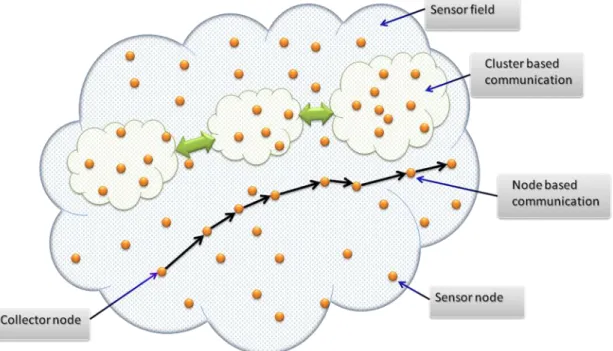
A WSN has a great number of sensor nodes that are deployed densely and randomly for monitoring in specific terrains such as inaccessible environments or battlefields (Akyildiz et al., 2002). Transmission of information is conducted through node-based multi hop communications. This method transmits information obtained from the collector node to subsequent nodes until the data reach the target. The same task can be done using cluster-based communication. This method employs selection strategies that enable the more powerful mobile or fixed nodes to form several clusters to perform the same function. Figure 2.2 presents the typical operating strategies of a sensor network.
Figure 2.2 A wireless sensor network
WSNs have unique features that are different from ad hoc networks. Nevertheless, the protocols and algorithms used in traditional wireless ad hoc
16
networks can also be applied to WSNs (Haibin et al., 2006). The unique features of WSNs include the following (Haibin et al., 2006):
The number of sensor nodes in a sensor network can be several orders of magnitude higher than that in an ad hoc network.
The topology of ad hoc network changes frequently.
Sensor nodes are limited in power, computational capacity, memory storage, and prone to failure (Rahman, 2010).
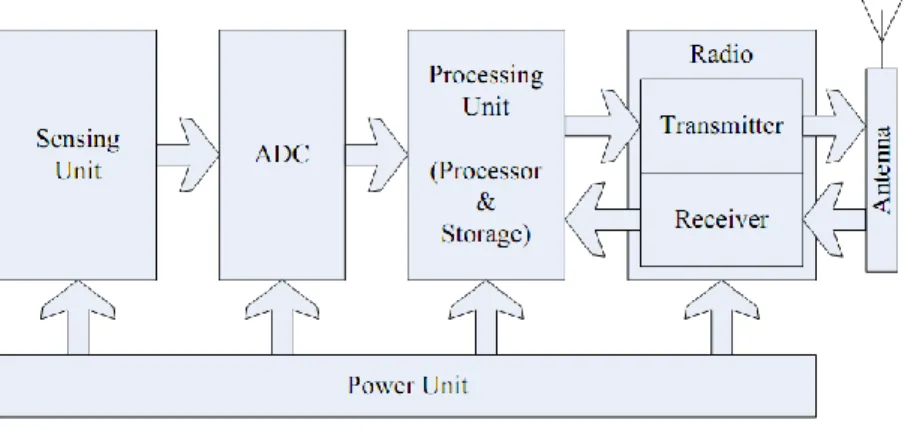
The physical structure of sensor nodes contains two types of sensor networks, namely, homogeneous and inhomogeneous WSNs. Homogeneous WSNs have identical sensor nodes, whereas inhomogeneous nodes have sensor nodes designed with varying energies and capabilities (Akyildiz et al., 2002). Both types of WSNs have basic sensor nodes comprising four fundamental components: a sensing unit, a processing unit, a transceiver unit, and a power supply unit (Haibin et al., 2006). Figure 2.3 presents the fundamental components of a sensing unit. The lifetime of a sensor network is determined by the service life of the batteries, as all functions of the sensor node are powered by onboard batteries that are difficult to recharge or replace. Therefore, the most critical design factors for WSNs are power conservation and management.
17
2.2.2 Protocol Stack
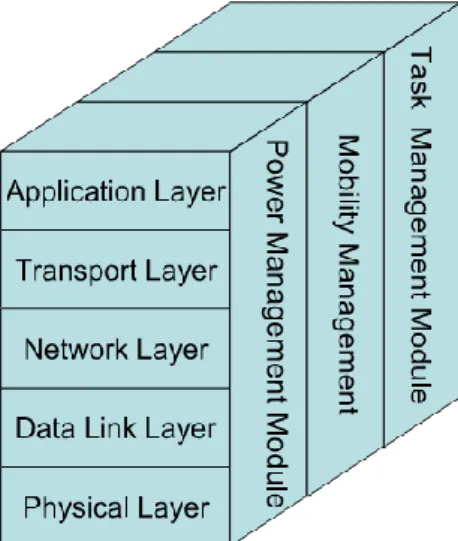
The sensor network is composed of the physical, date link, network, transport, and application layers (Figure 2.4). The following are the descriptions of each layer (Akyildiz et al., 2002).
The physical layer performs frequency selection, carrier frequency generation, signal detection, modulation, and data encryption.
The data link layer performs the multiplexing of data streams, data frame detection, medium access, and error control. This layer secures reliable point-to-point and point-to-multipoint connections in a communication network.
The network layer is responsible for the routing of data supplied by the transport layer.
The transport layer assists in maintaining the data flow, and it may be critical for WSNs if it is accessed through the Internet or other external networks.
The application layer defines a standard set of services and interface primitives available to a programmer independently in their implementation in every kind of platform. An example is the so-called sensor network services platform (Sgroi et al., 2004, Akyildiz and Vuran, 2010).
18
Figure 2.4 Sensor network protocol stack (Akyildiz and Vuran, 2010)
The following management planes should be considered by WSNs to function efficiently (Akyildiz and Vuran, 2010):
Power management module plane oversees how a sensor node uses its power and handles its power consumption in sensing, computation, and wireless communications operations.
Mobility management plane detects and registers movement of nodes to maintain a data route to the sink.
Task management module plane balances and arranges the sensing tasks assigned to the sensing field. Therefore, only the necessary nodes are assigned with sensing tasks, and the remaining nodes focus on routing and data aggregation.
19
2.2.3 Network Connectivity and Deployment
Connectivity is critical for WSNs, as information collected needs to be sent to data collection or processing centers. This transmission is conducted through ad hoc communications, which require network connectivity as a mandated criterion. The connectivity of a WSN is usually defined based on a graph associated with that WSN.
A WSN or a wireless ad hoc network is often represented by a graph, in which vertices correspond to the communication nodes in the wireless network, and an undirected edge between a pair of vertices indicates that the corresponding nodes can communicate directly. Edges of the graph are undirected because all the nodes in the WSN are assumed to have homogeneous transmission range. With this graph representation, a network is called connected if its associated graph is connected. A graph G is connected if and only if there exists a path between any pair of its vertices (Diestel, 2005). A connected network implies that any pair of nodes can communicate with each other, possibly through multiple hops by using relay nodes. More strict definitions of connectivity exist, such as 2-connectivity and 3-connectivity, which have similar meanings as in the graph theory, i.e., there exist two or three disjoint paths between any pair of nodes, for 2-connectivity or 3-connectivity, respectively.
It is clear that the connectivity of a WSN is related to the positions of nodes, and those positions are heavily affected by the sensor deployment. In general, there are two types of approaches to deploy sensors in a WSN, deterministic deployment, i.e., sensors are placed exactly on pre-engineered positions, and random deployment,
20
i.e., nodes are deployed on random positions. For the deterministic deployment, networks are carefully planned, and nodes are placed on desired positions. Therefore, it is not difficult to achieve network connectivity, if specifications of nodes are known. Although the deterministic deployment has such an advantage, in order to reduce installation costs, there are also requirements for applying random deployment to deploy large WSNs which contains very large numbers of nodes. Nodes may be dispersed by a moving vehicle or artillery shell (Akyildiz et al., 2002). Therefore, sensors often have nondeterministic positions, and the analysis of connectivity of such a type of networks involves proper modelling of random networks.
The random deployment can be the direct result of certain deployment strategies. For example, sensors may be air-dropped or launched via artillery in battlefields or unfriendly environments that result in random spatial distributions of node densities of varying degrees in a given area i.e. sparsely dense distribution. Under this assumption, the locations of sensors can be modeled by a stationary two-dimensional Poisson point process (Daley and Vere-Jones, 2007). Denote the density of the underlying Poisson point process as λ, which is measured by the number of sensors per unit area. The number of sensors located in a region A, , follows a Poisson distribution of parameter , where represents the area of the region.
21
2.2.4 Network Lifetime Based on Connectivity
Network lifetime has become the key characteristic for evaluating sensor networks in an application-specific way. Especially the availability of nodes, the sensor coverage, and the connectivity have been included in discussions on network lifetime (Dietrich and Dressler, 2009).
Connectivity is a metric that is commonly encountered in the context of ad hoc networks because there is no notion of sensor coverage in ad hoc networks and thus the ability to transmit data to a given destination is most important. The definition for ad hoc network lifetime given by Blough and Santi (Blough and Santi, 2002) defines the lifetime as the minimum time when either the percentage of alive nodes or the size of the largest connected component of the network drop below a specified threshold.
Baydere et al. (Baydere et al., 2005) and Yu et al. (Yu et al., 2001) define the network lifetime in terms of the total number of packets that could be transmitted to the sink. While this number can serve as an indicator for the persistence of the network, it is very dependent on the actual algorithms used in the network. If, for example, data aggregation algorithms are used, the number of packets to be transmitted to the sink is reduced. However, these aggregated packets contain the same degree of information as the much higher number of non-aggregated packets. Therefore, the applicability of this metric in comparing the lifetimes of different network setups is limited. Especially when data aggregation algorithms are employed, this metric loses much of its expressive power. Another drawback is that the number of transmitted messages gives no clue as to how long, in time units, the
22
network was able to measure its environment. Even if the traffic pattern produced by the sensing application is known, no conclusions can be drawn about the absolute lifetime because the pattern can be modified by packet loss or data aggregation. Similar considerations hold for in-network data processing (Dressler et al., 2007).
A third metric aiming at network connectivity defines the network lifetime in terms of the number of successful data gathering trips Olariu and Stojmenovic (Olariu and Stojmenovic, 2006). In Giridhar and Kumar (Giridhar and Kumar, 2005) this is further confined to the number of trips possible ―without any node running out of energy.‖ This statement effectively reduces the definition to n-of-n lifetime, the difference being only that the lifetime is not given in time units, but in the number of data gathering trips. Therefore, in addition to the drawbacks described for n-of-n lifetime, the draw-backs for the definition based on the total number of transmitted packets also apply.
2.3Strategies for WSNs
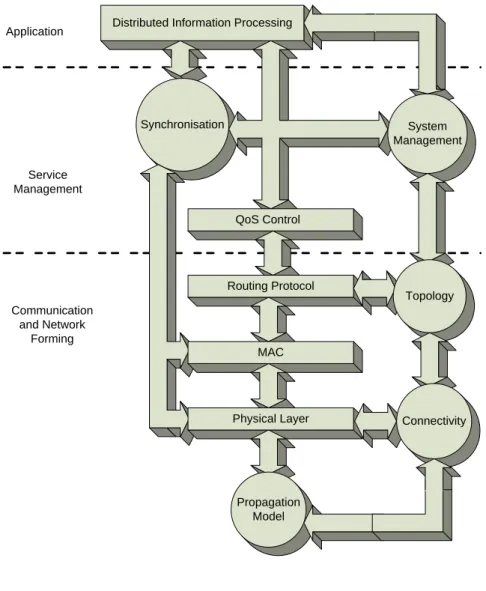
WSNs are communication systems that follow the seven-layer Open Systems Interconnection (OSI) model. The main strategies are divided into three categories, namely, communication and network forming, service management, and application system (Akyildiz et al., 2002, Haibin et al., 2006) (Figure 2.5).
23
Distributed Information Processing
Synchronisation System Management QoS Control Application Service Management Routing Protocol Topology MAC Physical Layer Communication and Network Forming Connectivity Propagation Model
Figure 2.5 Main strategies for WSNs
This section focuses on clustering, energy management, channel access technology, synchronisation, and connectivity. These topics are related to the problem statement for this dissertation.
2.3.1 Physical Layer Modeling
(1) Radio Wave Propagation Modeling, Ground Surface Influence
There are many problems in communications, navigation, and applied geophysics, in which the system performance is dependent on the electromagnetic ground wave. The latter refers to the wave that propagates along the surface of the
24
Earth such that its characteristics are influenced by the profile and electrical properties of the Earth‘s surface. In the last century, much effort was undertaken to solve this issue. Here some propagation model that are closely related to this dissertation will be introduced. The theoretical models of electric force E for a vertical electric dipole or current element, located over a conductive half-space (Wait, 1998):
, (
(2.1) where is the wave vector in free space, is the wave length, is the distance from the transmitter.
Theoretical model of the complex amplitude of the electric field intensity (Feinberg, 1959) in term of attenuation function, produced by an electric dipole radiator on the ground (z=0) at distances that are much greater than a wavelength is presented as follows:
, (
(2.2) where is the attenuation function. The value of attenuation function, may require very complex mathematical calculation (Feinberg, 1959).
The ground wave propagation model in terms of electric field strength is presented as follows (Sevgi, 2007):
(