Abstract—E-learning and distance learning are all forms of learning that take place outside of a traditional learning environment and can be alternatives for learners who are not able to study in a traditional environment for various reasons. With advancement in technologies and increased use of smart phone, mobile learning has gained popularity as another form of learning and has enabled learners to learn anywhere and anytime. Ubiquitous learning takes mobile learning to another level by providing contents that are context and location aware. There is therefore the need to provide mobile devices with the right learning contents for the right users. The right learning contents should be adaptive to the learner’s location, as well as learning style and device etc. To be able to implement the learning, learning management systems play the important role in creating, managing, and delivering the learning contents. In this paper, a location-based Learning Management System for adaptive and personalized mobile learning is presented. The systems makes use of 5R Adaptation Framework for Location based Mobile learning, the location-based dynamic grouping algorithm, and concepts of the IMS Learning Design model to produce a location-based adaptive mobile learning setting.
IndexTerms—Adaptive and personalized learning, location and context awareness, learning management system, mobile learning.
I. INTRODUCTION
Learning Management Systems (LMS) have been in existence for quite some time now. It dates back to around the 1920’s when the first teaching machine was invented. It has evolved since then to having an interactive learning network in the mid 1990’s, open source LMS (Moodle) and SCORM architecture in early 2000, and currently the cloud based systems available [1]. LMS provides e-learning/study materials to learners, interaction between learners and instructors and sometimes administers exam scores [1]. With advancement in mobile technology, e-learning has also evolved allowing learning to take place on mobile devices anywhere anytime in what is now termed mobile learning and also ubiquitous learning [2]. For leaning to take place anywhere and anytime, the right learning materials should be made available to the right learner. This means, learning materials presented to learners must take into consideration the location and context aware information of the learner.
Manuscript received April 19, 2013;revised June 26, 2013. This work was supported in part by the NSERC/iCORE/Xerox/Markin research program at Athabasca University.
The authors are with the School of Computing and Information Systems, Athabasca University, Athabasca, AB T9S 3A3 Canada (e-mail: [email protected], [email protected]).
A literature review conducted shows the interest and studies being undertaken in the areas of mobile learning, location based learning and the availability of context aware learning materials. This study proposes a Location-based Learning Management System for Adaptive Mobile Learning. An architecture and LMS will be presented based on the 5R presented in [3]. The paper is divided as follows. Section II presents the findings on the literature review conducted. Section III and Section IV will introduce the 5R architecture and content generation systems respectively. Section V presents the location based LMS architecture and design and Section VI concludes the paper.
II. LITERATURE REVIEW
The literature review conducted presented some outcomes in the study of mobile learning. These outcomes showed the positive results achieved by using mobile devices for learning purposes. In the areas of student engagement, results showed students got more engaged when using mobile devices and game based learning approaches for studying as compared to other students who followed the traditional classroom based instructor led session. Ownership and collaboration improved as well with students in the mobile learning and game-based environment [4]. Initial feedback from the study in [5] showed that student learning and collaborative knowledge building improved while on site at a learning location. In other studies [2], [6], the use of location-aware and mobile game-based learning improved learning of the English language as it allowed students to learn grammar and form sentences suited for where they were currently located. The use of mobile devices and location game-based learning also promotes and enhances collaborative learning and build learning communities [7], [8].
With this interest in mobile and location based learning, many other studies have also been undertaken to see how best location-aware, context-aware, adaptive and personalized contents can be created and presented for learning. Reference [9] presented an infrastructure for developing pervasive learning environments. This infrastructure acknowledged the different learning skills and preferences possessed by learners and presented learning materials adaptable and personalized for such learner needs. Helpful research frameworks and topics are presented in [10] for location based adaptive mobile learning. In other studies [11]-[14], proposals for authoring contents for location-based, context aware and adaptive personalized learning were presented as well as ways for retrieving these contents in an efficient manner.
Location-Based Learning Management System for
Adaptive Mobile Learning
Frederick Ako-Nai and Qing Tan
Results from the studies show much interest in location-based mobile learning. However, the review
conducted did not come up with any platform or learning
management systems for location-based mobile learning. The
next section will introduce an architecture and design for a location-based LMS for adaptive mobile learning.
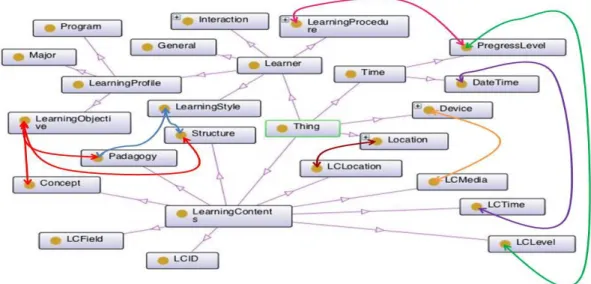
Fig. 1. The 5R ontology input schema.
III. 5RARCHITECTURE
The 5R Adaptive framework [3] is described as learning by providing the right contents to the right learner using the right device at the right location and the right time. The 5R framework creates the platform for an adaptive location based mobile and ubiquitous learning environment. The location-awareness and context-awareness of the user, as depicted by the device being used, the time learning is to take place and learner’s learning style, progress and preferences are all brought together when choosing the right learning content to deliver to the learner.
The 5R – location, time, learner, device, and content, produces the right learning contents personalized and adapted to a user’s learning style, device type and current geographic location. Inputs of the 5Rs, their relationships and how they arrive at the personalized and adaptive learning contents are described in Fig. 1 [3].
IV. THE 5RCONTENT GENERATION PLATFORM
Learning Management Systems (LMS) form the core of mobile learning or e-learning [15]. These systems provide some functionalities to help students access learning materials and also for instructors to create these learning materials. These systems can also facilitate interaction of student-to-student and student-to-instructor. Although these systems provide students access to learning materials, they do not always provide the right contents to all students. Some students may be farther ahead than others in their learning [15] or have different learning preferences and styles [16]. LMSs do not also take the location of the students into consideration.
As stated by [17], developing the right models to support pervasive learning and also mobile learning is one of the challenges faced when implementing mobile learning. The contents generated must include as much information to satisfy the user’s needs in terms of location, device, time,
contents, and learner as described in the 5R adaptive framework for location-based mobile learning systems. In their study [18], the authors noted one challenge of fully utilizing mobile devices for learning in a non-tradition learning environment being the ability to access learning contents designed to present the right learning contents on mobile devices. The outcome of this study was a content generation platform based on the 5R Framework that aided learning content creators in creating location-based contents that meets the location of the leaner and can also be displayed in the right supported format of the learner’s mobile device.
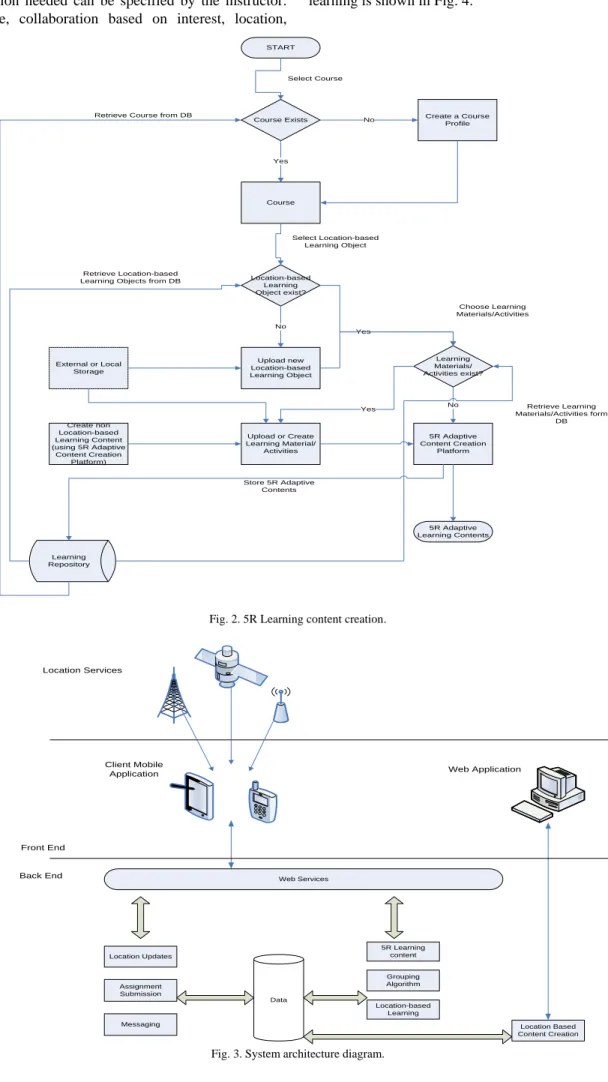
The platform generates the right learning contents based on the inputs in the ontology schema in Fig. 1. These main inputs or factors are learner, location/learning environment, learning object/content and presentation types/devices and time [3], [19]. These form the building block to which learning contents are then created and can be reused. Once this information has been gathered, a course instructor can proceed to create learning contents for a course. These contents will contain the course, which is depicted by a course name, a location-based object, learning materials and/or activities for the location-based object, the order in which the learning materials are to be presented and the type of device these objects can be viewed and/or accessed on. The data flow for creating location-based learning contents is shown in Fig. 2.
V. LOCATION-BASED LEARNING MANAGEMENT SYSTEM
Distance learning has evolved from the use of audio tapes, radio and television to the use of desktop computers and now by using mobile devices like PDA’s and smartphones. It has evolved from being called distance learning to e-learning and now mobile learning (m-learning) and ubiquitous (u-learning). Mobile learning allows learner to access learning materials in anywhere and at anytime. Ubiquitous learning enhances mobile learning by providing the right learning services at the right location and time [2]. This takes
into account context-aware and location-aware services to deliver the right contents. Advancements in mobile technology have given mobile devices the ability to detect one’s location and context. With the advancement in technology, suppliers of learning and learning materials should not only be able to provide anywhere and anytime learning, but also the appropriate learning contents based on the learner’s location and time of day and adaptable for the learners mobile device. This paper presents architecture and design based on the 5R Adaptive framework [3] and IMS Learning Design Model [20], for such a system to provide and facilitate context-aware adaptive mobile learning.
A. Architecture
The location-based LMS presented in this paper is geared towards mobile learning, although contents can also be viewed on personal computers as well. The system includes, Location Sensing Engine – this accepts the current geographic coordinates of a learner’s location and is used in matching location-based contents during content retrieval and also during grouping users for collaborative learning.
Content Generation Engine – this is the platform for creating adaptive location-based learning contents
Grouping Engine – this helps to group learners for collaborative learning based on geographic location, learning style, learning preferences and interests.
Learning Engine – this is the module that manages leaning by presenting learning activities to learners, and making sure these activities are completed as well managing assignments, tests and quizzes, and
Messaging Engine – this helps student-to-student and student-to-instructor interaction.
Fig. 3 shows the System Architecture diagram of the Location-based LMS.
The location-based LMS has three Main Modules. Administration Module for managing the administrative
functions
Instructor Module used by instructors and content creators to create and manage learning contents, objects and activities
Learner Module for managing user access, retrieving leaning contents and collaborating with other learners. This module is also used by instructors to assess learner’s progress.
B. Design
Course AB1 is a geography course that studies rivers. Unit 1 of the course asks learner to visit some rivers and perform ascribed learning activities. Unit 2 asks learners to describe their findings with their peers. Unit 3 is a group presentation. Learners in distance or online can be located in any part of the world. How can this course be presented to online learners?
In our example, course AB1 cannot rely on just one river, for instance, LOB1 the North Saskatchewan River located in Edmonton, Alberta, Canada as the main location-based learning object for the course. If a learner is in Toronto, the learner is not expected to travel Edmonton just for Unit 1 of this course. Therefore, some flexibility should be allowed in the location based learning objects used in the contents. The
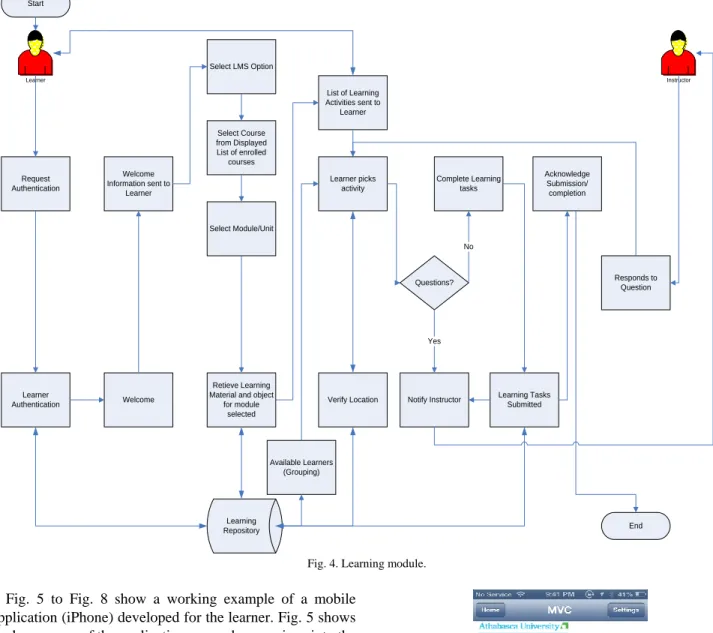
design of the LMS is based on such a scenario and uses the 5R Adaptive framework [3] and IMS Learning Design Model [20] as the foundation frameworks. The 5R framework presents the inputs needed to satisfy a location-based adaptive and personalized contents taking into account the elements specified by the IMS workgroup and make the object and content reusable. We present 2 modules in this paper, the Instructor Module for creating and managing contents and the Learner module for learning. Fig. 2 and 4 show the information flow for the Instructor module and Learner module respectively.
Once the system validates a user as content creator or instructor, s/he is presented with the platform for creating location-based contents. The content creator then proceeds to create learning contents as described in fig. 2 as follows: Select course. If the course is not available, a course profile will be requested and created by a user with Administrative privilege. Once a course has been selected, a location-based learning object will be selected. If not available, a new object can be uploaded. Learning materials and activities are then added for the chosen object to become a location-based learning object in the LMS. The sequence in which these activities are to be performed is also stated during the content creation.
When creating the course, the 5R framework allows the content creator to have as many objects as possible related to the content in different locations. In our example, the learning object, that is the river, can be a particular river located in each city an online learner is situated, or it can be an ―open‖ object where the learner has to locate any river in his/her location and perform the learning activities assigned. Assuming this course is unique to a particular area, for example, southern Alberta, and then there will be different rivers, one for each central location – Edmonton (North Saskatchewan river), Red Deer (Red Deer river), Calgary (Bow river). A radius will have to be specified so learners within a particular location radius will be able to access a river in that central location. The location-based object, learning materials/activities and sequence once created will form a unit of a course. In our example, unit 1 of course AB1. For contents to be adaptable, the 5R framework allows content creators to also create learning activities/materials in different formats to accommodate all mobile devices as possible. The learning activity can be created in a video, audio, plan text or flash format so it can be adaptable to a devices presentation capability.
When a learner enrolled in AB1 signs into the learning module of the LMS, s/he will be presented with the course units. The learner’s location information sensed by the mobile device as well as the context information is sent along with the unit request to the learning engine to retrieve the right location-based contents personalized and adapted for the learner’s location and context. A learner in the Edmonton area will be presented with the North Saskatchewan River and directions to get to this location. The learner then proceeds with completing the assigned tasks and activities provided for the learning unit. The learning module also makes use of the messaging engine to send messages to instructors for clarification of activities etc. The grouping engine is also employed here to group students for collaborative learning. In our example, unit 2 requires
learners to discuss their findings with other learners and come up with a presentation for unit 3 of the course. The type of collaboration needed can be specified by the instructor. For Example, collaboration based on interest, location,
preferences, skills, progress etc. or a combination of these. The flow of information and sequence of activities in the learning is shown in Fig. 4.
START
Course Exists Create a Course Profile Course Location-based Learning Object exist? Upload new Location-based Learning Object 5R Adaptive Content Creation Platform Learning Materials/ Activities exist? Upload or Create Learning Material/ Activities Create non Location-based Learning Content (using 5R Adaptive Content Creation Platform) External or Local Storage 5R Adaptive Learning Contents Learning Repository Yes No No Yes No Yes Select Course Store 5R Adaptive Contents Select Location-based Learning Object Choose Learning Materials/Activities Retrieve Learning Materials/Activities form DB Retrieve Course from DB
Retrieve Location-based Learning Objects from DB
Fig. 2. 5R Learning content creation.
Location Based Content Creation Data Grouping Algorithm 5R Learning content Web Services ` Location Updates Assignment Submission Front End Back End Client Mobile
Application Web Application
Location-based Learning Messaging
Location Services
Learner Learner Authentication Request Authentication Welcome Welcome Information sent to Learner Select LMS Option Retieve Learning Material and object
for module selected List of Learning Activities sent to Learner Complete Learning tasks Learning Tasks Submitted Notify Instructor Instructor Questions? No Yes Responds to Question Learning Repository Acknowledge Submission/ completion Available Learners (Grouping) Select Course from Displayed List of enrolled courses Select Module/Unit Learner picks activity Verify Location Start End
Fig. 4. Learning module.
Fig. 5 to Fig. 8 show a working example of a mobile application (iPhone) developed for the learner. Fig. 5 shows the home page of the application once a learner signs into the system. S/he proceeds to select ―My Learning Space‖ option and is presented with the courses/classes registered in as shown in Fig 6. The learner then selects a course to work on. Fig. 7 and 8 show the content of the course, in this case, a Geography course AB1 presented earlier. The same can be presented in a web version on a regular laptop or desktop computer as well.
Fig. 5. Learning module.
Fig. 6. Learning module.
Fig. 8. Learning module.
VI. CONCLUSION
One of the main problems in providing location-based mobile learning is the availability of location-aware and context-aware tagged learning contents. In this research, which is still in progress, we have presented a Learning Management System for the location-based adaptive and personalized mobile learning. This will help instructors create contents suitable for mobile learning and present the right location based contents to mobile users at the right time.
This will also help aid easy interaction between learners as well as between instructors and learners within a mobile learning environment.
For future studies, we hope to incorporate another engine to dynamically and automatically identify and model learner’s learning styles and preferences. This will help group learners for enhanced collaboration and also present more personalized contents to learners. Another module is the mobile application that is currently being enhanced based on the mobile virtual campus [21] to interface with the LMS.
REFERENCES
[1] History of the LMS. [Online]. Available:
http://www.mindflash.com/learning-management-systems/history-of-l ms.
[2] H.-C. Hsieh et al., ―Context-Aware Ubiquitous English Learning in a
Campus Environment,‖ in Proc. 7th IEEE International Conference on
Advanced Learning Technologies, 2007, pp. 351-353.
[3] Q. Tan, X. Zhang, Kinshuk, and R. McGreal, ―The 5R Adaptation Framework for Location-Based Mobile Learning Systems,‖ in
Proc.10th World Conference on Mobile and Contextual Learning,
Beijing, 2011. pp. 87-94.
[4] J. Huizenga, W. Admiraal, S. Akkerman, and G. Dam, ―Mobile game-based learning in secondary education: engagement, motivation and learning in a mobile city game,‖ Journal of Computer Assisted
Learning, vol. 25, no. 4, pp. 332-334, Aug. 2009.
[5] P. Seow et al., ―Location matters: leveraging knowledge building with mobile devices and Web 2.0 technology,‖ Interactive Learning
Environments, vol. 17, no. 4, pp. 367-382, Dec. 2009.
[6] C.-M. Chen, ―Interactive Location-based Game for Supporting Effective English Learning,‖ International Journal of Intelligent Information Technology Application, vol. 3, no. 1, pp. 44-50, Mar. 2010.
[7] A. Ellertson and P. Seeling, ―Work in progress—Using mobile & social game technology with location-based services for building learning
communities,‖ in Proc. 2011 Frontiers in Education Conference, 2011, pp. S4H-1-S4H-3.
[8] D. Tsolis, P. Christia, S. Kampana, and A. Tsakalidis, ―OWLEARN: An Open Source E-Learning Platform Supporting Adaptivity, Personalization and Mobile Learning,‖ in Proc. The International
Conference on Information Technologies, 2011, pp. 383-392.
[9] S. Graf et al., ―An Infrastructure for Developing Pervasive Learning Environments,‖ in Proc. 6th Annu. IEEE International Conf. on
Pervasive Computing and Communications, 2008, pp. 389-394.
[10] T. Qing et al., ―Location-Based Adaptive Mobile Learning Research
Framework and Topics,‖ in Proc. 2009 International Conf. on
Computational Science and Engineering, 2009, pp. 140-147.
[11] S. Wen-Chung and T. Shian-Shyong, ―Folksonomy-Based Indexing for Location-Aware Retrieval of Learning Contents,‖ in Proc. 5th IEEE
International Conf. on Wireless, Mobile, and Ubiquitous Technology
in Education, 2008, pp. 143-147.
[12] D. Aijuan and L. Honglin, ―Ontology-based information integration in virtual learning environment,‖ in Proc. The 2005 IEEE/WIC/ACM
International Conference on Web Intelligence, 2005, pp. 762- 765.
[13] A. Grasso and T. Roselli, ―Guidelines for designing and developing contents for mobile learning,‖ in Proc. IEEE International Workshop
on Wireless and Mobile Technologies in Education, 2005, pp. 123-127.
[14] E. FitzGerald, ―Creating user-generated content for location-based learning: an authoring framework,‖ Journal of Computer Assisted
Learning, vol. 28, no. 3, pp. 195-207, Jun. 2012.
[15] M. Phankokkraud and K. Woraratpanya, ―Web services for Learning Management Systems: Communication architecture,‖ in Proc.IEEE
9th Malaysia International Conference on Communications, 2009, pp.
403-408.
[16] J. Y.-K. Yau and M. Joy, ―A Context-Aware Personalized M-learning Application Based on M-learning Preferences,‖ in Proc. 6th IEEE International Conference on Wireless, Mobile and Ubiquitous
Technologies in Education, 2010, pp. 11-18.
[17] P. V. Vinu, P. C. Sherimon, and R. Krishnan, ―Towards pervasive mobile learning – the vision of 21st century,‖ Procedia - Social and
Behavioral Sciences, vol. 15, pp. 3067-3073, 2011.
[18] F. Ako-Nai, Q. Tan, F. C. Pivot, and Kinshuk, ―The 5R Adaptive Learning Content Generation Platform for Mobile Learning,‖ in Proc. 2012 IEEE Fourth International Conference on Technology for
Education, Hyderabad, 2012, pp. 132-137.
[19] F. Haiguang, L. Jing, H. Ronghuai, and L. Yushun, ―Research on adaptive mobile learning resources platform based on learning object model,‖ in Proc. 3rd International Conference on Application of
Information and Communication Technologies,Azerbaijan, 2009, pp.
1-6.
[20] IMS Learning Design Information Model. [Online]. Available: http://www.imsglobal.org/learningdesign/ldv1p0/imsld_infov1p0.htm l. Accessed March 6, 2013.
[21] Q. Tan, Kinshuk, Y. L. Jeng, and Y. M. Huang, ―A Collaborative Mobile Virtual Campus System Based on Location-Based Dynamic Grouping,‖ in Proc. The 10th IEEE International Conference on
Advanced Learning Technologies. Sousse, 2010, pp. 16-18.
Frederick Ako-Nai was born in Accra, Ghana, and is currently a master’s student at Athabasca University in Athabasca, Canada. Frederick holds a bachelors degree in computing science from Augustana University College, Camrose Alberta, Canada, earned in 2004.
He is currently a systems analyst in Edmonton, Alberta, Canada. He has worked previously as a Developer working with Java and .Net
technologies. His research interest includes location-based learning, location-detection, mobile learning, and information systems.
Qing Tan is an associate professor in School of Computing and Information Systems at Athabasca University. Dr. Tan’s background is in aviation navigation, control engineering, and computer information systems. As a Northwest Polytechnic University undergraduate in Xi’an, China, he majored in Gyroscopic and Inertial Navigation. Dr. Tan conducted his PhD study at the Norwegian Institute of Technology in Trondheim. He then performed a senior research fellow at the Japan Atom Energy Research Institute. Dr. Tan worked in the IT industry for over ten years in Canada.
Author’s formal photo
His research interests include Location-Based Technologies, Mobile Computing, Mobile Learning, Wireless Sensor Networks, Computer Network and Cyber Security, Cloud Computing, and Robotics. Dr. Tan was one of the first people to introduce the location awareness of mobile devices into mobile learning applications. He, along with other co-authors, published it on a paper that has received an outstanding paper award. In addition, there
are several location-based mobile applications have been developed for enhancing collaborative and adaptive mobile learning. Overall, Dr. Tan’s pioneer research is greatly impacting distance education and learning. He has also published and presented his research on location-aware technologies for mobile learning in wide range of international conferences and journals.