Sustainability2019, FOR PEER REVIEW www.mdpi.com/journal/sustainability
Article
1
Trusting/distrusting auditors’ opinion
2
Waymond Rodgers1, Andrés Guiral 2,*, and Jose A. Gonzalo 3
3
1 University of Hull/University of Texas, El Paso. [email protected]
4
2 School of Business, Yonsei University, Seoul 03722, Korea; [email protected]
5
3 Facultad de Ciencias Económicas, Empresariales y Turismo, Universidad de Alcalá. Plaza de la Victoria 3,
6
28802 Alcalá de Henares, Madrid (Spain). [email protected]
7
* Correspondence: [email protected] ; Tel.: +82-02-2123-5458
8
Abstract: Trust relations are essential for effective interchanges in the financial markets. Investors
9
(trustors), as well as other market participants, can only trust financial markets if they trust their
10
auditors (trustees). Especially, auditors' assessment on the client’s financial condition and its
11
ability to continue as a going concern is paramount to improving social capital and maintaining
12
sustainable financial markets. Research shows that a going concern opinion may have immediate
13
consequences for both the auditing profession and financial statement users. We utilize the
14
Throughput Model to illustrate how different trust positions are aligned with a particular
15
auditor’s decision-making pathway to enhance trust, distrust or no trust from the point of view of
16
investors’ and creditors’.
17
Keywords: trust; social capital; audit report; sustainable financial markets
18
19
1. Introduction
20
The main question posed in this paper inquires: Are financial information users’ decisions
21
influenced by their trust in auditors’ opinions? Given the apparent relationship between auditors
22
and stakeholders (such as creditors, investors, unions, regulators, interest groups), it seems
23
paramount to understand in what manner trust can nurture or erode social capital when parties
24
interact [1]. According to Putnam [2] (p. 167), social capital can be defined as "features of social
25
organization, such as trust, norms, and networks, that can improve the efficiency of society by facilitating
26
coordinated action." Szczepankiewicz [3] (p. 319) argue that the value of social capital in
27
organizations is rooted in mutual social relations and trust units, which thanks to it can achieve
28
more social and economic benefits. Coleman [4] (p. 98) articulated that, "like other forms of capital and
29
human capital, social capital is not completely fungible but may be specific to certain activities. A given form
30
of social capital that is valuable in facilitating certain actions may be useless or even harmful to others."
31
The primary goal of the accounting profession is to enhance social capital by honoring public
32
trust. Specifically, auditors contribute to society by assessing the truth and fair view of their clients’
33
financial statements [5–7]. In honoring public trust, auditors should act as the guardians of third
34
parties’ interests rather than evaluate the consequences of their opinions in their relationship with
35
their clients.
36
When suspicion arises that auditors are not providing reliable and relevant information to
37
third parties, distrust may emerge [8]. Furthermore, if society believes that the auditor function is of
38
little or no value, then trust can be eroded [9–11]. In this paper, we share the view that trusting and
39
distrusting cannot be understood as the opposite ends of a continuum [8–12]. Accordingly, we
40
argue that the very complexity of the trustworthiness in auditors’ function relies on simultaneous
41
high levels of trust-distrust relations [8].
42
Although some previous research investigates the association between trust and reputation of
43
different parties [13–15], research on the link between auditors and society is lacking [16, 17]. In this
44
paper, we focus on auditors' going concern opinions, probably the hardest and more controversial
45
task for this profession [18]. A going concern opinion is a powerful warning signal that might
46
negatively influence investors and other stakeholders in terms of credit re-allocation. However,
47
previous literature shows that auditors face trust dilemmas and potential economic and
48
non-economic incentives influencing their decisions, such as the possibility of being fired by their
49
own clients [7].
50
To illustrate this phenomenon, we utilize the Throughput Model [19–20] to demonstrate how
51
different trust positions are aligned with a particular decision-making pathway to enhance trust,
52
distrust or no trust. Particularly, we discuss six dominant trust positions taken from Kramer [21]: a
53
rational choice, rule-based trust, category-based trust, third parties as conduits of trust, role-based
54
trust, and history-based trust/dispositional-based trust, and apply them to the auditors' going
55
concern opinion. Because of the essential role played by auditors, we argue that a better
56
understanding of the aforementioned trust/distrust positions will contribute to improving social
57
capital and maintaining sustainable financial markets. This is important, since financial
58
sustainability is the foundation upon which both social and environmental sustainability rest [22].
59
The next section deals with trust definitions, followed by a section devoted to explaining the
60
institutional trust nature between auditors and primary stakeholders, such as stockbrokers,
61
shareholders, financial institutions, employees, and society. This section is followed by how the
62
decision-making model, The Throughput Model, is related to the dominant determinants of six
63
trust positions. Then, the case of the author’s opinion about the going concern evaluation and the
64
six trust decision pathways are discussed. Lastly, we provide our conclusions and implications.
65
2. Trust, Trustworthiness and the Going Concern Opinion
66
2.1. Social Capital and Trust
67
Trust is viewed in this paper as (1) a body of beliefs or expectations, and (2) a tendency to
68
behave with those beliefs accordingly [23]. These beliefs or expectations have grown up due to
69
often long-lived relationships, intense in nature when there may be a great depth to the
70
relationships between the parties, or where there are frequent interactions between them; the
71
parties may also be reciprocally interdependent, and bounded whether by law or contract, such that
72
the parties have incentives to maintain their relationship [24–25].
73
Trust affects auditors’ positions within networks by influencing investment and credit
74
decisions. However, distrust can also provoke negative effects, e.g., auditors’ clients not receiving
75
financing in a timely manner, and hence going out of business [26–27]. Gambetta [28] also
76
emphasizes that uncertainty can lead to distrust and less cooperation. Others [21] have suggested
77
that individuals’ reactions, in term of defensiveness, may depend on the level of trustworthiness in
78
a given relationship. That is, stakeholders, relying on auditors’ viewpoints, may experience
79
difficulties when interpreting organizational information and values and, therefore, will find these
80
less accurate, whereby an increased distortion of messages may result. Therefore, understanding
81
trust and distrust relationships are required for effective problem-solving in organized capital
82
markets worldwide [29]. When financial statement users rely on auditors’ opinions, they recognize
83
their common interests and cooperative relations may take place [30].
84
Trustworthiness can be viewed as the underlying base that promotes an efficient solution to
85
problems of coordinating expectations and interactions between individual actors [20, 31–33].
86
Figure 1 summarizes the connection between trust/distrust/no trust scenarios and social capital. In
87
the trusting/distrusting situations, we differentiate three types of trustworthiness: incentive-based,
88
normatively based, or psychologically based. Incentive-based trustworthiness refers to the
89
incentives of the trusted person in order to act in accordance with that trust. Incentive-based trust is
90
rooted in a precise alignment with the motivations and desires of the other party, i.e., encapsulated
91
interest, allowing one to serves as an “agent” for the other and as a substitute for trades and other
92
interpersonal relations [34]. The second type of trustworthiness relies on the use of standards, rules
93
or abstract universal principles rooted in moral commitment autonomy under the social capital
94
framework. The third type of trustworthiness relates to reasons of character or psychological
95
disposition towards problem-solving and decision making. Finally, there is also possible a “no
96
trust” scenario, where trustworthiness is null and may provoke undesirable effects, such as
97
negative market responses and absence of reliable and relevant information.
98
99
Figure 1. Trust/Distrust/No Trust scenarios & Social capital.
100
2.2. Auditors’ Going Concern Opinions
101
As stated by Duska, “society has carved out a vital role for the independent auditor that is absolutely
102
essential for the effective functioning of the economic system” [35] (p.21). In this way, the auditor’s
103
opinion on their clients’ ability to continue in existence is an act to establish trust with stockbrokers,
104
creditors, investors, employees, and society. That is, financial statement users need to know the
105
possibility that an organization may go bankrupt and the auditor is expected to deliver such critical
106
information [6, 36].
107
The irony of this relationship is that an organization (client) hires the auditor to report to third
108
parties whether the client is truthfully revealing the outcomes and status of its operations [24] (p.
109
39). Furthermore, auditors’ going concern opinions are often associated with Type Error I (i.e., firms
110
that receiving a going-concern opinion survive in the subsequent year) and Type Error II (i.e., firms
111
that do not receive a going-concern opinion but subsequently going bankrupt) [37]. While auditors'
112
opinions should be rooted in normative reasons, previous research indicates that their decisions are
113
subject to several economic incentives and psychological biases [6–7]. Uncertainty appears to be an
114
unavoidable feature of trust. However, if individuals are uncertain about the auditor’s opinion,
115
they might as well refrain from trusting, and seek other less informational sources. This would
116
result in an undesirable effect since auditors are supposed to be the guardian of public trust [35].
117
In the next section, the Throughput Model and its relation with dominant determinants of six
118
trust positions are discussed. We then illustrate the six trust pathways with the case of the auditors’
119
going concern opinion, before we present the conclusions and implications of this paper.
120
3. The Throughput Conceptual Model
121
The Throughput Model technique has been widely used to explore different financial and
122
social issues such as lending [38–39], CEO’s ethical reasoning [40–42], auditors’ decisions with
123
No Trust
Encapsulated Interest
Rational reasons of one’s interest Moral Commitment Autonomy Psychological Disposition
Normative reasons: ethical belief code, moral principles, etc.
Predispositional character or psychological traits towards problem solving and decision making
Negative Market Effects; Use of different information system; Slow down in industry’s productivity due to lack of reliable and relevant information
Trusting/ Distrustful Relations
SOCIAL CAPITAL
Influences on trustworthy Based on trust positions
No Trust
Encapsulated Interest
Rational reasons of one’s interest Moral Commitment Autonomy Psychological Disposition
Normative reasons: ethical belief code, moral principles, etc.
Predispositional character or psychological traits towards problem solving and decision making
Negative Market Effects; Use of different information system; Slow down in industry’s productivity due to lack of reliable and relevant information
Trusting/ Distrustful Relations
SOCIAL CAPITAL
Influences on trustworthy Based on trust positions
environmental risk information [6–7, 43–44], information processing [45] and sexual harassment
124
[46].
125
The Throughput Model decomposed the ethical decision- making process into four main
126
stages, namely perception (P), information (I), judgment (J) and decision outcome (D) to isolate six
127
predominant ethical pathways (see Figure 2). As shown in Figure 2, information is likely to affect
128
the way an individual perceives a circumstance. But perception is also likely to influence how
129
individuals rely on the information to be employed in the decision-making process. Therefore,
130
under the Throughput Model lens, both perception and information are mutually dependent (see
131
the double-ended arrow in Figure 2).
132
133
Figure 2. Throughput Model. Source: Rodgers [16, 45].
134
The first processing stage (perception in Figure 2) involves the framing of an organization’s
135
problem or a circumstance (P). For the auditing case, framing implies the risk being perceived by
136
the auditor in the organization’s financial statements. An example of this framing is the auditor’s
137
assessment of the client’s internal controls. When internal controls are robust, audit risk will be
138
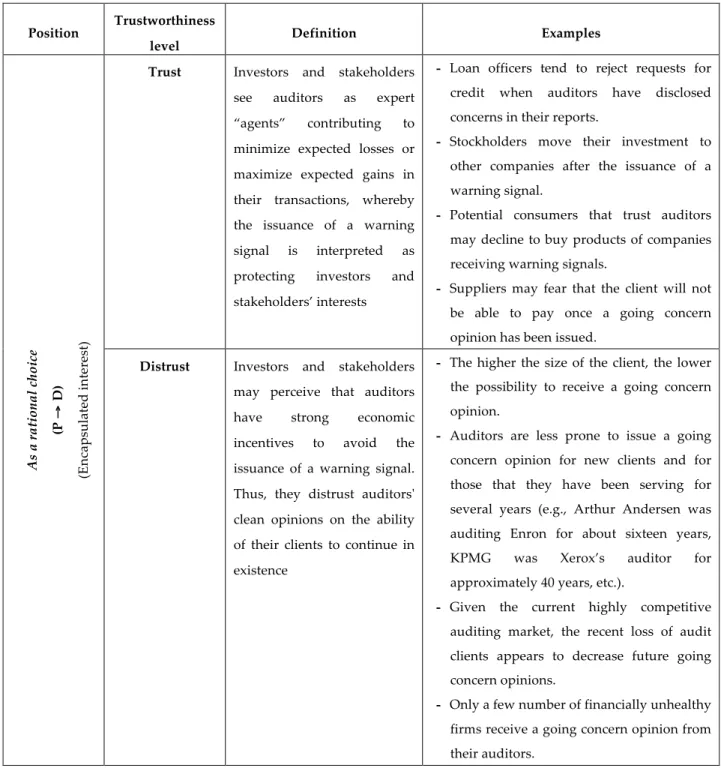
perceived as low compared to a client with a weak internal control system.
139
An organization’s information (I) as portrayed by auditors’ viewpoint can influence trust
140
relations. Wicks et al. [47] argued that trust “lowers agency and transaction costs…, promotes smooth
141
and efficient market exchanges…, and improves organizations’ ability to adapt to complexity and change” (p.
142
99). For example, John Morrissey, deputy chief accountant of the Securities and Exchange
143
Commission stated that the enhanced rules of the Ethics Committee of the International Federation
144
of Accountants “… are based on the need to maintain investors’ confidence and trust in the reported
145
numbers, through the services of an auditor that will be perceived as objective and unbiased.” [48] (p. 2)
146
The judgment stage (J) is critical in the auditor decision- making process. Both financial and
147
non-financial information are compiled at the subconscious level to develop alternative solutions or
148
courses of action by using compensatory or non-compensatory weighting methodologies [38, 49].
149
The trust decision (D) is rooted in positive confidence in the trustworthiness one attributes to
150
another party. Currall and Epstein [50] (p. 194) stated: "Therefore, trust arises from judgments we make
151
about the likelihood that another party will behave in a trustworthy manner as well as assessments we make
152
about the possible costs we will suffer if the other party turns out to be untrustworthy.” In this paper, we
153
explore investors and stakeholders decision to trust or distrust auditors’ opinions.
154
4. Six Dominant Trust Pathways
155
Once we have decomposed the ethical decision- making process into its four main stages, we
156
use the Throughput Model to conceptualize the dominant determinants of the above six dominant
157
decision-making pathways: (1) rational choice-based trust, (2) rule-based trust, (3) category-based
158
trust, (4) third parties as conduits of trust, (5) role-based trust, and (6) history-based
159
trust/dispositional-based trust [40]. Although other alternative pathways are also possible, they do
160
not do so as significantly as the dominant pathways. These dominant positions enhance or weaken
161
social capital based on the situation or contextual framework (see Table 1 and Figure 2).
162
Furthermore, these pathways can be divided into two broad categories: primary and secondary. (1)
163
Rational choice, (2) rule-based trust, (3) category-based trust are three primary trust pathways since
164
P
I
they either focus on perception (P) or evidence (I). Whereas, (4) third parties as conduits of trust, (5)
165
role-based trust, and (6) history-based trust/dispositional-based trust are secondary since they
166
include both “P” and “I” [38].
167
Table 1. Trust Positions connected to Social Capital.
168
169
P → D depicts the most direct pathway to a goal or decision choice from a perceptual
170
point of view. That is individuals frame a problem based upon their experiences, training and
171
education and make a decision choice. Moreover, perception and information are coherent,
172
which is to say that incoming information is constantly updating perception similar to a
173
Bayesian statistical approach. Trust as a rational choice indicates that people are typically stirred
174
to behave in their self-interest [51]. In addition, trust decisions are expected to be comparable
175
to other types of risky choice in that people are recognized to be motivated to make rational
176
and efficient choices, thereby improving social capital between auditors and society. That is, in
177
accordance with traditional economic models, individuals are assumed to take action to exploit
178
expected gains or reduce expected losses from their dealings. This viewpoint comprises two
179
primary components [52]. First, knowledge is contemplated, which drives a person to trust
180
another person, place or thing. Second, it associates with the trusted person’s incentives to
181
honor that trust. This particular kind of trust is predicated on a broad grasp of the other
182
individual’s wants, needs, and desires; i.e., it is rooted in the encapsulated interest concept
183
under the social capital framework. Consequently, this particular kind of trust permits one to
184
act on behalf of (i.e., "agent") the other and replace the other individual in interpersonal
185
dealings [34]. Hardin [52, p. 189] stated: “You can more confidently trust me if you know that
186
my interest will induce me to live up to your expectations. Your trust then encapsulates my
187
interests.”
188
Investors and stakeholders see auditors as an expert “agent” who contributes to minimize
189
expected losses or maximize expected gains in their transactions. If they are convinced that
190
information focuses auditors on maximizing third parties’ interests, they are more likely to trust
191
(distrust) them. This leads to the first proposition:
192
P1: Auditors’ opinions on an organization’s information are trustworthy (untrustworthy) to the
193
extent that they (do not) protect/maximize third parties’ interests.
194
(2) P
→
J→
D illustrates rule-based trust and focuses on the use of standards or laws which are195
rooted in moral commitment autonomy under the social capital framework. In other words, rules
196
hinge on the arrangement of the decision choice together with the relational behavior of the driver
197
of the action. The underlying and interpersonal mechanisms of rules are to be expected to prompt
198
# Trust Position Pathway Type Social Capital
(1) Trust as a rational choice P → D primary Encapsulated interest
(2) Rule-based trust P → J → D primary Moral Commitment Autonomy
(3) Category-based trust I → J → D primary Psychological Disposition
(4) Third parties as conduits of trust I → P → D secondary Psychological Disposition/Encapsulated interest
(5) Role-based trust P → I → J → D secondary Psychological Disposition
perceived trust [53] (p. 88) and increase or decrease social capital. Hummels and Roosendaal [54]
199
asserted that “way to deal with complexity is to draw up an extensive contract that specifies the rights and
200
obligations of the contract partners and to decide on the penalties when one of the parties fails to meet its
201
obligations.” P → J → D assumes that direct evidence influence from I is downplayed and a trust
202
decision is formed through judgment. Evidence is just ignored due to lack of reliability and an
203
individual forms a perception with small or no weights on information. Then, he or she assesses
204
alternative scenarios based on perception to arrive at a trust decision.
205
Currall and Epstein articulated that [50] (p. 196) "Because it involves such personal
206
consequences, trust is a largely solitary decision. Under certain conditions, our decision to trust also
207
may be influenced by what family or friends do or urge us to do. Indeed, it is common for us to be
208
swayed to trust someone by what others tell us about him or her." Kant’s Categorical Imperative
209
states [55] (p. 1) “if it was right for one person to take a given action then it must be right for all
210
others to be encouraged to take that same action.” Currall and Epstein also stated that
211
“Furthermore, although trust is an evidentiary decision, we may use family members’ or friends’
212
experience as a proxy for our own. And, because trust decisions are often made in the context of
213
incomplete information, we may seek out the advice of others as a supplement to our own
214
information.” [51] (p. 196). Individuals maintain a set of values that are either implicitly or explicitly
215
understood. Besides, philosophers, religious and non-profit organizations have emphasized and
216
promoted ideal sets of ethical principle or rules [40]. Illustrations of accepted moral values or rules
217
at the implementation stage comprise bylaws, spiritual dogmas, trust codes for specialized and
218
licensed groups, such as auditors, and a code of conduct at the organizational level. This leads to
219
the second proposition:
220
P2Society’s perception that auditors’ follow a higher (lower) level of standards (rules) than other
221
market participants will result in a higher (lower) reliance on an organization’s information.
222
(3) I → J → D depicts that category-based trust relies on commitment and collaboration rooted in
223
group belongingness. Category-based trust may be extended broadly within psychological
224
disposition under the social capital framework and may be reinforced by ceremonial and figurative
225
actions [56] that underline cultural similarity [57]. However, collaboration can exist without trust
226
[58]. Trust can also be viewed as a means of promoting cooperation when other methods may not
227
work or be as efficient. People are more willing to assign positive characteristics relating to honesty,
228
cooperativeness, and trust to individuals within a particular group [59]. On the other hand, if
229
common characteristics are absent, distrust can arise when dealing with an ethical issue (e.g., the
230
prisoners’ dilemma game) [52]. A game such as “prisoner dilemma” can be implemented to
231
discover how cooperation between unrelated parties can develop by normal choice. For example, in
232
this type of game, each participant can either “cooperate” (invest in a common good) or “not
233
cooperate” (exploit the other’s investment). Institutional form may obtain acceptability predicated
234
upon perceptual framing pertaining to the trust on behalf of authoritative powers. Powell and
235
Dimaggio [60] argued that an institute is a respected source to the degree that its structure and
236
procedures follow the decrees of established laws and beliefs. This leads to the third proposition:
237
P3More (fewer) market transactions occur when society believes that a trustworthy (distrustworthy)
238
auditing professional was responsible for reporting habits of organizations.
239
(4) I → P → D emphasizes the third parties as conduits of trust and supposes that individuals use
240
themselves or people within close proximity to them as their foundation for delineating ethical
241
standards in lawless settings thereby impacting on social capital. Third-party material assists to
242
underpin prevailing relationships, enforcing one’s perception to be assured of his trust (or distrust)
243
in a person, place or thing. Furthermore, the study conducted by Labianca et al. [61] demonstrated
244
that third parties might be pulled into damaging interpersonal exchanges. Hence, trust rest on the
245
undeviating link amid two entities as opposed to their indirect links through third parties and the
246
circumstances that the strong indirect links, which augment trust overturn their effect to generate
247
distrust. The certainty may also be an illusion of whether or not the individual or the institution is
248
trustworthy or not. Likewise, Blau [62] (p. 112-113) argued that trust progresses since social
249
exchange involves unspecified obligations for which no binding contract can be written.
250
Henceforth, trust is obligated to a swap deprived of a person knowing how the other individual
251
will respond. This leads to the fourth proposition:
252
P4 Bad (good) publicity of an organization will influence auditors to issue a negative (positive)
253
opinion on an organization’s financial reporting.
254
(5)P → I → J → D accentuates that role-based trust is knotted to recognized societal
255
configurations, contingent on a person or organizational particular social capital features. This
256
particular pathway suggests that a person’s perceptual problem framing will inspire the assembly
257
and information kind to be exercised in analysis (i.e., judgment). In other words, a person is
258
encouraged to act aptly (i.e., perception) that impacts upon the information compendium
259
implemented to be evaluated (i.e., judgment) in advance of a trust decision choice. This viewpoint
260
put forward that an ethically compelled person with suitable inspirations is more likely to
261
understand what task should be accomplished than an ethically deficient person would do.
262
Beauchamp and Bowie [63] (p. 39) advocated: “A person who simply follows rules of obligation and who
263
otherwise exhibits no special moral character may not be trustworthy.” Simon [64] (p. 125) proceeded that
264
the inclination to undertake an expert's decisions can happen through respect to the authorities’
265
administrative part and can be made “independently of judgments of the correctness or acceptability of
266
the premise (of their decisions).” Likewise, Tyler and Degoey [65] maintained that people's
267
assessments of organizational authority trust formed their readiness to receive the authorities’
268
actions as well as prompting a state of mind of commitment to follow institutional rules and laws.
269
Besides, Fisher et al. [66] acclaimed that people are bound together by professional positions within
270
the social order. The special trust relationship between society and its professions can reduce or
271
eliminate harm or exacerbate problems that people are confronted with on a daily basis. This leads
272
to proposition five:
273
P5 Stakeholders are more (less) trusting when they view auditors as the guardians (agents of the
274
organization) of reliable and relevant information for their decision-making purposes.
275
(6) I → P → J → D illustrates the history-based trust and/or dispositional trust that is rooted in the
276
personal experience of recurring exchanges. In addition, personal experiences are augmented by
277
information sources, such as databases, records, archival files, etc.
278
The historical-based/dispositional trust position takes into account the probability of others likely
279
actions based on past and present information. For instance, contracts are inherently incomplete –
280
all the contingencies in a transaction simply cannot be specified. In a long-standing association,
281
exchange is at the center of this course of action. Through this process, organizational dealings are
282
connected to the social setting where psychological issues interlink with economic matters in
283
reaching a decision choice [67]. In the aggregate, the security and constancy of repeated
284
give-and-take interactions permit learning [68] and stimulate trust [69]. This outlook epitomizes the
285
final conceivable distinct manner for people’s decision-making based on information processing.
286
According to this pathway, a person evaluates the existing evidence (I), frames the issue (P),
287
proceeds to assess the issue (J) to finally arrive at a decision (D) leading to some level of trust or
288
distrust. This leads to the sixth and final proposition:
289
P6Auditors’ trustworthiness (distrustworthiness) is a function of how independent information can
290
(cannot) influence their opinions regarding an organizations’ performance.
291
5. Illustrating Six Trust Pathways: The Case of the Auditors’ Going Concern Opinion
292
In this Section, we applied the Throughput Model and its six dominant trust/distrust positions
293
in the discussion of auditors' going concern opinions. We illustrate these positions with several
294
examples in Table 2.
295
From a normative point of view, auditors should maintain an independent (trustworthiness)
296
position in their decision-making process [7]. Investors’ reaction to a going concern opinion (i.e., a
297
warning signal) for a client with strong financial distress could be based on trust as a rational choice
298
pathway, P → D. This pathway suggests that evidence (I) is disregarded, and the decision is made
299
without a significant assessment (J). In trusting as a rational choice, investors and other
300
stakeholders are expected to behave in their own interest to make efficient and rational decisions
301
(i.e., encapsulated interest under the social capital framework). That is, investors just trust an
302
auditor’s opinion and then will decide whether or not to move their investment to other companies.
303
In this regard, investors perceive that a qualified audit opinion (P) reflects a rational risk to keep
304
their investment in the company. Thus, without looking for further information or making any
305
evaluation of the company’s ability to survive, investors would trust auditors’ opinions moving
306
their investment to other market opportunities (D).
307
In this process, investors and stakeholders see auditors as an expert “agent” who contributes to
308
minimize expected losses or maximize expected gains in their transactions [70]. Similarity, potential
309
consumers that trust an auditor’s warning signal would decline to buy products of financially
310
distressed companies [7, 71]. Other important trustors of the auditor's report are commercial
311
bankers. To improve financial health, companies may try to get a loan from a bank institution. In
312
this negotiation process, loan officers tend to reject requests for credit when auditors have disclosed
313
concerns in their reports [72, 73].
314
However, the reality is that the auditing market is highly competitive [5] and auditors might
315
face economic incentives to avoid going concern opinions. Several research papers indicate the
316
proportion of going concern opinions for financial distress firms is low [71, 74]. Therefore, despite
317
the fact that the final goal of the auditing profession is to honor and protect public interests,
318
economic factors, such as the fear to be dismissed, or the magnitude of audit and non-audit fees,
319
may affect auditors’ independence [75‒76]. Audit fees and client size have been some of the
320
indicators used by the empirical research to measure the association between clean audit reports
321
and economic incentives [73, 77]. For example, investors, such as bankers and financial analysts,
322
may rationally distrust a clean audit report when they perceive that the company has been attested
323
for a long time by the same auditing firm (i.e., long term contracts). Another reason to distrust
324
auditors' opinion is the so-called "opinion shopping," that is, when the company management fires
325
the auditor after the receipt of a warning signal about its ability to survive and hires a new one who
326
issues a clean audit report [78‒79]. Thus, investors and other users perceiving opinion shopping
327
would distrust clean auditors’ opinions regarding firms that are financially distressed. Following
328
this argument, financial statement users will distrust if they perceive that auditors are not
329
protecting their interests when issuing clean reports for financially distressed firms. In this
330
situation, distrust as a rational choice pathway, P → D, may explain investors and other third parties’
331
behavior.
332
The rule-based trust,P → J→ D, highlights auditors’ trust relations, whereby they issue their
333
opinion based upon prescribed rules (i.e., moral commitment autonomy under the social capital
334
framework). Rule-based trust describes much of the auditors’ explicit and tacit understandings with
335
other individuals. Indeed, it is based on auditors and other parties’ common understandings of the
336
set of norms concomitant of proper behavior. For instance, auditors draw up a contract (P) based on
337
the rules, that determine if the company abides by the rules (J), and decide (D) on whether to issue
338
an opinion. From the rule-based trust pathway, investors may have confidence in auditors, a
339
self-correcting profession which has reacted after the Enron and other financial scandals. For
340
example, after the Enron-Arthur Andersen scandal, the American Institute of Certified Public
341
Accountants (AICPA) has significantly updated its code of ethics. In addition, recent reforms,
342
including mandatory audit tenure and the banning of non-audit services, have been executed after
343
the passage of the Sarbanes-Oxley Act of 2002 to enhance auditor independence.
344
However, some authors have argued that compliance with externally imposed rules may not
345
be construed that one is trustworthy [80‒81]. This argument is also supported by the so-called
346
“strategy issue cycling” theory recently developed by Moore et al. [82] and Bazerman et al. [83]
347
asserting that current accounting reforms, rather than overcome auditors’ ethical dilemmas, seem to
348
hide the reluctance of the auditing profession to make changes in the system. Thus, more
349
regulation, such as the Sarbanes-Oxley Act, may be interpreted as a set of temporary and illusory
350
solutions to an unresolved problem. Here, the rule-based distrust,P → J → D, may help understand
351
why investors distrust auditors' opinions within a robust legal system, which is more “apparent”
352
than real [82‒83].
353
The category-based trust pathway, I → J → D, may explain why investors show a tendency to
354
trust international auditing firms highly. In this regard, big audit firms are seen as a specialist in
355
many sectors (i.e., banking, insurance, high-technology). That is, international audit firms might be
356
categorized as more trustworthiness in comparison to national and regional firms and have strong
357
incentives to protect their reputation in the global market [84]. Also, firms with higher international
358
reputation can hire and retain the best professionals [85]. Following this argument, investors would
359
tend to attribute positive characteristics, such as independence, reputation, industry knowledge, etc.
360
(i.e., psychological disposition under the social capital framework), to international firms. For
361
instance, a clean audit opinion for a company suffering from financial distress issued by a small
362
audit firm would provoke a feeling of distrust. On the other hand, the category-based trust pathway
363
would explain investors’ trust in the same unqualified opinion guarantee by a select few large audit
364
firms.
365
Auditors may be sensitive to third parties as conduits of trust (e.g., newspapers report on
366
litigation), I → P → D, and hence the issuance of an auditor's opinion may alter trust relations with
367
others (e.g., bankers, bondholders, etc.). For instance, a qualified audit report may provoke credit
368
rating agencies to lower their recommendation (e.g., from “investment grade” to “junk”) [86-87].
369
Thus, third parties’ information (i.e., the financial press, financial analysts, credit rating agencies) (I)
370
might serve to reinforce investors’ trustworthiness (P), and an auditor’s opinion would be
371
trusted/distrusted (D). Furthermore, third parties as conduits of the distrust pathway are also useful to
372
illustrate why Arthur Andersen lost its reputation and, consequently, most of its clients after the
373
intense press coverage of the Enron scandal, where that auditing firm never issued a previous
374
warning signal about the company’s financial health.
375
From the role-based trust point of viewP → I → J → D, an auditor’s decision to avoid a going
376
concern opinion might be seen as a trustworthy behavior if the auditor takes into account the
377
environmental conditions that affect a client's ability to survive. In deciding to issue a qualified
378
audit report, auditors face the so-called "self-fulfilling prophecy effect", that is, a market belief that a
379
going concern opinion will contribute to a client's failure due to its negative impact on creditors,
380
investors, suppliers and customers who would lose their confidence in the company [6–7, 44, 73]
381
[88‒89]. For instance, the issuance of a going concern opinion has been found to cause clients’ stock
382
price declines [90] and reduce a loan officer’s willingness to approve a loan request [72, 73]. Then,
383
the auditor’s decision of avoiding a going concern opinion (I) can be trusted (D) whether the
384
investors believe there is still a chance for the company to recover its financial health (J) and
385
perceive that the release of a warning signal will unnecessarily hasten users’ confidence in the client
386
(P).
387
388
Table 2. Simultaneous Trust/Distrust Positions on Auditors’ Going Concern Opinions.
389
Position Trustworthiness
level Definition Examples
As a ra ti on al c ho ic e (P → D) (E nc ap su la te d in te re st)
Trust Investors and stakeholders
see auditors as expert “agents” contributing to minimize expected losses or maximize expected gains in their transactions, whereby the issuance of a warning signal is interpreted as protecting investors and stakeholders’ interests
- Loan officers tend to reject requests for credit when auditors have disclosed concerns in their reports.
- Stockholders move their investment to other companies after the issuance of a warning signal.
- Potential consumers that trust auditors may decline to buy products of companies receiving warning signals.
- Suppliers may fear that the client will not be able to pay once a going concern opinion has been issued.
Distrust Investors and stakeholders
may perceive that auditors have strong economic incentives to avoid the issuance of a warning signal. Thus, they distrust auditors' clean opinions on the ability of their clients to continue in existence
- The higher the size of the client, the lower the possibility to receive a going concern opinion.
- Auditors are less prone to issue a going concern opinion for new clients and for those that they have been serving for several years (e.g., Arthur Andersen was auditing Enron for about sixteen years, KPMG was Xerox’s auditor for approximately 40 years, etc.).
- Given the current highly competitive auditing market, the recent loss of audit clients appears to decrease future going concern opinions.
- Only a few number of financially unhealthy firms receive a going concern opinion from their auditors.
Ru le -bas ed (P → J → D) (M or al C om m itm en t A uto no m y)
Trust Investors and other
stakeholders may see the auditing profession as ethical exemplary due to a rigorous normative rule or legal system function in force. Also, the auditing profession may be viewed as a self-correcting profession which has positively reacted after the Enron-Arthur Andersen episode and other recent financial scandals
- The AICPA has significantly updated its code of ethics.
- The SOX may have contributed to mitigate
auditor economic motives as well as by properly regulating auditor independence.
- The European Commission mandated mandatory audit firm rotation, banned most of non-audit services, and imposed a limitation on permitted non-audit services.
Distrust Investors and other
stakeholders perceive that the weak current legal system leads them to highly distrust auditors’ opinions (i.e., strategy issue cycling theory)
- Contrary to the rule-based trust position, the SOX may be viewed as a set of inefficient rules and laws.
- The AICPA might update its code of ethics just to maintain its status quo against public interest after resounding financial scandals.
- The PCAOB still nixes mandatory auditor rotation due to the heavy resistance of corporate board members and large companies. Ca te go ry -bas ed (I → J → D) (P sy ch ol og ic al D is po si tio n)
Trust Investors and other
stakeholders highly trust auditors’ opinions from international accounting firms
- In terms of a superior reputation, international auditing firms are viewed as high-status companies that convey more legitimacy than small audit firms.
- High-status audit firms are considered as experts in many sectors, such as banking, insurance, and high technology.
- International auditing firms have a superior ability to recruit, retain and motivate the very best professionals.
Distrust Investors and other
stakeholders tend to distrust auditors' opinions issued by small auditing firms.
- Small audit firms have more economic incentives to be dependent on their clients.
- Non-international accounting firms do not
possess enough expertise to issue on-time warning signals regarding their client's risk of bankruptcy.
Thi rd par ti es as c ondui ts of tr us t (I → P → D) (P sy ch ol og ic al D is po si tio n/E nc ap su la te d in te re st)
Trust Investors and other
stakeholders highly trust auditors’ opinions when media reports support their clients’ financial (either healthy or distressed) status
- Negative news of the client in the press increases auditors’ propensity to issue going concern opinions.
- Credit rating agencies scores affect auditors' understanding of their clients' financial status.
Distrust Investors and stakeholders
highly distrust on auditors involved in financial scandals and corruption cases
- The Arthur Andersen dramatic collapse after the media coverage on the financial scandal of Enron, which, at the time, was one of the world's top accounting firms.
- PricewaterhouseCoopers paid $175 million in 1998, as a result of a lawsuit due to its inappropriate way of examining the financial records of Bank of Credit and Commerce International (BCCI).
Ro le -bas ed (P → I → J → D) (P sy ch ol og ic al D is po si tio n)
Trust Investors and stakeholders
may perceive auditors' decision to issue a clean audit opinion for a financially distressed client might be seen as a trustworthy behavior if the auditor takes
into account the
environmental conditions that affect client's ability to survive.
- There is a market belief that suggests that a going concern opinion directly contributes to provoke the final bankruptcy of an already distressed client (i.e., going concern opinion serving as a self-fulfilling prophecy). For instance, many commercial banks reject firms’ request for financing when those firms have received a warning signal from their auditors.
- Auditors’ fear of causing damage to their clients’ shareholders. Several research reports indicate that the issuance of a going concern opinion significantly reduces clients’ stock price.
Distrust Investors and stakeholders may perceive an auditor’s decision to issue a going concern opinion (clean opinion) for a financially distressed client like an untrustworthy behavior under a high (low) risk
exposure auditing
environment
- In the light of the recent financial scandals, auditors fear they will lose their market reputation when involved in. Thus, investors may perceive that auditing firms, rather than improve their compliance with externally imposed rules (e.g., Sarbanes Oxley Act), have increased the likelihood to issue going concern opinions to protect their market reputation.
- Many auditing firms use their audit report containing a going concern opinion as a shield for potential lawsuits.
- In auditing environments with low litigation risk, such as the cases of Spain, Belgium, and Hong Kong, auditors may offer a high reluctance to alert investors.
Hi st or y-ba se d and/ or di spos iti ona l (I → P → J → D) (P sy ch ol og ic al D is po si tio n/M or al C om m itm en t A uto no m y)
Trust Investors and stakeholders may trust a clean audit opinion (warning signal) for a financially distressed client might as a trustworthy behavior if they perceive that available information dominates auditors’ decision
- Auditors are in the best position to assess the going concern assumption due to their expertise and their privileged access to insider information.
- After examining the financial information
of a distressed client, the auditor must evaluate both management’s plans (i.e., forecasts, budgets) and abilities to conclude the firm’s risk of bankruptcy.
Distrust Investors and stakeholders may perceive a clean audit opinion for a financially distressed client as an untrustworthy behavior if they perceive that auditors'
decision may be
unconsciously biased when processing independent information (e.g., Bazerman et al.'s moral seduction theory [79])
- Selective perception, escalation of commitment and discounting of information biases illustrate auditors’ unintended predisposition to reach their own interest even when they want to honor public trust. For instance, to preserve future quasi-rents (audit fees), auditors may be unintentionally reluctant to issue going concern opinions.
390
However, under the role-based distrust pathway, the issuance of a going concern opinion may
391
lead stakeholders to distrust auditors. In recent years, some accounting auditing firms have issued
392
going-concern opinions for companies that eventually went bankrupt. As a result, most of the
393
financial and non-financial press has repeatedly asked auditors the reasons why they did not issue
394
on time going concern opinions. This situation has provoked a new high risk-litigation environment
395
in which investors and other stakeholders now have a higher tendency to sue auditors [91‒92].
396
Following this argument, the chance of being sued by stakeholders would lead auditors to perceive
397
that the potential costs of alerting them can be significantly greater compared to issuing a clean
398
audit opinion.
399
Finally, the history-based trust and/or dispositional trust pathway, I → P → J → D, represents
400
auditors’ trust relations given a sufficient amount of information in an attempt to behave in a
401
normative way. This pathway assumes that evidence influences auditor’s perception in an
402
“unbiased” manner leading. For example, the consideration of the feasibility of management's
403
future plans can be critical information to avoid a going concern opinion [18]. Besides, the
404
history-based distrust argument might explain why auditors’ psychological disposition may lead
405
investors to distrust auditors’ role as vanguards. Moral seduction theory suggests that the unique
406
complexity of the auditor-client relationship precipitates auditors’ unintended lack of professional
407
skepticism. Thus, even the most open-minded and diligent of auditors may be unconsciously biased
408
when processing information [6‒7, 82‒83].
409
6. Discussion and Conclusions
410
A vast variety of social capital devices, including institutions, norms, and so forth, enable
411
individuals/organizations to cooperate efficiently and effectively. In this paper, we propose the
412
Throughput Model as an efficient mechanism to better understand why auditors may act in a
413
manner that seems not to exploit social capital for positive results. Social capital augmented in a
414
positive manner is ‘satisfactory' for civilization bestowing to the ethical sources of standard
415
philosophy, not rendering to the moral aspects of a particular assemblage of people or culture.
416
Beliefs about what is right, just and fair are possible influences on social capital.
417
The Throughput Model can provide more insight on auditors’ and other professionals’
418
deliberations when they are confronted with the task of being the guardian of public trust. That is,
419
the model posits six dominant decision pathways that can influence knowledge transfer from client
420
and auditor informants effective enough to establish their trustworthiness [93]. We believe that
421
understanding the complexity of auditor trustworthiness is paramount to improving social capital
422
and maintaining sustainable financial markets [3-4, 94‒95].
423
Our research has important practical implications for auditors, auditees, and regulators. For
424
instance, consider the long debate about imposing mandatory audit firm rotation to enhance
425
auditor independence and, as a result, audit quality. On the one hand, trust can be enhance if
426
regulators enforce mandatory audit firm rotation as an effective way to increase auditor
427
independence when a long association with audit clients exists (rule-based trust). However,
428
mandatory firm rotation may also create distrust since it is likely to result in a loss of client-specific
429
knowledge (category-based distrust) [96]. Alternatively, regulators may consider to enhance trust by
430
imposing joint audits, i.e., a team of two or more auditors sharing responsibility and providing a
431
single audit report (rule-based trust) [97].
432
Our study has limitations. First, we rely on a single decision-making model, namely the
433
Throughput model, to illustrate how main financial statements users can trust auditors’ going
434
concern opinions. Alternative models with a different conceptualization of trust antecedents, such
435
as personality-based trust or cognition-based trust (i.e., built on first impressions), could be also
436
useful to examine our research question [98]. Second, there are other important decisions made by
437
auditors. For example, consider auditors’ opinion on their clients’ internal control systems. This
438
remains as an important research question since the vast majority of public companies with clean
439
internal control audit opinions announcing subsequent restatements continues to be very high,
440
around 75 percent in 2015 [99]. Finally, while we have focused our analysis on main financial
441
stakeholders, it is also possible that non-financial stakeholders, such as governments, the media,
442
not-for-profit organizations, regulators, etc., may trust/distrust auditors’ opinions in a different
443
manner.
444
Future research can study whether a particular trust position, supported by a particular
445
decision-making pathway, is more appropriate given a particular situation involving "trust." Also,
446
future research can explore which decision-making pathway can typify better relationships
447
between organizations; their auditors and investors' trust positions; and ultimately the
448
improvement of social capital for society at large. Finally, the model’s different pathways can allow
449
us to understand better how trust is nurtured and eroded as different parties interact.
450
Author Contributions: Conceptualization, W.R., A.G. and J.A.G.; methodology, W.R., A.G. and J.A.G.;
451
investigation, W.R., A.G. and J.A.G.; writing—original draft preparation, W.R., A.G. and J.A.G.;
452
writing—review and editing, W.R., A.G. and J.A.G.; supervision, W.R., A.G. and J.A.G.
453
Funding: This research was supported by Spain's Ministry of Economy and Competitiveness: [Grant Number
454
ECO2015-66240-P].
455
Conflicts of Interest: The authors declare no conflicts of interest.
456
References
457
1. Rodgers, W. Knowledge Creation: Going Beyond Published Financial Information; Nova Publication:
458
Hauppauge, NY, USA, 2016.
459
2. Putnam, R. D. Making democracy work: Civic traditions in modern Italy. Princeton University Press: Princeton,
460
USA, 1993.
461
3. Szczepankiewicz, E.I. Definitions and Selected Aspects of Measuring and Improving Social Capital in
462
Organisations. IN P. Jeżak (ed.), Social Aspect of Market Economy (pp. 317-335). Częstochowa, AJD, 2011.
463
4. Coleman, J.S. Social capital in the creation of human capital. Amer. J. Socio. 1988, 94, 95–120.
464
5. Duska, R.; Duska, B. Accounting Ethics. Blackwell Publishing: Oxford, UK, 2003.
465
6. Guiral, A.; Rodgers, W.; Ruiz, E.; Gonzalo, J. A. Ethical dilemmas in auditing: Dishonesty or unintentional
466
bias? J. Bus. Ethics 2010, 91, 151–166.
467
7. Rodgers, W.; Guiral, A.; Gonzalo, J. A. Different pathways that suggest whether auditors’ going concern
468
opinions are ethically based. J. Bus. Ethics 2009, 86, 347–361.
469
8. Lewicki, R. J.; McAllister, D. J.; Bies, R. J. Trust and distrust: New relationships and realities. Acad. Manag.
470
Rev. 1988 23, 438-458.
471
9. Elfenbein, D. W.; Zenger, T. R. What is a relationship worth? Repeated exchange and the development and
472
deployment of relational capital. Organ. Sci. 2014 25, 222–244.
473
10. Levine, E.E.; Schweitzer, M.E. Prosocial lies: When deception breeds trust. Organ. Behav. Hum. Dec. Proc.
474
2015, 126, 88–106.
475
11. Parkhe, A.; Miller, S. R. The structure of optimal trust: A comment and some extensions. Acad. Manag. Rev.
476
2000, 25, 10–11.
477
12. Flores, F.; Solomon, R. Creating trust. Bus. Ethics. Quart. 1998, 8, 205–232.
478
13. Dellarocas, C. The digitization of word of mouth: Promise and challenges of online feedback mechanisms.
479
Manag. Sci. 2003, 49, 1407–1424.
480
14. Sabater, J.; Sierra, C. Review on computational trust and reputation models. Artif. Intellig. Rev. 2005, 24,
481
33–60.
482
15. Scott, S.V.; Walsham, G. Reconceptualizing and managing reputation risk in the knowledge economy:
483
Toward reputable action. Organ. Sci. 2005, 16, 308–322.
484
16. Szczepankiewicz, E.I., The role of the audit committee, the internal auditor and the statutory auditor as the
485
bodies supporting effective corporate governance in banks. Finanse, Rynki, Ubezpieczenia, 2011, 38, 885–897.
486
17. Szczepankiewicz, E.I., The role and tasks of the Internal Audit and Audit Committee as bodies supporting
487
effective Corporate Governance in Insurance Sector Institutions in Poland. Oeconomia Copernicana, 2012, 4,
488
23–39.
489
18. Abbott, L.J., Parker S.; Peters, G. The effects of post-bankruptcy financing on going concern reporting. Adv.
490
Account. 2003, 20, 1–20.
491
19. Rodgers, W. Throughput Modeling: Financial information used by decision makers. JAI Press: Greenwich, CT,
492
1997.
493
20. Rodgers, W. E-commerce and biometric issues addressed in a Throughput Model. Nova Publication: Hauppauge,
494
NY, 2010.
495
21. Kramer, R. M. Trust and distrust in organizations: Emerging perspectives, enduring questions. Ann. Rev.
496
Psych. 1999, 50, 569–598.
497
22. Carroll, A. B. The pyramid of corporate social responsibility: Toward the moral management of
498
organizational stakeholders, Bus. Horizons. 1991, 34, 39–48.
499
23. Doney, P.M., Cannon, J.P.; Mullen, M. R. Understanding the influence of national culture on the
500
development of trust. Acad. Manag. Rev. 1998, 23, 601–620.
501
24. Kleinman, G.; Palmon, D.A negotiation-oriented model of auditor-client relationships. Group Decis. Negot.
502
2000, 9, 17–45.
503
25. Lioukas, C.S.; Reuer, J.J. Isolating trust outcomes from exchange relationships: Social exchange and
504
learning benefits of prior ties in alliances. Acad. Manag. J. 2015, 58(6), 1826–1847.
505
26. McEvily, B., Zaheer, A.; Kamal, D.F. Mutual and exclusive: Dyadic sources of trust in interorganizational
506
exchange. Organ. Sci. 2017, 28(1), 74–92.
507
27. Sparrowe, R.T., Liden, R.C., Wayne, S. J.; Kramer, M.L. Social networks and the performance of
508
individuals and groups. Acad. Manag. J. 2001, 44, 316–325.
509
28. Gambetta, D. Mafia: The price of distrust. In D. Gambetta (Ed.), Trust: Making and breaking cooperative
510
relations (pp.154–175). Oxford: Basil Bernstein, 1998.
511
29. Ryan, L.V.; Buchholtz, A.K. Trust, risk, and shareholder decision making: An investor perspective on
512
corporate governance. Bus. Ethics. Quart. 2001, 11, 177–193.
513
30. Axelrod, R. The evolution of cooperation. Basic Books: New York, NY, 1984.
514
31. Kim, P. H., Ferrin, D. L., Cooper, C.D.; Dirks, K.T. Removing the shadow of suspicion: The effects of
515
apology versus denial for repairing competence-versus integrity-based trust violation. J. Appl. Psych. 2004,
516
89, 104–118.
517
32. Luhmann, N. Trust and power. Wiley: New York, NY, 1979.
518
33. Hardin, R. Trust and Trustworthiness. Russell Sage Foundation: New York, NY, 2002.
519
34. Whitener, E.M., Brodt, S.E., Korsgaard, M.A.; Werner, J.M. Managers as initiators of trust: An exchange
520
relationship framework for understanding managerial trustworthy behavior. Acad. Manag. Rev. 1998, 23,
521
513–530.
522
35. Duska, R. The good auditor-skeptic or wealth accumulator? Ethical lessons learned from the Arthur
523
Andersen debacle. J. Bus. Ethics 2005, 57, 17– 29.
524
36. Barnes, P. The auditors’ going concern decision and types I and II errors: The Coase theorem, transaction
525
costs, bargaining power and attempts to mislead. J. Account. Public Policy 2004, 23, 415–440.
526
37. Feng, M.; Chan, L. Are Auditors Professionally Skeptical? Evidence from Auditors’ Going-Concern
527
Opinions and Management Earnings Forecasts. J. Account. Res. 2014, 52, 1061–1085.
528
38. Rodgers, W. The effects of accounting information on individuals’ perceptual processes. J. Account. Audit.
529
Fin. 1992, 7, 67–95.
530
39. Rodgers, W. The influences of conflicting information on novices’ and loan officers’ actions. J. Econ. Psych.
531
1999, 20, 123–145.
532
40. Rodgers, W.; Gago, S. A model capturing ethics and executive compensation. J. Bus. Ethics 2001, 48, 189–
533
202.
534
41. Rodgers, W.; Gago, S. Stakeholder influence on corporate strategies over time. J. Bus. Ethics 2004, 52, 349–
535
363.
536
42. Rodgers, W., Söderbom, A. ; Guiral, A. Corporate social responsibility enhanced control systems reducing
537
the likelihood of fraud. J. Bus. Ethics 2015, 185, 871–882.
538
43. Rodgers, W.; Housel, T.J. The effects of environmental risk information on auditors’ decisions about
539
prospective financial statements. Europ. Account. Rev. 2004, 13, 523–540.
540
44. Guiral, A., Rodgers, W., Ruiz, E.; Gonzalo, J.A. Can expertise mitigate auditors’ unintentional biases? J.
541
Internat. Account. Audit. Tax. 2015, 24, 105–117.
542
45. Foss, K.; Rodgers, W. Enhancing information usefulness by line managers’ involvement in cross-unit
543
activities. Organiz. Stud. 2011, 32, 683–703.
544
46. Culbertson, A.; Rodgers, W. Improving managerial effectiveness in the workplace: The case of sexual
545
harassment of navy women. J. Appl. Soc. Psych. 1997, 27, 1953–1971.

![Figure 2. Throughput Model. Source: Rodgers [16, 45].](https://thumb-us.123doks.com/thumbv2/123dok_us/1789437.2755625/4.892.273.618.317.496/figure-throughput-model-source-rodgers.webp)