Popular bearing range
P
opul
r
b
e
ring
r
nge
3
SKF is an international industrial Group
operating in some countries and is world
leader in bearings.
The company was founded in 1907
follow-ing the invention of the self-alignfollow-ing ball
bear-ing by Sven Wbear-ingquist and, after only a few
years, SKF began to expand all over the
world.
Today, SKF has some 43 000 employees
and more than 80 manufacturing facilities
spread throughout the world. An international
sales network includes a large number of
sales companies and some 20 000
distrib-utors and retailers. Worldwide availability of
SKF products is supported by a
comprehen-sive technical advisory service.
The key to success has been a consistent
emphasis on maintaining the highest quality
of its products and services. Continuous
in-vestment in research and development has
also played a vital role, resulting in many
examples of epoch-making innovations.
The business of the Group consists of
bearings, seals, special steel and a
compre-hensive range of other hich-tech industrial
components. The experience gained in these
various fields provides SKF with the
essen-tial knowledge and expertise required in
order to provide the customers with the most
advanced engineering products and efficient
service.
© Copyright SKF 1997
The contents of this catalogue are the
copyright of the publishers and may not be
reproduced (even extracts) unless
permis-sion is granted. Every care has been taken
to ensure the accuracy of the information
contained in this catalogue but no liability
can be accepted for any loss or damage
whether direct, indirect or consequential
arising out of the use of the information
contained here in.
Catalogue 4007/I E
Reg. 47 · 10 000 · 1997-08
Printed in Denmark by Scanprint as
4
3
2
1
Introduction
3
Recommendations and advice
17
Product data
39
1
Before starting
This catalogue is arranged so as to allow all
the important information about the desired
product and its use to be found quickly. The
contents are divided into four sections which
are clearly indicated by an edge marking.
Thus, the desired information is easily
found, whether it concerns a particular
prod-uct, or the answer to a specific problem.
Each of the four sections also has its own
contents list.
For the sake of clarity, all figures and
tables which are referred to in the text are
numbered.
All information relating to specific products
is given immediately preceding the tables
listing those products. General information
and information common to several products
are to be found in sections 1 and 2.
Refer-ences in the text to these sections generally
give the number of the page where more
detailed information will be found.
This catalogue shows the popular range of
SKF ball, roller and plain bearings. These
are products which are in regular demand and
are used in a wide variety of applications.
The many users of these bearings bear
wit-ness to the many advantages. These SKF
products
– can normally be supplied from stock, or at
short notice, and
– will still be available many years from now,
and on a worldwide basis. Thus purchasing
can be planned and stocking simplified,
with-out unnecessary tying up of capital. SKF
products embody other advantages too.
They are of the highest quality and represent
innovative technology as well as exceptional
value for money in respect of performance.
This catalogue is mainly intended for end
users and for maintenance purposes. The
bearing data have, therefore, been kept to a
minimum.
NB.
When developing new designs, it is
recom-mended that the SKF General Catalogue
and/or Product Catalogues are referred to;
see also section 4 “Design of bearing
arrange-ments”, page 185.
Introduction
Before starting ...page 3
Why SKF is a good choice ...page 4
Make use of the “Trouble-Free Operation” concept ...page 5
Watch the packaging ...page 6
SKF designations explained ...page 8
The products in this catalogue...page 10
Why SKF is a good
choice
“Made by SKF” is not just a statement
indic-ating who has made the bearing, it is
recog-nised throughout the world as a hallmark of
quality. Products equipped with SKF
bear-ings underline the importance attached by
the manufacturer of those products to quality.
SKF ball, roller and plain bearings
repre-sent the latest state of the art. In many cases
they have set the standards by which such
products are judged and have thus driven
the technical advancement of bearing
tech-nology. The advanced technology used for
their production provides SKF products
with reserves of performance or tangible
total cost benefits to the user in the form of
extended service life or reduced energy
consumption.
The sales organisation is also an
import-ant factor for the customer. SKF authorised
distributors are not only competent, they are
close at hand, with stock including much of
the range shown in this catalogue. They are
able to identify SKF equivalents for other
makes from lists or using computer software.
SKF products not in stock are ordered from
the SKF central stock via on-line facilities.
Their product knowledge is kept up to date
by SKF training sessions.
1
Make use of the
“Trouble-Free
Operation” concept
Bearing damage can cause unplanned
stop-pages and loss of production. This can be
very costly, particularly where capital
intens-ive plant is concerned.
Use SKF bearings
It is desirable that every SKF bearing has a
long service life and gives no trouble in
op-eration. Considerable investments in
re-search and development enable SKF to
pro-duce bearings of the highest quality.
How-ever, bearing quality alone cannot guarantee
trouble-free operation, since the life of a
bearing is influenced by external factors.
Reduce the risks
To perform properly, all machines and
mech-anical components must be kept in proper
condition. Bearings, for example, should not
be too tightly clamped or be subjected to
ex-treme temperatures, and they must be
pro-tected against damp and contaminants.
Use SKF mounting tools ...
The methods as well as the tools used to
mount bearings must be suitable for the job,
so that the bearings are not damaged during
installation, before they even start to operate.
... and maintenance equipment
To achieve long life, bearings must be
prly lubricated and maintained, and the
oper-ating conditions controlled.
Proper bearing maintenance is
funda-mental to good performance. The SKF
con-cept of “Trouble-Free Operation” shows how
bearing failures can be avoided and allows
maximum exploitation of bearing potential.
SKF offers a comprehensive range of
prod-ucts and services which eliminate
uncertain-ties in bearing mounting and maintenance,
see page 25.
Watch the packaging
SKF bearings are properly packed, and the
packages provide optimum protection to the
product using a minimum of packaging
materials.
When buying SKF bearings check that
they are always in their original packages. As
it is not possible to open a single pack
with-out breaking the seal, an unopened package
is a guarantee that the product is in “mint”
condition, and has not been subjected to
detrimental environental influences. In cases
where the authorised distributor takes an
SKF bearing from a bulk package, the
bear-ing should be put it into a plastic container or
bag which can be sealed, and the package
clearly labelled.
Single packages
Singly packaged bearings are those best
protected against environmental influences,
particularly if, for example, for certain
re-placement bearings, it must be expected
that they will be in store for quite a long time.
SKF bearings having an outside diameter
up to and including 30 mm are packaged in
fully sealed plastic pouches (fig 1).
Larger bearings and bearing units
weigh-ing up to and includweigh-ing 3,5 kg are wrapped in
dust and oil-resistant foil and then put in
cardboard boxes (fig 2).
Bearings and bearing units weighing more
than 3,5 kg and up to and including 30 kg are
singly packed in partly decorated cardboard
boxes (fig 3).
Bearings weighing more than 30 kg are
delivered in wooden boxes or crates (fig 4).
Introduction
1
2
1
Bulk packages
For customers using moderate to large
num-bers of bearings, SKF offers bulk packages
in order to limit the quantity of packaging
materials and the cost of disposing of these
materials. Special packages suited to
cus-tomer production routines are also available.
Labelling and identification
The complete product designation is marked
on all single packages and normally also the
country of origin (fig 5). The packaging date
is coded.
Environmentally friendly
SKF packaging materials are not damaging
to the environment and most can be
re-cycled. PVC is not used by SKF. All materials
including printing inks, lacquers and glues
are chosen to be environmentally friendly.
4
22222 E 6222-2Z 2222 KM/C3 56-MADE IN MALAYSIA 21-MADE IN FRANCE PK 12 0502 15 • MADE IN SWEDEN5
6
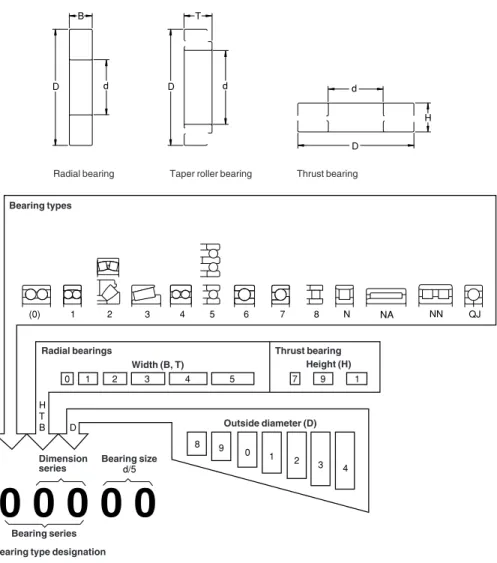
SKF designations
explained
The standard metric bearings have a
charac-teristic basic designation which identifies the
type of bearing and its standardised
bound-ary dimensions. This basic designation
consists of 3, 4 or 5 figures, or a combination
of letters and figures. It gives the bearing
type, Dimension Series and the bore
dia-meter in that order. The basic designation,
together with a possible suffix indicating a
change in the internal design, but without the
bore diameter or size indication, constitutes
the series designation, being common to
several bearings of the same type but of
increasing size.
The figure opposite shows the designation
system for metric ball and roller bearings in
diagram form.
Bore diameter identification
As shown opposite, the last two figures of a
designation give the bore diameter in
milli-metres divided by five. The size identification
of the smallest and largest bearings differs
from this rule: for bearings having bore
dia-meters smaller than 10 mm and equal to or
larger than 500 mm, the diameter is given
uncoded in millimetres preceded by an
ob-lique stroke (the / is not used on some of the
small bearings), e.g. bearing 623 has a bore
diameter of 3 mm and bearing 618/8 a bore
diameter of 8 mm.
Bearings having bore diameters of 10, 12,
15 and 17 have the following bore diameter
codes: 00 = 10 mm, 01 = 12 mm, 02 = 15 mm,
and 03 = 17 mm.
Supplementary designations
Suffixes are used to identify changes
com-pared with the original design, or variants of
the standard design. They follow a given
system, being divided into groups, and when
several suffixes identifying more than one
variant/feature are used, they are listed in a
given order following the basic designation.
The suffixes which appear in this
cata-logue and which are frequently encountered
are listed and explained in the text preceding
the relevant bearing table section under the
heading “Supplementary designations”.
More detailed information concerning the
SKF designation system for rolling bearings
and accessories will be found in the SKF
brochure PI 100.
Designations for other products
The designations for plummer block
hous-ings, adapter and withdrawal sleeves, lock
nuts etc. follow a similar system to that for
rolling bearings and are covered to some
ex-tent in the brochure PI 100. The designations
of spherical plain bearings, rod ends and
GLYCODUR plain bearings follow other
rules. The bore diameter of these products
is always given uncoded in mm, and for
GLYCODUR products, the other dimensions
are also given in the designation.
1
Bearing type designation
0 Angular contact ball bearings, double row
1 Self-aligning ball bearings
2 Spherical roller bearings and spherical roller thrust bearings
3 Taper roller bearings
4 Deep goove ball bearings, double row
5 Thrust ball bearings
6 Deep groove ball bearings, single row
7 Angular contact ball bearings, single row
8 Cylindrical roller thrust bearings
N Cylindrical roller bearings, single row.
Following the letter N, one or two letters may be added, denoting the flange configuration, e.g. NJ, NU, NUP etc.
NA Needle roller bearings according to ISO 15-1981.
Needle roller bearings with other dimensions are designated NK(I)
NN Cylindrical roller bearings, double or multi row – otherwise like “N”
QJ Four-point contact ball bearings
Diagram of the basic designation system for rolling bearings
Bearing series (0) 1 2 3 4 5 6 7 8 N NN QJ H T B D 8 9 0 1 2 3 4 7 9 1 d/5
0 0 0 0 0
1 5 0 2 3 4 d d d D D B T D H NA Bearing typesRadial bearings Thrust bearing
Width (B, T) Height (H)
Outside diameter (D)
Dimension Bearing size series
The products in this
catalogue
The range of products shown in this
cata-logue comprises some 5 000 ball, roller and
plain bearings, track runner bearings,
bear-ing units, bearbear-ing housbear-ings and accessories.
In order to find bearings, for which the
desig-nation is known, the following index has
been compiled. The first section is arranged
in numerical order (first figure, second figure,
third figure etc. so that 108 comes before 12)
and is followed by an alphabetical list.
Because of the large number of products,
most are listed by their series designation
only, e.g. 62-2RS1 for all deep groove ball
bearings of series 62 which have seals at
both sides. The page number shown is
always the first page on which a product of
the particular series can be found.
1
Designation Product Page
07000 Single row taper roller bearings, inch size... 97
09000 Single row taper roller bearings, inch size... 97
108 Self-aligning ball bearing ... 52
112 Self-aligning ball bearing ... 52
11500 Single row taper roller bearings, inch size... 97
12 Self-aligning ball bearings ... 52
126 to 129 Self-aligning ball bearings ... 52
13 Self-aligning ball bearings ... 52
135 Self-aligning ball bearing ... 52
1300 Single row taper roller bearings, inch size... 97
15000 Single row taper roller bearings, inch size... 97
160 Single row deep groove ball bearings ... 44
160-2Z Single row deep groove ball bearings ... 44
161 Single row deep groove ball bearings ... 44
17262(00)-2RS1 Y-bearings with standard inner ring ... 134
18600 Single row taper roller bearings, inch size... 98
18700 Single row taper roller bearings, inch size... 98
1900 Single row taper roller bearings, inch size... 97
213 Spherical roller bearings... 85
22 Self-aligning ball bearings ... 52
222 Spherical roller bearings... 85
223 Spherical roller bearings... 85
23 Self-aligning ball bearings ... 52
230 Spherical roller bearings... 86
231 Spherical roller bearings... 86
232 Spherical roller bearings... 86
2344(00) Double direction angular contact thrust ball bearings... 121
2347(00) Double direction angular contact thrust ball bearings... 121
239 Spherical roller bearings... 88
240 Spherical roller bearings... 86
241 Spherical roller bearings... 86
25500 Single row taper roller bearings, inch size... 97
25800 Single row taper roller bearings, inch size... 97
2700 Single row taper roller bearings, inch size... 97
292 Spherical roller thrust bearings ... 109
293 Spherical roller thrust bearings ... 109
294 Spherical roller thrust bearings ... 109
29600 Single row taper roller bearings, inch size... 98
302 Single row taper roller bearings ... 92
303 Single row taper roller bearings ... 92
313 Single row taper roller bearings ... 92
32 Double row angular contact ball bearings ... 61
32 A-2RS1 Double row angular contact ball bearings ... 61
32 A-2Z Double row angular contact ball bearings ... 61
320 X Single row taper roller bearings ... 92
322 Single row taper roller bearings ... 92
323 Single row taper roller bearings ... 92
329 Single row taper roller bearings ... 95
33 Double row angular contact ball bearings ... 61
33 A-2RS1 Double row angular contact ball bearings ... 61
33 A-2Z Double row angular contact ball bearings ... 61
330 Single row taper roller bearings ... 93
331 Single row taper roller bearings ... 92
332 Single row taper roller bearings ... 92
3400 Single row taper roller bearings, inch size... 97
3500 Single row taper roller bearings, inch size... 97
355 Single row taper roller bearings, inch size... 97
365 Single row taper roller bearings, inch size... 98
3700 Single row taper roller bearings, inch size... 98
385 Single row taper roller bearings, inch size... 98
3900 Single row taper roller bearings, inch size... 98
39500 Single row taper roller bearings, inch size... 98
42 A Double row deep groove ball bearings... 49
43 A Double row deep groove ball bearings... 49
475 Single row taper roller bearings, inch size... 98
47600 Single row taper roller bearings, inch size... 98
48200 Single row taper roller bearings, inch size... 98
511 Single direction thrust ball bearings ... 101
512 Single direction thrust ball bearings ... 101
Designation Product Page
522 Double direction thrust ball bearings... 103
523 Double direction thrust ball bearings... 103
524 Double direction thrust ball bearings... 103
525 Single row taper roller bearings, inch size... 97
53000 Single row taper roller bearings, inch size... 97
532 Single direction thrust ball bearings ... 102
533 Single direction thrust ball bearings ... 102
535 Single row taper roller bearings, inch size... 98
56000 Single row taper roller bearings, inch size... 98
575 Single row taper roller bearings, inch size... 98
595 Single row taper roller bearings, inch size... 98
60 Single row deep groove ball bearings ... 43
60-RS1 Single row deep groove ball bearings ... 43
60-2RS1 Single row deep groove ball bearings ... 43
60-2RZ Single row deep groove ball bearings ... 43
60-Z Single row deep groove ball bearings ... 43
60-2Z Single row deep groove ball bearings ... 43
618 Single row deep groove ball bearings ... 43
618-2RS1 Single row deep groove ball bearings ... 43
618-2RZ Single row deep groove ball bearings ... 44
618-2Z Single row deep groove ball bearings ... 43
619 Single row deep groove ball bearings ... 43
619-2RS1 Single row deep groove ball bearings ... 44
619-2RZ Single row deep groove ball bearings ... 44
619-2Z Single row deep groove ball bearings ... 43
62 Single row deep groove ball bearings ... 43
62-RS1 Single row deep groove ball bearings ... 43
62-2RS1 Single row deep groove ball bearings ... 43
62-2RZ Single row deep groove ball bearings ... 44
62-Z Single row deep groove ball bearings ... 43
62-2Z Single row deep groove ball bearings ... 43
622-2RS1 Single row deep groove ball bearings ... 44
623-2RS1 Single row deep groove ball bearings ... 44
628-2Z Single row deep groove ball bearings ... 43
63 Single row deep groove ball bearings ... 43
63-RS1 Single row deep groove ball bearings ... 44
63-2RS1 Single row deep groove ball bearings ... 44
63-Z Single row deep groove ball bearings ... 44
63-2Z Single row deep groove ball bearings ... 43
630-2RS1 Single row deep groove ball bearings ... 43
6300 Single row taper roller bearings, inch size... 98
64 Single row deep groove ball bearings ... 44
64000 Single row taper roller bearings, inch size... 98
6500 Single row taper roller bearings, inch size... 98
655 Single row taper roller bearings, inch size... 98
675 Single row taper roller bearings, inch size... 98
70 B Single row angular contact ball bearings... 60
70 CD Single row angular contact ball bearings... 115
719 CD Single row angular contact ball bearings... 115
72 CD Single row angular contact ball bearings... 115
72 B Single row angular contact ball bearings... 59
73 B Single row angular contact ball bearings... 59
74 B Single row angular contact ball bearings... 59
811 Cylindrical roller thrust bearings ... 105
812 Cylindrical roller thrust bearings ... 105
1
Designation Product Page
AH 22 Withdrawal sleeves ... 163 AH 23 Withdrawal sleeves ... 162 AH 240 Withdrawal sleeves ... 162 AH 241 Withdrawal sleeves ... 162 AH 3 Withdrawal sleeves ... 162 AH 30 Withdrawal sleeves ... 163 AH 31 Withdrawal sleeves ... 163 AH 32 Withdrawal sleeves ... 163
AHX 23 Withdrawal sleeves ... 162
AHX 3 Withdrawal sleeves ... 162
AHX 30 Withdrawal sleeves ... 162
AHX 31 Withdrawal sleeves ... 162
AHX 32 Withdrawal sleeves ... 162
AOH 23 Withdrawal sleeves, for oil injection method ... 163
AOH 240 Withdrawal sleeves, for oil injection method ... 164
AOH 241 Withdrawal sleeves, for oil injection method ... 164
AOH 30 Withdrawal sleeves, for oil injection method ... 163
AOH 31 Withdrawal sleeves, for oil injection method ... 163
AS Thrust washers for needle roller and cage thrust assemblies... 107
ASNA .. V Seal sets for SNH plummer block housings ... 153
ASNH End covers for SNH plummer block housings ... 153
AXK Needle roller and cage thrust assemblies ... 107
BA Thrust ball bearings ... 101
BK Drawn cup needle roller bearings ... 76
ECY 2 End covers for Y-bearing housings ... 138
FRB Locating rings for bearing housings ... 156
FS Felt strips for bearing housings ... 155
FY Y-bearing units with flanged housing ... 141
FYJ Y-bearing units with flanged housing ... 141
FYK Y-bearing units with flanged housing ... 141
FYTB Y-bearing units with flanged housing ... 143
FYTBK Y-bearing units with flanged housing ... 143
GAC .. F Angular contact spherical plain bearings, maintenance-free... 170
GE .. C Spherical plain bearings, maintenance-free ... 169
GE .. E Spherical plain bearings, steel-on-steel ... 167
GE .. ES Spherical plain bearings, steel-on-steel ... 167
GE .. ES-2RS Spherical plain bearings, steel-on-steel ... 167
GE .. TA-2RS Spherical plain bearings, maintenance-free ... 169
GE .. TE-2RS Spherical plain bearings, maintenance-free ... 169
GE .. TGR Spherical plain bearings, maintenance-free ... 169
GEG .. ES Spherical plain bearings, steel-on-steel ... 168
GEH .. C Spherical plain bearings, maintenance-free ... 169
GEH .. ES-2RS Spherical plain bearings, steel-on-steel ... 167
GEM .. ES-2RS Spherical plain bearings, steel-on-steel ... 168
GLY.PBG .. F GLYCODUR flanged bushings ... 184
GLY.PG .. A GLYCODUR bushings... 181
GLY.PG .. F GLYCODUR bushings... 181
GLY.PXG .. A GLYCODUR thrust washers... 185
GLY.PXG .. F GLYCODUR thrust washers... 185
GS 811 Housing washers for cylindrical roller and needle roller thrust bearings ... 107
GS 812 Housing washers for cylindrical roller and needle roller thrust bearings ... 107
GX .. F Spherical plain thrust bearings, maintenance-free... 170
H 2 Adapter sleeves... 160
H 23 Adapter sleeves... 160
H 3 Adapter sleeves... 160
H 30 Adapter sleeves... 161
H 31 Adapter sleeves... 161
H 913800 Single row taper roller bearings, inch size... 98
HJ 2 EC Angle rings for cylindrical roller bearings... 66
HJ 22 EC Angle rings for cylindrical roller bearings... 66
HJ 23 EC Angle rings for cylindrical roller bearings... 66
HJ 3 EC Angle rings for cylindrical roller bearings... 66
HK Drawn cup needle roller bearings ... 76
HK RS Drawn cup needle roller bearings ... 76
HK.2RS Drawn cup needle roller bearings ... 76
HM 220100 Single row taper roller bearings, inch size... 98
HM 801300 Single row taper roller bearings, inch size... 97
HM 803100 Single row taper roller bearings, inch size... 97
HM 88500 Single row taper roller bearings, inch size... 97
Designation Product Page
HM 903200 Single row taper roller bearings, inch size... 97
HM 911200 Single row taper roller bearings, inch size... 98
KR Cam followers... 128
KRV Cam followers... 128
L 44600 Single row taper roller bearings, inch size... 97
L 68100 Single row taper roller bearings, inch size... 97
LM 102900 Single row taper roller bearings, inch size... 97
LM 11700 Single row taper roller bearings, inch size... 97
LM 48500 Single row taper roller bearings, inch size... 97
LM 501300 Single row taper roller bearings, inch size... 97
LM 67000 Single row taper roller bearings, inch size... 97
LS Raceway washers for needle roller thrust bearings... 107
M 12600 Single row taper roller bearings, inch size... 97
M 802000 Single row taper roller bearings, inch size... 97
M 86600 Single row taper roller bearings, inch size... 97
M 88000 Single row taper roller bearings, inch size... 97
N 2 Single row cylindrical roller bearings... 66
N 3 Single row cylindrical roller bearings... 66
NA 22.2RS Support rollers ... 125
NA 48 Needle roller bearings ... 82
NA 49 Needle roller bearings ... 81
NA 49 RS Needle roller bearings ... 81
NA 49.2RS Needle roller bearings ... 81
NA 69 Needle roller bearings ... 81
NATR Support rollers ... 126
NATV Support rollers ... 126
NCF 29 V Single row full complement cylindrical roller bearings ... 73
NJ 2 Single row cylindrical roller bearings... 66
NJ 22 Single row cylindrical roller bearings... 66
NJ 23 Single row cylindrical roller bearings... 66
NJ 3 Single row cylindrical roller bearings... 66
NK Needle roller bearings, without inner ring... 79
NKI Needle roller bearings ... 81
NKIA Combined needle roller bearings ... 112
NKIB Combined needle roller bearings ... 112
NKIS Needle roller bearings ... 81
NKS Needle roller bearings, without inner ring... 79
NKX Combined needle roller bearings ... 113
NN 30 Double row cylindrical roller bearings ... 118
NNF 50 ADA-2LS Double row full complement cylindrical roller bearings... 73
NNU 49 Double row cylindrical roller bearings ... 118
NU 10 Single row cylindrical roller bearings... 66
NU 2 Single row cylindrical roller bearings... 66
NU 22 Single row cylindrical roller bearings... 66
NU 23 Single row cylindrical roller bearings... 66
NU 3 Single row cylindrical roller bearings... 66
NUKR Cam followers... 128
NUP 2 Single row cylindrical roller bearings... 66
NUP 22 Single row cylindrical roller bearings... 66
NUP 23 Single row cylindrical roller bearings... 66
NUP 3 Single row cylindrical roller bearings... 66
NUTR Support rollers ... 126
OH 30 H Adapter sleeves for oil injection method... 161
OH 31 H Adapter sleeves for oil injection method... 161
P Y-bearing plummer block units ... 140
PF Y-bearing flanged units... 144
PFD Y-bearing flanged units... 145
PFT Y-bearing flanged units... 146
QJ 2 Four-point contact ball bearings ... 63
QJ 3 Four-point contact ball bearings ... 63
RIS 2 Rubber inserts for Y-bearing units ... 140
RNA 22.2RS Support rollers, without inner ring ... 125
RNA 48 Needle roller bearings, without inner ring... 80
RNA 49 Needle roller bearings, without inner ring... 79
RNA 49.2RS Needle roller bearings, without inner ring... 79
RNA 69 Needle roller bearings, without inner ring... 79
RSTO Support rollers, without inner ring ... 124
1
Product index in alphabetical order
Designation Product Page
SA .. C Rod ends, maintenance-free ... 177
SA .. E Rod ends, steel-on-steel... 173
SA .. ES Rod ends, steel-on-steel... 173
SA .. TE-2RS Rod ends, maintenance-free ... 177
SAKAC .. M Rod ends, steel-on-bronze ... 176
SAKB .. F Rod ends, maintenance-free ... 178
SC .. ES Rod ends, steel-on-steel... 175
SCF .. ES Rod ends, steel-on-steel... 175
SI .. C Rod ends, maintenance-free ... 177
SI .. E Rod ends, steel-on-steel... 173
SI .. ES Rod ends, steel-on-steel... 173
SI .. TE-2RS Rod ends, maintenance-free ... 177
SIKAC .. M Rod ends, steel-on-bronze ... 176
SIKB .. F Rod ends, maintenance-free ... 178
SIQG .. ES Rod ends, for hydraulic cylinders ... 174
SIR .. ES Rod ends, for hydraulic cylinders ... 174
SIRD .. ES Rod ends, for hydraulic cylinders ... 174
SNH 2 Plummer block housings, without seals ... 155
SNH 5 Plummer block housings, without seals ... 153
SNH 5-6 Plummer block housings, without seals ... 153
SNH 2 TA Plummer block housings, with V-ring seals... 154
SNH 2 TC Plummer block housings, with felt seals... 154
SNH 2 TG Plummer block housings, with double-lip seals... 154
SNH 3 TA Plummer block housings, with V-ring seals... 154
SNH 3 TG Plummer block housings, with double-lip seals... 154
SNH 5 TA Plummer block housings, with V-ring seals... 152
SNH 5 TC Plummer block housings, with felt seals... 152
SNH 5 TG Plummer block housings, with double-lip seals... 152
SNH 6 TA Plummer block housings, with V-ring seals... 152
SNH 6 TC Plummer block housings, with felt seals... 152
SNH 6 TG Plummer block housings, with double-lip seals... 152
STO Support rollers ... 124
SY Y-bearing plummer block units ... 138
SYJ Y-bearing plummer block units ... 138
SYK Y-bearing plummer block units ... 138
SYT Pop-Release units ... 149
TSNA 2 A V-ring seal sets for SNH plummer block housings ... 155
TSNA 2 G Double-lip seal sets for SNH plummer block housings ... 155
TSNA 3 A V-ring seal sets for SNH plummer block housings ... 155
TSNA 3 G Double-lip seal sets for SNH plummer block housings ... 155
TSNA 5 A V-ring seal sets for SNH plummer block housings ... 153
TSNA 5 C Felt seal sets for SNH plummer block housings ... 153
TSNA 5 G Double-lip seal sets for SNH plummer block housings ... 153
TSNA 6 A V-ring seal sets for SNH plummer block housings ... 153
TSNA 6 C Felt seal sets for SNH plummer block housings ... 153
TSNA 6 G Double-lip seal sets for SNH plummer block housings ... 153
TU Y-bearing take-up units ... 147
U 2 Seating washers for thrust ball bearings with sphered housing washer(s) ... 102
U 3 Seating washers for thrust ball bearings with sphered housing washer(s) ... 102
W 619-2Z Single row deep groove ball bearings of stainless steel ... 43
W 628-2Z Single row deep groove ball bearings of stainless steel ... 43
WS 811 Shaft washers for cylindrical roller and needle roller thrust bearings ... 107
WS 812 Shaft washers for cylindrical roller and needle roller thrust bearings ... 107
YAJ 2-2RF Y-bearings with grub screw locking... 133
YAR 2-2F Y-bearings with grub screw locking... 133
YAR 2-2RF Y-bearings with grub screw locking... 133
YAR 2-2RFW Y-bearings with grub screw locking... 133
YAT 2 Y-bearings with grub screw locking... 133
YEL 2 Y-bearings with eccentric locking ring... 133
YEL 2-2RF Y-bearings with eccentric locking ring... 133
YET 2 Y-bearings with eccentric locking ring... 133
2
How to find the right
replacement bearing
When the bearing is an SKF bearing, the
product designation (page 8) provides exact
information. Where bearings of other makes
are concerned, all SKF authorised
distrib-utors can help. They have interchange
in-formation, which generally includes
appropri-ate SKF software. Usually, an SKF product
of the same type will be provided, as the
SKF product range is second to none.
How to identify bearings
Each SKF ball, roller and plain bearing
carri-es a dcarri-esignation which is usually to be found
on the side face of the inner and/or outer ring
(fig 1). This designation (page 8) identifies
the bearing type, size and other features and
is also all that is needed when ordering.
If it is not possible to read the designation
marking then it is still possible to identify the
bearing by
1. looking in the machine specification; this
normally states which bearings are
instal-led at the various positions;
2. taking the bearing to an SKF distributor
for identification;
3. measuring the bearing.
Recommendations
and advice
How to find the right replacement bearing ...page 17
About bearing storage ...page 19
What to remember when mounting bearings ...page 20
How to maintain correctly...page 28
How to lubricate properly ...page 30
What to remember when dismounting bearings...page 34
What to remember about sealing ...page 36
6210
How to identify a bearing by measuring it
It is often possible to identify a bearing from
its boundary dimensions. The procedure is
as follows:
– measure the bore and outside diameters
of the bearing and its width or height
(figs 2, 3 and 4),
– turn to the bearing type in the catalogue,
– find the measured bore diameter in the
column headed “d”, then the outside
dia-meter under “D” and the width or height
under “B”, “T” or “H”,
– follow the appropriate line to the right and
the designation will be found in the column
headed “Designation”.
Recommendations and advice
D
B
d
H
d
D
D
C
T
d
2
3
4
2
About bearing
storage
The ball, roller and plain bearings shown in
this catalogue form the SKF popular bearing
range and are generally available from stock
or at short notice. SKF authorised distributors
also carry stocks in order to be able to serve
their specific customers. In spite of this, there
are good reasons for many bearing users to
have their own bearing stores. This is
espe-cially true when the replacement bearings
are for machines or plant where a stoppage
would lead to a total loss of production, or
where special bearings are used.
Bearings in original packages
Before being packaged, SKF bearings are
treated with a rust inhibiting medium and can
be stored for many years. The bearings
should be stored lying down, preferably in
rooms which are free from vibration, at a
rel-ative humidity that does not exceed 60 %
and a temperature which is reasonably
con-stant.
NB.
Bearings with shields at both sides (suffix -2Z)
should only be stored for a maximum of two
years and bearings with seals at both sides
(suffix -2RS1) for a maximum of three years.
Longer storage of these “lubricated-for-life”
bearings is not recommended because the
grease with which they are filled will age and
gradually loose its lubricating properties.
Such bearings will also have a higher
start-ing torque than new bearstart-ings when they
have been in storage for some time.
Bearings not in original packages
If bearings are stored without their original
packaging, it is necessary to ensure that
they are adequately protected against
corro-sion and contamination. The SKF
high-per-formance, high-viscosity oil LHPT 48 is
emin-ently suitable for the protection of bearings
from corrosion, and is a must for any
work-shop. It protects against rust, repels
mois-ture and lubricates at the same time. To
pro-tect bearings against contamination, they
should be wrapped in plastic foil (e.g.
poly-ethylene) and kept in a cardboard box or
other container.
The full designation of the bearing should
be marked on the box or container.
What to remember
when mounting
bearings
Rolling bearings are reliable machine
ele-ments with long lives, provided they are
properly mounted and maintained. Proper
mounting calls for experience as well as care,
cleanliness and accuracy, and the right tools.
If contaminants are allowed to enter the
bearing when it is being mounted, even the
most efficient seals and lubricants will not
prevent premature bearing failure. This can
be avoided if a few simple recommendations
are followed.
Where to mount
Mounting should, where possible, be
con-ducted on a suitable workbench in dry and
dust-free surroundings. The bearing should
never be exposed to contaminants such as
metal filings, swarf, sand or corrosive liquids.
Only in exceptional cases should bearings
be mounted outside closed rooms.
If it is not possible to move complete
machines to a suitable workplace, then the
part(s) of machines with bearings should be
brought to a workshop where mounting can
be carried out under proper conditions.
Preparations for mounting
Not only the bearing but also the shaft,
hous-ing and other components of the bearhous-ing
ar-rangement must be clean. All parts,
includ-ing the seals, should be checked. Any burrs
should be removed and the bearing seatings
on the shaft and in the housing should be
cleaned and any damaged seals replaced.
The seatings should be lightly oiled to
pre-vent damage during mounting.
Where repairs are concerned, the whole
machine should be cleaned, especially
where bearings are to be mounted.
New bearings
SKF bearings in their original packages are
well protected against corrosion and should
only be unpacked just before they are to be
mounted (fig 1). The rust inhibiting medium
with which the bearings are coated need not
be removed, except on the outside diameter
and in the bore. These surfaces should be
wiped with a cloth which has been dipped in
a petroleum solvent and should be dried
using a clean lint-free cloth.
Bearings from damaged packages should
be treated as used bearings.
Used bearings
Used bearings must be carefully cleaned
be-fore being remounted. Cleaning may be done
cold or hot.
For cold cleaning, the bearing is dipped in
a petroleum solvent or similar liquid and
cleaned using a brush (fig 2). During
wash-ing, the bearing rings should be turned so
Recommendations and advice
2
that all surfaces are cleaned. Separate
sol-vent baths should be used for washing and
rinsing. The bearings should be protected
against contamination as they are drying off.
If compressed air is used to dry the bearings,
care should be taken to see that the bearings
do not rotate. As soon as the bearing is dry it
must be protected against corrosion, e.g.
with LHPT 48.
For hot cleaning, a thin machine oil which
has been heated to approximately 120 °C can
be used. For safety reasons, the oil should
have a flash point above 250 °C. Again
separ-ate baths should be used for washing and
rinsing. The oil film which remains on the
bearing after washing provides temporary
protection against corrosion.
Very dirty bearings or those covered with
tough, hardened lubricant are usually in such
poor condition that cleaning is not worthwhile.
It is generally more economic to replace
them by new bearings. This also applies to
bearings with seals at both sides, which
can-not be cleaned and inspected without first
removing the seals.
NB.
Whenever possible, protective gloves should
be worn as frequent skin contact with
petro-leum products can cause allergies. Hot oil
should be used with proper care because of
the danger of fire.
Mounting on the shaft
The SKF tool kit TMFT 33 can be used to
mount small bearings quickly, precisely and
reliably. It is also possible to make mounting
dollies or use lengths of piping for small
bear-ings. The tools should be applied to the inner
ring. The bearing should never be hit directly
with a hammer (fig 3).
If a mechanical or hydraulic press is
avail-able, this may be used to mount small or
medium-sized bearings. A sleeve or ring
should be placed between the bearing and
the press.
Medium and large-sized bearings are
easier to mount if they are first heated to
ap-proximately 80 °C above room temperature.
The SKF induction heaters TIH, see page
27, are particularly suitable for heating
bear-ings. After heating, the bearing should
quick-ly be pushed home on its seating and held in
position until it has cooled (fig 4). Protective
gloves should be used when handling hot
bearings.
Small and medium-sized bearings with a
tapered bore can be driven up on their
taper-ed seatings using a shaft (lock) nut and a
hook or impact spanner. For larger bearings
it is recommended that a hydraulic nut be
used, and for really large bearings the SKF
oil injection method should be applied. This
method requires the presence of oil ducts
and distributor grooves in the shaft seating.
Mounting in the housing
The SKF tool kit TMFT 33 can also be used
to mount small bearings in their housings
(fig 5) or mounting dollies or lengths of piping
can be used. The tools should be applied to
the outer ring of the bearing. Never apply
hammer blows directly to a bearing. A
mech-anical or hydraulic press can also be used.
In order to mount bearings, particularly
larger bearings, in their housings it is often
necessary to heat the housing. Generally,
the housing need only be slightly heated,
e.g. using an electric light bulb (fig 6).
Mounting cylindrical roller bearings
Generally the bearing rings of cylindrical
roller bearings are mounted separately. After
oiling or greasing the rollers, the free ring
and the ring with cage and roller assembly
are joined (fig 7). The shaft or housing
should be slowly turned as this is being
done. Special care should be taken that the
inner and outer rings do not skew. A
mount-ing sleeve is useful here.
Mounting angular contact ball bearings
and taper roller bearings
Mounting angular contact ball bearings and
taper roller bearings may present difficulties.
In many cases the bearing arrangement
must be adjusted to a given clearance or
preload. If instructions did not come with the
machine, the machine builder should be
contacted for advice.
Recommendations and advice
5
6
2
Mounting bearings on adapter sleeves
The adapter sleeve should be pushed on to
the shaft to a pre-marked position (fig 8).
This is relatively easy as the slot widens.
The bearing is then positioned on the sleeve,
the nut screwed on and the bearing pressed
up the sleeve by tightening the lock nut.
Remove the lock nut, insert the locking
washer and replace the nut. Tighten it
se-curely and bend down a tab of the washer
to lock the nut (fig 9).
SKF hook and impact spanners can be
used to tighten the nut, or the SKF spanner
set TMHN 7 is also available, see page 25.
Bearings having a bore diameter of 50 mm
and above can be easily and reliably
mount-ed using an SKF hydraulic nut, see page 26.
Mounting bearings on withdrawal sleeves
The withdrawal sleeve should be positioned
between the bearing and the shaft seating
and then be pressed into the tapered bore of
the bearing. With small bearings this can be
achieved using a hammer and a mounting
dolly. If the shaft is threaded, larger bearings
can be much more easily installed using a
lock nut or a hydraulic nut (fig 10). Here, too,
the use of the SKF oil injection method
con-siderably reduces the force required for
mounting.
8
9
Bearing damage caused by faulty
mounting
When the necessary experience or the
proper tools are not available, mounting can
often lead to premature bearing failure as
illustrated by the following three examples.
The flaking (fig 11) in the outer ring
race-way was caused by deformation of the ring
resulting from, for example, out-of-round
(ovality) of the housing seating. Such
de-formation often occurs where split bearing
housings are used.
The damage shown in fig 12 is caused by
axial clamping, which may have arisen
because of an insufficiently wide seating in
the housing. This would mean, for example,
that the bearing could not be axially
displa-ced in the housing if the shaft were to expand
as temperatures increased.
If a bearing, which is to have an
interfer-ence fit on the shaft, is pushed along the
shaft by blows to the outer ring, the damage
shown in fig 13 can result. The same
dam-age could also be caused by blows to a shaft
which is not properly supported.
Test run
After mounting has been completed,
lubric-ant should be applied to the bearing and a
test made to see that the bearing performs
well under the operating conditions.
Instructions are given on page 28. During,
or immediately after the test run, the
perfor-mance of the seals and any lubrication
equip-ment should be checked, and with oil bath
lubrication, the oil level should also be
checked.
The test run should be made under partial
load and, where there is to be a wide range
of speeds in operation, at low to moderate
speed. Under no circumstances should
bear-ings be started up after mounting before the
load is applied, or be allowed to accelerate
without load.
Recommendations and advice
11
12
2
The tools to use for mounting
SKF mounting tools are right for the job. The
SKF trademark is a guarantee that the tool is
suitable for its purpose and is a high-quality
product. The wide SKF range of tools and
equipment for use with bearings enables the
most efficient method to be used. The proper
tool or equipment for any bearing type or size,
and any type of bearing location method will
always be available so that there is
consider-able freedom of choice.
Mechanical tools
– Bearing mounting tool kit TMFT 33 (fig 14)
for bearings with bore diameters from
10 to 50 mm and outside diameters from
26 to 110 mm. Includes recoilless hammer
with rubber covered fibre glass handle.
– Spanner set TMHN 7 (fig 15) for lock nuts
and adapter sleeves of sizes 5 to 11
in-clusive.
– HN hook spanners (fig 16), for all nuts
and adapter sleeves up to and including
size 40.
– Impact spanners, series 7189(00) (fig 17),
for all nuts and adapter sleeves from
size 24.
14
15
17
16
Hydraulic tools
– HMV hydraulic nuts (fig 18) for threads
from 50 mm diameter.
– Hand-operated oil pumps 728619 and
729124 (fig 19) for use with hydraulic nuts
and the SKF oil injection method.
– Hydraulic tool kit 729101 B (fig 20) for the
oil injection method.
– Pneumatically operated oil pump THAP
(fig 21) for large volumes of oil.
– Mounting fluids LHMF 300 and LHDF 900
as pressure media for hydraulic nuts and
the oil injection method.
– Accessories for high pressure applications,
including piping, connection and valve
nipples, extension leads and pressure
gauges.
Recommendations and advice
18
19
21
20
2
Heaters
– Electric hotplate 729659 B (fig 22) for
small bearings and machine components.
– TIH induction heaters (fig 23) for small and
medium-sized bearings.
– EAZ electric withdrawal tools (fig 24).
– Heating rings for cylindrical roller bearing
inner rings (fig 25).
Full details of the tools and heaters
mention-ed above will be found in the brochure MP
236 “The Tools for Trouble-Free Operation”
which also provides information on SKF
con-dition monitoring equipment for bearings and
machines.
The oil injection method is described in the
SKF brochure PI 303. Both these
publica-tions are available on request.
22
23
25
24
How to maintain
correctly
Although rolling bearings are “predictable”
machine elements and have long service
lives, they should, in common with other
machine elements, be checked from time to
time. How often they have to be checked
depends on the operating conditions.
Checking bearings in operation
In preventive maintenance, condition
mon-itoring is becoming increasingly important.
If incipient bearing damage is detected at an
early stage, the bearings can be replaced at
the next planned maintenance of the
ma-chine and unscheduled stoppages because
of bearing damage are avoided. SKF has a
wide range of equipment and associated
sof-tware for the condition monitoring of bearing
arrangements, complete machines and
plants.
So far, in practice, the condition of very
few machines is monitored using modern
equipment. Maintenance engineers must,
therefore, still rely on recognising the “alarm
signals” sent out by the bearings which can
either be heard, felt, or seen.
Listening
A widespread method of monitoring bearing
arrangements is to listen to the running noise
of the bearings. This may be achieved using
the SKF electronic stethoscope TMST 2
(fig 1) which can identify and locate the
source of unusual noise. But running noise
can also be checked without electronics. A
simple wooden stick can be used. By placing
an ear at one end and applying the stick to
the housing as close as possible to the
bear-ing, the running noise can be heard. An even
quiet “purring” noise will be heard when there
is nothing wrong, but if the bearing is
dam-aged the noise will be a loud, generally
irregular “knocking”.
Feeling
The temperature at the bearing position can
be measured using the SKF digital
Thermo-Pen TMTP 1 or simply by placing a hand on
the bearing housing (fig 2). Unusually high
temperatures or a sudden rise in
temperat-ure without any change in the operating
con-ditions are sure signs that something is
wrong. Exactly what is wrong, whether it is
lubricant starvation or bearing damage, must
then be ascertained and rectified.
NB.
Be careful when checking temperature by
hand to avoid being burnt – a very slight
tou-ch or “near” toutou-ch of a finger tip should
indicate whether it is safe to feel or not.
Recommendations and advice
2
Looking
Visual inspection (fig 3) can be used to check
the condition of seals, screw plugs, housing
joints etc. and also lubrication (sight glass for
oil bath level). If continuous lubrication is
employed, it is necessary to check that
suffi-cient lubricant is available in the system and
that the proper quantity of lubricant is
actu-ally supplied.
The lubricant itself should also be
check-ed. A small quantity should be removed and
compared with the unused product. If the
lub-ricant has become discoloured, this usually
indicates ageing of the lubricant and if it is
dark in colour this is a sign of contamination.
Aged oil will also flow less easily. If the oil is
cloudy this generally means that it contains
water. In all cases it is advisable to
complete-ly replace the lubricant, and it is also
recom-mended that the seals be replaced at the
same time.
Otherwise, the maintenance instructions
from the machine builder should be followed
for grease lubrication, and the appropriate
grease or corresponding SKF grease, see
page 33, should be used for relubrication.
With oil lubrication, the oil level should be
checked and the correct oil used for filling
up. More information on lubrication will be
found on page 30.
Checking bearings when they are
standing still
This type of inspection should preferably be
carried out during a planned stoppage of the
machine, or when the machine is to be
di-sassembled, e.g. for repairs. Some time
be-fore the machine is stopped it is advisable
to check that replacement bearings and
re-placement seals are available and any
draw-ings needed are also ready.
When dismounting the bearings, the
re-commendations given on page 34 should be
followed. Recommendations for re-mounting
are given on page 20.
Maintenance report
It is advisable to record all the data relevant
to a particular bearing position in a
mainten-ance report. This should contain, for
ex-ample, the condition of the bearing
arrange-ment, the lubricant to be used, the
tion intervals, the date of the last
relubrica-tion etc. Drawings of the bearing
arrange-ment or the machine and a list of spare parts
should also be included. This type of report
gives a good picture of the situation and
allows future maintenance work to be well
planned.
Recommendations and advice
How to lubricate
properly
The purpose of the lubricant is to prevent
direct contact occurring between the rolling
elements, raceways and cage(s), and thus to
keep friction and wear at a minimum.
Lubric-ant should also protect the bearing surfaces
against corrosion. In addition, grease is often
used to enhance sealing, and oil to remove
heat from the bearing position (circulating oil).
The choice of the particular lubricant and
lubrication method to be used for a given
application depends on the operating
condi-tions, but may also be dictated by the
lubrca-tion requirements of neighbouring
compo-nents. Environmental factors such as dust,
water spray, condensation or aggressive
media and the orientation of the shaft
(hori-zontal or vertical) also play a part. The
lubric-ant must also be compatible with the cage
material of the bearing and any seals. More
details will be found in the adjacent table.
Grease lubrication
Open bearings, i.e. without shields or seals,
must be greased on mounting. When and
how this should be done depends on the type
of bearing and on the design of the housing.
The rings, with or without cage and roller
assembly, of separable bearings, e.g.
cylin-drical roller bearings or taper roller bearings,
should be greased as they are mounted.
After mounting the first ring, the space
be-hind it should be greased (fig 1). The
race-ways of the separate rings should be lightly
greased to prevent the raceway becoming
damaged when the bearing is “assembled”.
After the ring with roller and cage assembly
has been mounted, the free space between
the rollers should be filled with grease.
Non-separable bearings should be filled
with grease from both sides. After
self-alig-ning bearings have been mounted on the
shaft, the outer ring can be swivelled out
and grease be introduced into the space
be-tween the two sets of balls or rollers. Only if
it is impossible to evenly distribute grease in
a bearing once it has been mounted should it
be greased before mounting.
For split bearing housings (plummer
shaft and filled with grease from both sides
(fig 2). Then the bearing with the shaft is
lowered into the housing and the prescribed
amount of grease put into the free space in
the housing.
For one-piece housings and
non-separab-le bearings, the free space behind the
bear-ing should first be filled with grease. After
fitting the bearing (normally ungreased), the
bearing should be greased from the open
side of the housing. Greasing bearings with
annular groove and/or lubrication holes in
the outer or inner ring (or both) is particularly
easy if appropriate means of lubricant supply
are provided in the housing and/or shaft.
Finally, the free space in front of the bearing
should be filled with grease.
Permissible operating temperatures
for cages of glass fibre reinforced polyamide 6,6 with various bearing lubricants
Lubricant Permissible
operating temperature1)
Mineral oils
Oil without EP additives
e.g. machine oils, hydraulic oils 120 °C EP oils
e.g. industrial and automotive
gearbox oils 110 °C
EP oils
e.g. rear axle and differential gear oils (automotive), hypoid
gear oils 100 °C
Synthetic oils
Polyglycols, poly-α-olefins 120 °C Diesters, silicones 110 °C
Greases
Lithium base2), polyurea,
bentonite, calcium complex 120 °C
1)Measured on the outside surface of the outer ring 2)For sodium and calcium base grease as well as
bearing greases with EP additives, the maximum temperature for the polyamide cage is the same as
2
Relubrication
The maintenance instructions issued by the
machine builders should be followed when
relubricating the bearing positions. Before
relubrication, make sure that any grease
nipples are clean. If there are no grease
nipples on the housing, the housing cap
(upper half) or side cover should be removed.
The used grease is then taken out and
re-placed by fresh grease of the same type or
by an equivalent SKF grease, see page 33.
SKF can also supply hand-operated grease
guns (fig 3) which are useful when
relubric-ating via a grease nipple. Full details are
available on request.
Grease quantity
Generally, the used grease in the bearing
should be replaced by fresh grease. The
qu-antity required depends on the bearing size.
If no instructions are available, the requisite
quantity can be obtained using the following
rule of thumb.
G = 0,005 D B
where
G = grease quantity, g
D = bearing outside diameter, mm
B = total bearing width or height, mm
1
2
Oil lubrication
Care should be taken when mounting
bear-ings which are to be lubricated with oil to see
that the raceways and rolling elements are
oiled and also that after mounting, but before
oil is supplied (fig 4), the bearings are not
ro-tated at speed, and above all are not roro-tated
under load.
Oil change
How often the oil must be changed depends
mainly on the operating conditions and the
oil quantity. Generally the machine builder
will specify suitable intervals.
If the oil is cloudy, discoloured or does not
flow easily, it will contain water and other
contaminants. In such cases, the oil should
be completely replaced, and preferably the
bearing position should be washed out, or
flushed with clean oil. The correct oil must
Recommendations and advice
4
SKF lubricating greases
Properties Lubricating greases (Designations) Description
Suitability LGMT 2 LGMT 3 LGEP 2 LGWM 1 LGMB 2 LGHB 2
Thickener Lithium soap Lithium soap Lithium soap Lithium soap Lithium/calcium Calcium soap sulphonate
complex Base oil Mineral oil Mineral oil Mineral oil Mineral oil Mineral oil Mineral oil Temperature range, °C −30/+120 −30/+120 −20/+110 −30/+110 −20/+120 −20/+150
Kinematic 110 120 190 200 780 420
viscosity, mm2/s, of base oil at 40 °C
Description Multi-purpose Multi-purpose Extreme Extreme Highly viscous Highly viscous industrial and industrial and pressure pressure, low extreme high tempera-automotive automotive grease temperature pressure ture extreme
grease grease grease grease pressure
grease
Suitable for:
very high speeds
■
■
■
■
■
■
—■
■
very slow oscillation
■
■
■
■
■
■
low friction