DOI:10.1051/0004-6361/201014833
c
ESO 2011
Astrophysics
&
The progenitor of binary millisecond radio pulsar PSR J1713+0747
(Research Note)
W.-C. Chen
1,2,3and J. A. Panei
4,5 1 Department of Physics, Shangqiu Normal University, 476000 Shangqiu, PR Chinae-mail:[email protected]
2 School of Physics and State Key Laboratory of Nuclear Physics and Technology, Peking University, 100871 Beijing, PR China 3 Key Laboratory of Modern Astronomy and Astrophysics (Nanjing University), Ministry of Education, 210093 Nanjing, PR China 4 Facultad de Ciencias Astronómicas y Geofísicas, UNLP, Paseo del Bosque S/N, La Plata B1900FWA, Argentina
e-mail:[email protected]
5 Instituto de Astrofísica de La Plata (CCT La Plata), CONICET-UNLP, Argentina Received 21 April 2010/Accepted 10 January 2011
ABSTRACT
Context.PSR J1713+0747 is a binary system comprising millisecond radio pulsar with a spin period of 4.57 ms, and a low-mass white dwarf (WD) companion orbiting the pulsar with a period of 67.8 days. Using the general relativistic Shapiro delay, the masses of the WD and pulsar components were previously found to be 0.28±0.03Mand 1.3±0.2M(68% confidence), respectively. Aims.Standard binary evolution theory suggests that PSR J1713+0747 evolved from a low-mass X-ray binary (LMXB). Here, we test this hypothesis.
Methods.We used a binary evolution code and a WD evolution code to calculate evolutionary sequences of LMXBs that could result in binary millisecond radio pulsars such as PSR J1713+0747.
Results.During the mass exchange, the mass transfer is nonconservative. Because of the thermal and viscous instabilities devel-oping in the accretion disk, the neutron star accretes only a small part of the incoming material. We find that the progenitor of PSR J1713+0747 can be modelled as an LMXB including a donor star with mass 1.3−1.6Mand an initial orbital period ranging from 2.40 to 4.15 days. If the cooling timescale of the WD is 8 Gyr, its present effective temperature is between 3870 and 4120 K, slightly higher than the observed value. We estimate a surface gravity of Log(g)≈7.38−7.40.
Key words.stars: low-mass – pulsars: general – white dwarfs
1. Introduction
Since the first X-ray source Sco X-1 was discovered (Giacconi et al. 1962), it was proposed that the strong Galactic X-ray sources were accreting neutron stars or black holes in binary systems (Zeldovich & Guseynov 1966;
Novikov & Zel’Dovitch 1966;Shklovskii 1967). These sources have significant higher flux in X-ray than other wavelengths. Over 90% of strong Galactic X-ray sources can be classified in two kinds as follows: high-mass X-ray binaries and low-mass X-ray binaries (LMXBs). The latter consists of a neutron star or a black hole and a low-mass donor star (<∼1−2M).
The mechanisms that drive mass transfer in LMXBs de-pend on the initial separations of the binary components (Bhattacharya & van den Heuvel 1991). In narrow systems with an orbital period (Porb) less than two days, mass transfer is driven by angular momentum loss due to gravitational radia-tion and magnetic braking. However, mass transfer is driven by the evolution of the secondary in relatively wide LMXBs (Porb >∼ 2 d). In LMXBs, mass accretion onto neutron star causes a magnetic field decay and spins it up to a short spin period (<∼20 ms). It is believed that circular binaries in-cluding millisecond radio pulsar and He or CO white dwarfs (WDs) are formed as a result of long-term mass accretion (Alpar et al. 1982; Stairs 2004). The discovery of the first mil-lisecond X-ray pulsar in LMXB SAX 1808.4-3658 strongly sup-ports this scenario (Wijnards & van der Klis 1998).
Through a survey for millisecond pulsars with the 305 m Arecibo radio telescope, Foster et al. (1993) have discovered PSR J1713+0747. This pulsar has a spin period of 4.57 ms. It is in a circular orbit of 67.8 days and has a low-mass WD as companion. It has a weak magnetic field of 1.9×10⁸ G and a spin-down age of 8.9±1.0 Gyr, so is an older neutron star. By detecting the general relativistic Shapiro delay, the neutron star and WD were set up as the low limits for the masses of 1.2M
and 0.27M, respectively (Camilo et al. 1994).
Through observations for 12 years between April 1992 and May 2004, 343 pulse times of arrival for PSR J1713+0747 were recorded with uncertainties down 200 nanosecond. These timing data can result in the measurement of the Shapiro delay, which can constrain the mass of the WDM2and the inclination of the orbiti. The observational data constrained the masses of the pul-sar to 1.3±0.2Mand the WD to 0.28±0.03M(68% confi-dence,Splaver et al. 2005).
It is clear that PSR J1713+0747 is a recycled pulsar, be-cause it gained mass and angular momentum from its donor star, the progenitor of the WD (Alpar et al. 1982). Assuming the mass of the WD is equal to the helium core mass of its progenitor, binary evolution theory has presented a pe-culiar relation between the orbital period Porb and the mass of WD M2 (Rappaport et al. 1995; Tauris & Savonije 1999;
Podsiadlowski et al. 2002). According to this relation, Tauris & Savonije (1999) obtained the range of the WD mass for PSR
J1713+0747, 0.31 M < M2 < 0.34 M. Later on, M2 was constrained in the range of 0.30−0.35 M (Pfahl et al. 2002). After adopting the predicted value by the theoretical relation ofPorb −M2, the pulsar has a somewhat higher mass, M1 = 1.53+0.08
−0.06M(68% confidence) (Splaver et al. 2005).
Assuming that the neutron star accretes 10 % of the material coming from the donor star,Benvenuto et al. (2006)have calcu-lated the evolution of PSR J1713+0747 progenitor to fit its com-ponent masses and the orbital period. Their results show that the progenitor of PSR J1713+0747 may be an LMXB with initial masses ofM1 =1.4MandM2 =1.5Mand an initial orbital
period ofPi = 3.10 d (Z = 0.02) or Pi = 3.05 d (Z = 0.01). Adopting a semi-analytic approach, Chen et al. (2006) have also performed binary evolution calculations to account for the com-ponent masses and the orbital period of PSR J1713+0747.
In this paper, where we employ a detailed stellar evolution-ary code and a WD evolutionevolution-ary code, we attempt to simulate the evolutionary history of the progenitor of binary millisecond ra-dio pulsar PSR J1713+0747. The structure of this paper is orga-nized as follows. In Sect. 2, we describe the stellar evolutionary codes, input physics in the binary evolution calculations, and the WD evolutionary code. Numerically calculated results for the evolutionary sequences of binary system resulting in the birth of PSR J1713+0747 are presented in Sect. 3. Finally, we discuss and summarize our results in Sect. 4.
2. Stellar evolutionary code and input physics By employing an updated version of the stellar evolution-ary code developed by Eggleton (1971), Eggleton (1972) (see
Han et al. 1994; Pols et al. 1995), we investigated the evo-lution of LMXBs. The LMXBs consist of a main se-quence donor star with a mass of M2 and a neutron star with a mass of M1. Radiative opacities are those from
Rogers & Iglesias (1992) and at low-temperature molecular opacities fromAlexander & Ferguson (1994). For the secondary star, we take a mixing-length parameter ofα=2.0 and an eff ec-tive Roche lobe radius given byEggleton (1983)
RL a =
0.49q2/3
0.6q2/3+ln(1+q1/3), (1) whereaandq=M2/M1are the orbital separation and the mass ratio of the binary, respectively.
The mass transfer rate from the donor star via Roche lobe overflow can be written as
˙
M2=−RMT·max[0,(R2/RL−1)3]Myr−1, (2) here we take RMT to be 1000 in the calculations. We neglect the spin angular momentum of LMXBs because it is smaller com-pared with the total orbital angular momentum of the system1. In the calculations we consider two types of mechanisms for or-bital angular momentum loss from the binary system, they are described as follows.
1 If we take typical parameters for the binary, such as M 1 = 1.4M,M2 = 1.0M,R1 = 106 cm,R2 = 1R, the spin period of the NS is 1 ms, and the orbital period isPorb=3 d, the orbital angular momentum of the binary is estimated to beJorb=1.9×1052g cm2s−1. Assuming that the donor star corotates with the orbital rotation, we have J1 =7.0×1048g cm2s−1,J2=2πk2M2R22/Porb=2.4×1049g cm2s−1 (k2≈0.1 for main-sequence stars,Dervi¸soˇglu et al. 2010), whereJ
1,J2 are the spin angular momentum of the NS, and the donor star, respec-tively. It is clear that the orbital angular momentum is three to four orders of magnitude greater than the spin angular momentum.
2.1. Orbital angular momentum loss mechanisms 2.1.1. Magnetic braking
The low-mass main-sequence donor stars in LMXBs were braked by the coupling between the magnetic field and the stellar winds (Verbunt & Zwaan 1981). The loss of specific angular momentum in stellar winds is very large because the outflowing ionized particles are bound in the magnetic field lines to corotate with the stars out to the magneto-spheric radius (seeWeber & Davis 1967;Mestel & Spruit 1987;
Kalogera 1999). In LMXBs, the spin angular momentum loss of the donor star by magnetic braking causes its spin-down, while the tidal interaction between two components would continu-ously act to spin the donor star back up into corotation with the orbital motion. Because the spin-up of the donor star consumes the orbital angular momentum, magnetic braking indirectly ex-tracts the orbital angular momentum of LMXBs.
A standard magnetic braking model for the angular momen-tum loss is widely applied in studying the evolution of cata-clysmic variables, and the angular momentum loss rate can be written as (Rappaport et al. 1983)
˙
JMB' −3.8×10⁻³⁰M2R4(R2/R)γω3dyn cm, (3)
whereR2is the radius,ωthe angular velocity of the donor star, andγis a dimensionless parameter in the range of zero to four.
However, observations based on rapidly rotating stars with a spin period less than two to five days in young open clusters, indicate that the standard magnetic braking description should overestimate the angular momentum loss rate (Queloz 1998;
Andronov et al. 2003). Sills et al. (2000) propose the induced magnetic braking model, and the angular momentum loss rate is given by ˙ Jmb= ⎧⎪⎪ ⎪⎨ ⎪⎪⎪⎩−Kω 3R2 R M M2 1/2 , ω≤ωcrit −Kωω2 crit R 2 R M M2 1/2 , ω > ωcrit (4)
where K = 2.7 × 1047 g cm2 (Andronov et al. 2003). Observations show that there is a saturation level in the an-gular momentum loss, andωcrit is the critical angular velocity at which the angular momentum loss rate reaches a saturated state. Kim & Demarque (1996) suggest that ωcrit is inversely proportional to the convective turbulent timescale in the star at 200 Myr age,
ωcrit=ωcrit, τ
τ, (5)
where ωcrit, = 2.9 ×10⁻⁵ Hz, τ, and τ are the convective turbulent timescales of the Sun and donor star, respectively (Krishnamurthi et al. 1997).
2.1.2. Accretion disk instability and mass loss
According to the mass of PSR J1713+0747 inferred by its Shapiro delay, there is a large amount of transfer ma-terial that should be lost from this binary system dur-ing the mass exchange. Either the accretion disk instabili-ties (Pringle 1981; van Paradijs 1996) or the propeller effect (Illarionov & Sunyaev 1975) may be responsible for the mass loss even for sub-Eddington accretion. During the mass transfer via Roche Lobe overflow, the transferring material would form an accretion disk around the neutron star. It is well known that
disk accretion in LMXBs may suffer thermal and viscous insta-bility, if the effective temperature in the disk is below the hy-drogen ionization temperature about 6500 K (van Paradijs 1996;
King et al. 1997; Lasota 2001). This corresponds to a criti-cal mass-transfer rate under which the accretion disk is un-stable. This critical mass-transfer rate is (van Paradijs 1996;
Dubus et al. 1999) ˙ Mcr'3.2×10⁻⁹ M1 1.4M !0.5 M2 1M !−0.2 Porb 1d 1.4 Myr−1. (6) When an accretion-disk instability occurs, the accreting neu-tron star will become a transient X-ray source, experiencing short-lived outbursts separated by long-term quiescence. When the mass transfer rate−M˙2 is lower than ˙Mcr, we assume that the neutron star accretes only during outbursts, so the accretion rate is ˙Mactout =−M˙2tr, wheretout,tr are the outburst timescale and the recurrence time, respectively. Introducing the duty cycle f = tout/tr, we have ˙Mac = −M˙2/f [a typical duty cycle is in the range of 0.1–0.001 (King et al. 2003)]. If−M˙2 ≥ M˙cr, the accretion rate is ˙Mac =−M˙2. In addition, in both cases the mass growth rate of the neutron star ˙M1 is limited to the Eddington accretion rate ˙MEdd, i.e.
˙
M1 =min[ ˙Mac,M˙Edd], (7)
where ˙MEdd≈1.5×10⁻⁸Myr−1is the Eddington accretion rate of the neutron star.
The transferred matter that exceeds the Eddington accretion rate is assumed to be ejected in the vicinity of the neutron star. The matter forms an isotropic wind and carries away the spe-cific orbital angular momentum of the neutron star. Based on the above assumptions, we can derive the angular momentum loss rate: ˙ JIW= ˙ M M2 MM1 J, (8)
whereJ = a2μΩis the total orbital angular momentum of the LMXB with a circular orbit,μ=M1M2/(M1+M2),M =M1+ M2, and ˙M=M˙1−M˙acare the reduced mass, the total mass, and the mass-loss rate of the binary system, respectively.
2.2. WD regime: the evolutionary code
When the LMXB becomes a detached system, the donor star evolves into an He-core WD. From this stage, during thermonu-clear flashes scenario and in WD regime, we adopt the stellar evolutive codeLPCODE(Althaus et al. 2005). The code is based on a detailed description of the main physical processes in-volved in the formation of WD. Radiative opacities are those from OPAL (including carbon- and oxygen-rich compositions) for arbitrary metallicity (Iglesias & Rogers 1996). These opac-ities are calculated for metallicopac-ities consistent with the diff u-sion predictions. During the WD cooling regime gravitational settling leads to metal-depleted outer layers. The equation of state is an updated version of that ofMagni & Mazzitelli (1979). High-density conductive opacities and the various mechanisms of neutrino emission are taken from works ofItoh et al. (1992). Hydrogen burning is taken into account by considering a com-plete network of thermonuclear reaction rates corresponding to the proton-proton chain and CNO cycle. Nuclear reactions rates are taken fromCaughlan & Fowler (1988). We consider the evolution of the chemical abundance distribution caused by element diffusion during the WD regime. Our treatment of
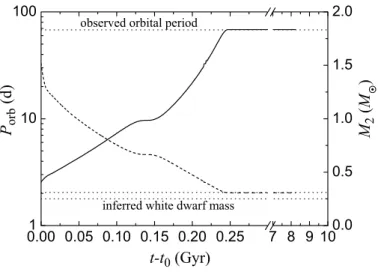
Fig. 1.Evolution of the orbital period (solid curve) and the donor star mass (dashed curve) vs. evolutive timescale for LMXB. LMXB has a donor star with an initial mass of 1.5Mand an initial orbital period of 2.57 d. Horizontal dotted lines on the bottom of the figure correspond to the observed mass of WD with its error, and horizontal dotted line on the top of the figure represents the observed orbital period.
time-dependent diffusion is based on the multicomponent gas treatment presented by Burgers (1969), for element diffusion scheme we considered the following nuclear species1H,3He, 4He,12C,14N, and 16O. Abundance changes are computed ac-cording to element diffusion and then to nuclear reactions and convective mixing.
In this work, we have computed the complete evolution of seven remnants arisen from binary systems as soon as the trans-fer of mass has ceased. The masses of these seven pre-WDs are listed in Table 1 (M2,f). The evolution of these WDs is continued until they arrive at a luminosity of Log(L/L)≈ −4.8.
3. Results
To study the characteristics of the progenitor of PSR J1713+0747, we calculated evolutionary sequences of many LMXBs. We consider both the angular momentum loss mechanisms described in Sect. 2.1, adopting the induced magnetic braking model (Eq. (4)) for the donor stars with mass less than 1.5 M. Some initial input parameters were set as follows, the neutron star has a canonical mass ofM1,i=1.4M,
the mass of the donor star M2,i is in the range of 1.0−2.0 M (with a solar metallicity ofZ=0.02), the duty cycle f =0.01.
The characteristic age of PSR J1713+0747 estimated by Splaver et al. (2005) isτPSR ≈8 Gyr. This implies that the WD has a cooling timescaleτcool of approximately 8 Gyr since the end of the mass transfer episode. Based on different initial or-bital periodPorb,i, we stop the binary evolution calculation when
the binary becomes a detached system and the donor star evolve into a WD. Subsequently, a WD evolutionary code (LPCODE) is applied to the donor star. If the final donor star mass is in the range of 0.25 to 0.31M, and the orbital period of the binary is approximately of 67.8 d, the corresponding binary was assumed to be the progenitor candidate of PSR J1713+0747.
Firstly, we calculated the evolutionary sequences of an LMXB with M2,i = 1.5 M and Porb,i = 2.57 d. In Figs. 1 and 2 we plot the evolution of orbital period and donor star mass, and the mass transfer rate and the neutron star mass, re-spectively. In the early phase, the orbital period decrease to be
Fig. 2.Evolution of the mass transfer rate (solid curve) and the neu-tron star mass (dashed curve) with the evolutive timescale for the same LMXB of Fig.1. The dotted curve represents the critical mass transfer rate, under which the disk accretion is unstable. The mass transfer rate has been slightly smoothed for clarity.
approximately 2.56 d due to magnetic braking even if there is no mass exchange. With nuclear evolution, the donor star fills its Roche lobe when its age is 2.54 Gyr. WhenM2 =0.66M, andPorb=9.66 d, the binary system detaches and mass transfer ceases about 4.9 Myr. This detached phase also is found in other studies for the evolution of LMXBs (Tauris & Savonije 1999;
Han et al. (2000); Podsiadlowski et al. 2002). After the tempo-rary shrinkage, the donor star fills its Roche lobe again and climbs the giant branch. When the age is 2.79 Gyr, the second Roche lobe overflow (RLOF) episode terminates. Hereafter, the donor star evolves to a helium WD and cools. The evolution end point is a binary pulsar with an orbital period of 68.3 d. The binary consists of an He-core WD of 0.3070Mand a neu-tron star of 1.5184M. Because the material is transferred from the more massive donor star to the less massive neutron star, the mass transfer proceeds initially on short thermal timescale about 10 Myr. In this phase, the mass transfer rate is in a range of 10−7 to 10−8 M
yr−1, and the LMXB is a short-lived
per-sistent X-ray source. Subsequently, the mass transfer occurs on a much longer nuclear timescale of 0.25 Gyr, with a rate of 10−9 or 10−8 Myr−1. This rate is always less than the critical mass transfer rate. Therefore, the progenitor of PSR J1713+0747 should be a transient X-ray source about 95% of all its life.
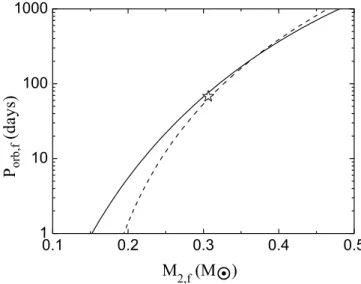
In Fig.3, we plot the evolutionary path of the donor star in the Hertzsprung-Russell diagram (HRD). After the donor star evolves into a pre-WD, a hydrogen thermonuclear flash oc-curs. During this stage the element diffusion is a key physical ingredient in obtaining a thin hydrogen envelope. We stress that thermonuclear flashes also occur in the absence of element diff u-sion, but in this case the residual hydrogen envelope is thick, ac-cording toBenvenuto & De Vito (2004)andPanei et al. (2007). Figure 4 presents theoretical predicted relation between Porb,f andM2,f for binary radio pulsars. It is clear that our simulation result is consistent with the theoretical prediction.
To investigate the distribution of the initial donor star mass and orbital period for the progenitor system of PSR J1713+0747, we calculated the evolution of a large amount of LMXBs for different initial input parameters. Table1summarizes the calcu-lated results. Assuming that the cooling timescale of the WD is τcool = 8 Gyr, as seen in Table1 makes it clear that the donor star with an initial mass ofM2,i = 1.0−1.2 M would require
Fig. 3.Calculated evolutionary tracks in H – R diagram for the donor star with an initial mass of 1.5M. The open triangle, solid triangle, and open star indicate the beginning of RLOF, the end of the last episode of RLOF and the present situation of the donor star, respectively.
Fig. 4.Theoretical predicted relation betweenPorb,fandM2,ffor binary radio pulsars. The solid curves and dashed curves correspond to the relations obtained by Rappaport et al. (1995) and Tauris & Savonije (1999). The open star sign represents our simulation result.
times in excess of the Hubble time in order to evolve into a dim WD like the one observed in PSR J1713+0747. Therefore, PSR J1713+0747 may originated from an LMXB with a donor star ofM2,i =1.3−1.6 Mand an initial orbital period ofPorb,i = 2.40−4.15 d. Thus with an age of τcool = 8 Gyr, we obtain WD effective temperatures in the range of∼3870−4120 K, ap-proximately in agreement with the observational datum 3700 ± 100 K given byLundgren et al. (1996),Benvenuto et al. (2006)
derived a value of 4320±180 K and 4250±250 K determined bySchönberner et al. (2000). In addition, the luminosity of the WD was determined to be −4.171 ≤ Log(L/L) ≤ −4.047. Apparently, the final effective temperature of the WD in our cal-culations is sensitive to its cooling timescale, and a long cool-ing timescale can result in a low effective temperature. On the basis of these models with real history, we estimated the range
Table 1.Calculated results for different initial input parameters.
No. M2,i Porb,i t0 tf tf−t0 M2,f M1,f Porb,f tp,8 LogL8 Teff,8 Logg8 (M) (days) (Gyr) (Gyr) (Gyr) (M) (M) (days) (Gyr) (L) (K) (cm s−2) 1 1.0 5.65 12.48 12.68 0.20 0.3058 1.4211 66.7 20.68 –4.0318 4152 7.3810 2 1.1 5.09 8.74 8.95 0.21 0.3069 1.4220 68.8 16.95 –4.1054 3999 7.3909 3 1.2 4.48 6.12 6.34 0.22 0.3063 1.4247 67.6 14.34 –4.1349 3937 7.3925 4 1.3 4.15 4.70 4.92 0.22 0.3067 1.4260 68.1 12.92 –4.1114 3985 7.3905 5 1.4 3.70 3.30 3.54 0.24 0.3068 1.4964 68.0 11.54 –4.1707 3872 7.4001 6 1.5 2.57 2.54 2.79 0.25 0.3070 1.5184 68.3 10.79 –4.0471 4122 7.3856 7 1.6 2.40 1.96 2.20 0.24 0.3068 1.5383 67.5 10.20 –4.1682 3880 7.4010
Notes.The meaning of the columns are presented as follows.M2,i: initial mass of the donor star;Porb,i: initial orbital period;t0: age when Roche
lobe overflow begins;tf: age when the main Roche lobe overflow ends;tf−t0: mass transfer timescale; M2,f: mass of the WD;M1,f: mass of
the neutron star;Porb,f: final orbital period;tp,8, LogL8,Teff,8 and Logg8 : age, luminosity, effective temperature and gravity whenτco =8 Gyr, respectively.
of surface gravity for the WD in 7.386≤Log(g)≤7.401 (gin units of g cm−2). Detailed tabulations of our WD evolutionary se-quences are available athttp://www.fcaglp.unlp.edu.ar/ ~panei/papers.html.
Although the final mass of the neutron star (see Nos. 6 and 7 in Table 1) is slightly higher than the one derived by Splaver et al. 2005, it is still in the allowed mass inter-val by theoretical orbital period - WD mass relation (M1 = 1.53+0.08
−0.06 M). Though adopting various scenarios, our re-sults are approximately consistent with the ones derived by
Benvenuto et al. (2006).
4. Summary and discussion
In this paper, we attempt to carefully study the evolution his-tory and the progenitor characteristics of PSR J1713+0747. Based on Eggleton’s stellar evolution code, we calculated the evolutionary sequences of a number of LMXBs to fit the ob-served data (M1,M2, and Porb) of PSR J1713+0747. For the WD regime we employed the stellar evolution code LPCODE
(Althaus et al. 2005).
In calculations, angular momentum loss via magnetic brak-ing is included if the mass of the donor star is less than 1.5M. The observations show that PSR J1713+0747 has only accreted less than 0.1Mfrom the donor star during evolution. Unstable mass transfer due to the thermal and viscous instability of the accretion disk may be responsible for the extensive mass loss2.
Therefore, LMXBs may be transient X-ray sources for most of their life. If we adopt a duty cycle of 0.01, the progenitor of PSR J1713+0747 can be constrained to be an LMXB with an initial donor star of 1.3−1.6 M(Z = 0.02) and an initial or-bital period of 2.40−4.15 d. Adopting a cooling timescale of 8 Gyr for the WD, our calculations show that at present its eff ec-tive temperature is between 3870 and 4120 K. Compared with the results derived byBenvenuto et al. (2006), forZ =0.02, the cooling timescale of the WD in our model is close to the spin-down age of the pulsar3. We obtained absolute magnitudes of MV ≈ 15.7±0.4 and MI ≈ 13.8±0.3 in theV andI bands,
and inferred effective temperatures Teff ≈ 3301–4169 K and Teff ≈ 3946–4694 K. Detailed tabulations of our WD
evolu-tionary sequences are available athttp://www.fcaglp.unlp. edu.ar/~panei/papers.html.
2 Certainly, the propeller effect of the pulsar cannot be excluded (Illarionov & Sunyaev 1975).
3 Benvenuto et al. (2006)propose that the WD needs 10.8±2 Gyr to cool whenZ=0.02.
Our accretion disk instability model successfully reproduces the orbital period and the mass of the WD. However, the ef-fective temperature of the WD is slightly higher than obser-vations, although we consider gravitational settling and chem-ical and thermal diffusion during the evolution of the WD (Panei et al. 2007). EmployingHubble Space Telescope(HST),
Lundgren et al. (1996) performed optical observations for the WD companion of PSR J1713+0747. Adopting the tempera-ture calibration of (V−I) colour given byMonet et al. (1992), they presented the effective temperature of the WD is Teff = 3700 ± 100 K. Assuming a blackbody spectrum, Hansen & Phinney (1998) fitted the HST data, and obtained Teff = 3430±270 K. A long cooling timescale of the WD may be responsible for the discrepancy between our evolution results and the inferred value of observations. In this work we takeτco=8 Gyr (Splaver et al. 2005). However, it is very rough to estimate the spin-down age of the pulsar fromτPSR = P/2 ˙P, wherePand ˙Pare the spin period and the period derivative of the pulsar, respectively4. We expect that further spectroscopic
and photometric observations can help us understand the evolu-tionary track of PSR J1713+0747.
As an alternative evolution channel, millisecond pulsars may also be formed by accretion-induced collapse (AIC) when the mass of the accreting ONe WD exceeds the Chandrasekhar mass of 1.4 M (Nomoto 1984, Nomoto 1986). Statistical analysis shows that the birthrate of LMXBs is 1–2 orders of magnitude lower than that of millisecond pulsars (Cote & Pylyser 1989,
Lorimer 1995). The AIC channel was raised to interpret this birthrate discrepancy (Bailyn & Grindlay 1990). Based on a sce-nario including both the AIC of an accreting WD and unstable disk accretion,Xu & Li (2009)propose that GRO J1744-28 may be evolved from a WD binary. Recently, the estimated birthrates of millisecond pulsars show that the often neglected AIC channel cannot be ignored (Hurley et al. 2010). Therefore, the formation possibility of PSR J1713+0747 via the AIC of a massive WD cannot be ruled out. We plan to explore the AIC channel for the formation and evolution of PSR J1713+0747.
Of course, there are many uncertainties in our input physics. Firstly, the orbital angular momentum loss plays a vital role in the evolution of LMXBs. Some mechanism of extracting an-gular momentum possibly exists besides magnetic braking and
4 The standard spin-down age of the pulsar is τ
PSR = (n−P1) ˙P[1 − (P0/P)n−1], whereP0 is the initial period andnthe braking index of the pulsar. WhenP0 Pandn=3,τPSR = P/2 ˙P. However, the de-rived braking indice of several young radio pulsars are all less than 3 (Xu & Qiao 2001;Chen & Li 2006).
mass loss due to the accretion disk instability. For example, the propeller effect of the neutron star may carry away the specific orbital angular momentum at the magnetosphere of the neutron star (Illarionov & Sunyaev 1975). In addition, a circumbinary disk around LMXBs may also extract orbital angular momen-tum efficiently from the binary system (Spruit & Taam 2001;
Taam & Spruit 2001). Secondly, our results strongly depend on duty cycles, which are poorly known. In this work, we take a constant duty cycle. However, duty cycles may change from one system to another (Lasota 2001), and change with the orbital period and the mass transfer rate. Finally, a gamma-ray flux caused by the interaction of the magnetic field of the neutron star with the accretion disk may drive a wind from the donor star by heating its outer layers; i.e., the donor star may be evaporated (van den Heuvel & van Paradijs 1988; Klu´ziniak et al. 1988;
Ruderman et al. 1989a;Ruderman et al. 1989b).
Acknowledgements. We are grateful to the referee, Christopher A. Tout, for his constructive suggestions for improving this manuscript. We also thank Zhan-Wen Han and Xue-Fei Chen for their helpful discussions, and thank Stephen Justham for his help in improving the English of this manuscript. This work has been supported in part by the National Natural Science Foundation of China (Grant No 10873011), Program for Science & Technology Innovation Talents in Universities of Henan Province, and Innovation Scientists and Technicians Troop Construction Projects of Henan Province, China. We acknowledge the Facultad de Ciencias Astronómicas y Geofísicas (UNLP), Instituto de Astrofísica de La Plata (CCT La Plata, CONICET-UNLP) and Lic. H. Viturro for his technical support.
References
Alexander, D. R., & Ferguson, J. W. 1994, ApJ, 437, 879
Alpar, M. A., Cheng, A. F., Ruderman, M. A., & Shaham, J. 1982, Nature, 300, 728
Althaus, L. G., Serenelli, A. M., Panei, J. A., et al. 2005, A&A, 435, 631 Andronov, N., Pinsonneault, M., & Sills, A. 2003, ApJ, 582, 358 Bailyn C. D., & Grindlay J. E. 1990, ApJ, 353, 159
Benvenuto, O. G., & De Vito, M. A. 2004, MNRAS, 352, 249
Benvenuto, O. G., Rohrmann, R. D., & De Vito, M. A. 2006, MNRAS, 366, 1520
Bhattacharya, D., & van den Heuvel, E. P. J. 1991, Phys. Rep., 203, 1 Burgers, J. M. 1969, Flow Equations for Composite Gases (New York: Academic
Press)
Camilo, F., Foster, R. S., & Wolszczan, A. 1994, ApJ, 437, L39
Caughlan, G. R., & Fowler, W. A. 1988, Atomic Data and Nuclear Data Tables, 40, 284
Chen, W.-C., & Li, X.-D. 2006, A&A, 450, L1
Chen, W.-C., Li, X.-D., & Wang, Z.-R. 2006, PASJ, 58, 153 Cote J., & Pylyser, E. H. P. 1989, A&A, 218, 131
Dervi¸soˇglu, A., Tout, C. A., & Ibanoˇglu, C. 2010, MNRAS, 406, 1071 Dubus, G., Lasota, J.-P., Hameury, J.-M., & Charles, P. 1999, MNRAS, 303, 139 Eggleton, P. P. 1971, MNRAS, 151, 351
Eggleton, P. P. 1972, MNRAS, 156, 361 Eggleton, P. P. 1983, ApJ, 268, 368
Foster, R. S., Wolszczan, A., & Camilo F. 1993, ApJ, 410, L91
Giacconi, R., Gursky, H., Paolini, F. R., & Rossi, B. B. 1962, Phys. Rev. Lett., 9, 439
Han, Z., Podsiadlowski, Ph., & Eggleton, P. P. 1994, MNRAS, 270, 121 Han, Z., Tout, C. A., & Eggleton, P. P. 2000, MNRAS, 319, 215 Hansen, B. M. S., & Phinney, E. S. 1998, MNRAS, 294, 569
Hurley J. R., Tout C. A., Wickramasinghe, D. T., Ferrario, L., & Kiel, P. D. 2010, MNRAS, 402, 1437
Iglesias, C. A., & Rogers, F. J. 1996, ApJ, 464, 943 Illarionov, A. F., & Sunyaev, R. A. 1975, A&A, 39, 185
Itoh, N., Mutoh, H., Hikita, A., & Kohyama, Y. 1992, ApJ, 395, 622; Erratum: 1993, ApJ, 404, 418
Kalogera, V. 1999, ApJ, 521, 723
Kim, Y.-C., & Demarque, P. 1996, ApJ, 457, 340
King, A. R., Frank, J., Kolb, U., & Titter, H. 1997, ApJ, 484, 844 King, A. R., Rolfe, D. J., & Schenker, K. 2003, MNRAS, 341, L35
Klu´ziniak, W., Ruderman, M., Shaham, J., & Tavani, M. 1988, Nature, 334, 225 Krishnamurthi, A., Pinsonneault, M. H., Barnes, S., & Sofia, S. 1997, ApJ, 480,
303
Lasota, J.-P. 2001, NewAR, 45, 449
Lundgren, S. C., Foster, R. S., & Camilo, F. 1996, in Pulsars: Problems and Progress (San Francisco), ASP Conf. Ser. 105, IAU Colloq., 160, 497 Lorimer, D. R. 1995, MNRAS, 274, 300
Magni, G., & Mazzitelli, I. 1979, A&A, 72, 134 Mestel, L., & Spruit, H. C. 1987, MNRAS, 226, 57
Monet, D. G., Dahn, C. C., Vrba, F. J., et al. 1992, AJ, 103, 638
Nomoto, K. 1984, in Problems of Colalpse and Numerical Relativity, ed. D. Bancel, & M. Sifnore (Dordrecht: Reidel), 89
Nomoto K. 1986, in Accretion Processes in Astrophysics, ed. J. Audouze, J. Tran Thanh Van (Gif-sur-Yvette: Éditions Frontières), 137
Novikov, I. D., & Zel’Dovitch, Y. B. 1966, Nuova Cimento Sup., 4, 810 Panei, J. A., Althaus, L. G., Chen, X., & Han, Z. 2007, MNRAS, 382, 779 Pfahl, E., Rappaport, S., & Podsiadlowski, Ph. 2002, ApJ, 573, 283 Podsiadlowski, Ph., Rappaport, S., & Pfahl, E. D. 2002, ApJ, 565, 1107 Pols, O., Tout, C. A., Eggleton, P. P., & Han, Z. 1995, MNRAS, 274, 964 Pringle, J. E. 1981, ARA&A, 19, 137
Queloz, D., Allain, S., Mermilliod, J. C., Bouvier, J., & Mayor, M. 1998, A&A, 335, 183
Rappaport, S., Verbunt, F., & Joss, P. C. 1983, ApJ, 275, 713
Rappaport, S., Podsiadlowski, Ph., Joss, P. C., Di Stefano, R., & Han, Z. 1995, MNRAS, 273, 731
Ruderman, M., Shaham, J., & Tavani, M. 1989a, ApJ, 336, 507
Ruderman, M., Shaham, J., Tavani, M., & Fichler, D. 1989b, ApJ, 343, 292 Rogers, F. J., & Iglesias, C. A. 1992, ApJS, 79, 507
Schönberner, D., Driebe, T., & Blöcker, T. 2000, A&A, 356, 929 Shklovskii, I. 1967, ApJ, 148, L1
Sills, A., Pinsonneault, M. H., & Terndrup, D. M. 2000, ApJ, 534, 335 Splaver, E. M., Nice, D. J., Stairs, I. H., et al. 2005, ApJ, 620, 405 Spruit, H. C., & Taam, R. E. 2001, ApJ, 548, 900
Stairs, I. H. 2004, Science, 304, 547
Taam, R. E., & Spruit, H. C. 2001, ApJ, 561, 329 Tauris, T. M., & Savonije, G. J. 1999, A&A, 350, 928
van den Heuvel, E. P. J., & van Paradijs, J. 1988, Nature, 334, 227 van Paradijs, J. 1996, ApJ, 464, L139
Verbunt, F., & Zwaan, C. 1981, A&A, 100, L7 Weber, E. J., & Davis, L. 1967, ApJ, 148, 217 Wijnards, R., & van der Klis, M. 1998, Nature, 394, 344 Xu, R. X., & Qiao, G. J. 2001, ApJ, 561, L85
Xu, X. -J., & Li, X. -D. 2009, A&A, 495, 243