Tiago José Martins Oliveira
January 2017
UMinho|2017
Clinical Decision Support:
Knowledge Representation
and Uncertainty Management
Tiago José Martins Oliveira
Clinical Decision Suppor
t: Knowledge
R
epresent
ation and Uncer
tainty Management
Governo da República Portuguesa
Thesis supervised by
Professor Paulo Jorge Freitas de Oliveira Novais
Professor José Carlos Ferreira Maia Neves
Tiago José Martins Oliveira
January 2017
Clinical Decision Support:
Knowledge Representation
and Uncertainty Management
Doctoral Thesis
“Look up at the stars and not down at your feet. Try to make sense of what you see, and wonder about what makes the universe exist. Be curious.”
- Stephen Hawking (2012) This doctoral thesis was the product of many contributions provided by important people that crossed my path and left their mark in a positive, unforgettable way. This is a big thank you to you all for pushing me to look up at the stars.
Professor Paulo Novais, whom I now call my friend, opened up a new world to me and, for that, I will forever be in his debt. Professor Paulo always offered the guidance I needed, at the professional and personal levels, and gave me the opportunity to work with him at the Intelligent Systems Lab, which was an immense pleasure and an experience that shaped the person I am today.
To Professor Jos´e Neves, who always pushed me to do my best, to improve, to be better, I address my gratitude. His experience and advice helped me pursue my goals and, for that, I cannot express how grateful I am.
I would also like to thank Professor C´esar Analide who was always there throughout my stay at the Intelligent Systems Lab with great advice and a friendly word.
Professor Ken Satoh gave me the opportunity to work up close with him and fulfil the lifelong dream of travelling to Japan. I will always treasure the moments I spent at the National Institute of Informatics (NII) and all the (many) things he has taught me.
My thanks to Professor Vicente Juli´an for welcoming me at the Grupo de Tecnolog´ıa Inform´atica - Inteligencia Artificial (GTI-IA), at Valencia University of Technology (UPV). I am very grateful to all the members of the lab.
My sincere thanks to the MD Pedro Le˜ao, who kindly helped me to understand the domain and was always available to answer my questions.
A special word of gratitude to my friends from the Intelligent Systems Lab: ˆAngelo Costa, Davide Carneiro, Marco Gomes, F´abio Silva, Jo˜ao Ramos, Andr´e Pimenta, Ant ´onio Silva, Filipa Ferraz, Dalila Dur˜aes, and Ana Silva. I am very happy to have met you and to have collaborated with you.
I would like to dedicate this thesis and all the effort behind it, all the the time spent, and all the emotional roller-coaster brought about in its completion to my family and friends. My parents, my grandparents, and my friends mean the world to me and they always support me in whatever I set my mind to do. Thank you for being there for me.
FCT - Fundac¸˜ao para a Ciˆencia e a Tecnologia (Portuguese Foundation for Science and Technology) with the reference SFRH/BD/85291/2012.
Decision-making in clinical practice is faced with many challenges due to the inherent risks of being a health care professional. From medical error to undesired variations in clinical practice, the mitigation of these issues seems to be tightly connected to the adherence to Clinical Practice Guidelines as evidence-based recommendations
The deployment of Clinical Practice Guidelines in computational systems for clinical decision support has the potential to positively impact health care. However, current ap-proaches to Computer-Interpretable Guidelines evidence a set of issues that leave them wanting. These issues are related with the lack of expressiveness of their underlying mod-els, the complexity of knowledge acquisition with their tools, the absence of support to the clinical decision making process, and the style of communication of Clinical Decision Support Systems implementing Computer-Interpretable Guidelines. Such issues pose as obstacles that prevent these systems from showing properties like modularity, flexibility, adaptability, and interactivity. All these properties reflect the concept ofliving guidelines.
The purpose of this doctoral thesis is, thus, to provide a framework that enables the expression of these properties.
The modularity property is conferred by the ontological definition of Computer-Interpre-table Guidelines and the assistance in guideline acquisition provided by an editing tool, allowing for the management of multiple knowledge patterns that can be reused. Flexibility is provided by the representation primitives defined in the ontology, meaning that the model is adjustable to guidelines from different categories and specialities.
On to adaptability, this property is conferred by mechanisms of Speculative Computation, which allow the Decision Support System to not only reason with incomplete information but to adapt to changes of state, such as suddenly knowing the missing information.
The solution proposed for interactivity consists in embedding Computer-Interpretable Guideline advice directly into the daily life of health care professionals and provide a set of reminders and notifications that help them to keep track of their tasks and responsibilities.
All these solutions make the CompGuide framework for the expression of Clinical De-cision Support Systems based on Computer-Interpretable Guidelines.
A tomada de decis˜ao na pr´atica cl´ınica enfrenta in ´umeros desafios devido aos riscos iner-entes a ser um profissional de sa ´ude. Desde o erro m´edico at´e `as variac¸ ˜oes indesejadas da pr´atica cl´ınica, a atenuac¸˜ao destes problemas parece estar intimamente ligada `a ades˜ao a Protocolos Cl´ınicos, uma vez que estes s˜ao recomendac¸ ˜oes baseadas na evidˆencia.
A operacionalizac¸˜ao de Protocolos Cl´ınicos em sistemas computacionais para apoio `a decis˜ao cl´ınica apresenta o potencial de ter um impacto positivo nos cuidados de sa ´ude. Contudo, as abordagens atuais a Protocolos Cl´ınicos Interpret´aveis por M´aquinas eviden-ciam um conjunto de problemas que as deixa a desejar. Estes problemas est˜ao relacionados com a falta de expressividade dos modelos que lhes est˜ao subjacentes, a complexidade da aquisic¸˜ao de conhecimento utilizando as suas ferramentas, a ausˆencia de suporte ao pro-cesso de decis˜ao cl´ınica e o estilo de comunicac¸˜ao dos Sistemas de Apoio `a Decis˜ao Cl´ınica que implementam Protocolos Cl´ınicos Interpret´aveis por M´aquinas. Tais problemas con-stituem obst´aculos que impedem estes sistemas de apresentarem propriedades como mod-ularidade, flexibilidade, adaptabilidade e interatividade. Todas estas propriedades refletem o conceito deliving guidelines.
O prop ´osito desta tese de doutoramento ´e, portanto, o de fornecer uma estrutura que possibilite a express˜ao destas propriedades.
A modularidade ´e conferida pela definic¸˜ao ontol ´ogica dos Protocolos Cl´ınicos Inter-pret´aveis por M´aquinas e pela assistˆencia na aquisic¸˜ao de protocolos fornecida por uma ferramenta de edic¸˜ao, permitindo assim a gest˜ao de m ´ultiplos padr ˜oes de conhecimento que podem ser reutilizados. A flexibilidade ´e atribu´ıda pelas primitivas de representac¸˜ao definidas na ontologia, o que significa que o modelo ´e ajust´avel a protocolos de diferentes categorias e especialidades.
Quanto `a adaptabilidade, esta ´e conferida por mecanismos de Computac¸˜ao Especulativa que permitem ao Sistema de Apoio `a Decis˜ao n˜ao s ´o raciocinar com informac¸˜ao incompleta, mas tamb´em adaptar-se a mudanc¸as de estado, como subitamente tomar conhecimento da informac¸˜ao em falta.
A soluc¸˜ao proposta para a interatividade consiste em incorporar as recomendac¸ ˜oes dos Protocolos Cl´ınicos Interpret´aveis por M´aquinas diretamente no dia a dia dos profissionais de sa ´ude e fornecer um conjunto de lembretes e notificac¸ ˜oes que os auxiliam a rastrear as suas tarefas e responsabilidades.
Todas estas soluc¸ ˜oes constituem a estrutura CompGuide para a express˜ao de Sistemas de Apoio `a Decis˜ao Cl´ınica baseados em Protocolos Cl´ınicos Interpret´aveis por M´aquinas.
Abstract vii
Resumo ix
List of Figures xiii
List of Tables xv
Acronyms 1
1 i n t r o d u c t i o n 3
1.1 Clinical Decision-Making 3
1.1.1 The Decision-Making Process 4
1.1.2 Uncertainty in Modern Health Care 7
1.2 Challenges of Clinical Practice 8
1.2.1 Medical Error 9
1.2.2 Variations in Clinical Practice 10
1.3 Clinical Decision Support Systems 11
1.3.1 Evolution 11
1.3.2 Impact 13
1.3.3 Guideline-based Clinical Decision Support Systems 13
1.4 Research Hypothesis 16
1.5 Objectives 16
1.6 Research Methodology 17
1.7 Document Guide 18
2 p u b l i c at i o n s c o m p o s i n g t h e d o c t o r a l t h e s i s 23 2.1 Development and Implementation of Clinical Guidelines:
An Artificial Intelligence Perspective 23
2.2 Representation of Clinical Practice Guideline Components in OWL 53 2.3 Assessing an Ontology for the Representation of Clinical Protocols
in Decision Support Systems 63
2.4 Decision Support Provided by a Temporally Oriented Health Care
Assistant 73
2.5 A Dynamic Default Revision Mechanism for Speculative Computation 87 2.6 A Mobile and Evolving Tool to Predict Colorectal Cancer Survivability 129
3 c o n c l u s i o n s 143
3.1 Contributions 143
3.2 Validation of the Research Hypothesis 148
3.3 Dissemination of Results 148
3.3.1 Other Publications 149
3.3.2 Participation and Organization of Events 152 xi
3.3.4 Supervision of Students 153
3.3.5 Research Stays 153
3.4 Final Remarks and Future Work Considerations 154
Figure1 Cognitive continuum model for clinical decision-making (extracted
fromMuir(2016)). 7
Figure2 Uncertainty taxonomy according to the content of its possible issues
(adapted fromHan et al.(2011)). 8
Figure3 Perception of European Union (while consisting of27countries) cit-izens of having experienced either directly or indirectly an adverse event (extracted fromEurobarometer(2010)). 10 Figure4 Main window of the CompGuide editor for the acquisition of CIGs.145
Table1 Objectives of the doctoral thesis and document sections where they
were achieved. 147
A
AI - Artificial Intelligence
AIM - Artificial Intelligence in Medicine
C
CBR - Case-based Reasoning
CDSS - Clinical Decision Support System CIG - Computer-Interpretable Guideline CPG - Clinical Practice Guideline
E
ES - Expert System
G
GLARE - GuideLine Acquisition, Representation and Execution GLIF3- Guideline Interchange Format
GTI-IA - Grupo de Tecnologia Inform´atica - Inteligencia Artificial
N
NII - National Institute of Informatics
O
OWL - Web Ontology Language
S
SAGE - Standards-based Sharable Active Guideline Environment
T
TNM - Task Network Model
U
UPV - Valencia University of Technology
I N T R O D U C T I O N
Conducting medical practice is, in its essence, making decisions. Health care professionals (typically physicians and nurses) are constantly faced with situations in which there is the need to select one of several options and, at the same time, to predict the possible effects of the selected option on the patient. The range of clinical decisions consists of two large groups (Thompson and Dowding,2009): diagnosis and management.
Diagnosis refers to the analysis of available data to determine the pathophysiologic ex-planation for a patient’s symptoms. It is a complex process where the health care pro-fessional needs to determine which questions to ask, tests to perform, and the values of results. Thus, it is not only necessary to decide what is true about a patient but also what data is needed to decide what is true.
Management is equally demanding. The health care professional has to follow up on the patient, ensuring that his health status evolves positively or, depending on the severity of the situation, does not deteriorate any further. Therefore, it is required of him to decide when to intervene or even the need to intervene. Furthermore, he has to be constantly monitoring the patient and using therapy responses to guide the process, one a step at a time.
This Introduction Section aims to characterize clinical decision-making and refer the challenges that clinical practice is faced with. Since this is a doctoral thesis in Biomedical Engineering with a strong component in Computer Science, the focus is placed on the solutions that the last field has to offer in order to meet those challenges. As such, a brief characterization of Clinical Decision Support Systems (CDSSs) is made, with a reflection on their evolution throughout the years, impact, and identification of the main limitations of CDSSs based on Computer-Interpretable Guidelines (CIGs), which are particularly ori-ented for the provision of decision support in diverse situations. Based on the identified limitations, the hypothesis and objectives of the doctoral thesis are defined. Additionally a guide for the document is provided.
1.1 c l i n i c a l d e c i s i o n-m a k i n g
The nature of clinical decision-making is that of a process that can be fast and intuitive or well reasoned, based on heuristics and analytical evidence-based decisions. There is a balance that must be achieved between the intuition and experience of the health care professional, given the high volume of decisions to be made. An observational study
patient care decision every30 seconds, and another study, this time conducted byWatson (1994) in the United Kingdom, determined that nurses made18decisions every20minutes for a period of two hours. Of course nurses are an extreme case, given their closer and longer contact with patients. However, these are good indicators of the frequency and velocity of clinical decisions.
According to the Oxford Online Dictionary, a decision is defined as being a “conclu-sion or resolution reached after consideration”(Oxford Online Dictionary,2016). The work of
Matteson and Hawkins(1990) further characterizes a decision by stating that: it ends doubt or debate, it is based on indications or evidence, it involves a deliberate mental choice, and, finally, it includes two or more options. The actual decision is the last point of the decision-making process, after a complex series of deliberations, occurring in an environment of uncertainty (Thompson and Dowding,2009), as is the case in health care. However, rather than being just an obstacle to the decision-making process, uncertainty is a defining charac-teristic of a decision. If there were no uncertainty in the relationship between the problem and the outcome, there would not be the need for a decision in the first place, and the best solution to the problem would be immediately calculated.
1.1.1 The Decision-Making Process
Typically, the process of making a clinical decision, or any decision for that matter, follows a set of necessary steps, from gathering the necessary information to the outcome. Yet, this should not be seen as a linear process. Ideally one step should inform the other, but emerging information may cause one to jump back and forth, according to its interpretation. These steps can be framed according to numerous models used to interpret and explain the process. In terms of clinical decision-making, there are two antagonistic conceptual frameworks derived from general decision-making. They are the analytical framework and the intuitive framework (Hammond et al.,1987).
The Analytical Framework
In the analytical approach, the health care professional tries to associate the situation he is presented with to a set of guiding principles or rules. This framework is based, to an extent, on the assumptions from information processing theory, according to which the decision maker stores relevant information in his memory and problem solving occurs when he retrieves this information from both long and short-term memory (Han et al., 2007;Hunink et al.,2014). The information gained from education and experience is stored in the long-term memory, which has more capacity, and the decision maker uses the access to short-term memory information to stimulate the retrieval of long-term memories. For instance, when presented with a case, the health care professional will use his short-term memories of the patient’s signs and symptoms to retrieve, from his long-term memory, information about the signs and symptoms for the type of diagnosis he is performing.
one developed by (Carnevali et al., 1993) defines seven stages of clinical decision-making, more oriented to diagnosis. The stages are as follows:
1. Exposure to pre-encounter data;
2. Entry to the data search field and shaping the direction of data gathering; 3. Coalescing of cues into clusters;
4. Activating possible diagnostic explanations (hypotheses); 5. Hypothesis and data-directed search of the data field; 6. Testing for the correct diagnostic hypothesis;
7. Diagnosis.
In general terms, the health care professional meets the patient and starts gathering cues or data, such as signs, symptoms and patient history. Even during this interaction, the health care professional may start to identify the main cues and pieces of data. He then starts to make inferences from this information. This is when short-term and long-term memory come into play, as the health care professional starts to form clusters of data and to recognize patterns. Based on the identified patterns, the health care professional formulates a set of hypotheses that guide the collection of information. It is based on this newly acquired information that the health care professional confirms or refutes a certain hypothesis. It is from the deliberation of these cues and the evaluation of hypotheses that results a diagnosis. In this approach, reasoning is considered to be conscious, speculative and evaluative when the practitioner is solving problems.
An alternative model, still within the analytical framework was suggested by (Carroll and Johnson,1990). It outlines seven temporal stages of decision-making, namely:
1. Recognition of the situation; 2. Formulation of explanation;
3. Alternative generation of other explanations;
4. Information search to clarify choices and available evidence; 5. Judgement or choice;
6. Action; 7. Feedback.
This approach is more heavily focused on decision-making in the sense that the aim, as opposed to the previous, is to take action and obtain feedback rather than the careful deliberation that characterizes diagnosis. As such, this model is more flexible and fit for situations that require fast decisions (Bryans and McIntosh,1996;Catriona,2002).
cognition in the process of making a judgement on the basis of a few critical pieces of information. The main characteristic of pattern information is that each new case is com-pared with previous cases stored in an individual’s memory (Offredy,1998).
The Intuitive Framework
In the intuitive framework, intuition is regarded as an alternative explanation for how health care professionals make decisions. Intuition can be defined as understanding without rationale (Benner and Tanner,1987), without a clear indicator for something being the case. In the intuitive framework, intuition is crucial for clinical judgement and it is closely linked to the health care professionals’ expertise and experience. InBenner(1982), it was possible to observe that the judgement of less experienced professionals was worse than that of more experienced ones. Novice health care professionals rely more on analytical principles to guide their actions, whereas the actions of expert professionals have a component of intuition.
This intuitive aspect of decision-making may be regarded as heuristics, also referred to as rules of thumb. In Buckingham and Adams (2000), it is considered that these rules of thumb are short-cuts created to deal with large amounts of information. For instance, a health care professional may recall the usual pattern or presentation of patients with a particular condition and compare them to the current patient. It is also stated that this intuitive process may occur at an unconscious level, while the analytical process occurs at the conscious level. Therefore, the intuitive explanation lacks the staged structure that the analytical approach shows.
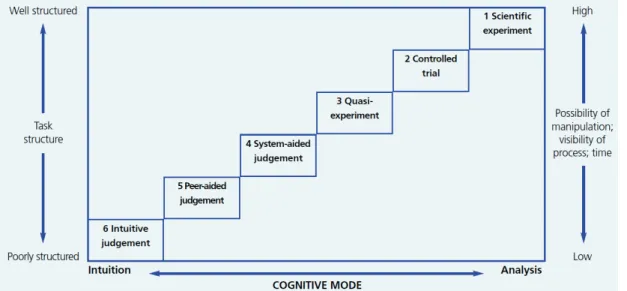
In reality, what is observed is that health care professionals use a combination of the analytical and the intuitive strategies when making a decision, which means that neither offers an exclusive explanation of how decisions are made in a clinical setting (Harbison, 2001; Catriona, 2002). An alternative explanation, provided by Hamm (1988), is the cog-nitive continuum model. The main principle of this model is that the strategy for clinical decision-making varies on a scale from intuitive to analytical, according to the structure of the task, the time available and the number of information cues. This model is depicted in Figure1. An example is that, when a task is structured as a experiment (represented as mode1in Figure1), with fewer cues, but more time, the cognitive practice is more analyt-ical and will lead to an analytanalyt-ical judgement. Otherwise, if the task is unstructured, there is little time available, with the potential of lots of cues (represented as mode6 in Figure 1), then this leads to an intuitive judgement. The intermediary modes represent situations with varying degrees of structure, available time, and number of cues.
The element of memory is undoubtedly more prevalent in the analytical framework. Past cases serve as templates for new cases, and the relationships between symptoms and health conditions that are established, namely in well conducted clinical trials, build the theoretical knowledge that health care professionals must have in order to make decisions that lead to better outcomes. Evidence-based medicine is exactly this, the explicit and judicious use of current best evidence in making decisions about the care of individual
Figure1: Cognitive continuum model for clinical decision-making (extracted fromMuir(2016)).
patients Sackett (1997). It means integrating individual clinical expertise with the best available external clinical evidence from systematic research.
1.1.2 Uncertainty in Modern Health Care
As already mentioned, the concept of uncertainty is deeply intertwined with that of de-cision. Uncertainty is not only an obstacle to the decision-making process, but also one of its defining characteristics.
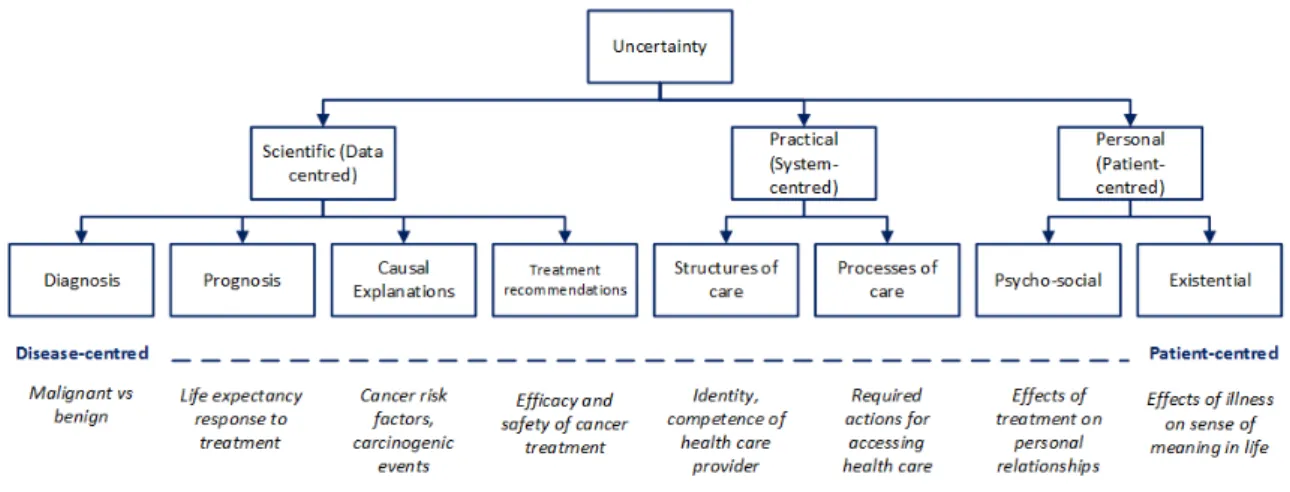
There are multiple meanings and varieties of uncertainty in health care, which are not of-ten distinguished (Lipshitz and Strauss,1997;Babrow et al.,1998;Mishel,1981). According toHan et al.(2011), uncertainty can be defined as the perception of not having knowledge about some aspect of the real world. The form it takes depends on many factors such as the source of uncertainty and how it manifests. In the same work, a comprehensive clas-sification of uncertainty based on the type of issue it raises is provided. The taxonomy diagram is shown in Figure2 along with examples in cancer treatment. Accordingly, un-certainty can be subdivided into three main categories: scientific, practical, and personal. This division is based on the type of content of the issue. Scientific uncertainty is centred on the disease, whilst practical and personal uncertainties are centred on the health care system and patient, respectively. These three main categories can be further divided into more specific ones. As shown in Figure2, scientific uncertainty encompasses uncertainties about diagnosis, prognosis, causal explanations, and treatment recommendations. Prac-tical uncertainty applies to the structures and processes of care that the patient is expected to receive from a clinician or institution, or the actions a patient has to undertake in order to receive care. As for personal uncertainty, it is related to psychological and existential issues, reflecting the impact of a disease on the patient’s psyche and social life. The non-scientific aspects of uncertainty include issues related with social integration and physician trustability.
Figure2: Uncertainty taxonomy according to the content of its possible issues (adapted fromHan
et al.(2011)).
Out of the main categories of uncertainty, the one that affects the most the health care professional’s decision-making ability is scientific uncertainty, because it is data-centred, and data is the substrate of a decision. The sources of this kind of uncertainty are related with probability, ambiguity and complexity Smithson (1999). Uncertainty derived from probability is related to the indeterminacy of future outcomes and is expressed in terms of numeric probability estimates. Although there are estimates, it is difficult to judge if they are good enough to be the basis of a decision. Ambiguity signifies the lack of reliability, credibility, or adequacy of risk estimates. Complexity captures a source of uncertainty that arises not from the indeterminacy of a phenomenon (probability) or the lack of reliability or credibility about a phenomenon (ambiguity), but from aspects of the phenomenon itself that make it difficult to understand. Another source of scientific uncertainty is incomplete information, discussed inLipshitz and Strauss (1997), described as the lack of knowledge about the correct values for the parameters of a model. Incomplete or missing information blocks completely the decision-making process, considering that data is vital for the early and intermediary stages, as seen in the description of the analytical process. This later source of uncertainty will be object of study and reflection further ahead in this thesis and, also, one of the issues addressed in the objectives.
1.2 c h a l l e n g e s o f c l i n i c a l p r a c t i c e
There is an increasing pressure on health care professionals to standardize their clinical practice in order to prevent undesired outcomes. The trust patients have in their clinicians has a vital importance in clinical interventions, as the lack of it may generate situations of practical uncertainty, related with the structure of care. It is possible to identify three situ-ations that, given their impact in health care, require special attention. They are: medical error, defensive medicine, and undesired variations in clinical practice. These situations may be, themselves, the cause or the consequence of poorly made decisions.
Errors are planned activities that fail to achieve their goal, and when such failures are not due to chance alone (Reason, 2000). In a clinical context, a medical error has been considered to be a failure of a planned action to be completed as intended (Kalra, 2004). A concept related to medical error is adverse event, which signifies injuries that result from medical management rather than the underlying disease (Kalra, 2004). Given these definitions, a medical error may or may not result in injury, i.e., it may or may not cause a preventable adverse event.
The causes for the occurrence of medical errors are related with the environment in which decisions take place (Kalra,2004). Health care is being delivered in an environment with complex interactions among many variables like the disease process itself, the medical staff and equipment, the infrastructure, organizational policies and procedures. And the processes in health care often lack a well-defined structure that allows for a tight control. Some of the key decisions are taken in split seconds, following an intuitive strategy, and are frequently based on little or no prior medical information. As such, it is to be expected that the rates of error are the highest in such challenging environments.
The frequency of adverse events in health care should not be neglected, as this is an issue in health care institutions worldwide. Vincent et al.(2001) showed that, in London hospit-als, the rate of adverse events is about 10.8% and, another study in Australian hospitals showed that this number in health care institutions of the country rises to 16.6% (Wilson
et al.,1995). According to recently published work by Makary and Daniel(2016), medical error is the third leading cause of death in the United States. European data, mostly from European Union Member States, consistently shows that medical errors and health-care related adverse events occur in8% to12% of hospitalizations (World Health Organization, 2016). A survey conducted in the European Union, showed that 26% of patients believe they have suffered an adverse event either directly or indirectly, as shown in Figure 3 (Eurobarometer,2010).
In Portugal, it is difficult to find statistics about medical error, yet there are cases that emerge and are indicative of how complex the health care environment is and that Por-tuguese health care institutions are not unaffected. In early 2016, a case in a Portuguese hospital was reported in the news (LUSA, 2016). According to the article, three patients who had surgeries to remove cancerous tumours were not properly directed to the neces-sary adjuvant therapy, which was, in this case, chemotherapy. The principles of adjuvant therapy for cancer are clearly defined in Clinical Practice Guidelines (CPGs), and chemo-therapy, except in special cases, normally follows surgical treatment. This course of action puts the patients’ well-being at risk and can have a deep negative impact in their recovery. Although what happened in this case is unclear, it is fair to consider that there was some kind of error in the management of these patients.
Thus, there is a need to provide a better support to health care professionals and make the information they need available at the time and place of care, helping them keep track of their patients and of what they need to do.
Figure3: Perception of European Union (while consisting of27countries) citizens of having
experi-enced either directly or indirectly an adverse event (extracted fromEurobarometer(2010)).
1.2.2 Variations in Clinical Practice
Variations in clinical practice occur during the decision-making process and describe situ-ations in which, presented with the same information, health care professionals take dif-ferent decisions. They can be divided into two groups: justified variations and unjustified variations (Hampton,1997).
Justified variations are those that occur due to differences in health care systems, dif-ferences in population characteristics (e.g., socio-demographical, cultural, health condition, among others) or due to preferences of the patient or health care professional, in the event that there is no scientifically valid option (Hampton, 1997). This kind of variation stems from the inherent freedom of health care professionals and is desirable, since it allows them to adapt their practice to the conditions of the environment.
Unjustified variations are those that occur when one has the above-mentioned factors controlled, for no apparent reason. They bring no benefit and are harmful for patients, contributing to the deterioration of medical practice. Although difficult to quantify with accuracy, there is evidence that gaps exist between what is known to be effective and based on the best available evidence and research, and what happens in practice. Although there are numerous references reporting this problem, there is little data about variations in clinical practice, as this is a sensible topic and one that is also difficult to study (Wennberg, 1991;Grol,2001).
The origins of these variations can be pointed out as being occupational stress, lack of accuracy in data collected from patients, and the tendency of health care processionals to follow the practice of the majority, even if it is not supported by the best evidence ( Hamp-ton, 1997). This causes difficulties in the assessment of the quality of care, considering there is no standard practice that can be linked to an outcome. Therefore, it is necessary to promote the standardization of health care, while safeguarding the freedom of judgement of health care professionals, as long as it is based on scientific evidence. One way to achieve
evidence-based clinical practice (Pearson,1998).
1.3 c l i n i c a l d e c i s i o n s u p p o r t s y s t e m s
Since the emergence of Artificial Intelligence (AI), a term first coined at a famous Darmouth College conference in1956by John McArthy (Russell et al.,2003), researchers have been try-ing to amass its computational power and direct it towards clinical decision-maktry-ing. This led to the emergence, in the1970s, of Artificial Intelligence in Medicine (AIM) (Shortliffe, 1993; Patel et al., 2016), which consists in the application of tools and techniques from the field of AI to biomedical problems. One of the tasks that AIM is most concerned with is clinical decision-making. Therefore, CDSSs became one of the flagships of AIM.
According toMusen et al.(2006), a CDSS is”any computer program designed to help health care professionals to make clinical decisions”. This definition includes any computer system that deals with clinical data or knowledge in order to provide decision support. According to their function, it is possible to classify CDSSs into:
• Tools for information management: specialized knowledge-management
worksta-tions for storing, retrieving and browsing clinical information. These tools provide the knowledge and data needed by physicians, but do not help them to apply it. They do not provide any interpretation for the data;
• Tools for focusing attention: tools that focus the users’ attention to remind them of
diagnoses or problems that can be overlooked. Examples include clinical laboratory systems that flag abnormal values;
• Tools for patient-specific recommendations: these are programs that are
custom-tailored to provide assessments or advice based on sets of patient-specific data. They can follow simple algorithms, symbolic approaches to represent knowledge and reas-oning, or models with origins in machine learning.
The separation between these types of CDSSs is not rigid. There are systems that show qualities that place them in more than one category. Nonetheless, this division is useful to showcase the different capabilities in which computer systems can support health care.
1.3.1 Evolution
One of the first approaches to CDSSs was the Leeds Abdominal Pain System, from the early 1970s, developed at the University of Leeds (De Dombal et al., 1972). The system used sensitivity, specificity, and disease-prevalence data for various signs, symptoms, and test results to calculate, using Bayes’ theorem, the probability of seven possible explanations for acute abdominal pain, namely appendicitis, diverticulitis, perforated ulcer, cholecystitis, small-bowel obstruction, pancreatitis, and nonspecific abdominal pain. The diagnoses of the system were compared with those of real life physicians, and the reports showed that,
91.8% of correct results. However, application in other settings failed to produce better or equal results. This is an example of a system that takes over the decision process and plays the role of a physician, providing also an explanation for the diagnosis and, thus, acting as an Expert System (ES).
The MYCIN system was a consultation system for the management of patients with infec-tious diseases (Shortliffe et al.,1975). The knowledge of the system consisted of production rules chained together. By removing, altering, or adding rules, the developers could re-define the knowledge base, without explicitly reprogramming or restructuring the other rules. Again, this is an ES that offers explanations about its reasoning and outputs. The dif-ferentiating factor from the previous system is that its developers believed straightforward algorithms or statistical approaches were unfit for infectious disease management.
Another early example is the HELP system, developed at the LDS Hospital in Salt Lake City (Gardner et al., 1999). It adds to a conventional medical-record system a monitoring program and a mechanism for storing decision logic in HELP sectors or logic modules. Besides allowing the consultation of information, there was an event-driven mechanism, based on specified criteria about clinical parameters, of specialized warnings, alerts, and reports. This is a classic example of a system that can be placed in the categories of tools for information management and tools for focusing attention. HELP was the first major example of the integration of decision support with other system functions in health care institutions.
These earlier approaches demonstrated that it was possible to encode medical know-ledge in machine-interpretable formats. However, they were rarely used by health care professionals and were regarded with scepticism. But, in due time this started to change, given the emergence of personal workstations, the World Wide Web, more intuitive inter-faces, and the recognition that technology may play and important role in health care. The growing distress of health care professionals with their workload and the complexity of their tasks, along with the pressure to avoid medical error and improve the quality of care, while saving costs, also contributed to this change of perspective (Musen et al., 2006). At the same time, CDSSs started to position themselves as supporting tools, rather than re-placements for health professionals, helping in the formalization ot the decision-making process, the gathering of necessary data for a decision, and the overall management of the clinical process.
This new posture led to the emergence of more recent CDSSs such as ONCOCIN, a rule-based medical expert system for oncology protocol management, developed at Stan-ford University (Shortliffe, 1986). ONCOCIN was designed to assist physicians with the treatment of cancer patients receiving chemotherapy. It was one of the first systems to model decisions and to sequence actions over time, using a customised flowchart language. Within the system, the history of past events and the duration of actions are the main focus. Another example is DXplain (Barnett et al., 1987), a CDSS that uses signs, symptoms, and laboratory data to produce a ranked list of diagnoses which might explain (or be associated with) the clinical manifestations. DXplain provides justification for why each of
useful to collect for each disease, and lists what clinical manifestations will ensue. The key word here is suggest, which reflects the new framing of CDSSs within decision support.
Now, well into the twenty first century, with the advent of machine learning techniques, deep learning, and big data, new and sophisticated AIs are being developed . The most impressive examples are arguably IBM’s Watson and Google DeepMind’s AlphaGo, both with extraordinary feats under their belt. Efforts are underway to adapt these AIs to clinical decision support (Murdoch and Detsky, 2013), particularly in Watson’s case. Recently, it was reported by the University of Tokyo that IMB Watson spotted a 60 year-old woman’s rare form of leukaemia, a diagnosis that had eluded her doctors for months (News Health Care IT,2016). The AI compared the patient’s genetic changes with a database of20million cancer research papers. The supercomputer’s diagnosis led to the right treatment for the patient.
1.3.2 Impact
When looking at systems such as DXplain (Barnett et al., 1987), it is clear what they do. They emulate the decision-making process of a health care professional in its most analyt-ical form. One of the stages of this process at which CDSSs are more helpful is the gathering of information. Given the growing amounts of data and knowledge based on which health care professionals have to make decisions, CDSSs offer platforms for the management of this volume of information.
Depending on how their knowledge base is organized, CDSSs help define the complex interactions between the variables in the health care environment. They organize informa-tion in ways that facilitate decision making. Addiinforma-tionally, CDSSs support the formulainforma-tion of hypotheses, ensuring that all possibilities are covered. They may also analyse hypotheses and rank them by a metric derived from their decision model (Musen et al.,2006).
CDSSs have been shown to influence physician behaviour by promoting the adherence to the best clinical practice and the avoidance of undesired variations (Schedlbauer et al., 2009; Scheepers-Hoeks et al., 2013). They also have a positive impact on patient safety (Bates and Gawande, 2003) and provide a rationale for diagnostic test ordering and other care processes (Bright et al., 2012), thus reducing the occurrence of medical errors and health care costs. For this, it can be considered that they offer solutions to meet the current challenges of clinical practice. However, the evidence supporting the impact of CDSSs on the outcomes of care are scarce, and there are few studies that corroborate it.
1.3.3 Guideline-based Clinical Decision Support Systems
A wide variety of techniques have been used in the design and implementation of decision models in CDSSs. They range from simple logics, such as specifically designed flowcharts for particular problems, to methods drawn from Bayesian modelling, decision analysis with utilities associated to outcomes, or artificial neural networks (Sim et al.,2001).
How-address. In order to increase the reach of a system (if that is actually the objective), its underlying decision model and knowledge base have to cover a wide range of clinical mo-ments, namely multiple situations of diagnosis and management, across different clinical categories and specialities. An ideal support for such CDSSs are CPGs.
Characteristics
Guideline-based CDSSs have CPGs as their underlying support. These documents are systematically developed statements to assist health care professionals and patients about appropriate health care in specific clinical circumstances (Miller and Kearney,2004). CPGs are developed for a wide range of clinical situations and contain advice based on the best available evidence. They are often called other names such as clinical protocols or practice policies. The potential benefits of their inclusion in CDSSs are the reduction of undesired variations in clinical practice, the improvement of outcomes, reduction of medical error, and cost containment (Woolf et al.,1999). CPGs typically represent a medical expert consensus regarding the screening, diagnosis, or management, over either limited or extended periods of time, of patients who have a particular clinical problem, need, or condition.
CIGs are the machine-readable format of CPGs for automatic interpretation in CDSSs (Ten Teije et al., 2008; Peleg, 2013). The interaction with systems that integrate these machine-interpretable formats follows the structure of a dialogue between the care pro-vider and the system. Since CPGs, and thus CIGs, are similar to algorithms with stages connected to each other and receiving information from each other, they resemble the stages of the analytical framework. CIGs define the information necessary for making a decision, elicit options for that decision, and drive the clinical process to the next step.
The development of CIGs started around the late 1980s. Since then, significant ap-proaches to CIG decision support emerged, namely Arden Syntax (Hripcsak, 1994), the Guideline Interchange Format (GLIF3) (Boxwala et al.,2004), PROforma (Fox et al.,1998), Asbru (Shahar et al., 1998), the GuideLine Acquisition, Representation and Execution (GLARE) (Bottrighi et al.,2006), and the Standards-based Sharable Active Guideline Envir-onment (SAGE) (Tu et al.,2007), possessing their own knowledge acquisition and execution tools.
Limitations
The development of CIG-based clinical decision support systems thrived throughout the 1990s and early 2000s (de Clercq et al., 2004), yielding models and supporting systems that focus on different aspects of clinical practice. The result from these fragmented ap-proaches is that there is no standard approach to CIG modelling and execution. These CIG approaches show limitations at several levels that affect, to an extent, the adoption of CIG-based CDSSs:
• Starting with their underlying models, they typically focus on one single aspect of CIGs, paying less attention than the required to the remaining aspects. Such is the
modelling of clinical recommendations, possessing knowledge primitives for only one type of situation in the clinical process, a decision, without the possibility to chain recommendations together. Or even GLIF3 (Boxwala et al., 2004), which is severely limited in terms of the representation of temporal constraints;
• Another issue is that these CIG models require the user to have proficiency in pro-gramming languages for the definition of constraints regarding clinical recommend-ations. These languages are used to express which variations in the clinical process trigger sets of recommendations. An example of this is the use of the GELLO (Sordo et al., 2003) language, developed for GLIF3. This may be a deterrent to users who do not have such proficiency from adopting a CIG system, considering that their learning curve would be long;
• The complexity of the models, with numerous proprietary specifications, is also a factor to take into account, PROforma (Fox et al., 1998) and Asbru (Shahar et al., 1998) are paradigmatic cases in this regard. The knowledge acquisition systems for CIGs, whose purpose is to enable and facilitate the encoding of CPGs in machine-interpretable formats, lack features that reduce this complexity (Isern and Moreno, 2008);
• The support to the clinical decision-making process has also been neglected. The current CIG execution systems do not provide complements to the CIG knowledge base and the decision is made with the simple matching of clinical parameters with the premisses of CIG rules (Isern and Moreno, 2008). Although CIGs are machine-interpretable versions of CPGs, they still carry some of the criticism that is directed to their textual counterparts, namely that they are strict practices that are difficult to adapt to the context. There are situations that CIG systems cannot accommodate, one of them being the problem of incomplete information in data entry points. CIG exe-cution is driven by data, and, if it is missing, the system is unable to proceed with the decision-making process and produce a recommendation. There are also tasks, such as prediction (e.g., of the evolution of patients) and classification (e.g., categorization of patients according to signs and symptoms), that CIG execution systems either can-not handle or they manage based on static and stiff models that barely reflect the context of the patients;
• The way in which CIG execution systems provide advice should also be object of reflection. The structured dialogue that these systems typically follow may be unfit for every moment of clinical practice. There is a need of methods to integrate and increase the adoption of CPGs through CIG-based CDSSs in order to prevent cases such as the medical error reported in Section1.2.1;
Addressing these limitations is the underlying motivation for this doctoral thesis and the driving factor of all the work that supports it.
Taking into account the challenges that CIG-based CDSSs face, which were pointed out in Section 1.3.3, there should be solutions that address them. The objective of any com-putational system should be to enhance the functions of the rudimentary systems that were in place before them. However, this is clearly not he case when it comes to the limitations of CIG-based CDSSs. These very same limitations can be pointed out to the paper versions of CPGs, which means that they were transported to their computational implementation. This is particularly true in the complexity of the models, since CPGs are, themselves, complex documents that are difficult to interpret. Yet, their implementation in systems for automatic reasoning did not smooth out this complexity. Additionally, the style of communication of these CIG-based CDSSs and the lack of higher-level decision-making functions (they are purely analytical without any component that could resemble some kind of intuition) makes the interaction with them little different than reading their document counterparts.
The point here is that there is a need to approximate CPGs to the concept of living guidelines (Seyfang et al., 2007), which conveys desirable properties for these documents such as modularity and interactivity. These properties translate into CPGs that are easier to create and modify, that have an increasing presence in a clinical setting, and are more flexible and adaptable. It is considered that the use of CIGs in CDSSs is a step forward in that direction, but, as seen, the idea is still far from being completely fulfilled.
The goal of this thesis is, thus, to answer these challenges by turning to AI techniques such as ontology specification, logic programming and machine learning, and to web tech-nologies to outline a framework for the expression of CIG-based CDSSs. Of course that there is also a social motivation underlying this work. By increasing the intervention of CPGs in a clinical setting, through the improvement of CIG-based CDSSs, one is also pro-moting the adherence to best practices and, therefore, potentially reducing medical error and undesired variations in clinical practice.
To conclude, theresearch hypothesisfor this work is formulated as follows:
The proposed framework for CIG-based CDSSs enables the expression of properties of living guidelines, namely modularity, flexibility, adaptability, and interactivity.
The same is to say that, through the application of the studied AI techniques and techno-logies, it is possible to answer the current challenges of CIG-based CDSSs.
1.5 o b j e c t i v e s
The title of this doctoral thesis is “Clinical Decision Support: Knowledge Representation and Uncertainty Management”. As such, the developed work focuses on the matters of knowledge representation in CDSSs, reasoning with this knowledge, and the underlying decision-making process. Given the exposition about CDSSs, the limitations of CIG sys-tems, and the research hypothesis formulated for this thesis, the main goal of the work
increase their flexibility and adaptability, so that they can become more modular and in-teractive. The term flexibility is used here to convey the ease with which the knowledge in the system is moulded to accommodate new domains. As for adaptability, it refers to the capacity of the execution system to adapt to situations of uncertainty, namely that of scientific uncertainty.
This main goal was approached in terms of the following objectives:
1. Identification and characterization of the main requirements and necessities of CIG systems;
2. Identification and analysis of techniques and models stemming from AI and web tech-nologies that can provide the capacities to CIG systems to overcome their challenges. 3. Formalization of a comprehensive CIG representation, fit for multiple medical
do-mains and situations in the clinical process;
4. Development of a library of guideline items with re-usable knowledge patterns that facilitates the encoding of CPGs in a CIG format;
5. Definition of an architecture for the agile deployment of a CIG-based CDSS;
6. Suggestion of a method to achieve a higher integration of CIG recommendations in clinical practice;
7. Development of a mechanism to manage data-centred uncertainty, namely incom-plete information, in the decision points of CIGs;
8. Exploration of dynamic models, for prediction and classification, that offer a comple-ment to CIG recommendations.
Following the enumeration of relevant aspects of CIG-based systems proposed byde Clercq et al.(2004), namely guideline acquisition, guideline verification and testing, and guideline execution, this work focuses on the aspects of acquisition and execution, with the addition of decision-making, from the point of view of the availability of the information.
1.6 r e s e a r c h m e t h o d o l o g y
In order to develop this doctoral thesis, the Action Research methodology (O’Brien,1998) was employed. It is a holistic approach to problem-solving, based on continuous devel-opment, and directed to problem-solving. What distinguishes this approach from normal, everyday problem-solving is the emphasis it puts on scientific study. The researcher system-atically studies the problem and his interventions are backed by theoretical considerations. The process starts with a research hypothesis, based on a thorough review of the state of the art, in this case of CIG-based CDSSs. From this step results a report of available resources and features. In the context of this thesis, and faced with what was exposed
hypothesis, a set of objectives is established. They pave the way to proving or refuting the research hypothesis. Accordingly, the objectives for the thesis are outlined in Section1.5. Since they can be grouped into three different aspects of CIGs, namely CIG acquisition, CIG execution, and CIG decision-making, the set of steps defined by Action Research were applied to each one of these aspects separately. There are, in total, six steps modelled in Action Research. They are the following:
1. Definition of the problem and issues: this step states the problem and investigates
what originates it, gathering all its features and formulating a hypothesis;
2. Constant update of the state of the art: the review of the state of the art studies
the features of all the projects related to the current research. The update of this component allows for the adjustment of objectives and the pursuit of new solutions;
3. Design of a solution: the information gathered in the previous steps enables the
design of a solution that fulfils the specified objectives, which, in turn, will allow to prove or refute the research hypothesis;
4. Implementation and experimentation through prototypes: formalization of a
pro-totype that contains all the features specified in the solution. Its behaviour is then observed in order to ascertain its efficacy;
5. Analysis, validation and conclusion: this step consists in the analysis and
valida-tion of the prototype. This is done by checking if the implementavalida-tion achieves the objectives, which leads to conclusions regarding the research hypothesis;
6. Dissemination of results in the scientific community: dissemination of research
results in peer-reviewed journals, conferences, workshops, among others.
Based on this last step of Action Research and the logical sequence of publications that resulted from the developed work, it was decided that the presentation of this thesis would follow the scheme of publication compilation.
1.7 d o c u m e n t g u i d e
This section aims to be a guide for helping readers to easily find the right content in this thesis and, also, to understand some aspects related with the structure of the document.
This thesis is presented under the scheme of publication compilation and, therefore, some requirements have to be met in order to make it understandable and coherent. The first content to be provided is a summary of the presented doctoral thesis, both in English and Portuguese. This is followed by the necessary Table of Contents, List of Figures, List of Tables, and Acronyms.
The thesis can be divided into three main blocks: Introduction (Chapter1), Publications Composing the Doctoral Thesis (Chapter 2), and Conclusions (Chapter3). At the end of the thesis, the Bibliography used in the Introduction and Conclusions is presented.
each one is presented, with more focus on Chapter 2, which contains the compilation of publications. The description is as follows.
Chapter1: Introduction
This chapter introduces the thesis with the exposition of concepts that are relevant to the understanding of its scope and purpose. The topics covered by the chapter include clinical decision-making, uncertainty in health care, the current challenges of clinical practice, and CDSSs. On this last topic, a special attention is given to the characterization of CIG-based CDSSs and their limitations.
Based on these limitations and the challenges they present, the research hypothesis and the objectives for the thesis are defined. Following this, the research methodology is out-lined. The section ends with a document guide describing the structure and contents of the thesis.
Chapter2: Publications Composing the Doctoral Thesis
This section contains the publications selected to integrate the doctoral thesis. It consists of six sections, each one representing a different scientific publication. At the beginning of each section there is a table with relevant information about the featured publication.
Section 2.1: Development and Implementation of Clinical Guidelines: An Artificial Intelligence Perspective
The publication featured in this section characterizes CPGs and CIGs, providing defini-tions and examples. Six CIG approaches, namely Arden Syntax, GLIF3, PROforma, Asbru, GLARE and SAGE, are described in terms of their strengths and limitations in the acquis-ition and execution of CPGs. The section also covers ESs, case-based reasoning (CBR), medical ontologies, and logic programming as solutions to meet the requirements of a CIG-based CDSS. It is a review of the state of the art in the field.
Section2.2: Representation of Clinical Practice Guideline Components in OWL
This section presents the CompGuide ontology for the representation of CPGs. The pub-lication featured in the section describes the fundamentals about Web Ontology Language (OWL), and the advantages of choosing this knowledge formalism. The representation primitives of the ontology are presented with a brief example. The publication ends with an analysis of the advantages of the model in comparison with existing ones.
Systems
The publication included in this section describes an experiment conducted in order to as-sess the expressiveness of the CompGuide ontology. In it,14students were asked to repres-ent a set of CPGs according to the ontology. They were then asked to evaluate the ontology through a questionnaire regarding the expressiveness of the model for different types of content, particularly in the representation of administrative information, the construction of workflow of procedures, the definition of temporal constraints, and the definition of clinical constraints. The answers were provided in a five point Likert scale demonstrating the agreement with sets of statements. The publication ends with a critical analysis of the results.
Section2.4: Decision Support Provided by a Temporally Oriented Health Care Assistant
The publication occupying this section reports the development of a health care assistant tool for the execution of CIGs. It provides a description of the CompGuide temporal model, which is crucial for the development of the assistant. There is also a comparison of this model with other existing temporal models. Additionally, there is a description of the CompGuide system which supports all the logics behind the execution of CIGs against patient data. To demonstrate the full expressiveness of the temporal model, a case study with a guideline for colon cancer treatment is presented. To end the section, the temporally oriented functionalities of the health care assistant are described.
Section2.5: A Dynamic Default Revision Mechanism for Speculative Computation
This section is dedicated to the explanation of Speculative Computation, a theory from lo-gic programming for the management of incomplete information in decision-making steps, based on default constraints. The theory features a dynamic revision of default constraints supported by Bayesian networks built from past data about the decision problem in ques-tion. The publication provides related work in the fields of constraint logic programming and defeasible reasoning. A CIG-based CDSS is used as a case-study to showcase the speculative mechanisms and their effects.
Section2.6: A Mobile and Evolving Tool to Predict Colorectal Cancer Survivability
The publication featured in this section proposes a tool for survivability prediction of pa-tients with colorectal cancer. It provides a state of the art in the field and identifies lim-itations in existing approaches, defining the requirements that a tool performing such a task should have. The architecture of the whole prediction system is described as being service-oriented. The prediction models and an interface example are showcased. This system performs a complementary function to CIG-based CDSSs.
In the Conclusions there is a description of the contributions resulting from the thesis and of how they validate the research hypothesis. In addition, the activities undertaken for the dissemination of results are enumerated. The chapter ends with final remarks and considerations about future work.
P U B L I C AT I O N S C O M P O S I N G T H E D O C T O R A L T H E S I S
2.1 d e v e l o p m e n t a n d i m p l e m e n tat i o n o f c l i n i c a l g u i d e l i n e s: a n a r t i f i c i a l i n t e l l i g e n c e p e r s p e c t i v e
Title Development and implementation of clinical guidelines:
An artificial intelligence perspective
Authors Tiago Oliveira, Paulo Novais, and Jos´e Neves
Publication Type Journal
Publication Name Artificial Intelligence Review
Publisher Springer Netherlands
Volume 42 Number 4 Pages 999–1027 Year 2014 Month December Online ISSN 1573-7462 Print ISSN 0269-2821 URL http://link.springer.com/article/10.1007/ s10462-013-9402-2 State Published
Scimago journal rank (2014) 1.013, Artificial Intelligence (Q2), Language and Linguist-ics (Q1)
JCR impact factor (2014) 2.111, Computer Science (Q2), Artificial Intelligence (Q2)
Contribution of the doctoral candidate
The doctoral candidate, Tiago Jos´e Martins Oliveira, declares to be the main author and the major contributor of the paper Development and implementation of clinical guidelines: An artificial intelligence perspective.
DOI 10.1007/s10462-013-9402-2
Development and implementation of clinical guidelines:
An artificial intelligence perspective
Tiago Oliveira · Paulo Novais · José Neves
© Springer Science+Business Media Dordrecht 2013
Abstract Clinical practice guidelines in paper format are still the preferred form of deliv-ery of medical knowledge and recommendations to healthcare professionals. Their current support and development process have well identified limitations to which the healthcare community has been continuously searching solutions. Artificial intelligence may create the conditions and provide the tools to address many, if not all, of these limitations.. This paper presents a comprehensive and up to date review of computer-interpretable guideline approaches, namely Arden Syntax, GLIF, PROforma, Asbru, GLARE and SAGE. It also provides an assessment of how well these approaches respond to the challenges posed by paper-based guidelines and addresses topics of Artificial intelligence that could provide a solution to the shortcomings of clinical guidelines. Among the topics addressed by this paper are expert systems, case-based reasoning, medical ontologies and reasoning under uncer-tainty, with a special focus on methodologies for assessing quality of information when managing incomplete information. Finally, an analysis is made of the fundamental require-ments of a guideline model and the importance that standard terminologies and models for clinical data have in the semantic and syntactic interoperability between a guideline exe-cution engine and the software tools used in clinical settings. It is also proposed a line of research that includes the development of an ontology for clinical practice guidelines and a decision model for a guideline-based expert system that manages non-compliance with clinical guidelines and uncertainty.
Keywords Computer-interpretable guidelines·Ontologies·Decision support· Quality of information
T. Oliveira (
B
)·P. Novais·J. NevesCCTC/DI, Department of Informatics, University of Minho, Campus of Gualtar, 4710-057 Braga, Portugal
e-mail: [email protected] P. Novais e-mail: [email protected] J. Neves e-mail: [email protected]
123
1 Introduction
There is an increasing pressure in healthcare professionals to standardize their clinical practice in order to prevent undesired variations. Clinical practice guidelines (CPGs) are developed in order to achieve this purpose. In recent years there has been an explosion of interest in CPGs, with initiatives to stimulate guideline development promoted by many countries and healthcare institutions. In fact, CPGs are, currently, the best way to convey information to healthcare professionals, to ensure that their clinical practice follows the rules of medical procedures. This is a very important matter, if one takes into account the consequences that may arise from a poorly conducted clinical process. The prevalence of medical errors is significant in hospitals across the world (Brennan 2000;Kalra 2004). Putting aside the human cost, which is immeasurable, the economic cost from lawsuits and other legal issues resulting from medical error has a deep impact in the budget of healthcare institutions. However, an overzealous practice, like defensive medicine, may have equally undesired consequences (Chawla and Gunderman 2008). The prescription of exams and treatments without scientific proof or basis also has a great economic impact and may seriously undermine the confidence that patients have in their physicians. This has consequences in the mental health of patients as well. The primary objective of CPGs is to provide a scientific support to clinical procedures, thus mitigating the occurrence of these situations.
However, healthcare professionals still show some resistance towards complying with CPGs. The arguments used to justify this behavior are that guidelines stifle change and inno-vation, and restrain clinical practice, preventing healthcare professionals from adapting their practice to their social, economic and cultural contexts (Thomson et al. 1995). Guidelines evolved in order to address some of this criticism, through the development of mechanisms to smooth updating processes and to accommodate justified variations in clinical practice. Currently, we live in the age of information and, once again, CPGs should evolve to keep up with the rapid growth of scientific knowledge. Research in the field of computer-interpretable guidelines (CIGs) is booming, due to the need to deliver information to healthcare profes-sionals in a faster way and to support them in decision making.
This paper starts by providing some background information on CPGs and how they are developed. Then some artificial intelligence (AI) techniques will be addressed with the objective of determining how AI can improve the current state of the art as well as the development and the execution of CPGs. The final sections of the paper provide a general presentation of the research line that is being followed and how it integrates the conclusions extracted from the analysis made. It goes without saying that a paper format cannot be compared to a computerized guideline, as the first cannot be processed electronically. The perspective this work intends to show is how a digital format can be more advantageous and provide a new set of tools to facilitate the work of healthcare professionals.
2 Clinical practice guidelines
2.1 What are clinical practice guidelines?
CPGs are systematically developed statements to assist healthcare professionals and patients about appropriate healthcare in specific clinical circumstances (Miller and Kearney 2004). This is the most widely accepted definition of clinical guideline, provided by the Institute of Medicine, of the United States (US). There are other terms used as synonyms of CPGs such as protocols, practice policies, clinical policies, practice parameters and clinical pathways.
123
Usually, the name given to these documents is a matter of personal preference rather than a reference to a standard nomenclature and it can change across healthcare institutions and countries. Despite these differing nomenclatures, there are common objectives associated (Miller and Kearney 2004) with all of them, such as:
• Help healthcare professionals and patients in decisions about clinical procedures;
• Describe appropriate care based on scientific evidence;
• Act as the focus for quality assessment and activity improvement, including audits. CPGs are decision tools devised to shorten the distance between real clinical practice and optimal clinical practice (Mead 2000). The potential benefits from the implementation of CPGs include the reduction of morbidity and mortality, efficiency improvement and cost containment. They also provide their users with a reference by which they guide their clinical practice, and measurable criteria to assess their performance. The evidence contained in CPGs is used, at the same time, to inform healthcare professionals of the latest developments in scientific knowledge and to justify their decisions during the clinical process (Thomson 2000).
The format of these documents is not standardized and shows variations according to the organization producing the guideline and the clinical area it addresses. Since the middle of 1990s, many worldwide organizations started evidence-based CPG development programs, namely the Scottish Intercollegiate Guidelines Network (SIGN), the New Zealand Guide-lines Group (NZGG), the GuideGuide-lines Advisory Committee (GAC) in Canada, and the National Federation of Cancer Centers (FNCLCC) in France, among others (Rosenbrand et al. 2008). These organizations joined others that paved the way for guideline development like the Institute of Medicine and the Dutch Institute for Healthcare Improvement. In 2002, an inter-national effort towards the dissemination of CPGs culminated in the creation of the Guidelines International Network (G-I-N). (Ollenschläger et al. 2004). Currently, this global network comprises 92 organizations and 127 individual members, representing 48 countries, putting forth efforts in order to standardize guideline development and implementation. In recent years, some online guideline repositories started to appear, among which should be high-lighted the National Guideline Clearinghouse (NGC) of the US. NGC1 is a public resource for evidence-based CPGs and gathers guidelines from various organizations under different labels that represent their category and medical specialty.
2.2 Development of clinical practice guidelines
Each organization follows its own guideline development process. However, the different development methodologies have common phases and follow similar principles.
Initially, guidelines were only based on the consensus of groups of experts, but with the growth of evidence-based clinical practice, other techniques were included in guideline development. The Delphi and nominal group techniques are some of the methodologies that were later included in the development process and are still used today (Hutchings et al. 2006). Currently, guideline development is more focused on an extensive research of the literature and thorough analysis of empirical evidence.
The process usually starts with the choice of the guideline topic or subject, based on the problems that motivate the development (Rosenbrand et al. 2008;Rosenfeld and Shiffman 2006). CPGs can be developed to a wide range of subjects and medical areas, including health
1http://guideline.gov/index.aspx.
conditions bound to diseases and economical costs. To choose the topic, it is necessary to do a preliminary check of the available evidence in order to ascertain the validity of the theme. The composition of the work group is the following step (Rosenbrand et al. 2008; Rosen-feld and Shiffman 2006). The efficiency of the guideline highly depends of the nature of the group producing it. The work group must be multidisciplinary, in a way that includes partici-pants from all the areas affected by the topic of the guideline. Once the group is gathered, the analysis of the underlying problem, to which the guideline must provide a solution, starts. The work group must search for other guidelines concerning the topic, whose existence does not invalidate the creation of a new one as the existing ones may be outdated. The result from the analysis of the problem should be a set of key-questions that clearly identify the population being studied (the group of individuals who will be the target of the diagnosis or intervention), the type of control used and the efficiency measures that will be used to evaluate the interventions.
The objective of