Who Wants to Know? Question-asking and Answering
Practices among Facebook Users
Rebecca Gray
1College of Communication Arts
and Sciences
Michigan State University
409 CommArts Building
East Lansing, MI 48824
[email protected]
Nicole B. Ellison
2,
Cliff Lampe
4School of Information
University of Michigan
105 S. State St
Ann Arbor, MI 48109
{enicole, cacl}@umich.edu
Jessica Vitak
3College of Information Studies
University of Maryland
Room 4105 Hornbake Bldg,
South Wing
College Park, MD
[email protected]
ABSTRACTResearch has identified a link between Facebook use and bridging social capital, which speaks to the informational resources provided by a diverse network of connections. In order to explicate the mechanism through which Facebook may help individuals mobilize these embedded informational and support resources, this study explores the role of bridging social capital, question type, and relational closeness on the perceived utility and satisfaction of information obtained through questions posed to one’s network of Facebook Friends through the status update feature. Employing a mixed-method approach, we utilize survey data collected from a sample of non-academic university staff (N=666), as well as actual Facebook question examples and responses collected during a follow-up lab session from a subset of this sample (N=71). Results indicate that question-askers’ bridging social capital positively predicts the utility of responses received on SNS, while useful responses are more likely to be received from weaker ties.
Author Keywords
Social network sites; social search; Q&A; Facebook; social capital; information seeking.
ACM Classification Keywords
H.5.3 [Group and Organization Interfaces]: Web-based interaction.
INTRODUCTION
Originally used primarily for relationship maintenance purposes, social network sites (SNSs) like Facebook are gaining increasing attention as venues for a variety of information exchanges between individuals, ranging from the quotidian to the substantive. Research suggests this is a
relatively common practice [20], and SNS scholars point to specific technical and social affordances that make SNSs useful sites for information gathering and sharing [15]. Through these information-sharing practices, individuals attempt to harness the latent resources of their personal connections by asking questions and requesting other kinds of assistance, such as social and instrumental support, from their SNS connections. These forms of support are captured in the concept of social capital [3], and activities like posing a question to one’s network via a SNS can be viewed as a distinct attempt to mobilize, or enact, one’s social capital. In this paper, we propose that asking a question on Facebook is an explicit action enacted by users in order to convert the social relationships maintained on the site into actionable information and other social capital outcomes. In order to gain insight into social capital processes on the site, we focus on one particular instance of social capital conversion: questions posed via status updates.
There are many social and technical affordances of SNSs— and Facebook in particular—that make them an appropriate forum for asking questions. For instance, SNSs enable users to communicate with a potentially large audience through a single post [5]. On Facebook, status updates are presented to one’s network via the News Feed, an aggregated collection of content presented in reverse chronological order. This broadcasting feature, a key component of most SNSs, allows users to distribute content, including requests for informational or emotional support, to their network. This feature is especially useful when seeking information because it enables users to broadcast inquiries to a wide set of ties at a minimal cost in terms of time and effort expended [20]. The ability to broadcast is also helpful when one does not know which specific person in a larger group holds the needed information or when the information is held by weak ties only available through Facebook. Past research on question-asking in this context reveals that individuals who use SNSs to pose questions to their social networks predominately report two motivations for seeking information: a) trust in their online contacts and b) the expectation of subjective relevance regarding the answers provided by their contacts [20]. These motivations highlight Permission to make digital or hard copies of all or part of this work for
personal or classroom use is granted without fee provided that copies are not made or distributed for profit or commercial advantage and that copies bear this notice and the full citation on the first page. To copy otherwise, or republish, to post on servers or to redistribute to lists, requires prior specific permission and/or a fee.
CSCW ’13, February 23–27, 2013, San Antonio, Texas, USA. Copyright 2013 ACM 978-1-4503-1331-5/13/02...$15.00.
the unique advantages of posing questions on SNSs compared to more generic Q&A sites and echo patterns identified by research on information seeking which suggests that certain information needs, such as those revolving around quotidian occurrences, are more commonly sought from individuals one already knows [25], as opposed to other formal sources such as organizations. Johnson [14] found that turning to known individuals to solve an information need as compared to turning to organizations or other media sources (e.g., newspapers and television) resulted in more successful and satisfying outcomes. Likewise, Nardi and O’Day [21] argue that members of one’s social network are valuable in the information seeking process because they have context-based information about the question-asker and can tailor responses accordingly. In short, when seeking information, it is advantageous to turn to one’s social network, because you know (and presumably trust) your network, and they know you.
A number of studies have identified a positive relationship between individuals’ reported use of SNSs such as Facebook and their perceptions of social capital (e.g., [5, 10, 12]), and the research presented here extends this investigation by focusing on instances of informational exchanges between users connected on Facebook and by examining the relationship between perceived bridging social capital and question-asking outcomes. In contrast to much of the existing work on social capital and SNS use [9,10,11], this study utilizes actual examples of broadcasted questions posed by participants on Facebook (as captured on the site itself), enabling us to empirically assess
naturally occurring instances of social capital conversion in action. Thus we believe this line of inquiry – focusing on specific, “in the wild” examples of Facebook-enacted question-asking – can productively complement other work that employs more general perceptual measures of social capital (e.g., [10]) and can shed insight into the relationship between these perceptual measures of bridging social capital and other components of social capital, such as the utility of information received via SNS contexts.
Additionally, we explore whether the relationship between the question-asker and answerer impacts the kinds of responses one receives in an SNS. Recent research examining online social information seeking behavior has examined the relationship between relationship strength (between information-seeker and responder) and the utility or quality of information received. Examining instances of question-asking on Facebook, Panovich, Miller and Karger [22] found that responses from close ties were rated as contributing more to participants’ overall knowledge than weak ties. Additional research by Burke and Kraut [4] found that after losing a job, communication with individuals’ strong ties was more instrumental to finding new employment within 90 days. These findings are somewhat unexpected given support for the theoretical framework proposed by Granovetter [13], which argues that
weaker ties will be more instrumental for accessing novel information. This framework, known as the “Strength of Weak Ties,” has been empirically supported in a wide range of contexts [4, 19, 22, 25]. We extend this literature through an empirical assessment of how relational closeness affects the perceived utility and satisfaction of information obtained through questions posed on Facebook. Lastly, we explore how these patterns change when the
kinds of information and types of assistance requested vary. RELATED WORK
Question-asking on SNS
Research on question-asking in SNS contexts, which confirms individuals are repurposing SNSs for information seeking purposes, has documented how and to what ends this practice is occurring and examined the perceived utility and quality of responses to broadcasted questions. Morris et al. [20] found that 94% of participants believed the questions they posted were answered promptly, and roughly 70% rated the responses as helpful. Exploring the effectiveness of asking questions on SNSs, Teevan, Morris and Panovich [26] found that characteristics of the question itself predicted the quality, quantity, and speed of responses. In particular, a concise style of question-asking, a defined scope (or audience), and the inclusion of a question mark were associated with more and higher quality responses within shorter periods of time [26]. Likewise, research on Twitter found that two-thirds of questions received responses within 30 minutes and 84% of responses were deemed “relevant” to the question [23]. Across the various question types, responses to rhetorical questions were deemed least useful, probably because answers to these questions are either not expected at all or are not truly expected to be useful [20].
Bridging social capital and access to novel information
As described above, we view question-asking as an activity meant to enact an episode of social capital conversion. Emerging from the sociological tradition but now employed by a range of disciplines, social capital theory has been used to study outcomes such as educational outcomes and civic participation [3, 6, 7, 18, 24]. The construct of social capital captures the benefits associated with one’s network: these benefits can be in the form of access to information (which is the focus of this study), provisions of social support, exposure to different world views, or other outcomes. For the questions this study addresses, bridging social capital is most useful as it speaks to the informational benefits associated with one’s social network [24].
Putnam [24] defines bridging social capital as being associated with exposure to heterogeneous networks. Coming into contact with diverse kinds of people is productive for information seeking purposes, in that different groups of individuals can broker access to distinct perspectives, worldviews, and information. Exposure to diverse opinions can result in broader horizons, more
open-mindedness, feelings of being connected to a wider community, and a willingness to try new things [6, 27]. Burt’s [6] work demonstrates that those in bridging positions (connecting two clusters of people) are typically more successful in meeting certain information and communication goals, in part because they have access to information from multiple clusters and control the flow of information between these clusters. A long line of research on homophily reinforces the fact that “Similarity breeds connection” [19]. These “birds of a feather” are more likely to have access to the same stores of information as one another. Conversely, weaker ties are associated with diverse and novel information, and thus in some situations (such as looking for an employment opportunity) information-seekers find ideas or information from weaker ties to be more useful than information generated from their closer ties [13].
Social capital measures assess the extent to which individuals feel they have access to diverse individuals within their network who expose them to different kinds of worldviews and information. Thus, we expect to see a relationship between those with higher levels of bridging social capital and more useful responses, as the type of network associated with bridging social capital is also associated with question-askers’ ability to obtain useful answers to their questions in a SNS setting.
H1: Bridging social capital will be positively related to perceived usefulness of responses to a question posed on Facebook.
Strength of ties and knowledge transfer
As suggested by the work on bridging social capital reviewed above, tie strength (the degree of relational closeness between two individuals) is related to the extent to which these individuals are likely to provide novel (and thus useful) information. One of the most important investigations of the role of tie strength on information exchange is Granovetter’s [13] work on “The Strength of Weak Ties.” This work emphasized the significance of weak ties (e.g., those with whom one is not in frequent contact) in one’s network in gathering novel information. Contrary to findings about the role of weak ties in accessing novel information and resources, there is increasing evidence that close ties play a role in the acquisition of new information and levels of bridging social capital. Past research has pointed to the superiority of strong ties in knowledge exchange [11, 12]. Some researchers maintain that these strong ties may be more likely to ensure that the information they provide is understood and capable of being implemented effectively [11, 15]. Krackhardt [14] in particular argued the importance of strong ties in transferring tacit, complex knowledge within organizations, particularly because they are usually more accessible and willing to help. Additionally, in a recent investigation of information flow in white-collar, professional e-mail
networks, Aral and Van Alstyne [1] advanced the argument for the strength of close ties by considering the dynamic environments in which knowledge transfer occurs. When looking at the utility of ties per unit time, close ties are more instrumental to knowledge exchange, as individuals are likely to target others they know can help with their information needs, as opposed to reaching out to more distant connections in their network with whose knowledge bases they may not be as familiar.
Looking specifically at question-asking in SNSs, where these information needs can be broadcast to multiple ties at once, Panovich et al. [22] also found support for close ties being more instrumental to knowledge contribution. Responses received from close ties were more highly valued than those from weak ties and were less likely to provide information the question-asker already knew. Similarly, recent research by Burke and Kraut found that communication with strong ties was concurrently predictive of greater feelings of stress, but most importantly, predictive of finding employment in three months following the loss of a job whereas weak ties were not as instrumental to this end. These findings are in contrast with the “strength of weak ties” argument made by Granovetter [13]. One possible explanation offered for this was the notion of information personalization in SNS information seeking [22]. Close ties may be better able to tailor their responses to the information-seeker than weak ties, making their responses more useful. Depending on the type of question asked, weak ties or strong ties may be more likely to provide a useful answer.
Given the discrepancy between the theoretical predictions of tie strength and the empirical findings above, we pose the following research question regarding the relationship between tie strength and information utility:
RQ1: What is the relationship between tie strength and usefulness of responses to questions posed on Facebook?
Responses to questions in SNSs serve multiple goals, sometimes simultaneously. Although in many cases, commenters may be motivated by an altruistic desire to help by providing useful information, Ellison et al. [12] note that the lack of non-verbal attention cues (such as eye contact) in SNSs may create an additional layer of motivation for responding to a query from a SNS “Friend” – signaling attention to components of one’s network and engaging in social grooming with these ties. Responses to questions may perform a relationship maintenance function, serving as intrinsically satisfying or meaningful to the receiver – even if they do not explicitly answer the question posed. For instance, an old friend posting “Congratulations!” to a question about what to wear to one’s graduation may not provide useful information, but it may still be satisfying and meaningful because it provides another resource, i.e., social support. One possible reason for why an answer might be satisfying but not useful to a question-asker is based on his or her relationship to the
answerer. Panovich et al. [22] reported that information provided by close ties in SNS Q&A was more highly
valued than information from weak ties; however, the literature does not speak to how the closeness of a relationship may impact one’s satisfaction with a question response. Thus, we additionally ask:
RQ2: What is the relationship between tie strength and satisfaction with responses received to a question posed on Facebook?
Question Types and Response Quality
Morris, Teevan, and Panovich [20] surveyed Microsoft employees about SNS question-asking and answering practices and found that half of the respondents reported using Facebook or Twitter to pose a diverse set of questions to their social network, with the most common categories of questions being recommendations (29%), opinions (22%), and factual knowledge (17%). Subsequent research by Paul, Hong, and Chi [23] analyzed 1.2 million tweets to identify questions being asked on Twitter and develop categories of the types of questions users asked through the site. They found that, somewhat in contrast to Facebook, the majority of question-based tweets were rhetorical questions (42%), requests for factual knowledge (16%), and polls (15%). Although many kinds of SNS-hosted questions may elicit answers that have the potential to be useful to the question-asker, not all questions are attempts to solicit actual information or action. Some may be attempts to initiate conversation, communicate a need for social support, or achieve other interpersonal goals. For example, Harper et al. [14] identified “conversational questions,” while Morris et al. [20] labeled these questions as “rhetorical” and defined them as “aimed at prompting discussion rather than eliciting practical answers” (p. 1743). Consequently, in their study, Morris et al. [20] found that response usefulness was impacted by question type. Specifically, responses to rhetorical questions were rated as having a significantly smaller percentage of helpful responses than non-helpful responses. In our study, we anticipate that responses to rhetorical questions will be, on average, rated less useful by the question-asker than responses that are aimed at soliciting practical or informational responses.
H2: Responses to rhetorical questions will be rated as less useful than responses to non-rhetorical questions.
Within an SNS context, it is possible that some information requests are more successful or satisfying than others. Those asking questions of their Friend networks may perceive that responses to recommendation questions are more satisfying than social invitations, and so on. Given the lack of literature on this topic that might provide a basis for predicting which questions result in more satisfying responses, we pose the following research question:
RQ3: Are responses to certain question types perceived as more satisfying than others?
Past research has not attempted to distinguish between the ‘usefulness’ of an answer (presumably based on the quality of the information and its ability to address the information needs of the asker) and the ‘satisfaction’ one feels with the answer, perhaps based on the fact that a particular person took the time and effort to post a visible response. We are curious as to whether “non-useful” answers can still be considered satisfying or whether these two attributions are always linked.
Similarly, RQs 2 and 3 investigate whether tie strength and question type play a role in the relationship between the usefulness of and satisfaction with responses received to questions on SNS. If, in fact, tie strength and question types do correlate with usefulness of and satisfaction with responses, it may be that this changes the way usefulness and satisfaction relate to one another. Thus, we pose the following three final research questions:
RQ4: What is the relationship between the reported usefulness of an answer and one’s level of satisfaction with it?
RQ5: Does the relationship between usefulness and satisfaction of responses vary based on the relationship between the question-asker and answerer?
RQ6: Does the relationship between usefulness and satisfaction of responses vary by question type?
METHOD
Data presented here were collected as part of a larger data collection effort examining the role of SNSs in information seeking processes among adults. Non-academic staff at a large Midwestern university were invited in fall 2010 and
spring 2011 to participate in an online survey about their use of online communication tools, including their use of Facebook and their attitudes about the site in general and as a useful place to get information. Of the 3,150 staff members invited to take the survey, 666 staff members completed the survey, and 106 of these respondents participated in a follow-up lab session.
Criteria for participation in the lab selection were based on responses to three survey items regarding their propensity to perform information seeking behaviors on Facebook: “How often do you… (1) ask questions of your Facebook friends? (2) respond to questions from your Facebook friends? (3) coordinate with your Facebook friends?” In the fall, the participants invited to lab sessions were those who reported asking their Facebook friends questions “often” (22 participants), “very often” (11 participants), or “sometimes” (37 participants). We also included in the lab sessions three participants who reported “rarely” asking questions of their Facebook friends but reported high levels of question-answering behaviors. Similar selection criteria were utilized in the spring 2011 data collection. During this phase, participants included those who reported asking their Facebook friends questions “often” (26 participants), “very often” (4 participants) and “sometimes” (as well as reporting engagement in the other behaviors listed above “sometimes” or more frequently; 81 participants). A total of 184 respondents were invited to participate in a lab session in either the fall or spring, and 106 attended a lab session. All participants invited to participate were offered an incentive of an Amazon gift card ranging from $10-$151. During the lab sessions, participants first completed a semi-structured interview with one of three research assistants, during which they were asked general questions about their use of Facebook and their propensity to use Facebook to ask questions. Participants were then asked to go through their Facebook history and locate the most recent example of a status update that met two criteria: (1) the goal of the update was to seek information or feedback from their Facebook Friends and (2) they had received at least two comments from two Friends on the update (in order to capture examples of both question-asking and the variety of responses that network members might provide through the site). (See Figure 1 for an example of a question and its responses from our dataset.) In cases where participants could not locate an example of question-asking in their Facebook history, we used the most recent status update with two or more responders. Examples that were not questions were excluded from the analyses presented here. Of the 106 participants, we were unable to collect usable data for approximately 25% of them (i.e., some of these participants could not locate any examples of status updates
1 All participants received a minimum of $10 for participating in the lab session, with some receiving more based on participation in a separate task.
at all and reported during the interview that they had never used the feature), leaving us with a total of 71 question examples and 420 response ratings to analyze. Of the participants that could find adequate examples, the majority were female (71%), White (81%), and highly educated, with over 85% of the sample having acquired at least a bachelors degree. The average participant age was 41 years old (SD = 9.50).
Participants received a median of 5 responses (M = 5.89, min = 2, max = 16) to their questions. The participants were asked to rate each response to their question in terms of its usefulness and their satisfaction with it on a 10-point scale in response to the prompts: “How useful was this response?” (1 = Not at all useful, 10 = Extremely useful; M
= 6.01, SD = 3.36) and “How satisfied were you with this response?” 1 = Not at all satisfied, 10 = Extremely satisfied;
M = 7.52, SD = 2.98). Participants did not rate their own comments, if any were included in the comment stream. Upon completion of the response-rating task, participants rated their perceived level of closeness and relationship type (e.g., former classmate, close friend, etc.) with each responder. Participants also answered two final questions about the overall utility of Facebook for getting their question answered (“On a scale of 1 to 10, how useful was Facebook in getting this question answered?”; M = 6.83, SD
= 2.77) as well as their likelihood of using Facebook for similar questions in the future (“On a scale of 1 to 10, how likely are you to use Facebook to ask a similar question in the future?”; M = 8.88, SD = 1.57).
Measures
Perceived closeness. Perceived closeness of the participant to the respondent was measured using Aron, Aron, and Smollan’s [2] Inclusion of Other in Self (IOS) scale. This one item, pictorial measure of relational closeness utilizes a scale of seven images of two circles with increasing degrees of overlap conveying increasing degrees of connectedness or closeness. Aron et al. [2] demonstrated that this measure
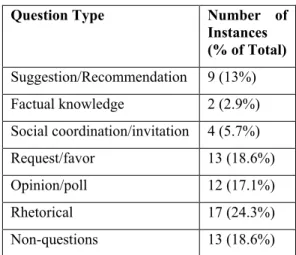
Question Type Number of Instances (% of Total) Suggestion/Recommendation 9 (13%) Factual knowledge 2 (2.9%) Social coordination/invitation 4 (5.7%) Request/favor 13 (18.6%) Opinion/poll 12 (17.1%) Rhetorical 17 (24.3%) Non-questions 13 (18.6%) Table 1: Distribution of question categories
shows convergent validity with other established multi-item scales of relational closeness. The average reported degree of closeness to question-answerers was 3.07 (SD = 1.68). Question examples were rated using an adaptation of the question typology created by Morris et al. [20]. The categories used were: suggestion/recommendation, factual knowledge, social coordination/invitation, request/favor, opinion/poll, rhetorical questions, and non-questions. See Table 1 for distribution of question categories.
Facebook-specific bridging social capital. This measure (10 items, alpha = .82, M = 3.84, SD = 0.49) was adapted from earlier research [27] to reflect the resources associated with bridging social capital – such as access to diverse information – that individuals perceive are available via members of their Facebook networks. Example items include: “Interacting with people in my Facebook network reminds me that everyone in the world is connected” and “Interacting with people in my Facebook network makes me want to try new things.” Responses employed a 5-point Likert scale (1 = Strongly disagree, 5 = Strongly agree).
Frequency of using Facebook to ask questions. This one-item measure (M = 3.62, SD = 0.83) reflects how often individuals use Facebook to ask others in their networks for information. Individuals responded on a scale of frequency ranging from 1 to 5, in which 1 = Never and 5 = Very often.
Facebook information seeking behaviors. This measure (4 items, alpha = .82, M = 3.42, SD = 0.61) captures the extent to which individuals use Facebook to seek information. Sample items include “I use Facebook to get business referrals” and “I use Facebook to get advice about something I want to buy.” Individuals responded with their level of agreement on a 5-point Likert scale (1 = Strongly disagree, 5 = Strongly agree).
RESULTS
Research questions and hypotheses were investigated utilizing both univariate and hierarchical statistical analyses. The following analyses did not include non-question examples.
To examine the relationship between bridging social capital and the perceived usefulness of responses (H1), we used hierarchical linear modeling (HLM) as we were using two levels of data: question-askers (i.e., participants) and responders. HLM is an ideal type of analysis for evaluating multilevel data where level-2 variables – in this case the bridging social capital of the question-asker – are used to explain between-group variance in the level-1 variables – here, the utility of responses of question-responders. Also entered into the model as fixed predictors of response utility were Facebook information seeking behaviors and
frequency of asking questions on Facebook, which served as controls for the question-asking behaviors of the participants. The model using bridging social capital, Facebook information seeking behaviors, and frequency of
asking questions to predict usefulness was a good fit, χ2 = 341.85, p < .001; thus H1 was supported. The level of perceived bridging social capital positively predicted the perceived usefulness of responses from the commenters. To examine the relationship between tie strength and perceived usefulness of responses (RQ1), a simple Pearson correlation demonstrated an inverse relationship between the variables, r(239) = -.20, p < .001. When removing rhetorical questions – hypothesized to differ from the other question categories in terms of useful acquired answers – the correlation became slightly stronger while remaining negative, r(182) = -.24, p < .001. For information needs and other non-rhetorical questions, responses received from weaker ties were rated as more useful than responses received from closer ties. Another question posed in this study was whether or not responses from network members would be perceived as more or less satisfying dependent on the strength of tie or closeness of the relationship (RQ2). There was no significant relationship between perceived closeness and satisfaction with question response, indicating that participants perceived responses to be equally satisfying, regardless of their perceived relational closeness with the responder..
Our second hypothesis predicted that rhetorical questions would receive less useful responses than other question types (H2). A one-way ANOVA using question category to predict usefulness of the answer indicated a significant difference between question types on the response usefulness, F(339) = 9.981, p < .001, η² = .105, but post-hoc comparisons using Tukey’s procedure at p < .05 showed that although usefulness of responses varied by question type, rhetorical questions did not result in the least useful responses on average, as predicted by H2 (see Table 2). In other words, question-askers were just as likely to mark answers to rhetorical questions as useful as they were to mark responses to other kinds of questions as useful. Although we did not predict a relationship between
Question Type Usefulness Social coordination/ Invitation 3.88a (3.34) Suggestion/ Recommendation 4.66ab (3.23) Rhetorical 5.96bc (3.43) Favor/ Request 6.86c (3.37) Opinion/ Poll 7.39c (2.99) Note: Means having no letter in common in their subscripts differ significantly at p < .05 according to Tukey’s procedure. Standard deviations are reported in parentheses.
Table 2: Mean usefulness scores as a function of question type
question type and how satisfying responses were, we wanted to explore whether the satisfaction with responses varied by question category (RQ3) and found that satisfaction did vary significantly by category, F(336) = 14.490, p < .001, η² = .147. Using Tukey’s post-hoc comparison, we found that requests/favors (M = 8.18a, SD = 2.75), opinions/polls (M = 8.68a, SD = 2.13), and rhetorical questions (M = 8.24a, SD = 2.85) were considered more satisfying than responses to suggestion/recommendation
questions (M = 5.63b, SD = 3.32) and social
coordination/invitation questions (M = 6.17b, SD = 3.24). Our next research question asked about the relationship between the rated usefulness of a response and how satisfying it was (RQ4). There was a strong, positive correlation between usefulness and satisfaction, r(348) = .661, p < .001. To examine how the relationship changed between satisfaction and usefulness ratings by tie strength (RQ5) and question type (RQ6), we used the absolute value of the difference between the two ratings – or “discrepancy” – for each comment. For tie strength, there was a small, significant correlation between this discrepancy value and strength of ties, r (234) = .161, p < .05. Closer ties’ responses were more likely to have a greater difference between their satisfaction and usefulness ratings than weaker ties’ responses. There was no significant change in the relationship between usefulness and satisfaction by question type.
DISCUSSION
Research suggests SNSs are used for interpersonal purposes, such as maintaining distant relationships and “checking out” (or socially surveilling) proximate and distant others [12], these interpersonal activities are well-aligned with popular beliefs about the purpose of these sites. More recently, scholars have identified other uses of SNSs, which are increasingly being used for information-gathering and question-asking, in organizational [8] and educational contexts [17]. We believe these two sets of activities – relationship maintenance and question-asking – are inextricably and intimately related to one another when viewed through the lens of social capital, and this paper emphasizes the implications for social capital conversion in the latter.
These information-based uses are important to study because instances of question-asking are explicit instances of social capital in action. Studying these instances in a SNS context offers insight into the ways these tools are changing the fabric of everyday life for their users, not only helping them to achieve interpersonal goals but also to get things done—solve problems, get advice, share opinions and information, learn about new opportunities, and participate in sundry other activities that help day-to-day life go more smoothly. The present study examines organic examples of individuals mining their Facebook networks for informational resources and examines the outcomes of these requests in light of the individuals’ perceived bridging
social capital. In doing so, we can take the first steps toward linking perceptions of bridging social capital as utilized in SNS scholarship with concrete outcomes – the responses our participants received when they posted questions to their Facebook networks. Additionally, we identify and analyze the specific types of questions in an attempt to gain a sense of how the type of information solicited might be related to the quality of responses and relationships with responders. Our findings complement and extend our knowledge of information seeking in SNSs and how it relates to bridging social capital in several ways.
A consistent stream of research has identified a link between perceptions of social capital and Facebook use among undergraduate student and adult users of the site [5, 10, 12]. However, less research examines the specific mechanisms behind these associations. Asking questions of one’s network using the broadcasting features of Facebook is an observable, explicit instance of social capital conversion. In our study, we found that bridging social capital was positively related to the reported usefulness of the responses (or “answers”) received in response to the question they posed to their Facebook network. As access to useful – and especially novel – information is an important component of bridging social capital, this is unsurprising. However, this finding is important because it helps to validate social capital scales that assess perceptions of access. This is one of the first studies to demonstrate a robust relationship between Williams’ [27] social capital scales and one component of the construct – access to information – measured using specific behavioral data contributed by users’ networks and users’ retrospective rating of these responses.
Past research has shown that other behaviors on SNSs, such as receiving messages from friends [5] and signaling attention to others via “Happy Birthday” posts and other methods [16] are associated with increased bridging social capital. One possibility is that asking a question acts as an invitation for a social exchange that may not happen on its own. In other words, answering a question on Facebook gives individuals an excuse to interact and to signal they are paying attention to their ties on the site. This is more likely to be important for weak ties, who may be critical for bridging social capital outcomes. In this way, these interactions serve to support the entire lifecycle of social capital, as individuals extract benefits, put themselves in debt to others (and thus helping to cultivate future interactions due to reciprocity norms), and contribute to the strength and longevity of their network connections through their interactions.
In contrast to findings by Panovich et al. [22] that strong ties provide more useful answers and contribute more to overall knowledge, we find that weak ties are more associated with response utility. This is consistent with the Strength of Weak Ties perspective and early work on SNSs that predicted that the “technologies that expand one’s
social network will primarily result in an increase in available information and opportunities – the benefits of a large, heterogeneous network” (p. 80) [9]. Closer connections within our social networks are typically more similar to us, with access to similar, redundant information or viewpoints, while connections that are weaker likely share fewer mutual contacts and offer exposure to new and different ideas. This finding also differs, however, from Burke and Kraut’s [4] recent discovery that communication with strong ties is more useful than communication with weak ties in terms of gaining employment after a job loss. Future research should explore this question further to help determine whether these inconsistencies are due to different measures, participant population, or the type of question asked. For example, the respondents in Panovich et al.’s [22] study were instructed to ask technology-focused questions, whereas in this study, participants found an example from their past history. Although our method did not include qualitative analysis of our participants’ questions and responses, in reading through them it was clear that many of the questions identified by our respondents had affective components as well as purely informational one. This could mean that a “useful” answer was emotionally supportive in addition to, or rather than, informative, which changes the nature of the exchange. Although weak ties were more likely to supply useful responses, we found no significant role between reported
satisfaction with responses and tie strength. Regardless of the responder’s relationship to the question-asker, comments were equally as likely to be seen as satisfying when they were provided by a close tie as when contributed by a weak tie. Additionally, the mean satisfaction rating was relatively high (7.67/10). A participant’s “satisfaction” with the response may be associated with other factors we did not measure (such as time since last interaction), but our findings suggest that tie strength did not have a uniform relationship with satisfaction valence. We believe that one’s “satisfaction” with responses to a posted question may be more closely linked to the emotional investment signaled by a response, such that any response will be satisfying, regardless of who posted it, because it signals that someone paid attention to the utterance and made the effort to respond. Future research should explore other methods of assessing the relational maintenance functions of question-answering on Facebook. It may be that any response – useful or not – is satisfying in that a comment or other visible activity trace is the only way to know with certainty that someone not only saw the post (which isn’t clear with the News Feed filtering algorithm), but took the time to acknowledge it and in doing so invest in the social connection.
In addition to examining relationships of bridging social capital and strength of ties with question-asking outcomes, we sought to learn more about differences in outcomes inherent to the various types of questions identified. Our analysis found that rhetorical questions did not result in
fewer useful responses than non-rhetorical questions, as found by [20], which is surprising. However, responses did vary in their overall usefulness by question type. Responses to opinion and favor/request questions had the highest usefulness ratings, while social coordination/invitation had the lowest. Our method – in which we asked participants to retrospectively rate the usefulness of responses – may have contributed to this finding, in that social coordination and other time-sensitive invitations have a more limited “shelf life” than other kinds of questions, and thus our method may have been biased against them in terms of their retrospectively perceived usefulness. Solicitations for opinions were rated highly, which may result from their being no “wrong” answer possible for this type of question, or they may also be solicitations for emotional support, which comments could provide regardless of the extent to which they include objective, “useful” information. In terms of satisfaction, opinion/poll questions had the most satisfying responses while suggestion/recommendation questions had the least. We suspect that in some of these cases, even if the askers are not getting useful answers, the process of requesting help and getting some response may still be important for meeting relational goals. As Ellison et al. [11] note, responses to questions may constitute a form of social grooming – signaling attention in a context in which attention is not apparent unless explicitly signaled. The reciprocal nature of social capital may also come into play here, in that responses may be satisfying because they signal a continued pattern of interaction between two parties. Finally, the usefulness of a comment was strongly correlated with how satisfying an individual rated it. Tie strength was positively related to the discrepancy between usefulness and satisfaction ratings. In essence, participants gave answers from weak ties more similar ratings for usefulness and satisfaction than they rated those from closer ties. Given that we found tie strength negatively relates to usefulness, with weak ties providing more useful responses, and that reported satisfaction does not vary by tie strength, we can interpret that weak ties are providing responses that are rated more closely on useful
and satisfying dimensions, while comments from close ties are rated as slightly less useful than they are satisfying. This supports the idea that close ties may be more likely to be commenting to signal attention or convey interest as a form of relational maintenance and not always providing useful or novel information as homogenous ties are typically associated with redundant information [10]. When looking at the relationship between usefulness and satisfaction by question type, we found no significant difference, indicating that there were no specific question types that were more likely than others to have responses that were not useful but still satisfying. If we had found that responses to rhetorical questions were rated as significantly less useful than responses to non-rhetorical questions (i.e., findings similar to the findings of Panovich et al. [20]), we
likely would have seen that rhetorical questions had comments with greater usefulness-satisfaction discrepancy. One curious aspect of our data collection worth considering is the gap between those participants who indicated they asked questions on Facebook (by responding to the question “How often do you use Facebook to ask questions of your Facebook friends?” with a response of at least “sometimes”) but then were unable to find any instances of question-asking in their News Feed in the lab – approximately 25% of our participants said they asked questions of their network but were unable to find an example. This suggests that either participants have a faulty ability to self-report this behavior or perhaps are gaining information on Facebook through channels other than the status update. Although past literature and an affordance-based consideration of SNSs suggest the status update is well-suited for broadcasting informational requests to a wide network with one action, perhaps users are encountering useful information through other activities on the site, such as browsing others' updates, or perhaps are gaining information even through responses to updates that are not “questions.” Future work should use other methods to explore these issues, such as interviews or analysis of server-level data to identity instances of resource mobilization that do not take the form of a question. Limitations
SNS activities leave behavioral traces that can be used as a source of data and as user prompts during lab studies or interviews, potentially leading to perceptual data that is more accurate than purely self-report. However, our method also has some limitations that should be considered when reviewing our findings. We asked participants to retrospectively rate aspects of their post and its responses, which may have led to biased responses due to difficulties remembering details about the incident, the fact that relationships may have changed between the original posting and the lab appointment, or other factors. The collection of naturalistic question examples from individuals’ feeds also led to some limitations in terms of analysis that could be performed; specifically, we were unable to investigate differences in usefulness or satisfaction of responses within factual knowledge
questions in analysis of variance, because of the low occurrence of this question type (N=2). Although asking participants to rate responses and relationship characteristics as they occurred would have ameliorated this concern, we felt this was a better compromise than asking participants to rate an artificial stimulus or have to contend with the intrusive nature of a real-time rating application. As mentioned by Panovich et al. [20], the number of responses per person could bias ratings (in that those with more responses may have been rated more useful, regardless of the content of their contribution). Finally, we only considered instances in which a question received more than two responses, so questions with only one or
zero responses were not considered in this analysis. There is more we can learn from unanswered, broadcasted questions and future research should explore these instances as well as information seeking through Facebook channels other than the status update (e.g., private messages). Future research needs to further delineate the nuanced relationship between relational closeness, type of information need, and utility of information received, as well as to identify whether or not bridging social capital is more instrumental for certain information needs over others.
CONCLUSION
Question-asking within SNS settings is an increasingly prevalent activity performed by individuals to satiate a variety of interpersonal goals and information needs. In this study, we’ve looked at individuals’ performance of broadcasting questions via the status update feature on Facebook, which allows users to seek information among an entire network of strong and weak ties at once, in order to connect perceptual measures of bridging social capital with concrete outcomes in a naturalistic setting. Ultimately, perceived bridging social capital was significantly positively associated with obtaining useful responses to questions broadcasted on Facebook, supporting the notion that information exchanges on SNSs can serve as a form of social capital conversion.
Information exchanges in SNS may be different than what is found between users and search engines like Google, or even in social search services like Quora or Yahoo! Answers. Our findings suggest that SNS questions and answers may contain multiple agendas, including requests for emotional support and feedback, and responding can be motivated by more than just wanting to share a correct answer. Question exchanges in SNSs may help maintain relationships by signaling attention and reciprocity, as well as provide a context for weak ties to interact in a socially acceptable manner. As the extant research suggests, SNSs are well suited to foster information exchanges and thus can be a valuable source of knowledge sharing among users. When viewed through a social capital lens, we see that receiving responses to questions in this social context can serve not only to exchange useful information or support but also to facilitate conversation and maintain relationships with close and weak ties, suggesting that relationship maintenance and question-asking activities are intimately related and should not be studied in isolation.
In this study, we have only started to unpack the complexity of knowledge exchange within this online social context, as it is bound up in messy entanglements of interpersonal relationships, attention signaling, information exchanges, norms of reciprocity, and social capital processes. We believe that SNSs have the potential to lower barriers to information sharing, make potential resources in our networks more visible, and reshape networks. However, even beyond their purely information value, these types of exchanges in social network sites may be ways in which
users are connecting with and strengthening their bonds with others. In other words, question-asking is a means, not an end.
ACKNOWLEDGMENTS
This work was supported in part by the National Science Foundation (HCC 0916019). The authors would also like to thank Brandon Brooks for his help with data collection and Andrea Parker for her help with data analysis.
REFERENCES
1. Aral, S. and Van Alstyne, M. The diversity-bandwidth trade-off. American Journal of Sociology, 117 (1). 90-171.
2. Aron, A., Aron, E.N. and Smollan, D. Inclusion of other in the self scale and the structure of interpersonal closeness. Journal of Personality and Social
Psychology, 63. 596-612.
3. Bourdieu, P. Forms of Capital. in Richardson, J.G. ed.
Handbook of Theory and Research for the Sociology of Education, Greenwood Press, New York, 1983. 4. Burke, M. and Kraut, R., Using Facebook after losing a
job: Differential benefits of strong and weak ties. . in
2013 ACM Conference on Computer Supported Cooperative Work. (CSCW), (San Antonio, TX, 2013), ACM.
5. Burke, M., Kraut, R. and Marlow, C. Social capital on facebook: differentiating uses and users Proceedings of the 2011 annual conference on Human factors in computing systems, ACM, Vancouver, BC, Canada, 2011, 571-580.
6. Burt, R.S. Structural Holes. Harvard University Press, Cambridge, MA, 1992.
7. Coleman, J.S. Social Capital in the Creation of Human Capital. American Journal of Sociology, 94. S95-S120. 8. DiMicco, J., Millen, D.R., Geyer, W., Dugan, C.,
Brownholtz, B. and Muller, M. Motivations for social networking at work Proceedings of the ACM 2008 conference on Computer supported cooperative work, ACM, San Diego, CA, USA, 2008.
9. Donath, J. and Boyd, D. Public Displays of Connection. BT Technology Journal, 22 (4). 71-82. 10. Ellison, N., Steinfield, C. and Lampe, C. The benefits
of Facebook "friends:" Social capital and college students' use of online social network sites. Journal of Computer Mediated Communication, 12 (4). article 1. 11. Ellison, N., Vitak, J., Gray, R., Lampe, C, & Brooks,
B. Cultivating Social Resources on Facebook: Signals of Relational Investment and their Role in Social Capital Processes iCS-OII 2011 “A Decade in Internet Time” Symposium. , Oxford, UK, 2011.
12. Ellison, N.B., Steinfield, C. and Lampe, C. Connection Strategies: Social Capital Implications of Facebook-enabled Communication Practices. New Media & Society, 13. 873-892.
13. Granovetter, M.S. The Strength of Weak Ties. Amerian Economic Review, 78 (6). 1360-1480.
14. Harper, F.M., Moy, D. and Konstan, J.A., Fact or friendship?: Distinguising informational and conversational questions in social Q&A sites. in
Proceedings of the 27th international conference on Human factors in computing systems., (2009), 759-768. 15. Krackhardt, D. The strength of strong ties. . in Nohria,
N. and Eccles, R.G. eds. Networks and organizations: Structure, form and action, Harvard Business School Press, Boston, 1992, 216-239.
16. Lampe, C., Vitak, J., Gray, R. and Ellison, N., Perceptions of Facebook's Value as an Information Source in 30th International Conference on Human Factors in Computing Systems (CHI), (Austin, TX, 2012), ACM Press.
17. Lampe, C., Wohn, D.Y., Vitak, J., Ellison, N.B. and Wash, R. Student use of Facebook for organizing collaborative classroom activities. International Journal of Computer-Supported Cooperative Learning,
6 (3). 329-347.
18. Lin, N. Social Capital: A Theory of Social Structure and Action. Cambridge University Press, New York, NY, 2001.
19. McPherson, M., Smith-Lovin, L. and Cook, J.M. Birds of a Feather: Homophily in Social Networks. Annual Review of Sociology, 27. 415-444.
20. Morris, M.R., Teevan, J. and Panovich, K. What do people ask their social networks, and why?: a survey study of status message q&a behavior Proceedings of the 28th international conference on Human factors in computing systems, ACM, Atlanta, Georgia, USA, 2010.
21. Nardi, B.A. and O'Day, V.L. Information Ecologies: Using Technology with Heart. MIT Press, Cambridge, MA, 1999.
22. Panovich, K., Miller, R. and Karger, D. Tie strength in question & answer on social network sites Proceedings of the ACM 2012 conference on Computer Supported Cooperative Work, ACM, Seattle, Washington, USA, 2012, 1057-1066.
23. Paul, S.A., Hong, L. and Chi, E.H., Is Twitter a Good Place for Asking Questions? A Characterization Study. in ICWSM - International Conference on Weblogs and Social Media, (Barcelona, Spain, 2011).
24. Putnam, R.D. Bowling Alone. Simon & Schuster, New York, 2000.
25. Savolainen, R. Everyday life information seeking: Approaching information seeking in the context of “way of life”. Library & Information Science Research, 17 (3). 259-294.
26. Teevan, J., Morris, M.R. and Panovich, K., Factors Affecting Response Quantity, Quality, and Speed for
Questions Asked via Social Network Status Messages. in ICWSM - International Conference on Weblogs and Social Media, (Barcelona, Spain, 2011).
27. Williams, D. On and Off the 'Net: Scales for Social Capital in an Online Era Journal of Computer Mediated Communication, 11 (2).