Towards Linux-based Telecom Plarforms
Ibrahim Haddad
Ericsson Research
Abstract
Traditionally, communications and data ser-vice networks were built on proprietary plat-forms that had to meet very specific availabil-ity, reliabilavailabil-ity, performance, and service re-sponse time requirements. Today, communica-tion service providers are challenged to meet their needs cost-effectively for new architec-tures, new services, and increased bandwidth, with highly available, scalable, secure, and reliable systems that have predictable perfor-mance and that are easy to maintain and up-grade. This paper presents the technological trend of migrating from proprietary to open platforms based on software and hardware building blocks. It also focuses on the ongo-ing work by the Carrier Grade Linux workongo-ing group at the Open Source Development Labs, examines the CGL architecture, the require-ments from the latest specification release, and presents some of the needed kernel features that are not currently supported by Linux such as a Linux cluster communication mechanism, a low-level kernel mechanism for improved re-liability and soft-realtime performance, sup-port for multi-FIB, and supsup-port for additional security mechanisms.
1
Open platforms
The demand for rich media and enhanced communication services is rapidly leading to
significant changes in the communication in-dustry, such as the convergence of data and voice technologies. The transition to packet-based, converged, multi-service IP networks require a carrier grade infrastructure based on interoperable hardware and software building blocks, management middleware, and appli-cations, implemented with standard interfaces. The communication industry is witnessing a technology trend moving away from propri-etary systems toward open and standardized systems that are built using modular and flex-ible hardware and software (operating system and middleware) common off the shelf com-ponents. The trend is to proceed forward de-livering next generation and multimedia com-munication services, using open standard car-rier grade platforms. This trend is motivated by the expectations that open platforms are go-ing to reduce the cost and risk of developgo-ing and delivering rich communications services. Also, they will enable faster time to market and ensure portability and interoperability between various components from different providers. One frequently asked question is: ’How can we meet tomorrow’s requirements using existing infrastructures and technologies?’. Proprietary platforms are closed systems, expensive to de-velop, and often lack support of the current and upcoming standards. Using such closed platforms to meet tomorrow’s requirements for new architectures and services is almost impos-sible. A uniform open software environment with the characteristics demanded by telecom
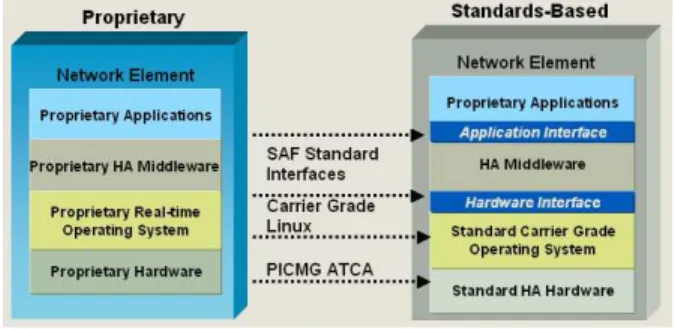
applications, combined with commercial off-the-shelf software and hardware components is a necessary part of these new architectures. The following key industry consortia are defin-ing hardware and software high availability specifications that are directly related to tele-com platforms:
1. The PCI Industrial Computer Manufactur-ers Group [1] (PICMG) defines standards for high availability (HA) hardware. 2. The Open Source Development Labs [2]
(OSDL) Carrier Grade Linux [3] (CGL) working group was established in Jan-uary 2002 with the goal of enhancing the Linux operating system, to achieve an Open Source platform that is highly avail-able, secure, scalable and easily main-tained, suitable for carrier grade systems. 3. The Service Availability Forum [4] (SA
Forum) defines the interfaces of HA mid-dleware and focusing on APIs for hard-ware platform management and for appli-cation failover in the appliappli-cation API. SA compliant middleware will provide ser-vices to an application that needs to be HA in a portable way.
Figure 1: From Proprietary to Open Solutions
The operating system is a core component in such architectures. In the remaining of this pa-per, we will be focusing on CGL, its architec-ture and specifications.
2
The term Carrier Grade
In this paper, we refer to the term Carrier Grade on many occasions. Carrier grade is a term for public network telecommunications prod-ucts that require a reliability percentage up to 5 or 6 nines of uptime.
• 5 nines refers to 99.999% of uptime per year (i.e., 5 minutes of downtime per year). This level of availability is usually associated with Carrier Grade servers.
• 6 nines refers to 99.9999% of uptime per year (i.e., 30 seconds of downtime per year). This level of availability is usually associated with Carrier Grade switches.
3
Linux versus proprietary
operat-ing systems
This section describes briefly the motivating reasons in favor of using Linux on Carrier Grade systems, versus continuing with propri-etary operating systems. These motivations in-clude:
• Cost: Linux is available free of charge in the form of a downloadable package from the Internet.
• Source code availability: With Linux, you gain full access to the source code allow-ing you to tailor the kernel to your needs.
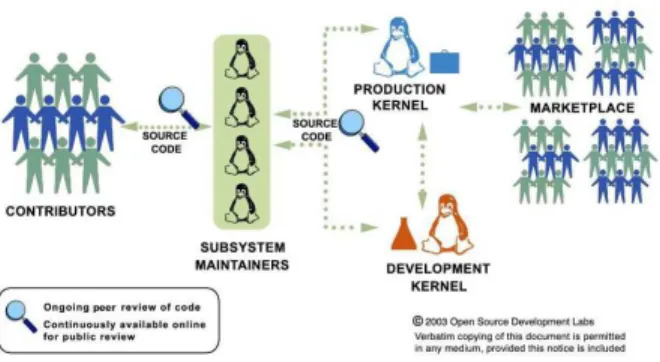
• Open development process (Figure 2): The development process of the kernel is open to anyone to participate and tribute. The process is based on the con-cept of "release early, release often."
• Peer review and testing resources: With access to the source code, people using a
wide variety of platform, operating sys-tems, and compiler combinations; can compile, link, and run the code on their systems to test for portability, compatibil-ity and bugs.
• Vendor independent: With Linux, you no longer have to be locked into a specific vendor. Linux is supported on multiple platforms.
• High innovation rate: New features are usually implemented on Linux before they are available on commercial or propri-etary systems.
Figure 2: Open development process of the Linux kernel
Other contributing factors include Linux’ sup-port for a broad range of processors and peripherals, commercial support availability, high performance networking, and the proven record of being a stable, and reliable server platform.
4
Carrier Grade Linux
The Linux kernel is missing several features that are needed in a telecom environment. It is not adapted to meet telecom requirements in various areas such as reliability, security, and scalability. To help the advancement of
Linux in the telecom space, OSDL established the CGL working group. The group specifies and helps implement an Open Source platform targeted for the communication industry that is highly available, secure, scalable and easily maintained. The CGL working group is com-posed of several members from network equip-ment providers, system integrators, platform providers, and Linux distributors. They all contribute to the requirement definition of Car-rier Grade Linux, help Open Source projects to meet these requirements, and in some cases start new Open Source projects. Many of the CGL members companies have contributed pieces of technologies to Open Source in order to make the Linux Kernel a more viable option for telecom platforms. For instance, the Open Systems Lab [5] from Ericsson Research has contributed three key technologies: the Trans-parent IPC [6], the Asynchronous Event Mech-anism [7], and the Distributed Security Infras-tructure [8]. There are already Linux distri-butions, MontaVista [9] for instance, that are providing CGL distribution based on the CGL requirement definition. Many companies are also either deploying CGL, or at least evaluat-ing and experimentevaluat-ing with it.
Consequently, CGL activities are giving much momentum for Linux in the telecom space allowing it to be a viable option to propri-etary operating system. Member companies of CGL are releasing code to Open Source and are making some of their proprietary technolo-gies open, which leads to going forward from closed platforms to open platforms that use CGL Linux.
5
Target CGL applications
The CGL Working Group has identified three main categories of application areas into which they expect the majority of applications imple-mented on CGL platforms to fall. These
appli-cation areas are gateways, signaling, and man-agement servers.
• Gateways are bridges between two dif-ferent technologies or administration do-mains. For example, a media gateway per-forms the critical function of converting voice messages from a native telecommu-nications time-division-multiplexed net-work, to an Internet protocol packet-switched network. A gateway processes a large number of small messages received and transmitted over a large number of physical interfaces. Gateways perform in a timely manner very close to hard real-time. They are implemented on ded-icated platforms with replded-icated (rather than clustered) systems used for redun-dancy.
• Signaling servers handle call control, ses-sion control, and radio recourse control. A signaling server handles the routing and maintains the status of calls over the net-work. It takes the request of user agents who want to connect to other user agents and routes it to the appropriate signaling. Signaling servers require soft real time re-sponse capabilities less than 80 millisec-onds, and may manage tens of thousands of simultaneous connections. A signaling server application is context switch and memory intensive due to requirements for quick switching and a capacity to manage large numbers of connections.
• Management servers handle traditional network management operations, as well as service and customer management. These servers provide services such as: a Home Location Register and Visitor Lo-cation Register (for wireless networks) or customer information (such as per-sonal preferences including features the
customer is authorized to use). Typi-cally, management applications are data and communication intensive. Their re-sponse time requirements are less strin-gent by several orders of magnitude, com-pared to those of signaling and gateway applications.
6
Overview of the CGL working
group
The CGL working group has the vision that next-generation and multimedia communica-tion services can be delivered using Linux based open standards platforms for carrier grade infrastructure equipment. To achieve this vision, the working group has setup a strat-egy to define the requirements and architecture for the Carrier Grade Linux platform, develop a roadmap for the platform, and promote the development of a stable platform upon which commercial components and services can be deployed.
In the course of achieving this strategy, the OSDL CGL working group, is creating the re-quirement definitions, and identifying existing Open Source projects that support the roadmap to implement the required components and in-terfaces of the platform. When an Open Source project does not exist to support a certain re-quirement, OSDL CGL is launching (or sup-port the launch of) new Open Source projects to implement missing components and inter-faces of the platform.
The CGL working group consists of three dis-tinct groups that work together. These sub-groups are: specification, proof-of-concept, and validation. Responsibilities of each sub-group are as follows:
1. Specifications: The specifications sub-group is responsible for defining a set of
requirements that lead to enhancements in the Linux kernel, that are useful for car-rier grade implementations and applica-tions. The group collects, categorizes, and prioritizes the requirements from partici-pants to allow reasonable work to proceed on implementations. The group also in-teracts with other standard defining bod-ies, open source communitbod-ies, develop-ers and distributions to ensure that the re-quirements identify useful enhancements in such a way, that they can be adopted into the base Linux kernel.
2. Proof-of-Concept: This sub-group gener-ates documents covering the design, fea-tures, and technology relevant to CGL. It drives the implementation and integration of core Carrier Grade enhancements to Linux as identified and prioritized by the requirement document. The group is also responsible for ensuring the integrated en-hancements pass, the CGL validation test suite and for establishing and leading an open source umbrella project to coordi-nate implementation and integration ac-tivities for CGL enhancements.
3. Validation: This sub-group defines stan-dard test environments for developing val-idation suites. It is responsible for co-ordinating the development of validation suites, to ensure that all of the CGL re-quirements are covered. This group is also responsible for the development of an Open Source project CGL validation suite.
7
CGL architecture
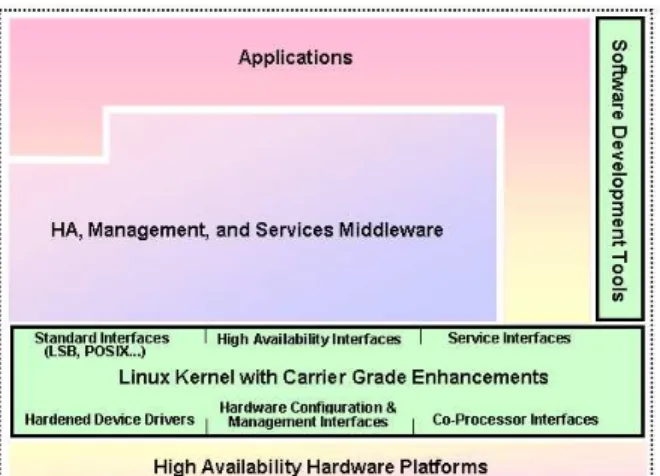
Figure 3 presents the scope of the CGL Work-ing Group, which covers two areas:
• Carrier Grade Linux: Various require-ments such as availability and scalability
Figure 3: CGL architecture and scope
are related to the CGL enhancements to the operating system. Enhancements may also be made to hardware interfaces, inter-faces to the user level or application code and interfaces to development and debug-ging tools. In some cases, to access the kernel services, user level library changes will be needed.
• Software Development Tools: These tools will include debuggers and analyzers. On October 9, 2003, OSDL announced the availability of the OSDL Carrier Grade Linux Requirements Definition, Version 2.0 (CGL 2.0). This latest re-quirement definition for next-generation carrier grade Linux offers major advances in security, high availability, and cluster-ing.
8
CGL requirements
The requirement definition document of CGL version 2.0 introduced new and enhanced fea-tures to support Linux as a carrier grade plat-form. The CGL requirement definition divides the requirements in main categories described briefly below:
8.1 Clustering
These requirements support the use of multi-ple carrier server systems to provide higher lev-els of service availability through redundant re-sources and recovery capabilities, and to pro-vide a horizontally scaled environment sup-porting increased throughput.
8.2 Security
The security requirements are aimed at main-taining a certain level of security while not en-dangering the goals of high availability, perfor-mance, and scalability. The requirements sup-port the use of additional security mechanisms to protect the systems against attacks from both the Internet and intranets, and provide special mechanisms at kernel level to be used by tele-com applications.
8.3 Standards
CGL specifies standards that are required for compliance for carrier grade server systems. Examples of these standards include:
• Linux Standard Base
• POSIX Timer Interface
• POSIX Signal Interface
• POSIX Message Queue Interface
• POSIX Semaphore Interface
• IPv6 RFCs compliance • IPsecv6 RFCs compliance • MIPv6 RFCs compliance • SNMP support • POSIX threads 8.4 Platform
OSDL CGL specifies requirements that sup-port interactions with the hardware platforms making up carrier server systems. Platform ca-pabilities are not tied to a particular vendor’s implementation. Examples of the platform re-quirements include:
• Hot insert: supports hot-swap insertion of hardware components
• Hot remove: supports hot-swap removal of hardware components
• Remote boot support: supports remote booting functionality
• Boot cycle detection: supports detecting reboot cycles due to recurring failures. If the system experiences a problem that causes it to reboot repeatedly, the system will go offline. This is to prevent addi-tional difficulties from occurring as a re-sult of the repeated reboots
• Diskless systems: Provide support for diskless systems loading their ker-nel/application over the network
• Support remote booting across common LAN and WAN communication media
8.5 Availability
The availability requirements support height-ened availability of carrier server systems, such as improving the robustness of software com-ponents or by supporting recovery from failure of hardware or software. Examples of these re-quirements include:
• RAID 1: support for RAID 1 offers mir-roring to provide duplicate sets of all data on separate hard disks
• Watchdog timer interface: support for watchdog timers to perform certain speci-fied operations when timeouts occur
• Support for Disk and volume manage-ment: to allow grouping of disks into vol-umes
• Ethernet link aggregation and link failover: support bonding of multiple NIC for bandwidth aggregation and provide automatic failover of IP addresses from one interface to another
• Support for application heartbeat moni-tor: monitor applications availability and functionality.
8.6 Serviceability
The serviceability requirements support servic-ing and managservic-ing hardware and software on carrier server systems. These are wide-ranging set requirements, put together, help support the availability of applications and the operating system. Examples of these requirements in-clude:
• Support for producing and storing kernel dumps
• Support for dynamic debug to allow dy-namically the insertion of software instru-mentation into a running system in the kernel or applications
• Support for platform signal handler en-abling infrastructures to allow interrupts generated by hardware errors to be logged using the event logging mechanism
• Support for remote access to event log in-formation
8.7 Performance
OSDL CGL specifies the requirements that support performance levels necessary for the environments expected to be encountered by carrier server systems. Examples of these re-quirements include:
• Support for application (pre) loading.
• Support for soft real time performance through configuring the scheduler to pro-vide soft real time support with latency of 10 ms.
• Support Kernel preemption.
• Raid 0 support: RAID Level 0 pro-vides "disk striping" support to enhance performance for request-rate-intensive or transfer-rate-intensive environments
8.8 Scalability
These requirements support vertical and hori-zontal scaling of carrier server systems such as the addition of hardware resources to result in acceptable increases in capacity.
8.9 Tools
The tools requirements provide capabilities to facilitate diagnosis. Examples of these require-ments include:
• Support the usage of a kernel debugger.
• Support for Kernel dump analysis.
• Support for debugging multi-threaded programs
9
CGL 3.0
The work on the next version of the OSDL CGL requirements, version 3.0, started in Jan-uary 2004 with focus on advanced require-ment areas such as manageability, serviceabil-ity, tools, securserviceabil-ity, standards, performance, hardware, clustering and availability. With the success of CGL’s first two requirement docu-ments, OSDL CGL working group anticipates that their third version will be quite beneficial to the Carrier Grade ecosystem. Official re-lease of the CGL requirement document Ver-sion 3.0 is expected in October 2004.
10
CGL implementations
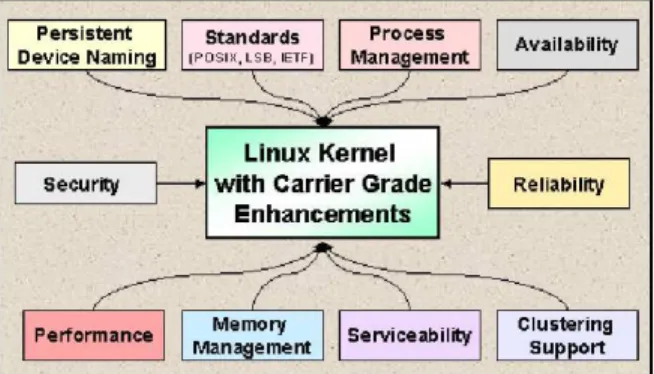
There are several enhancements to the Linux Kernel that are required by the communication industry, to help adopt Linux on their carrier grade platforms, and support telecom applica-tions. These enhancements (Figure 4) fall into the following categories availability, security, serviceability, performance, scalability, relia-bility, standards, and clustering.
Figure 4: CGL enhancements areas
The implementations providing theses en-hancements are Open Source projects and planned for integration with the Linux ker-nel when the implementations are mature, and ready for merging with the kernel code. In
some cases, bringing some projects into matu-rity levels takes a considerable amount of time before being able to request its integration into the Linux kernel. Nevertheless, some of the en-hancements are targeted for inclusion in kernel version 2.7. Other enhancements will follow in later kernel releases. Meanwhile, all enhance-ments, in the form of packages, kernel modules and patches, are available from their respective project web sites. The CGL 2.0 requirements are in-line with the Linux development com-munity. The purpose of this project is to form a catalyst to capture common requirements from end-users for a CGL distribution. With a com-mon set of requirements from the major Net-work Equipment Providers, developers can be much more productive and efficient within de-velopment projects. Many individuals within the CGL initiative are also active participants and contributors in the Open Source develop-ment community.
11
Examples of needed features in
the Linux Kernel
In this section, we provide some examples of missing features and mechanisms from the Linux kernel that are necessary in a telecom environment.
11.1 Transparent Process and Inter-Processor Communication Protocol for Linux Clusters
Today’s telecommunication environments are increasingly adopting clustered servers to gain benefits in performance, availability, and scal-ability. The resulting benefits of a cluster are greater or more cost-efficient than what a single server can provide. Furthermore, the telecommunications industry interest in clus-tering originates from the fact that clusters address carrier grade characteristics such as guaranteed service availability, reliability and
scaled performance, using cost-effective hard-ware and softhard-ware. Without being absolute about these requirements, they can be divided in these three categories: short failure detection and failure recovery, guaranteed availability of service, and short response times. The most widely adopted clustering technique is use of multiple interconnected loosely coupled nodes to create a single highly available system.
One missing feature from the Linux kernel in this area is a reliable, efficient, and transpar-ent inter-process and inter-processor commu-nication protocol. Transparent Inter Process Communication (TIPC) [6] is a suitable Open Source implementation that fills this gap and provides an efficient cluster communication protocol. This leverages the particular condi-tions present within loosely coupled clusters. It runs on Linux and is provided as a portable source code package implementing a loadable kernel module.
TIPC is unique because there seems to be no other protocol providing a comparable com-bination of versatility and performance. It includes some original innovations such as the functional addressing, the topology sub-scription services, and the reactive connec-tion concept. Other important TIPC fea-tures include full location transparency, sup-port for lightweight connections, reliable mul-ticast, signaling link protocol, topology sub-scription services and more.
TIPC should be regarded as a useful toolbox for anyone wanting to develop or use Carrier Grade or Highly Available Linux clusters. It provides the necessary infrastructure for clus-ter, network and software management func-tionality, as well as a good support for de-signing site-independent, scalable, distributed, high-availability and high-performance appli-cations.
It is also worthwhile to mention that the
ForCES (Forwarding and Control Element WG) [11] working group within IETF has agreed that their router internal protocol (the ForCES protocol) must be possible to carry over different types of transport protocols. There is consensus on that TCP is the pro-tocol to be used when ForCES messages are transported over the Internet, while TIPC is the protocol to be used in closed environments (LANs), where special characteristics such as high performance and multicast support is de-sirable. Other protocols may also be added as options.
TIPC is a contribution from Ericsson [5] to the Open Source community. TIPC was an-nounced on LKML on June 28, 2004; it is li-censed under a dual GPL and BSD license.
11.2 IPv4, IPv6, MIPv6 forwarding tables fast access and compact memory with multi-ple FIB support
Routers are core elements of modern telecom networks. They propagate and direct billion of data packets from their source to their des-tination using air transport devices or through high-speed links. They must operate as fast as the medium in order to deliver the best qual-ity of service and have a negligible effect on communications. To give some figures, it is common for routers to manage between 10.000 to 500.000 routes. In these situations, good performance is achievable by handling around 2000 routes/sec. The actual implementation of the IP stack in Linux works fine for home or small business routers. However, with the high expectation of telecom operators and the new capabilities of telecom hardware, it appears as barely possible to use Linux as an efficient forwarding and routing element of a high-end router for large network (core/border/access router) or a high-end server with routing capa-bilities.
One problem with the networking stack in Linux is the lack of support for multiple forward-ing information bases (multi-FIB) wit h overlapping interface’s IP address, and the lack of appropriate interfaces for addressing FIB. Another problem with the curren t imple-mentation is the limited scalability of the rout-ing table.
The solution to these problems is to provide support for multi-FIB with overlapping IP ad-dress. As such, we can have on differe nt VLAN or different physical interfaces, inde-pendent network in the same Linux box. For example, we can have two HTTP servers serv-ing two different networks with potentially the same IP address. One HTTP server will serve the network/FIB 10, and the othe r HTTP server will serves the network/FIB 20. The ad-vantage gained is to have one Linux box serv-ing two different customers usi ng the same IP address. ISPs adopt this approach by provid-ing services for multiple customers sharprovid-ing the same server (server pa rtitioning), instead of using a server per customer.
The way to achieve this is to have an ID (an identifier that identifies the customer or user of the service) to completely separ ate the rout-ing table in memory. Two approaches exist: the first is to have a separate routing tables, each routing table is looked up by their ID and within tha t table the lookup is done one the prefix. The second approach is to have one ta-ble, and the lookup is done on the combined key = prefix + ID.
A different kind of problem arises when we are not able to predict access time, with the chain-ing in the hash table of the routi ng cache (and FIB). This problem is of particular inter-est in an environment that requires predictable per-formance.
Another aspect of the problem is that the route cache and the routing table are not kept
syn-chronized most of the time (path MTU, just to name one). The route cache flush is exe-cuted regularly; therefore, any updates on the cache are lost. For example, if you have a rout-ing cache flush, you have to rebuild every route that you are currently talking to, by going for every route in the hash/try table and rebuilding the information. First, you have to lookup in the routing cache, and if you have a miss, then you need to go in the hash/try table. This pro-cess is very slow and not predictable since the hash/try table is implemented wi th linked list and there is high potential for collisions when a large number of routes are present. This design is suitable fo r a home PC with a few routes, but it is not scalable for a large server.
To support the various routing requirements of server nodes operating in high perfor-mance and mission critical envrionments, Linux should support the following:
• Implementation of multi-FIB using tree (radix, patricia, etc.): It is very impor-tant to have predictable performance in in-sert/delete/lookup from 10.000 to 500.000 routes. In addition, it is favourable to have the same data structure for both IPv4 and IPv6.
• Socket and ioctl interfaces for addressing multi-FIB.
• Multi-FIB support for neighbors (arp).
Providing these implementations in Linux will affect a large part of net/core, net/ipv4 and net/ipv6; these subsystems (mostly network layer) will need to be re-written. Other areas will have minimal impact at the source code level, mostly at the transport layer (socket, TCP, UDP, RAW, NAT, IPIP, IGMP, etc.).
As for the availability of an Open Source project that can provide these functionalities,
there exists a project called "Linux Virtual Routing and Forwarding" [12]. This project aims to implement a flexible and scalable mechanism for providing multiple routing in-stances within the Linux kernel. The project has some potential in providing the needed functionalities, however no progress has been made since 2002 and the project seems to be inactive.
11.3 Run-time Authenticity Verification for Bi-naries
Linux has generally been considered immune to the spread of viruses, backdoors and Tro-jan programs on the Internet. However, with the increasing popularity of Linux as a desk-top platform, the risk of seeing viruses or Tro-jans developed for this platform are rapidly growing. To alleviate this problem, the sys-tem should prevent on run time the execu-tion of un-trusted software. One soluexecu-tion is to digitally sign the trusted binaries and have the system check the digital signature of bina-ries before running them. Therefore, untrusted (not signed) binaries are denied the execution. This can improve the security of the system by avoiding a wide range of malicious bina-ries like viruses, worms, Trojan programs and backdoors from running on the system.
DigSig [13] is a Linux kernel module that checks the signature of a binary before running it. It inserts digital signatures inside the ELF binary and verifies this signature before load-ing the binary. It is based on the Linux Security Module hooks (LSM has been integrated with the Linux kernel since 2.5.X and higher). Typically, in this approach, vendors do not sign binaries; the control of the system remains with the local administrator. The responsible ad-ministrator is to sign all binaries they trust with their private key. Therefore, DigSig guarantees two things: (1) if you signed a binary, nobody
else other than yourself can modify that binary without being detected. (2) Nobody can run a binary which is not signed or badly signed.
There has already been several initiatives in this domain, such as Tripwire [14], BSign [15], Cryptomark [16], but we believe the DigSig project is the first to be both easily accessible to all (available on SourceForge, under the GPL license) and to operate at kernel level on run time. The run time is very important for Car-rier Grade Linux as this takes into account the high availability aspects of the system.
The DigSig approach has been using exist-ing solutions like GnuPG [17] and BSign (a Debian package) rather than reinventing the wheel. However, in order to reduce the over-head in the kernel, the DigSig project only took the minimum code necessary from GnuPG. This helped much to reduce the amount of code imported to the kernel in source code of the original (only 1/10 of the original GnuPG 1.2.2 source code has been imported to the kernel module).
DigSig is a contribution from Ericsson [5] to the Open Source community. It was released under the GPL license and it is available from [8].
DigSig has been announced on LKML [18] but it not yet integrated in the Linux Kernel.
11.4 Efficient Low-Level Asynchronous Event Mechanism
Carrier grade systems must provide a 5-nines availability, a maximum of five minutes per year of downtime, which includes hardware, operating system, software upgrade and main-tenance. Operating systems for such systems must ensure that they can deliver a high re-sponse rate with minimum downtime. In ad-dition, carrier-grade systems must take into account such characteristics such as
scalabil-ity, high availability and performance. In car-rier grade systems, thousands of requests must be handled concurrently without affecting the overall system’s performance, even under ex-tremely high loads. Subscribers can expect some latency time when issuing a request, but they are not willing to accept an unbounded response time. Such transactions are not han-dled instantaneously for many reasons, and it can take some milliseconds or seconds to re-ply. Waiting for an answer reduces applica-tions abilities to handle other transacapplica-tions.
Many different solutions have been envisaged to improve Linux’s capabilities in this area us-ing different types of software organization, such as multithreaded architectures, imple-menting efficient POSIX interfaces, or improv-ing the scalability of existimprov-ing kernel routines.
One possible solution that is adequate for car-rier grade servers is the Asynchronous Event Mechanism (AEM), which provides asyn-chronous execution of processes in the Linux kernel. AEM implements a native support for asynchronous events in the Linux kernel and aims to bring carrier-grade characteristics to Linux in areas of scalability and soft real-time responsiveness. In addition, AEM offers event-based development framework, scalabil-ity, flexibilscalabil-ity, and extensibility.
Ericsson [5] released AEM to Open Source in February 2003 under the GPL license. AEM was announced on the Linux Kernel Mailing List (LKML) [20], and received feedback that resulted in some changes to the design and im-plementation. AEM is not yet integrated with the Linux kernel.
12
Conclusion
There are many challenges accompanying the migration from proprietary to open platforms. The main challenge remains to be the
availabil-ity of the various kernel features and mecha-nisms needed for telecom platforms and inte-grating these features in the Linux kernel.
References
[1] PCI Industrial Computer Manufacturers Group,
http://www.picmg.org
[2] Open Source Development Labs,
http://www.osdl.org
[3] Carrier Grade Linux,
http://osdl.org/lab_activities
[4] Service Availability Forum,
http://www.saforum.org
[5] Open System Lab,
http://www.linux.ericsson.ca
[6] Transparent IPC,
http://tipc.sf.net
[7] Asynchronous Event Mechanism,
http://aem.sf.net
[8] Distributed Security Infrastructure,
http://disec.sf.net
[9] MontaVista Carrier Grade Edition,
http://www.mvista.com/cge
[10] Make Clustering Easy with TIPC, LinuxWorld Magazine, April 2004
[11] IETF ForCES working group,
http://www.sstanamera.com/~forces
[12] Linux Virtual Routing and Forwarding project,
http://linux-vrf.sf.net
[13] Stop Malicious Code Execution at Kernel Level, LinuxWorld Magazine, January 2004
[14] Tripwire, http://www.tripwire.com [15] Bsign, http://packages.debian.org/bsign [16] Cryptomark, http://immunix.org/cryptomark.html [17] GnuPG, http://www.gnupg.org [18] DigSig announcement on LKML, http://lwn.net/Articles/51007
[19] An Event Mechanism for Linux, Linux Journal, July 2003
[20] AEM announcement on LKML,
http://lwn.net/Articles/45633
Acknowledgments
Thank you to Ludovic Beliveau, Mathieu Giguere, Magnus Karlson, Jon Maloy, Mats Naslund, Makan Pourzandi, and Frederic Rossi, for their valuable contributions and re-views.
Linux Symposium
Volume One
July 21st–24th, 2004
Ottawa, Ontario
Andrew J. Hutton, Steamballoon, Inc.
Stephanie Donovan, Linux Symposium
C. Craig Ross, Linux Symposium
Review Committee
Jes Sorensen, Wild Open Source, Inc.
Matt Domsch, Dell
Gerrit Huizenga, IBM
Matthew Wilcox, Hewlett-Packard
Dirk Hohndel, Intel
Val Henson, Sun Microsystems
Jamal Hadi Salimi, Znyx
Andrew Hutton, Steamballoon, Inc.
Proceedings Formatting Team
John W. Lockhart, Red Hat, Inc.
Authors retain copyright to all submitted papers, but have granted unlimited redistribution rights to all as a condition of submission.