Received February 27, 2019, accepted March 25, 2019, date of publication April 9, 2019, date of current version April 18, 2019. Digital Object Identifier 10.1109/ACCESS.2019.2909563
Progressive Caching System for Video Streaming
Services Over Content Centric Network
HYUNMIN NOH AND HWANGJUN SONG
Department of Computer Science and Engineering, Pohang University of Science and Technology (POSTECH), Pohang-si 790-784, South Korea
Corresponding author: Hwangjun Song ([email protected])
This work was partly supported by Institute for Information & communications Technology Promotion (IITP) grant funded by the Korea government (MSIT) (No. 2015-0-00567, Development of Access Technology Agnostic Next-Generation Networking Technology for Wired-Wireless Converged Networks) and National Research Foundation of Korea (NRF) grant funded by the Korea government (MSIP) (No. 2016R1A2B4007812).
ABSTRACT This paper presents a metafile-based progressive caching system over the content-centric networking (CCN) tree that supports seamless video streaming services with a high network utilization. In the proposed caching system, each CCN node uses a metafile made by a scalable caching algorithm for efficient and fast chunk caching management, and the reserved area of the CCN interest/data packet headers is used to deliver caching information among the CCN nodes. Based on this caching information, the proposed caching system determines the caching range of video data to minimize the required peak bandwidth for each link. The proposed caching system is implemented using the NS-3 based named data networking simulator. Furthermore, a real cellular wireless network testbed is realized with C/C++, open sources such as CCNx and Ubuntu MATE, and a Raspberry PIs to examine the performance of the proposed caching system. The experiment results demonstrate the performance improvement achieved by the proposed caching system.
INDEX TERMS Video caching, channel bandwidth, content centric networking, video streaming.
I. INTRODUCTION
In recent years, the demand for video streaming services over wired/wireless networks has been increasing rapidly. According to the Cisco visual network index [1], overall data traffic is expected to grow at a compound annual growth rate (CAGR) of 24% from 2016 to 2021, reaching 3.3 ZB per year, or 278 EB per month, which represents nearly a threefold increase compared to 2016. The main catalyst for this exponential rise in data traffic is the explosive increase in over-the-top (OTT) media services such as YouTube, Net-flix, and Hulu. In [1], Cisco estimates that video traffic will increase at a CAGR of 25% from 2016 to 2021 and account for 82% of total data traffic in 2021. Unfortunately, this explosive growth in video traffic may cause a traffic overload problem on the limited capacity of wired/wireless networks, which degrade the user-perceived video quality. It is still quite challenging to support this explosive data traffic growth in wired/wireless networks. To solve this problem, various approaches have been considered to alleviate network traffic [2]–[6], e.g. web cache [7], content delivery networks (CDNs) [8], and Peer-to-Peer (P2P) [9] networks, etc.
The associate editor coordinating the review of this manuscript and approving it for publication was Byung-Seo Kim.
However, their performance is limited due to their operations at the application layer and the deployments that do not share a common naming or encoding of their data units [10], [11]. The Content Centric Networking (CCN) [12] technology is an emerging technology to efficiently handle rapid traf-fic growth by accessing content with its name instead of the physical location of data, and realizing the in-network caching. In a CCN, content is divided into chunks (i.e., CCN data packets) and each chunk has its own identified name. A content consumer requests content through a CCN interest packet, and any node with the requested content immediately provides the content to the consumer through a CCN data packet. A CCN node includes a packet forwarding engine consisting of a Forwarding Information Base (FIB), a Pend-ing Interest Table (PIT), and a Content Store (CS). The FIB stores a face list that interest packets should be forwarded. The PIT saves the face at which the CCN interest packet arrives, and the requested CCN data packets are forwarded to the corresponding face. The CS is a cache space to store arriving CCN data packets. So far, considerable amounts of research efforts have been devoted to alleviating the network traffic in the CCN architecture. In [13], Psaras et al. pro-posed a probabilistic in-network caching scheme. It approx-imates the capability of paths based on their lengths, and
VOLUME 7, 2019
2169-35362019 IEEE. Translations and content mining are permitted for academic research only.
caches contents probabilistically to reduce caching redun-dancy. In [14], Bernardini et al. introduced a simple, but effective caching algorithm that caches only popular contents in order to achieve a higher cache hit ratio and reduce the cache load at each node. In [15], Cho et al. proposed a collaborative caching algorithm that considers content pop-ularity. In this algorithm, an upstream node recommends the number of chunks to be cached at its downstream node by reflecting the content popularity. In [16], Suksomboon et al. proposed a PopCache that caches contents more or less in accordance with a popularity characteristic. In [17], Jing et al. proposed a distributed max-gain in-network caching strategy for information-centric networks. They focused on maximiz-ing local cache gain and minimizmaximiz-ing the cache replacement penalty to improve the cache hit ratio. In [18], Wang et al. proposed a cache allocation algorithm that distributes cache capacity across routers under a constrained total storage budget.
Until now, many effective caching and replacing algo-rithms for video streaming services have been studied. In [19], Sung et al. proposed an efficient cache placement strategy in a two-tier wireless content delivery network; in such a scheme, the cache servers are deployed in small cell mesh networks as well as a data center to overcome the overload problem. Li et al. [20] introduced a caching scheme for adaptive video streaming to reduce total video distortion by considering the rate-distortion characteristics of multiple bitrate videos and the coordination among distributed cache servers. In [21], Su et al. proposed a game theory-based layered video caching scheme for multiple social groups with limited caching capacity to achieve a higher cache hit ratio and user QoE of each social group. Miao et al. pro-posed a scalable selective caching system for QoS networks (SCQ) [22]. The SCQ algorithm determines a caching frame sequence to prevent client buffer underflow with low net-work bandwidth cost. In [23], Oh et al. proposed a metafile based scalable caching system, which is designed to minimize the required peak bandwidth depending on relative caching frame positions as well as frame sizes. However, when these algorithms are employed on multiple caching nodes, the unnecessary or redundant caching may increase because they consider only single caching node such as a proxy server.
In this paper, we propose a metafile based progressive caching system for seamless video streaming services over the CCN tree. The major contributions of this manuscript are summarized in the following:
• A metafile created by a scalable caching algorithm [23]
is employed in the CCN architecture. The metafile is designed to reduce the required peak bandwidth for seamless streaming services according to the cached chunks along the content delivery route.
• An efficient caching information exchanging protocol with no additional network overhead is designed among CCN nodes by using the reserved header area of the CCN interest/data packets.
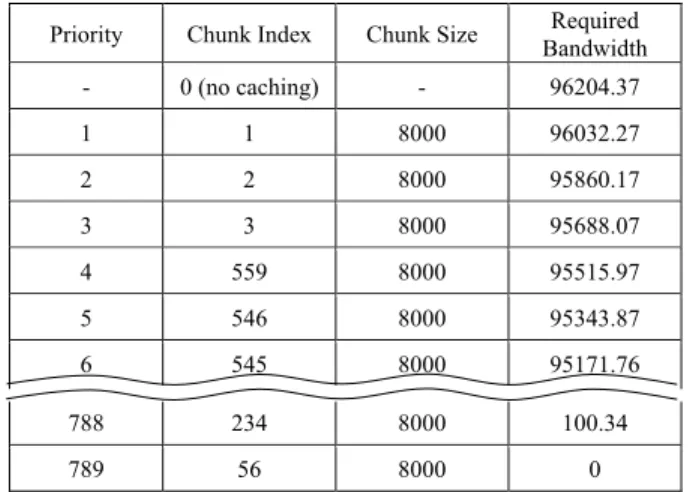
TABLE 1.An example of the metafile for scalable caching over CCN tree.
• A progressive caching system effectively determines
the caching range based on the above metafile for the seamless video streaming services. Chunks of video are selectively stored at each node by a progressive caching module.
• For performance verification in large-scale CCN envi-ronments, we use the NS-3 based named data network-ing simulator (ndnSIM). In addition, for performance verification under a real cellular wireless environment, the proposed caching system is fully implemented using CCNx and C/C++on a single-board computer, called Raspberry Pi.
The rest of this paper is organized as follows. The details of the proposed progressive caching system over the CCN tree are presented in section II, and experimental results are given in section III. Finally, the concluding remarks are provided in section IV.
II. PROPOSED PROGRESSIVE CACHING SYSTEM OVER CCN TREE
The goal of the proposed caching system is to provide seam-less video streaming services with high network utilization over the CCN tree. The overall architecture of the proposed caching system is illustrated in Fig. 1. As shown in the figure, the CCN node includes three components: the CCN forward-ing engine, the cachforward-ing information exchangforward-ing module, and the progressive caching module. The CCN forwarding engine
FIGURE 1. Architecture of the proposed caching system (red and blue lines indicate the packet flow when CCN node #2 caches the requested data).
performs basic CCN operations as mentioned earlier. The caching information exchanging module updates the caching status of the CCN nodes through the interest/data packet headers, and the progressive caching module manages cached chunks in the CS using metafiles and the caching informa-tion received from other CCN nodes. There are two main differences between the proposed caching system and the original CCN. First, the proposed caching system exchanges caching information among CCN nodes through the mod-ified header structure of interest packet and data packet, whereas the original CCN does not share any information among CCN nodes. Second, the proposed caching system is implemented to support a selective caching scheme in order to reduce unnecessary redundant caching at neighbor-ing nodes by usneighbor-ing metafiles and exchangneighbor-ing cachneighbor-ing infor-mation. The metafiles provide caching priority to minimize the required peak bandwidth and alleviate redundant caching over distributed CCN nodes. In the followings, the metafile structure for CCN is discussed in section 2.A, a problem description is provided in section 2.B, and the details of the proposed caching system over the CCN tree are presented in section 2.C.
A. METAFILE STRUCTURE FOR CCN
In this section, we describe how to create the metafile for the CCN environment based on scalable caching algorithm [23]. It is assumed that video frames are compressed in variable sizes and transmitted in chunk format over the CCN tree. Therefore, a chunk may contain multiple frames, or a com-pressed frame may be split into multiple chunks. Since a video frame can only be displayed after all the chunks con-taining the frame data arrive, the required peak bandwidth should be calculated in the chunk unit, which is stored in the metafile. At first, some symbolic descriptions are provided to the metafile structure for the CCN. The total size of the video #mto provide seamless streaming service at the timet
is calculated by sframem (t)= t/Tframe+1 X k=1 Rm,k, (1) where Rm,k is the size of the kth frame for video #m, and the time interval between two adjacent frames isTmframe. The number of chunks for the seamless streaming service at the timetis represented by nchunkm (t)= & sframem (t) Schunk ' , (2)
whereSchunkis the size of the chunk. When the video #m con-sists ofNmchunk chunks, the cached chunks along the interest packet forwarding route are represented by
E cm = cm,1, ...,cm,k, ...,cm,Nchunk m , (3) cm,k = (
1, if thekthchunk of the video #mis cached, 0, otherwise.
(4)
The number of chunks downloaded through the content server-side link due to cache misses is calculated by
nEdownc m (t)= nchunkm (t) X k=1 1−cm,k . (5)
The required peak bandwidth on the content server-side link for the seamless streaming service for video #mis defined by
BWmlink(Ecm)= max 1≤t≤Tmframe·Nmframe ( ndownEcm (t)·Schunk t ) , (6) whereNmframe indicates the number of frames in video #m. The time that the peak bandwidth is required for video #mis obtained by
tmpeak(Ecm)= arg max 1≤t≤Tmframe·Nmframe ( ndownEc m (t) ·Schunk t ) . (7) The maximum buffer size to prevent buffer overflow for video #mat the client is calculated by
Bccn(Ecm)= max 1≤t≤Tmframe·Nmframe
n
t·BWlink(Ecm)−ndownEcm (t)·Schunk
o
, (8) and the normalized buffer size is defined by the decreased maximum buffer size after caching a chunk divided by its chunk size as follows.
Bnormccn (Ecm,k)=
Bccn(Ecm)|cm,k=0−Bccn(Ecm)|cm,k=1
Schunk , (9) where Bccn(Ecm)|cm,k=0 and Bccn(Ecm)|cm,k=1 are the maxi-mum buffer size before and after caching thekth chunk of video #m, respectively. Now, we make the metafile for the CCN environment as follows.
Step 1)Find thekth chunk maximizingBnormccn (Ecm,k)for 1≤ t ≤ tmpeak. Then, store the caching priority, chunk num-ber, chunk size, and required peak bandwidth after caching the chunk in the metafile.
Step 2)When several chunks have the same normalized buffer size, find a chunk minimizing the normalized buffer sizeBccn(Ecm). Then, store the caching priority, chunk num-ber, chunk size, and required peak bandwidth in the metafile. The caching priority, chunk number, chunk size and required peak bandwidth determined through the above steps are stored in the metafile as shown in Table 1. In the proposed caching system, the metafiles are generated by the service provider, and distributed to all CCN nodes.
B. OPTIMAL PROBLEM DESCRIPTION
Now, we formulate the caching range optimization problem to support seamless video streaming services with high net-work utilization over the CCN tree. Most existing caching algorithms [22], [23] store chunks of content in order of their priority at a single proxy node. In contrast, we assume distributed caches in the tree structure over the CCN. In this
case, if the CCN relay nodes cache contents indepen-dently, the existing algorithms may cause inefficient duplicate chunks caching among CCN nodes. Therefore, the prob-lem is formulated to efficiently determine the caching range at each CCN node while considering dependencies among distributed caches to avoid unnecessary duplicate chunks. Before presenting a detailed description of the proposed caching system, some symbolic descriptions are given in the following.
FIGURE 2. An example of the CCN tree topology under consideration. The CCN tree topology under our consideration is illus-trated in Fig. 2. We assume that a root node is the content server, and all the interest packets are forwarded from each leaf node to the root node. V is the set of all CCN nodes over the CCN tree,Vleafi is the set of all leaf nodes associated with the node i, andVpathi,j is the set of all nodes along the interest packet forwarding route between nodeiand nodej. The caching range of a CCN node is represented by lim,him
, wherelmi andhimindicate the lowest and the highest priority values of the cached chunks for the video #mat the nodei, respectively. Now, the following condition should be satisfied among nodeiand its descendant nodes to achieve consecutive caching in the metafile without missing parts.
him≤ max x∈Vpathi,j −{i}
lmx for∀m∈M, ∀i∈V, ∀j∈Vleafi . (10) And, the total amount of peak bandwidth required for the seamless display of the video #mover a link between node
iand its parent node with no cache is calculated by X j∈Vleafi λj m·bw sc m max x∈Vpathi,j lmx , (11) wherebwscm max x∈Vpathi,j lmx
is the required peak bandwidth corresponding to the priority value max
x∈Vpathi,j
lmx in the metafile, λjm is the request rate for the video #m from the
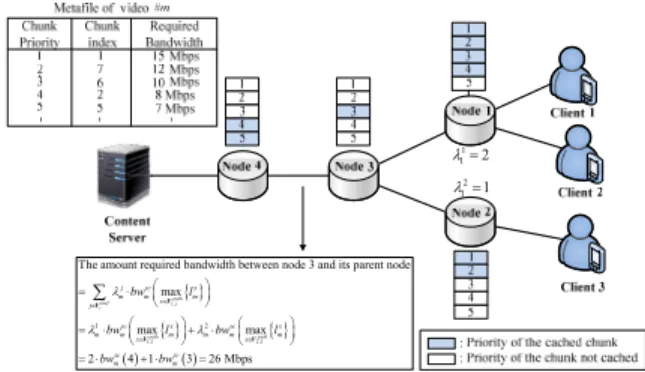
leaf nodej. Fig. 3 illustrates a tree example for the calculation of the amount of required peak bandwidth at a link.
FIGURE 3. An example to calculate the amount of required peak bandwidth.
Now, we can formulate the optimal problem to achieve our goal as follows.
Optimal Problem Formulation:Determinehim andlmi for ∀i ∈ V,∀m ∈ M with the tree topology information to minimize the total amount of required peak bandwidth
X mM X iV X jVleafi λj m.bw sc m0 max xVpathi,j {lmx} , (12) subject to X m∈M lmi −him≤Sics for ∀i∈V, (13) and him≤ max x∈Vpathi,j −{i} lmx for∀m∈M, ∀i∈V, ∀j∈Vleafi , (14) whereSicsis the CS capacity of the nodeiandM is the set of caching videos over the CCN tree. However, it is very difficult to obtain the optimal solution because the whole tree topology information and the caching status of all CCN nodes are needed. Furthermore, the computational complexity and the amount of control overhead increase exponentially accord-ing to the number of videos and nodes. The computational complexity of the full search for the optimal solution is
O n2|V||M|, and the amount of control overhead to deliver the global caching information is 2|V| |M|.
C. PROPOSED PROGRESSIVE CACHING SYSTEM
We simplify the above optimal problem to acquire a near optimal solution in a distributed way with a low computa-tional complexity and no addicomputa-tional control overhead. In the proposed caching system, each CCN node determines its own caching range in a distributive way, and effectively shares caching information with other nodes. The proposed system has no additional control overhead since it employs the reserved field of CCN interest/data packet headers to exchange caching information among CCN nodes. When new caching information arrives, each node updates its own caching range. These processes work iteratively to converge a near optimal solution. Compared with the optimal solution of
Protocol 1When an Interest Packet Arrives at the Nodei
Node i receives an interest packet for the chunk with prioritypin the video #mwithlinterest
Iflmi >linterest linterest ←lki End IF Iflminterest>linterest lminterest←linterest End IF IfCache miss
Forward the interest packet withlinterestto the next node λi
j,k ←λ i j,k+1 End IF
Protocol 2When a Data Packet Arrives at the Nodei
Nodeireceives a data packet for the chunk with priorityp
in the video #mwithldata, hdata, dhop
If hdata ≤lmi ≤ ldata hdata←him End IF Ifhdatam >hdata hdatam ←hdata End IF dmhop,p←dhop dhop←dhop+1
Forward the data packet withldata, hdata, dhopto the next node
the above problem, we can avoid a disastrous increase of the computational load and the control overhead. In this section, we describe the proposed caching system over the CCN tree in detail. First, the caching information exchanging protocol, and a simplified problem formulation is given to obtain a near optimal solution in a distributed way. Finally, the caching range determining processes are described in detail.
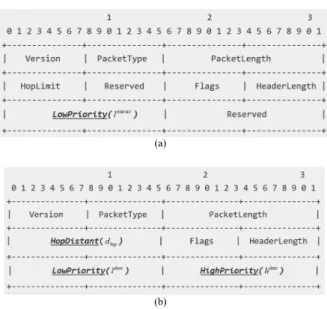
1) CACHING INFORMATION EXCHANGING PROTOCOL In the proposed caching system, the total amount of required peak bandwidth is associated with the lowest/highest priority values, hop distance, and request rate. To share caching infor-mation with CCN nodes, we propose a caching inforinfor-mation exchanging protocol by modifying the reserved fields of the existing CCN interest/data packet headers. Fig. 4 represents the modified header structure of CCN packets. If the lowest priority value of the cached chunks at a node is lower than theLowPriorityfield (linterest) of the arriving interest packet, thenlinterestis updated with the lowest priority of the cached chunks at the node. And the node store the minimumlinterest
for each video #min lminterest. If the highest priority of the cached chunks at a node is between the LowPriority field (ldata) and theHighPriorityfield (hdata) of the arriving data packet,hdatais replaced with the highest priority of the cached chunks at the node. TheHopDistancefield (dhop) is updated to dhop +1. And the node stores the minimum hdata for each video #minhdatam . By using these protocols, every node
FIGURE 4. Modified header structure of CCN packets: (a) interest packet and (b) data packet (the changing parts are written in Italic font).
AlgorithmCaching Range Determining Process
Input:lminterest,hdatam ,λim,p,dmi,pfor∀m∈ M and 1≤ p≤
Nmchunk Output:lmi,himfor∀m∈M For∀m∈M him←lmmin,lmi ←hminm End For For∀m∈M Forlmi +1≤x≤Nmchunk µi m(x)← x P p=lim (bwscm(p+1)−bwscm(p))·λim,p·dmi,p x−li m End For End For ncachei ← P m∈M lmi −him
A=Sort (m,x) in the descending order byµim(x)
For all (m,x)∈A If x>lmi andncachei +x−lmi ≤SiCS ncachei ←ncachei +x−lmi lmi ←x End IF End For
Requests and caches the chunks within the caching range betweenhimandlmi for∀m∈M
can obtain the hop distance, request rate of each chunk, and caching information. It is summarized in the following:
Fig. 5 shows how the proposed system delivers the low-est/highest priority values, hop distance, and the request rate of each chunk to nodes by using the modified CCN packets. 2) SIMPLIFIED PROBLEM DESCRIPTION
We simplify the above optimal problem to obtain a near opti-mal solution in a distributed way. When caching information
FIGURE 5. An example of interest and data packet delivery mechanism to provide the lowest/highest priority values, the hop distance, and the request rate to the node i.
such as the lowest/highest priority values, hop distance and request rate of each chunk is delivered at the nodeias shown in Fig. 5, we can calculate the expected amount of reduced peak bandwidth by caching a chunk with priority p in the video #mat the nodeias follows.
bwscm(p+1)−bwscm(p)·λi
m,p·dmhop,p, (15) whereλi
m,pis the request rate of the chunk with prioritypin the video #m.dmi,p is the hop distance between the cached node to the node i. Now, we simplify the above optimal problem as follows.
Simplified Problem Formulation at the Node i:Determine
him andlmi for ∀m ∈ M to maximize the total amount of reduced peak bandwidth
X m∈M li m X p=hi m bwscm(p+1)−bwscm(p)·λi m,p·d hop m,p, (16) subject toX m∈M lmi −him≤Sics, (17)
and him≤lminterestandlmi ≥hdatam for∀m∈M. (18) 3) CACHING RANGE DETERMINING PROCESS
We describe how to obtain a feasible solution of the simplified problem in detail based on the metafiles and the caching information exchanged among CCN nodes. In the proposed caching system,him andlmi are initialized by caching infor-mation delivered through interest/data packets. And then,
lmi increases greedily to maximize the total amount of reduced peak bandwidth. The caching range determining process is performed iteratively from external nodes to the root node until the amount of required peak bandwidth converges. The details of the caching range determining process at the nodei
are presented below. STEP 1) Initialization:
Initialize the highest/lowest caching priorities for∀m∈M.
himandlmi are initialized tolminterestandhdatam , respectively. STEP 2) Calculation of the average amount of reduced peak bandwidth per cacheable chunks:
Generate a possible set of (m,x) for∀m ∈ M andlmi + 1 ≤ x ≤ Njchunk. For all generated sets of (m,x), calculate the average amount of reduced peak bandwidth per cacheable
chunkµi m(x)as follows µi m(x)= x P p=li m bwscm(p+1)−bwscm(p)·λim,p·dmi,p x−lki . (19)
STEP 3) Determination of the caching range:
Find the maximumx for each video #mthat satisfies the limited CS capacity constraint of Eq. (17) by examining all in descending order byµim(x). And then,lmi is set tox for each video #m.
III. EXPERIMENTAL RESULTS
During the experiments, the proposed caching system is implemented using the ndnSIM [26] for large-scale network environments and a real cellular wireless network testbed is realized with a Raspberry Pi [28] and CCNx [30]. We use three video sequences, ‘‘Elephants-Dream’’, ‘‘Of-Forests-And-Man’’, and ‘‘RedBull-Playstreet’’, with an average bit rate of 1Mbps and 24 frames per second. It is assumed that the video requests follow the Zipf distribution or uniform distribution. Zipf parameter is set to 1.1. The chunk size (Schunk) is set to 8 KB. The total amount of required peak bandwidth is measured every 600 s and the caching range determining process is performed iteratively every 600 s. The maximum number of cacheable chunks (Sics) is set to 700 at all CCN relay nodes.
A. PERFORMANCE COMPARISON WITH EXISTING CACHING SYSTEMS
In this section, we demonstrate the performance of the proposed caching system. In the simulations, we employ two k-ary tree topologies for large-scale environments as shown in Fig. 6. In literature, a k-ary tree has been used as a CCN tree topology to evaluate caching system per-formance [14], [15], [17], [24]. The asymmetric tree topol-ogy is composed of a content server, 23 CCN relay nodes, and 39 clients. The symmetric tree topology illustrated in Fig. 6 (b) is composed of a content server, 25 CCN relay nodes, and 45 clients. The available bandwidth for each link is set to 100Mbps and the transmission delay is set to 10ms.
Table 2 represents the total amount of required peak band-width for all content delivery routes. The route number indi-cates the route according to the order of depth-first. For example, Route #1 includes the CCN node #1 and #3, and Route #13 includes the CCN Node #2, #5, #6, and #12. As shown in Table 2, the total amount of required peak bandwidth decreases monotonically. This is because the pro-posed caching system always determines the caching range to minimize the total amount of required peak bandwidth.
Next, we compare the performance of the proposed caching system with that of five existing caching systems such as ProbCache [13], MPC [14], LRU [25], LFU [26], and the optimal solution obtained by CPLEX [34], which is a well-known software program for solving optimization problems. However, it is observed during the experiment
FIGURE 6. Simulation topologies: (a) asymmetric tree topology, (b) symmetric tree topology.
TABLE 2. The total amount of required peak bandwidth for all routes in an asymmetric tree topology.
that CPLEX requires approximately an hour to obtain the solution because the number of variables in the problem is approximately 130,000, and thus it is can be used as only a benchmarking for the performance comparison. The comparisons of total amount of required peak bandwidth according to tree network topology and content popularity are presented in Fig. 7. As shown in Fig. 7 (a) and (b), when the video requests follow a Zipf distribution, the total amount of required peak bandwidth of LFU is less than those of LRU
and ProbCache because LRU and ProbCache do not consider content popularity. While, as shown in Fig. 7 (c) and (d), when the video requests follow a uniform distribution, ProbCache shows a lower total amount of required peak bandwidth than LFU since LFU frequently replaces cached chunks with a similar video request rate. The proposed caching system provides the lowest total amount of required peak bandwidth compared with existing caching systems, regardless of tree network topology and content popularity. Furthermore, it is
FIGURE 7. Comparison of the total amount of required peak bandwidth: (a) Asymmetric tree topology & Zipf distribution, (b) Symmetric tree topology & Zipf distribution, (c) Asymmetric tree topology & Uniform distribution, (d) Symmetric tree topology & Uniform distribution.
apparently observed that the total amount of required peak bandwidth of the proposed caching system monotonically decreases and approaches the optimal solution by CLPEX.
B. PERFORMANCE VERIFICATION OVER REAL CELLULAR WIRELESS NETWORK TESTBED
In this section, we demonstrate the performance of the pro-posed caching system over a real cellular wireless network testbed. During the experiments, the proposed caching system has been fully implemented by using a Raspberry Pi, C/C++, CCNx, and Ubuntu MATE 16.04 [31]. Fig.8 (a) presents the network topology of the real cellular wireless network testbed that is constructed to emulate a cellular network such as a Long-Term Evolution (LTE) [29] and an LTE-Advanced (LTE-A) [33]. Fig. 8 (b) shows the web interface of the CCNx that represents cache statistics and the forwarding table at each node. The blue box indicates the activated interface. Therefore, the interest and data packets are delivered via UE1, eNB1, S-GW1, and the Content Server. Fig. 9 shows the location of the cellular network components in our laboratory.
FIGURE 8. Network topology for the real cellular wireless network testbed.
In addition, the network emulator (NetEM) [28] is employed to emulate a cellular network environment and generate back-ground traffic to limit the available bandwidth to 2.5Mbps. The video requests follow a uniform distribution.
TABLE 3. Changes in the highest and the lowest priority of the cached chunks.
TABLE 4. Summary of performance comparison with existing caching system.
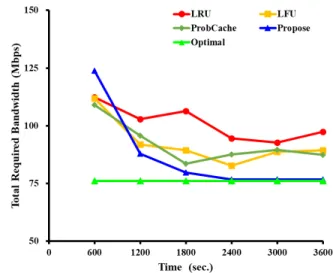
The changes in the highest and lowest caching priorities of the proposed caching system are represented in Table 3. In the proposed caching system, eNB1 firstly caches the chunks of ‘‘Elephants-Dream’’ because the video bitrates of ‘‘Elephants-Dream’’ are somewhat higher than those of ‘‘Of-Forests-And-Man’’ and ‘‘RedBull-Playstreet’’. The chunks of the ‘‘Of-Forests-And-Man’’ and ‘‘RedBull-Playstreet’’ are partially cached in eNB1, S-GW1, and P-GW. Cached chunks are replaced every 600 s until the required peak bandwidth converges. The proposed caching system gradually reduces the required peak bandwidth as shown in Fig. 10. Furthermore, it is shown that the proposed caching system has a lower required peak bandwidth than the existing caching systems and presents almost the same performance as CPLEX after converging.
FIGURE 9. Locations of cellular network components in the laboratory.
FIGURE 10. Comparison of the total amount of required peak bandwidth in the real cellular wireless network testbed.
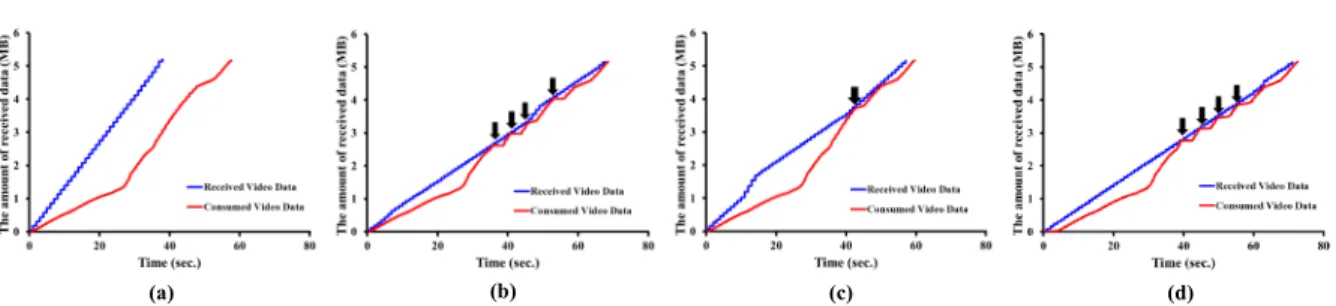
Finally, we compare the temporal video quality among the proposed caching system and existing caching systems. The number of buffer underflows and the buffering duration incur-ring unsmooth video playout are adopted as performance measures for temporal video quality. Figs. 11 and 12 provide the cumulative curves of received and consumed video data at UE #1. It is observed that the proposed caching system provides seamless video streaming for ‘‘Elephants-Dream’’ as all its chunks are cached at eNB1 due to the higher bitrate. When the test video sequence is ‘‘Of-Forests-And-Man.’’, the proposed caching system still achieves the lowest number of buffer underflows compared with other existing caching sys-tems as shown in Fig. 12. However, frozen video is sometimes detected since its chunks are partially cached at P-GW1 and S-GW1 in the proposed caching system. The average number of underflows and average buffering duration are summarized in Table 4. It is observed in the table that the proposed caching system provides the lowest average number of under-flows and buffering duration compared with other existing
FIGURE 11. Cumulative curves of the received video data and consumed video data in the case of ‘‘Of-Forests-And-Man’’: (a) Proposed caching system, (b) LRU, (c) LFU and (d) ProbCache (The black arrows indicate a buffer underflow).
FIGURE 12. Cumulative curves of the received video data and consumed video data in the case of ‘‘Elephants-Dream’’: (a) Proposed caching system, (b) LRU, (c) LFU and (d) ProbCache (The black arrows indicate a buffer underflow).
caching systems. Consequently, the proposed caching sys-tem provides streaming services while significantly reducing buffer underflow and buffering duration.
IV. CONCLUSION
In this paper, we have proposed a metafile based progressive caching system for seamless streaming services with high network utilization over the CCN tree. The proposed caching system considers caching range and content popularity to improve network utilization. First of all, we construct a metafile for the CCN to provide the cached chunk priority. Next, a caching information exchanging protocol is designed to efficiently deliver the caching information among CCN nodes. Based on this information, the proposed caching sys-tem determines the caching range of video data to minimize the required peak bandwidth for all links. The proposed caching system is examined by using not only simulations for various large-scale network environments, but also a real cellular wireless network testbed. Based on the simulations and experimental results, we have shown that the proposed caching system can support better video streaming services with reduced network stress.
REFERENCES
[1] Cisco Visual Networking Index, Global Mobile Data Traffic Forecast Update, 2016–2021, document C11-481360-01, Cisco Systems, San Jose, CA, USA, 2017, pp. 1–17.
[2] H. Che, Z. Wang, and Y. Tung, ‘‘Analysis and design of hierarchi-cal Web caching systems,’’ in Proc. IEEE INFOCOM, Apr. 2001, pp. 1416–1424.
[3] Y. Chen, L. Qiu, W. Chen, L. Nguyen, and R. H. Katz, ‘‘Efficient and adaptive Web replication using content clustering,’’IEEE J. Sel. Areas Commun., vol. 21, no. 6, pp. 979–994, Aug. 2003.
[4] A. Rowstron and P. Druschel, ‘‘Storage management and caching in PAST, a large-scale, persistent peer-to-peer storage utility,’’SIGOPS Oper. Syst. Rev., vol. 35, no. 5, pp. 188–201, Oct. 2001.
[5] V. Gopalakrishnan, B. Silaghi, B. Bhattacharjee, and P. Keleher, ‘‘Adaptive replication in peer-to-peer systems,’’ in Proc. 24th Int. Conf. Distrib. Comput. Syst., 2004, pp. 360–369.
[6] H. Shen, ‘‘An efficient and adaptive decentralized file replication algorithm in P2P file sharing systems,’’IEEE Trans. Parallel Distrib. Syst., vol. 21, no. 6, pp. 827–840, Jun. 2010.
[7] J. Wang, ‘‘A survey of Web caching schemes for the Internet,’’SIGCOMM Comput. Commun. Rev., vol. 29, no. 5, pp. 36–46, Oct. 1999.
[8] A. Vakali and G. Pallis, ‘‘Content delivery networks: Status and trends,’’ IEEE Internet Comput., vol. 7, no. 6, pp. 68–74, Nov. 2003.
[9] S. Androutsellis-Theotokis and D. Spinellis, ‘‘A survey of peer-to-peer content distribution technologies,’’ACM Comput. Surv., vol. 36, no. 4, pp. 335–371, Dec. 2004.
[10] A. Ioannou and S. Weber, ‘‘A survey of caching policies and forwarding mechanisms in information-centric networking,’’IEEE Commun. Surveys Tuts., vol. 18, no. 4, pp. 2847–2886, 4th Quart., 2016.
[11] A. Passarella, ‘‘A survey on content-centric technologies for the current Internet: CDN and P2P solutions,’’Comput. Commun., vol. 35, no. 1, pp. 1–32, 2012.
[12] V. Jacobson, D. K. Smetters, J. D. Thornton, M. F. Plass, N. Briggs, and R. L. Braynard, ‘‘Networking named content,’’ inProc. ACM CoNEXT, 2009, pp. 1–12.
[13] I. Psaras, W. K. Chai, and G. Pavlou, ‘‘Probabilistic in-network caching for information-centric networks,’’ inProc. 2nd Ed. ICN Workshop Inf.-Centric Netw., 2012, pp. 55–60.
[14] C. Bernardini, T. Silverston, and O. Festor, ‘‘MPC: Popularity-based caching strategy for content centric networks,’’ in Proc. IEEE ICC, Jun. 2013, pp. 3619–3623.
[15] K. Cho, M. Lee, K. Park, T. T. Kwon, Y. Choi, and S. Pack, ‘‘Wave: Popularity-based and collaborative in-network caching for content-oriented networks,’’ inProc. IEEE INFOCOM WKSHPS, Mar. 2012, pp. 316–321.
[16] K. Suksomboonet al., ‘‘PopCache: Cache more or less based on content popularity for information-centric networking,’’ inProc. IEEE Conf. Local Comput. Netw. (LCN), Oct. 2013, pp. 236–243.
[17] J. Renet al., ‘‘MAGIC: A distributed MAx-gain in-network caching strategy in information-centric networks,’’ inProc. IEEE Conf. INFOCOM Workshop, Apr./May 2014, pp. 470–475.
[18] Y. Wang, Z. Li, G. Tyson, S. Uhlig, and G. Xie, ‘‘Design and evaluation of the optimal cache allocation for content-centric networking,’’IEEE Trans. Comput., vol. 65, no. 1, pp. 95–107, Jan. 2016.
[19] J. Sung, M. Kim, K. Lim, and J.-K. K. Rhee, ‘‘Efficient cache placement strategy in two-tier wireless content delivery network,’’ IEEE Trans. Multimedia, vol. 18, no. 6, pp. 1163–1174, Jun. 2016.
[20] C. Li, L. Toni, J. Zou, H. Xiong, and P. Frossard, ‘‘QoE-driven mobile edge caching placement for adaptive video streaming,’’IEEE Trans. Multime-dia, vol. 30, no. 4, pp. 965–984, Apr. 2018.
[21] Z. Su, Q. Xu, F. Hou, Q. Yang, and Q. Qi, ‘‘Edge caching for layered video contents in mobile social networks,’’IEEE Trans. Multimedia, vol. 19, no. 10, pp. 2210–2221, Oct. 2017.
[22] Z. Miao and A. Ortega, ‘‘Scalable proxy caching of video under storage constraints,’’IEEE J. Sel. Areas Commun., vol. 20, no. 7, pp. 1315–1327, Sep. 2002.
[23] H. R. Oh and H. Song, ‘‘Metafile-based scalable caching and dynamic replacing algorithms for multiple videos over quality-of-service net-works,’’ IEEE Trans. Multimedia, vol. 9, no. 7, pp. 1535–1542, Nov. 2007.
[24] S. Williams, M. Abrams, C. R. Standridge, G. Abdulla, and E. A. Fox, ‘‘Removal policies in network caches for World-Wide Web documents,’’ inProc. ACM SIGCOMM, Aug. 1996, pp. 293–305.
[25] W. K. Chai, D. He, I. Psaras, and G. Pavlou, ‘‘Cache ‘less for more’ in information-centric networks (extended version),’’Computer Commun., vol. 36, no. 7, pp. 758–770, Apr. 2013.
[26] J. T. Robinson and M. V. Devarakonda, ‘‘Data cache management using frequency-based replacement,’’ inProc. ACM SIGMETRICS Conf. Meas. Modeling Comput. Syst., May 1990, pp. 134–142.
[27] A. Afanasyev, I. Moiseenko, and L. Zhang, ‘‘ndnSIM:NDN simulator for NS-3,’’ Univ. California, Los Angeles, CA, USA, NDN Project, Tech. Rep. NDN-0005, Jul. 2012.
[28] Stephen Hemminger. (2005).Network Emulation With NetEm. [Online]. Available: https://linux.conf.au/
[29] Raspberry Pi 3. Accessed: Apr. 9, 2019. [Online]. Available: https://www.raspberrypi.org
[30] CCNx. Accessed: Apr. 9, 2019. [Online]. Available: https://github.com/ProjectCCNx/ccnx
[31] Ubuntu Mate. Accessed: Apr. 9, 2019. [Online]. Available: https:// ubuntu-mate.org/
[32] D. Astely, E. Dahlman, A. Furuskär, Y. Jading, M. Lindström, and S. Parkvall, ‘‘LTE: The evolution of mobile broadband,’’IEEE Commun. Mag., vol. 47, no. 4, pp. 44–51, Apr. 2009.
[33] Technical Specification Group Radio Access Network; Requirements for Further Advancements for Evolved Universal Terrestrial Radio Access (E-UTRA) (LTE-Advanced) (Release 12), document TR 36.913 v12.0.0, 3GPP, Sophia Antipolis, France, Sep. 2014.
[34] CPLEX. Accessed: Apr. 9, 2019. [Online]. Available: https://www. ibm.com/analytics/cplex-optimizer
HYUNMIN NOHreceived the B.S. degree from the School of Computer Science and Engineering, Hanyang University, South Korea, in 2015. He is currently pursuing the Ph.D. degree in computer science and engineering with the Pohang Uni-versity of Science and Technology (POSTECH), South Korea. His research interests are in the areas of content centric networking, software-defined networking, and multimedia networking.
HWANGJUN SONGreceived the B.S. and M.S. degrees from the Department of Control and Instrumentation (EE), Seoul National University, South Korea, in 1990 and 1992, respectively, and the Ph.D. degree in electrical engineering-systems from the University of Southern California, Los Angeles, CA, USA, in 1999. From 2000 to 2005, he was an Assistant Professor/Vice Dean of admission affairs with Hongik University, Seoul, South Korea. Since 2005, he has been with the Department of Computer Science and Engineering, Pohang University of Science and Technology (POSTECH), South Korea. He was a courtesy Associate Professor with the University of Florida, on sabbatical leave (2011–2012), and has served as the Vice President of the Korean Institute of Information Scientists and Engineers (2016–2017). He was an APSIPA Distinguished Lecturer (2017–2018). His research interests include multime-dia signal processing and communication, image/video compression, digital signal processing, network protocols necessary to implement functional image/video applications, and network control systems. He is an Editorial Board Member of theJournal of Visual Communication and Image Repre-sentationand an Associate Editor of theJournal of Communications and Networks. He has served as an Editorial Board Member of theInternational Journal of Vehicular Technologyand a Guest Editor of the Special Issue on Network Technologies for Emerging Broadband Multimedia Services in theJournal of Visual Communication and Image Representationand the Special Issue on Wireless and Mobile Networks in theInternational Journal of Ad Hoc and Ubiquitous Computing.