Monitoring
Database
Objects
Tore Risch
Hewlett-Packard
Laboratories
1501 Page Mill Rd., Palo Alto, CA94303
Abstract
A method is described for actively interfac- ing an Object-Oriented Database Manage- ment System (OODBMS) to application pre grams. The method, called a database moni- tor, observes how values of derived or stored attributes of database objects change over time. Whenever such a value change is ob- served, the OODBMS invokes tracking pro- cedures within running application programs. The OODBMS associates tracking procedures and the object attributes they monitor, and it invokes appropriate tracking procedures when data changes. Use is made of atomic transac- tions in the OODBMS.
The applicability of monitors is localized both in time and space, so that only a minimal amount of data is monitored during as short a time as possible. Such localization reduces the frequency of tracking procedure invoca- tion, makes it easy to add and remove mon- itors dynamically, and permits efficient imple- mentation.
To demonstrate these ideas, an implementa- tion is described for the Iris OODBMS [lo]. The implementation uses a technique of partial view materialization for efficient implementa- tion.
1
Introduction
Database monitors are computer programs that observe changes in the contents of database objects, e.g. the current price of some commodity or the location of some
Permission fo copy without fee all or pari of this mate&l is
granted provided that the copies are not made o+ distributed for direct commercial advantage, the VLDB copyzighl notice and the Me of the publication and its date appear, and notice is given that copying is by permission of the Very Large Dolo Base Endowment To copy otherwise, or Lo republish, requires a fee and/or special permission from the Endowment.
Proceedings of the Fifteenth International
ship. In addition to stored facts one often wants to mon- itor derived information, e.g. the highest paid employee in a department or the expenses of a department rela- tive to its sales. Other monitoring applications include real time systems where a process is invoked or where a user is alerted upon pre-specified data changes. The need for similar concepts has been indicated by others [7, 18,, 20, 30, 311.
The monitoring mechanism described in this paper is integrated with the Iris object-oriented database system [lo]. In Iris, both derived and stored object attributes can be defined using functions expressed by an object- oriented query language, OSQL [3].
A tracking procedure is a procedure in a running ap plication program to be invoked if the value of an as- sociated object attribute has changed because of state changes to the database. We use OSQL to specify the derived or stored associated attribute. The DBMS does not transmit monitored data to tracking procedures; it merely signals that the state of derived data has changed by invoking tracking procedures. It is up to the tracking procedures to retrieve data by accessing the database. Possible tasks for tracking procedures in- clude notifying the end user that data have changed, re- freshing data browsers, or passing information to other systems. In case the application program caches data retrieved from the DBMS, tracking procedures can be used to inform the application that pieces of the cached data have been invalidated by database updates, so that caches can be refreshed and computations dependent on the old caches can be undone.
.
In the architecture presented here, the DBMS stores associations between tracking procedures, the at- tributes they monitor, identifiers of application pr+ cesses, and the physical workstations in which they re- side. After the DBMS has detected changes in moni- tored data it uses this information to call the appropri- ate tracking procedures. We then say that the appli- cation process has been notified or that the DBMS has sent a notification to the process.
In conventional database interfaces the DBMS be- haves as a ‘passive object’ in that an application pro- gram always must request service from the DBMS. With
monitors, the DBMS becomes an ‘active object’; a re- quest from an application process to the DBMS may result in procedure invocations in other application pro- cesses.
Tracking procedure invocations can be either local or external. An invocation is local if the process contain- ing the invoked tracking procedure also requested the triggering database updates. An invocation is external if it is the result of a database update by some other process. External tracking procedure invocations do not occur until after the updates have been committed, while local invocations occur before the commit. Thus at the end of an update transaction, the DBMS first in- vokes local tracking procedures in the updating process and then immediately after the commit, the DBMS in- vokes external tracking procedures. The local tracking procedures are invoked synchronously, i.e. the system waits for them to return, while the external tracking procedures are invoked asynchronously and the system does not wait for them to return. Since a process may be performing unrelated work when the tracking proce- dure is invoked asynchronously, the system provides a no-interrupt option. In this mode the DBMS accumu- lates notifications and the application process can check for them synchronously.
2
Related
work
This section discusses related techniques from several research areas. The database field has the notions of alerters, triggers, and integrity constraints, while the programming language field has the idea of active val- ues. These ideas are somewhat related to data driven expert systems.
In [7] it is proposed that alerters be displayed when database updates cause certain boolean conditions to become true. This is a common special caSe of mon- itoring a boolean value. The RETRIEVE ALWAYS mechanism of Postgres [30] re-retrieves the results of queries into ‘portals’ associated with each client when- ever there is a data change. Our monitoring mechanism is different from the above methods because the DBMS calls procedures in the client processes instead of send- ing data. In addition we employ methods, described below, that localize the applicability of monitors both in time and space.
Some DBMSs, e.g. System R [l], use database pro- cedures called ‘triggers’ that are invoked upon updates of either user-specified base relations or by other ac- tions [8, 161. The ECA model [8] is a generalization of triggers in which the programmer can declare a pre- condition for the trigger. Triggers can be chained so that one update triggers another. This is useful for maintaining integrity constraints. However, the compli- cated cascading of triggers can make the database struc- ture tangled and difficult to understand and maintain. Moreover, improper use of cascading triggers may slow down database updates considerably. In contrast, the
invocation mechanism described here is non-procedural. The user specifies a database query whose value states are to be monitored, leaving the system to keep track of actions that may change a monitored state. In ad- dition, the system creates an optimized mechanism to invoke tracking procedures when appropriate.
The technique called access-oriented programming, or ‘active values’, used in object-oriented programming languages such as Loops [28] is similar to traditional, procedural database triggers. But unlike DBMSs, ac- tive values are restricted to a single-user environment. Active values typically set properties or display some value. It is important that active values can be dynam- ically added to and removed from running systems [21], so that their use does not interfere with the logic of the rest of the system.
Declarative integrity constraint methods [4, 11, 18, 20, 23, 27, 291 are related to the monitor model in that they monitor boolean conditions, typically cancelling the updating transaction if the boolean conditions are unsatisfied at commit time. Tracking procedures, by contrast, are local to the application program process, are active during limited time periods, are triggered by value changes of any data type, can perform many tasks, and can be invoked both locally inside the updating transaction and asynchronously in processes outside the transaction. The tracking procedure may cancel the transaction only when invoked locally.
Database integrity constraints typically have perfor- mance problems [2]. The reason for this is that they may be very expensive to check for every update. Sev- eral techniques have been proposed to attack this prob- lem, e.g. limit the assertions so that only those relevant to the updates of the particular file are checked [ll, 191; symbolically simplify the constraints checked per file [7, 111; maintain intermediate aggregation data [4, 151; exploit semantic constraint simplification [23]; simplify and check all constraints after many updates [12]; dis- tribute constraints over several processors [24]; or auto- matically generate consistency maintenance code from declarative integrity constraints [18, 19, 20, 231. These techniques are applicable to the monitor model as well. The monitor model avoids the efficiency problems of global integrity constraints, by being localized both in time and in the amount of data monitored, and by al- lowing asynchronous execution outside updating trans- actions.
Cactis [13] is an OODBMS to support software en- vironments in which each data item is time stamped when updated. This allows the system to know what to recompile when the user retrieves an object. By con- trast, our method checks if monitored data have actu- ally changed, in which case the tracking procedures are invoked.
We may also contrast the present work with some data driven expert system tools like Syntel [Q, 25, 261 and OPS5 (61. Syntel is a tight integration of a database, an expert system tool and a user interface,
specialized for financial applications. Syntel monitors a moderate amount of virtual memory data retrieved from persistent data and user input. In Syntel all shared data is passive, and there is no feedback from the persis- tent data to Syntel. By contrast, the method presented here monitors interactions between multiple users and their active and shared persistent large database inde- pendent of applications and user interfaces. The meth- ods presented here may be used to extend the scope of data-driven systems like Syntel or forward chaining, rule-based systems like OPS5, making it possible to de- sign systems where several expert systems cooperate.
3
An example
The following example of an Iris database will be used later to illustrate the monitor model. Assume a database of ‘Person’ and ‘Department’ objects with the attributes Name, Income, and Dept for objects of type Person and the attributes DeptName and Manager for objects of type Department.
The objects types can be defined by the OSQL state- ments:
create Type Person; create Type Department;
The attributes of the above types are accessed using eztensional Iris functions with OSQL definitions: create Function Name(Person) -> String; create Function Income(Person) -> Integer; create Function Dept(Person) -> Department;
create Function DeptName(Depaxtment) -> String;
create Function Manager(Depsutment) -> Person;
For example, given an object identifier (i.e. a surro- gate), p, for a person, we may access its income and department name by the OSQL queries:
select Income(p);
select DeptName(Dept (p>) ;
We may also set the value of an attribute by OSQL statements, e.g.:
set Income(p) = 41000;
These statements define the object types Person and Department. Iris also allows different views of objects by defining intensional Iris functions. For example, we may want to work with a view of the Person object with the attributes Name, Income, DeptName (as a string),
MgrName (as a string), EarnsMoreThanManager (as a
Boolean), and ColleaguesEarningMore (as a set of tu- ples of their names and incomes).
Such view of a Person object can be defined by the following Iris functions:
create function Name(Person) -> String;
/* extensional */
create function Income(Person) -> Integer;
/* extensional */
create function DeptName(Person p) -> String as select DeptName(Dept(p));
/* intensional */
create function MgrName(Person p) -> String as select Name(Manager(Dept(p)));
/* intensional */
create function EarnsHoreThanManager(Person p)
-> Boolean as select where
Income(Manager(Dept(p))) < Income(p);
/* intensional */
create function ColleaguesEarningMore(Person p)
-> <Person, Integer>
as select each Person ~011, Integer inc
where inc = Income(col1) and
inc > Income(p) and Dept(col1) = Dept(p);
/* intensional */
Thus an application may have the above view of the Per- son object, not even knowing how attributes are physi- cally stored.
Iris functions can also have more than one argument, e.g. to retrieve those persons earning more than agiven income in a given department:
create function HighInc(Department d, Integer i)
-> Boolean
as select each Person p
where Income(p) > i and Dept(p) = d;
4
Design
overview
We will now continue by discussing some critical aspects of the architecture:
Efficiency is gained by minimizing the amount of monitored data and by allowing monitors to be ac- tive only while applications need them.
We also gain efficiency by separately performing the expensive process of compiling monitor defini- tions, and storing the analyzed definitions in the database for later use.
Application processes may’ receive asynchronous notifications while performing an unrelated task. Such processes will be interrupted by the DBMS to invoke the tracking procedures asynchronously. The DBMS does not wait for such asynchronous calls to return, to maximize system performance. Notifications of external tracking procedures must be delayed until just after transactions are commit- ted.
The DBMS must handle distributed notifications to client processes executing on separate machines. Finally, we must efficiently detect when values of monitored queries have changed.
4.1 Localizing Monitors
The monitor model handles common situations occur- ring in a serverized, shared, object-oriented DBMS such as Iris. Efficient execution is obtained from a relatively simple implementation.
One common situation involves monitoring values of properties of a given object. The properties may be either stored or derived from other properties. Often, monitoring is needed only during the execution of par- ticular sections of an application process.
For example, we may wish to monitor the values of
attributes Income, ColleaguesEarningMore, and
EaxnsMoreThanHanager of a Person object view, p, in- voking the tracking procedures Mpl, Mp2, and Mp3, re- spectively, when any of these values changes.
We provide restricted monitors for efficient execution of common situations, as follows:
l The monitors can be time localized so they are ac- tive only during a limited time, e.g. when a seg- ment of an application program requires them to be active. We must therefore provide for efficient activation and deactivation of monitors.
l The monitors can be client localized by associating monitors with client processes. The system deacti- vates monitors when no client needs them. l The monitors can be object localized by monitoring
values of particular, or focused database objects, e.g. properties of specific persons. During the ex- ecution of an application program the monitor’s focus may change from one object to another, i.e. the functions will be monitored for different argu- ments. Therefore the system should be reasonably efficient in refocusing from one object to another. l The monitors can be property localized so that not
every property of a database object is monitored. In the example, only the attributes Income, Col-
leaguesEarningMore, and EarnsMoreThanMan-
ager are monitored, not, e.g. Manager and Name. This restriction is important, since an object view may have many attributes.
In Iris, all the above localizations are supported.
4.2 Monitor Definition and Activation
Time localization requires efficient monitor activation and deactivation. This is achieved by separating mon- itor activation and deactivation from monitor creation and deletion, thereby performing as much work as early as possible at monitor creation time.
Monitor creation analyzes the monitored query and dynamically builds persistent tables and indexes to sup- port efficient tracking. Monitor creation is therefore relatively slow. Monitors remain in the database un- til they are explicitly deleted. Monitors are generic in that they may be subsequently activated for different sets of arguments; we say that there are many monitor
instances for a given monitor definition.
An application program typically focuses on differ- ent database objects during different time periods. The system thus has to support efficient changes in the set of focused objects. In Iris this amounts to an efficient method to vary arguments of monitored Iris functions. To refocus a monitor from one object to another we simply deactivate the monitor for one object and then activate it for another object.
Iris also supports overloaded functions. These cur- rently cannot be monitored.
The following functions are provided for monitor cre- ation and activation:
DefineMonitor( creates a new monitor; Iris
data structures are created to support subsequent activation of the created monitor. Any Iris query can be monitored by first defining it as an Iris func- tion and then defining a monitor for that function.
ActivateMonitor(Fn,Arglist,Proc), activates a
monitor for a given Iris function, set of arguments, and tracking procedure within the current applica- tion process. The system will subsequently invoke the tracking procedure on changes to monitored object values.
DeactivateMonitor(Fn,Arglist), deactivates a
monitor for the given Iris function and arguments in the current process.
DeleteHonitor(Fn), deletes a monitor definition permanently.
Def inenonitor creates a new table for each monitor, definition called the instance client table. The instance client table is later updated by ActivateMonitor to store the network address and process identifier of each application process monitoring a given instance. The system also assigns a unique tracking procedure iden- tifier to each tracking procedure in each process and stores it in the instance client table. Thus, by loot- ing up the instance client table, the system will know which tracking procedures in which processes in which machines to notify when the instance is changed.
4.3 Notifying clients
After the database has been updated, one or more track- ing procedures may be invoked in case their monitored
function values were changed. The database server
must detect value changes of monitored Iris functions, and notify client processes to invoke their tracking pro- cedures.
The system only sends notifications after it has de- tected change to monitored data.
The actual time to check if updates make notifica- tions necessary may vary. The most common case is that monitor notifications are checked only at the end of a transaction, when the database is in a consistent state. Therefore, in the current implementation, checks for notifications are made at transaction commit. How- ever, the system provides an option for the application
program to check for notifications even before a trans- action is committed, by explicitly calling a procedure, CheckMonitors.
If CheckMonitors is called before a transaction is committed, and there have been updates to values mon- itored by that process, the system will invoke local tracking procedures of the application process. How- ever, notifications of monitors activated by other pro- cesses will always be delayed until just after the transac- tion is committed. The system works this way because transactions hide updates from other clients until they are committed. (If ‘dirty reads’ were allowed we could eventually relax this delay.)
Another option is to defer checking monitors alto- gether. Instead, CheckMonitors is called explicitly af- ter any number of transactions have been committed, or perhaps in some separately running process. This option has not been implemented.
Local tracking procedures are invoked because of lo- cal database updates. By contrast, external tracking procedures are invoked because of database updates by other processes. The external invocation may happen at any time, even when the application process is do- ing unrelated work. The notified client process is inter- rupted asynchronously when the notification arrives, in order to invoke the tracking procedure.
It is important to have the option of ignoring exter- nal monitor notifications, e.g. while processing a crit- ical section of code. When external notifications are accepted, we say the application process is in listening mode. The system provides a procedure to toggle be- tween listening mode and not listening mode.
When an application process is not in listening mode its monitor notifications will be collected by the system. Tracking procedure invocations will then be delayed un- til the procedure CheckMonitors is explicitly called or the process is toggled to listening mode.
4.4 Distributed Notification
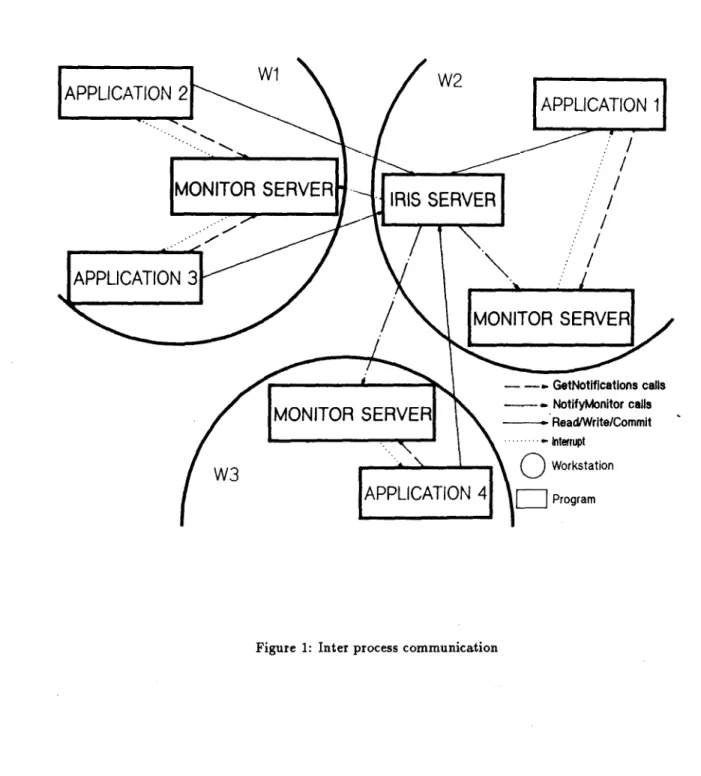
Since the application process may run on a worksta- tion other than the Iris server, we need a mechanism to handle the network communication involved in noti- fying a client. Such a communication architecture has been designed, by using the Network File System proto co1 for remote procedure calls. Figure 1 illustrates this architecture. 1
The basic idea is that every workstation running an Iris client must also run a monitor aeruer that takes care of receiving notifications and interrupting application processes az appropriate.
Given a notification, a remote procedure call, NotifyMonitor(ProcId,NonId), is made to the af- fected monitor server, informing the monitor server that
‘The inter process communication in the current imple- mentation is slightly more complicated than illustrated in Figure l., because the code to detect ‘changes is actually implemented as part of the client interface to Iris.
a notification has occurred to the monitor identified by Monid of the process identified by ProcId .
The monitor server saves the tracking procedure iden- tifiers for a given process in a main memory data struc- ture. It then interrupts the appropriate application pro- cess, signalling that some of its tracking procedures have been activated. In case the notified process has been terminated the system deletes the tracking procedure identifiers of that process from the monitor server and deactivates the monitor. When control returns back to the Iris server, the DBMS knows that the application process has been notified, but it is up to the application process to do something when the notification interrupt arrives.
If the application process is not in listening mode the interrupt signals are ignored. A later call to CheckMonitors first does a remote procedure call, GetNotifications(ProcId,MonIds), to the moni- tor server to access the tracking procedure identi- fiers activated for the application process identifier. GetNotifications then deletes the tracking procedure identifiers from the global data structure of the monitor server.
Given these tracking procedure identifiers,
CheckMonitors knows which application process proce- dure to invoke for the activated monitors.
If the application process is in listening mode, it catches all notification interrupts and then calls CheckMonitors immediately to asynchronously invoke notified tracking procedures.
If one or more notification interrupts arrive while an- other tracking procedure is running, the system will call CheckMonitors again after the first tracking procedure has finished executing. By this sequentialization, pro- grammers need not worry about recursive notifications of tracking procedures.
4.5 Change detection
The purpose of the change detection algorithm is to de- termine if the values of a monitored Iris function have changed since the last time its monitoring clients were notified. This process is initialized by notifying the monitoring client at the end of the transaction in which the monitor was activated. Then the system determines if the value of the monitored function has changed since the previous notification.
The current algorithm is rather simple, assuming that only a few objects are monitored per function and that the values of monitored properties are not very volumi- nous. It also assumes that the definitions of Iris func- tions are simple and fast to evaluate, a reasonable as- sumption if the functions are used to do simple deriva- tions such as those in the example.
The algorithm is designed to minimize the overhead of database operations when no monitor is created or active. It also minimizes the notification traffic; in par- ticular, notification occurs only when there is actually a value change and then only at monitor checking time.
I
nnr /w3
GetNotifications calls NotifyMonitor calls ‘ReadA4ritelCommit . Interrupt Workstation ProgramThe algorithm can be viewed as a variant of view materialization [5, 15, 171 whereby only the monitored instances of an Iris function are materialized, rather than the complete function traditionally materialized; thus we call the method partial view materialization. When an Iris function is defined, the system will also access-path-optimize the query to retrieve function val- ues given that all arguments are known. If there has been an update invalidating some partial view mate- rialization, the algorithm re-executes the access-path- optimized monitored function call for each monitored instance and compares the new values with the materi- alized values. If they are different, the new values are cached and the monitoring application processes are no- tified.
The change detection algorithm has four steps: l A local update detection procedure is called for ev-
ery Iris operation that updates the value of a stored Iris function [lo], independent of whether the func- tion is monitored or not. For every transaction, the system keeps track of Iris functions that have been updated. This procedure holds no locks and is very fast, associating with each transaction a virtual memory table of update-detected Iris func- tions. The size of this table is limited by the num- ber of Iris functions updated by the transaction.
l At monitor checking time, for every update-
detected Iris function, a monitor detection test is made to see if the updated functions participated in some monitor for some set of arguments. This is done by referring to a table, SupportsMonitors, that is updated by the system when monitors are created. This table maintains relationships be- tween updatable Iris functions and their associated monitored Iris functions. For example these are some value sets of SupportsMonitors:
SupportsMonitors(Income) = {Income, EarnsMoreThanManager, ColleaguesEarningMore) SupportsMonitors(Dept) = {EarnsMoreThanManager, ColleaguesEarningMore) SupportsMonitors(Manager) = {EarnsMoreThanManager)
SupportsMonitors is of limited size and can be kept in main memory.
l For every Iris function that was monitor-detected, a more expensive instance detection is done to test if its value changed. This detection is much slower than the previous ones, requiring re-execution of the pre-defined (and access-path-optimized) moni- tored Iris function in order to materialize the mon- itored instances and compare the new and old ma- terialized values.
The materialized values are stored in a system- generated table called the instance cache table. For
example, the monitor for ColleaguesEarningMore will generate an instance cache table
-MCA-ColleaguesEarningMore(Person) -> (Person, Integer>
l For every instance detection, a notification is sent to the client processes that had activated that in- stance. The process identifier is found in the in- stance client table that maps each monitored in- stance to a list of its client processes and track- ing procedures. Three levels of identification are needed :
A client ident$eridentifies the name (network address) of the workstation running each ap- plication process.
A process identifier identifies each (Unix) pre cess per workstation.
A tracking procedure identifier identifies each tracking procedure in each process.
4.6 Fetching notified data
The notification mechanism does not transmit any data to the client. Instead the application process may decide to re-retrieve monitored instances. This can be done using the standard Iris query language. However, since the partial view materialization algorithm also caches monitored instances, we make use of the instance cache table when fetching notified data. This is implemented by an interface between the notification mechanism and the Iris query language, so that queries are modified to make use of the instance cache table.
For example, assume that the application program makes the OSQL query:
select ColleaguesEarningMore(p);
and that ColleaguesEarningMore is monitored for Per- son p. The system wiIl modify the above query to access the instance cache table:
select JlCA~ColleaguesEarningMore(p);
thus avoiding any access path search. That is
ColleaguesEarningMore is a derived function defined in terms of the stored Iris functions Income and Dept. It is not required to compute the derived value again since it is already cached. This simple query modifica- tion can be made in the client process without accessing the Iris server.
When a tracking procedure is invoked, the system passes the system-created tracking procedure identifier and a flag indicating whether the tracking procedure is invoked locally or externally. By passing the track- ing procedure identifier, it is possible to write generic tracking procedures that can be used for many monitor definitions. A special primitive is provided to fetch the monitored data given such a tracking procedure identi- fier, using the instance cache table.
5
Summary
and Discussion
We have proposed and implemented a method to in- terface application programs to the Iris object-oriented database system by using monitors that activate ap- plication program tracking procedures whenever values of derived or stored attributes of objects change. The attributes are specified declaratively, using an object- oriented query language. Monitors are localized both in space and time by limiting the amount of monitored data to be object attribute values, and by being active only while application processes need them.
The time localization strategy requires fast methods to turn monitors on and off. Therefore we separate the (slow) process of defining monitors from their activa- tion and deactivation. Thus, monitor definition involves creation and update of database tables as well as opti- mizations for later monitor activations. A monitor that is created but not activated generates little overhead to database operations.
The application may run on a client workstation other than the database server. The system keeps track of which application processes on which workstations mon- itor which data, and automatically notifies application processes when monitored data change. Notification is done by invoking tracking procedures; external in- vocations may interrupt application processes and exe- cute asynchronously, without the DBMS waiting for the tracking procedures to terminate.
Monitors may improve the concurrency of object- oriented database systems by allowing for very short transactions instead of long transactions, and letting the notification mechanism broadcast notifications to affected clients when database updates are committed.
The monitor model is also useful for the construction of systems of data-driven cooperative processes by let- ting the DBMS activate processes given data updates, rather than letting the cooperative processes directly call each other. In this way concurrent process invoca- tions can be stated declaratively.
It is important that monitors execute efficiently and do not slow down the database server for applications not using them. The current implementation is effi- cient enough for some typical uses of database objects, where attribute definitions are specified using simple (thus fast) queries. More research is needed to extend the technique to handle complex queries.
The present change detection strategy could be com- bined with other strategies, such as those used for in- tegrity constraint checking [4, 7, 11, 12, 15, 18, 19, 20, 23,241. Sometimes the system should not need not save values to determine that a change has occurred. For ex- ample if a monitored query specifies the sum of a set of values of which only one has changed, we may deduce that the sum has changed without doing any material- ization.
The methods presented here are also applicable to relational DBMSs, by regarding Iris functions as re-
lational views. The method proposed by Wiederhold [32] can be used to define derived objects by relational views. (Iris has many additional object features, includ- ing a persistent hierarchical type system, and persistent object identifiers.)
The ‘monitor model could be generalized to handle integrity constraints, which can be regarded as uni- versal monitors activated continuously for all applica- tions. The tracking procedure for an integrity con- straint would always be locally invoked whenever the constraint is violated and it would always cancel the transaction. However, more research is needed to get good performance for such integrity constraint moni- tors, since they would not be localized and since they could not use asynchronous tracking procedure invoca- tions.
ACKNOWLEDGEMENTS:
I wish to thank Dan Fishman, Bill Kent, David Beech, and Waqar Hasan for helpful comments on earlier ver- sions of this paper.
References
Ill
PI
[31 141 PIPI
PI
PI
PI
M.Astrahan et al: System R: A Relational Ap- proach to Database Management, ACM tinsac- tions on Database Systems, 1 (2) June 1976. D.Badal, G.Popek: Cost Performance Analysis of Semantic Integrity Validation Methods, Proc. ACM SIGMOD Conf., 1979, pp109-115.
D.Beech: A Foundation for Evolution from Rela- tional to Object Databases, Advances in Databare Technology - EDBT ‘88, Lecture Notes in Com- puter Science, Springer-Verlag, 1988, ~~251-270. P.Bernstein, B.Blaustein, E.Clarke: Fast Mainte- nance of Semantic Integrity Assertions Using Re- dundant Aggregate Data, Pn-x. 6th VLDB Conf., 1980, ~~126-136.
J.A.Blakeley, P.A.Larson, F.W.Tompa: Efficiently Updating Materialized Views, Proc. SIGMOD, Washington D.C., 1986, ~~61-71.
L.Brownston, R.Farell, E.Kant, N.Martin: Pro- gramming Ezpert Systems in OPS5, Addison- Wesley, Reading, MA, 1985.
O.P.Buneman, E.K.Clemons: Efficiently Monitor- ing Relational Databases, ACM Tmnsactions on Database Systems 4, 3 (Sept. 1979), ~~368-382. U.Dayal, A.P.Buchmann, D.R.McCarthy: Rules Am Objects Too: A Knowledge Model
FOT
An Ac- tive, Object- Oriented Databwe System, Advances in Object-Oriented Database Systems, 2nd Intl. Workshop on Object-Oriented Database Systems, Sept. 1988, pp129-143.R.O.Duda, P.E.Hart, R.Reboh, J.Reiter, TRisch: Syntel: Using a functional language for financial
[lOI
IllI
WI
1131
WI
PI
WI
1171
I181
WI
PI
WI
WI
risk assessment, IEEE Expert 2, 3 (Fall 1987), ~~18-31
D.H.Fishman, D.Beech, H.P.Cate, E.C.Chow,
T.Connors, J.D.Davis, N.Derrett, C.G.Hoch,
W.Kent, P.Lyngbaek, B.Mahbod, M.A.Neimat,
T.A.Ryan, M.C.Shan: Iris: An Object-Oriented
Database Management System, ACM TOOIS, 5,
1 (Jan 1987), pp48-69
M.Hammer, D.McLeod: A Framework for
Database Semantic Integrity, Proc. 2nd Int. Conf.
on Software Engineering, San Fransisco, 1976,
pp498-504.
A.Hsu, T.Imielinski: Integrity Checking for Multi- ple Updates, Proc. ACM SIGMOD Conf., Austin, 1985, ~~152-168.
S.E.Hudson, R.King: Object-Oriented Database
Support for Software Environments, Proc. ACM
SIGMOD Conf., San Fransisco, 1987, pp491-502.
W.Kim, D.S.Reiner, D.S.Batory: Qzlery Process-
ing in Database Systems, Springer-Verlag, New
York, 1985.
S.Koenig, R.Paige: A transformational framework for the automatic control of derived data, 7th
VLDB Conf., 1981, ~~306-318.
A.M.Kotz, K.R.Dittrich, J.A.Mulle: Supporting
Semantic Rules by a Generalized Event/Trigger
Mechanism, Advances in Database Technology -
EDBT ‘88, Lecture Notes in Computer Science,
Springer-Verlag, 1988, pp76-91.
B.Lindsay, L.Haas, C.Mohan, H.Pirahesh,
P.Wilms: A Snapshot Differential Refresh Algo-
rithm, Proc. SIGMOD, Washington D.C., 1986,
~~53-60.
M.Morgenstern: Active Databases as a Paradigm
for Enhanced Computing Environments, 9th
VLDB Conf., Florence, 1983, ~~34-42.
M.Morgenstern: CONSTRAINT EQUATIONS:
Declarative Expression of Constraints With Auto- matic Enforcement, Proc. 10th VLDB Conf., Sin- gapore, 1984, pp291-300.
M.Morgenstern: The Role of Constraints in
Databases, Expert Systems, and Knowledge Rep-
resentation, in L.Kerschberg ed.: Ezpert Database
Systems, Benjamin Cummings, Menlo Park, CA,
1986.
K.Osterbye: Active Objects: An Access Oriented
Framework for Object-Oriented Languages, Jour-
nal of Object-Oriented programming, Vol. 1, No 2, (June/July 1988), ~~6-10.
J.Park, A.Segev: Using Common Subexpressions
to Optimize Multiple Queries, Proc. 4th Intl. Conf. on Data Engineering, Los Angeles, 1988, pp311- 318.
P31
1241
P51
PI
WI
PI
PI
[301
1311
WI
X.Qian, G.Wiederhold: Knowledge-based Integrity
Constraint Validation, Proc. 12th VLDB Conf.,
Kyoto, Japan, 1986, ~~3-12.
X.Qian: Distribution Design of Integrity Con-
straints, Proc. 2nd Intl. Conf. on Ezpert Database Systems, Virginia, 1988, ~~75-84.
R.Reboh, T.Risch: Syntel: Knowledge pro-
gramming using functional representations, Proc.
AAAI-86 (Philadelphia, PA, Aug), Morgan Kauf-
man, Los Altos, CA, 1986, pp1003-1007.
TRisch, R.Reboh, P.Hart, R.Duda: A Functional Approach to Integrating Database and Expert Sys- tems, Communications of the ACM 31, 12 (Dec. 1988), ~~1424-1437.
A.Shepherd, L.Kerschberg: PRISM: A knowledge
based system for semantic integrity specification and enforcement in database systems, Proc. ACM
SIGMOD Conf., Boston, MA, 1984, ~~307-315.
M.J.Stefik, D.G.Bobrow, K.M.Kahn: Integrating
access-oriented programming into a multiparadigm environment, IEEE Software 3, 10 (Jan. 1986), ~~10-18.
M.Stonebraker: Implementation of Integrity Con- straints and Views by Query Modification, Proc.
ACM SIGMOD Conf., San Jose CA, May 1975.
M.Stonebraker: The Design of POSTGRES, Proc.
ACM SIGMOD Conf., Washington, D.C., 1986,
pp340-355.
M.Stonebraker: Future Trends in Data Base Sys- tems, Proc. 4th Intl. Conf. on Data Engineering, Los Angeles, 1988, ~~222-231.
Wiederhold, G.: Views, objects, and databases, IEEE Computer 19(12) 1986, pp.37-44.