Power and exponential functions
Overview:As we will see in later chapters, many mathematical models use power functionsy=xn and
exponential functions y=bx. The definitions and basic properties of these functions, which are studied in precalculus courses, are reviewed in this section. We will discuss applications of these functions in later chapters, beginning with Chapter 4, where we study their derivatives. We also describe here how formulas for functions can be modified to translate, reflect, expand, and contract their graphs, The section closes with notes on the history of analytic geometry.
Topics:
• Power functions
y
=x
n and their graphs • Vertical and horizontal translation• Reflection, magnification, and contraction
• Exponential functions
y
=b
x and their graphs • Laws of exponents• Historical notes
Power functions
Apower functionis a function of the formy=xn, wherexis the variable andnis a constant. Ifnis
a positive integer, thenxn equals the product ofn x’s, as in the formulax3=x·x·x. If nis a positive fraction, p/q, thenxn =xp/q is theqth root of thepth power of x, which also equals thepth power of theqth root ofx. In the case ofn= 53, for example, we have
xn=x5/3= √3x5 =
√3x
5.If nis a negative integer or fraction, so that n=−m withm a positive integer or fraction, then xn equals 1/xm, as in the formulas
x−3= 1 x3 = 1 x·x·x x−5/3= 1 x5/3 = 1 3 √ x5 = 1
√3 x5 .To have formulas and identities involving xn apply with zero exponents,x0 is defined to be 1 for allx.
If nis not an integer or a fraction, it isirrational and has an infinite decimal expansion, which
is used to define xn for positive x. The irrational number √2, for example, has the decimal expansion √
2 = 1.4142135623. . ., and if we want to define 10√2, we letn1= 1.4 be the number obtained by taking
only one digit after the decimal point in the expansion of √2, let n2 = 1.41 be the number obtained
by taking two digits after the decimal point, and so forth. This gives us an infinite string of rational numbersn1, n2, n3, . . . that approaches√2. We say that√2 is thelimitof the numbersn1, n2, n3, . . ..†
The numbers 10n1,10n2,10n3, . . . are defined because the exponents n
1, n2, n3, . . . are rational. And,
just as the numbersn1, n2, n3, . . . approach their limit
√
2, the numbers 10n1,10n2,10n3, . . . approach
their limit, which is defined to be 10√2. The first seven of the numbers 10nj are calculated in the next
question.
†We will discuss limits in Chapter 1.
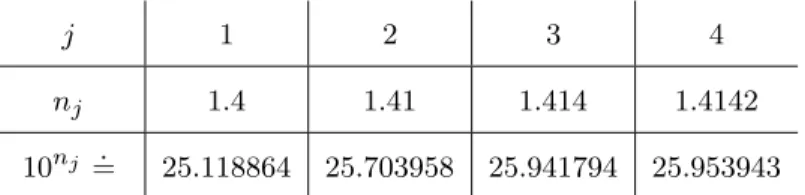
Question 1 The following table gives the first seven of numbers√ n1, n2, n3, . . . that approach
2 = 1.4142135623. . .. Use a calculator or computer to complete the second row of include approximate decimal values of 10n1,10n2,10n3, . . . ,10n7.
j 1 2 3 4
nj 1.4 1.41 1.414 1.4142
10nj =. 25.118864 25.703958 25.941794 25.953943
The same procedure is used to definexn for any irrationalnand positive x. We letnj denote the rational number obtained by takingjdigits after the decimal point in the decimal expansion ofn. Then the numbers nj approach n and the numbersxnj approach xn. The expression xn is defined unless it involves dividing by zero, taking an even root of a negative number, or taking an irrational power of a negative number. Consequently,y=xn is defined for allxwith three exceptions: it is not defined at 0 if n is negative; it is not defined for negativexif n is a fraction with an even denominator, and it is not defined for negativexis nis irrational.
The graphs of
y
=x
nFigures 1 through 4 show four curvesy=xnwith odd integersn. The curvey =xwithn= 1 in Figure 1 is a line through the origin. The shapes of the other curves are analyzed in the following questions.
x 1 y 1 y=x FIGURE 1
Question 2 (a) Why does y = x3 in Figure 2 pass through the origin and why is it above the x-axis for x >0 and below thex-axis forx < 0? (b) Use the formulax3=x2·x to explain whyy=x3is much closer to thex-axis thany=xfor nonzeroxvery close to 0 and is much farther from thex-axis than y=xfor xvery far from 0.
x 1 y 1 y=x3 y=x x 1 y 1 y=x1/3 y=x x 1 y 1 y=x−1
FIGURE 2 FIGURE 3 FIGURE 4
Question 3 (a) Why does y = x1/3 in Figure 3 pass through the origin and why is it above the x-axis forx >0 and below thex-axis forx <0? (b) Use the formulax=x2/3·x1/3to explain whyy=xis closer to the x-axis than y=x1/3 for−1< x <0 and 0< x <1 and is farther from thex-axis thany=x1/3 forx <−1 andx >1.
Notice that the curvey=x1/3in Figure 3 gets less steep as xmoves away from 0.
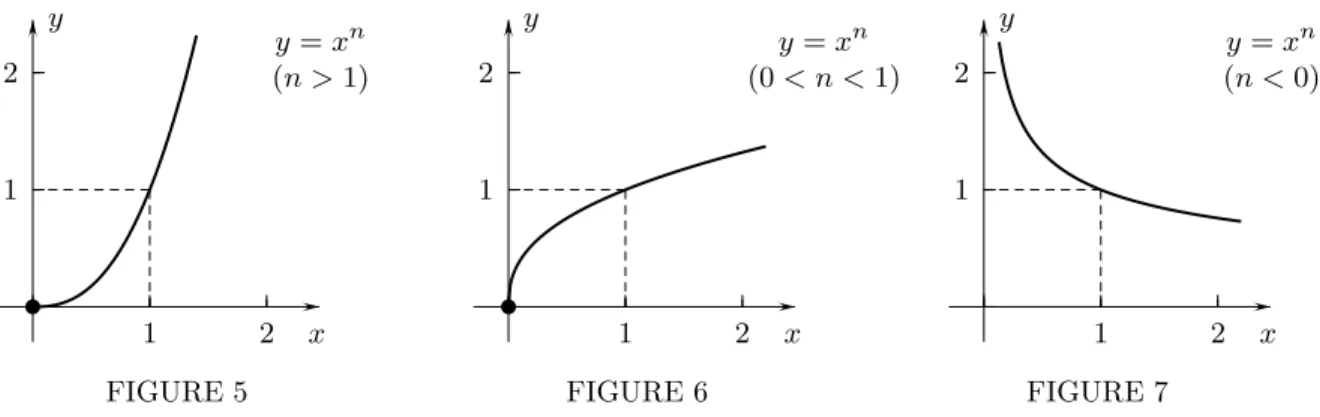
Question 4 Explain whyy=x−1 in Figure 4 (a) does not intersect they-axis and is above it for x >0 and below it forx <0, (b) is far from the x-axis for small positive and small negativex, and (c) is close to thex-axis for large positive and large negativex. The reasoning in Questions 2 through 4 can be used to show that, for any constant nnot equal to 0 or 1, the portion ofy =xn for positive xis similar to the portion of one of the curves in Figures 2 through 4 for positive x. For n >1 (Figure 5), the curvey =xn, like y =x3 in Figure 2, curves up to the right from the origin. For 0< n <1 (Figure 6), the curvey=xn, likey =x1/3 in Figure 3, rises up from the origin but gets less steep as xmoves to the right. Forn <0 (Figure 7), the curvey =xn, like y=x−1 in Figure 4, comes down to the right of they-axis and approaches they-axis asxmoves to the right. x 1 2 y 1 2 y =xn (n >1) x 1 2 y 1 2 y=xn (0< n <1) x 1 2 y 1 2 y=xn (n <0)
FIGURE 5 FIGURE 6 FIGURE 7
The nature of the graphy=xn forx <0 depends on the value ofn. There are three possibilities: y=xnis either an oddfunction, is anevenfunction, or is not defined for negativex. We are using here
the following definition.
Definition 1 A function y = f(x) is even if f(−x) = f(x) for all x in its domain and is odd if f(−x) =−f(x)for allxin its domain.
The graphs of odd functions are symmetric about the origin; the graphs of even functions are symmetric about they-axis.
The functionsy=x3, y=x1/3, and y=x−1of Figures 2 through 4 are odd because (−x)3=−x and (−x)1/3 =−x1/3 for all xand (−x)−1 =−x−1 for x6= 0. Their graphs are symmetric about the origin.
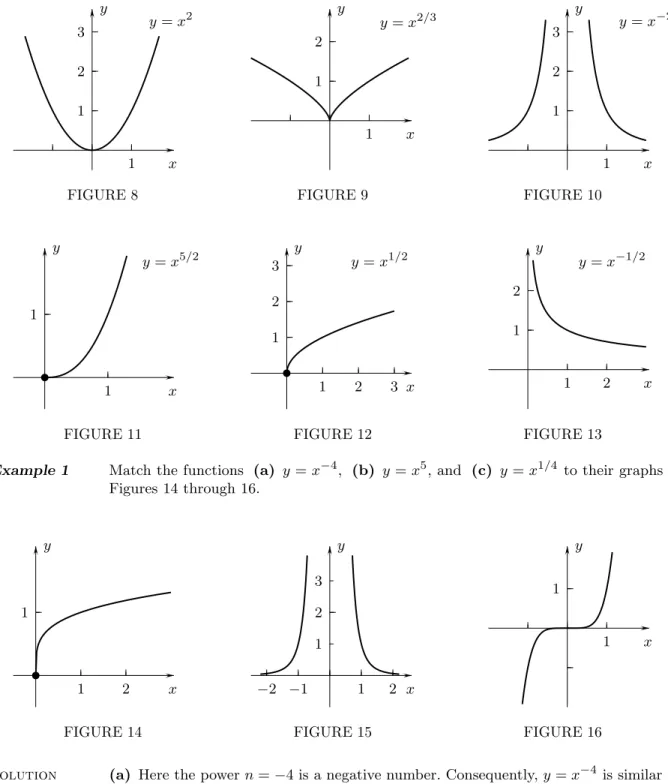
The functionsy =x2, y=x2/3, andy =x−2of Figures 8 through 10 are even because (
−x)2=x2
and (−x)2/3=x2/3for allxand (−x)−2=x−2forx6= 0. Their graphs are symmetric about they-axis. The functions y =x5/2, y =x1/2, andy = x−1/2 of Figures 11 through 12 are not defined for negativexbecause they involve the square rootx1/2=√x. Consequently, their graphs do not extend to
x 1 y 2 1 3 y=x 2 x 1 y 1 2 y=x2/3 x 1 y 1 2 3 y=x −2
FIGURE 8 FIGURE 9 FIGURE 10
x 1 y 1 y=x5/2 x 1 2 3 y 2 1 3 y=x1/2 x 1 2 y 2 1 y =x−1/2
FIGURE 11 FIGURE 12 FIGURE 13
Example 1 Match the functions (a) y =x−4, (b) y =x5, and (c) y=x1/4 to their graphs in Figures 14 through 16. x 1 2 y 1 x 1 −1 2 −2 y 2 1 3 x 1 y 1
FIGURE 14 FIGURE 15 FIGURE 16
Solution (a) Here the powern=−4 is a negative number. Consequently,y=x−4 is similar to
y=x−1for positive x. The functiony=x−4is even, so its graph is symmetric about they-axis and is in Figure 15.
(b) The power 5 in this case is greater than 1, soy =x5is similar toy=x3forx≥0. The functiony=x5is odd, so its graph is symmetric about the origin and is in Figure 16.
(c) Because n= 14 is a fraction between 0 and 1,y =x 1/4
is similar toy =x1/3 for x≥0, but sincen= 14 has an even denominator, the function is not defined forx≤0,
Vertical and horizontal translation
If we add a positive constant to a functiony =f(x), we obtain the functiony=f(x) +k, whose graph is obtained from the graph off by raising itkunits. Subtracting a positive constantk yieldsy=f(x)−k, whose graph is obtained by lowering the graph ofy=f(x) bykunits (Figure 17). The raising or lowering of a graph is calledvertical translation.
x y y=f(x) +k y=f(x) k y=f(x)−k k x y y =f(x−k) y=f(x) k y=f(x+k) k FIGURE 17 FIGURE 18
If, on the other hand, we add a positive constant k to the variable in the formulay =f(x), we obtain y =f(x+k), whose value at x0−k is f((x0−k) +k) =f(x0), which is the value of y =f(x)
at x0. Consequently,y =f(x+k) is obtained by shifting the graph off to the left kunits, as shown in
Figure 18. This action is called horizontal translation. Subtracting a positive constant k from the
variable gives y = f(x−k), whose value at x0+k is f((x0+k)−k) = f(x0), which is the value of
y =f(x) atx0. Hence,y =f(x−k) is the curvey =f(x) shiftedk units to the right, as is also shown
in Figure 18.†
Example 2 Sketch the graph of the functiony=x2−2x+ 3 by completing the square.
Solution We complete the square in the formulay=x2−2x+ 3 by adding and subtracting the
square of half the coefficient 2 ofx. This givesy = (x2−2x+1)−1+3 ory= (x−1)2+2. Its graph in Figure 19 is the curvey=x2translated up 2 units and 1 unit to the right.
x −1 1 2 3 y 2 6 y= (x−1)2+ 2 FIGURE 19Reflection
Multiplying a functiony=f(x) by−1 gives the functiony =−f(x) whose value at xis the negative of the value ofy =f(x). Its graph is the mirror image ofy =f(x) relative to thex-axis. Multiplying the variable by−1 gives the function y=f(−x) whose value at xis the value ofy =f(x) at −x. Its graph is the mirror image ofy=f(x) relative to they-axis (Figure 20).
x y y=−f(x) y=f(x) y =f(−x) FIGURE 20
Question 5 Draw the graph ofy=−f(−x), wheref is the function whose graph is in Figure 20.
Example 3 Sketch the graphs of (a) y=−√xand (b) y =√−x.
Solution (a) The graph of y =−√xin Figure 21 is the mirror image relative to the x-axis of
the curvey=√xin Figure 12.
(b) The graph of y =√−xin Figure 22 is the mirror image relative to the y-axis of y=√x.
x 1 2 3 y −2 −1 1 y=−√x x −1 −2 1 y 1 2 3 y=√−x FIGURE 21 FIGURE 22Magnification and contraction
If we multiply a functiony =f(x) by a constantk >1, we obtain the functiony =kf(x), whose graph is obtained fromy =f(x) by multiplying they-coordinate of every point on it byk. This magnifies the curve vertically, as shown by the middle and upper curves in Figure 23. Similarly, if we divide the function byk >1, we obtainy= 1
kf(x), whose graph is obtained from y=f(x) by dividing the y-coordinate of each point byk. This contracts the curve vertically, as shown by the lower curve in Figure 23.
x y y=f(x) y=kf(x) y= 1 kf(x) (k >1) x y y=f(x) y=f(x/k) y=f(kx) (k >1) FIGURE 23 FIGURE 24
Multiplying the variable by a constant k >1 contracts the graph horizontally since y=f(kx) for positivekhas the same valuef(k(x0/k)) =f(x0) at x0/kasy=f(x) has atx0. Similarly, dividing the
variable byk >1 magnifies the graph horizontally (Figure 24).†
Example 4 The curve drawn with a heavy line in Figure 25 is the graph ofy=G(x). Is the other curve the graph ofy= 12G(2x), y=
1 2G( 1 2x), y= 1 2G(x), ory= 2G(2x)? x −3 −2 −1 1 2 3 y 4 y=G(x) FIGURE 25
Solution The second curve in Figure 25 has the equationy = 2G(2x) because it is obtained by
magnifying y = G(x) by a factor of 2 vertically and contracting it by a factor of 2 horizontally.
Exponential functions
Anexponential functionis a function of the form y =bx, where the exponentxis the variable and
bis a positive constant, called thebase. All exponential functions are defined and positive for allx, and
their graphs pass through the point (0,1) sinceb0= 1 for any positiveb.
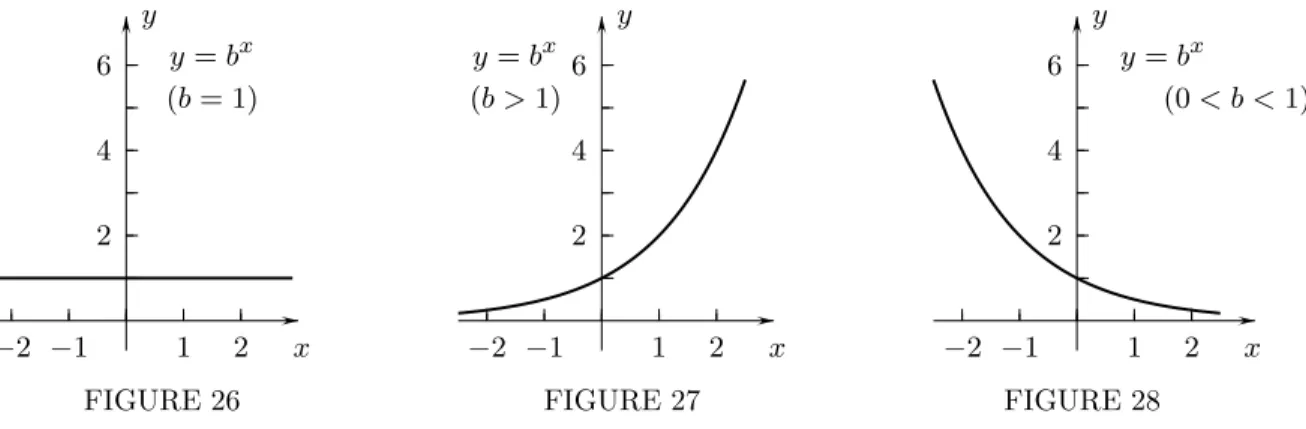
If b= 1, thenbx is the constant functiony= 1 (Figure 26). If bis greater than 1, then the graph approaches the x-axis on the left and curves up on the right (Figure 27). If 0< b <1, then the graph approaches thex-axis on the right and curves up on the left (Figure 28).
x −2 −1 1 2 y 2 4 6 y =bx (b= 1) x −2 −1 1 2 y 2 4 6 y=bx (b >1) x −2 −1 1 2 y 2 4 6 y=bx (0< b <1)
FIGURE 26 FIGURE 27 FIGURE 28
Notice that the function y = bx with positive b 6= 1 is neither even or odd; its graph is not symmetric about they-axis nor about the origin.
Example 5 Draw the curvey = 5 + 3(2x).
Solution The curve y = 5 + 3(2x) is y = 2x magnified vertically by a factor of 3 and then
translated up 5 units. It is drawn in Figure 29, where the values y(0) = 5 + 3(20) = 5 + 3 = 8 andy(2) = 5 + 3(22)
= 5 + 12 = 17 on it have been plotted. The curve hasy= 5 as a horizontal asymptote.
x 1 2 −1 y 20 10 15 y= 5 + 3(2x) y= 5 FIGURE 29Question 6 Draw the curvey =−5−3(2−x).
Example 6 A sample of radioactive radium-266 has mass M(t) = 16 1 2
t/1620grams at time t (years). (a) What is the mass of the sample at t = 0, t = 1620, and t = 3240 years and how are these numbers related? (b) Draw the graph ofM=M(t) in atM-plane.
Solution (a) The formula M(t) = 16 1
2
t/1620 gives M(0) = 16 12 0 = 16, M(1620) = 16 1 2 1 = 8, and M(3240) = 16 1 2 2 = 4. Consequently, M(1620) is half of M(0) andM(3240) is half ofM(1620). (These calculations illustrate the fact that the half-lifeof radium is 1620 years.)(b) The graph ofM =M(t) in Figure 30 is obtained by plotting the values from part (a).
t 1620 3240 M (grams) 4 8 16 12 M = 16 12 t/1620 (years) FIGURE 30The natural exponential function
As we will see later, the most useful exponential function in calculus is the natural exponential function y = ex, whose base is an irrational number e = 2.7182818285. . . that will be defined in
Chapter 4. The graph ofy=ex is shown in Figure 31.
x 2 4 −2 −4 y 2 4 y=ex FIGURE 31
Laws of exponents
The following rules for working with exponents are valid for any numbersxand y ifbis positive. Ifbis negative, they hold for all values ofxandy such that all expressions involved are defined.
bxby = bx+y (1)
(bx)y = bxy (2)
(bc)x = bxcx (3)
b−x = 1
bx (4)
The advantage of using exponential notation and these rules is illustrated in the next example.
Example 7 (a) Simplify the formulay = √
b
3 √
b without using fractional or negative exponents by taking the sixth power of both sides, simplifying, and taking the sixth root. (b) Simplifyy=
√ b
3 √
b by using fractional and negative exponents and rules(1)through
(4).
Solution (a) Taking sixth powers of both sides ofy=
√ b 3 √ b gives y6= √ b
6 3 √ b6 = √ b√b √b√b √b√b 3 √ b√3b√3b √3b√3b√3b = bbb bb =b.Then taking sixth roots yieldsy =√6bsincey >0.
(b) Fractional exponents enable us to make a more direct calculation:
y= √ b 3 √ b=b 1/2 b−1/3=b1/2−1/3=b1/6= √6b.
Historical notes
General algebraic equations were first studied in the sixteenth century, but without the modern convention of using a single letter for the unknown. The Italian physician and algebraist Gerolamo Cardano (1501– 1572), for example, used the Latin sentence,Cubusp6 rebus aequalis 20, for the equation that we would writex3+ 6x= 20.In Cardano’s sentence, the word “cubus” denotes the cube of the unknown,pstands for “plus”, “rebus” denotes the unknown, and “aequalis” means “equals.”
The use of a single letter for the unknown and of exponents for positive integer powers was popularized by a treatise “La G´eom´etrie,” written in 1637 by the French philosopher R´en´e Descartes (1587–1650) as an appendix to a work on the philosophy of science.
R´en´e Descartes Pierre Fermat
(1587–1650) (1601–1665)
Descartes and a French lawyer Pierre Fermat (1601–1665) are considered the inventors of analytic geometry as a tool for giving geometric meaning to aspects of algebra and calculus. Greek mathematicians, including Euclid (ca. 300 BC), Archimedes (287–212 BC), and Apollonius (ca. 225 BC), used the equivalent of coordinate systems with the theory of proportions for studying geometric figures, and algebra was employed in the sixteenth century to solve geometric problems. It was Descartes and Fermat, however, who first studied curves defined by equations as well as by their geometric properties and who made extensive use of the association between the algebra of equations and the geometry of curves. Fermat’s work was not published until after his death, more than forty years after the publication of Descartes’ “La G´eom´etrie,” so Descartes often receives more credit for creating what now is known as analytic or “cartesian” geometry.
Fermat and Decartes generally used only positive coordinates. Negative coordinates were first used systematically by Isaac Newton (1642–1727) in his Enumeration of Curves of Third Degree(1676).
Fermat’s name has been in the news in recent years because his “famous last theorem”, that xn+yn=zn has no nonzero integer solutionsx, y, andz for integersn >2, has finally been proved.
Responses 0.3
Response 1 The table is completed below. (Notice that all of the values of 10nj begin with 25,
the last five begin with 25.95, and the last two begin with 25.9545. This illustrates that the numbers approach the infinite decimal 25.9445· · ·= 10√2.)
j 1 2 3 4 5 6 7
xj 1.4 1.41 1.414 1.4142 1.41421 1.414213 1.4142135 10xj =. 25.118864 25.703958 25.941794 25.953943 25.954341 25.954520 25.954550
Response 2 (a) y=x3passes through the origin because 03= 0, is above thex-axis forx >0 because x3 is positive for x > 0, and is below the x-axis for x < 0 because x3 is negative for x <0.
(b) y = x3 is much closer to the x-axis thany =xfor very small nonzero x and is much farther from the x-axis than y=xfor large positive or negativexbecause x3=x2·xequalsxmultiplied by a very small positive number for small nonzerox and multiplied by a large positive number for large positive or negativex.
Response 3 (a) y=x1/3passes through the origin because 01/3= 0 and is above thex-axis for positive xand below thex-axis for negativexbecause x1/3is positive for positive xand negative for negativex.
(b) y=xis closer to thex-axis thany=x1/3for−1< x <0 and 0< x <1 and is farther from thex-axis thany=x1/3forx <−1 andx >1 becausex=x2/3·x1/3 equalsx1/3 multiplied by a positive number less than 1 if−1< x <0 or 0< x <1 and equalsx1/3multiplied by a number greater than 1 if x <−1 or x >1.
Response 4 (a) y = x−1 does not intersect the y-axis because x−1 = 1/x is not defined at x= 0.
(b) y=x−1is far from thex-axis for very smallxclose to zero becausex−1= 1/x is very large whenxis very small.
(c) y=x−1is close to thex-axis ifxis a large positive or negative number because thenx−1= 1/x is very small.
Response 5 y = −f(−x) is y = f(x) reflected about the x-axis and about the y-axis. • Figure R5 x y y=−f(−x) x 1 −2 −1 y 5 −15 y=−5−3(2−x) y =−5 Figure R5 Figure R6
Response 6 y =−5−3(2−x) isy = 5 + 3(2x) (Figure 29) reflected about thex- andy-axes. • Figure R6
Interactive Examples 0.3
Interactive solutions are on the web page http//www.math.ucsd.edu/˜ashenk/.† 1. Solve the equations (a) x3/4= 8 and (b) x4/3= 16 forx.
2. The curve in Figure 32 has the equation y=a− 1
x−b with constantsa andb. What are those constants? x 1 3 4 y −2 6 2 8 FIGURE 32
3. Do the two curves in Figure 33 have the equations y = 5 +ex, y = 5−ex, y = 5 +e−x, or y= 5−e−x? x 1 −2 −1 y 10 15 FIGURE 33
4. Solve the equation 9
3x
9x = 3 for xby using the fact that ifb
x1 =bx2 with a positiveb
6
= 1, then x1=x2.
5. (a) Determine the general shape of the curvey= 3−1/x2without generating it on a calculator or computer. (b) Sketch the curve by plotting at least one point on it.
6. (a) Determine the general shape of the curvey= 1+√x−1 without generating it on a calculator or computer. (b) Sketch the curve by plotting at least one point on it.
†In the published text the interactive solutions of these examples will be on an accompanying CD disk which can be run by any computer browser without using an internet connection.
7. Figure 34 shows the graph of a functiony =P(x) and the curvesy= 2P(x) andy =P(x) + 2. Which curve is which?
x 1 2 3 y 1 2 3 FIGURE 34
8. The curve drawn with a fine line in Figure 35 is the graph of y=H(x). (a) Is the other curve above thex-axis the graph of y =H(2x) or of y =H(x/2)? (b) Give equations in terms of H for the two curves below thex-axis.
x −2 2 y 4 2 y=H(x) FIGURE 35
Exercises 0.3
AAnswer provided. OOutline of solution provided. CGraphing calculator or computer required. CONCEPTS:
C
1. Generate the curvesy=x2andy=x4together in the window−1.5≤x≤1.5,−0.25≤y≤1.75 and copy them on your paper. Then use the equationx4=x2(x2) to explain whyy =x4is below
y=x2for some values ofxand above it for others. C
2. Generate the curves y = x−2 and y = x−4 together in the window
−2.25 ≤ x≤ 2.25,−0.5≤ y ≤2.5 and copy them on your paper. Then use the equation x−2 = x2(x−4) to explain why y=x−2 is belowy=x−4 for some values ofxand above it for others.
3. Derive the identity bxby = bx+y for a positive constant b in the case of x = 2 and y = 3 by writingb2=b·bandb3=b·b·b.
4. Derive the identity (bx)y=bxy for a positive constantbin the case ofx= 2 andy = 3 by writing (b2)3as (b2)·(b2)·(b2) and then writing b·bforb2.
BASICS:
6. Find all real solutionsxof (a) x2=k2+ 4, (b) x3+ 8 =k3, and (c) √x=√k+ 10. Herek is a positive constant.
7. Solve the following equations forx by recognizing powers of 2 and 10 and using the fact that if bx1 =bx2 with positiveb 6 = 1, thenx1=x2.
(a)
2x = 8(b)
2x= 18(c)
10x = 0.001(d)
10x10x = 100(e)
(10x)x = 100(f )
2 6x 2x = 168. The middle curve in Figure 36 is y = 5
1 +x2. The other curves are y = 5 1 + (2x)2 and y= 5 1 + (x/2)2. Which is which? x 4 2 −4 −2 y 1 6 FIGURE 36
In Exercises 9 through 12 solve the equations forx.
9.O x3· x4= 5 10.A x 3 x5 = 16 11. x 4/3 x = 10 12. (x4)3= 2.
In Exercises 13 through 19 solve the equations for xby using the fact that if bx1 = bx2 with positive
b6= 1, thenx1=x2. 13.O 2x3x = 36 14. 10 x 5x = 8 15.A 1 2
2x = 4−x. 16.O 7x2 = (7x)2 17.A 3x2 = 9(3x) 18. (2x)2= 4x 19. 9x= 27 What are the domains of the functions in Exeercises 20 through 23? 20.Oy=x4/3 21.A y=x1/4
22. y=x−1 23. y=x−3/2
Determine the general shapes of the curves in Exercises 24 through 31 without generating them on your calculator or computer by analyzing their equations. Then sketch them by plotting at least one point on each. 24.A y=−5/x 25. y=−10 + 5/x2 26.O y= 5−2/(x+ 1)2 27.A y= 1 +√x−1 28. y= 4 + (x−1)3 29.O y= 2x−2 30.A y= 10−ex 31. y= 10e−x/10
32. The lower curve in Figure 37 isy =P(x) and the upper curve isy=A+P(Bx) with constants A andB. What are Aand B?
x 2 4 6 y 1 2 3 4 −1 y=P(x) y=A+P(Bx) FIGURE 37
33. Figure 38 shows the curvesy=L(x+k) andy=L(x−k) for a functiony =L(x) and a positive constantk. (a) Which is which and what is the value ofk ?(b) Draw the graph of y=L(x).
x
−2 2
y
FIGURE 38
34.A According to Newton’s law of gravity, an object that weighs one pound on the surface of the earth weighsw= 16r−2pounds when it isrthousand miles from the center of the earth. (The radius of the earth is 4 thousand miles.) Sketch the portion ofw= 16r−2 forr≥4 in anrw-plane. 35.A A boy throws a ball straight up in the air at time t = −1 (seconds) and catches it at t = 1.
Because there is no air resistance, the ball ish= 16−16t2feet above his hand for −1≤t≤1. Sketch the portion ofh= 16−16t2 for−1≤t≤1 in a th-plane
36.A
It costs a factory 5 dollars to manufacture each pint of a chemical, plus an overhead of 100 on each batch produced. The cost for a batch of x pints is therefore 100 + 5x dollars, and the average cost of a batch ofxpints isA= 100 + 5x
x =
100
x + 5 dollars per pint. Draw the portion ofA= 100
x + 5 forx >0 in an xA-plane.
37. A culture of bacteria contains 500 bacteria initiallly and, because the number doubles every 3 days, the culture contains N = 500(2t/3) bacteria t days later. Draw the graph of this function in atN-plane.
38. When air pressure is measured inatmospheres, the air pressure at the surface of the earth is 1 atmosphere. At an altitude h <80 kilometers above the surface of the earth, the air pressure is P = 1
2
h/5.8. Draw the graph of this function in anhP-plane. EXPLORATION:
40.O (5x2)(5x)2= 53 forx. 41.A Solve (5x2)(5x)2= 5 forx. 42.A
The curvey= (2x)2can be obtained fromy=x2by contracting it horizontally or by magnifying it vertically. Explain.
43. The curve y = ex+1 can be obtained from y = ex by horizonta1 translation or by vertical magnification. Explain.
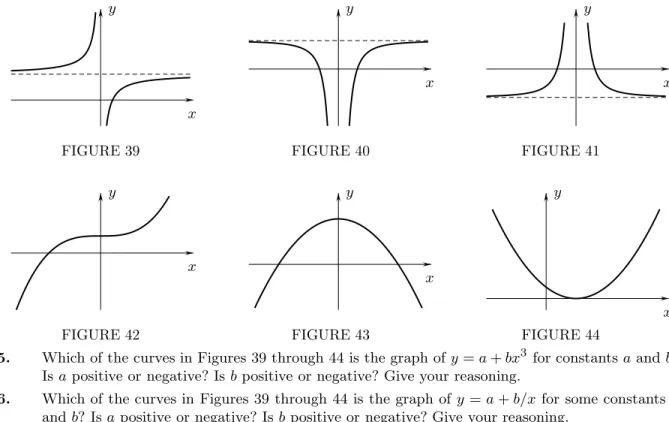
44.A Which of the curves in Figures 39 through 44 is the graph of y = a+b/x2 with a > 0? Is b positive or negative? Give your reasoning.
x y x y x y
FIGURE 39 FIGURE 40 FIGURE 41
x y x y x y
FIGURE 42 FIGURE 43 FIGURE 44
45. Which of the curves in Figures 39 through 44 is the graph ofy=a+bx3 for constantsaand b? Is apositive or negative? Isbpositive or negative? Give your reasoning.
46. Which of the curves in Figures 39 through 44 is the graph of y =a+b/xfor some constants a and b? Isapositive or negative? Isbpositive or negative? Give your reasoning.
47. Which of the curves in Figure 45 has the equationy = x
2
+a
x2+b (a) with 0< a < b, (b) with 0< b < a, and (c) witha <0 and b >0? Give your reasoning.
x y I II III FIGURE 45 C
48. Generate y =x2+axon your calculator or computer in the window
−4≤x≤4,−2≤y ≤5, first for a= 0,1 and 2, and then for a= 0,−1, and −2. Explain how changing a changes the graph and why.
C
49. How does changingbchange the curve y = 5x+bx3 and why? (Generate the curve for sample values ofbin the window −4≤x≤4,−30 ≤y≤30 withy-scale = 10.)
50. The curvey=M(x) is shown in Figure 46. Draw the curves (a) y=M(x/2), (b) y =M(2x), (c) y= 2M(x), (d) y=M(x)/2, (e) y=M(x)+2, (f ) y=M(x−2), and (g) y= 2M(x/2). x 2 4 6 8 10 y 2 4 6 y=M(x) FIGURE 46
51. Figure 47 shows the graphs of y = 1.5x, y = ex, and y = 6x. (a) Which is the upper curve, which is the middle curve, and which is the lower curve for x > 0? (b) Which is the upper curve, which is the middle curve, and which is the lower curve forx <0?
x 1 2 −1 −2 y 2 3 FIGURE 47
52. Find constantsband C such thatE(x) =Cbx has the values in the following table:
x 0 1 2 3 4
53. Figure 48 shows the curvey =bx with constantb >1 and the mirror image of this curve about the origin. What is the equation of the second curve?
x y
FIGURE 48
C
54. Generate the curves y = x2 and y = 2x in the window −2.5 ≤ x ≤ 6,−2.5 ≤ y ≤ 25 to see that the equationx2= 2x has two positive solutions and one negative solution. Find the positive solutions by trial and error and use a calculator or computer to find the approximate value of the negative solution.
55. Give a formula for the surface area A = A(V) (square meters) of a cube as a function of its volumeV (cubic meters) and draw the graph of this function.