Physics Olympiad for P.G. students - 2018
Time: 3 hours Max. Marks: 150
PART A
Answer any 25 out of 30 questions. Each question carries 2 marks.
1. Ifx= 3 + 2√2, then√x− √1 x is equal to (a) −2, (b) +2, (c) 2√2 (d) √2 Sol:1(b) √ x−√1 x !2 = x+ 1 x −2 = 3 + 2 √ 2 + 1 3 + 2√2−2 = 3 + 2√2 + 3−2 √ 2 9−8 −2 = 6−2 = 4 Taking the square root,
√
x− √1
x =±2.
Since x is greater than 1, the quantity should be positive.
2. Given the following quantities
(1) position vector , (2) momentum, (3) energy, (4) mass, (5) acceleration, (6) orbital angular momentum, (7) spin, (8) force,
group separately the scalars, polar vectors and axial vectors.
(a) (3) and (4) are scalars, (1),(2),(5),(7) and (8) are polar vectors, (6) is an axial vector
(b) (3) and (4) are scalars, (1),(2) and (5) are polar vectors, (6), (7) ad (8) are axial vectors
(c) (3) and (4) are scalars, (1),(2),(5) and (8) are polar vectors, (6) and (7) are axial vectors
(d) (3) and (4) are scalars, (1) and (2) are polar vectors, (5),(6),(7) and (8) are axial vectors
Sol:2(c)
3. In the Bohr model of the atom, how do the radius of the first Bohr orbit and the velocity of electron in the first Bohr orbit change with the increase of charge number z?
(b) Both radius and velocity increase (c) Radius decreases but velocity increases (d) Radius increases but velocity decreases.
Sol:3(c) ze2 r2 = mv2 r ; mvr =n¯h r = n 2¯h2 mze2; v = n¯h mr = ze2 n¯h. So, r decreases with z and v increases with z.
4. Consider three situations of 4 identical particles in a one-dimensional box of width L with hard walls of infinite height. In case (i), the particles are Fermions, in case (ii), the particles are Bosons and in case (iii), the particles are classical. If the total energy of the four particles in ground state in these three cases are EF, EB and Ecl respectively, which of the following is true? (a) EF =EB =Ecl (b) EF > EB =Ecl
(c) EF < EB < Ecl (d) EF > EB > Ecl
Sol:4(d)
5. Two satellites of masses 3m and m orbit the earth in circular orbits of radii r and 3r respectively. The ratio of their speeds is
(a) !:1 (b) √3 : 1 (c) 3:1 (d) 9:1
Sol:5(b)
The speed v of the satellite of mass m orbiting the earth with a radius r is given by mv2 r = GM m r2 =⇒ v = s GM r ,
where M is the mass of the earth. The speed is independent of the mass of the satellite. So,
v1 v2 = s r2 r1 = s 3r r = √ 3.
6. Consider the scattering ofπ− on proton.
π−+p −→ π−+p π−+p −→ π0+n
The optical theorem states that the total cross section (σtotal) is related to the imaginary part of the forward scattering amplitude (Im f(0)).
σtotal = 4π
where k represents the wave number and σtotal represents (a) the total cross section for π−+p→π−+p
(b) the total cross section for π−+p→π0+n
(c) the sum of total cross zsection for π−+p→π−+p andπ−+p→π0+n. (d) The optical theorem is not applicable in this case.
Sol:6(c)
7. A sphere when it is at rest in the stationary frame of reference is found to have a radius a and volume V. The sphere is set in motion with velocity 0.9c with respect to the observer, wherecis the velocity of light. What will be the shape and volume of the sphere as measured by the observer in the stationary frame?
(a) Sphere, Volume V; (b) Spheroid, Volume 0.9V; (c) Spheroid, Volume √0.19V (d) Spheroid, Volume 0.19V.
Sol:7(c)
The length along the direction of motion will contract. So, the sphere will appear as a spheroid with volume
Vq(1−v2/c2) =V√1−0.81 = 0.19V
8. For a system described by the Hamiltonian H, an observable denoted by the operator A is a constant of motion if
(a) dAdt commutes with H (b) dAdt anticommutes with H (c) A commutes withH (d) A anticommutes with H.
Sol:8(c)
9. A particle of massmmoves in a circular orbit in a three-dimensional space with a central potential V(r) = kr4, wherek is a constant. Its angular frequencyω depends on the radius R of the circular orbit as:
(a) ω∝R (b) ω ∝R−1 (c) ω∝R1/4 (d) ω ∝R−2/3 Sol:9(a) Force = −dV dr =−k d drr 4 =−4kr3 Centrifugal force = mv 2 r = mω2r2 r =mω 2r For equilibrium, let the radius be r =R.
mω2R= 4kR3 =⇒ω2 = 4kR 3 mR =⇒ω = s 4k mR.
10. A particle of unit mass moves in a potential V(x) = ax2+ b
x2, where a and b
are positive constants. The angular frequency of small oscillations about the minimum of the potential is
(a) √8b (b) q8ba (c) √8a (d) q8ab
Sol:10(c)
V(x) is minimum at the value of x at which dVdx = 0. V(x) =ax2+ b x2 =⇒ dV dx = 2ax− 2b x3 = 0 =⇒x 4 = b a. V(x) is minimum at x=x0: x40 =b/a.
Expanding V(x) around the point x=x0, we get V(x) = V(x0) + (x−x0) dV dx x=x 0 + (x−x0) 2 2! d2V dx2 x=x 0 +· · · V(x)−V(x0) = (x−x0)2 2 d2V dx2 x=x 0 , since dV dx x=x 0 = 0. d2V dx2 = 2a+ 6b x4; d2V dx2 x=x 0 = 2a+ 6ba b = 8a. This yields V(x)−V(x0) = (x−x0)2 2 (8a) = 1 2k(x−x0) 2,
where k = 8a. This represents a simple harmonic motion about the point x=x0 with angular frequency ω=
q
k/m=√8a since m = 1.
11. A box contains 6 red balls, 4 white balls and 5 blue balls. Three balls are drawn, one after another, from the box without replacement. The probability that they are drawn in the order red, white and blue is
(a) 2258 (b) 914 (c) 22513 (d) 918
sol:11(b)
If each ball is not replaced, then drawing R,W,B are dependent events. Pr{R, W, B} = Pr{R}Pr{W|R}Pr{B|W R} = 6 15× 4 14× 5 13 = 4 91.
Pr{B|W R} denotes the probability of getting a blue ball, if a white and red balls have already been chosen.
12. The Lagrangian of the one-dimensional motion of a particle of massm is given by L= 1 2(mx˙ 2− kx2)eγt,
where t is the time and k and γ are constants. Its equation of motion is (a) m¨x+kx= 0 (b) mx¨+kx=mγx˙
(c) m¨x+kx=−mγx˙ (d) m¨x−kx=mγ.
Sol:12(c)
The equation of motion is the Lagrange equation: d dt ∂L ∂x˙ ! −∂L ∂x = 0. We have ∂L ∂x˙ = mxe˙ γt d dt ∂L ∂x˙ ! = {m¨x+γmx˙}eγt ∂L ∂x = −kxe γt
Substituting these values in Lagrange Equation, we get the equation of motion for the particle.
mx¨+kx=−mγx.˙
13. If one of the eigenvalues of the following matrix
A= 1 2 2 2 2 1 2 2 2 2 1 2 2 2 2 1 ,
is 7 and the other three eigenvalues are equal, then det A = (a) 0, (b) +5, (c) +7 (d) −7.
Sol:13(d)
The following principles are to be used:
1. The sum of the eigenvalues of the matrix is equal to the trace of the matrix. 2. The product of the eigenvalues is equal to the determinant of the matrix. The trace of the matrix A is equal to 4. Since one of the eigenvalues is 7 and the other three eigenvalues are equal, it follows that the other three eigenvalues are −1, −1, −1. The product of the eigenvalues is−7 and so, the determinant of the matrix A is−7.
14. The Laplace transform of a function f(x) is defined by
L(f(x)) =
Z ∞
0
e−sxf(x)dx, s real and >0. If f(x) = coshax, a < s, its Laplace transform is found to be (a) s2−1a2, (b) s s2−a2, (c) a s2−a2, (d) s s2+a2 sol:14(b) cosh(ax) = 1 2 eax+e−ax L(cosh(ax)) = 1 2 Z ∞ 0 e−sxeaxdx+ Z ∞ 0 e−sxe−axdx = 1 2 Z ∞ 0 e−(s−a)xdx+ Z ∞ 0 e−(s+a)xdx = 1 2 1 s−a + 1 s+a = s (s2 −a2).
15. The Fourier transformg(k) of a function f(x) is defined by g(k) = √1 2π Z ∞ −∞f(x)e −ikx dx.
For the given function f(x) = e−x2, which satisfies the relation R∞
−∞e−x
2
dx =
√
π, the Fourier transform g(k) is (a) √1 2e −k2/4 (b) √1 2πe −k2/2 (c) √1 πe −k2 (d) √1 2e k2/4 Sol:15(a) g(k) = √1 2π Z ∞ −∞ f(x)e−ikxdx= √1 2π Z ∞ −∞ e−x2−ikxdx = √1 2π Z ∞ −∞ exp−(x+ (ik/2))2e−k2/4dx = √1 2πe −k2/4Z ∞ −∞
exp(−y2)dy, wherey=x+ (ik/2) = √1
2e
−k2/4
16. In a certain inertial frame S, two events occur at space points A and B, sep-arated by a distance 10 Km, at a time interval of 10 µs. If these two events
appear to take place simultaneously for an observer in another inertial frame S’ which is moving with a uniform velocity v along AB, then the velocity (in terms of the velocity of light c) of the inertial frame S’ should be
(a) 0.6c, (b) 0.5c, (c) 0.4c, (d) 0.3c.
Sol:16(d)
Using Lorentz transformation equations for time, we find that the time interval between the two events for the observer in motion is given by
t0B−t0A =γ (tB−tA)− v c2(xB−xA) .
It is given that tB−tA= 10µs = 10×10−6 sec. and xB−xA= 10 km. If the two events were to occur simultaneously for the moving observer, t0B−t0A= 0.. Substituting these values in the above equation, we find
v c2(xB−xA) = tB−tA v c = (tB−tA)c xB−xA = 10×10 −6×3×108 10×103 = 0.30. Hence the speed with which the observer is moving = 0.30 c.
17. If r is a radius vector andr its length, then r·dr
dr is equal to (a) 3 (b) 3r (c) r (d) 0 Sol:17(b) r· dr dr =x dx dr +y dy dr +z dz dr r=x2+y2+z21/2; dr dx = 1 2(x 2+y2+z2)−1/22x= x r Similarly, dr dy − y r; dr dz = z r. Thus, r· r dr =x r x+y r y +z r z = 3r.
18. If σ is the Pauli spin vector operator and ˆn is an unit vector in arbitrary direction, then the expectation value of σ·nˆ for the Fermion spin vector is
(a) 0 (b) 3 (c) ±1
2 (d) ±1
Sol:18(d)
(σ·nˆ)2 = ˆn·nˆ +iσ·( ˆn×nˆ) = 1. Therefore σ·nˆ =±1.
19. If
"
j1 j2 j m1 m2 m
#
is the Clebsch-Gordan coefficient for coupling of two angular momentum states |j1m1i and |j2m2i to yield the angular momentum state
|jmi, then using the properties of Clebsch-Gordan coefficients, the value of the Clebsch-Gordan coefficient
" 3/2 3/2 0 1/2 −1/2 0 # is obtained as (a) 0 (b) 1 (c) −1 2 (d) 1 2 Sol:19(c)
Using the notation [j] =√2j+ 1,
" 3/2 3/2 0 1/2 −1/2 0 # = (−1) [0] [3/2] " 3/2 0 3/2 1/2 0 1/2 # =−1 2.
20. If A and B are two operators whether commuting or non-commuting, then 1 A−B is equal to (a) 1 A + 1 AB 1 A−B (b) 1 A − 1 AB 1 A−B (c) 1 A − 1 A−BB 1 A−B (d) 1 A + 1 A−BB 1 A−B Sol:20(a) Post-multiply by (A−B). Then 1 A−B ×(A−B) = 1. Now post-multiply (a) by (A−B).
1 A + 1 AB 1 A−B (A−B) = 1 A(A−B) + 1 AB = 1.
21. The packing fraction for the face-centred cubic (fcc) structure is (a) 1, (b) 0.524, (c) 0.68, (d) 0.74
Sol:21(d):
For fcc structure, the number of atoms in unit cell = 4. If r is the radius of the atom and a, the lattice constant,
Atomic packing fraction = Vol. occupied by atoms Vol. of unit cell = 4×(4/3)πr 3 a3 = (16/3)πr3 (4r/√2)3 = √ 2π 6 = 0.74.
22. What is the value of the following series?
1− 1 2! + 1 4! − · · · 2 + 1− 1 3!+ 1 5!− · · · 2 (a) 0 (b) e (c) e2 (d) 1 Sol:22(d) cosx = 1− x 2 2! + x4 4! − x6 6! +· · · sinx = x− x 3 3! + x5 5! − x7 7! =· · · sin2x+ cos2x = 1
In the given series, x= 1.
23. The mean square radius hr2i of a nucleus considered as a sphere of radius R with uniform matter density ρ is
(a) R2 (b) 1 2R 2 (c) 3 5R 2 (d) 3 4R 2 Sol:23(c)
Mean square radius = hr2i=
RR 0 r 2ρd3r RR 0 ρd 3r , whered 3r = 4πr2dr Since ρ is constant, hr2i= RR 0 r4dr RR 0 r2dr = 3 5R 2.
24. According to the nuclear shell model, the spin-parity of the ground state of the nucleus 11B is
(a) 12+ (b) 32+ (c) 32− (d) 52+
Sol:24(c)
11B has 5 protons and 6 neutrons, in configuration 1s 1/2
2P,2N
1p3/2
3P,4N
. So, its spin-parity is that of odd proton 32−.
25. The nuclear magnetic moment of the nucleus29Al
13, according to the Schmidt model, is (Given the nuclear g-factors for the proton gl = 1, gs = 5.586 and for the neutron gl = 0, gs=−3.826)
(a) −1.913 µN, (b) 14.414 µN, (c) 4.793µN, (d) 0.
Sol:25(c)
According to the Schmidt model, the nuclear magnetic moment is due to the odd nucleon; in this case, due to the odd proton in the d5/2 state with l = 2, s = 1/2, j = 5/2.
µ=gll+gss = 2 + 5.5865× 1 2
= 2 + 2.79325 = 4.793 µN.
26. Consider a uniformly charged sphere of radius R. If Q is the total charge of the sphere and ρ its charge density and0 the permittivity of free space, then the electric field at any point P within the sphere at a distance r from the centre is (a) 0, (b) 3ρr 0, (c) ρr 0, (d) 2ρr 0 . Sol:26(b)
For any point P within the sphere, the electric field can be can be found by drawing a spherical Gaussian surface of radius r and by finding the charge enclosed within the Gaussian surface.
q = 4 3πr
3ρ. By Gauss’ law, the electric field E is given by
4πr2E = 4πr 3ρ 30 or E = ρr 30 , if r < R.
27. The electrical conductivity of a semiconductor increases when electromagnetic radiation of wavelength shorter than 2480 nm is incident on it. The band gap for the semiconductor is approximately
(a) 0.9 eV (b) 0.7 eV (c) 0.5 eV (d) 0.3 eV
Sol:27(c)
Band gap (Eg) = Energy equivalent to wavelength λ. Eg = hν = hc λ = 6.67×10 −13×3×108 2480×10−9×1.6×10−19 = 0.5 eV
28. A piece of copper and a piece of germanium are cooled from room temperature to 80o K. Then one of the following is correct:
(a) Resistance of each will increase (b) Resistance of will decrease (c) Re-sistance of copper will increase while that of germanium will decrease (d) Resistance of copper will decrease while that of germanium will increase.
Sol:28(c)
Resistance of copper will decrease.
For semiconductor, Rt = R0(1− αt). So, for Germanium, resistance will increase.
29. The elementary particle Σ+ is made up of three quarks as given below: (a) uds (b) uus (c) uu¯s (d) uds¯
Sol:29(b)
30. Higgs Bosons are
(a) massless particles with spin zero
(b) particles with mass about 125 MeV with spin zero (c) particles with mass about 125 GeV with spin zero (d) particles of spin - 1
2
Sol:30(c)
PART B
Answer any 25 out of 35 questions. Each question carries 4 marks.
31. The operator d dx −x ! d dx +x ! is equivalent to (a) dxd22 −x2, (b) dxd22 −x 2+ 1 (c) dxd22 −x d dxx 2+ 1 (d) dxd22 −2x d dx−x 2. Sol:31(b) d dx −x ! d dx +x ! = d dx d dx +x ! −x d dx +x ! = d 2 dx2 + 1 +x d dx−x d dx −x 2 = d 2 dx2 + 1−x 2
32. If the distribution function ofx isf(x) = xe−x/λ over the interval 0< x < ∞, then the mean value of x is
(a) λ, (b) 2λ, (c) λ/2, (d) 0. Sol:32(b) ¯ x= R∞ 0 xf(x)dx R∞ 0 f(x)dx = R∞ 0 x2e −x/λdx R∞ 0 xe−x/λdx Put u=x2 and dv =R e−x/λdx. Then v =−λe−x/λ. Z ∞ 0 x2e−x/λ= −λx2e−x/λ ∞ 0 + 2λ Z ∞ 0 xe−x/λ = 2λ Z ∞ 0 xe−x/λ Hence ¯x= 2λ.
33. Evaluate the integral Rθ=π
θ=0 cos2θ dΩ wheredΩ is the element of the solid angle 2πsinθdθ. The result is
(a) 4π (b) 4π/3 (c) 8π/3 (d) 16π/3. Sol:33((b) 2π Z π 0 cos2θsinθdθ=−2π Z −1 1 x2dx=−2π x 3 3 −1 1 = 4π 3 , where x= cosθ.
34. Choosing a suitable contour, the value of the integral
Z ∞
0
cosx dx
x2+a2, a >0, is found to be
(a) πe−a (b) πe−a
a (c) πe−a 2a (d) πe−a 2 Sol:34(c)
Since the integrand is an even function of x, Z ∞ 0 cosx dx x2+a2 = 1 2 Z ∞ −∞ cosx dx x2+a2. The related complex integral is
I1 =
I
c eiz z2+a2dz,
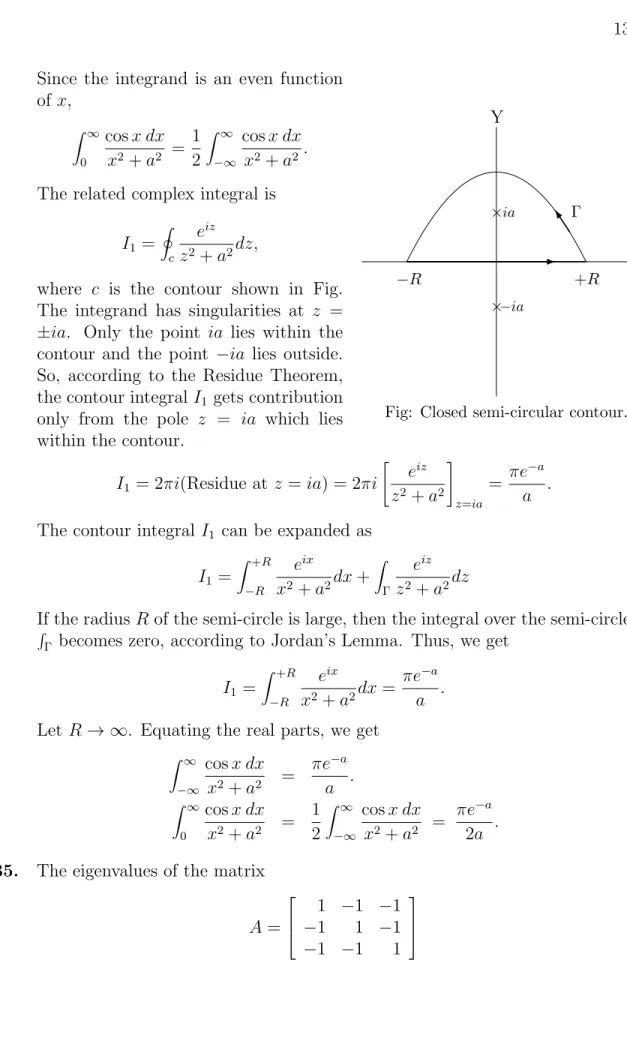
where c is the contour shown in Fig. The integrand has singularities at z =
±ia. Only the point ia lies within the contour and the point −ia lies outside. So, according to the Residue Theorem, the contour integral I1 gets contribution only from the pole z = ia which lies within the contour.
−R +R Γ × × ia −ia x Y
Fig: Closed semi-circular contour.
I1 = 2πi(Residue at z =ia) = 2πi
" eiz z2+a2 # z=ia = πe −a a . The contour integral I1 can be expanded as
I1 = Z +R −R eix x2+a2dx+ Z Γ eiz z2+a2dz
If the radius R of the semi-circle is large, then the integral over the semi-circle
R
Γ becomes zero, according to Jordan’s Lemma. Thus, we get I1 = Z +R −R eix x2+a2dx= πe−a a . Let R→ ∞. Equating the real parts, we get
Z ∞ −∞ cosx dx x2+a2 = πe−a a . Z ∞ 0 cosx dx x2+a2 = 1 2 Z ∞ −∞ cosx dx x2+a2 = πe−a 2a .
35. The eigenvalues of the matrix A= 1 −1 −1 −1 1 −1 −1 −1 1
are:
(a) 1, −1, 3 (b) −1,2, 2 (c) 0, 1,2 (d) 1, 1,1.
Sol:35(b)
Characteristic equation of the matrix A: det(A−λ) = 1−λ −1 −1 −1 1−λ −1 −1 −1 1−λ = 0.
The determinant is unaltered by the following transformation:r1 =r1+r2+r3
−1−λ −1−λ −1−λ −1 1−λ −1 −1 −1 1−λ = 0.
Since −(λ+ 1) is a common factor, it can be pulled out.
−(λ+ 1) 1 1 1 −1 1−λ −1 −1 −1 1−λ = 0.
Now, you can make the following transformations: r2 → r2 +r1 and r3 →
r3+r1. −(λ+ 1) 1 1 1 0 2−λ 0 0 0 2−λ = 0. This yields the condition for det(A−λ) = 0.
−(λ+ 1)(2−λ)2 = 0, from which we obtain the eigenvalues.
λ1 =−1, λ2 = 2, λ3 = 2. Alternative method det(A−λ) = (1−λ){(1−λ)2−1}+ 1{(λ−1)−1} −1{1 + 1−λ} = (1−λ)(λ2−2λ) + (λ−2)−(2−λ) = (1−λ)λ(λ−2) + 2(λ−2) = (λ−2){λ−λ2+ 2} = −(λ−2)(λ−2)(λ+ 1)
Since det (A−λ) = 0, it follows that
(λ+ 1)(λ−2)2 = 0, yielding the eigenvalues
λ1 =−1, λ2 = 2, λ3 = 2.
36. The Fermi energy of electron in a monovalent bcc solid whose lattice constant a is 5.34 ˚A is
(a) 1.02 eV, (b) 2.04 eV, (c) 6.06 eV, (d) 10 eV.
Sol:36(b)
Lattice constant a= 5.34×10⁻¹⁰ m
Volume of unit cell V =a3 = (5.34)3×10−30 = 1.523×10⁻²⁸ m3 For bcc solid, there are 2 atoms in a unit cell.
Number of atoms per unit volume = 2
1.523×10−28 = 1.313×10
−28. Since the solid consists of monovalent atoms, the number of free electrons is equal to the number of atoms. So, the number of free electrons per unit volume n = 1.313×1028.
IfpF is the Fermi momentum of electron, then the number of statesN available for electrons in a volume V is (using the phase-space concept)
N = V ×(4/3)πp 3 F h3 = V ×(4/3)πp3 F (2π¯h)3 .
In each state, two electrons, one with spin up and the other with spin down, can occupy. So, the number of electrons n per unit volume is
n= 2N V = 2× (4/3)πp3 F (2π¯h)3 = 2× (4/3)π(2mEF)3/2 (2π¯h)3 = (2mEF)3/2 3π2¯h3 ,
since EF =p2F/(2m). n is the number of free electrons per unit volume. This yields the Fermi energy EF.
(EF)3/2 = 3π2n¯h3 (2m)3/2 EF = (3π 2n)2/3¯h2 2m = (3×π 2×1.313×1028)2/3×(1.055×10−34)2 2×9.1×10−31 = 3.256×10⁻¹⁹J = 2.035 eV,
since 1 eV = 1.602×10⁻¹⁹ J.
36(a). Alternate Problem
The Fermi energy of electron in a monovalent bcc solid whose lattice constant is a is (a) 3πa32 2/3 ¯h2 2m, (b) 6π2 a3 2/3 ¯h2 2m, (c) 6π2 a3 1/3 ¯h2 2m, (d) 3π2 a3 1/3 ¯h2 2m. Sol:(b)
Volume of unit cell V =a3.
For bcc solid, there are 2 atoms in a unit cell. So, the number of atoms per unit volume = a23
Since the solid consists of monovalent atoms, the number of free electrons is equal to the number of atoms. So, the number of free electrons per unit volume n = a23.
IfpF is the Fermi momentum of electron, then the number of statesN available for electrons in a volume V is (using the phase-space concept)
N = V ×(4/3)πp 3 F h3 = V ×(4/3)πp3 F (2π¯h)3 .
In each state, two electrons, one with spin up and the other with spin down, can occupy. So, the number of electrons n per unit volume is
n= 2N V = 2× (4/3)πp3 F (2π¯h)3 = 2× (4/3)π(2mEF)3/2 (2π¯h)3 = (2mEF)3/2 3π2¯h3 ,
since EF =p2F/(2m). n = a23 is the number of free electrons per unit volume.
Hence, it follows that
n = 2 a3 =
(2mEF)3/2 3π2¯h3 This yields the Fermi energy EF.
(EF)3/2 = 6π2 a3 ¯ h3 (2m)3/2 EF = 6π2 a3 !2/3 ¯ h2 2m
37. The mean lifetime of muon is 2.251 µs. What is the average distance that a highly energetic cosmic ray muon of velocity 0.95 c will travel before it
disintegrates?
(a) 642 m (b) 1204 m (c) 2054 m (d) 3205 m
Sol:37(c)
Lifetime of the cosmic ray muon as observed by the observer on earth is γτ where tau is the proper life-time 2.251µs and γ = 1/q1−(v2/c2).
If v = 0.95 c, then γ = 1/√1−0.9025 = 3.2026.
Distance travelled before disintegration =0.95c×γ×2.251×10−6 = 20.54×10² m.
38. IfE1 =xyi+ 2yzj+ 3xzk and E2 =y2i+ (2xy+z2)j+ 2yzk(where i, j, k denote the unit vectors along x, y, z directions), then
(a) both are not electrostatic fields, (b) both are possible electrostatic fields, (c) only E1 is a possible electrostatic field, (d) only E2 is a possible electrostatic field.
Sol:38(d)
For Electrostatic field, ∇×E= 0.
∇×E1 = i j k ∂ ∂x ∂ ∂y ∂ ∂z xy 2yz 3xz 6= 0 ∇×E2 = i j k ∂ ∂x ∂ ∂y ∂ ∂z y2 2xy+z2 2yz = 0
Therefore, E2 is a possible electrostatic field.
39. The magnetic field corresponding to the vector potential,
A= 1
2F ×r+ 10
r3r, where F is a constant vector, is , (a) F, (b) −F, (c) F + 30r4r, (d) F −
30 r4r.
Sol:39(a)
Magnetic field: B=∇×A, whereA= 12F ×r+ 10r3r
F ×r = i j k Fx Fy Fz x y z = (Fyz−Fxy)i+ (Fzx−Fxz)j + (Fxy−Fyx)k ∇×(F ×r) = i j k ∂ ∂x ∂ ∂y ∂ ∂z (Fyz−Fxy) (Fzx−Fxz) (Fxy−Fyx) = 2F
∇× r
r3 = 0.
Hence B= 12∇×(F ×r) =F.
40. Three chargesq1,q2andq3are placed at the midpoints D,E,F of the sides of an equilateral triangle ABC of sidea= 20 cm. Ifq1 =−2×10⁻⁹ C,q2 = 3×10⁻⁹ C,q3 =−4×10⁻⁹ C, the work done in shifting the charges from the midpoints D,E,F to the vertices A,B,C of the triangle is
(a) 3×10⁻⁷ J (b) 4.5×10⁻⁷ J (c) 6×10⁻⁷ J (d) 9×10⁻⁷ J
Sol:40(b) page 163 of STR
Find the initial potential energy Ui of the system of charges when they are at the midpoints D,E,F of the sides of the triangle ABC. Find the potential energy Uf of the charges when they are shifted to the vertices A,B,C. The work done W in shifting the charges is the difference in potential energy.
W =Uf −Ui. The potential energy of the system of
charges is U = 1 4π0 q 1q2 r12 + q2q3 r23 + q3q1 r31 , where r12, r23, r31 represent the dis-tance between the corresponding pair of charges. B C A D E F 60o 60o Uf = 9×10⁹ 0.20 {−6−12 + 8}10 −18 =−4.5×10⁻⁷Joules Ui = 9×10⁹ 0.10 {−6−12 + 8}10 −18 =−9×10⁻⁷Joules.
Hence the work done = Uf−Ui = 4.5×10⁻⁷ Joules. The positive sign implies that the work is done on the charge.
41. The expectation value ofσ1·σ2 depends on the spin stateS of the two-fermion system.
(a) −3 for S=1 and 1 for S=0, (b) 1 for S=1 and −3 for S=0, (c) 1 for S=1 and −1 for S=0 , (d) 1 for S=1 and 0 for S=0.
Sol: 41(b) (σ1+σ2)2 = σ21+σ22+ 2σ·σ2 = 3 + 3 + 2σ1·σ2 = 6 + 2σ1·σ2 σ1 ·σ2 = 1 2(σ1+σ2) 2−3
Since σ = 2S, where S is the spin, σ1 +σ2 = σ = 2S and the expectation value of S2 is S(S+ 1). S can take two values S= 1 and S = 0. Therefore
σ1·σ2 = 2S(S+ 1)−3 = 1, if S= 1 = −2, if S= 0.
42. Evaluate ∇2eik·r, where k and r are momentum and position vectors. The
result is (a) k2eik·r (b) −k2eik·r (c) (k·r)eik·r (d) (k·r)2eik·r. Sol:42(b) ∇2eik·r = d 2 d2x + d2 d2y + d2 d2z ! ei(kxx+kyy+kzz) = −k2eik·r
43. The de Broglie wavelength of an electron which is accelerated from rest through a potential difference of 500 volts is 5.48×10⁻¹¹ m. Instead if the electron is accelerated from rest through a potential difference of 2000 volts, the de Broglie wavelength will be
(a) 1.37×10⁻¹¹ m (b) 2.74×10⁻¹¹ m (c) 10.96×10⁻¹¹ m (d) 21.92×10⁻¹¹ m.
Sol:43(b)
The de Broglie wavelength
λ= h p = h √ 2mE λ2 λ1 = s E1 E2 = s 500 2000 = 1 2. Therefore λ2 = 1 2 ×5.48×10 −11 = 2.74×10⁻¹¹ m.
44. In Quantum Mechanics, the commutator [x2, p2
x]− is equal to
(a) 2i¯hxpx (b) 2i¯hpxx (c) 2i¯h(xpx+pxx) (d) 2i¯h(xpx−pxx).
Sol:44(c)
The commutator [x, px]−=i¯h.
[x2, px]− =x[x, px]−+ [x, px]−x= 2i¯hx
[x2, px2]−= [x2, px]−px+px[x
2
, px]− = 2i¯h(xpx+pxx)
45. The angular momentum ladder operators are defined by J+ = Jx+iJy and J− =Jx−iJy. The commutator [J+, J−]− is equal to
(a) 0 (b) 2¯h (c) 2¯hJz (d) 2¯hJ+
Sol:45(c)
The commutator [Jx, Jy]− =i¯hJz.
J+J− = (Jx+iJy)(Jx−iJy) =Jx2+Jy2−i[Jx, Jy]−
J−J+ = (Jx−iJy)(Jx+iJy) =Jx2+J 2
y +i[Jx, Jy]−
[J+, J−]− = −2i[Jx, J−y]−= 2¯hJz.
46. Planck’s law for the spectral energy density distributionu(λ)dλ in black body radiation is given by
u(λ)dλ = 8π λ5
hc
ehc/(λkBT)−1dλ
wherehdenotes Planck’s constant, kB the Boltzmann constant andc, velocity of light. In the short wavelength limit, it yields Wein’s displacement law. If the surface temperature of the Sun is 6000 o K, the wavelength in which the maximum radiant energy is emitted is found by using Wein’s law as
(a) 3977 ˚A, (b) 4797 ˚A, (c) 5597 ˚A, (d) 6597 ˚A.
Sol:46(b)
In the short wavelength limit,
ehc/(λkBT) 1. Hence
ehc/(λkBT)−1≈ehc/(λkBT).
In this limit, Planck’s radiation law reduces to Wein’s law. u(λ) = 8πhc
λ5 e
−hc/(λkBt) = A λ5e
where A and B are two constants.
A= 8πhc; B = hc kB . To find λ at which u(λ) is maximum, put du(λ)dλ = 0.
du(λ) dλ = A − 5 λ6 e−B/(λT)+ A λ5 d dλ e−b/(λBT) = 0 = A λ5 −5 λ + B T λ2 e−B/(λT) = 0. This yields λm. λmT = B 5 = hc 5kB = 2.8785×10⁻³ m K,
substituting the values h = 6.625×10⁻³⁴J.sec; c = 2.998×10⁸; msec; k B = 1.38×10⁻²³J/K. If T = 6000o, λm is λm= 2.8785×10 −3 6000 = = 4797×10 −10 m = 4797 ˚A.
47. Given the five digits 1,2,3,4,5, let the number of sets of three digit numbers that can be chosen be n and the total number of three digit numbers that can be formed be N. Then n and N obtained are
(a) n= 5, N = 30; (b) n = 10, N = 60; (c) n= 20, N = 60; (d) n= 20, N = 120.
Sol:47(b)
(a) Given the 5 digits, the number of ways you can choose a set of 3 digits is 5C
3.
This is a problem in Permutations and Combinations. (a) Number of sets of three digits that can be chosen is
5 C3 =
5!
3! 2! = 10. Let us write them down explicitly:
1,2,3; 1,2,4; 1,2,5; 1,3,4; 1,3,5; 1,4,5; 2,3,4; 2,3,5; 2,4,5; 3,4,5. (b) Given a set of three digits, you can form as many different 3-digit numbers as possible by permutation. Number of permutations that you can make in the three digit number is
3P 3 = 6.
(c) The total number of 3-digit numbers that can be formed from a set of 5 digits is obtained by taking the product
(5C3)×(3P3) = 10×6 = 60. This is the same as 5P
3 which is 60.
48. A charged π-meson (rest mass = 273 me) at rest decays into a muon (rest mass = 207 me) and a neutrino (zero rest mass), where me denotes the rest mass of electron (me = 0.511 Mev/c2. The energy of the emitted neutrino is (a) 29.6 MeV, (b) 33.7 MeV, (c) 16.85 MeV, (d) 45.5 MeV.
Sol:48(a)
This problem and similar problems can be solved by using the concept of four-vectors. If P is a four-vector,P, the three-vector, E, the total energy and m the rest mass of the particle, then, in natural units,
P2 =E2−P2 =m2.
Four-momentum equation for the pion-decay π− →µ−+νµ is
Pπ =Pµ+Pν or Pπ −Pν =Pµ. Squaring the latter Eq., we get
P2π+P2ν −2Pπ·Pν = P2µ. m2π +m2ν−2mπEν = m2µ. Since mν = 0, we obtain Eν = m2π−m2µ 2mπ .
Substituting the values mπ = 273me, mµ = 207me, we get Eν = 273
2 −2072
2×273 = 58.02me= 58.02×0.511 = 29.6 MeV.
49. An electron at rest is accelerated by a potential of 1.5 MeV and enters a uni-form magnetic field (B) of 0.2 Tesla perpendicular to its direction of motion. The following data are given: Rest mass of electron m0 = 0.511/,MeV/c2 = 9.109×10⁻³¹Kg; Electron charge = 1.602×10⁻¹⁹ Coulomb; Velocity of light c= 3×10⁸ m/sec. Determine the radiusR of the curved path of the electron. (a) 8.1×10⁻³ m (b) 3.25×10⁻² m (c) 6.25×10⁻¹ m (d) 2.15 m
Sol:49(b) mv2 R =Bev or R = mv Be. m0 = 0.511 MeV = 9.109×10⁻³¹Kgm; m = (1.5 + 0.511) MeV/c2; e = 1.602×10⁻¹⁹ Coulomb, vc22 = 1−(m0/m)
2. Substituting the values, we get R = 3.247×10⁻² m.
50. Ifσ is the Pauli spin vector and Aand Bare polar vectors, then the commu-tator [(σ·A),(σ·B)]− is (a) 2A·B (b) 2(A×B) (c) 2iσ·(A×B) (d) 0 Sol.50(c) [σ·A,σ·B]− = σ·Aσ·B−σ·B σ·A = A·B+iσ·(A×B)− {B·A+iσ·(B×A)} = 2iσ·(A×B).
51. Proton (p) and neutron (n) are treated as two states of a nucleon using the concept of iso-spin. Let us consider nucleon-nucleon collision resulting in the production of deuteron (d) and a pion (π). Ifσppdenotes the total cross section for the reactionp+p→d+π+ and σ
pn denotes the total cross section for the reaction p+n → d+π0, then from iso-spin considerations, the ratio of the cross sections σpp
σpn is found to be
(a) 1 (b) 2 (c) 12 (d) 13
Sol:51(b)
Iso-spin (I, Iz) of proton, neutron, deuteron and π mesons are: Proton: 12,+12; Neutron: 12,−1
2; Deuteron: 0,0; π
+ : 1,+1; π0 : 1,0 pp can exist only in iso-spin state I = 1; whereas pn can exist both in I = 1 and I = 0 states with equal probability. Since the final state of deuteron and pion can only exist in I = 1 state and since I is to be conserved in strong interaction, the reactions can take place only through I = 1 channel. So
σpp σpn = 2.
52. The ground state wave function of a particle executing linear harmonic motion is given by ψ(x) = α 2 π ! e−α2x2/2. Given the following integrals
Z ∞ −∞ e−α2x2dx= r π α2; Z ∞ −∞ x2e−α2x2dx = 1 2α2 r π α2;
the uncertainty (root mean square deviation) ∆p in the measurement of the momentum of the particle executing linear harmonic motion in the ground state is (a) 1 α (b) α¯h √ 2 (c) ¯ h 2 (d) ¯ h √ 2 Sol:52(b) Uncertainty : ∆p=qhp2i − hpi2 Since ψ(x) is an even function of x,hpi will vanish.
Z ∞
−∞ψ ∗
pψdx= 0. So, we need to evaluate only hp2i.
hp2i = −¯h2 Z ∞ −∞ψ ∗d2ψ dx2dx = ¯h2 α 2 π !1/2 α2 Z ∞ −∞e −α2x2 dx−α2 Z ∞ −∞x 2e−α2x2 dx = ¯h2 α 2 π !1/2 α2 r π α2 −α 2 1 2α2 r π α2 = 1 2α 2¯h2 . The square root of this gives the uncertainty.
∆p=qhp2i= √1 2α¯h.
53. The ground state wave function of a particle of mass m in an attractive delta function potential
V(x) =−bδ(x), withb >0
is calculated with the variational trial function (with variable parameter a) ψ(x) = ( Acosπx2a, for −a < x < a 0, otherwise is (a) −mb2 π2¯h2 (b) −2mb 2 π2¯h2 (c) − mb 2 2π2¯h2 (d) − mb 2 4π2¯h2 Sol:53(b)
The Hamiltonian and the energy are given by H = −¯h 2 2m d2 dx2 −bδ(x) E = hψ|H|ψi hψ|ψi ,
where ψ is non-vanishing only for −a < x < a. ψ =Acosπx 2a. We have hψ|ψi = A2 Z a −a cos2 πx 2adx = A 2 2 Z a −a 1 + cosπx a
dx, since cos 2θ= 2 cos2θ−1
= A 2 2 x+ a πsin πx a a −a = A 2 2 (2a) =A 2a
Thus, we find that ψ is normalized ifA= √1
a. Let us now find dψdx and ddx2ψ2
dψ dx = A d dx cosπx 2a =−A π 2asin πx 2a d2ψ dx2 = −A π 2a 2 cosπx 2a hψ|Hψi = * ψ −¯h 2 2m d2 dx2 −bδ(x) ψ + = I1 + I2 I1 = − ¯ h2 2m * ψ d2 dx2 ψ + = ¯h 2 A2 2m π 2a 2 cosπx 2a cos πx 2a = ¯h 2A2 2m π 2a 2 a I2 = −bA2 Z a −a cos2 πx 2aδ(x)dx=−bA 2 E = hψ|H|ψi hψ|ψi = 1 A2aA 2 ( ¯ h2 2m π 2a 2 a−b ) = π 2¯h2 8ma2 − b a
To find the value of the parameter a for E to be minimum, put dEda = 0. dE da =− 2¯h2π2 8ma3 + b a2 = 0.
This yields the value of a. a = ¯h4mb2π2. Substituting this value in E, we get E =−2mb
2 π2¯h2.
54. The ground state wave function of a particle of mass m executing simple harmonic motion with potential V(x) = 12mω2x2 is given by
ψ0(x) =
mω
π¯h
1/2
e−mω2/(2¯h).
Now, let us consider the particle in a slightly modified potential V(x) = 1
2mω
2x2+gcosθ.
What will be the first order correction to the ground state energy of the par-ticle? If need be, the value of the following definte integral may be used:
Z ∞ 0 e−ax2cosbx dx= √ π 2a e −¯h2/(4a2) , (ab6= 0). The first order correction to the ground state energy is
(a) g exp−k2¯h 2mω (b) g exp2mωk2¯h (c) g exp−2k2¯h mω (d) g exp−k2¯h 4mω Sol:54(d)
The following data are required:
1. The ground state wave function of the linear harmonic oscillator is ψ0(x) =
mω
π¯h
1/4
e−mω2/(2¯h) 2. The following definite integral may be used.
Z ∞ 0 e−a2x2cosbx dx= √ π 2a e −b2 4a2, (ab6= 0)
The Hamiltonian consists of two parts: H =H0+H0. H0 = p2 2m + 1 2mω 2x2; H0 =gcoskx.
H0 is the Hamiltonian of the linear harmonic oscillator which yields the eigen-values: H0ψ = n+1 2 ¯ hω
H0 is the perturbation which yields the change in energy ∆E. ∆E = hψ0(x)|H0|ψ0(x)i= mω π¯h 1/2 g Z ∞ −∞e −mωx2/¯h coskx dx = mω π¯h 1/2 g s π¯h mω e −¯hk2/4mω = g exp − hk¯ 2 4mω !
55. A particle of massmis confined within a one-dimensional infinite potenial well extending from x = −L/2 to x = L/2. The particle is in the ground state given by ψ0(x) = q2/Lcos(πx/L). The walls of the box are moved suddenly to form a box extending from x=−L tox=L. What is the probability that the particle will be in the ground state after this sudden expansion?
(a) (8/3π)2 (b) 0 (c) (16/3π)2 (d) (4/3π)2.
Sol:55(a) It is a quantum-mechanical problem, using sudden approximation. Ifψi is the initial state andψf is the final state, then the overlaphψf|ψiigives the amplitute of probability of transition from the initial to the final state.
ψi(x) =ψ0(x) = s 2 Lcos πx L ; ψf(x) = s 1 Lcos πx 2L. hψf(x)|ψi(x)i= √ 2 L Z L/2 −L/2 cosπx 2Lcos πx L dx.
The limits of the integration are chosen as −L/2 and +L/2, since ψi vanishes outside these limits. Using the trignometrical relation
cosxcosy= 1
2[cos(x+y) + cos(x−y)], we get hψf(x)|ψi(x)i = √ 2 L 1 2 " Z L/2 −L/2 cos3πx 2L dx+ Z L/2 −L/2 cosπx 2Ldx # = √1 2L 2L 3π sin 3πx 2L + 2L π sin πx 2L L/2 −L/2 = √1 2L 2L 3π sin3π 4 + sin 3π 4 +2L π sinπ 4 + sin π 4 = √1 2L √ 2 2L 3π + 2L π , since sinπ 4 = 3π 4 = 1 √ 2 = 8 3π.
The probability is the square of the amplitude. |hψf(x)|ψi(x)i|2 = 8 3π 2 . So, the correct answer is: (a).
56. If the binding energy (B.E.) of a nucleus of mass number A and charge Z is given by B.E.=avA−asA2/3−ac Z2 A1/3 −aasym (A−2Z)2 A ,
where av = 16 MeV,as = 16 MeV,ac= 0.75 MeV and aasym = 24 MeV, then the Z value of the most stable isobar with A= 216 is
(a) 68 (b) 72 (c) 84 (d) 92
Sol:56(c)
The Binding energy (B) should be maximum for a stable nucleus. So, dBdZ = 0. B = avA−asA2/3−ac Z2 A1/3 −aa (A−2Z)2 A (1.1) dB dZ = −ac 2Z A1/3 + 4aa(A−2Z) A = 0 (1.2)
The condition for the most stable isobar is 2acZ A1/3 = 4aa(A−2Z) A acZA2/3 = 2aa(A−2Z) Z(acA2/3+ 4aa) = 2aaA Z = 2aaA acA2/3+ 4aa
Substituting the values A = 216, ac = 0.75 MeV and aa = 24 MeV, we get Z= 84.29. The nearest integer is 84. So, the most stable isobar will be with Z=84.
57. According to the Nuclear Shell Model, the energy difference of 5 MeV between the single particle energy levels 1d5/2 and 1d3/2 in 17O is due to spin-orbit interaction Cl·s, where C is the strength of the interaction. If the energy level 1d5/2 is found to be lower than the energy level 1d3/2, then the strength of the interaction C is found to be
Sol:57(b)
Let us denote the spin-orbit interaction by the term Cl·s,
where C is the strength of the spin-orbit interaction. The total angular mo-mentum J of the single particle state is given by
J =l+s. Squaring, we get
J2 =l2+s2+ 2l·s, from which, we deduce that
l·s= 1 2(J
2−l2−
s2).
Choosing the eigenfunctions ψ(nlsj) and remembering thats= 1
2, we obtain hl·si j=l+ 12 = 1 2 n (l+ 1 2)(l+ 3 2)−l(l+ 1)−s(s+ 1) o = 1 2l. (1.3) hl·si j=l− 1 2 = 1 2 n (l− 1 2)(l+ 1 2)−l(l+ 1)−s(s+ 1) o = 1 2(−l−1).(1.4) The energy splitting due to spin-orbit interaction is
∆E = Cnhl·sij=l+1/2− hl·sij=l−1/2
o
= C
2(2l+ 1). (1.5)
In the present problem, l= 2 and so
∆E =E(1d5/2)−E(1d3/2) = 5
2C = 5 MeV,
from which we obtain the strength of the coupling constant (numerical value) as
|C|= 2 MeV.
Since the energy level of 1d5/2 is lower than that of 1d3/2, the strength of the coupling constant, including the sign, is
58. The low-lying levels of the nucleus234U
92are of spin-parity 0+, 2+, 4+, 6+with energies (in keV) 0.0, 43.5, 143.0, 297.0 respectively. The next higher energy level with spin-parity 8+ will be at an approximate energy
(a) 450 keV (b) 500 keV (c) 550 keV (d) 600 keV
Sol:58(b) The energy levels of 234U92 correspond to rotational states. For a rigid rotator, the energy levels are given by
Ej = ¯h 2
2Ij(j+ 1). This leads to a sequence of energy levels
E0 :E2 :E4 :E6 :E8 = 0 : 3¯h2 I : 10¯h2 I : 21¯h2 I : 36¯h2 I ,
from which, it is possible to estimate the moment of inertia I of the rotating nucleus.
The energy levels of the excited states of 234U92 are roughly in the ratio E2 :E4 :E6 :E8 = 3 : 10 : 21 : 36,
and hence it can be inferred that the given energy levels of 234U
92 correspond to the rotational states of the nuclei.
59. In the deep inelastic scattering of electrons, used to probe the inner structure of the nucleon of approximate size 1 fm, the minimum energy of the incident electron should be approximately
(a) 100 MeV (b) 500 MeV (c) 1.2 GeV (d) 12 GeV
Sol:59(c)
The size of the nucleon is approximately 1 fm. The deBroglie wavelength of the incident electron should be smaller than 1 fm.
λ= h p =
hc E
For high energy electron, E = pc, since the electron mass is negligible when compared to its kinetic energy. Substituting the following values:
h = 6.626×10⁻³⁴ J.sec; c= 3×10⁸ m/sec; 1 MeV = 1.602×10⁻¹³ J, we get E = hc λ = 6.626×10−13×3×108 10−15×1.602×10−13 = 1.24×10 3 MeV.
60. The hydrogen atom is in its ground state. The normalized radial wave function of the electron is given by
ψ(r) = 2
1
a0
3/2
e−r/a0,
wherea0denotes the radius of the first Bohr orbit of the hydrogen atom. What is the probability that the electron will be found within the first Bohr orbit of radius a0?
(a) 1, (b) 0.75, (c) 0.68, (d) 0.32.
Sol:60(d)
Normalized ground state radial w.f. of Hydrogen atom : ψ(r) = 2 1 a0 3/2 e−r/a0. Z ∞ 0 ψ∗(r)ψ(r)r2dr = 1.
This can be easily checked using the standard integral
Z ∞
0
rne−ardr= n! an+1.
To find the probability Pa0 of finding the electron within the Bohr orbit, the
radial integral has to be limited to the range 0 and a0. Pa0 = Z a0 0 ψ∗(r)ψ(r)r2dr = 4 a3 0 Z a0 0 e−2r/a0r2dr = 4 a3 0 Z 1 0
e−2xa30x2dx, wherex=r/a0; dx=dr/a0 = 4 x2e−2x −2 1 0 − Z 1 0 e−2x −2 2xdx = 4 −1 2e −2 + Z 1 0 e−2xxdx = 4 −1 2e −2 + e−2x −2 1 0 − Z 1 0 e−2x −2 dx = 4 −1 2e −2− 1 2e −2 = 1 2 Z 1 0 e−2xdx = 4 −e−2+1 2 e−2x −2 1 0 = 4 −e−2−1 4(e −2−1) = 1−5e−2 = 1−0.677 = 0.323.
Probability of finding the electron inside the first Bohr orbit = 0.323
61. A particle of mass m is scattered by a Yukawa potential defined by V(r) =−ge
−αr
r , whereg, α= constants. Using the standard integral,
Z ∞
0
e−axsinmx dx = m
a2+m2, a >0
the differential cross section, in Born approximation, for the momentum trans-fer q is obtained as (a) ¯h4(α4m22+qg22)2 (b) 2m2g2 ¯ h2(α2+q2)2 (c) m2g2 ¯ h2(α2+q2)2 (d) m2g2 2¯h2(α2+q2)2 Sol:61(a)
In Born approximation, the scattering amplitude f(θ) is obtained as f(θ) =− m
2π¯h2
Z
eiq·rV(r)dr, the square of which yields the differential cross section.
dσ dΩ =|f(θ)| 2 = m 2π¯h2 Z eiq·rV(r)dr 2 .
Let us now evaluate the scattering amplitude f(θ). The three-dimensional integration dr = 2πr2drsinβdβ can be performed easily.
f(θ) = − m
2π¯h2
Z
eiqrcosβV(r)2πr2drsinβ dβ. The integration over the polar angle yields
Z π
0
eiqrsinβsinβ dβ = 2 sinqr qr . Substituting this result, we get
f(θ) = −2m ¯ h2q Z sinqrV(r)rdr. = 2mg ¯ h2q Z ∞ 0 sinqr e−αrdr = 2mg ¯ h2(α2+q2).
Squaring this, we obtain the differential cross section. dσ dΩ =|f(θ)| 2 = 4m 2g2 ¯ h4(α2+q2)2.
62. Given the Dirac Hamiltonian H = cα· p+ βmc2 and the orbital angular momentum operator L, the commutator [H,L] gives the value
(a) 0, (b) −i¯hc(α×p), (c) i¯hc(α×p), (d) ¯hc(α×p).
sol:62(b)
The Dirac Hamiltonian and the orbital angular momentum operator are given by
H =cα·p+βmc2, L=r×p,
where p is to be regarded as an operator −i¯h∇. Since the operator L com-mutes with the term βmc2 of the Dirac Hamiltonian,
[H,L] = [cα·p,L]
= c[α·p, Lx]ˆex+c[α·p, Ly]ˆey+c[α·p, Lz]ˆez,
where ˆex,ˆey,eˆz denote the unit vectors. The matrices αx, αy and αz are in-dependent of the position coordinates and momenta and hence commute with them. Let us evaluate the first term on the right hand side of the above equation.
c[α·p, Lx] = c[αxpx+αypy+αzpz, ypz−zpy] = c[αypy, ypz]−c[αzpz, zpy]
= cαy[py, y]pz −cαz[pz, z]py
= −i¯hc(αypz−αzpy) = −i¯hc(α×p)x.
Similarly, the second and third terms can be evaluated and the final result is [H,L] =−i¯hc(α×p)6= 0.
63. As shown in Fig. given below, a transistor is connected in common emitter (CE) configuration in which the collector supply is 8 Volts and the voltage drop across resistance Rc connected in the collector circuit is 0.5 Volt.
• VBB VCC=8 V IC 0.5 V RC (800 Ω) VCE IB IE
If the value of RC = 800 Ω andα = 0.96, (i) the collector emitter voltageVCE and (ii) the base current IB are
(a) VCE = 8 V, IB = 0.41×10⁻³ mA (b) VCE = 8 V, IB = 26×10−3 mA (c) VCE = 7.5 V,IB = 26×10−3 mA (d) VCE = 7.5 V,IB = 0.41×10⁻³ mA
Sol:63(c)
(i) Collector-emitter voltage VCE:
VCE =VCC−0.5 = 8−0.5 = 7.5 V (ii) Voltage drop across RC = 800 Ω is 0.5 V.
IC = 0.5 800 = 5 8×10 3 = 0.625mA β = α 1−α = 0.96 1−0.96 = 24 IB = IC β = 0.625 24 = 0.026 mA
64. The simplified final output Y of the logic circuit given below is
• • O O O O • B A
Y
output input Y0 Y00 Y000 (a) ¯A·B+A·B¯ (b) A·B¯+A·B (c) ¯A·B¯+A·B (d) A·B¯+ ¯A·B¯ Sol:64(a) Y0 = A·B = ¯A+ ¯B Y00 = A·( ¯A+ ¯B) = ¯A+ ( ¯A+ ¯B) = A¯+ ( ¯¯A·B¯¯) = ¯A+ (A·B) Y000 = B·( ¯A+ ¯B) + ¯A+ ( ¯A+ ¯B) = B¯+ ( ¯¯A·B¯¯) = ¯B+ (A·B) Y = [ ¯A+ (A·B)]·[ ¯B+ (A·B)] = [ ¯A+ (A·B)] + [ ¯B+ (A·B)] = A·(A·B) +B ·(A·B) = (A+B)·(A·B) = (A+B)·( ¯A+ ¯B) = A·A¯+A·B¯+B ·A¯+B ·B¯ = A·B¯+ ¯A·Bsince AA¯= 0, BB¯ = 0.
65. A radioactive isotope X decays to a stable isotope Y with a half-life of 1.4×10⁹ years. A sample of the rock was found to contain isotopes X and Y in the ratio 1:7. Assuming that the rock originally contained only the isotope X, the age of the rock is found to be
(a) 1.96×10⁹ years (b) 3.92×10⁹ years (c) 4.20×10⁹ years (d) 8.40×10⁹ years Sol:65(c) At time t= 0 ( Number of isotopes X =N0 Number of isotopesY = 0 After time t ( Number of isotopesX =N0−x Number of isotopesY =x N0−x x = 1 7 =⇒ x= 7 8N0.
So, the isotope X remaining after time t =N0−x= 18N0 =
1
2
3
N0. The time elapsed is three half lives = 3×1.4×109 = 4.2×10⁹ years. The age of the rock is 4.2×10⁹ years.