Leadership Skills
Development Program
Evaluation
2006-2007
Murari Suvedi, Professor Lori Langone, Graduate StudentCenter for Evaluative Studies
Department of Community, Agriculture, Recreation and Resource Studies 135 Natural Resources
Michigan State University East Lansing, MI 48824
Program Evaluation
Acknowledgement
The Center for Evaluative Studies in the Department of Community, Agriculture, Recreation and Resource Studies at Michigan State University would like to thank
Dr. Michael R. Kovacic, John Robertson and Ms. Vicki Pontz for their support. They contributed to this evaluation by reviewing and commenting on the
instruments, administering the surveys, and providing feedback on the draft findings.
Michigan State University initiated the Great Lakes Leadership Academy (GLLA) to develop leadership within communities and the food system, agriculture, natural resources, environmental and manufacturing sectors to address quality of life issues for the
citizens of Michigan. The Academy offers leadership education programs focusing on the development needs of leaders throughout their careers. Two programs are offered: the Leadership Advancement Program (LAP) and the Leadership Skills
Development Program (LSDP). The LSDP is designed for both potential leaders and current leaders seeking continuing professional development. The program focuses on developing individual and organizational leadership skills and applying those skills in a collaborative fashion to the common issues of diverse communities. The program is an outgrowth of the Natural Resource Leadership Project that has been conducted by the MSU Department of Fisheries and Wildlife, in partnership with Progress Associates of New York, since 2002. The program consists of three 4-day sessions within a nine month period. The sessions offer practical leadership and decision-making tools that help participants become successful leaders.
This study was conducted as a formative evaluation of the Leadership Skills Development Program to assess the immediate impacts of the program on participants and their organizations. Data were collected at the end of each training session. In addition, follow-up telephone interviews were conducted eight months after the completion of the program.
The major findings of the end-of-session evaluations included:
■The LSDP has improved participants
understanding of how to use the content, process and relationship skills, and the theory of individual communication styles. It has contributed to their understanding of meeting management
techniques.
■The training sessions were run very well. More than two-thirds of the participants strongly agreed that they had ample opportunity to ask questions during the sessions. They also agreed that the
Executive Summary
Making (LDM), emotional maturity, meeting management skills, decision making tools,
accountability and performance measures, and tools in their work settings.
■The participants indicated that the amount of material covered in the first session should perhaps be reduced. Similarly, they expressed concern that not enough time was allocated to cover the program materials during the second session.
■The things that the participants liked bestabout the LSDP sessions included:
•The active engagement of participants in discussions; strong interaction between
individuals and groups; experienced instructors; meeting fellow leaders; and sharing personal experiences, and
•The meeting management tools; understanding emotional development; tools for self-reflection; balancing personal life; balancing between hard and soft leadership skills; and tools for holding employees accountable.
■The things that the participants liked leastabout the LSDP sessions included:
•The redundancy of course content; games used; too slow a start; and little substance on the first day of the first session; and
•The “I promise” session; the exam; and the reading assignment at the end.
The major findings of the eight-month follow-up interviews included the following:
■A majority of the participants are still serving the same organization as when they applied to the program. Four of them indicated that they have new responsibilities, three have received promotions, and three have been assigned to a new team or board.
■Three of the participants mentioned that they are new members of a board or council; two of them have started volunteer teaching, one indicated being involved in fundraising; and another has been instrumental in implementing new projects.
■Participants were asked to indicate the kinds of changes they have made in their leadership style or leadership behaviors as a result of their participation in the LSDP. Four of the twelve respondents reported that they now get more input from their staff using new/different techniques, and two indicated utilizing more patience. Other responses included: providing not only direction but also vision, becoming more aware of strengths and weaknesses, having everyone on the same page, being more sensitive, implementing an accountability program, trying to ‘lead as a group’, and becoming more self-confident in roles of decision making.
■During the 9-month LSDP, participants interacted with a number of people — program participants and the program facilitators. When asked to describe the nature and extent of any
communication and/or collaboration they have had with these persons since completing the program, the findings indicate that they have had limited contacts. Some participants indicated that they have chatted informally; others indicated that they have been involved in a conference call. Four of them mentioned that they have interacted through e-mail, and three have developed friendships.
■They were asked, “As a result of participating in the Leadership Academy you might have some new ideas or plans for increasing collaboration between these industries, could you please share these with us?” Four respondents answered this question. One of the respondents indicated that s/he has been working with the local chamber of commerce, a second respondent has been
working with various state departments (i.e., DEQ and DNR), a third person indicated that s/he is
working with the Michigan Agricultural Environmental Assurance Program, and a fourth respondent stated, “I have been attending environmental conferences around the Great Lakes Region, and have been advocating for a ‘Great Lakes Region Environmentally Friendly
Competition’ for both sport and restoration. The Leadership Academy has provided a framework for establishing this interstate collaboration.”
■Participants were asked, “If you were to
recommend one or two changes to the Great Lakes Leadership Academy’s Leadership Skills
Development Program, what would they be?” Three persons suggested keeping the same instructors. Two persons suggested setting up the agendas and times for follow-up meetings and/or conference calls. One person suggested having more of a blend of private industry and the public sector in the program. Other suggestions included offering the LSDP at a more central location and providing a better review of the assigned readings. Overall, the LSDP sessions have been useful to the participants. All of the participants indicated that participation in the program was time very well spent. The quality of instruction was rated very positively; however, the content and format of the sessions may need some adjustments. For example, perhaps each session could focus on developing a set of specific leadership skills among the participants. Active and hands-on learning is preferred over exams and readings. The participants seemed to enjoy learning new concepts, skills, and tools with potential for immediate application, and some of them also expressed the desire for follow-up activities so they could stay connected as leaders. Establishing an alumni Internet network could keep the leaders connected.
In 2005, Michigan State University initiated the Great Lakes Leadership Academy (GLLA) to develop leadership within communities and the food system, agriculture, natural resources, environmental, and manufacturing sectors to address quality of life issues for the citizens of Michigan. Its mission is to promote positive change, economic vitality, and resource conservation, and to enhance the quality of life in Michigan by encouraging leadership for the common good. The Academy focuses on the issues and challenges associated with helping leaders from diverse constituencies transcend self-interests and create workable solutions for the common good. The GLLA offers two leadership programs focusing on the development needs of leaders throughout their careers, as well as a strong alumni support network:
(1) The Leadership Advancement Program (LAP) is designed for seasoned leaders preparing for upper-middle to top leadership roles — leaders committed to strengthening both their skills and their communities. The program consists of 12 sessions in a 2-year period at sites across Michigan. It offers opportunities for both
classroom and experiential learning. Participants get exposure to emerging issues through hands-on learning experiences, including opportunities to share with Michigan leaders, international travel, ongoing training, and networking.
(2) The Leadership Skills Development Program (LSDP) is designed for both potential leaders and current leaders seeking continuing professional development. The program focuses on developing individual and organizational leadership skills, and applying those skills in a collaborative fashion to the common issues of diverse communities. The program is an outgrowth of the Natural Resources Leadership Project that has been conducted by the MSU Department of Fisheries and Wildlife, in partnership with Progress
Associates of New York, since 2002. The program consists of three 4-day sessions within a nine-month period. The sessions are held in a unique country resort located near White Cloud,
Michigan, and they offer practical leadership and decision-making tools that help participants become successful leaders.
This study was conducted as a formative evaluation of the Leadership Skills Development Program for 2006-2007. Data were collected by administering a survey at the end of each 4-day session and by conducting a telephone interview about eight months after completion of the program. Both the end-of-session evaluation survey data and the telephone follow-up interview data were have been used to assess the immediate impacts of the program on participants and their organizations.
Leadership Skills Development Program 2006-2007
As described previously, the LSDP is designed tomeet the professional development needs of those individuals early in their leadership careers who are interested in their community and the food system, agriculture, natural resource, environmental, and manufacturing sectors. The program provides both classroom-based training and non-traditional
learning opportunities including small group projects and mentoring between the three program sessions. Participants are identified and selected to represent diverse communities and the food system,
agriculture, natural resource, environmental, and manufacturing sectors. They are expected to:
■Participate in highly interactive experiences (12 days of training to be completed over a nine-month time period),
■Complete specific leadership reading assignments (books, articles, etc.),
■Complete leadership competency-related work projects in small teams,
■Participate in e-mail correspondence and conference calls with course leaders,
■Complete mentoring assignments,
■Demonstrate mastery of specific leadership competencies, and
■Be willing to use newly acquired leadership skills in their work place and/or community leadership role(s).
In order to receive a certificate of completion,
individuals must complete all assignments, including a final examination. The program is limited to 21 participants who are expected to make a
commitment to attend all parts of the program. The philosophy inherent in the LSDP is that to be an effective leader, one must:
■Understand the differences between project management and organizational/community leadership,
■Understand the appropriate use (and potential misuse) of power and control in leadership roles,
■Develop effective facilitation skills (i.e. the skills necessary to run contentious public and/or challenging meetings),
■Develop advanced decision-making skills,
■Understand the basic principles of psychology, including demonstrating a willingness to examine oneself honestly and to grow emotionally,
■Know and understand change management theory and be able to provide leadership through difficult change,
■Provide leadership in both team and non-team settings and demonstrate the ability to know how and when to delegate,
■Learn how to hold oneself and others highly accountable for both success and failure,
■Be adept in conflict management, negotiation, and collaboration,
■Understand basic systems theory (how to arrive at a balance between content, process, and
relationship in all areas of work and leadership), and
■Understand how to encourage people with diverse ideas and opinions to work well together.
The 2006-2007 LSDP was offered in a three 4-day sessions format. Each session was designed to achieve specific leadership skills, as described in the following paragraphs.
The first session was held during September 18-20, 2006 and focused on the following six leadership skills:
■Understanding how leaders must learn to use Content, Process, and Relationship Skills,
■Understanding the theory of individual communication styles (e.g., the FACT model),
■Understanding the need for leaders to develop emotional maturity,
■Understanding how and why leaders must handle change and transition,
■Understanding techniques and tools that can be used by advanced decision makers, and
■Understanding the four universal defense communications used under stress and during times of chaos.
The second session was held during December 11-14, 2006 and focused on the following eight leadership skills:
■Ability to recognize specific meeting management techniques,
■Ability to use specific meeting management techniques,
■Ability to understand the differences between work groups and teams,
■Ability to understand the main principles of teaming,
■Ability to use specific skills in critiquing team projects,
■Ability to recognize different problem-solving approaches,
■Understanding leadership styles, and
■Commitment to leadership for the common good. The third session was held during February 5-8, 2007 and focused on the following leadership skills:
■Ability to understand the connection between chaos and family survival rules,
■Ability to understand how to hold others accountable,
■Ability to identify and work on personal leadership growing edges,
■Ability to successfully work on leadership projects in small teams,
■Understanding the need to achieve balance in the role of a leader, and
■Capacity to do self reflection leadership work.
The overarching goal of this evaluative study was to improve the LSDP by conducting a formative
evaluation of it. This evaluative study also attempted to assess the immediate impacts of the program on participants and their organizations. Specifically, this study attempted to answer the following evaluative questions:
1. Do graduates feel that they have increased their leadership knowledge, skills, and abilities as a result of program participation?
2. How do participants of the LSDP rate various aspects of the training sessions? What were their likes and dislikes of each LSDP session offered during 2006-2007?
3. Do graduates feel that they have increased the level of collaborative relationships between their communities and the target industries of
agriculture, natural resources, environment, and manufacturing?
4. Do graduates participate in the GLLA alumni network? Do they utilize the website and the electronic communications tools? Have they remained active in the public dialog and policy-making process of critical quality of life and sustainability issues?
This study followed a descriptive case study design and was conducted under the premise that the results would be utilized by the program managers to improve future programs. This study utilized two methods to generate information: (a) group
administered surveys in the form of end-of-session evaluations; and (b) telephone interviews with participants approximately eight months after the completion of the program.
Group administered surveys in the form of end-of-session evaluation questionnaires were used to gather information at the end of each 4-day session. This approach was chosen because of its low cost, convenience, and lack of interviewer bias. Three separate instruments with similar format were designed to conduct the end-of-session evaluations. Each instrument was developed after a careful review of the specific LSDP session objectives. Participants were asked to rate the extent to which the LSDP sessions improved their leadership skills, using a five-point scale with one representing “not improved” and five representing “greatly improved”. A Likert-type scale was implemented to gather information about their overall impressions of the LSDP sessions. The scale relied on a one-to-five numbering system with one being “strongly disagree” and five being “strongly agree.” Open-ended
questions solicited opinions about the best liked and least liked things about each LSDP session.
Participants were also asked to indicate how they expected to apply the specific skills or concepts they learned, when back in their work settings. The evaluation instruments were developed to collect feedback on each session and to assess the LSDP impacts using both closed- and open-ended
questions. The draft instruments were examined by the lead instructors and program managers who provided feedback that the evaluators used to revise the instruments.
Personal interviews were also conducted over the telephone with participants approximately eight months after the completion of the program. The telephone interviews consisted of open-ended questions and asked participants to indicate the extent to which the program impacted their leadership behavior.
the end-of-session evaluations were conducted following the conclusion of each session; each participant was asked to complete and return an evaluation form to the training coordinator. The telephone interviews were conducted in October 2007; participants were contacted at the work and/or home phone numbers provided in their LSDP
applications. Of the 21 participants, 12 persons participated in for the 8-month follow-up interview. The evaluators sought both quantitative analysis and qualitative synthesis of the LSDP. Quantitative data were analyzed using SPSS 15.0 software. Descriptive statistics such as frequencies, percentages, means, and standard deviations were used to analyze the data. Qualitative responses were analyzed through data entry, coding, and theme notation in Microsoft Word 2003.
How did participants of the LSDP rate various aspects of the training sessions? Participants were asked to rate the extent to which their leadership knowledge and skills improved as a result of their participation in each session of the LSDP.
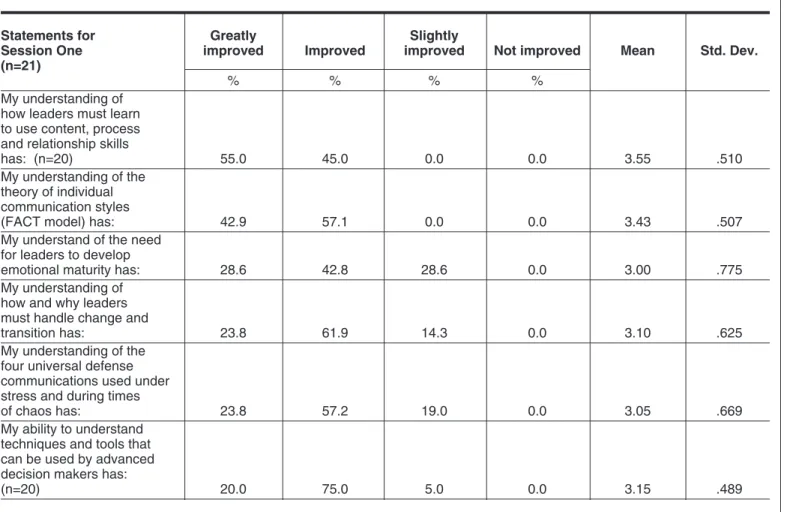
The findings in Table 1 show that the first session of the LSDP improved participant’s understanding of the need to learn to use Content, Process and Relationship Skills, and the theory of individual communication styles.
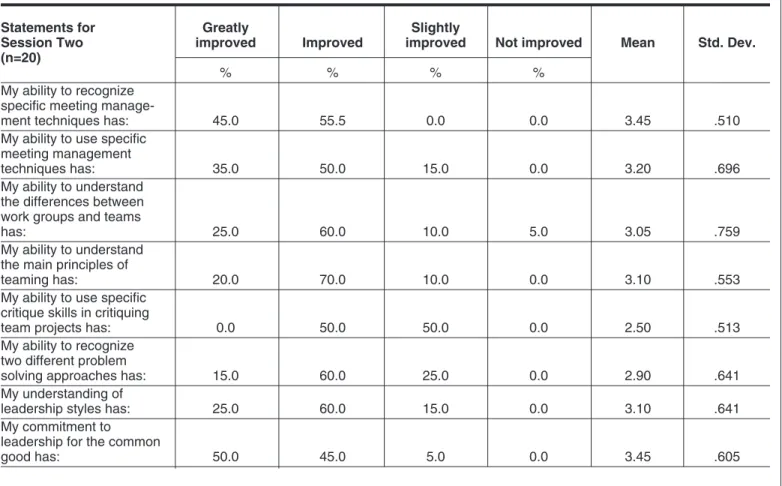
The findings in Table 2 indicate that the second session contributed to improving their ability to recognize specific meeting management techniques.
Evaluation Findings
All but one respondent also indicated that the second session helped improve their commitment to
leadership for the common good.
The findings in Table 3 show that the participants rated the impact of the third session in a much stronger way. Four out of five of them indicated that their ability to identify and work on specific
leadership growing edges has greatly improved. Almost the same percentage of participants indicated that their ability to understand the connection
between chaos and family survival has greatly improved. Other areas of leadership knowledge and skills that have been improved include the ability to hold others accountable, need to balance the role as a leader, and capacity to do self-reflection.
Table 1. Perceptions of Improvement in Leadership Skills: Session One
Statements for Greatly Slightly
Session One improved Improved improved Not improved Mean Std. Dev. (n=21)
% % % %
My understanding of how leaders must learn to use content, process and relationship skills
has: (n=20) 55.0 45.0 0.0 0.0 3.55 .510
My understanding of the theory of individual communication styles
(FACT model) has: 42.9 57.1 0.0 0.0 3.43 .507
My understand of the need for leaders to develop
emotional maturity has: 28.6 42.8 28.6 0.0 3.00 .775
My understanding of how and why leaders must handle change and
transition has: 23.8 61.9 14.3 0.0 3.10 .625
My understanding of the four universal defense communications used under stress and during times
of chaos has: 23.8 57.2 19.0 0.0 3.05 .669
My ability to understand techniques and tools that can be used by advanced decision makers has:
Table 2. Perceptions of Improvement in Leadership Skills: Session Two
Statements for Greatly Slightly
Session Two improved Improved improved Not improved Mean Std. Dev. (n=20)
% % % %
My ability to recognize specific meeting
manage-ment techniques has: 45.0 55.5 0.0 0.0 3.45 .510
My ability to use specific meeting management
techniques has: 35.0 50.0 15.0 0.0 3.20 .696
My ability to understand the differences between work groups and teams
has: 25.0 60.0 10.0 5.0 3.05 .759
My ability to understand the main principles of
teaming has: 20.0 70.0 10.0 0.0 3.10 .553
My ability to use specific critique skills in critiquing
team projects has: 0.0 50.0 50.0 0.0 2.50 .513
My ability to recognize two different problem
solving approaches has: 15.0 60.0 25.0 0.0 2.90 .641
My understanding of
leadership styles has: 25.0 60.0 15.0 0.0 3.10 .641
My commitment to leadership for the common
good has: 50.0 45.0 5.0 0.0 3.45 .605
Table 3. Perceptions of Improvement in Leadership Skills: Session Three
Statements for Greatly Slightly
Session Three improved Improved improved Not improved Mean Std. Dev. (n=18)
% % % %
My ability to understand the connection between chaos and family survival
rules has: 77.8 22.2 0.0 0.0 3.78 .428
My ability to understand how to hold others
accountable has: 61.1 38.9 0.0 0.0 3.61 .502
My ability to identify and work on my specific leadership growing
edges has: 83.3 16.7 0.0 0.0 3.83 .383
My ability to successfully work on leadership projects
in small teams has: 55.6 33.3 11.1 0.0 3.44 .705
My understanding of the need to achieve balance
in my role as a leader has: 66.6 27.8 5.6 0.0 3.61 .608
My capacity to do self reflection leadership
How did participants rate the overall LSDP sessions?
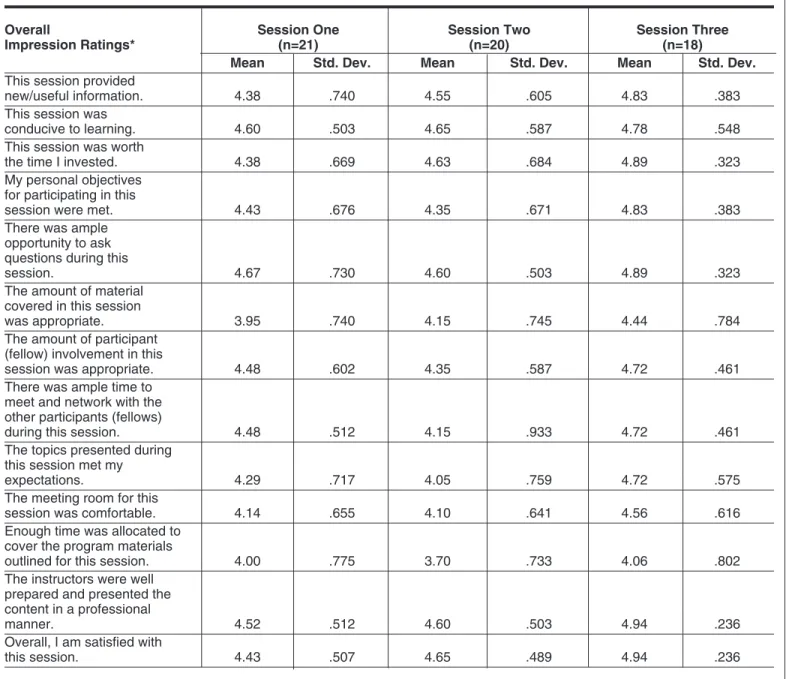
The evaluators attempted to solicit participants’ feedback on their overall impressions of the LSDP.
Table 4. Overall Impressions of the Three LSDP Sessions
Overall Session One Session Two Session Three Impression Ratings* (n=21) (n=20) (n=18)
Mean Std. Dev. Mean Std. Dev. Mean Std. Dev.
This session provided
new/useful information. 4.38 .740 4.55 .605 4.83 .383
This session was
conducive to learning. 4.60 .503 4.65 .587 4.78 .548
This session was worth
the time I invested. 4.38 .669 4.63 .684 4.89 .323
My personal objectives for participating in this
session were met. 4.43 .676 4.35 .671 4.83 .383
There was ample opportunity to ask questions during this
session. 4.67 .730 4.60 .503 4.89 .323
The amount of material covered in this session
was appropriate. 3.95 .740 4.15 .745 4.44 .784
The amount of participant (fellow) involvement in this
session was appropriate. 4.48 .602 4.35 .587 4.72 .461
There was ample time to meet and network with the other participants (fellows)
during this session. 4.48 .512 4.15 .933 4.72 .461
The topics presented during this session met my
expectations. 4.29 .717 4.05 .759 4.72 .575
The meeting room for this
session was comfortable. 4.14 .655 4.10 .641 4.56 .616
Enough time was allocated to cover the program materials
outlined for this session. 4.00 .775 3.70 .733 4.06 .802
The instructors were well prepared and presented the content in a professional
manner. 4.52 .512 4.60 .503 4.94 .236
Overall, I am satisfied with
this session. 4.43 .507 4.65 .489 4.94 .236
Participants were asked to rate various aspects of the LSDP on a Likert-type scale with one being “strongly disagree” and five being “strongly agree. The
findings are presented in Table 4 below.
What were the best-liked things about each of the three LSDP sessions?
Nineteen participants offered comments about what they liked bestabout the first session. The best-liked aspects included the active engagement of participants in the discussions, strong interaction between individuals and groups, experienced instructors, meeting fellow leaders, and sharing personal experiences. Examples of their comments included:
■Participant involvement complemented the lecture material.
■Interaction between the group and individuals.
■The reflective nature and opportunities.
■Individual discussions with teachers. Meeting fellow “student leaders”. Hearing personal experience stories relayed by fellow participants.
■Learning from highly skilled instructors, as well as learning from other participants in the course. Enjoyed learning more about myself.
■Learning tools/CPR model, practicing LDM, defense communication, personality test, and F-A-C-T session.
■I liked the philosophical discussions. They really got me thinking and help me learn best.
■Dan and Linda are great about “coaching” us. Network(ing) with new people outside of my “day to day” world.
■Far exceeded my expectations. The course was more and exceeded how it was marketed. Course = Great, but marketing is not representative. Twenty participants offered comments about what they liked bestabout the second session. Sharing about team projects and exercises, knowledge about quantum vs. Newtonian thinking exploration,
meeting tools, emotional development, and the balance between hard and soft leadership skills were mentioned as the most useful areas of discussion. Examples of their comments included:
■Presentation of group project and the follow-up discussion; emotional maturity.
■Both teachers knowledgeable in material; both teachers do not force you to conform to the teaching.
■The increased depth of relationships of group participants.
■Getting the additional meeting style and decision making tools.
■Quantum vs. Newtonian thinking exploration; the emotional part of leadership.
■Meeting tools and wise leadership presentation.
■Having the opportunity to critique each other and point out admirable attributes; the two movies.
■I enjoyed the time to think about my growing edges and also appreciated learning new skills to use at work.
■Building of relationships, especially with
individuals that I normally wouldn’t interact with. Also, enjoyed very much working on the emotional maturity piece.
■The balance between hard and soft leadership skills as well as the variety of communication techniques used to teach.
Eighteen participants offered comments about what they liked bestabout the third session. Again, the discussion on emotional maturity was mentioned by several participants. Family rules, tools for holding employees accountable, and tools for self-reflection and balancing personal life were the best-liked content areas. Examples of their comments included:
■The two main topics of ‘family rules’ and
accountability were well balanced for each other and complementary.
■Tools for holding employees accountable.
■One-on-one with teachers. Mentorship. Interaction with classmates. Everything was great! Thanks.
■Sections on emotional maturity and accountability.
■The feeling of community among all participants and the three instructors — it greatly facilitated learning.
■The balance of the content, the time spent working/learning was balanced well with time spent on our own.
■Exploring the relationship between family/survival rules and my actions (re-actions) during times of chaos.
■I thoroughly enjoyed the work on emotional maturity. I received answers, I received new questions for myself to ponder, and I grew — and will continue to.
What were the least liked things about each of the three LSDP sessions?
Nineteen participants listed things that they liked leastabout the first session. Redundancy of course content, games used, too slow a start, and little
substance on the first day were listed as least-liked aspects. Examples of their comments included:
■Too redundant — I had previous training.
■Sometimes too many questions slowed and derailed the course.
■The coffee. The chaos over team solution.
■I would have liked the pace to go a bit faster at times.
■The F.A.C.T. evaluation.
■ Ice breakers: they make me really tense and uncomfortable.
■Directions for games and project were, at times, not specific.
■Being preached to. Talk-talk-talk with no visuals.
■First day was too long with no substance. Nineteen participants listed things that they liked leastabout the second session. Participants
expressed the need to make the first day more active, suggested considering the removal of the “I promise” session, and comment that there was not enough time to digest the materials covered in the session. Examples of their comments included:
■Presenters from MSU: Other than the video that I found interesting, I found the Monday night session unhelpful and it didn’t produce anything “new” for me to ponder or consider.
■Emotional maturity — This section seemed like common sense to me.
■Tag team teaching is difficult for me; prefer if group split in two to different “classrooms”.
■The “I promise” portion.
■I least liked some of the situations in which I’m forced to talk one on one, but that’s my growing edge so that’s ok.
■“I promise”; wanting more opportunity for
individuals that need/want to work on being in a leader role to give them that opportunity — rather than strong personalities leading.
■We moved a little too slowly through the tools.
■Not enough time to cover all material yet have
Sixteen participants listed things they likedleast about the third session. Participants seemed not to enjoy the exam, the reading assignment, or the daily schedule, and this session was too close to the second one. Examples of their comments included:
■The exam — I would have preferred to work on it at home and bring it in.
■The large amount of “down time”. Some time off was necessary for self-reflection, but I think that the time allotted was excessive.
■Too much free time, not structured enough.
■So close to session two, had too little time to meet growing edges.
■The first day. I thought we could have covered additional material.
■There was a bit too much down time on day one. How will participants apply specific skills or concepts in their work settings?
Participants were asked to list one specific skill or concept that they learned during the first session and to describe how they expected to apply it in their work. Twenty participants answered this item. Multiple participants indicated that they will apply the CPR, LDM, and emotional maturity evaluation concepts and tools. Following is the list of specific skills or concepts learned during the first session that they planned to apply in their work.
■CPR — I will use this to steer meetings and interactions to be more efficient and productive.
■LDM — Will most definitely apply at meetings within my section.
■Paying attention to P&R and not being solely or mostly concerned w/c. This will impact my work in all ways and my personal relationships even more.
■Communication Style Mirroring — I have a few individuals who are hard to communicate with. I’m going to practice this.
■Identification of leadership styles and chose tools that will be applicable into committees to more effectively reach goals.
■I will try and notice people’s body language and tone and experiment with different ways of incorporating the idea that body language/tone can affect communication in my daily life.
■Decision-making — how to use different styles based on (the) situation to make decision(s).
■To identify my personal goal and to keep my eye on that personal goal (at all times).
■How to evaluate communication style.
■Emotional maturity in leadership — spread the word, for a better world.
■Although learning about the various types of communication styles wasn’t new for me, I needed the reminder to recognize and apply these in my personal and community life.
Similarly, participants were asked to indicate which specific skill or concept they learned during the second session and to describe how they expected to apply it in their work. Twenty participants listed some comments. The concepts and skills pertaining to ABC, meeting management skills, and decision-making tolls were mentioned frequently. Examples of their comments included:
■BTN — Formalized way to allow for feedback from all.
■BTN/MMG will be helpful for some meetings I attend in getting equal participation from everyone.
■I will use BTN in meetings and incorporate it to be in use all of the time.
■Decision-making tools
■ABC: one of the biggest challenges has been how to redirect the “decision making escalator”.
■I learned about teaming and how teams are different than workgroups, and I think that will be valuable in future endeavors.
■How to look at problems through different lenses. This will be challenging because I see
opportunities to apply these concepts in all work and personal experiences.
■All of the tools — it will take work, but they’ll all be useful. Also, more direction toward my growing
edge. Many of the skills we learned I don’t feel as if I improved much during this session, but I will practice. Thank you — I’ve thoroughly enjoyed this session.
■I learned a number of meeting management skills including pre-labeling and post-labeling.
■Personal understanding of emotional maturity has greatly increased.
And finally, seventeen participants listed a specific skill or concept that they learned during the third session and described how they will apply it in their work. Accountability and performance measures and tools, the CPR and LDM models, and self-reflection were frequently mentioned skill and concept areas. Following are examples of what the participants listed:
■Five components to accountability — will put into use for myself and upline and downline.
■Greater self examination.
■CPR and LDM models in use at meetings I chair. Accountability — will work to implement a more correct evaluation policy.
■How to hold employees accountable (design of performance elements and examples): I will use this when crafting my own performance elements, and (when I become a supervisor) I will use it to design performance measures for my employees.
■How to lead from behind.
■Mature leadership concept.
■Accountability tools — were better than I’ve experienced and emphasis on the learning is something I’ll use always.
■Self reflection — this was very useful in
understanding better about being a more effective leader.
■Accountability — holding myself and others accountable — how to. I have a lot better
understanding of what this is now and why it’s so critical.
A telephone follow-up call was made to each of the LSDP participants about eight months after the completion of the third session. The purpose of the follow-up call was to determine whether LSDP graduates have increased the level of collaborative relationships between their communities and the target industries of agriculture, natural resources, environment, and manufacturing; whether they have been participating in the GLLA alumni network and utilizing the website and the electronic
communications tools; and whether they have remained active in the public dialog and policy-making process of these identified issues. Two MSU students received brief training on the nature and purpose of telephone interviews. They were provided with the interview questions in a printed format. Telephone contacts were made using a speaker phone in the office of the evaluator. One of the students asked the questions on the telephone and took extensive notes. The second student typed the responses verbatim using Microsoft Word. Telephone interview protocols were followed to ensure that each participant received a courteous and professional call.
Of the 21 participants, one declined to participate in the interview, the phone numbers of two others were disconnected or disabled, persons answering at two of the phone numbers indicated that the participants were no longer associated with that office, three of the participant’s numbers were not answered, and one asked to be called back after few days and could not be contacted later. Twelve participants
completed the telephone interview.
The data captured via the phone interviews were printed and read carefully to identify themes in the responses. Once themes were identified, the responses were read again, and the themes were underlined for each record.
All of the participants who were reachable and participated in an interview were still serving the same organization as when they applied to the LSDP. Four of them indicated that they now have new responsibilities, three have received promotions, and three have been assigned to a new team or board. Examples of their responses to the follow-up interview questions include:
“I am a new member of the board of directors for an organization called The Great Lakes Aquatic
Network and Fund, which is in Petoskey, Michigan. It is a Great Lakes-wide organization, and I am the board secretary.”
“In Maine I’ve becoming more involved with a watershed coalition. I’m organizing a stream clean up for next spring, and we now have a kiosk for information. We’ve created a registry and a few dam projects.”
“The conference helped me figure out that my leadership is valued not only in the workplace but outside as well. I have become involved volunteering with the school family council, where we council families on school-related conflicts such as terrorism.”
When asked to describe any new roles and/or responsibilities that they have taken on during the past year in the community/ies where they live and work, respondents provided various answers. Three of them mentioned that they are new members of a board or council, two of them have started volunteer teaching, one indicated being involved in
fundraising, and one has been instrumental in implementing new projects. Selected responses include:
“I have been appointed Vice President of “Lansing Area Skate, Bike & Recreation Foundation,” through which I have responsibility to assist the President with community relations, and oversee the
coordination of volunteers in community projects.” “Founder of fledgling organization “MSU GREEN SPORTS,” responsibilities include organizing, recruiting, and strategic positioning of the organizational position.”
“More front office assignments are coming down my way. I did get a promotion.”
“I have been assigned as the research representative for the Lake Huron Basin team through the DNR.” “No specific roles or responsibilities, although I was
the academy.”
“I was promoted to program manager, which is a step above where I was prior to the leadership program. So, I now manage our entire water resource program for the Great Lakes region. I’ve also become more involved with other programs such as the water quality program, the water restoration program, and even a global warming program.”
“I decided to enlist in the Army in order to take on more roles.”
“There are always new responsibilities coming up.” “I’m still coordinator for the department’s magazine, “Fisheries and Wildlife Spotlight”; a lot of what I learned at the program applied to running that magazine. There’s a lot of editing stuff and students working on committees that I’m responsible for. “At work, I’ve changed responsibilities. I felt stuck in my current position, but transferred positions due to the skills I learned at the leadership academy. The conference helped chart out my future path.”
Participants were also asked to describe their typical decision-making process as a leader. Eight
participants mentioned terms like coordination, consultation on different levels, gathering inputs, teamwork, communication, and collaboration. Three indicated that they have made use of Robert’s Rules of Order, the CPR model, or other tools that were taught during the LSDP. Sample responses are as follows:
“I try to use those techniques such as CPR model.” “It depends on the topic and subject. In the workplace, of course, we have a lot of procedures depending on the nature of the decision and who’s involved. My projects are in coordination with the field staff who are the implementers. In terms of administration, I consult with our station head. We also consult with those with a stake in the outcome and use their input to make decisions.”
“It all depends on the situation and who’s involved. Sometimes, I just need to make a decision, that’s it. If other people are involved, I will tell then what I’m thinking and see what they’re thinking. I will take others’ input and adjust the decision if I need to. I try to inform others involved of the decision and get input rather than just tell them. It all depends on the
audience.”
“I’ve found the CPR model to be very practical and think that it really facilitates group collaboration and problem solving. Labeled Decision Making, also, helps make those big decisions, and keeps
everything on the table, so everybody knows what’s going on.”
“Depends on the decision I am trying to make. There are a lot of decisions as program manager that I just make, and others where I weigh pros and cons and decide what will take us closest to our end goal. Other decisions involve more people within the community and organization. For those, I either consult folks one on one, perform conference calls, or hold meetings for a broader discussion. If there’s an internal decision or a broader decision, then I must consult with a broader community to reach consensus.”
“More of a team decision-making process. At my workplace we know what needs to be done and try to find the safest way to do it.”
“Typically, since I’m not a supervisor, most of my work is working with technicians. I am a part of the ‘I will live with decision making’ process.”
“Pretty collaborative — talking back and forth with a lot of people. While running the Spotlight committee meetings, I have everyone put in their input up front and we make decisions as a group. Basically, a lot of work up front as opposed to just making a decision.
“If a problem arises, I try to talk through the problem and think of different angles of dealing with the problem. I talk to other people to brainstorm, gather facts, and devise options, then select the best avenue and assess if it was the right decision.”
“It depends on the setting; whether it’s a larger or smaller group setting. I don’t have a conventional leadership role in some of the larger groups I
participate in. In the larger groups we operate under Robert’s Rules of Order (basic parliamentary
procedure). In smaller groups or around the office and support staff, I think we don’t use the outright tool of Labeled Decision Making. I do think I am more effective at making decisions since the academy. I have always been someone who has overanalyzed or taken too much time, and now I think I am more comfortable making decisions with the information I have. I do think I am more comfortable making decisions given a short time frame or limited information.”
Participants were further asked to indicate the kinds of changes they have made in their leadership style or leadership behaviors as a result of their
participation in the LSDP. They were encouraged to share some examples of how their leadership style and behaviors have changed. Four of the twelve respondents reported that they now get more input using new/different techniques, and two indicated utilizing more patience. Other responses included, providing not only the direction but also vision, becoming more aware of strengths and weaknesses, having everyone on the same page, being more sensitive, implementing an accountability program, trying to ‘lead as a group’, and becoming more self-confident in roles of decision making. Sample comments include:
“It is giving me more confidence. Thinking more before I speak, it is a maturity process.”
“I can’t say for certain I’ve implemented any particular style. I was already aware of “Labeled Decision Making”. We were already doing a lot of that, although I am probably more cognitive of that now, especially if it’s a meeting I am leading. I am thinking more from a leadership perspective, not just providing direction but also vision that pertains to the leadership role. It’s just more of a mindset. I was definitely influenced by the leadership program.” “I am much more sensitive than I was before. We’ve also implemented an accountability program, which was a direct result of one of the programs at the conference.”
“More patience.”
“My ability to hand things over to others on a team or support staff. In one of the models at the academy, we learned how to hand over decisions when someone else is in charge of an aspect of the decision. I feel more comfortable doing that after the academy.”
“I am more aware of my strengths and weaknesses and areas I need to grow as a leader. I spend more time thinking about it and the areas I am not as strong, and I take advantage of where I am strong. I have grown in understanding my skills in order to make all areas of my life stronger. Before the
“I try to get more input on decisions I make.” “The program reinforced what I already knew — I already had some idea. The reinforcement gave me a more complete understanding of leadership.” “Just become more collaborative.”
“At the conference my focus was on emotions and skills I learned. I was able to connect with the community on a personal and professional level since I could chart my path into my career. I am more self-confident in roles of decision-making.” “I’ve become more aware of how to get input from people by using different techniques that I learned at the academy. I am now more conscious of getting input from others, and not necessarily leading and waiting for others to follow but rather leading as a group.”
“Greater confidence and a systematic approach in recognizing people’s differences, without feeling ‘over-saturated’ with one perspective. For instance, in the past I had a tendency to let one (a few) people dominate discussion. Now, however, I am much more skilled at eliciting others’ responses with a ‘distributive empathy’ and some of the other group discussion techniques taught in class. I’ve grown emotionally.
During the 9-month long LSDP, participants interacted with a number of people — program participants and the program facilitators.
Participants were asked to describe the nature and extent of any communication and/or collaboration they have had with those persons since completing the program. It was learned that seven of the twelve participants have been chatting informally. Five of them indicated that they have been involved in conference calls, four have interacted via email, and three have developed friendships. Sample comments include:
“I have been in contact with a few members of the group, some unintentionally and another
intentionally. A few email exchanges have occurred providing life updates. A few phone calls
“We’ve had a couple communications, some follow up emails, and also some additional resources. There was one small thing we didn’t finish during the program that we had to do on our own. In the meantime, I’ve come up with a few questions I’d like to ask. I have also talked with my fellow classmates, and I always enjoy talking with them; nothing formal, but they’re always on my mind.” “None with the other participants.”
“I haven’t had any, because they are outside my area.”
“Very limited.”
“I’ve built some pretty good relationships with people. We’ve had follow up conference calls. Two calls related to things we learned at the academy and on self-teaching. I’ve also had emails and calls on a more social manner.”
“I developed several friendships through the workshop. I continue to stay in touch with three of them on a regular basis. We mostly stay in touch on a friendship basis, and listening and talking about where we are in life and where we want to go. We articulate goals, and how to achieve our goals; it is more aimed towards personal development.” “We did have one conference call to cover a part we didn’t get to in the leadership class, and always to let everyone know of people’s address changes.” “I’ve had some collaboration with people within the DNR that had the training. In fact, (....) is coming up with a decision making process for biology. A group of biologists will figure out how they will make future decisions.”
“We had a follow-up conference call on conflict management between big groups of people. There have been a couple of different conferences over the phone. I know that others have been keeping in touch.”
An attempt was made to find out if participants might be thinking of, or working on, specific plans to increase collaborative relationships between the target industries of agriculture, natural resources, environment, and manufacturing. They were asked, “As a result of participating in the Leadership
Academy you might have some new ideas or plans for increasing collaboration between these
industries, could you please share these with us?” Three respondents answered this question. One of
the respondents indicated that s/he is now working locally with the chamber of commerce. Working with State departments (i.e., DEQ and DNR) was mentioned by the second respondent. The third person indicated that s/he is working with the Michigan Agricultural Environmental Assurance Program. Examples of collaborative relationships include:
“I work with the ag(riculture) industry, bringing natural resources and environment together, such as MAEAP — Michigan Agriculture Environmental Assurance Program — a 30-plus organization voluntary proactive program.”
“I don’t know if this really applies to the question, but I am seriously considering going back for my Ph.D. I can trace my desire to do that to the leadership academy which got me thinking on a larger scale and about lifelong education. I am eager to do additional training on my own, which will probably be within my field of fisheries and which might involve policy work. I don’t know what my project will be yet, but there will probably be some policy involved. Not cross disciplinary development.”
“I work with vegetables primarily and irrigation is obviously involved. Irrigation involves water and the State’s natural resources. I could see in the future working with the DEQ for water use and with the DNR; I could see how we’d collaborate there. Also, I’ve made efforts in the past to work with energy efficiency, and the DNR is working on energy efficiency as well, so we might coordinate there.” “No plans.”
“I have plans that are indirectly related to the leadership and facilitation skills. I am taking a co-lead to develop agricultural economic development plans that seem to be missing agriculture as a significant portion of Michigan economy. The mindset of decision-makers is that agriculture won’t be a major part of our economy in Michigan. I led a conference call with people from the MSU Product Center, Land Policy Institute, and Michigan Department of Agriculture, and we had
conversations with the Farm Bureau to develop a plan in my home county to use as a learning opportunity and to make a model that can be reproduced elsewhere in the state.”
“I don’t know if I have any new ideas that could be put into place easily. I try to implement regularly to outreach to folks in those industries. I continue to develop understanding of where they are on issues
and positions and how they got there. So, when we are working on water legislation it helps to know where everyone is coming from and why, to work out specific questions and concerns. People know that I care where they are coming from, and I know that people care where I am coming from. We know each other and have worked together, and it’s good to know that people know where you’re coming from. Personally, just making sure there are open lines of communication and deepening our relationships to move water protection forward in Michigan. I’m actually working with the chamber of commerce right now.”
“I have been attending environmental conferences around the Great Lakes Region, and have been advocating for a “Great Lakes Region
Environmentally Friendly Competition” for both sport and restoration. The Leadership Academy has provided a framework for establishing this interstate collaboration.”
“Not between industries, but between agencies. We interact with Forestry, Fisheries and Wildlife, and tribal organizations. We have a continual process for cooperative projects. We have ongoing ideas and are trying to incorporate those ideas into meetings. “No ideas off hand. Just the whole process of having people on board up front rather than contacting people later in the process.”
My job previously had a lot to do with Michigan Department of Agriculture, so I’d been dealing with intercultural coordination along the way. I have no new ideas, just how I function as a leader when approaching different people and problems through collaboration.”
Finally, participants were asked, “If you were to recommend one or two changes to the Great Lakes Leadership Academy’s Leadership Skills
Development Program, what would they be?” Three persons suggested keeping the same instructors. Two persons suggested setting up the agenda and time for follow-up meetings and/or conference calls. One person suggested having more of a blend of private industry and the public sector in the program. Offering the LSDP at a more central location, and
I would encourage their role in the academy because they are very smart, intelligent, motivated leaders. In order for our people to participate on a regular basis, we’d want to have those two in the picture. Another suggestion is to have a more central meeting location — more in the middle of the state; that might encourage more participation. Minimizing costs for others would be great as well. I really enjoyed the different disciplines of everyone there, and everyone brought different perspectives, and it helped for a better learning experience.”
“I was just hoping to have more of a blend of private vs. public in the program.”
“I really enjoyed it. I enjoyed the format and the location. I guess there were times when the conducting of the actual program could have been tightened up a little more. It’s a give and take; others think that’s not a problem. Overall it’s a great program; I would tell anybody to go to it. I wish I would have had it twenty years ago.”
“More review of the assigned readings.”
“After the program follow-up effort, there hasn’t been a real interest or organized effort to stay connected as a learning community, just follow-up conference calls and individuals staying in touch. There should be more dedication to keeping in touch. If there were more resources, people might stay connected.” “I thought it was a great program and very valuable. The one thing, which is not a fault of the program, is we were trying to get back together on conference calls and that’s fallen out. I don’t think it’s a lack of interest, more a lack of time. I could initiate a call, and I am sure people would participate, but it would take a lot of time and effort and it’s hard to fit that in. The difficulty would be setting an agenda and
figuring out what people would talk about. It would be nice if the program could build in a way to do follow-up amongst the group members to help pull everyone together. Maybe the program could set up a 6-month or 1-year follow-up conference call.” “Try to get more people from the private industry rather than the public sector.”
“No suggestions, it was overall a pretty good experience.”
“I understand a lot of changes have already occurred. I thought “oh that’s too bad”, because I really valued what I did as far as the emotional pieces on how individuals deal with problems.” “The design of the Academy seemed to be thoroughly considered, and well orchestrated with a flexible balance of time to be alone and/or socialize with others. The setting provided many opportunities for self-reflection and leisure activities to develop relationships with other people. While this “restorative time” was very critical for the space to grow, it seemed to bias educational pedagogy
toward an “arm chair leadership.” More experiential learning opportunities, particularly, like the first session’s “movie field trip to the Capitol” group. This group got to know one another very well, while exercising and practicing the leadership techniques. Time allocated during the Academy toward extended experiential learning activities can provide alternative settings to practice skills and develop understanding, and may provide a “richer,” more “engaging,” context to learn.
“Additional recommendation, I’m not aware the group ever made it into the alumni Internet network — more support seems necessary to facilitate/ operationalize this resource.”
References
Kirkpatrick, D.L., & Kirkpatrick, J.D. (2006).
Evaluating Training Programs: The Four Levels (3rd Edition). San Francisco, CA: Berrett-Koehler Publishers, Inc.
Hannum, K.M., Martineau J.W., & Reinelt, C. (2007).
The Handbook of Leadership Development Evaluation.
San Francisco, CA: John Wiley & Sons, Inc.
W.K. Kellogg Evaluation Handbook (2000). W.K. Kellogg Foundation, Battle Creek, MI.
http://www.wkkf.org/documents/wkkf/ evaluationhandbook/
The purpose of this survey is to gauge your level of satisfaction with the first session of the Leadership Skills Development Program and to collect your feedback about that session. Your responses and comments will be combined with the responses and comments of your program fellows and will be summarized in a program evaluation report, which
Leadership Skills Development Program — 2006-2007
Evaluation of the September 18-20, 2006 Session
will be reviewed as part of a continuous
improvement process. Your confidentially is assured and will be protected under the guidelines outlined by the Michigan State University Human Research Protection Program. Please read each question carefully, and make sure you also respond to the questions on the reverse side of this page.
Leadership Skills Greatly Improved Improved Slightly Improved Not Improved
4 3 2 1
1. My understanding of how leaders must learn to use Content, Process, and
Relationship Skills has...
❑
❑
❑
❑
2. My understanding of the communication styles
theory of individual
❑
❑
❑
❑
(FACT model) has... 3. My understanding of
the need for leaders to develop emotional maturity
has...
❑
❑
❑
❑
4. My understanding of how and why leaders must handle change and
transition has...
❑
❑
❑
❑
5. My understanding of the four universal defense communications used under stress and during times of
chaos has...
❑
❑
❑
❑
6. My ability to understand
Part I. Session Objectives— Please indicate the extent to which your participation in this session helped to improve your understanding of the leadership skills listed below, by placing a “✔” in the box that represents your answer to each statement.
Part II. Overall Impressions — Please indicate your level of agreement with each of the statements about Session 1 that are listed below by placing a “✔” in the box that represents your answer to each statement.
Statements About Session 1 Strongly Agree Neutral Disagree Strongly
Agree Disagree
5 4 3 2 1
1. This session provided new/
useful information.
❑
❑
❑
❑
❑
2. This session was conducive
to learning.
❑
❑
❑
❑
❑
3. This session was worth the time
I invested.
❑
❑
❑
❑
❑
4. My personal objectives for participating in this session
were met.
❑
❑
❑
❑
❑
5. There was ample opportunity to ask questions during
this session.
❑
❑
❑
❑
❑
6. The amount of material covered
in this session was appropriate.
❑
❑
❑
❑
❑
7. The amount of participant (fellow) involvement in this session
was appropriate.
❑
❑
❑
❑
❑
8. There was ample time to meet and network with the other participants
(fellows) during this session.
❑
❑
❑
❑
❑
9. The topics presented during this
session met my expectations.
❑
❑
❑
❑
❑
10. The meeting room for this
session was comfortable.
❑
❑
❑
❑
❑
11. Enough time was allotted to cover the program materials outlined
for this session.
❑
❑
❑
❑
❑
12. The instructors were well prepared and presented the content in a
professional manner.
❑
❑
❑
❑
❑
13. Overall, I am satisfied with
this session.
❑
❑
❑
❑
❑
1. What did you like bestabout Session 1 of the Leadership Skills Development Program?
2. What did you like leastabout Session 1 of the Leadership Skills Development Program?
3. Please list one specific skill or concept that you learned during this session, and describe how you will apply it in your work.
Thank you for completing this survey. Please place it in the envelope provided with the questionnaire, seal the envelope, and turn it in to the survey administrator.
Leadership Skills Development Program - 2006-2007
Evaluation of the December 11-14, 2006 Session
Part I. Session Objectives — Please indicate the extent to which your participation in this session helped to improve your understanding of the leadership skills listed below, by placing a “✔“ in the box that represents your answer to each statement.
Leadership Skills Greatly Improved Improved Slightly Improved Not Improved
4 3 2 1
1. My ability to recognize specific meeting management
techniques has...
❑
❑
❑
❑
2. My ability to use specific meeting management
techniques has...
❑
❑
❑
❑
3. My ability to understand the differences between work groups
and teams has...
❑
❑
❑
❑
4. My ability to understand the
main principles of teaming has...
❑
❑
❑
❑
5. My ability to use specific critique skills in critiquing team
projects has...
❑
❑
❑
❑
6. My understanding of advanced
conflict management theory has...
❑
❑
❑
❑
7. My ability to apply advanced
conflict management theory has...
❑
❑
❑
❑
8. My ability to recognize two different problem solving
approaches has...
❑
❑
❑
❑
9. My understanding of leadership
The first purpose of this survey is to evaluate the degree to which you think that Session 2 of the Leadership Skills Development Program has
impacted your leadership competencies. The second purpose is to gauge your level of satisfaction with the session.
Your responses will remain confidential and will only be reported in combination with those of other participants and will in no way be affiliated with your name in any published report.
Please read each question carefully, and make sure to also complete the questions on page two.
Appendix B
Statements About Session 2 Strongly Agree Strongly agree nor disagree Neither agree Disagree disagree
5 4 3 2 1
1. This session provided
new/useful information.
❑
❑
❑
❑
❑
2. This session was conducive
To learning.
❑
❑
❑
❑
❑
3. This session was worth the
time I invested.
❑
❑
❑
❑
❑
4. My personal objectives for participating in this session
were met.
❑
❑
❑
❑
❑
5. There was ample opportunity to ask questions during this
session.
❑
❑
❑
❑
❑
6. The amount of material covered
in this session was appropriate.
❑
❑
❑
❑
❑
7.The amount of participant (fellow) involvement in this session was
appropriate.
❑
❑
❑
❑
❑
8. There was ample time to meet and network with the other participants (fellows) during this
session.
❑
❑
❑
❑
❑
9. The topics presented during this
session met my expectations.
❑
❑
❑
❑
❑
10. The meeting room for this session
was comfortable.
❑
❑
❑
❑
❑
11. Enough time was allotted to cover the program materials outlined
for this session.
❑
❑
❑
❑
❑
12. The instructors were well prepared and presented the content in a
professional manner.
❑
❑
❑
❑
❑
13. Overall, I am satisfied with this
session.
❑
❑
❑
❑
❑
Part II. Overall Impressions — Please indicate your level of agreement with each of the statements about Session 2 that are listed below by placing a “✔” in the box that represents your answer to each statement.
1. What did you like bestabout Session 2 of the Leadership Skills Development Program?
2. What did you like leastabout Session 2 of the Leadership Skills Development Program?
3. Please list one specific skill or concept that you learned during this session, and describe how you will apply it in your work.
Thank you for completing this survey. Please return it to the survey administrator.
Leadership Skills Development Program — 2006-2007
Evaluation of the February 5-8, 2007 Session
Leadership Skills Greatly Improved Improved Slightly Improved Not Improved
4 3 2 1
1. My ability to understand the connection between chaos and
family survival rules has...
❑
❑
❑
❑
2. My ability to understand how
to hold others accountable has...
❑
❑
❑
❑
3. My ability to identify and work on my specific leadership growing
edges has...
❑
❑
❑
❑
4. My ability to successfully work on leadership projects in small
teams has...
❑
❑
❑
❑
5. My understanding of the need to achieve balance in my role as
a leader has...
❑
❑
❑
❑
6. My capacity to do self reflection
leadership work has....
❑
❑
❑
❑
The first purpose of this survey is to evaluate the degree to which you think that Session 3 of the Leadership Skills Development Program has
impacted your leadership competencies. The second purpose is to gauge your level of satisfaction with the session.
Your responses will remain confidential and will only be reported in combination with those of other participants and will in no way be affiliated with your name in any published report.
Please read each question carefully, and make sure to also complete the questions on page two. Part I. Session Objectives— Please indicate the extent to which your participation in this session helped to improve your understanding of the leadership skills listed below, by placing a “✔” in the box that represents your answer to each statement.
Statements About Session 3 Strongly Agree Strongly agree nor disagree Neither agree Disagree disagree
5 4 3 2 1
1.This session pr