Lecture 1 — Symmetry in the solid state
-Part I: Simple patterns and groups
1 Introduction
Concepts of symmetry are of capital importance in all branches of the physical sciences. In physics,continuoussymmetry is particularly important and is rightly emphasized because of its connection with conserved quantities through the famous Noether’s theorem. For example, trans-lational invariance of the Hamiltonian implies the conservation of linear momentum, rotational invariance that of angular momentum and so on.
Discretesymmetries — those in which a figure of a solid is invariant by rotation of a finite angle, by reflection and/or by translation of a finite vector — are also very familiar to us. Symmetry is found everywhere in nature, particularly in connection with the crystalline state. In traditional physics courses, discrete symmetries receive far less attention, certainly less than it deserves, particularly in solid-state physics. The reason for this can perhaps be traced to the fact that most examples in solid-state physics books relate to simple compounds, such as metals and binary alloys, which tend to have some of the richest but also most complex cubic symmetries. It is therefore convenient for the Authors to overlook symmetry aspects and illustrate results such as phonon dispersions and electronic band structures by “brute-force” methods. As a consequence, it is natural for students to get the impression that discrete symmetry is exclusive to the realm of crystallography. Nothing could be farther from the truth: in fact, discrete symmetries drive some of the most profound insight (for example, the Neumann’s principle) and produce drastic simpli-fications in calculations for a variety of superficially unrelated subjects, such as the effect of the electric field on the valence electron energies in crystals (crystal electric field theory), the energy level structures of atomic vibrations (phonons) and of conduction electrons (band structures), the stability of magnetically ordered structure and the general theory of phase transitions and many others. Some of the theorems that can be deduced from group theory appear to be “gifts of na-ture” and deserved names such as “Wonderful Orthogonality Theorem” (Van Vleck). In this first part of the solid-state physics course, we will focus particularly on the elementary understanding of discrete symmetries in the crystalline state and its applications. From this brief discussion, it should be clear that we are not only interested in the symmetry of atoms and molecules, but also of “smooth” functions such as charge densities (real, positive — an example is shown in fig. 1) and wavefunctions (complex). Therefore, we will not make any “atomicity” assumption, but rather consider the most general cases of a continuous pattern in three dimensions. As the symmetry of these patterns can be rather complex, we will build out knowledge by “practicing” on simpler patterns in zero, one and two dimensions.
One of the main goals of this part of the course is acquire a general, if not detailed, understanding of the“International Tables for Crystallography”(thereafter referred to as ITC). The ITC are an essential tool for understanding the literature and carrying out original research in the sub-fields of solid-state physics, chemistry and structural biology dealing with crystalline materials. Since their first edition, published in two volumes in 1935 under the titleInternationale Tabellen zur Bestimmung von Kristallstrukturenwith C. Hermann as editor, the ITC have steadily grown into eight ponderous volumes, to become the true“bible” of crystallographers.
Figure 1: Valence electron density map for the orthorhombic structure of C3N4. The electronic
density increases on going from the red to the violet (from, Maurizio Mattesini , Samir F. Matar and Jean Etourneaum J. Mater Chem 1999)
2 Symmetry around a fixed point
In this lecture, we will introduce some basic symmetry concepts by describing a few simple transformations of a 2D pattern around a fixed point. The transformations we are interested in are discrete (i.e., we are not interested in infinitesimal transformations) and preserve distances (isometric transformations). In essence, the transformations in question arerotationsaround the fixed point by a rational fraction of360◦, reflections by a line (by analogy with 3D, we will often call this a “plane”) passing through the fixed point and combinations thereof. As we shall see later on, the very concept of “transformation” (or “operation”, an equivalent term will introduce shortly) will require some clarification. To begin with, a few simple and intuitive examples should serve to introduce the basic concepts employed in this lecture.
2.1 The symmetries of a parallelogram, an arrow and a rectangle
A parallelogram has two-fold rotational symmetry around its center. We will denote the two-fold axis with a vertical “pointy” ellipse (Fig. 2, left) and with the number2. An arrow is symmetric by reflection of a line through its middle. We will denote this reflection with a thick line (Fig. 2, right) and with the letterm.
P
Figure 2: The symmetry of a parallelogram (left) and of an arrow (right)
In the previous cases, the transformations 2ormare the only ones present, if one excludes the trivial identity transformation. However, these two transformations can also be found combined in the case of therectangle. Here, we have twomtransformations and a2transformation at their intersection, which is also the fixed point of the figure (Fig. 3).
2.2 What do the graphic symbols for
2
and
m
really mean? Graphs and
their symmetry.
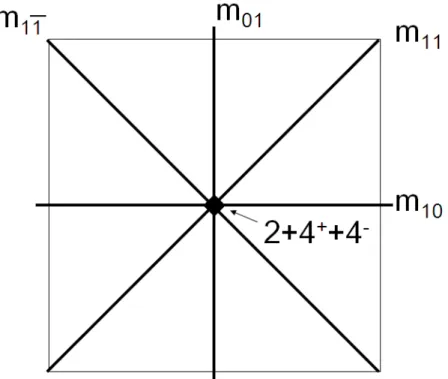
By inspecting Fig. 3, it is easy to understand that the graphic symbols (or “graphs”) that we have drawn representsets of invariant points. The points on the mgraphs are transformed into themselves by the reflection, whereas all the other points are transformed into different points. The same is true for2, for which the graph is also the “fixed point” that, in this type of symmetry, is left invariant by all transformations. Since graphs are part of the pattern, it is natural that they should also be subject to transformations, unless they coincide with the fixed point. This is clear by looking at Fig. 4, which represent the symmetry of a square. The central symbol, on the fixed point represents three transformations: the counterclockwise rotation by90◦ (4+), the clockwise rotation by90◦(4−) and the rotation by180◦(2). All the other transformations are of typem. It is easy to see that for each mirror linemthere is another line rotated by90◦, which can be thought as its symmetry partner via the transformations4+or4−. The two90◦-rotations are (perhaps less
P
P
Figure 3: The symmetry of a rectangle
obviously) the mirror image of each other. However, it is also clear that the planes rotated by 45◦ cannot be obtained by symmetry from the other operators. Where do they come from? We anticipate the answer here: the diagonal mirrors are obtained by successive application (we will later call thiscompositionormultiplication) of a horizontal (or verical) mirror followed by a90◦ rotation. In order to understand this, we need to learn a little more about these transformations and their relations.
2.3 Symmetry operators
This section may seem rather formal, but, if you read through it, you will find it is mostly common sense.
In a somewhat more formal way, the transformations we described as2,m,4+, etc. are said to be produced by the application of “symmetry operators”. Operators of this kind define a two-way correspondence (a bijection) of the plane (or space) into itself. In other words, each point p is uniquely associated by the transformation with a new point p’. Likewise, each point q’, after the transformation, will receive the attributes of a point q. As already mentioned, here we are only concerned with isometries, i.e., operators that preserve distances (and therefore shapes). In other words, the distance between points p’ and q’ is the same as for points p and q, and likewise for angles. Theidentityof the points themselves (and their coordinates — see later on) are unchanged by the transformation, but the attributes of point p are transferred to p’. This
Figure 4: The symmetry of a square. The central symbol describes three transformations: “4+”
(counterclockwise rotation by90◦), “4−” (clockwise rotation by90◦) and “2” (rotation by180◦).
The labelling of the four mirror lines is referred to in the text.
is known as an active transformation(in an alternative interpretation, a passive transformation transforms the coordinates). Examples ofattributes in this context are the color or the relief of the pattern etc. In crystallography, content will mean an atom, a magnetic moment, a vector or tensor quantity etc.
Figure 5: A generic symmetry operator acting on a pattern fragment.
SYMMETRY OPERATORS: KEY CONCEPTS
• Operators: transform (move) the whole pattern (i.e., theattributes, or content, of all points in space). We denote operators initalic fontsand we used parentheses()around them for clarity, if required.
• Symmetry operators: a generic operator as described above is said to be asymmetry oper-ator if upon transformation, the new pattern is indistinguishable from the original one. Let us imagine that a given operatorg transforms point p to point p’. In order forg to be asymmetryoperator, theattributesof the two points must be in some sense “the same”. This is illustrated in a general way in Fig. 5.
• Application of operators to points or parts of the pattern, relating them to other points or sets of points. We indicate this with the notation v=gu, where u and v are sets of points. We denote sets of points with roman fonts and put square brackets [ ] around them for clarity, if required. We will also say that pattern fragment u is transformed by g into pattern fragment v. If the pattern is to be symmetric, v must have the same attributes as u in the sense explained above.
• Operator composition. It is the sequential ordered application of two operators, and we indicate this withg◦h. The new operator thus generated acts as(g◦h)u = g[hu]. Im-portant Note: Symmetry operators in generaldo not commute, so the order is important. We will see later on that translations (which are represented by vectors) can be symmetry operators. The composition of two translations is simply theirvector sum.
• Operator Graphs. They aresets of pointsin space that are invariant (i.e., are transformed into themselves) upon the application of a given operator. We draw graphs with conven-tional symbols indicating how the operator acts. We denote the graph of the operator g (i.e., the invariant points) as [g]. Note: graphs can be thought of as parts of the pattern, and are subject to symmetry like everything else (as explained above). Sometimes, as in the above case of the fourfold axis, the graphs of two distinct operators coincide (e.g., left and right rotations around the same axis). In this case, the conventional symbol will account for this fact.
2.4 Group structure: the few “formal” things you need to know
Sets of symmetry operators of interest for crystallography have the mathematical structure of a group. In particular, groups describing transformations around a fixed point are known as point groups. In order for a generic set to have the group structure, it has to have the following properties:
FORMAL PROPERTIES OF A GROUP
• A binary operation (usually calledcompositionormultiplicationmust be defined. We indi-cated this with the symbol “◦”.
• Composition must beassociative: for every three elementsf,g andhof the set
f ◦(g◦h) = (f ◦g)◦h (1)
• The “neutral element” (i.e., the identity, usually indicated withE) must exist, so that for every elementg:
g◦E =E◦g =g (2)
• Each elementghas aninverseelementg−1so that
g◦g−1 =g−1◦g =E (3)
• Another useful concept you should be familiar with is that of subgroup. A subgroup is a subset of a group that is also a group.
2.5 Composition (multiplication) of symmetry operators
If a finite group Ghas n elements, then clearly there will ben2 possible multiplications in the group. These can be collected in the form of an n ×n matrix, known as the multiplication table. Multiplication tables for the simple point groups we encountered so far are described in Appendix I.
For our purposes it is more important to understand how the symmetry transformations are “com-posed” or “multiplied” with each other to yield other symmetry transformations. Once this is done, constructing multiplication tables is a very simple exercise indeed.
4+ƕm 10 45º m10 m11 4+ 6WDUW (QG
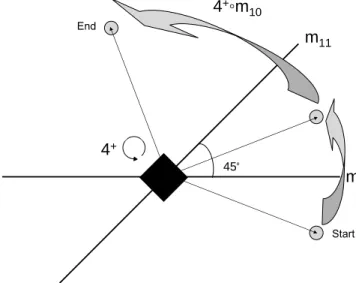
Figure 6: A graphical illustration of the composition of the operators 4+ and m
10 to give4+◦
m10=m11.
As an example, fig. 6 illustrates in a graphical way the composition of the operators4+andm 10
1. The fragment to be transformed (here a dot) is indicated with ”start”, and the two operators are
applied in order one after the other, until one reaches the ”end” position. It is clear by inspection that ”start” and ”end” are related by the “diagonal mirror” operator m11. You can check in Appendix I that this is reflected in the multiplication table for the square group (tab. 4).
Note that the two operators4+andm
10do not commute(see again tab. 4 in Appendix I):
4+◦m
10 = m11
m10◦4+ = m1¯1 (4)
2.6 Graph symmetry vs. composition
Let us now return on the issue of why some apparently equivalent symmetry elements, such as the two mirror lines in Fig. 3, are not related by symmetry. Likewise, in fig. 4, thehorizontal planem10is related by symmetry to theverticalplanem01, butnottop thediagonalplanesm11 andm1¯1.
Applying a symmetry operator to the graph of another is not the same thing as composing the two operators.
However, we also know that we must be able to generate all new operators from the old ones by some form of composition. So what is the composition corresponding to a given graph symmetry operation? The answer is given here below (you can convince yourself that this is correct by drawing a few example or looking at the multiplication tables in Appendix I):
Transformation by graph symmetry is equivalent toconjugation
g[h] = [g◦h◦g−1] (5)
For later use, we will introduce a short-hand notation for the “conjugation operator” by introduc-ing the symbolh˜g, defined as
˜
hg = (g[h]) = g◦h◦g−1 (6)
We read Eq. 5 in the following way: “The graph of the operatorhtransformedby symmetrywith the operatorgis equal to the graph of the operatorg◦h◦g−1”. This relation clearly shows that graph symmetry isnotequivalent to composition.
2.7 Conjugation and conjugation classes
The group operation we just introduced, g ◦h ◦g−1, also has special name — it is known as conjugation. Ifk =g◦h◦g−1we say that “k andhareconjugatedthrough the operatorg”.
Operators like k and h here above, which are conjugate with each other form distinct non-overlapping subsets2(notsubgroups) of the whole group, known asconjugation classes(not to
be confused with crystal classes — see below). conjugation classes group together operators with symmetry-related graphs
Conjugated operators are very easy to spot in a picture because their graphs contain the same pattern. On the other hand, operators such asm10andm11in the square group may look the same, but are not conjugated, so they do not necessarily contain the same pattern. We will see many examples of both kinds in the remainder.
2.8 The remaining 2D point groups
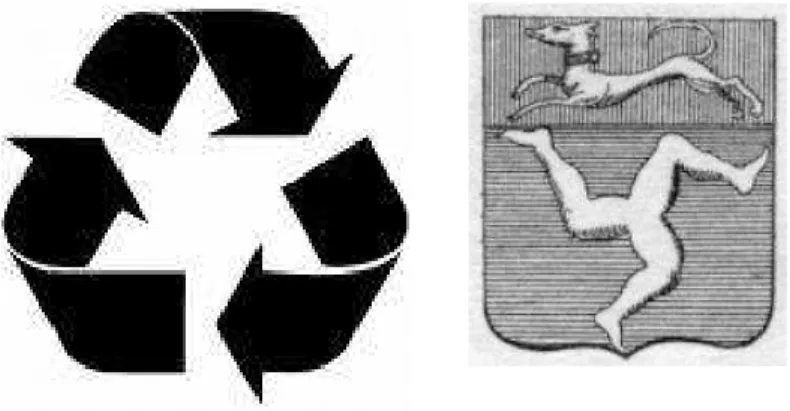
We have so far encountered 4 2D point groups. A fifth is the trivial group in which the only symmetry is the identity E, and a sixth is the group containing the fourfold rotation without mirrors (“4”, fig. 7). There are 4 more crystallographic 2D point groups, that can be easily obtained using the rules listed above. There are only 2 new operators, in additions to the one we know already: the threefold axis ( ) and the sixfold axis( ). The 4 new groups contain three-fold and six-fold axes with and without mirrors. The “three-fold-with-mirrors” group is listed either as3m1or as31m, which are actually thesamegroup in a different setting. We shall see later why five-fold axes and axes of higher order are not allowed in crystallography.
Figure 7: The central square of this Roman mosaic from Antioch has fourfold symmetrywithout
Figure 8: Two examples of three-fold symmetry without mirror lines. Leftthe ”Recycle” logo.
Right the ”Triskele” appears in the symbol of Sicily, but variations of it are a very common element in Celtic art.
3 Graph symmetry, conjugation and patterns
It is often quite easy to spot the parts of the patterns that lay on symmetry graphs. For example, the ”spikes” on the snowflake shown in Fig. 9 correspond to mirror planes in its symmetry. We should note, however, that there are two types of spikes, each occurring 6 times. This is because, as we recall, there are 2 types of mirror planes (twoconjugation classes, which are notrelated by symmetry, marked “1” and “2” on the drawing). This examples underlines the importance of conjugation classes — as we said before, the graphs of operators in the same conjugation class always carry the same attributes (patterns).
4 The 2D point groups in the ITC
4.1 Symmetry directions: the key to understand the ITC
The group symbols used in the ITC employ the so-called Hermann-Mauguin notation3 The
symbols are constructed with letters and numbers in a particular sequence — for example,6mm is apoint groupsymbol andI41/amdis an ITC space groupsymbol. This notation is complete and completely unambiguous, and should enables one, with some practice, to construct all the
3The Schoenflies notation is still widely used in the older literature and in some physics papers. In Appendix I
Figure 9: Left. A showflake by by Vermont scientist-artist Wilson Bentley, c. 1902. RightThe symmetry group of the snowflake,6mmin the ITC notation. The group has 6 classes, 5 marked on the drawing plus the identity operator E. Note that there are two classes of mirror planes, marked “1” and “2” on the drawing. One can see on the snowflake picture that their graphs containdifferent patterns.
symmetry operator graphs. Nevertheless, the ITC symbols are the source of much confusion for beginners (and even some practitioners). In the following paragraphs we will explain in some detail the point-group notation of the ITC, but here it is perhaps useful to make some general remarks just by looking at the snow flake and its symmetry group diagram (6mm) in fig. 9.
• The principal symmetry feature of the 6mm symmetry is the 6-fold axis. Axes with order higher than 2 (i.e., 3, 4 and 6)define theprimary symmetry directionand always come upfront in the point-group symbol, and right after the lattice symbol (P,I,F, etc.) in the space group symbols. This is the meaning of the first character in the symbol6mm.
• The next important features are the mirror planes. We can pick any plane we want and use it to define the secondary symmetry direction. For example, in fig. 9, we could define the secondary symmetry direction to be horizontal and perpendicular to the vertical mirror plane marked ”1”. This is the meaning of the second character in the symbol6mm
• The tertiary symmetry directionis never symmetry equivalent to the other two. In other word, the operator “m” appearing in the third position as 6mmdoes not belong to the same class as either of the other two symbols. It has therefore necessarily to refer to a mirror plane of theother class, marked as “2”.
• Therefore, in 6mm, secondary and tertiary symmetry directions make an angle of 60◦ with each other. Likewisein 4mm, (the square group) secondary and tertiary sym-metry directions make an angle of45◦ with each other.
Operators listed in the ITC group symbolsnever belong to the same conjugation class.
4.2 Detailed description of the 2D point group tables in the ITC
The 10 2D point groups are listed in ITC-Volume A ( [1]) on pages 768–769 (Table 10.1.2.1 therein, see Fig. 10). We have not introduced all the notation at this point, but it is worth examining the entries in some details, as the principles of the notation will be largely the same throughout the ITC.
• Reference frame: All point groups are represented on a circle with thin lines through it. The fixed point is at the center of the circle. All symmetry-related points are at the same dis-tance from the center (remember that symmetry operators are isometries), so the circle around the center locates symmetry-related points. The thin lines represent possible sys-tems of coordinate axes (crystal axes) to locate the points. We have not introduced axes at this point, but we will note that the lines have the same symmetry of the pattern.
• System: Once again, this refers to the type of axes and choice of the unit length. The classifi-cation is straightforward.
• Point group symbol: It is listed in the top left corner, and it generally consists of 3 characters: a number followed by two letters (such as 6mm). When there is no symmetry along a particular direction (see below), the symbol is omitted, but it could also be replaced by a ”1”. For example, the point groupm can be also written as1m1. The first symbol stands for one of the allowed rotation axes perpendicular to the sheet (the “primary symmetry direction”). Each of the other two symbols represent elements defined by inequivalent symmetry directions, known as ”secondary” and ”tertiary”, respectively. In this case, they are sets of mirror lines that are equivalent by rotational symmetry or, in short, different conjugation classes. The lines associated with each symbol are not symmetry-equivalent (so they belong o different conjugation classes). For example, in the point group 4mm, the first m stands for two orthogonal mirror lines. The second m stands for two other
(symmetry-inequivalent) orthogonal mirror lines rotated by 45◦ with respect to the first set. Note that the all the symmetry directions are equivalent for the three-fold axis 3, so either the primary or the secondary direction must carry a ”1” (see below).
• General and special positions: Below the point group symbol, we find a list of general and special positions (points), the latter lying on a symmetry element, and therefore having fewer ”equivalent points”. Note that the unique point at the center is always omitted. From left to right, we find:
Column 1 Themultiplicity, i.e., the number of equivalent points.
Column 2 TheWickoff letter, starting withafrom the bottom up. Symmetry-inequivalent points with the same symmetry (i.e., lying on symmetry elements of the same type) are assigned different letters.
Column 3 The site symmetry, i.e., the symmetry element (always a mirror line for 2D) on which the point lies. The site symmetry of a given point can also be thought as the point group leaving that point invariant. Dots are used to indicate which symmetry element in the point group symbol one refers to. For example, siteb of point group 4mmhas symmetry..m, i.e., lies on thesecond set of mirror lines, at45◦ from the first set.
Column 4 Name of crystal and point forms (the latter in italic) and their ”limiting” (or degenerate) forms. Point forms are easily understood as the polygon (or later polyhe-dron) defined by sets of equivalent points with a given site symmetry. Crystal forms are historically more important, because they are related to crystal shapes. They represent the polygon (or polyhedron) with sides (or faces) passing through a given point of symmetry and orthogonal to the radius of the circle (sphere). We shall not be further concerned with forms.
Column 5 Miller indices. For point groups, Miller indices are best understood as related to crystal forms, and represent the inverse intercepts along the crystal axes. By the well-known ”law of rational indices”, real crystal faces are represented by integral Miller indices. We also note that for the hexagonal system 3 Miller indices (and 3 crystal axes) are shown, although naturally only two are needed to define coordinates.
• Projections: For each point group, two diagrams are shown. It is worth noting that for 3D point groups, these diagrams arestereographic projectionsof systems of equivalent points. The diagram on the left shows the projection circle, the crystal axes as thin lines, and a set of equivalent general positions, shown as dots. The diagram on the right shows the symmetry elements, using the same notation we have already introduced.
• SettingsWe note that one of the 10 2D point groups is shown twice with a different notation, 3m1and31m. By inspecting the diagram, it is clear that the two only differ for the position
of the crystal axes with respect of the symmetry elements. In other words, the difference is entirely conventional, and refers to the choice of axes. We refer this situation, which reoccurs throughout the ITC, as two differentsettingsof the same point group.
• Unlike the case of other groups, the group-subgroup relations are not listed in the group entries but in a separate table. See Appendix II for an explanation.
5 Frieze patterns and frieze groups
Friezes are two dimensional patterns that are repetitive in one dimension. They have been em-ployed by essentially all human cultures to create ornamentations on buildings, textiles, metal-work, ceramics, etc. (see examples below). Depending on the nature of the object, these decora-tive motifs can be linear, circular (as on the neck of a vase) or follow the contour of a polygon. Here, we will imagine that the pattern is unwrapped to a linear strip and is infinite. In addition, we will only consider monochrome patterns Although the design can comprise a variety of natu-ralistic or geometrical elements, as far as the symmetry is concerned frieze patterns follow a very simple classification. There are only five types of symmetries, three of them already known to us:
1. Rotationsthrough an axis perpendicular to the viewing plane. Only the 2-fold rotation, as for the symmetry of the letter “S”, is allowed.
2. Reflectionsthrough lines in the plane of the pattern, perpendicular to the translations, as for the symmetry of the letter “V”. Again, we will liberally use the term ”mirror plane” instead of the more rigorous ”mirror line”, to be consistent later on with the space group definitions.
3. Reflectionsthrough a line in the plane of the pattern,parallel to the translations, as for the symmetry of the letter “K”.
4. Translations. This is a new symmetry that we did not encounter for point groups, since, by definition they had a fixed point, whereas translations leave no point fixed. In all frieze patterns, there exists a fundamental (”primitive”) translation that defines the repeated pat-tern. Its opposite (say, left instead of right) is also a symmetry element, as are all multiples thereof, clearly an infinite number of symmetry translations (see box here below).
5. Glides. This is a composite symmetry, which combines a translation with a parallel re-flection, neither of which on its own is a symmetry. The primitive translation is always twicethe glide translation, for a reason that should be immediately clear (see Problem 2.1 below). This symmetry is represented by the repeated fragmentbd, as in...bdbdbd....
All symmetry translations can be generated as linear combinations of “primitive” trans-lation. This is a general result valid in all dimensions
These elements can be combined in 7 different ways, the so-called ”7 frieze patterns” (and corre-sponding groups). In addition to pure translations or translations combined with one of the other four types, we have two additional frieze Groups, both containingtranslationsandperpendicular reflections, combined either with aparallel reflectionor with aglide. In both cases,rotationsare always present as well. The 7 frieze groups are illustrated in Fig. 11 to 14.
p1 1
p211
Figure 11: Frieze groupsp1andp211
6 Symbols for frieze groups
The new symmetry elements in Fig. 11 to 14 are shown in a symbolic manner, as in the case of point groups. The symbols for the new symmetry elements are:
• Translationsare shown both with arrows (→) and by means of a repeated unit. The choice of the latter, however, is arbitrary, in that we could have chosen a shifted repeated unit or even one with a different shape.
p1m1
p11m 3
4
Figure 12: Frieze groupsp1m1andp11m
p11g
5
p2mm
6
Figure 13: Frieze groupsp11gandp2mm
6.1 A few new concepts from frieze groups
Here, we introduce a few more formal definitions related to the frieze groups; in some case, they extend analogous concepts already introduced for the point groups.
• Repeat unit or unit cell. A minimal (but never unique, i.e., always conventional) part of the pattern that generates the whole pattern by application of thepure translations.
p2mg
Figure 14: Frieze groupp2mg
Figure 15: A detail of the Megalopsychia mosaic (Fifth century AD, Yakto village near Daphne, Turkey). The symmetry isp211. From [4].
• Asymmetric unit. A minimal (but never unique) part of the pattern that generates the whole pattern by application of all the operators. It can be shown that there is always a simply connected choice of asymmetric unit.
• Multiplicity. It is the number of equivalent pointsin the unit cell.
• Points of special symmetry. These are points that are invariant by application of one or more operator, and have therefore reduced multiplicty with respect to “general positions”. This is analogous to the case of the point groups. They are essentially the graphs of generalized rotations and their intersections. the generalized rotation operators intersecting in each given point define apoint group, known as thelocal symmetry groupfor that point.
Figure 16: A detail from the border of the Megalopsychia mosaic (Fifth century AD, Yakto village near Daphne, Turkey). The symmetry isp11m. From [4].
Figure 17: A mosaic from the ”Tomb of Amerimnia” (Calmness), fourth century Antioch, Turkey, showing different types of frieze symmetry. From the center outwards: p2mm, p1m1,
p2mg,p1m1. From [4].
6.2 Commutation: how to “switch” operators
As we have seen in the case of the square point group 4mm, symmetry operators in general do not commute. This is still true for frieze patterns where the sequence of application of the
Figure 18: Part of a splendid ”carpet” mosaic, found in an upper level of the ”House of the Bird Rinceau” in Daphne and dating from 526–40 AD. The mosaic was divided among sponsoring in-stitutions after excavation; this is known as the Worcester fragment. The symmetry of the bottom frieze is p11g. The top frieze has symmetryp1, but note that introducingcolorwould increase the symmetry of the fragment, since the pattern is symmetric by two-fold rotation combined with black-white interchange. Color symmetry is used in crystallography to describe magnetic structures. From [4].
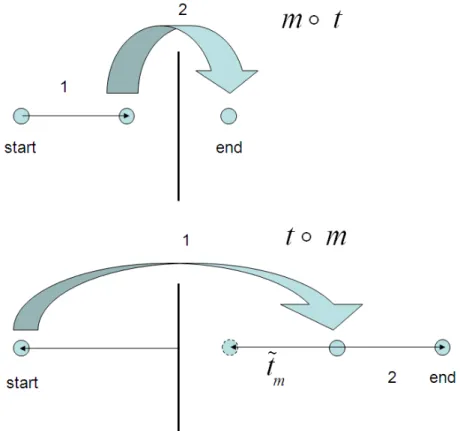
Figure 19: A simple example to show that the order of application of the the operators does matter. Applying a translation an then a mirror is not the same as applying the mirror first. To go back to the same point, we would need to apply the operator˜tm, as explained in the text.
operatorsdoesindeed matter. This is easily seen from the example in Fig. 19.
shall see, when we want to write operators in vector/matrix form. Once again, we can work out the switching rules graphically by means of graph symmetry. Let us have a closer look at the conjugation relation in eq. 5 and make now use of the shorthand notation introduced in eq. 6. We can now work out how to “switch” operators:
g◦h = (g◦h◦g−1)◦g = ˜hg◦g (7) h◦g = g◦(g−1◦h◦g) = g◦˜h
g−1
We may read this as follows: to pass an operatorhfrom the right to the left of another operator g, we need to transformh bygraph symmetrythroughg (conjugateh throughg). As a natural corollary follows from Eq. 7 that
Two operators commute if their graphs are mutually invariant.
Let us see how this applies to the example in Fig. 20. Eq. 7 says thatm◦t= ˜tm◦m, whereby, in this case,t˜mis the mirror image of the translation, i.e., the translation in theoppositedirection.
VWDUW HQG VWDUW HQG m
m
D
t
t
D
m
Figure 20: An example of how two operators can be switched. Similar to the example on fig. 19, the translation needs to beconjugated throughmto yield the same end point.
6.3 Normal form for symmetry operators
By using the “commutation rules” we have just learned, we can convince ourselves of the fol-lowing statement.
We can choose any arbitrary point of the pattern as anorigin, and re-write any symmetry operator g as a simple rotation or mirror passing through that origin (ro, known as the rotational part), followed bya translation(tknown as the translational part). The transla-tional parttis not necessarily a primitive translation. For example for a frieze-group glide operator passing through the origin, the translational part is1/2of a primitive translation.
g =t◦r0 (8)
When converted as in eq. 8, an operator is said to be innormal form. Symmetry operators are listed in the ITC in normal form, and for a good reason: a generic rotation about the origin is a 3×3matrix, whereas a translation is a 3-element vector, so, mathematically, any operator can be written in a compact form as a 4×3array — a very common albeit not very transparent notation that helps enormously with crystallographic computation. Once operators are in normal form, we can employ once again the commutation rule in eq. 7 to compose two operators and obtain a new normal-form operator (not shown here).
6.4 Frieze groups in the ITC
The 7 frieze groups are listed in ITC-Volume E ( [2]) on pages 30–36. An explanation of all the entries is provided in Appendix III. One item in the IT entries deserves special attention — the crystal class, which we have not introduced before.
Definition of crystal class
The crystal class is a point group obtained by combining all the rotational parts of the operators in the frieze group. The same definition is valid for wallpaper and space groups.
7 Wallpaper groups
Wallpaper groups describe the symmetry of patterns that are repetitive in 2 dimensions. In the case of true wallpapers, the repetition vectors tend to be orthogonal, because the process of hanging the wallpaper usually involves lining up identical elements on straight horizontal lines. However, no such restriction applies, for example, to textiles, pavements or other decorative forms in two dimensions.
No new operators need to be introduced to describe the wallpaper groups, and as combina-tion of the point-group and frieze-group operators is all that is required. The composicombina-tion rules are the same as before, and can be worked out graphically. The most significant new issue is the introduction oflattices.
7.1 The “translation set” and its symmetry
As in the case of the frieze group, each wallpaper group has a set of translationsas one of its subgroups. It is apparent that
The symmetry of the translation set must be “compatible” with that of the other operators of the group. In other words, if one applies a rotation to one of the primitive translation vectors (remember that this means transforming the translation by graph symmetry, one must find another primitive translation. This is best seen by introducing the concept of lattices.
7.2 Lattices
Lattices are an alternative representation of the translation set. They are sets of point generated from a single point (origin) by applying all the translation operators, and can be thought as graphs of all the translation operators simultaneously. Once the origin is chosen, the translations uniquely define the lattice. Conversely, all the translation can be obtained as position vectors of each point with respect to the origin.
By looking at the examples in fig. 21, we can easily see that thepoint symmetries(i.e., keeping one of the nodes fixed) of the lattices shown therein are4mmand6mmrespectively. However, it is also easy to see that the whole hexagonal lattice can be generated by applying the operator to asingletranslation and apply the normal vector sum, subtraction and scalar multiplication rules. The key to understand this is to see that a vector space is always “centrosymmetric”, since for every vectort, the vector−tmust exist.
We state (without proof) here a general result that is also valid in 3 dimensions.
The symmetry of the lattice (known as theholohedry) must be at least as high as thecrystal class, supplemented by the inversion (180◦rotation in 2 dimensions).
7.3 Crystallographic restriction
As we anticipated, there is no need to introduce new operators to describe the wallpaper groups. In particular
Figure 21: Portions of the square and hexagonal lattices, with their respective point symmetry groups. Note that the symmetry or the lattice is higher than that of the minimal point group needed to construct them from a single translation (4and3, respectively)
Axes of order otherthan2,3, 4and6are not allowed in 2D or 3D, because no lattice can be constructed to support them.
This is shown by an elegant theorem, provenex absurdo, known as therestriction theorem. For those interested in this aspect, a description can be found in [10].
7.4 Bravais lattices in 2D
Bravais lattices, named after the French physicist Auguste Bravais (1811–1863), define all the translation sets that are mutually compatible with crystallographic point groups. There are 5 of them: ”Oblique”, ”p-Rectangular”, ”c-Rectangular”, ”Square” and ”Hexagonal”. They can all be generated constructively in simple ways.
7.4.1 Oblique system (Holohedry2)
Here, each translation is symmetry-related to it opposite only, so there is no restriction on the length or orientation of the translations. The resulting lattice is a tiling of parallelograms.
7.4.2 Rectangular system (Holohedry2mm) Here we have two cases (Fig. 22):
• Both the shortest translation and the next one up that is not collinear with the first lie on the mirror planes. In this case, the result is simple tiling of rectangles, known as a ”p-Rectangular” (primitive rectangular) lattice.
• Either the shortest or the next-shortest translation are at an angle with the planes (in the latter case, one can showby restriction that its projection on the plane must bisect the shortest translation). The result is a rectangular lattice with nodes at the centers of the rectangles, known as a ”c-Rectangular” (centered rectangular) lattice.
ಯ
p
ರ
“c”
7.4.3 Square system (Holohedry4mm)
There are two point groups in this system:4and4mm. They both generate simple square lattices. In the latter case, as we have already shown, the nodes must lie on the mirror planes (Fig. 21).
7.4.4 Hexagonal system (Holohedry6mm)
There are four point groups in this system: 3, 3m1 (or 31m), 6 and6mm. They all generate simple hexagonal lattices. In the case of6mm, the nodes must lie on the mirror planes (Fig. 21), whereas in the case of31mthey must lie either on the mirror planes (setting31m) or exactly in between (setting3m1). Note that here the distinction is real, and will give rise to two different wallpaper groups.
7.5 Unit cells in 2D
Figure 23: Possible choices for the primitive unit cell on a square lattice.
We have already introduced the concepts of primitiveand asymmetric unit cell for the case of frieze patterns. These concepts are essentially the same for wallpaper groups, representing min-imal units that can generate the whole pattern by translation and by application of all symmetry operators, respectively. It should be noted that a variety of choices are possible for the unit cell, including cells with curvilinear sides, as long as they tile perfectly and have the same areas (Fig. 23). In particular, one can show that any translation vector that is not multiple of another can serve as one of the sides of a parallelogram-shaped unit cell. Nevertheless, the natural choice
for theprimitiveunit cell, and the one that is usually adopted, is a parallelogram defined by the two linearly-independent shortest translations. In the case of the c-rectangular lattice, this unit cell is either a rhombus or a parallelogram. The latter does not possess the full symmetry of the lattice (holohedry), and neither is particularly convenient to define coordinates (see below). It is therefore customary to introduce a so-called conventional centered rectangular unit cell, which has double the area of the primitive unit cell (i.e., it always contains two lattice points), but has the full symmetry of the lattice and is defined by orthogonal translation vectors, known asconventional translations(Fig. 24).
“c”
Figure 24: Two primitive cells and the conventional unit cell on ac-centered rectangular lattice.
7.6 Composition rules in 2D
The last step to construct the wallpaper groups is to determine the composition rules between the allowed operators. Clearly, the rules we have previously established for the point and frieze groups will still be valid, but, with wallpaper groups, more possibilities arise. Now we have axes of order3,4and6, which can be composed with translations. In addition, translations can be composed with mirror and glide planes at different angles, not only orthogonal or parallel to them. Finally, axes of allowed orders can be composed with mirror planes and glides; the axes can be either on or off the planes. Here, we will present a few graphical examples rather than a lengthy description, which can be found in [10].
7.6.1 Composition of translations axes, mirrors and glides
Fig. 25 shows an example of composition of an axis with a three-fold rotation. The result, as one can see, is a threefold rotation translated in both directions. This gives rise to the characteristic pattern of 3-fold axes found in trigonal groups. Likewise, fig. 26 shows how to compose transla-tions with mirrors and glides and fig. 27 shows an example of composing rotatransla-tions with mirrors. These constructions are easily done on a piece of paper, so one does not need to learn them by memory.
t
2/3 t 1/3 t
t
Geometrical construction for [t
ƕ
3]
6WDUW
t
Figure 25: Graphical construction illustrating the composition of a threefold axis with a transla-tion orthogonal to it.
7.7 The 17 wallpaper groups
We can construct all the possible candidates wallpaper groups by simply combining the 5 Bravais lattices with the 10 2D crystal classes, and systematically replace m’s with g’s at all locations. This procedure yields 27 symbols. Many symbols are duplicate wallpaper groups (stroked out in
t
1/2t
1/2t
Geometrical constructions for
>WთP@
60º
t
¥
2/2t
45º
1/2t
6WDUW
(QG
6WDUW
(QG
Figure 26: Graphical construction illustrating the composition of mirrors and glides with a trans-lation at60◦and45◦ inclination.
4
ƕ
m (m parallel to 4 but does not intersect it)
2
ƕ
m (m parallel to 2 but does not intersect it)
6WDUW
(QG
6WDUW
(QG
Figure 27: Two examples of composition of mirror planes with parallel rotation axes not lying on them.
Table 1: The 17 wallpaper groups. The symbols are obtained by combining the 5 Bravais lattices with the 10 2D point groups, and replacing g with m systematically. Strikeout symbols are duplicate of other symbols (“rules of priority” — see text).
crystal system crystal class wallpaper groups
oblique 1 p1 2 p2 rectangular m pm,cm,pg,cg 2mm p2mm,p2mg(=p2gm),p2gg,c2mm,c2mg,c2gg square 4 p4 4mm p4mm,p4gm,p4mg hexagonal 3 p3 3m1-31m p3m1,p3mg,p31m,p31g 6 p6 6mm p6mm,p6mg,p6gm,p6gg
tab. 1). When two symbols can describe the same group or in the case of other ambiguities, one adopts the followingconventions/rules of priority:
• When parallel mirrors and glide planes are present simultaneously,mtakes precedence, so the operatorg is listed only if there is nom parallel to it. Therefore, for example, there is no minp2gg, but there are glides incm.
• For square and hexagonal lattices (e.g., p3m1), thethird symbol isperpendicular to the lat-tice translations (secondary symmetry direction), whereas thefourth isperpendicular to the other (”tertiary”) non-equivalent direction (at 45◦ for the square and at 30◦ for the hexagonal).
7.8 Analyzing wallpaper and other 2D art using wallpaper groups
The symmetry of a given 2D pattern can be readily analyzed and assigned to one of the wall-paper groups, using one of several schemes. One should be careful in relying too much on the lattice symmetry, since it can be often higher than the underlying pattern (especially for true wallpapers). Mirrors and axes are quite easily identified, although, once again, one should be careful with pseudo-symmetries. Fig. 28 shows a decision-making diagram that can assist in the identification of the wallpaper group. Here, no reliance is made on the lattice, although some-times centering is easier to identify than glides. Fig. 29 to 34 show a few 2D patterns from various sources, with the associated wallpaper group. In the caption, the rational for the choice is explained. Many more examples are available on the cited sources.
6 4 H a s m ir ro rs ? 3 2 H a s m ir ro rs ? H a s m ir ro rs ? H a s m ir ro rs ? p 6 p 6 m m A x e s o n m ir ro rs ? p 4 p 4 m m p 4 g m A ll a x e s o n m ir ro rs ? p 3 p 3 m 1 1 p 3 1 m H a s o rt h o g o n a l m ir ro rs ? H a s g li d e s ? p 2 p 2 g g p 2 m g H a s r o ta ti o n s o ff m ir ro s ? c 2 m m p 2 m m H a s m ir ro rs ? H a s g li d e s ? p m cm H a s g li d e s ? p g p 1 A x is o f h ig h e s t o rd e r
Figure 28: Decision-making tree to identify wallpaper patterns. The first step (bottom) is to identify the axis of highest order. Continuous and dotted lines are ”Yes” and ”No” branches, respectively. Diamonds are branching points.
Figure 29: Jali screen (one of a pair), second half of 16th century; Mughal, probably from Fatehpur Sikri, India, Carved red sandstone [5]. The highest-order rotation is 4. The 4-armed hooked crosses inside the octagons all turn in the same direction, so there cannot be mirror planes. The wallpaper group is thereforep4.
p4mm No. 11
Figure 30: A pattern from the ceiling of the author’s home. The highest-order rotation is4, and there are mirror planes on the four-fold axes (2 inequivalent ones). The symmetry isp4mm.
p4gm No. 12
Figure 31: A Chinese pattern from [6]. The highest-order rotation is 4, and there are mirror planes relating the hooked crosses, but the four-fold axes are off them. The pace group isp4gm.
Figure 32: Escher drawing of fishes and turtles [7]. There are two types of three-fold sites (the heads of the fishes and of the turtles), both with mirror symmetry. The group isp3m1
Figure 33: Escher drawing of devils [7]. Mirror symmetry is present, but only on the heads of the devils, not on their hands. he group isp31m
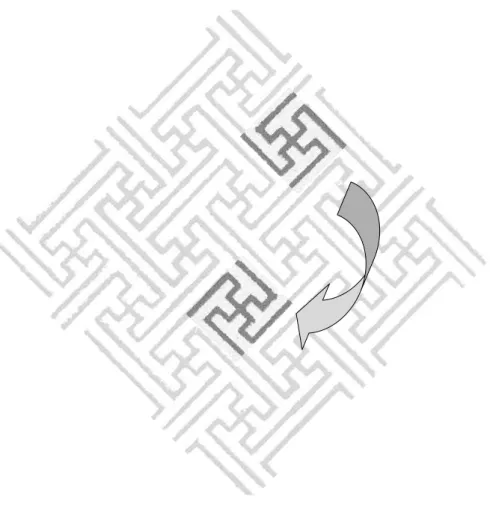
Figure 34: An Egyptian pattern from [6] The hexagons have 6-fold symmetry, while the hooked crosses only 3-fold (in spite of appearances) All rotate clockwise, so there cannot be any mirror. Groupp6
8 Appendix I: multiplication tables for simple point groups
8.1 A few examples
Using the concept of multiplication tables, we can classify all elements of finite groups in a simple manner.
Theparallelogramandarrow groups(Fig. 2) have the same multiplication table, shown in Tab. 2, so they are the sameabstract group. They have only two elements: 2 ormand the identity, which we will indicated withE.
Table 2: Multiplication table for the symmetry groups of the parallelogram and of the arrow (Fig. 2). There are only two elements, the identityEand the two-fold rotation2or the mirror linem.
E 2orm
E E 2orm
2orm 2orm E
Therectangle group(Fig. 3) has four elements, and its Multiplication Table is shown in Tab. 3.
Table 3: Multiplication table for the symmetry group of the rectangle. There are four elements, the identityE, two orthogonal mirror planesm10andm01and the twofold rotation2.
E m10 m01 2
E E m10 m01 2
m10 m10 E 2 m01
m01 m01 2 E m10
2 2 m01 m10 E
The square group(Fig. 4) has four elements, and its Multiplication Table is shown in Tab. 4. Note that here the order of the operators is important. We will applyfirst the operators on the top, thenthose on the side. It is easy to see that some of the elements do not commute — for instance the fourfold axes with the mirror planes.
8.2 Rules to obtain 2D multiplication tables
It is already clear at this point that multiplication tables can be rather complex to handle, even when the group has only 8 elements. The largest 3D crystallographic point groups has 48 ele-ments, so its multiplication table has 2304 eleele-ments, clearly not a very practical tool. However, all the 2D point group multiplication tables, including the ones we have not yet seen, can be obtained from three simple rules:
Rule 1 The composition of two rotations (around the same axis) is a rotation by the sum of the angles. Rotations (around the vertical axis) commute.
Table 4: Multiplication table for the symmetry group of the square. There are eight elements, the identityE, for mirror planes orthogonal in pairsm10,m01,m11andm1¯1 , the twofold rotation2
and two rotations by90◦ in the positive (4+) and negative (4−) directions.
E m10 m01 m11 m1¯1 2 4+ 4− E E m10 m01 m11 m1¯1 2 4+ 4− m10 m10 E 2 4− 4+ m01 m1¯1 m11 m01 m01 2 E 4+ 4− m10 m11 m1¯1 m11 m11 4+ 4− E 2 m1¯1 m10 m01 m1¯1 m1¯1 4− 4+ 2 E m11 m01 m10 2 2 m01 m10 m1¯1 m11 E 4− 4+ 4+ 4+ m 11 m1¯1 m01 m10 4− 2 E 4− 4− m 1¯1 m11 m10 m01 4+ E 2
Rule 2 The composition of two intersecting planes is a rotation around the intersection. The rotationangleistwicethe angle between the planes. Thedirectionof the rotation is from the plane that is applied first (i.e., that appears to therightin the composition). From this follows that two mirror planesanticommute.
Rule 3 This is the reverse of Rule 2. The composition of a plane with a rotation by an axis in the plane itself (in the ordern+◦m) is a plane obtained by rotating the first plane around the axis byhalf the rotation angle. If the two operators are exchanged, the rotation is in the opposite direction. Note that this is a generalization of what shown is Fig. 6.
9 Appendix II: Group-Subgroup relations for 2D point groups
The Group-Subgroup relations for 2D point groups are shown in a diagrammatic form on page 795 in ITC-Volume A ( [1], Fig. 10.1.3.1 therein, reproduced in Fig. 35). The relations are shown in the form of afamily tree. Theorder of the group (i.e., the number of elements) is shown as a scale on the left side. Lines are shown to connect point groups that differ by a minimal number of operators (known as maximal subgroups/minimal supergroups). A single continuous line is shown when a point groups has only one subgroup of a given type. Multiple lines are shown when more than one subgroup of a given type exist, but the subgroups are not equivalent by symmetry. A dashed line is shown when the subgroups are equivalent by symmetry. This difference should be clear by inspecting the diagrams of4mmand6mm, both having2mmas a maximal subgroup.10 Appendix III: Frieze groups in the ITC
The entry for the frieze groupp2mgis shown in Fig. 36.Figure 35: Group-subgroup relations for 2-D point groups: a reproduction from page 795 of the ITC [1].
• First line. From left to right, the entries are for the frieze group, thecrystal classand the crys-tal system. The frieze group symbol (known as the Hermann–Mauguin symbol) contains 4 characters. The first is always ap, and indicates thatprimitivetranslations are symmetry elements. The second symbol (either1or2) indicates the absence or presence of a 2-fold rotation. The third symbol (1orm) indicates the presence or absence of a mirror line or-thogonal to the repeat direction. The fourth symbol (1ormorg) refers to the symmetry elementsparallelto the repeat direction.
• Second line. From left to right, the entries are a sequence number from 1 to 7, a repetition of the Hermann–Mauguin symbol (for space groups, this entry contains an ”extended” symbol) and the ”Patterson symmetry”, i.e., the symmetry of the “Patterson function”. We will discuss the Patterson function latter in this course.
• Diagrams. Two diagrams are shown: the left-hand diagram shows the arrangement of the symmetry elements within oneunit cell, the right-hand one shows a general positions and its equivalents, also within one unit cell. By longstanding crystallographic convention (and contrary to everyone else), the a-axis points vertically downwards, whereas the b-axis points to the right. The axes and the unit cell are chosen to be symmetric by the crystal class. In the right-hand diagram, general points are represented with circles. Circles with a comma (”,”) are related by an odd number of reflections to circles without the comma. This is of course immaterial if they are to represent points, but it may matter if we were to ”dress” the points with attributes such as a polar vector or a chiral molecule.
In these diagrams, theorigin (see next line) is at the center of the diagram. The diagram can be rotate to give a different ”setting” of the frieze group, which differs simpy by the axes conventions. Note: Frieze groups belonging to the ”oblique” systems (1and 2) are shown with a non-orthogonal set of axes and an oblique unit cell. Although this conforms to symmetry, there is actually no reason not to adopt cartesian coordinates, since the y direction is non-periodic (see below). We have adopted a simpler orthogonal system in Fig. 11.
• Statement of the origin. The origin chosen for the subsequent entries is stated here.
• Asymmetric unit. One choice of the asymmetric unit is given here. All the position listed below are within the primitiveunit cell, provided that the first point x, y, z is within the asymmetricunit cell.
• Symmetry operators. All the inequivalent symmetry operators within the asymmetric unit cell (excluding the translation) are listed here. The operators are not listed in normal form. Rather, the type of symmetry operator is listed, followed by a position within the asym-metric unit cell that uniquely locates the symmetry element. For example, the entry (3) m1
4, y in Fig. 36 indicates the presence of a mirror plane at 1
4 along the x direction and parallel toy.
• Generator selected. A set of generators for the Frieze group, not necessarily minimal. The first generator is always1, the second is the primitive translationt. The others are chosen from the symmetry operators given above.
• Positions. The general and special positions for the frieze group. The entries for Columns 1–3 are the same as for the point groups.
Column 4 Coordinates. A general position and its equivalent positions is listed first. the equivalent positions are obtained by applying the symmetry operators listed above in the listed order. For the higher-symmetry positions, the same order is followed but identical positions are omitted.
Column 4 Reflection conditions. We will defer the discussion of this entry.
• Symmetry of special projections. This entry indicates the symmetry of projections of the patters alonga(a point group) orb(a 1D line group).
• Subgroups and supergroups. A list of maximal subgroups and minimal supergroups follows. A complex classification scheme, which we will not describe in detail, is used to generate this list. Note that ”isotypic” subgroups have the same Hermann– Mauguin symbol but different periodicity (larger unit cell). For example, the entry [2]p11g(5)1;4 has the following meaning: The subgroup has index 2 ([2]), has H–M
symbolp11g, correspond to frieze group number 5 and has symmetry operators 1 and 4 in the list above. An entry such as(a0 = 3a)means that the subgroup has tripled periodicity with respect to the original group.
11 Bibliography
The International Tables for Crystallography [1] is an indispensable consultation text for any serious condensed-matter physicist. It currently consists of 8 volumes. A selection of pages relevant for this course is provided on the web site. Additional sample pages can be found on http://www.iucr.org/books/international-tables.
C. Giacovazzo, “Fundamentals of crystallography” [3] is an excellent book on general crys-tallography, including some elements of symmetry.
P.G. Radaelli, “Fundamentals of crystallographic symmetry” [10], currently in draft form, contain much of the same materials covering lectures 1-3, but in an extended form.
References
[1] T. Hahn, ed., International tables for crystallography, vol. A (Kluver Academic Publisher, Do- drecht: Holland/Boston: USA/ London: UK, 2002), 5th ed.
[2] V. Kopsk`y and D.B. Litvin, ed., International tables for crystallography, vol. E (Kluver Academic Publisher, Do- drecht: Holland/Boston: USA/ London: UK, 2002), 1st ed.
[3] C. Giacovazzo, H.L. Monaco, D. Viterbo, F. Scordari, G. Gilli, G. Zanotti and M. Catti, Fundamentals of crystallography (International Union of Crystallography, Oxford Univer-sity Press Inc., New York)
[4] http://www.sacred-destinations.com/turkey/antioch-mosaic-photos/index.html
[5] Department of Islamic Art. ”The Nature of Islamic Ornament: Geometric Patterns”. In Timeline of Art History. New York: The Metropolitan Museum of Art, 2000. http://www.metmuseum.org/toah/hd/geom/hd geom.htm (October 2001)
[6] ”Grammar of Ornament”, originally published in 1856 by Owen Jones (1808-74). http://www.spsu.edu/math/tile/grammar/
[7] ”Visions of Symmetry: Notebooks, Periodic Drawings, and Related Work of M. C. Escher”, W.H.Freeman and Company, 1990. . On http://www.mcescher.com/ and http://www.mccallie.org/myates/Symmetry/wallpaperescher.htm.
[8] B.E. Warren,X-ray diffraction(Dover Publications, Inc., New York) 2nd Ed. 1990.
[9] U. Shmueli, ed., International tables for crystallography, vol. B (Kluver Academic Pub-lisher, Do- drecht: Holland/Boston: USA/ London: UK, 2001), 2th ed.
[10] Paolo G. Radaelli, Fundamentals of Crystallographic Symmetry (in draft form), on http://radaelli.physics.ox.ac.uk/documents/more advanced.pdf


![Figure 10: 2-Dimensional point groups: a reproduction of Pages 768–769 of the ITC [1]](https://thumb-us.123doks.com/thumbv2/123dok_us/690590.2584691/15.892.250.694.303.820/figure-dimensional-point-groups-reproduction-pages-itc.webp)