Engineering Applications of Artificial Intelligence 17 (2004) 313–325
Real/binary-like coded versus binary coded genetic algorithms to
automatically generate fuzzy knowledge bases: a comparative study
Sofiane Achiche*, Luc Baron, Marek Balazinski
Department of Mechanical Engineering,Ecole Polytechnique de Montre´al, P.O. 6079, Station Centre-Ville, Montre´al, Que´bec, Canada H3C 3A7!
Abstract
Nowadays fuzzy logic is increasingly used in decision-aided systems since it offers several advantages over other traditional decision-making techniques. The fuzzy decision support systems can easily deal with incomplete and/or imprecise knowledge applied to either linear or nonlinear problems. This paper presents the implementation of a combination of a Real/Binary-Like coded Genetic Algorithm (RBLGA) and a Binary coded Genetic Algorithm (BGA) to automatically generate Fuzzy Knowledge Bases (FKB) from a set of numerical data. Both algorithms allow one to fulfill a contradictory paradigm in terms of FKB precision and simplicity (high precision generally translates into a higher level of complexity) considering a randomly generated population of potential FKBs. The RBLGA is divided into two principal coding methods: (1) a real coded genetic algorithm that maps the fuzzy sets repartition and number (which drives the number of fuzzy rules) into a set of real numbers and (2) a binary like coded genetic algorithm that deals with the fuzzy rule base relationships (a set of integers). The BGA deals with the entire FKB using a single bit string, which is called a genotype. The RBLGA uses three reproduction mechanisms, a BLX-a;a simple crossover and a fuzzy set reducer, while the BGA uses a simple crossover, a fuzzy set displacement mechanism and a rule reducer. Both GAs are tested on theoretical surfaces, a comparison study of the performances is discussed, along with the influences of some evolution criteria.
r2004 Elsevier Ltd. All rights reserved.
Keywords: Artificial intelligence; Fuzzy logic systems; Fuzzy knowledge bases; Automatic learning; Real coded genetic algorithms; Binary coded genetic algorithms
1. Introduction
Nowadays fuzzy logic is increasingly used in decision-aided systems since it offers several advantages over other traditional decision-making techniques. The fuzzy decision support systems (FDSS) can easily deal with incomplete and/or imprecise knowledge applied to either linear or nonlinear problems. In most cases decision making systems are used when there is:
* an expert available to manually construct the FKB; * an important nonlinearity of the modeled process.
Hence, there is a difficulty to build a good enough mathematical model (impossible in some cases) that emulates the behavior of the problem to be solved. The construction of FKBs requires the evaluation of each
potential solution (the generated FKBs), which allows to establish the accuracy level when comparing their behaviors (outputs) to the one in the learning data. The manual construction of an FKB requires the evaluation of each proposition made by the expert to measure its performance. If the result is not satisfactory, the expert determines the modifications either to the fuzzy sets repartition, to the fuzzy rule base or to both, in the hope of improving the accuracy. This process is extremely long and tedious since it is completely dependent on the expert’s intuition, experiences and his understanding of the problem’s behavior. Therefore, a multi-criteria optimization tool is highly desirable. The genetic algorithms (GAs) are powerful stochastic optimization methods (Goldberg, 1989) and are con-sidered here as an optimization tool for the automatic generation of FKBs. The GA allows one to improve FKB performance in terms of accuracy and simplicity with respect to one or several performance criteria. This can be done automatically, i.e., without the need of expert intuition. This paper presents an overview of the *Corresponding author.
E-mail addresses:sofi[email protected] (S. Achiche), [email protected] (L. Baron), [email protected] (M. Balazinski).
0952-1976/$ - see front matterr2004 Elsevier Ltd. All rights reserved. doi:10.1016/j.engappai.2004.04.006
FDSS software Fuzzy-Flou, developed at Ecole Poly-technique (Canada) and the University of Silesia (Poland) (Balazinski et al., 1993) which was used for the validation tests. Then, it presents a brief description of the BGA and an extended one of the RBLGA which was used in this work, explaining the specifications of the reproduction and mutation mechanisms of each. Finally validation results are presented along with a comparative study of their performances inspected through different evolution parameters and perfor-mance paradigms.
2. Fuzzy decision support system
In this section we present a rule-based approach to decision making using fuzzy logic techniques, based on the compositional rule of inference (CRI). This approach is used to handle uncertain knowledge and was developed in the 1960s by Zadeh (1973). Such knowledge can be collected and delivered by a human expert (e.g. decision-maker, designer, process planner, machine operator, etc.). The CRI may be written in the form:
U¼ ðC?BAÞ3R; ð1Þ
whereRrepresents the global relation that aggregates all the fuzzy rules, ðA;B;y;CÞ represents the inputs
(observations) andUrepresents the output (conclusion). The symbol 3 represents the CRI operator. Three
defuzzification methods are usually available, i.e., center of gravity (COG), average of maximums (AOM) and the modified center of gravity (MCOG) (Balazinski et al., 1993). The FKB consists of two components: the linguistic term base (database) and the fuzzy production rule base. The database is divided into two parts: fuzzy
premises and fuzzy conclusions. Fig. 1 shows a screen printout of the premises and a conclusion (on the right), the fuzzy rules and settings (on the left) of the FDSS Fuzzy-Flou software. FKBs can be divided into two main categories:
* multiple inputs single output systems (MISO); * multiple inputs multiple outputs systems (MIMO).
In this paper only MISOs are considered. The deffuzi-fication mechanism used is the COG. The fuzzy rules are a finite number of heuristic fuzzy rules of the if then
type.
3. Automatic generation of fuzzy knowledge bases using GAs
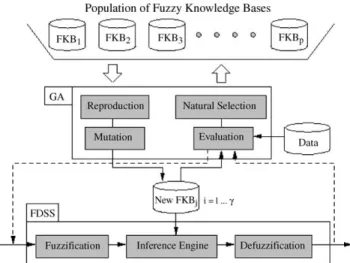
The automatic generation of fuzzy knowledge bases is performed using a GA. A GA is based on the analogy of the mechanics of natural genetics, and imitates the Darwinian survival-of-the-fittest approach (Baron,
1998). The GA uses four basic operations: crossover,
mutation, evaluation and natural selection. Crossover and mutation are used respectively to generate and modify an FKB genotype and the natural selection sorts the different FKBs according to the performance criteria.
Several research used GAs for the automatic genera-tion of FKBs (Cordon et al., 2000;! Diederich and
Renaud, 1999; Surmann and Selenschtschikow, 2002;
Valenzuela-Rendon, 1991). As shown in Fig. 2, each
individual of a population is a potential FKB. The method uses iterative improvement of individuals at each generation to converge toward multiple optima simultaneously.
When the number of unknown parameters increases, GA exhibits only a polynomial increase of the complex-ity (Deb et al., 2000;Lobo et al., 2000), while the other optimization techniques show an exponential increase.
Fig. 2presents the encoding/decoding scheme as well as
the four basic operations of the developed GA learning software (Baron et al., 2002).
3.1. Binary coded genetic algorithm
The binary representation (BGA) of the genotype dominated most of the works using GAs, since the efficiency of the binary coded GAs was proved theoretically (Goldberg, 1989). The other obvious reason is the rather simple numerical implementation of BGA. This evolutionary process operates directly on the genotype—i.e., the coded physical characteristics into bit string—of individuals rather than on its
phenotype—i.e., the physical characteristics themselves.
3.1.1. Coding
Thegenotype Gof an FKB is the coding of the fuzzy sets and the rule base into a bit-string:
G fGsets;Grulesg; ð2Þ where Gsets and Grules are respectively the genotypes of the fuzzy sets and the fuzzy rules.
3.1.1.1. Input/output premises. The FDSS Fuzzy-Flou
allows the use of trapezoidal membership functions (see Fig. 3). For the sake of coding simplicity, we consider only non-symmetrical triangular fuzzy sets on the premises and symmetrical triangular fuzzy sets on the conclusion. Therefore the position of each fuzzy set is given asm1¼m2¼position of the summit,amandbm
are set to reach the positions of the previous and next summit, whilehm¼1 as shown inFig. 3. The size of the
Gsetsdepends on the number of premisesN;the number of fuzzy setsNion each premiseiand the number of bits
br allocated to specify the resolution on the position. For example, ifbr¼4;the genotype of the fuzzy sets of premiseiis given as GXi |ffl{zffl}1001 summit1 1110 |ffl{zffl} summit2 ? 0111 |ffl{zffl} summitKi 8 < : 9 = ;; ð3Þ
where Ki is the number of fuzzy sets on premise Xi
excluding the two summits located at the extreme values of each premise. The total size ofGsets is given as sizeðGsetsÞ ¼ XN i¼1 Kibr ! þKybr; ð4Þ
whereKy is the number of fuzzy sets on the conclusion.
However on the conclusion, the number of fuzzy sets is equal to the number of the coded summits since the limits are also coded.
3.1.1.2. Fuzzy rules. The genotype of the fuzzy rules must contain information about all of the possible combinations connecting one fuzzy set on each premise to a fuzzy set on the conclusion. ForN input premises andKifuzzy sets on each premisei(including the limits),
the maximum number of fuzzy rulesK is computed as
K¼ ðK1Þ ðK2Þ ? ðKNÞ: ð5Þ
The fuzzy rules are coded as an ordered list of combination of the premises, each having an enable/ disable bit, denoted e—0 for disable; 1 for enable— together with a conclusion fuzzy set number. Each rule is coded into a 4 bit string, i.e.,
Grules |ffl{zffl}e101 rule1 e111 |ffl{zffl} rule2 ?e011 |ffl{zffl} ruleK 8 < : 9 = ;: ð6Þ
3.1.2. BGA reproduction mechanisms
The evolution of the population is achieved by reproduction of the best individuals based on their
Fig. 3. Fuzzy set.
Fig. 2. The GA learning process of an FDSS Fuzzy-Flou knowledge base.
ability to survive natural selection. This reproduction is performed with a combination of the four following operators:
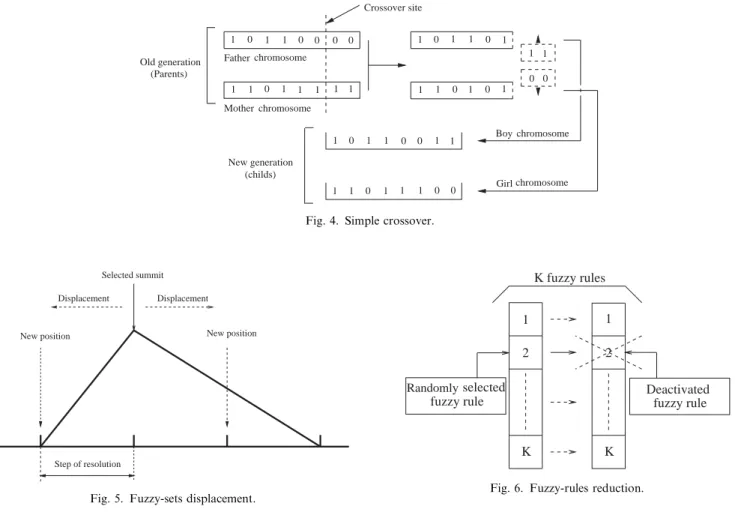
1.Simple crossover: The main reproduction mechan-ism is performed by crossing the genotype of the parents, in order to obtain the genotype of two children. The crossover technique used in BGA is a simple
crossover (Syswerda, 1989) as shown in Fig. 4. This
part of the reproduction mechanism is governed by an initiating probabilityp1:
2.Fuzzy sets displacement: Displacement of the fuzzy sets is performed (with an initiating probability p2) by randomly selecting a fuzzy set on a premise. The summit of the selected fuzzy set is then moved by one step of resolution toward the left or the right, with an equal probability (seeFig. 5). This reproduction operator has the virtue of trying different fuzzy set repartitions, while decreasing the number of fuzzy sets by superimposing two or more of them.
3.Fuzzy-rules reduction: The reduction of the number of fuzzy rules is performed with a probabilityp3given by
p3¼1 p1 p2: ð7Þ
One of the K fuzzy rules is randomly selected and deactivated—the biteis set to disable—as shown inFig.
6. Obviously, this reproduction operator does not always generate a reduction in the number of fuzzy rules (the case wheneis already set to 0), but gradually works toward that direction. The bias toward the reduction of the number of rules tends to produce less complex FKBs.
4.Mutation: Mutation is a random inversion of a bit in the genotype of a new member of the population as shown in Fig. 7. Mutation makes it possible to try completely different solutions (Deb and Agrawal, 1998). The probability of mutation p4 should be kept very small in order to give the other reproduction operators precedence for improving the population.
Old generation (Parents) 1 0 1 1 0 0 0 0 1 1 1 1 1 1 0 1 1 0 1 1 Crossover site Father Boy 1 1 0 0 1 1 0 0 chromosome New generation (childs) 1 0 1 1 0 1 1 1 0 1 0 1 1 1 0 1 1 1 0 0 Mother Girl chromosome chromosome chromosome
Fig. 4. Simple crossover.
Selected summit
Displacement Displacement
New position New position
Step of resolution
Fig. 5. Fuzzy-sets displacement.
K K 2 2 1 1 fuzzy rule Deactivated fuzzy rule K fuzzy rules Randomlyselected
Fig. 6. Fuzzy-rules reduction.
1 1 1 0 1 1 1 Mutation site Mutated gene 1 0 1 0 1 0 0 0 0
This way of seeking completely different solutions allows the algorithm to jump out of a local optimum, and potentially fall into more promising regions.
3.2. Real/binary like coded genetic algorithm
The most important success of the GAs remains in their evolution paradigm rather than in the way they are coded, hence the occurrence of real coded genetic algorithms (RCGA) in recent years, where they were mostly used in numerical optimization works (Herrera et al., 1995;Ono et al., 2003).
The use of RCGAs overcomes one of BGAs weak-nesses, which is the low resolution of the solutions (Baron et al., 2002; Achiche et al., 2002). Moreover, most optimization works are done in a continuous mathematical space (real space). However, the FKBs contain two cooperative but distinct parts:
* the premises and the conclusion, along with the fuzzy
sets on them;
* the fuzzy rules base.
They are distinct in such a way that the first one deals with real numbers while the second one uses integer numbers, since the fuzzy rules are simple pointers to the index of a fuzzy set on the conclusion. For this matter, we used a combination between an RCGA and a BGA where the binary part is mapped into a string of integers, the algorithm is called Real/Binary-like Coded Genetic Algorithm (RBLGA).
3.3. Coding
ThegenotypeRG corresponds to several independent
sets of reals and a set of integers:
RG fRGsets;RGrulesg; ð8Þ where RGsetsand RGrules are respectively the genotypes of the fuzzy sets and the fuzzy rules. Thegenotypecan be described as follows:
Input/output premises: There are as many real number sets as there are premises in the problem, and one set for the conclusion. Each set contains a predefined maximum number of real numbers representing the location of the summit of each fuzzy set on each premise and the conclusion. The two summits located at the minimum and maximum limits of each premise and the conclusion are not coded, since they are constant throughout the evolution (similar to the BGA coding).
As in the BGA we consider non-symmetrical-over-lapping triangular fuzzy sets for premises and symme-trical triangular fuzzy sets for the conclusion. The
genotype of the fuzzy sets of premiseiis given as
RGXi x1 |{z} summit1 x2 |{z} summit2 ? xi |{z} summitKi 8 > < > : 9 > = > ;; ð9Þ
whereKiis the number of fuzzy sets on the premisei(or
the conclusion). The limits of the premises are not included in the sets. RGsets is then given as
RGsets RGX1 |fflffl{zfflffl} premise1 ;RGX2 |fflffl{zfflffl} premise2 ;y;RGXi |fflffl{zfflffl} premisei ;y; RGXc |fflffl{zfflffl} conclusion 8 > < > : 9 > = > ;: ð10Þ
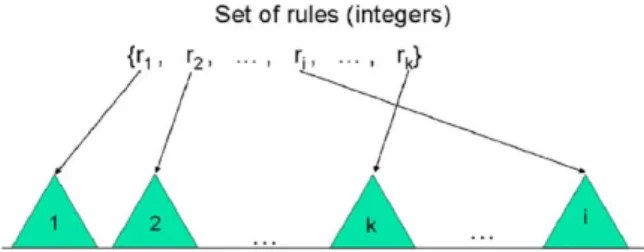
Fuzzy rules: The fuzzy rules are coded as a set of integers representing an ordered list of the combination of the premises. Each integer in the set represents a conclusion fuzzy set summit (see Fig. 8). The genotype of the fuzzy rules is given as
RGrules |{z}r1 rule1 ;|{z}r2 rule2 ;y; rK |{z} ruleK 8 < : 9 = ;: ð11Þ
The number of fuzzy rulesKis computed using Eq. (5). The initial population of FKBs is composed of P
randomly generate FKBs. The genotype of each new solution contains all the sets mentioned above. How-ever, as we will explain below, the size of the sets can decrease.
3.3.1. RBLGA reproduction mechanisms
Reproduction is performed by crossover of the parent’sgenotypeto obtain the offspring’sgenotype(or two offsprings). The reproduction of the FKBs in the RBLGA is performed through three crossover mechan-isms, each one having a certain purpose to achieve, as explained below.
3.3.1.1. Multi crossover. The multi-crossover mechan-ism is a combination of two crossovers applied on different parts of thegenotype.
Premises/conclusion crossover: The mechanism used is called blending crossover a (BLX-a) (Eshelman and
Schaffer, 1993), where a determines the exploitation/
exploration level of the offspring obtained from the selected parents. Exploitation indicates the usage of the interval between the values of the two parents; the
exploration uses an interval outside of these two limits, hence trying new solutions (see Fig. 9).
If A¼ fx1;x2;y;xi;y;xng and B¼
fy1;y2;y;yi;y;yngrepresents the two selected parents,
C the offspring obtained by the crossover ofA and B
then C¼ fz1;z2;y;zi;y;zng; where zi are randomly
selected in the interval [mini I a;maxi+ Ia] where:
* max i¼maximum fxi;yig; * min i¼minimumfxi;yig; * I¼ fmax i minig:
Fig. 9 shows the above-described mechanism. The
parameter acontrols the exploitation/exploration level, knowing that:
* in the exploitation zone, the offspring inherits
behaviors close to those of his parents;
* in the exploration zone, the offspring is a result of an
exploration, therefore his attributes will be distant from his parent’s average.
In order to avoid any bias in either direction (exploita-tion or explora(exploita-tion) the value of a is set to 0.5, which provides offsprings in the zone named the relaxed exploitation zone (Herrera and Lozano, 2000) (see Fig. 9).
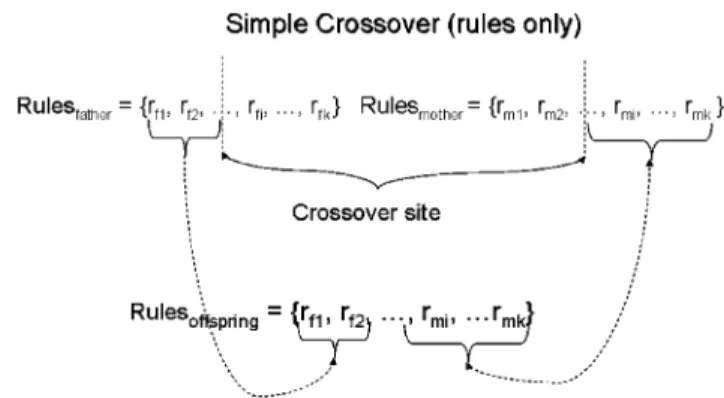
Fuzzy rules crossover: Since the part of the genotype
representing the fuzzy rule base is composed of integer numbers, the crossover on this part of the genotype is done by asimple crossover. The use of a BLX crossover is not suitable in this case, because of the integer nature of the values (the rules will tend to be the value zero most of the time). The operation is performed by inverting the end part of the sets of the parents at a randomly selected crossover site as shown in Fig 10. These two mechanisms are governed by an initiating probability pr1:
3.3.1.2. Fuzzy set reducer. This mechanism aims to
increase the simplicity level of the FKBs by randomly selecting a fuzzy set on a premise and erasing it together with the corresponding fuzzy rules. This mechanism allows one to obtain different and more simple (less information) solutions (i.e.; FKBs). This mechanism is governed by the initiating probability pr2:
3.3.1.3. Mutation. Mutation is the creation of an
individual by altering the gene of an existing one. The
probability pr3 governs the occurrence of this mechan-ism. The mutation used in the RBLGA is a Random mutation (uniform) (Michalewicz, 1992), applied to one randomly selected individual, as follows:
* an individual C is randomly selected, C¼
fz1;z2;y;zi;y;zng;
* a mutation site is randomly set in the interval [1,n]; * the selected value ‘‘z
i’’ is replaced by z0i¼
randomðai;biÞ;whereaiandbiare the limits enclosing
zi:
4. Learning process
The learning process is formulated as an optimization problem applied to the numerical data, using the BGA and the RBLGA in order to produce near to optimal FKBs.
An FKB contains the following entities/information: 1. the number of premises (inputs) and the number of
conclusions (outputs);
2. the number of fuzzy sets and their distribution on the premises and the conclusions; and
3. the fuzzy rules (fuzzy rule base).
Item 1 is a part of the problem’s input data and all the features in items 2 and 3 are a part of the learning process. The maximal complexity on each premise (i.e.; maximal number of fuzzy sets) is fixed at the beginning of the optimization and therefore these entities are not a part of the learning process (the maximal complexity can differ from premise to premise). After few execu-tions, maximal complexity can be readjusted to a higher number if required.
The goal of the learning process is to generate FKBs while maximizing the performance criteria in terms of accuracy ðfrmsÞ and simplicity level ðfsiÞ:Criteria frms
and fsi are defined in Section 4.1. The optimization problem can be defined as follows:
Fig. 10. BLGA simple crossover. Fig. 9. Blended crossovera–BLX-a:
For the BGA:
Maxfðfrms;fsiÞ with G: Binary Genotype: ð12Þ
For the RBLGA:
Maxfrms with RG : Real Genotype: ð13Þ
4.1. Performance criteria
The performance criteria allow one to compute the ratings of each FKB. Those performance ratings are used by the RBLGA and the BGA in order to perform natural selection. The principal performance criterion is the accuracy level of the FKB (approximation error) in reproducing the outputs of the learning data. The approximation error of the FKB is measured using the root-mean-square error Drms¼ ffiffiffiffiffiffiffiffiffiffiffiffiffiffiffiffiffiffiffiffiffiffiffiffiffiffiffiffiffiffiffiffiffiffiffiffiffiffiffiffiffiffiffiffiffiffiffiffiffiffiffiffiffiffiffiffiffiffiffiffiffi 1 M XM i¼1
ðGAoutputi dataoutputi
v u u
t Þ2; ð14Þ
whereMrepresents the number of points in the sampled data. The fitness value is evaluated as a percentage of the conclusion length base (L), as follows:
frms¼L Drms
L 100; ð15Þ
whileð100 frmsÞbeing the error percentage.
The RBLGA uses the value of frms as the only evaluation criterion to perform the natural selection, however the BGA uses a second performance criterion that rates the simplicity of the FKBs ðfsiÞ:The use of this additional criterion is due to the particularities of the reproduction mechanisms (fuzzy set displacement and fuzzy rules reduction) that are less straightforward than the ones used by the RBLGA when it comes to reducing the size of the FKB. The fitness value, denoted
fsi;is defined as
fsiK na
K ; ð16Þ
where K is the maximum number of fuzzy rules (using the initial complexity) and na is the number of active rules of the FKB under evaluation. In order to chose between these two contradictory objectives, the BGA uses a weighted sum of the two objective functions, i.e.:
fBGA¼ofrmsþ ð1 oÞfsi; ð17Þ
whereosets the bias betweenfrms andfsi:
4.2. Natural selection
Natural selection is performed on the population by keeping the most promising individuals based on their fitness value. This is equivalent to using solutions that are closest to the optimum. For convenience, we keep the size of the population constant.
4.2.1. Natural selection in the BGA
The first generation starts with P FKBs and additional Ps are generated by reproduction and mutation. These brand new FKBs are then evaluated.
Natural selection is applied on the 2P FKBs by
ranking them based onfBGAandfrms:We keep the first
P=2 non-identical—to maintain diversity in the popula-tion—FKBs of the two lists.
4.2.2. Natural selection in the RBLGA
The first generation begins with P FKBs, and the same number of additional FKBs are generated by reproduction and mutation. Moreover, in the RBLGA
natural selection is applied on the 2P FKBs by
ordering them according to the principal performance criterionfrmsand keeping the Pfirst FKBs.
The size P has to be selected depending upon the performances of the computer in use. A high value ofP
generally ensures a better diversity in the population, which helps to avoid premature convergence. However it increases the learning time.
5. Validation results
The BGA and RBLGA learning performances are now investigated using three examples of known behavior in terms of typez¼fðx;yÞ 3Dsurfaces, where the nodes are the learning set of sampled data. We have used three different surfaces of different complexities to have a better idea on the generality of the results (rather than a specific result to a specific surface). The evolution and selection criteria used for both algorithms are set to the following values:
BGA’s evolution/selection criteria:
* p 1¼85:0%; * p 2¼13:5%; * p 3¼1:5%; * p 4¼5:0%; * o¼1:0;and
* maximal complexity: six fuzzy sets (including the
limits) on each premise and 8 on the conclusion (8 being the maximum allowed by the coding resolution).
From this set of parameters we can say that the dominant evolution of the BGA is performed using the simple crossover with a probability p1: The emphasis on the Fuzzy-Rules reduction reproduc-tion mechanism is set at a low level to let the FKBS evolve toward a lower complexity level naturally rather than in a forced way. With o¼1 the emphasis of the selection mechanism is put on frms¼fBGA: These values have been chosen with respect to the conclusions driven from the work presented in Balazinski et al. (1993).
RBLGA’s evolution/selection criteria: * pr 1¼85:0%; * pr 2¼15:0%; * pr 3¼5:0%;and
* maximal complexity: six fuzzy sets (including the
limits) on each premise and 8 on the conclusion (no limits on the number, since it can match the number of fuzzy rules).
The evolution is mostly governed by themulti-crossover
reproduction mechanism, however the fuzzy set reducer
weight is not negligible which will tend to produce more simple FKBs.
Note1: In the RBLGA the value of pr2is equal to the sum of the probabilities p2 and p3 of the BGA. This equality sets a good comparative basis, since the mechanism driven by these probabilities performs similar changes in the FKBS, i.e., reducing the size of the fuzzy rule base.
Note 2: The maximal complexity is set in order to fix the maximum size of the genotypes, it can be changed if the early results are not satisfying. However, the number of variables taking part in the learning process can decrease through the generations and moreover, in the same population both the BGA and the RBLGA can deal with individuals of different sizes below the fixed maximum.
5.1. Theoretical surfaces
The theoretical surfaces used for the learning process are as follows:
1. Sinusoid surface. The theoretical sinusoid surface (Fig. 11) is defined as
z¼sinðxyÞ with 0pxp1:6;
0pyp1:4: ð18Þ
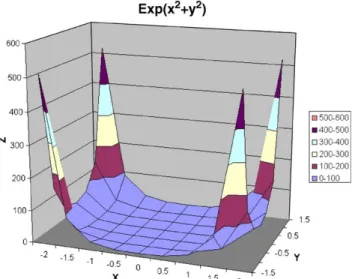
2. Exponential surface. The theoretical concave sur-face (Fig. 12) is defined as
z¼expðx2þy2Þ with 1:5pxp1:5;
2pyp2: ð19Þ
3. Hyper-tangent surface. The theoretical
hyper-tangent surface (Fig. 13) is defined as
z¼tanhðxðx2þy2ÞÞ with 0:2pxp1:4;
0:2pyp1:4: ð20Þ
5.1.1. FKBs accuracy level
To measure the accuracy levels (fitness levels) of both the BGA and the RBLGA, in generating FKBs, and for the sake of comparison, several runs have been made on Fig. 11. Theoretical sinusoid surface.
Fig. 12. Theoretical exponential surface.
the three surfaces cited above. The population size P
was set to 100:Runs were performed for 10;50;100;500; 1000 and 2500 generations. The best individual’s fitness level has been taken into account at the last generation. The average value of the three different results obtained for each theoretical surface was computed, as shown in
Fig. 14 and compiled inTable 1.
Fig. 14 shows the superiority of RBLGA when it
comes to accuracy for the same number of evaluated solutions (number of generationpopulation size). For instance, the highest level of accuracy obtained by the BGA after the exploration of 250,000 FKBs (i.e. 91.65%) is below the one achieved by the RBLGA after exploring 5000 FKBs, meaning that the RBLGA is able to create a more versatile population of FKBs faster than the BGA. The BGA was late in the accuracy race even when 50,000 times more solutions where explored. This leads to the conclusion that when dealing with a complex model to map into an FKB, the RBLGA will most probably produce a more satisfactory accurate FKB.
Fig. 14, also shows that the RBLGA tends to reach an accuracy plateau faster than the BGA, which drags the problem of premature convergence, very often a draw-back to real coded GAs.
5.1.2. The simplicity level of the FKBs
In this section, the simplicity level of the FKBs is studied. The simplicity level of an FKB is inversely proportional to the number of fuzzy rules representing the fuzzy rule base. The two main advantages of constructing more simple FKBs are:
1. a simple FKB is more flexible toward a manual tuning by a human expert;
2. a simple FKB tends to be a more general model to the existing problem as reported by the authors in Balazinski et al. (2000).
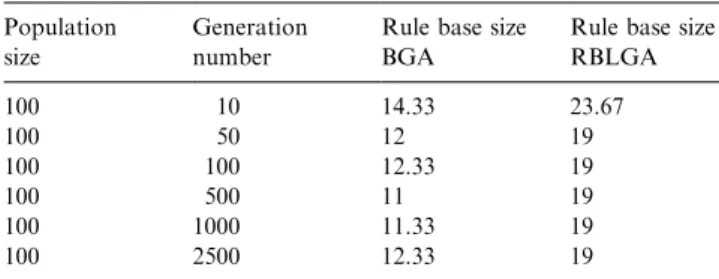
Table 2shows the averages of the rule base size obtained
for the three different surfaces.
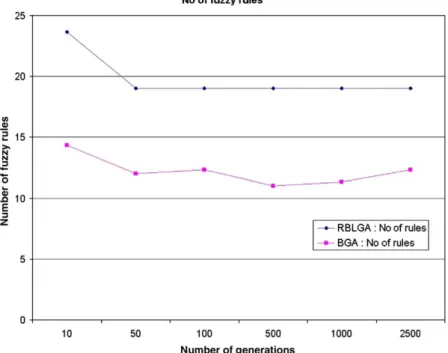
Fig. 15 shows that the BGA is more successful in
creating simple FKBs, and the RBLGA reached a Fig. 14. Fitness values: RBLGA versus BGA.
Table 1
Averagefrmspercentage versus the number of generations Population size Generation number Fitness BGA (%) Fitness RBLGA (%) 100 10 68.15 79.93 100 50 77.73 93.38 100 100 80.52 95.08 100 500 86.49 95.72 100 1000 89.99 95.78 100 2500 91.65 95.94 Table 2
Size of the rule base versus the number of generations Population
size
Generation number
Rule base size BGA
Rule base size RBLGA 100 10 14.33 23.67 100 50 12 19 100 100 12.33 19 100 500 11 19 100 1000 11.33 19 100 2500 12.33 19
simplicity plateau with only 19 fuzzy rules. Taking into account that the primary maximum number of fuzzy rules was 36; 19 fuzzy rules still represents approxi-mately a 50% simplification rate. The difference in the simplicity level between the BGA and the RBLGA is quite predictable from of the differences in the reproduction mechanisms. The BGA simplifies the FKBs in three different ways:
1. the first randomly generated population of indivi-duals is already created with inactive fuzzy rules; 2. the Fuzzy Sets Displacement reproduction
mechan-ism can reduce a set of fuzzy rules if a summit is separated by a step of resolution from his neighbor; 3. the Fuzzy Rules Reduction reproduction mechanism
randomly reduces the rules.
while the only way the RBLGA reduces rules is by reducing the number of fuzzy sets on the premises (by erasing rather than displacing). The lowest number of fuzzy rules the BGA proposed is around 12—E67%— which is better than the RBLGA.
5.1.3. Learning time
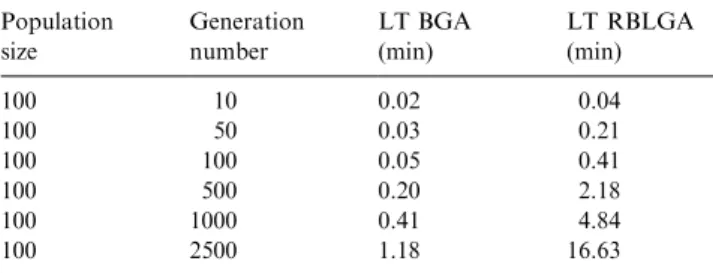
We studied the accuracy and the complexity/simpli-city level of the FKBs. However, an important aspect of the automatic generation of FKBs is the GAs learning time. In this section, we explore the learning time (LT) of the BGA versus the LT of the RBLGA. The comparison is based on the average LT obtained for the same three surfaces, using the same evolution/ selection criteria.Fig. 16illustrates the results that were compiled in Table 3. It is quite obvious that the BGA
outperforms the RBLGA, since for the same number of explored solutions, the LT for the BGA is much lower. Also the slope of the curve representing the evolution of the RBLGA is higher than the one of the BGA, which means that the LT increases faster for the RBLGA. However, even if the LT of the BGA is very advantageous, the accuracy result is still very low (see Table 1).
The first question is: for approximatively the same LT, which GA performs better (i.e.; better fitness)?
From Table 4, for the same LT ðE0:20 minÞ the
RBLGA reaches the fitness level of 93:38%; while the BGA reaches 86:49%;hence, concerning this aspect, the RBLGA outclasses the BGA.
The second question is: what is the LT needed by the BGA to reach an accuracy level, near the best ones which are proposed by the RBLGA?
To determine the LT for approximatively the same level of fitness for both AGs, we pushed the evolution of the BGA up to 10,000 generations. Table 5 shows the average of the results obtained for the three surfaces. The BGA reached an accuracy level of 93:41% after 9:62 min (and 10,000 generations) while the RBLGA proposed approximatively the same value in around 0:2 min (see Table 4). From these different results, we can conclude that the RBLGA is more efficient, relative to the LT.
5.1.4. Influence of the population size
In this section we explore the influence of the population size on the outcome of the learning process. For the sake of comparison the number of generations is Fig. 15. Number of fuzzy rules: RBLGA versus BGA.
fixed at 100 for both algorithms.Table 6, highlights the influence of the population size.
Increasing the population size improves the perfor-mances of both algorithms when it comes to accuracy. However, since accuracy and the rule base size are linked, the size of the rule base increases for the RBLGA and remains quite stable for the BGA. The reasons behind the BGA stability are the special reproduction
mechanisms for the fuzzy rules (see 5.1.2). The LT increases along with the population size, which is very predictable, since the number of evaluated solutions increases. For both the BGA and the RBLGA, the optimal population size seems to be around 100 individuals, since when increasing from 100 to 200 individuals the accuracy improves by approximately 1:00%for the RBLGA and less than 0:20%for the BGA, while the LT doubles.
5.1.5. Comparison and discussion
The BGA and the RBLGA reacted differently throughout the different tests which were performed in this paper.Table 7summarizes the ability comparison of both GAs, and the check markO gives an edge to one over the other. The RBLGA completely outperformed the BGA regarding fitness level, since the RBLGA was able to produce satisfactory solutions (FKBs) from a Table 3
Learning time RBLGA versus BGA Population size Generation number LT BGA (min) LT RBLGA (min) 100 10 0.02 0.04 100 50 0.03 0.21 100 100 0.05 0.41 100 500 0.20 2.18 100 1000 0.41 4.84 100 2500 1.18 16.63 Table 4
Fitness BGA versus RBLGA: same LT
GA Population size Generation number LT (min) Fitness
BGA 100 500 0.21 86.49%
RBLGA 100 50 0.20 93.38%
Table 5
LT and fitness of the BGA after 10,000 generations
GA Population size Generation number LT (min) Fitness
BGA 100 10,000 9.62 93.41%
Fig. 16. Learning time: RBLGA versus BGA. Table 6
Influence of the population size Generation
number
Population size
Fitness (%) Size of the rule base Learning time (min) BGA 100 25 76.89 12.33 0.02 100 50 80.27 12.00 0.03 100 100 80.52 12.33 0.05 100 200 80.60 13.67 0.09 RBLGA 100 25 93.12 11.00 0.09 100 50 93.92 20.33 0.21 100 100 95.08 19.00 0.41 100 200 96.42 23.33 0.89
restricted set of evaluated individuals, giving an edge to the RBLGA over the BGA.
For the simplicity level of the FKBs, the BGA gave a lower number of fuzzy rules, the difference was not sharp enough from what the RBLGA proposed, the GAs are almost identical on this point giving a slight edge to the BGA.
Considering the LT, for the same number of evaluated solutions, the BGA is faster. However as seen in Section 5.1.3, in order to obtain a comparative accuracy level the BGA has to run longer and even then the BGA did not achieve the results obtained by the RBLGA. Both GAs are efficient but an edge is given to the RBLGA since we consider the accuracy of the FKBs as the most important criterion to achieve (as we can see by the weight put on the accuracy in the evolution parameters). From these remarks we can conclude that even if the BGA remains quite efficient, the RBLGA was more convincing in the search for near optimal solutions (FKBs).
6. Conclusion
From the different tests, we can attest that generally both the binary coded genetic algorithm (BGA) and the real/binary like coded genetic algorithm (RBLGA) are efficient, when dealing with the artificial data. However, in most cases the RBLGA was more satisfactory.
Some principal conclusions can be stated:
* when dealing with a complex process to map into a
fuzzy knowledge base, the RBLGA will be more effective than the BGA;
* for a simple process to model, the BGA can be a
more appropriate choice since it runs faster along with providing satisfactory results;
* a population size of 100 is a good compromise
between the accuracy level and learning time, for both GAs;
* if fast accurate responses are needed the use of the
RBLGA is more appropriate, since it reaches high accuracy levels faster than the BGA;
* if a simple fuzzy knowledge base is needed, the BGA
will be used, due to the efficiency of the rules reduction mechanisms;
* the evolution parameters can be changed for both
GAs, if a new optimization paradigm has to be set.
Better accuracy can be achieved by increasing the initiating probability that governs the crossover mechanisms.
Acknowledgements
Financial support from the Natural Sciences and Engineering Research Council of Canada under grants RGPIN-203618, RGPIN-105518 and STPGP-269579 is gratefully acknowledged.
References
Achiche, S., Balazinski, M., Baron, L., Jemielniak, K., 2002. Tool wear monitoring using genetically-generated fuzzy knowledge bases. Engineering Applications of Artificial Intelligence 15, 303–314. Balazinski, M., Bellerose, M., Czogala, E., 1993. Application of fuzzy
logic techniques to the selection of cutting parameters in machining processes. International Journal for Fuzzy Sets and Systems 61, 307–317.
Balazinski, M., Achiche, S., Baron, L., 2000. Influence of optimization and selection criteria on genetically-generated fuzzy knowledge bases. International Conference on Advanced manufacturing Technology, (ICAMT2000) Johor Bahru, Malaysia, pp. 159–164. Baron, L., 1998. Genetic algorithm for line extraction, Technical
Report EPM/RT-98/06, Ecole Polythechnique de Montre´al,! 19pp.
Baron, L., Achiche, S., Balazinski, M., 2002. Fuzzy decisions system knowledge base generation using a genetic algorithm. International Journal of Approximate Reasoning 28, 125–148.
Cordon, O., Herrera, F., Villar, P., 2000. Analysis and guidelines to! obtain a good uniform fuzzy partition granularity for fuzzy-rule based systems using simulated annealing. International Journal of Approximate Reasoning 187–216.
Deb, K., Agrawal, S., 1998. Understanding interactions among genetic algorithm parameters. In: Banzhaf, W., Reeves, C. (Eds.), Foundations of Genetic Algorithms, vol. 5. Morgan Kaufman, San Mateo, CA, pp. 265–286.
Deb, K., Pratap, A., Agarwal, S., Meyarivan, T., 2000. A fast and elitist multi-objective genetic algorithm: NSGA-II. IEEE Transac-tions on Evolutionary Computation 6, 182–200.
Diederich, J., Renaud, F., 1999. A Fuzzy classifier using genetic algorithms for biological data. Proceedings of the Eighth Interna-tional Conference of the North American Fuzzy Information Processing Society, NAFIPS, New York, BEE, pp. 680–684. Eshelman, L.J., Schaffer, J.D., 1993. Real-Coded Genetic Algorithms
and Interval-Schemata, Foundations of Genetic Algorithms 2. Morgan Kaufman Publishers, San Mateo, pp. 187–202.
Goldberg, D.E., 1989. Genetic Algorithms in Search, Optimi-zation and Machine Learning. Addison-Wesley, Reading, MA, 412pp.
Herrera, F., Lozano, M., 2000. Gradual distributed real-coded genetic algorithms. IEEE Transactions on Evolutionary Computation 4, 43–63.
Herrera, F., Lazano, M., Verdegay, J.L., 1995. Tunning fuzzy logic controllers by genetic algorithms. International Journal of Approximate Reasoning 12, 299–315.
Lobo, F.G., Goldberg, D.E., Pelikan, M., 2000. Time complexity of genetic algorithms on exponentially scaled problems. GECCO-2000: Proceedings of the Genetic and Evolutionary Computation Conference, pp. 151–158.
Table 7
Performances: RBLGA versus BGA
Fitness Simplification Learning time
BGA O
Michalewicz, Z., 1992. Genetic AlgorithmsþData Structure¼
Evolution Programs:Springer, New York.
Ono, I., Kita, H., Kobayashi, S., 2003. A real-coded genetic algorithm using the unimodal normal distribution crossover. Advances in Evolutionary Computing: Theory and Applications, Natural Computing Series. Springer-Verlag, New York, pp. 213–237. Surmann, H., Selenschtschikow, A., 2002. Automatic generation of
fuzzy logic rule bases: Examples I. Proceeding of the First International ICSC Conference on Neuro-Fuzzy Technologies, pp. 75–81.
Syswerda, G., 1989. Uniform crossover in genetic algorithms. Proceedings of the International Conference on Genetic Algorithms, pp. 2–9.
Valenzuela-Rendon, M., 1991. The fuzzy classifier system: a classifier system for continuously varying variables. Proceedings of the Fourth International Conference on Genetic Algorithms, pp. 346–353.
Zadeh, L.A., 1973. Outline of new approach to the analysis of complex systems and decisions processes. IEEE Transactions of Systems, Man and Cybernetics 3, 28–44.