Learning Multi-Tree Classification Models with Ant Colony Optimization
Khalid M. Salama and Fernando E. B. Otero
School of Computing, University of Kent, Canterbury, UK{kms39,F.E.B.Otero}@kent.ac.uk
Keywords: Ant Colony Optimization (ACO), Data Mining, Classification, Decision Trees, Multi-trees.
Abstract: Ant Colony Optimization (ACO) is a meta-heuristic for solving combinatorial optimization problems, inspired by the behaviour of biological ant colonies. One of the successful applications of ACO is learning classifi-cation models (classifiers). A classifier encodes the relationships between the input attribute values and the values of a class attribute in a given set of labelled cases and it can be used to predict the class value of new unlabelled cases. Decision trees have been widely used as a type of classification model that represent com-prehensible knowledge to the user. In this paper, we propose the use of ACO-based algorithms for learning an extended multi-tree classification model, which consists of multiple decision trees, one for each class value. Each class-based decision trees is responsible for discriminating between its class value and all other values available in the class domain. Our proposed algorithms are empirically evaluated against well-known decision trees induction algorithms, as well as the ACO-based Ant-Tree-Miner algorithm. The results show an overall improvement in predictive accuracy over 32 benchmark datasets. We also discuss how the new multi-tree models can provide the user with more understanding and knowledge-interpretability in a given domain.
1
INTRODUCTION
Data mining is an active research area involving the development and analysis of algorithms for extracting interesting knowledge (or patterns) from real-world datasets. Classification is a central problem in the data mining and machine learning fields, where the goal is to build a model (classifier) using a set of la-belled cases (of which the class values are known) that captures the relationships between the input attribute values and the values of the target (class) attribute. The classifier is then used to predict the class of new, unlabelled cases (of cases of which the class values are unknown). While the literature includes several types of classification models, such as classification rules, artificial neural networks, support vector ma-chines and Bayesian network classifiers (Witten and Frank, 2010), in this paper we focus on the popular and widely used classification models, namely deci-sion trees.
Decision trees (Tan et al., 2005; Han and Kamber, 2000) are widely used as a comprehensible represen-tation model, given that they can be easily represented in a graphical form and also be represented as a set of classification rules, which generally can be expressed in the form of IF-THEN rules. In a decision tree, the internal nodes correspond to attribute tests (decision
nodes) and leaf nodes correspond to predicted class labels. In order to classify a case, the tree is traversed from the root node towards a leaf node by selecting branches according to internal nodes’ tests, until a leaf node (class prediction) is reached.
Top-Down Induction of Decision Trees (TDIDT) is the most common approach in the literature of learning decision trees, which employs a divide-and-conquerof approach: 1) select the best attribute to use as internal node of the tree at a certain level; 2) divide the dataset into several subsets according to the branches (values) of the selected node (attribute); and 3) recursively apply the previous steps on each subset until all cases from the subset have the same class label or when another stopping criterion is sat-isfied, creating a leaf node to represent a class label to be predicted. The well-known ID3, C4.5 (Quinlan, 1993) and CART (Breiman et al., 1984) algorithms follow such approach for learning decision trees.
Nonetheless, the divide-and-conquer approach represents a deterministic, greedy search strategy to create a decision tree; the selection of the best at-tribute is made locally at each iteration, without tak-ing into consideration its influence over the subse-quent iterations. This makes the algorithm prone to get stuck in local optima. While several heuristics (functions) for choosing attributes have been used in
the literature, such as Gini Index, Information Gain, and Gain Ratio (Tan et al., 2005), the idea of utiliz-ing stochastic, global search algorithms – that are less likely to get stuck into local optima – to learn decision trees is under-explored; only three related papers can be found in the literature (see Section 2.2).
Ant Colony Optimization (ACO) is a meta-heuristic for solving combinatorial optimization prob-lems, inspired by the behaviour of biological ant colonies. Ant-Tree-Miner (Otero et al., 2012) is a re-cently introduced ACO-based algorithm for inducing decision trees. In this paper, we extend the Ant-Tree-Miner algorithm to build a new multi-tree classifica-tion model. In essence, a multi-tree model consists of several class-based decision trees, where each tree is responsible for discriminating between a specific class value and all other values in the class domain. The multi-tree model can provide the user with a po-tentially useful representation of the knowledge dis-covered from the dataset, by focusing on the specific patterns describing each class value and differentiat-ing it from the other ones.
In this context, we propose two new ACO-based algorithms to build multi-tree classifiers: 1) Ant-Tree-MinerML, which learns one class-based tree at a time
in a local approach, and 2) Ant-Tree-MinerMI, which
learns a complete multi-tree model in an integrated approach. Our proposed algorithms are empirically evaluated against the C4.5 and CART decision trees induction algorithms, as well as the original Ant-Tree-Miner. The results show that Ant-Tree-MinerMLand
Ant-Tree-MinerMIachieve an overall improvement in
predictive accuracy over 32 benchmark datasets. The rest of the paper is organized as follows. Sec-tion 2 provides an overview on ACO and its related work in the classification learning domain, focusing on the Ant-Tree-Miner decision tree induction algo-rithm. In Section 3, we describe the multi-tree classi-fication model. We introduce our two new ACO algo-rithms for learning multi-trees in Section 4. The ex-perimental methodology and results are discussed in Section 5, followed by concluding remarks and fur-ther research directions in Section 6.
2
CLASSIFICATION WITH ANT
COLONY ALGORITHMS
2.1
Ant Colony Optimization Overview
Inspired by the behaviour of natural ant colonies, Dorigo et al. (Dorigo and St¨utzle, 2004; Dorigo and St¨utzle, 2003) have defined Ant Colony Optimization(ACO) as a meta-heuristic that has been widely ap-plied to solve combinatorial optimization problems. The basic principle of ACO is that a population of ar-tificial ants cooperates with each other to find the best path in a graph, representing a candidate solution to the target problem, analogously to the way that nat-ural ants cooperate to find the shortest path between two points like their nest and a food source. The out-line of the basic ACO procedures is presented in Al-gorithm 1.
Algorithm 1Pseudo-code of basic ACO algorithm.
BeginACO
ConstructionGraph←Problem definition;
Initialize();
best←ϕ; /* best solution found so far */
repeat
current←ant.ConstructSolution();
ApplyLocalSearch(current); /* Optional */
ifQuality(current)>Quality(best)then
best←current;
end if
ant.U pdatePheromone(current);
untiltermination condition
return best;
End
In order to design an ACO algorithm to solve a specific type of problem, the following components of the algorithm should be designed:
Construction Graph- This graph defines the search
space to be explored by the ACO algorithm, which consists of the various components (nodes or edges) by which an ant constructs a solution to the target problem.
Heuristic Function - This function uses
problem-specific information to locally evaluate the quality of each candidate solution component available in the construction graph.
State Transition Rule- This probabilistic transition
rule determines how each ant decides which solution component will be visited next in the construction graph, in order to continue the creation of its candi-date solution. This rule is based on both the heuristic function valueηand the pheromone amountτ associ-ated with the available components.
Quality Evaluation Function - This is a
problem-specific function used to evaluate the quality of a can-didate solution constructed by an ant. The higher the quality of a solution, the more pheromone will be de-posited on the construction graph components used in that solution.
Local Search- An optional procedure to improve the
per-formed on each constructed candidate solution, or just on the best solution among the colony to reduce com-putational time.
In ACO, an ant incrementally constructs a candi-date solution by visiting nodes and edges in the graph, creating a search path. An ant deposits pheromone on the nodes or edges of the path corresponding to its constructed solution, where the amount of pheromone deposited is proportional to the quality of that so-lution. The higher the amount of pheromone on a node or edge, the higher the probability that other ants will decide to visit that node or edge when con-structing their solution. The iterative process of solu-tion construcsolu-tion, quality evaluasolu-tion, and pheromone update incorporates an aspect of global search into an ACO algorithm, which makes it less likely to get trapped into local optima than conventional greedy al-gorithms.
2.2
ACO Related Work
ACO has been successful in tackling the classifica-tion problem of data mining. A number of ACO-based algorithms have been introduced in the litera-ture with different classification learning approaches. Ant-Miner (Parpinelli et al., 2002), is the first ant-based classification algorithm, which discovers a list of IF-THEN classification rules.
Ant-Miner is a sequential covering ACO-based rule induction algorithm, where in which iteration the algorithm, the ACO meta-heuristic is utilized to discover the best classification rule using the current training set. The rule is then add the discovered rule list, and all the instances covered by this rule are re-moved from the training set. The algorithms continu-ous until all the training instances are covered by the discovered rules, or until the maximum number of it-eration is reached.
The Ant-Miner algorithm has been followed by several extensions. Ant-Miner+ (Martens et al., 2007) used the
M AX
-M I N
Ant System (St¨utzle and Hoos, 1997), the class is selected before the an-tecedent construction. The Multi-pheromone Ant-Miner (Salama et al., 2011; Salama et al., 2013) in-troduced the idea of class-based pheromone. That is, the ant select class values prior to the rule antecedent construction process, and the ant is only influenced by the pheromone dropped by previous ant that con-structed rules with the same current class value, so that pheromone information is not shared by ant con-structing rules with different consequent classes.cAnt-Miner (Otero et al., 2009) is the version of the Ant-Miner algorithm that copes with continues at-tributes, by dynamically creating intervals that best
fits the rule that is currently being constructed. Re-cently,cAnt-MinerPB(Otero et al., 2013; Otero and
Freitas, 2013) was introduced as a new sequential covering strategy for ACO classification algorithms, where the whole rule list is constructed in one ant it-eration. The order of the rules is implicitly encoded as pheromone values and the search is guided by the quality of a candidate list of rules.
In addition, ACO has also been employed to learn various types of Bayesian network classifiers. ABC-Miner (Salama and Freitas, 2013d) learns Bayesian Augmented Na¨ıve-Bayes (BAN) classifier, while ABC-Miner+ (Salama and Freitas, 2013c) builds Markov Blanket classifiers, which the algorithms per-form embedded feature selection and produces more flexible Bayesian network structures. ACO for learn-ing Bayesian Multi-nets is introduced in (Salama and Freitas, 2013a; Salama and Freitas, 2013b).
ACO-PB (Liu et al., 2006) ia a hybrid of the ant colony and back-propagation algorithms to opti-mize the network weights. It adopts ACO to search the optimal combination of weights in the solution space, and then uses BP algorithm to obtain the accu-rate optimal solution quickly. ACOR, an ant colony optimization algorithm for continuous optimization (Socha and Dorigo, 2008), was used to train feed-forward neural networks (Socha and Blum, 2005; Socha and Blum, 2007).
As for learning decision trees, only ACDT (Bo-ryczka and Kozak, 2010; Bo(Bo-ryczka and Kozak, 2011), and Ant-Tree-Miner (Otero et al., 2012), were in-troduced as ACO-based algorithms. Since our algo-rithms are built upon Ant-Tree-Miner, it is described in more details in the following subsection.
2.3
The Ant-Tree-Miner Algorithm
The Ant-Tree-Miner algorithm (Otero et al., 2012) follows the traditional divide-and-conquer approach, with the difference that an ACO procedure is used during the tree construction to select the nodes (attributes) of the tree. Instead of applying a greedy deterministic selection, Ant-Tree-Miner uses a stochastic process based on heuristic information and pheromone values. To create a candidate decision treeDT, an ant starts by selecting an attribute from the construction graph. The probability of selecting an at-tribute is based on both their heuristic function value ηand the pheromone amountτ.
Each entry in the pheromone matrix is represented by a triple [Ei j,L,xk], whereEi jis the edge represent-ing thej-th attribute condition of the attributexiin the construction graph,Lis the level of the decision tree where theEi jappears andxkis its destination attribute
vertex. The level information of the edge is associ-ated with an entry to discriminate between multiple occurrences of the same type of edge (i.e., the same attribute condition) at different levels of the tree, ei-ther for occurrences in the same tree path – possible in the case of edges of continuous attribute vertices – or in different tree paths.
Once an attribute is selected to represent a deci-sion node, branches corresponding to each attribute-condition are created. At this point, the training set is divided into one subset for each branch, where each subset contains the training cases satisfying the attribute-condition represented by the branch. When an ant follows a branch, it checks whether a leaf node should be added or if it should recursively add a sub-tree below its current branch. An ant chooses to add a leaf node if one of the following conditions occur:
1. the branch’s subset is empty —i.e., no training case satisfy the branch’s condition;
2. all cases in the subset have the same class label; 3. the subset size is smaller than or equal to the
min cases per branch user-defined value;
4. there are no more (unused) attributes to be se-lected.
If none of the above conditions is observed, the con-struction procedure is applied recursively to create a sub-tree given the subset of training cases.
When all ants create a decision tree, they are eval-uated and the iteration-best tree (DTtbest) is used to update pheromone values. The creation process is re-peated until a user-defined maximum number of iter-ations is reached or the algorithm has converged (i.e., the pheromone values lead the algorithm to create the same solution). The pheromone update procedure is given by: τ(E,L,xk)= ρ.τ(E,L,xk), i f (E,L,xk)∈/DTtbest; ρ.τ(E,L,xk)+Q(DT tbest), i f (E,L,xk)∈DTtbest; (1)
where ρ is the evaporation factor parameter, τ(E,L,xk)–Eis the attribute condition of the edge that this pheromone entry corresponds to,Lis the level in which the edge occurs andxks the edge’s destination attribute vertex – andQ(DT)is the quality of the can-didate constructed decision treeDT.
3
MULTI-TREE MODELS
Unlike a decision tree classification model, which represents the induced knowledge from a given
dataset as a tree model, the multi-tree model repre-sents the induced knowledge in several decision trees, one from each class value perspective. More pre-cisely, a multi-tree modelMT consists of a set of sep-arate local decision trees{DT1,DT2, ...DT|C|}, where
|C|is the number of the available class values.DTlis responsible for discriminating between a class value
l and all the other values in the class domain. In other words, each tree in the multi-tree model treats its related class values as the positive class, and all the other class values as one negative class. Hence,
DTl concerned with classifying a case to one of two class values: one natural positive class value (C=l), and other artificial negative class value (C̸=l). Thus, the knowledge captured in each tree of a multi-tree model only describes the attribute-value relationships that are relevant to specific class value, regardless of the other relationships that might be relevant to the other classes.
Therefore, for each Dl, an induction algorithm will only focus on discovering the specific patterns that describe class valuel, and will not get distracted by patterns related to other classes. This should make the induction process ofDl effective in terms of dis-criminatinglfrom other class values. This is opposite to the conventional decision tree induction algorithms that try to discriminate between all the class values in a single model.
In essence, in order to predict the label of a new test casexusing a multi-tree classification model,xis classified using each treeDTlin the model. EachDTl produces a classification output:P(C=l|x), which is the probability thatxbelongs to local positive classl. The outputs of the different trees in a multi-tree can take on of the following forms:
–P(C=l|x)>0.5 in only one tree in the set, thenx
is assigned to classl;
– P(C=l|x)>0.5 in multiple trees in the set, then
xis assigned to class valuel of the tree that has the highest probability;
– P(C=l|x)≤0.5 for all the trees in the set, thenx
is also assigned to class valuelof the tree that has the highest probability as well.
4
LEARNING MULTI-TREES
WITH ACO ALGORITHMS
4.1
A Local ACO Approach for
Learning Multi-Trees
Ant-Tree-MinerMLis the first ACO algorithm we
models. The algorithm employs a local approach to build a multi-tree, in which each tree in the model is learnt in a one-at-a-time fashion. In other words, there is no dependency between the processes of learning different trees in the model — each tree induction pro-cess is considered as a separate optimization problem, carried out by a separate ACO procedure. Algorithm 2 shows the overall process of Ant-Tree-MinerML.
Algorithm 2Pseudo-code of Ant-Tree-MinerML
1: Begin 2: D=training set;MT ←ϕ; 3: forl=1to|C|do 4: Dl=GetBinaryDataset(D,l); 5: InitializeConstructionGraph(); 6: DTlgbest=ϕ; 7: Qgbest=0; 8: t=1; 9: repeat 10: DTltbest=ϕ; Qtbest =0; 11: fori=1tocolony sizedo
12: DTi l =anti.CreateTree(Dl); 13: Qi=EvaluateQuality(DTi l,Dl); 14: ifQi>Q(tbest)then 15: BNtbest l =BNli; 16: Qtbest=Qi; 17: end if 18: end for 19: PruneTree(DTtbest l ); 20: U pdatePheromone(DTltbest);
21: ifQtbest>Qgbestthen
22: DTlgbest=DTltbest; 23: Qgbest=Qtbest; 24: end if
25: t←t+1;
26: untilt=max iterationsorConvergence() 27: appendDTlgbest toMT;
28: end for
29: return MT; 30: End
The following course of actions are repeated for each class labellavailable in the class domainC(lines 3 to 28), in order to produce a decision tree for each class. For classl, a new modified binary class training dataset copyDTlis generated from the original train-ing datasetD(line 4). In each new datasetDl, cases labelled with classlare considered positive cases; all the cases that are labelled with class values other than
lare considered the negative cases, and re-labelled to classl−. Hence, cases in eachDl will be either la-belled withlorl−.
At this point, an ACO procedure is responsible
inducing a decision tree on the new binary dataset. In essence, a construction graph (similar to the one discussed in Section 2.3) is constructed and the pheromone amounts are initialized as is done in Ant-Tree-Miner (Otero et al., 2012). Now, eachanti in the colony creates a candidate decision treeDTli(line 12), using the decision tree construction procedure described in Section 2.3. Then, the predictive accu-racy of DTli is evaluated, however, using its related new training datasetDl (line 13). That is, a correct classification occurs when DTli correctly classify a case to either positive (l) or negative (l−) class (re-gardless of the specific negative classes). Predictive accuracy (the qualityQiof the current local decision treeDTi
l) is calculated as the number of correctly clas-sified instances by DTli over the total number of in-stance in the binary training datasetDl.
The iteration-best DTltbest (best tree constructed in the colony during the iteration) is selected to un-dergo pruning and perform pheromone update, using the same error-based pruning procedure and level-based pheromone update strategy used in the Ant-Tree-Miner algorithm, with respect toDl. The global best solutionDTlgbest is updated – if possible – at the end of each iteration (lines 21 to 23).
This set of steps is considered one iteration of the outer repeat-until loop (lines 9 to 26) and it is itera-tively performed is repeated until the sameDTis gen-erated for a number of consecutive trials specified by
theconv iterations parameter (indicating
conver-gence) or untilmax iterations is reached (see Table 1 for parameter settings). The induced decision tree
DTlgbest for class labellis appended to the multi-tree modelMT and then the algorithm moves to build the next decision tree for class labell+1.
4.2
An Integrated ACO Approach for
Learning Multi-Trees
The second algorithm proposed in this paper follows an integrated approach. Ant-Tree-MinerMIworks in
a different way from its local counterpart. A single run of ACO is used to build the whole solution; each ant builds acompletemulti-tree classification model as a candidate solution at once. This is accomplished by building a candidate localDTlfor each class value
l in each single ant trial, appending them to current candidate multi-tree model.
Unlike Ant-Tree-MinerML, which has to
com-pletely finish building the local treeDTlbefore start-ing to build DTl+1, in Ant-Tree-MinerMI the whole
multi-tree model is constructed before performing the quality evaluation and pheromone update. In this case, the integrated approach is not concerned with
the quality of each individual decision treeDTl—in classifying the artificial training datasetDl—per se, rather it is concerned with the quality of the complete multi-tree model when used to classify the original training setD.
Algorithm 3Pseudo-code of Ant-Tree-MinerMI
1: Begin
2: D=training set;MTgbest=ϕ; 3: Qgbest=0;
4: t=1;
5: InitializeConstructionGraphs(); 6: repeat
7: MTtbest=ϕ;Qtbest=0; 8: fori=1tocolony sizedo
9: MTi←ϕ; 10: forl=1to|C|do 11: Dl=GetBinaryDataset(D,l); 12: DTli=anti.CreateTree(Dl); 13: appendDTlitoMTi; 14: end for 15: Qi=EvaluateQuality(MTli,D); 16: ifQi>Qtbest then 17: MTtbest=MTi; 18: Qtbest=Qi; 19: end if 20: end for 21: PruneMultitree(MTtbest); 22: U pdatePheromone(MTtbest);
23: ifQtbest>Qgbestthen
24: MTgbest=MTtbest; 25: Qgbest=Qtbest; 26: end if
27: t=t+1;
28: untilt=max iterationsorConvergence() 29: return MTgbest;
30: End
As shown in Algorithm 3, eachantiin the colony creates a candidate solution MTi—i.e., a complete multi-tree model (lines 10 to 13). Then, the quality of the constructedMTi is evaluated on the original training setD(line 15). The best solutionMTtbest pro-duced in the colony at iterationtis selected to undergo pruning before the ant updates the pheromone trail ac-cording to the classification qualityQtbestof the multi-treeMTtbest (line 21 and 22). Finally,MTtbestis com-pared with the global best solutionMTgbest to keep track of the best multi-tree found so far (lines 23 to 26). This is iteratively repeated until the termination conditions are met. At the end,MTgbestis considered the final induced multi-tree classification model.
In order to apply such an integrated approach us-ing ACO, we use several construction graphs for a
given dataset. More precisely, we use|C|construction graphs, one for each class valuel∈C. Pheromone amounts and heuristic information initialization are performed on all the used construction graphs. As for solution creation, an ant uses each construction graph to build each localDTl, one for each class la-bell. Once an ant creates the localDTl, it proceeds to the construction of the localDTl+1, using the(l+1)th
construction graph and theDl+1.
The tree pruning procedure is applied on each tree
DTlin the the iteration-bestMTtbestmulti-tree model. As for pheromone update, it is performed on all struction graphs according to the quality of the con-structedMTtbestas a whole.
5
EXPERIMENTS AND RESULTS
We compare the predictive performance of the two proposed ACO algorithms for learning multi-tree classification models against the well-known CART and C4.5 decision trees induction algorithms. In our experiments, we used the WEKA (Witten and Frank, 2010) implementations for these algorithms, Simple-CART and J48, respectively.
In addition, we implemented a greedy algorithm for learning multi-tree models, C4.5-MTree, as an-other baseline for our comparisons. In essence, sev-eral binary datasets are generated for a given dataset, one for each available class value (as described in Section 4.1). Then, the C4.5 algorithm is used to in-duce a decision tree from each binary dataset. The final multi-tree model would be the set of the induced decision trees. We also compare the predictive perfor-mance of the multi-tree models produced by the pro-posed algorithms against the decision trees produced by the Ant-Tree-Miner algorithm.
The experiments were carried out using the strat-ifiedten-fold cross validation procedure. In essence, a dataset is divided into ten mutually exclusive par-titions (folds), with approximately the same number of cases in each partition. Then each classification algorithm is run ten times, where each time a differ-ent partition is used as the test set and the other nine partitions are used as the training set. The results (ac-curacy rate on the test set) are then averaged and re-ported as the accuracy rate of the classifier. For the ACO algorithms, we run them ten times – using a dif-ferent random seed to initialize the search each time – for each of the ten iterations of the cross-validation procedure (i.e., 100 runs in total, for each dataset). In the case of the deterministic algorithms, each one is run just once for each iteration of the cross-validation procedure.
The parameter configuration used in our ex-periments is shown in Table 1. Note that the
max iterations parameter refers to the maximum
number of iterations used to build a single local tree in the Ant-Tree-MinerMLalgorithm. The value of this
parameter is multiplied by the number of class val-ues when used with Ant-Tree-MinerMI. However, this
maximum number is not fully tilized, since the algo-rithms converge earlier. The WEKA default parame-ter settings were used for CART and C4.5.
Table 1: ACO Parameter settings used in experiments.
Parameter Value
max iterations 500
colony size 50
conv iterations 10
min cases per branch 3
evaporation factor 0.9
5.1
Predictive Accuracy Results
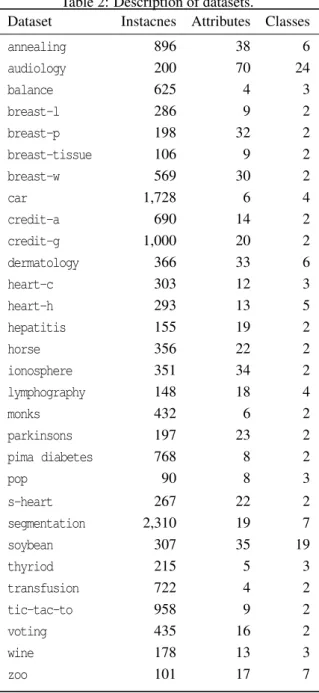
The experimental evaluation was performed using 32 public-domain datasets from the University of Cal-ifornia at Irvine (UCI) dataset repository (Asuncion and Newman, 2007). The main characteristics of the datasets are shown in Table 2
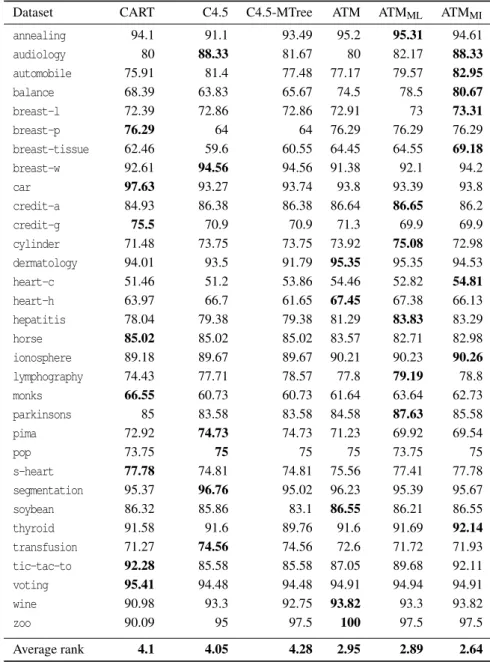
Table 3 reports the average predictive accuracy values obtained by ten-fold cross validation for the 32 datasets, where the highest accuracy value for each dataset is shown in bold face. The last row shows the average rank of each algorithm in terms of predictive accuracy according to the non-parametric Friedman test (Garca and Herrera, 2008). The average rank for a given algorithmgis obtained by first computing the rank ofgon each dataset individually. The individual ranks are then averaged across all datasets to obtain the overall average rank. Note that the lower the value of the rank, the better the algorithm performance.
As shown in Table 3, the proposed Ant-Tree-MinerMI—which uses the ACO integrated approach
to learn multi-tree models—obtained the best over-all average ranking of 2.64 and achieved the high-est predictive accuracy in 8 datasets. In the second place is Ant-Tree-MinerML—the local approach ACO
algorithm for learning multi-tree models—obtained an overall average ranking of 2.89 and achieved the highest predictive accuracy in 6 datasets. Ant-Tree-Miner—the ACO algorithm for learning deci-sion trees—came in the third place with overall av-erage ranking of 2.95 and achieved the highest pre-dictive accuracy in 5 datasets. The C4.5 And CART
Table 2: Description of datasets.
Dataset Instacnes Attributes Classes
annealing 896 38 6 audiology 200 70 24 balance 625 4 3 breast-l 286 9 2 breast-p 198 32 2 breast-tissue 106 9 2 breast-w 569 30 2 car 1,728 6 4 credit-a 690 14 2 credit-g 1,000 20 2 dermatology 366 33 6 heart-c 303 12 3 heart-h 293 13 5 hepatitis 155 19 2 horse 356 22 2 ionosphere 351 34 2 lymphography 148 18 4 monks 432 6 2 parkinsons 197 23 2 pima diabetes 768 8 2 pop 90 8 3 s-heart 267 22 2 segmentation 2,310 19 7 soybean 307 35 19 thyriod 215 5 3 transfusion 722 4 2 tic-tac-to 958 9 2 voting 435 16 2 wine 178 13 3 zoo 101 17 7
decision tree induction algorithms came in the fourth and the fifth place with overall average rankings of 4.05 and 4.1, and achieved the highest predictive ac-curacy in 6 and 9 datasets, respectively. The multi-tree C4.5-MTree obtained an overall average ranking of 4.28 and performed last.
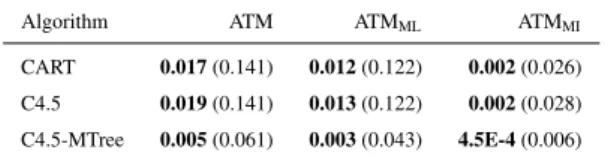
The non-parametric Friedman statistical test (Garca and Herrera, 2008) with the Holm’s post-hoc test was applied to the predictive accuracy results shown in Table 3. The test showed that both Ant-Tree-MinerMLand Ant-Tree-MinerMIare statistically
sig-Table 3: Average predictive accuracy for each algorithm in the 32 datasets. The columns annotated with ATM correspond to Ant-Tree-Miner and the proposed multi-tree extensions.
Dataset CART C4.5 C4.5-MTree ATM ATMML ATMMI
annealing 94.1 91.1 93.49 95.2 95.31 94.61 audiology 80 88.33 81.67 80 82.17 88.33 automobile 75.91 81.4 77.48 77.17 79.57 82.95 balance 68.39 63.83 65.67 74.5 78.5 80.67 breast-l 72.39 72.86 72.86 72.91 73 73.31 breast-p 76.29 64 64 76.29 76.29 76.29 breast-tissue 62.46 59.6 60.55 64.45 64.55 69.18 breast-w 92.61 94.56 94.56 91.38 92.1 94.2 car 97.63 93.27 93.74 93.8 93.39 93.8 credit-a 84.93 86.38 86.38 86.64 86.65 86.2 credit-g 75.5 70.9 70.9 71.3 69.9 69.9 cylinder 71.48 73.75 73.75 73.92 75.08 72.98 dermatology 94.01 93.5 91.79 95.35 95.35 94.53 heart-c 51.46 51.2 53.86 54.46 52.82 54.81 heart-h 63.97 66.7 61.65 67.45 67.38 66.13 hepatitis 78.04 79.38 79.38 81.29 83.83 83.29 horse 85.02 85.02 85.02 83.57 82.71 82.98 ionosphere 89.18 89.67 89.67 90.21 90.23 90.26 lymphography 74.43 77.71 78.57 77.8 79.19 78.8 monks 66.55 60.73 60.73 61.64 63.64 62.73 parkinsons 85 83.58 83.58 84.58 87.63 85.58 pima 72.92 74.73 74.73 71.23 69.92 69.54 pop 73.75 75 75 75 73.75 75 s-heart 77.78 74.81 74.81 75.56 77.41 77.78 segmentation 95.37 96.76 95.02 96.23 95.39 95.67 soybean 86.32 85.86 83.1 86.55 86.21 86.55 thyroid 91.58 91.6 89.76 91.6 91.69 92.14 transfusion 71.27 74.56 74.56 72.6 71.72 71.93 tic-tac-to 92.28 85.58 85.58 87.05 89.68 92.11 voting 95.41 94.48 94.48 94.91 94.94 94.91 wine 90.98 93.3 92.75 93.82 93.3 93.82 zoo 90.09 95 97.5 100 97.5 97.5 Average rank 4.1 4.05 4.28 2.95 2.89 2.64
nificance level of 5%. Besides that, Ant-Tree-Miner is shown to be statistically better than CART, C4.5 and C4.5-MTree with a significance level of 10%. Table 4 shows the results of non-parametric Friedman Statis-tical test.
Table 4: The results of non-parametric Friedman Sta-tistical test. p-values are shown in bold-face, while Holm values are shown between brackets.
Algorithm ATM ATMML ATMMI
CART 0.017(0.141) 0.012(0.122) 0.002(0.026) C4.5 0.019(0.141) 0.013(0.122) 0.002(0.028) C4.5-MTree 0.005(0.061) 0.003(0.043) 4.5E-4(0.006)
One notice regarding the results of C4.5-MT, which uses the C4.5 in a local approach to build multi-tree models, is that it did not performed, overall, bet-ter than C4.5 decision tree induction algorithm. One important reason is the function used to select the best attribute to create an internal tree node, and its at-tribute values become branches to split the training set into more pure data subset relative to the class values. C4.5 uses Information Gain Ration (Quinlan, 1993), which is proper for reducing the entropy (impurity) of the data subsets with respect toallthe class values. However, a multi-tree induction algorithm may need to use a different function that focus on the quality of the split with respect to thespecific(positive) class value for which the current local tree is built. This can also be beneficial in class imbalance problems, where one (or more) class values has a low occurrence in the dataset compared to other class values. Precision and Recall measures are candidate functions for this task, yet we leave this for future investigation.
On the other hand, the ACO algorithms do not have the same problem, since ACO perform a global search to build the tree model as a whole, rather than local decision of selecting the next attribute to add to the tree model.
5.2
Model Comprehensibility Results
Although predictive accuracy improvements that multi-tree induction ACO-based algorithms made over the Ant-tree-Miner decision tree induction algo-rithm are not statistically significant according to the used test, and therefore are regarded as similar, we claim that our proposed algorithm have advantages re-garding comprehensibility of their produced model. It is controversial to state which one is more easily com-prehensible from the user perspective: one relatively large decision tree model (produced by a decision tree induction algorithm) or several relatively smallclass-based trees in the multi-tree models.
Therefore, for fair size comparison, we extracted a set of rules from the constructed models and we compared the total number of the terms in these rules. In essence, for decision tree models, each path from the root node to a leaf node represents a rule, where the rule terms (antecedent) are the node-branch condi-tions in the path, and the rule consequent is the major-ity class predicted by the leaf node. As for the multi-tree models, the rules are extracted as follows. First, we extract the rules from each local tree in the same aforementioned way. However, for each treeDl, we only keep the rules where the consequent is the tree’s positive classl and discard the rules where the con-sequent is the tree’s negative classl−. Second, since there may be two (or more) rules—with different con-sequent classes—that can classify the same instance (i.e., one of them contains all the antecedent terms of the other), we only keep the rule with the highest con-sequent class probability.
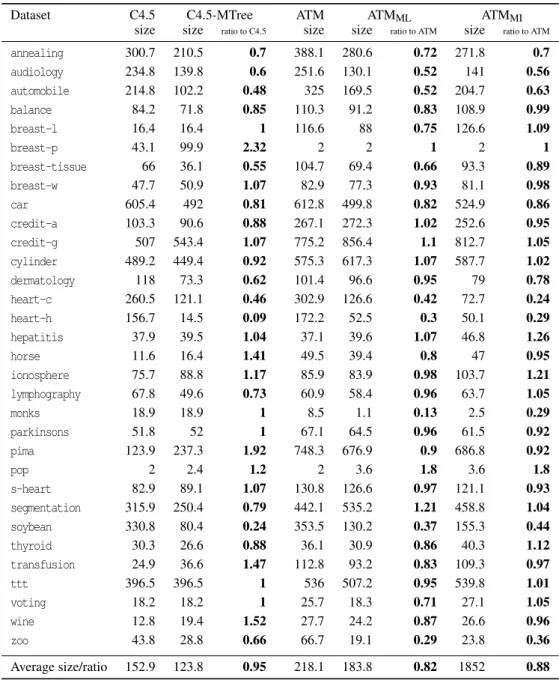
The size results are in Table 5, which shows that, overall, the total terms in the rules extracted from the multi-tree model is smaller than the total terms in the rules extracted from the single decision tree model built for the same dataset, supporting our claim that the multi-tree model provides a model that is sim-pler to interpret. This is shown in the ratio of each multi-tree induction algorithm’s size results to its cor-responding decision tree induction algorithm’s size results.
6
CONCLUDING REMARKS
In this paper, we have introduced two new ACO-based algorithm for learning multi-tree classification model. A multi-tree model consists of several class-based decision trees, each is responsible for discrim-inating between a specific class value and all other values in the class domain. We empirically evaluated the performance of our algorithms over 32 bench-mark UCI datasets and compared their results against the results of well-known CART and C4.5 decision trees induction algorithms, as well as the Ant-Tree-Miner ACO-based algorithm. In addition, we com-pared our results to C4.5-MT, a greedy implementa-tion for learning multi-tree models.
The results showed that the two proposed ACO algorithms are statistically significantly better than the three greedy algorithms and produces compara-ble predictive accuracy results compared to Ant-Tree-Miner. An interesting aspect of the multi-tree mod-els induced by our ACO algorithms is that they can provide the user with a potentially useful view of the
Table 5: Average size (in terms of the total number of rules’ terms extracted from each model) results. The ratio results represent the size results ratio of a multi-tree induction algorithm to the size results of its corresponding decision tree induction algorithm.
Dataset C4.5 C4.5-MTree ATM ATMML ATMMI
size size ratio to C4.5 size size ratio to ATM size ratio to ATM
annealing 300.7 210.5 0.7 388.1 280.6 0.72 271.8 0.7 audiology 234.8 139.8 0.6 251.6 130.1 0.52 141 0.56 automobile 214.8 102.2 0.48 325 169.5 0.52 204.7 0.63 balance 84.2 71.8 0.85 110.3 91.2 0.83 108.9 0.99 breast-l 16.4 16.4 1 116.6 88 0.75 126.6 1.09 breast-p 43.1 99.9 2.32 2 2 1 2 1 breast-tissue 66 36.1 0.55 104.7 69.4 0.66 93.3 0.89 breast-w 47.7 50.9 1.07 82.9 77.3 0.93 81.1 0.98 car 605.4 492 0.81 612.8 499.8 0.82 524.9 0.86 credit-a 103.3 90.6 0.88 267.1 272.3 1.02 252.6 0.95 credit-g 507 543.4 1.07 775.2 856.4 1.1 812.7 1.05 cylinder 489.2 449.4 0.92 575.3 617.3 1.07 587.7 1.02 dermatology 118 73.3 0.62 101.4 96.6 0.95 79 0.78 heart-c 260.5 121.1 0.46 302.9 126.6 0.42 72.7 0.24 heart-h 156.7 14.5 0.09 172.2 52.5 0.3 50.1 0.29 hepatitis 37.9 39.5 1.04 37.1 39.6 1.07 46.8 1.26 horse 11.6 16.4 1.41 49.5 39.4 0.8 47 0.95 ionosphere 75.7 88.8 1.17 85.9 83.9 0.98 103.7 1.21 lymphography 67.8 49.6 0.73 60.9 58.4 0.96 63.7 1.05 monks 18.9 18.9 1 8.5 1.1 0.13 2.5 0.29 parkinsons 51.8 52 1 67.1 64.5 0.96 61.5 0.92 pima 123.9 237.3 1.92 748.3 676.9 0.9 686.8 0.92 pop 2 2.4 1.2 2 3.6 1.8 3.6 1.8 s-heart 82.9 89.1 1.07 130.8 126.6 0.97 121.1 0.93 segmentation 315.9 250.4 0.79 442.1 535.2 1.21 458.8 1.04 soybean 330.8 80.4 0.24 353.5 130.2 0.37 155.3 0.44 thyroid 30.3 26.6 0.88 36.1 30.9 0.86 40.3 1.12 transfusion 24.9 36.6 1.47 112.8 93.2 0.83 109.3 0.97 ttt 396.5 396.5 1 536 507.2 0.95 539.8 1.01 voting 18.2 18.2 1 25.7 18.3 0.71 27.1 1.05 wine 12.8 19.4 1.52 27.7 24.2 0.87 26.6 0.96 zoo 43.8 28.8 0.66 66.7 19.1 0.29 23.8 0.36 Average size/ratio 152.9 123.8 0.95 218.1 183.8 0.82 1852 0.88
knowledge discovered from the dataset by producing several classification trees, each one focusing on the specific patterns describing one class value and differ-entiating it from the other classes. Moreover, predic-tions made by the multi-tree model involve a smaller number of terms, which contributes to the compre-hensibility of the model. Therefore, the user needs to analyze a smaller number of attribute-value condi-tions in order understand a prediction.
In the future, an interesting direction is to explore different measures, other than accuracy, to evaluate the quality of the candidate constructed decision trees in the local approach, where the focus might be in-creasing the true positives rate of each tree rather than improving the its general predictive accuracy. We can also explore more sophisticated quality evaluation measures in both approaches, such as Quadratic Loss Function and Bayesian Information Reward.
REFERENCES
Asuncion, A. and Newman, D. (2007). UCI Machine Learning Repository. URL:http://www.ics.uci.edu/ mlearn/MLRepository.html. Boryczka, U. and Kozak, J. (2010). Ant Colony Decision
Trees. In4th International Conference on Computa-tional Collective Intelligence: Technologies and Ap-plications (ICCCI’11), pages 4373–382, Berlin, Hei-delberg. Springer.
Boryczka, U. and Kozak, J. (2011). An Adaptive Discretiza-tion in the ACDT Algorithm for Continuous At-tributes. In3rd International Conference on Compu-tational Collective Intelligence: Technologies and Ap-plications (ICCCI’11), pages 475–484, Berlin, Hei-delberg. Springer.
Breiman, L., Friedman, J., Stone, C., and Olshen, R. (1984). Classification and Regression Trees. Chapman and Hall.
Dorigo, M. and St¨utzle, T. (2003). The Ant Colony Op-timization Metaheuristic: Algorithms, Applications, and Advances. InHandbook of Metaheuristics, vol-ume 57 ofOPRMS, pages 250–28, New York, NY, USA. Springer.
Dorigo, M. and St¨utzle, T. (2004). Ant Colony Optimiza-tion. MIT Press, Cambridge, MA, USA.
Garca, S. and Herrera, F. (2008). An Extension on ”Sta-tistical Comparisons of Classifiers over Multiple Data Sets” for all Pairwise Comparisons. Journal of Ma-chine Learning Research, 9:2677–2694.
Han, J. and Kamber, M. (2000). Data Mining: Concepts and Techniques. Morgan Kaufmann, San Francisco, CA, USA, 2nd edition.
Liu, Y.-P., Wu, M.-G., and Qian, J.-X. (2006). Evolving neural networks using the hybrid of ant colony opti-mization and bp algorithms. In3rd International Con-ference on Advances in Neural Networks (ISNN’06), pages 714–722, Berlin, Heidelberg. Springer-Verlag.
Martens, D., Backer, M. D., Haesen, R., Vanthienen, J., Snoeck, M., and Baesens, B. (2007). Classification with ant colony optimization. IEEE Transactions on Evolutionary Computation, 11:651–665.
Otero, F. and Freitas, A. (2013). Improving the Inter-pretability of Classification Rules Discovered by an Ant Colony Algorithm. InGenetic and Evolutionary Computation Conference (GECCO-2013), pages 73– 80, New York, NY, USA. ACM Press.
Otero, F., Freitas, A., and Johnson, C. (2009). Handling continuous attributes in ant colony classification algo-rithms. InIEEE Symposium on Computational Intelli-gence in Data Mining (CIDM 2009), pages 225–231, New York, NY, USA. IEEE Press.
Otero, F., Freitas, A., and Johnson, C. (2013). A New Se-quential Covering Strategy for Inducing Classification Rules with Ant Colony Algorithms. IEEE Transac-tions on Evolutionary Computation, 17(1):64–74. Otero, F. E. B., Freitas, A. A., and Johnson, C. G.
(2012). Inducing Decision Trees with an Ant Colony Optimization Algorithm. Applied Soft Computing, 12(11):3615–3626.
Parpinelli, R. S., Lopes, H. S., and Freitas, A. A. (2002). Data mining with an ant colony optimization algo-rithm. IEEE Transactions on Evolutionary Compu-tation, 6(4):321–332.
Quinlan, J. (1993).Programs for Machine Learning. Mor-gan Kaufmann.
Salama, K., Abdelbar, A., and Freitas, A. (2011). Mul-tiple Pheromone Types and Other Extensions to the Ant-Miner Classification Rule Discovery Algorithm. Swarm Intelligence, 5(3-4):149–182.
Salama, K., Abdelbar, A., Otero, F., and Freitas, A. (2013). Utilizing multiple pheromones in an ant-based algo-rithm for continuous-attribute classification rule dis-covery.Applied Soft Computing, 13(1):667–675. Salama, K. and Freitas, A. (2013a). Ant Colony Algorithms
for Constructing Bayesian Multi-net Classifiers. Ma-chine Learning - (Under Review).
Salama, K. and Freitas, A. (2013b). Clustering-based Bayesian Multi-net Classifier Construction with Ant Colony Optimization. In IEEE Congress on Evo-lutionary Computation (IEEE CEC) (2013), pages 3079–3086, New York, NY, USA. IEEE Press. Salama, K. and Freitas, A. (2013c). Extending the
ABC-Miner Bayesian Classification Algorithm. In6th In-ternational Workshop on Nature Inspired Cooperative Strategies for Optimization (NICSO’13), volume 512 ofSCI, pages 1–12, Berlin. Springer.
Salama, K. and Freitas, A. (2013d). Learning Bayesian Network Classifiers Using Ant Colony Optimization. Swarm Intelligence, 7(2-3):229–254.
Socha, K. and Blum, C. (2005). Training feed-forward neu-ral networks with ant colony optimization: An appli-cation to pattern classifiappli-cation. In5th International Conference on Hybrid Intelligent Systems (HIS ’05), pages 233–238, Washington, DC, USA. IEEE Com-puter Society.
Socha, K. and Blum, C. (2007). An ant colony optimization algorithm for continuous optimization: Application to
feed-forward neural network training. Neural Com-puting & Applications, 16:235–247.
Socha, K. and Dorigo, M. (2008). Ant colony optimization for continuous domains.European Journal of Opera-tional Research, 185:1155–1173.
St¨utzle, T. and Hoos, H. (1997). MAX-MIN Ant System and local search for the traveling salesman problem. Evolutionary Computation, 1997., IEEE International Conference on, pages 309–314.
Tan, P.-N., Steinbach, M., and Kumar, V. (2005). Introduc-tion to Data Mining. Addison Wesley, 2nd ediIntroduc-tion. Witten, I. H. and Frank, E. (2010). Data Mining:
Practi-cal Machine Learning Tools and Techniques. Morgan Kaufmann, San Francisco, CA, USA, 3rd edition.