Research Article
Analyzing Big Data with the Hybrid Interval
Regression Methods
Chia-Hui Huang,
1Keng-Chieh Yang,
2and Han-Ying Kao
31Department of Business Administration, National Taipei University of Business, No. 321, Section 1, Jinan Road, Zhongzheng District, Taipei City 100, Taiwan
2Department of Information Management, Hwa Hsia Institute of Technology, No. 111, Gongzhuan Road, Zhonghe District, New Taipei City 235, Taiwan
3Department of Computer Science and Information Engineering, National Dong Hwa University, No. 123, Hua-Shi Road, Hualien 97063, Taiwan
Correspondence should be addressed to Chia-Hui Huang; [email protected] Received 19 May 2014; Accepted 7 July 2014; Published 20 July 2014
Academic Editor: Jung-Fa Tsai
Copyright © 2014 Chia-Hui Huang et al. This is an open access article distributed under the Creative Commons Attribution License, which permits unrestricted use, distribution, and reproduction in any medium, provided the original work is properly cited.
Big data is a new trend at present, forcing the significant impacts on information technologies. In big data applications, one of the most concerned issues is dealing with large-scale data sets that often require computation resources provided by public cloud services. How to analyze big data efficiently becomes a big challenge. In this paper, we collaborate interval regression with the smooth support vector machine (SSVM) to analyze big data. Recently, the smooth support vector machine (SSVM) was proposed as an alternative of the standard SVM that has been proved more efficient than the traditional SVM in processing large-scale data. In addition the soft margin method is proposed to modify the excursion of separation margin and to be effective in the gray zone that the distribution of data becomes hard to be described and the separation margin between classes.
1. Introduction
Big data has become one of new research frontiers. Generally speaking, big data is a collection of large-scale and complex data sets that it becomes more difficult to process using current database management systems and traditional data processing applications. In 2012, Gartner Inc. gave a defini-tion of big data as “Big data is high volume, high velocity, and/or high variety information assets that require new forms of processing to enable enhanced decision making, insight
discovery and process optimization” [1]. The trend of big
data sets is due to the additional information derivable from analysis of a single large set of related data, as compared to separate smaller sets with the same total amount of data.
One of the major applications of the future parallel,
distributed, and cloud systems is in big data analytic [2–5].
Most concerned issues are dealing with large-scale sets which often require computation resources provided by public cloud
services. How to analyze big data efficiently becomes a big challenge.
The support vector machine (SVM) has shown to be an efficient approach for a variety of data mining, classification, analysis, pattern recognition, and distribution estimation
[6–14]. Recently, using SVM to solve the interval
regres-sion model [15] has become an alternative approach. Hong
and Hwang [16] evaluated interval regression models with
quadratic loss SVM. Bisserier et al. [17] proposed a revisited
fuzzy regression method where a linear model is identified from Crisp-Inputs Fuzzy-Outputs (CISO) data. D’Urso et al.
[18] presented fuzzy clusterwise regression analysis with LR
fuzzy response variable and numeric explanatory variables. The suggested model is to allow for linear and nonlinear relationship between the output and input variables. Jeng
et al. [19] developed a support vector interval regression
networks (SVIRNs) based on both SVM and neural networks.
Huang and Kao [20] proposed a soft-margin SVM for interval
Volume 2014, Article ID 243921, 8 pages http://dx.doi.org/10.1155/2014/243921
regression analysis. Huang [21] solved interval regression model with reduced support vector machine.
However, there are several main problems while using SVM model.
(1) Big data: when dealing with big data sets, the solution by using SVM with a nonlinear kernel may be difficult to be found.
(2) Noises and interaction: the distribution of data becomes hard to be described and the separation margin between classes becomes a “gray” zone. (3) Unbalance: the number of samples from one class is
much larger than the number of samples from other classes. It causes the excursion of separation margin. Under this circumstance, developing an efficient method to analyze big data becomes important. The smooth support vector machine (SSVM) has been proved more efficient than
the traditional SVM in processing large-scale data [22–24].
The main idea of SSVM is solved by a fast Newton-Armijo
algorithm [25] and has been extended to nonlinear separation
surfaces by using a nonlinear kernel technology [24].
In this study, we collaborate interval regression [15] with
SSVM to analyze big data. The main idea of SSVM is solved by a fast Newton-Armijo algorithm and has been extended to nonlinear separation surfaces by using a nonlinear kernel technology. Additionally, to modify the excursion of sepa-ration margin and to be effective in the gray zone, the soft margin method is proposed. The experiment results show that the proposed methods are more efficient than existing methods.
This study is organized as follows.Section 2reviews the
current methods for interval regression analysis.Section 3
proposes the soft margin method and the formulation of
interval regression with SSVM to analyze big data.Section 4
gives a numerical example by the proposed methods dealing with big data which is extracted from Taiwan Stock Exchange
Capitalization Weighted Stock Index (TAIEX) [26]. Finally,
Section 5gives the concluding remarks.
2. Literature Review
Since Tanaka et al. [27] introduced the fuzzy regression model
with symmetric fuzzy parameters, the properties of fuzzy regression have been studied extensively by many researchers. Fuzzy regression model can be simplified to interval regres-sion analysis which is considered as the simplest verregres-sion of possibilistic regression analysis with interval coefficients. An interval linear regression model is described as
𝑌 (x𝑗) = 𝐴0+ 𝐴1𝑥1𝑗+ ⋅ ⋅ ⋅ + 𝐴𝑛𝑥𝑛𝑗, (1)
where 𝑌(x𝑗), 𝑗 = 1, 2, . . . , 𝑞, is the estimated interval
cor-responding to the real input vectorx𝑗 = (𝑥1𝑗, 𝑥2𝑗, . . . , 𝑥𝑛𝑗)𝑡.
An interval coefficient𝐴𝑖is defined as(𝑎𝑖, 𝑐𝑖), where𝑎𝑖is the
center and𝑐𝑖is the radius. Hence,𝐴𝑖can also be represented
as
𝐴𝑖= [𝑎𝑖− 𝑐𝑖, 𝑎𝑖+ 𝑐𝑖] = {𝑎𝑖− 𝑐𝑖≤ 𝑎 ≤ 𝑎𝑖+ 𝑐𝑖} . (2)
The interval linear regression model (1) can also be
expressed as 𝑌 (x𝑗) = 𝐴0+ 𝐴1𝑥1𝑗+ ⋅ ⋅ ⋅ + 𝐴𝑛𝑥𝑛𝑗 = (𝑎0, 𝑐0) + (𝑎1, 𝑐1) 𝑥1𝑗+ ⋅ ⋅ ⋅ + (𝑎𝑛, 𝑐𝑛) 𝑥𝑛𝑗 = (𝑎0+∑𝑛 𝑖=1 𝑎𝑖𝑥𝑖𝑗, 𝑐0+∑𝑛 𝑖=1 𝑐𝑖𝑥𝑖𝑗) . (3)
For a data set with crisp inputs and interval outputs, two interval regression models, the possibility and necessity mod-els, are considered. By assumption, the center coefficients of the possibility regression model and the necessity regression
model are the same [15]. For this data set, the possibility and
necessity estimation models are defined as
𝑌∗(x𝑗) = 𝐴∗0+ 𝐴∗1𝑥1𝑗+ ⋅ ⋅ ⋅ + 𝐴∗𝑛𝑥𝑛𝑗
𝑌∗(x𝑗) = 𝐴0∗+ 𝐴1∗𝑥1𝑗+ ⋅ ⋅ ⋅ + 𝐴𝑛∗𝑥𝑛𝑗, (4)
where the interval coefficients𝐴∗𝑖and𝐴𝑖∗are defined as𝐴∗𝑖 =
(𝑎∗
𝑖, 𝑐𝑖∗)and𝐴𝑖∗= (𝑎𝑖∗, 𝑐𝑖∗), respectively. The interval𝑌∗(x𝑗)
estimated by the possibility model must include the observed
interval𝑌𝑗and the interval𝑌∗(x𝑗)estimated by the necessity
model must be included in the observed interval𝑌𝑗.
In this section, we review the current methods which are ordinarily used for interval regression analysis.
2.1. Tanaka and Lee’s Approach. Tanaka and Lee [15] posed an interval regression analysis with a quadratic pro-gramming (QP) approach which gives more diverse spread coefficients than a linear programming (LP) one.
The interval regression analysis by QP approach unifying the possibility and necessity models subject to the inclusion
relations,𝑌∗(x𝑗) ⊆ 𝑌𝑗 ⊆ 𝑌∗(x𝑗), can be represented as
min 𝑞 ∑ 𝑗=1 (𝑑0+∑𝑛 𝑖=1 𝑑𝑖𝑥𝑖𝑗) 2 + 𝜑∑𝑛 𝑖=0 (𝑎𝑖2+ 𝑐𝑖2) s.t. 𝑌∗(x𝑗) ⊆ 𝑌𝑗 ⊆ 𝑌∗(x𝑗) , 𝑗 = 1, 2, . . . , 𝑞 𝑐𝑖, 𝑑𝑖≥ 0, 𝑖 = 0, 1, . . . , 𝑛, (5)
where𝜑is an extremely small positive number and makes
function negligible. The constraints of the inclusion relations are equivalent to 𝑌∗(x𝑗) ⊆ 𝑌𝑗⇐⇒ { { { { { { { { { { { 𝑦𝑗− 𝑒𝑗 ≤ (𝑎0+∑𝑛 𝑖=1 𝑎𝑖𝑥𝑖𝑗) − (𝑐0+∑𝑛 𝑖=1 𝑐𝑖𝑥𝑖𝑗) (𝑎0+∑𝑛 𝑖=1 𝑎𝑖𝑥𝑖𝑗) + (𝑐0+∑𝑛 𝑖=1 𝑐𝑖𝑥𝑖𝑗) ≤ 𝑦𝑗+ 𝑒𝑗, (6) 𝑌𝑗⊆ 𝑌∗(x𝑗) ⇐⇒ { { { { { { { { { { { { { { { { { { { { { { { { { { { { { (𝑎0+∑𝑛 𝑖=1 𝑎𝑖𝑥𝑖𝑗) − (𝑐0+∑𝑛 𝑖=1 𝑐𝑖𝑥𝑖𝑗) − (𝑑0+∑𝑛 𝑖=1 𝑑𝑖𝑥𝑖𝑗) ≤ 𝑦𝑗− 𝑒𝑗 𝑦𝑗+ 𝑒𝑗 ≤ (𝑎0+∑𝑛 𝑖=1 𝑎𝑖𝑥𝑖𝑗) + (𝑐0+∑𝑛 𝑖=1 𝑐𝑖𝑥𝑖𝑗) + (𝑑0+ 𝑛 ∑ 𝑖=1𝑑𝑖𝑥𝑖𝑗) , (7)
wherex𝑗 is the𝑗th input vector and𝑌𝑗 is the corresponding
interval output that consists of a center𝑦𝑗 and a radius𝑒𝑗
denoted by𝑌𝑗= (𝑦𝑗, 𝑒𝑗).
2.2. Hong and Hwang’s Approach. Hong and Hwang [16] evaluated interval regression model combining the possibility and necessity estimation formulation with the principle of quadratic loss support vector machine (QLSVM). This version of SVM utilizes the quadratic loss function. The QLSVM performs interval nonlinear regression analysis by constructing an interval linear regression function in high-dimensional feature space.
With the principle of QLSVM, the interval nonlinear regression model is given as follows:
max −1 2( 𝑛 ∑ 𝑖,𝑗=1 (𝜆2𝑖− 𝜆∗2𝑖) (𝜆2𝑗− 𝜆∗2𝑗) 𝐾 (x𝑖,x𝑗) + ∑𝑛 𝑖,𝑗=1 (𝜆3𝑖− 𝜆∗3𝑖) (𝜆3𝑗− 𝜆∗3𝑗) 𝐾 (x𝑖,x𝑗) + ∑𝑛 𝑖,𝑗=1 (𝜆4𝑖− 𝜆∗4𝑖) (𝜆4𝑗− 𝜆∗4𝑗) 𝐾 (x𝑖,x𝑗) + 2∑𝑛 𝑖,𝑗=1 (𝜆2𝑖− 𝜆∗2𝑖) (𝜆3𝑗− 𝜆∗3𝑗) 𝐾 (x𝑖,x𝑗) − 2∑𝑛 𝑖,𝑗=1 (𝜆2𝑖− 𝜆∗2𝑖) (𝜆4𝑗− 𝜆∗4𝑗) 𝐾 (x𝑖,x𝑗) − 2∑𝑛 𝑖,𝑗=1(𝜆3𝑖− 𝜆 ∗ 3𝑖) (𝜆4𝑗− 𝜆∗4𝑗) 𝐾 (x𝑖,x𝑗) + ∑𝑛 𝑖,𝑗=1 (𝜆3𝑖+ 𝜆∗3𝑖) (𝜆3𝑗+ 𝜆3𝑗∗) 𝐾 (x𝑖,x𝑗) + ∑𝑛 𝑖,𝑗=1 (𝜆4𝑖+ 𝜆∗4𝑖) (𝜆4𝑗+ 𝜆∗4𝑗) 𝐾 (x𝑖,x𝑗) − 2∑𝑛 𝑖,𝑗=1 (𝜆3𝑖+ 𝜆∗3𝑖) (𝜆4𝑗+ 𝜆∗4𝑗) 𝐾 (x𝑖,x𝑗) + ∑𝑛 𝑖,𝑗=1 𝜆1𝑖𝜆1𝑗𝐾 (x𝑖,x𝑗) − 2∑𝑛 𝑖,𝑗=1𝜆1𝑖(𝜆3𝑗+ 𝜆 ∗ 3𝑗) 𝐾 (x𝑖,x𝑗)) − 1 2𝐶 𝑛 ∑ 𝑖=1 𝜆21𝑖− 1 2𝐶 𝑛 ∑ 𝑖=1 (𝜆22𝑖+ 𝜆∗22𝑖) +∑𝑛 𝑖=1 (𝜆2𝑖− 𝜆∗ 2𝑖) 𝑦𝑖+ 𝑛 ∑ 𝑖=1 (𝜆3𝑖− 𝜆∗ 3𝑖) 𝑦𝑖 −∑𝑛 𝑖=1(𝜆4𝑖− 𝜆 ∗ 4𝑖) 𝑦𝑖 +∑𝑛 𝑖=1 (𝜆3𝑖+ 𝜆∗3𝑖) 𝜖𝑖−∑𝑛 𝑖=1 (𝜆4𝑖+ 𝜆∗4𝑖) 𝜖𝑖 s.t. 𝜆1𝑖, 𝜆2𝑖, 𝜆∗2𝑖, 𝜆3𝑖, 𝜆∗3𝑖, 𝜆4𝑖, 𝜆∗4𝑖≥ 0, (8)
where 𝜆1𝑖, 𝜆2𝑖, 𝜆∗2𝑖, 𝜆3𝑖, 𝜆∗3𝑖, 𝜆4𝑖, and 𝜆∗4𝑖 are Lagrange
multipliers. 𝐾(∗) is a nonlinear kernel. The followings are
well-known nonlinear kernels, where𝜎, 𝛾, 𝑟, ℎ, and𝜃 are
kernel parameters:
(1) Gaussian (radial basis) kernel:𝑒−‖𝑥𝑖−𝑥𝑗‖2/2𝜎2, 𝜎 > 0
[10],
(2) hyperbolic tangent kernel: tanh(𝛾𝑥𝑖𝑥𝑡𝑗+𝜃),𝛾 > 0[12],
(3) polynomial kernel:(𝛾𝑥𝑖𝑥𝑡𝑗+ 𝑟)ℎ,ℎ ∈ N,𝛾 > 0, and
𝑟 ≥ 0[14].
The advantage of Hong and Hwang’s approach is a model-free method in the sense that there is no need to assume the underlying model function for interval nonlinear regression model with crisp inputs and interval output.
2.3. Huang’s Approach. There are two problems while using the traditional SVM model. (1) Large scale: when dealing with large-scale data sets, the solution may be difficult to be found when using SVM with nonlinear kernels; (2) Unbalance: the number of samples from one class is much larger than the number of samples from the other classes. It causes the excursion of separation margin.
To resolve these problems, Huang [21] proposed a
reduced support vector machine (RSVM) approach in eval-uating interval regression models. RSVM has been proven
more efficient than the traditional SVM in processing large-scale data.
With the principle of RSVM, the interval nonlinear regression model is listed as follows:
max −1 2 𝑛 ∑ 𝑖,𝑗=1 𝜆1𝑖𝜆1𝑗𝑄𝑡⋅,𝐾𝑄⋅,𝐾 −12∑𝑛 𝑖,𝑗=1 (𝜆2𝑖− 𝜆∗2𝑖) (𝜆2𝑗− 𝜆∗2𝑗) 𝐾 (x𝑖,x𝑗) −1 2 𝑛 ∑ 𝑖,𝑗=1 (𝜆3𝑖− 𝜆∗3𝑖) (𝜆3𝑗− 𝜆∗3𝑗) 𝐾 (x𝑖,x𝑗) − ∑𝑛 𝑖,𝑗=1 𝜆1𝑖𝑄⋅,𝐾(𝜆2𝑗− 𝜆∗2𝑗)x𝑗 + ∑𝑛 𝑖,𝑗=1 𝜆1𝑖𝑄⋅,𝐾(𝜆3𝑗− 𝜆∗3𝑗)x𝑗 + ∑𝑛 𝑖,𝑗=1(𝜆2𝑖− 𝜆 ∗ 2𝑖) (𝜆3𝑗− 𝜆∗3𝑗) 𝐾 (x𝑖,x𝑗) −1 2 𝑛 ∑ 𝑖,𝑗=1 (𝜆2𝑖+ 𝜆∗2𝑖) (𝜆2𝑗+ 𝜆∗2𝑗) 𝐾 (x𝑖,x𝑗) + ∑𝑛 𝑖,𝑗=1 (𝜆2𝑖+ 𝜆∗2𝑖) (𝜆3𝑗+ 𝜆∗3𝑗) 𝐾 (x𝑖,x𝑗) − ∑𝑛 𝑖,𝑗=1 (𝜆3𝑖+ 𝜆∗3𝑖) (𝜆3𝑗+ 𝜆∗3𝑗) 𝐾 (x𝑖,x𝑗) − 1 4𝐶 𝑛 ∑ 𝑖=1 𝜆2 1𝑖+ 𝑛 ∑ 𝑖=1 (𝜆2𝑖− 𝜆∗ 2𝑖) 𝑦𝑖 −∑𝑛 𝑖=1 (𝜆3𝑖− 𝜆∗3𝑖) 𝑦𝑖 −∑𝑛 𝑖=1 (𝜆2𝑖+ 𝜆∗2𝑖) 𝜖𝑖+∑𝑛 𝑖=1 (𝜆3𝑖+ 𝜆∗3𝑖) 𝜖𝑖 s.t. 𝜆1𝑖, 𝜆2𝑖, 𝜆∗2𝑖, 𝜆3𝑖, 𝜆∗3𝑖≥ 0, (9)
where𝜆1𝑖,𝜆2𝑖,𝜆∗2𝑖,𝜆3𝑖, and𝜆∗3𝑖are Lagrange multipliers.𝑄is
a positive semidefinite matrix in RSVM.𝐾(∗)is a nonlinear
kernel.
The advantage of Huang’s approach is to reduce the number of support vectors by randomly selecting a subset of samples. While processing with large-scale data sets, the solution can be found easily by the proposed method with nonlinear kernels.
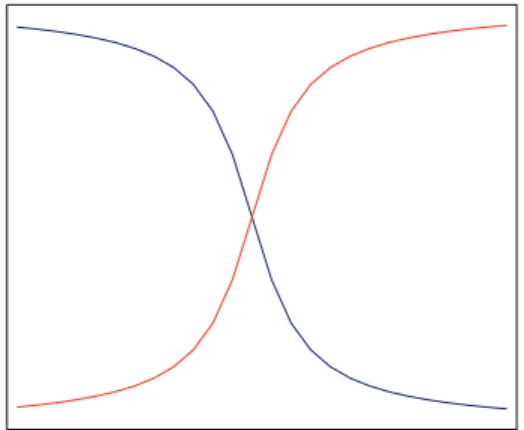
Figure 1: Soft margin.
3. Proposed Methods
In this section we first propose the soft margin method to modify the excursion of separation margin and to be effective in the gray zone. Then the formulation of interval regression with SSVM to analyze big data is introduced.
3.1. Soft Margin. In a conventional SVM, the sign function is used as the decision-making function. The separation thresh-old of the sign function is 0, which results in an excursion of separation margin for unbalanced data sets. The aim of the hard-margin separation margin is to find a hyperplane with the largest distance to the nearest training data. However, the limitations of the hard-margin formulation are as follows:
(1) there is no separating hyperplane for certain training data;
(2) complete separation with zero training error will lead to suboptimal prediction error;
(3) it is difficult to deal with the gray zone between classes.
Thus, the soft margin method is proposed to modify the excursion of separation margin and to be effective in the gray zone. The soft margin is defined as
𝑓−(𝛿) = arctan(−𝛿 ⋅ 𝑠 + 𝜗 ⋅ 𝑠)
𝜋 + 0.5,
𝑓+(𝛿) = arctan(𝛿 ⋅ 𝑠 − 𝜗 ⋅ 𝑠)𝜋 + 0.5,
(10)
where𝛿is the decision value.𝜗and𝑠are offset parameter and
scale parameter which need to be estimated using statistical method.
With the soft margin as shown inFigure 1, the predication
of the class labels can be determined as follows:
𝑦 (𝑥)
= {−1,+1, if (]𝑟 < 𝑓−(𝛿) , 𝛿 < 𝜗) or (]𝑟 > 𝑓+(𝛿) , 𝛿 > 𝜗)
if (]𝑟 > 𝑓−(𝛿) , 𝛿 < 𝜗) or (]𝑟 < 𝑓+(𝛿) , 𝛿 > 𝜗) , (11)
3.2. Interval Regression with SSVM. The main idea of smooth support vector machine (SSVM) is solved by a fast
Newton-Armijo algorithm [25] and has been extended to nonlinear
separation surfaces by using a nonlinear kernel technology
[24].
Suppose that𝑚training data{𝑥𝑖, 𝑦𝑖},𝑖 = 1, 2, . . . , 𝑚, are
given, where𝑥𝑖∈R𝑛are the input patterns and𝑦𝑖 ∈ {−1, 1}
are the related target values of two-class pattern classification case. Then the standard support vector machine with a linear
kernel [14] is min 𝑤,𝑏,𝜉 1 2‖𝑤‖2+ 𝐶 𝑚 ∑ 𝑖=1 𝜉𝑖2 s.t. 𝑦𝑖(𝑤𝑡𝑥𝑖+ 𝑏) ≥ 1 − 𝜉𝑖 𝜉𝑖≥ 0, 𝑖 = 1, 2, . . . , 𝑚, (12)
where𝑏is the location of hyperplane relative to the origin.
The regularization constant 𝐶 is a positive parameter to
control the tradeoff between the training error and the part of
maximizing the margin that is achieved by minimizing‖𝑤‖2.
𝜉𝑖is the slack variable with weight𝐶/2.‖𝑤‖is the Euclidean
norm of𝑤which is the normal to the following hyperplanes:
𝑤𝑡𝑥𝑖+ 𝑏 = +1, for𝑦𝑖= +1, (13)
𝑤𝑡𝑥𝑖+ 𝑏 = −1, for𝑦𝑖= −1. (14)
The first hyperplane (13) bounds the class{+1}and the
second hyperplane (14) bounds the class {−1}. The linear
separating hyperplane is
𝑤𝑡𝑥𝑖+ 𝑏 = 0. (15)
In Lee and Mangasarian’s approach [24],𝑏2/2is added to
the objective function of (12). This is equivalent to adding a
constant feature to the training data and finding a separating hyperplane through the origin. Consider
min 𝑤,𝑏,𝜉 1 2(‖𝑤‖2+ 𝑏2) + 𝐶 2 𝑚 ∑ 𝑖=1 𝜉2 𝑖 s.t. 𝑦𝑖(𝑤𝑡𝑥𝑖+ 𝑏) ≥ 1 − 𝜉𝑖 𝜉𝑖≥ 0, 𝑖 = 1, 2, . . . , 𝑚, (16)
where𝜉𝑖 = {1 − 𝑦𝑖(𝑤𝑡𝑥𝑖+ 𝑏)}+ for all𝑖and the “+” function
is defined as𝑥+ =max{0, 𝑥}. Then (12) can be reformulated
as the following minimization problem by replacing𝜉𝑖with
{1 − 𝑦𝑖(𝑤𝑡𝑥𝑖+ 𝑏)}+: min 𝑤,𝑏 1 2(‖𝑤‖2+ 𝑏2) + 𝐶 2 𝑚 ∑ 𝑖=1 {1 − 𝑦𝑖(𝑤𝑡𝑥𝑖+ 𝑏)}2+. (17)
The objective function in (17) is not twice differentiable
and can be solved by using a fast Newton-Armijo method
[25]. Thus the “+” function in SSVM is approximated by a
smooth function,𝑝(𝑥, 𝛼), as follows:
𝑝 (𝑥, 𝛼) = 𝑥 +𝛼1log(1 + 𝑒−𝛼𝑥) , 𝛼 > 0, (18)
where𝛼 > 0 is the smooth parameter.1/(1 + 𝑒−𝛼𝑥) is the
integral of the sigmoid function of neural networks [28].
The𝑝(𝑥, 𝛼)with a smoothing parameter𝛼 is to replace the
“+” function of (17) to obtain the following smooth support
vector machine (SSVM) with a linear kernel:
min 𝑤,𝑏 1 2(‖𝑤‖2+ 𝑏2) + 𝐶 2 𝑚 ∑ 𝑖=1 𝑝({1 − 𝑦𝑖(𝑤𝑡𝑥 𝑖+ 𝑏)} , 𝛼)2. (19)
For specific data sets, an appropriate nonlinear mapping
𝑥 → 𝜙(𝑥)can be used to embed the originalR𝑛features into
a Hilbert feature spaceF,𝜙 : R𝑛 → F, with a nonlinear
kernel𝐾(𝑥𝑖, 𝑥𝑗) ≡ 𝜙(𝑥𝑖)𝑡𝜙(𝑥𝑗). Thus, (19) can be extended to
the SSVM with a nonlinear kernel:
min 𝑤,𝑏 1 2(‖𝑤‖2+ 𝑏2) +𝐶 2 𝑚 ∑ 𝑖=1 𝑝({{ { 1 − 𝑦𝑖(∑𝑚 𝑗=1 V𝑗𝐾 (𝑥𝑖, 𝑥𝑗) + 𝑏)}} } , 𝛼) 2 , (20)
where∑𝑚𝑗=1V𝑗𝐾(𝑥𝑖, 𝑥𝑗) + 𝑏is the nonlinear SSVM classifier.
The coefficient V𝑗 is determined by solving an
optimiza-tion problem (20) and the data points with corresponding
nonzero coefficients.
With the principle of SSVM, we can formulate the interval linear regression model as follows:
min 𝑎,𝑐,𝑑 1 2(𝑎𝑡𝑎 + 𝑐𝑡𝑐 + 𝑑 𝑡 𝑑 + 𝑏2) +𝐶2∑𝑚 𝑖=1 𝑝({1 − 𝑦𝑖(𝑤𝑡𝑥𝑖+ 𝑏)} , 𝛼)2 s.t. 𝑎x𝑖+ 𝑐 x𝑖 ≤ 𝑦𝑖+ 𝑒𝑖 𝑎x𝑖− 𝑐 x𝑖 ≥ 𝑦𝑖− 𝑒𝑖 𝑎x𝑖+ 𝑐 x𝑖 + 𝑑x𝑖 ≥ 𝑦𝑖+ 𝑒𝑖 𝑎x𝑖− 𝑐 x𝑖 − 𝑑x𝑖 ≤ 𝑦𝑖− 𝑒𝑖 𝑖 = 1, 2, . . . , 𝑚, (21)
where𝑎,𝑐, and𝑑are the collections of all𝑎𝑖,𝑐𝑖, and𝑑𝑖,𝑖 =
Given (21), the corresponding Lagrangian objective func-tion is 𝐿 := 1 2(𝑎𝑡𝑎 + 𝑐𝑡𝑐 + 𝑑 𝑡 𝑑 + 𝑏2) +𝐶 2 𝑚 ∑ 𝑖=1 𝑝({1 − 𝑦𝑖(𝑤𝑡𝑥𝑖+ 𝑏)} , 𝛼)2 −∑𝑚 𝑖=1 𝜆1𝑖(𝑦𝑖+ 𝑒𝑖− 𝑎x𝑖− 𝑐 x𝑖) −∑𝑚 𝑖=1 𝜆2𝑖(𝑎x𝑖− 𝑐 x𝑖 − 𝑦𝑖+ 𝑒𝑖) −∑𝑚 𝑖=1 𝜆3𝑖(𝑎x𝑖+ 𝑐 x𝑖 + 𝑑x𝑖 − 𝑦𝑖− 𝑒𝑖) −∑𝑚 𝑖=1 𝜆4𝑖(𝑦𝑖− 𝑒𝑖− 𝑎x𝑖+ 𝑐 x𝑖 + 𝑑x𝑖), (22)
where𝐿is Lagrangian and𝜆1𝑖,𝜆2𝑖,𝜆3𝑖, and𝜆4𝑖are Lagrange
multipliers. The idea to construct a Lagrange function from the objective function and the corresponding constraints is to introduce a dual set of variables. It can be shown that the Lagrangian function has a saddle point with respect to the
primal and dual variables in the solution [29].
The Karush-Kuhn-Tucker (KKT) conditions that the
partial derivatives of𝐿with respect to the primal variables
(𝑎, 𝑐, 𝑑)for optimality 𝜕𝐿 𝜕𝑎 = 0 ⇒ 𝑎 = − 𝑚 ∑ 𝑖=1 (𝜆1𝑖− 𝜆2𝑖− 𝜆3𝑖+ 𝜆4𝑖)x𝑖, 𝜕𝐿 𝜕𝑐 = 0 ⇒ 𝑐 = − 𝑚 ∑ 𝑖=1 (𝜆1𝑖+ 𝜆2𝑖− 𝜆3𝑖− 𝜆4𝑖) x𝑖, 𝜕𝐿 𝜕𝑑 = 0 ⇒ 𝑑 = 𝑚 ∑ 𝑖=1 (𝜆3𝑖+ 𝜆4𝑖) x𝑖. (23)
Substituting (23) in (22) yields the following optimization
problem: max 1 2( 𝑚 ∑ 𝑖,𝑗=1 (𝜆1𝑖− 𝜆2𝑖− 𝜆3𝑖+ 𝜆4𝑖) × (𝜆1𝑗− 𝜆2𝑗− 𝜆3𝑗+ 𝜆4𝑗)x𝑡𝑖x𝑗 + ∑𝑚 𝑖,𝑗=1 (𝜆1𝑖+ 𝜆2𝑖− 𝜆3𝑖− 𝜆4𝑖) × (𝜆1𝑗+ 𝜆2𝑗− 𝜆3𝑗− 𝜆4𝑗) x𝑖𝑡x𝑗 − ∑𝑚 𝑖,𝑗=1(𝜆3𝑖+ 𝜆4𝑖) (𝜆3𝑗+ 𝜆4𝑗) x𝑖 𝑡 x𝑗 + 𝑏2) +𝐶 2 𝑚 ∑ 𝑖=1 𝑝({1 − 𝑦𝑖(𝑤𝑡𝑥𝑖+ 𝑏)} , 𝛼)2 s.t. 𝜆1𝑖, 𝜆2𝑖, 𝜆3𝑖, 𝜆4𝑖≥ 0. (24) Similarly, we can obtain the interval nonlinear regression
model by mapping 𝑥 → 𝜙(𝑥) to embed the original R𝑛
features into a Hilbert feature space F, 𝜙 : R𝑛 → F,
with a nonlinear kernel𝐾(𝑥𝑖, 𝑥𝑗) ≡ 𝜙(𝑥𝑖)𝑡𝜙(𝑥𝑗)as discussed
inSection 2.2. Then we obtain the optimization problem as
(25) by replacingx𝑡𝑖x𝑗 and|x𝑖|𝑡|x𝑗|in (24) with𝐾(x𝑖,x𝑗)and
𝐾(|x𝑖|, |x𝑗|), respectively: max 1 2( 𝑚 ∑ 𝑖,𝑗=1 (𝜆1𝑖− 𝜆2𝑖− 𝜆3𝑖+ 𝜆4𝑖) × (𝜆1𝑗− 𝜆2𝑗− 𝜆3𝑗+ 𝜆4𝑗) 𝐾 (x𝑖,x𝑗) + ∑𝑚 𝑖,𝑗=1 (𝜆1𝑖+ 𝜆2𝑖− 𝜆3𝑖− 𝜆4𝑖) × (𝜆1𝑗+ 𝜆2𝑗− 𝜆3𝑗− 𝜆4𝑗) 𝐾 (x𝑖,x𝑗) − ∑𝑚 𝑖,𝑗=1 (𝜆3𝑖+ 𝜆4𝑖) × (𝜆3𝑗+ 𝜆4𝑗) 𝐾 (x𝑖,x𝑗) + 𝑏2) +𝐶2∑𝑚 𝑖=1 𝑝({{ { 1 − 𝑦𝑖(∑𝑚 𝑗=1 V𝑗𝐾 (x𝑖,x𝑗) + 𝑏)}} } , 𝛼) 2 s.t. 𝜆1𝑖, 𝜆2𝑖, 𝜆3𝑖, 𝜆4𝑖≥ 0. (25)
4. Numerical Example
To illustrate the methods developed inSection 3, the
follow-ing example is presented.
Example. To illustrate the proposed methods dealing with big data sets, we use the data sets from Taiwan Stock
Exchange Capitalization Weighted Stock Index (TAIEX) [26]
which included the highest, lowest, and closed data and the
ranges are from01/02/2012to12/28/2012, from01/02/2011
to12/28/2012, from01/02/2010to 12/28/2012, and from
01/02/2009to12/28/2012, respectively. For these data sets,
the Gaussian kernel [10] is used where 𝜎 = 2.5 and the
regularization constant𝐶 = 300. The results are illustrated
fromFigure 2toFigure 5.
The comparison is shown by using the measure of fitness
Table 1: Comparison results of the measure of fitness.
Tanaka and Lee [15] Hong and Hwang [16] Huang [21] Proposed methods
𝜑𝑌(Figure 2) 0.1404 0.1395 0.1412 0.1354 𝜑𝑌(Figure 3) 0.1573 0.1562 0.1581 0.1429 𝜑𝑌(Figure 4) 0.1694 0.1658 0.1706 0.1583 𝜑𝑌(Figure 5) 0.1714 0.1695 0.1723 0.1609 TWSE TAIEX (01/02/2012~12/28/2012) 6.500.00 7.000.00 7.500.00 8.000.00 8.500.00 Highest Lowest TAIEX
Figure 2: TAIEX [26] from01/02/2012to12/28/2012.
TWSE TAIEX 6.000.00 6.500.00 7.000.00 7.500.00 8.000.00 8.500.00 9.000.00 9.500.00 (01/02/2011~12/28/2012) Highest Lowest TAIEX
Figure 3: TAIEX [26] from01/02/2011to12/28/2012.
for the𝑗th input approximates the necessity output for the𝑗th
input. Consider 𝜑𝑌(x𝑖) = 1 𝑞 𝑞 ∑ 𝑗=1 𝑐0+ ∑𝑛𝑖=1𝑐𝑖𝑥𝑖𝑗 𝑐0+ ∑𝑛𝑖=1𝑐𝑖𝑥𝑖𝑗 + 𝑑0+ ∑𝑛𝑖=1𝑑𝑖𝑥𝑖𝑗, (26)
where𝑞is a sample size and0 ≤ 𝜑𝑌≤ 1.
Table 1presents the proposed methods with a Gaussian kernel along with the results computed by Tanaka and Lee
TWSE TAIEX 6.000.00 6.500.00 7.000.00 7.500.00 8.000.00 8.500.00 9.000.00 9.500.00 (01/02/2010~12/28/2012) Highest Lowest TAIEX
Figure 4: TAIEX [26] from01/02/2010to12/28/2012.
TWSE TAIEX 4.000.00 5.000.00 6.000.00 7.000.00 8.000.00 9.000.00 (01/02/2009~12/28/2012) Highest Lowest TAIEX
Figure 5: TAIEX [26] from01/02/2009to12/28/2012.
[15], Hong and Hwang [16], and Huang [21]. We can find that
the proposed methods are more efficient than other methods.
5. Conclusions
In this paper, we collaborate interval regression with SSVM to analyze big data. In addition, the soft margin method is proposed to modify the excursion of separation margin and to be effective in the gray zone. The main idea of SSVM is solved by a fast Newton-Armijo algorithm and has
been extended to nonlinear separation surfaces by using a nonlinear kernel technology. The experiment results show that the proposed methods are more efficient than existing methods. In this study, we estimate the interval regression model with crisp inputs and interval output. In future works, both interval inputs-interval output and fuzzy inputs-fuzzy output will be considered.
Conflict of Interests
The authors declare that there is no conflict of interests regarding the publication of this paper.
Acknowledgments
The authors appreciate the anonymous referees for their useful comments and suggestions which helped to improve the quality and presentation of this paper. The original ver-sion was accepted by International Conference on Business, Information, and Cultural Creative Industry, 2014. Also, special thanks are due to the National Science Council, Taiwan, for financially supporting this research under Grants nos. NSC 102-2410-H-141-012-MY2 (C. H. Huang) and NSC 102-2410-H-259-039-(H. Y. Kao).
References
[1] D. Laney,The Importance of Big Data: A Definition, Gartner,
2012.
[2] C. L. P. Chen and C. Y. Zhang, “Data-intensive applications, challenges, techniques and technologies: A survey on Big Data,”
Information Sciences, vol. 275, pp. 314–347, 2014.
[3] K. Kambatla, G. Kollias, V. Kumar, and A. Grama, “Trends in big
data analytics,”Journal of Parallel and Distributed Computing,
vol. 74, no. 7, pp. 2561–2573, 2014.
[4] V. L´opez, S. del Ro, J. M. Bentez, and F. Herrera, “Cost-sensitive linguistic fuzzy rule based classification systems under the
MapReduce framework for imbalanced big data,”Fuzzy Sets and
Systems, 2014.
[5] T. Shelton, A. Poorthuis, M. Graham, and M. Zook, “Mapping the data shadows of Hurricane Sandy: uncovering the
sociospa-tial dimensions of ’big data’,”Geoforum, vol. 52, pp. 167–179,
2014.
[6] M. Arun Kumar, R. Khemchandani, M. Gopal, and S. Chandra, “Knowledge based least squares twin support vector machines,”
Information Sciences, vol. 180, no. 23, pp. 4606–4618, 2010. [7] S. Maldonado, R. Weber, and J. Basak, “Simultaneous feature
selection and classification using kernel-penalized support
vector machines,”Information Sciences, vol. 181, no. 1, pp. 115–
128, 2011.
[8] O. L. Mangasarian, “Mathematical programming in data
min-ing,”Data Mining and Knowledge Discovery, vol. 1, no. 2, pp.
183–201, 1997.
[9] O. L. Mangasarian, “Generalized support vector machines,” in
Advances in Large Margin Classifiers, A. J. Smola, P. L. Bartlett, B. Sch¨olkopf, and D. Schuurmans, Eds., pp. 135–146, The MIT Press, Cambridge, Mass, USA, 2000.
[10] C. A. Micchelli, “Interpolation of scattered data: distance
matri-ces and conditionally positive definite functions,”Constructive
Approximation, vol. 2, no. 1, pp. 11–22, 1986.
[11] R. Savitha, S. Suresh, and N. Sundararajan, “Fast learning Circu-lar COMplex-valued Extreme Learning Machine (CCELM) for
real-valued classification problems,”Information Sciences, vol.
187, pp. 277–290, 2012.
[12] B. Sch¨olkopf, C. J. C. Burges, and A. J. Smola,Advances in Kernel
Methods: Support Vector Learning, MIT Press, Cambridge, Mass, USA, 1999.
[13] A. Unler, A. Murat, and R. B. Chinnam, “mr2PSO: a maximum
relevance minimum redundancy feature selection method based on swarm intelligence for support vector machine
clas-sification,”Information Sciences, vol. 181, no. 20, pp. 4625–4641,
2011.
[14] V. N. Vapnik,Statistical Learning Theory, John Wiley & Sons,
New York, NY, USA, 1998.
[15] H. Tanaka and H. Lee, “Interval regression analysis by quadratic
programming approach,”IEEE Transactions on Fuzzy Systems,
vol. 6, no. 4, pp. 473–481, 1998.
[16] D. H. Hong and C. H. Hwang, “Interval regression analysis
using quadratic loss support vector machine,”IEEE
Transac-tions on Fuzzy Systems, vol. 13, no. 2, pp. 229–237, 2005. [17] A. Bisserier, R. Boukezzoula, and S. Galichet, “A revisited
approach to linear fuzzy regression using trapezoidal fuzzy
intervals,”Information Sciences, vol. 180, no. 19, pp. 3653–3673,
2010.
[18] P. D’Urso, R. Massari, and A. Santoro, “Robust fuzzy regression
analysis,”Information Sciences, vol. 181, no. 19, pp. 4154–4174,
2011.
[19] J. T. Jeng, C. C. Chuang, and S. F. Su, “Support vector interval
regression networks for interval regression analysis,”Fuzzy Sets
and Systems, vol. 138, no. 2, pp. 283–300, 2003.
[20] C. Huang and H. Kao, “Interval regression analysis with
soft-margin reduced support vector machine,” Lecture Notes in
Computer Science (including subseries Lecture Notes in Artificial Intelligence and Lecture Notes in Bioinformatics), vol. 5579, pp. 826–835, 2009.
[21] C. H. Huang, “A reduced support vector machine approach for
interval regression analysis,”Information Sciences, vol. 217, pp.
56–64, 2012.
[22] C.-C. Chang, L.-J. Chien, and Y.-J. Lee, “A novel framework for multi-class classification via ternary smooth support vector
machine,”Pattern Recognition, vol. 44, no. 6, pp. 1235–1244,
2011.
[23] Y. J. Lee, W. F. Hsieh, and C. M. Huang, “𝜀-SSVR: a smooth
support vector machine for 𝜀-insensitive regression,” IEEE
Transactions on Knowledge and Data Engineering, vol. 17, no. 5, pp. 678–685, 2005.
[24] Y. Lee and O. L. Mangasarian, “SSVM: a smooth support vector
machine for classification,”Computational Optimization and
Applications, vol. 20, no. 1, pp. 5–22, 2001.
[25] L. Armijo, “Minimization of functions having Lipschitz
con-tinuous first partial derivatives,”Pacific Journal of Mathematics,
vol. 16, pp. 1–3, 1966.
[26] “Taiwan Stock Exchange Capitalization Weighted Stock Index,” http://www.twse.com.tw.
[27] H. Tanaka, S. Uejima, and K. Asai, “Fuzzy linear regression
model,”IEEE Transactions on Systems, Man and Cybernetics,
vol. 10, pp. 2933–2938, 1980.
[28] O. L. Mangasarian, “Mathematical programming in neural
networks,”ORSA Journal on Computing, vol. 5, no. 4, pp. 349–
360, 1993.
[29] O. L. Mangasarian,Nonlinear Programming, McGraw-Hill, New
Submit your manuscripts at
http://www.hindawi.com
Hindawi Publishing Corporation
http://www.hindawi.com Volume 2014
Mathematics
Journal ofHindawi Publishing Corporation
http://www.hindawi.com Volume 2014
Mathematical Problems in Engineering
Hindawi Publishing Corporation http://www.hindawi.com
Differential Equations
International Journal of
Volume 2014
Hindawi Publishing Corporation
http://www.hindawi.com Volume 2014 Hindawi Publishing Corporationhttp://www.hindawi.com Volume 2014
Hindawi Publishing Corporation
http://www.hindawi.com Volume 2014
Mathematical PhysicsAdvances in
Complex Analysis
Journal of Hindawi Publishing Corporationhttp://www.hindawi.com Volume 2014
Optimization
Journal ofHindawi Publishing Corporation
http://www.hindawi.com Volume 2014
Combinatorics
Hindawi Publishing Corporation
http://www.hindawi.com Volume 2014
International Journal of
Hindawi Publishing Corporation
http://www.hindawi.com Volume 2014
Journal of
Hindawi Publishing Corporation
http://www.hindawi.com Volume 2014
Function Spaces
Abstract and Applied Analysis
Hindawi Publishing Corporation
http://www.hindawi.com Volume 2014 International Journal of Mathematics and Mathematical Sciences
Hindawi Publishing Corporation http://www.hindawi.com Volume 2014
The Scientific
World Journal
Hindawi Publishing Corporation
http://www.hindawi.com Volume 2014
Hindawi Publishing Corporation
http://www.hindawi.com Volume 2014
Discrete Dynamics in Nature and Society
Hindawi Publishing Corporation
http://www.hindawi.com Volume 2014
Hindawi Publishing Corporation
http://www.hindawi.com Volume 2014
Discrete Mathematics
Journal ofHindawi Publishing Corporation
http://www.hindawi.com Volume 2014 Hindawi Publishing Corporationhttp://www.hindawi.com Volume 2014