© 2010 Elsevier B.V. All rights reserved.
Integrated Campaign Planning and Resource
Allocation in Batch Plants
Naresh Susarla, I. A. Karimi
Department of Chemical & Biomolecular Engineering, National University of Singapore, 4 Engineering Drive 4, Singapore 117576
Abstract
In this work, we develop a simple MILP model for simultaneous campaign planning and resource allocation in multi-stage batch plants. We capture several real life scenarios including maintenance planning, product outsourcing, and NPIs and study the effect of various process decisions on the solution of the integrated and resource constrained planning problem. Given the products, their projected demands, and available resources for a given time horizon, our model determines campaign lengths, product schedules on different production lines, and resource allocation profiles. Also, we consider sequence-dependent changeover times between two campaigns. To demonstrate the performance of our mathematical formulation, we consider a case study from a typical multistage specialty chemical batch plant. We validate our approach considering a series of dynamic business scenarios.
Keywords: Campaign scheduling, multiproduct batch plants, resource allocation, MILP
1.Introduction
Batch-wise manufacturing is very popular for specialty products (pharmaceuticals, cosmetics, polymers, biochemicals, food products, etc.) which are of high added value, low volume or require close control of process conditions. Operational planning seeks inputs and is reviewed by several departments such as process, maintenance, laboratory, suppliers, sales, and higher management. This is mainly because operational planning is often constrained by the availability of resources (manpower, utilities, laboratory, parts, etc.). Thus, planning is a collaborative activity of several departments. For this reason, a simple planning tool or strategy is required that can quickly cater to the needs of all the stakeholders.
In general, the problem of operational planning in multiproduct batch plants has been addressed by several researchers. Recently, Corsano et al. (2009) developed a MINLP model for the design and planning of multiproduct batch plants. Stefansson et al. (2006) presented a 3-level hierarchical framework for the planning and scheduling in pharmaceutical plants. Sundaramoorthy and Karimi (2004) studied the effect of new product introductions in the medium-term planning in the context of a pharmaceutical production facility. Sundaramoorthy et al. (2006) developed a simple LP model as a decision support tool for medium term integrated planning decisions to the managers in specialty chemical industry. Suryadi and Papageorgiou (2004) considered a production planning problem and incorporated maintenance planning and crew allocation constraints. Clearly, campaign planning problem has been well studied in batch plants, few work study the effect of integrating resource allocation
In this work, we use a basic model of Sundaramoorthy and Karimi (2004) and modify it to develop a multiperiod MILP planning model. Our model is less complicated, in terms
of solution strategy and model structure, and can address the needs of higher management readily. Our model captures several real life scenarios such as the effect of resource (manpower, utilities, laboratory, and waste-treatment capacity) availability in process planning, routine maintenance, new product introductions (NPIs), outsourcing of intermediate products, and sequence-dependent cleaning times. Furthermore, to capture the dynamic changes in the plant, we propose a reactive scheduling strategy for our model. Finally, to demonstrate the performance of our approach, we consider a case study from a typical multistage specialty chemical batch plant. Also, we evaluate our model considering various business scenarios.
2.Problem statement
A multiproduct specialty chemical manufacturing facility (F) produces several products using J processing units/lines (j = 1, 2, …, J). Operations in F involves I (i = 1, 2, …, I) tasks, which includes both processing (Ip) and maintenance (Im) tasks. A recipe diagram of the manufacturing process gives the information on processing tasks, material states (s = 1, 2, …, S), and mass ratios (σsij) (Susarla et al., 2009). The planning problem in F can be described as follows. Given the (1) production recipes, (2) fixed batch sizes and processing and cycle times, (3) planning horizon, (4) demands and their due-dates, (5) cost and revenue details, (6) sequence-dependent cleaning times and costs, (7) resource availability, costs, & effects on process performance, (8) preventive-maintenance timings, (9) potential new products and their demands, we determine (1) allocation of tasks to production units/lines, (2) resource allocations, (3) campaigns, schedules, and number of batches, (4) material inventory profiles, (5) outsourcing strategy, assuming (1) deterministic scenario, (2) stable intermediate materials, (3) instantaneous procurement of raw materials (zero inventory cost), (4) all demands due at due dates, (5) one campaign per interval. We consider the maximization of gross profit (revenue through sales – cost of goods sold) as the optimization objective.
3.MILP formulation
We model the planning horizon H, on each unit j (1, …, J), in NT (1, …, NT) discrete
intervals of length ht (h1, h2, …, hNT) each. An interval t is then referred to the time between two product delivery dates [DDt-1 - DDt] and is of length ht. Furthermore, to model the interval ht we use a separate local time axis on every unit j and define KTj (k
= 1, 2, …, KTj) slots, using a multi-grid continuous time approach (Susarla et al.,
2009). Let s jkt T and [k = 1, 2, …, KTj; 1 e jkt T s j t T ≥ 0; TjeKTt ≤ht; Tjkte ≥ Tjkts ; Tj ks(+1)t ≥ jkte note the start and end time of the slot k on unit j for the interval t. Thus, the slot length is [ e T ] de jkt T - s jkt T ]. We use c [ ijkt T j s c Tjkt= Tijkt i
∑
∈I] to denote the start of a campaign of task i in slot k of unit j for interval t.
3.1.Campaign allocation
Each campaign involves several batches, every slot must have a campaign, and each campaign can be allocated to only one slot. To allocate each campaign in interval t to a slot, model transition of campaigns and extension of a campaign to the next interval we define the one binary (ysijkt) and two 0-1 variable
1 if a campaign of task is allocated to slot on unit in interval 0 Otherwise ijkt i k j ys = ⎨⎧ ⎩ t
i ∈ Ij, 1 ≤j≤J, 1 ≤k≤ KTj, 1 ≤t≤ NT
'
1 if campaign of task in slot precedes campaign of ' 0 Otherwise ii jkt i k x = ⎨⎧ ⎩ i i,i′ ∈ Ij, 1 ≤j≤J, 1 ≤k < KTj, 1 ≤t≤ NT
1 if a campaign of task in unit stretches from interval to 1 0 Otherwise ijt i j t t y = ⎨⎧ + ⎩ i ∈ Ij, 1 ≤j≤J, 1 ≤t≤ NT
Now, a slot k on unit j cannot perform more than 1 campaign. Also, we do not allow multiple campaigns of a task in the same processing unit, within a time interval.
j ijkt i ys ∈
∑
I ≤ 1 1 ≤ j ≤ J, 1 ≤ k ≤ KTj, 1 ≤ t ≤ NT (1a) j ijkt k ys ∈∑
KT ≤ 1 i ∈Ij, 1 ≤ j ≤ J, 1 ≤ t ≤ NT (1b) ' ' ' i j ii jkt i i x ∈ ≠∑
I ≤ ysijkt i ∈Ij, 1 ≤ j ≤ J, 1 ≤ k < KTj, 1 ≤ t ≤ NT (2a) ' ' ' i j i ijkt i i x ∈ ≠∑
I ≤ ysij(k+1)t i ∈Ij, 1 ≤ j ≤ J, 1 ≤ k < KTj, 1 ≤ t ≤ NT (2b) ysijkt + ysi′j(k+1)t - 1 ≤ xii′jkt i,i′∈Ij, 1 ≤ j ≤ J, 1 ≤ k < KTj, 1 ≤ t ≤ NT (2c) A campaign can stretch over to the next interval only if it is the last campaign for the current interval in unit j. Also, if the campaign is stretched over to the next interval from the current one, it will be the first campaign in the next interval.yijt≤ ysijkt i ∈Ij, 1 ≤ j ≤ J, k = KTj, 1 ≤ t ≤ NT (3a) yijt≤ ysij1(t+1) i ∈Ij, 1 ≤ j ≤ J, 1 ≤ t < NT (3b) 3.2.Campaign and Slot lengths
A campaign of a processing tasks i in unit j for interval t consists of nbijkt number of batches of constant processing time (ptij) and cycle time (ctij) (or maintenance time, mtjt), the sequence-dependent changeover/set-up time (
τii'
), and constant batch size (bsij). We incorporate following constraints for the timings of campaigns and for ensuring minimum campaign lengths (MCLij).' ' ' e s jkt jkt ij ijkt ijkt ij ii ii jkt i T −T ≥ pt ys +n ct +
∑
τ x i,i′∈Ij, 1 ≤ j ≤ J, 1 ≤ k < KTj, 1 ≤ t ≤ NT (4a) ( 1) ( ) e s jkt jkt ij ijkt ijt ij t i i T −T ≥∑
MCL ys −∑
H y +y − i ∈ Ij, k ≤ KTj (4b) 1( 1) 0( 1) (1 ) e s e s jkt jkt j t j t ij ijkt t ijt i i T −T +T + −T + ≥∑
MCL ys −∑
h −y i ∈ Ij, k = KTj (4c) 3.3.Operation timesWe demand that the start time for a campaign of task i to be zero whenever slot k is not allocated to task i. So,
c
ijkt t ijkt
T ≤h ys 1 ≤ j ≤ J, 1 ≤ k ≤ KTj, 1 ≤ t ≤ NT (5) A campaign of task i cannot start unless all of the tasks i′, which precede i in the product recipe, have produced sufficient amounts of material states that are required by i. Now, if both i and i′ occur in the same interval, we demand the following.
' ' ' ' ( ) (1 j j c c ijkt ij ijkt i j kt t i j kt k KT k KT k KT T pt ys T h ys ∈ ∈ ∈ + ≤ + −
∑
∑
∑
) j ≤ ) i ∈Ij, i′∈Ij′, 1 ≤ j, j′≤ J, σsi > 0, σsi′ < 0 (6a) ( ) j cijkt ij ijkt ijkt ij k KT T pt ys nb ct ∈ + +
∑
c ' ' ' ' ' ' ' ' ' ' ' ' ( ) (1 j j i j kt i j i j kt i j kt i j t i j kt k KT k KT T pt ys nb ct h ys ∈ ∈ + + + −∑
∑
i ∈Ij, i′∈Ij′, 1 ≤ j, j′≤ J, σsi > 0, σsi′ < 0 (6b) 3.4.InventoriesLet Ist (Ist ≤ max) denotes the inventory of the material state s, s
I os
s
I is the amount of material state s outsourced, sup
s
I is the amount of material state s supplied to the customers, and v
st
I is the safety stock violation at the end of a interval t. We write a balance on the inventory of material state s in the storage/supplied to customers/carry over to the next interval, similar to those of Sundaramoorthy and Karimi (2004, p.8293). 3.5.Resources
All chemical plants in general and specialty chemical plants in particular require several other utilities and resources for their general operations. These resources broadly include human, utilities, waste-treatment capacity, catalysts, and laboratory. For this reason, a typical scenario in the plants is that the initial plan is reviewed by various other departments (maintenance, process, and laboratory). We capture this variability of productivity depending on the availability of resources
( ) ijt t
nb ≤a mp ;nbijt ≤b u( )t (7)
where, mpt is available number of human resource for the period t, ut is available quantity of each of the utilities u, and a, b are the conversion constants which are specific to each plant and can be calculated based on the experience or plant logs. Let, ucuit monitors consumption of utility u. Given the specific consumption rate (μuit) and the total available amount (Uut) of utility u for the interval t, we write
(
uit uit ij ijkt ijkt ij j k uc =
∑∑
μ pt ys +nb ct ) uc ≤U∑
(8a) uit ut i (8b) 3.6.New Product Introductions (NPIs)Following Sundaramoorthy and Karimi (2004), we define the following 0-1 continuous variable
1 if unit begins campaign of task in the slot of interval for the first time 0 Otherwise
ijkt
j i k t
yv = ⎨⎧ ⎩
Now, since the validation is one-time, and happens in the beginning of the first campaign of a task i of the new product in unit j.
1 ijkt t k yv ≤
∑∑
i ∈Ij, 1 ≤ j ≤ J (9a) ' ' ' ' ijkt ijkt ijk tt t k<
yv ≥ys −
∑∑
yv i∈Ij, 1 ≤ j ≤ J, 1 ≤ k < KTj, 1 ≤ t ≤ NT (9b) To include the validation time (vtij) into our timing constraints, we modify 4a, 4b, and 6a accordingly.3.7.Strategies to include maintenance and reactive scheduling
The time intervals and the duration for routine maintenance are known a priori. So, we fix binary variables in our model to perform the maintenance.
Our model can easily handle uncertainties and revisions of plan. For this, we redefine the intervals from the current time and update model status by fixing the current values of variables as the initial condition for the revised model.
3.8.Planning Objective: costs and profits
The most preferred objective in planning process is the maximization of gross profit (revenue through sales – cost of production).
Cost of production includes processing cost (pcsj), sequence-dependent changeover/cleaning cost (ccii′), maintenance cost (mtcj), inventory holding cost (hcst), material procurement cost (mcst), waste treatment/disposal cost (wcs), utility usage cost (utut
−
), loss for delaying order delivery (dcs), and a penalty (spcst) for the violation of safety stock limit. Let υs denote the revenue per unit sale of material state s. Thus,
max NGP sup cost s st t t
I υ
=
∑∑
(10)This completes our model (SKplanning, eqs. 1-10 and few other constraints) for operational planning.
4.Model Evaluations and Results
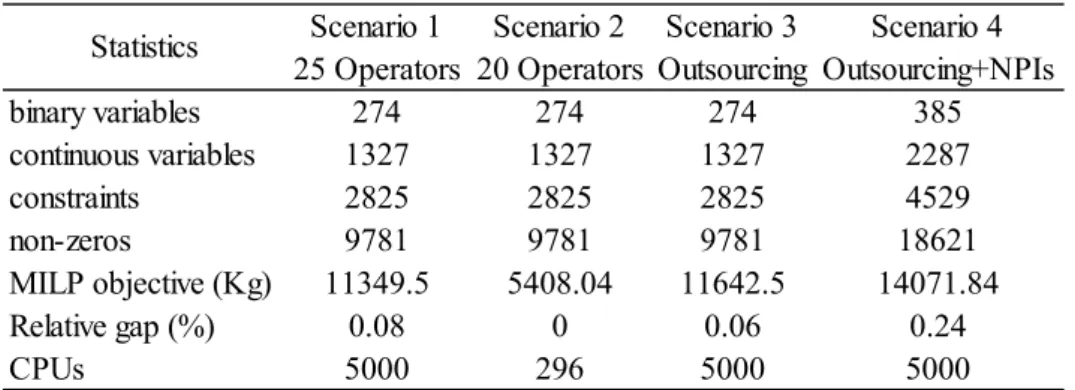
We present a case study from a multiproduct specialty chemical plant, to demonstrate the performance of our model. Our case study involves 13 tasks (9 process tasks, 3 maintenance tasks), 13 material states (m1 – m13), 3 units (j1 – j3), 25 operators, and 1 potential new product (tasks 7, 8, 9). We consider a planning horizon of 6 months. Table 1 consolidates the model and solution statistics for all the scenarios. For our evaluation, we used CPLEX 11/GAMS 22.8 on a LENOVO computer with AMD Athlon™ 64X2 Dual Core Processor 6000+ 3 GHz CPU, 3.25 GB RAM, running Windows XP Professional. Also, we present results by solving this case study for 4 different scenarios.
4.1.Scenario 1: 25 Operators
This is the base scenario and involves scheduling of product campaigns, maintenance, sequence-dependent changeover times, and 25 available operators. This scenario does not include the introduction of the new product.
4.2.Scenario 2: 19 Operators
We solve scenario 1 again with a limiting human resource. In this scenario, numbers of operators available are only 19. As expected, here the gross profit is less than the scenario 1 (5408.04 Kg vs. 11349.5 Kg). Similarly, we can solve our model for other limiting resources such as laboratory, waste treatment, parts, and utilities.
4.2.1.Scenario 3: Outsourcing
For this scenario, we allow outsourcing for one of the intermediates (material - m6). We consider the base scenario with 25 operators. The gross profit for this scenario is 11642.5 Kg.
4.3.Scenario 4: Outsourcing + NPIs
In this scenario, we allow both outsourcing of intermediate (material - m6) and the introduction of the new product (material - m13).
Table 1 Model and Solution Statistics
Scenario 1 Scenario 2 Scenario 3 Scenario 4 25 Operators 20 Operators Outsourcing Outsourcing+NPIs
binary variables 274 274 274 385 continuous variables 1327 1327 1327 2287 constraints 2825 2825 2825 4529 non-zeros 9781 9781 9781 18621 MILP objective (Kg) 11349.5 5408.04 11642.5 14071.84 Relative gap (%) 0.08 0 0.06 0.24 CPUs 5000 296 5000 5000 Statistics
% Relative gap [(best estimate - best integer) / best integer] - represents the upper bound for the distance between the best integer and optimal solution
5.Conclusions and Future Work
We successfully modify the model of Sundaramoorthy and Karimi (2004) to develop a simpler MILP model for campaign planning. We also demonstrate the usefulness of our model by evaluating 4 scenarios for a multiproduct specialty chemical plant and a planning horizon of 6 months. Our model successfully captures process variability with limited resources, sequence-dependent changeover times, and several real-life resources, features, and scenarios. We are currently working on further improving the solution efficiency of our model and interact further with a local company to improve the utility and acceptability of our model by the industry. Also, we are developing a planning tool that can readily generate several scenarios and adapt to the dynamic requirements of various stakeholders of a company.
References
Corsano, G., Aguirre, P. A., Montagna, J. M., 2009. Multiperiod design and planning of multiproduct batch plants with mixed-product campaigns. AIChE Journal 55, 9, 2356-2369. Stefansson, H., Shah, N., Jensson, P., 2006. Multiscale planning and scheduling in the secondary
pharmaceutical industry. AIChE Journal 52, 12, 4133-4149.
Sundaramoorthy, A., Karimi, I. A., 2004. Planning in pharmaceutical supply chains with outsourcing and new product introductions. Industrial and Engineering Chemistry Research 43, 8293-8306.
Sundaramoorthy, A., Xianming, S., Karimi, I. A., Srinivasan, R., Presented in PSE-2006, July 09-13. An integrated model for planning in global chemical supply chains.
Suryadi, H., Papageorgiou, L. G., 2004. Optimal maintenance planning and crew allocation for multipurpose batch plants. International Journal of Production Research 42, 2, 355-377. Susarla, N., Li, J., Karimi, I. A., 2009. A novel approach to scheduling multipurpose batch plants