City, University of London Institutional Repository
Citation
:
Chen, J., Chen, X., Horrocks, I., Jimenez-Ruiz, E. ORCID:
0000-0002-9083-4599 and Myklebus, E. B. (2020). Correcting Knowledge Base Assertions. In: WWW '20:
Proceedings of The Web Conference 2020. (pp. 1537-1547). New York, NY, United States:
Association for Computing Machinery. ISBN 978-1-4503-7023-3
This is the published version of the paper.
This version of the publication may differ from the final published
version.
Permanent repository link: https://openaccess.city.ac.uk/id/eprint/23585/
Link to published version
:
http://dx.doi.org/10.1145/3366423.3380226
Copyright and reuse:
City Research Online aims to make research
outputs of City, University of London available to a wider audience.
Copyright and Moral Rights remain with the author(s) and/or copyright
holders. URLs from City Research Online may be freely distributed and
linked to.
City Research Online:
http://openaccess.city.ac.uk/
City Research Online
Correcting Knowledge Base Assertions
Jiaoyan Chen
University of Oxford [email protected]
Xi Chen
Jarvis Lab Tencent [email protected]
Ian Horrocks
University of Oxford [email protected]
Erik B. Myklebust
Norwegian Institute for Water Research
University of Oslo [email protected]
Ernesto Jimenez-Ruiz
City, University of London University of Oslo [email protected]
ABSTRACT
The usefulness and usability of knowledge bases (KBs) is often limited by quality issues. One common issue is the presence of erroneous assertions, often caused by lexical or semantic confusion. We study the problem of correcting such assertions, and present a general correction framework which combines lexical matching, semantic embedding, soft constraint mining and semantic consis-tency checking. The framework is evaluated using DBpedia and an enterprise medical KB.
KEYWORDS
Knowledge Base Quality, Assertion Correction, Semantic Embed-ding, Constraint Mining, Consistency Checking
ACM Reference Format:
Jiaoyan Chen, Xi Chen, Ian Horrocks, Erik B. Myklebust, and Ernesto Jimenez-Ruiz. 2020. Correcting Knowledge Base Assertions. InProceedings of The Web Conference 2020 (WWW ’20), April 20–24, 2020, Taipei, Taiwan.ACM,
New York, NY, USA, 11 pages. https://doi.org/10.1145/3366423.3380226
1
INTRODUCTION
Knowledge bases (KBs) such as Wikidata [42] and DBpedia [2] are playing an increasingly important role in applications such as search engines, question answering, common sense reasoning and data integration. However, they still suffer from various quality issues, including constraint violations and erroneous assertions [11, 31], that negatively impact their usefulness and usability. These may be due to the knowledge itself (e.g., the core knowledge source of DBpedia, Wikipedia, is estimated to have an error rate of 2.8% [44]), or may be introduced by the knowledge extraction process. Existing work on KB quality issues covers not only error detec-tion and assessment, but also quality improvement via compledetec-tion, canonicalizaiton and so on [31]. Regarding error detection, erro-neous assertions can be detected by various methods, including consistency checking with defined, mined or external constraints [18, 33, 38], prediction by machine learning or statistical methods [7, 22, 32], and evaluation by query templates [19]; see Section
This paper is published under the Creative Commons Attribution 4.0 International (CC-BY 4.0) license. Authors reserve their rights to disseminate the work on their personal and corporate Web sites with the appropriate attribution.
WWW ’20, April 20–24, 2020, Taipei, Taiwan
© 2020 IW3C2 (International World Wide Web Conference Committee), published under Creative Commons CC-BY 4.0 License.
ACM ISBN 978-1-4503-7023-3/20/04. https://doi.org/10.1145/3366423.3380226
2.1 for more details. However, the erroneous assertions are often eliminated [6, 27], and few robust methods have been developed to correct them.
Lertvittayakumjorn et al. [20] and Melo et al. [21] found that most erroneous assertions are due to confusion or lexical simi-larity leading to entity misuse; for example confusion between
Manchester_UnitedandManchester_City, two football clubs based
in Manchester, UK, can lead to facts aboutManchester_Unitedbeing
incorrectly asserted aboutManchester_City. Such errors are
com-mon not only in general KBs like DBpedia and Wikidata but also in domain KBs like the medical KB used in our evaluation. Both studies proposed to find an entity to replace either the subject or the object of an erroneous assertion; however, subject replacement used a simple graph metric and keyword matching, which fails to capture the contextual semantics of the assertion, while object replacement relies on Wikipedia disambiguation pages, which may be inaccessible or non-existent, and again fail to capture contextual semantics.
Other work has focused on quality improvement, for example by
canonicalizingassertions whose objects are literals that represent
entities (i.e., entity mentions); for example, the literal object in the assertion⟨Yangtze_River,passesArea,“three gorges district”⟩.
Replacing this literal with the entityThree_Gorges_Reservoir_Region
enriches the semantics of the assertion, which can improve query answering. Such literal assertions are pervasive in wiki-based KBs such as DBPedia [2] and Zhishi.me [29], and in open KBs extracted from text; they may also be introduced when two KBs are aligned or when a KB evolves. According to the statistics in [15], DBpedia (ca. 2016) included over 105,000 such assertions using the property
dbp:locationalone. Current methods can predict the type of the
entity represented by the literal [15], which is useful for creating a new entity, and can sometimes identify candidate entities in the KB [4], but they do not propose a general correction method; see Section 2.2 for a more details.
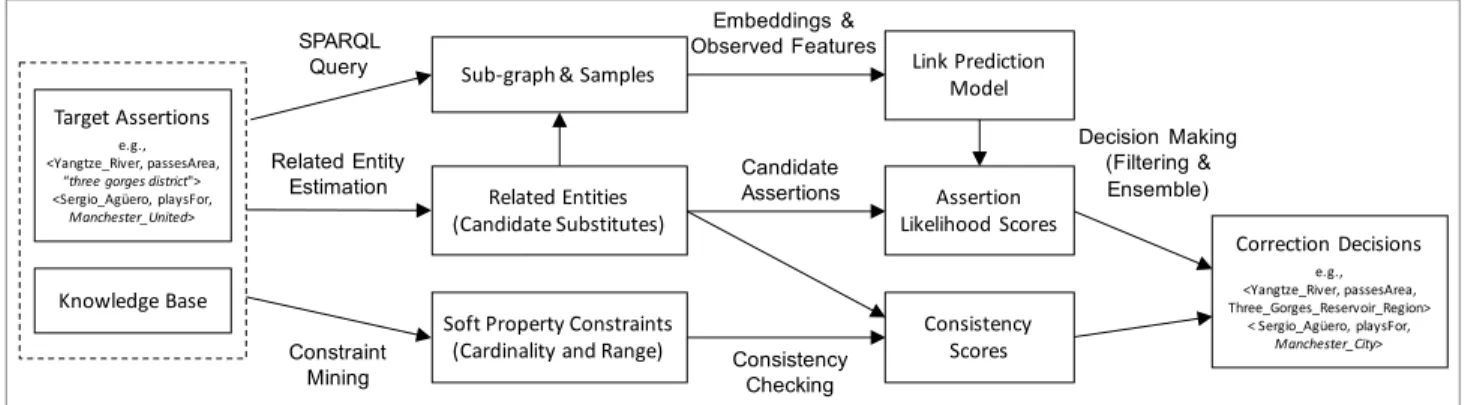
In this paper, we propose a method for correcting assertions whose objects are either erroneous entities or literals. To this end, we have developed a general framework that exploits related en-tity estimation, link prediction and constraint-based validation, as shown in Figure 1. Given a set of target assertions (i.e., asser-tions that have been identified as erroneous), it uses semantic re-latedness to identify candidate entities for substitution, extracts a multi-relational graph from the KB (sub-graph) that can model the context of the target assertions, and learns a link prediction model
using both semantic embeddings and observed features. The model predicts the assertion likelihood for each candidate substitution, and filters out those that lead to unlikely assertions. The frame-work further verifies the candidate substitutions by checking their consistency w.r.t. property range and cardinality constraints mined from the global KB. The framework finally makes a correction deci-sion, returning a corrected assertion or reporting failure if no likely correction can be identified.
Briefly this paper makes the following main contributions:
•It proposes a general framework that can correct both
erro-neous entity assertions and literal assertions;
•It utilizes both semantic embeddings and observed features
to capture the local context used for correction prediction, with a sub-graph extracted for higher efficiency;
•It complements the prediction with consistency against “soft”
property constraints mined from the global KB;
•It evaluates the framework with erroneous entity assertions
from a medical KB and literal assertions from DBpedia.
2
RELATED WORK
We survey related work of assertion validation which includes erroneous assertion detection, link prediction with semantic em-beddings and observed features, canonicalization, and assertion correction.
2.1
Assertion Validation
The validity of KB assertions is clearly an important consideration. One way to is to check their consistency against logical constraints or rules. Explicitly stated KB constraints can be directly used, but these are often weak or even non-existent. Thus, before using the DBpedia ontology to validate assertions, Topper et al. [38] enriched it with class disjointness, and property domain and range costraints, all derived via statistical analysis; Paulheim and Gangemi [33] en-riched it via alignment with the DOLCE-Zero foundational ontology. Various constraint and rule languages such as Shapes Constraint Language (SHACL) [18], Rule-Based Web Logics [1] and SPARQL query templates [19], have also been proposed so that external knowledge can be encoded and applied.
As machine learning develops, various methods have been pro-posed to encode the semantics of entities and relations into vectors for prediction [43]. The observed features are typically indicators (e.g., paths) extracted for a specific prediction problem. They of-ten work together with other learning and prediction algorithms, including supervised classification (e.g., PaTyBRED [21]), autoen-coder (e.g., RDF2Vec [36]), statistical distribution estimation (e.g., SDValidate [32]) and so on. PaTyBRED and SDValidate directly detect erroneous assertions, while RDF2Vec utilizes graph paths to learn intermediate entity representations that can be further used to validate assertions via supervised classification.
In contrast to observed features, which often rely on ad-hoc feature engineering, semantic embeddings (vectors) can be learned by minimizing an overall loss with a score function for modeling the assertion’s likelihood. They can be directly used to estimate the assertion likelihood. State-of-the-art methods and implementations include DistMult [46], TransE [3], IterE [47], ComplEx [40], OpenKE [16] and so on. They can also be combined with algorithms such as
outlier detection [7] and supervised classification [25] to deal with assertion validation in specific contexts.
On the one hand, the aforementioned methods were mostly de-veloped for KB completion and erroneous assertion detection, and few have been applied in assertion correction, especially the seman-tic embedding methods. On the other hand, they suffer from various shortcomings that limit their application. Consistency checking depends on domain knowledge of a specific task for constraint and rule definition, while the mined constraints and rules are often weak in modeling local context for disambiguation. Semantic embedding methods are good at modeling contextual semantics in a vector space, but are computationally expensive when learning from large KBs [30] and suffer from low robustness when dealing with real world KBs that are often noisy and sparse [35].
2.2
Canonicalization
Recent work on KB canonicalization is relevant to our related entity estimation. Some of this work focuses on the disambiguation of entity mentions in an open KB extracted from textual data [12, 41, 45]; CESI [41], for example, utilizes side information (e.g., WordNet), semantic embedding and clustering to identify equivalent entity mentions. However, these methods cannot be directly applied in our correction framework as they focus on equality while we aim at estimating relatedness. The contexts are also different as, unlike entity mentions, literals have no neighbourhood information (e.g., relationships with other entities) that can be utilized.
Chen et al. [4] and Gunaratna et al. [15] aimed at the canoni-calization of literal objects used in assertions with DBpedia object properties (whose objects should be entities). Instead of correcting the literal with an existing entity, they focus on the typing of the entity that the literal represents, which is helpful when a new entity is created for replacement. Although [4] also tried to identify an existing entity to substitute the literal, it suffers from some limita-tions: the predicted type is used as a constraint for filtering, which is not a robust and general correction method; the related entity estimation is ad-hoc and DBpedia specific; and the type predic-tion itself only uses entity and property labels, without any other contextual semantics.
2.3
Assertion Correction
We focus on recent studies concerning the automatic correction of erroneous assertions. Some are KB specific. For example, Dimou et al. [9] refined the mappings between Wikipedia data and DBpedia knowledge to correct errors during DBpedia construction, while Pellissier et al. [34] mined correction rules from the edit history of Wikidata to resolve its constraint violations. In contrast, our framework is general and does not assume any additional KB meta information or external data.
Regarding more general approaches, some aim at eliminating constraint violations. Chortis et al. [5, 37] defined and added new properties to avoid violating integrity constraints, while Melo [6] removedsameAslinks that lead to such violations. These methods
ensure KB consistency, but they can neither correct the knowledge itself nor deal with those wrong assertions that satisfy the con-straints. Lertvittayakumjorn et al. [20] and Melo et al. [21] both
correct assertions by replacing the objects or subjects with cor-rect entities. The former found the substitute by either keyword matching or a simple graph structure metric, while the latter first retrieved candidate substitutes from the Wikipedia disambiguation page (which may not exist, especially for KBs that are not based on Wikipedia) and then ranked them by lexical similarity. Both meth-ods, however, only use simple graph structure or lexical similarity to identify the substitute, and ignore the linkage incompleteness of a KB. In contrast, our method utilizes semantic embeddings to exploit the local context within a sub-graph to predict assertion likelihood, and at the same time uses global property constraints to validate the substitution.
3
BACKGROUND
3.1
Knowledge Base
In this study we consider a KB that follows Semantic Web standards including RDF (Resource Description Framework), RDF Schema, OWL (Web Ontology Language)1and the SPARQL Query Language
[10]. A KB is assumed to be composed of a TBox (terminology) and an ABox (assertions). The TBox usually defines classes (con-cepts), a class hierarchy (viardfs:subClassOf), properties (roles),
and property domains and ranges. It may also use a more expres-sive language such as OWL to express constraints such as class disjointness, property cardinality and so on [14].
The ABox consists of a set of assertions (facts) describing con-crete entities (individuals), each of which is represented by an Uniform Resource Identifier. Each assertion is represented by an RDF triple⟨s,p,o⟩, wheresis an entity,pis a property andois
either an entity or a literal (i.e., a typed or untyped data value such as a string or integer).s,pandoare known as the subject, predicate and object of the triple. An entity can be an instance of one or more classes, which is specified via triples using therdf:typeproperty.
Sometimes we will useclass assertionto refer to this latter kind of
assertion andproperty assertionto refer to assertions wherepis not
a property from the reserved vocabulary or RDF, RDFS or OWL. Such a KB can be accessed by SPARQL queries using a query engine that supports the relevant entailment regime (e.g., RDFS or OWL) [13]; such an engine can, e.g., infer⟨e0rdf:typec2⟩, given ⟨e0rdf:typec1⟩and⟨c1rdfs:subClassOf c2⟩. In addition, large-scale
KBs (aka knowledge graphs) often have a lookup service that en-ables users to directly access its entities by fuzzy matching; this is usually based on a lexical index that is built with entity labels (phrases defined byrdfs:label) and sometimes entity anchor text
(short descriptions). DBpedia builds its lookup service2using the
lexical index of Spotlight [23], while entities of Wikidata can be retrieved, for example, via the backend API of OpenTapioc [8].
3.2
Problem Statement
In this study, we focus on correcting ABox property assertions
⟨s,p,o⟩whereois a literal (literal assertion) or an entity (entity assertion). Note that in the former case correction may require
more than simple canonicalization; e.g., the property assertion
1There is a revision of the Web Ontology Language called OWL 2, for simplicity we
also refer to this revision as OWL.
2https://wiki.dbpedia.org/lookup
⟨Sergio_Agüero,playsFor,“Manchester United”⟩should be corrected
to⟨Sergio_Agüero,playsFor,Manchester_City⟩.
Literal assertions can be identified by data type inference and regular expressions as in [15], while erroneous entity assertions can be detected either manually when the KB is applied in down-stream applications or automatically by the methods discussed in Section 2.1. It is important to note that if the KB is an OWL ontology, the set ofobject properties(which connect two entities) anddata properties(which connect an entity to a literal) should be disjoint.
In practice, however, KBs such as DBpedia often do not respect this constraint.
We assume that the input is a KBK, and a setEof literal and/or
entity assertions that have been identified as incorrect. For each assertion⟨s,p,o⟩inE, the proposed correction framework aims at
either finding an entityefromKas an object substitute, such that
eis semantically related tooand the new triple⟨s,p,e⟩is true, or
reporting that there is no such an entityeinK.
4
METHODOLOGY
4.1
Framework
As shown in Figure 1, our assertion correction framework mainly consists of related entity estimation, link prediction, constraint-based validation and correction decision making. Related entity estimation identifies those entities that are relevant to the object of the assertion. Given a target assertiont =⟨s,p,o⟩, its related
entities, ranked by the relatedness, are denoted asREt. They are
calledcandidate substitutesof the original objecto, and the new
assertions whenois replaced are calledcandidate assertions. We
adopt two techniques — lexical matching and word embedding — to measure relatedness and estimateREt. Note that the aim of this step
is to ensure high recall; precision is subsequently taken care of via link prediction and constraint-based validation over the candidate assertions.
Link prediction estimates the likelihood of each candidate as-sertion. For each entityei inREt, it considers a target assertion t = ⟨s,p,o⟩and outputs a score that measures the likelihood of ⟨s,p,ei⟩. To train such a link prediction model, a sub-graph that
con-tains the context of the correction task (i.e.,E) is first extracted, with
the related entities, involved properties and their neighbourhoods; positive and negative assertions are then sampled for training. State-of-the-art semantic embeddings (TransE [3] and DistMult [46]), as well as some widely used observed features (path and node) are used to build the link prediction model.
Constraint-based validation checks whether a candidate asser-tion violates constraints on the cardinality or (hierarchical) range of the property, and outputs a consistency score which measures its degree of consistency against such constraints. Such constraints can be effective in filtering out unlikely assertions, but modern KBs such as DBpedia and Wikidata often include only incomplete or weak constraints, or do not respect the given constraints as no global consistency checking is performed. Therefore, we do not assume that there are any property cardinality or range constraints in the KB TBox,3but instead use mined constraints, each of which
is associated with a supporting degree (probability).
3Any property range and cardinality constraints that are defined in the TBox, or that
Correction decision making combines the results of related entity estimation, link prediction and constraint-based validation; it first integrates the assertion likelihood scores and consistency scores, and then filters out those candidate substitutes that have low scores. Finally, it either reports that no suitable correction was found, or recommends the most likely correction.
4.2
Related Entity Estimation
For each target assertiont=⟨s,p,o⟩inE, related entity estimation
directly adoptsoas the input ifois a literal, or extracts the label ofo
ifois an entity. It returns a listREtcontaining up tokmost related
entities; i.e.,|REt| ≤ k. Our framework supports both a lexical
matching based approach and a word embedding based approach; this allows us to compare the effectiveness of the two approaches on different KBs (see Section 5.2).
For those KBs with a lexical index, the lexical matching based approach can directly use a lookup service based on the index, which often returns a set of related entities for a given phrase. Direct lookup with the original phrase, however, often misses the correct entity, as the input phrase, either coming from the erroneous entity or the literal, is frequently noisy and ambigu-ous. For example, the DBpedia Lookup service returns no entities with the input “three gorges district” which refers to the entity
dbr:Three_Gorges_Reservoir_Region. To improve recall, we retrieve
a list of up tokentities by repeating entity lookup using sub-phrases, starting with the longest sub-phrases and continuing with shorter and shorter sub-phrases until eitherkentities have been retrieved or all sub-phrases have been used. The list of each lookup is or-dered according to the relatedness (lexical similarity) to the original phrase, while all the lists are concatenated according to the above lookup order. To extract the sub-phrases, we first tokenize the origi-nal phrase, remove the stop words and then concatenate the tokens in their original order for sub-phrases of different lengths. For those KBs without an existing lexical index, the lexical matching based ap-proach adopts a string similarity score i.e., normalized Edit Distance [26] to calculate the relatedness of an entity with its label.
The word embedding based approach calculates the similarity ofoagainst each entity in the KB, using vector representations of their labels (literals). It(i)tokenizes the phrase and removes
the stop words,(ii)represents each token by a vector with a word
embedding model (e.g.,Word2Vec[24]) that is trained using a large
corpus, where tokens out of the model’s vocabulary are ignored,
(iii)calculates the average of the vectors of all the tokens, and(iv)
computes the distance-based similarity score of the two vectors by e.g., the cosine similarity.
Compared with lexical matching, word embedding considers the semantics of a word, which assigns a high similarity score to two synonyms. In the above lookup example, “district” becomes noise as it is not included in the label ofdbp:Three_Gorges_Reservoir_Region,
but can still play an important role in the word embedding based approach due to the short word vector distance between “district” and “region”. However, in practice entity misuse is often not caused by semantic confusion, but by similarity of spelling and token composition, where the lexical similarity is high but the semantics might be quite different. Moreover, lexical matching with a lexical index makes it easy to utilize multiple items of textual information,
such as labels in multiple languages and anchor text, where different names of an entity are often included.
4.3
Link Prediction
Given related entitiesREt of a target assertiont = ⟨s,p,o⟩, link
prediction is used to estimate a likelihood score for the candidate assertion⟨s,p,ei⟩, for each entityeiinREt. For efficiency in dealing
with very large KBs, we first extract a multi-relational sub-graph for the context of the task, and then train the link prediction model with a sampling method, observed features and semantic embeddings.
4.3.1 Sub-graph.Given a KB Kand a set of target assertions E, the sub-graph corresponding toEis a part ofK, denoted as KE =⟨E,P,T⟩, whereEdenotes entities,Pdenotes object
prop-erties (relations) andT denotes assertions (triples). As shown in Algorithm 1, the sub-graph is calculated with three steps:(i)extract
the seeds — entities and properties involved in the target assertions
E, as well as related entities of each assertion inE;(ii)extract the
neighbourhoods — directly associated assertions of each of the seed properties and entities;(iii)re-calculate the properties and entities
involved in the assertions. Note that|=means an assertion is
ei-ther directly declared in the KB or can be inferred by the KB. The statements with|=can be implemented by SPARQL: Line 13 needs |P|queries each of which retrieves the associated assertions of a
given property, while Line 14 needs 2× |E|queries each of which
retrieves the associated assertions of a given subject or object.
Algorithm 1: Sub-graph Extraction (K,E,REt)
1 Input: (i)The whole KB:K,(ii)The set of target assertions:E,(iii)
The related entities of each target assertion:REt,t ∈ E
2 Result: The sub-graph:KE=⟨E,P,T⟩ 3 begin
4 %Step 1: Extract the seeds
5 S E={s| ⟨s,p,o⟩ ∈ E }%extract subject entities
6 P={p| ⟨s,p,o⟩ ∈ E }%extract target properties
7 RE=∪t∈EREt%The union of related entities
8 E=S E∪RE
9 foreach⟨s,p,o⟩inEdo 10 ifo is an entity then
11 E=E∪ {o}%add object entity 12 %Step 2: Extract the neighbourhoods
13 T={ ⟨s,p,o⟩ |p∈P∧ K |=⟨s,p,o⟩ }
14 T=T∪ { ⟨s,p,o⟩ |o∈E∧s∈E∧ K |=⟨s,p,o⟩ } 15 %Step 3: Re-calculate entities and properties
16 E=E∪ {s| ⟨s,p,o⟩ ∈T} ∪ {o| ⟨s,p,o⟩ ∈T} 17 P=P∪ {p| ⟨s,p,o⟩ ∈T}
18 returnKE=⟨E,P,T⟩
4.3.2 Sampling.Positive and negative samples (assertions) are
ex-tracted from the sub-graphKE=⟨E,P,T⟩. The positive samples
are composed of two parts:Tpos =Tsp∪Tpr, whereTsprefers
to assertions whose subjects and properties are amongSE (i.e., those subject entities involved inE) andP respectively (Tsp = {⟨s,p,o⟩|s∈SE∧p∈P∧ ⟨s,p,o⟩ ∈T}), whileTpr refers to those
Target Assertions e.g., <Yangtze_River, passesArea,
“three gorges district"> <Sergio_Agüero, playsFor,
Manchester_United> (Candidate Substitutes)Related Entities Sub-graph & Samples
Soft Property Constraints (Cardinality and Range)
SPARQL Query Related Entity Estimation Link Prediction Model Embeddings & Observed Features Assertion Likelihood Scores Consistency Scores Candidate Assertions Correction Decisions e.g., <Yangtze_River, passesArea, Three_Gorges_Reservoir_Region> < Sergio_Agüero, playsFor, Manchester_City> Decision Making (Filtering & Ensemble) Consistency Checking Knowledge Base Constraint Mining
Figure 1: The Overall Framework for Assertion Correction
assertions whose objects and properties are amongREandP respec-tively (Tpr ={⟨s,p,o⟩|p∈P∧o∈RE∧ ⟨s,p,o⟩ ∈T}).TspandTpr
are calculated by two steps:(i)extract all the associated assertions
of each propertypinPfromT;(ii)group these assertions according
toSEandRE. Compared with an arbitrary assertion inT, the above samples are more relevant to the candidate assertions for prediction. This can help release the domain adaption — the data distribution gap between the training and predicting assertions.
The negative samples include two parts as well:Tneд=T˜sp∪T˜pr,
where ˜Tspis constructed according toTspby replacing the object
with a random entity inE, while ˜Tpr are constructed according
toTpr by replacing the subject with a random entity inE. Take Tspas an example, for each of its assertion⟨s,p,o⟩, an entity ˜eis
randomly selected fromEfor a synthetic assertion ˜t =⟨s,p,e˜⟩such
thatK⊭t˜, where⊭denotes that an assertion is neither declared
nor can be inferred, and ˜tis added to ˜Tsp. In implementation, we
getK⊭t˜if ˜t<T, asT is extracted from the KB with inference.Tpr
is constructed similarly. The size ofTposandTneдis balanced. 4.3.3 Observed Features.We extract two kinds of observed features
— the path feature and the node feature. The former represents potential relations that can connect the subject and object, while the latter represents the likelihood of the subject being the head of the property, and the likelihood of the object being the tail of the property. For the path feature, we limit the path depth to two, for reducing computation time and feature size, both of which are exponential w.r.t. the depth. In fact, it has been shown that paths of depth one are already quite effective. They outperform the state-of-the-art KB embedding methods like DistMult and TransE, together with the node feature on some benchmarks [39]. The predictive information of a path also vanishes as its depth increases.
In calculation, we first extract paths of depth one:FPso1 andFPos1 , whereFPso1 represents properties fromstoo(i.e.,{p0|⟨s,p0,o⟩ ∈T}),
whileFPos1 represents properties fromotos(i.e.,{p0|⟨o,p0,s⟩ ∈T}).
Next we calculate paths of depth two (ordered property pairs) in two directions as well:FPso2 ={(p1,p2)|⟨s,p1,e⟩ ∈T ∧ ⟨e,p2,o⟩ ∈T},
FPos2 = {(p1,p2)|⟨o,p1,e⟩ ∈T ∧ ⟨e,p2,s⟩ ∈T}. Finally we merge
these paths:FP =FPso1 ∪FPos1 ∪FPso2 ∪FPos2 , and encode them
into a multi-hot vector as the path feature, denoted asfp. Briefly
we collect all the unique paths from the training assertions as a candidate set, where one path corresponds to one slot in encoding.
When an assertion is encoded into a vector, a slot of the vector is set to 1 if the slot’s corresponding path is among the assertion’s paths and 0 otherwise.
The node feature includes two binary variables:fn=[vs,vo],
wherevsdenotes the likelihood of the subject whilevodenotes the
likelihood of the object. Namely,vs=1 if there exists some entity o′such that⟨s,p,o′⟩ ∈T andv
s =0 otherwise.vo =1 if there
exists some entitys′such that⟨s′,p,o⟩ ∈T andv
o =0 otherwise.
Finally we calculatefpandfn, and concatenate them for each
sample inTpos∪Tneд, and train a link prediction model with a
basic supervised classifier named Multiple Layer Perception (MLP):
Mpn←classifier e.g., MLP−−−−−−−−−−−−−−− Tpos∪Tneд
fp,fn. (1)
We also adopt the path-based latent feature learned by the state-of-the-art algorithm RDF2Vec [36], as a baseline. RDF2Vec first extracts potential outstretched paths of an entity by e.g., graph walks, and then learns embeddings of the entities through the neural language modelWord2Vec. In training, we encode the subject and
object of an assertion by their RDF2Vec embeddings, encode its property by a one-hot vector, concatenate the three vectors, and use the same classifier MLP. The trained model is denoted asMr2v.
4.3.4 Semantic Embeddings.A number of semantic embedding
algorithms have been proposed to learn the vector representation of KB properties and entities. One common way is to define a scoring function to model the truth of an assertion, and use an overall loss for learning. We adopt two state-of-the-art algorithms — TransE [3] and DistMult [46]. Both are simple but have been shown to be competitive or outperform more complex alternatives [3, 17, 46]. For high efficiency, we learn the embeddings from the sub-graph.
TransE tries to learn a vector representation space such thato
is a nearest neighbor ofs+pif an assertion⟨s,p,o⟩holds, andois
far away froms+potherwise.+denotes the vector add operation. To this end, the score function oft = ⟨s,p,o⟩, denoted asд(t),
is defined asd(es +ep,eo), wheredis a dissimilarity (distance)
measure such asL2norm, whilees,epandeoare embeddings ofs, pandorespectively. The embeddings have the same dimension that is configured, and are initialized by one-hot encoding. In learning, a batch stochastic gradient descent algorithm is used to minimize
the the following margin-based ranking loss: L= Õ t∈T,t→t˜ γ+д(t) −д(t˜) + (2)
whereγ > 0 is a hyper parameter, [·]+ denotes extracting the
positive part, and ˜trepresents a negative assertion oft, generated by randomly replacing the subject or object with an entity inE.
DistMult is a special form of the bilinear model where the non-diagonal entries in the relation matrices are assumed to be zero. The score function of an assertion⟨s,p,o⟩is defined asepT(es◦eo),
where◦denotes the operation of pairwise multiplication. As TransE,
the embeddings are initialized by one-hot encoding, with the a dimension configured. A similar margin-based ranking loss as (2) is used for training with batched stochastic gradient descent.
In prediction, the likelihood score of an assertion can be calcu-lated with the corresponding scoring function and the embeddings of its subject, property and object. We denote the link prediction model by TransE and DistMult asMteandMdmrespectively.
4.4
Constraint-based Validation
We first mine two kinds of soft constraints — property cardinality and hierarchical property range from the KB, and then use a con-sistency checking algorithm to validate those candidate assertions.
4.4.1 Property Cardinality.Given a propertyp, its soft cardinality
is represented by a probability distributionDpcar(k) ∈ [0,1], where
k ≥ 1 is an integer that denotes the cardinality. It is calculated
as follows:(i)get all the property assertions whose property isp,
denoted asT(p), and all the involved subjects, denoted asS(p),(ii)
count the number of the object entities associated with each subject
sinS(p)andp:ON(s,p) =|{o|⟨s,p,o⟩ ∈T(p)}|,(iii)find out the
maximum object number:ONmaxp =max{ON(s,p)|s∈S(p)}, and (iv)calculate the property cardinality distribution as:
Dpcar(k)= |{s∈S(p)|ON(s,p)=k}|
|S(p)| ,k=1, ...,ON p max, (3)
where|·|denotes the size of a set. SpeciallyONmaxp =0 ifT(p)
is empty.Dcarp (k>n)is short forÍO N
p max
i=n+1 Dpcar(k=i), denoting
the probability that the cardinality is larger thann. In implementa-tion,T(p)can be accessed by one time SPARQL query, while the
remaining computation has linear time complexity w.r.t.|T(p)|.
The probability of cardinalitykis equal to the ratio of the subjects that are associated withkdifferent entity objects. For example, considering a propertyhasParentthat is associated with 10 different
subjects (persons) in the KB, if one of them has one object (parent) and the remaining have two objects (parents), then the cardinality distribution is:Dcar(k=1)=101 andDcar(k=2)=109. Note that
although such constraints follow Closed Word Assumption and Unique Name Assumption, they behave well in our method. On the one hand, probabilities are estimated to represent the supporting degree of a constraint by the ABox. One the other hand, they are used in an approximate model to validate candidate assertions instead of as new and totally true knowledge for KB TBox extension.
4.4.2 Hierarchical Property Range. Given a propertyp, its range
constraint consists of(i) specific rangewhich includes the most
specific classes of its associated objects, denoted asCpsp, and(ii)
general rangewhich includes ancestors of these most specific classes,
denoted asCдep , with top classes such asowl:Thingbeing excluded.
A most specific class of an entity refers to one of the most fine grained classes that the entity is an instance of according to class assertions in the KB. Note that there could be multiple such classes as the entity could be asserted to be an instance of multiple classes for which there is no sub-class relationship. General classes of an entity are those that subsume one or more of the specific classes as specified in the KB viardfs:subClassOf assertions.
Each range classcinCpsp(Cдep resp.) has a probability in[0,1]
that represents its supporting degree by the KB, denoted asDpsp(c)
(Dpдe(c)resp.).Cpsp,Cдep and the supporting degrees are calculated by
the following steps:(i)get all the object entities that are associated
withp, denoted asOE(p);(ii)infer the specific and general classes of
each entityoeinOE(p), denoted asCsp(p,oe)andCдe(p,oe)
respec-tively, and at the same time collectCspp as∪oe∈O E(p)Csp(p,oe)and
Cpдeas∪oe∈O E(p)Cдe(p,oe);(iii)compute the supporting degrees:
Dpsp(c)= |{oe|oe∈O E|O E(p),(cp∈) |Csp(p,oe)}|,c∈Cpsp,
Dpдe(c)=|{oe|oe∈O E|O E(p),(cp∈) |Cдe(p,oe)}|,c∈Cpдe. (4)
The degree of each range class is the ratio of the objects that are instances of the class, as either directly declared in the ABox or inferred byrdfs:subClassOf. The implementation needs one time
SPARQL query to getOE(p), and|OE(p)|times SPARQL queries to
get the specific and ancestor classes. The remaining computation has linear time complexity w.r.t.|OE(p)|. As property cardinality,
range is also used for approximating the likelihood of candidate as-sertions, with a consistency checking algorithm introduced bellow.
4.4.3 Consistency Checking.As shown in Algorithm 2, constraint
checking acts as a model, to estimate the consistency of an assertion against soft constraints of hierarchical property range and cardi-nality. Given a candidate assertiont =⟨s,p,e⟩, the algorithm first
checks the property cardinality, with a parameter named maximum cardinality exceeding rateσ∈ (0,1]. Line 5 counts the number of
entity objects that are associated withsandpin the KB, assuming that the correction is made (i.e.,thas been added into the KB). Note that 1≤n≤ONmaxp +1. Line 6 calculates its exceeding raterw.r.t.
ONmaxp , wherer∈ (−∞,1]. In Line 8,ONmaxp =0 indicates thatp
is highly likely to used as a data property in the KB. This is common in correcting literal assertions: one example is the property has-Namewhose objects are phrases of entity mentions but should not
be replaced by entities. In this case, it is more reasonable to report that the object substitute does not exist, and thus the algorithm sets the cardinality scoreycar to 0.
Another condition of settingycarto 0 isr ≥σ. Specially, whenσ
is set to 1.0,r≥σ(i.e.,ONmaxp =1 ,n=2) means thatpis a object
property with functionality in the KB but the correction violates this constraint. Note thatncan exceedONmaxp by a small degree which happens whenONmaxp is large. For example, whenσis set to 0.5,r=0.25 (i.e.,ONmaxp =4 andn=5) is allowed. Line 11 to
16 calculate the property cardinality scoreycar as the probability
of being a functional property (n=1), or as the probability of being a none-functional property (n>1). Specially, we punish the score
whenn>ONmaxp (i.e.,r>0) by multiplying it with a degrading
factor 1−r: the higher exceeding rate, the more it degrades.
Line 17 to 21 calculate the property range scoreyr an, by
comb-ing the specific range scoreyr an,c and the general range score yr an,дwith their importance weightsωcandωд. Usually we make
the specific range more important by settingωc andωд to e.g.,
0.8 and 0.2 respectively. Line 19 computesyr an,candyr an,д: the
score is higher if more classes of the objects are among the range classes, and these classes have higher range degrees. For example, considering the propertybornInwith the following range
cardinal-ity:Cpsp = {City,Town,Place},Cдep ={Place},Dpsp(City) =0.5,
Dpsp(Town) =0.4,Dpsp(Place) =0.05 andDpдe(Place)=0.95, we
will have(i)yr an,c=1−(1−0.5)(1−0.05)=0.525 andyr an,д=0.95
ifC(e) = {City,Place},(ii)yr an,c = 0.05 andyr an,д = 0.95 if C(e) = {Villaдe,Place}, and(iii)yr an,c = 0 andyr an,д = 0 if C(e)={Prof essor,Person}. The order of the consistency degree
against the property range is:{City,Place}>{Villaдe,Place}> {Prof essor,Person}.
The algorithm finally returns the property cardinality scoreycar
and the property range scoreyr an. The former model is denoted
asMcar while the letter is denoted asMr an. According to some
empirical analysis, we can multiply or average the two scores, as the final model of consistency checking, denoted asMcar+r an.
4.5
Correction Decision Making
Given a target assertiontinE, and its top-krelated entitiesREt, for
each entityei inREt, the correction framework(i)calculates the
assertion likelihood scoreyl
i with a link prediction model (Mpn, Mte orMdm), and the consistency scoreyci withMcar,Mr an
orMcar+r an;(ii)separately normalizesyli andyci into[0,1]
ac-cording to all the predictions by the corresponding model forE; (iii)ensembles the two scores by simple averaging:yi = (y
l i+yic)
2 ;
(iv)filters outei fromREt ifyi <τ. Noteei is always kept ift
is a literal assertion and its literal is exactly equal to the label of
ei. The related entities after filtering keep their original order in REt, and are denoted asREt′.τis a parameter in[0,1]that needs
to be adjusted with a developing data set. It eventually returns none, which means there is no entity in the KB that can replace the object oft, ifRE′
tis empty, and the top-1 entity inREt′as the object
substitute otherwise. The ensemble of the link prediction score and constraint-based validation score is not a must. Either of them can make a positive impact independently, while their ensemble can make the performance higher in most cases (cf. Section 5.4).
5
EVALUATION
5.1
Experiment Settings
5.1.1 Data. In our experiment, we correct assertions in DBpedia
[2] and in an enterprise medical KB whose TBox is defined by clinic experts and ABox is extracted from medical articles (text) by some open information extraction tools (cf. more details in [28]). DBpedia is accessed via its official Lookup service, SPARQL Endpoint4and
entity label dump (for related entity estimation withWord2Vec). The
medical KB contains knowledge about disease, medicine, treatment,
4http://dbpedia.org/sparql
Algorithm 2: Consistency Checking (Mr an,Mcar) 1 Input: (i)A candidate assertion:t=⟨s,p,e⟩,(ii)property
cardinality constraint:⟨Dcarp ,O Nmaxp ⟩,(iii)the maximum
cardinality exceeding rate:σ ∈ (0,1],(iv)hierarchical
property range constraint:⟨Dspp,Dpдe,Cspp,Cдep ⟩,(v)
weights of the specific range and general range:⟨ωc,ωд⟩
2 Result:ycar: score thattis consistent with the property
cardinality;yr an: score thattis consistent with the
property range
3 begin
4 %count the number of object entities
5 n=| {o| K |=⟨s,p,o⟩,ois entity} ∪ {e} |;
6 r=(n−O N
p max)
O Nmaxp ; %calculate the exceeding rate 7 %no object entities are associated withpin the KB, or the
cardinality exceeds the maximum by a specific rate
8 ifO Nmaxp =0∥r ≥σthen
9 ycar=0;
10 else
11 ifn=1then
12 %probability as a functional property
13 ycar=Dcarp (k=1);
14 else
15 %probability as a none-functional property
16 ycar=
(
Dpcar(k>1), ifr≤0 (1−r) ·Dcarp (k >1), else
17 C(e)={c| K |=⟨e,rdf:type,c⟩ }; %get the object’s classes
18 %calculate the constraint score of specific and general ranges 19 yr an,c=1−Î c∈Cpsp∩C(e)(1−D p r an(c)), yr an,д=1−Î c∈Cдep ∩C(e)(1−D p r an(c));
20 %calculate the overall range constraint score
21 yr an=ωc·yr an,c+ωд·yr an,д; 22 returnycar,yr an
symptoms, foods and so on, with around 800 thousand entities, 7 properties, 48 classes, 4 million property assertions. The data are representative of two common situations: errors of DBpedia are mostly inherited from the source while errors of the medical KB are mostly introduced by extraction.
For DBpedia, we reuse the literal set proposed by [4, 15]. Literals containing multiple entity mentions are removed, while proper-ties with insufficient literal objects are complemented with more literals from DBpedia. We annotate each assertion with a ground truth (GT), which is either a correct replacement entity from DB-pedia (i.e.,Entity GT) or none (i.e.,Empty GT). Ground truths are
carefully checked using DBpedia, Wikipedia, and multiple external resources. Regarding the medical KB, we use a set of assertions with erroneous entity objects that have been discovered and col-lected during deployment of the KB in enterprise products; the GT annotations have been added with the help of clinical experts. For convenience, we call the above two target assertion sets DBP-Lit and MED-Ent respectively.5More details are shown in Table 1.
Assertions (with Entity GT) # Properties # Subjects # DBP-Lit 725 (499) 127 668 MED-Ent 272 (225) 7 200
Table 1:Some statistics of DBP-Lit and MED-Ent.
5.1.2 Settings. In the evaluation, we first analyze related entity
esti-mation (Section 5.2) and link prediction (Section 5.3) independently. For the former, we report the recall of Entity GTs of different meth-ods with varying top-kvalues, based on which suitable settings are selected for the framework. For link prediction, we compare different KB embeddings and observed features, using those target assertions whose Entity GTs are recalled in related entity estimation. The related entities of a target assertion are first ranked according to the predicted score, and then standard metrics including Hits@1, Hits@5 and MRR (Mean Reciprocal Rank) are calculated.
Next we evaluate the overall results of the assertion correction framework (Section 5.4), where the baselines are compared with, and the impact of link prediction and constraint-based validation is analyzed. Three metrics are adopted:(i) Correction Ratewhich is
the ratio of the target assertions that are corrected with right sub-stitutes, among all the target assertions with Entity GTs;(ii) Empty Ratewhich is the ratio of the target assertions that are corrected
with none, among all the target assertions with Empty GTs;(iii) Accuracywhich is the ratio of the truly corrected target assertions
by either substitutes or none, among all the target assertions. Note that accuracy is an overall metric considering both correction rate and empty rate. Either high (low resp.) correction rate or empty rate can lead to high (low resp.) accuracy. With the overall results, we finally analyze the constraint-based validation with more details.
The reported results are based on the following setting (unless otherwise specified).Word2Vec[24] is trained using the Wikipedia
article dump in June 2018. In link prediction,γ is set by linear increasing w.r.t. the training step, the embedding size is set to 100, and the other training hyper parameters such as the number of epochs and MLP hidden layer size are set such that the highest MRR is achieved on an evaluation sample set. For RDF2Vec, pre-trained versions of DBpedia entities by Mannheim University6are tested,
and the results with the best MRR are reported. In constraint-based validation,σ,ωc andωд are set to 1.0, 0.8 and 0.2 respectively,
according to the algorithm insight. Some other reasonable settings explored can achieve similar results. The embeddings are trained by GeForce GTX 1080 Ti with OpenKE [16], while the remaining is computed by Intel(R) Xeon(R) CPU E5-2670 @2.60GHz.
5.2
Related Entity Estimation
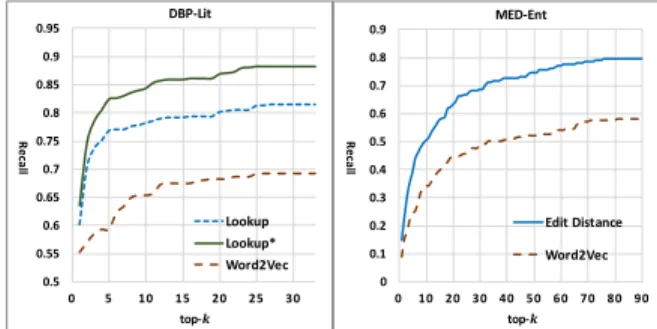
We compare different methods and settings used in related entity estimation with the results presented in Figure 2, where the recall of Entity GTs by top-krelated entities are presented. First, we find that the lexical matching based methods (Lookup, Lookup∗and Edit
Distance) have much higher recall thanWord2Vec, on both
DBP-Lit and MED-Ent. The reason for DBP-DBP-Lit may lie in the Lookup service provided by DBpedia, which takes not only the entity label but also the anchor text into consideration. The latter provides more
6https://bit.ly/2M4TQOg
semantics, some of which, such as different names and background description, is very helpful for recalling the right entity. The reason for MED-Ent, according to some empirical analysis, is that the erroneous objects are often caused by lexical confusion, such as misspelling and misusing of an entity with similar tokens. Second, our Lookup solution with sub-phrases, i.e., Lookup∗, as expected,
outperforms the original Lookup. For example, when both curves are stable, their recalls are around 0.88 and 0.81 respectively,
The target of related entity estimation in our framework is to have a high recall with akvalue that is not too large (so as to avoid additional noise and limit the size of the sub-graph for efficiency). In real application, the method andkvalue can be set by analyzing the recall. According to the absolute value and the trend of the recall curves in Figure 2, our framework uses Lookup∗withk=30
for DBP-Lit, and Edit Distance withk=76 for MED-Ent.
0.5 0.55 0.6 0.65 0.7 0.75 0.8 0.85 0.9 0.95 0 5 10 15 20 25 30 Lookup Lookup* Word2Vec top-𝒌 Re ca ll 0 0.1 0.2 0.3 0.4 0.5 0.6 0.7 0.8 0.9 0 10 20 30 40 50 60 70 80 90 Edit Distance Word2Vec top-𝒌 Re ca ll DBP-Lit MED-Ent
Figure 2:The recall of Entity GTs by top-krelated entities
5.3
Link Prediction
5.3.1 Impact of Models.The results of different link prediction
methods are shown in Table 2, where the sub-graph is used for training. The baseline Random means randomly ranking the re-lated entities, while AttBiRNN, which is successfully applied in [4] for literal object typing, refers to the attentive bidirectional Recurrent Neural Networks that utilize the labels of the subject, property and object. First of all, the results verify that either latent semantic embeddings or observed features with MLP are effective for both DBP-Lit and MED-Ent: MRR, Hits@1 and Hits@5 are all dramatically improved w.r.t. Random and AttBiRNN.
We also find that concatenating the node feature and path feature (Node+Path) achieves higher performance than the node feature and the path feature alone, as well as the baseline RDF2Vec which is based on graph walks. For DBP-Lit, it outperforms RDF2Vec by 39.9%, 44.1% and 45.5% for MRR, Hits@1 and Hits@5 respectively. Meanwhile, Node+Path performs better than TransE and Dist-Mult for DBP-Lit, while for MED-Ent, TransE and DistDist-Mult out-performs Node+Path. For example, considering the metric of MRR, Node+Path is 71.3% higher than DistMult for DBP-Lit, but DistMul is 108.8% higher than Node+Path for MED-Ent. One potential rea-son is the difference in the number of properties and sparsity of the two sub-graphs. DBP-Lit has 127 properties in its target assertions and 1958 properties in its sub-graph; while MED-Ent has 7 proper-ties in its target assertions and 19 properproper-ties in its sub-graph. The small number of properties for MED-Ent leads to quite poor path feature, which is verified by its independent performance (e.g., the
MRR is only 0.09). In the sub-graph of DBP-Lit, the average number of connected entities per property (i.e., density) is 150.7, while in the sub-graph of MED-Ent, it is 2739.0. Moreover, a larger ratio of properties to entities also leads to richer path features. According to these results, we use Node+Path for DBP-Lit and DistMult for MED-Ent in our correction framework.
Methods DBP-Lit MED-Ent MRR Hits@1 Hits@5 MRR Hits@1 Hits@5 Random 0.199 0.100 0.275 0.027 0.013 0.066 AttBiRNN 0.251 0.126 0.348 0.255 0.111 0.414 TransE 0.342 0.173 0.518 0.744 0.652 0.862 DistMult 0.424 0.300 0.536 0.752 0.694 0.806 RDF2Vec 0.419 0.320 0.492 — — — Node 0.495 0.379 0.604 0.338 0.171 0.514 Path 0.473 0.356 0.578 0.090 0.028 0.133 Node+Path 0.586 0.461 0.716 0.360 0.200 0.525
Table 2:Link prediction results based on the sub-graph.
5.3.2 Impact of The Sub-graph. We further analyze the impact of
sub-graph usage in training the link prediction model. The results of some of the methods that can be run over the whole KB with limited time are shown in Table 3, where Node+Path (DBP-Lit) uses features extracted from the whole KB but samples from the sub-graph. One the one hand, in comparison with Node+Path trained purely with the sub-graph, Node+Path with global features actu-ally performs worse. As all the directly connected properties and entities of each subject entity, related entity and target property are included in the sub-graph, using the sub-graph makes no difference for node features and path features of depth one. Thus the above result is mainly due to the fact that path features of depth two actu-ally makes limited contribution in this link prediction context. This is reasonable as they are weak, duplicated or even noisy in compar-ison with node features and path features of depth one. One the other hand, learning the semantic embeddings with the sub-graph has positive impact on TransE and negative impact on DistMult for MED-Ent. However the impact in both cases is quite limited. Considering that the sub-graph has only 36.9% (11.2% resp.) of the entities (assertions resp.) of the whole medical KB, which reduces the training time of DistMult embeddings from 46.7 minutes to 19.0 minutes, the above performance drop can be accepted.
Cases MRR Hits@1 Hits@5 TransE (MED-Ent) 0.713 (-.031) 0.608 (-.044) 0.834 (-.028) DistMult (MED-Ent) 0.766 (+.014) 0.721 (+.027) 0.822 (+.016) Node+Path (DBP-Lit) 0.504 (-.082) 0.384 (-.077) 0.611 (-.105) Table 3:Link prediction results based on the whole KB, and their outperformance (gap) over those based on the sub-graph
0.45 0.5 0.55 0.6 0.65 0.7 0.75 0 0.2 0.4 0.6 0.8 1 Correction Rate 0.1 0.2 0.3 0.4 0.5 0.6 0.7 0.8 0.9 1 0 0.2 0.4 0.6 0.8 1 Empty Rate 0.45 0.5 0.55 0.6 0.65 0.7 0.75 0 0.2 0.4 0.6 0.8 1 Accuracy
Lookup* Lookup* + LP Lookup* + CV Lookup* + LP + CV
0 0.1 0.2 0.3 0.4 0.5 0.6 0.7 0 0.2 0.4 0.6 0.8 1 Correction Rate 0 0.1 0.2 0.3 0.4 0.5 0.6 0.7 0 0.2 0.4 0.6 0.8 1 Empty Rate 0 0.1 0.2 0.3 0.4 0.5 0.6 0.7 0 0.2 0.4 0.6 0.8 1 Accuracy
EditDistance EditDistance + LP EditDistance + CV EditDistance + LP + CV
Figure 3:Overall results of the correction framework for DBP-Lite [Above] and MED-Ent [Below]. + LP and + CV represent filtering with link prediction and constraint-based validation respectively, with the filtering thresholdτranging from0to1with a step of0.05.
5.4
Overall Results
Figure 3 presents the correction rate, empty rate and accuracy of our assertion correction framework with a ranging filtering threshold
τ. Note that lexical matching without any filtering is similar to the existing method discussed in related work [20]. On the one hand, we find that filtering with either link prediction (LP) or constraint-based validation (CV) can improve the correction rate whenτis set to a suitable range. This is because those candidate substitutes that are lexically similar to the erroneous object but lead to unlikely assertions are filtered out, while those that are not so lexically similar but lead to true assertions are ranked higher. As the empty rate is definitely increased after filtering (e.g., improved from 0.252 to 0.867 by Lookup∗+ LP + CV for DBP-Lit), the accuracy for both
DBP-Lit and MED-Ent is improved in the whole range ofτ. On the other hand, we find that averaging the scores from link prediction and constraint-based validation is effective. It leads to both higher correction rate and accuracy than either of them for some values ofτ, such as[0.05,0.1]for DBP-Lit and[0.85,0.95]for MED-Ent.
Table 4 presents the optimum correction rate and accuracy. Note that they are achieved using a suitableτsetting; in real applications this can be determined using an evaluation data set. With these results, we make the following observations. First, the optimum results are consistent with our above conclusions regarding the positive impact of link prediction, constraint-based validation and their ensemble. For example, the optimum accuracy of DBP-Lit is improved by 32.6% using constraint-based validation in comparison with the original related entities by lexical matching. The correction rate of MED-Ent provides another example: REE + LP + CV is 1.5% higher than REE + LP, and 121.4% higher than REE + CV.
Second, lexical matching using either Lookup (for DBP-Lit) or Edit Distance (for MED-Ent) has a much higher correction rate and accuracy thanWord2Vec, while our Lookup with sub-phrases
of DBpedia. These overall results verify the recall analysis on re-lated entity estimation in Section 5.2. Meanwhile, we find that the overall results on observed features (Mnp) and latent semantic
embeddings (MdmandMte) are also consistent with the link
pre-diction analysis in Section 5.3:Mnphas a better filtering effect than MdmandMtefor DBP-Lit, but worse filtering effect for MED-Ent.
Methods DBP-Lit MED-Ent C-Rate Acc C-Rate Acc Lexical Matching 0.597 0.611 0.149 0.123 Lookup∗ 0.635 0.516 — — Word2Vec 0.553 0.410 0.089 0.076 REE + LP (Mnp) 0.677 0.677 0.360 0.327 REE + LP (Mdm) 0.635 0.628 0.600 0.588 REE + CV (Mr an) 0.671 0.668 0.271 0.239 REE + CV (Mcar) 0.639 0.622 0.164 0.147 REE + CV (Mr an+car) 0.677 0.684 0.271 0.246 REE + LP + CV 0.701 0.690 0.609 0.599
Table 4:Optimum correction rate (C-Rate) and accuracy (Acc). REE denotes Related Entity Estimation: Lookup∗for DBP-Lit, Edit Dis-tance for MED-Ent.
5.5
Constraint-based Validation
Besides the positive impact on the overall results mentioned above, we get several more detailed observations about constraint-based validation from Table 4. On the one hand, the property range con-straint plays a more important role than the property cardinality constraint, while their combination is more robust than either of them, as expected. Considering the assertion set of MED-Ent, fil-tering byMr an, for example, leads to 62.6% higher accuracy than
filtering byMcar, while filtering byMr an+car has 2.9% higher
accuracy and equal correction rate in comparison withMr an.
On the other hand, we find constraint-based validation performs well for DBP-Lit, with higher accuracy and equal correction rate in comparison with link prediction, but performs worse for MED-Ent. This is mainly due to the gap between the semantics of the two target assertion sets and their corresponding KBs:(i)the mined
property ranges of DBP-Lit include 404 hierarchical classes, while those of MED-DB have only 8 classes and these classes have no hierarchy;(ii)23 out of 127 target properties in DBP-Lit have pure
functionality (i.e.,Dpcar(k=1)=1.0) which plays a key role in the
consistency checking algorithm, while none of the target properties of MED-Ent has such pure functionality. The second characteristic is also a potential reason why filtering by constraint-based validation with property cardinality only achieves a very limited improvement over Edit Distance for MED-Ent as shown in Table 4.
We additionally present some examples of the mined soft prop-erty constraints in Table 5. Most of them are consistent with our common sense understanding of the properties, although some noise is evident (e.g., the range Person and Agent ofdbp:homeTown),
most likely caused by erroneous property and class assertions.
Property Cardinality Specific Range General Range
dbp: homeTown 1 : 0.415 2 : 0.422 3 : 0.163 Location: 0.801, City: 0.280, Country: 0.268, Person: 0.228, ... PopulatedPlace: 0.821, Place: 0.821, Settlement: 0.299, Agent: 0.259, ... dbp: finalteam 1 : 1.000 BaseballTeam: 0.493, SportsTeam: 0.154, SoccerClub: 0.015, ... Agent: 0.688, Organization: 0.665, SportsTeam: 0.510, ... Table 5:Soft constraints of two property examples
6
DISCUSSION AND OUTLOOK
In this paper we present a study of assertion correction, an impor-tant problem for KB curation, but one that has rarely been studied. We have proposed a general correction framework, which rely on no KB meta data or external information, and which exploits both deep learning and consistency reasoning to correct erroneous ob-jects and informally annotated literals. The framework has been evaluated by correcting assertions in two KBs: DBpedia with cross-domain knowledge and an medical KB. We discuss below several more observations and possible directions for the future work.
Entity relatedness.Our method follows the principle of
cor-recting the object by a related entity rather than an arbitrary entity that leads to a correct assertion. Relatedness can be due to either lexical or semantic similarity. Currently, the recall for DBP-Lit and MED-Ent is 0.882 and 0.797 respectively, which is promising, but still leaves space for further improvement. One extension for higher recall but limited noise and sub-graph size is incorporating more literal attributes of the entity.
KB variation.Although both constraint-based validation and
link prediction improve overall performance, their impact varies from DBpedia to the medical KB. The effectiveness of constraint-based validation depends on the richness of the KB schema, such as property functionality, the complexity of property range, etc. The more complex the schema is, the better performance constraint-based validation achieves. The impact of link prediction is more complicated: the path and node features perform better on DBpedia which has many more properties, while the semantic embeddings by DistMult and TransE are more suitable for the medical KB which has less properties but higher density. Integrating link prediction and constraint-based validation, even with simple score averaging, can improve performance, but further study is needed for a better integration method that is adapted to the given KB.
Property constraints.On the one hand, the evaluation
indi-cates that the mined property constraints are effective for assertion validation and can be independently used in other contexts like online KB editing. On the other hand, unlike the link prediction model, the constraints as well as the consistency checking algorithm are interpretable. One benefit is that explicitly defined or external TBox constraints can easily be injected into our framework by overwriting or revising the constraints. For example, the mined specific range Person: 0.228 in Table 5, which is inappropriate for the propertydbp:homeTown, can be directly removed.
ACKNOWLEDGMENTS
This work was supported by the AIDA project (Alan Turing Insti-tute), the SIRIUS Centre for Scalable Data Access (Research Council of Norway), Samsung Research UK, Siemens AG, and the EPSRC projects AnaLOG (EP/P025943/1), OASIS (EP/S032347/1) and UK FIRES (EP/S019111/1). Data of MED-Ent, GPU resources and Xi Chen’s contribution were supported by Jarvis Lab Tencent.
REFERENCES
[1] Dörthe Arndt, Ben De Meester, Anastasia Dimou, Ruben Verborgh, and Erik Mannens. 2017. Using Rule-based Reasoning for RDF Validation. InInternational Joint Conference on Rules and Reasoning. Springer, 22–36.
[2] Sören Auer, Christian Bizer, Georgi Kobilarov, Jens Lehmann, Richard Cyganiak, and Zachary Ives. 2007. DBpedia: A Nucleus for A Web of Open Data. InThe Semantic Web. Springer, 722–735.
[3] Antoine Bordes, Nicolas Usunier, Alberto Garcia-Duran, Jason Weston, and Ok-sana Yakhnenko. 2013. Translating Embeddings for Modeling Multi-relational Data. InAdvances in Neural Information Processing Systems. 2787–2795. [4] Jiaoyan Chen, Ernesto Jiménez-Ruiz, and Ian Horrocks. 2019. Canonicalizing
Knowledge Base Literals. InInternational Semantic Web Conference.
[5] Michalis Chortis and Giorgos Flouris. 2015. A Diagnosis and Repair Framework for DL-LiteA KBs. InEuropean Semantic Web Conference. Springer, 199–214. [6] Gerard De Melo. 2013. Not quite the same: Identity constraints for the web of
linked data. InTwenty-Seventh AAAI Conference on Artificial Intelligence. [7] Jeremy Debattista, Christoph Lange, and Sören Auer. 2016. A Preliminary
Inves-tigation towards Improving Linked Data Quality Using Distance-based Outlier Detection. InJoint International Semantic Technology Conference. Springer, 116– 124.
[8] Antonin Delpeuch. 2019. OpenTapioca: Lightweight Entity Linking for Wikidata. arXiv preprint arXiv:1904.09131(2019).
[9] Anastasia Dimou, Dimitris Kontokostas, Markus Freudenberg, Ruben Verborgh, Jens Lehmann, Erik Mannens, Sebastian Hellmann, and Rik Van de Walle. 2015. Assessing and Refining Mappings to RDF to Improve Dataset Quality. In Interna-tional Semantic Web Conference. Springer, 133–149.
[10] John Domingue, Dieter Fensel, and James A Hendler. 2011.Handbook of Semantic Web Technologies. Springer Science & Business Media.
[11] Michael Färber, Frederic Bartscherer, Carsten Menne, and Achim Rettinger. 2018. Linked Data Quality of DBpedia, Freebase, Opencyc, Wikidata, and Yago.Semantic Web9, 1 (2018), 77–129.
[12] Luis Galárraga, Geremy Heitz, Kevin Murphy, and Fabian M Suchanek. 2014. Canonicalizing Open Knowledge Bases. InProceedings of the 23rd ACM Interna-tional Conference on Information and Knowledge Management. ACM, 1679–1688. [13] Birte Glimm and Chimezie Ogbuji. 2013. SPARQL 1.1 Entailment Regimes.W3C
Recommendation(2013).
[14] Bernardo Cuenca Grau, Ian Horrocks, Boris Motik, Bijan Parsia, Peter F. Patel-Schneider, and Ulrike Sattler. 2008. OWL 2: The Next Step for OWL. Web Semantics: Science, Services and Agents on the World Wide Web6, 4 (2008), 309– 322.
[15] Kalpa Gunaratna, Krishnaprasad Thirunarayan, Amit Sheth, and Gong Cheng. 2016. Gleaning Types for Literals in RDF Triples with Application to Entity Summarization. InEuropean Semantic Web Conference. 85–100.
[16] Xu Han, Shulin Cao, Xin Lv, Yankai Lin, Zhiyuan Liu, Maosong Sun, and Juanzi Li. 2018. OpenKE: An Open Toolkit for Knowledge Embedding. InProceedings of the 2018 Conference on Empirical Methods in Natural Language Processing: System Demonstrations. 139–144.
[17] Rudolf Kadlec, Ondrej Bajgar, and Jan Kleindienst. 2017. Knowledge Base Comple-tion: Baselines Strike Back. InProceedings of the 2nd Workshop on Representation Learning for NLP. 69–74.
[18] Holger Knublauch and Dimitris Kontokostas. 2017. Shapes Constraint Language (SHACL).W3C Recommendation20 (2017).
[19] Dimitris Kontokostas, Patrick Westphal, Sören Auer, Sebastian Hellmann, Jens Lehmann, Roland Cornelissen, and Amrapali Zaveri. 2014. Test-driven Evaluation of Linked Data Quality. InProceedings of the 23rd International Conference on World Wide Web. ACM, 747–758.
[20] Piyawat Lertvittayakumjorn, Natthawut Kertkeidkachorn, and Ryutaro Ichise. 2017. Correcting Range Violation Errors in DBpedia.. InInternational Semantic Web Conference (Posters, Demos & Industry Tracks).
[21] André Melo and Heiko Paulheim. 2017. An Approach to Correction of Erroneous Links in Knowledge Graphs. InCEUR Workshop Proceedings, Vol. 2065. RWTH, 54–57.
[22] André Melo and Heiko Paulheim. 2017. Detection of Relation Assertion Errors in Knowledge Graphs. InProceedings of the Knowledge Capture Conference. ACM, 22.
[23] Pablo N Mendes, Max Jakob, Andrés García-Silva, and Christian Bizer. 2011. DBpedia Spotlight: Shedding Light on the Web of Documents. InProceedings of the 7th International Conference on Semantic Systems. ACM, 1–8.
[24] Tomas Mikolov, Kai Chen, Greg Corrado, and Jeffrey Dean. 2013. Efficient Esti-mation of Word Representations in Vector Space.arXiv preprint arXiv:1301.3781 (2013).
[25] Erik B. Myklebust, Ernesto Jiménez-Ruiz, Jiaoyan Chen, Raoul Wolf, and Knut Erik Tollefsen. 2019. Knowledge Graph Embedding for Ecotoxicological Effect Predic-tion.CoRRabs/1907.01328. arXiv:1907.01328 http://arxiv.org/abs/1907.01328 [26] Gonzalo Navarro. 2001. A Guided Tour to Approximate String Matching.Comput.
Surveys33, 1 (2001), 31–88.
[27] Axel-Cyrille Ngonga Ngomo, Mohamed Ahmed Sherif, and Klaus Lyko. 2014. Unsupervised Link Discovery through Knowledge Base Repair. InEuropean Semantic Web Conference. Springer, 380–394.
[28] Christina Niklaus, Matthias Cetto, André Freitas, and Siegfried Handschuh. 2018. A Survey on Open Information Extraction. InProceedings of the 27th International Conference on Computational Linguistics. 3866–3878.
[29] Xing Niu, Xinruo Sun, Haofen Wang, Shu Rong, Guilin Qi, and Yong Yu. 2011. Zhishi.me - Weaving Chinese Linking Open Data. InInternational Semantic Web Conference. Springer, 205–220.
[30] Pouya Ghiasnezhad Omran, Kewen Wang, and Zhe Wang. 2018. Scalable Rule Learning via Learning Representation.. InProceedings of the 27th International Joint Conference on Artificial Intelligence. 2149–2155.
[31] Heiko Paulheim. 2017. Knowledge Graph Refinement: A Survey of Approaches and Evaluation Methods.Semantic web8, 3 (2017), 489–508.
[32] Heiko Paulheim and Christian Bizer. 2014. Improving the Quality of Linked Data Using Statistical Distributions.International Journal on Semantic Web and Information Systems (IJSWIS)10, 2 (2014), 63–86.
[33] Heiko Paulheim and Aldo Gangemi. 2015. Serving DBpedia with DOLCE – More than Just Adding A Cherry on Top. InInternational Semantic Web Conference. Springer, 180–196.
[34] Thomas Pellissier Tanon, Camille Bourgaux, and Fabian Suchanek. 2019. Learning How to Correct A Knowledge Base from the Edit History. InThe World Wide Web Conference. ACM, 1465–1475.
[35] Jay Pujara, Eriq Augustine, and Lise Getoor. 2017. Sparsity and Noise: Where Knowledge Graph Embeddings Fall Short. InProceedings of the 2017 Conference on Empirical Methods in Natural Language Processing. 1751–1756.
[36] Petar Ristoski and Heiko Paulheim. 2016. RDF2Vec: RDF Graph Embeddings for Data Mining. InInternational Semantic Web Conference. Springer, 498–514. [37] Alberto Tonon, Michele Catasta, Gianluca Demartini, and Philippe
Cudré-Mauroux. 2015. Fixing the Domain and Range of Properties in Linked Data by Context Disambiguation.LDOW@ WWW1409 (2015).
[38] Gerald Töpper, Magnus Knuth, and Harald Sack. 2012. DBpedia Ontology En-richment for Inconsistency Detection. InProceedings of the 8th International Conference on Semantic Systems. ACM, 33–40.
[39] Kristina Toutanova and Danqi Chen. 2015. Observed versus Latent Features for Knowledge Base and Text Inference. InProceedings of the 3rd Workshop on Continuous Vector Space Models and their Compositionality. 57–66.
[40] Théo Trouillon, Johannes Welbl, Sebastian Riedel, Éric Gaussier, and Guillaume Bouchard. 2016. Complex embeddings for simple link prediction. InInternational Conference on Machine Learning. 2071–2080.
[41] Shikhar Vashishth, Prince Jain, and Partha Talukdar. 2018. CESI: Canonicalizing Open Knowledge Bases Using Embeddings and Side Information. InProceedings of the 2018 World Wide Web Conference. International World Wide Web Conferences Steering Committee, 1317–1327.
[42] Denny Vrandečić and Markus Krötzsch. 2014. Wikidata: A Free Collaborative Knowledge Base. (2014).
[43] Quan Wang, Zhendong Mao, Bin Wang, and Li Guo. 2017. Knowledge Graph Embedding: A Survey of Approaches and Applications. IEEE Transactions on Knowledge and Data Engineering29, 12 (2017), 2724–2743.
[44] Gabriel Weaver, Barbara Strickland, and Gregory Crane. 2006. Quantifying the Accuracy of Relational Statements in Wikipedia: A Methodology. InProceedings of the 6th ACM/IEEE-CS Joint Conference on Digital Libraries, Vol. 6. Citeseer, 358–358.
[45] Tien-Hsuan Wu, Zhiyong Wu, Ben Kao, and Pengcheng Yin. 2018. Towards Practical Open Knowledge Base Canonicalization. InProceedings of the 27th ACM International Conference on Information and Knowledge Management. ACM, 883–892.
[46] Bishan Yang, Wen-tau Yih, Xiaodong He, Jianfeng Gao, and Li Deng. 2014. Em-bedding Entities and Relations for Learning and Inference in Knowledge Bases. arXiv preprint arXiv:1412.6575(2014).
[47] Wen Zhang, Bibek Paudel, Liang Wang, Jiaoyan Chen, Hai Zhu, Wei Zhang, Abraham Bernstein, and Huajun Chen. 2
![Figure 3: Overall results of the correction framework for DBP-Lite [Above] and MED-Ent [Below]](https://thumb-us.123doks.com/thumbv2/123dok_us/416934.2547769/10.918.477.837.124.407/figure-overall-results-correction-framework-dbp-lite-med.webp)