
Investigation of one-stage meta-analysis methods for joint longitudinal and time-to-1
event data through simulation and real data application 2
Maria Sudell1,3, Ruwanthi Kolamunnage-Dona2,3 , François Gueyffier4, and Catrin
3
Tudur Smith2,3
4
Abstract 5
Background: Joint modelling of longitudinal and time-to-event data is often advantageous
6
over separate longitudinal or time-to-event analyses as it can account for study dropout, error
7
in longitudinally measured covariates, and correlation between longitudinal and time-to-event
8
outcomes. The current literature on joint modelling focuses mainly on the analysis of single
9
studies with a lack of methods available for the meta-analysis of joint data from multiple
10
studies. Methods: We investigate a variety of one-stage methods for the meta-analysis of
11
joint longitudinal and time-to-event outcome data. These methods are applied to the
12
INDANA dataset to investigate longitudinally measured systolic blood pressure, with each of
13
time to death, time to myocardial infarction and time to stroke. Results are compared to
14
separate longitudinal or time-to-event meta-analyses. A simulation study is conducted to
15
contrast separate versus joint analyses over a range of scenarios. Results: The performance of
16
the examined one-stage joint meta-analytic models varied. Models that accounted for
17
between study heterogeneity performed better than models that ignored it. Of the examined
18
methods to account for between study heterogeneity, under the examined association
19
structure, fixed effect approaches appeared preferable, whilst methods involving baseline
20
hazard stratified by study were least time intensive. Conclusions: One-stage joint
meta-21
analytic models that accounted for between study heterogeneity using a mix of fixed effects
22
or stratified baseline hazard were reliable, however models examined that included study
23
level random effects in the association structure were less reliable.
24
Keywords: Joint model, meta-analysis, longitudinal, time-to-event, simulation 25
1 Corresponding author, 2 Joint senior author, 3 Department of Biostatistics, University of 26
Liverpool, 4 Centre Hospitalier Universitaire de Lyon 27
1 Introduction 28
Univariate shared random effect joint models for longitudinal and time-to-event data
29
simultaneously model a single longitudinal and a single time-to-event outcome1. The model 30
consists of a longitudinal sub-model and a time-to-event sub-model linked through an
31
association structure, which quantifies the relationship between the two outcomes. Many
32
options are presented in the literature for each sub-model (such as linear mixed effects
33
models or splines for the longitudinal sub-model, and proportional hazards or accelerated
34
failure time models for the time-to-event sub-model). A range of association structures
35
exist2, including sharing random effects between the sub-models3, sharing the current
36
longitudinal trajectory (both the fixed and random effects), or sharing the first derivative of
37
the longitudinal trajectory4. The research presented here focuses on joint models that concern
38
a single continuous longitudinal and a single possibly censored time-to-event outcome, linked
39
using an association structure consisting of shared zero mean random effects with common
40
association parameter for random effects acting at the same level3.
41
Joint models for longitudinal and time-to-event data are often employed to account for study
42
dropout and measurement error in time varying covariates, whilst producing less biased
43
estimates of study parameters3,5. An example of their application compared to separate
44
longitudinal models is presented by Powney et al6, who discuss the MAGNETIC trial7 which
reported a longitudinal case with missing data where a complete case analysis found no
46
significant difference between treatment groups, whilst use of joint models to account for
47
missing data resulted in a statistically significant difference. A recent review of current
48
reporting of single study joint analyses by Sudell et al8 identified that the number of
49
published joint analyses has been increasing over recent years, suggesting a growing resource
50
of joint datasets. Examples of single study joint models applied in the literature include
51
Jacoby et al9, Kolamunnage-Dona et al10, Lloyd-Williams et al11, and Kovanda et al12. 52
Glass13 defined meta-analysis (MA) as the statistical analysis or pooling of results from
53
several studies. Meta-analyses can result in analyses with increased precision and power,
54
whilst permitting new research questions to be answered. An individual participant or patient
55
data meta-analysis (IPD-MA) utilises the original data collected in each study, whereas an
56
aggregate data meta-analysis (AD-MA) utilises study level results, including those available
57
in published reports. IPD-MA can be one-stage or two-stage. A two-stage meta-analysis fits
58
models to the data from each study included in the meta-analysis, and then uses standard MA
59
techniques14,15 to pool the study specific parameter estimates. A one-stage meta-analysis
60
stores the data from all studies included in the meta-analysis in a single meta-dataset, to
61
which a single model is fitted (which should account for the clustering of data within studies).
62
The literature for meta-analyses is extensive14,15, but research into the meta-analysis of joint
63
longitudinal and time-to-event data is limited to a small number of references8,16. However, it 64
is reasonable that if joint modelling is preferred over separate longitudinal or time-to-event
65
models in certain single study cases (e.g. to account for informative dropout in longitudinal
66
study designs17 or when a time-to-event outcome is influenced by longitudinal outcomes18),
67
use of joint models rather than separate methods may also be preferred in a meta-analytic
68
setting.
69
Currently, methodological research has mainly focused on joint models applied to single
70
study datasets (for overviews see5,19), although a limited number of references exist that deal
71
with multi-centre joint data20, and multi-level joint models21. However, these references did
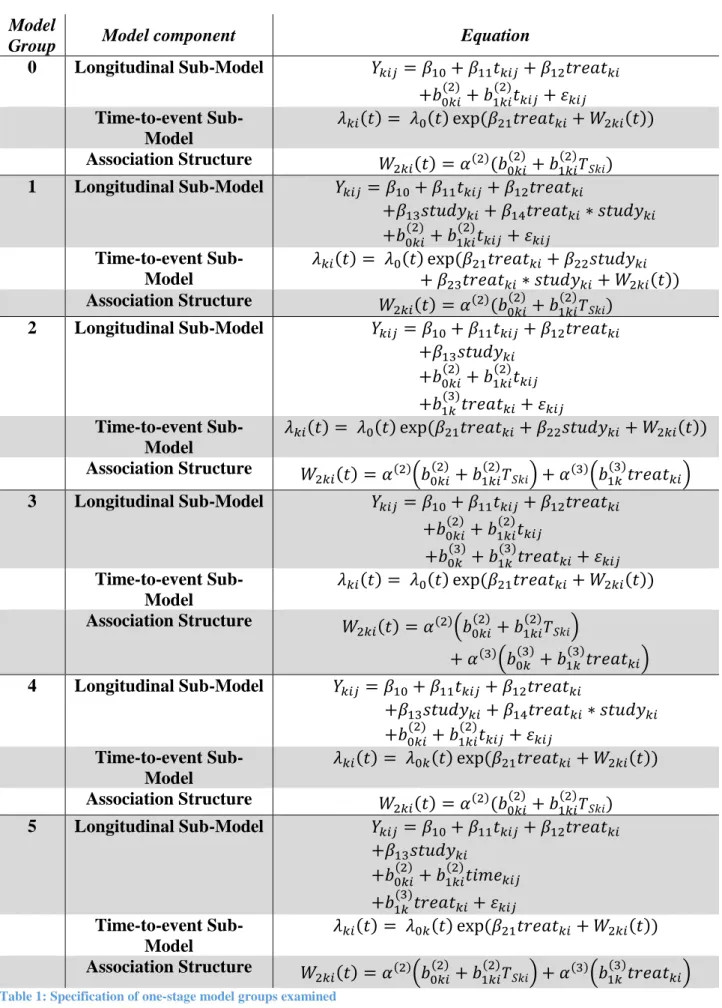
72
not specifically investigate the meta-analytic case. Multi-centre and meta-analytic datasets
73
are similar, in that they have a structure where individuals are nested within studies or
74
centres. However, the number of higher level units differs between cases; meta-analyses
75
often contain fewer studies, each containing a larger number of individuals, whereas
multi-76
centre datasets often contain a larger number of centres, each containing a comparatively
77
smaller number of individuals. As such, the spread of data across the different levels is
78
different for a meta-analytic compared to a multi-centre dataset, leading to potentially
79
different approaches being required. This paper extends this methodology by investigating
80
multi-level joint models specifically for use in meta-analytic datasets.
81
Recently Sudell et al16 investigated methods for the two-stage MA of joint data. In this
82
article, we investigate one-stage models to analyse individual participant multi-study joint
83
longitudinal and time-to-event data (termed joint IPD). The results of the one-stage
meta-84
analytic joint models are compared to one-stage separate longitudinal or time-to-event
meta-85
analytic models. The article begins with a discussion of the methods employed in the
86
investigation. The presented methods are then applied to an example dataset. A simulation
87
study is then conducted to test the methods under a range of scenarios. The article concludes
88
with a discussion of joint modelling methodology in one-stage MA.
2 Methods for one-stage joint IPD-MA 90
As mentioned, this research assumes the availability of joint longitudinal and time-to-event
91
IPD. This IPD is considered to have three nested levels, namely longitudinal measurements at
92
level 1, nested within individuals at level 2, nested within studies at level 3. The joint models
93
considered in this research assume a linear mixed effects model for the longitudinal outcome,
94
and a Cox Proportional Hazards (PH) model with an unspecified baseline hazard for the
time-95
to-event outcome. The two sub-models are linked through shared zero mean random effects,
96
with common association parameter (represented using 𝜶 terms) for the random effects acting
97
at the same level. Unlike joint models for single study data, the proposed models must
98
account for the clustering of individuals within studies, and model potential heterogeneity
99
between these studies.
100
The one-stage joint model follows the structure:
101 𝑌𝑘𝑖𝑗 = 𝑿𝟏𝜷𝟏+ 𝒁𝒌𝒊(𝟐)𝒃𝒌𝒊(𝟐)+ 𝒁𝒌(𝟑)𝒃𝒌(𝟑)+ 𝜀𝑘𝑖𝑗 𝜆𝑘𝑖(𝑡) = 𝜆0(𝑡) exp(𝑿𝟐𝜷𝟐+ 𝑊2𝑘𝑖(𝑡)) 𝑊2𝑘𝑖(𝑡) = 𝛼(2)(𝑍 𝑘𝑖(2)𝑏𝑘𝑖(2)) + 𝛼(3)(𝑍𝑘(3)𝑏𝑘(3)) (1)
Studies are identified by 𝑘 = 1 … 𝐾, where 𝐾 is the total number of studies in the
meta-102
dataset. Individuals within each study are represented by 𝑖 = 1 … 𝑛𝑘 where 𝑛𝑘 denotes the
103
total number of individuals in study 𝑘. The longitudinal measurement points are identified
104
using 𝑗 = 1 … 𝑚𝑘𝑖 where 𝑚𝑘𝑖 represents the total number of longitudinal measurements
105
recorded for individual 𝑖 in study 𝑘.
106
The longitudinal measurement recorded for individual 𝑖 in study 𝑘 at time-point 𝑗 is
107
represented by 𝑌𝑘𝑖𝑗, with the longitudinal error term 𝜀𝑘𝑖𝑗. Fixed effects are represented using
108
𝜷 terms, with the first element of the subscript identifying the sub-model they belong to (such
109
that 𝜷𝟏= 𝛽11, 𝛽12, 𝛽13, … are the longitudinal sub-model fixed effects, and 𝜷𝟐=
110
𝛽21, 𝛽22, 𝛽23, … are the time-to-event sub-model fixed effects). Random effects are
111
represented by 𝒃, with individual level (level 2) random effects represented by 𝒃𝒌𝒊(𝟐) and study
112
level (level 3) random effects by 𝒃𝒌(𝟑). Design matrices are represented by 𝑿 for the fixed
113
effects and 𝒁 for the random. 𝑿𝟏 represents the longitudinal sub-model fixed effects design
114
matrix, and 𝑿𝟐 represents the time-to-event sub-model fixed effects design matrix.
115
Additionally, 𝒁𝒌𝒊(𝟐) represents the design matrix for the individual level (level 2) random
116
effects, and 𝒁𝒌(𝟑) represents the design matrix for the study level (level 3) random effects.
117
The individual level random effects follow distribution 𝒃𝑘𝑖(2)~𝑁(𝟎, 𝑫), whilst the study level
118
random effects follow distribution 𝒃𝑘(3)~𝑁(𝟎, 𝑨), and the error terms each follow distribution
119
𝜀𝑘𝑖𝑗~𝑁(0, 𝜎𝑒2). The individual level and the study level random effects are considered
120
independent of each other, and of the error terms. The random effects are intended to
121
represent how covariate effects differ for units at the respective levels (individuals or studies)
122
from those estimated for the overall population by the fixed effects, for example how the
123
individuals contained within a particular study differ from those in the overall population. As
124
such, the 𝒁 matrices are assumed to be subsets of the 𝑿𝟏 matrix.
125
In the time-to-event sub-model, 𝜆0(𝑡) represents the unspecified baseline hazard. The
sub-126
models are linked through shared zero mean random effects, with common association
127
parameters 𝛼(2) for the individual level random effects and 𝛼(3) for the study level random
effects. Note that if a particular component of the joint model is not required (e.g. the study
129
level random effects), terms involving this component (e.g. 𝒁𝒌(𝟑)𝒃𝒌(𝟑)) do not appear in the
130
model.
131
A range of model groups are investigated, which represent a variety of methods to account
132
for between study heterogeneity. The specifications of the model groups are stated in Table
133
1. These models involve only longitudinal time (𝑡𝑘𝑖𝑗), a binary treatment assignment variable
134
(𝑡𝑟𝑒𝑎𝑡𝑘𝑖), and study membership (𝑠𝑡𝑢𝑑𝑦𝑘𝑖) as covariates. However, the models examined
135
can be easily extended if other covariates are of interest to the MA. Note, instances of
136
longitudinal time 𝑡𝑘𝑖𝑗 in the association structure term 𝑊2𝑘𝑖(𝑡) (which is present in the
time-137
to-event sub-model) are replaced by the individuals survival time 𝑇𝑆𝑘𝑖.
138
Model group 0 in Table 1 is a naïve model which does not account for between study
139
heterogeneity in any way. This model is presented here to highlight the consequence of
140
ignoring the clustered nature of multi-study joint data. Note, any instances of longitudinal
141
time in the association structure are replaced with the individual’s survival time
142
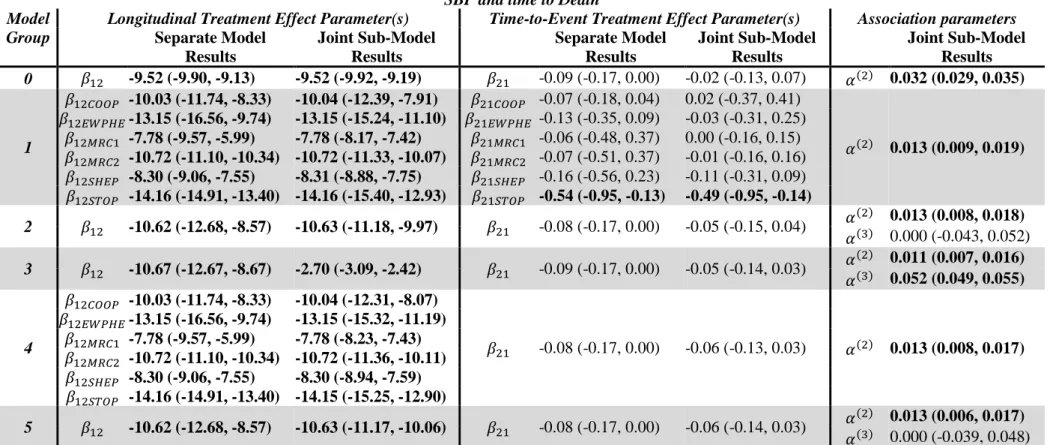
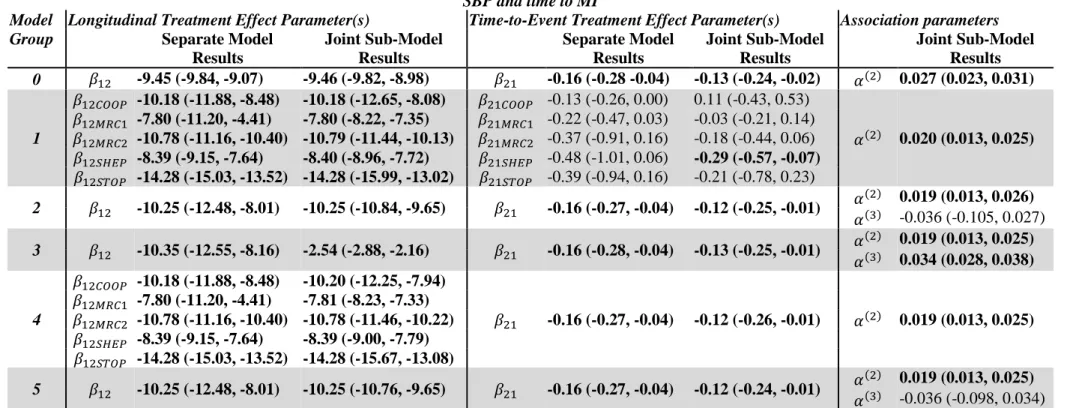
(denoted 𝑇𝑆𝑘𝑖, equal to the minimum of their event and censoring times).
143
Model group 1 accounts for between study heterogeneity using a fixed study membership
144
variable, along with its interaction with treatment assignment, in both sub-models. Study
145
membership is expected to be a factor variable, and so a separate 𝛽13, 𝛽14, 𝛽22 and 𝛽23
146
parameter will be produced for each study 𝑘 in the meta-analysis (apart from the reference or
147
baseline study), denoted 𝛽13𝑘, 𝛽14𝑘, 𝛽22𝑘 and 𝛽23𝑘. The study considered to be the reference
148
study should be representative of the population of interest. In model group 1, inclusion of
149
the fixed study membership variable allows calculation of study specific fixed longitudinal
150
trajectory intercepts (with 𝛽10 representing the fixed intercept for the reference study, and
151
𝛽10+ 𝛽14𝑘 for non-reference study 𝑘). Likewise, study specific longitudinal treatment
152
effects can be calculated (with 𝛽13 representing the fixed longitudinal treatment effect for the
153
reference study, and 𝛽13+ 𝛽15𝑘 for non-reference study 𝑘). In the time-to-event sub-model,
154
the 𝛽22𝑘 parameter represents the difference in risk of an event between study 𝑘, and the
155
reference study. The deviation in risk of an event due to treatment group is equal to 𝛽21 for
156
the reference study, and by 𝛽21+ 𝛽23k for non-reference study 𝑘.
157
Model group 2 accounts for between study heterogeneity using a fixed study membership
158
variable in both sub-models, and a study level zero-mean random treatment effect (𝑏1𝑘(3)).
159
Study specific longitudinal trajectory intercepts and log-hazard ratio risks of an event for
160
each study can be calculated from the fixed effects as for model group 1. The interpretation
161
of the study specific random treatment effect 𝑏1𝑘(3)is more complex than for separate
162
longitudinal or time-to-event one-stage MA-models due to its presence in both sub-models.
163
In the longitudinal sub-model, the 𝑏1𝑘(3) term adjusts the overall population treatment effect
164
coefficient 𝛽12 to give the observed treatment effect in study 𝑘 of 𝛽12+ 𝑏1𝑘(3). Through the
165
association structure, 𝑏1𝑘(3) is present in the time-to-event sub-model. As such, the population
166
treatment effect coefficient 𝛽21 is altered to give a study specific estimate of the deviation in
167
the risk of an event due to treatment group (𝛽21+ 𝛼(3)𝑏1𝑘(3)).
168
Model group 3 accounts for between study heterogeneity solely using study level random
169
effects, as it involves a study level random intercept (𝑏0𝑘(3)) and random treatment effect
170
(𝑏1𝑘(3)). Again, the interpretation of these random effects is more complex than for separate
one-stage longitudinal or time-to-event MA-models due to their presence in both sub-models
172
through the association structure. The study level random intercept 𝑏0𝑘(3) causes the
173
longitudinal intercept for study 𝑘 to equal 𝛽10+𝑏0𝑘(3), but also 𝛼(3)𝑏0𝑘(3) represents the deviation
174
in the risk of an event in the 𝑘th study from the population average taken across all studies in
175
the meta-analysis. The interpretation of the random treatment effect (𝑏1𝑘(3)) is the same as for
176
model group 2.
177
Model group 4 has a longitudinal sub-model with the same specification (and so
178
interpretation) as model group 1. However the baseline hazard in the time-to-event sub-model
179
is stratified by study (𝜆0𝑘(𝑡)), and the time-to-event sub-model contains only a fixed
180
treatment assignment term. As such, between study heterogeneity in the time-to-event model
181
is captured by the study specific baseline hazards.
182
Model group 5, accounts for between study heterogeneity in a variety of ways. A fixed study
183
membership term is included in the longitudinal sub-model, a study level random treatment
184
effect (𝑏1𝑘(3)) is present in both sub-models through the association structure, and the baseline
185
hazard of the time-to-event sub-model is stratified by study. Each component of the model
186
has interpretations as already discussed.
187
In addition to the one-stage joint MA-models, we also fit separate longitudinal and
time-to-188
event one-stage MA-models for the comparison with the joint estimates. These separate
189
models have the same specification as the corresponding joint model sub-models, except for
190
the 𝑊2𝑘𝑖(𝑡) term is removed from the time-to-event one-stage MA-models.
191
3 Model fitting 192
The models described in Section 2 were fitted using the Expectation Maximisation (EM)
193
algorithm22, whose use in single study joint modelling analyses has been described by
194
Wulfsohn and Tsiatis1 and Rizopoulos4. Starting values for the algorithm were extracted from
195
initial separate longitudinal and time-to-event model fits (of the same specification as the
196
corresponding sub-models of the joint model, excluding the association structure). In the
197
Expectation or E-step, estimates of functions of random effects were calculated using
pseudo-198
adaptive Gaussian quadrature procedures23, where conditional modes of the random effects
199
calculated in the initial separate longitudinal model fit were used to calculate appropriate
200
locations for the abscissa to be used throughout the model fitting process. In the
201
Maximisation or M-step, these estimated functions of the random effects were used to
202
calculate maximum likelihood estimates of model parameters. The derived maximum
203
likelihood estimators have been made available as Supplemental Material.
204
4 Software 205
We developed a flexible R24 code to fit one-stage multi-study joint models described in this
206
article which will be available as joineRmeta package, the R codes can currently be
207
downloaded at https://github.com/mesudell/joineRmeta/. This software is an extension of the
208
single study joint modelling package joineR25 to the multi-study case. Example code and
209
simulated data are available in the supplemental information, demonstrating methods
210
discussed in this article.
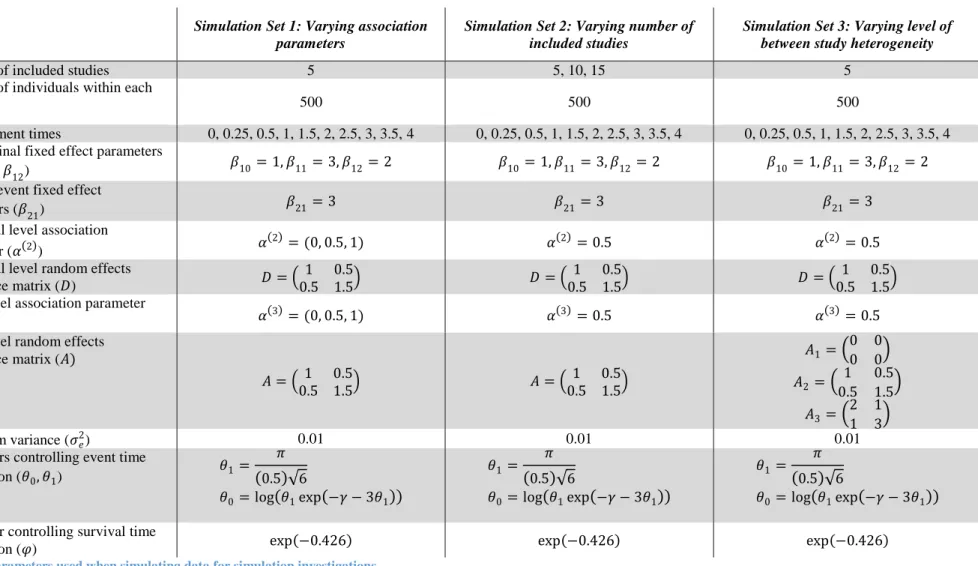
5 Application 212
5.1 Example Data 213
To investigate the behaviour of the proposed methods in a real world scenario, the methods
214
were applied to a subset of the INDANA dataset26. This is a multi-study dataset compiled to
215
investigate the effect of patient characteristics on the efficacy of pharmacological treatment
216
for high blood pressure. The subset analysed here (henceforward referred to as the INDANA
217
dataset) contains any study identified by the INDANA collaboration26 that supplied both 218
longitudinal and time-to-event data, and contains 6 studies (EWPHE27, COOP28, STOP29,
219
SHEP30, MRC131 and MRC232 ). The INDANA dataset concerns hypertensive patients
220
assigned to one of two treatment groups; any treatment for hypertension versus placebo, no
221
treatment or usual care. Longitudinally measured Systolic and Diastolic Blood Pressure were
222
available, referred to as SBP and DBP. Three time-to-event outcomes were measured,
223
namely time to death, time to myocardial infarction (MI) and time to stroke.
224
The data contained 9 possible longitudinal time-points at baseline, 6 months, 1 year and
225
annually thereafter to a maximum of 7 years. The SHEP study recorded individuals at only 6
226
measurement times, whilst STOP and MRC1 presented 7 measurement times, with the
227
remaining studies presenting data at each of the 9 possible measurement times. Only
228
longitudinal data recorded prior to an individual’s survival time contributed to the analyses.
229
Tables of the number of measurements provided by each study at each time point are
230
available in the supplemental information (supplemental tables S1-S3).
231
Analyses of SBP and each time-to-event outcome are presented in Tables 2-4. For EWPHE,
232
an intention to treat analysis was only possible for fatal endpoints, and so the study only
233
contributes to the analysis of SBP and time to death. As such, the final dataset examined
234
contained a maximum of 6 studies totalling at most 29825 individuals. The exact number of
235
individuals involved in each analysis is stated in the captions of Tables 2-4.
236
The aim of this investigation was to illustrate the proposed one-stage joint meta-analytic
237
models, rather than to investigate potential treatment modifiers. As such, whilst the
238
INDANA dataset contained a range of patient covariates that could influence the outcomes,
239
models in this investigation included only treatment assignment, study membership and the
240
longitudinal time covariate.
241
The models of specification shown in Table 1 were fitted to the data for each combination of
242
outcomes (SBP and each of time to death, time to MI and time to stroke, with longitudinal
243
outcome 𝑌𝑘𝑖𝑗 = 𝑆𝐵𝑃𝑘𝑖𝑗). However plots of the longitudinal trajectories for each study
244
panelled by event type (Supplemental Figures S1-S3) indicated a changepoint early in the
245
trajectories. A range of terms were tested to account for non-linearity due to the changepoint
246
including 𝑡𝑘𝑖𝑗2 , exp (−𝑡𝑘𝑖𝑗) and exp (−𝑎 ∗ 𝑡𝑘𝑖𝑗). Comparison of the log-likelihoods and AIC
247
values of the models determined that inclusion of the term exp (−3 ∗ 𝑡𝑘𝑖𝑗) gave the best fit.
248
Consequently, in addition to the terms stated in Table 1, each longitudinal sub-model also
249
contained a exp (−3 ∗ 𝑡𝑘𝑖𝑗) term (for clarity, full model specifications for real data analyses
250
are available in Supplemental Table S4).
251
In the models examined, a statistically significant negative treatment assignment coefficient
252
in the time-to-event model would indicate that assignment to any treatment for hypertension
253
versus placebo, no treatment or usual care significantly reduced the risk of the event in
254
question. Model groups 0, 2, 3, 4 and 5 each produce a single global time-to-event treatment
effect estimate (𝛽21), whilst model group 1 produces study specific treatment effect estimates
256
(calculated by 𝛽21 for the reference study, and 𝛽21+ 𝛽23𝑘 for non-reference study 𝑘).
257
A statistically significant negative treatment assignment coefficient in the longitudinal
sub-258
model would indicate that assignment to any treatment for hypertension significantly
259
decreased SBP. Model groups 0, 2, 3 and 5 each produce a single global longitudinal
260
treatment effect estimate (𝛽12), whilst model groups 1 and 4 produce study specific estimates
261
(calculated by 𝛽12 for the reference study, and 𝛽12+ 𝛽14𝑘 for non-reference study 𝑘).
262
A statistically significant positive study level association parameter (𝛼(3)) indicates that
263
individuals in studies with longitudinal outcome values above the corresponding overall
264
population mean are at higher risk of experiencing the event at a given time point. A
265
statistically significant positive individual level association parameter (𝛼(2)) indicates that
266
individuals with longitudinal values above that predicted by the terms in the longitudinal
sub-267
model (apart from the individual level random effects) are at higher risk of experiencing the
268
event at a given time point. Association parameters were only estimated for joint analyses.
269
5.2 Results from the INDANA dataset meta-analyses 270
Tables 2-4 present the results of application of model groups 0-5 (as stated in Supplemental
271
Table S4) to the INDANA dataset. Graphical representations of these results are shown in
272
Supplemental Figures S4-S12.
273
Across all pairwise combinations of outcomes investigated, the estimated treatment effect
274
from the separate longitudinal one-stage IPD-MA and the joint one-stage IPD-MA
275
longitudinal sub-model were significant and negative, indicating that assignment to treatment
276
for hypertension significantly reduced SBP compared to placebo, no treatment or usual care.
277
The estimated treatment effect from the separate and joint analyses agreed well across model
278
groups examined, apart from model group 3 (which solely accounted for between study
279
heterogeneity using study level random effects). Here the separate results were similar to
280
those produced by the other model groups, however the results from the joint analysis, whilst
281
still significant, were much smaller in magnitude than the joint results from the other
282
modelling groups. In the separate group 3 model, the study level random effects accounted
283
for between study heterogeneity in the longitudinal trajectory. However, in the joint model
284
they also accounted for between study heterogeneity in the time-to-event sub-model through
285
their presence in the association structure. It was important to determine if sharing study
286
level random effects in this way between sub-models caused bias in covariate estimates,
287
examined through simulations in Section 5.
288
Throughout the analyses, the estimated time-to-event treatment coefficient from the joint
one-289
stage IPD-MA models were smaller in magnitude than those from the separate one-stage
290
IPD-MA model. However the direction of the results agreed between the separate and the
291
joint analyses. For SBP and time to death, the separate and joint analyses agreed in the
292
significance of results, with a significant reduction in risk of death due to assignment to any
293
treatment for hypertension estimated only for the STOP trial for model group 1. For SBP and
294
time to MI, model groups 0, 2, 3, 4 and 5 for both the separate and joint analyses estimated
295
significant negative global treatment effect estimates, indicating a significant reduction in risk
296
of MI due to assignment to treatment for hypertension. However, for model group 1, only the
297
study specific estimate for the SHEP trial from the joint analysis was significant. For SBP
298
and time to stroke, model groups 0, 2, 3, 4 and 5 for both the separate and joint analyses
299
estimated significant negative global treatment effect estimates, indicating a significant
300
reduction in risk of stroke due to assignment to treatment for hypertension. These treatment
assignment coefficients were larger in magnitude than the results for time to death or time to
302
MI. For model group 1, the separate time-to-event model identified study specific significant
303
treatment effects for COOP and MRC1, however the joint analysis additionally identified
304
significant effects for SHEP and STOP.
305
Individual level random effects were included in all model groups examined causing the
306
individual level association parameter 𝛼(2) to be present in all model groups. For each set of
307
outcomes examined, all model groups estimated significant positive values for 𝛼(2),
308
indicating that individuals with SBP values above the corresponding population average are
309
at higher risk of an event. We should note that model group 0 consistently estimated
310
𝛼(2)values of larger magnitude than the other model groups (which were consistent in the
311
magnitude of 𝛼(2) estimated). This highlights the importance of accounting for between
312
study heterogeneity in joint analyses of multi-study data.
313
Study level random effects were only employed in model groups 2, 3 and 5, meaning that the
314
study level association parameter 𝛼(3) was only estimated in these model groups. There was
315
a noticeable discrepancy between results from model group 3, and model groups 2 or 5.
316
Model group 3 contained both a study level random intercept and treatment effect, whereas
317
model groups 2 and 5 contained only a study level random treatment effect. Model group 3
318
estimated a significant positive study level association parameter across all three sets of
319
analyses (with interpretation that studies with SBP values above the population average were
320
at higher risk of an event). However as noted earlier, for the joint analysis, estimated
321
parameters from model group 3 were inconsistent with the results produced by the other
322
model groups. Model groups 2 and 5 estimated insignificant 𝛼(3) values across the three sets
323
of analyses, which were different in magnitude to model group 3, and had wide confidence
324
intervals. These results motivated a simulation study to investigate when use of shared study
325
level random effects may be recommended.
326
6 Simulation Investigations 327
In practice meta-analyses involve data with very different characteristics to those displayed in
328
our real data example. For example, associations between the longitudinal and time-to-event
329
outcomes may be different in significance and / or magnitude. The number of studies
330
included in the meta-analysis might differ. There might be a different level of variability or
331
heterogeneity between studies involved in the meta-analysis. To assess the behaviour of the
332
models stated in Table 1 under a range of these different conditions, a range of simulation
333
investigations were conducted. These simulations can be split into three main sets:
334
Simulation Set 1 investigates the models under different levels of association, Simulation Set
335
2 investigates differing numbers of studies included in the meta-analysis, and Simulation Set
336
3 investigates differing levels of between study heterogeneity. During the simulation
337
investigations data was firstly simulated using the models and methods discussed in Section
338
6.1. The models stated in Table 1 were then fitted to each simulated dataset, the results of
339
which are presented in Section 6.2.
340
6.1 Data Simulation 341
Data for each set of simulations was simulated under the same model structure, but with
342
different model parameter values, which we will now describe. For each set of simulations,
343
for each scenario, 1000 datasets were simulated.
344
For each dataset within each set of simulations, multi-study joint data was generated
345
containing a single continuous normally distributed longitudinal outcome and a single
346
censored time-to-event outcome. The number of included studies varies between simulation
sets, however each simulated study contained 500 individuals randomised equally to two
348
treatment groups. A maximum of 10 longitudinal measurements at times 0, 0.25, 0.5, 1, 1.5,
349
2, 2.5, 3, 3.5, 4 were permitted, with measurements recorded only up to the individual’s
350
survival time (𝑇𝑆𝑘𝑖). Data for all studies was simulated simultaneously, with any between
351
study heterogeneity generated through specification of the distribution of study level random
352
effects. The longitudinal data was simulated under equation (2):
353
𝑌𝑘𝑖𝑗 = 𝛽10+ 𝛽11𝑡𝑘𝑖𝑗+ 𝛽12𝑡𝑟𝑒𝑎𝑡𝑘𝑖+ 𝑏0𝑘𝑖(2) + 𝑏1𝑘𝑖(2)𝑡𝑘𝑖𝑗 + 𝑏0𝑘(3)+ 𝑏1𝑘(3)𝑡𝑟𝑒𝑎𝑡𝑘𝑖 + 𝜀𝑘𝑖𝑗 (2) In equation (2), the longitudinal outcome 𝑌𝑘𝑖𝑗 follows a linear mixed effects model containing
354
fixed intercept, time and treatment assignment terms (with coefficients 𝛽10, 𝛽11 and 𝛽12),
355
individual level random intercept and slope terms (𝑏0𝑘𝑖(2) and 𝑏1𝑘𝑖(2)), study level random
356
intercept and treatment effect terms (𝑏0𝑘(3) and 𝑏1𝑘(3)) and an error term 𝜀𝑘𝑖𝑗. The random
357
effects follow multivariate normal distributions, with individual level random effects
358
distributed 𝒃𝑘𝑖(2)~𝑁(𝟎, 𝑫), and study level random effects distributed 𝒃𝑘(3)~𝑁(𝟎, 𝑨). The
359
random effects are independent of each other, and of the error terms, which are considered to
360
be independently and identically distributed 𝜀𝑘𝑖𝑗~𝑁(0, 𝜎𝑒2).
361
The simulation of time-to-event data under a proportional hazards model with time varying
362
covariates is described by Bender et al33 and Austin34. In these simulations, the time-to-event
363
data was generated under equation (3), where 𝜆0(𝑡) is an unspecified baseline hazard:
364
𝜆𝑘𝑖(𝑡) = 𝜆0(𝑡) exp(𝛽21𝑡𝑟𝑒𝑎𝑡𝑘𝑖+ 𝑊2𝑘𝑖(𝑡))
𝑊2𝑘𝑖(𝑡) = 𝛼(2)𝑊1𝑘𝑖(𝑡) = 𝛼(2)(𝑏0𝑘𝑖(2) + 𝑏1𝑘𝑖(2)𝑇𝑆𝑘𝑖) + 𝛼(3)(𝑏0𝑘(3)+ 𝑏1𝑘(3)𝑡𝑟𝑒𝑎𝑡𝑘𝑖)
(3)
As a time varying covariate is present in the time-to-event sub-model (the individual level
365
random time term 𝑏1𝑘𝑖(2), present through the association structure), event times are simulated
366
under a Gompertz distribution, as it has a baseline hazard that can vary over time.
367
Consequently, individual event times 𝑇𝐸𝑘𝑖 are generated under equation (4), (where
368 𝒁𝒌𝒊(𝟑)𝒃𝒌(𝟑) = 𝑏0𝑘(3)+ 𝑏1𝑘(3)𝑡𝑟𝑒𝑎𝑡𝑘𝑖): 369 𝑇𝐸𝑘𝑖 =𝛼(2)𝒃1 𝟏𝒌𝒊 (𝟐)+𝜃 1log [1 + (𝛼(2)𝑏1𝑘𝑖(2)+𝜃1)(− log(𝑈𝑘𝑖)) exp(𝜃0+𝛽21𝑡𝑟𝑒𝑎𝑡𝑘𝑖 +𝛼(2)𝑏0𝑘(2)+𝛼(3)(𝒁𝒌𝒊(𝟑)𝒃𝒌(𝟑))) ] (4)
In equation (4), 𝑈𝑘𝑖 is an individual specific realisation from a Uniform 𝑈(0,1) distribution.
370
The parameters 𝜃0 (the exponential of which is the scale parameter of a Gompertz
371
distribution) and 𝜃1 (the shape parameter of a Gompertz distribution) are used along with the
372
coefficients in the model to control the distribution of the event times.
373
The event times 𝑇𝐸𝑘𝑖 were specified to be Gompertz distributed with mean 𝜇0 = 3 and
374
standard deviation 𝜎0 = 0.5. Using the extreme value distribution (as recommended by
375
Bender et al33, with 𝛾 ≈ 0.5772 representing Euler’s constant), this lead to the parameters 376
controlling the event times distributions to be set to:
377 𝜃1 = 𝜋 √6𝜎0 = 𝜋 (0.5)√6 ≈ 2.5651 378
𝜃0 = log(𝜃1exp(−𝛾 − 𝜇0𝜃1)) = log(𝜃1exp(−𝛾 − 3𝜃1)) ≈ −7.330517 379
A Gompertz distribution has increasing hazard for a positive shape parameter, constant
380
hazard for a shape parameter equal to 0 (equivalent to an exponential distribution), and a
381
decreasing hazard for negative shape parameters. Under the above model, the probability
382
density function of the event times takes form:
383
𝑓0(𝑡) = 𝜅 exp(𝜃1𝑡) exp (𝜃𝜅
1(1 − exp(𝜃1𝑡))), where 𝜅 = exp 𝜃0
(5)
If the shape parameter is negative, if time is allowed to tend towards infinity, there is a
non-384
zero probability of living forever. As such, in the function used to simulate event times
385
(available in the aforementioned joineRmeta package), when the Gompertz distribution is
386
employed event times are simulated under a two step process. First, for each individual 𝑖
387
within study 𝑘, the following two conditions are checked (using the realization from the
388 𝑈(0,1) distribution, 𝑈𝑘𝑖). 389 𝐶𝑜𝑛𝑑𝑖𝑡𝑖𝑜𝑛 1: (𝜃1 + 𝛼(2)𝑏 1𝑘𝑖(2)) < 0 390 𝐶𝑜𝑛𝑑𝑖𝑡𝑖𝑜𝑛 2: 𝑈𝑘𝑖 < exp ( exp (𝜃0+ 𝛼(2)𝑏0𝑘𝑖(2)) 𝜃1 + 𝛼(2)𝑏 1𝑘𝑖(2) ) 391
If the conditions are both true, the individual is automatically assigned an event time of
392
infinity, otherwise their event time is generated under equation (4).
393
The censoring times were simulated under an exponential distribution with parameter 𝜆𝑐𝑒𝑛𝑠.
394
As such, individual censoring times 𝑇𝐶𝑘𝑖 are generated using equation:
395
𝑇𝐶𝑘𝑖 =
−log(𝑈𝑘𝑖) 𝜆𝑐𝑒𝑛𝑠
(6)
The event rate of the simulated data was controlled through the censoring process. Due to the
396
volume of planned simulations, only datasets with a “low” (~25%) event rate were generated.
397
A range of censoring parameters were tested to obtain datasets with mean event rate at 25%,
398
leading to setting 𝜆𝑐𝑒𝑛𝑠 = exp(−0.426). The survival time for each individual was the
399
minimum of their censoring and event times (𝑇𝑆𝑘𝑖 = min (𝑇𝐸𝑘𝑖, 𝑇𝐶𝑘𝑖)).
400
All data used in the simulation studies were simulated under the models shown in equations
401
(2) and (3), although certain parameter values were altered between different sets of
402
simulations. Parameter values in the simulation sets were chosen such that deviations of
403
different methods from the true parameters values would be clearly discernible. A summary
404
of the values used for the different sets of simulations is given in Table 5. All simulation
405
groups utilised the same fixed effect and error term variance values (𝛽10= 1, 𝛽11 = 3, 𝛽12=
406
2, 𝛽21= 3, 𝜎𝑒2 = 0.01). Additionally, throughout different sets of simulations, the individual
407
level random effects covariance matrix 𝑫 remained constant (defined in Table 5). However
408
the remaining aspects of the datasets (association parameters, number of included studies,
409
level of between study heterogeneity) varied between simulation sets. These aspects are
410
stated in Table 5, and are briefly discussed in the following sections. Throughout, both
411
separate longitudinal or time-to-event one stage MA and joint one stage MA were conducted,
412
to compare the two approaches,
6.1.1 Simulation Set 1: Varying levels of association 414
In practice, the magnitude of the association between the longitudinal and time-to-event
415
outcomes at the individual and the study level of the data could impact the performance of the
416
model groups defined in Section 2. Consequently, we performed a simulation investigation
417
to assess the effect of varying magnitudes of association at different levels.
418
The individual level association parameter 𝛼(2) and the study level association parameter 𝛼(3)
419
were permitted to take values 0, 0.5 and 1, giving a total of 9 unique scenarios. The number
420
of included studies in each dataset equalled 5, whilst the study level random effects
421
covariance matrix 𝑨 (Table 5) remained constant across scenarios.
422
6.1.2 Simulation Set 2: Varying numbers of studies included in the meta-analysis 423
The models introduced in Section 2 that include study level random effects may not reliably
424
estimate the distribution of the study level random effects unless the number of studies
425
included in the meta-analysis is large. In addition, models including fixed interaction terms
426
between study membership and treatment group may become unwieldy or difficult to
427
estimate as the number of included studies increases. To investigate this, simulations were
428
conducted comparing one-stage analyses of joint data for datasets containing 5, 10 or 15
429
studies.
430
During this set of simulations, the association parameters were held constant across scenarios
431
(with 𝛼(2) = 𝛼(3) = 0.5). Additionally, the study level random effects covariance matrix 𝑨
432
(Table 5) remained constant across scenarios.
433
6.1.3 Simulation Set 3: Varying levels of between study heterogeneity 434
Finally, the level of between study heterogeneity could affect the behaviour of the different
435
one-stage models described in Section 2. As such, the third set of simulations alters the study
436
level random effects covariance matrix 𝑨 across different scenarios, to increase or reduce
437
between study heterogeneity. Values taken for 𝑨, labelled 𝑨𝟏, 𝑨𝟐 and 𝑨𝟑 are specified in
438
Table 5, representing cases for no between study heterogeneity, and then two increasing
439
levels of between study heterogeneity.
440
During this simulation set, across all scenarios 5 studies were simulated for each dataset, with
441
association parameters held constant across scenarios at 𝛼(2) = 𝛼(3)= 0.5.
442
6.1.4 Models fitted to Simulated Data 443
Model groups 0 through 5 (as defined in Table 1) were fitted to each of the datasets simulated for each 444
scenario within each set of simulations. As the data was simulated under a joint model of structure 445
from Model Group 3, the results of fitting examples of Model Group 3 to the data could be expected 446
to provide less biased results than the other model groups. 447
6.1.5 Reporting of Simulation Results 448
For model groups that estimated study specific parameters (the longitudinal treatment effect
449
in model groups 1 and 4, and the time-to-event treatment effect in model group 1), overall
450
pooled effects have been reported by combining study specific estimates using methods
451
equivalent to conducting a random effects MA of study level results14,35. Results are reported
452
as the mean estimate produced across studies (SE between simulation estimates) [coverage],
453
where SE is the standard error (the standard deviation) of the produced estimates. As defined
454
by Burton et al36, and using a significance level of 𝛾 = 0.05, coverage is calculated as the
455
proportion of times the 100(1 − 𝛾)% confidence intervals for parameter estimate 𝛽̂𝑣, defined
by 𝛽̂𝑣± 𝑍1−𝛾/2𝑆𝐸(𝛽̂𝑣), includes the “true” value of parameter 𝛽 that the data was simulated
457
under (where 𝑍1−𝛾/2 ≈ 1.96 for significance level 0.05, and 𝑣 takes values 1 to total number
458
of simulations performed, here 1000). Where parameters are not estimated for a model group
459
(e.g. 𝛼(3) for model groups not including study level random effects) an NA is printed. The
460
total number of successful model fits are also reported. As the joint models were fitted using
461
the EM algorithm22, separate longitudinal and time-to-event models were automatically fitted
462
to determine suitable starting values for the algorithm. Consequently, the number of failed
463
fits were equal for the separate and joint model analyses.
464
6.2 Results of Simulation Investigations 465
6.2.1 Results of Simulation Set 1: Differing levels of association 466
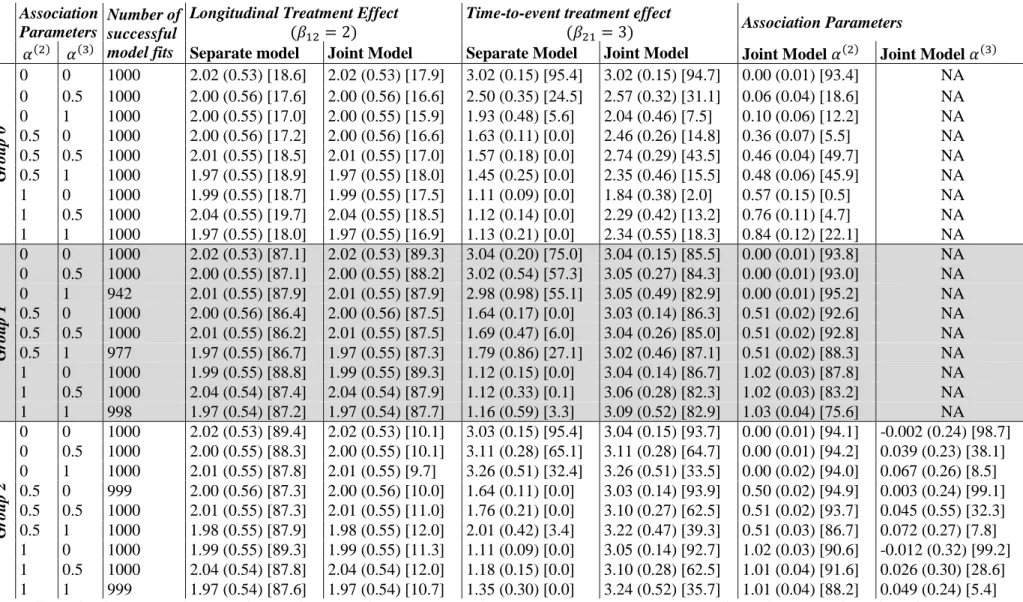
The results of Simulation Set 1 are presented in Tables 6-7. Graphical representations of the
467
mean estimates displayed in Tables 6-7 are provided in Supplementary Figures S13-S16, with
468
representations of the point estimates from each simulation given in Supplemental Figures
469
S17-S28. Across the scenarios investigated, most model groups showed a high proportion of
470
successful model fits (99.9% or over). However model group 1 experienced more failed fits
471
when 𝛼(3) ≠ 0 (94.2%, 97.7% and 99.8% model fit success rate).
472
Longitudinal treatment effect (𝛽12) 473
Throughout Simulation Set 1, the mean pooled longitudinal treatment effect estimate was
474
similar in magnitude between the separate and joint one-stage analyses. The coverage for
475
model group 0 was poor for both the separate and joint analyses, however the coverage for
476
the remaining model groups for the separate longitudinal one-stage MA-model was
477
consistently high. Conversely the joint one-stage MA-model results displayed high coverage
478
for models that did not include study level random effects, but low coverage across all levels
479
of association for any model group that involved study level random effects. The reason for
480
the comparable mean estimates, but differing coverage, between the separate and joint
one-481
stage MA-models, is identifiable through examination of the results from each separate
482
scenario (Supplemental Figures S17-S28). The confidence intervals for 𝛽12 for joint
one-483
stage models involving study level random effects were quite narrow, leading to poor
484
coverage even though the point estimates are clustered about the “true” value of 𝛽12.
485
Time-to-event treatment effect (𝛽21) 486
For all scenarios investigated in Simulation Set 1, the width of confidence intervals for
487
estimates of 𝛽21 increased for both separate and joint analyses, as 𝛼(3) increased in
488
magnitude. The results from separate or joint analyses for model group 0 (which ignored
489
between study heterogeneity) were poor when there was non-zero association.
490
When individual level association was zero, the estimates produced by the separate analyses
491
for 𝛽21 were close to their “true” value of 3, however the separate analyses underestimated
492
𝛽21 when 𝛼(2) was non-zero. For the separate analyses, for 𝛼(2) = 0, coverage for 𝛽21
493
estimates decreased as study level association increased, however, when 𝛼(2) ≠ 0, coverage
494
was close to 0.
495
For the joint analyses, for any model group that accounted for between study heterogeneity in
496
some way (model groups 1-5) the mean estimates were close to the “true” value of 𝛽21 for all
497
model groups, however model groups 2, 3 and 5 displayed mean estimates diverging from the
498
“true” value of 𝛽21 as the magnitude of the “true” 𝛼(3) value increased. Coverage was good
across all scenarios for model group 1. For the remaining model groups, coverage decreased
500
as the magnitude of the “true” 𝛼(3) value increased, although coverage was good for joint
501
models from any of model groups 1 to 5 when 𝛼(3) = 0.
502
Association Parameters (𝛼(2), 𝛼(3)) 503
The individual level association parameter 𝛼(2) was poorly estimated by model group 0.
504
However the estimates of 𝛼(2) were close to the “true” parameter value for model groups 1,
505
2, 4 and 5, with good coverage. However for model group 3, which solely accounted for
506
between study heterogeneity using study level random effects, where the “true” 𝛼(2) was
507
non-zero, as the magnitude of 𝛼(3) increased from zero, the mean parameter estimate
508
decreased in magnitude, with corresponding decrease in coverage.
509
The estimation of the study level association parameter was poor in model groups 2 and 5,
510
with large coverage values explained by wide confidence intervals (Supplemental Figures
511
S22-S24). Mean estimates of 𝛼(3) were closer to the “true” values in model group 3 although
512
were still underestimated. Coverage for all model groups that estimated 𝛼(3) decreased as the
513
value of the “true” 𝛼(3) increased.
514
Summary 515
Under a one-stage joint model containing a single longitudinal and single time-to-event
516
outcome, with association structure sharing both individual and study level random effects
517
(when present), with common association parameter at each level, separate time-to-event
518
one-stage MA-models appeared to behave poorly when 𝛼(2) ≠ 0, however joint one-stage
519
MA-models displayed issues when study level random effects were shared between
sub-520
models.
521
6.2.2 Results of Simulation Set 2: Differing numbers of included studies 522
The results of Simulation Set 2 are presented in Table 8. Graphical representations of the
523
mean estimates displayed in Table 8 are provided in Supplementary Figures S29-S32, with
524
representations of the point estimates from each simulation given in Supplemental Figures
525
S33-S36. The proportion of successful model fits was 99.9% or above for all model groups
526
for all scenarios investigated.
527
Longitudinal treatment effect (𝛽12) 528
Across all scenarios investigated, for both the separate and the joint analyses, the mean
529
estimate for the longitudinal treatment effect 𝛽12 was close to the “true” value of 2.
530
Coverage was poor for both the separate and joint analyses for model group 0, which ignores
531
between study heterogeneity. Coverage was consistently good for the separate analyses in
532
the remaining model groups, and good for joint models from model groups 1 and 4. However
533
coverage was poor from joint models for model groups involving study level random effects.
534
Time-to-event treatment effect (𝛽21) 535
For the time-to-event treatment effect 𝛽21, we saw mean estimates from the joint analyses
536
closer to the “true” value of 3 for the joint analyses than the separate. Coverage for the
537
separate analyses was below 6% for all scenarios investigated, whilst coverage for the joint
538
models appeared best for model group 1 (above 85%), followed by model groups 4 and 5
539
(above 69%). Coverage was noticeably lower for model group 0, which ignored between
study heterogeneity, and coverage decreased for model groups 2 and 3 as the number of
541
included studies increased.
542
Association parameters (𝛼(2), 𝛼(3)) 543
The mean estimate for the individual level association was close to the “true” value of 0.5 for
544
model groups 1-5, with slightly worse estimates from model group 0. Coverage was good for
545
model groups 1, 2, 4 and 5. However coverage decreased with increasing number of studies
546
for model group 0 and 3.
547
Study level association was poorly estimates in model groups 2 and 5, with estimates closer
548
to the “true” value of 0.5 for model group 3. However coverage was consistently poor, and
549
decreased with increasing number of included studies.
550
Summary 551
Under a one-stage joint model containing a single longitudinal and single time-to-event
552
outcome, with association structure sharing both individual and study level random effects,
553
with common association parameter at each level, there appeared to be little benefit of
554
increasing number of included studies. However this result may not hold for other
555
association structures e.g. just sharing individual level random effects between studies.
556
6.2.3 Results of Simulation Set 3: Differing levels of between study heterogeneity 557
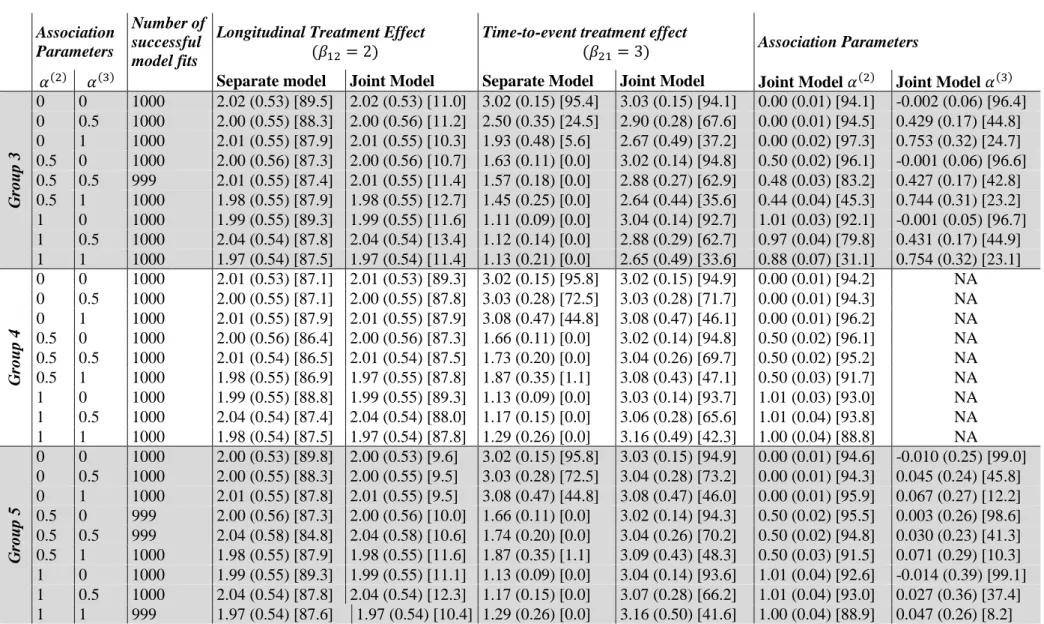
The results of Simulation Set 3 are presented in Table 9. Graphical representations of the
558
mean estimates displayed in Table 9 are provided in Supplementary Figures S37-S40, with
559
representations of the point estimates from each simulation given in Supplemental Figures
560
S41-S44. There were issues with model fitting for a large proportion of simulations for model
561
groups involving study level random effects when there was no between study heterogeneity
562
(𝑨 = 𝑨𝟏), however otherwise the proportion of successful fits was 99.8% or over.
563
Longitudinal treatment effect (𝛽12) 564
Across scenarios investigated, the mean estimated longitudinal treatment effect produced by
565
both the separate and joint one-stage MA-model were close to the “true” parameter values.
566
Coverage of estimates produced by model group 0 was good from both the separate and the
567
joint one-stage MA-models when no between study heterogeneity existed, however coverage
568
decreased as between study heterogeneity increased. For the remaining model groups,
569
coverage was consistently good for the separate analyses, but joint analyses involving study
570
level random effects displayed decreasing coverage as between study heterogeneity
571
increased.
572
Time-to-event treatment effect (𝛽21) 573
Throughout the scenarios investigated, the time-to-event treatment effect was consistently
574
underestimated by the separate analyses compared to the joint (which displayed estimates
575
closer to the “true” value of the parameters). Models involving study level random effects
576
showed estimates diverging slightly from the “true” value as between study heterogeneity
577
increased. Coverage was consistently good for model group 1, however the remaining model
578
groups displayed decreasing coverage as between study heterogeneity increased.
579
Association parameters (𝛼(2), 𝛼(3)) 580
The mean estimate for individual level association 𝛼(2) was good for model groups 1, 2, 4
581
and 5, with corresponding high coverage. However model groups 0 and 3 showed mean
582
estimates increasingly below the true value, with corresponding decreasing coverage as
583
between study heterogeneity increased.
584
Mean estimates for study level association 𝛼(3) was poor for model groups 2 and 5, and
585
closer to the true value for model group 3. Coverage was good for model groups 2 and 5 for
586
the case of no between study heterogeneity, and decreased as between study heterogeneity
587
increased. However examination of Supplemental Figure S44 indicates that wide confidence
588
intervals explained the higher coverage at no between study heterogeneity, with the width of
589
confidence intervals decreasing as between study heterogeneity increases. Coverage was
590
relatively constant but not good for model group 3 across examined levels of between study
591
heterogeneity.
592
Summary 593
Under a one-stage joint model containing a single longitudinal and single time-to-event
594
outcome, with association structure sharing both individual and study level random effects,
595
with common association parameter at each level, model group 1 appeared to be the most
596
consistently reliable modelling option. However, as noted earlier, this result may not hold for
597
other joint model specifications.
598
7 Discussion 599
In this research, we have presented and investigated a variety of models for use when
600
analysing multi-study joint longitudinal and time-to-event data. Analyses of single study
601
joint datasets are increasing8. Ensuring availability of appropriate methods for the
meta-602
analysis of such data is vital, in order to maximise use of available data and better inform
603
healthcare decisions.
604
We have examined a range of the possible modelling options, however other combinations of
605
the approaches discussed here to account for between study heterogeneity are also possible.
606
Each of the model groups examined present a range of advantages and disadvantages.
607
Models that use fixed effects to account for between study heterogeneity estimate 𝐾 − 1
608
parameters for each term involving study membership (one for each study apart from the
609
reference study). As such, results may not be generalisable to external studies, and the
610
number of parameters estimated quickly increases as the number of studies included in the
611
meta-analysis increases. However such methods do allow calculation of effect sizes within
612
each study (although this is not a primary aim of meta-analyses).
613
Conversely, use of study level random effects accounts for between study heterogeneity, but
614
study specific effect estimates are not generally automatically provided (unless the estimates
615
of the random effects can be extracted from models fitted). However this should not be an
616
issue, as meta-analyses aim to pool data rather than provide study specific estimates. The
617
number of parameters to be fitted due to study level random effects does not increase as the
618
number of included studies increases. However the distribution of the random effects may be
619
poorly estimated unless a large number of studies are included in the meta-analysis.
620
Additionally, model groups with a common baseline hazard across studies assume
621
proportional hazards across all studies included in the meta-analysis. However, model groups
622
that stratify the baseline hazard by study assume proportional hazards within but not across
623
studies. This may be a more reasonable assumption, especially if the demographics of the
624
studies differ.
The simulation investigation displayed poor performance for models that ignored any
626
between study heterogeneity present in the data. Consequently, it is clear that accounting for
627
any between study heterogeneity present in multi-study joint data is vital. The most
628
consistently well-performing model group was model group 1, which accounted for between
629
study heterogeneity using fixed study membership and interaction between study membership
630
and treatment assignment in both sub-models. The remaining model groups for the joint
631
analyses showed issues under various scenarios. As the coverage was good for separate
632
models for any model group that accounted for between study heterogeneity, the poor
633
coverage in the joint analyses for model groups 2, 3 and 5 may be due to the dual use of the
634
study level random effects to account for between study heterogeneity and account for study
635
level behaviour in the link between the longitudinal and time-to-event outcomes. It may be
636
that this dual use is not possible, unless an unrealistically large number of studies are
637
included in the meta-analysis.
638
Whilst point estimates were similar in magnitude between the separate and joint analyses for
639
the longitudinal treatment effect, we note bias in the estimates of the time-to-event treatment
640
effect from separate analyses where a non-zero association between the longitudinal and
641
time-to-event outcomes is present. This behaviour has previously been noted in single study
642
cases by Guo and Carlin18, and in two-stage joint MA analyses by Sudell et al16, our research
643
confirms that this issue persists for one-stage analyses. This behaviour may be comparable to
644
the established situation where omission of covariates from Cox models causes bias in
645
estimated effect parameters37-39. The 𝑊
2𝑘𝑖(𝑡) term is included in the joint time-to-event
sub-646
model, but is not present in the separate time-to-event sub-model. Where association is
647
present (i.e. where 𝛼(2) ≠ 0 or 𝛼(3) ≠ 0), the joint analyses model risk of an event associated
648
with the longitudinal outcome through the 𝑊2𝑘𝑖(𝑡) term. This term (which has an effect on
649
risk of an event when association is present) is not included in the separate time-to-event
650
model, giving a possible explanation for the observed biased treatment effect estimates. As
651
noted in Sudell et al16, similar behaviour was not observed between the separate and joint
652
longitudinal analyses as the model specifications for the longitudinal trajectory are identical
653
in both cases. As such, it is recommended that joint one-stage MA-models are used in place
654
of separate time-to-event one-stage MA-models where significant association exists. This
655
can be assessed prior to analyses through plotting of the longitudinal trajectories panelled by
656
event type16; differences between the trajectories between those censored and experiencing an
657
event can indicate presence of such an association.
658
The models investigated utilised an unspecified baseline hazard in the time-to-event
sub-659
model. Hseih et al40 noted that when unspecified baseline hazards are used in a joint model,
660
standard errors should be obtained through bootstrapping procedures to avoid their
661
underestimation. As such, the time commitment to perform bootstrapping procedures on
662
large meta-datasets was considerable. Performing bootstrapping procedures on a standard
663
computing environment took several days for the real dataset. Consequently bootstraps were
664
performed in parallel using the University of Liverpool’s HTCondorsystem (see41,
665
https://research.cs.wisc.edu/htcondor/, and http://condor.liv.ac.uk/ which was also used to run
666
the simulations), with the results compiled using purpose written code rather than relying on
667
single computer bootstrapping procedures. Researchers using large datasets without coding
668
experience or access to such computer systems may experience issues conducting large scale
669
joint data meta-analyses.
670
In our clinical example, we assume common association parameters across treatment groups.
671
However, in reality, the association between the longitudinal blood pressure and risk of an
672
event could differ between those assigned to any treatment for hypertension versus those
assigned to placebo, no treatment or usual care42. In single study cases, association structures
674
involving interactions between baseline covariates and the association parameters have been
675
presented2,4, however this association structure has not yet been investigated in meta-analytic 676
joint models.
677
The research presented here prompts a range of future areas of research. Investigation of
678
one-stage joint MA-models with varying association structures, including sharing only
679
individual level random effects or sharing the current value of the longitudinal trajectory, is
680
vital. Additionally, it is vital to investigate alternative modelling options, such as alternative
681
baseline hazard specifications, with could reduce model fitting times by removing the
682
necessity of bootstrapping. Also, in our simulation study, we assumed common longitudinal
683
measurement schedules across the included studies, identical numbers of individuals
684
recruited to each study, and common association parameter across studies. Further
685
simulation investigations varying these aspects could provide additional useful information
686
for future joint data meta-analyses.
687
In conclusion, this research indicates the benefit of the one-stage meta-analysis of joint
688
longitudinal and time-to-event data where significant association exists between the
689
longitudinal and time-to-event outcomes. Given the current research, it is recommended that
690
analyses do not rely on models that share study level random effects between sub-models.
691
Further research into one-stage joint MA-models is required.
692
Acknowledgements 693
We would like to thank the INDANA collaboration26, for use of the dataset for the real data
694
analysis, as well as the individual studies contained in this dataset27-32,43. This work was
695
supported by the Health eResearch Centre (HeRC) funded by the Medical Research Council
696
Grant MR/K006665/1.
697
References 698
1. Wulfsohn MS, Tsiatis AA. A Joint Model for Survival and Longitudinal Data Measured with 699
Error. International Biometric Society. 1997(1):330. 700
2. Gould AL, Boye ME, Crowther MJ, et al. Joint modeling of survival and longitudinal non-701
survival data: current methods and issues. Report of the DIA Bayesian joint modeling 702
working group. Stat Med. Jun 30 2015;34(14):2181-2195. 703
3. Henderson R, Diggle P, Dobson A. Joint modelling of longitudinal measurements and event 704
time data. Biostatistics (Oxford, England). 2000;1(4):465-480. 705
4. Rizopoulos D. Joint Models for Longitudinal and Time-to-Event Data With Applications in R.
706
Vol 1. 1 ed2012. 707
5. Tsiatis AA, Davidian M. Joint modeling of longitudinal and time-to-event data: An overview. 708

![Table 8: Simulation Group 2 (varying numbers of included studies). Results reported as mean parameter estimate (SE between simulation estimates) [coverage]](https://thumb-us.123doks.com/thumbv2/123dok_us/358835.2539496/27.1262.112.1155.102.544/simulation-included-results-reported-parameter-estimate-simulation-estimates.webp)
![Table 9: Simulation Group 3 (varying levels of between study heterogeneity). Results reported as mean parameter estimate (SE between simulation estimates) [coverage]](https://thumb-us.123doks.com/thumbv2/123dok_us/358835.2539496/28.1262.108.1168.131.604/simulation-heterogeneity-results-reported-parameter-estimate-simulation-estimates.webp)