Real Time Robust L1 Tracker Using Accelerated Proximal Gradient Approach
Chenglong Bao
1, Yi Wu
2, Haibin Ling
2, and Hui Ji
11Department of Mathematics, National University of Singapore, Singapore,119076
2Department of Computer and Information Sciences, Temple University, Philadelphia, PA, USA,19122 {baochenglong,matjh}@nus.edu.sg, {wuyi,hbling}@temple.edu
Abstract
Recently sparse representation has been applied to vi-sual tracker by modeling the target appearance using a sparse approximation over a template set, which leads to the so-called L1 trackers as it needs to solve an1 norm related minimization problem for many times. While these L1 trackers showed impressive tracking accuracies, they are very computationally demanding and the speed bottleneck is the solver to 1 norm minimizations. This paper aims at developing an L1 tracker that not only runs in real time but also enjoys better robustness than other L1 trackers. In our proposed L1 tracker, a new1norm related minimiza-tion model is proposed to improve the tracking accuracy by adding an2norm regularization on the coefficients associ-ated with the trivial templates. Moreover, based on the ac-celerated proximal gradient approach, a very fast numeri-cal solver is developed to solve the resulting1norm related minimization problem with guaranteed quadratic conver-gence. The great running time efficiency and tracking accu-racy of the proposed tracker is validated with a comprehen-sive evaluation involving eight challenging sequences and five alternative state-of-the-art trackers.
1. Introduction
Visual tracking has been an active research topic in the computer vision community as it is widely applied in the automatic object identification, automated surveillance, ve-hicle navigation and many others. Despite great progresses in last two decades, due to numerous factors in real life, many challenging problems still remain when designing a practical visual tracking system. For example, sophisticated object shape or complex motion, illumination changes and occlusions all may cause serious stability issues for a visual tracker (see a more detailed discussion in [26]).
Recently, sparse representation and compressed sensing techniques (e.g. [5, 7]) for finding a sparse solution of an under-determined linear system have drawn a great deal of attention in both mathematics and many applied fields,
in-cluding visual tracking [15, 16, 11, 14, 24]. Similar to sparsity-based approach for face recognition developed in [22], these tracking methods express a target by a sparse linear combination of the templates in the template space, i.e., the target is well approximated by the linear combina-tion of only a few templates. Benefitting from the stable recovery capability of sparse signal using the1norm min-imization (e.g. [5]), these trackers have demonstrated good robustness in various tracking environments.
In the L1 tracker first proposed by [15], hundreds of1 norm related minimization problems need to be solved for each frame during the tracking process. The solver for the
1norm minimizations used in [15] is based on the interior point method which turns out to be too slow for tracking. A minimal error bounding strategy is introduced [16] to re-duce the number of particles, equal to the number of the
1norm minimizations for solving. A speed up by four to five times is reported in [16], but it is still far away from being real time. An efficient solver for the1norm related problems has been the key to use the L1 tracker in practice. Moreover, in the existing L1 tracker, trivial templates are included in the template dictionary such that its sparse linear combination will present the occlusions and image noise in the target. However, as we empirically observed, the sparse linear combination of the trivial templates sometimes in-clude parts of the object in the target, which will result in a loss of tracking accuracy in some sequences.
Built upon the same framework of the L1 tracker [15, 16], this paper aims at developing a more robust L1 tracker which runs in real time. There are two main contribu-tions in the proposed approach. One is the introduction of a new 1norm related minimization model which empiri-cally showed improvements on the tracking accuracy over the model used in [15]. The other more significant contribu-tion is the introduccontribu-tion of a very fast numerical method to solve the resulting 1norm minimization problems which leads to a real time L1 tracker. It is noted that the1 min-imization problem shown in [15] is just a special case of our1minimization problem. Thus, the proposed numeri-cal method can also be applied to the original L1 tracker to
make it a real-time tracker.
2. Related Work
Among many approaches for real world visual ing problem, discriminative tracking and generative track-ing are two different categories with different formulations. Tracking problem is formulated as a binary classification problem in discriminative tracking methods. Discrimina-tive trackers locate the object region by finding the best way to separate object from background; seee.g. [1, 2, 21, 27]. In [1], a feature vector is constructed for every pixel in the reference image and an adaptive ensemble of classifiers is trained to separate pixels that belong to the object from the ones in the background. Online multiple instance learning is used in [2] to achieve robustness to occlusions and other image corruptions. Sparse Bayesian learning is used in [21]. Global mode seeking is used in [27] to detect the object af-ter total occlusion and reinitialize the local tracker.
Generative tracking method is based on the appearance model of target object. Tracking is done via searching target location with best matching score by some metric; seee.g. eigentracker [3], mean shift tracker [6], incremental tracker [18] and covariance tracker [17]. To adapt to pose and illu-mination changes of the object, appearance model is often dynamically updated during the tracking.
Sparse representation have been applied to tracking problem in [15], and later exploited in [14, 13]. In [15], a tracking candidate is sparsely represented by target tem-plates and trivial temtem-plates. In [14], group sparsity is inte-grated and very high dimensional image features are used for improving tracking robustness. In these approaches, the sparse representation is obtained via solving a1-norm re-lated minimization problem [15] or 0-norm related mini-mization in [14, 13]. It is well known that 0-norm re-lated minimization is an NP-hard problem. The large-scale
1-norm related minimization is also a challenging problem due to the non-differentiability of1norm. The numerical methods for solving1-norm related minimization in [15] is based on the interior point method [10], which is very slow when solving large-scale1-norm minimizations.
In recent years, there have been great progresses on fast numerical methods for solving large-scale1-norm related minimization problems arising in image science, such as Linearized Bregman iteration [4], Split Bregman method [8] etc. Meanwhile, Yanget al. [25] has done a comprehen-sive study of the1 norm related minimization on robust face recognition. Among all these methods, one promis-ing approach is the so-called accelerated proximal gradi-ent (APG) method introduced by [20] for minimizing the summation of one smooth function and one non-differential function. The APG method is used in [19] to solve a uncon-strained1norm related problem related to image restora-tion.
3. Introduction to L1 Tracker
Our tracker is closely related to the L1 tracker proposed by Mei and Ling [15]. The main differences lie in a different minimization model and a much faster numerical solver for the resulting 1 norm minimization problems. We first give a brief review on the L1 tracker within the particle filter framework proposed in [16, 15].
Particle Filter: The particle filter provides an estimate of posterior distribution of random variables related to Markov chain. In visual tracking, it gives an important tool for es-timating the target of next frame without knowing the con-crete observation probability. It consists of two steps: pre-diction and update. Specially, at the frame t, denote xt which describes the location and the shape of the target, y1:t−1={y1,y2,· · ·,yt−1}denotes the observation of the target from the first frame to the framet−1. Particle filter proceeds two steps with following two probabilities:
p(xt|y1:t−1) =
p(xt|xt−1)p(xt−1|y1:t−1)dxt−1, (1)
p(xt|y1:t) =p(yt|xt)p(xt|y1:t−1)
p(yt|y1:t−1) . (2) The optimal state for the frame t is obtained according to the maximal approximate posterior probability: x∗t = arg maxxp(x|y1:t).
The posterior probability (2) is approximated by using fi-nite samplesSt ={x1t,x2t,· · ·,xNt }with different weights W = {w1t,w2t,· · ·,wNt }where N is the number of sam-ples. The samples are generated by sequential importance distributionΠ(xt|y1:t,x1:t−1)and weights are updated by:
wit∝wit−1p(yt|x
i
t)p(xit|xit−1)
Π(xt|y1:t,x1:t−1). (3) In the case of Π(xt|y1:t,x1:t−1) = p(xt|xt−1), the equation (3) has a simple formwit ∝wit−1p(yt|xit). Then, the weights of some particles maybe keep increasing and fall into the degeneracy case. To avoid such a case, in each step, samples are re-sampled to generate new sample set with equal weights according to their weights distribution. Sparse Representation: The sparse representation model aims at calculating the observation likelihood for sample statext, i.e.p(zt|xt). At the framet, given the target tem-plate set Tt = [t1t,t2t,· · ·,tnt], letSt = {x1t,x2t,· · ·,xNt } denote the sampled states and let Ot = {y1t,y2t,· · ·,yNt } denote the corresponding candidate target patch in target template space. The sparse representation model is then:
yit=TtaiT+IaiI, ∀yit∈Ot, (4)
whereIis the trivial template set (identity matrix) andait= [aiT;aiI]is sparse. Additionally, nonnegative constraints are
imposed on aiT for the robustness of the L1 tracker [15]. Consequently, for each candidate target patchyit, the sparse representation ofyitcan be found via solving the following
1-norm related minimization with nonnegative constraints:
min
a
1
2yit−Aa22+λa1,a0, (5) whereA= [Tt, I,−I].
Finally, the observation likelihood of statexitis given as
p(zt|xit) = 1
Γexp{−αyit−TtciT22}, (6) whereαis a constant controlling the shape of the Gaussian kernel,Γis a normal factor andciT is the minimizer of (5) restricted toTt. Then, the optimal statex∗t of framet is obtained by
x∗t = arg max
xit∈St
p(zt|xit). (7) In addition, a template update scheme is adopted in [15] to overcome pose and illumination changes.
Minimal Error Bound:In [15], the1-norm related mini-mization problem (5) is solved by the interior point method which is very slow. A minimal error bounding method is then proposed in [16] to reduce the number of needed1 minimizations. Actually, their method is based on the fol-lowing observation: Tta−y22≥ Ttaˆ−y22, ∀a∈RN, (8) where ˆ a= arg min a Tta−y22. (9) Consequently, for any samplesxit, its observation likelihood has the following upper bound:
p(zt|xit)≤ 1
Γexp{−αTtˆa−yit22}q(zt|xit), (10)
whereq(yit|xit)is the probability upper bound for statexit. It is seen that ifq(zt|xt)< 21N
i−1
j=1p(zt|x
j
t), then the sample
xit will not appear in the resample set. In other words,xit can be discarded without being processed. Thus, a two-stage resample method is proposed in [16] to significantly reduce the number of samples needed in tracking.
4. Real Time L1 Tracker
Even though the minimal error bound [16] was proposed to reduce the computation load for L1 tracker, there are still many1-norm related minimizations for solving during the tracking process, For example, in the sequencecarwith 620 frames, around 80,0001-norm related minimizations (5) needs to be solved with minimal error bound resampling
scheme in [16]. Therefore, the speed bottleneck in the L1 tracker is how to solve the1-norm related minimization (5) much faster, in the scale of hundreds of times.
Also, as seen in the model (5), the trivial templates are included in the template dictionary such that its sparse linear combination will represent the occlusions and image noise in the target. However, as we observed in the experiments, the sparse linear combination will sometimes include parts of the object in the target which may lead to a loss of track-ing accuracy in some sequences.
In this section, we first proposed a modified version of the minimization problem (5) such that the sparse linear combination of trivial templates can represent the occlu-sions and image noise more accurately. Then, based on the accelerated proximal gradient approach [20], we proposed a fast numerical method for solving the resulting1norm related minimization problem such that the tracker runs in real time. It is noticed that the developed method is also applicable to original minimization problem in (5).
4.1. A modified1norm related minimization model
There are two types of templates in the template dic-tionary used by (5): target templates and trivial templates. The target templates are updated dynamically for represent-ing target objects durrepresent-ing the trackrepresent-ing process. The trivial templates (identity matrixI) is for representing occlusions, background and noise. However, since parts of objects may also be represented by the trivial templates, the region de-tected by the original tracker sometimes does not fit the tar-get very accurately.
We take a modified version of (5) for improving track-ing accuracy. The new model is based on the followtrack-ing observation. When there are no occlusions, the target in the next frame should be well approximated by a sparse linear combination of target templates with a small resid-ual. Thus, the energy of the coefficients in a associate with trivial templates, namedtrivial coefficients, should be small. On the other hand, when there exist noticeable occlu-sions, the target in the next frame cannot be well approxi-mation by any sparse linear combination of target templates, the large residual (corresponding to occlusions, background and noise in an ideal situation) will be compensated by the part from the trivial templates, which leads to a large energy of the trivial coefficients. The minimization (5) is obviously not optimal since it does not differentiate these two cases.
In other words, to optimize the usage of the trivial tem-plates in the tracking, we need to adaptively control the en-ergy of the trivial coefficients. That is, when occlusions are negligible, the energy associated with trivial templates should be small. When there are noticeable occlusions, the energy should be allowed to be large. This motivation leads
0 50 100 150 200 250 300 350 400 0.1 0.15 0.2 0.25 0.3 0.35 0.4 0.45 0.5 0 50 100 150 200 250 300 350 400 0.05 0.1 0.15 0.2 0.25 0.3 0.35 0.4 0.45 0.5 0.55
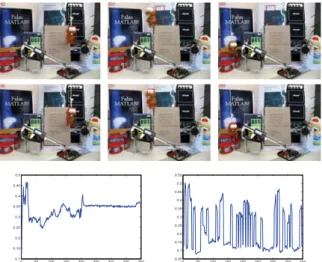
Figure 1. Illustration of the L1 tracker on the sequencelemming
using the model (5) and the L1 tracker using the proposed model (11). The first and the second row: results using (5) and using (11) respectively. Last row: the energy ratioaI2/a2. The left graph is from (5) and the right is from (11).
to the following minimization model for L1 tracker
min a 1 2y−Aa22+λa1+ μt 2aI22, s.t. aT 0, (11)
whereA= [Tt, I],a= [aT;aI]are the coefficients
associ-ated with target templates and trivial templates respectively, and the parameterμt is a parameter to control the energy
in trivial templates. In our implementation, the value ofμt
for each state is automatically adjusted using the occlusion detection method [16]. That is, if occlusions are detected,
μt= 0; otherwiseμtis set as some pre-defined constant. The benefit of the additional2norm regularization term aI22is illustrated in Fig. 1. In Fig. 1, about 30 percent of object energy is contained in trivial templates from min-imization (5). In other words, trivial templates can not dis-tinguish the object and background. On the other hand, we can see the trivial templates coefficients from minimization (11) are small and lead to better tracking results. At last, we note that the original minimization (5) is a special case of the minimization (11) by settingμt= 0.
4.2. Fast numerical method for solving(11)
The proposed method for solving the minimization problem (11) is based on the accelerated proximal gradient (APG) approach [20].
APG approach. The APG method is originally designed for solving the following unconstrained minimization:
minF(a) +G(a), (12) whereF(a)is a differentiable convex function with
Lips-chitz continuous gradient1 and G(a) is a non-smooth but convex function. The outline of the APG method is given in Algorithm 1. The efficiency of the APG method is justi-fied by its quadratic convergence; see Theorem 4.1. How-ever, we emphasize here that the APG method is fast only for particular type of functionG. During each iteration of Algorithm 1, we need to solve a minimization in Step 2. So, the quadratic convergence of APG is materialized only when the sub-problem in Step 2 has an analytic solution. Theorem 4.1 ([20])Let{αk}is the sequence generated by Algorithm 1. Then withinK =O(L/)iterations,{αk}
achieves-optimality such thatαK−α∗ < ,whereα∗
is one minimizer of (12).
Algorithm 1the generic APG approach in [20] (i) Setα0=α−1=0∈RNand sett0=t−1= 1. (ii) Fork= 0,1, . . ., iterate until convergence
⎧ ⎪ ⎪ ⎨ ⎪ ⎪ ⎩ βk+1:=αk+tk−1−1tk (αk−αk−1); αk+1:= arg min a L 2a−βk+1+∇F(Lβk+1)22+G(a); tk+1:= 1+ √ 1+4t2 k 2 . (13)
Reformulation of (11) for applying APG method. As we see, the original APG method is designed for uncon-strained minimization problem which can not be directly applied to (11). Thus, we need to convert the constrained minimization model into an unconstrained problem. Let 1 ∈ RN denote the vector with all entries are equal to 1 and let1RN
+(a)denote the indicator function defined by 1RN
+(a) =
0, a0;
+∞, otherwise. (14)
It is easy to see that the minimization (11) is equivalent to the following minimization problem:
arg min a 1 2y−Aa22+λ1TaT+aI1+μ2taI22+1Rn +(aT). (15) Then, the APG method can be applied to (15) with
F(a) = 1
2y−Aa22+λ1TaT +μ2taI22,
G(a) =aI1+1Rn
+(aT).
(16)
All steps in Algorithm 1 are trivial except Step 2, in which we need to solve an optimization problem:
αk+1= arg min a L 2a−βk+1+ ∇F(βk+1) L 2 2+G(a). (17)
1the gradient ofF is Lipschitz continuous if∇F(x)− ∇F(y) ≤
For general functionG, it cannot be directly solved. How-ever, in our setting, we have the analytic solution for (17); see Proposition 4.2. The algorithm for solving1-norm re-lated minimization (11) is given in Algorithm 2.
Proposition 4.2 IfF(a)andG(a)are defined in(16), then the minimization problem(17)has the following solution:
αk+1|T = max(0, gk+1|T)
αk+1|I =Tλ/L(gk+1|I). (18)
where gk+1 = βk+1 − ∇F(βLk+1) and T is the soft-thresholding operator:Tλ(x) = sign(x) max(|x| −λ,0). Proof See the appendix A.
Algorithm 2 Real Time Numerical algorithm for solving the minimization (11)
(i) Setα0=α−1=0∈RN and sett0=t−1= 1. (ii) Fork= 0,1, . . ., iterate until convergence
⎧ ⎪ ⎪ ⎪ ⎪ ⎪ ⎪ ⎪ ⎪ ⎨ ⎪ ⎪ ⎪ ⎪ ⎪ ⎪ ⎪ ⎪ ⎩ βk+1:=αk+ tk−1−1 tk (αk−αk−1); gk+1|T :=βk+1|T−(A(Aβk+1−y))|T/L−λ1T; gk+1|I :=βk+1|I−(A(Aβk+1−y))|I/L −μβk+1|I/L; αk+1|T := max(0, gk+1|T); αk+1|I:=Tλ/L(gk+1|I); tk+1:= (1 +1 + 4t2k)/2.
Tight Lipschitz constant L estimation. There is only one parameter, the Lipschitz constantLof∇F, is involved in Algorithm 2. This Lipschitz constantLplays a crucial role in the above algorithm. Algorithm 2 with an wrongL
will either diverges or converges very slowly. Next, we give a tight upper bound ofLforF defined in (16) such thatL
is automatically set with optimal performance; see Proposi-tion 4.3. The detailed descripProposi-tion of the proposed real time L1 tracker, calledAPG-L1tracker, is given in algorithm 3. Proposition 4.3 LetF denote the function defined in(16) withA= [T, I], whereT is template set andIis the iden-tity matrix. The upper bound of the Lipschitz constantLfor ∇F is given as follows.
L≤λ2max+μt+ 1, (19)
whereλmaxis the largest singular value ofT.
Proof See Appendix B.
5. Experiments
Through the experiments, APG algorithm is imple-mented with Matlab, μt = 5 in (11) when the occlusion
is not detected and0otherwise, andλ = 10−2, T = 8in Algorithm 2.
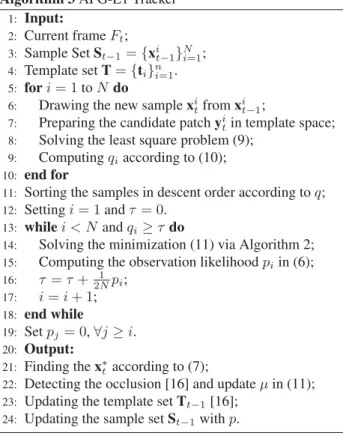
Algorithm 3APG-L1 Tracker 1: Input:
2: Current frameFt;
3: Sample SetSt−1={xit−1}Ni=1; 4: Template setT={ti}ni=1. 5: fori= 1toNdo
6: Drawing the new samplexitfromxit−1;
7: Preparing the candidate patchyitin template space; 8: Solving the least square problem (9);
9: Computingqiaccording to (10);
10: end for
11: Sorting the samples in descent order according toq; 12: Settingi= 1andτ = 0.
13: whilei < Nandqi≥τ do
14: Solving the minimization (11) via Algorithm 2; 15: Computing the observation likelihoodpiin (6); 16: τ =τ+ 21Npi;
17: i=i+ 1; 18: end while
19: Setpj= 0,∀j≥i.
20: Output:
21: Finding thex∗t according to (7);
22: Detecting the occlusion [16] and updateμin (11); 23: Updating the template setTt−1[16];
24: Updating the sample setSt−1withp.
5.1. Comparison with the L1 Tracker [16]
The computation efficiency and tracking accuracy of the proposed APG-L1 tracker is first compared to that of the BPR-L1 tracker [16] on ten sequences. The average run-ning time of the proposed APG-based solver v.s. the inte-rior point method used [16] is about1 : 150. As a result, the average running time of the APG-L1 tracker v.s. the BPR-L1 tracker is around 1:20, with 600 particles. The APG-BPR-L1 tracker achieves about average 26 frames per second with 600 particles on a PC with Intel i7-2600 CPU (3.4GHz). The output bounding boxes of the target from the two tack-ers are similar in many sequences, while the results from APG-L1 are more accurate on some challenging sequences.
#277 #741 #676 #770
Figure 2. Demonstration of the improvement of APG-L1 tracker (red) over BPR-L1 (blue) on tracking accuracy.
5.2. Qualitative Comparison with Other Methods
The performance of the proposed APG-L1 tracker is also evaluated on eight publicly available video sequences and is compared with five latest state-of-the-art trackers
named Incremental Visual Tracking (IVT) [18], Multiple Instance Learning (MIL) [2], Visual Tracking Decomposi-tion (VTD) [12], Incremental Covariance Tensor Learning (ICTL) [23], and Online AdaBoost (OAB) [9]. The track-ing results of the compared methods were obtained ustrack-ing the codes provided by the authors with the default parame-ters and using the same initial positions in the first frame.
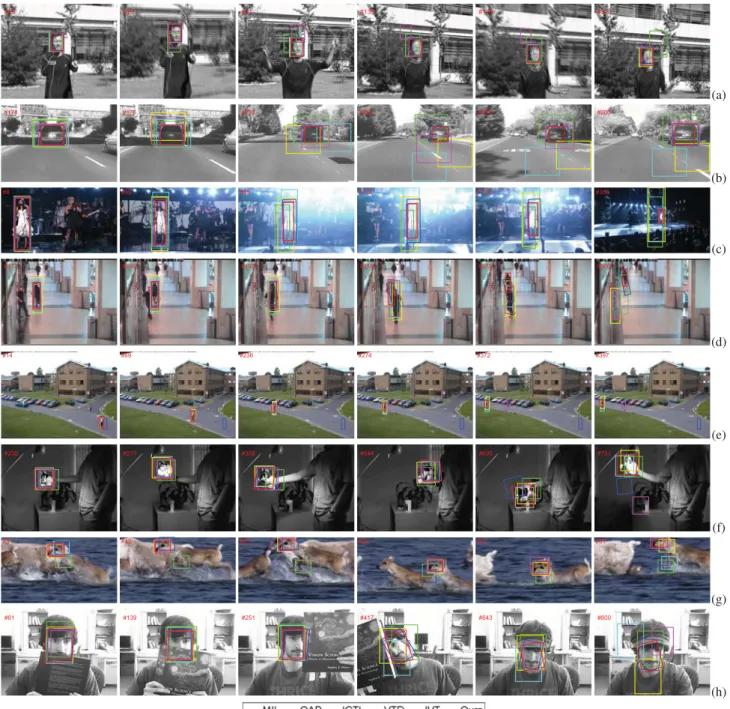
The sequencejumpwas captured outdoors. The target was jumping and the motion blurs are very severe. Results on several frames are presented in Fig. 3 (a). The APG-L1 tracker, IVT, OAB, and MIL tracks the target faithfully throughout the sequences. The other trackers fails track the target when there are abrupt motion and severe motion blur. The sequencecar shows a vehicle undergoes drastic il-lumination changes as it passes beneath a bridge and un-der trees. Tracking results on several frames are shown in Fig. 3 (b). The APG-L1 tracker and IVT can track the tar-get well despite the drastic illumination changes, while the other trackers lose the target after it goes through the bridge. Results of the sequencesingerare shown in Fig. 3 (c). In this sequence, we show the robustness of our algorithm in severe illumination changes and large scale variations. Only our APG-L1 tracker and the VTD tracker can track the target throughout the sequence.
In the sequencewoman (Fig. 3 (d)), only the APG-L1 tracker is able to track the target during the entire sequence. The other trackers drift to the man when he occludes the target due to his similar appearance as the target.
In the sequence pole, a person is walking away from the camera and is occluded by the pole for a short time (Fig. 3 (e)). The IVT loses the target from the start and the VTD starts to drift off the target at frame 274 and finally loses the target. All the rest successfully track the target but our APG-L1 tracker recovers the target scale better.
Results on the sequencesylv are shown in Fig. 3 (f), where a moving animal doll is undergoing challenging pose variations, lighting changes and scale variations. The IVT, and VTD eventually fails at frame 605 as a result of drastic pose and illumination changes. The rest trackers are able to track the target for this long sequence while our APG-L1 tracker performs with higher accuracy.
Results of the sequencedeerare shown in Fig. 3 (g). In this sequence, we show the robustness of our algorithm in background clutters and the fast motion. Only our APG-L1 tracker and VTD can track the target through the sequence. Fig. 3 (h) shows the results on the sequenceface. Many trackers start drifting from the target when the man’s face is severely occluded by the book. The APG-L1 tracker and IVT handle this very well and continue tracking the target when the occlusion disappears.
MIL OAB ICTL VTD IVT ours
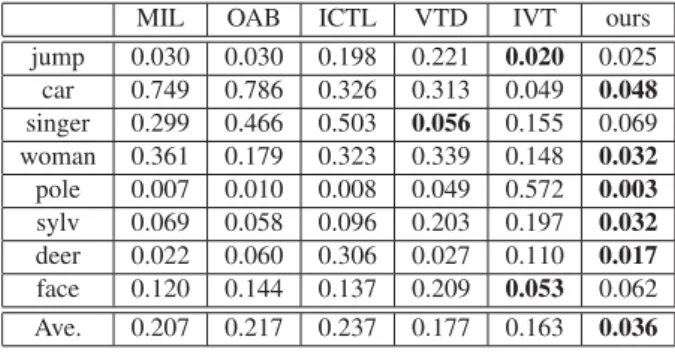
jump 0.030 0.030 0.198 0.221 0.020 0.025 car 0.749 0.786 0.326 0.313 0.049 0.048 singer 0.299 0.466 0.503 0.056 0.155 0.069 woman 0.361 0.179 0.323 0.339 0.148 0.032 pole 0.007 0.010 0.008 0.049 0.572 0.003 sylv 0.069 0.058 0.096 0.203 0.197 0.032 deer 0.022 0.060 0.306 0.027 0.110 0.017 face 0.120 0.144 0.137 0.209 0.053 0.062 Ave. 0.207 0.217 0.237 0.177 0.163 0.036 Table 1. The average tracking errors. The error is measured using the Euclidian distance of two center points, which has been nor-malized by the size of the target from the ground truth. The last row is the average error for each tracker over all the test sequences.
5.3. Quantitative Comparison with other methods
To quantitatively evaluate the robustness of the APG-L1 tracker under challenging conditions, we manually anno-tated the target’s bounding box in each frame for all test sequences. The tracking error evaluation is based on the relative position errors (in pixels) between the center of the tracking result and that of the annotation. As shown in Fig.4 and Table 1, the APG-L1 tracker achieves comparable to the best performer on the sequencejump,singerandfaceto the best-performed trackers, and on all the other sequences it performs best.
6. Conclusion
In summary, based on the framework of the L1 tracker [15, 16], we developed a real time L1 visual tracker with improved tracking accuracy. The accuracy improvement is achieved via a new minimization model for finding the sparse representation of the target and the real time perfor-mance is achieved by a new APG based numerical solver for the resulting1norm minimization problems. The experi-ments also validated the high computational efficiency and better tracking accuracy of the proposed APG-L1 tracker.
References
[1] S. Avidan. Ensemble tracking. InCVPR, 2005.
[2] B. Babenko, M. Yang, and S. Belongie. Visual tracking with online multiple instance learning. InCVPR, 2009. [3] M. Black and A. Jepson. Eigentracking: Robust matching
and tracking of articulated objects using a view-based repre-sentation.IJCV, 26(1):63–84, 1998.
[4] J. Cai, S. Osher, and Z. Shen. Linearized bregman iterations for compressed sensing.Math. Comp, 78:55–59, 2009. [5] E. Candes, J. Romberg, and T. Tao. Stable signal recovery
from incomplete and inaccurate measurements.Commu. on pure and applied mathematics, 59(8):1207–1223, 2006. [6] D. Comaniciu, V. Ramesh, and P. Meer. Kernel-based object
#15 #16 #31 #135 #176 #311 (a) #174 #176 #293 #354 #418 #600 (b) #8 #49 #85 #108 #133 #350 (c) #177 #190 #197 #218 #373 #500 (d) #14 #89 #236 #274 #372 #397 (e) #230 #271 #358 #544 #605 #731 (f) #8 #12 #27 #38 #51 #61 (g) #81 #139 #251 #417 #643 #800 (h) Figure 3. Tracking results of different algorithms for sequencesjump(a),car(b),singer(c),woman(d),pole(e),sylv(f),deer(g) andface(h).
[7] D. Donoho. Compressed sensing.IEEE Trans. on Informa-tion Theory, 52(4):1289–1306, 2006.
[8] T. Goldstein and S. Osher. The split bregman method for l1 regularized problems.SIAM J Imag. Sci., 2:323–343, 2009. [9] H. Grabner, M. Grabner, and H. Bischof. Real-time tracking
via online boosting. InBMVC, 2006.
[10] S. Kim, K. Koh, M. Lustig, S. Boyd, and D. Gorinevsky. An interior-point method for large-scale l1-regularized least squares.IEEE J Sel Topics in Sig. Proc., 1:606–617, 2007.
[11] S. Kwak, W. Nam, B. Han, J.H. Han. Learning Occlusion with Likelihoods for Visual Tracking. InCVPR, 2011. [12] J. Kwon and K. Lee. Visual tracking decomposition. In
CVPR, 2010.
[13] H. Li, C. Shen, and Q. Shi. Real-time Visual Tracking Using Compressive Sensing. InCVPR, 2011.
[14] B. Liu, L. Yang, J. Huang, P. Meer, L. Gong, and C. Ku-likowski. Robust and fast collaborative tracking with two stage sparse optimization. InECCV, 2010.
0 50 100 150 200 250 300 0 0.1 0.2 0.3 0.4 0.5 # jump Error 0 100 200 300 400 500 600 0 0.1 0.2 0.3 0.4 0.5 # car Error 0 50 100 150 200 250 300 350 0 0.1 0.2 0.3 0.4 0.5 # singer Error 0 100 200 300 400 500 0 0.1 0.2 0.3 0.4 0.5 # woman Error 0 100 200 300 400 0 0.02 0.04 0.06 0.08 0.1 # pole Error 0 200 400 600 800 0 0.1 0.2 0.3 0.4 0.5 # sylv Error 0 10 20 30 40 50 60 0 0.1 0.2 0.3 0.4 0.5 # deer Error 0 200 400 600 800 0 0.1 0.2 0.3 0.4 0.5 # face Error
Figure 4. The tracking error for each test sequence. The error is measured the same as in Table 1 and the legend as in Fig.3.
[15] X. Mei and H. Ling. Robust visual tracking using l1 mini-mization. InICCV, 2009.
[16] X. Mei, H. Ling, Y. Wu, E. Blasch, and L. Bai. Minimum error bounded efficient L1 tracker with occlusion detection. InCVPR, 2011.
[17] F. Porikli, O. Tuzel, and P. Meer. Covariance tracking using model update based on lie algebra. InCVPR, 2006. [18] D. Ross, J. Lim, R. Lin, and M. Yang. Incremental learning
for robust visual tracking.IJCV, 77(1):125–141, 2008. [19] Z. Shen, K. Toh, and S. Yun. An accelerated proximal
gra-dient algorithm for frame based image restorations via the balanced approach.SIAM J on Imag. Sci., 4:573, 2011. [20] P. Tseng. On accelerated proximal gradient methods for
convex-concave optimization.SIAM J on Opti., 2008. [21] O. Williams, A. Blake, and R. Cipolla. Sparse bayesian
learning for efficient visual tracking. PAMI, 27(8):1292– 1304, 2005.
[22] J. Wright, A. Yang, A. Ganesh, S. Sastry, and Y. Ma. Robust face recognition via sparse representation.PAMI, 31(1):210-227, 2009.
[23] Y. Wu, J. Cheng, J. Wang, H. Lu, J. Wang, H. Ling, E. Blasch, and L. Bai. Real-time Probabilistic Covariance Tracking with Efficient Model Update.IEEE T-IP, 2012. [24] Y. Wu, H. Ling, J. Yu, F. Li, X. Mei, and E. Cheng. Blurred
Target Tracking by Blur-driven Tracker. InICCV, 2011. [25] A. Yang, A. Ganesh, S. Sastry, and Y. Ma. Fast
l1-minimization algorithms and an application in robust face recognition: a review. InICIP, 2010.
[26] A. Yilmaz, O. Javed, and M. Shah. Object tracking: A sur-vey.Acm Computing Surveys, 38(4):13, 2006.
[27] Z. Yin and R. Collins. Object tracking and detection after oc-clusion via numerical hybrid local and global mode-seeking. InCVPR, 2008.
Appendix A: Proof of Proposition 4.2.
The optimization problem (17) is expressed as follows,
min
a
L
2a−gk+122+1R+
n(aT) +aI1. (20)
Since the variables ofaare independent, (20) is the same as
min aT L 2aT−gk+1|T22+1R+ n(aT), min aI L 2aI−gk+1|I22+λaI1. (21)
It is easy to see the solution of first minimization in (21) is the projection of gk+1|T to the R+n space, i.e.
max(0, gk+1|T). For the second minimization in (21), all
the variables are independent. So, we only need to solve the following minimization :
min
x
L
2y−x22+λx1f(x), (22) wherex, y∈R. The minimizer of (22) can be expressed as a soft thresholding operation:
x=Tλ/L(y) = sgn(y)∗max(|y| −L,0). (23) Thus, we haveaI =Tλ/L(gk+1|I)as the minimizer of (21).
Appendix B: Proof of Proposition 4.3. From (16), we have
∇2F(x) = TT T
T (1 +μ)I
(24)
Assume T = UΣV by singular value decomposition, whereUandV are orthonormal matrices,Σ∈Rm×N(m < N) with Σii = λi and λ1 ≥ λ2 ≥ . . . ≥ λm ≥
0. It is easy to know ∇2F(x) is similar to M
ΣΣ Σ
Σ (1 +μ)I
. SoλF max = λMmax ≤ λ2max+
1 +μ, whereλF max,λMmaxandλmaxare the largest