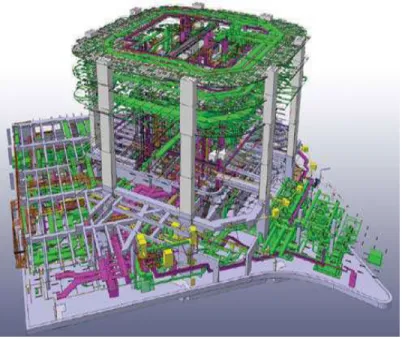
Figure 1. Ghery Technologies BIM Model. Riese, Martin and Den nis R. Shelden. 2008. “Comprehensive international BIM with full owner involvement.” ZD Law Quarterly Review. http://www.zdlaw.com/quarterlyreview/?p=39 (accessed December 4, 2010)
What is BIM?
Building Information Modeling (BIM) is the future of construction. BIM programs have created a new class of cutting-edge software that accurately and completely communicates building design. Traditionally, architects and engineers use two dimensional (2D) paper
drawings. Since those drawings only show 2D, many conflicts and problems go unseen until far into the construction process. Construction must then stop as a team assembles to redesign the structure or fix the problem. This delay not only wastes time, but creates additional cost. When using BIM, the entire building is accurately modeled in three dimensions (3D). Every building component is placed including each truss, beam, girder, footing, HVAC duct, vent, and electrical outlet. Figure 1 below shows a typical BIM model of a large project. The building is constructed virtually before any actual work begins on site.
BIM was designed as a “human activity” (Eastman 2008, p. 286). The software gives the operators the freedom to play an active role in the building process. Together, a team models an entire building. Sets of plans no longer need to revolve between multiple engineers, architects, and consultants, increasing opportunities for discrepancy; rather everyone works on a central
digital model. The program can then detect any conflicting components in the model, allowing designers to resolve problems before they have a chance to delay the project.
This technology solves many challenges associated with traditional 2D
paper drawings. It gives users the tools to visualize the completed building before construction begins. Architects and contractors can collaborate with greater efficiency and interpret the project more accurately. This collaboration saves the company from volumes of incorrect or unclear 2D plans, lost time, and wasted money.
Even though BIM programs save time and money, only 25% of companies currently use them as their primary design communication tool (Eastman 2008, p. 292). What can be done to overcome the obstacles currently preventing BIM from becoming the primary method of building design communication? If problems are resolved concerning the implementation, finance, and legal issues surrounding BIM, the tedious world of two dimensional design communications can be eliminated.
Implementation of BIM in the workplace
Once one gains a basic understanding of BIM and its applications, the first obstacles to overcome in the workplace include the initial changes the implementation of BIM entails. Many companies try to implement BIM but fail to see the initial need or benefit from the change right away. Oftentimes this failure results from a lack of focus and objective in the company‟s BIM implementation program.
Planning for BIM
“The Contractor‟s Guide to BIM” explains that a company which chooses to implement a BIM program must start with specific goals and objectives in mind. Companies should begin using the software on a simple or low-risk project (Ernstrom et al. 2006, p. 11). Not only is it important to have a clear objective, but the objective should be measurable and provide a return on investment (ROI). Many contracting companies focus on the ROI to determine the
project using a BIM program in its construction crucially determines the further use of BIM in future projects. A good implementation plan will help assure a strong ROI, and help the effectiveness of BIM projects to come. For this reason, the people chosen to work on that first project must be carefully selected.
Training for BIM
Firms implementing BIM are often concerned about the time it takes to train employees to use the new software. Many contractors believe that the time it takes to learn the new program will be time that is unproductive to the company, and few design teams have the time to learn a new and complicated computer program. However, if the company looks at the time saving computations that BIM executes, such as materials take offs, clash detection, 3D space analysis, and structural calculations, they will see that these benefits alone compensate for the time spent in learning a new program. The short term productivity dip will be well worth the effort, and according to the Autodesk website it takes surprisingly only 3-4 months on average to become as productive with a BIM program as a previously used 2D CAD program (2007, p. 6). The benefits of using a BIM software tool for those whom the company chooses to train include increased productivity in future projects, greater collaborative and cooperative skills with other employees and participating subcontracting teams, faster on-site communication, and easier plan editing if problems do arise. As these benefits and others become more apparent, additional contractors and designers alike will take the plunge to train employees in BIM to take advantage of this new expanding market. Not only will the overall productivity of the employees trained to use BIM increase, but they will learn valuable cooperation skills used to work with others involved in the BIM process.
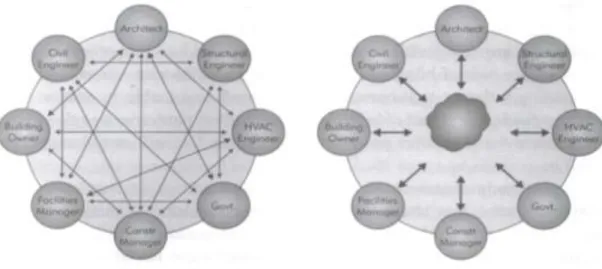
Figure 2. BIM Collaboration. Smith, Dana K. and Michael Tardif. 2009. “Building information modeling: a strategic implementation guide.” Hoboken, NJ: Wiley.
The collaborative effort
Another problem associated with the switchover to BIM is the challenge of working closely and cooperating with the different building trades who are often in competition with each
other. Many contractors and subcontractors are unfamiliar with the BIM process, and on certain large projects multiple subcontractors of the same trade may be involved, leading to
confrontation. Conflicts may arise as competitive human nature surfaces between the different groups involved. In actuality however, the constant need for collaboration using a BIM model allows for the different contracting groups to work together under a BIM „arbiter‟ or manager, and bring together the collective intelligence and experience of these different groups (See Figure 2). Oftentimes different entities of the building industry that have had long time rivalries will find that through the collaboration and increased communication required by BIM those long-standing differences are mitigated and more productive work results.
Financial aspects of BIM
Some of the financial aspects associated with BIM include the up-front costs of training, software, hardware and salaries of the BIM modelers. For the average contractor the price of the
software may be too high. The financial benefits generally are more significant in large construction companies who work on large projects worth millions of dollars. Other costs include on-site computers used to view the model. Top-of-the-line, multi-core-processor computers needed to run most BIM software do not come cheap. Sufficient equipment can cost companies an average of $2000 or more per computer to generate effective results. Software licensing fees, training, and hiring new employees are all additional expenditures.
Who should be responsible for the costs?
Who should pay for the cost of using BIM? “Who‟s receiving the most benefits and therefore bear the cost of developing the model?” (AGC of America 2010, p. 4). Realistically the contractor, architect, engineer, and owner receive benefits from the model and should bear some of the expense. The biggest challenge is deciding who pays for what, and how much. Ultimately, the owner pays for the model, but the overall savings are well worth the initial cost.
Financial benefits of BIM
Stanford University Center for Integrated Facilities Engineering (CIFE) conducted a research project on the benefits of BIM. They based their research on 32 major projects using BIM. The following indicates benefits shown in the research (CIFE, 2007):
Up to 40% elimination on unbudgeted change. Cost estimation accuracy within 3%.
Up to 80% reduction in time taken to generate a cost estimate.
A savings of up to 10% of the contract value through clash detections. Up to 7% reduction in project time.
Holder Construction Company of Atlanta, Georgia conducted a case study on the benefits of BIM for the Hilton Aquarium, Atlanta Georgia. The project cost $46M, with a 484,000 SF hotel
and parking structure. The BIM used on this project cost $90,000. This cost was 0.2% of the project budget, of which $40,000 was paid by the owner. Before the project started it was estimated that $600,000 was saved due to elimination of clashes, and 1143 hours were saved on the schedule. Through the use of BIM the team members were able to recognize problems and cut out many risks still in the design phase (Azhar, p. 10-11).
This case study shows Holder Construction Company saved time and money through implementing BIM into their project. The financial costs of BIM are great, but BIM does have excellent benefits for everyone on the project which includes, savings in the end through recognizing initial problems, and reducing the risks of building.
BIM and the law
For hundreds of years, architects, designers, engineers, and contractors have relied on 2D drawings. Construction law has been developed around this outdated method of communication. Modern buildings are so complex that 2D drawings have become inadequate, making BIM a necessity. BIM is young technology and as anything new and different, many legal unknowns arise. The root of essentially every legal issue surrounding BIM lies in ownership. Who is liable? Who holds the copyright? Who is responsible?
Why ownership is different with BIM
Traditionally, architects create the design and manage all of the 2D drawings. They hire consultants to engineer and draw detailed plans of mechanical, electrical, structural, and other systems. The consultant submits those to the architect who approves them, then passes them on to the contractor. The architect has a clear sphere of responsibility and liability as did the contractor. This worked well for many years but as was mentioned earlier, the complexity of
modern buildings is requiring a shift away from this outdated method and into the paradigm of BIM.
When implemented to its fullest, BIM is used as the heart of “Integrated Project Delivery” or IPD. BIM integrates all of the different building components and documents into one model. Under IPD, each consultant directly contributes to the BIM model. Every trade uses the same program and technology. According to the American Institute of Architects (AIA), this allows for unprecedented collaboration, cost savings, and increased efficiency, but as you can imagine this new method creates some very grey areas when it comes to ownership,
responsibility, and liability (AIA National et al. 2007, p. 1). For BIM to become an industry standard, contract documents and laws need to address this issue.
Establishing ownership and responsibility
Recently, several professional organizations and standard-setting bodies in the architecture and construction industry have released documents that address the issue of ownership. Resources are now available for any company to fully implement BIM with clear legal waters. One of these resources is published by the AIA.
AIA Document E202
The AIA is a respected and well recognized association serving the building trades. Every contractor, engineer and architect extensively uses AIA documents. To help clear up legal issues with BIM, the AIA recently released document E202. The document lays out standard
procedures and responsibilities for BIM models but most importantly, it serves as a standard contract for projects using BIM. It establishes who owns the model, how it is used and the party responsible for each model element. Because of the unique nature of each project, Document
E202 does not give a blanket declaration of each; rather it lays out a legally binding frame work of rules and then allows for adaption to each unique project (AIA 2008, p. 1).
This document has been a huge boon to BIM based contracts. People all across the building industries recognize AIA and have embraced their efforts in simplifying the complex legal environment around BIM. Because BIM is very new, many of those dealing in construction law simply do not know how to work with BIM. Document E202 created a standard BIM based contract.
Liability
The document addresses the BIM model as a collection of separate pieces, each created by different “Model Element Authors,” (MEA‟s). Each MEA is responsible and legally liable for their portion of the model (AIA 2008, p. 6). If a conflicts or issues surface, the responsible MEA must fix the problem with his or her Element.
Ownership and copyright
E202 addresses ownership by stating that “in contributing to the Model, the Model Element Author does not convey any ownership right in the content provided or in the software used to generate the content.” It goes on to state that the use of the model is limited to the specific project unless ownership is “granted in a separate license” (p. 2).
This document overcame the biggest legal fear of architects who were concerned that someone could legally take their design from the BIM model and build the same building without compensating the Architect.
Reliance on Model Elements and LOD
Another common legal problem is termed in E202 as “Reliance on Model Elements.” After the structural engineer contributes their portion of the model, the Mechanical Engineer will
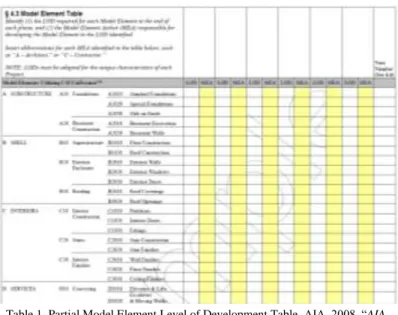
Table 1. Partial Model Element Level of Development Table. AIA. 2008. “AIA Document E202 - 2008 Building information modeling protocol exhibit.” AIA Documents.
http://www.aia.org/aiaucmp/groups/aia/documents/pdf/aiab083007.p df (accessed November 17, 2010).
route duct work and pipes around the structure. He assumes that he can rely on model elements created by the Mechanical Model Element Author. What happens if the Structural Model
Element Author omits steel connection plates that conflict with pipes? Who is responsible for the cost? Who must change their element?
E202 addresses this by defining five different “Levels of Development,” or (LOD). Each definition identifies the amount of detail and accuracy required at each level. E202 then states,
“Any use of, or reliance on, a Model Element inconsistent with the LOD…. By subsequent MEA or Model Users shall be at their sole risk and without liability to the MEA. To the fullest extent permitted by law, subsequent Model Element Authors and Model Users shall indemnify and defend the Model Element Author from and against all claims arising from or related to the subsequent MEA‟s or Model User‟s modification to, or unauthorized use of the MEA‟s content” (p. 6). Essentially, if the Structural MEA was only required to model a lower LOD and the Mechanical
MEA relied on it as though it was a higher LOD, the Mechanical MEA would be responsible to change his or her systems. A legally binding table completes the LOD section (See Table 1). The completed table is filled out as part of each unique contract and defines who is responsible for each Model Element and to which LOD it is to be modeled.
With the release of E202 the AIA paved the way for architects, contractors and
companies of all sizes to fully integrate BIM. E202 has cleared up the majority of legal questions surrounding BIM and overcome the legal obstacles preventing BIM from becoming the primary method of building design communication.
The Future of BIM
The implementation, financial and legal challenges of BIM will be overcome. In the next five years, 60% to 70% of firms will use BIM as their primary design communication tool (Eastman 2008, p. 292). Buildings will be built better, assembly will be more organized, and operations costs will drop. The technology rapidly develops as more firms incorporate BIM and give feedback on the BIM process. BIM is not just another drafting program. It invites the industry to work together and provides the proper designing tools. Today‟s dynamic market requires highly specialized buildings, and these new tools are needed to satisfy this demand. “During this time period, more advanced analysis and simulation tools will emerge as options for specific types of facilities, such as healthcare, public access area, stadiums, transit facilities, civic centers, and educational centers” (Eastman 2008, p. 295). With this technology and the
collaborative efforts of contractors and architects, the opportunities are endless. Starting a project where the user can see and understand the end result and know exactly how all the components will be assembled is the future of construction.
Appendix A: Works Cited
Administrator. 2008. “BIM implementation: problems, prospects and strategies.”
http://www.architecturalevangelist.com/innovation-in-aec/bim-implementation-problems-prospects-and-strategies.html (accessed November 24, 2010).
AGC of America. 2010. “BIM FAQ.” http://bimforum.org/resources/bim-faq/#faq_8. (accessed November 23, 2010).
AIA. 2008. “AIA Document E202 - 2008 Building information modeling protocol exhibit.” AIA Documents. http://www.aia.org/aiaucmp/groups/aia/documents/pdf/aiab083007.pdf (accessed November 17, 2010).
AIA National et al. 2007. “Integrated project delivery: a guide.”
http://www.aia.org/aiaucmp/groups/aia/documents/pdf/aiab083007.pdf (ccessed November 17, 2010).
AutoDesk. 2007. “Transitioning to BIM.”
http://images.autodesk.com/adsk/files/transitioning-to-bim_jan07_1_.pdf (accessed November 22, 2010).
Azhar, Hein and Sketo. “Building information modeling (BIM): benefits, risks, and challenges.” McWhorter School of Building Science.
http://ascpro0.ascweb.org/archives/cd/2008/paper/CPGT182002008.pdf. (accessed November 23, 2010).
CIFE. 2007. “CIFE technical reports” http://cife.stanford.edu/Publications/index.html. (accessed November 23, 2010).
Eastman, Charles M. 2008. “BIM handbook: a guide to building information modeling for owners, managers, designers, engineers, and contractors”. Hoboken, NJ: Wiley.
Riese, Martin and Dennis R. Shelden. 2008. “Comprehensive international BIM with full owner involvement.” ZD Law Quarterly Review. http://www.zdlaw.com/quarterlyreview/?p=39 (accessed December 4, 2010)
Smith, Dana K. and Michael Tardif. 2009. “Building information modeling: a strategic implementation guide.” Hoboken, NJ: Wiley.
Appendix B: Proposal
MEMORANDUM
DATE: 3 Nov 2010 TO: Brother Papworth
FROM: Brittany Black, Emma Harman, Jeremy Peiffer, Brady Schimpf, SUBJECT: Research Paper Proposal
The purpose of this proposal is to outline and define the area of research in our paper, and to accurately communicate the scope of work the research paper entails. Also, if we need to change our preliminary plan we can effectively alter our approach before spending unnecessary time researching.
Purpose and Rational
The building industry is one of the most innovative and dynamic industries in the United States, accounting for about 14% of the total gross domestic product in 2008 (Occupational Outlook Handbook). New products and methods of construction further improve the
effectiveness and production time of both commercial and residential building projects. One of the biggest revolutionary changes currently in the building industry is the ever-expanding selection of computer modeling software. New computer programs can accurately model what the proposed building will look like in 3D. These programs known as building information modeling programs or BIM programs, have the ability to accurately detail every aspect of the building process. BIM programs not only graphically illustrate the building process in 3D, but do it in the manner the building will actually be built. They even calculate the amounts of materials needed as well as dimensions and other building information. Other benefits include
accurate predicting of costs of materials, insulation values, and preliminary clash detection. With all of these benefits, many architecture firms and contractors still do not know of or choose to not utilize these programs in their companies. One would think that with the advances in technology making the industry more efficient, all construction and architecture firms would want to embrace these new BIM programs, but the truth is they do not. Therefore, the object of our research paper is to find out what can be done to overcome the obstacles currently preventing BIM from becoming the primary method of building design communication.
Many architects and contractors still rely on normal 2D CAD drawings to communicate major building designs. With BIM there is little need to rely on often-misinterpreted 2D line drawings, which many sub-contractors often cannot interpret correctly, leading to costly change orders and delays. Possible causes for the slow acceptance of BIM may include company owners‟ reluctance to invest the time and money it takes to learn a new program and upgrade their computer systems to meet the requirements of the BIM programs, or fears of the legal conflicts involved in a shared computer model. Our focus will be how companies and business owners can overcome many of the fears and logistical concerns keeping them from fully embracing BIM software. We will simply put forth the problems and then offer solutions that can help integrate BIM programs throughout the industry.
Outline of Paper 1. Introduction-
a. Thesis: What can be done to overcome the obstacles currently preventing BIM from becoming the primary method of building design communication? b. What is BIM?
c. Brief overview of what BIM can do and the benefits of using BIM (This is what it can do, this is why BIM challenges need to be overcome)
d. 3 major obstacles. Startup/implementation, Financial Legal. 2. Startup/ Implementation
a. Time investment and learning curve
b. Computer upgrades to meet the requirements of the BIM programs.
c. Integration and collaboration between different programs, versions, offices d. Learning new standards for BIM (Omni Class) vs. CAD standards already known e. Solutions: how to fix these problems and how to get over “the wall” (Contractors
Guide to BIM p. 18) 3. Financial
a. Cost of training for employees b. Cost of hardware
c. Cost of “BIM manager”
d. Added cost of modeling and designing with BIM e. Other added costs of using BIM
f. Why it is worth it to pay these costs up front
g. Solutions: Who covers costs? How to reduce BIM costs, who receives cost savings in the end?
4. Legal
a. Issues with a model shared and contributed to by many companies. b. Liability. Who is to blame if something goes wrong?
d. Bonding and Insurance issues
e. Controlling access and tracking who makes changes
f. Solutions: How to distinguish ownership and liability of the model/portions of the model.
5. Conclusion
a. What wide spread implementation of BIM and overcoming these challenges means for the industry.
Proposed Time Line October 27 Research paper topic
October 29 Group meeting to discuss research proposal November 1 Individual proposal parts due
November 3 Proposal due November 5 Research 3 sources
November 10 Evaluate sources, decide subtopics, and outline individual parts November 12 Paper conference
November 17 First rough draft done November 19 Group meeting
November 24 Research paper draft due in class, bring 2 copies to class November 26 Paper Conference
December 1 Research paper draft due in class, bring 2 copies to class December 3 Paper Conference
December 6 Paper Conference
December 10,13,15 Oral Presentation, PowerPoint Review of Literature
A preliminary review of Literature reveals many sources that help resolve fears and answer questions about BIM. Many of the BIM product companies offer helpful instruction guides to using their products, an example including Autodesk for their product Revit. The “Contractor‟s Guide to BIM” outlines in a helpful pamphlet how companies that are starting to use BIM need not fear the change in the design process. The guide goes on to explain the finer details of how BIM integrates with the existing company, and how the logistical considerations and initial cost are worth the final product when it comes down to the bottom line. The guide also clarifies the legal problems and responsibilities of the different parts of the contracting firm. These sources only scratch the surface of the research available explaining how companies may overcome the challenge of changing from the traditional method of building design to using the more-efficient BIM technology.
Selected Bibliography
Applied Technology Council. ATC. Web. 02 Nov. 2010. <http://www.atcouncil.org/ index.php?option=com_content&view=article&id=92&Itemid=135>. "Auto Desk." Autodesk Education Community. 2003. Web. 02 Nov. 2010. <http://
students.autodesk.com/>.
"Autodesk - Autodesk Navisworks Products." Autodesk - 3D Design & Engineering Software for Architecture, Manufacturing, and Entertainment. 2010. Web. 02 Nov. 2010. <http:// usa.autodesk.com/adsk/servlet/pc/index?siteID=123112&id=10571060>.
"BIM - Building Information Modeling | SmartBIM." Reed Construction Data. 2010. Web. 02 Nov. 2010. http://www.reedconstructiondata.com/bim/.
"Bimworld.com." AutoCAD Everything. Web. 02 Nov. 2010. <http://
www.autocadeverything.com/help/showthread.php/2737-bimworld.com>.
Building Design & Construction. Building Design Construction |. 2010. Web. 02 Nov. 2010. <http://www.bdcnetwork.com/>.
"Building Information Modeling." Wikipedia, the Free Encyclopedia. 15 Oct. 2010. Web. 02 Nov. 2010. <http://en.wikipedia.org/wiki/Building_Information_Modeling>. “Contractor‟s Guide to BIM. 1st
ed.” Associated General Contractors of America. Web. September 2006. <www.agcnebuilders.com/documents/BIMGuide.pdf>
"First Look at SCIA Engineer and the Highlights of "BE Inspired"" AECbytes: Analysis, Research, and Reviews of AEC Technology. 2010. Web. 02 Nov. 2010. <http://
www.aecbytes.com/>.
Google. "3D Modeling for Everyone." Google SketchUp. 2010. Web. 02 Nov. 2010. <http:// sketchup.google.com/>.
“Occupational Outlook Handbook, 2010-2011 Edition.” Bureau of Labor Statistics. Web. 17 December 2009. <http://www.bls.gov/oco/oco2006.htm>
"Revit Plugins and Add-ons Review 2008." Revit In Plain English. Web. 02 Nov. 2010. <http:// revit.blogspot.com/2008/12/revit-plugins-and-add-ons-review-2008.html>.
Smith, Deke. AEC/CAD/BIM: the User Perspective. 22 Mar. 2007. Web. 2 Nov. 2010. „ <http:// www.facilityinformationcouncil.org/bim/index.php>.