Abstract parsing:
static analysis of dynamically generated string output using
LR-parsing technology
Kyung-Goo Doh1, Hyunha Kim1, David A. Schmidt2 1
Hanyang University, Ansan, South Korea 2
Kansas State University, Manhattan, Kansas, USA
Abstract. We combine LR(k)-parsing technology and data-flow analysis to analyze, in ad-vance of execution, the documents generated dynamically by a program. Based on the doc-ument language’s context-free reference grammar and the program’s control structure, the analysis predicts how the documents will be generated andparsesthe predicted documents. Our strategy remembers context-free structure by computingabstract LR-parse stacks. The technique is implemented in Objective Caml and has statically validated a suite of PHP pro-grams that dynamically generate HTML documents.
1
Introduction
Scripting languages like PHP, Perl, Ruby, and Python use strings as a “universal data structure” to communicate values, commands, and programs. For example, one might write a PHP script that assembles within a string variable an SQL query or an HTML page or an XML document. Typically, the well-formedness of the assembled string is verified when the string is supplied as input to its intended processor (database, web browser, or interpreter), and an incorrectly assembled string might cause processor failure. Worse still, a malicious user might deliberately supply misleading input that generates a document that attempts a cross-site-scripting or injection attack.
As a first step towards preventing failures and attacks, the well-formedness of a dynamically generated, “grammatically structured” string (document) should be checked with respect to the document’s context-free reference grammar (for SQL or HTML or XML) before the document is supplied to its processor. Better still, the document generator programitselfshould be analyzed to validate that all its generated documents are well formed with respect to the reference grammar, like an application program is type checked in advance of execution.
In this paper, we employ LR(k)-parsing technology and data-flow analysis to analyzestatically a program that dynamically generates documents as strings, and at the same time,parse the dy-namically generated strings with the context-free reference grammar for the document language. We computeabstract parse stacksthat remember the context-free structure of the strings.
x = ’a’ r = ’]’ while ... x = ’[’ . x . r print x X0 =a R=] X1 =X0⊔X2 X2 =[·X1·R X3 =X1 (Read.as an infix string-append operation.)
Fig. 1.Sample program and its data-flow equations
2
Motivating example
Say that a script must generate an output string that conforms to this grammar, S→a|[S]
whereSis the only nonterminal. (HTML, XML, and SQL are such bracket languages.) The grammar is LR(0), but it can be difficult to enforce even for simple programs, like the one in Figure 1, left column. Perhaps we require this program to print only well-formedS-phrases — the occurrence of xat “print x” is a “hot spot” and we must analyzex’s possible values.
– An analysis based ontype checking assigns types (reference-grammar nonterminals) to the
pro-gram’s variables. The occurrences of xcan indeed be data-typed as S, but rhas no data type that corresponds to a nonterminal.
– An analysis based onregular expressions(Christensen [2], Minamide [6], Wasserman [8]) solves
flow equations shown in Figure 1’s right column in the domain of regular expressions, determining that the hot spot’s (X3’s) values conform to the regular expression,[∗·a·]∗, but this does not validate the assertion.
– A grammar-based analysis (Thiemann [7]) treats the flow equations as a set of grammar rules.
The “type” ofx at the hot spot isX3. Next, a language-inclusion check tries to prove that all X3-generated strings areS-generable.
Our approach solves the flow equations in the domain ofparse stacks—X3’s meaning is theset of LR-parsesof the strings that might be denoted byx.
[
.
S S.
[S].
a S s 0 S [.
S] S.
[S].
a S s 1.
S s5 S a.
s2 S [S.
] s 3 S [S].
s4 [ S S a a ]parse stack (top lies at right) input sequence (front lies at left)
s0 [[a]]
s0::s1 [a]] (becausegoto(s0,[) =s1)
s0::s1::s1 a]] s0::s1::s1::s2 ]] (reduce:S→a) s0::s1::s1 S ]] s0::s1::s1::s3 ]] (becausegoto(s1, S) =s3) s0::s1::s1::s3::s4 ] (reduce:S→[S]) s0::s1 S ] s0::s1::s3 ] s0::s1::s3::s4 (reduce:S→[S]) s0 S s0::s5 (finished)
Fig. 2.gotocontroller forS→[S]|a and an example parse of[[a]]
Assume that the reference grammar is LR(k); we first calculate its LR-items and build its parse (“goto”) controller.
We interpret the flow equations in Figure 1 asfunctionsthat map an input parse state to (a set of) output parse stacks.
x = ’a’ r = ’]’ while ... x = ’[’ . x . r print x X0 =a R=] X1 =X0⊔X2 X2 =[·X1·R X3 =X1 [
.
S S.
[S].
a S s 0 S [.
S] S.
[S].
a S s1.
S s5 S a.
s2 S [S.
] s 3 S [S].
s4 [ S S a a ]To analyze the hot spot atX3, we generate the function call,X3(s0), wheres0is the start state for parsing anS-phrase. The flow equation,X3 =X1, generates
X3(s0) =X1(s0)
which itself demands a parse of the string generated at pointX1from states0: X1(s0) =X0(s0)∪X2(s0)
The union of the parses fromX0andX2must be computed.3
ConsiderX0(s0): X0(s0) =goto(s0,a) =s2 (reduce:S→a)
⇒goto(s0, S) =s5
A parse of string ’a’ from s0 generates s2, a final state, that reduces to nonterminal S, which generatess5— anS-phrase has been parsed. (The⇒signifies areducestep to a nonterminal.) The completed stack is therefores0::s5. The remaining call,X2(s0), goes
X2(s0) = ([·X1·R)(s0) =goto(s0,[)⊕(X1·R)
=s1⊕(X1·R) =s1:: (X1(s1)⊕R)
The ⊕ operator sequences the parse steps: for parse stack, st, and function, E, st⊕E = st ::
E(top(st)), that is, the stack made by appending st to the stack returned by E(top(st)). Then, X1(s1) =X0(s1)∪X2(s1)computes tos3, and
X2(s0) =s1:: (X1(s1)⊕R) =s1:: (s3⊕R) =s1::s3::R(s3)
=s1::s3::s4 (reduce:S →[S]) ⇒goto(s0, S) =s5
That is,X2(s0)built the stack, s1:: s3 ::s4, denoting a parse of[S], which reduced toS, giving s5.
x = ’a’ r = ’]’ while ... x = ’[’ . x . r print x X0 =a R=] X1 =X0⊔X2 X2 =[·X1·R X3 =X1 Here is the complete list of solved function calls:
X3(s0) =X1(s0) X1(s0) =X0(s0)∪X2(s0) =· · ·=s5∪s5=s5 X0(s0) =goto(s0,a) =s2⇒goto(s0, S) =s5 X2(s0) =goto(s0,[)⊕(X1·R) =s1::X1(s1)⊕R =· · ·=s1::s3::R(s3) =s1::s3::s4⇒goto(s0, S) =s5 R(s3) =goto(s3,]) =s4
X1(s1) =X0(s1)∪X2(s1) =· · ·=s3∪s3=s3(see comment below) X0(s1) =goto(s1,a) =s2⇒goto(s1, S) =s3
X2(s1) =goto(s1,[)⊕(X1·R)
=s1:: (X1(s1)⊕R) =· · ·=s1::s3::R(s3) (see comment below)
=s1::s3::s4⇒goto(s1, S) =s3
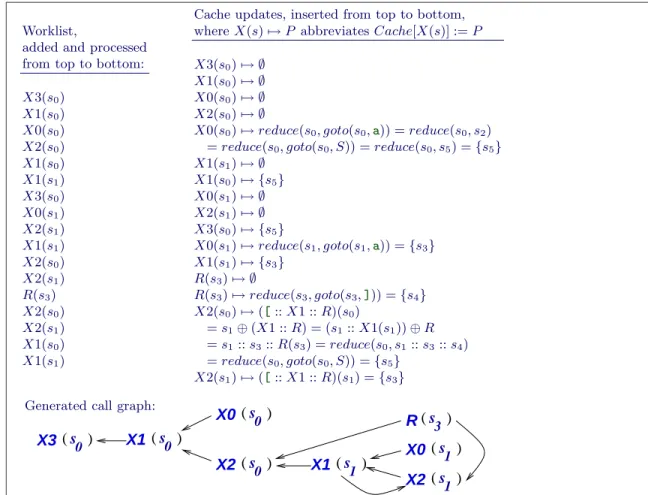
The solution isX3(s0) =s5, validating that the strings printed at the hot spot must beS-phrases. Each equation instance,Xi(sj) =Eij, isa first-order data-flow equation. In the example,X1(s1) and X2(s1) are mutually recursively defined, and their solutions are obtained by iteration-until-convergence. The flow-equation set is generated dynamically while the equations are being solved. This is a demand-driven analysis [1, 3, 4], calledminimal function-graph semantics[5], computed by a worklist algorithm.
Worklist,
added and processed from top to bottom:
X3(s0) X1(s0) X0(s0) X2(s0) X1(s0) X1(s1) X3(s0) X0(s1) X2(s1) X1(s1) X2(s0) X2(s1) R(s3) X2(s0) X2(s1) X1(s0) X1(s1)
Cache updates, inserted from top to bottom, whereX(s)7→P abbreviatesCache[X(s)] :=P X3(s0)7→ ∅
X1(s0)7→ ∅ X0(s0)7→ ∅ X2(s0)7→ ∅
X0(s0)7→reduce(s0, goto(s0,a)) =reduce(s0, s2) =reduce(s0, goto(s0, S)) =reduce(s0, s5) ={s5}
X1(s1)7→ ∅ X1(s0)7→ {s5}
X0(s1)7→ ∅ X2(s1)7→ ∅ X3(s0)7→ {s5}
X0(s1)7→reduce(s1, goto(s1,a)) ={s3}
X1(s1)7→ {s3} R(s3)7→ ∅ R(s3)7→reduce(s3, goto(s3,])) ={s4} X2(s0)7→([::X1 ::R)(s0) =s1⊕(X1 ::R) = (s1::X1(s1))⊕R =s1::s3::R(s3) =reduce(s0, s1::s3::s4) =reduce(s0, goto(s0, S)) ={s5} X2(s1)7→([::X1 ::R)(s1) ={s3} Generated call graph:
0 X3( ) s 1 X2( ) s 3 ( ) R s 0 X1( ) s 0 X2( ) s 0 X0( ) s 1 X1( ) s 1 X0( ) s
Fig. 3.Worklist-algorithm calculation of call,X3(s0), in Figure 1
The initialization step places initial call,X0(s0), into the worklist and into the call graph and assigns to the cache the partial solution,Cache[X0(s0)]7→ ∅. The iteration step repeats the following until the worklist is empty:
1. Extract a call,X(s), from the worklist, and for the corresponding flow equation,X =E, compute E(s), folding abstract stacks as necessary.
2. While computingE(s), if a call,X′(s′)is encountered,(i)add the dependency,X′(s′)→X(s), to the call graph (if it is not already present); (ii) if there is no entry forX′(s′) in the cache, then assignCache[X′(s′)]7→ ∅and place X′(s′)on the worklist.
3. WhenE(s)computes to an answer set,P, andP contains an abstract parse stack not already listed in Cache[X(s)], then assignCache[X(s)]7→ (Cache[X(s)]∪P)and add to the worklist allX′′(s′′)such that the dependency,X(s)→X′′(s′′), appears in the flowgraph.
Concrete semantics: A source program computes a store that maps variables to strings. Theconcrete collecting semantics computes a set of stores for each program point; the collecting semantics is then abstracted so that it computes, for each program point, a single store that maps each variable to a set of strings.
The collecting semantics is overapproximated by thedata-flow semantics, which uses flow equations to compute the set of strings denoted by each variable at each program point. In Figure 1, the data-flow semantics computes these values of variablexat the program points:
X0 ={a} X2 ={[s1]|s1∈X1} R={]} X1 =X0∪X2 =X3 LetΣname the states in the parser’sgoto-controller. A parse stack,st∈Σ+
, models those strings that parse tost. Functionγ:P(Σ+)
→ P(String) concretizes a set of parse stacks into a set of strings:
γ(S) ={t∈String|s0::s1::· · ·::sk∈S andparse(s0, t) =s0::s1::· · ·::sk}
Theabstract collecting interpretation,X, computes the set of parse stacks denoted by a program variable. For flow equation,Xi =Ei, the function,Xi:Σ→ P(Σ∗), is defined asXi(s) = [[Ei]](s), where s∈Σ and
[[t]]s={reduce(s, goto(s,t))}, wheretis a terminal symbol [[E1⊔E2]]s= [[E1]]s∪[[E2]]s
[[Xj]]s= [[Ej]]s, whereXj =Ejis the flow equation forXj [[E1·E2]]s={reduce(s, p′)|p′∈([[E1]]s)⊕[[E2]]},
whereS⊕g={p::g(top(p))|p∈S}
wherereduce(s, p) reduces the final states within parse stack,s::p.
reduce(s, p) =
t:=top(p)
if t=sm, the final state for item,T →U1U2· · ·Um·,
then p′:=pop(m, p) // pop m states, corresponding toU
1U2· · ·Um
p′′:=p′::goto(top(s::p′), T)
return reduce(s, p′′) // repeat till finished
else return p //twas not a final state, so nothing to reduce
Fig. 4.Abstract collecting interpretation:Xi(s) = [[Ei]]sdenotes the set of parse stacks generated by parsing the strings denoted byEi, starting from parse states.
3
Abstract parse stacks
In the previous example, the result for each Xi(sj) was a single stack. In general, a set of parse stacks can result, e.g., for
x = ’[’ while ... x = x . ’[’ x = x . ’a’ . ’]’ X0 =[ X1 =X0⊔X2 X2 =X1·[ X3 =X1·a·]
at conclusion,xholds zero or more left brackets and anS-phrase;X3(s0)is the infinite set,{s5, s1:: s3, s1::s1::s3, s1::s1::s1::s3, · · ·}.
To bound the set, we abstract it by “folding” its stacks so that no parse state repeats in a stack. Since Σ, the set of parse-state names, is finite, folding produces a finite set of finite-sized stacks (that contain cycles).
A stack segment like p=s1 :: s1 is a linked list, a graph, s1 s1 , where the stack’s top and bottom are marked by pointers; when we push a state, e.g.,p::s2, we get s1 s1 s2 .
The folded stack is formed by merging same-state objects and retaining all links: s1 s2 . (This can be written as the regular expression,s+1 ::s2.) Folding can apply to multiple states, e.g.,
6 s7 s6 s7 s6 s8
s folds to s6 s7 s8
. For the above example,X3(s0) ={s5, s
+ 1 ::s3}.
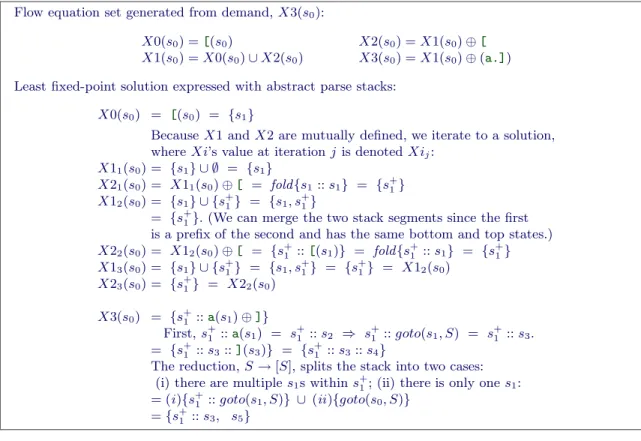
Flow equation set generated from demand,X3(s0):
X0(s0) =[(s0)
X1(s0) =X0(s0)∪X2(s0)
X2(s0) =X1(s0)⊕[
X3(s0) =X1(s0)⊕(a.]) Least fixed-point solution expressed with abstract parse stacks:
X0(s0) = [(s0) = {s1}
BecauseX1 andX2 are mutually defined, we iterate to a solution, whereXi’s value at iterationjis denotedXij:
X11(s0) = {s1} ∪ ∅ = {s1}
X21(s0) = X11(s0)⊕[ = fold{s1::s1} = {s + 1}
X12(s0) = {s1} ∪ {s1+} = {s1, s+1}
= {s+1}.(We can merge the two stack segments since the first is a prefix of the second and has the same bottom and top states.)
X22(s0) = X12(s0)⊕[ = {s+ 1 ::[(s1)} = fold{s + 1 ::s1} = {s+1} X13(s0) = {s1} ∪ {s+1} = {s1, s+1} = {s + 1} = X12(s0) X23(s0) = {s+1} = X22(s0) X3(s0) = {s+1 ::a(s1)⊕]} First,s+ 1 ::a(s1) = s + 1 ::s2 ⇒ s+1 ::goto(s1, S) = s+1 ::s3. = {s+ 1 ::s3::](s3)} = {s+1 ::s3::s4}
The reduction,S→[S], splits the stack into two cases: (i) there are multiples1s withins+1; (ii) there is only ones1: = (i){s+
1 ::goto(s1, S)} ∪ (ii){goto(s0, S)} ={s+
1 ::s3, s5}
Fig. 5.Iterative solution with folded parse stacks, depicted as regular expressions
The result, X3(s0) = {s5, s+1 :: s3}, asserts that the string at X3 might be a well-formed S phrase or it might contain a surplus of unmatched left brackets.
At the end of the calculation in Figure 5, the reduction of S →[S]is done on the folded stack segment,s+1 ::s3::s4, that is, the complete stack iss0 s1 s3 s4 , meaning that three states must be popped: we traverses4,s3, ands1, and follow the links from the last state,s1, to see what the remaining stack might be. There are two possibilities: s0 s1 and s0 . We compute the result for each case, as shown in the Figure.
A set of parse stacks can be soundly approximated by a single, abstract stack: For label setΣ, aΣ-labelled graph,g, is a tuple,hnodesg,edgesg,labelgi, where
– nodesg is a set of nodes,
– edgesg ⊆nodesg×nodesg is a set of directed edges (at most one per source, target node pair),
– andlabelg :nodesg →Σassigns a label to each node.
LetGraphΣ be the set ofΣ-labelled graphs.
Anabstract stackis a triple, (g, bot, top), such thatg∈GraphΣandbot, top∈nodesg mark the bottom
and top nodes of the stack. LetAbsStackΣ be the set of abstract stacks labelled withΣ-values. Example: the stack,s1::s1::s3, is modeled as (h{a, b, c}, {(c, b),(b, a)}, [a7→s1, b7→s1, c7→s3]i, a, c). An abstract stack, (g, bot, top)∈AbsStackΣ, concretizes to a set of parse stacks:
γ(g, bot, top) ={st∈ P(Σ+
)|stis a finite path throughgfromtoptobot}
Two abstract stacks,G1 = (g1, bot1, top1) andG2= (g2, bot2, top2), are composed by :: into the disjoint union ofg1andg2 plus one new edge frombot2totop1:
G1::G2= (hnodesg1 ⊎nodesg2,
edgesg1∪edgesg2 ∪ {(bot2, top1)},
labelg1 +labelg2i, bot1, top2)
An abstract stack is folded (widened) by merging all nodes that share the same label, in effect, equating the nodes with the labels:
fold(g, bot, top) = (h{s∈Σ| ∃n∈nodesg,labelg(n) =s}, {(s, s′)| ∃(n, n′)∈edges
g,labelg(n) =s,labelg(n′) =s′}, λs.si, labelg(bot), labelg(top))
The abstract interpretation of flow equation,Xi =Ei, is the function,
Xi:Σ→ Pfin(AbsStackΣ), defined as
Xi(s) ={fold(p)|p∈[[Ei]](s)}.
This interpretation is sound for the abstract collecting semantics in Figure 4.
A set of abstract stacks can be further abstracted into asinglestack of form,GraphΣ× P(Σ)× P(Σ), by unioning the stacks’ node sets, edge sets,bot-values andtop-values. The resulting ”stack” is asubgraph of the parser’sgoto-controller.
PHP program String−flow Analyzer Abstract Parser ocamlyacc reference grammar data−flow equations LALR(1) table parsed OK parsing ERR hot spot PHP Fig. 7.Implementation
4
Implementation and experiments
The implementation is in Objective Caml. The front end of Minamide’s analyzer for PHP [6] was modified to accept a PHP program with a hot-spot location and to return data-flow equations with string operations for the hot spot.ocamlyaccproduces an LALR(1) parsing table, and the abstract parser uses the data-flow equations and the parsing table to parse statically the strings generated by the PHP program. Abstract parsing works directly on characters (not tokens), so the reference grammar is written for scannerless parsing. (Performance was good enough for practical use.)
We applied our tool to a suite of PHP programs that dynamically generate HTML documents, the same one studied by Minamide [6], using a MacOSX with an Intel Core 2 Duo Processor (2.56GHz) and 4 GByte memory:
webchess faqforge phpwims timeclock schoolmate
files 21 11 30 6 54
lines 2918 1115 6606 1006 6822
no. of hot spots 6 14 30 7 1
no. of parsings 6 16 36 7 19 parsed OK 5 1 19 0 1 parsed ERR 1 15 17 7 18 no. of alarms 1 31 16 14 20 true positives 1 31 13 14 17 false positives 0 0 3 0 3 time(sec) 0.224 0.155 1.979 0.228 2.077
We manually identified the hot spots and ran our abstract parser for each hot spot. Since we do not yet have parse-error recovery, each time a parse error was identified by our analyzer, we located the source of the error, fixed it, and tried again until no parse errors were detected.
All the false-positive alarms were caused by ignoring the tests within conditional commands. The parsing time shown in the table is the sum of all execution times needed to find all parsing errors for all hot spots. The reference grammar’s parse table took 1.323 seconds to construct; this is not included in the analysis times.
webchess faqforge phpwims timeclock schoolmate
files 21 11 30 6 54
lines 2918 1115 6606 1006 6822
no. of hot spots 6 14 30 7 1
no. of parsings 6 16 36 7 19 parsed OK 5 1 19 0 1 parsed ERR 1 15 17 7 18 no. of alarms 1 31 16 14 20 true positives 1 31 13 14 17 false positives 0 0 3 0 3 time(sec) 0.224 0.155 1.979 0.228 2.077 The alarms are classified below:
classification occurrences open/close tag syntax error 11
open/close tag missing 45 superfluous tag 5 improperly nested 14
misplaced tag 5
escaped character syntax error 2
All in all, our abstract parser works without limiting the nesting depth of tags, validates the syntax reasonably fast, and is guaranteed to find all parsing errors reducing inevitable false alarms to a minimum.
Minamide excluded one PHP application, named tagit, from his experiments [6], since tagit generates an arbitrary nesting depth of tags. In principle, our abstract parser should be able to validate tagit, but we also excluded tagit from our studies because the current version of our abstract parser checks that string-update operations satisfy anupdate-invariance property(a string update must preserve the existing parse). Unexpectedly (to us!), so many string updates intagit violated update invariance that our abstract parser generated too many false-positives to be helpful. We can eliminate these false positives with some easy finite-machine theory: every string update, e.g.,
x = ...
replace(pattern, target, x)
defines a f.s.a.-transducer (pattern is an f.s.a.; target is the f.s.a.’s output; x is the input). For each such transducer that appears in flow-equation generation,we compose the transducer with the LR-parse controller, itself a transducer. The compound transducer directs the abstract parse.
We are implementing this technique, which can also be used for input validation and sharpening the results of tests in conditional commands.
5
Conclusion
Injection and cross-site-scripting attacks can be reduced by analyzing the programs that dynamically generate documents [9]. In this paper, we have improved the precision of such analyses by employing LR-parsing technology to validate the context-free grammatical structure of generated documents.
A parse tree is but the first stage in calculating a string’s meaning. The parsed string has a semantics (as enforced by its interpreter), and one can encode this semantics with semantics-processing functions, like those written for use with a parser-generator. (Tainting analysis — tracking unsanitized data — is a simplistic semantic property that is encoded this way.) The semantics can then be approximated by the static analysis so that abstract parsing and abstract semantic processing proceed simultaneously.
This talk is saved atwww.cis.ksu.edu/∼schmidt/papers/hometalks.html
The paper was published at the 2009 Static Analysis Symposium (Springer LNCS 5673). The paper is saved locally atwww.cis.ksu.edu/∼schmidt/papers
References
1. G. Agrawal. Simultaneous demand-driven data-flow and call graph analysis. InProc. Int’l. Conf. Software Maintenance, Oxford, 1999.
2. A.S. Christensen, A. Møller, and M.I. Schwartzbach. Static analysis for dynamic XML. InProc. PLAN-X-02, 2002.
3. E. Duesterwald, R. Gupta, and M.L. Soffa. A practical framework for demand-driven interprocedural data flow analysis. ACM TOPLAS, 19:992–1030, 1997.
4. S. Horwitz, T. Reps, and M. Sagiv. Demand interprocedural dataflow analysis. In Proc. 3rd ACM SIGSOFT Symp. Foundations of Software Engg., 1995.
5. N.D. Jones and A. Mycroft. Data flow analysis of applicative programs using minimal function graphs. InProc. 13th Symp. POPL, pages 296–306. ACM Press, 1986.
6. Y. Minamide. Static approximation of dynamically generated web pages. InProc. 14th ACM Int’l Conf. on the World Wide Web, pages 432–441, 2005.
7. P. Thiemann. Grammar-based analysis of string expressions. InProc. ACM workshop Types in languages design and implementation, pages 59–70, 2005.
8. G. Wassermann, C. Gould, Z. Su, and P. Devanbu. Static checking of dymanically generated queries in database applications. ACM Trans. Software Engineering and Methodology, 16(4):14:1–27, 2007. 9. G. Wassermann and Z. Su. Sound and precise analysis of web applications for injection vulnerabilities.

![Fig. 2. goto controller for S → [S] | a and an example parse of [[a]]](https://thumb-us.123doks.com/thumbv2/123dok_us/353451.2538907/3.918.129.777.97.477/fig-goto-controller-s-s-example-parse.webp)