Cheddar : a Flexible Real Time Scheduling Framework
F. Singhoff, J. Legrand, L. Nana, L. Marc ´e
EA 2215, University of Brest 20, av Le Gorgeu CS 93837, 29238 Brest Cedex 3
{singhoff,jlegrand,nana,marce}@univ-brest.fr
ABSTRACT
This paper describes an Ada framework called Cheddar which provides tools to check if a real time application meets its temporal constraints. The framework is based on the real time scheduling theory and is mostly written for educational purposes. With Cheddar, an application is defined by a set of processors, tasks, buffers, shared resources and messages. Cheddar provides feasibility tests in the cases of monocessor, multiprocessor and distributed systems. It also pro-vides a flexible simulation engine which allows the designer to describe and run simulations of specific systems. The framework is open and has been designed to be easily con-nected to CASE tools such as editors, design tools, simula-tors, ...
Keywords
Real time scheduling, simulation tool.
General Terms
Performance, Reliability, Verification.
Categories and Subject Descriptors
SOFTWARE ENGINEERING [Software/Program
Ver-ification]: Validation
1.
INTRODUCTION
This paper presents a new Ada framework : Cheddar. Cheddar provides services to study the temporal behavior of real time applications. Most of the time, such kinds of appli-cations have to meet temporal constraints such as response time, execution rate or deadline.
To check temporal constraints of an application made of concurrent tasks, system designers have to check if task tem-poral constraints are met. Since 1980, many models, meth-ods and tools were proposed to check if a real time system
Permission to make digital or hard copies of all or part of this work for personal or classroom use is granted without fee provided that copies are not made or distributed for profit or commercial advantage and that copies bear this notice and the full citation on the first page. To copy otherwise, to republish, to post on servers or to redistribute to lists, requires prior specific permission and/or a fee.
SIGAda’04, November 14–18, 2004, Atlanta, Georgia, USA.
Copyright 2004 ACM 1-58113-906-3/04/0011 ...$5.00.
fulfills its requirements (eg. Petri Net [20], Synchronous lan-guages [11], ...). One of them, usually called “Rate Mono-tonic Analysis” is part of a larger set of quantitative meth-ods : the real time scheduling theory. This theory helps the system designer to predict the timing behavior of a set of real time tasks with scheduling simulation and feasibil-ity tests. Scheduling simulation requires, first to compute a scheduling on a given time interval and second, to look for timing properties in this computed scheduling. On the contrary, feasibility tests allow the designer to study a set of real time tasks without computing scheduling.
The first real time scheduling theory contributions were proposed 30 years ago [18]. The theory was strongly ex-tended to cope with many application requirements [14] and was successfully used in many projects [21]. Nevertheless, only few tools were proposed to help system designers to automatically apply these results.
Rapid-RMA [26] and Timewiz [24] seem to be the most complete tools. These tools provide most of the classical scheduling algorithms and feasibility tests. They can be connected to different programs such as CASE tools (eg. Rational Rose), middlewares, operating systems. Unfortu-nately, they are not freely available.
From the academic community, a lot of tools were de-veloped in the past but only few of them seem to be still maintained. Most of the time, they do not provide both simulation and feasibility tests.
TkRTS only focuses on task feasibility tests with various real time schedulers [19]. No scheduling simulation services are proposed and feasibility tests are limited to task response time.
On the contrary, YASA [4] and the tool of the Universit´e Libre de Bruxelle [7] focus on scheduling simulation only. They do not provide feasibility tests. The flexible tool of the Universit´e Libre de Bruxelle provides a language used to describe task models and various schedulers, but the lan-guage itself seems to be hard to use. By the way, all these tools were not designed to work with other programs.
Finally, the MAST [12] Ada framework also provides some basic feasibility tests and simulation services for fixed prior-ity schedulers. The framework is portable enough and open source. Unfortunately, if simulations with a new scheduler or new task activation pattern must be done, the simula-tor has to be modified. Defining specific schedulers may be difficult to do for students.
The Cheddar project was motivated by the lack of free, flexible and open scheduling tools. Then, the design and
the development of the Cheddar framework was conducted to fulfill three main requirements.
First, we aim at providing a framework which implements most of the classical real time scheduling theory methods [10, 14]. Implemented feasibility tests can be applied to monoprocessor and distributed systems with most of usual real time schedulers and task activation patterns. Ched-dar feasibility tests also focus on systems which are less studied by the community such as systems with buffers shared by tasks [15, 23] or task precedency constraints [5, 3, 25]. The program is distributed with publications which describe how to compute feasibility tests. Each result computed by Cheddar is displayed with the ref-erence of the equation used to compute it. Cheddar can then be used by people or students to understand the foundations of real time scheduling theory.
Second, we aim at providing an open, portable and easy to use framework. The framework should remain easy to use even for students or people who do not have a large back-ground on real time scheduling theory. By open, we mean a framework which is easy to connect with other programs (simulators, CASE tools, monitoring services from operat-ing systems, ...). Even if the framework is object oriented, it exports a very simple interface. All data sent to the frame-work or produced by the frameframe-work are XML formatted. For portability and maintainability reasons, the framework is written in Ada. It runs on Solaris, Linux and win32 boxes but should run on every Gnat/GtkAda supported platform. The framework is distributed under the GNU General Public License (see http://beru.univ-brest.fr/~singhoff/cheddar).
Finally, we aim at providing a flexible framework. Since feasibility tests are only available for a few well known sched-ulers and task activation patterns, the Cheddar simulation engine is flexible enough to simulate systems with specific temporal behavior. We propose the use of an Ada-like lan-guage to extend the framework. User extensions expressed with this language are not compiled but interpreted by the framework at simulation time. This makes it possible for the designer to quickly write and test new scheduling features without having a deep knowledge of the framework design and of the Ada language.
This paper is organized as follows. In section 2, we give an introduction to the real time scheduling theory and to the main services provided by the framework. Section 3 gives few details on the design of the scheduling simulation engine and explains how to extend it. Finally, we conclude and give future work in section 4.
2.
FEASIBILITY TESTS AND SIMULATION
SERVICES PROVIDED BY THE
FRAME-WORK
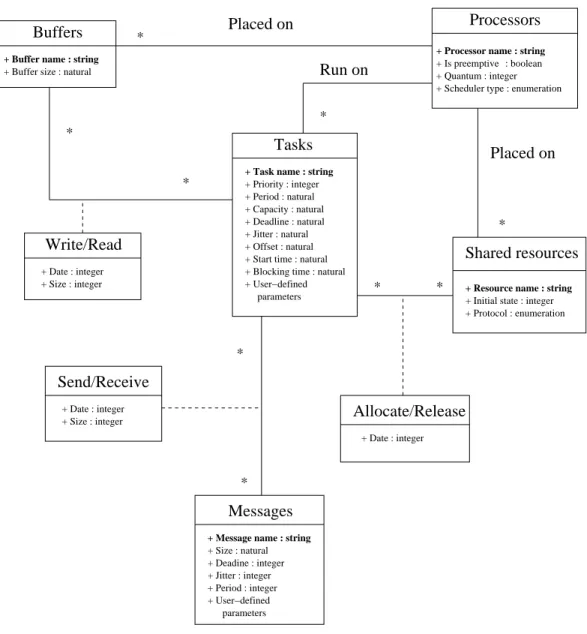
With Cheddar, an application is defined by a set of pro-cessors, buffers, shared resources, messages and tasks (see Figure 2). In the most simple task model, each task period-ically performs a treatment. This “periodic” task is defined by three parameters : its deadline (Di), its period (Pi) and its capacity (Ci). Pi is a fixed delay between two wake up times of the taski. Each time the taskiis woken up, it has to do a job whose execution time is bounded byCi units of time. This job has to be ended beforeDiunits of time after the task wake up time.
From a set of tasks, two kinds of analysis can be
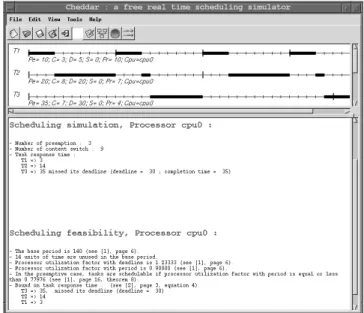
per-Figure 1: The main window of the Cheddar Editor
formed : scheduling simulation and feasibility tests. Scheduling simulation consists in predicting for each unit of time, the task to which the processor should be allocated. Checking if tasks meet their deadline can then be done by analyzing the computed scheduling. Figure 1 shows a set of 3 periodic tasks (T1, T2 and T3) respectively defined by the periods 10, 20 and 35, the capacities 3, 8, 7 and the dead-lines 5, 20 and 30. In the top of the window, the schedul-ing simulation of the task set is displayed. These tasks are scheduled with a preemptive Rate Monotonic sched-uler1. The Cheddar framework provides most of usual real time schedulers [6] such as Earliest Deadline First, Deadline Monotonic, Least Laxity First and POSIX schedulers with
SCHED F IF O, SCHED RR, and SCHED OT HERS
queueing policies. After scheduling, information can be ex-tracted from the simulation (worst/best/average case re-sponse time, worst/best/average case blocking time, number of preemptions, number of context switches, buffer utiliza-tion factor, end to end message communicautiliza-tion delay ...).
For a given task set, if a scheduling simulation is very long to compute [17], feasibility tests can be applied instead (see the bottom of the window, Figure 1). Different kinds of feasibility tests exist. In the sequel, we present three of them : tests based on processor utilization factor, task response time designed to check task deadlines and tests based on buffer utilization factor designed to check buffer overflow.
The first feasibility test consists in comparing the utiliza-tion factor of a processor to a given bound. With a set of periodic tasks, the processor utilization factor can be com-puted with the formula
P
n
i=1CPii, wherenis the number of tasks on the processor. For instance, with a preemptive Rate Monotonic scheduler, Liu and Layland have shown that if the processor utilization factor is less thann(21/n−1), task temporal constraints are met [18].
1With such a scheduler, the task with the lowest period is
+ Size : integer + Date : integer
Allocate/Release
+ Date : integer + Date : integer + Size : integerSend/Receive
* * * *Placed on
Run on
Placed on
* * * * *+ Buffer name : string
+ Buffer size : natural
+ Protocol : enumeration
+ Resource name : string
+ Initial state : integer + Is preemptive
+ Quantum : integer : boolean
+ Processor name : string
parameters
+ Task name : string
+ Priority : integer + Period : natural + Capacity : natural + Deadline : natural + Jitter : natural + Offset : natural + Start time : natural + Blocking time : natural
Write/Read
parameters
+ Message name : string
+ Size : natural + Deadine : integer + Jitter : integer + Period : integer
+ Scheduler type : enumeration
Buffers
Tasks
Processors
Messages
Shared resources
+ User−defined + User−definedFigure 2: UML diagram of an application modeled with Cheddar
The second feasibility test consists in comparing the worst response time of each task with its deadline. The response time is the maximum delay between the time the task be-comes ready to run and the time the task ends its job. In [13, 2, 25], Joseph, Pandia, Audsley et al have shown that
ri, the worst response time of a taski, can be computed as follows : ri= max q=0,1,2,...(Ji+Bi+wi(q)−qPi) (1) where wi(q) = (q+ 1)Ci+ X ∀j∈hp(i) Jj+wi(q) Pj Cj and ∀q:wi(q)≥(q+ 1).Pi
wherehp(i) is the set of tasks which have a priority greater thani,Biis a bound on shared resource blocking times and
Jiis a bound on the task wake up time jitter.
The last feasibility test consists in finding a bound on buffer utilization factor in the case of a buffer shared by pe-riodic tasks scheduled with a fixed priority scheduler. To understand this last test, we study the case of voice trans-mission service provided by the AAL2 layer of ATM net-works. In AAL2/ATM, a producer sends audio packets at a fixed rated. This throughput is expressed in cells per sec-ond, the protocol data unit of ATM networks. A bounded variable delay is required by each cell to go from the sender to the receiver. In an AAL2 communication service, the consumer should receive the cell at the same rate the pro-ducer sends it. Each received cell is then buffered during a sufficient amount of time to hide this variable transmission delay. In [8], it has been shown that the size of the buffer used to hide variable transmission delay is bounded by :
Ready tasks Compute priorities Election Running task Priority stage 00 00 11 11 00 00 11 11 0 0 1 1 Max priority Min priority
Queueing stage Election stage
analysis Do event table results Display XML results XML description of an application (files) Compute scheduling schedulers or
Predefined and user−defined
Predefined and user−defined event analyzers
Event table
(Can be imported/exported from/to XML files)
task activation patterns
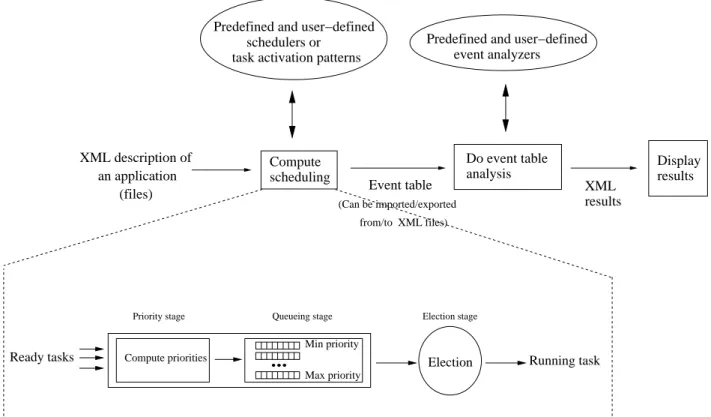
Figure 3: Design of the simulator engine
B= δ d (2)
Whereδis the maximum delay a cell stays in the buffer. We call this delay the maximum memorization delay. We can apply equation (2) to find bound on buffers shared by periodic tasks. For a buffer shared by N periodic producers and 1 periodic consumer, the buffer bound is [15] :
B= max ∀y≥0 0 @ X prod∈P ROD δ+Oprod Pprod −y 1 A (3)
WhereP RODis the set of producers,Pprodthe period of the producerprodand Oprod the maximum delay between the wake up time of the consumer and the wake up time of the producerprod. This bound is based on the maximum memorization delay which is equal toδ= (y+ 2).Pcons for a given message i (y is the number of messages that may already be in the buffer before the message i is inserted;
Pcons is the period of the buffer consumer). From equation (3) and for all possible values ofy, it has been proven that for a buffer shared by 1 periodic consumer and N periodic producers, the buffer bound is [15]:
B= 2.N
if tasks are harmonics2 and
B= 2.N+ 1 in the other cases.
The three feasibility tests presented above are valid for preemptive fixed priority schedulers with periodic tasks. Of course, a large number of results exists for other schedulers (preemptive or not [10]) but also for more complex task sets such as tasks with PIP and PCP shared resources [22], or tasks with precedency constraints [5, 3, 25]. Different kinds of properties can also be checked with feasibility tests (eg. determinist properties such as the ones presented above, but also probabilist properties on task deadlines [16] or buffer utilization factor [23]). The system designer will find some of these extensions implemented in Cheddar. Since the number of feasibility tests is large, each result displayed is presented with the bibliography reference which describes the way to compute it. Finally, Cheddar binaries are distributed with papers introducing each feasibility test.
3.
EXTENDING THE FRAMEWORK
Usual feasibility tests are limited to only few task models (mainly periodic tasks) and to only few schedulers. When an application built with a particular task activation pattern or scheduled with a particular scheduler has to be checked, feasibility tests are not necessarily available. In this case, the only solution consists in analyzing the scheduling simu-lation. Cheddar allows the user to design and easily build
2A task set is said to be harmonic if and only if each task
period is a positive integer multiple of all smaller task peri-ods.
framework extensions to do simulation of user-defined sched-ulers or task activation patterns. By easy, we mean quickly write and test framework extensions without a deep under-standing of the framework design and of the Ada language. We propose the use of a simple language to describe frame-work extensions. Frameframe-work extensions are interpreted at simulation time. As a consequence, they can be changed and tested without recompiling the framework itself.
Figure 3 gives an idea on the way the simulation engine is implemented in the framework. Running a simulation with Cheddar is a three-steps process.
The first step consists in computing the scheduling : we have to decide for each unit of time which events occur. Events can be allocating/releasing shared resources, writ-ing/reading buffers, sending/receiving messages and of cour-se running a task at a given time. At the end of this step, a table is built which stores all the generated events. The event table is built according to the XML description file of the studied application and according to a set of task activa-tion patterns and schedulers. Usual task activaactiva-tion patterns and schedulers are predefined in the Cheddar framework but users can add their own schedulers and task activation pat-terns.
In the second step, the analysis of the event table is per-formed. The table is scanned by “event analyzers” to find properties on the studied system. At this step, some stan-dard information can be extracted by predefined event ana-lyzers (worst/best/average blocking time, missed deadlines ..) but users can also define their own event analyzers to look for ad-hoc properties (ex : synchronization constraints between two tasks, shared resources access order, ...). The results produced during this step are XML formatted and can be exported towards other programs.
Finally, the last step consists in displaying XML results in the Cheddar main window (see Figure 1).
3.1
Defining new schedulers or task activation
patterns
Now, let’s see how user-defined schedulers or task activa-tion patterns can be added into the framework. Basically, all tasks are stored in a simple array called the “TCB ar-ray”. A scheduler has to find a ready task to run from this array. To achieve this, schedulers are built like a three stages pipe-line with :
• A priority stage. For each ready task, a priority is computed.
• A queueing stage. Ready tasks are inserted into different queues. There is one queue per priority level. Each queue contains all the ready tasks with the same priority value. Queues are managed like POSIX sche-duling queues : if a quantum is associated to the sched-uler, queues work like the SCHED RR scheduling queueing policy [9]. Otherwise, the SCHED F IF O
queueing policy is applied.
• An election stage. The scheduler looks for the non empty queue with the highest priority level and al-locates the processor to the task at the head of this queue. The elected task keeps the processor during one unit of time if the designed scheduler is preemp-tive or during all its capacity if the scheduler is not preemptive.
Defining a new scheduler is simply overloading some of the pipe-line stages. Schedulers defined by users are stored together with XML application description files and are or-ganized in “sections”. Each section gives the statements that the simulator engine should run during simulation. A scheduler can be composed of a start section, apriority
section, anelectionsection and atask activationsection. In thestart section, the designer can declare variables that he needs and can put the initialization code. Two vari-able families exist : static and dynamic varivari-ables. Static variables describe the studied application and are defined by XML tags of application description files (see Figure 2). Values of static variables never change during simulation and are read from the XML application description files. Dynamic variables are data collected by the framework at simulation time. They show the state of tasks, processors and the other elements of the studied application during the simulation.
All variables used in a scheduler should have a type. The framework provides two type families : scalar types (double,
integer,boolean, ...) and arrays. An array is a type which stores one scalar data per task, message, buffer or shared resource. Vectorial operations can be done on this kind of variable.
Thepriority sectioncontains the code necessary to com-pute task priorities. The code given here is called each time a scheduling decision has to be taken (at each unit of time for preemptive schedulers and when a task stops running in the non preemptive case).
The election section. In this section, the scheduling simulator engine decides which ready task should receive the processor for the next units of time.
Finally,the task activation sectiondescribes how tasks will be activated during a simulation. In Cheddar, 3 kinds of predefined task activation patterns exist : aperiodic, pe-riodic and “Poisson process”. Apepe-riodic tasks are activated only once and periodic or “Poisson process” tasks can be activated several times. In the case of periodic tasks, two successive task activations are delayed by a fixed amount of time called a period. In the case of Poisson process tasks, two successive task activations are delayed by an exponen-tial random delay. If necessary, the designer can define more complex task activation patterns in this section (ex : spo-radic task, randomly activated task, burst of activations, ...).
Now, let’s see some scheduler examples. The most simple scheduler can be defined as below :
election section:
return min to index(period);
Figure 4: A simple Rate Monotonic scheduler
This first scheduler allocates the processor to the task with the smallest period : it’s a Rate monotonic scheduler [6]. period is a predefined static variable initialized from the XML application description files modeling the stud-ied application. To implement a Rate Monotonic scheduler, no priorities are computed and no variables are necessary. Then, the scheduler designer does not have to redefine the start and the priority sections.
The election section contains a return statement to inform the framework which task should run during the next units of time. The return statement uses amin to indexfunction. This function performs a vectorial operation : it scans the TCB array to find the ready task with the minimum value for the static variableperiod.
The second example is an ARINC 6533 scheduler. It shows a complete scheduler example. An ARINC 653 sys-tem is composed of several partitions. A partition is a unit of program and is itself composed of processes and memory spaces. A processor can host several partitions. Two lev-els of scheduling exist in an ARINC 653 system : partition scheduling and process scheduling.
1. Process scheduling. In one partition, processes are scheduled according to their fixed priority. The sched-uler is preemptive and always gives the processor to the highest fixed priority ready task of the partition. When several tasks of a partition have the same prior-ity level, the oldest one is elected.
2. Partition scheduling. Partitions share the processor in a predefined way. On each processor, partitions are activated according to an activation table. This table is built at design time and defines a cycle of parti-tion scheduling. The table describes for each partiparti-tion when it has to be activated and how much time it has to run.
Figure 5: An example of ARINC 653 scheduling
Figure 5 displays an example of ARINC 653 scheduling. The system is made of 3 tasks hosted by one processor. The processor owns 2 partitions : partitions P0 and P1. The taskT1P0 runs on the partitionP0 and the two others run on the partitionP1. Tasks have a fixed priority :T2P1 is the highest priority level task andT1P0 is the lowest one. The cyclic partition scheduling has to be done so that P0 runs before P1. In each cycle, P0 should run during two
3ARINC 653 is a standard interface for avionic applications.
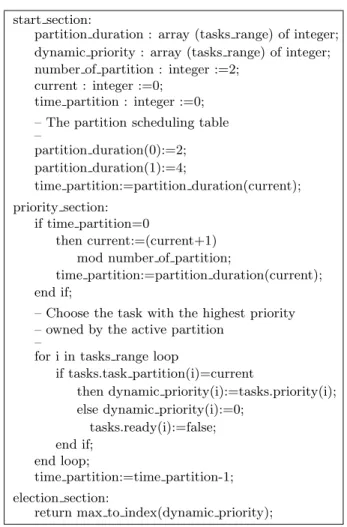
units of time and P1 should run during four units of time. To achieve this scheduling, a possible user-defined scheduler is the one given in Figure 6.
start section:
partition duration : array (tasks range) of integer; dynamic priority : array (tasks range) of integer; number of partition : integer :=2;
current : integer :=0; time partition : integer :=0; – The partition scheduling table –
partition duration(0):=2; partition duration(1):=4;
time partition:=partition duration(current); priority section:
if time partition=0
then current:=(current+1) mod number of partition;
time partition:=partition duration(current); end if;
– Choose the task with the highest priority – owned by the active partition
–
for i in tasks range loop
if tasks.task partition(i)=current
then dynamic priority(i):=tasks.priority(i); else dynamic priority(i):=0;
tasks.ready(i):=false; end if;
end loop;
time partition:=time partition-1; election section:
return max to index(dynamic priority);
Figure 6: Process and partition scheduling in an ARINC 653 system
In Figure 6,task partitionis a static variable defined by the user and taken from XML application description files. For each task,task partitionstores the partition on which it should run. The variable partition duration stores the partition cyclic activation table. Finally,dynamic priority
is computed according to the partition scheduling and to the task fixed priority.
3.2
Looking for ad-hoc properties
In the same way that users can define new schedulers, Cheddar makes it possible to create user-defined event ana-lyzers. These event analyzers are also written with an Ada-like language and interpreted at simulation time.
The event table produced by the simulator records events related to task execution and related to objects that tasks access. Event examples stored in this table can be :
• Events produced when a task becomes ready to run (event task activation), when a task starts or ends running its capacity (eventsstart of task capacityand
start section: i : integer :=0;
number T1 P0 : integer :=0 number T2 P1 : integer :=0 jitter bound : integer;
max jitter : integer := integer’first; min jitter : integer := integer’last; jitter : integer;
T1 P0 end time : array (time units range) of integer; T2 P1 end time : array (time units range) of integer; gather event analyzer section:
if (events.type = “end of task capacity”) then if (events.task name = “T1 P0”) then T1 P0 end time(number T1 P0):= events.time; number T1 P0:=number T1 P0+1; end if; if (events.task name = “T2 P1”) then T2 P1 end time(number T2 P1):= events.time; number T2 P1:=number T2 P1+1; end if; end if;
display event analyzer section:
while (i<number T1 P0) and (i<number T2 P1) loop jitter:=abs(T1 P0 end time(i)-T2 P1 end time(i)); min jitter:=integer’min(jitter, min jitter);
max jitter:=integer’max(jitter, max jitter); i:=i+1;
end loop;
jitter bound:=abs(max jitter-min jitter); put(min jitter);
put(max jitter); put(jitter bound);
Figure 7: Example of user-defined event ana-lyzer : computing task termination jitter bound
• Events produced when a task reads or writes data from/to a buffer (events write to buf f er and read
-f rom bu-f -f er),
• Events produced when a task sends or receives a mes-sage (eventssend to messageandreceive f rom mes
-sage),
• Events produced when a task starts waiting for a busy resource (eventwait f or a resource), allocates or re-leases a given resource (eventsallocate resourceand
release resource). • ...
Each of these events is stored with the time it occurs and with information related to the event itself (eg. name of the resource, of the buffer, of the message, of the task ...).
The event table is scanned sequentially by event analyz-ers. User-defined event analyzers are composed of several sections : astartsection, a datagatheringsection and an
analyse and displaysection.
As user-defined schedulers, thestartsection is devoted to variable declarations and initializations.
Thegatheringsection contains code which is called for each item of the event table. Most of the time, this sec-tion contains statements which extract usefull data from the event table, and store them for the event analyzer.
Finally, the display section performs analysis on data previously saved by thegatheringsection and displays the results in the main window of the Cheddar Editor.
Figure 7 gives an example of user-defined event analyzer. From an ARINC 653 scheduling this event analyzer com-putes the minimum, the maximum and the jitter on the delay between end times of two tasks owned by different partitions (tasksT1P0 andT2P1 ; see Figure 5).
4.
CONCLUSION AND FUTURE WORK
This paper presents an Ada framework designed to check task temporal constraints. The framework implements most usual parts of the real time scheduling theory and has been mostly written for educational purposes. It provides two kinds of features : feasibility tests and a scheduling simula-tion engine. Feasibility tests allow the designer to predict task temporal constraints without computing the scheduling of the application. On the contrary, the simulation engine first computes the scheduling of the application and then, applies event analyzers to check/look for properties.
The framework has been designed to be open and flexible. By open, we mean a framework easy to connect with other CASE tools. Data sent to the framework or received from the framework are XML formatted.
By flexible, we mean a framework which can be extented to run specific schedulers, to do specific analysis or to sched-ule tasks with particular activation patterns. We propose the use of an Ada-like language. Schedulers, task activation patterns and event analyzers expressed with this language are not compiled but interpreted by the framework during simulation. This solution makes it possible to quickly write and test framework extensions without a deep knowledge of the framework design and of the Ada language.
The framework provides predefined services for basic task models and schedulers for both uniprocessor and multipro-cessor architectures. Currently, the team is working on some important missing features.
First, Cheddar aims at doing analysis of applications that contain tasks sharing buffers. The current Cheddar release provides tools to predict buffer utilization when buffer pro-ducers and consumers are periodic tasks [15]. This feature will be extended in the next Cheddar release in order to take into account the case of randomly activated tasks [23].
Second, the simulator engine supports distributed schedul-ing simulation but users have to give a worst case communi-cation delay for each message. As in the case of user-defined schedulers, a way to express specific message scheduling will be given.
Finally, we are looking for a method to do model-checking of user-defined framework extensions.
5.
ACKNOWLEDGMENTS
We would like to thank the students who worked on this project and the reviewers of this article for their english advices.
6.
REFERENCES
[1] Arinc.Avionics Application Software Standard Interface. The Arinc Committee, January 1997. [2] A. N. Audsley, A. Burns, M. Richardson, and
K. Tindell. Applying new scheduling theory to static priority pre-emptive scheduling.Software Engineering Journal, pages 284–292, 1993.
[3] J. Blazewicz. Scheduling Dependant Tasks with Different Arrival Times to Meet Deadlines. In. Gelende. H. Beilner (eds), Modeling and Performance Evaluation of Computer Systems, Amsterdam, Noth-Holland, 1976.
[4] J. Blumenthal, olatowski, J. Hildebrandt, and D. Timmermann.Framework for validation and Analysis of Real time Scheduling Algorithms and scheduler implementations. University of Rostock, Technical report available from
http://yasa.e-technik.uni-rostock.de/, 2003. [5] H. Chetto, M. Silly, and T. Bouchentouf. Dynamic
Scheduling of Real-time Tasks Under Precedence Constraints .Real Time Systems, The International Journal of Time-Critical Computing Systems, 2(3):181–194, September 1990.
[6] F. Cottet, J. Delacroix, C. Kaiser, and Z. Mammeri.
Scheduling in Real Time Systems. John Wiley and Sons Ltd editors, 2002.
[7] S. Devroey, J. Goossens, and C. Hernalsteen. A generic simulator of real-time scheduling algorithms. pages 242–249. Proceedings of the 29th Annual Simulation Symposium, New Orleans, Louisiana, April 1996.
[8] M. Gagnaire and D. Kofman.R´eseaux Haut D´ebit : r´eseaux ATM, r´eseaux locaux, r´eseaux tout-optiques. Masson-Inter Editions, Collection IIA, 1996. [9] B. O. Gallmeister.POSIX 4 : Programming for the
Real World. O’Reilly and Associates, January 1995. [10] L. George, N. Rivierre, and M. Spuri. Preemptive and
Non-Preemptive Real-time Uni-processor Scheduling. INRIA Technical report number 2966, 1996.
[11] P. L. Guernic, T. Gautier, M. L. Borgne, and C. L. Maire. Programming real time applications with SIGNAL. INRIA-RENNES, Rapport num´ero 1446, 1991.
[12] M. G. Harbour, J. G. Garca, J. P. Gutirrez, and J. D. Moyano. MAST: Modeling and Analysis Suite for Real Time Applications. pages 125–134. Proc. of the 13th Euromicro Conference on Real-Time Systems, Delft, The Netherlands,, June 2001.
[13] M. Joseph and P. Pandya. Finding Response Time in a Real-Time System.Computer Journal,
29(5):390–395, 1986.
[14] M. H. Klein, T. Ralya, B. Pollak, R. Obenza, and M. G. Harbour.A Practitioner’s Handbook for Real Time Analysis. Kluwer Academic Publishers, 1994. [15] J. Legrand, F. Singhoff, L. Nana, L. Marc´e,
F. Dupont, and H. Hafidi. About Bounds of Buffers Shared by Periodic Tasks : the IRMA project. In the 15th Euromicro International Conference of Real Time Systems (WIP Session), Porto, July 2003. [16] J. P. Lehocsky. Real Time Queueing Theory. pages
186–194. Proceedings of the 17th IEEE Real-Time Systems Symposium (RTSS ’96), Washington, DC, USA, December 1996.
[17] J. Leung and M. Merril. A note on preemptive scheduling of periodic real time tasks.Information processing Letters, 3(11):115–118, 1980.
[18] C. L. Liu and J. W. Layland. Scheduling Algorithms for Multiprogramming in a Hard Real-Time
Environnment.Journal of the Association for Computing Machinery, 20(1):46–61, January 1973. [19] J. Migge.Real-time scheduling: a trajectory based
model. PhD Thesis, University of Nice Sophia Antipolis, November 1999.
[20] J. L. Peterson.Petri Net theory and the Modelling of Systems. Prentice Hall, 1981.
[21] SEI. The Rate Monotonic Analysis. Technical report, In the Software Technology Roadmap.
http://www.sei.cmu.edu/str/descriptions/rma bo-dy.html, September
2003.
[22] L. Sha, R. Rajkumar, and J. Lehoczky. Priority Inheritance Protocols : An Approach to real-time Synchronization.IEEE Transactions on computers, 39(9):1175–1185, 1990.
[23] F. Singhoff, J. Legrand, L. Nana, and L. Marc´e. Extending Rate Monotonic Analysis when Tasks Share Buffers. In the DAta Systems in Aerospace conference (DASIA 2004), Nice, July 2004. [24] TimeSys.Using TimeWiz to Understand System
Timing before you Build or Buy. White paper, http://www.timesys.com/index.cfm?bdy=home
bdy-library.cfm, 2002.
[25] K. W. Tindell and J. Clark. Holistic schedulability analysis for distributed hard real-time systems.
Microprocessing and Microprogramming, 40(2-3):117–134, April 1994.
[26] Tri-Pacific.Rapid-RMA : The Art of Modeling Real-Time Systems.
http://www.tripac.com/html/prod-fact-rrm.html, 2003.