Clock-driven distributed real-time implementation of
endochronous synchronous programs
D. Potop-Butucaru
INRIA Rocquencourt, FranceR. de Simone
INRIA Sophia Antipolis,France
Y. Sorel
INRIA Rocquencourt, France
J.-P. Talpin
INRIA Rennes, France
ABSTRACT
An important step in model-based embedded system de-sign consists in mapping functional specifications and their tasks/operations onto execution architectures and their ressources. This mapping comprises both temporal scheduling and spa-tial allocation aspects. Therefore, we promote an approach which starts from loosely-timed/asynchronous models and proceeds by refining them to fully synchronized ones, using so-called clock calculus techniques under the architecture constraints. In this paper we provide a modeling frame-work based on an intermediate representation format, called clocked graphs, for polychronous endochronous specifications, which are the ones that can be safely considered for deter-ministic distributed real-time implementation using static scheduling techniques. Our formalism allows the specifica-tion of both “intrinsic” correctness properties of the speci-fication, such as causality and clock consistency, and “ex-ternal” correctness properties, such as endochrony, which ensure compatibility with the desired implementation archi-tecture, including both hardware and software aspects. Us-ing this formalism, we define a new method for distributed real-time implementation of synchronous specification. The move from (endochronous) synchronous specification to real-time scheduled implementation is a seamless sequence of model decorations.
Categories and Subject Descriptors
D.3.4 [Programming Languages]: Processors—Code gen-eration, Optimization; D.4.7 [Operating systems]: Or-ganization and Design—Distributed systems, Real-time sys-tems and Embedded syssys-tems
Keywords
synchronous model, intermediate representation, clock cal-culus, distributed real-time scheduling
Permission to make digital or hard copies of all or part of this work for personal or classroom use is granted without fee provided that copies are not made or distributed for profit or commercial advantage and that copies bear this notice and the full citation on the first page. To copy otherwise, to republish, to post on servers or to redistribute to lists, requires prior specific permission and/or a fee.
EMSOFT 2009 Grenoble, France
Copyright 200X ACM X-XXXXX-XX-X/XX/XX ...$5.00.
1.
INTRODUCTION
Synchronous reactive formalisms [1, 2] are modeling and programming languages used in the specification and analy-sis of safety-critical embedded systems. They comprise (syn-chronous) concurrency features, and are based on the Mealy machine paradigm: Input signals can occur from the en-vironment, possibly simultaneously, at the pace of a given global clock. Output signals and state changes are then com-puted before the next clock tick, grouped as oneatomic re-action, also calledexecution instant. Because common com-putation instants are well-defined, so is the notion of signal absenceat a given instant. Reaction to absence is allowed, i.e., a change can be caused by the absence of a signal on a new clock tick. Since component inputs may become local signals in a larger concurrent system,absentvalues may have to be computed and propagated, to implement correctly the synchronous semantics.
When an asynchronous, possibly distributed implementa-tion is meant, where possibly distributed components com-municate via message passing, the explicit propagation of all absent values may clog the system to a certain extent. A natural question arises: when can one dispose of such ab-sent signal communications? Sufficient conditions, known as (weak) endochrony [3, 4, 5], have been introduced in the past to figure when the absent values can be replaced in the implementation by actual absence of messages without af-fecting its correctness and determinism. These conditions establish that compound reactions that are apparently syn-chronous can be split into independent smaller reactions that are asynchronously feasible in a confluent way (as coined by R. Milner [6]), so that the first one does not discard the sec-ond. This is also linked to the Kahn principles for networks [7], where only internal choice is allowed, in order to ensure that overall lack of confluence cannot be caused by input signal speed variations.
In this paper, we use these theoretical results as the foun-dation of a new method for distributed real-time implemen-tation of synchronous specifications. Following the tradi-tional approach in compiler development, our method is centered around a new intermediate representation format, calledclocked graphs (CG). On one hand, this format allows the faithful representation of specifications written in high-level synchronous languages like Esterel [8], Scade/Lustre [9], Signal [4], or discrete Scicos [10], including some struc-tural information that can be used for efficient code gener-ation purposes. On the other hand, a CG specification is
close enough to the target machine code to allow fine ma-nipulations such as scheduling, allocation, and optimization. We focus in this paper on the real-time implementation of CGspecifications on distributed hardware architectures (a large corpus of work exists on the translation of high-level synchronous specifications into intermediate representations related to ours).
TheCGrepresentation is based on the separation of com-putations, under the form of adataflow graph, from control, under the form ofclockswhich identify the synchronous ex-ecution instants where the dataflow elements are executed. The two parts are interconnected, as all computations and communications are associated a clock defining their execu-tion condiexecu-tion, and clocks may depend on values computed by the dataflow.
We stress the clock-driven specificity of our method. Clocks are logical activation condition defining the sequence of syn-chronous execution instants where some computation or com-munication takes place. While such activation conditions are traditionally represented withevents, the activation events associated with our clocks arelogical, in the sense where they are computed by the system itself at each execution instant, and not received from the exterior (e.g. under the form of interrupts). This model is nowadays common in computer science and engineering, even at hardware level whereclock gatingtechniques are used to minimize power consumption. The implementation of our CG specifications is defined as a sequence of transformations which gradually add infor-mation to the representation. The first implementation step is to make explicit the dependencies between the compu-tations of the various logical clocks in aclocked graph with dependencies (CGd). Then, we provide conditions deter-mining when such a graph is endochronous. Endochrony being a scheduling-independence criterion, we know that for endochronous clocked graphs (CGe), untimed asynchronous simulation is deterministic and equivalent with the synchronous semantics.
The last step of our implementation process produces a real-time schedule by assigning real-time dates and execu-tion ressources (processors and buses) to each element of a CGe. This approach, inspired from the AAA/SynDEx methodology [11], results in ascheduled clocked graph (CGsch) that describes the real-time scheduling of one clock cycle. The execution of the scheduled implementation is an infinite repetition of such execution instants. The difficulty here is to ensure the consistency between the logical clocks of the CGespecification and the retime dates and ressource al-locations of theCGschscheduled implementation. We pro-vide a scheduling algorithm ensuring by construction these consistency properties, and we compare it with the existing one of SynDEx. For simplicity, we restrict ourselves to sim-ple target hardware architectures formed of a unique asyn-chronous message-passing broadcast bus that connects a set of (possibly different) sequential processors. We also make the simplifying assumption that the bus is reliable, which is realistic in certain settings for real-life buses such as CAN [12, 11], pending the use of fault tolerant communication libraries and a reliability analysis that are not covered in this paper. Our scheduling technique also works for static TDMA buses such as TTA or FlexRay (static segment), but does not take full advantage of the time-triggered nature of these architectures. Future work will cover better im-plementations on time-triggered and heterogenous
architec-tures and more complex interconnect topologies.
2.
RELATED WORK
Our work is closely related to the work of Benvenisteet al. on tagged systems [13]. Indeed, the main originality of our work – the combination of logical clocks and “real” time in a single formalism – occurs in the form of a time refinement, which can be modeled using tag refinements. The difference is that we also need to deal with spatial allocation issues, causality, and that we focus on specific time models in order to give efficient implementation algorithms.
The second main inspiration of this work is the AAA/SynDEx methodology for distributed real-time implementation of syn-chronous specifications [11]. The scheduling approach we use here is much inspired from the SynDEx one. The dif-ference is that SynDEx does not treat clocks as first-class citizens, allowing their definition only through structured dataflow constructs. By consequence, execution conditions of a specification are often pessimistic, which also pessimizes the implementation. Our work provides, on one hand, a more flexible language supporting better specifications and implementations and on the other hand, a more general for-mal framework for reasoning about the correctness of such implementation processes.
The third main inspiration of our work is the previous work on endochrony, already mentioned above. Our work extends this line by proposing a formalism combining the manipulation of endochronous logical clocks with that of “real” time. In this sense, it goes beyond results on the im-plementation of the Signal/Polychrony language [14]. Also related to Signal are the results of Kountouris and Wolinski [15] on the scheduling ofhierarchical conditional dependency graphs, a formalism allowing the representation of data de-pendencies and execution conditions. The main difference with our work is that we focus on timed and distributed implementation, whereas Kountouris and Wolinski focus on optimizing mono-processor untimed implementations.
The intermediate representation proposed in this paper is also inspired from the large corpus of work concerning clock analysis and the compilation of synchronous languages.
We also mention here the large corpus of work on opti-mized distributed scheduling of dataflow specifications onto time-triggered architectures [16, 17]. Given the proximity of the specification formalism, we insist here on the work of Caspiet al. on the distributed scheduling of Scade/Lustre specifications onto TTA-based architectures [18]. The main difference is that in TTA-based systems communications must be realized in time slots that are statically assigned to the various processors.
3.
INTERMEDIATE REPRESENTATION
This section defines the syntax of clocked graphs. A clocked graph is a dataflow graphGwhose elements (nodes and arcs) are labelled with clocks. We first introduce the clock defi-nition language, which is the focus of our approach. Then, we introduce the dataflow constructs, and conclude with an example.
3.1
Clocks
Clocks represent execution conditions defining when a com-putation or communication is performed, or when some data is available to be used in computations. In our purely
syn-instant 1 2 3 4 5 6 7 8 9 output portx 5 4 3 2 1 0 -1 -2 -3 true 1 1 1 1 1 1 1 1 1 x >0 1 1 1 1 1 0 0 0 0 (01)∗ 0 1 0 1 0 1 0 1 0 0(01)∗ 0 0 1 0 1 0 1 0 1 (x >0)∧(01)∗ 0 1 0 1 0 0 0 0 0 (01)∗.0(01)∗ 0 0 0 0 1 0 0 0 1
Figure 1: Examples of clocks
chronous setting, clocks are functions associating to each execution instant a value of 1 (true, active) or 0 (false, in-active). A computation or communication whose clock isc will be executed in the execution instants where cis true. We define here the syntax allowing the definition of clocks.
Regular repetitions of active and inactive instants, such as data-independent counters, are specified using ultimately periodic infinite Boolean words of the formwt(wp)∗, where
wt, wpare finite words over {0,1}, andwt(wp)∗ stands for
the infinite word starting withwt and continuing with an infinite sequence of wp. For instance, 11(001)∗ stands for 11001001001. . .. The constant clocks are denoted true = (1)∗andfalse= (0)∗.
Conditional data-dependent computations are represented using Boolean expressions over the output ports of the dataflow nodes.1 For instance, ifois an integer output port of dataflow
noden, o = 3 is the clock defining the execution instants whereohas a value of 3. Similarly,o1 =o2 intuitively
de-fines execution instants whereo1equalso2. Much effort will
be dedicated in the following sections to ensure that the ar-guments needed to compute such clocks are available when the Boolean expressions are evaluated.
These elementary clocks (constants, ultimately periodic words, and Boolean atoms) can be composed using:
• The Boolean combinators ∧, ∨, and ¬, which work instant-wise. For instance,c1∧c2is true at execution
instants where bothc1andc2are true. We also denote
with c1 \c2 = c1 ∧ ¬c2 the difference operators on
Booleans and clocks.
• The subclock operator c1.c2, which evaluates c2 only
on instants where c1 is true. The subclock operator
is different from a simple conjunction. When c2 is a
ultimatelly periodic word, we advance inc2only when
c1 is true. Whenc2 is a Boolean expression, we need
its arguments only whenc1 is true.
Fig. 1 gives examples of clocks, both elementary and com-posed.
3.1.1
Clock semantics
In the synchronous model, each variable (output port of a dataflow node1) is either absent in an execution instant, or
is assigned a unique value that will be used in computations throughout the instant. To facilitate notations, we shall append to the data domains of all the output ports of the specification a special value⊥that denotes the absence of a value in a given execution instant. When a dataflow node
1All dataflow constructs are defined in Section 3.2. We also
explain there why only node outputs are considered.
is not executed in a given instant, all its outputs are set to
⊥. Given a domainD, we shall denoteD⊥=
D ∪ {⊥}. Using this notation, we can represent each clockcwith a predicate defining the instants where the clock is active:
c:N× Y
o∈S n∈NO(n)
D⊥o → {0,1}
whereN is the set of all dataflow nodes of the specification,
O(n) is the set of output ports of node n (defined in the Section 3.2), and Nis the set of positive integer indices of
execution instants.
This interpretation of clocks as predicates naturally orga-nizes the clocks in a Boolean algebra where the Boolean com-binators have their usual meaning.2 We denote with≤the partial order between clocks, wherec1 ≤c2 means that at
each execution instantc2 is true wheneverc1is true. Given
that the subclock operator is non-standard, we list here some of its properties: true.c = c.true= c, false.c = c.f alse = false; associativity: (a.b).c = a.(b.c); left distributivity of the binary Boolean operators: c.(c1opc2) =c.c1opc.c2.
Determining clock inclusion or equality (a form of satisfi-ability modulo theories) is undecidable in the general case, because it involves the complexity of dealing with the func-tions of the dataflow nodes. However, various sufficient con-ditions (and associated decision algorithms, known as “clock calculi”) have been proposed for clock inclusion and equality, ranging from simple syntactical ones (as in SynDex [11]), to BDD-based techniques like those of Kountouris and Wolin-ski [15]. All scheduling algorithms proposed later in this paper are design to function with such sufficient conditions, instead of exact equality and inclusion tests.
3.2
Clocked graphs
A clocked graph is a pairG= (N,A) formed of the set of dataflownodesN and the set ofarcsA. Each noden∈ N
has a set ofnamed input portsI(n), a set of named output ports O(n), and a clock clk(n). The name of a port p is denotedname(p), and we assume that the ports of a node have all different names. The port of namename of noden shall be denoted withn.name. Each input and output port pis assigned a data type (a domain)Dp.
Each dataflow arca∈ Aconnects one output port denoted src(a) to one input port denoteddest(a) upon a communi-cation condition (a clock) denotedclk(a). Therefore:
A ⊆ [ n∈N O(n) ! × [ n∈N I(n) ! × C
where C denotes the set of all clocks that can be defined using the previously-defined syntax. Each arc has a data domainDaand we require that for all arca∈ Awe have:
Dsrc(a)=Ddest(a)=Da
There are two types of dataflow nodes: computations and delays. Computation nodes represent atomic stateless com-putations (function calls) that are completed inside one ex-ecution cycle. The state of the system is maintained by the delays, which allow data to be passed from one execution cycle to the next (but otherwise perform no computation). We denote withNC the set of computation nodes, and with
N∆the set of delays.
2Note that our interpretation means that the set of clocks
c i1 in o1 om f c ∆ i o c i ID o
(computation block) (delay) (identity)
Figure 2: Basic dataflow nodes (identity is a special kind of computation block)
For each computation node n ∈ NC, we assume an im-plementation (a piece of code in a library) is provided that takes as input one value for each input porti∈ I(n) and produces one value for each output port o ∈ O(n). The computation needs not be deterministic, to allow the mod-eling of sensors. It is assumed, however, that no hidden dependencies (e.g. side effects on unspecified variables) ex-ist between implementations of different nodes, or between successive computations of a given computation node. The computation is assumed to be atomic, in the sense where all inputs are read before performing the computation and before all output is produced.
One particular type of computation node is the identity node that has one input port, named i, one output port, named o, and whose function is identity (copy the value from the input port to the output port). To an identity nodenwe associate its domain Dn, which is the domain of its input and output ports.
A delay δ ∈ N∆ of clock clk(δ) specifies the passing of
values between the successive execution instants defined by clock δ. A delay δ has a data domain Dδ, one input port iof typeDδ, one output portoof typeDδ, and one initial valueδ0 ∈ Dδ. In the first execution instant where clk(δ)
is true,δproducesδ0 through the output port, and reads a
new value through the input port. In subsequent execution instants whereclk(δ) is true, the output port produces the value previously input throughi.
We use for dataflow nodes the simple graphical represen-tations of Fig. 2. Delay nodes are labelled with ∆, identity nodes are labelled withID, and other computation nodes (including non-deterministic ones) are labelled with their computing function.
This paper being focused on code generation and schedul-ing problems that are of a global nature, we do not give provisions for interconnecting dataflow specifications. Our formalism only allows the specification of complete systems, where acquisition of data and actuation is represented with computation nodes (non-deterministic for the sensing part). However, extending the formalism to allow composition can be easily done.
Derived dataflow blocks.
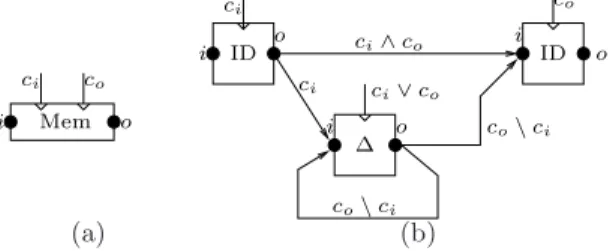
The semantics of our format will be directly defined for the previously-defined “primitive” dataflow constructs. How-ever, we allow the definition of derived dataflow constructs that serve as syntactic sugar at specification time, and which may be directly used (for efficiency purposes) by analysis and optimization algorithms. The definition of a derived dataflow block includes the syntax of the block, and its semantics under the form of an expansion over primitive dataflow. Fig. 3 provides one example of derived block: the classical memory cell that can be written and read at
differ-co Mem i o ci co\ci ci∨co ∆ i o co\ci ci co i ID o ci∧co i ID o ci (a) (b)
Figure 3: The memory cell written on clock ci and read on clock co: graphical representation (a) and semantics by expansion (b).
ent rates (as opposed to the synchronizing message passing philosophy of delays).3 Its definition by expansion is given
in Fig. 3, and also shows the form of our dataflow specifica-tions.
3.3
Example
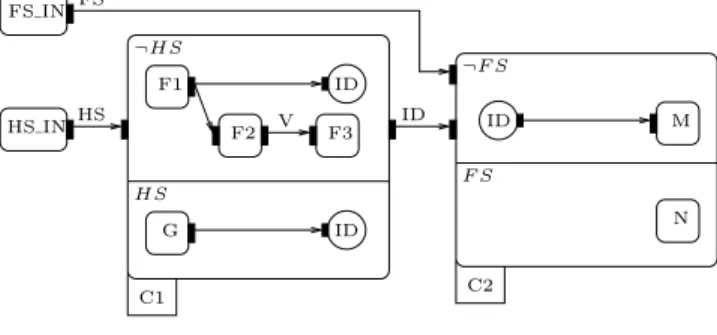
We give in Fig. 4 the intermediate representation corre-sponding to the simple SynDEx synchronous specification of Fig. 5. The specification represents a system with two switches (Boolean inputs) controlling its execution: high-speed (HS) vs. low-high-speed (¬HS), and fail-safe (F S) vs. normal operation (¬F S). In the low-speed mode, more op-erations can be executed, whereas in the fail-safe mode the operation that gets executed (N) does not use any of the inputs, because the sensors or treatment chain are assumed to be faulty (control is done using default values).
The behavior of ourCGrepresentation is: NodesF S IN and HS IN have clock true, so they are executed at each execution cycle to read F S and HS. If HS = false then clock ¬HS is true for the instant, which triggers the exe-cution of F1, followed by F2 and F3. Otherwise, execute G (on clock HS). Clock dependencies, such as clock HS depending on the output portHS IN.HS, are not explicit. Both F1 and G are computing through their output ports namedIDthe SynDEx-level output value ID of the hierar-chical conditional node C1. The execution of M (on clock
¬F S) can start after IDis received from either F1 orG. The execution of N can start as soon as we can determine thatF S istruefor the instant.
Dataflow blocks having no dependency between them can be executed in parallel. For instance, if F S = true then N can be executed as soon asF S is read, independently of the execution of F1, F2, F3, or G. On the contrary, the computation of M must wait until both F S and ID have arrived.
3.4
Clocked graph semantics
The previously-defined formalism allows the representa-tion of programs written in languages such as Esterel [8], Scade/Lustre [9], Signal [4], or discrete Scicos [10]. In par-ticular, it is flexible enough to allow the definition of se-mantics compatible to the sese-mantics of the aforementioned
3The functioning of the memory element is as follows: Whenever
reading and writing occur in the same synchronous instant, the input value is directly copied to the output, hence theci∧coclock on the
arc between the two identity blocks. When reading occurs without writing (clockco\ci), the value is taken from the delay element. Each
write updates the value of the delay (clockci). In instants where the
cell is read, but not written (clockco\ci), we need to explicitly refresh
its delay value (the loopback arc from the output to the input of the delay).
¬HS∧ ¬F S F1 G FS IN HS IN FS HS ¬HS HS ¬HS true true N M F S ¬F S F3 ¬HS ¬HS F2 ¬HS HS∧ ¬F S ID ID ID ID
Figure 4: Example of specification in our formalism
F S F1 ID ID C1 C2 M N G ID F3 F2 V HS IN FS IN FS HS ID ¬HS HS ¬F S
Figure 5: Corresponding SynDEx specification
languages.
However, our goal is the definition of efficient implementa-tions, so we are not only interested in specification correct-ness. Indeed, the remainder of the paper is mostly dedicated to the definitionat the level of our intermediate representa-tionof:
•“Intrinsic” correctness properties of the specification that should be included in all the semantics assigned to the format. Classical correctness properties used in synchronous program analysis, such as causality and clock consistency, fall in this category.
•“External” correctness properties ensuring compatibil-ity with the desired implementation architecture, in-cluding both hardware and software aspects. Such properties are:
– The absence of reaction to signal absence [19], which ensures that a distributed implementation can be constructed that uses absence of messages to encode the signal absence of the synchronous model.
– Endochrony [3], which ensures the existance of a static schedule, which can be computed offline.
– Real-time schedulability [20], which ensures that a schedule exists satisfying the desired real-time constraints.
These properties remain compatible with the semantics of the high-level programming languages, in the sense where they identify (efficiently) implementable sub-classes of se-mantically correct programs. At the same time, however, the definition of these properties requires the refinement of theCGspecification into a real-time implementation.
In this section we only define some of the “intrinsic” cor-rectness properties corresponding to the synchronous hy-pothesis. The next sections shall continue with the intro-duction of endochrony and scheduling properties.
o READ IN T o= 10
Figure 6: A globally non-causal example
To ensure compliance with the synchronous hypothesis and the atomicity assumption for node executions, the com-putation of the dataflow nodes must satisfy at each execution instant 3 correctness properties:
No uninitialized data: All the inputs of a node n are computed and transmitted in instants wherenis exe-cuted. Formally, we require that:
• for alln∈ N and for alli∈ I(n) we have:
clk(n)≤ _
a∈A,dest(a)=i clk(a)
• for alla∈ Awe haveclk(a)≤clk(src(a)). Note that we allow data to be computed and transmit-ted in instants where it is not needed.
Single assignment: Each input of a node n is received from at most one source at each execution instant (no write conflict is possible). Formally, we require that for all a1, a2 ∈ A with dest(a1) = dest(a2) we have
clk(a1)∧clk(a2) =false.
No causality cycle: All cycles in the dataflow graph ei-ther contain a delay node, or have the conjunction of all conditions of all arcs equal to false. This con-dition, specific to the synchronous approach, ensures that the computation of each cycle can be performed in bounded time.
A good abstraction of the last condition is the absence of cycles that contain no delay. However, the acyclicity of the dataflow is not sufficient to ensure by itself the causal cor-rectness of a specification. Indeed, the computation of the clocks may induce additional causal dependencies. For in-stance,we want to reject specifications such as the one in Fig. 6, where the output of a sensor (o) is used to compute its clock. We deal with these issues in the next section.
4.
EFFICIENT IMPLEMENTATION:
USING ENDOCHRONY
We explained in the introduction that endochrony [3] is a scheduling-independence property allowing us to encode signal absence with absence of messages. By consequence, endochrony allows us to perform no computation in parts of the system that are semantically inactive (something which is not possible in the general synchronous model). More-over, endochrony ensures that an asynchronous simulation of the specification gives the same results as the synchronous one. Thus, endochrony identifies synchronous specifications that allow a deterministic and efficient implementation over asynchronous implementation architectures.
We introduce in this section a notion of endochronous clocked graph (CGe)that combines endochrony with dataflow acyclicity using a notion ofendochronous clockwhich we de-fine. The choice is natural, because (1) endochrony is a
sufficient property ensuring the static schedulability of the computations in a synchronous specification, and (2) global acyclicity is a sufficient condition which can be checked us-ing low-complexity algorithms and ensures the absence of causality cycles.
4.1
Clock with dependencies
The definition of endochronous clocked graphs is based on associating to each clock of the clocked graph a data support – the set of all the output ports used in its com-putation, along with the clocks defining the instants where these output ports are needed. In practice, this means that each dataflow element (node or arc)xis assigned not just a clockclk(x), but also a supportsupp(x). We call clocks with dependenciesthe pairs<clk(x),supp(x)>formed of a clock and its support.
The support of a clock with dependencies c is a set of pairso@co, whereois an output port of some noden, and co is a clock defining the instants where the value of o is used in the computation of c. We call the pair o@co the sampling ofoon the clock co. Intuitively, the support of a clock gives sufficient data for some algorithm to compute the clock. For instance, a good support for the clockc= (o1 =
3)∧(o2 = 5) is {o1@true, o2@(o1 = 3)} which corresponds
to the following computation ofc: c = false ; read(o1) ; if(o1 == 3){ read(o2) ; if(o2 == 5) c = true }
Note that a given clock can have several supports. For in-stance, the clockcdefined above also accepts{o2@true, o1@(o2= 5)}
as a support.
Of course, not all pairs formed of a clock and a support are meaningful. For instance,< a= 3,{a@(01)∗}>is not, becauseais needed for the clock computation at all instants, not just once every two instants, as it is specified in the sup-port. To identify meaningful clocks, we introduce the gen-eration relations⊢cstating thatccan be computed from the output port samplings ofs. This relation is inductively defined by the following rules:
1. ∅ ⊢wi(wp)∗, for allwi, wp∈ {0,1}∗
2. {o1@true, . . . , ok@true} ⊢B(o1, . . . , ok), for all Boolean
functionB of argumentso1, . . . , ok
3. ifs⊢cthens⊢ ¬c
4. if s1 ⊢ c1 and s2 ⊢ c2 then s1∪s2 ⊢ c1opc2 for all
binary Boolean operatorop 5. ifs1⊢c1 ands2⊢c2, then
s1∪ {[email protected]|o@c∈s2} ⊢c1.c2
6. ifs⊢cando@c1 ∈s andc2≥c1, then
(s\ {o@c1})∪ {o@c2} ⊢c
7. ifc1=c2ands⊢c1 thens⊢c2.
The first 5 rules naturally build a support for any clock by inductively following its syntax. Rule 6 states that having more information than is strictly necessary does not affect computability. Rule 7 is the most difficult. It states that if two syntaxesc1 and c2 represent the same clock in the
clock algebra, then a support generatingc1 also generates
c2 (meaning that the algorithm used to computec1 can be
used forc2).
4.2
Endochronous clock
Note that the definition of a clock with dependencies may involve recursive computations of other clocks. To ensure that the recursive computation process is finite, we intro-duce the notions of endochronous support and endochronous clock.
We shall say of a supportsthat it isendochronous when-ever we can associate to eacho@c∈sa subsetdep(N,A)
s (o@c)
ofssuch that:
• dep(N,A)
s (o@c)⊢c
• The dependency sets induce a “dependency” partial order over the support sets (there are no cyclic de-pendencies)
Intuitively, this means that there are some samplings in s whose clocks depend on no output ports. Once read, the cor-responding output ports allow the computation of new clock samplings, a.s.o. until all the clocks of the samplings have been computed and all corresponding output ports read. No cyclic computation is possible.
We say that a clock with dependencies < c, s > is en-dochronous whenever s is endochronous and s ⊢ c. Note that the first 5 rules of the previous section can be used to automatically transform any clock into an endochronous one, by assigning it a support.
4.3
Endochronous clocked graph
Consider now a clocked graph where all clocks are clocks with dependencies. We introduce a preorder over the the ports and arcs of the dataflow graph, defined by the generators:
• pafor all outgoing arcaof a portp
• apfor all incoming arcaof a portp
• oxfor all output portoand port or arcxsuch that supp(x) containso@cfor somec
• iofor all input portiand output portoof a node nthat is not a delay
With this definition, we shall say that the clocked graph is endochronous if, by definition:
• is a partial order relation, and
• ifo@cbelongs to the support of some clock ando is an output of noden, thenc≤clk(n)
This criterion ensures a strong form of causal correctness, amounting to acyclicity (including the computation of the clocks), and ensuring the existence of a static schedule of all the operations (including the computation of the clocks).
5.
SCHEDULING CLOCKED GRAPHS
In this section, we provide a method for bulding distributed real-time implementations of endochronous clocked graphs. The definition of the method is intended to show that the our model supports a realistic real-time implementation tech-nique. Therefore, it is restricted to the simple bus-based distributed architectures defined in the introduction. Ex-tensions to cover more complex implementation architec-tures with more complex interconnect topologies and dif-ferent bus types (time-triggered, unicast) are the object of ongoing work.
P2 M=3 F1=3 HS IN=1 FS IN=1 G=3 N=3 F3=2 F3=3 V type=2 ID type=5 boolean=2 F2=8 Asynchronous broadcast bus P1 P3
Figure 7: Hardware architecture
We follow the SynDEx approach [11] by computing a sched-ule for one execution cycle, the global scheduling being an infinite repetition of the scheduling of a cycle. This corre-sponds to the case where the computations of the different cycles do not overlap in time in the real-time implementa-tion.4 Our scheduling method uses a greedy heuristic
in-spired from AAA/SynDEx, but deals with clocks in a finer way, potentially resulting in better real-time schedules.
The remainder of the section is structured in three main parts. We first define the timing information used as input for our scheduling technique. Then, we introduce a model ofscheduled clocked graph (CGsch), obtained by decorating endochronous clock graphs with spatial and temporal alloca-tion informaalloca-tion. We also define sufficient condialloca-tions ensur-ing that the allocation information of anCGschis compati-ble with both the clocks of the initial endochronous clocked graph and the underlying hardware architecture. The sec-ond part introduces a simple scheduling technique generat-ing schedules that satisfy the previously-defined correctness (compatibility) properties. This last part includes a brief comparison with the output of AAA/SynDEx.
5.1
Timing information
We explained in the introduction that we consider in this paper simple distributed architectures formed of a unique asynchronous or static TDMA message-passing reliable broad-cast bus denotedBthat connects a set of sequential proces-sors P ={Pi | i = 1..n}. Fig. 7 pictures an architecture formed of 3 processors connected to the central bus.
The architecture is decorated with timing information that specifes:
• The dataflow functions that can be executed by each processor, and their duration on that processor. Each processor has a list of timing information of the form “node name=duration”.
• The communication operations that can be executed by the bus (the data types that can be sent atomically), and the durations of the communications, assuming the bus is free. The bus has a list of timing information of the form “data type=duration”.
The durations provided for computations and communica-tions must be upper bounds obtained by some worst-case execution time (WCET) analysis. Timing information for one atomic node can be present on several processors, to
4The results of this paper can be extended to the case where
cycles can overlap by considering modulo scheduling tech-niques.
denote the fact that the node can be executed by several processors. For instance, node F3 can be executed on P2 with duration 3, and on P3 with duration 2. We assume that writing a delay, reading a delay, and local communi-cations (that do not use the bus) take no time. We shall denote withdP(n) the duration of computation node non processorP. To represent the fact that a processorP can-not perform computationn, we setdP(n) =∞. We denote withdB(D) the duration of a communication of a value of
typeDover the bus (in the absence of all interference).
5.2
Scheduled clocked graph
In this section we introduce our model of scheduled clocked graph, and give sufficient conditions ensuring that it cor-rectly implements the semantics of the given endochronous clocked graph.
By definition, a scheduled clocked graph is an endochronous clocked graph (N,A) along with a scheduleSof its elements over the ressources of the chosen architecture. Such a sched-ule is formed of:
• An allocation of the delays to processors determining on which processor is stored the delay value between execution cycles:
S∆:N∆→ P
• A set of scheduled functions assigning a processor and a real-time date (an integer) to each computation of the dataflow:
SC:NC→ P ×N
• A set of scheduled communications assigning to each arc of the dataflow the emitter processor, a real-time date, and an effective communication clock:
SA:A → P ×N× C
• For each element of the graph x ∈ N ∪ A, a set of scheduled communications assigning to each sampled output of the supportsupp(x) an emitter processor, a real-time date, and an effective communication clock:
Sx:supp(x)→ P ×N× C For convenience, we denote with:
• tx the real-time date associated byS to any computa-tion node, arc, or sampled output of some support.
• Res(x) the processor associated with each node, arc, or sampled output of some support (the execution pro-cessor for dataflow functions, the storage propro-cessor for delays, and the emitter processor for arcs and support elements).
• e clk(x) the effective communication clock associated with an arc or sampled output.
• d(n) =dRes(n)(n) the duration of a scheduled
compu-tation noden.
• d(x) =dB(Dx) the duration of the scheduled
We say that the scheduleS is partial when eitherS∆orSC
is partial.5 WhenS is a partial schedule of (N,A), then we
allow its incremental completion using the following opera-tor:
• IfS∆(δ) is undefined, then we denote withS∪{δ7→P}
the partial schedule with (S ∪ {δ7→P})∆(δ) =P, and
which equalsSeverywhere else.
• Similarly, we defineS ∪ {n7→(P, t)}whenever SC(n)
is undefined,S ∪ {a7→(P, t, c)}when SA(a) is
unde-fined, andS ∪ {o@co 7→(P, t, c)}whenSx(o@co) is not defined.
Our definition implies that computations are executed on the specification clock (the schedule defines no new clock). However, communications can be realized on a different clock, to avoid cases where a data is transmitted twice on the bus in the same execution instant. In this paper, we interpret the real-time date associated to communications and computa-tions as the latest (worst-case) real-time date at which the execution of the communication or computation will start.
Note that the definition ofSB implicitly assumes that we
make no use of specialized synchronization messages, nor data encoding. We also assume that each operation is sched-uled exactly once inS, meaning that no optimizing replica-tion such as inlining is done. This hypothesis is common in real-time scheduling.
5.3
Consistency of an
CGschThe properties of this section formalize the compatibil-ity between the dates and ressource allocations of a sched-uled clocked graph and the logical clocks of the underly-ing endochronous clocked graph. These properties depend on chosen target architectures, and extending the schedul-ing techniques to new architectures consists in definschedul-ing new consistency properties.
5.3.1
Availability functions
Consider a scheduleSof the endochronous clocked graph (N,A). The execution condition defining the execution cy-cles where the value of an output portois sent on the bus before datetis denotedclkS(o, t,
B) =, and is defined as the union of all the clockse clk(x), wheree ranges over:
• the arcsa∈ Awithsrc(a) =othat have been sched-uled such thatta+dB(a)≤t
• the sampled portso@c∈supp(y) (for some arc or node y) that have been scheduled (Sx(o@c)) such thatto@c+ dB(o@c)≤t.
Obviously,clkS(o, t,
B) is the execution condition giving the cycles whereois available system-wide at all datest′≥t.
Assuming ois a port of node n, we also define the exe-cution conditionclkS(o, t, P) defining the cycles where
ois available onP at datet:
• Ifnis not allocated onP(Res(n)6=P), thenclkS(o, t, P) = clkS(o, t,B)
• If n is a delay node allocated on P (Res(n) = P), thenclkS(o, t, P) =clk(n), meaning that the value is
5Communication arcs may remain unassigned, for instance
when they represent local communications for which no code is necessary.
available from the beginning of all execution instants ofn.
• Ifnis a computation node allocated onP at datetn, thenclkS(o, t, P) isclk(n) ift≥tn+dP(n), andfalse if not.
Ifcis a clock withc≤clk(n), then we denote with ready date(P,o,c) the minimumtsuch thatclkS(o, t, P)
≥
c, and with ready date(B,o,c) the minimum date t such thatclkS(o, t,B)≥c.
Note that clkS(o,∞, R) is the clock giving the instants whereobecomes available at some point on ressourceR.
5.3.2
Consistency properties
The following properties define the consistency of a static scheduleSwith the underlying endochronous clocked graph (N,A) and the timing information that was provided. This concludes the definition of our model of real-time schedule, and allows us to reason about the correctness of the simple scheduling algorithm defined in the next section.
Exclusive resource use.
A processor or bus cannot be used by more than one op-eration at a time. Formally:
• On processors: If n1 and n2 are different scheduled
computation nodes withclk(n1)∧clk(n2)6=false, then
eithertn1 ≥(tn2+dP(n2)) ortn2≥(tn1+dP(n1)). • On the bus: Ifx1andx2are different scheduled arcs or
sampled outputs with e clk(x1)∧e clk(x2) 6=f alse,
then eithertx1 ≥(tx2+dB(x2)) ortx2 ≥(tx1+dB(x1)).
Causal correctness.
Intuitively, to ensure causal correctness our schedule must ensure in a static fashion that when a computation or com-munication is using the value of an output portoat timeton execution conditionc, the port value has been computed or transmitted on the bus at a previous time and on a greater execution condition. Formally:
1. IfSC(n) = (P, t) is defined for a noden, then: • clkS(o, t, P)≥cfor allo@c∈supp(n)
• clkS(o, t, P)
≥cfor all o@c∈ supp(a) ifdest(a) is an input port ofn
• clkS(src(a), t, P)≥clk(a) for all arcawithdest(a) being an input port ofn
2. To derive the rule ensuring that a delay has enough in-put at the end of an instant, we simply set in the previ-ous rules the date to∞. More precisely, ifS∆(n) =P
is defined for a delay nodeδ, then:
• clkS(o,∞, P)≥cfor allo@c∈supp(δ)
• clkS(o,∞, P)≥cfor allo@c∈supp(a) ifdest(a) is an input port ofδ
• clkS(src(a),∞, P)≥clk(a) for all arcawithdest(a) being an input port ofδ
3. IfSA(a) = (P, ta, ca) is defined for an arcawithca6=
falseand ifnais the source node ofa, then:
• SC(na) is defined and Res(na) = P and tna + dna(≤)ta
4. Assume that x ∈ N ∪ A, that o@c ∈ supp(x), and thatois a node ofno. Then, ifSx(o@c) = (P, t, c1) is
defined withc16=falsewe have:
• c1is generated by the data that has already
tran-sited the bus before datet(the set of allo′@clkS(o′
, t,B) where o′ ranges over all the output ports of the system.
• clkS(o′, t,B)≥c′ for allo′@c′∈depSx(o@c)
Function 1 SchedulingDriver
Input: (N,A): endochronous clocked graph timing information
Output: S: full schedule
S ← ∅
whileexistsnwithSC(n) undefineddo
choose such an nminimal in the sense of
for allP processor withdP(n)6=∞do
(SP,tP)←ScheduleOneNode(S, n, P) Assign toS theSP that minimizestP return
5.4
Scheduling algorithm
Our scheduling algorithm is a simple heuristic inspired from the one of SynDEx, and which works on the primitive subset of our format. It works by scheduling one dataflow node at a time on the processor that minimizes its com-pletion date. The main scheduling routine is Function 1. Scheduling a node n on a given processor p is realized by Function 2, and consists in: (1) scheduling the commu-nications allowing the computation of clk(n), (2) schedul-ing the communications allowschedul-ing the acquisition of all in-puts, and (3) scheduling the node at the earliest possible date. The auxiliary functionFirstAvailable(S, R, t, c, d) re-turns the first slot of durationdavailable on resourceRafter datetand on the conditionc.
Function 2 ScheduleOneNode
Input: S: partial schedule,P: target processor
n: yet unscheduled computation node (the clocked graph and timing information are assumed global)
Output: S: schedule (partial or not),t: date onP where ncompletes its execution
(S, t)←ScheduleEndoSupport(S, P,supp(n))
for allincoming arc ofndo
(S, t′)←
ScheduleEndoSupport(S, P,supp(a)∪{src(a)@clk(a)}) t←max(t, t′)
t←FirstAvailable(S, P, t, c, dP(n))
S ← S ∪ {n7→(P, t)};t←t+dP(n) return
The real complexity of the scheduling algorithm is hidden in Function 3 which schedules the communications which ensure that a given endochronous support is available on a given processorP.
As explained in the introduction, our algorithm can han-dle asynchronous or static TDMA buses. The only difference
Function 3 ScheduleEndoSupport
Input: S: partial schedule,P: target processor
s={o1@c1, . . . , on@cn}: endochronous support set such
that for allk{o1@c1, . . . , ok@ck} ⊢ck+1
(the clocked graph and timing information are assumed global)
Output: S: schedule (partial or not), t: date onP where the data in the support set become available
t←0 ;k←n;flag←true
whileflag do
if clkS(ok,∞, P)≥ck then
t←max(t,ready date(P,ok,ck)) ;k←k−1
else if okoutput of a delayδnot yet allocatedthen
S ← S ∪ {δ7→P};k←k−1
else
flag←false
forj:= 1 tokdodo if clkS(oj,∞,B)< cjthen
t0←max(ready date(B,o,c)|o@c∈depSs(oj@cj)) Assign toc′′the union of all effective clocksc′ of bus communications ofoj such thatc′∧cj 6=false, and tot′′the greatest date of these communications. t0←max(t0, t′′)
t0←FirstAvailable(S,B, t0, cj\c′′, dB(oj))
Letnjbe the source processor ofoj
S ← S ∪ {oj@cj7→(nj, t0, cj\c′′)}
t←max(t,ready date(B,oj,cj)) return
between the two cases is theFirstAvailablefunction which gives a slot where some operation can be allocated. Our algorithm, however, is better adapted to asynchronous ar-chitectures, because the generated schedule does not take advantage of the time triggers of a TDMA architecture.
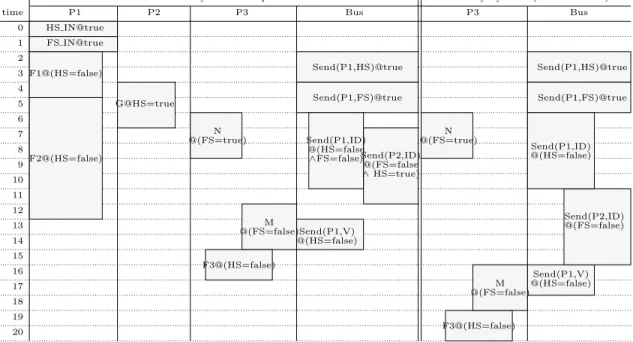
The output of the scheduling for the example in Fig. 4 and an asynchronous bus is given in Fig. 8. We simplified the notations for space reasons. The figure also gives the result of SynDEx for the same example (which is worse, because of the coarser clock manipulations). The width of an oper-ation (its support) inside its lane intuitively represents its execution condition (the larger it is, the more its execution condition is simple). Much like in Venn diagrams, the logical relations between execution conditions of various operations are given by the horizontal overlapping of supports.
6.
CONCLUSION
We have introduced a new method for the distributed real-time implementation of synchronous specifications. Our method is built around a new clocked graph intermediate representation, and works as a seamless series of transforma-tions that add causality, time refinement or allocation infor-mation on the clocked graph nodes and arcs. Endochrony, a scheduling-independence property related to the Kahn prin-ciple and the notion of confluence, is used as a criterion ensuring efficient implementability. Endochronous clocked graphs are transformed into scheduled graphs by assigning real-time dates and ressources to their elements. We de-fined the correctness of such a schedule graph, and provided an algorithm for the scheduling of endochronous clocked graphs on distributed architectures built around a single asynchronous bus.
Generated by SynDEx (different lanes) P3 Bus FS IN@true HS IN@true F1@(HS=false) P1 time G@HS=true P2 3 2 1 0 4 5 6 7 8 9 10 11 12 13 14 15 16 17 18 19 20
Generated by our technique
Send(P2,ID) Send(P1,ID) @(HS=false ∧FS=false) ∧@(FS=falseHS=true) N @(FS=true) M @(FS=false) F3@(HS=false) @(HS=false)Send(P1,V) Send(P1,HS)@true Send(P1,FS)@true @(FS=true) M @(FS=false) F3@(HS=false) P3 Send(P1,V) @(HS=false) @(HS=false) Send(P2,ID) @(FS=false) Bus Send(P1,HS)@true Send(P1,FS)@true Send(P1,ID) F2@(HS=false) N
Figure 8: The real-time schedules generated by our algorithm and by SynDEx. We only figure for the SynDEx schedule the lanes that differ from ours. Time flows from top to bottom. We give here the schedule for one execution cycle. An execution of the system is an infinite repetition of this pattern. The width of an operation inside its lane intuitively represents clock inclusion and exclusion properties.
We are currently focusing on the extension of the for-malism and scheduling techniques to cover (1) multi-period implementations where all the computations and commu-nications are not bound to a single global clock, and (2) larger classes of implementation architectures, such as time-triggered ones.
7.
[1] Nicolas Halbwachs.REFERENCES
Synchronous Programming ofReactive Systems. Kluwer academic Publishers, 1993. [2] Albert Benveniste, Paul Caspi, Stephen A. Edwards,
Nicolas Halbwachs, Paul Le Guernic, and Robert de Simone. The synchronous languages 12 years later. Proceedings of the IEEE, 91(1):64–83, January 2003. [3] A. Benveniste, B. Caillaud, and P. Le Guernic.
Compositionality in dataflow synchronous languages: Specification and distributed code generation. Information and Computation, 163:125 – 171, 2000. [4] P. Le Guernic, J.-P. Talpin, and J.-C. Le Lann.
Polychrony for system design.Journal for Circuits, Systems and Computers, April 2003. Special Issue on Application Specific Hardware Design.
[5] D. Potop-Butucaru, B. Caillaud, and A. Benveniste. Concurrency in synchronous systems.Formal Methods in System Design, 28(2):111–130, March 2006. [6] R. Milner.Communication and Concurrency. Prentice
Hall, 1989.
[7] G. Kahn. The semantics of a simple language for parallel programming. In J.L. Rosenfeld, editor, Information Processing ’74, pages 471–475. North Holland, 1974.
[8] D. Potop-Butucaru, S. Edwards, and G. Berry. Compiling Esterel. Springer, 2007.
[9] N. Halbwachs, P. Caspi, P. Raymond, and D. Pilaud. The synchronous dataflow programming language Lustre.Proceedings of the IEEE, 79(9):1305–1320, 1991.
[10] S. Campbell, J.-P. Chancelier, and R. Nikoukhah. Modeling and Simulation in Scilab/Scicos. Springer, 2006.
[11] T. Grandpierre and Y. Sorel. From algorithm and architecture specification to automatic generation of distributed real-time executives. InProceedings MEMOCODE, 2003.
[12] R. Obermeisser.Event-Triggered and Time-Triggered Control Paradigms. Springer, 2005.
[13] A. Benveniste, B. Caillaud, L. Carloni, P. Caspi, and A. Sangiovanni-Vincentelli. Composing heterogeneous reactive systems.ACM TECS, 7(4), 2008.
[14] P. Amagb´egnon, L. Besnard, and P. Le Guernic. Implementation of the data-flow synchronous language signal. InProceedings PLDI, 1995.
[15] A. Kountouris and C. Wolinski. Efficient scheduling of conditional behaviors for high-level synthesis.ACM Transactions on Design Automation of Electronic Systems, 7(3):380–412, July 2002.
[16] Z. Gu, X. He, and M. Yuan. Optimization of static task and bus access schedules for time-triggered distributed embedded systems with model-checking. In Proceedings DAC, 2007.
[17] W. Zheng, J. Chong, C. Pinello, S. Kanajan, and A. Sangiovanni-Vincentelli. Extensible and scalable time triggered scheduling. InProceedings ACSD, 2005. [18] P. Caspi, A. Curic, A. Maignan, C. Sofronis,
S. Tripakis, and P. Niebert. From simulink to
scade/lustre to tta: a layered approach for distributed embedded applications. InProceedings LCTES, 2003. [19] D. Potop-Butucaru, R. de Simone, and Y. Sorel.
Necessary and sufficient conditions for deterministic desynchronization. InProceedings EMSOFT’07, Salzburg, Austria, October 2007.
[20] C. L. Liu and J. Layland. Scheduling algorithms for multiprogramming in a hard real-time environment. Journal of the ACM, 20(1):46–61, January 1973.