REMAKING
AMERICAN
SECURITY
May 2013
SUPPLY CHAIN VULNERABILITIES &
NATIONAL SECURITY RISKS ACROSS
THE U.S. DEFENSE INDUSTRIAL BASE
B R I G A D I E R G E N E R A L J O H N A D A M S , U . S . A R M Y ( R E T I R E D )
CHAPTER 3
•
SPECIALTY METALS
EXECUTIVE SUMMARY
Specialty metals are used in countless ways, including high-strength alloys, semiconductors, consumer electronics, batteries, and armor plate, to name a few. The United States possesses significant reserves of many specialty met-als, with an estimated value of $6.2 trillion. However, it currently imports over $5 billion worth of minerals annually, and is almost completely dependent on foreign sources for 19 key specialty metals.
Industrial metals are a group of specialty metals that are most often added to base metals to form alloys. These metals play critical roles in many steel alloys, adding hardness, heat resistance, and strength. They are often highly reactive transition metals and require complex and expensive extraction processes. In a few cases they can only be extracted as byproducts of other metals. As such, production is dictated by production of their carrier metals, resulting in limited supply and mounting demand.
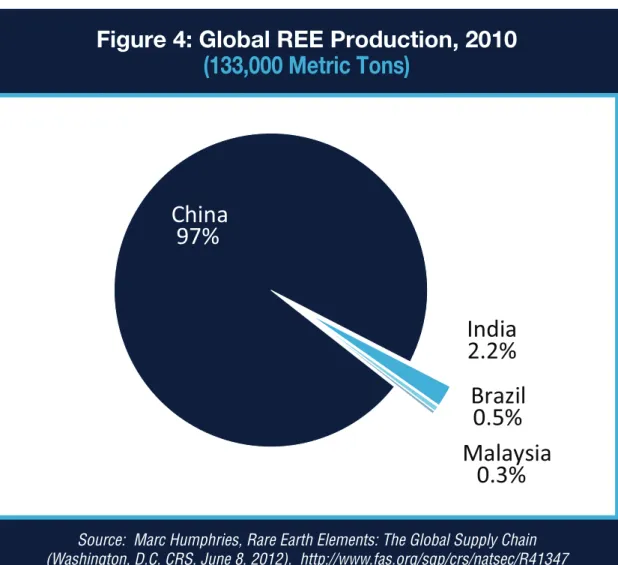
Rare earth elements (REEs), a second important group, have unique prop-erties that make them essential for many defense products, especially high-technology ones. Currently, China dominates REE production, con-trolling 90 percent of global supply. This market share was achieved in part by undercutting competitors through overproduction, which drove U.S. and other mines out of business. Upon obtaining a near monopoly, Chinese produc-ers have scaled back production to inflate prices through restricted supply. Quotas limiting the amount of raw REEs that may be exported have been used to force foreign investment in Chinese manufacturing, while exports to Japan were halted temporarily in 2010 after a diplomatic incident. Western companies scrambled to invest in REE mining to secure supplies just as the speculative bubble burst in fall 2011, sending prices downward and leaving the industry outside China in disarray. China still controls the global supply chain of REE oxides.
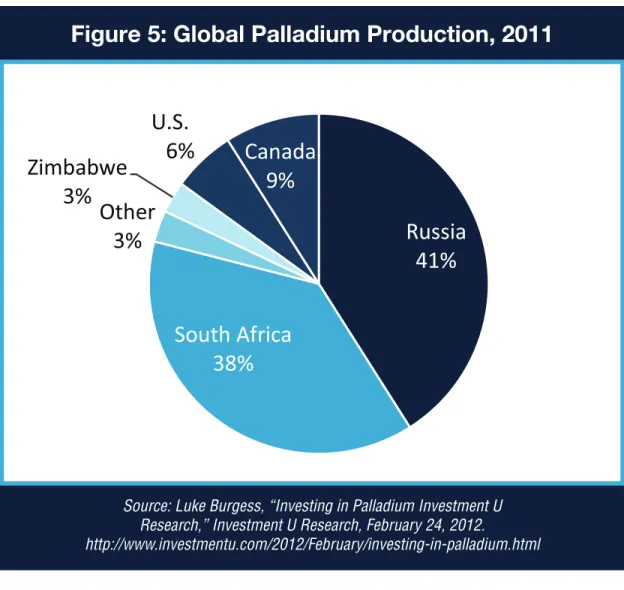
Production of the platinum group metals (PGMs) is dominated by South Africa. The country possesses more than 90 percent of known PGM reserves, and accounts for almost 40 percent of global palladium production and 75 percent of world platinum production. PGMs are commonly used in automo-tive engines and advanced electronics, and do not have viable substitutes. South Africa’s dominance over PGM production threatens the integrity of defense industrial base supply chains, as political and economic instabili-ties within South Africa could restrict U.S. access to these metals. Recent
The U.S. is wholly reliant on foreign suppliers
for 19 key minerals used in specialty metals
U.S. DEPENDENCY
MANUFACTURING SECURITY
Specialty metals are crucial to U.S. national security
and are used in a wide range of military end-items
MISSILE GUIDANCE COMPUTER CHIPS AND DEVICES AIRCRAFT COMPONENTS
100%
19 KEY MINERALS
MITIGATING RISKS
Protecting U.S. access to specialty metals
STRENGTHEN NATIONAL STOCKPILE DEVELOP DOMESTIC CAPACITY
IMPORT-RELIANT FOR
INTERAGENCY & INTERNATIONAL COORDINATION = 1,OOO25
Total U.S. annual consumption of new non-fuel minerals per capitaTHOUSAND
POUNDS
U.S. CONSUMPTION
VALUABLE METALS
Many specialty metals are vastly more
valuable than other commonly used metals
SUPPLY OF REES
90% OF THE WORLD’S
CHINA PRODUCES
China is the leading supplier of rare earth elements essential to national securityRARE EARTH VULNERABILITY
$3600
PER KILOGRAM
$1.60
PER KILOGRAM
VS.
RHENIUM
ALUMINUM
SPECIALTY METALS
QMissile guidance systems (gallium, neodymium, and rhenium) QGBU-28 laser-guided bomb
QJet engines (rhenium and tungsten) QMQ-1B Predator drones (indium) QF-22 Raptor fighter (yttrium) QC-17 Military transport aircraft (yttrium) QMissile guidance systems (gallium, neodymium, and rhenium) QSubmarine-launched ballistic missiles (tungsten)
WEAPON SYSTEMS PLATFORMS OTHER SYSTEMS
DEPARTMENT
MILITARY EQUIPMENT CHART
SELECTED DEFENSE USES OF SPECIALTY METALS
ARMY
NAVY
AIR
FORCE
MARINE
CORPS
QMissile guidance systems (gallium, neodymium, and rhenium) QMissile guidance systems (gallium, neodymium, and rhenium) QBGM-71 TOW Anti-Tank missile (tantalum)QPlatforms that use Steel Armor Plate (molybdenum)
QM1 Abrams main battle tank (tantalum)
QPlatforms that use Steel Armor Plate (molybdenum)
QPlatforms that use Steel Armor Plate (molybdenum)
QLithium-ion batteries (lithium)
QNight vision devices (lanthanum and gallium)
QLaser Rangefinders (neodymium)
QLithium-ion batteries (lithium)
QNight Vision devices (lanthanum and gallium)
QLaser rangefinders (neodymium)
QLithium-ion batteries (lithium)
QNight vision devices (lanthanum and gallium)
QLaser Rangefinders (neodymium)
QLithium-ion batteries (lithium)
QNight vision devices (lanthanum and gallium)
QLaser rangefinders (neodymium)
reforms have increased taxes on PGM mines and introduced Chinese investment into those mines, increasing scarcity and forcing prices to rise while creating uncer-tainty over the future availability of the commodities.
Mitigating these risks is complex, and strategies will vary among commodities. The United States should maintain strate-gic reserves of those defense-critical ele-ments that face likely shortages (REEs and PGMs) while seeking alternative sources. Congress is beginning to give this issue the necessary attention, and is shifting towards a more bottom-up approach to securing the supply chains of key materi-als—but more must be done. The federal government has not formulated a compre-hensive and coherent policy approach to address the national security risks of inad-equate access to many key minerals and metals. Strengthening efforts to identify substitutes and improve recycling will help mitigate these risks.
INTRODUCTION
This chapter will investigate “specialty metals,” categories of metals that are also known as industrial, rare, or pre-cious metals. Other common names for these types of metals include military, green, clean, critical, minor, technology, and strategic metals. It should be noted that specialty metals are not base metals (e.g. iron, copper, nickel, lead and zinc), or metals that oxidize, tarnish, or corrode easily. In addition, specialty metals are not
energy metals (e.g. uranium and thorium). This chapter will examine specialty metals, comparing their properties and assessing their vulnerabilities with respect to U.S. military capabilities and U.S. economic
competitiveness associated with the extraction and production of these metals. It is currently estimated that an average U.S. consumer’s lifestyle requires roughly 25,000 pounds of non-fuel minerals per year, requiring massive efforts to either extract or import these materials.1 Each
year, the U.S. Department of Defense (DoD) acquires nearly 750,000 tons of minerals for an array of defense and mil-itary functions.2 For example, tungsten,
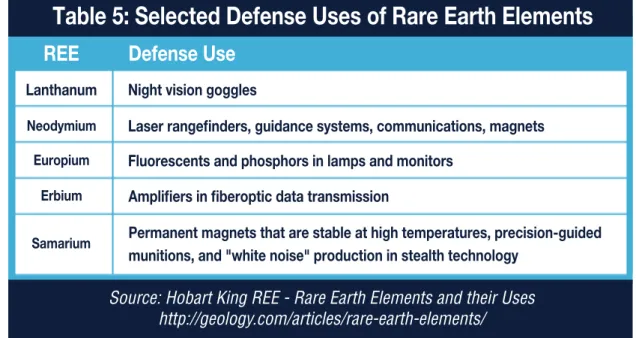
which is almost as hard as diamond, has the highest melting point of all non-al-loyed metals, and is commonly used in turbine blades, missile nose cones, and other applications requiring exceptional heat resistance. Other minerals acquired are Rare earth elements (REEs) (some of which are used to fabricate permanent magnets), which maintain their magnetic fields even at high temperatures and are used in missile guidance and nearly every other small motor. Yet another example is palladium, which is part of the platinum metals group (PGMs), and is used in catalytic converters.
Despite possessing an estimated $6.2 trillion worth of key minerals reserves, the United States recently recorded a small surplus on the trade balance of raw min-eral materials: it exported $9 billion and imported $8 billion of unprocessed min-erals in 2012. However, the United States runs a deficit of $27 billion on the balance
of processed mineral materials because it exported $120 billion and imported $147 billion in 2012.3 In short, although the U.S.
is self-sufficient in many minerals and has the chemical engineering know-how to process them, to some extent, it has cho-sen to rely on imports.
Increasingly, it is recognized that miner-als are central to modern life and modern defense preparedness. Yet the federal gov-ernment has not formulated a comprehen-sive and coherent response to the mineral/ materials supply vulnerabilities, and there is no standard definition of which miner-als or materiminer-als are critical and strategic and how the government should improve access to key minerals.4
The Defense Logistics Agency (DLA) Strategic Materials stores 28 commodities at 15 locations. In FY2012, DLA Strategic Materials sold $1.5 million of minerals and materials from its stockpile. At the end of the fiscal year, mineral materials valued at $1.4 billion remained. The stockpile is meant to help remedy the fact that the U.S. is completely import-dependent for 19 key minerals (including arsenic, asbes-tos, bauxite, graphite, fluorspar, indium, manganese, mica, niobium, tantalum, yttrium, and all REEs).5 (The DLA Strategic
Materials stockpile does not adequately compensate for the import dependence on a host of minerals because it emphasizes zinc, cobalt, chromium, and mercury, which are mined or recycled in the United States.) The stockpile is meant to protect against domestic and foreign supply constraints, spiking prices, and excessive speculation. However, because the U.S. government lacks a working understanding of which minerals are absolutely critical and which are strategic, the selection of metals for inclusion in the future stockpile managed by the DLA seems somewhat arbitrary.
In the past, a global abundance of min-erals has been more than able to meet U.S. demand. However, as mineral-pro-ducing countries begin to consume more of their domestic production to fuel their own growing economies, the quantities available in the global marketplace have decreased. The increased demand for min-erals has encouraged resource national-ism, where countries seek to exert greater control over the extraction and processing of key elements. Furthermore, many miner-als are mined in only a few countries (some of which are politically unstable), expos-ing the United States and other importexpos-ing countries to potential supply disruptions and other risks.
This situation is widely recognized as critical. In the words of one observer, “the whole periodic table is under siege… the growing demand for complex mate-rials is leading to exploding demand for elements that are now used in only small quantities.”6
The metals in this chapter fall into three different groups. The first group is indus-trial metals (e.g. antimony, manganese, tungsten, molybdenum, vanadium, and magnesium), which are usually mixed with base metals to create alloys to man-ufacture different kinds of steel products. Demand has risen for these alloyed metals because of their special properties that make them essential in aviation, engine turbines, green technology, and nuclear energy. Many of these metals are scarce because they are the byproduct of the other processes and because they are expensive to produce. Moreover, process-ing these metals involves advanced indus-trial chemistry and metallurgy that is more complex than extracting copper, zinc, and iron ore.
The second group consists of REEs, which are found across a surprisingly wide variety of applications and devices that enhance modern life in advanced industrialized countries. REEs are almost exclusively mined in China, which has by far the largest concentration of these elements. Mining REEs requires a more complex process than that used to mine gold or zinc, for example. From initial extraction to production, the process takes approximately 10 days. REEs are separated based on atomic weight, with actual processing duration based on the specific element. The most abundant REE is cerium. Terbium, a heavy REE, is more difficult to extract, and its extraction can take an additional 30 days.7 Neodymium is
also found with cerium, but the mine must first separate cerium and then extract the neodymium. This explains the length of production time and the costs. Importantly, companies cannot know beforehand whether valuable REEs are mixed in with the more common kinds, as each indi-vidual mine is different. Geologists and mining engineers must study each mine to find out which elements are available. The many engineering and processing chal-lenges make REE mining among the most difficult types of mining operations.8
Mine operators need to know in advance how the REEs are going to be used so that they can determine the appropriate extraction and refining process. (Different processes must be used depending on the intended end-use of the REE.9) In fact,
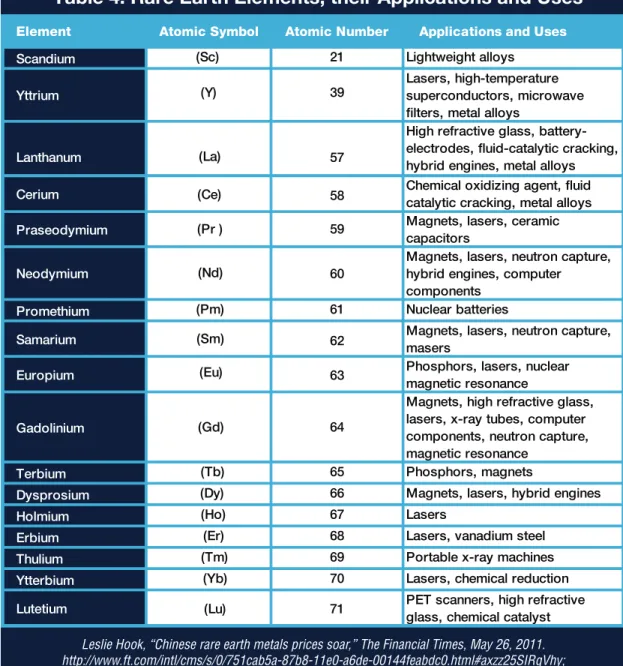
REEs are not inherently rare, but they are costly to mine and process because they are found in minute quantities mixed in with other ores. As Table 4 shows, REEs are used in a strikingly diverse range of products, including high-tech permanent magnets (see this report’s chapter on magnets) and night vision devices (see this report’s chapter on night vision devices).
The third group of specialty metals is very small and consists of the platinum group metals (PGMs), which are used in a range of applications such as vehi-cle production, future power sources, and many key military technologies. Palladium and platinum are used in cat-alytic converters. The largest concentra-tions of these deposits and reserves are found in South Africa.
Key themes discussed in this chapter are:
Q Within the past decade, many countries
rich in natural resources have taken a stance of “resource nationalism” and are attempting to control and manip-ulate extractive mining by threatening to impose extra taxes, reduce exports, nationalize mining operators, and restrict licensing.
Q Western countries and mining operators
face competition from less developed countries for access to specialty metals as well as from China, which has moved aggressively offshore to guarantee access to natural resources.
Q Advanced industrialized countries,
including the United States, have aban-doned mining and mining exploration, even though global demand for eco-nomically and militarily significant ores and chemical elements has risen and will continue to rise.
Q Many specialty metals are found in only
a handful of countries, and often in regions that are politically and economi-cally unstable.
Q The risk of disruptions to the supply
chains that use specialty metals is high, jeopardizing U.S. national security.
Q Various U.S. agencies recognize the
risks, but they provide different and divergent answers and solutions. The lack of a mechanism to coordinate policies among agencies hampers the development of a comprehensive and coherent strategy.
A NOTE ON CRITICALITY
Access to many natural resources is largely a function of geography. Although different types of specialty metals face different levels of risk (as described below), PGMs are consistently classified as fac-ing the highest risks. Global reserves are situated almost exclusively in South Africa, which is the only country possessing significant long-term production capabil-ity. Limited global production capacity is coupled with high and increasing demand for PGMs, leading to high, unstable prices. Any number of events could cre-ate temporary or protracted shortages of PGMs, the most likely of which being internal political and economic instabilities
associated with the South African gov-ernment. The geographic concentration of PGM reserves, the high potential for disruption to the primary global provider, and the scarcity imposed by heightened demand indicate an extreme risk of these metals becoming unavailable.10
An insufficient supply of PGMs would have a significant impact on national defense capabilities. Although PGMs are most commonly known for their role in cata-lytic converters that reduce emissions from internal combustion engines, they also play an important role in advanced electronics used by the military (such as guided missile systems) due to their exceptional performance and ability to withstand high temperatures.
BACKGROUND
The issue for most advanced industri-alized countries is that demand for rare elements has risen, while proven reserves and mining operations are increasingly
THE COST OF FAILURE TO ADDRESS POTENTIAL SPECIALTY METALS SUPPLY CHAIN DISRUPTIONS (a notional though realistic scenario)
The inauguration of the new South African president has led to a strengthening of ties between the Republic of South Africa and the People’s Republic of China. In return for financial assistance in achieving its internal developmental policies and goals, South Africa has agreed to export manganese exclusively to China. Department of Defense supply chain specialists have begun to seek other sources of the metal; however, the effect on the market of this exclusive deal is expected to be pronounced. South Africa possesses one of the largest deposits of this mineral, and the removal of this source is expected to significantly increase prices for remaining sources. Reduced manganese supply means increased defense costs, as the U.S. military is a major consumer of manganese as a component of a variety of weapons systems and capabilities, including in the manufacture of steel armor plate and munitions.
concentrated in a handful of countries that have sought to exploit their geological advantages and their desire to meet their own growing domestic needs. In 2011, the British Geological Survey published a “risk list” that employed four variables (detailed below) to assess the risk fac-tors of 52 elements or element groups with economic value.11 The variables they
used were scarcity (or the abundance of elements in the earth’s crust); production concentration (the location of current production); reserve base distribution (the location of reserves); and governance (the political stability of those locations). Using these categories, experts determined that the chemical elements or element groups with the highest supply vulnerabilities were antinomy, which is produced in China and is used in micro-capacitors; PGMs, which
are produced in South Africa and used in automobile catalytic converters, fuel cells, seawater desalination equipment; mercury, which is produced in China; tungsten, which is produced in China and is a hard metal used in all cutting tools; REEs, which are produced in China; and niobium, which is produced in Brazil and used in MRI scanners, touch screens, micro capacitors, and ferroalloys.12
The German government also has
expressed concern, as the country’s large manufacturing base requires substantial amounts of REEs. As demand from emerg-ing economies has risen, the German gov-ernment has been aggressive in securing access to REEs in regions or countries other than China. The German government entered into multiple agreements with Kazakhstan to give German companies better access to REEs.13
Last but not least, the European Union has pushed the governments of its member states to agree to a “critical metals” list, and to approve new policies to ensure continuous access to gallium, indium, tan-talum, and tungsten, in addition to REEs. One of the measures on the agenda is to establish a critical metals stockpile, which would include gallium, indium, tantalum, and tungsten.14
It is not surprising that the U.S. Geological Survey (USGS), DoD, the Department of Energy (DoE), and the Congressional Research Service have joined the chorus of concerned voices by publishing numer-ous reports and presenting long lists of critical minerals. Critical minerals are indis-pensable to modern life and security, yet they may be at risk because of their geo-graphic availability, the costs of extraction and processing, the dearth of (manmade) substitutes, and limited potential for recy-cling. USGS puts REEs highest on their list,15 followed by cobalt, indium, and
tellu-rium, which are needed for many important applications including magnets for motors and super alloys common in turbine blades and other aeronautical functions. In light of the rapid growth in demand for advanced batteries, most of which require minute amounts of lithium, USGS also has raised concerns about the possibility of depleting all known reserves of the element (see this report’s chapter on lithium-ion batteries).
As the United States frees itself from fossil fuel
dependence, it may replace it with dependence
on energy sources from power-generating
equipment that relies on specialty metals.
Tables 1 and 2 demonstrate the trend of the last 10 years during this relatively short period of time, U.S. import dependence has radically increased across the board. A wide variety of metals are plagued by the same issues that account for this current state of affairs. For one, political leaders of advanced industrialized coun-tries have abandoned mining in light of the substantial negative externalities and pollution of waterways, soil, and air. Take the example of REEs. In reality, they are abundant in the earth’s crust, but they tend to be found in small concentrations and deposits. They rarely exist in pure form and must be extracted from other oxides, which increases the costs of processing. More importantly than the expense of extraction, RE mining also creates radio-active environmental pollutants.16 In every
mining operation, the extraction process results in tailings (ground rock, process-ing agents, and chemicals), which cannot be fully reclaimed or reused or recycled. Frequently, the unrecoverable and uneco-nomic metals, minerals, chemicals, and process water are discharged, normally as slurry, to a final storage area. RE mining, however, produces tailings that contain radioactive uranium and thorium, which pose additional environmental threats beyond the risks associated with normal mining waste. In Western countries, gov-ernments and the public essentially have decided that it is easier to offshore this process to localities with less vocal and organized citizens or less democratic and transparent regimes. China, for example, has witnessed extreme degradation of its soil, water, and air quality to a degree that would not be tolerated in advanced indus-trialized countries.17
Another issue is that global demand is being driven higher by new discoveries of these metals’ special properties, and by
new technological innovations in how to design, fabricate, and incorporate them into consumer and military products. For example, neodymium (an REE) combined with iron and boron was discovered to possess strong magnetic properties, and it became the foundation of the high-tech permanent magnet sector (discussed in this report’s chapter on high-tech mag-nets). Other examples include: gallium and tellurium, which are used in completing types of solar panels; rhenium, used in the super alloys employed in jet turbines; indium, which is used in flat panel dis-plays; and graphite, used in lithium-ion (Li-ion) batteries. Green technology (such as hybrid cars, wind turbines, electric motors, and lightweight metals) relies heavily on specialty metals and REEs. Many technological devices consume tiny amounts of specialty metals, without which the product would not operate or would need to be much larger and heavier. For example, every guided missile requires modest amounts of oxides, the form in which REEs occur in the mineral ore. While the amount of REEs used in a guided mis-sile is genuinely small in quantity, without them the missiles would be heavier, less precise, and less advanced. In a similar vein, some metals must be able to withstand high temperatures, which are primarily achieved by adding minor elements to steel.
Additionally, more than two billion people (notably, the populations of China and India) are moving towards higher stan-dards of living more closely resembling those in advanced industrial nations such as the United States and those in Europe. This development means that demand for electronic devices, green technology, and other advanced applications will continue to rise and in spite of economic crises in Europe, the United States, and Japan.
Table 1: U.S. Net Import Reliance for
Selected Nonfuel Mineral Materials in 2000
Material
Percent
Source: U.S. Geological Survey, Mineral Commodity Summaries 2000 (Washington DC: U.S. Geological Survey).
ARSENIC (TRIOXIDE) ASBESTOS
COLUMBIUM (NIOBIUM) BAUXITE & ALUMINA FLUORSPAR
GRAPHITE (NATURAL) MANGANESE
MICA, SHEET (NATURAL) QUARTZ CRYSTAL STRONTIUM THALLIUM THORIUM YTTRIUM GEMSTONES BISMUTH ANTIMONY TIN PLATINUM STONE TANTALUM CHROMIUM TITANIUM CONCENTRATES COBALT RARE EARTHS BARITE
China, Chile, Mexico
Canada
Australia, Guinea, Jamaica, Brazil
Brazil, Canada, Germany, Russia
China, South Africa, Mexico
China, Mexico, Canada
South Africa, Gabon, Australia, France
India, Belgium, Germany, China
Brazil, Germany, Madagascar
Mexico, Germany
Belgium, Canada, Germany, United Kingdom
France
China, Hong Kong, France, United Kingdom
Israel, India, Belgium
Belgium, Mexio, United Kingdom, China
China, Mexico, South Africa, Bolivia
China,Brazil, Peru, Bolivia
South Africa, United Kingdom, Russia, Germany
Italy, Croatia, Spain, India
Australia, China, Thailand, Japan
South Africa, Kazakhstan, Russia, Zimbabwe
South Africa, Australia, Canada, India
Norway, Finland, Zambia, Canada
China, France, Japan, United Kingdom
China, India, Mexico, Morocco
100% 100% 100% 100% 100% 100% 100% 100% 100% 100% 100% 100% 100% 100% 95% 94% 86% 83% 80% 80% 78% 76% 74% 72% 71%
Material
Percent
ARSENIC (TRIOXIDE) ASBESTOS
BAUXITE & ALUMINA CESIUM
FLUORSPAR GRAPHITE (NATURAL) INDIUM
MANGANESE
MICA, SHEET (NATURAL) NIOBIUM (COLUMBIUM)
QUARTZ CRYSTAL (INDUSTRIAL) RARE EARTHS RUBIDIUM SCANDIUM STRONTIUM TANTALUM THALLIUM THORIUM YTTRIUM GALLIUM IODINE GEMSTONES GERMANIUM BISMUTH
DIAMOND (DUST, GRIT, & POWDER)
Morocco, China, Belgium
Canada, Zimbabwe
Jamaica, Brazil, Guinea, Australia
Canada
Mexico, China, South Africa, Mongolia
China, Mexico, Canada, Brazil
China, Canada, Japan, Belgium
South Africa, Gabon, China, Australia
China, Brazil, Belgium, India
Brazil, Canada, Germany, Russia
China, Japan, Russia
China, France, Estonia, Japan
Canada
China
Mexico, Germany
China, Germany, Kazakhstan, Australia
Russia, Germany, Kazakhstan
France, India, Canada, United Kingdom
China, Japan, France, United Kingdom
Germany, Canada, United Kingdom, China
Chile, Japan
Israel, India, Belgium, South Africa
China, Belgium, Russia, Germany
China, Belgium, United Kingdom
China, Ireland, Republic of Korea, Russia
100% 100% 100% 100% 100% 100% 100% 100% 100% 100% 100% 100% 100% 100% 100% 100% 100% 100% 100% 99% 99% 98% 90% 89% 89%
Table 2: U.S. Net Import Reliance for
Selected Non-fuel Mineral Materials in 2011
Source: U.S. Geological Survey, Mineral Commodity Summaries 2012 (Washington D.C.: U.S. Geological Survey).
Finally, metal and mineral suppliers have witnessed booming mining sectors due to rising prices. Thanks to the rising value of natural resources, producing countries have pursued a policy of resource nation-alism. Many of the most sought-after elements are found in developing countries that face multiple economic and political challenges. To finance development proj-ects or to extract rents, governments of these countries might be tempted to push for a greater share of the profits made by mining companies. Examples of this trend are ubiquitous. Ghana has been reviewing mining contracts, and may renegotiate existing arrangements to increase gov-ernmental revenue. Zambia doubled its copper royalty to six percent. Guinea, which controls the largest known reserves of both bauxite and iron ore, has taken a 15 percent stake in mining operations. In Namibia, a state-owned company controls all new mining and exploration. Foreign mining operations in Zimbabwe must cede a 51 percent stake to local owners.18
To ensure the country benefits from its mineral wealth, South Africa may impose a 50 percent windfall tax on mining profits and a 50 percent capital gains tax on pros-pecting rights. The ruling African National Congress wants to collect a larger share of the resource boom. Even Australia, an advanced industrialized country, plans to impose a new, $8 billion tax on mining.19
This state of affairs has not gone unno-ticed. Since the mid to late 2000s, increased scrutiny and heightened alarm surround the fact that the U.S. economy and national security depend on specialty metals—many of which are vulnerable to supply threats resulting from sovereign risk and resource nationalism, geological scar-city, lack of viable substitutes, byproduct sourcing, and inadequate post-consumer recycling and recovery programs.20
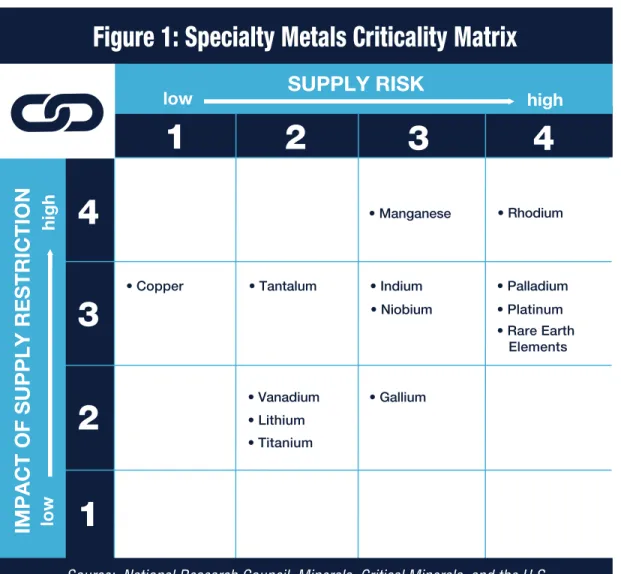
In 2008, the National Research Council Committee on Critical Mineral Impacts on the U.S. Economy (Committee on Earth Resources) compiled a statistical approx-imation to assess supply restrictions impact on the entire U.S. economy and defense capabilities. The report also took into consideration the technical substitu-tion potential of a mineral.21
The National Research Council report pre-sented a criticality matrix that juxtaposed the probability of a supply disruption with the overall economic impact of that sup-ply disruption. Supsup-ply disruptions can be caused by the physical unavailability of a commodity or by increasingly restrictive prices as a result of scarcity or of artificial means. The study considered five factors that contribute to availability: geologi-cal; technigeologi-cal; social and environmental; economic; and political. Economic impact was assessed by the availability of a close substitute, the costs associated with that substitution, and the consequences of the supply restriction. The committee exam-ined 11 metals or metal groups: copper, gallium, indium, lithium, manganese, niobium, PGMs (including iridium, osmium, palladium, platinum, rhodium, ruthenium), REEs, tantalum, titanium, and vanadium to determine their criticality. The study’s conclusions are presented in Figure 1. Indium, manganese, niobium, PGMs, and REEs fall in the “critical” zone of the matrix.22 They are considered critical
because of the importance of their appli-cations in catalytic converters, industrial chemical production, electronics, batteries, liquid crystal displays, and hardeners or strengtheners in steel and iron alloys. In addition, if a physical disruption or sudden price surge jeopardizes supplies, there are no readily available mineral substitutes for these applications.
However, the study concludes that essen-tially any mineral could be considered critical, because both economic impor-tance as well as factors influencing avail-ability could change. Additionally, the report stresses that import dependence alone is not means for alarm; however, the
concentration of supplies in a small num-ber of countries plagued by political insta-bility could be disastrous. Alternatively, rapid growth in the internal demand of exporting countries could limit the quanti-ties available on the global market, result-ing in risresult-ing prices and restricted supply.
• Gallium
SUPPLY RISK
Figure 1: Specialty Metals Criticality Matrix
IMPACT OF SUPPLY RESTRICTION
• Manganese • Indium • Rhodium
1
2
3
4
4
3
2
1
• Copper • Vanadium • Lithium • Titanium • Tantalum • Niobium • Palladium • Platinum • Rare Earth Elementslow
high
Source: National Research Council, Minerals, Critical Minerals, and the U.S. Economy (Washington, D.C.: National Academies Press, 2008). p. 165.
low
INDUSTRIAL METALS
Industrial metals (also called minor metals) are in vogue because new uses for these metals are discovered frequently. They are classified as minor metals because until recently they were largely ignored by industry. They are not readily available or mined in the United States. Often, the ele-ments are in fact rare and are not abundant in the earth’s crust, with only a few parts per million of recoverable ore, even in the geologically significant deposits. As many of these elements are only found in a few dense concentrations globally, extraction may be dominated by a handful of coun-tries. Subsequently, the price and supply of the element may be subject to export controls, price manipulation, and sudden disruptions. In some cases, elements are in fact a byproduct of a primary ore and are uneconomical to extract independent of the refining process for those other ores. These metals are therefore relatively costly and challenging to produce. Finally, the time required to adapt to new production and utilization processes is long, making planning and investment difficult.
The United States (along with almost all Organization for Economic Co-operation and Development [OECD] countries) relies heavily on imports for these materials, while the main producers are often coun-tries with rapidly expanding economies (such as China, Russia, Chile, and South Africa) with sizeable and increasing domes-tic demand for these metals. Because certain metals are only commercially pro-duced in a few countries, they can claim near monopolies over global reserves and influence pricing and availability.
The evolution of computing circuitry over the past three decades clearly illustrates the critical importance of industrial metals. The number of elements used in computer
circuitry has expanded from 12 in the 1980s, to 16 during the 1990s, to over 60 today.23 These circuits are found in nearly
every piece of modern technology, and especially in highly specialized, high-tech defense applications.
The summary of the industrial metals sector below includes an overview of the different metal groups, selected elements, their most significant uses, and some of the concerns surrounding these commod-ities. The next section presents a more general discussion of the dominant risks facing this sector. The critical importance of these metals should be readily apparent. At the most basic level, many of them are used in heat-resistant, hard metal alloys that are used in aircraft, ships, subma-rines, and countless other defense-re-lated applications. Other metals are at the core of solar energy, which is necessary for defense satellites and has a growing importance for civilian energy. Others still are used in electronic components such as rechargeable batteries, which are essential to consumer electronics, communication, and hybrid engines.
THE UNIVERSE OF
INDUSTRIAL METALS
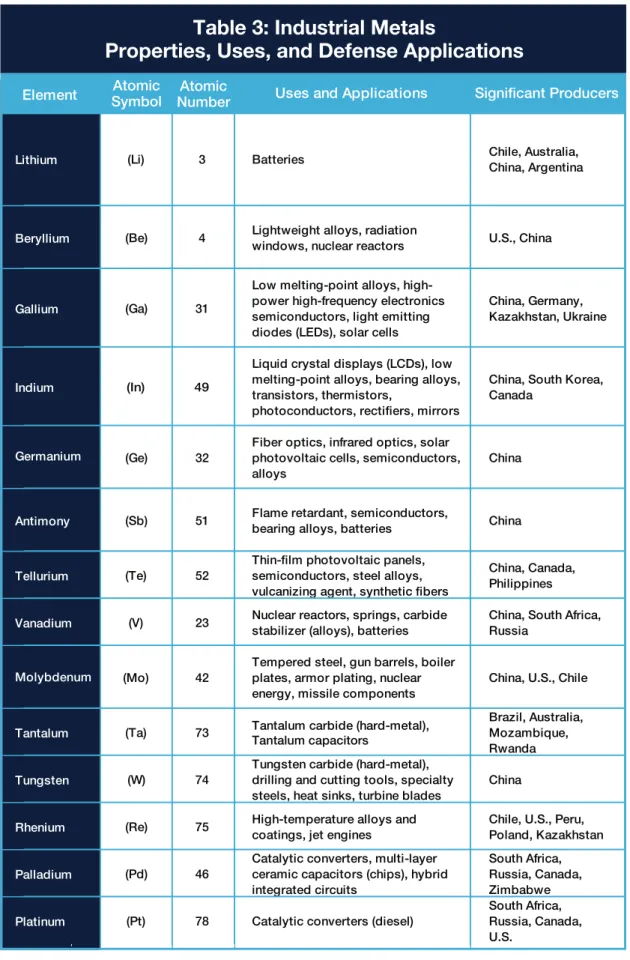
Most of the elements in industrial metals are used in alloys in order to improve heat resistance, reduce the weight of a metal item, or harden steel. (Table 3 provides an overview of the different metals and their defense applications and describes the particular risks or vulnerabilities associated with each industrial metal.) Many industrial metals are in demand in consumer electronics, high-energy rechargeable batteries, and the computer industry. They also are indispensable in numerous and wide-ranging military
defense applications. Radar systems, airframes and engines, optical equipment, armor plating, coatings, electronic display screens, solar cells, and military batteries rely on small but vital quantities of indus-trial metals.
The universe of industrial metals can be divided into different chemical classifica-tions. Each chemical group possesses different properties and advantages, which are further discussed below.
ALKALI AND ALKALI EARTH METALS
Alkali and alkali earth metals are located in the first two columns of the periodic table (excluding hydrogen). They are highly reactive elements, and as such, are not found in their elemental form, but instead as compounds in the earth’s crust. Alkali metals (such as lithium) are relatively soft with low melting points, and form weak bonds with other elements because they have only one electron available for bond-ing. Alkali earth metals (such as beryllium) are harder and denser than the alkali met-als, though not to the same extent as the transition metals.LITHIUM
Lithium (Li) is a light and highly reactive metal, and is a key component of the rechargeable, high-energy lithium-ion (Li-ion) batteries that are widely used in the military and have a bright future as the main power source for electric or hybrid vehicles. Chile, Australia, Argentina, and China are the leading producers of lithium; almost the entirety of the U.S. import mar-ket comes from Argentina and Chile. Chile possesses over half of the world’s known lithium reserves and is the main producer, extracting lithium from the Atacama Desert.24 U.S. production of lithium is
insignificant.25 Because lithium is highly
reactive and reacts with water, producing the pure form of lithium is very complex and requires a dry environment.26
Increase in demand for lithium, especially from China, have caused a recent expan-sion of production in many countries. Production of lithium was reported to have increased 20 percent in both Australia and Chile in 2011, while Chinese production was reported to have increased 30 per-cent. 27 This expansion corresponds to the
growing demand for high-purity lithium for use in Li-ion batteries.
Analysts in the advanced battery sec-tor and green technology community express considerable concern about the world’s reliance on lithium, because most of the reserves are concentrated in two countries (Chile and Argentina) and may outstrip global demand as soon as 2017. Currently, there is no substitute for lithium, which is the ideal material to create rechargeable batteries and energy network stations to store surplus power from solar and wind power (see this report’s chapter on lithium-ion batteries).28
Unlike with other specialty metals, the main concern about lithium is not price or the potentially monopolistic behavior by foreign governments but rather that the world may face supply restrictions as reli-ance on technologies that require lithium increases and the world’s known reserves of lithium are depleted.29
BERYLLIUM
Beryllium (Be) currently is considered a material critical to U.S. national defense, and is retained in the DLA Strategic Materials stockpile. Beryllium is criti-cal to many military systems, including the airborne Forward-Looking-Infrared (FLIR) system, missile guidance systems, and surveillance satellites. There are no
Table 3: Industrial Metals
Properties, Uses, and Defense Applications
Uses and Applications
(Li) 3 Batteries Chile, Australia, China, Argentina
(Be) 4 Lightweight alloys, radiation
windows, nuclear reactors U.S., China
(Ga) 31
Low melting-point alloys, high-power high-frequency electronics semiconductors, light emitting diodes (LEDs), solar cells
China, Germany, Kazakhstan, Ukraine
(In) 49
Liquid crystal displays (LCDs), low melting-point alloys, bearing alloys, transistors, thermistors,
photoconductors, rectifiers, mirrors
China, South Korea, Canada
(Ge) 32
Fiber optics, infrared optics, solar photovoltaic cells, semiconductors, alloys
China
(Sb) 51 Flame retardant, semiconductors,
bearing alloys, batteries China (Te) 52
Thin-film photovoltaic panels, semiconductors, steel alloys, vulcanizing agent, synthetic fibers
China, Canada, Philippines (V) 23 Nuclear reactors, springs, carbide
stabilizer (alloys), batteries
China, South Africa, Russia
(Mo) 42
Tempered steel, gun barrels, boiler plates, armor plating, nuclear energy, missile components
China, U.S., Chile (Ta) 73 Tantalum carbide (hard-metal),
Tantalum capacitors
Brazil, Australia, Mozambique, Rwanda (W) 74
Tungsten carbide (hard-metal), drilling and cutting tools, specialty steels, heat sinks, turbine blades
China (Re) 75 High-temperature alloys and
coatings, jet engines
Chile, U.S., Peru, Poland, Kazakhstan (Pd) 46
Catalytic converters, multi-layer ceramic capacitors (chips), hybrid integrated circuits
South Africa, Russia, Canada, Zimbabwe (Pt) 78 Catalytic converters (diesel)
South Africa, Russia, Canada, U.S. Atomic Number Atomic
Symbol Significant Producers Element Lithium Beryllium Gallium Indium Germanium Antimony Tellurium Vanadium Molybdenum Tantalum Tungsten Rhenium Palladium Platinum
substitutes for beryllium, and in previous years there was a shortage of high-purity beryllium due to high production costs and health and safety issues. Foreign-sourced beryllium is not of sufficient purity for defense applications.
In 2005, under Title III of the Defense Production Act (P.L. 81-774), DoD invested roughly $90 million in a pri-vate-public partnership with domestic beryllium producer Brush Wellman, Inc. (now called Materion Brush Beryllium and Composites) to produce a primary beryllium plant in Ohio.30 That plant
became operational in early 2011, drop-ping the reported U.S. import depen-dence from 61 percent in 2010 to 21 percent in 2011. Twelve percent of the annual U.S. beryllium consumption is attributed to defense applications. The USGS reports that the U.S. currently possesses about 65 percent of the world’s beryllium reserves and, with the opening of the Materion Brush plant in 2011, accounts for almost 90 percent of world production.31
TRANSITION METALS
The group of transition metals contains 38 elements that are grouped together due to their common electron configuration, and are generally hard, malleable, and possess high melting points. They are good electric conductors and are often magnetic. The uses of transition metals are vast, making their use common.
RHENIUM
Rhenium (Re) is a rare metallic element that is important to the defense commu-nity because of its contribution to the properties of high-temperature alloys and coatings. The USGS reports that nearly 70 percent of rhenium is used for
high-temperature engine turbines com-mon to jet engines, while an additional 20 percent is a key catalyst in refining oil.32 Rhenium is also used as a promoter
in catalysts in gas-to-liquid operations, which may become more important in the future in light of the rapid expansion of shale gas output in the United States and elsewhere.
Rhenium is obtained almost exclusively as a byproduct of the processing of a special type of copper deposit known as a porphyry copper deposit. Specifically, rhenium is obtained from the processing of the mineral molybdenite (a molybdenum ore), which in itself is a copper byproduct. Therefore, rhenium is among the most expensive and volatile metals in the world, and its price fluctuated from $10,000/ kg in 2008 to $3,500/kg in March 2013.33
Currently, the United States is the world’s second leading producer of rhenium (after Chile), with about a 12 percent market share. However, because rhenium is a byproduct of a byproduct, its production is limited by the production of molybde-num, which is in turn limited by copper production. In 2012, the U.S. imported nearly seven times its domestic produc-tion of rhenium, mainly from Chile and Kazakhstan.34 Rhenium is part of the DLA
Strategic Materials stockpile.
MOLYBDENUM
Molybdenum (Mo) is an important alloying agent that contributes to the hardening and toughness of tempered steels, and is used in steel armor plate, gun barrels, and boiler plates. Almost all ultra-high strength steels contain up to eight percent molybdenum. Molybdenum is used in nuclear energy applications and for missile and aircraft parts. Molybdenum is both mined as a primary ore and recovered as a byproduct of copper. The United States is
the second largest producer of molybde-num with about one quarter of the global share, and currently exports about half of its annual output.35
VANADIUM
Vanadium (V) is used predominantly as an additive in steel that is then used in nuclear energy applications and in rust-re-sistant springs and high-speed tools. Ferrovanadium, an alloy of steel, accounts for 95 percent of the vanadium used in the United States. Vanadium is a non-substi-tutable component of aerospace titanium alloys; however, for many other applica-tions, other metals such as molybdenum, tungsten, manganese, niobium, or titanium may be substituted for vanadium.36 Small
amounts of vanadium are added to iron alloys to improve corrosion resistance; ferrovanadium is mostly used in gears for cars, jet engines, and springs. The type of vanadium used in steel does not face immediate supply constraints. Due to increasing demand for steel in expanding economies, the demand for vanadium is expected to increase.
Three countries —China, South Africa, and Russia—dominate the vanadium market, and together account for more than 96 percent of current global production. The United States depends on imports for 80 percent of its domestic consumption of ferrovanadium; its main import sources are South Korea, Austria, Canada, and the Czech Republic.37
Twenty percent of the vanadium market consists of vanadium pentoxide, which is more valuable than ferrovanadium. In 2012, the major exporters of vanadium to the United States were Russia (47 per-cent), South Africa (32 perper-cent), and China (19 percent). Vanadium pentoxide is used as a catalyst in petroleum refineries, in
ceramics, and in super-conductive mag-nets. Currently, however, vanadium pent-oxide is considered suitable for vanadium redox batteries, a new type of advanced rechargeable battery that is able to store renewable energy coming from wind or solar generation. This new type of battery can store more energy more efficiently than Li-ion batteries, with a faster recharge time and a longer lifecycle (see this
report’s chapter on Li-ion batteries).38
Demand for vanadium pentoxide is expected to expand 30 percent in the next three years while supply is tight; 90 percent of the vanadium on the market is not suitable for processing into vanadium pentoxide, and is only appropriate for strengthening steel.39 Vanadium pentoxide
(used in large format batteries) is a byprod-uct of combusting fossil fuels containing vanadium. The byproducts containing vanadium pentoxide can be in the forms of dust, soot, boiler scale, and fly ash.
TANTALUM
Tantalum (Ta) is used in several alloys due to its thermal and corrosion resistances, ductility, and strength. Many types of tan-talum minerals are mined in different parts of the world and possess slightly different properties. In many applications, it cannot be substituted without lessening quality. For example, tantalum carbide is among the most durable materials currently known.40 The United States has no
identi-fied reserves of tantalum and depends on imports for all its tantalum consumption. Tantalum is found in selected geological regions of the world, namely in the east-ern areas of the Democratic Republic of Congo as well as in Australia, Brazil, Canada, and Mozambique. Furthermore, a related mineral, coltan, the industrial name for a columbite–tantalite mineral
from which columbium (also known as niobium) and tantalum are extracted,41 is
widely used to manufacture capacitors found in consumer electronics, computers, and automobiles.42 In the last 10 years,
demand for coltan-extracted tantalum has surged, stirring armed conflicts in central Africa as paramilitary groups mine and smuggle the chemical elements in order to finance their own activities. Coltan is the mineral equivalent of “blood dia-monds,” which received large amounts of publicity and incited a human rights campaign in the late 1990s and early 2000s. Coltan-related conflicts also have destroyed the habitat of lowland gorillas and the livelihood of numerous indigenous communities.
In spite of tantalum’s importance to the U.S. economy and national security, the DLA Strategic Materials sold off most of its tantalum mineral, tantalum metal pow-der, metal ingots, and metal oxides in the 2000s. In 2013, it still holds small quanti-ties of tantalum carbide powder. The latter is extremely hard and brittle, and is com-monly used in tool bits for cutting appli-cations or sometimes added to tungsten to create a metal alloy. The United States consumes 120,000 metric tons annu-ally, with no reserves; the United States imports all tantalum from China, Germany, Australia, and Kazakhstan.
Although USGS forecasts that supplies of tantalum are sufficient for projected demand, and significant untapped reserves exist in Brazil and Australia, a third of the current tantalum production originates from politically unstable sub-Sa-haran African countries.43
TUNGSTEN
Tungsten (W) possesses the highest melting point of all metals (3,400 degrees Celsius or 6,150 degrees Fahrenheit) and is nearly as strong as diamond. Additionally, it is an excellent electrical conductor. The most common use is as tungsten carbide, a “hard metal” known for industrial drilling and other cutting tools.44
Additionally, tungsten carbide and tung-sten alloys are used for armaments, heat sinks, turbine blades, and rocket nozzles.45
China is the largest producer of tungsten is, accounting for about 80 percent of global production and possessing roughly two-thirds of world tungsten reserves. China is also the world’s top consumer of tungsten, and using a majority of the tungsten it produces. The Chinese govern-ment actively intervenes in the tungsten industry to limit supply: foreign invest-ment is forbidden; exports are controlled by licenses, taxes, and quotas; overall
Figure 2: Global Production of Tungsten in 2010
Source: International Tungsten Industry Association, 2011. http://ormondemining.com/uf/Company%20Presentations/ Ormonde%20Mining%20Website%20Presentation%20January%202012.pdf China 86% Rest of the World 14%
production is limited; and exploration and new operations are tightly controlled. In the immediate future, China is expected to be even more protective of its domestic supply, and is likely to attempt to further reduce exports as well as increase tung-sten imports.46
Accordingly, tungsten prices are expected to increase in light of increasing demand and constricted supply. Historically, the United States and Russia have stockpiled tungsten, although both countries have been disposing of their stockpiles over recent years. The Russian stockpile is thought to be depleted, while the entire U.S. government holding of tungsten has been authorized for disposal.47
Although the United States imports a fair amount of tungsten, thanks to improved recycling of scrap consumed by pro-cessors and end-users, import reliance dropped from 63 percent in 2010 to 36 percent in 2011.48 Nevertheless, there is
only one domestic source of tungsten concentrates in the United States. The U.S. military cannot function without tung-sten, and there are no substitutes for most applications. World demand slackened due to the global financial crisis, but scarcity will push up tungsten prices, especially since strategic manufacturing sectors would be willing to pay inflated prices.49
POST-TRANSITION METALS
Post-transition metals are softer than tran-sition metals, with lower melting points, but they have high electronegativity, meaning that they are better at attracting electrons than the transition metals and more readily form polar bonds. They are malleable, ductile, and generally good conductors.
GALLIUM
Gallium (Ga) is not produced in the United States even though it is a critical com-ponent of optoelectronic devices, solar cells, light-emitting diode (LED) lights, and photo-detectors. Gallium is essential for creating high-brightness LEDs, and many governments in Asia are committed to introducing widespread LED lighting.50
Therefore, demand for gallium likely will increase. Moreover, gallium is also a key component for thin film photovoltaic tech-nology, a sector expected to grow by a factor of 9 by 2018; however, falling prices of silicon-based solar cells are limiting the current demand for more expensive gallium-based cells.51 The primary military
application of gallium is in high-power, high-frequency communications, such as those used in missile guidance systems. Gallium semiconductors can function at much higher temperatures than silicon, allowing them to function at a much higher capacity and reliability than more common silicon-based chips.52 While silicon-based
alternatives may be viable for commercial uses, they are not suitable replacements for defense-related applications.
The leading producers of gallium are China, Kazakhstan, and Ukraine. The United States is roughly 99 percent import-dependent on gallium, which is produced as a byproduct of bauxite (alu-minum ore) and zinc ores, making it very difficult to accurately calculate gallium reserves. United States bauxite resources generally are not economical to extract, because their high silica content makes domestic production uneconomic and very unlikely.53 Because gallium is primarily
a byproduct of bauxite, and only a small portion of gallium in bauxite is recoverable (approximately 50 parts per million [ppm]), it is uneconomical to recover gallium inde-pendently of aluminum. The demand for
aluminum will likely continue to dictate the world’s supply of gallium.
INDIUM
Indium (In) is used in liquid crystal displays (LCDs) as the compound indium tin oxide, and is a byproduct of zinc ores. Indium is unevenly distributed in the earth’s crust, causing the United States to be completely reliant on imports (although lower-grade imported indium is refined domestically). Due to its low abundance in most ores (less than 100 ppm in most zinc ores), recovering indium separately is uneconom-ical except as the byproduct of refining other ores. Currently, over half the world’s indium is produced in China, with another 16 percent coming from South Korea. While there are techniques for reclaiming indium from discarded LCD screens, this option is only economically viable when indium prices are already high.54
Indium is used in transistors, thermistors, photoconductors, and low melting point alloys. It can also be used to create cor-rosion-resistant mirrors.55 Indium is used
in short-wave infrared (SWIR) imaging, including advanced night vision applica-tions. Its advantage over traditional night vision systems is that a single SWIR device can function in both daylight and night, and does not require the extreme cooling that alternative technologies require. Such indium devices are used in Unmanned Aerial Vehicles, such as the Spectre-Finder and Predator. Because this technology does not rely on detecting heat but rather reflected light, it provides crisp images in starlight conditions, allowing for much greater accuracy in identifying targets than the alternative imaging technologies.56
METALLOIDS
Metalloids are elements that possess properties of both metals and non-metals. They are generally metallic in appearance, but are often brittle rather than malleable. They often possess good semiconductor qualities, and can serve as good insu-lators. Chemically, they behave as both metals and non-metals depending on the substance with which they react.
GERMANIUM
Germanium (Ge) is constrained in its availability because it is not found in con-centrated deposits. It is relatively rare in the earth’s crust (approximately 1.6 ppm), and while certain minerals do contain high levels of germanium, those minerals do not exist in any mineable deposits. Instead, germanium is most often pro-duced as a byproduct of zinc extraction. Significant quantities of germanium are also recoverable from ash that comes from the burning of certain coals in energy production. China is the main producer of germanium, with a 68 percent market share, although significant reserves do exist within the United States. In 2011, the price of germanium nearly doubled as a result of increased Chinese export taxes and the closing of one germanium plant in China due to “environmental con-cerns.”57 However, germanium recycling
has become increasingly common, with roughly 30 percent of consumed germa-nium coming from recovered scrap (recy-cled optical devices and window blanks in decommissioned tanks and other mili-tary vehicles).58
Germanium is used in fiber and infrared optics and in solar photovoltaic cells. Silicon shares many similar semiconduct-ing properties with germanium, and may be a suitable substitute (at the expense of performance).
The estimated value of U.S. germanium consumption in 2012 was only about $55 million. Germanium sales represent an extremely small market. Yet germanium has been considered a critical material, and DLA Strategic Materials holds a small stockpiled inventory in case of sudden shortages. None was released in 2012.59
The United States has known reserves of germanium though it has not mined them. Certain military applications will not work without germanium, and the metal’s price fluctuates wildly because of the policy decisions by the most important mining regions.
The Chinese government restricts supplies by imposing new export controls or clos-ing down germanium mines. These export restrictions are aimed at encouraging more finished production in China and stimu-lating the growth of an industry that relies on raw germanium such as optical lenses, fiber optics, LEDs, and solar cells. Chinese authorities have also identified germanium as a strategic resource and included it in their stockpile.60
ANTIMONY
Antimony (Sb) is used in a variety of applications, including semiconductors and batteries. It is most widely used as a flame-retardant, which accounts for about 36 percent of its use, and for which there is no effective substitute. While antimony sometimes occurs in pure form, it is more common as stibnite (Sb2S3, a sulfite), with other heavy metals, and as oxides.
China accounts for about 88 percent of annual antimony production, and over 60 percent of the global antimony reserves. Government officials in the Hunan region (where nearly 60 percent of China’s anti-mony is produced) recently closed many
antimony plants, citing health and safety concerns. As a result, the price of anti-mony increased by 20 percent between January and September 2011. Additionally, at current production levels, the Chinese supply is projected to be depleted within five years.61 The U.S. previously stockpiled
antimony; however, these stocks were disposed of by 2003.
TELLURIUM
Tellurium (Te) is a relatively uncommon element, and acts as a semiconductor. Tellurium’s major use is as an alloying additive in steel to improve machining characteristics. It is also used as a vulca-nizing agent for rubber and as a catalyst for synthetic fiber and is important for photovoltaic (solar) cells, which will likely become a major source of solar electricity in the future. These cells are incredibly thin—usually only 1 to 10 micrometers (μm) thick—and can be flexible and highly adaptable to various designs in different applications. Tellurium is also used in creating fiber-optics capable of functioning in harsh environments, which are likely to become increasingly prevalent in military aircraft.
Tellurium is most often produced as a byproduct of copper processing. Tellurium is extremely rare, with its presence in cop-per concentrates often below 100 ppm.62
Most imported tellurium comes from China, although tellurium is also produced in the United States, which possesses sizeable reserves (about 15 percent of known global reserves).63 The metal is
commercially profitable to recover only when it is concentrated in residues col-lected from copper refineries.
EXTRACTION RISK
FACTORS
Many of these metals or metal-type elements are in fact byproduct metals of a carrier metal such as zinc, copper, or bauxite. Consequently, many of these metals are uneconomical to produce independent of the production of the carrier metal. Demand for the carrier metal therefore drives the production of these industrial metals, creating the potential for undesirable market conditions including price spikes and shortages. Germanium, gallium, and indium, for example, are all extracted from zinc ores; gallium is also obtainable from the processing of baux-ite (aluminum) ore; tellurium, gallium, and molybdenum are recovered as byproducts of copper ores. Rhenium is a special case, as it is produced as a byproduct from molybdenum, which in itself is a byprod-uct of copper, making it among the most expensive metals in the world.64
Many of these elements simply are not found in concentrations high enough to warrant extraction as a primary product and are produced only as the byproduct of other metals. This fact raises problems with both increasing supply and supply availability. For example, it is uneconom-ical to increase the mining of copper in order to extract more tellurium. In 2009, copper production approached $80 billion, while the production value of tellurium was only about $30 million.65 Because
tellurium’s abundance in copper ores is very low (less than 100 ppm), there would have to be a massive increase in copper production to have any impact on the tellurium supply. Given the values of the two markets, and the resultant drop in copper prices if such an expansion were to occur, producers would lose money overall if they attempted to expand the supply
of tellurium. Expanding tellurium produc-tion does not appear economically viable despite the fact that tellurium’s role in photovoltaic panels that could dramatically reduce the costs of solar energy.
Another example is gallium, which is experiencing a surge in demand due to increased interest in LED lighting. Gallium arsenide (GaAs) is commonly used in high-efficiency, high-brightness LEDs because it has the ability to convert elec-tricity directly into laser light. Many govern-ments, including that of South Korea, are encouraging the adoption of LED lighting in the private sector and mandating it in the public sector, resulting in a rapid increase in gallium demand. According to the USGS, gallium consumption more than doubled between 2009 and 2011, resulting in a price increase of more than 50 percent.66 However, gallium is mostly
extracted as a byproduct of bauxite (alumi-num). If demand for bauxite ore declines, then there would also be a reduced supply of gallium, even though the demand for gallium appears to be rapidly increasing.
GEOPOLITICAL RISKS
The United States relies on imports for many of the industrial metals (see Tables 1 and 2), a trend that has grown over the last decade. According to data collected by the USGS, the United States now imports more than 50 percent of 43 key miner-als (compared to 29 in 1995). The United States is now totally reliant on importing 19 minerals, compared to 10 in 1995. Thus, import reliance or dependence has increased as the importance of certain minerals has grown.
The concentration of an important com-modity among only a small number of
sources creates significant potential for supply disruptions. For example, cobalt and tantalum are produced in the Democratic Republic of the Congo. The extraction of these elements has fed political instability, poverty, and human rights violations. In other situations, the presence of raw materials encourages monopolistic practices and price manip-ulation. For example, South Africa nearly has a monopoly over PGMs; citing con-cerns over shrinking reserves, China, the dominant producer of antimony, has tightened its production restrictions. As countries become dependent on the extraction and global production of often-scarce elements, they may be tempted to impose extra fees, taxes, and prices in order to exploit their unique position in the global market. They also may be tempted to restrict exports in order to build up a domestic processing and fabricating industry, as China did with the REs mar-ket. Even in the best of cases, the United States faces risks if it depends on a few suppliers of critical elements, since a major earthquake, accident, industrial strife, or lack of investments may disrupt supplies.
RARE EARTH
ELEMENTS
REEs are necessary for many of the mod-ern world’s most advanced technologies: missile guidance systems, flat-screen TVs, cellphones, generators in windmills, and motors in hybrid cars, to name just a few. During the last decade, China has cornered the market on REEs—a group of 17 elements including scandium, yttrium, and 15 lanthanide elements at the bot-tom of the periodic table (see Table 4). Demand for REEs is expected to continue to increase.
In the short term, REE demand has fluc-tuated, because the state of the global economy strongly determines the need for REEs. Demand rose again in 2009, after the immediate impact of the global economic crisis had passed. As demand increased, the Chinese authorities cut export quotas, artificially reducing the supply of REEs. This fueled fears of possible shortages and caused stockpiling, driving prices to historically high levels by 2011. In 2012, prices plunged by as much as 90 percent in international markets (see Figure 3). During the two years of surging prices for REEs, many mining companies and investors decided to go into the business of extracting REE oxides. When prices fell suddenly, mining companies suffered financial setbacks. In fact, the collapse of prices has been devastating for Western mining companies, which were trying to bring online new operations to take advantage of the high prices and reduce the West’s dependence on Chinese oxides. Molycorp of the U.S. and Lynas of Australia suffered financial difficulties and ran into operational problems. Both com-panies have seen their share prices drop by more than half.67 Many smaller players
have also suffered calamitous financial set-backs, and their fate hinges on being able to mine so-called heavy REEs. Not all 17 rare earth elements are equally rare; DoE has identified five of them as “critical.” Neodymium, a light REE, and dysprosium, a heavy REE, are used in permanent mag-nets for wind turbines or electric vehicles. Europium, terbium, and yttrium are heavy REEs, and are used in flat-screen electron-ics and energy-saving lightbulbs. Demand growth for these REEs will be strong, while mining them will be challenging.
REE mining is unlike any other type of mining. Unlike other metals used in many consumer and defense items, REEs are
to some extent abundant though they are hardly ever found in high enough concen-trations to make mining them economical. Rather, REEs are mingled with other met-als and must be carefully extracted and refined. REEs are often found together; mine operators must identify and isolate the individual oxides. Moreover, each REE oxide possesses different and distinct properties; mine operators must take the customer of their oxides into consider-ation. Thus, a mine that has a contract to sell neodymium must first refine the oxides and then extract the neodymium
elements. The length of this process makes REE mining costly and complex. First the miner must extract the ore, and then the mine operator must separate the REEs according to atomic weight. The various separation processes differ in complexity because some REEs (such as cerium) are common, while others (such as terbium) require a month of separation before ample oxides can been extracted.68
Accordingly, mine operators cannot ramp up production quickly in response to changing global demand. Not only is it time-consuming to extract and refine the
Source: Adapted from: Helen Thomas, “Miners ready to take punt on rare earths,” The Financial Times, December 30, 2012.
Neodymium oxide
Yttrium oxide
Terbium oxide
Europium oxide
Jan 2008 190,000 Jun 2011 1,475,000 Dec 2012 415,000 Jan 2008 63,000 Jun 2011 490,000 Dec 2012 120,000 Jan 2008 4,100 Jun 2011 21,000 Dec 2012 4,500 Jan 2008 2,400 Jun 2011 29,500 Dec 2012 6,100
Figure 3: Price Trends for Four Rare Earth Elements 2008-2012
(Renminbi per ton)
REE oxides, but deposits vary by mine and each separation plant must be tailored to the specific local situation of that particu-lar mine. For this reason, REEs represent some of the most technically challenging mining operations.69
Nevertheless, it is worth remembering that REEs are important to many renewable energy technologies. To a large extent, green energy technologies rely on an abundance of REEs. Electric vehicles use large amounts of neodymium and dys-prosium (magnets) and lanthanum. Wind
Table 4: Rare Earth Elements, their Applications and Uses
Element Atomic Symbol Atomic Number Applications and Uses
Scandium (Sc) 21 Lightweight alloys
Yttrium (Y) 39
Lasers, high-temperature superconductors, microwave filters, metal alloys
Lanthanum (La) 57
High refractive glass, battery-electrodes, fluid-catalytic cracking, hybrid engines, metal alloys
Cerium (Ce) 58 Chemical oxidizing agent, fluid catalytic cracking, metal alloys
Praseodymium (Pr ) 59 Magnets, lasers, ceramic capacitors
Neodymium (Nd) 60
Magnets, lasers, neutron capture, hybrid engines, computer components
Promethium (Pm) 61 Nuclear batteries
Samarium (Sm) 62 Magnets, lasers, neutron capture, masers
Europium (Eu) 63 Phosphors, lasers, nuclear magnetic resonance
Gadolinium (Gd) 64
Magnets, high refractive glass, lasers, x-ray tubes, computer components, neutron capture, magnetic resonance
Terbium (Tb) 65 Phosphors, magnets
Dysprosium (Dy) 66 Magnets, lasers, hybrid engines
Holmium (Ho) 67 Lasers
Erbium (Er) 68 Lasers, vanadium steel
Thulium (Tm) 69 Portable x-ray machines
Ytterbium (Yb) 70 Lasers, chemical reduction
Lutetium (Lu) 71 PET scanners, high refractive glass, chemical catalyst
Leslie Hook, “Chinese rare earth metals prices soar,” The Financial Times, May 26, 2011. http://www.ft.com/intl/cms/s/0/751cab5a-87b8-11e0-a6de-00144feabdc0.html#axzz25SIRqVhy;
and Department of Energy, Critical Materials Strategy (December 2010). http://energy.gov/sites/prod/files/edg/news/documents/criticalmaterialsstrategy.pdf