LEGISLATIVE ASSEMBLY OF THE NORTHERN TERRITORY
Sessional Committee on the Northern Territory’s Energy Future
ELECTRICITY PRICING OPTIONS
National Library of Australia Cataloguing-in-Publication Data
Author: Sessional Committee on the Northern Territory’s Energy Future
Title: Electricity Pricing Options
ISBN: 9780992589158 (paperback)
Subjects: Electricity--Prices--Government policy--Northern Territory.
Energy policy--Northern Territory Power resources--Northern Territory
Other Authors/Contributors: Northern Territory Legislative Assembly Sessional Committee on the Northern Territory’s Energy Future, author.
Northern Territory Legislative Assembly, issuing body.
Contents
Chair’s Preface ...4
Committee Members ...6
Committee Secretariat ...7
Acknowledgments ...7
Acronyms and Abbreviations ...8
Glossary of Terms ...9
Committee’s Terms of Reference ... 11
Recommendations ... 12
1 Introduction ... 14
Background to Inquiry ... 14
Inquiry Terms of Reference ... 15
Conduct of the Inquiry ... 16
2 National Electricity Market Reform ... 17
National Reform Agenda ... 17
Network Tariff Reform ... 19
Dynamic Pricing Structures ... 26
Retail Tariffs ... 33
Enabling Technology ... 34
Feed-In Tariffs – Micro Generation ... 39
3 Northern Territory Electricity Market Reform ... 46
COAG Energy Market Reform - Implementation Plan ... 46
Northern Territory Reform Agenda ... 47
Tariff Reform ... 48
4 Electricity Pricing in the NT ... 50
Price Trends ... 50
Tariff Reform ... 52
Metering Technology ... 55
Feed-in Tariffs ... 59
Energy Policy... 62
Appendix 1: Submissions and Tabled Papers ... 64
Appendix 2: Hearings and Briefings ... 65
Appendix 3: Summary of International Tariff Structures ... 66
Appendix 4: National Principles for Feed in Tariff Arrangements ... 68
Appendix 5: State and Territory Feed-in Tariffs ... 70
Chair’s Preface
The Committee’s preliminary inquiry found that the security of the Northern Territory’s energy future is not simply a matter of ensuring access to a reliable fuel source. Rather, it is also contingent upon the development of an efficient electricity market characterised by effective participation of both the supply and demand sides, with the capacity to adapt to changes in load profiles and deliver the most cost effective access to energy by all Territorians. Network tariff reform is widely acknowledged as an essential pre-requisite to support the efficient utilisation of the network by consumers, minimise cross-subsidies between customers, enable the efficient integration of new technologies, defer network augmentation, and put downward pressure on prices.
Dynamic pricing structures, in particular capacity and time-of-use tariffs, have proven to be an extremely effective way of managing peak demand by providing consumers with the means to compare the value they place on using the network with the costs caused by their use of it. While key stakeholders agreed that network tariff reform in the Northern Territory is well overdue, the Committee identified a number of issues that are currently impacting on the Territory’s capacity to rollout cost reflective tariffs and other enabling technologies that allow consumers to respond to price signals. The Committee found that effecting tariff reform in the Territory is largely constrained by the fact that the majority of smaller network users still have standard accumulation meters. While Jacana Energy’s recently introduced Switch to Six time-of-use retail tariff incorporates a Meter Cost Smoothing Plan to assist with meeting the cost of meter upgrades, the Committee heard that costs associated with the removal and replacement of asbestos meter panels represents a significant barrier to the voluntary uptake of advanced meters and an undue cost burden on affected customers. In line with other jurisdictions, the Committee has recommended that a New and Replacement Electricity Meter Policy is developed that supports a market-led rollout of advanced meters. The Committee has also recommended the establishment of an
Advanced Meter Upgrade Rebate program to compensate residential and small business customers for installation costs associated with the removal and replacement of asbestos switchboard and meter panels.
A number of issues were also raised during the inquiry regarding the efficiency and transparency of the Territory’s regulated retail price determination process. In light of the Australian Energy Market Commission’s Advice on Best Practice in Retail Price Methodology, and the benefits of a nationally consistent approach to setting regulated retail prices, the Committee formed the view that it would be beneficial to review and consider options for improving current processes.
With regards to feed-in tariffs for micro generation, the Committee found that the Northern Territory’s one-for-one gross metered Solar Buyback Scheme contravenes the 2012 Revised National Principles for Feed-in Tariff Arrangements and is out of step with other jurisdictions that have since moved to net metered schemes based on the avoided cost of generation.
The Committee heard that the cost of the Territory’s scheme has doubled in the past 12 months and currently amounts to $1.5 million per annum. It is of particular concern to the Committee that the difference between the feed-in tariff rate and the avoided cost of generation is effectively borne by non PV owners in the form of higher retail prices. The Committee has therefore recommended that the scheme is reviewed and a formal policy for Feed-in Tariffs is developed in accordance with the National Principles.
While the Committee’s recommendations seek to complement and progress the Territory’s Electricity Market Reform Agenda, it was particularly concerning that the Committee was unable to identify the agency responsible for reviewing or developing associated policy. Consequently, the Committee has recommended that consideration be given to establishing and resourcing an electricity market reform policy unit within the Energy Directorate that has the capacity to formulate and implement policy advice and ensure that the Territory fulfils its commitments as a member of the Council of Australian Government’s Energy Council.
On behalf of the Committee I would like to thank all those that provided submissions and attended hearings and briefings. In particular, the Committee thanks the Power and Water Corporation, Jacana Energy and Territory Generation for their willingness to provide the Committee with background briefings on various issues of interest to the Committee. I also thank my fellow committee members for their work on the Committee.
Hon Gary Higgins MLA Chair
Committee Members
Hon Gary HIGGINS MLA: Member for Daly
Party: Country Liberals
Parliamentary Position: Minister for the Environment, Minister for Sport and Recreation, Minister for Arts and Museums
Committee Membership
Standing: Standing Orders.
Sessional: Northern Territory’s Energy Future. Chair: Northern Territory’s Energy Future.
Mr Gerry WOOD MLA: Member for Nelson
Party: Independent
Parliamentary Position: Deputy Chairman of Committees
Committee Membership
Standing: Public Accounts, Estimates & Government Owned Corporations, Standing Orders. Sessional: Northern Territory’s Energy Future.
Mr Matthew CONLAN MLA: Member for Greatorex
Party: Country Liberals
Parliamentary Position: Deputy Speaker, Chairman of Committees
Committee Membership
Sessional: Northern Territory’s Energy Future.
Mr Francis KURRUPUWU MLA: Member for Arafura
Party: Country Liberals
Committee Membership
Sessional: Northern Territory’s Energy Future
Ms Nicole MANISON MLA: Member for Wanguri
Party: Territory Labor
Committee Membership
Standing: Public Accounts, Estimates & Government Owned Corporations. Sessional: Northern Territory’s Energy Future.
Mr Gerry McCARTHY MLA: Member for Barkly
Party: Territory Labor
Committee Membership
Standing: Legal & Constitutional Affairs, Subordinate Legislation & Publications. Sessional: Northern Territory’s Energy Future.
On 21 October 2014 Member for Casuarina, Mr Kon Vatskalis was discharged from the Committee and replaced by Member for Wanguri, Ms Nicole Manison. On 22 October 2014 Member for Drysdale, Mrs Lia Finocchiaro was discharged from the Committee and replaced by Member for Arafura, Mr Francis Kurrupuwu. On 17 February 2015 Member for Blain, Mr Nathan Barrett was discharged from the Committee and replaced by Member for Greatorex, Mr Matthew Conlan.
Committee Secretariat
Committee Secretary: Ms Julia Knight Administration/Research Officer: Ms Lauren Orrock Administration Assistant: Ms Kim Cowcher
Contact Details: GPO Box 3721 DARWIN NT 0801 Tel: +61 08 8901 4149
Email: [email protected]
Acknowledgments
The Committee acknowledges the individuals and organisations that provided written submissions or oral evidence and attended public hearings and briefings. The Committee also acknowledges the work of the Parliamentary Library Service for their research assistance.
Acronyms and Abbreviations
AEMC Australian Energy Market Commission
AEMO Australian Energy Market Operator
AER Australian Energy Regulator
AMI Advanced Metering Infrastructure
c/kWh Cents per Kilowatt Hour
COAG Council of Australian Governments
CPP Critical Peak Pricing
CSO Community Service Obligation
DRM Demand Response Mechanism
DRED Demand Response Enabling Device
DSM Demand Side Management
DSP Demand Side Participation
ENA Energy Networks Association
ERAA Energy Retailers Association of Australia
ESAA Energy Supply Association of Australia
FiT Feed-in Tariff
kWh Kilowatt-hour
kVA Kilovolt-ampere
MCE Ministerial Council on Energy
MWh Megawatt-hours
NEL National Electricity Laws
NEM National Electricity Market – incorporating SA, VIC, TAS, ACT, NSW and QLD
NER National Electricity Rules
NERA NERA Economic Consulting
PFIT Premium Feed-in Tariff (Victoria)
PPA Power Purchase Agreement
PV Photovoltaic
PWC Power and Water Corporation
RET Renewable Energy Target
RTP Real Time Pricing
SCI Statement of Corporate Intent
SCER Standing Council on Energy and Resources
SWIS South Western Interconnected System
Glossary of Terms
AccumulationMeters
Electricity meters that only measure total electricity used(kwh, Mwh) between meter readings and do not record the dates and times when the electricity usage occurs. Also referred to as ‘flat rate’ meters.
Advanced Metering Infrastructure
A specific form of smart metering capable of a range of functions including: recording electricity imported or exported from a metering point in half hourly intervals; remote disconnection and reconnection; load control; and remote detection of loss of supply.
Australian Energy Market
Commission
Responsible for rule-making and energy market development at a national level, including in respect of the National electricity Rules, the National Gas rules and the National Energy Retail Rules.
Australian Energy Market
Operator
Responsible for day-to-day operation and administration of both the power system and electricity wholesale market in the NEM, the retail electricity markets, the retail and wholesale gas markets and other support activities. Australian
Energy Regulator
Responsible for regulation and compliance at a national level, including in respect of the Australian Energy Market Legislation.
Block Tariff Pricing structures that include either an incline or decline in price per kWh beyond a given threshold of electricity usage.
Capacity Tariff Electricity tariff based on maximum demand rather than total electricity used over a period of time.
Controlled Load
Appliances (such as hot water systems, pool pumps, space heating) that are connected to a dedicated circuit which is only energised ‘ON’ at predetermined times of the day and are subject to separate metering.
Cost Reflectivity Where the price of a service is based on the true cost of providing that service.
Critical Peak Pricing
When utilities observe or anticipate high wholesale market prices or power system emergency conditions, they may call critical events during a specified time period), the price for electricity during these time periods is substantially raised.
Cross Subsidy Cross subsidies occur where prices do not reflect costs. This leads to some consumer groups subsidising the costs of other groups.
Demand Side Management
Activities or programs (education, financial incentives) undertaken by the load-servicing entity or its customers to influence the amount or timing of electricity they use – also referred to as load management.
Demand Side Participation
The ability of consumers to make informed choices about how much electricity they use at different times. These choices should efficiently relect the value they obtain from using electricity services. Examples of DSP can include, but are not limited to, such measures as electricity conservation, peak demand shifting, fuel switching, utilisation of distributed generation and energy efficiency.
Demand Response
Changes in electricity usage by end-use customers from their normal consumption patterns in response to changes in the price of electricity over time, or to incentive payments designed to induce lower electricity use at
Mechanism times of high wholesale market prices or when system reliability is jeopardized.
Dual Element Meter
A meter that separately records electricity usage for controlled loads and other circuits.
Flat Rate Tariff Electricity tariffs with a fixed price for electricity use that neither varies according to the time of use nor according to the quantity used.
Feed-in Tariff
Price received by customers for selling renewable energy into the main electricity grid that they generate on their property; from roof-top solar PV panels for example.
Full Retail Contestability
Electricity market where customers have the capacity to choose between electricity retailers who may tailor different products to different customers that may provide price and non-price benefits.
Interval Meter Meters that record how much electricity is used every 30 minutes. Also referred to as ‘time of use’ meters.
Maximum Demand
The maximum power drawn from the grid at any point in time
Smart Metering
A generic term to identify a meter with remote communication ability that can undertake a range of functions other than merely interval metering – see also advanced metering infrastructure (AMI)
Solar Grid-Parity Where solar power, without subsidies, costs the same as conventional grid electricity.
Solar Penetration
Typically classified as energy penetration or power penetration. Energy penetration (average penetration [kWh/kWh]) is the fraction of total energy solar provides to the system, usually assessed on a per annum basis. Power penetration (instantaneous penetration [kW/kW]) is the fraction of power solar provides instantaneously to the power system. For example, a solar system may reach 80 % instantaneous power penetration at times and provide 30 % annual energy penetration overall.
Real Time Pricing
Real-time pricing is generally a half hourly or hourly rate which is applied to usage on a half hourly or hourly basis.
Tariff Structure
Electricity retailers quote tariffs in different formats. The ‘tariff structure’ refers to how the various costs are incorporated and presented to consumers.
Time Coincident Tariff
A tariff that charges consumers for their demand when the network is at its maximum demand.
Time of Use Pricing
Time-of-use pricing typically applies to usage over broad blocks of hours (e.g peak, off-peak and shoulder) where the price for each period is predetermined and constant.
Two Part Tariff Typically a tariff with a fixed charge component and usage charge component.
Committee’s Terms of Reference
On 21 August 2013 the Assembly resolved that:
1. A Sessional Committee to be known as the Committee on the Northern Territory’s Energy Future be appointed.
2. The Committee’s membership to comprise three Government Members, two Opposition Members and one Independent Member.
3. The Committee shall elect a Government Member as Chair.
4. The Committee may elect a Deputy Chair of the Committee, who may act as the Chair when the Chair is absent from a meeting or there is no Chair of the Committee.
5. A quorum of the Committee shall be three members of the Committee.
6. The Committee shall inquire into, report from time to time and make recommendations regarding:
i) the Territory’s current energy capability;
ii) the Territory’s probable and proven energy capability; iii) the prospect for additional energy resources;
iv) the future energy needs of the Territory and the continuity of supply; v) the most cost effective means of meeting the Territory’s energy needs; vi) regulatory impacts on the cost of energy insofar as these can be
reasonably ascertained.
vii) alternative sources of energy supply available to the Territory, including oil, gas, coal, uranium, and the renewable energy sources such as hot rock, solar, biofuels, wind and tidal energy;
viii) emerging technologies and their applicability to the Northern Territory. 7. The Committee will give priority to its terms of reference insofar as they apply to
onshore energy resources.
8. The Committee may appoint subcommittees comprising two or more of its members and refer to any such subcommittee any matter which the committee may examine, and the quorum of a subcommittee shall be two.
9. The provisions of this resolution, insofar as they are inconsistent with the Standing Orders, have effect notwithstanding anything contained in the Standing Orders.
Recommendations
Recommendation 1
The Committee recommends that the Utilities Commission of the Northern Territory, in consultation with Jacana Energy and other relevant stakeholders:
a) undertake and publish a review of the regulated retail price determination process incorporating options for improving the efficiency and transparency of retail price setting in the Northern Territory; and
b) The Treasurer, as the Regulatory and Shareholding Minister, table a copy of the review in the Assembly by June 2016.
Recommendation 2
The Committee recommends that the Government, in consultation with the Australian Energy Regulator, Power and Water Corporation, Jacana Energy and other relevant stakeholders:
1. Develop and implement a Northern Territory Policy for New and Replacement Electricity Meters in line with the Minimum Services Specification, as proposed by the Australian Energy Market Commission, that supports:
a) a market-led rollout of advanced meters that ensures competition in metering services; and
b) facilitates uptake of dynamic retail tariff offers and associated products by small consumers.
2. The Treasurer, as the Regulatory and Shareholding Minister, table a copy of the
Northern Territory Policy for New and Replacement Electricity Meters in the Assembly by the end of the first quarter 2016.
Recommendation 3
The Committee recommends that the Government, in consultation with the Power and Water Corporation and Jacana Energy, establish and implement an Advanced Meter Upgrade Rebate program that:
a) compensates residential and small business customers that elect to upgrade their accumulation meter to an advanced meter for installation costs associated with the removal and replacement of switchboard and meter panels manufactured from an asbestos/resin or asbestos/coal tar pitch composite; and b) the Treasurer, as the Regulatory and Shareholding Minister, table a copy of the
Advanced Meter Upgrade Rebate program in the Assembly by the end of the first quarter 2016.
Recommendation 4
The Committee recommends that the Government, in consultation with the Power and Water Corporation, Territory Generation, Jacana Energy and other relevant stakeholders:
1. Undertake and publish a review and evaluation of the Solar Buyback Scheme
currently operating in the Northern Territory.
2. Develop and implement a Northern Territory Policy for Feed-in Tariffs for Micro Generation in accordance with the Revised National Principles for Feed-in Tariff Arrangements that, as a minimum, addresses:
a) methodology for calculating 'fair and reasonable' feed-in tariff rates; b) mandatory requirements to offer feed-in tariffs;
c) independent regulatory oversight of FiT rates; and d) transitional and legacy arrangements .
3. The Treasurer, as the Regulatory and Shareholding Minister, table copies of the review and Northern Territory Policy for Feed-in Tariffs for Micro Generation in the Assembly by June 2016.
Recommendation 5
The Committee recommends that the Government give consideration to establishing and resourcing an electricity market reform policy unit within the Energy Directorate that has the capacity, in consultation with key stakeholders, to formulate and implement policy advice as and when required.
1 Introduction
Background to Inquiry
1.1 The Committee’s preliminary inquiry sought to gain an understanding of the Territory’s energy market, and identify the key challenges and opportunities associated with meeting the Northern Territory’s future energy needs. The Committee found that the security of the Northern Territory’s energy future is not simply a matter of ensuring access to a reliable fuel source. Rather, it is also contingent upon the development of an efficient electricity market characterised by effective participation of both the supply and demand sides, with the capacity to adapt to changes in load profiles and deliver the most cost effective access to energy by all Territorians.1
1.2 As highlighted in the literature, technological advances in recent years have effectively “changed the nature of electricity supply and consumption.”2 Since 2009 Australia’s overall consumption of electricity has been steadily decreasing as a result of more energy efficient appliances, the uptake of rooftop solar PV and the decline in energy intensive manufacturing. However, peak demand driven by an increasing number of electronic household devices, in particular air conditioners, continues to rise. In turn, costly network upgrades required to meet the rise in peak demand and avoid blackouts has led to an unprecedented escalation in electricity prices as network and distribution businesses endeavour to recoup their costs.3
1.3 Although household consumption accounts for less than one third of Australia’s total electricity use, the Committee understands that “peak demand growth is most largely driven by demand within the residential sector, despite average demand decreasing for this sector.”4 As noted by the Productivity Commission, some estimates suggest that the residential sector “may account for more than two-thirds of peak loads.”5 This situation has raised significant concerns regarding the on-going affordability of electricity and the potential for what has been termed an energy death spiral: a scenario wherebypeak demand growth continues unabated and associated investment in infrastructure maintains upward pressure on electricity prices, encouraging customers to further reduce consumption or opt to offset costs through the uptake of increasingly affordable
1
Committee on the Northern Territory’s Energy Future, Key Challenges and Opportunities, Legislative Assembly of the Northern Territory, Darwin NT, May 2014, pp. 112-3
2
Australian Energy Market Commission (AEMC), Power of Choice Review – giving consumers options in the way they use electricity, Australian Energy Market Commission, Sydney, 30 November 2012, p.x; see also Productivity Commission, Electricity Networks Regulatory Frameworks Vol 2, Australian Government, Melbourne VIC, April 2013
3
AEMC, Power of Choice, pp.11-12; see also Tony Wood et.al., Shock to the System: Dealing with falling electricity demand, Grattan Institute, Victoria, December 2013 andTony Wood et.al., Fair Pricing for Power, Grattan Institute, Victoria, July 2014, p.1
4
AEMC, Power of Choice, p.12
5
Productivity Commission, Electricity Networks Regulatory Frameworks Vol 2, Australian Government, Melbourne VIC, April 2013, p.348
rooftop solar PV, leaving fewer customers to foot the bill for network augmentation.6
1.4 The Australian Energy Market Commission (AEMC) notes that achieving an efficient demand-supply balance within this new operating context requires more active participation by the demand side and “better integration of the potential of the demand side into supply side investment decisions …”7 Providing consumers with the means to more effectively manage their electricity consumption and expenditure through network tariff reform is widely acknowledged as key to encouraging a greater level of demand side participation (DSP) in the market.8
1.5 While the Northern Territory tends to have a comparatively flat load profile due to the climate and far less penetration from rooftop solar PV than other jurisdictions, it is certainly not immune from the challenges currently facing the NEM. As the Utilities Commission of the Northern Territory advised the Committee in October 2013:
We have noticed the load factors falling very slightly in Darwin, Katherine and Alice Springs. Arguably that is not a good thing; that suggests in fact peak demand is growing at a slightly higher rate than average demand or total energy consumption. 9
The slower than expected growth in demand is no doubt partly attributable to the 30% rise in electricity prices since 1 January 2013.10 Higher rooftop solar PV uptake rates were also observed in 2013-14 with the number of units installed up by almost 30% on 2012-13 figures; further impacting on demand and prompting a review of solar PV uptake projections. 11
1.6 Given the above, and in light of the Northern Territory’s Government’s current focus on electricity market reform12, the Committee considered it timely to undertake a review of electricity pricing in the Territory as it pertains to residential and small business customers.
Inquiry Terms of Reference
1.7 At its meeting of 20 August 2014, the Committee subsequently adopted the following terms of reference:
6
see for example, Paul Simhauser and Tim Nelson, The Energy Market Death Spiral – Rethinking Customer Hardship, Working Paper No. 31, AGL Energy Ltd, Brisbane QLD, June 2012, pp. 13-14; Tony Wood et.al., Shock to the System: Dealing with falling electricity demand, Grattan Institute, Carlton, December 2013, pp. 19-20
7
AEMC, Power of Choice, p.x
8
COAG Energy Council, Meeting Communiqué: Adelaide/11 December 2014, viewed 17 March 2015, http://www.scer.gov.au/council-meetings/; Department of Industry and Science, 2015Energy White Paper, Australian Government, Canberra ACT, April 2015, p.11
9
Utilities Commission of the Northern Territory, Committee Transcript, 11 October 2013, p.9
10
Hon Adam Giles MLA, Chief Minister, Giles acts on power and water concerns, (Media Release), Northern Territory Government, 14 March 2013, http://newsroom.nt.gov.au/mediaRelease/7926
11
John Baskerville, CEO: Power and Water Corporation, in Northern Territory Estimates Committee Transcript, 4 June 2015; Northern Territory Utilities Commission, Power System Review 2013-14, Northern Territory Utilities Commission, Darwin NT, May 2015, pp. 23-5
12
Department of Treasury and Finance, Northern Territory Electricity Market Reform: Information Paper, NT Government, Darwin, February 2014
That the Committee inquire into and report on Electricity Pricing Options with specific reference to:
a) The advantages and disadvantages of different electricity tariff designs; b) Factors to be taken into consideration in the design and implementation of
electricity tariffs; and
c) Options for Feed-in Tariffs for renewable electricity generation
Conduct of the Inquiry
1.8 Following adoption of the inquiry terms of reference the Committee called for submissions to be received by 17 October 2014. The call for submissions was advertised in the NT News, Katherine Times, Centralian Advocate, Tennant and District Times, Arafura Times, Territory Regional Weekly, and The Australian, and placed on the Committee’s website. The Committee also directly contacted a number of key stakeholders to advise them of the call for submissions.
1.9 As listed at Appendix 1, the Committee received 14 submissions.
1.10 Over the course of the inquiry the Committee held two public hearings in Darwin with a total of 13 organisations appearing – see Appendix 2. The Committee also held private briefings with the Power and Water Corporation and Jacana Energy.
2 National Electricity Market Reform
National Reform Agenda
2.1 The Council of Australian Governments’ (COAG) Energy Council13, consisting of ministers with portfolio responsibility for energy and resources from the Commonwealth, each state and territory, and New Zealand, has overarching responsibility for policy leadership and pursuing key reforms in the Australian electricity market including:
• Development of secure, effective and competitive markets; • Promotion of energy affordability and efficiency;
• Stimulation of technical and economic efficiency in the supply,
distribution and consumption of energy;
• Oversight of governance and regulatory frameworks; and
• Promotion of energy efficiency and energy productivity including
encouragement of technological innovation.14
2.2 Acknowledging that opportunities for the efficient operation of demand side participation in the electricity market are not as well developed as supply side opportunities, in 2011 the former Ministerial Council on Energy directed the AEMC to identify the:
market and regulatory arrangements needed across the electricity supply chain to facilitate the efficient investment in, operation and use of DSP in the NEM.15
The information graphic at Figure 1 below provides an overview of the AEMC’s subsequent recommendations as presented in its 2012 Power of Choice Review.
2.3 In December 2012 COAG endorsed a comprehensive package of national electricity market reforms.16 Incorporating the AEMC’s recommendations, the reforms are designed to respond to the challenges of rising electricity prices and restore the focus of the electricity market on the National Electricity Objective, namely to “promote efficient investment in, and efficient operation and use of, electricity services for the long term interests of consumers of electricity…”17
13
Up until 2013 the COAG Energy Council was previously known as the Standing Council on Energy and Resources or SCER
14
COAG Energy Council, Terms of Reference, viewed 4 August 2015, https://scer.govspace.gov.au/about-us/terms-of-reference/
15
AEMC, Directions Paper: Power of choice – giving consumers options in the way they use electricity, Australian Energy Market Commission, Sydney, p. 1
16
COAG Energy Council, COAG Energy Council, COAG Energy Market Reform – Implementation Plan December 2012, viewed 18 November 2014, https://www.coag.gov.au/node/481
17
Figure 1: Power of Choice Review: Final Report – Information Graphic18
18
AEMC, Power of Choice Review: Final Report – Information Graphic, Australian Energy Market Commission, Sydney, 30 November 2012
2.4 Nevertheless, over the past couple of years there has been mounting concern regarding the pace at which reforms are being implemented. As the Australian Government noted in its Energy White Paper – Green Paper released in September 2014:
Continuous reform in the electricity sector since the early 1990s has resulted in better outcomes for consumers. However, there is increasing concern that reform has slowed. The pace of reform needs to accelerate to provide downward pressures on further price rises.19
2.5 At its December 2014 meeting the COAG Energy Council subsequently identified network tariff reform as the key priority for Ministers and an essential next step to “support the efficient utilisation of the network by consumers, enable the efficient integration of new technologies and lower future network costs.”20 Reiterating the importance of competition and demand side participation as a means of putting downward pressure on prices, the Australian Government’s priorities detailed in the 2015 Energy White Paper include the:
• rollout of cost-reflective tariffs to reduce cross-subsidies between consumers and drive better uptake of enabling technologies (particularly advanced metering) that allow consumers to respond to price signals; [and]
• further development of market frameworks to encourage innovative products and services that give consumers more choice in managing bills and support greater competition.21
2.6 The Committee notes that modelling indicates that the potential benefit from peak demand reduction through cost reflective tariffs is significant. As the Grattan Institute points out, between 2009 and 2013 power networks in Australia spent $17.6 billion on infrastructure upgrades to cope with rising peak demand.22 However, it is estimated that,
if prices had encouraged consumers to use less power in periods of peak demand, $7.8 billion of this investment could have been avoided and the savings passed on as lower power bills.23
Network Tariff Reform
2.7 For the majority of Australian households and small businesses the default tariff is a two-part, flat rate tariff; often referred to as the traditional or conventional tariff. Dating back to the early 1890’s, the two-part tariff was originally designed to reflect the “atypical cost characteristics of power systems – a non-storable commodity with a cost structure overwhelmingly driven by periodic demand
19
Department of Industry, Energy White Paper – Green Paper, Australian Government, Canberra ACT, September 2014, p. 27
20
COAG Energy Council, Meeting Communique: Adelaide/ 11 December 2014, viewed 17 March 2015, http://www.scer.gov.au/council-meetings/; see also COAG Energy Council, COAG Energy Council Reform Agenda Implementation Plan – Progress Report, Issue Date 23 July 2015, viewed 10 August 2015, http://www.scer.gov.au/general-council-publications/council-reform-implementation-plan/
21
Department of Industry and Science, 2015 Energy White Paper, Australian Government, Canberra ACT, April 2015, p. 6
22
Tony Wood et.al., Fair Pricing for Power, p.1
23
rather than annual energy demand”.24 Consequently, the theoretically optimal two–part tariff consisted of:
a demand charge (expressed in dollars per kilowatt or $/kW) reflecting peak capacity utilised by a customer, and a variable energy charge (expressed in cents per kilowatt hour or c/kWh) reflecting the real-time marginal running costs of the power system.25
2.8 However, since the metering technology of the time was unable to measure both total sales volume (kWh) and peak consumption (kW) the demand charge was substituted by a fixed charge; installing a second meter was deemed cost prohibitive for all but the largest customers.26 Levied on a uniform basis the fixed charge component was designed to be reflective of the underlying cost structure of supplying electricity given that “a significant proportion of costs (in particular, generation and network costs) are fixed, particularly in the short to medium term.”27
2.9 In Australia, two-part tariffs are dominated by the variable component of the charge with the fixed component accounting for approximately 10% of the overall tariff structure for the average small customer.28 While the fixed component has degraded over time, Deloitte note that it is also the case that:
the fixed component of the charge is usually set below the level that would be reflective of the fixed costs of the electricity system, in part due to customers’ desire to have control over their bills.29
As such, the simple two-part network tariff recovers most costs based on the volume of energy sold within each billing period.30
2.10 Introduction of the flat rate usage charge further eroded the efficiency and equity of the theoretically optimal two-part tariff since an average cost variable tariff inevitably understates the value of peak energy while overstating the value of off-peak energy.31 As Deloitte point out in their recent review of residential electricity tariffs in Australia:
where the per unit charge rate of a Two Part Tariff does not vary with time or usage patterns, it results in cross subsidisation of electricity usage at peak times. During times of peak usage, the marginal cost of supplying an additional unit of electricity can be very high (either due to network constraints, or the requirement for high-cost generation, or both) with the result that a flat charge will tend to understate the cost of supply. In this case, flat charges will tend to result in cross subsidies between customers who consume more electricity at peak times and those with a more balanced consumption profile.32
24
Paul Simshauser and David Downer, On the inequity of flat-rate electricity tariffs, Working Paper No. 41, AGL Energy Ltd, Brisbane QLD, June 2014, p.1
25
Paul Simshauser and David Downer, On the inequity of flat-rate electricity tariffs, p.1
26
Paul Simshauser and David Downer, On the inequity of flat-rate electricity tariffs, pp.1-2
27
Deloitte Access Economics Pty Ltd, Residential Electricity Tariff Review, Deloitte Access Economics Pty Ltd, Sydney NSW, 22 January 2014, p.19
28
Paul Simshauser and David Downer, On the inequity of flat-rate electricity tariffs, p..3
29
Deloitte Access Economics Pty Ltd, Residential Electricity Tariff Review, p.19
30
Submission No. 13, Energy Networks Association, p. 4
31
Paul Simshauser and David Downer, On the inequity of flat-rate electricity tariffs, p. 3
32
2.11 Moreover, as the Committee heard from a number of witnesses, the potential for cross subsidisation has been exacerbated in recent years by the uptake of energy intensive appliances, in particular air conditioners, and the installation of roof-top solar PV systems.33 In the absence of tariff reform, the AEMC notes that further cross subsidisation is projected to result with the uptake of electric vehicles.34
2.12 Growth in the penetration of air conditioning, particularly in the residential sector, has been cited by network businesses as a key contributor to increasing maximum demand and, as such, “a significant factor in the need to expand network capacity to meet peak demand.”35 As depicted in Figure 2 below, the number of households with air conditioning has increased markedly since 1975. Noting that the national stock of air conditioners doubled in the 10 years to 2008, the Productivity Commission points out that “by 2020, the associated use of electricity is projected to be five times greater than it was in 1990.”36
Figure 2: Percentage of Households with Air Conditioning37
2.13 Modelling undertaken by NERA Economic Consulting (NERA) indicates that in Victoria, for example, “the air conditioner load profile contributes around 84% of its installed capacity to the system maximum demand.”38 It is estimated that use of a large (5kW) air conditioner during peak times results in additional network costs of approximately $1,000 per annum. However, based on the extra air conditioner electricity usage, the conventional two-part volumetric tariff only provides the customer a price signal of around $300 per annum in
33
see for example: Submission No. 5, United Energy Distribution Pty Ltd; Submission No. 10, Power and Water Corporation; Submission No. 12, Ms Vickki McLeod; Submission No. 13, Energy Networks Association
34
AEMC, Power of Choice Review, p.18; see also AECOM Australia Pty Ltd, Impact of Electric Vehicles and Natural Gas Vehicles on the Energy Markets: Final Advice, AECOM Australia Pty Ltd, Sydney NSW, 15 May 2012
35
Submission No. 13, Energy Networks Association, The Road to Fairer Prices, p. 2; see also AEMC, Power of Choice Review, p.12
36
Productivity Commission, Electricity Networks Regulatory Frameworks Vol 2, p.350
37
Productivity Commission, Electricity Networks Regulatory Frameworks Vol 2, p.350
38
NERA Economic Consulting, Efficiency of Tariffs for Current and Emerging Technologies, NERA Economic Consulting, Sydney NSW, July 2014, p.
additional charges with the balance recovered through higher annual network prices for all other customers.39
2.14 The Committee heard that all air conditioners sold in Australia must now be equipped with load management terminals. As Mr Trevor Horman (Manager Sustainable Energy, Power and Water Corporation) explained, demand response enabled air conditioners provide network businesses with the means to minimise the impact of air conditioners during peak load events:
For instance, in this building you could interrupt the air conditioning compressor for five minutes but the air handling system would keep going so nobody in this room would notice that major load has been interrupted for five minutes. That would certainly be a big help to mitigate those peak loads that we experience only one or two days per year. The technology is advancing but we need price signals to underpin it.40
2.15 Direct load control of air conditioners is currently being trialled by Ausgrid in NSW. Funded through the Demand Management Innovation Allowance, the primary objective of the CoolSaver trial is to:
Explore ways to reduce the impact of peak demand from residential air conditioners by partnering with customers and offering direct incentives for controlling their air conditioners on peak summer days.41
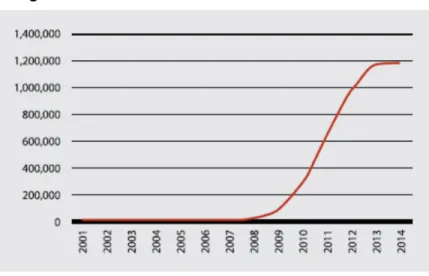
2.16 As highlighted in Power and Water Corporation's (PWC) submission to the inquiry, the uptake of roof-top solar PV has given rise to further cross subsidisation.42 Although, the rate of household solar PV installations in Australia has slowed slightly in recent years, due primarily to the removal of government subsidies, as Figure 3 indicates, there has been a significant increase in solar penetration since 2008.
Figure 3: Rising Penetration of Solar PV in Australia43
39
NERA Economic Consulting, Efficiency of Tariffs for Current and Emerging Technologies, pp. 16-17; Productivity Commission, Electricity Networks Regulatory Frameworks Vol 2, pp. 351-2;
40
Power and Water Corporation, Committee Transcript, 11 October 2013, p. 22
41
Ausgrid, Ausgrid Demand Management CoolSaver Interim Report, Ausgrid, Sydney, September 2015, p. 3
42
Power and Water Corporation, Submission No. 10, p.8
43
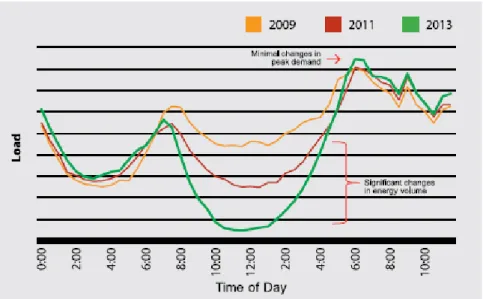
2.17 While it is acknowledged that the reduction in electricity demand from solar PV owners has the capacity to lower required network investment, Figure 4 illustrates that where peak demand tends to occur late in the day “solar panels do not appear to materially reduce the peak demand; the key driver of network expenditure.” 44
Figure 4: Impacts of Solar PV on Energy Consumption and Peak Demand45
2.18 As NERA points out:
The network benefits provided by PVs are a function of their output and system profile of demand. In networks where the system peak occurs at times when PV output is high, it can be expected that PVs may have a considerable effect on system demand. In contrast, if the system peak tends to occur at a time when PV output is low, there may be few network benefits from PV systems.46
2.19 For example, analysis of a South Australian consumer on the standard two-part flat rate tariff with a 2.5 kW north-facing roof-top solar PV system found that, as a consequence of their reduced energy consumption, they pay approximately $200 a year less in network costs than a similar consumer without solar panels. However, since north-facing solar panels only generate about 18% of their maximum capacity during the time of peak network demand, the actual benefit to the network is around $80 per annum in reduced costs. As is the case with air conditioners, the $120 difference is recovered by other consumers facing higher prices.47
2.20 NERA also notes that while west-facing panels produce 15% less energy than north-facing systems, they generate around 38% of their installed maximum capacity during South Australia’s system peak when energy is more valuable. Consequently, the reduction in network costs is much higher effectively limiting
44
Submission No. 13, Energy Networks Association, The Road to Fairer Prices, p.2
45
Submission No. 13, Energy Networks Association, The Road to Fairer Prices, p.3
46
NERA Economic Consulting, Efficiency of Tariffs for Current and Emerging Technologies, p.24
47
the extent of cross subsidisation by non PV owners. In summary, NERA points out that their analysis indicates that:
Current network tariffs are providing a price signal to PV systems that exceeds the benefits of those systems to the network. Moreover, the price signal encourages customers to use PVs in a manner that is sub-optimal for the network, i.e., by orienting their PV to the north and not the west.48
Furthermore, the AEMC also points out that current network pricing structures provide no incentive for customers to install battery storage, "despite its ability to significantly reduce network costs."49
2.21 With regards to the potential impact of emerging technologies the Committee heard that the uptake of electric vehicles could impose significant network and generation costs on the electricity system and result in further cross subsidisation between customers.50 As illustrated in Figure 5, it is estimated that there could be up to 500,000 electric vehicles in the National Energy Market (NEM) and the South West Interconnected System (SWIS) of Western Australia by 2020.
Figure 5: Estimated Annual Sales of Electric Vehicles in the NEM and SWIS51
2.22 AECOM's analysis of the uptake of EV's notes that the potential impact on the energy market is largely dependent upon the extent to which drivers can be incentivised to charge in off-peak periods.52 EV trials to date indicate that, in the absence of outside influence such as cost reflective tariffs, smart metering or controlled charging, EV charging demand tends to align with existing periods of peak load; with most drivers choosing to charge their cars as soon as they get
48
NERA Economic Consulting, Efficiency of Tariffs for Current and Emerging Technologies, p.27
49
AEMC, Why do we need to restructure distribution network prices?, AEMC, Sydney NSW, 28 August 2014, p.2
50
AEMC, Power of Choice Review, p.18; see also AECOM Australia Pty Ltd, Impact of Electric Vehicles and Natural Gas Vehicles on the Energy Markets: Final Advice
51
AECOM, Impact of Electric Vehicles and Natural Gas Vehicles on the Energy Markets, p.30
52
home from work.53 The potential impact of 'unmanaged charging' on the NEM and SWIS for the low, central and high uptake scenarios are shown in Table 1.
Table 1: Impact of EV’s on the Energy Market with Unmanaged Charging54
2.23 In the case of the central uptake scenario, AECOM suggests that if 50% of EV users charge their vehicles during peak periods the cost of increased capacity in the NEM alone "could be around $1.8 billion by 2020 and $4.6 billion by 2030."55 Equating to approximately $10,000 per EV depending on location and use profile:
Approximately $3,000-$3,500 of these costs between 2015 and 2020 would be paid for by the EV consumer. The remainder ($6,500-$7,000) would be borne by all consumers if charging is unmanaged. Over a five year period, this equates to just over an extra $1000 per EV per year of costs that would be recovered from all consumers.56
2.24 Then too, as noted in the mid-term report from the Victorian electric vehicle trial currently underway, flat rate tariffs provide no incentive for EV owners to invest in smart home charging solutions:
53
Department of Economic Development, Jobs, Transport and Resources, Creating A Market: Victorian Electric Vehicle Trial Mid-Term Report, State Government of Victoria, Melbourne VIC, 2013, p.66; see also AECOM, Impact of Electric Vehicles and Natural Gas Vehicles on the Energy Markets, pp. 48-52
54
AECOM Australia Pty Ltd, Impact of Electric Vehicles and Natural Gas Vehicles on the Energy Markets, p.vii
55
AECOM Australia Pty Ltd, Impact of Electric Vehicles and Natural Gas Vehicles on the Energy Markets, p.ix
56
The best case/least cost home charging solution for around $500 will provide no charge management capability or insight into energy use ... For an average household seeking basic charge management capability, a home charging solution will cost $2,000-$3,000 ... Most of this investment gets written-off for EV owners who move house.57
2.25 Apart from the impacts of disruptive technologies such as those discussed above, the Committee’s discussions with the Power and Water Corporation highlight the fact that while a range of new technologies are coming on the market, such as washing machines and dishwashers that can be programmed to operate at off-peak times, or demand response enabling devices (DRED) such as air conditioners, heat pumps and pool pumps, without the right price signals there is no incentive for customers to spend a little extra for these types of appliances or to change their behaviour and use energy intensive appliances in a manner that benefits the network.58
2.26 The Committee notes that a recent review of the international status of residential tariffs indicates that a number of countries around the world are experiencing similar network challenges to Australia for similar reasons.59 While policy responses differ depending on local market conditions and cultural considerations, the study found that there is a growing recognition of the important role small consumers play in creating efficient electricity markets; that "empowering consumers to participate in the market and respond to appropriate incentives provides benefits for both end-users and the economy as a whole."60
Dynamic Pricing Structures
2.27 As highlighted in the preceding discussion, “tariff design choices ... will have a profound impact on future network price increases, customer bills and potential cross subsidies.”61 Although a number of network businesses across Australia are currently trialling and beginning to introduce more cost reflective pricing structures, tariff design options under consideration tend to be fairly limited. While acknowledging that tariffs need to be designed to address local market distortions, AECOM and the Brattle Group suggest that Australia could benefit from a consideration of international experience and global tariff trends.62 2.28 As detailed in Appendix 3, in recent years, countries with electricity systems
analogous to Australia have introduced a wide range of dynamic pricing structures that aim to improve cost reflectivity and minimise cross subsidies. In
57
Department of Economic Development, Jobs, Transport and Resources, Creating A Market: Victorian Electric Vehicle Trial, p. 70
58
Power and Water Corporation, Committee Transcripts, 28 November 2014 and 20 February 2015
59
Lampard, M., and Aspinall, M., Managing Energy for Our Future: Power Pricing Internationally – Learnings for Australia, AECOM Australia Pty Ltd., Melbourne VIC, June 2014, p.35
60
Lampard, M., and Aspinall, M., Managing Energy for Our Future, p.37
61
ENERGEIA, Network Pricing and Enabling Metering Analysis, Energy Networks Association, Kingston ACT, November 2014, p.7
62
Lampard, M., and Aspinall, M., Managing Energy for Our Future, p.37; see also Brown, T., and Faruqui, A., Structure of Electricity Distribution Network Tariffs: Recovery of Residual Costs, the Brattle Group Inc., London UK, August 2014, pp.13-23
addition to the two part, flat rate volumetric tariff discussed previously, the various tariff designs employed can be broadly categorised as:
Tariffs that vary with customer's electricity usage such as:
• Inclining Block: tariff rates increase as consumption increases • Declining Block: tariff rates decrease as consumption increases
• Capacity or Demand Tariff: tariff is based on demand at a particular time,
rather than consumption; and
Tariffs that vary with the time at which customers consume electricity, including:
• Seasonal Pricing: tariff rates vary depending on the season reflecting the
typical annual network load profile
• Time of Use Tariffs: tariff rates vary for different time periods within the
day reflecting the typical daily network load profile
• Peak Time Rebates: customers are paid for load reductions relative to
their baseline load during critical peak events
• Critical Peak Pricing: customers pay higher rates during critical peak
price events and receive a discount on the standard tariff during other hours of the season or year. 63
• Controlled loads: tariff rates are lower at off-peak times for separately
metered and time controlled loads such as hot water heaters and pool pumps.
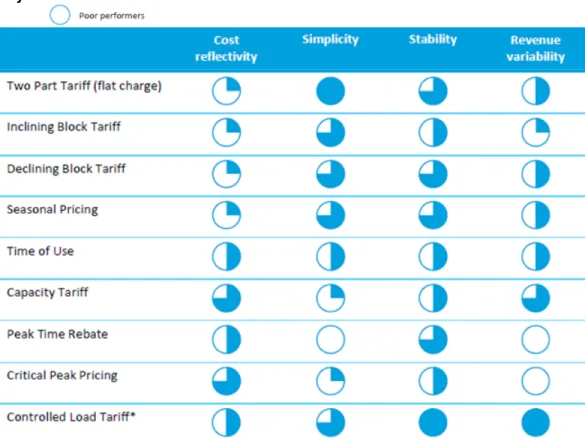
2.29 To better understand the merits and likely consumer acceptance of different tariff designs, in 2014 the Energy Supply Association of Australia (ESAA) engaged Deloitte Access Economics Pty Ltd (Deloitte) to examine and report on the effectiveness, simplicity, and equity of the aforementioned tariffs.64 Each tariff design was evaluated against four factors that Deloitte considered reflected "generally positive or desirable attributes of tariffs in the Australian context",65 namely,
1. Cost reflectivity - Electricity prices should reflect the cost, including the economic cost, of service provision. Cost reflectivity also promotes equity because it reduces or limits cross subsidies between customers.
2. Simplicity - A tariff's operation should be easy for customers to understand. It should be easy to convey the tariff's operation to a large group of customers. The tariff design should be simple to implement and administer.
3. Stability - In the absence of significant changes in use, customers should not experience unduly large, sudden increases in their electricity bill. Once customers are on a particular tariff design, their charges should be reasonably predictable.
63
Deloitte Access Economics Pty Ltd, Residential Electricity Tariff Review, Deloitte Access Economics Pty Ltd, Sydney NSW, 22 January 2014
64
Deloitte Access Economics Pty Ltd, Residential Electricity Tariff Review, p.3
65
4. Revenue variability - Network electricity businesses should be able to recover their efficient costs and should not experience significant under or over-recovery from one period to the next.66
2.30 As illustrated in Table 2 below, each of the tariff designs evaluated has its own strengths and weaknesses. For example, although capacity tariffs are the strongest performers on cost reflectivity and revenue variability for network businesses, they are generally considered to be relatively complex and, depending on their design and implementation, may impact on customer bill stability.67 Conversely, while Time of Use (TOU) tariffs do not perform as strongly on cost reflectivity and revenue variability, they tend to be more readily understood by customers and, “once bedded down…are likely to provide reasonably stable bill outcomes for customers, unless large changes in timing of consumption occur.”68
Table 2: Evaluation of Tariff Designs69 Key:
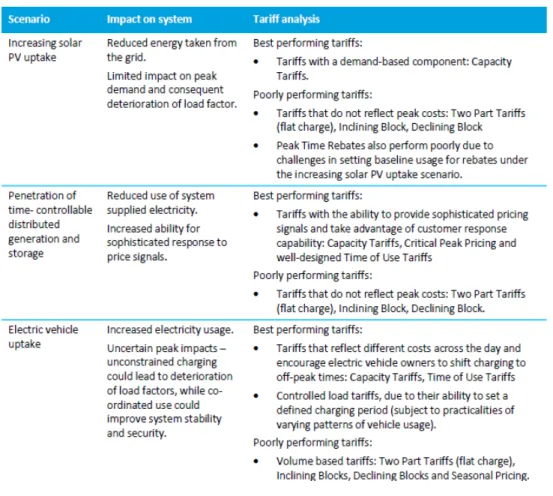
2.31 As summarised in Table 3 below, in the context of current and expected disruptions to the electricity sector, tariff designs with a demand-based
66
Deloitte Access Economics Pty Ltd, Residential Electricity Tariff Review, p.3
67
Deloitte Access Economics Pty Ltd, Residential Electricity Tariff Review, pp.3-4
68
Deloitte Access Economics Pty Ltd, Residential Electricity Tariff Review, pp.22-3
69
component perform best. However, up until very recently, capacity or demand charges have not been considered for residential customers in Australia.70 Given that simplicity and bill stability are key indicators of customer acceptance, “a transition to Time of Use pricing … is a smaller deviation from traditional tariff designs than transitioning to Capacity Tariffs.”71
Table 3: Summary of scenario-based tariff analysis72
2.32 Nevertheless, as highlighted in Appendix 3, various capacity based pricing mechanisms have been successfully incorporated into residential tariff offerings in many other countries. Noting the importance of ensuring tariffs are designed with both simplicity and cost reflectivity in mind, AECOM’s review of power pricing internationally found that while:
tariff simplicity is considered essential in developing a knowledgeable consumer group … simplicity is a function of many parameters, including: the tariff structure, the number of tariff products presented to consumers and the way information is communicated. AECOM commonly found that countries with many tariff options were considered more complex than those who had sophisticated pricing mechanisms with few options.73
70
Deloitte Access Economics Pty Ltd, Residential Electricity Tariff Review, p.25
71
Deloitte Access Economics Pty Ltd, Residential Electricity Tariff Review, p.5
72
Deloitte Access Economics Pty Ltd, Residential Electricity Tariff Review, p.41
73
2.33 Recognising the benefits of combining tariff designs to enhance a tariff’s incentive properties or mitigate risks that customers may face with a standalone tariff design, in 2014 the electricity industry association of Europe (Eurelectric) released a manifesto to advise policy makers how to develop a more balanced, efficient and competitive energy market. Reflecting the findings of the AEMC’s
Power of Choice Review, the manifesto highlights the importance of facilitating demand side participation in the electricity market and recommended that network tariffs should progressively be more capacity-based and peak time differentiated.74
2.34 With potential productivity gains in the order of $1.6 billion per annum in the NEM alone, AGL points out that:
From an economic perspective, the case for default tariff reform is as clear as it is unremarkable. But like most microeconomic reforms, winners and losers arise when benchmarked against (an inequitable) status quo.75
Research to date indicates that 60% of Australian households would benefit from more cost reflective electricity tariffs. At the same time it is acknowledged that not all consumers will want, or be able to shift their usage to off peak periods and could potentially be worse off.76
2.35 Based on the household load profiles and demographic characteristics of residential electricity customers in Victoria, AGL's study into the inequity of flat-rate tariffsprovides an insight into the likely impact of cost reflective pricing on residential customers. The primary objective of the study was to:
analyse the extent of wealth transfers within and between household cohorts [and] compare the annual electricity bills facing 160,000 households using the two products in Table 1, (1) Flat-Rate tariff, and (2) time-of-Use plus Critical Peak Price (TOU+CPP) - both of which are set within two-part tariff structures. 77
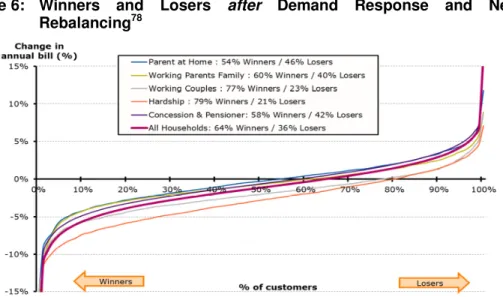
2.36 Accounting for demand response and network rebalancing, Figure 6 illustrates that while 64% of households are likely to be better off under the TOU+CPP tariff, the impact of cost reflective pricing varies quite considerably both within and between household cohorts.
74
Eurelectric, Manifesto For a Balanced, More Efficient European Policy: Power for a Competitive Europe, Eurelectric, Brussels Belgium, February 2014, pp.2-3; see also, Eurelectric, Network Tariff Structure for a Smart Energy System, Eurelectric, Brussels Belgium, May 2013
75
Paul Simshauser and David Downer, On the inequity of flat-rate electricity tariffs, p.19
76
Department of Industry and Science, 2015 Energy White Paper, pp. 15-16; see also
77
Figure 6: Winners and Losers after Demand Response and Network Rebalancing78
2.37 As AGL point out, the 36% of households that are immediately worse off are the households that are cross subsidised under a flat rate tariff; "that is, they have higher peak loads than average and cause greater power system operating costs."79 Further, the data indicates that under a flat rate tariff it is the 'Parent at Home' cohort that receives the highest level of cross subsidy, financed primarily by the 'Hardship'80 and 'Working Couples' cohorts. Importantly for policymakers, while hardship in relation to energy supply tends to be seen as an issue primarily affecting pensioners, the medically ill, and the unemployed, AGL's results suggest that households in the 'Family Formation' cohort (Parent at home and Working Parents Family) are also at risk of experiencing energy related financial hardship.81
2.38 To facilitate the introduction of cost reflective network tariffs, Mr Chris Pattas (General Manager Networks: Australian Energy Regulator) advised the Committee that the AEMC has set a new pricing objective for distribution businesses whereby prices are to reflect the efficient costs of providing network services to each consumer.82 The AEMC points out that “this will allow consumers to compare the value they place on using the network with the costs caused by their use of it.”83
2.39 To achieve this objective, distribution business will be required to comply with four new pricing principles:
• Each network tariff must be based on the long run marginal cost of providing the service. If consumers choose to take actions that will
78
Paul Simshauser and David Downer, On the inequity of flat-rate electricity tariffs, p.18
79
Paul Simshauser and David Downer, On the inequity of flat-rate electricity tariffs, p.16
80
'Households in Hardship' are defined as those households who have the willingness, but not the financial capacity, to pay their electricity account and have, in turn, been placed on AGL Energy's 'Staying Connected' program - Paul Simshauser and David Downer, On the inequity of flat-rate electricity tariffs, footnote 20, p. 10
81
Paul Simshauser and David Downer, On the inequity of flat-rate electricity tariffs, pp. 20-1
82
Australian Energy Regulator, Committee Transcript, 28 November 2015, pp.2-3
83
Australian Energy Market Commission, New rules for distribution network pricing, Australian Energy Market Commission, Sydney NSW, 27 November 2015, p.1
reduce future network costs, such as by reducing peak demand, then they will be rewarded with lower network charges.
• The revenue to be recovered from each network tariff must recover the network business's total efficient costs of providing services in a way that minimises distortions to price signals that encourage efficient use of the network by consumers.
• Tariffs are to be developed in line with a new consumer impact principle that requires network business to consider the impact on consumers of changes in network prices and develop price structures that are able to be understood by consumers.
• Network tariffs must comply with any jurisdictional pricing obligations imposed by state or territory government. But if network businesses need to depart from the above principles to meet jurisdictional pricing obligations, they must do so transparently and only to the minimum extent necessary.84
2.40 Mr Pattas noted that the rule change strengthens and expands the role of the AER and introduces a new network pricing process. The process begins with the AER making a determination on the total revenue a network business can recover from its customers. Network business will then be required to:
develop a Tariff Structure Statement (TSS) outlining the tariff classes, tariff structures and the methodologies associated with the new pricing principles and submitting these to the AER for approval. Before submitting the proposed TSS to the AER, distribution business will need to engage in discussions with stakeholders, particularly retailers and consumers, about the network tariff structures and indicative price levels that it is considering proposing.
The AER will assess the TSS against the pricing principles in conjunction with the businesses' five year regulatory proposal. We would approve the TSS where it meets the pricing principles and other rule requirements. Secondly, the distribution businesses would develop and submit their annual pricing proposals to the AER. This annual tariff adjustment would apply pricing levels to the tariff structures outlined in the AER approved TSS.85
2.41 While cautioning against making generalisations about which types of consumers may or may not benefit from network tariff reform, the AEMC also recommends that, as part of the network pricing process, “governments review the structure of their energy concessions schemes so that they deliver on their purpose in an efficient and targeted way."86 As highlighted in AGL’s study on the inequity of flat-rate tariffs cited previously, research related to identification of the demographic incidence of hardship indicates that the design of concession schemes and energy efficiency initiatives has not necessarily kept pace with the changing nature of the electricity market and customer consumption patterns. Based on energy market and demographic data, AGL’s 2012 review of the credit characteristics of its customer base, representing approximately one quarter of all households in the NEM, found that:
84
Australian Energy Market Commission, New rules for distribution network pricing, p.2
85
Australian Energy Regulator, Submission No. 6, p. 2; see also Australian Energy Regulator, Committee Transcript, pp. 3-4
86
Australian Energy Market Commission, Restructured distribution network prices and consumers, Australian Energy Market Commission, Sydney NSW, 28 November 2014,, p. 2