Organization and structure of the chain in the Integrated Projects
of Food Chain in Basilicata region: the effects on the new rural
dynamics
Contò F.
1, La Sala P.
2and Papapietro P.
3 1University of Foggia/DSEMS, Professor, Largo Papa Giovanni Paolo II, Foggia, Italy
2
University of Basilicata/DITEC, PhD, Viale dell’Ateneo Lucano n. 10, Potenza, Italy
3
University of Bari/Diritto Privato, PhD, Piazza Umberto I° n. 10, Bari, Italy
PAPER PREPARED FOR THE 116
THEAAE SEMINAR "Spatial Dynamics in
Agri-food Systems: Implications for Sustainability and Consumer Welfare".
Parma (Italy) October 27th -30th, 2010
Copyright 2010 Contò F., La Sala P. and Papapietro P.All rights reserved. Readers may make verbatim copies of this document for non-commercial purposes by any means,
Organization and structure of the chain in the Integrated Projects of Food Chain in
Basilicata region: the effects on the new rural dynamics
Contò F.
1, La Sala P.
2and Papapietro P.
3 1University of Foggia/DSEMS, Professor, Largo Papa Giovanni Paolo II, Foggia, Italy
2
University of Basilicata/DITEC, PhD, Viale dell’Ateneo Lucano n. 10, Potenza, Italy
3
University of Bari/Diritto Privato, PhD, Piazza Umberto I° n. 10, Bari, Italy
Abstract - The introduction of the Integrated Projects
of Food Chain requires the development of models capable of interpreting the dynamics of vertical and horizontal coordination between agents and the definition of the issues that most affect the ability of professionals to provide value added to goods and products to acquire in exchange a competitive advantage.
With reference to the Basilicata region, the production structure of the region and the recent development of the Integrated Projects of Food Chain, this research has developed a new model of territorial organization of rural development. Now connect a new food chain model that combines theories of productivity, typical of contract economic, with those of social welfare and environmental economics: multifunctionality and biodiversity related to the needs of income and efficiency of companies in various stages of the food chain classic, in a context in which planning consultation is major determinant of local and regional development.
Keywords - Food Chain, Rural Development,
Integrated Project of Food Chain
I. INTRODUCTION
The agro-food industry is evolving more towards new forms of organization much more complex and characterized by a greater degree of coordination, whether in the form of vertical integration of explicit or implicit contract between players of different levels of the food chain.
The causes of this structural and organizational changes are related to different issues, whose weight varies greatly depending on the sector.
However, the underlying driving forces may be due to at least three factors:
a) those related to changing consumption and therefore demand for food and agricultural products;
b) those related to the organization of the markets upstream and downstream supply the same products;
c) those related organization of the markets upstream and downstream of the agricultural sector.
Often, the common feature in many food chain lies in the role played by farmers or, in general, the agricultural sector, capable of reacting passively to stress imposed by other sectors of the economy without being part of proposal. And this is a datum that causes a loss of competitiveness of this stage of the process, frequently unable to innovate and to lay down rules according to what should be his “natural force” against an organization of food chain which is the engine: an agricultural world incapable, that is, to be the protagonist in exchange relations, important for survival in a market economy.
Therefore, it becomes essential to seek mechanisms to capture value at first for the production phase to push to increase competitiveness of the whole food chain. In reaching this result is important since the pipeline concept to analyze how this has been the subject of theoretical developments and how these developments have come to define a model basically in line with what happens in practice.
The analysis was conducted with specific reference to the Basilicata region, characterized by a productive structure and territorial organization that greatly influences the dynamics of rural development and development of agro-food chains, as evidenced by the recent emergence of Integrated Projects of Food Chain.
In this context, in fact, the quality and identity of territorial production - resulting from the strong link
between companies and territory and the social value of agriculture as well as economic - combined with the need to develop regional and interregional networks, are the main factor of integration and competitive advantage.
On that basis, through the use of questionnaires to sample between the companies who participated in focus groups that preceded the publication of notices for the presentation of regional Integrated Projects of Food Chain and field surveys aimed at determining the value added at different stages in the food chain and cost impacts of internal and external to it, it was possible to develop - from a new model of territorial organization of local development based on the role played by Local Action Groups (LAG) and rural and agro-food of quality districts - a model of food chain capable of combining theories productivity, typical economic contract, with those of social welfare and environmental economics: multifunctionality and biodiversity related to the income and efficiency of companies in various stages of the classical food chain, in a context in which consultation of planning is major determinant of local and regional development.
II. THE FOOD CHAIN FROM ECONOMICS TO AGRICULTURAL POLICY
The food chain concept and applications of the same analysis of the issues concerning the food system have long attracted the attention of the economic - agricultural Italian literature, recognizing the concept of food chain the role of interpretative tool able to analyze these issues in light of changes that have characterized the system and related mainly to the increasing integration upstream and downstream of agricultural production processes.
In this sense, the approach of the food chain states as particularly appropriate tool for analysis by defining a unit of intermediate survey of the production process and economic system, especially considering that, today, the market competition is increasingly between food chains rather than between individual companies. However, the literature tends to consider the food chain simply as a form of organizational transformation process which includes the chain of actors involved in the implementation of a specific end product, regardless of strategic considerations. It
seems entirely appropriate, therefore, to draw attention to business analysis methodologies developed in the literature to verify the possibility of their application to the analysis of the problems associated with the enhancement of farming (Antonelli, 2010). And, above all, to consider developments in the pipeline concept in agricultural policy and EU level, as well as national delivery food chain organization to spearhead rural development. For the first time, in fact, there is talk of having food chain as a reference entities, in line with the guidelines of its Rural Development Programs (RDP) regional, have a legal recognition of partnership between companies producing, processing and marketing.
A. The food chain in the agricultural economics
The concept of supply chain, specifically in the food, derives from the assumption need to define a framework of analysis can overcome the boundaries defined by the concept of industry typically tends to focus on the interrelationships of the various stages that develop from the production of agricultural raw materials the finished product.
Where the concept of chain is used as a means of describing purely technical, economic theories focus on different stages of production associated with obtaining a product in which case one can speak of a technological chain.
The pipeline can be represented as a structure composed of technological stages of production, distinct and separable, associated with the use of a particular resource or obtaining a specific product. Thus, the sectoral analysis appears as a kind of micro detail inputs and outputs (Saccomandi, 1991).
There is also an approach that tends to insist on the strategies of economic agents, so the industry itself is configured as a tool to analyze the degree of integration between enterprise, in which the integration is carried out upstream and downstream, the Comparative study of performance between integrated firms and specialized (Arena Rainelli, Tower, 1985).
From a macroeconomic perspective, however, emerges often need to consider the company they keep chains with branches of production, with individual operators and groups of sections and microfilaments.
So that the concept of supply chain becomes a useful reference for the analysis of complex issues related to the production, processing and marketing of products with a view to understand and analyze the reports, especially vertical, between or among segments of production.
Other economists stress the concept of agrarian sector as a tool for analysis of agrifood systems: in its most general sense, the chain is the route followed by a food product to arrive from the initial stage of production to final use, and the total interactions among all agents involved in this process (Saccomandi, 1986).
Following the approach formulated by Malassis (1979), analysis of a given sector consists of the following phases:
a) identification of the supply chain, operations and staff involved, defining the limits of the sector is the vertical (height) than the horizontal (width);
b) study of regulatory mechanisms in the sector, with particular reference to the price formation mechanisms, policies of public intervention at different levels of government and the actions undertaken by the various interest groups. c) The food system can be considered as a set of
interdependent activities, which aim to produce goods that may have different destinations: final consumption, intermediate consumption, or both.
If, for each commodity is associated with that part of any activity which directly or indirectly participated in its production yields a chain.
The sector is, therefore, all fractions of each of the activities involved in the production of specific goods: each village is, in fact, a stage route through which the goods are due to pass; (P. De Muro, 1992).
The distinction between industry and product supply chains or chain strict sense is meaningful (Arena Rainelli, Tower, 1985): the first refers only to the final product, while the second refers to the output of goods , made up of both intermediate goods that final goods. This distinction is important when we proceed to the choice of methodology for analysis of feed and food chain.
Therefore, the identification phase of a sector is based on a given product. To describe the chain so
identified, it is necessary to identify technical and financial operations implemented in the production chain - processing - distribution - consumption and agents involved in them: agriculture, agri-food businesses, firms providing goods and intermediate goods instrumental public or private institutions, trade unions, consumer groups.
This pattern of vertical relationships along the supply chain is part of horizontal relationships with the socio - economic area in which the chain is located.
The study of regulatory mechanisms, however, refers to the strategies adopted by different agents in the sector and the adjustment mechanisms that ensure the circulation of goods and services from production to final consumption, in particular the mechanisms of price formation, government policies and those of regional and international.
Starting from these assumptions, the supply chain analysis allows to identify internal and external trading relations undertaken by other branches of agriculture production. The concept of chain link and that includes; analysis of the supply chain becomes relevant when analyzing the phenomena of vertical integration (De Muro, 1992), as when connecting two production processes when the output becomes the first input of the second, a development that generates added value.
Companies exist precisely because of their ability to add value to the resources used by the process of transformation. From an economic standpoint it is important to understand the contribution of resources / assets employed in the production of value and is therefore useful to have an interpretive scheme that focuses on this aspect. The chain is a system offered on the market that competes with other trade organizations. In this perspective, the centrality of the consumer and fulfill your expectations are important elements in the behavior of individual companies, not less so for all businesses operating in a sector. This concept is the basis of models of competitive advantage of the value chain and value system (Porter, 1985). The value chain allows us to consider the enterprise as a system-generating activities of value, meaning the price that the consumer is willing to pay for the product which meets their needs.
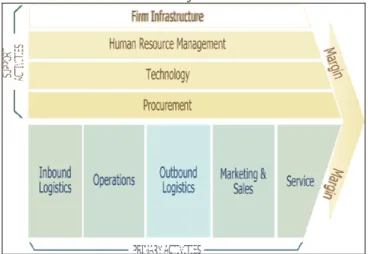
The company’s activities are divided into nine general categories: five are called direct or primary activity, four or ancillary support activities (Figure 1).
Figure 1 – the division of activities in the value chain of Porter
Source: Porter (1987)
The correct starting centerpiece for analyzing supply chain is the consideration that what counts is always the ability of business to produce value for end customers and not for intermediate customers, as this is the end customer who pays the price that corresponds to the product, all costs incurred by companies that belong to the sector. In fact, the price of a product increases from one stage to another of the value chain, the contribution of each stage to the formation of the final value is the value added.
In reality the food system, the overall configuration of the product offered to consumers in its component form, time and place, never dependent on the individual enterprise (Pilati, 2004). Even in the short supply chain (direct selling, kilometer zero, farmer’s markets, etc..) Creation of the final value for the consumer is the result of the connections between the value chain of the agricultural and consumer.
The value chain is not, however, able to represent how the interrelationships within the economic system will result in a value creation in areas that are not directly related to agricultural.
From this point of view, the concept of value system refers to the fact that the chain of the company’s value is inserted into a system of interlinked value chains and downstream: Value chain
of suppliers; Value chain of farms; Value chain of distribution; Value chain of consumer.
Whenever a particular sector increases its production, in fact, it generates an increase in demand given to sectors which are linked, which triggers a new production throughout the economic system in a chain.
The use of the concepts of value chain system and the Porter value system allows you to watch, so in the industry as an “extended enterprise”, with its value chain on the inside confluence of value chains of individual firms and characterize (Antonelli, 2010).
Similar considerations apply in the event that you consider when analyzing the dynamics outside the industry itself, namely socio - economic and institutional.
So much to talk about systems and value creation (Parolini, 1996) that refer not to the concept of enterprise stable and clearly defined boundaries but to a context defined by a network of more connections between economic actors (firms, households, public , various organizations) and final buyers whose co-presence generates a total value which should be read as taking the perspective of the consumer.
However, whatever approach to supply chain, the study of the role of individual agents within it can not capture the variety of business relationships with the external environment which the sectoral analysis is a valuable tool for identifying forms of vertical coordination to integrate with a territorial approach, which allows to interpret the behavior of firms in relation to the environment in which they are located. This test system, therefore, is meaningless if not contextualized to a geographical region and sector.
B. Thefood chain in agricultural policy
The agricultural policy has invested heavily on the food chain recognizing vertical and horizontal coordination of different actors involved in the processes of production - processing - marketing - distribution of food products the best model for the generation of economic value and competitive advantage for the entire system.
The European Commission, according to the analysis resulted in following the global financial crisis, is studying the issue, focusing attention on the
opportunities that may arise by acting on the food chain and focusing on three priorities:
1. promote market-based and lasting relationships between the operators of the food chain (farmers, processors, traders, wholesalers, retailers);
2. increase transparency along the supply chain to foster competition and improve reactivity to price volatility;
3. promote the integration and competitiveness of the food chain.
In this sense, the RDP 2007-2013 plan to earmark for Integrated Projects of Food Chain (IPF), a high percentage of available financial resources (investment in agricultural holdings and investments for manufacturing and processing of raw materials).
This trend was confirmed in Basilicata, where the Region has invested about 90 million euros on Integrated Planning of Food Chain: an initial examination of the acts on the progress of programs, shows a good tendency of companies to join in Basilicata by signing specific food chain agreements: is a positive signal, but you need to consider carefully whether, in fact, such contracts between the parties are effectively implemented and whether there is fair distribution of value added between the various players.
In fact, it needs to be greater cohesion between producers and processors for a fair distribution of value added and to gain greater bargaining power against the supermarkets.
In assessing the impact of the Integrated Projects to food chain quality and competitiveness of agricultural holdings is essential, however, that the European Union a specific action of active monitoring, evaluation and analysis determines that:
- How the mechanisms regulate the industry effectively encouraged the growth quality and competitiveness of the agricultural sector; - What are the investments in this sense, may be
decisive for the quality of products, processes and development of know - how;
- What are the conditions governing the supply relationships on which these mechanisms can affect the benefit of world production according to the purposes set out above.
The agreement formalizes the commitment of industry to the individual companies making
investments coordinated with each other, for the modernization of business and processing structures, introduce innovations in the development of new products and or processes in the agri-transfer knowledge, information and promotion activities, participation in food quality schemes and use of consulting services.
Thus, the agreement seeks to bind the members of the IPF around the common goal of raising the value added for all segments of the industry, by creating intervention strategies that improve the competitiveness of the system, removing the weaknesses and strengthening relations within and outside the industry, from an IDE.
Therefore, the contract sector, defining relations and mutual commitments between persons belonging to the IPF, the primary objective of:
1. redevelop the field and offer that gives added value to all components of the supply chain with shared responsibility and ethical behavior; 2. address the trade issues in an organized manner
by developing synergies between the various players in the sector and providing specific interventions from primary production to be competitive offer in terms of cost reduction, quality and guarantee for the consumer;
3. creating a coordinated partnership between enterprises of production, manufacture, processing and marketing in order to submit a chain project to improve the supply and target the best quality to the more lucrative markets and straining toward the needs and requirements of the consumer, view to:
- Environmental protection; - Traceability in the food industry; - Food security;
- High quality;
- Fair value for money.
According to this logic, the beneficiaries of an IPF must undertake to develop:
a) investment in respect of measures 111, 114, 121, 123 of the PSR for the continuous improvement of product quality and process; b) b) innovative product / process through the
implementation of assistance under measure 124.
To enable higher quality and safety of production, a prerequisite for adding value and gain greater competitive advantage, farms that are on the stage of production and companies engaged in manufacturing and processing industry must commit to:
- formalize and share production specifications and / or manufacture, handling, processing marketing;
- to adopt a voluntary system of traceability that allows you to monitor all flows of the production chain to identify the sources and all phases of the production / distribution.
The provision is a prerequisite for obtaining these goals: the basic producers are obliged to sign with the other parties participating in the IPF contracts governing supplier relationships, which must be spelled out the specifications and analytical disciplines for all clauses the sale / transfer including any exceptions for reasons of force majeure. Conversely, companies located in the last stage of the supply chain, will market production afferent PIF through specific trade agreements to be formalized with the major multiples, other distribution channels and / or sales / administration direct or indirect food and agricultural production , including catering, sales network, marketing and use of local products, farmers’ markets, purchasing groups and other supportive.
There is opportunity to gain competitive advantage if you invest on innovation: the added value of integrated design of pipeline can be represented precisely by the capacity of the supply chain to cooperate in the development of new products, processes and technologies. By measuring 124 activated by the IPF, companies can benefit from product and process innovations that improve production standards, to ensure a higher quality process and to act on the costs by improving efficiency and revenues by improving efficiency of production or manufacturing processes.
Finally, through vocational training, in measure 111, can generate improved levels of specialization of farms by allowing, through synergic actions between the supply chain, creating professionals in line with their technical or business needs of companies themselves.
The above translates into account the existence of two different models of agriculture that require specific models of development and integration of the
industry. The root node is the type of industry - long and short - and the complexity of relations and relationships that come to be.
Often the size of farms is that it does not provide an adequate level of coordination of production and organization of local production system according to classical logic chain. In such contexts, the degree of impact of small farms and very small non-organized processes for determining producer prices is zero.
This situation corresponds to areas of local hills and mountains.
In those areas of production response in terms of regional programming models is to supply chain integration models different from those typical of production systems characterized by intensive agriculture and specialized: it speaks specifically of zero distance, farmer markets, short chain and neighborhood. About models that can change the structure of production and socio-economic territory, through the development of chain operations, taking into account the specific context of industry and the relationships between actors in the chain, combines the best the value chain resulting from calls for ERP in terms of territorial organization and governance, environment and territory, as a consumer.
These are food chains for which the Basilicata Region has developed ad hoc calls to apply the same RDP 2007 - 2013 the implementation of integrated projects aimed chain of protected areas and proximity:
a) the supply chain of protected areas are typically all-embracing specific to certain areas occupied mostly by parks (chains of protected areas), focusing primarily on quality and feature strongly in territories within which these protected areas are located;
b) the proximity chains are aimed at bringing the smaller producers to market local (regional), with specific reference to that of urban areas, including tourism.
In the first case, therefore, chain – all-embracing or intersector - pointing primarily on the quality and territorial identity of the productions for which the main factor of integration and competitive advantage lies in the strong link between companies and territory and in the social value than Agriculture and economic area protected.
In the second, one can speak of agro-territorial that go beyond the classical approach to the sector, including aggregating multiple priority belonging to different sectors or in many marginal producers, whose interests can not be represented in the sectors traditionally designed, focusing on large specialized production and concentration of financial resources. For these sectors, the objective is to reduce the distance from the market, surpassing the classical approach to the stages of processing, distribution and marketing due to volumes and bargaining power are different from those typical of other production dynamics.
For these contexts, it is very important to combine the needs of biodiversity and multifunctional income and efficiency of the supply chain.
However, it remains the open question on the ability of these forms of organization of the supply chain to ensure, at the local level, the increase of production income and to identify regulatory mechanisms that can ensure greater quality certified products to the benefit of producers and consumers.
Therefore, it is essential to identify and implement, with reference to the Basilicata region, a model of territorial organization for rural development, starting from the development of food chains, be able to combine the spatial dimension with the need to develop interregional networks interregional and can generate a value for these chains is not confined to the territorial dimension that generates.
III. TERRITORIALIZZAZIONE DEGLI INTERVENTI E ORGANIZZAZIONE TERRITORIALE DELLO SVILUPO LOCALE The principle of territorial actions dictated by the European Union to the Regions for the execution of the Rural Development Programs 2007/2013 met, in Basilicata, a programmatic fragmentation generating in recent years and with reference only to agri-food sector (rural) of 4 districts and 8 Local Action Groups (GAL).
The District of Vulture and the District Agro-Food Quality Metapontino were born in 2003 and 2004 and have adopted, since 2006, its own development program concerning the characteristics of businesses, agricultural food production and area of expertise with
special reference to issues of supply chain development, promotion, training, logistics.
It’s obvious, however, for these districts, the absence, generated by the limitations into the regional law (LR 1 / 2001),of an ability to structure and implement the program guidelines identified and to allow, for example through the establishment of centers community services, to meet a wide range of services to companies and the industries of the area in order to determine an improvement of competitiveness, as well as appropriate policies for local marketing.
In 2010 they were recognized by the District Rural of Materana Hills and Mountains and the Local Production System of the Pollino - Lagonegrese, that in a few months will be required also to submit its district development program to Basilicata Region.
Therefore with regard to the primary sector, Basilicata’s territory is organized in local production systems, according to its own logic of districtualisation of productive activities with regard to the agricultural sector, remains out of this development model, only the north-west of the region.
In 2010, following the issue for the submission of Local Development Plans regarding the Leader Axis regional PSR from 2007 to 2013, the Region of Basilicata granted - even provisionally - for the current programming period, eight Local Action Groups (seven of which are already operating in the previous period) whose actions involve almost entirely, except a few towns in the region:
- Metapontino e Basso Sinni (CO.SV.E.L.); - Medio Basento (Le Macine);
- Bradanica (Bradanica);
- Marmo Melandro (CSR Area Marmo Melandro); - Alto Basento e Camastra (Basento Camastra) - Vulture Alto Bradano (Sviluppo Vulture Alto
Bradano);
- Alto e Medio Agri, Alto Sauro (Akiris);
- Lagonegrese, Alto Sinni, Pollino e Sarmento (La Cittadella del Sapere).
In the same 2010, these actors of rural development, will add new corporate holders of many development programs, but to rely on Axis I and III of the RDP regional partnerships represented by the chain. The regional call for the submission of Integrated Supply Chain Projects, published in December 2009, was
founded with the goal to pursue, through the Integrated Supply Chain Design, throughout the regional action in support of the productive fruit and vegetables, cereals, livestock (meat and milk), wine and olive oil, defining for each of these sectors a number of specific objectives.
In particular, the call aims to encourage, through an overall design approach and shared aggregation and cooperation between the various participants in the chain, from production to marketing, in order to rationalize the economic activities taking place along the main operational steps, encourage the concentration of supply, increase the added value of industry and enterprise competitiveness, promote the typical products and land, increase the bargaining power of employers. The PIF constitute a coordinated and systematic operations relate to several measures of the RDP can be activated through a process of negotiation, to which the various participants in a particular food supply chain access through the submission of a joint application (Integrated Project Sector) submitted by a proponent.
Following the closing of the planned first step in that announcement, the Basilicata Region has recognized, even provisionally, with reference to six productive sectors identified as many as 16 proponents of FIP 5 and 11 of the regional BIP are territorial.
In fact, the Basilicata region intended to define, given the different spatial distribution of firms due to the different production sectors, two levels of integrated projects of the sector:
Supply chain management projects at the regional
level;
Supply chain projects management-level planning.
It also considers that these projects will follow those relating to networks and proximity of protected areas: thus, the entire region will be fully involved in the development of the sector, although the latter characterized by the presence of subject leader and different programming strategies.
But local development is also subject to other intervention strategies that, in different sectors, the main players of programming at the local level, as well as districts, Gal and Partnerships Die (with its plans for district projects, integrated supply chain plans local development), other subjects such as tourism systems and power systems.
Basilicata Region, published in 2009, the Call for the presentation of tourist offer an integrated package (PIOT) in respect of the specific goal IV.1 axis IV "Enhancement of cultural and natural heritage" of the PO ERDF 2007 - 2013, after which it adopted in 2010, six PIOT, represented by six different public - private partnerships at local level, in relation to the different systems in regional tourism:
- Pollino Benessere tra Natura e Cultura (Parco del Pollino);
- Basilicata Naturacultura (Rete Area diffusa con capofila il Comune San Fele);
- Montagne di emozioni Gallipoli Cognato Dolomite Lucane Potentine (Area Parco Gallipoli Cognato e Montagna Potentina);
- Maratea terra e mare (Area Maratea);
- Metapontino Basso Sinni (Metapontino ed interno);
- Val d'Agri Appennino Lucano-Lagonegrese (Val D’Agri – Appennino Lucano Lagonegrese).
The purpose of PIOT is to increase the tourist appeal of Basilicata through actions and interventions designed to achieve an integrated approach to tourism development that can form the basis for the possible subsequent formation of the local tourist systems able to network the various "attractors" cultural, natural and landscape in the area, such as to encourage, through a stable partnership, the development of innovative business forms and marketing of tourism products targeted.
In the energy field, however, the Basilicata Region, published in 2009, the Regional Environmental Energy Plan (PIEAR), valid until 2020, which sets policy for regional planning in the field of energy development of the territories and aimed at achieving four broad objectives : Reduction of energy consumption and energy bills, increase the production of electricity from renewable sources, increase the thermal energy from renewable sources, creating a district in Val d'Agri.
Even with regard to social, finally, the territorialization of different interventions has allowed territories to have their own programming tool: in 2009, in fact, the Basilicata Region has published in favor of institutional partnerships, the call for the submission of plans Offer Integrated Services (POIS) Axis VI in respect of social inclusion of the ERDF OP
2007/2013 to support the strengthening and qualification of integrated services to individuals, families and communities, to take action on seven geographical areas identified, including two in the province of Matera and five in the province of Potenza:
- Alto Basento;
- Vulture Alto Bradano;
- Metapontino Collina Materana; - Lagonegrese Pollino;
- Bradanica Medio Basento; - Marmo Platano Melandro; - Val d’Agri.
From the above, is emerging as a clear programmatic fragmentation of local development strategies, which contrasts surely the need for a balanced and substantial development of the regional economy that can not result from an overall view of prospects for endogenous growth Luke's territory as a whole.
Therefore, with regard to rural development, is a crucial form of organization capable of reconciling the programming at the local level in order to determine a spatial dimension of rural development and productive even at regional level in order to compete with the market logic and globalization that dominate the agri-food system.
The principle of territorialization that has defined the Basilicata entirely rural and divided into three main areas for intervention in the PSR (B, D1 and D2), can be an important opportunity for the implementation of priority actions aimed at the development but implemented the investment policy should also allow for a development policy based on the escape from the ghetto of territorialization, only important to organize production in the territory and the operators and, at the same identities and strengthen the organizational capacity to make room for transnational and interregional programs, which are essential in fostering relationships and developing networks.
Not being, in fact, the Basilicata region in intensive production except in areas of Metapontino and Vulture in which they were born two districts of high quality food, the specificity is all in the rural areas which is typical of the Pollino - Lagonegrese and the Materana Hill and Mountain (where they were born,
respectively, the local production system and the rural district). Integrated Supply Chain Projects have been developed, in Basilicata, on a territorial basis and on a regional basis, were not, however, spatial location into account the division of Basilicata in priority areas.
Therefore, the Basilicata region generally characterized by a dimension of their supply chains, even with the priorities of certain exclusive territorial production systems (Pollino), in relation to which invitations have been developed specifically to sectors defined as "atypical" in that multi or multi-sector product.
In order to plan a harmonious development of the regional economy starting from the local circumstances, is crucial to define a model of territorial organization of rural development can make the system programming lines and the roles of various players: a model in which, with reference to the primary sector, GAL and districts are required to work according to the logic of integration and overcoming the jurisdictional boundaries in favor of a development of productive sectors and territories that starts with the local specificities as a means to compete in a global market.
In conformity with the new development perspectives of the agricultural field, the role of the local productive systems is very important for local development and investment policies. The districts and the local productive systems are new entries into the new programmatic model of the UE’s development policy, because they have a fly-wheel role in its applying; as a matter of fact, this policy is based on territorial-making actions. For instance the Rural Development Policy, which is a strong point in the 2007-2013 planning system, is based on a strategic, integrated and territorial approach, and on the main role of the local partners in the development strategies promoting. So, the UE’s rules about the rural development and the Common Market Organizations (OCM) apply for consultation and partnering strategy, involving the stakeholders in all the planning and realization steps of those programs.
It means to adopt dialogues and comparisons among regional administration, local organizations and socio-economic forces, in order to make shared choiceand so to create more efficient investments and skills to control the
executive processes and their results. In this way, the local productive systems become territorial organizers of joining of each factory to the PSR: they promote and enliven the area for searching factories and projecting with them the Food Chain Integrated Programs.
The same Reg. (EC) No. 1698/2005 Art 6, the Partnership identified the main form of consultation between the European Commission and Managing Authorities, the identification of those to be consulted, the regulation refers to organisms representative at the regional and local part of the following categories:
a) local governments and other public authorities; b) the economic and social;
c) any other appropriate body representing civil society, non-governmental organizations, including environmental organizations and agencies for the promotion of equality between men and women.
. The above is implemented by the methods provided by the RDP in terms of integrated projects as well as Chain of Local Development Plans.
In this perspective, the local production systems become territorial organization of the participation of individual companies to RDP measures: promoting and animating the territory to try and design companies, with them, the said Program of Integrated Supply Chain, representing (together with Multi-pack for young people) the only providence that will provide substantial axis I of the PSR in the current programming period.
According also to the birth of Local Communities and the Leader approach promoted by the PSR thanks to the Local Action Groups (GAL), the Metapontum District can realize the territorial organization model of the rural development.
The common starting point is the homogeneity of the socio-economic and productive context of this area. On the contrary, the tasks of the several local operators are different and complementary: technical tools of operative support (District and GAL), linking the administrative organizations (the Provinces) with the enterprises, are controlled by the Planning Organization (the Region), making programmatic choices thanks to consultation and territorial-making actions.
These technical tools are divided into territorial promotion tools (GAL), linking with the territory and the III and IV PSR’s Axis, and economic-productive
ones for the factories development (the District), linking with local factories and the I and II PSR’s Axis (food chain programs, factory investments, innovations transfer for local factories – factory impact – and common service development, i.e. creation of the Service Centre for the same local factories – territorial impact).
The interaction between these technical tools of operative support (GAL agreement pact - District) allows enterprises and territory to share development ideas and projects.
Finally, it stresses that the guiding principles of the new EU programming alongside the territorial integration of operations between the EU funds EAFRD, ERDF and ESF. The District, serving as the territorial organization of development, is able to identify strategies for action that can foster the effective integration of territorial PSR EAFRD with the policies promoted by the OP ERDF and the ESF OP: you can include the Logistics Knowledge Society (Research and Innovation System and the Information Society) under the ERDF or training for businesses in the district to rely on the ESF.
In a schematic way, our idea of territorial implementation of agricultural development policy under the 1st and 2nd pillar of the CAP, it is clear that:
it needs to develop two different organisms having different and complementary tasks, because the GAL cannot manage the I and II Axis’ rules with all the first pillar’s activities: i.e. OCM and OP (on the contrary, the District can do it);
the District aims at promoting and creating local networks among the vertical subjects (food chain factories), and between them and the development transversal subjects (Cities, Banks, Universities, service, professional classes, etc…). I.e. they manage the relationships between users and providers of: research, technological innovations, streets, facilities, energy, transports, logistics, credit, factory consulting, etc…;
So, the local suitors and stakeholders (the Province and OOPP) apply the rural and productive development policies (sectorial: cereals, oil, wine, milk, etc…) by two different tools: the GAL (for everything dealing with the III and IV PSR’s Axis) and the District (for every main action of the I and II Axis, and above all for linking factories with themselves and the outside).
IV. THE FORMATION OF VALUE CHAINS IN FOOD: FROM THEORY TO PRACTICE The analysis of the value chain can be considered as the main investigative tool to combine the theories of economic development promoted by the agricultural policy and food chain.
The ongoing debate among policy makers tend to emphasize the importance of outlining strategies to ensure the production phase of an increase in the value chain in the chain, especially in response to the expressed intention of the Committee on Agriculture and Rural Development of the European Parliament (2010) to seek a better functioning of the food chain for the adoption of any tools that can improve the operation thereof in order to offer farmers more equitable revenue, while maintaining affordable prices for consumers.
This, starting from a number of problems become evident due to the severe volatility of commodity prices in agriculture and food sector closely related to the increased concentration of wholesalers, retailers and supermarket chains, with their increasing market power and various abuses of dominant purchasing power in the food chain.
The strategies identified in this sense, are increasingly referring to mechanisms designed to improve price transparency and implementation of competition rules in the industry to combat abuses of power in negotiation and speculation.
Analysis of the structure of the agrifood Italian (Nomisma, 2008), emerges as the same is characterized not only by the abundance of workers but also by some other structural features that determine the level of efficiency and competitiveness (with direct effects on the level of prices), including:
a) extreme fragmentation of the production phase; b) a degree of concentration in the distribution /
sales not yet aligned with the major European countries;
c) dependence for many agricultural food production (especially agricultural commodities).
In particular, the formation of consumer food prices also contribute substantially to the cost incurred by those in the sector (agriculture, industry, wholesale and retail trade and catering) to collect the goods and services offered by external actors:
- Providers of transport services and logistics; - Providers of communications services and
promotion;
- Energy suppliers and utilities; - Packaging suppliers;
- Providers of technical means; - Suppliers of additives; - Technology providers;
- Providers of consulting services; - Etc.
Wanting to suggest a breakdown of household expenditure and eating and drinking can thus identify the following components of the value of food consumption:
- Internal costs of each actor in the food chain, defined as the sum of labor costs, capital costs (depreciation of machinery, equipment, buildings etc..) and the cost of financing (bank, bond etc.).
- The value of the cost items outside the chain aggregate (for goods and services purchased outside as transport, energy, packaging, etc.).
- Direct taxes (eg income taxes) and indirect (VAT, excise duties etc..) that form the value of consumption; - Supply chain profit declined for individual domestic actors;
- Net imports of agricultural products and foodstuffs. Bringing these considerations in the survey carried out in food chain of Basilicata, through sample surveys carried out within the six sectors for which the Basilicata Region has created focus groups (fruit and vegetables, wine, olive oil, livestock, dairy, cereal), it was possible to make an estimate of the weight of these variables in a breakdown of expenditure of EUR 100 food.
The players in the sector have more limited influence than commonly considered the consumer prices of foodstuffs. The set of internal costs and profit of each actor inside the food industry is the wealth generated (value added) from the same. The sum of
the wealth generated by all the players inside represents about 60% of food consumption (domestic and outside the home).
Increased wealth creation is related to the production phase. In the distribution business and there is less wealth creation activities as manufacturing / processing replaces the function of intermediary business and service, structurally less expensive.
The payment of external costs for goods and services and the collection of indirect taxes absorb the remaining 40% of the value of food consumption.
The same breakdown of spending € 100 can be drawn considering the food chain as a single economic entity, with a series of final costs and profits.
Among the internal costs of the industry (54 million) include:
• labor costs (38 euros);
• the cost of capital (10 million); • the cost of finance (6 euros).
These are flanked by external costs of the supply chain (27 euros) that represent all costs incurred by players in the sector for the procurement of goods and services by operators related to other economic sectors. The most significant costs are estimated to be packaging (8.50 euros), transport and logistics (euro 5.70) and promotional (5.00 euros).
Then there are taxes, which account for 12 euros and is divided between indirect (10 euros) and direct (2 million).
Beside all costs considered, the estimated profit chain, the value that remains to shareholders / entrepreneurs, equal to about 3 100 euros on the value of the expenditure in Italy. This value is divided among all the actors inside the chain, thereby highlighting that the sector has a margin structurally limited. The breakdown of this profit between the different phases reflects what was seen about the wealth generated. Therefore, the largest share (0.70 euros respectively with agriculture and food industry € 1.10) belong to the production phase, which assumes a higher risk business (with a higher incidence of committed capital turnover) and generates a share more wealth than the actors in the chain of distribution and sales stage (always less than 0.40 euro and particularly the self-service distribution of 0.30 euro).
Is not productive, therefore, take action by the agricultural component for "tearing" of
use to other internal components of the sector (industrial, trade, retail distribution, catering), given their small amount of 3 euros.
You must instead aim at a reduction of labor costs, external costs of the supply chain (transport, logistics, packaging, energy and technical resources), taxes and social security charges and insurance costs, bureaucratic costs. <
Greater efficiency in terms of internal and external costs of enterprises in the food industry and the competitive environment in which they would release resources which can both reduce retail prices to support the reduced profits of the various operators.
This result is certainly punishable by implementing the model of territorial organization in which many common services firms are paid on a scale from the Service Center.
Therefore, the quality is absolutely necessary but not sufficient to enable farmers and consumers to improve their incomes and their own conveniences in the functioning of food chains.
Should therefore focus on improving relationships between the actors in the food industry and traders to allow external real benefits to producers and consumers.
V. RELATIONS BETWEEN BUSINESS AND INTEGRATION OF SUPPLY CHAIN
As Above, it is essential to base the analysis of its supply chain analysis of relations between enterprises of the same chain in a given local production system.
To this end, it is useful, the use of network analysis to verify and evaluate whether and how companies are able to take advantage of favorable external conditions for its production system to develop the value chain and create value for the same. The role of relationships and factors such as trust and relationships informal (and formal) may well be crucial in the process of creating value and competitive advantage for the sector as a whole and for individual companies involved. The network economy offers to small and medium size the advantage of better performance.
The agri-food chains have several favorable characteristics Lucan from that point of view.
The number of companies concentrated in specific geographical areas with strong production, the productive to look to tradition and authenticity, regional marketing events linked to agricultural and tourism, offering many opportunities for local entrepreneurs to meet, facilitating the exchange among enterprises, promote collective learning processes and the creation of tacit knowledge that is reflected, for example, in the high standards of production.
From this point of view, the potential relationship is essential for the development of the industry, enabling customers to improve performance of companies that can benefit from competitive conditions in which actions are integrated vertical supply chain system with horizontal actions of the Integrated Planning helps to develop.
The network analysis has enabled, so a qualitative analysis of the relationship between the companies. It was possible to highlight - through investigations carried out on companies that took part in focus gruops organized by the Basilicata Region in collaboration with INEA Basilicata to share with the operators of the underlying strategies of the Integrated Projects of Die and note their needs of industry - the characteristics of the relations (content, density, strength, confidence) and the flow of resources exchanged.
In light of this analysis, the relationships between the actors in the chain can be classified into two types: market relations and relations of cooperation. These were in turn divided into formal and informal. The former are often governed by instruments such as contracts where, for example, the withdrawal of a partner for cooperation entails the necessity of concluding a new contract for the parties concerned to continue the cooperation, or based on statutes or multilateral agreements that can only be amended with the approval of a majority of partners of cooperation.
The transition from one type of collaboration is often found to be gradual. The market reports have indicated a low potential relationship. Major turned out to be the number of informal reports, the more it is revealed the potential of the relational field. The informal co-operation are the most important index to evaluate the potential relationships in a sector or group of companies. These reports are solely based on trust and reciprocity so on.
The reports were exchanged the following resources (in order of frequency): know-how, information, equipment, labor, encouragement and contacts. The analysis of resource flows has shown that the trade concerned, above all, two stages: the production and marketing.
The exchange of information, experience and know-how brings clear benefits for companies by raising production standards. With regard to marketing, however, there was little opening and little interest in sharing their know-how
As noted above, the advantage of a production at the regional level depends not only on relations between companies in the sector, but also by being in the world of research, education, politics and public administration. These actors have an important role in the economic development of sectors, both for the resources made available, either because they can act as intermediaries between the firms themselves, either because they can give rise to competitiveness for our economy.
The competitive ability of a territorial system is, in fact, depend on policies of territorial marketing, innovation, training and quality of resources, as well as the collective strategies of negotiated planning and strategic planning.
Both local companies and institutions play an important role in supporting regional competitiveness through innovation strategies, organizational restructuring and the internationalization of the first and the actions to improve the external conditions necessary to network and compete for the second
To this end, it becomes essential for the development and strategic planning of programmatic actions which, based on specific territories, are able to overcome its limitations in light of the global market.
This is the meaning of a system, the creation of value that goes beyond the normal rules of economic theory and economic policy, where actions may play a role.
The agricultural food production, according to the ability to make a system become containers of messages, lifestyles, social patterns and economic implications, so as to represent an important source of competitive advantage for the region and vice versa.
These actions represent an added cultural and economic implications for the production itself, for the territory and for the entire local production system.
The whole is capable of generating output system that institutionalized - through relationships and relationships between companies and external environment - the product and create a positive collective reputation and social utility.
These aspects create a new concept of value creation in supply chain and operations environment, starting from the production quality and the degree of coordination of local actors, models theorized allow tools to generate economic growth over territorial and sectoral level.
These concepts can help to overcome some weaknesses detected in the food chain Lucan affecting especially the relationships and relationships between actors in the chain, such as:
1. the lack of vertical integration of the sector; 2. the critical relationship between the stage of
agricultural production and the processing with reference to existing contractual arrangements due to the difficulty of using negotiated agreements formalized;
3. information asymmetries that penalize the agricultural phase, only partially overcome by the expansion of processing centers;
4. the slowness and difficulty in quality management systems through the implementation of traceability / tracing due to financial difficulties and the management to convince the membership.
It’s obvious that the integration of supply chain must act in a tangible way to improve these weaknesses by creating, especially through the instrument of the integrated projects of the sector, new relationships, new relationships: in short, an organization different from those in the sector leading to approach the market in a different and more proactive.
It will be proper and its synergistic application of the measures of the RDP 2007 - 2013 included in the PIF to contribute substantially to the improvement of relations between the parties adhering changing relationships through a series of actions.
According to this road is essential to refer to the establishment of partnerships as envisaged by the PIF
sector through the establishment of the A / ATS and activation of the contracts for the supply chain.
In this way, the vertical integration of supply chain integration is through contract between the actors of the production phase with those of the stage of processing and marketing: the first reduces the risk of the market due to price variability, the latter resulting safety of supply of raw material in terms of its quantity, quality and consistency of delivery deadlines. Such coordination can play an effective improvement in the quality of production through a greater connection between the demands of industry and the productive sector of the base.
But the bond is also critical of the quality of production delivered in partnership in line with the provisions in the contracts of the supply chain of the obligations to transfer and discipline of production, processing and marketing.
For those involved in the different phases, this system of relations can be a guarantee of income for primary producers, improved technologies and processes for the sustainability of the sector, an embodiment of certain levels of the market but also an increase in the Know-how and awareness of human capital.
VI. COMPETITIVENESS AND MULTI-FUNCTIONALITY OF THE FOOD CHAIN, FROM PRODUCTIVE TO SOCIAL FUNCTION The issue of competitiveness of the farm can not be, however, addressed only in terms of allocable efficiency: many other factors, in fact, acquire importance in generating capacity and ability of the enterprise to respond to the opportunities that evolve and create value.
By combining structural characterizations, economic -financial, relational, commercial, organizational and territorial defines the strategic approach in undertaking this new horizon.
One possible schematic representation of competitiveness in agriculture, therefore, based on the meet of four groups of factors:
- Structural features and business, representing the physical, economic, typological peculiarities of farms and farmers;
- The economic and institutional environment, driven by the policy and sector regulations and that extra;
- The conditions of production factors (labor and funds), widened the geographical location of infrastructure and equipment;
- Relations with the market, separate from those upstream, for the supply of inputs and downstream, but related to the sale of farm produce.
These four pillars factor that can affect the competitiveness of agricultural if it adds another, more recent introduction, as determined by recognition - the institutional and regulatory framework - the multifunctional role of agriculture detainee, whose implications relate to both so-called externalities (which may not find a market return) and the diversification of business activities.
In this context, the land component represents a significant opportunity to add value to food production area: the territory, seen as the set of local resources for economic and financial, productive, physical, environmental, human, cultural and history, but also institutional and administrative means a set of elements highly characteristic and different from territory to territory, difficult if not impossible to import.
In light of these considerations, the area can certainly be identified as a factor in competitiveness, especially in the light of studies and empirical evidence that over time have resulted in identification and recognition of the districts and local productive systems, as in the case of Basilicata.
To contextualize these considerations, in fact, simply refer to the territorial and productive characteristics of Basilicata in which the spatial concentration of traditional products based much of their competitiveness as well as on the quality and typicality on resources and territorial factors: well-preserved natural environment, scenic resource adequately valued and preserved, contextual knowledge at the service of local production, interactions with industry (local) downstream of the primary phase, support of local institutions, low transaction costs, socio-economic participation in the definition of strategic development trajectories, and historical resources and culture. All these elements are not facts but are the result of collective action
organized locally (and supported by over local institutions) that allow the definition of trajectories of development in line with the real socio-economic needs of the , so not only purely economic relationships, but also social and institutional interactions.
So, recognizing the territory can be defined as a factor of competitiveness implies the awareness to take into account a number of factors difficult to quantify and respect that many times there is not even a market value (eg. landscape) . This complexity analysis, however, ignores the role of material resources, intellectual, environmental, social and institutional highly specific local, that are the result of social actions and collective with a strong local roots.
Emerges, therefore, a new paradigm of agricultural policy in the same speech, marking the transition from a productivist vision, which was pin on the mechanisms of stabilization of markets and production incentives, with an orientation in which the support is to encourage functional behavior manufacturers meet the expectations that society feeds to the primary sector. Is so favored the multifunctionality of agriculture, promoted the conservation of the landscape, brought vitality and a balanced development of rural areas.
When you started using the concept of multifunctionality in analyzing the behavior of farmers, he stressed, in particular, the degree of conjunction and inseparability of primary and secondary productions, meaning only those public goods (externalities) that the market is unable to cover. Subsequently, it was aimed at giving a broader definition of multifunctional, meaning it is the production of public goods and private to help diversify farm incomes in the sign of the socially and ecologically sustainable development (farm, agriculture, education and therapeutic production local products, traditional and quality linked to the territory). According to this sense, multifunctionality is gradually becoming a real business strategy through which to diversify the profile of production and expand opportunities for income. (Mazzarino, Scoreboard, 2003; Eboli, 2004, De Rosa, Russian, Sabbatini, 2006).
The current concept of competitiveness in agriculture should therefore be more analytical than
that traditionally used and take into account all the factors of competitiveness, including those linked to multifunctionality.
Agriculture which, in addition to producing safe food and quality, to be engaged in environmental protection, conservation of resources and rural landscapes as well as in socio-economic development of rural areas through employment generation, is defined multifunctional agriculture (European Commission, 1998) and enterprises in implementing their activities meet these goals, then, multifunctional agriculture. Agricultural multifunctionality in the enterprise can become the hub of the three goals of economic, environmental and social.
Based on these program lines in the PSR were included as instruments to achieve synergies between the measures of the same axis and between Aces to ensure the sustainability of the actions of the Integrated Supply Chain Projects with the aim to involve more actors in the project ( private and public) in a given territory or in a given sector.
It is clear that this approach can be successful if it is an expression of effective governance action of the various choices within the corporate sector involved and whether governance is as effective as the government seeks to encourage the presentation of these projects and to verify compatibility with the objectives.
For participating companies, the IPF must become, in fact, the means by which to act according to a logic system to create more added value than the sum of the benefits produced by the implementation of individual interventions and for the party that promotes public project should contribute to sustainable development of land and employment.
These objectives underpin the policy choices that land, synthetically, can refer to both pillars of the CAP, apply to all types of business with the difference that the economic enterprises or what might become must combine these objectives with those of efficiency that every company must pursue in order to compete, while others, the no business can be found in these objectives, the reason that justifies, not just survival, but the very economic viability.
The common framework for both types of enterprise thus becomes multifunctional agriculture involving factors such as sustainable agriculture, territorial
balance, the local socio-economic development, food security (food safety) landscape conservation and the environment and others, having the common characteristic of not being goods merchant (Velasquez, 2001).
The key element is that agriculture, compared to other productive activities, is characterized by the strong presence of joint production of output.
Output that have the connotation of food and non-food goods, the utility or disutility charged, both positive and negative, on the whole community.
It is clear that the purpose of improving the competitiveness of the farm the first type of goods and services, those that targeted the market, is the factor of interest for companies that have defined economic.
But it is the second category of products, not directly to the market, which will play in the near future, the challenge of competitiveness of all business types, whether they are businesses or companies. In fact, by virtue of its relationship of interdependence with the land and the environment that multifunctional agriculture can contribute to socio-economic and sustainable development of rural areas by promoting employment and multiple jobs, stopping the process of depopulation and environmental degradation, using the opportunities of modernization products with quality traits typical. The multi-functionality has to be seen, therefore, as an economic opportunity for farms.
VII. CONCLUSIONS
Regarding the agro-food industry, there is a growing awareness that the forms of vertical coordination is an important strategic lever to cope with changes in a scenario of increasing competition, because of globalization, the rapid spread of new technologies, the huge changes in the structure of consumption of food, which, although declining in quantitative terms, are characterized by the demand for a greater variety of products and increased consumer expectations for quality, and changes taking place in institutional framework.
The quality and technological innovation become very important for vertical relationships, particularly in some areas, very much influenced by the relationship between raw material suppliers, processors and distributors. The need to develop long