Further evidence that gender matters for GHG
mitigation in the dairy sector
Analysis of survey data from central Kenya highlights interactive effects of gender and
farm management practices on milk yield and GHG emission intensity
Andreas Wilkes, Shimels Eshete Wassie, Miriam Vorlaufer, Charles Odhong’, Suzanne van Dijk
FEBRUARY 2020
Key messages
Milk yield and concentrate feeding are key determinants of the GHG intensity of smallholder dairy production in central Kenya.
Intensification:
Male-headed households are more likely to adopt zero-grazing (i.e. stall-feeding) and dairy breeds, which bring higher yields.
Men tend to feed more concentrate, which does not always increase milk yield, but increases GHG emissions.
Commercialization:
When milk yields are higher, men are more engaged in milk sales.
Women prefer to sell to informal markets where prices are higher, even when the household is a cooperative member.
Formalization:
Selling milk to cooperatives does not weaken women’s participation in decision-making. Cooperative membership:
Cooperative membership may be associated with greater female participation in household
decision-making.
Only women’s decision-making about breeding directly affects milk yields.
Female ownership of cooperative payment accounts is associated with higher milk yields. More attention should be paid to potential for cooperatives to support gender-inclusive outcomes in dairy development in Kenya.
Consumption of dairy products in Sub-Saharan Africa is projected to increase significantly in the coming decades. As production increases, there will be an increasing need to reduce the environmental impacts of dairy production. One way to reduce the carbon footprint of milk production is to increase productivity: more productive cows use a greater proportion of feed energy and protein intake for milk production than less productive cows. Because more milk is produced for a given level of feed intake, the carbon footprint of milk can be reduced.
Productivity may be increased by a range of management practices, such as improved breeds, use of higher quality feeds, animal health interventions and more. Often these measures are implemented as technology packages. For example, stall-feeding often involves adoption of
improved dairy breeds and changes in feed sources and feed quality. Adoption of more intensive management practices is commonly linked to increased
commercialization so that intensive production remains profitable. While most smallholders sell to informal markets, linking smallholders to the formal market (e.g. cooperatives and processing firms) is also seen as one way to incentivize and enable increased milk production. Thus, Kenya’s proposed dairy NAMA intends to promote intensification of production practices on farm to increase milk yields, and link dairy farmers to cooperatives and formal sector milk processors to strengthen market-based incentives for increased milk production (SDL 2017). However, previous research in Kenya suggests that gender affects the ownership of assets and involvement in decision-making by men and women, adoption of dairy management practices on-farm, as well as gendered participation in and benefits from milk marketing (see Box
1). Intensification, marketing, commercialization and formalization of milk production may limit the potential for women to benefit from initiatives such as Kenya’s dairy NAMA.
This Info Note summarizes key findings from a survey conducted in central Kenya – an area targeted by Kenya’s proposed dairy NAMA – to establish the relationship between milk yield and the carbon footprint of milk. It uses data on gendered aspects of milk production and
marketing to examine whether and how gender affects milk yields on smallholder farms in the region.
Milk yields and carbon footprint of milk
In January to February 2018, 382 households with dairy cattle were interviewed in Embu, Kiambu, Kirinyaga, Meru, Murang’a, Nakuru, Nyandarua and Nyeri counties in central Kenya. The survey collected data used to estimate GHG emissions from dairy farming (Wilkes et al. 2019), as well as data on the household members involved in decision making and activities related to dairy production and milk sales.
The average household had about 3.4 dairy cattle (average of 1.8 cows, 0.6 heifers, 0.7 calves, 0.3 adult males). Of the 1284 cattle on these farms, about 64% were stall-fed all year round (zero-grazing), 11% mainly
grazed on natural pastures with limited feed
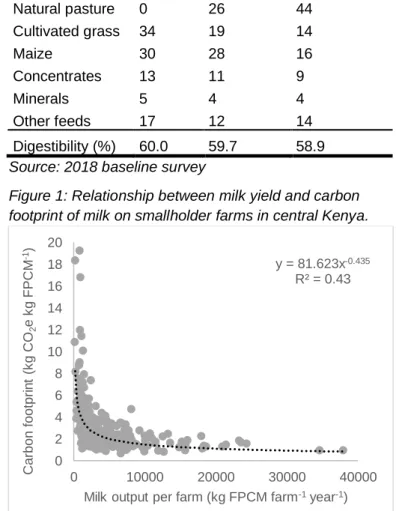
supplementation, and 25% were both stall-fed and grazed (i.e., ‘semi-zero grazing’). Different feed resources are used in different feeding systems (Table 1). Feed digestibility – an indicator of feed quality – was higher on zero-grazing than other farm types. Concentrates and feed supplements were fed on most farms in all feeding systems, but higher average amounts of concentrate were fed on zero-grazing farms (3.2 kg per cow per day) than on other farm types (2.5 kg). Average milk yields were significantly higher on zero-grazing farms (7.3 kg of fat and protein corrected milk [FPCM] per cow per day) than on other farm types (5.8 kg FPCM per cow per day). After GHG emissions on each farm had been quantified, analysis found that milk yield explained just under half the variation in the carbon footprint on dairy farms in central Kenya (Figure 1), and the amount of concentrate fed per farm explained about half of the remaining variation in the carbon footprint (i.e. the distance of each circle from the prediction curve in Figure 1).
Table 1: Contribution of feed resources to diet (%) in different feeding systems on smallholder dairy farms in central Kenya.
Source: 2018 baseline survey
Figure 1: Relationship between milk yield and carbon footprint of milk on smallholder farms in central Kenya.
Source: Wilkes et al. (2019)
y = 81.623x-0.435 R² = 0.43 0 2 4 6 8 10 12 14 16 18 20 0 10000 20000 30000 40000 Carbon footpri n t (k g CO 2 e k g FPCM -1)
Milk output per farm (kg FPCM farm-1year-1)
Feed Type Zero- grazing N = 245 Semi-zero grazing N = 95 Grazing only N = 42 Natural pasture 0 26 44 Cultivated grass 34 19 14 Maize 30 28 16 Concentrates 13 11 9 Minerals 5 4 4 Other feeds 17 12 14 Digestibility (%) 60.0 59.7 58.9 Box 1: Gendered participation in milk production
Intensification
• Productive assets tend to be owned by men.1
• Inconsistent evidence on the role of gender variables in adoption of zero-grazing, improved breeds and concentrate feeding.2
• Intensification may increase women’s labor burden, unless hired labor is used.1
• Intensification may increase joint decision making within the household.3
Commercialization
• With increased milk sales, women may lose control over the use of milk and income from milk sales.3
Formalization of milk marketing
• Women prefer selling to informal milk markets because they can control the income from these sales.4
• Women may lose control over milk income and decision-making when milk is sold to formal markets.4
• Women may be reluctant to join collective marketing institutions (e.g. cooperatives).5
• Participation in collective milk marketing may increase women’s decision-making about production and control of income.6
Sources: 1Gallina 2016; 2Kiff et al. 2017; 3Njuki et al. 2016; 4Tavenner and Crane 2018; 5Omondi et al. 2014; 6Njuki et al. 2014.
Table 2: Association of selected factors with milk yield of individual cows on smallholder farms in central Kenya.
Model Unstandardized
coefficients
t p-value VIF 95% confidence
interval for B
B S.E. Lower Upper
Constant 0.720 0.111 6.47 0.000 0.502 0.938
Feeding system (0 = zero-grazing, 1= other types) -0.182 0.0431 -4.22 0.000 1.07 -0.2666 -0.0973
Breed (0 = small breed, 1 = large breeds) 0.280 0.0661 4.23 0.000 1.1 0.1499 0.4096
Parity 0.073 0.0144 5.05 0.000 1.03 0.0445 0.1011
Dry matter intake (kg per day) 0.065 0.0101 6.45 0.000 1.14 0.0452 0.0848
Gender of household head (0= M, 1= F) -0.254 0.0618 -4.12 0.000 1.19 -0.3757 -0.1331
Gender of milk seller (0= M, 1= F) -0.110 0.0428 -2.58 0.010 1.06 -0.1945 -0.0264
Decision-making for breeding (0= M, 1= F) 0.115 0.0541 2.13 0.033 1.2 0.0091 0.2214
Household sells to formal market (0= no, 1=yes) 0.258 0.0467 5.52 0.000 1.35 0.166 0.3495
Household cooperative membership (0= no, 1=yes) -0.095 0.0479 -1.98 0.048 1.28 -0.1891 -0.001
Notes: Dependent Variable: ln (FPCM); adjusted r2=0.26.
Here, we use the survey data to ask:
(1) How does gender affect milk yield and management practices associated with higher milk yields?
(2) How does commercialization relate to milk yields and gender? and
(3) How does selling milk to the formal market relate to milk yields and gender factors?
To analyze the effect of gender and other variables on milk yield of 702 cows, we tested the significance of selected variables in a linear regression, clustering the standard errors at household level to account for similarities between cows raised on the same farms (Table 2). Further associations were explored through t-tests (for continuous variables) and Chi-square t-tests (for categorical variables).
Milk yield, intensification and gender
Intensification may be one way to reduce the carbon footprint of milk production: Cows kept in zero-grazing systems, Holstein-Friesian or Ayrshire breeds, cows with a higher parity index (i.e. cows that have given birth more times) and cows with higher daily feed intake tended to have higher milk yields (Table 2). These findings indicate that intensification through adoption of specialized dairy breeds and zero-grazing systems can increase milk yields.
Milk yields are higher in male-headed than in female-headed households because of more intensive management practices: Fifteen percent of the 382 households interviewed were female-headed households, and the remainder were male-headed. There were no significant differences in the numbers of cattle owned by male- and female-headed households. However, Chi-square tests show that male-headed households were more likely to have zero-grazing feeding systems and specialized dairy breeds. As a consequence, cows in male-headed households had significantly higher milk yields (av. 6.0 kg FPCM per day) than cows in female headed households (av. 4.6 kg FPCM), and Table 2 shows a negative sign on the coefficient for the gender of
the household head. Household wealth or labor resources could be potential explanations for these differences. Increasing women’s ownership of cattle per se may not directly increase either milk yields or women’s involvement in milk sales: Out of 702 cows enumerated in the survey, 170 cows (24%) were jointly owned by men and women, mostly in male-headed households; 122 (17%) were owned by women, 100 of which were in female headed households, and 22 were owned by women in male-headed households. Thus, about 58% of cows were owned solely by men. Within male-headed households, female-owned and male-owned cows were equally likely to be raised in stall-feeding systems, and overall there was no significant difference in milk yields of male-owned, female-owned or jointly owned cows. Female and joint ownership of cows were not associated with the gender of the household member who sells milk. Zero-grazing is not associated with less involvement of women in decision-making, except about
concentrate feed purchases: There were no statistically significant differences between zero-grazing and other households in the proportion of households in which women made decisions over breeding, milking, marketing or fodder production. However, in households with zero-grazing systems, women were significantly less likely to make decisions over purchase of feed concentrates. Training to improve concentrate feeding may need to address gendered constraints: Concentrates are expensive, in addition to which production of each kg of concentrate emits more than 1.3 kg of GHG emissions. The amount of concentrate fed was not significantly related to milk yield. Only 43% of households reported fluctuating the quantity of concentrate offered to cows, as their energy needs vary through the lactation cycle. This suggests that improving concentrate feeding practices could be an important measure to reduce household production costs while also reducing the carbon footprint of milk. Overall, cows were fed a significantly higher amount of concentrate if the decision was made by male household members (av. 3.1 kg per farm) than if the decision was made by female household members (av.
2.6 kg per farm). This may be because men have more access to cash and less competing demands from household expenditure needs than women.
Milk yields are higher if women make decisions over cow breeding: If women made decisions over cow breeding, milk yields were higher (Table 2). Women’s role in decision making over breeding is significantly and positively related to household membership in a cooperative. This could be related to the role of cooperatives in facilitating access to artificial
insemination, but the effect of cooperative membership itself on milk yield was negative (Table 2). This may be because cooperative members tend to have less intensive feeding systems than non-members.
Milk yield, commercialization and gender
About 82% of households surveyed sold milk the day before the survey; almost all of these households sold morning milk and about 60% also sold evening milk. Informal milk markets include sales to individuals and small traders, while formal marketing channels were almost all to cooperatives. Informal markets were the main channel for both morning (54% of milk sellers) and evening (65% of milk sellers) milk sales, and about one-third of households selling milk sold to both informal markets and cooperatives.
Women are more likely to make milk sales when yields are lower: Of the 314 households that sold milk the day before the survey, women made the actual sales of morning milk in 34% of cases and evening milk in 21% of cases. Milk yields were significantly lower if milk sales were made by women(5.5 liters (L) compared to 6.5 liters), as also shown by the negative sign on the gender of the milk seller variable in the model in Table 2. It is important to note, however, that this says nothing about the direction of causality: it may be that women are more likely to participate in milk sales when milk yields are lower or when milk is a less important source of household income. This is suggested by the data on gender roles in decision making, which indicates that average milk yields are significantly higher when
marketing decisions are made by males (6.5 L compared to 5.5 L), and that about 10% less milk is sold if marketing decisions are made by women (after controlling for differences in the number of cows per farm).
In about 65% of households, decisions about milking were made by male household members and 35% by female household members. If women make decisions about milking or marketing, the likelihood that a woman sells the milk is significantly higher and vice versa. However, the gender of the person who makes milking or marketing decisions was not significantly related to milk yield and is not included in the model in Table 2.
Milk prices are higher when women sell milk: Although sale of milk by women is associated with lower yields, the
data clearly show that if women sell milk, they obtain a significantly higher price: on average a 7% higher price for morning milk and a 12% higher price for evening milk. This has to do with women’s preferences for sales to informal markets, as average prices were higher in the informal market (Ksh 40.3/L) than in formal marketing channels (Ksh 35.1/L).
Milk yield, market formalization and
gender
Of all milk sold on the day before the survey, 57% was sold to formal marketing channels – almost all to cooperatives – and 43% to the informal market (i.e. individuals, small traders). A greater proportion of households sold morning milk to informal markets (54%) than to cooperatives (46%), and the difference was even greater for evening milk (64% compared to 36%).
Thirty percent of the 382 households surveyed were dairy cooperative members. Unsurprisingly, cooperative members are significantly more likely to sell morning milk to the cooperative, but cooperative members and non-members are equally likely to sell evening milk to informal or formal markets, and 33% of households that are not cooperative members also sold to cooperatives.
Women are significantly more likely to sell to informal markets: 63% of morning sales by women were to the informal market compared to 47% for sales by men, and 76% of evening milk sales by women were to the informal market compared to 52% for sales by men.
Milk yields are higher for households that sell to the formal market: Irrespective of cooperative membership, milk yields are significantly higher for households who sell to cooperatives (ca. 7.2 L compared to 5.2 L), even when the number of cows per farm is accounted for. This is further supported by the positive coefficient on the formal market sales variable in Table 2. Sellers to the formal market are more likely to have zero-grazing systems than those who only supply the informal market, but there are no differences in the breeds raised or the amounts of concentrate fed. It is possible that in households with higher yields, men prefer to sell to cooperatives because of their greater purchasing volumes than individual buyers or small traders. Control over milk income may also be a factor.
Cooperative members tend to have lower milk yields: Overall, cooperative membership has a negative
relationship with milk yield (Table 2). This is most likely because cooperative members tend to have less
intensive feeding systems: cooperative members are less likely to have zero-grazing feeding systems, feed about the same amount of concentrate to cows, but are more likely to have specialized dairy breed cows. This may be because of the role of cooperatives in providing access to artificial insemination.
Table 3: Comparison between cooperative members and non-members selling to the formal market in the percentage of households where women make decisions related to dairy production and milk sale.
Decision domain Cooperative members (N=48)
Not coop member (N=96) Chi-square test Result Breeding 35 23 χ2(1) =2.649, p>0.1 Concentrate purchasing 35 24 χ2(1) =1.885, p>0.1 Concentrate feeding 39 31 χ2(1) =0.845, p>0.1 Milking 48 37 χ2(1) =1.281, p>0.1 Marketing 42 38 χ2(1) =0.184, p>0.1 Planting fodder 41 23 χ2(1) =4.142, p<0.05 Weeding fodder 41 28 χ2(1) =2.001, p>0.1 Harvesting fodder 40 28 χ2(1) =1.790, p>0.1
Households with a cooperative payment account tend to have higher milk yields: Just under half of
cooperative members reported having a payment account with their cooperative, probably because these
households are regular suppliers to the cooperative whereas other members supply irregularly: among cooperative members, those with payment accounts had significantly higher milk yields (8.6 L compared to 5.4 L) and fed significantly more concentrate per cow (4.2 kg compared to 2.7 kg). However, with few households owning payment accounts in the sample, this variable was not significantly related to milk yields and is not included in Table 2.
Cooperative payment accounts in the name of a female household member is associated with higher milk yield: Of the 54 payment accounts, 28 were in the name of a male and 26 in the name of a female
household member. Cooperative members with a payment account in the name of a female household member used similar amounts of concentrate but had higher average milk yields than if the payment account was registered to a man (7.5 L compared to 6.1 L). Men and women with payment accounts can likely obtain inputs such as concentrate using the cooperatives’ check-off systems (in which inputs can be obtained against the value of milk supplied to the cooperative). This relaxes households’ finance constraints, enabling greater quantities of concentrate purchase. Given the relatively equal number of male and female account holders in our sample, it seems that both men and women are able to take advantage of this system.
Women in cooperative member households still prefer to sell milk to the informal market: Similar to women in other households, women in households that are cooperative members are more likely to sell morning milk to the informal market (41% of sales) than if sales are made by men (19% of sales). For evening milk, women were also more likely to sell to the informal market (68% of sales), but the difference with men (50% of sales) was not significant.
Sales to the formal market are not associated with decreasing participation of women in dairy-related decision-making: Considering all households, survey
respondents suggested that women are the decision makers in less than 50% of households across all
decision-making domains. The percentage of households where women make decisions related to dairy production and marketing were very similar between households that sold to cooperatives and households that supplied only informal markets. Therefore, the development of formal markets appears not to directly affect gendered
household decision making patterns.
Cooperative membership may be linked to increased participation in decision-making by women:
Comparing only households that sold milk to
cooperatives, there is a tendency for women to have greater participation in decisions when the household is a cooperative member. However, in most cases the
differences are not statistically significant (Table 3). While women’s role in decision making about dairy production and marketing is often constrained, for households that supply to cooperatives, cooperative membership may have positive effects. Omondi et al. (2014) also reported positive effects of participation in collective milk marketing on some aspects of women’s empowerment.
Conclusions
The carbon footprint of milk production on smallholder farms in central Kenya is strongly related to milk yield and concentrate feed use. Quantitative analysis suggested some direct and indirect links between gender variables and milk yield, and between gender variables and concentrate feeding. The relationships between these factors are complex, in part because of parallel ongoing processes of intensification, commercialization and market formalization in Kenya’s dairy sector.
Female-headed households are less likely to adopt zero-grazing and specialized dairy breeds, and male decision-making is correlated with higher concentrate feeding. Women prefer to sell to informal markets, but have higher milk yields, men tend to engage in milk marketing and prefer to sell to formal markets. Since who sells milk is related to control of dairy income, this supports previous suggestions that there may be a trade-off between increasing milk yield (and thus reducing carbon footprint) and benefits for women (Tavenner and Crane 2018).
Our findings also provide suggestive evidence that when households do engage in formal markets, cooperative membership may increase women’s roles in household decision-making, although the effect is not strong and the mechanism is still not clear. Just under half of cooperative members surveyed had payment accounts, which were registered to male and female household members in relatively equal numbers. When women had a payment account in their own name, milk yields were higher. This suggests the need to further explore the potential of cooperatives in promoting gender-inclusive outcomes in dairy development in Kenya. This may also make sense from a GHG mitigation perspective, as cooperative members tend to have lower milk yields, indicating greater potential to reduce the carbon footprint of milk production.
References and further reading
Gallina A. 2016. Gender dynamics in dairy production in Kenya: A literature review. CCAFS Working Paper no. 182. Copenhagen, Denmark: CGIAR Research Program on Climate Change, Agriculture and Food Security (CCAFS).
Kiff L, van Dijk S, Wilkes A, Bateki C. 2017. Technology adoption in Kenya’s dairy sector: a review of factors influencing adoption of technologies and management practices by smallholder dairy producers in Kenya. Report to CCAFS, UNIQUE forestry and land use GmbH.
Njuki J, Baltenweck I, Mutua E, Korir L, Muindi P. 2014. Women’s empowerment in collective dairy value chains. ILRI Research Brief 38. Nairobi, Kenya: ILRI
Njuki JM, Wyatt A, Baltenweck I, Yount K, Null C, Ramakrishnan U, Girard AW, Sreenath S. 2016. An exploratory study of dairying intensification, women’s decision making, and time use and implications for child nutrition in Kenya. The European Journal of Development Research28(4): 722–740.
Omondi I, Zander K, Bauer S, Baltenweck I. 2014. Using dairy hubs to improve farmers’ access to milk markets in Kenya: Gender and its implications. Presented at the Tropentag 2014: Bridging the Gap between Increasing Knowledge and Decreasing Resources Workshop, Prague, Czech Republic, 17-19 September 2014. Nairobi, Kenya: ILRI.
State Department of Livestock. 2017. Kenya’s Dairy NAMA Concept Note. http://www.kilimo.go.ke/wp- content/uploads/2018/03/NAMA-Kenya-Dairy-NAMA-GCF-concept-NoteJanuary-2017-1.pdf
Tavenner K, Crane TA. 2018. Gender power in Kenyan dairy: cows, commodities, and
commercialization. Agriculture and human values35(3): 701–715.
Wilkes A, Odhong’ C, van Dijk S, Fraval S, Wassie SE. 2019. Methods and guidance to support MRV of livestock emissions: Methods for data collection, analysis and summary results from a pilot baseline survey for the Kenya dairy NAMA. CCAFS Working
Paper No. 285. CGIAR Research Program on Climate Change, Agriculture and Food Security (CCAFS).
This brief is based on a study conducted by UNIQUE Forestry and Land Use GmbH as part of CCAFS support to the development of the Kenya dairy NAMA. It is intended to further research and action to support low emissions development. The views expressed in this brief are those of the authors and are not necessarily endorsed by UNIQUE Forestry and Land Use, CCAFS or its supporters.
Andreas Wilkes ([email protected]) is an associated expert with UNIQUE forestry and land use GmbH.
Shimels Eshete Wassie ([email protected]), Miriam Vorlaufer
([email protected]), Suzanne van Dijk ([email protected]) and Charles Odhong’
([email protected]) are consultants in the Agriculture and Rural
Development Division of UNIQUE forestry and land use GmbH.