Joint Prediction for Entity/Event-Level Sentiment Analysis
using Probabilistic Soft Logic Models
Lingjia Deng
Intelligent Systems Program University of Pittsburgh
Janyce Wiebe Intelligent Systems Program Department of Computer Science
University of Pittsburgh [email protected]
Abstract
In this work, we build an entity/event-level sentiment analysis system, which is able to recognize and infer both explicit and im-plicit sentiments toward entities and events in the text. We design Probabilistic Soft Logic models that integrate explicit senti-ments, inference rules, and +/-effect event information (events that positively or neg-atively affect entities). The experiments show that the method is able to greatly im-prove over baseline accuracies in recog-nizing entity/event-level sentiments. 1 Introduction
There are increasing numbers of opinions ex-pressed in various genres, including reviews, newswire, editorials, and forums. While much early work was at the document or sentence level, to fully understand and utilize opinions, re-searchers are increasingly carrying out more fine-grained sentiment analysis to extract components ofopinion frames: the source (whose sentiment is it), the polarity, and the target (what is the senti-ment toward). Much fine-grained analysis is span or aspect based (Yang and Cardie, 2014; Pontiki et al., 2014). In contrast, this work contributes to entity/event-level sentiment analysis. A sys-tem that could recognize sentiments toward enti-ties and events would be valuable in an application such as Automatic Question Answering, to sup-port answering questions such as “Who is nega-tive/positive towardX?” (Stoyanov et al., 2005), whereXcould be any entity or event.
Let us consider an example from the MPQA opinion annotated corpus (Wiebe et al., 2005a; Wilson, 2007; Deng and Wiebe, 2015).
Ex(1) When the Imam
( may God be satisfied with him1)
issued the fatwa against2Salman Rushdie for insulting3the Prophet ( peace be upon him4), the countries that are so-called5supporters of human rights protested against6the fatwa.
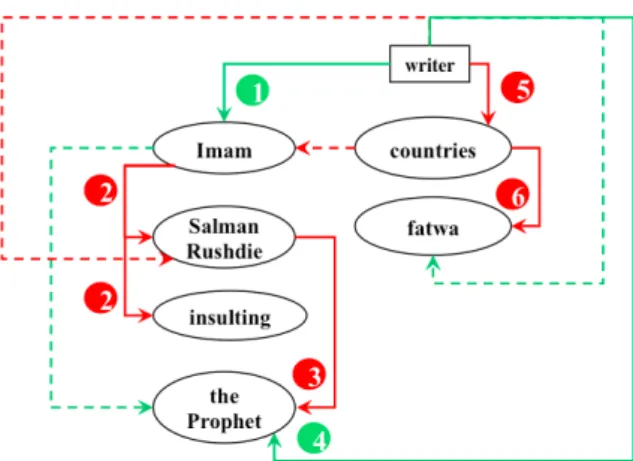
There are several sentiment expressions anno-tated in MPQA. In the first clause, the writer is positive toward Imam and Prophet as expressed by may God be satisfied with him (1) andpeace be upon him(4), respectively. Imam is negative toward Salman Rushdie and the insulting event, as revealed by the expression issued the fatwa against (2). And Salman Rushdie is negative to-wardProphet, as revealed by the expression insult-ing(3). In the second clause, the writer is negative toward the countries, as expressed by so-called
(5). And the countries are negative toward fatwa, as revealed by the expression protested against
(6). Using the source and the target, we summa-rize the positive opinions above in a setP, and the negative opinions above in another setN. Thus,P
contains{(writer, Imam), (writer, Prophet)}, and
N contains{(Imam, Rushdie), (Imam, insulting), (Rushdie, Prophet), (writer, countries), (countries, fatwa)}.1
An (ideal) explicit sentiment analysis system is expected to extract the above sentiments expressed by (1)-(6). However, there are many more sen-timents communicated by the writer but not ex-pressed via explicit expressions. First, Imam is positive toward the Prophet, because Rushdie in-sults the Prophet and Imam is angry that he does
1Sources in MPQA are nested, having the formhwriteri
orhwriter, S1, . . . , Sni. This work only deals with the
right-most source, writer orSn. Also, actions likeissuing a fatwa
are treated the same as private states. Please see (Wiebe et al., 2005a).
Figure 1: Explicit and implicit sentiments in Ex(1).
so. Second, the writer is negative toward Rushdie, because the writer is positive toward the Prophet but Rushdie insults him! Also, the writer is prob-ably positive toward the fatwa since it is against Rushdie. Third, the countries are probably nega-tive toward Imam, because the countries are neg-ative toward fatwa and it is Imam who issued the fatwa. Thus, the set P should also contain {(Imam, Prophet), (writer, fatwa)}, and the set
N should also contain{(writer, Rushdie), (coun-tries, Imam)}. These opinions are not directly ex-pressed, but areinferredby a human reader.2 The
explicit and implicit sentiments are summarized in Figure 1, where each green line represents a posi-tive sentiment and each red line represents a neg-ative sentiment. The solid lines are explicit senti-ments and the dashed lines are implicit sentisenti-ments. In this work, we detect sentiments such as those inP andN, where the sources are entities (or the writer) and the targets are entities and events.
Previous work in sentiment analysis mainly fo-cuses on detecting explicit opinions. Recently there is emerging focus on sentiment inference, which recognizes implicit sentiments by inferring them from explicit sentiments via inference rules. Current works in sentiment inference differ on how the sentiment inference rules are defined and how they are expressed. For example, Zhang and Liu (2011) define linguistic templates to rec-ognize phrases that express implicit sentiments, while previously we (Deng et al., 2014) represent a few simple rules as (in)equality constraints in In-teger Linear Programming. In contrast to previous
2Note that the inferences are conversational implicatures;
they are defeasible and may not go through in context (Deng et al., 2014; Wiebe and Deng, 2014).
work, we propose a more general set of inference rules and encode them in a probabilistic soft logic (PSL) framework (Bach et al., 2015). We chose PSL because it is designed to have efficient infer-ence and, as similar methods in Statistical Rela-tional Learning do, it allows probabilistic models to be specified in first-order logic, an expressive and natural way to represent if-then rules, and it supports joint prediction. Joint prediction is criti-cal for our task because it involves multiple, mutu-ally constraining ambiguities (the source, polarity, and target).
Thus, this work aims at detecting both implicit and explicit sentiments expressed by an entity to-ward another entity/event (i.e., aneTarget) within the sentence. The contributions of this work are: (1) defining a method for entity/event-level senti-ment analysis to provide a deeper understanding of the text; (2) exploiting first-order logic rules to infer such sentiments, where the source is not lim-ited to the writer, and the target may be any entity, event, or even another sentiment; and (3) devel-oping a PSL model to jointly resolve explicit and implicit sentiment ambiguities by integrating in-ference rules.
2 Related Work
Fined-grained sentiment analysis. Most fine-grained sentiment analysis is span or aspect based. Previous work differs from the entity/event-level sentiment analysis task we address in terms of tar-gets and sources. In terms of tartar-gets, in a span-based sentiment analysis system, the target is a span instead of the exact head of the phrase re-ferring to the target. The target in a span-based system is evaluated by measuring the overlapping proportion of an extracted span against the gold standard phrase (Yang and Cardie, 2013), while the eTarget in an entity/event-level system is eval-uated against the exact word (i.e., head of NP/VP) in the gold standard. It is a stricter evaluation. While the targets in aspect-based sentiment analy-sis are often entity targets, they are mainly product aspects, which are a predefined set.3 In contrast,
the target in the entity/event-level task may be any noun or verb. In terms of sources, previous work in sentiment analysis trained on review data assumes that the source is the writer of the review (Hu and Liu, 2004; Titov and McDonald, 2008).
3As stated in SemEval-2014: “we annotate only aspect
Our work is rare in that it allows sources other than the writerandfinds sentiments toward eTar-gets which may be any entity or event.
Sentiment Inference. There is some recent work investigating features that directly indicate implicit sentiments (Zhang and Liu, 2011; Feng et al., 2013). That work assumes the source is only the writer. Further, as it uses features to di-rectly extract implicit sentiments, it does not per-form general sentiment inference.
Previously, we (Deng et al., 2013; Deng and Wiebe, 2014; Deng et al., 2014) develop rules and models to infer sentiments related to+/-effect events, events that positively or negatively affect entities. That work assumes that the source is only the writer, and the targets are limited to entities that participate in +/-effect events. Further, our previous models all require certain manual (ora-cle) annotations to be input. In this work we use an expanded set of more general rules. We al-low sources other than the writer, and targets that may be any entity or event. In fact, under our new rules, the targets of sentiments may be other sen-timents; we model such novel “sentiment toward sentiment” structures in Section 4.3. Finally, our method requiring no manual annotations as input when the inference is conducted.
Previously, we also propose a set of sentiment inference rules and develop a rule-based system to infer sentiments (Wiebe and Deng, 2014). How-ever, the rule-based system requires all informa-tion regarding explicit sentiments and +/-effect events to be provided as oracle information by manual annotations.
Probabilistic Soft Logic. Probabilistic Soft Logic (PSL) is a variation of Markov Logic Net-works, which is a framework for probabilistic logic that employs weighted formulas in first-order logic to compactly encode complex undi-rected probabilistic graphical models (i.e., Markov networks) (Bach et al., 2015; Beltagy et al., 2014). PSL is a new statistical relational learning method that has been applied to many NLP and other ma-chine learning tasks in recent years (Beltagy et al., 2014; London et al., 2013; Pujara et al., 2013; Bach et al., 2013; Huang et al., 2013; Memory et al., 2012). Previously, PSL has not been applied to entity/event-level sentiment analysis.
3 Task Definition
In this section, we introduce the definition of the entity/event-level sentiment analysis task, fol-lowed by a description of the gold standard corpus. For each sentences, we define a setE consist-ing of entities, events, and the writer ofs, and sets
PandN consisting of positive and negative senti-ments, respectively. Each element inP is a tuple, representing a positive pair of two entities, (e1,
e2) wheree1, e2 ∈ E, and e1 is positive toward e2. A positive pair (e1,e2) aggregates all the
posi-tive sentiments frome1toe2in the sentence. Nis the corresponding set fornegative pairs.
The goal of this work is to automatically rec-ognize a set of positive pairs (Pauto) and a set of
negative pairs (Nauto). We compare the system
output (Pauto ∪ Nauto) against the gold standard
(Pgold∪Ngold) for each sentence.
3.1 Gold Standard Corpus: MPQA 3.0 MPQA 3.0 is a recently developed corpus with entity/event-level sentiment annotations (Deng and Wiebe, 2015).4 It is built on the basis of
MPQA 2.0 (Wiebe et al., 2005b; Wilson, 2007), which includes editorials, reviews, news reports, and scripts of interviews from different news agen-cies, and covers a wide range of topics.
In both MPQA 2.0 and 3.0, the top-level an-notations include direct subjectives (DS). Each DS has anested-sourceannotation. Each DS has one or more attitude links, meaning that all of the attitudes share the same nested source. The at-titudes differ from one another in their attitude types, polarities, and/or targets. Moreover, both corpora contain expressive subjective element (ESE) annotations, which pinpoint specific ex-pressions used to express subjectivity. We ignore neutral ESEs and only consider ESEs whose po-larity is positive or negative.
MPQA 2.0 and 3.0 differ in their target tions. In 2.0, each target is a span. A target annota-tion of an opinion captures the most important tar-get this opinion is expressed toward. Since the ex-act boundaries of the spans are hard to define even for human annotators (Wiebe et al., 2005a; Yang and Cardie, 2013), the target span in MPQA 2.0 could be a single word, an NP or VP, or a text span covering more than one constituent. In contrast, in MPQA 3.0, each target is anchored to the head of an NP or VP, which is a single word. It is called an
eTargetsince it is an entity or an event. In MPQA 2.0, only attitudes have target-span annotations. In MPQA 3.0, both attitudes and ESEs have eTarget annotations. Importantly, the eTargets include the targets of both explicit and implicit sentiments.
Recall Ex(1) in Section 1. Pgold = {(writer,
Imam), (writer, Prophet), (Imam, Prophet), (writer, fatwa)}, and Ngold = {(Imam, Rushdie),
(Imam, insulting), (Rushdie, Prophet), (writer, countries), (countries, fatwa), (writer, Rushdie), (countries, Imam)}.
4 PSL for Sentiment Analysis
We need to resolve three components for an opin-ion frame: the source, the polarity, and the eTarget. Each of these ambiguities has several candidates. For example in Ex(1), the eTarget of the opinion expressioninsulting is an ambiguity. The candi-dates includeProphet,countries, and so on.
In this work, we use Probabilistic Soft Logic (PSL). A PSL model is defined using a set of atoms to be grounded, and a set of weighted if-then rules expressed in first-order logic. For ex-ample, we define the atom ETARGET(y,t) to
rep-resent an opinion y having eTarget t. If y and
t are constants, then ETARGET(y,t) is a ground
atom (e.g., ETARGET(insulting, Prophet)). Each
ground atom is assigned a score by a local system. PSL takes as input all the local scores as well as the constraints defined by the rules among atoms, so that it is able to jointly resolve all the ambigu-ities. In the final output, for example, the score
ETARGET(insulting, Prophet)>0means that PSL
considers Prophet to be an eTarget of insulting, while ETARGET(insulting, countries) = 0 means
that PSL does not considercountriesto be an eTar-get ofinsulting.
In this section, we first introduce PSL in Section 4.1. We then present three PSL models in turn. PSL1 (Section 4.2) aggregates span-based opin-ions intoPautoandNauto. PSL2 (Section 4.3) adds
sentiment inference rules to PSL1. For PSL3 (Sec-tion 4.4), rules involving +/-effect events are added to PSL2, resulting in the richest overall model. 4.1 Probabilistic Soft Logic
PSL (Bach et al., 2015) uses logical representa-tions to compactly define large graphical models with continuous variables, and includes methods for performing efficient probabilistic inference for the resulting models (Beltagy et al., 2014). As
mentioned above, a PSL model is defined using a set of atoms to be grounded, and a set of weighted if-then rules in first-order logic. For example,
friend(x,y)∧votesFor(y,z)⇒votesFor(x,z) means that a person may vote for the same per-son as his/her friend. Each predicate in the rule is an atom (e.g., friend(x,y)). A ground atom is pro-duced by replacing variables with constants (e.g., friend(Tom, Mary)). Each rule is associated with a weight, indicating the importance of this rule in the whole rule set.
A key distinguishing feature of PSL is that each ground atomahas a soft, continuous truth value in the interval [0, 1], denoted asI(a), rather than a binary truth value as in Markov Logic Net-works and most other probabilistic logic frame-works (Beltagy et al., 2014). To compute soft truth values for logical formulas, Lukasiewicz re-laxations are used:
l1∧l2 = max{0, I(l1) +I(l2)−1} l1∨l2 = min{I(l1) +I(l2),1} ¬l1 = 1−I(l1)
A rule r ≡ rbody → rhead, is satisfied (i.e.
I(r) = 1) iff I(rbody) ≤ I(rhead).
Other-wise, a distance to satisfactiond(r)is calculated, which defines how far a ruleris from being satis-fied: d(r) = max{0, I(rbody)−I(rhead)}.
Us-ing d(r), PSL defines a probability distribution over all possible interpretations I of all ground atoms:
p(I) = Z1 exp{−1∗X
r∈R
λr(d(r))p}
where Z is the normalization constant, λr is the
weight of ruler,Ris the set of all rules, andp de-fines loss functions. PSL seeks the interpretation with the minimum distanced(r)and which satis-fies all rules to the extent possible.
4.2 PSL for Sentiment Aggregation (PSL1) The first PSL model, PSL1, aggregates span-based opinions intoPauto andNauto. We call this
senti-ment aggregation because, instead of building an entity/event-level sentiment system from scratch, we choose to fully utilize previous work on based sentiment analysis. PSL1 aggregates span-based opinions into entity/event-level opinions.
Consistent with the task definition in Section 3, we define two atoms in PSL:
(1) POSPAIR(s,t): a positive pair fromstowardt
Bothsandtare chosen from the setE. The val-ues of ground atoms (1) and (2) are not observed and are inferred by PSL.
Then, we define atoms to model an entity/event-level opinion:
(3) POS(y): yis a positive sentiment
(4) NEG(y):yis a negative sentiment
(5) SOURCE(y,s): the source ofyiss
(6)ETARGET(y,t): the eTarget ofyist
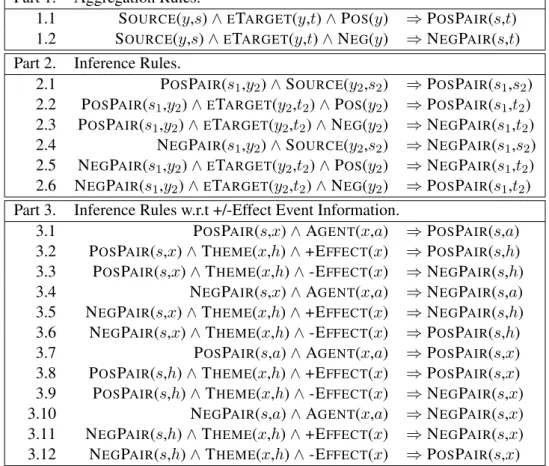
Two rules are defined to aggregate various opin-ions extracted by span-based systems into positive pairs and negative pairs, shown in Part 1 of Table 1 as Rules 1.1 and 1.2. Thus, under our repre-sentation, the PSL model not only finds a set of eTargets of an opinion (ETARGET(y,t)), but also
represents the aggregated sentiments among enti-ties and events (POSPAIR(s,t) and NEGPAIR(s,t))
in the sentence.
Next, we turn to assigning local scores to ground atoms (3)-(6).
POS(y) and NEG(y): We build upon three
span-based sentiment analysis systems. The first, S1 (Yang and Cardie, 2013), and the second, S2 (Yang and Cardie, 2014), are both trained on MPQA 2.0, which does not contain any eTarget annotations. S1 extracts triples of hsource span, opinion span, target spani, but does not extract opinion polarities. S2 extracts opinion spans and opinion polarities, but it does not extract sources or targets. The third system, S3 (Socher et al., 2013), is trained on movie review data. It extracts opinion spans and polarities. The source is always assumed to be the writer.
We take the union set of opinions extracted by S1, S2 and S3. For each opiniony, a ground atom is created, depending on the polarity (POS(y) ify
is positive and NEG(y) isy is negative). The
larity is determined as follows. If S2 assigns a po-larity to y, then that polarity is used. If S3 but not S2 assigns a polarity toy, then S3’s polarity is used. In both cases, the score assigned to the ground atom is 1.0. If neither S2 nor S3 assigns a polarity toy, we use the MPQA subjectivity lex-icon to determine its polarity. The score assigned to the ground atom is the proportion of the words in the opinion span that are included in the subjec-tivity lexicon.
SOURCE(y,s): S1 extracts the source of each
opinion, S2 does not extract the source, and S3 as-sumes the source is always the writer. Thus, for an opiniony, if the source sis assigned by S1, a
ground atom SOURCE(y,s) is created with score
1.0. Otherwise, if S3 extracts opiniony, a ground atom SOURCE(y,writer) is created with score 1.0
(since S3 assumes the source is always the writer). Otherwise, we run the Stanford named entity rec-ognizer (Manning et al., 2014; Finkel et al., 2005) to extract named entities in the sentence. The near-est named entity to the opinion span on the depen-dency parse graph will be treated as the source. The score is the reciprocal of the length of the path between the opinion span and the source span in the dependency parse.
ETARGET(y,t): Though each eTarget is an
en-tity or event, it is difficult to determine which nouns and verbs should be considered. Taking into consideration the trade-off between precision and recall, we experimented with three methods to select eTarget candidates. For each opinion y, a ground atom ETARGET(y,t) is created for each
eTarget candidatet.
ET1 considers all the nouns and verbs in the sentence, to provide a full recall of eTargets.
ET2considers all the nouns and verbs in the tar-get spans and opinion spans that are automatically extracted by systems S1, S2 and S3. We hypoth-esized that ET2 would be useful because most of the eTargets in MPQA 3.0 appear within the opin-ion or the target spans of MPQA 2.0.
ET3considers the heads of the target and opin-ion spans that are automatically extracted by sys-tems S1, S2 and S3.5 ET3 also considers the heads
of siblings of target spans and opinion spans. Among the three methods, ET3 has the lowest re-call but the highest precision.
In addition, for the eTarget candidate set ex-tracted by ET2, or ET3, we run the Stanford co-reference system (Manning et al., 2014; Recasens et al., 2013; Lee et al., 2013) to expand the set in two ways. First, for each eTarget candidatet, the co-reference system extracts the entities that co-refer witht. We add the referring entities into the candidate set. Second, the co-reference system extracts words which the Stanford system judges to be entities, regardless of whether they have any referent or not. We add this set of entities to the candidate set as well.
We train an SVM classifier (Cortes and Vap-nik, 1995) to assign a score to the ground atom
ETARGET(y,t). Syntactic features describing the
5The head of a phrase is extracted by the Collins head
Part 1. Aggregation Rules.
1.1 SOURCE(y,s)∧ETARGET(y,t)∧POS(y) ⇒POSPAIR(s,t)
1.2 SOURCE(y,s)∧ETARGET(y,t)∧NEG(y) ⇒NEGPAIR(s,t)
Part 2. Inference Rules.
2.1 POSPAIR(s1,y2)∧SOURCE(y2,s2) ⇒POSPAIR(s1,s2)
2.2 POSPAIR(s1,y2)∧ETARGET(y2,t2)∧POS(y2) ⇒POSPAIR(s1,t2)
2.3 POSPAIR(s1,y2)∧ETARGET(y2,t2)∧NEG(y2) ⇒NEGPAIR(s1,t2)
2.4 NEGPAIR(s1,y2)∧SOURCE(y2,s2) ⇒NEGPAIR(s1,s2)
2.5 NEGPAIR(s1,y2)∧ETARGET(y2,t2)∧POS(y2) ⇒NEGPAIR(s1,t2)
2.6 NEGPAIR(s1,y2)∧ETARGET(y2,t2)∧NEG(y2) ⇒POSPAIR(s1,t2)
Part 3. Inference Rules w.r.t +/-Effect Event Information.
3.1 POSPAIR(s,x)∧AGENT(x,a) ⇒POSPAIR(s,a)
3.2 POSPAIR(s,x)∧THEME(x,h)∧+EFFECT(x) ⇒POSPAIR(s,h)
3.3 POSPAIR(s,x)∧THEME(x,h)∧-EFFECT(x) ⇒NEGPAIR(s,h)
3.4 NEGPAIR(s,x)∧AGENT(x,a) ⇒NEGPAIR(s,a)
3.5 NEGPAIR(s,x)∧THEME(x,h)∧+EFFECT(x) ⇒NEGPAIR(s,h)
3.6 NEGPAIR(s,x)∧THEME(x,h)∧-EFFECT(x) ⇒POSPAIR(s,h)
3.7 POSPAIR(s,a)∧AGENT(x,a) ⇒POSPAIR(s,x)
3.8 POSPAIR(s,h)∧THEME(x,h)∧+EFFECT(x) ⇒POSPAIR(s,x)
3.9 POSPAIR(s,h)∧THEME(x,h)∧-EFFECT(x) ⇒NEGPAIR(s,x)
3.10 NEGPAIR(s,a)∧AGENT(x,a) ⇒NEGPAIR(s,x)
3.11 NEGPAIR(s,h)∧THEME(x,h)∧+EFFECT(x) ⇒NEGPAIR(s,x)
3.12 NEGPAIR(s,h)∧THEME(x,h)∧-EFFECT(x) ⇒POSPAIR(s,x)
Table 1: Rules in First-Order Logic. relations between an eTarget and the extracted
opinion span and target span are considered, in-cluding: (1) whether the eTarget is in the opin-ion/target span; (2) the unigrams and bigrams on the path from the eTarget to the opinion/target span in the constituency parse tree; and (3) the unigrams and bigrams on the path from the eTar-get to the opinion/tareTar-get word in the dependency parse graph. We normalize the SVM scores into the range of a ground atom score, [0,1].
4.3 PSL for Sentiment Inference (PSL2) The two rules defined in Section 4.2 aggregate various opinions into positive pairs and negative pairs, but inferences have not yet been introduced. PSL2 is defined using the atoms and rules in PSL1. But it also includes some rules defined in (Wiebe and Deng, 2014), represented here in first-order logic in Part 2 of Table 1. Let us go through an example inference for Ex(1), in partic-ular, the inference that Imam is positive toward the Prophet. Rule 2.6 supports this inference. Recall the two explicit sentiments: Imam is negative to-ward the insulting sentiment (revealed by issued the fatwa against), and Rushdie is negative
to-ward the Prophet (revealed by insulting). Thus, we can instantiate Rule 2.6, wheres1is Imam,y2
is the negative sentiment (insulting), andt2 is the Prophet. The inference is: since Imam is negative that there is any negative opinion expressed toward the Prophet, we infer that Imam is positive toward the Prophet.
NEGPAIR(Imam, insulting) ∧ETARGET(insulting, Prophet) ∧NEG(insulting)
⇒POSPAIR(Imam, Prophet).
The inference rules in Part 2 of Table 1 are novel in that eTargets may be sentiments (e.g., NEG
-PAIR(Imam,insulting) means that Imam is
nega-tive toward the neganega-tive sentiment revealed by in-sulting). The inference rules link sentiments to sentiments and, transitively, link entities to entities (e.g., from Imam to Rushdie to the Prophet).
To support such rules, more groundings of
ETARGET(y,t) are created in PSL2 than in PSL1.
For two opinions y1 and y2, if the target span of y1 overlaps with the opinion span ofy2, we
cre-ate ETARGET(y1,y2) as a ground atom
4.4 PSL Augmented with +/-Effect Events (PSL3)
Finally, for PSL3, +/-effect event atoms and rules are added to PSL2 for the inference of additional sentiments.
According to (Deng et al., 2013), a +effect event has positive effect on the theme (examples are
help, increase, and save), and a -effect event has negative effect on the theme (examples are ob-struct,decrease, andkill).6 We define the
follow-ing atoms to represent such events: (7) +EFFECT(x):xis a +effect event
(8) -EFFECT(x):xis a -effect event
(9) AGENT(x,a): the agent ofxisa
(10) THEME(x,h): the theme ofxish
Next we assign scores to these ground atoms. +EFFECT(x) and -EFFECT(x): We use the
+/-effect sense-level lexicon (Choi and Wiebe, 2014)7 to extract the +/-effect events in each
sen-tence. The score of +EFFECT(x) is the fraction of
that word’s senses that are +effect senses accord-ing to the lexicon, and the score of -EFFECT(x) is
the fraction of that word’s senses that are -effect senses according to the lexicon. If a word does not appear in the lexicon, we do not treat it as a +/-effect event, and thus assign 0 to both +EFFECT(x)
and -EFFECT(x).
AGENT(x,a) and THEME(x,h): We consider all
nouns in the same or in sibling constituents of a +/-effect event as potential agents or themes. An SVM classifier is run to assign scores to AGENT(x,a), and another SVM classifier is run to
assign scores to THEME(x,h). Both SVM
clas-sifiers are trained on a separate corpus, the +/-effect corpus (Deng et al., 2013) used in (Deng et al., 2014), which is annotated with +/-effect event, agent, and theme spans. The features we use to train the agent and theme classifier include uni-gram, bigram and syntax information.
Generalizations of the inference rules used in (Deng et al., 2014) are expressed in first-order logic, shown in Part 3 of Table 1. Let us go through an example inference for Ex(1), in partic-ular, the inference that the countries are negative toward Imam. Recall that we infer this because the countries are negative toward the fatwa and it is Imam who issued the fatwa. The rules support-ing this inference are Rules 3.11 and 3.4 in Table
6In (Deng et al., 2013), such events are called
good-For/badForevents; they are later renamed as+/-effectevents.
7Available at: http://mpqa.cs.pitt.edu/lexicons/effect lexicon/
1, wheresis the countries,his the fatwa,xis the issue event, andais Imam.
The application of Rule 3.11 can be explained as follows. The countries are negative toward the fatwa, and the issue event is a +effect event with theme fatwa (the issue event is +effect for the fatwa because it creates the fatwa; creation is one type of +effect event identified in (Deng et al., 2013)); thus, the countries are negative toward the issue event.
NEGPAIR(countries, fatwa)
∧THEME(issue, fatwa)
∧+EFFECT(issue)
⇒NEGPAIR(countries, issue) .
The application of Rule 3.4 can be explained as follows. The countries are negative toward the is-sue event, and it is Imam who conducted the event; thus, the countries are negative toward Imam.
NEGPAIR(countries, issue) ∧AGENT(issue, Imam)
⇒NEGPAIR(countries, Imam) .
Finally, to support the new inferences, more groundings ofETARGET(y,t) are defined in PSL3.
For a +/-effect eventxwhose agent isa, if one of
xandais an eTarget candidate ofy, the other will be added to the eTarget candidate set fory (senti-ments toward both +effect and -effect events and their agents have the same polarity according to the rules (Deng et al., 2014)). For +effect event
xwhose theme ish, if one ofxandh is an eTar-get candidate ofy, the other is added to the eTar-get candidate set fory (sentiments toward +effect events and their themes have the same polarity). 5 Experiments
We carry out experiments on the MPQA 3.0 cor-pus. Currently, there are 70 documents, 1,634 sen-tences, and 1,921 DS and ESEs in total. The to-tal number of POSPAIR(s,t) and NEGPAIR(s,t) are
867 and 1,975, respectively. Though the PSL in-ference does not need supervision and the SVM classifier for agents and themes in Section 4.4 is trained on a separate corpus, we still have to train the eTarget SVM classifier to assign local scores as described in Section 4.2. Thus, the experiments are carried out using 5-fold cross validation. For each fold test set, the eTarget classifier is trained on the other folds. The trained classifier is then run on the test set, and PSL inference is carried out on the test set.
In total, we have three methods for eTarget can-didate selection (ET1, ET2, ET3) and three mod-els for sentiment analysis (PSL1, PSL2, PSL3). Baselines. Since each noun and verb may be an eTarget, the first baseline (All NP/VP) regards all the nouns and verbs as eTargets. The first baseline estimates the difficulty of this task.
The second baseline (SVM) uses the SVM lo-cal classification results from Section 4.2. The score of ETARGET(y,t) is assigned by the SVM
classifier. Then it is normalized as input into PSL. Before normalization, if the score assigned by the SVM classifier is above 0, the SVM baseline con-siders it as a correct eTarget.
5.1 Evaluations
First, we examine the performance of the PSL models on correctly recognizing eTargets of a par-ticular opinion. This evaluation is carried out on a subset of the corpus: we only examine the opinions which are automatically extracted by the span-based systems (S1, S2 and S3). If an opinion expression in the gold standard is not extracted by any span-based system, it is not input into PSL, so PSL cannot possibly find its eTargets.
The second and third evaluations assess perfor-mance of the PSL models on correctly extracting positive and negative pairs. Note that our senti-ment analysis system has the capability, through inference, to recognize positive and negative pairs even if corresponding opinion expressions are not extracted. Thus, the second and third evaluations are carried out on the entire corpus. The second evaluation uses ET3, and compares PSL1, PSL2 and PSL3. The third evaluation uses PSL3 and compares performance using ET1, ET2 and ET3. The results for the other combinations follow the same trends.
ETargets of An Opinion. According to the gold standard in Section 3.1, each opinion has a set of eTargets. But not all eTargets are equally impor-tant. Thus, our first evaluation assesses the perfor-mance of extracting the most important eTarget. As introduced in Section 3.1, a span-based target annotation of an opinion in MPQA 2.0 captures the most important target this opinion is expressed toward. Thus, the head of the target span can be considered to be the most important eTarget of an opinion. We model this as a ranking problem to compare models. For an opinion yautomatically extracted by a span-based system, both the SVM
baseline and PSL assign scores toETARGET(y,t).
We rank the eTargets according to the scores. Be-cause the ALL NP/VP baseline does not assign scores to the nouns and verbs, we do not compare with that baseline in this ranking experiment. We use the Precision@N evaluation metric. If the top
N eTargets of an opinion contain the head of tar-get span, we consider it as a correct hit. The results are in Table 2.
Prec@1 Prec@3 Prec@5 SVM 0.0370 0.0556 0.0820 PSL1 0.5105 0.6905 0.7831 PSL2 0.5317 0.7486 0.7883 PSL3 0.5503 0.7434 0.8148 Table 2: Precision@N of Most Important ETarget.
Table 2 shows that SVM is poor at ranking the most important eTarget. The PSL models are much better, even PSL1, which does not include any inference rules. This shows that SVM, which only uses local features, cannot distinguish the most important eTarget from the others. But the PSL models consider all the opinions, and can rec-ognize a true negative even if it ranks high in the local results. The ability of PSL to rule out true negative candidates will be repeatedly shown in the later evaluations.
We not only evaluate the ability to recognize the most important eTarget of a particular opinion, we also evaluate the ability to extract all the eTargets of that opinion. The F-measure of SVM is 0.2043, while the F-measures of PSL1, PSL2 and PSL3 are 0.3135, 0.3239, and 0.3275, respectively. Cor-rectly recognizing all the eTargets is difficult, but all the PSL models are better than the baseline. Positive Pairs and Negative Pairs. Now we evaluate the performance in a stricter way. We compare automatically extracted sets of sentiment pairs: Pauto ={POSPAIR(s, t) >0}andNauto =
{NEGPAIR(s, t) > 0}, against the gold standard
sets Pgold and Ngold. Table 3 shows the
accura-cies using ET3. Note that higher accuraaccura-cies can be achieved, as shown later. Here we use ET3 just to show the trend of results.
As shown in Table 3, the low accuracy of base-line All NP/VP shows that entity/event-level sen-timent analysis is a difficult task. Even the SVM baseline does not have good accuracy. Note that the SVM baseline in Table 3 uses ET3. The base-line classifies the heads of target spans and
opin-POSPAIR NEGPAIR All NP/VP 0.1280 0.1654 SVM 0.0765 0.0670 PSL1 0.3356 0.3754 PSL2 0.3705 0.3705 PSL3 0.4315 0.3892
Table 3: Accuracy comparing PSL models (ET3 used for all)
ion spans, which are extracted by state-of-the-art span-based sentiment analysis systems. This shows the results from span-based sentiment anal-ysis systems do not provide enough accurate in-formation for the more fine-grained entity/event-level sentiment analysis task. In contrast, PSL1 achieves much higher accuracy than the baselines. PSL2 and PSL3, which add sentiment toward sen-timent and +/-effect event inferences, give fur-ther improvements. A reason is that SVM uses a hard constraint to cut off many eTarget candidates, while the PSL models take the scores as soft con-straints.
A more critical reason is due to the definition of accuracy: (TruePositive+TrueNegative)/All. A significant benefit of using PSL is correctly recog-nizing true negative eTarget candidates and elim-inating them from the set. Interestingly, even though both PSL2 and PSL3 introduce more eTar-get candidates, both are able to recognize more true negatives and improve the accuracy.
Note that F-measure does not count true nega-tives. Precision is T P
T P+F P, and recall is T PT P+F N;
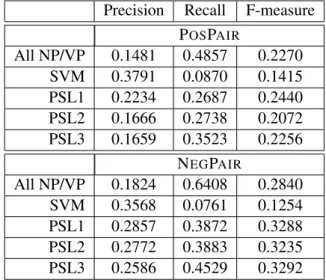
neither considers true negatives (TN). As shown in Table 4, the increment of PSL model over base-lines on F-measure is not as large as the increase in accuracy. Comparing PSL2 and PSL3 to PSL1, the inference rules largely increase recall but lower precision. However, the accuracy in Table 3 keeps growing. Thus, the biggest advantage of PSL models is to correctly rule out true negative eTar-gets. For the baselines, though the SVM baseline has higher precision, it eliminates so many eTarget candidates that the F-measure is not high.
ETarget Selection. To assess the methods for eTarget selection, we run PSL3 (the fullest PSL model) using each method in turn. The F-measures and accuracies are listed in Table 5. The measure of ET1 is slightly lower than the F-measures of ET2 and ET3, while the accuracy of
Precision Recall F-measure POSPAIR All NP/VP 0.1481 0.4857 0.2270 SVM 0.3791 0.0870 0.1415 PSL1 0.2234 0.2687 0.2440 PSL2 0.1666 0.2738 0.2072 PSL3 0.1659 0.3523 0.2256 NEGPAIR All NP/VP 0.1824 0.6408 0.2840 SVM 0.3568 0.0761 0.1254 PSL1 0.2857 0.3872 0.3288 PSL2 0.2772 0.3883 0.3235 PSL3 0.2586 0.4529 0.3292 Table 4: F-measure comparing PSL models (ET3 used for all)
ET1 is much better than the accuracies of ET2 and ET3. Again, this is because PSL recognizes true negatives in the eTarget candidates. Since ET1 considers more eTarget candidates, ET1 gives PSL a greater opportunity to remove true nega-tives, leading to an overall increase in accuracy.
POSPAIR NEGPAIR
F Acc. F Acc.
ET1 0.2192 0.4963 0.3157 0.4461 ET2 0.2374 0.4433 0.3261 0.3969 ET3 0.2256 0.4315 0.3295 0.3892 Table 5: Comparison of eTarget selection methods (PSL3 used for all)
6 Conclusion
This work builds upon state-of-the-art span-based sentiment analysis systems to perform entity/event-level sentiment analysis covering both explicit and implicit sentiments expressed among entities and events in text. Probabilis-tic Soft Logic models incorporating explicit senti-ments, inference rules and +/-effect event informa-tion are able to jointly disambiguate the ambigui-ties in the opinion frames and improve over base-line accuracies in recognizing entity/event-level sentiments.
Acknowledgements. This work was supported in part by DARPA-BAA-12-47 DEFT grant #12475008. We thank the anonymous reviewers for their helpful comments.
References
Stephen H Bach, Bert Huang, and Lise Getoor. 2013. Learning latent groups with hinge-loss markov ran-dom fields. InInferning: ICML Workshop on Inter-actions between Inference and Learning.
Stephen H. Bach, Matthias Broecheler, Bert Huang, and Lise Getoor. 2015. Hinge-loss markov random fields and probabilistic soft logic. arXiv:1505.04406 [cs.LG].
Islam Beltagy, Katrin Erk, and Raymond Mooney. 2014. Probabilistic soft logic for semantic textual similarity. InProceedings of the 52nd Annual Meet-ing of the Association for Computational LMeet-inguistics (Volume 1: Long Papers), pages 1210–1219, Bal-timore, Maryland, June. Association for Computa-tional Linguistics.
Yoonjung Choi and Janyce Wiebe. 2014. +/-effectwordnet: Sense-level lexicon acquisition for opinion inference. InProceedings of the 2014 Con-ference on Empirical Methods in Natural Language Processing (EMNLP), pages 1181–1191, Doha, Qatar, October. Association for Computational Lin-guistics.
Corinna Cortes and Vladimir Vapnik. 1995. Support-vector networks. Machine learning, 20(3):273–297. Lingjia Deng and Janyce Wiebe. 2014. Sentiment propagation via implicature constraints. In Proceed-ings of the 14th Conference of the European Chap-ter of the Association for Computational Linguistics, pages 377–385, Gothenburg, Sweden, April. Asso-ciation for Computational Linguistics.
Lingjia Deng and Janyce Wiebe. 2015. Mpqa 3.0: An entity/event-level sentiment corpus. In Proceed-ings of the 2015 Conference of the North Ameri-can Chapter of the Association for Computational Linguistics: Human Language Technologies, pages 1323–1328, Denver, Colorado, May–June. Associa-tion for ComputaAssocia-tional Linguistics.
Lingjia Deng, Yoonjung Choi, and Janyce Wiebe. 2013. Benefactive/malefactive event and writer at-titude annotation. InACL 2013 (short paper). Asso-ciation for Computational Linguistics.
Lingjia Deng, Janyce Wiebe, and Yoonjung Choi. 2014. Joint inference and disambiguation of im-plicit sentiments via implicature constraints. In Pro-ceedings of COLING 2014, the 25th International Conference on Computational Linguistics: Techni-cal Papers, pages 79–88, Dublin, Ireland, August. Dublin City University and Association for Compu-tational Linguistics.
Song Feng, Jun Sak Kang, Polina Kuznetsova, and Yejin Choi. 2013. Connotation lexicon: A dash of sentiment beneath the surface meaning. In Proceed-ings of the 51th Annual Meeting of the Association for Computational Linguistics (Volume 2: Short Pa-pers), Sofia, Bulgaria, Angust. Association for Com-putational Linguistics.
Jenny Rose Finkel, Trond Grenager, and Christopher Manning. 2005. Incorporating non-local informa-tion into informainforma-tion extracinforma-tion systems by gibbs sampling. InProceedings of the 43rd Annual Meet-ing on Association for Computational LMeet-inguistics, pages 363–370. Association for Computational Lin-guistics.
Minqing Hu and Bing Liu. 2004. Mining and summa-rizing customer reviews. InProceedings of the tenth ACM SIGKDD international conference on Knowl-edge discovery and data mining, pages 168–177. ACM.
Bert Huang, Angelika Kimmig, Lise Getoor, and Jen-nifer Golbeck. 2013. A flexible framework for probabilistic models of social trust. InSocial Com-puting, Behavioral-Cultural Modeling and Predic-tion, pages 265–273. Springer.
Heeyoung Lee, Angel Chang, Yves Peirsman, Nathanael Chambers, Mihai Surdeanu, and Dan Ju-rafsky. 2013. Deterministic coreference resolu-tion based on entity-centric, precision-ranked rules.
Computational Linguistics, 39(4):885–916.
Ben London, Sameh Khamis, Stephen H. Bach, Bert Huang, Lise Getoor, and Larry Davis. 2013. Collec-tive activity detection using hinge-loss Markov ran-dom fields. InCVPR Workshop on Structured Pre-diction: Tractability, Learning and Inference. Christopher D. Manning, Mihai Surdeanu, John Bauer,
Jenny Finkel, Steven J. Bethard, and David Mc-Closky. 2014. The Stanford CoreNLP natural lan-guage processing toolkit. In Proceedings of 52nd Annual Meeting of the Association for Computa-tional Linguistics: System Demonstrations, pages 55–60.
Alex Memory, Angelika Kimmig, Stephen Bach, Louiqa Raschid, and Lise Getoor. 2012. Graph summarization in annotated data using probabilistic soft logic. In Proceedings of the 8th International Workshop on Uncertainty Reasoning for the Seman-tic Web (URSW 2012), volume 900, pages 75–86. Maria Pontiki, Haris Papageorgiou, Dimitrios Galanis,
Ion Androutsopoulos, John Pavlopoulos, and Suresh Manandhar. 2014. Semeval-2014 task 4: Aspect based sentiment analysis. In Proceedings of the 8th International Workshop on Semantic Evaluation (SemEval 2014), pages 27–35.
Jay Pujara, Hui Miao, Lise Getoor, and William Cohen. 2013. Knowledge graph identification. InThe Se-mantic Web–ISWC 2013, pages 542–557. Springer. Marta Recasens, Marie-Catherine de Marneffe, and
Christopher Potts. 2013. The life and death of dis-course entities: Identifying singleton mentions. In
HLT-NAACL, pages 627–633.
Richard Socher, Alex Perelygin, Jean Y Wu, Jason Chuang, Christopher D Manning, Andrew Y Ng,
and Christopher Potts. 2013. Recursive deep mod-els for semantic compositionality over a sentiment treebank. InProceedings of the Conference on Em-pirical Methods in Natural Language Processing (EMNLP), pages 1631–1642. Citeseer.
Veselin Stoyanov, Claire Cardie, and Janyce Wiebe. 2005. Multi-Perspective Question Answering using the OpQA corpus. In Proceedings of the Human Language Technologies Conference/Conference on Empirical Methods in Natural Language Process-ing (HLT/EMNLP-2005), pages 923–930, Vancou-ver, Canada.
Ivan Titov and Ryan T McDonald. 2008. A joint model of text and aspect ratings for sentiment sum-marization. InACL, volume 8, pages 308–316. Cite-seer.
Janyce Wiebe and Lingjia Deng. 2014. An account of opinion implicatures. arXiv, 1404.6491[cs.CL]. Janyce Wiebe, Theresa Wilson, and Claire Cardie.
2005a. Annotating expressions of opinions and emotions in language. Language resources and evaluation, 39(2-3):165–210.
Janyce Wiebe, Theresa Wilson, and Claire Cardie. 2005b. Annotating expressions of opinions and emotions in language ann. Language Resources and Evaluation, 39(2/3):164–210.
Theresa Wilson. 2007. Fine-grained Subjectivity and Sentiment Analysis: Recognizing the Intensity, Po-larity, and Attitudes of private states. Ph.D. the-sis, Intelligent Systems Program, University of Pitts-burgh.
Bishan Yang and Claire Cardie. 2013. Joint infer-ence for fine-grained opinion extraction. InACL (1), pages 1640–1649.
Bishan Yang and Claire Cardie. 2014. Context-aware learning for sentence-level sentiment analysis with posterior regularization. InProceedings of ACL. Lei Zhang and Bing Liu. 2011. Identifying noun
prod-uct features that imply opinions. InProceedings of the 49th Annual Meeting of the Association for Com-putational Linguistics: Human Language Technolo-gies, pages 575–580, Portland, Oregon, USA, June. Association for Computational Linguistics.