Master’s Thesis
Computer Science
School of Computing
Blekinge Institute of Technology
Master’s Thesis
Computer Science
May 2012
Contact Information:
Fangjie Lu
E-mail:
Israr Khan
E-mail:
University advisor:
Professor Guohua Bai, Ph.D
Computer Science/Blekinge Tekniska Hogskola
Sharing elderly healthcare information in
Cloud Computing
CCloud Computing
Centered Title Times Font Size 24 Bold
Fangjie Lu, Israr Khan
School of Computing
Blekinge Institute of Technology
SE
–
371 79 Karlskrona
Internet : www.bth.se/com
Phone
: +46 455 38 50 00
Fax
: +46 455 38 50 57
Abstract
Context: Due to rapid increase in the population of elderly people, sharing healthcare information has become an essential requirement for the development of e-health system. By conducting a research in e-health and cloud computing we have explored the advantages and disadvantages of sharing healthcare information for elderly people through cloud computing.
Objectives: The main purpose of this research is to investigate the suitability of cloud computing to share healthcare information. The study is conducted by exploring the advantages and disadvantages of cloud computing for e-Health systems. Investigating a suitable cloud computing platform is also one of the objectives of this research.
Methods: In order to identify and get deeper understanding of these issues, we have performed literature review of E-health, EHI and Cloud Computing technologies and we have develop a prototype application as experiment.
Results: Based on the finding of literature review, we came to know that E-health was huge field. It needs a huge infrastructure to establish. The healthcare information in e-health requires quick and easy sharing. In EHI research, we defined EHI and find reasons for sharing elderly healthcare information. At cloud computing research, we knew the concept of cloud computing and found out advantages and disadvantages of implementing e-health in cloud computing. From literature review, we developed sharing application which was used to share EHI in cloud computing. In experiment, we proved our supposition and discussed advantages and disadvantages of sharing EHI in cloud
computing by using Google App Engine (GAE).
Conclusions: We conclude that cloud computing meets the requirements of sharing EHI, but it also has some limitations due to its architecture and network condition. In this research we have identified further research area that can help in enhancing security and privacy in cloud environment.
Keywords: E-health, elderly healthcare information,
Acknowledgement
We would like to express our sincere gratitude to our supervisor Professor Guohua Bai. Due to his continuous support we accomplish our thesis work and achieve our target on time. Even he gives us time on weekends. It was impossible for us to finish our work without his proper assistance and time.
--- Fangjie Lu & Israr Khan Special thanks to Yan Hu. She gives us alot of valuable suggestions and makes our research in right way.
At first, I am so deeply grateful to my parents for the great honor of your support and all you have done for me. You not only give me courage to face challenges, but you are my
backbone that supports me forever no matter if I am successful or failed.
Then, I am grateful to Shanghai Second Polytechnic University that give me the opportunity to study here as an exchange student and complete my master thesis.
Finally, I am also very thankful to my relatives and friends who ever gave me help and encouragement.
I am extremely thankful to my Parents and my family members for their love,
prayers, and continuous support throughout my life.
I am very thankful to my excellent thesis partner Fangjie Lu. His devotion and commitment always give me hope for successful completion of our thesis work. And Special thanks to Yan Hu and Muhammad Ullah which give us valuable suggestions to make our research work in right way.
Finally thanks to all my friends who directly or indirectly contribute to my research work. This thesis is dedicated to my parents, for their endless love, support and encouragement.
C
ONTENTS
ABSTRACT ...I ACKNOWLEDGEMENT ... II CONTENTS ... IV 1 INTRODUCTION ... 1 2 BACKGROUND ... 12.1 CHALLENGES OF ELDERLY HEALTHCARE (EH) ... 2
2.2 THE ELDERLY E-HEALTH NEEDS ... 2
2.3 SHARING HEALTHCARE INFORMATION REGARDING INTEROPERABILITY... 3
2.4 IMPLEMENTATION OF E-HEALTH IN CLOUD COMPUTING ... 3
3 RESEARCH DEFINITION ... 4 3.1 RESEARCH DESCRIPTION ... 4 3.2 PROBLEM DEFINITION ... 4 3.3 MOTIVATION ... 4 3.4 AIM AND OBJECTIVES ... 4 3.5 RESEARCH QUESTION ... 5
3.6 RESEARCH EXPECTED OUTCOME ... ERROR!BOOKMARK NOT DEFINED. 4 RESEARCH METHODOLOGY ... 6
4.1 OVERVIEW ... 6
4.2 RESEARCH METHOD RELATED TO RESEARCH QUESTION ... 7
4.2.1 Literature review: ... 7
4.2.2 Experiment:... 8
5 RELATED RESEARCH ... 9
5.1 CONCEPT OF E-HEALTH ... 9
5.2 MAIN E-HEALTH TECHNOLOGIES ... 9
5.3 REQUIREMENTS OF E-HEALTH IN SWEDEN ... 10
5.4 E-HEALTH ADVANTAGES ... 11
5.5 DISADVANTAGES OF E-HEALTH ... 11
5.5.1 Technical Disadvantages: ... 11
5.5.2 Operational Disadvantages: ... 12
5.5.3 Legal Disadvantages: ... 12
5.5.4 Cost / Benefit Disadvantages: ... 12
5.6 CLOUD COMPUTING IN HEALTH CARE ... ERROR!BOOKMARK NOT DEFINED. 5.7 CONCEPTS OF CLOUD COMPUTING ... 12
5.8 OVERVIEW MODEL CLOUD COMPUTING ... 12
5.8.1 Important characteristics ... 13
5.8.2 Service models ... 14
5.8.3 Cloud computing Deployment models ... 15
5.9 BENEFITS OF CLOUD COMPUTING ... 15
5.9.1 Technical Advantages ... 15
5.9.2 Users’ Advantages ... 16
5.9.3 Companies Advantages ... 16
5.9.4 Environment Advantages ... 16
5.10 LIMITATIONS OF CLOUD COMPUTING ... 16
5.10.1 Segregation of Data ... 16
5.10.2 Data Deletion ... 16
5.10.3 Offline Cloud ... 17
5.10.4 Privacy ... 17
5.10.5 Data Lock-In ... 17
5.10.6 Data Audit ability & Confidentiality ... 17
5.10.7 Network ... 17
5.10.9 Security ... 17
5.10.10 Control ... 17
5.11 SERVICE LEVEL AGREEMENT (SLA) ... 18
5.12 CLOUD COMPUTING SERVICE PROVIDERS ... 18
5.12.1 Google (Google App Engine) ... 18
5.12.2 Microsoft (Windows Azure) ... 19
5.12.3 Amazon EC2(aws.amazon.com) ... 19
5.12.4 Features of Google, Amazon and Microsoft Cloud ... 20
6 SHARING EHI IN CLOUD COMPUTING ... 22
6.1 THE EHI IN OUR RESEARCH ... 22
6.1.1 New EHI Source – Home Setting ... 22
6.1.2 The Format of EHI ... 22
6.1.3 The Dataset of EHI ... 23
6.1.4 Issues in Sharing EHI ... 23
6.2 E-HEALTH AND CLOUD COMPUTING ... 24
6.3 SHARING EHI IN CLOUD AS SAAS ... 25
7 SIMULATION IN GOOGLE APP ENGINE(GAE) ... 27
7.1 SCENARIO FOR SHARING EHI ... 27
7.2 TECHNOLOGY DESCRIPTION OF GAE ... 28
7.2.1 Development framework in GAE ... 29
7.2.2 Data Storage in GAE [55] ... 29
7.2.3 Interoperability mechanism – Java Servlet ... 30
7.3 SIMULATION ... 31 7.3.1 Simulation Environment ... 31 7.3.2 Prototype Structure ... 31 7.3.3 Input in Simulation ... 33 7.3.4 Simulation ... 34 7.3.5 Output of Simulation ... 38 8 RESULTS IN SIMULATION ... 39 8.1 DESCRIPTION ... 39 8.2 PARAMETER DESCRIPTION ... 39 8.3 DATA SENDING ... 39 8.4 DATA RECEIVING ... 40 8.5 RESULTS ANALYSIS ... 41 8.6 DISCUSSION ... 42
8.6.1 Discussion about EHI sharing ... 42
8.6.2 Discussion about scenario simulation ... 43
8.7 VALIDITY THREAT ... 43
8.7.1 External Validity Threat to Experiment ... 44
8.7.2 Internal Validity Threat to Experiment ... 44
9 CONCLUSION ... 45
10 FUTURE WORK ... 46
LIST OF FIGURES
FIGURE 4-1 Research Flow Overview ... 6
FIGURE 4-2 Research Flow ... 7
FIGURE 5-1 Cloud Computing Overview Model ... 13
FIGURE 5-2 Cloud Service Models ... 14
FIGURE 6-1 Relationship between SaaS, PaaS & IaaS ... 25
FIGURE 6-2 Structure of Sharing EHI as SaaS ... 26
FIGURE 7-1 Scenario for Sharing EHI ... 27
FIGURE 7-2 Scenario for Sharing EHI ... 28
FIGURE 7-3 Servlet Structure ... 30
FIGURE 7-4 Servlet Request and Response ... 30
FIGURE 7-5 Simulation Environment ... 31
FIGURE 7-6 Client Working Flow ... 32
FIGURE 7-7 Service in Google App Engine Working Flow ... 33
FIGURE 7-8 Healthcare centers -Data Sending ... 34
FIGURE 7-9 Hospital - Data Receive ... 35
FIGURE 7-10 Online Data Management for Healthcare Plan ... 35
FIGURE 7-11 Hospitals - Data Sending ... 35
FIGURE 7-12 Healthcare center - Data Receive ... 36
FIGURE 7-13 Online Data Management – Health Record ... 36
FIGURE 7-14 Online Add New Data ... 37
FIGURE 7-15 Hospital & Healthcare Center Receive Data from Online Service ... 37
FIGURE 7-16 Picture Sharing ... 37
FIGURE 7-17 Log output of application in GAE ... 38
FIGURE 8-1 Latency and stability of Sending Operation ... 40
LIST OF TABLES
TABLE 5-1 Features of SaaS Provider-Google, Amazon and Microsoft ... 21
TABLE 6-1 Dataset of EHI ... 23
TABLE 6-2 Relationships between E-health & Cloud computing ... 25
TABLE 7-1 Picture Input ... 34
TABLE 8-1 Latency and Stability of Sending Operation ... 39
Abbreviation
PaaS: Platform as a Service SaaS: Software as a Service EH: Elderly Healthcare
EHI: Elderly Healthcare Information
ICT: Information Communication Technology GAE: Google App Engine
WHO: World Health Organization IT: Information Technology
HIPAA: Health Insurance Portability and Accountability Act EMR: Electronic Medical Record
CIA: Confidentiality, integrity and Availability SLA: Service Level Agreement
1
I
NTRODUCTION
Due to rapid increase in “Aging population” [1], elderly healthcare become one of important
social issues and generate many challenges about the pace of future Medical Treatment System in developed and developing countries like USA, Japan ,and South Korea are focusing on developing e-health service to integrate healthcare information and healthcare resource.
But the problem isnumbers of medical institutions are entered in the race of e-health
implementation according to different policies classification by national strategy [2]. So this problem directly influences medical institutes to develop their E-health system according to their policies, requirements and standards and it also creates a big gap in information sharing among medical institutes [4].
The information sharing gap also exists in elderly healthcare, because elderly healthcare is connected with different medical institutes like hospital, clinics and healthcare center. Each medical institute requires elderly healthcare information (EHI) to diagnose, and treat elderly
people “How to solve the information gap which appears in elderly e-health service” is an
important issue to develop elderly e-health service. Many researchers have done their work in this area [8][13][14][15]. Some researchers focused on semantic standard [17] which is a basic information structure in Information Communication Technology (ICT); and this standard can be used to share healthcare information among each other.
We are not the first to implement e-health information sharing service in cloud. The famous attempt of sharing e-health information was made in May 2008 by Google, when they built Google Health in Google cloud. The main function were storing and sharing healthcare
information among users in cloud. “Google Health” offered some self- diagnosis services to
help users to check and monitor their health status. Though “Google Health” is closed in
2010, but still it can be a good example to prove cloud computing a good platform to process and share healthcare information.
Cloud Computing is an innovative idea for new Internet service [65]. The main idea of
Cloud Computing is “everything in cloud as service” [65]. It means cloud users have no
concerns about hardware and software, because everything they see and use in cloud is service. Thus researchers defined three service models as “Software as a Service”, “Platform as a Service” and “Infrastructure as a Service” based on different users’ requirements. They
also defined two deployment models as “Public Cloud” and“Private Cloud” based on the
requirements of different cloud developers. Therefore “Which cloud model is suitable to
implement EHI sharing service” is an important part in our research.
In our research, we use two research methods - literature review and experiment to reach our goal. In literature review, we emphasize to find enough references to support our research
“cloud computing can share EHI among medical institutions”. Then, according to scenario,
we developed a prototype to verify this research. Finally, based on the result of experiment, we discussed advantages and disadvantages of sharing EHI in cloud computing.
2
B
ACKGROUND
In this chapter we describe the Challenges of elderly healthcare, citizen healthcare needs, sharing healthcare information regarding interoperability, implementing e-health in cloud computing.
2.1
Challenges of elderly healthcare (EH)
Now a days, elderly healthcare has become a serious problem. According to the facts presented by World Health Organization (WHO), people with aged 60-and-older are increasing quickly. The ratio presented by WHO about elderly people is 7.6 percent of total population of world in year 2010 which will reach to 16.2 percent in 2050. It clearly shows
that the world's elderly people population – age 60 years and older – will increase from 650
million to 2 Billion in 2050. [1]
This number leads to both developed and developing countries which will face big
challenges including “strains on pension and social security systems”, “increasing demand
for health care”, “bigger need for trained-health workforce in gerontology”, “increasing demand for long-term care, particularly in dealing with dementia” and “the raising of pervasive ageism that denies older people the rights and opportunities available for other adults.” [1]
To overcome these, challenges it is important to implement new measures in elderly healthcare. “Ensuring that aging population have a basic level of financial security”,
“Developing age-friendly environments”, “Availability and accessibility of effective health care” and “Maintaining social patterns that influence the well-being of aging adults”[1] are
three new requirements for research to be solved. So that Elderly people can be handled in right way and get any medical treatment easily and quickly
As we know, elderly population is the largest consumers of health care resources. Generally speaking, an elderly person consumes more healthcare resources than other groups of people [2]. From economic dimension, the healthcare sectors are under great pressure of limited financial resources, human resources, lack of qualified doctors, nurses, and home healthcare staffs. This is other challenge for countries whose aging population is quickly increasing before their social welfare system gets well developed and established.
2.2
The Elderly E-health Needs
With the development of technology and civilization, Elderly people healthcare services needs have increased. Since the medical care systems have implemented in great extent of countries, people living in cities are healthier and can live longer. Consequently, demands
for healthcare services have increased and changed to “Development of medical technology
(increased possibilities)”, “Ageing population (increased need)” and “Increased mobility of people (changing the requirements for healthcare delivery)” [3]. The availability of hospitals,
clinics and different medical institute make the city people healthier and get treatment on time as compared to the rural area people. That’s the reason the cities elderly people are healthier than rural area elderly people.
With new requirements for healthcare services, e-health will develop on the trends related to
“Monitoring”, “Communication /accessibility”, “Knowledge and decision making”, “Support for relatives and citizens’ social life” and “Cross-border or cross-regional care” [3].
Thus, we have to develop the database of health care records which can be easily manage to handle healthcare information sharing as well as to fulfill the needs of elderly health. By doing this we will be able to share the EHI in a right and easy way.
2.3
Sharing healthcare information regarding
interoperability
According to EC Recommendation, “interoperability of electronic medical record systems"
is defined as the ability of two or more electronic medical record systems to exchange both computer interpretable data and human interpretable information and knowledge [66]. Interoperability is a major challenge in e-health which needs to be addressed when we share healthcare information among healthcare centers and hospitals. There are two major
challenges which are created in e-health interoperability. They are described respectively as
“problems are in communication among healthcare departments” and “problems with communication with different organizations” [4]. The importance of providing
interoperability among different healthcare centers is significant. This statement is justified with the definition of e-health interoperability itself. “Interoperability means the ability to communicate and exchange data accurately, effectively, securely and consistently with different information technology systems, software applications, and networks in various settings and exchange data such that clinical or operational purpose and meaning of the data are preserved and unaltered” [4]. It describes that sharing healthcare information is a
method to achieve e-health interoperability in e-health services.
2.4
Implement E-health in Cloud Computing
Cloud Computing is a suitable platform to support E-health development and information sharing. It is also a solution to integrate E-health services.
According to technology point of view, the main focus is to provide safe, fast, reliable and efficient healthcare information sharing regarding interoperability, a platform of high performance and quality should be introduced. Data persistence, durability and security as well as high computational power are of utmost importance to achieve the goal [5].
Cloud computing technology is considered to be relevant for this purpose. This approach is based on delivering software, infrastructure and the whole computation platform as a service. Unlike traditional web hosting providers, cloud computing offers pay-as-you-go services. It means users only have to pay for the resources they use over time [5]. These services are offered over the Internet by large data and computing centers [6]. This approach is not only a conceptual model of software, but a brand new technology which is suitable for distributed applications development [7]. Cloud computing platforms provide low cost, transparent, convenient and flexible services to small, medium scale businesses (SMBs) as well as large-scale corporations. Cloud computing offers a number of advantages such as economy of scale, availability, management effort, efficiency, consolidation, cost and energy savings. The services are provided on demand and accordingly to pay-as-you-go model. This allows the users to competently use the resources and reduce the overall costs.
From medical point of view, cloud offers special channel to access electronic medical records easily. This ability of quick access to personal medical history can speed up treatment, help to avoid complications, and even saves lives. Cloud also can make it easy for
3
R
ESEARCH
D
EFINITION
In this chapter we will go through the Research description, problem definition, aim and objectives, research questions, research expected outcomes and research description.
3.1
Research Description
Information sharing among different organizations is necessary, especially when some services are crossing outside their own organization like healthcare. Sharing of information is essential for elderly healthcare in e-health. To accomplish the needs for EHI sharing in E-health we suggest cloud computing .Cloud computing is a new technology which has good performance in storing and accessing information. Our research will mainly focus on the implementation of cloud computing platform to share EHI.
3.2
Problem Definition
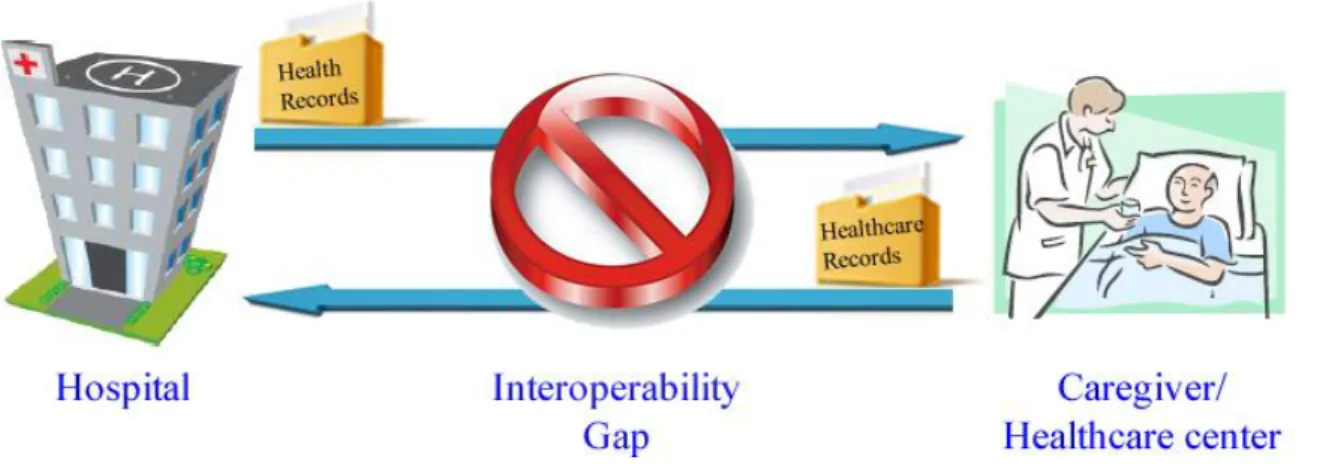
All the hospitals and healthcare centers use their own e-health system but they are unable to communicate and share data among each other, especially in case of sharing elderly health care information [8][13]. Hospitals want to share healthcare information with healthcare centers and healthcare centers also need healthcare information from hospitals. In this case when the hospitals and healthcare centers use different e-health systems with different standards, they cannot communicate with each other, so it directly creates a big gap in sharing healthcare information.
To solve this issue, we have done some research on cloud computing and suggested Google App engine to bridge this information gap among hospitals and healthcare centers so that they can share information with one another easily and quickly.
3.3
Motivation
Cloud computing has many features like data storage, sharing of resources, scalability and reduce in cost. Because of these features, other fields are implementing cloud computing to make their work efficient. Although health sector can get many benefits from cloud computing but it still hesitates to implement it. So we would like to identify problems which make postponing the adoption of cloud computing in healthcare through associate perspectives.
3.4
Aim and Objectives
To achieve our research, the following aims and objectives have been raised:
AO1: To identify the requirements of EHI.
AO2: To select an appropriate service model of cloud computing for EHI sharing.
AO3: To analyze the existing service model of cloud computing for sharing EHI.
AO4: To develop an application for sharing EHI in selected service model of cloud
3.5
Research Question
To reach our research purpose, the following questions have been raised:
Q1: Which Cloud Computing service model is suitable to implement EHI sharing
service?
Q2:
What are the advantages and disadvantages of cloud computing platform to
share EHI?
4
R
ESEARCH
M
ETHODOLOGY
In research methodology chapter we will write overview of our research topic, research flow, literature survey and experiment.
4.1
Over
v
iew
The Research topic “Sharing EHI in cloud computing”, presents three main concepts in our
Research area:
“Sharing” – we will define this concept as one interoperable action in different
information system. We will focus on the research in interoperability of elderly e-health service of “sharing”.
“EHI” – It is an important research point, Information mean a pile of data combined
which makes it meaningful. Since healthcare information has a large number of types,
patient records can be some healthcare information, the data of patient’s blood pressure,
blood sugar, heart rate also can be healthcare information. The phrase “healthcare
information” had made our research wide. We have minimized our topic according to our
master thesis time frame. That is the reason for us to choose “EHI” to minimize our research
area.
“Cloud computing” – It is also an important point in our research. We will focus on
technology level by using cloud computing in our research. We will present this part around cloud computing framework, cloud computing model, cloud computing platform etc. After presenting, we can discuss advantages and disadvantages of sharing EHI in cloud computing.
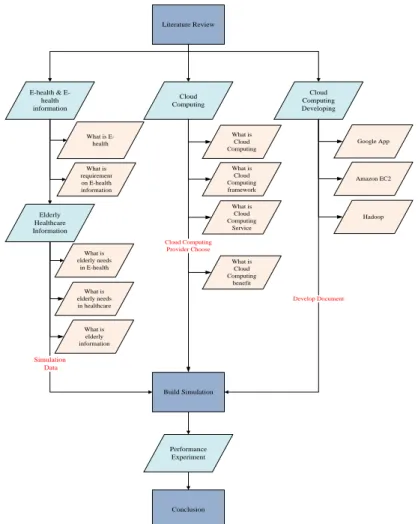
Literature Review Elderly Healthcare Information health & E-health information Cloud Computing Cloud Computing Developing What is E-health What is requirement on E-health information What is elderly needs in E-health What is elderly information What is elderly needs in healthcare What is Cloud Computing What is Cloud Computing framework What is Cloud Computing Service What is Cloud Computing benefit Google App Amazon EC2 Hadoop Build Simulation Cloud Computing Provider Choose Simulation Data Develop Document Conclusion Performance Experiment
In literature review, we focused on getting knowledge of elderly healthcare information, cloud computing and cloud computing development. Then, we applied that knowledge to our experiment, according to our scenario, we built simulation environment and developed a prototype. Figure 4-1 shows the research flow
4.2
Research Methodology Related to Research Question
AO1
Literature
Review
AO2
AO3
Q1
Answer
Simulation
Related
AO4
Answer
Q2
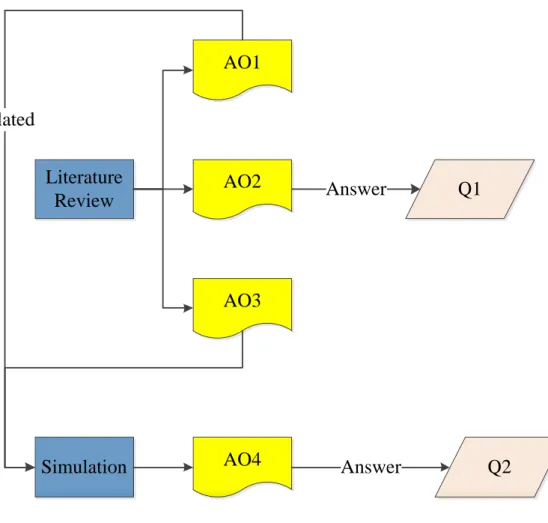
Figure 4-2 Research Flow
4.2.1
Literature review:
In literature review, we focused on finding the answers of “Which cloud service model is
suitable to implement EHI sharing service?” and “How to build application in cloud
computing?”
According to Dawson [10], a literature review is the first step to any research work which performed in two phases, respectively known as literature search and literature review. This approach has been selected since it is suitable for beginning to reach the research topic and identify gaps in the previous and current research. We have used keywords such as e-Health strategy, e-health service, elderly health care, EHI, information interoperability and cloud computing to do literature review. The publications have been searched in digital libraries provided by the library of Blekinge Institute of Technology (BTH). Libraries such as ACM Digital Library, Google Scholar, Scopus, and IEEE Explorer have been used. Through our
research, we would like to get knowledge about “What is e-health”, “What is EHI”, “What is
Through the literature review, we have answered RQ1:“What cloud service model is suitable to implement EHI sharing service?” Then, find AO1:“What are the requirements for sharing
EHI” and AO3:“How to build application in cloud computing?” Like Figure 4-2 shows.
4.2.2
Experiment:
In our research, we have verified the topic “sharing elderly healthcare information in cloud
computing” through simulation.
We have real case scenario from Blekinge Hospital Sweden. This scenario is described as
“Blekinge County has two main hospitals and several healthcare centers (caregiver) which
using electronic health record (EHR). Hospitals use SYStem Cross while municipality
healthcare centers use MAGNA CURA. These two systems are different in technology and
medicinal terminologies. The hospitals are interoperable with each other but they are not
interoperable with municipality healthcare centers. ” [11]
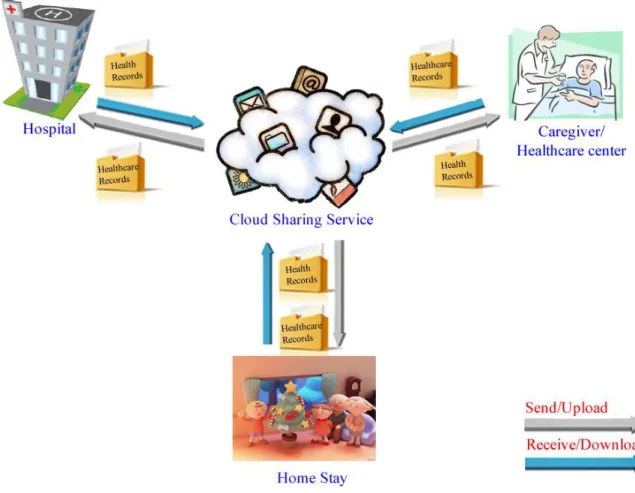
In simulation environment, we have built a cloud of four computers for the sharing services according to AO2. One of them played a role as information sharing server while other three computers were installed as clients like hospital, healthcare center and home to share
information with each other. From the results of simulation, as well as the requirements for sharing EHI and process of simulation, we discussed and answered research question
Q2:“
What are the advantages and disadvantages of cloud computing platform to
5
R
ELATED
R
ESEARCH
In this section, we describe about concept of e-health, e-Health definitions, e-health main technology, e-health advantages, Challenges. We will discuss potential applications of cloud computing for health care.
5.1
Concept of E-health
Through literature review, we find many definitions of “E-health” concept.
In 1999, Mitchell defined “E-health” as “A new term required describing the combined use
of electronic communication and information technology in the health sector. The use in the health sector of digital data transmitted, stored and retrieved electronically – for clinical, educational and administrative purpose, both at the local site and at a distance”[12]
In 2001, WHO (World Health Organization) defined keyword “E-health” as “use of
information and communications technologies (ICT) in support of health and health-related fields, including health-care services, health surveillance, health literature, health
education, knowledge and research”[13]
In the introduction of Action plan in 2004 which published by the EU Commission defined
“E-health” as “e-Health tools or solutions include products, systems and services that go beyond simple Internet-based applications. They include tools for health authorities and professionals as well as personalized health systems for patients and citizens. Examples include health information networks, electronic health records, telemedicine services, personal wearable and portable communicable systems, health portals, and many other information and communication technology-based tools assisting prevention, diagnosis, treatment, health monitoring, and lifestyle management.” [14]
5.2
Main E-health Technologies
From the chapter “What is e-health” we know “e-health” includes products, systems, services and educations.
Electronic medical records (EMR):
The electronic medical record develops for managing medical infrastructure. EMR stores and shares different kinds of electronic health care information from different medical departments which focus on integrating and interaction between different departments in
medical area. It includes “Patient management system”, “Pharmacy management system”,
“Laboratory management system”, “Radiology information system”, “Billing and insurance
system” and “Staff management system”. [15]
Computerized physician order entry:
In this process physicians’ prescriptions and directions are processed. CPOE is a promising
technology that allows the physicians to enter orders into computer instead of handwriting them. It can decrease cost and medical errors. The employees receive the orders through
Multipurpose smart card:
Smart cards store data in IC chip, so they can retrieve and transfer patient personal data by using an integrated circuit. Currently smart cards are adopted in a few countries of Europe [16].
Picture archiving and communication systems:
Through this system, patients’ digital images can be examined by more than one
physician through computer network. The purpose of this system is to replace the manual imaging system. It reduces the possibility of images being lost and reduces the cost of retaking images [16].
Electronic health records (EHR):
Electronic health records can be divided into two levels. In basic level, Electronic Healthcare
Record (EHR) digitally store patient’s information. EHR also called Electronic Patient
Record. Records which EHR stored include blood group, medical history, checkups, laboratory tests, diagnostic image reports and so on. [17]
In advance level, it can offer self diagnosis service through analyzed storage records in EHR. The patient can use this service to check health situation by himself.
Electronic health record is focus on:
Make a platform to collect healthcare information.
Integrate different structures and standards of records.
Improve communication among different health care providers.
E-Prescription Service:
“E-Prescription is the electronic transmission of prescription of pharmaceutical products from legally and professionally qualified/registered healthcare practitioners to registered pharmacies (or dispensing system).” [18] The E-Prescription service allows user orders and
gets prescription medicine from remote place or healthcare service.
5.3
Requirements of E-health in Sweden
In Sweden national strategy report [20], it evidently shows the national interest of e-health development by using three scenarios.
The individuals have access to easily accessible and quality-assured information on all forms of health and social care as a citizen, patient, end-user and close friend or relative. He shall have access to documentation on previous care interventions and treatments as well. The individuals also be offered interactive and customized eServices so that he could be able to
participate and exercise self-determination on the basis of his own requirements” This is how
Swedish government is focusing on e-health sector [20].
Health and social care staff shall be given access to well-functioning and concurrent electronic decision support. The system shall provide both quality and security and it must also facilitate their day-to-day work. Decisions on care interventions and treatments shall be taken on the basis of important structure information.
In order to monitor the quality and security of activities and obtain, updated and
the decision makers shall have all the appropriate tools. High quality data shall be made accessible to both public and private research with a respect for integrity of citizens [20].
5.4
E-health Advantages
The big advantage of E-health for users like patients, physicians, and nurse is by handling health information from one platform. A survey which has been conducted in United States has said that 75% of applications deduct the chances of errors; 70% suggested that use of IT in health care improve productivity; while over 60 % stated that it has the potential of reducing costs and helps patients act more responsibly [21].
The paper based system used before have errors, time consuming and cannot be accessed everywhere. In EHRs, data is stored in a simple and efficient way which can be accessed everywhere. EHRs also provide a complete and error free data storage method [22].
According to Mullner and Chung “records of paper have within many errors and inefficiencies,
and they block the communication between health care providers” [23]. So this means that
e-health also improves communication between e-healthcare providers. The doctors can easily access a patient data stored in a single location. In a case, patient wants to move to another hospital; his data can easily be transmitted electronically. E-health becomes an important tool to share health care information which can reduce the cost of managing chronic diseases, medication and wellness programs [24].
Physicians: Physicians have ease of controlling ordering process for patients
including drug prescription and dealing with allergies etc. Physicians prescriptions are stored electronically which help in avoiding the problems of elucidation of hand
written prescriptions. It also helps in reducing the time of locating patient’s health
charts.
Patients’ management: Patients receive more advantages from e-health.
Interdisciplinary communication for patients is improved by e-Health because handwritten errors are avoided in electronic prescriptions. It also plays a very important role in medication safety.
Ancillary departments: Now the pharmacists and nurses spend more time on
patients’ care instead going through the orders. Most of the resources in ancillary
departments are free from engaging in administrative tasks.
5.5
Disadvantages of e-Health
Although e-health developed with time span, it also meets some disadvantages:
5.5.1
Technical Disadvantages:
There is a probability of increased misuse with the advancement in technology. The same applies to e-Health as well. The security risks associated with e-Health have been widely discussed but it is still one of the main risks in implementation of e-Health. Security issues in e-Health are the same as threats to any information security. CIA
(Confidentiality, integrity and Availability) model should be followed in e-Health as well [25].e-Health infrastructure is focused on patients and their relevant data, but the record of people gaining access to patient data should be kept.
5.5.2
Operational Disadvantages:
Operational challenges are related to the interoperability of systems provided by e-Health [27].In order to communicate with a new system introduced by e-Health an interface should be developed for the existing system. Then a standard electronic language should be used for cross communication between different healthcare organizations regarding medical data. In order to do this, there must be a formal agreement for using a method of communication between organizations [27].
5.5.3
Legal Disadvantages:
Enforcing privacy of data is one of the major legal barrier faced by healthcare organizations [28].Since health care organization are mostly related to patients, it becomes utmost important to take care of patients privacy while adopting e-Health solutions. The main purpose of privacy laws is to protect the rights of individuals. In e-Health the main hurdle is to make sure that only authorized persons have access to patient data, depending on their daily work [29]. Another problem is to define who should have right of access and how to differentiate different groups based on their right of access. Both the hospitals and clinics have their own access rights, but e-Health facilitate cross communication of patient data between different healthcare organizations. This cross communications is a major source of concern for privacy laws. In U.S e-Health implementation is still facing strict legal barriers.
5.5.4
Cost / Benefit Disadvantages:
In order to implement e-Health systems the cost benefit analysis of implementing the system should be performed first. It should be made sure whether the implementation is feasible or not. Are the benefits more in comparison to the cost? Speaking from a technical perspective e-Health has got advantages as compared to the paper based methods, but from the
perspective of e-Health organizations these benefits may be less in comparison to its cost. The reason is the at the cost of implementing an e-Health system may be thousands of dollars. And the cost of hiring team of IT professionals for support and maintenance of the system is not even included in that cost [30].
5.6
Concepts of Cloud Computing
“Cloud computing model is enabling on demand network access to shared pool of
configurable computing resources (e.g., servers, applications, networks, services, storage etc.) that can quickly be purveyed and issued with less management effort or service provider
interaction.” [36].
Cloud computing is a combination of both software and hardware, it can be divided as Software as a Service (SaaS), Platform as a Service (PaaS) and Infrastructure as a Service (IaaS) by services provider; and it also can be divided as public cloud and private cloud by different usage. When we made cloud as pay-as-you-go; it is called public cloud. If we deal with internal data-centers then it called private cloud and it is not available for public.
5.7
Overview model Cloud computing
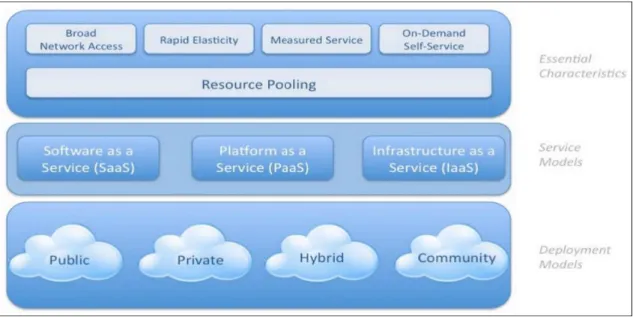
This model is composed of five essential characteristics, three service models, and four deployment models
Figure 5-1: Cloud computing overview model.
5.7.1
Important characteristics
There are five essential characteristics of cloud computing. Those are listed below [36]. On demand self –service:
Users unilaterally can increase or decrease computer capabilities like servers,
application, networks, services, storage according to requirement without any need of human interaction. It will help user to focus more on its business and get good results. Access to Broad network:
Users can access applications by using heterogeneous thin or thick client platforms .i.e. PDAs, laptops, mobile phones etc.
Resource pooling:
According to User demand, different physical and virtual resources (networks, storage, processing, bandwidth and virtual machines). Dependent on consumer demand, different virtual and physical resources (networks, storage, processing, bandwidth and virtual machines) dynamically assign or reassign to the specific application. These resources will assign to the applications based on multi-tenant model i.e. computer resources are pooled to serve multiple consumers. Consumer does not know the exact location where the data is stored but consumer may have a choice to choose the location of data center where he wants to store the data by specifying country, state or location of data center.
Quick elasticity:
Consumer has the ability to increase the resources whenever the demand is high and he is also able to reduce the resources like servers, virtual machines if the demand is less. For example, one website has more traffic in weekends and less in weekdays then we can use the resources rapidly and elastically.
Deliberate service:
5.7.2
Service models
Figure 3 shows the abstract layers of cloud service model. It maps the three service models with different security measures at various cloud operational levels.
Figure 5-2: Cloud Service Models [36] Software as a Service (SaaS):
Software as a service actually refers to on-demand software. SaaS is software
distribution model where the applications are hosted by service providers and available to customers over a network or the internet. The end users get rent software from cloud
provider as service. Software delivers to consumers on the basis of “one-to-many”.
Cloud service provider assert service level agreements to manage operating systems, servers, individual applications, storage and network infrastructure .while the user does not require any upgrades or changes to the software and also does not require to manage any server, operating system or any individual applications [36].
Platform as a Service (PaaS):
Platform as service is one of category of cloud computing which provides cloud computing platform and solution stack as a service. It is way to rent storage, operating system, hardware over the internet. The service delivery model allows the user to rent the virtual servers and related services to run existing program or develop and test new ones. The customer or user has the control over the application hosted configurations it does not need to control cloud infrastructure like networks, application, storage etc. PaaS use multi-tenant architecture so it can concurrent multiple users who can use the same development application [36].
Infrastructure as a Service (IaaS):
IaaS is sometimes call hardware as service (HaaS).The IaaS is provision model in which organization outsources the equipment used to support hardware, servers,
networking ,storage and other resources to the customer, where user simply place and run the arbitrary software like applications. The service provider have the equipment
and totally responsible for maintaining , running and debugging it, while the user or customer has control over operating systems and pay per use basis of these services [36].
5.7.3
Cloud computing Deployment models
Clouds are classified into four models based on their infrastructure and these are distinguished by their architecture and functionality [36].
Private Cloud:
Private cloud is operated for specific organization and it may be managed by the
organization or third party. SLA‘s are based on mutual understanding of cloud provider
and the organization. Public Cloud:
Public cloud is owned by specific cloud service provider. This public
cloud infrastructure is available for large organizations and public. SLA‘s are same to all
the customers those who are using public cloud. Community Cloud:
This cloud is shared by a group of organizations and supports a specific community that has shared concerns. This may be managed by organizations or third party.
Hybrid Cloud:
This cloud is a combination of private and public cloud. These clouds are bound together by standardized technology that enables data and application portability.
5.8
Benefits of Cloud Computing
Benefits of cloud computing can be divided into four categories. These categories are: Technical, Users, Infrastructural, Companies and Environmental. The benefits under each category have been described in the following sections.
5.8.1
Technical Advantages
Cloud computing has the following advantages from a technical point of view [31]. Power Management:
Managing virtual server is easier compared to physical server from a power management point of view.
Scalability:
Scalability is one of the most important aspects of cloud computing. For example cloud can easily handle sites with large number of users or high traffic without additional hardware
infrastructure or disturbing user’s activities.
Data Storage:
Since there are a large number of data servers all over the world, it becomes easier for business organizations to choose a data center which is easier for them to access. It enables them to access their data easily and quickly on servers with unlimited data storage.
Efficiency and Reliability:
Due to the fact that cloud computing is efficient, many organizations are shifting towards cloud computing. Beside this cloud computing enables organizations to maintain backup for all their remote sites and branch offices. It can also help in coping with many challenges like disaster recovery, security and bandwidth allocation [38]. Cloud computing applications for all services are available and reliable. According to [39]
an executive of cloud industry services said “Any business leader worried about the
security and reliability of their data in the cloud should remember that they have been trusted, saving and storing their personal financial assets in an external, virtual banking
cloud for years.”
5.8.2
Users’ Advantages
Cost reduction is one of the major advantages of cloud computing from the perspective of
user’s benefit [31].
In cloud computing the consumers do not need to worry about updating the software or hardware. The consumers get the latest services and resources in the least possible time. The
consumers don’t get the least bother by configuration issues and storages capacity because
they are handled for them by the cloud service providers. Besides they can use the resources according to their needs and pay according to their usage.
5.8.3
Companies Advantages
Cost reduction is also one of the most important benefits of cloud computing from a company perspective [31].
The main reason organizations are shifting towards cloud is that it can help in saving the cost required for building an infrastructure for a data center. Small scale organizations can also opt for cloud system because of the cost saving. It enables organization to pay more attention to their core competencies, which will help them gain more advantages in the future.
5.8.4
Environment Advantages
In the fact, resources that shared in cloud computing helps in protecting the environment. It helps in making the environment go green because it controlling the amount of power required for running and maintaining data centers. By adopting cloud, work required for running the servers inside the organizations can be reduced [40].
5.9
Limitations of Cloud Computing
Following are some limitations of cloud computing.
5.9.1
Segregation of Data
Due to the fact that the same data center, server or hard disks store data of many users, there
could be mismatch between users’ data. It is not clear as to how would the cloud isolate
users’ data securely and how will it differentiate the data of each unique user. Due to this
problem in the cloud information leakage from one customer to another could occur [41].
5.9.2
Data Deletion
As we know that the consumer’s data will probably be stored on the same data center, server
or hard disk. If a user want to cancel the contract and withdraw the Service Level Agreement
(SLA) after fulfillment of his tasks, it would be very difficult to erase a user’s data
re-writing the sectors with random data. The user may most probably need to format the server
which is impossible. The threat of recovering a user’s data is always there if it is not
perfectly overwritten with random data [45].
5.9.3
Offline Cloud
Due to the dependency of the cloud on internet connection, it will be impossible for a user to access his data or application in case of a problem in the internet connection [41].
5.9.4
Privacy
Privacy is one of the most important issues in cloud computing. In order to solve the issue of privacy high degree of trust is required among the users and cloud service providers. It is the
responsibility of the cloud service provider not to compromise users’ data [31].
5.9.5
Data Lock-In
In case of SLA with another cloud service provider, it is very difficult for customers to extract their data stored on the previous cloud. This problem is preventing many
organizations from adopting cloud services. The issue of data lock-in or customer lock-in is in a way better for cloud service providers, but it is not good for customers in case of rise in prices or reliability problems, or if the providers are leaving their businesses [30].
5.9.6
Data Audit ability & Confidentiality
Data confidentiality is one of the major concerns for the customers because data stored in public cloud is at the risk of exposure to third party and could be compromised in the absence proper security [42]. In the same way audit ability could also be added to provide more security to the applications [30].
5.9.7
Network
In order to use cloud applications and services effectively, a high speed internet connection is required. It is very difficult to access cloud if the speed of internet is slow. In the same way the company can have a loss due to network failures [31]. In the countries where the internet speed is not very high adopting cloud computing is still a matter of concern.
5.9.8
Software Licensing
Due to the fact that licensing model for commercial software is not good for utility computing, cloud computing platforms providers rely heavily on open source software [31]. Besides paying for the software the users pay for annual maintenances as well.
5.9.9
Security
Security is yet another important issue in cloud computing. Because the user data stored in a data center is not under the direct control of the user. The data is normally stored somewhere where the user is not able to access the data physically. There is also a potential risk of exposure of information. Although cloud systems are provided with encryption and identity
management, people still don’t want to move to cloud systems [40].
accidently violates a policy of the provider. The users can also face problems in case the providers leave the business due to loss. These issues should be solved for cloud computing to be adopted by users [40].
5.10
Service Level Agreement (SLA)
Service level agreement is mutual agreement of Client and Service provider about a particular service. That legal binding between the client and Service Provider is known as Service Level Agreement (SLA). SLA keeps record about services, responsibilities,
warranties, priorities, and guarantees between service provider and customer. While in case of violation of agreement is immense penalty, normally mentioned in the agreement [40] [31].
Service Delivered:
Service delivered SLA has to be in very detailed so that it is absolved to the customer, as what he is going to receive. It describes the services and the way they are delivered. It also describes the issues of unanticipated disturbance or failure within the system. Problem Management:
In this part of the document unplanned or unexpected incidents are explained. This part also explains how will these problems be solved and what will be done to prevent these problems in the future.
Performance:
By monitoring and measuring the services, the performance of the system can be measured. This will make it clear as to what was written in the contract is actually being offered or not
Warrant and Remedies:
This part of SLA contains information about quality of service, third party claims and exclusions.
Security:
Security is the most important part of SLA. It defines all the security approaches and features that must be followed and respected.
Termination:
This part of the SLA covers the details of termination of the contract. It describes the full details of contract termination from all the aspects for example ending the contract period or violation of terms by the user.
Customer Duties:
This part of the SLA explains the relationship between the customer and provider. The document also explains the responsibilities of both the customer and service provider. Preparing a well-documented SLA is not an easy task. It is a very important and critical task especially from a business point of view. Errors in SLA can enforce legal penalties, so it is very important to prepare SLA by paying full attention [40][31].
5.11
Cloud Computing Service Providers
5.11.1
Google (Google App Engine)
Google App is great for all types of applications such as Business, Consumer, Marketing, Mobile, and Website [62].
Easy to Build: By using the familiar development tool it will allow the user to
buildup and get started app quickly
Easy to Scale: It can serve any number of users and automatically responds to data
traffic change.
Easy to Manage: Administer app through the centralize app web console always
actives and works, can’t need software installation, server or backup etc.
Easy to Storage: GAE advanced storage infrastructure gives benefits to companies
to store and access their data
Highly Scalable: In the high scalability, GAE manages and stores infinite
number of objects
Flexible Security and sharing: The OAuth 2.0 supports the enhance
security and Adds flexibility. The ACLs authenticate the individual or group to share the data
Fast data access: GAE storage provides very quick and easy access to
consumer data around the world and it can give facility of hosting option in highly optimized data centers.
Reliable Storage Access: The data reliability of Google is high and SLA
helps to ensure that the data is available 100% when need it [62].
5.11.2
Microsoft (Windows Azure)
Microsoft windows azure is an open cloud platform which enable user to build deploy and manage applications across global network of Microsoft datacenters. The user can build applications by using any kind of language, tool or framework.net, node.js, java, php, it give facility to its customer that whatever language you want to install you can install and use it [64].
Always up and always on: Microsoft window azure claim that its deliver services
99.95% to its users and enable its users to build and run highly available application without focusing on its infrastructure.
Open: MWA is open source, it give facilities to its customer for using any kind of
language, framework, or tool to build their applications.
Unlimited Server and Unlimited Storage: MWA enable its customer to easily
scale their applications to any size. Window Azure is available on multiple
datacenters around the world, which enable its users to deploy their application near to their customers.
Powerful Capabilities: MWA can deliver flexible cloud computing platform which
can assure any application need. Its distributed caching and CDN service allow user to minimize latency and deliver great application performance anywhere in world [64].
5.11.3
Amazon EC2(aws.amazon.com)
Compute:Amazon is scale to meet user application demands whether it’s one
server or large cluster [63].
Amazon Elastic Compute Cloud (EC2)
AEC is web service which provides resizable compute capacity in cloud. Amazon EC2 web service allows users to obtain and build up with minimal friction. Amazon EC2 provides complete control to their users for computing resources and let them run on Amazons computing environment. Amazon Elastic MapReduce (EMR)
Database: It controls scalable database solutions which is managed by MySQL,
Oracle and SQL Server database services, hosted enterprise database software, or non-relational database solutions.
Storage: Amazon utilizes cost-effective solutions for storing and retrieving any
amount of data, anytime, anywhere which are Amazon simple Storage service (S3) and Amazon elastic Block Store (EBS).
Networking: In networking Amazon customize and control user network resources,
both inside and outside the cloud [63].
5.11.4
Features of Google, Amazon and Microsoft Cloud
Through literature review, we list some features of Google, Amazon and Microsoft Cloud [62][63][64].
Google [62] Amazon [63] Microsoft [64]
Cloud Provider Google App Engine Amazon EC2 Azure Service Mode PaaS /SaaS Provider PaaS/ SaaS Provider and
IaaS PaaS/ SaaS Provider and IaaS Develop Support
Web service Web service;
Windows console application;
Virtual Instance
Virtual machine
Feature Easy to build; Easy to scale; Easy to manage, inexpensive.
Elastic; Completely Controlled; Flexible; Designed for use with other Amazon Web Services Reliable; Secure; Easy to Start. Always up. Always on; Open; Unlimited servers. Unlimited storage. Powerful Capabilities. Compute model[65] Predefined application structure and framework; programmer-provided “handlers” written in Python, all persistent state stored in MegaStore (outside Python code); Automatic scaling up and down of computation and storage; network and server failover; all
consistent with 3-tier Web app structure
x86 Instruction Set Architecture (ISA) via Xeon VM; Computation elasticity allows
scalability, but developer must build the
machinery, or third party VAR such as Right Scale must provide it Microsoft Common Language Runtime (CLR) VM; common intermediate form executed in managed environment; Machines are provisioned based on declarative descriptions (e.g. which “roles” can be replicated); automatic load balancing Storage MegaStore/BigTable DynamoDB;SimpleDB;Rel Azure storage
ational Database Service (RDS); ElastiCache
service
Support SQL Cloud SQL - SQL Azure
Availability 100% 99.97% 99.95%
Free Usage Limitation usage in 1 GAE unite
Micro-Linux-instance 3 month for free Develop
Language
Java; Python Java; Python;Rubby;.net .net
6
S
HARING
EHI
I
N
C
LOUD
C
OMPUTING
In this section, firstly we will give very clear definition of EHI, then we will discuss about sharing EHI in Cloud computing in detail and give simple definitions and concepts of EHI in cloud computing to the readers. We will start with E-health and cloud computing
relationship comparison model, sharing EHI in Cloud as SaaS and features of SaaS Providers
6.1
The EHI in our research
EHI is totally a new concept and different from traditional health record information. Indeed,
it includes elements of traditional health record information. As we know “Elderly” people
are special group in world population. The definition of “elderly” people means person
whose age is more than 65. “Elderly healthcare” is a professional healthcare service which
will focuses on “elderly” people only. Thus, when we research in EHI, we ought to concern
with some special requirements in “elderly healthcare service” like disabled person care,
chronic illness care, continues care etc. It means “elder healthcare service” has to be handled with special and professional experiences which includes [44]:
Pain and other symptom prevention and treatment
Adequate support for families and caregivers including bereavement
Continuity of health care
Treatment consistent with patient and family preferences and medical knowledge
Effective, empathic communication about diagnoses, prognosis, and care plans
Well-being, including addressing existential and spiritual concerns
Function and self-determination
Length of survival
The above experiences show that checking the status of elderly people health is a very important issue which directly influences diagnosis and health care plan. So more and more detail data of basic health information can help healthcare center (caregiver) to make right decision, which can help healthcare centers implement elderly healthcare (EH) plan more efficiently and correctly.
6.1.1
New EHI Source – Home Setting
Main sources and users of EHI are medical institutions and professional caregiver agencies. Due to the aging society rapid increased, more and more aging people prefer to be cared at home [44].Those group of elderly person will easily involve in elder abuse [45], elder mental illness [46] and some aged diseases. To avoid those negative influences when elderly take care at home, complete information about elderly who stay at home is needed. In this case, home becomes another source of healthcare information.
6.1.2
The Format of EHI
Two formats of EHI can be used for sharing. One is file format of EHI, while another is data format of EHI. The file format is something like traditional health record document, but it should be based on medical document standards like HL7 (Health Level 7) [47]. Through standard document interface, each user will share EHI. The data format is based on dataset of healthcare information. The dataset will convert to data table which save in database. User can get and update data in dataset to achieve EHI sharing.
6.1.3
The Dataset of EHI
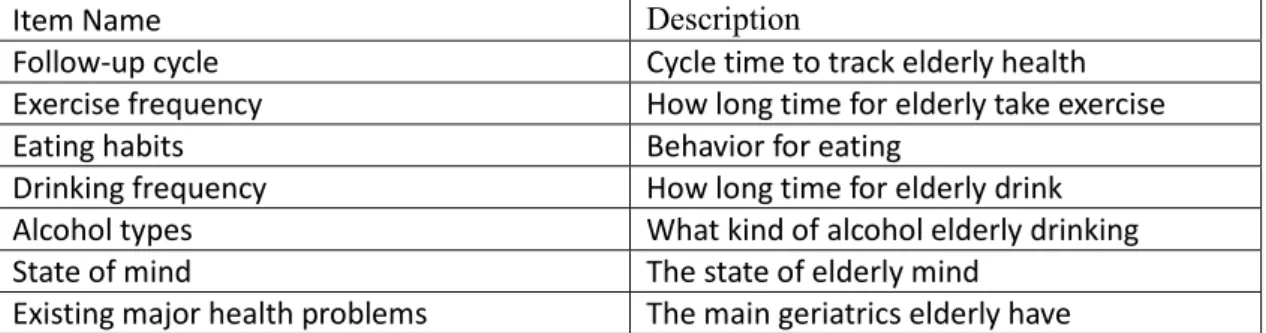
The dataset of EHI is from two research papers. Dataset of basic health status is from China
national standard “Basic dataset of older health management” [48]. Dataset of health record
history and health care history are from the interview in paper “Achieving e-Health
interoperability via peer-to-peer communication Using JXTA Technology” [11]
Dataset of Basic Health Status
Item Name Description
Follow-up cycle Cycle time to track elderly health Exercise frequency How long time for elderly take exercise
Eating habits Behavior for eating
Drinking frequency How long time for elderly drink Alcohol types What kind of alcohol elderly drinking
State of mind The state of elderly mind
Existing major health problems The main geriatrics elderly have
Dataset of Health Record History
Item Name Description
ID Record Number
Date Update Time
Symptom Patients’ symptom record
Treatment Patients’ treatment record
Drug Patients’ drug information
Dataset of Health Care history
Item Name Description
ID Record Number
Date Update Time
Care Items Personal healthcare plan
Notice Notice
Table 6-1 DATASET OF EHI
6.1.4
Issues in Sharing EHI
The authors [58] had pointed out the following issues regarding sharing EHI.
6.1.4.1
Security
The security of personal information is one of the main issue in sharing EHI on cloud computing. Because these information contains patients personal data, in order to keep the privacy of patients health record, health care provider should keep the data private and do not share it without the consultation of patient, also need to follow the HIPAA (Health Insurance Portability and Accountability Act) rules, Only allowing by the authorize users[58].
6.1.4.2
Accessibility
Accessibility is another issue and it means who has the right to access the patient data. The access should be given to the concern persons only patients who should know about his/her
6.1.4.3
Interfacing
Interfacing is a big problem for sharing the EHI; it is the boundary or layer where the two systems interact with each other. When two systems communicate with each other their languages and codes will be same [58].
6.1.4.4
Integration
Integration is the combination of diverse applications for functioning as joint coactions to single entity. It require different standards and suitable platform for implementation, otherwise integration would not take place [58].
6.1.4.5
Privacy
Privacy is one of important issues. When the information is available, there is a problem known as privacy. To deal with privacy, information ought to be accessed simply by the authorized users who have permission to use the system [58].
6.2
E-health and Cloud Computing
In literature review, we find currently e-health meets bottlenecks in “infrastructure”“storage”
and “interoperability”. In “infrastructure”, the main role of e-health changes from
management system to public service. E-health require huge infrastructure to store patients’
data and also needs a stable, available and maintainable architecture of infrastructure to support all e-health services that run all the time in the year. In “storage”, e-health service needs access e-health data quickly in real-time. And the information is large. E-health also needs to support large data storage. In “interoperability”, e-health services distribute to different medical institutes like clinic, hospital and healthcare center, those e-health services need the patient data from other medical institutes. So “interoperability” becomes one bottlenecks of e-health development.
Also in literature review, we find cloud computing is a powerful technology in IT. Cloud computing can give huge infrastructure space to users for running the applications and those
infrastructures maintain by cloud provider. It means cloud user don’t needs infrastructures
are maintained their remote infrastructure; they can put more cost to improve their own business. For storage, cloud computing use paralleled architecture to provide high speed storage. Cloud users can use multiple processor units to handle their storage task. For interoperability, cloud computing can bridge gap among different device, system and platform. In cloud, everything will be running in same framework; cloud services don’t
needs concern information obstacle when they communicate in cloud.
So, we get Table 6-2 and propose Cloud Computing is a good solution to solve the bottlenecks of E-health. We propose building EHI sharing service in cloud.
E-health Cloud Computing
Infrastructure Needs a huge infrastructure to establish different E-health service
Needs very easy maintain and high availability
A huge computing infrastructure which connect, access and distribute with huge numbers of small computing units
Cloud computing offer self-maintain hardware and operation system.
Storage Needs access and store large data quickly and efficiently
Support user to access and store large data quickly and efficiently
Interoperability The service is distributing to every medical institutes; it needs delivery information to other medical institutes and get information from those medical institutes.
Support information transmit in same framework without concern devices and services
Development Tendency Integrate different E-health services to be a platform
It support user to build platform in cloud
Table 6-2 Relationship between E-health and Cloud Computing
6.3
Sharing EHI in Cloud as SaaS
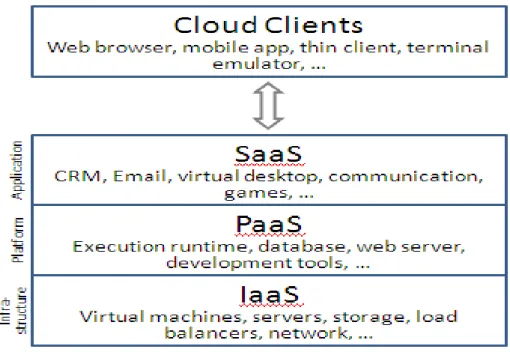
From Figure 6-1, as we know, each cloud service model has different relationship between users and cloud providers [65]. So sharing EHI in different Cloud Service, the solution should be different; the requirement also should be different.
Figure 6-1 Relationship between SaaS, PaaS and IaaS [65];
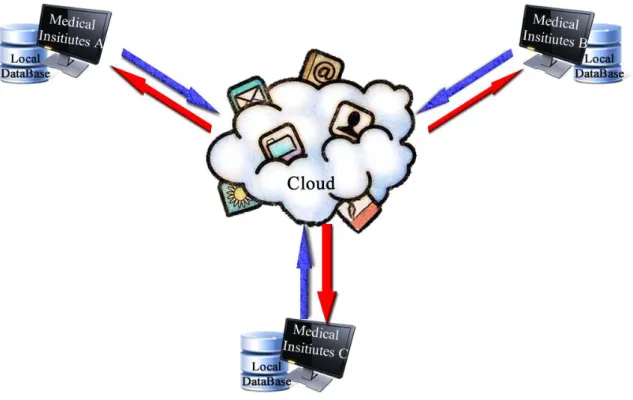
According to our research, hospitals and healthcare centers have their own local database; patients’ data are stored in local database. In this case, we need a service as middleware to bridge among hospitals and healthcare centers. SaaS is the best choice to build sharing service in Cloud computing [65].
![Table 5-1 Features of SaaS provider – Google, Amazon and Microsoft [62][63][64].](https://thumb-us.123doks.com/thumbv2/123dok_us/918892.2618738/30.892.131.764.107.273/table-features-saas-provider-google-amazon-microsoft.webp)