AN ANALYSIS AND COMPARISON OF
E-COMMERCE TRANSACTION PROTOCOLS -
PURCHASING ORDER
A Survey Paper for the completion of CMPE 298
by
Judy Nguyen Summer 1999
Abstract
One of the major part of E-Commerce that makes the communication between the buyer and the merchant possible is the transaction protocol that transmits data between two parties or among many parties. Some of the E-Commerce transaction protocols, such as EDI, follow certain message standard to put the data from the sender into standard format understood by the receiver, encrypt it for security, and send it across the internet via some transport technologies such as S-HTTP (Secure HyperText Transport Protocol), SSL (Secure Sockets Layer), SMTP (Simple Mail Transfer Protocol), and TCP/IP (Transmission Control Protocol/Internet protocol). Yet, some other E-Commerce protocols, such as SET, do not follow any specific message standard and just uses its own standard for each message in a transaction. In this case, more work might need to be done on the receiver’s side in order to understand the data received.
This paper surveys some of the common E-Commerce transaction protocols used in transmitting purchase order information, payment information, and in some cases receipt and shipping information between the buyer and the merchant. These protocols include EDI, SET, OBI, and OTP. They are examined and compared based on the architecture they provide, the format of the message being sent between two parties, the sequence of the messages, their performance, scalability, reliability, security, flexibility, exception handling, acknowledgment, and their application. Benefits and limitations of each protocol will be analyzed and described. A conclusion will also be drawn to determine problems of these existing protocols and to propose a new transaction protocol which will help solve most, if not all, of the problems in the existing protocols by combining some of the key functionalities in some of these protocols, and by providing additional features which can be used in the E-Commerce purchasing server.
TABLE OF CONTENTS
Abstract List of Figures List of Tables
1. Introduction
2. Motivation for E-Commerce
3. Infrastructure for E-Commerce
3.1 Business models
3.1.1 Introduction to Business Segments 3.1.2 Information Commerce
3.1.3 Business Workflow ? 3.2 Building blocks for E-Commerce
3.2.1 Components in an E-Commerce System 3.2.2 Content Transport ?
3.2.3 Server Components 3.2.4 Programming Clients
3.3 Functional and System Architecture
4. Existing Standards and Protocols for E-Commerce Transaction
4.1 EDI
4.1.1 Architecture 4.1.2 Standards
4.1.3 Structure of EDI Transactions 4.1.4 Security 4.2 SET 4.2.1 Architecture 4.2.2 Message Structure 4.2.3 Security 4.2.4 Error Handling 4.2.5 Standards 4.3 OBI 4.3.1 Architecture
4.3.2 Sequence of Protocol Transactions 4.3.3 Structure of an OBI object
4.3.4 Standards 4.3.5 Error Handling 4.4 OTP
4.4.2 Sequence of Protocol Transactions 4.4.3 OTP Message Structure
4.4.4 Error Handling 4.4.5 Security 4.4.6 Standards
5. Analysis and Comparison of Existing Transaction Protocols
5.1 Architecture 5.2 Message Structure 5.3 Sequence 5.4 Reliability 5.5 Security 5.5.1 Data Confidentiality 5.5.2 Authentication 5.5.3 Data Integrity 5.6 Flexibility 5.7 Performance 5.8 Scalability 5.9 Exception Handling 5.10 Customer Classification
5.11 Shipping and Receipt Confirmation 5.12 Application
5.13 Summary
5.13.1 Benefits 5.13.2 Limitations
LIST OF FIGURES
Figure 4.1: EDI process architecture … … … ...11
Figure 4.1.1a: Layered architecture of EDI … … … .… … 12
Figure 4.1.1b: Direct EDI communication between trading partners … … … .… .13
Figure 4.1.1c: EDI through a VAN … … … .… .14
Figure 4.1.2: The electronic form of an X12 transaction set … ..… … … .… … 15
Figure 4.1.3: EDI transaction structure … … … 16
Figure 4.1.4a: Data Communication Security … … … ..17
Figure 4.1.4b: Security in ANSI X12 Interchange Structure … … … ...… 18
Figure 4.2.1a: SET Architecture … … … ..… 21
Figure 4.2.1b: Interactions among all SET entities … … … ..23
Figure 4.2.1c: Sequence of SET message pairs … … … ...24
Figure 4.3: OBI Purchasing Process … … … 30
Figure 4.3.1: The OBI Architecture … … … .30
Figure 4.3.2: Sequence of OBI Transaction … … … .31
Figure 4.3.3a: Structure of an OBI object … … … 32
Figure 4.3.3b: OBI 850 EDI Data Structure … … … 33
Figure 4.3.3c: HTTP Transport of an OBI object from server to server … … … .34
Figure 4.4: OTP Trading Roles … … … 37
Figure 4.4.1: OTP Architecture … … … ...39
Figure 4.4.2: An OTP Transaction … … … ..… 39
Figure 4.4.3: OTP Message Structure … … … .40
LIST OF TABLES
Table 4.1.2: Standards used in EDI … … … .16
Table 4.2.2a: PinitReq … … … .26
Table 4.2.2b: PinitRes … … … ..27
Table 4.2.5: Standards used in SET … … … .28
Table 4.3.4: Standards relevant to OBI … … … 35
Table 4.4.6: Standards used in OTP … … … .44
Table 5.13a: Summary of Transaction Protocol Features … … … ....54
Table 5.13b: Profile of Transaction Protocols … … … .55
1 INTRODUCTION
In today’s businesses, quality, efficiency and cost cutting are very important. To reduce overhead and speed up service delivery, electronic commerce (or e-commerce) has come into play. E-commerce involves buying and selling of information, products, and services via computer networks. One of the key building blocks of e-commerce is to streamline business processes by reducing paperwork and increasing automation. E-commerce is becoming increasingly popular among all kinds of businesses, from customer service to new product design because it enables formation of new types of information-based products such as interactive games, electronic books, and other information on-demand that can be very useful to consumers. Since e-commerce involves a lot of communication of all kinds of information among different types of trading partners (most commonly known are buyers and sellers), information processing is very important. Purchasing server which is one of the major parts of e-commerce infrastructure is where the information processing is done. The actual transmission of information and formatting of the data is done by the transaction protocol. Currently, there are numerous different transaction protocols that are being developed and used today. The four most well-known transaction protocols that this paper will discuss are EDI, SET, OBI, and OTP.
The purchasing server in e-commerce involves the process of receiving purchase orders from the buyer via graphical user interface (i.e. an applet application running on a web page), sending confirmation to the buyer, formatting and structuring the purchase orders, handling the purchase orders by communicating with appropriate trading partners, booking request to transport company, sending status and shipping notice to the buyer, and formatting information of an invoice to be sent to the buyer. Once the buyer receives
the invoice, he can then proceed to send Payment to the seller. The payment is handled
by the payment server which will not be discussed in detail in this paper but will be touched upon briefly as some parts of the purchasing server interact with it.
Since communication between the buyer and seller involve a lot of transmissions of structured data traveling back and forth, the transaction protocol plays a important role in making this communication possible. Most transaction systems read information passed into it from the purchasing server’s buyer interface application. It then generates some kind of message format or structure. This formatted data stream is then transmitted to the seller. At the seller’s site, the data is fed into the transaction system which maps the standard fields into the simple file needed by the receiving computer application, edits and verifies the incoming information, and then passes it to the receiving order entry application for processing. For some transaction protocols, security and acknowledgement are also part of this transaction process.
Transaction protocols which have fixed message standard, such as EDI, only work well with onto-one communication. However, as more businesses are starting to get into e-commerce, a one-to-many or many-to-many communication is needed. These existing transaction protocols are therefore not powerful enough to support this kind of bursty transmissions of data among many different trading partners. Transaction protocols
which support flexible message structure, such as SET and OTP, are probably more efficient since they can handle communication among multiple trading parties.
This paper describes the e-commerce infrastructure, discusses the architecture and features of each of the four transaction protocols, gives an analysis and comparison of the information found, and proposes possible solutions and design for a new transaction protocol. Part 1 of this paper gives an introduction. Part 2 discusses the motivation for e-commerce. Part 3 describes the infrastructure for e-e-commerce. Part 4 discusses the architecture, features, and standards used in the four transaction protocols. Part 5 gives analysis and comparison of the four transaction protocols. Part 6 presents a proposal for a new design of the transaction protocol. Part 7 provides information regarding the environment and technology used in implementing the new protocol. Part 8 gives the results of new design and implementation. Finally, a conclusion is drawn in part 9. Appendices and references are also included at the end of this paper.
1 OVERVIEW
In today’s businesses, quality, efficiency and cost cutting are very important. To reduce overhead and speed up service delivery, electronic commerce (or e-commerce) has come into play. E-commerce involves buying and selling of information, products, and services via computer networks. One of the key building blocks of e-commerce is to streamline business processes by reducing paperwork and increasing automation. E-commerce is becoming increasingly popular among all kinds of businesses, from customer service to new product design because it enables formation of new types of information-based products such as interactive games, electronic books, and other information on-demand that can be very useful to consumers. Since e-commerce involves a lot of communication of all kinds of information among different types of trading partners (most commonly known are buyers and sellers), information processing is very important. Purchasing server which is one of the major parts of e-commerce infrastructure is where the information processing is done. The actual transmission of information and formatting of the data is done by the transaction protocol. Currently, there are numerous different transaction protocols that are being developed and used today. The four most well-known transaction protocols that this paper will discuss are EDI, SET, OBI, and OTP.
EDI stands for Electronic Data Interchange. It follows a fixed message format from the ANSI X12 standard. It supports direct transmission of information from one party to another which means both the sender and receiver must use the same network transport protocol in order to receive, send, and understand each other's messages. EDI can also be implemented with a VAN (Value Added Network) which helps deliver the message from one party to another. However, with VAN, both parties do not need to use the same transport protocol since they are not talking to each other directly. All messages sent will go the VAN. VAN will put the messages in the party's mailboxes which the receiving party can access at any time. Since EDI only concentrates on the transmission of the data between two parties, it does not provide security or any additional e-commerce features. For data confidentiality and authentication, a security package can be added to the EDI implementation. Section 4.1 will discuss details of the architecture and message structure of EDI and describe how it works.
SET (Secure Electronic Transaction) protocol was developed by VISA and MasterCard specifically for enabling secure credit card transactions on the Internet. This protocol is mainly used for payment. However, since it separates the purchase order information from the payment information to be sent to the Merchant and Payment Authority respectively, it can also be used to transmit order information. SET does not follow any fixed standard for its message format. Instead, it provides its own message format for each type of message sent between the merchant and consumer. SET uses public-key encryption and X.509 digital certificates for its security implementation. One of the nice additional features provided by SET is the error handling capability. SET handles errors such as duplicate, corrupted, or malformed messages. Depending on the type of the error found, SET either ignores the message or retransmits it.
OBI (Open Buying on the Internet) is a standard for business-to-business Internet commerce with an initial focus on automating high-volume, low-dollar transactions between trading partners. OBI was founded by the Internet Purchasing Rountable. The OBI standard includes not only contents of OBI Order Requests and OBI Orders, but also the customer profile, and the security and transport of the order requests. OBI involves four participants: Requisitioner, Buying Organization, Selling Organization, and Payment Authority. The Requisitioner browses the catalog of goods and services and selects items from it. The Buying Organization represents the Requisitioner in obtaining the catalog of gods and services. The Selling Organization represents the merchant in presenting the catalog of goods and services. Finally, the Payment Authority validates the payment, authorizes order fulfillment, and issues invoice. Even though OBI does not provide good error handling mechanism, it does provide very efficient customer profile which helps to uniquely identify the requisitioner and to construct a specialized catalog view from which the requisitioner can select items and check out. The OBI data part of the message follows the EDI-formatted order which conforms to the ANSI X12 standard. OBI follows SSL V3 API for cryptography and X.509 V3 certificates for public key certificates and Certificate Authorities.
OTP (Open Trading Protocol) is a protocol for the development of software products that will permit product interoperability for the electronic purchase that is independent of the chosen payment mechanism. The OTP protocol includes five trading roles: Consumer, Merchant, Deliverer, Value Acquirer, and Customer Care Provider. Most of the transactions are done between the Consumer and the other four roles. There are no transactions among the other four roles. The Consumer communicates with the Customer Care Provider to resolve Consumer disputes, with the Value Acquirer to accept value for Merchant, with the Merchant to make purchase request, and with the Deliverer to receive goods or services from the Merchant. The OTP message structure is broken down into blocks and components, each of which follows the XML standard. Because it uses the XML standard, OTP provides greater flexibility in terms of message format. Security implementation can also be included in the message as one of the message components. Like SET, OTP also provides error handling mechanism which not only checks for duplicates and corrupted messages but also monitors the length of time that the message was sent and automatically re-send the message if the timer expires.
The following sections will describe each protocol in more detail. This paper will discuss the architecture and features of each of the four transaction protocols, and gives an analysis and comparison of the information found. A conclusion is also drawn at the end.
2
EXISTING STANDARDS AND PROTOCOLS FOR
E-COMMERCE TRANSACTION
4.1
EDI
What is EDI?
EDI (Electronic Data Interchange) is an e-commerce transaction protocol for transacting business across a machine-to-machine interface with no form of human intervention. It is also sometimes considered as the application-to-application exchange of electronic data (in a structured, machine-readable format) across organizational boundaries, in such a way that no human intervention or interpretation is required.
Concepts
The EDI system first reads in a purchase order from the buyer. It then generates the machine-readable EDI standard file through an EDI translator. This file is then encrypted and transmitted to the seller via telephone lines, either directly from the sender to receiver or via a communications intermediary company called and EDI third-party service provider or VAN (Value Added Network). At the seller’s site, this file is first decrypted. Then, it is fed into the EDI system which maps the standard fields, via EDI translator, into the simple file needed by the receiving computer application, edits and verifies the incoming information, and then passes it to the receiving order entry application for processing. This whole process is described in figure 4.1 below.
Purchasing application applic. file EDI System Application link Fixed-length file C o m m u n i c a t C o m m u n i c a t Internal files EDI standard Internal files Purchasing application applic. file EDI System Application link Fixed-length file
Two essential elements of EDI are [13]:
• A standardized message that defines how data is to be represented. The format must
be understood by both (or all) of the trading partners; and
• Software that interfaces the organization’s in-house system(s) to the EDI
communications system, as well as converting the messages to a standard format from that used by an in-house system and vice versa.
These requirements imply that for EDI to be widely used, parties must develop standards that facilitate EDI. This requirement leads to the problem of The Tower of Babel which is discussed in section 5.6.
4.1.1 Architecture
EDI architecture specifies four layers: the semantic (or application) layer, the standards translation layer, the packing (or transport) layer, and the physical network infrastructure layer [12].
Semantic Layer
The semantic layer describes the business application that is driving EDI. Examples of these data are quotes, price quotes, purchase orders, acknowledgments, and invoices. At the sender’s site, this layer consists of the business application to convert the business proprietary information into EDI standard format which is agreed upon by all business
Figure 4.1 EDI process architecture (Source: “Opportunities for EDI”)
EDI semantic layer EDI standard layer EDI transport layer Physical layer
Application level services
EDIFACT business form standards
ANSI X12 business form standards
Electronic mail X.435, MINE
Point to point FTP, TELNET
World Wide Web HTTP
Dial-up lines, Internet, I-way
Figure 4.1.1a Layered architecture of EDI
(Source: “Frontiers of Electronic Commerce”, Kalakota & Whinston)
partners involved. This standard formatted data is then sent to the trading partner. At the receiver’s site, the EDI translator translates the EDI file into the receiver’s local format. The EDI translator on the receiver’s site sits in this semantic layer.
EDI Standards
The EDI standards follow the X12 and EDIFACT standards to specify business form structure and to some extent influence content seen at the application layer. For example, an address field on the purchase order might hold maximum of 20 characters in an X12 standard. An application using 50-character address field length will produce string truncation during the translation from the application layer to the standard layer [12].
EDI Transport Layer
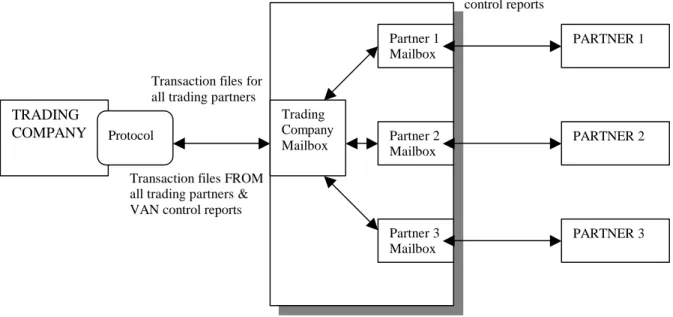
This layer involves the network mechanism to transport data between two parties. When EDI was first introduced, direct communication between two parties was used which means that both parties must communicate through the same transport protocol such as SMTP (Simple Mail Transport Protocol). However, as e-commerce becomes more popular and EDI being more widely used, a third-party service provider was introduced to eliminate problems with maintaining many different transport protocols for communicating with different trading partners. This third-party service provider is commonly known as VAN (Value Added Network). VAN acts as a postal system for EDI. These third-party service providers furnish clients with electronic mailboxes, storage and forwarding services, tracking capabilities, and translation services. VANs are an integral part of the EDI picture and without them, a large scale EDI program is virtually impossible. When using a VAN, there is no need to worry about different communication protocols between partners, a partner’s system downtime, or system security risks. VANs provide 24-hour access to the merchant and all the business partners’ mailboxes and can ensure data integrity. Also, VAN interconnects allow different VANs to pass information back and forth [9].
TRADING COMPANY PARTNER 1 PARTNER 2 PARTNER 3 Protocol 1 Protocol 2 Protocol 3
EDI Transaction file
EDI transaction file & Acknowledgment Acknowledgment
EDI Transaction file
EDI transaction file & Acknowledgment Acknowledgment
Acknowledgment
EDI transaction file & Acknowledgment EDI Transaction file
EDI Document Transport
This document transport layer is far more complicated than simply sending email messages between two parties. EDI documents are structured and contain header information that is used during transport and authentication process.
4.1.2 Standards
EDI relies on the use of standards for the structure and interpretation of electronic business transactions. All trading partners must agree on and use a particular standard to reduce errors and ensure accurate translation of data, regardless of the computer systems involved.
ANSI X12
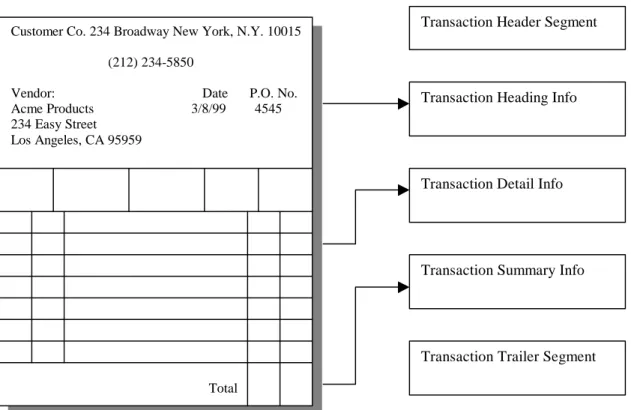
The ANSI chartered the Accredited Standards Committee in 1979 to research and develop standards for business documents. The X12 committee developed standards to facilitate EDI in business transactions such as order processing, shipping and receiving, and invoicing. The X12 transaction sets generally map traditional paper document to electronic format that can move easily over telecommunication networks. Each transaction includes several data segments which define the business functions and instructive information for correct network routing. The X12 transactions can be
TRADING COMPANY Protocol PARTNER 1 PARTNER 2 PARTNER 3 Partner 1 Mailbox Partner 2 Mailbox Partner 3 Mailbox Trading Company Mailbox Transaction files for
all trading partners
Transaction files FROM all trading partners & VAN control reports
Transaction TO/FROM all trading partners & VAN control reports
EDI VAN
Figure 4.1.1c EDI through a VAN
(Source: “Business Issues of EDI”)
Figure 4.1.1b Direct EDI communication between trading partners
transmitted to the trading partner through either the X400 e-mail protocol, or the multipurpose Internet mail extensions (MIME) protocols. [12]
UN/EDIFACT
EDIFACT was developed by the United Nations based on TRADECOMS which was developed by the U.K. Department of Customs and Excise. It was further developed by the United Nations Economic Commission for Europe. EDIFACT is becoming widely accepted as the foremost international EDI standard. Today, EDIFACT and ANSI are working towards compatibility. [12]
Because most EDI information exchanges are domestic, X12 is more widely used than EDIFACT in the United States. However, as global trade expands, most U.S. companies will require implementation of both standards. This will make EDI harder to implement and understand since it has to abide to the standard that is derived from so many government and business representatives around the world. Migration to the new international standard will be a challenge for businesses.
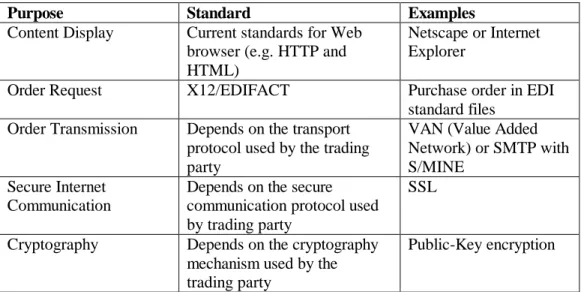
Other than message format, EDI does not follow other standards for security or network transport since these features are not part of EDI’s architecture. Below is a table listing standards used in EDI.
Customer Co. 234 Broadway New York, N.Y. 10015 (212) 234-5850
Vendor: Date P.O. No. Acme Products 3/8/99 4545 234 Easy Street
Los Angeles, CA 95959
Total
ANSI X12 TRANSACTION
Transaction Header Segment
Transaction Heading Info
Transaction Detail Info
Transaction Summary Info
Transaction Trailer Segment
Figure 4.1.2 The electronic form of an X12 transaction set (Source: “Business Issues of EDI”)
Purpose Standard Examples
Content Display Current standards for Web browser (e.g. HTTP and HTML)
Netscape or Internet Explorer
Order Request X12/EDIFACT Purchase order in EDI standard files
Order Transmission Depends on the transport protocol used by the trading party
VAN (Value Added Network) or SMTP with S/MINE
Secure Internet Communication
Depends on the secure communication protocol used by trading party
SSL
Cryptography Depends on the cryptography mechanism used by the trading party
Public-Key encryption
4.1.3 Structure of EDI Transactions
EDI messages share a common structure:
1. Transaction set is equivalent to a business document, such as a purchase order. Each transaction set is made up of data segments.
2. Data segments are logical groups of data elements that together convey information, such as invoice terms, shipping information, or purchase order line.
3. Data elements are individual fields, such as purchase order number, quantity on order, unit price.
Business document Data segment 1 Data segment 2
.
.
.
.
.
.
.
Data element 1 Data element 2.
.
.
.
.
.
.
4.1.4 Security
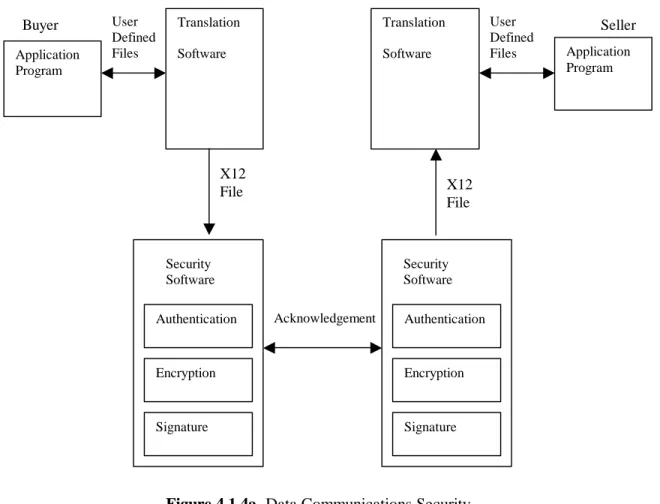
EDI is mainly just a transaction protocol and therefore does not include security in its implementation. Thus, security control must be added to the EDI process to ensure confidentiality of the data transmitted. Figure 4.1.4a shows the security modules that are needed in EDI [4].
Buyer Seller
Authentication
Authentication is a way of identifying the parties involved in the communication. A normal means of providing authentication is through the use of passwords. The latest technology provides authentication through the use of digital certificates which function like ID cards. The digital certificate has multiple functions, including browser authentication [4].
Encryption
Figure 4.1.3 EDI transaction structure
Application Program Translation Software Translation Software Application Program User Defined Files User Defined Files X12 File X12 File Acknowledgement Security Software Authentication Encryption Signature Security Software Authentication Encryption Signature
Encryption involves the process of encoding the data so that it is indecipherable to anyone except the intended recipient. Encryption prevents snoopers, hackers, and other parties from viewing data that is transmitted over telecommunications channels. Two basic encryption schemes are public-key and private-key encryption.
Signature
Electronic signatures are the computerized version of the signature function. Signatures are needed in some business applications for authorization purposes. A digital signature algorithm can be used to generate digital signatures. The digital signature itself is used to detect unauthorized modification to data and to authenticate the identity of the signature. Security is inserted into the EDI message as follows [23]:
4.2 SET
What it is
SET is the Secure Electronic Transaction protocol developed by Visa and MasterCard specifically for enabling secure credit card transactions on the Internet. It uses digital certificates to ensure the identities of all parties involved in a purchase and encrypts credit card information before sending it across the Internet [15]. When a consumer initiates a transaction at their computer, they can use a piece of software called electronic wallet containing a digital certificate that authenticates that the consumer is who he or she
Header Functional Functional Functional Trailer (ISA) Group Group Group (IEA)
Header Transaction Transaction Transaction Trailer (GS) Set Set Set (GE)
Header Transaction Set Trailer (ST) Segments (SE)
Security segment inserted Interchange
Functional Group
Transaction Set
Figure 4.1.4b Security in ANSI X12 Interchange Structure (Source: “Secure Electronic Commerce”, Ford and Baum)
says, while the merchant’s certificate provides the consumer with the same authenticating information about the merchant [2].
SET is basically a process that operates under a fixed set of rules. It has characteristics that are different than those associated with digital money such as DigiCash. Digital money by itself can cause a transaction to occur. SET requires a functional meeting (or at least an exchange of messages) of all the interested parties before a transaction can occur. A SET transaction must be authorized by all the parties concerned in order to complete, while merchants in the digital money realm may change the resultant value of a digital cash token. SET merchants cannot directly touch cardholder information, which is available only to the Issuer (and by extension the Payment Gateway), while digital money merchants can derive transaction/recipient information [13].
SET allows for the merchant's identity to be authenticated via digital certificates. However, SET also allows for the merchant to request users to authenticate themselves through digital certificates. This makes it much more difficult for someone to use a stolen credit card.
Concepts
One of the critical design objectives of SET was that messages could be resent without penalty to the overall transaction, since some messages will always be lost or misdirected in transit during operation [13].
According to SET business plan, SET should [13]:
1. Provide confidentiality of payment information and enable confidentiality of the order (merchandise) information that is transmitted along with the order’s payment information
2. Ensure integrity for all transmitted data
3. Provide authentication that a cardholder is a legitimate user of a branded payment card account
4. Provide authentication that a merchant can accept branded payment card transactions through its relationship with an acquiring financial institution
5. Ensure the use of the best security practices and system design techniques to protect all legitimate parties of an electronic commerce transaction
6. Ensure the creation of a protocol that is neither dependent on transport security mechanism nor prevents their use
Before starting the purchase request phase by invoking SET, all ordering information or functions, including adding on any applicable shipping charges and state tax, must be completed before SET transactions are begun. Below is a brief description of the SET process [14].
• When the Cardholder selects the form of payment to use for the order, SET is
initiated at this point.
• Cardholder sends completed order form and payment instructions to the Merchant.
SET is used to sign these order forms and payment instructions digitally using the Cardholder's digital certificate to prove they came from the Cardholder and no one else.
• Merchant requests payment authorization from the Issuer of the payment card using
its Merchant account through its Acquirer's payment system. SET wraps these messages in cryptography to assure their privacy and confidentiality.
• Merchant ships goods or performs requested services based on the order.
• Merchant requests to capture the payment that was previously approved for
processing. SET wraps these messages in cryptography, to ensure their privacy and confidentiality. Those steps not included under SET are considered out-of-band (or out of scope) activities, and their implementation is left up to the involved parties. SET provides open and robust data structures and corresponding security to handle virtually any type of order processing.
4.2.1 Architecture
The basic operations that constitute a routine SET transaction usually involves four main participants:
1. Certificate Authority (CA) helps to assure all the parties in a transaction that their partners are, indeed, who they purport to be. It has several primary functions in the certificate chain, including to receive registration requests, process and approve (or reject) them, and issue certificates. Certificates contain information that, after being processed, can establish their own validity and origin. Digital certificates are authentication certificates which use public-private key cryptography to identify people, privileges, and relationships. Before any transaction can take place, all parties involved needs to own a SET digital certificate.
2. Cardholder is the person that does the web browsing and shopping and is the authorized holder of a bank card who is registered with the corresponding issuer to perform electronic commerce. The Cardholder must register herself with a Cardholder Certificate Authority (CCA) so that she can participate in SET transactions with merchants. Unless she has certificates that can be traversed to the Root CA, merchants will refuse any SET attempts she makes.
3. Merchant is the seller of goods, services, or information, who accepts payment electronically. The Merchant also needs to register for the same reason as cardholder’s registration, since a merchant needs a properly signed certificate in order to process SET orders.
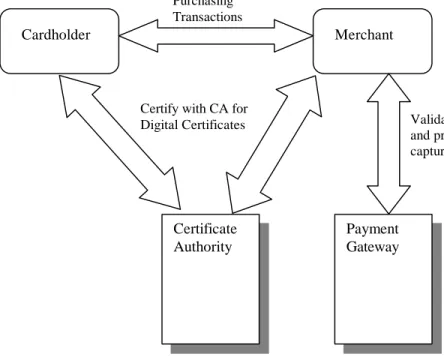
4. Acquirer Payment Gateway is a system that provides online electronic commerce services to merchants. It is needed to validate SET digital certificates and preprocess authorization, capture, and settlement work. Payment Gateways are operated by whatever company is serving the Charge Processor duties for Merchants and banks. Figure 4.2.1a shows the connections between these four participants.
Protocol Transaction
A list steps below show how these participants interact with each other in a SET transaction.
1. Obtaining digital certificates. All parties involved need to obtain digital certificates
from Certificate Authority (CertReq/CertRes).
2. Payment initiation processing. When payment option has been selected, Cardholder’s E-wallet (which contains consumer's digital signature or certificate)
Certificate Authority Payment Gateway Cardholder Merchant Purchasing Transactions
Certify with CA for
Digital Certificates Validates SET Digital Certificates and preprocesses authorization, capture, and settlement work
initiates the first SET payment processing message pair, called the Payment
Initialization Request (PInitReq), which is generated and sent back to the Merchant
SET POS software. With a successful Payment Initialization Response (PinitRes),
the E-wallet then creates a SET Purchase Request message (Preq). This message has
two components: Purchase Order information (OI) and Payment information (PI).
The Merchant POS software can only read the Purchase Order. The Payment Instructions, containing information about credit card account, can only be read and processed by the Payment Gateway software.
3. Payment Authorization Request. Merchant's SET POS prepares a SET
Authorization Request (AuthReq) message and Payment Instructions to be sent to the
Cardholder's Payment Gateway. The message contains details about the amount of the sale, the Merchant account requesting it, and the previously created Payment Instructions component that the Cardholder E-wallet software generated in step 2. With successful translation, Cardholder's Payment Gateway creates a standard authorization request and places it on the bank's Interchange Network that locates the Cardholder's account at bank A (for instance). With an approval code from bank A to proceed with the sale, the Payment Gateway responds with a SET Authorization
Response (AuthRes) that tells the Merchant to complete the sale. It then creates a
Purchase Response message and send it to the Cardholder's E-wallet that confirms the sale and produces an electronic version of a receipt or record of charge.
4. Delivery of Goods. Merchant will take care of delivering the goods to the Cardholder.
5. Capture and Settlement. With the successful authorization code from step 3, Merchant's SET POS software received a capture record (SET calls these tokens). With the sale completed and the goods delivered, the Merchant can initiate a Capture
Request (CapReq) to finalize the sale with Cardholder's Payment Gateway system.
With each Capture Response (CapRes), the Settlement File builds up, awaiting
Merchant's decision to deposit these receipts into the Merchant's account at bank B (for instance) in exchange for funds transfer. Settlement File or Batch Processing is also carried out via the Internet using SET's Batch Administration message pairs, designed specifically for those purposes.
Below are diagrams which illustrate the SET process and the involvement of the four participants [13][14].
Store Front Certificate Authority
E-Wallet SET POS Payment
Gateway Browser Merchant Server Acquirer Legacy System Bank Interchange CertReq CertReq CertRes CertRes PInitReq PInitRes PReq PRes AuthReq AuthRes CapReq CapRes Wakeup Ce rtReq CertRes Post HTTP Page
Message Details Wakeup AuthRes AuthReq
Shop
wakeup
Figure 4.2.1b Interactions among all SET entities
(Source: “Building SET Applications for Secure Transactions”, Merkow, Breithaupt, Wheeler)
Note that status of the order can also be obtained with InqReq and InqRes messages.
Transport Mechanism
SET uses either HTTP (HyperText Transport Protocol) or SMTP (Simple Mail Transport Protocol) as network transport protocol to transmit data from one party to another. In an HTTP session, MIME headers are transmitted along with any other headers following the initial request/response. HTTP supports binary data as the default transfer encoding. This means that SET messages do not have to invoke any MIME transfer encoding, since it’s taken care of by the defaults inherent in HTTP [13].
SET has some functional areas of conflict with HTTP.
1. Because of security issues, SET does not allow payment transactions to be initiated by the merchant.
2. MINE support in a web browser provides a way for the merchant to communicate with the SET payment application, but similar way of passing information back from the SET application to the merchant using a browser is not possible.
Cardholder Merchant Acquirer Payment Gateway PWakeup PInitReq PInitRes PReq PRes AuthReq AuthRes InqReq InqRes CapReq CapRes
Figure 4.2.1c Sequence of SET message pairs
3. For smoothest transition, the contents of the URLs should replace the merchant page that triggered the payment request. But there is no simple way via HTTP to allow a browser to retrieve any specific page.
4. There is no way for SET application to maintain state by staying “live” through the entire course of a SET transaction.
5. SET software operating over HTTP connections may not receive a timely response. Also, there needs to be limits on the number and frequency of retries for SET software so that it does not spend unlimited time retrying an interrupted connection over a dead communication path.
For now, the workaround to these problems is to use POST instead of GET to collect data from browsers as well as to set page expiration to “immediate”.
SET messages passed through e-mail must use the Simple Mail Transport Protocol supported by the Internet. SMTP-based electronic mail has two significant limitations in its ability to support SET transactions:
1. Not all SMTP servers support 8-bit and binary data. In fact, SMTP must generally assume the lowest common denominator of 7-bit transmissions.
2. SMTP mail delivery does not always occur in a direct source-to-destination fashion. Mail messages usually must pass through several intermediate “relay” hosts and therefore may encounter significant delays. This is a problem for supporting timely interactive communication using e-mail as a transport mechanism.
Currently, the existing workarounds for both of these problems is to use Base64 encoding to get around the lack of direct binary transmission of files. Remove two initial messages (PInitReq and PInitRes) and put the transaction-specific merchant values normally provided in the PinitRes message in the main message to speed up the email-based SET transaction.
4.2.2 Message Structure
Each of SET’s message pair (e.g. PInitReq/PInitRes) has its own message format with header, date, ID, SET extensions, etc. An example of the contents of one message pair, PInitReq/PInitRes, is shown in table 4.2.2a and table 4.2.2b. For details of the exact
format of other message pairs, refer to SET Secure Electronic Transaction Specification;
Book 3: Formal Protocol Definition, Version 1.0. SET Extensions
An extension field has been added to the end of certain SET protocol data units to allow for changes within SET as business conditions warrant. Some of the protocol data units that have extension added are MessageWrapper, PInitReq, PInitResData, SaleDetail, and Transaction Detail [13].
• An object identifier. This identifier uniquely identifies the extension and helps permit SET applications to recognize an extension and process the data contained within that extension.
• A criticality flag. This flag indicates whether or not the recipient must understand the extension to process the message containing the extension
• Data component. This component provides additional information that necessitate the definition of the extension. The layout of the data will be defined by the organization creating the extension.
One important step that must be followed is that organizations defining an extension must register the object identifier and the data content of the extension with the payment card companies (or their designate) prior to deploying software that transmits messages (including test messages) over an open network [13].
PinitReq {RRPID, Language, LID-C, [LID-M], Chall-C, BrandID, BIN, [Thumbs], [PIRqExtensions]}
RRPID Request/response pair ID
Language Cardholder’s natural language
LID-C Local ID; convenience label generated by and for the Cardholder system
LID-M Copied from SET initiation messages (if present) described in the External Interface Guide
Chall-C Cardholder’s challenge to Merchant’s signature freshness
BrandID Cardholder’s chosen payment card brand
BIN Bank Identification Number from the cardholder’s account number (first six digits)
Thumbs Lists of Certificate, CRL, and BrandCRLIdentifier thumbprints in Cardholder’s cache
PIRqExtensions Note: The purchase initialization request is not encrypted, so this extension must not contain confidential information
{ } A grouping of zero or more data elements [ ] Optional
Table 4.2.2a PinitReq
(Source: “SET Secure Electronic Transaction Specification, Book 3”, VISA/MasterCard)
PinitRes S(M, PinitResData)
PinitResData {TransIDs, RRPID, Chall-C, Chall-M,
[BrandCRLIdentifier, PEThumb, [Thumbs], [PIRsExtensions]}
TransIDs {LID-C, [LID-M], XID, PreqDate, [PaySysID],
Language} (see SET Secure Electronic Transaction Specification for more details)
RRRPID Request/Response pair ID
Chall-C Copied from PinitReq
Chall-M Merchant’s challenge to Cardholder’s signature
freshness
BrandCRLIdentifier List of current CRLs for all CAs under a Brand CA.
PEThumb Thumbprint of Payment Gateway key-exchange
certificate
Thumbs Copied from PinitReq
PIRsExtentions Note: The purchase initialization response is not encrypted, so this extension must not contain confidential information
4.2.3 Security
In a typical SET transaction, there are two kinds of information. One set of information such as items being ordered is private between the customer and the merchant. The other set of information such as the customer’s credit card number is private between the customer and the bank. The information for the bank is encrypted using the bank’s public key while information for the merchant is encrypted using the merchant’s public key. Both of these sets of information are digitally signed. SET, however, also allows for both of these sets of private information to be included in a single, digitally signed transaction by combining the two signatures [15]. SET relies on cryptography technologies such as public-key encryption and x.509 digital certificates to ensure message privacy, integrity, and authentication.
Many of the low-level functions, especially the cryptographic ones, in SET are usually handled by programmers with toolkits. However, before using the toolkits, programmers are also required to understand the details of SET in order to take full advantage of the toolkits and correctly implement SET. Since SET is not dependent on any transport security plan (like S-HTTP or SSL), SET is forced to generate its own security when needed even though it does not require this in order to assure confidentiality [13].
4.2.4 Error Handling
While SET incorporates transaction identifiers to evaluate necessary responses, it’s still
{ } A grouping of zero or more data elements [ ] Optional
Table 4.2.2b PinitRes
(Source: “SET Secure Electronic Transaction Specification, Book 3”, VISA/MasterCard)
the idempotency of SET is an essential characteristic of the rational design of any program that uses SET.
SET handles errors by first trying to classify them. Duplicate messages are detected by examining plaintext information found in the SET MessageWrapper (the highest level of information transmitted in SET) and are ignored [13].
Corrupted (non-parsable) messages are conceptually easy to handle. For example, if enough data have been received to determine the RRPID (a SET term that stands for Request/Response pair ID, an individual transaction’s statistically unique ID) of the transmitted SET message, the message is simply retransmitted to clean up the situation. If the corruption is such that nothing can be parsed, the message is ignored [13].
If a message is malformed, or differs after parsing from what is expected, SET will return an error message to the originator, who will deal with the situation and retransmit if indicated [13].
Lastly, if authentication tests fail, an error message is returned to the message originator. The message should be both delayed and generic so that details about the failure will not feed a possible attack.
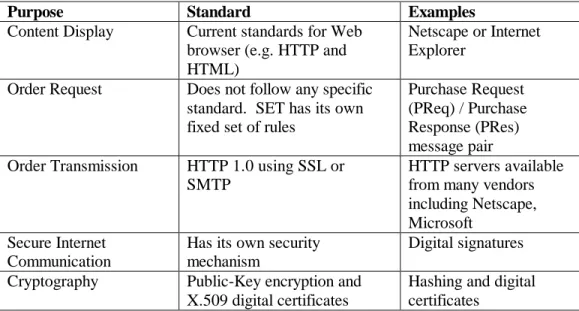
4.2.5 Standards
SET follows a set of standards listed below.
Purpose Standard Examples
Content Display Current standards for Web browser (e.g. HTTP and HTML)
Netscape or Internet Explorer
Order Request Does not follow any specific standard. SET has its own fixed set of rules
Purchase Request (PReq) / Purchase Response (PRes) message pair Order Transmission HTTP 1.0 using SSL or
SMTP
HTTP servers available from many vendors including Netscape, Microsoft
Secure Internet Communication
Has its own security mechanism
Digital signatures Cryptography Public-Key encryption and
X.509 digital certificates
Hashing and digital certificates
4.3 OBI
What it is
OBI (Open Buying on the Internet) is a standard for business-to-business Internet commerce with an initial focus on automating high-volume, low-dollar transactions between trading partners. It is a freely available standard that any organization can obtain and use. The OBI standard is the result of the work conducted by the Internet Purchasing Roundtable to provide access to easy-to-use, open, standards-based Internet purchasing solutions [17]. The Roundtable tries to produce a balanced and fair standard for all involved buying organizations, selling organizations, technology companies, financial institutions and service providers. The standard follows the principles below:
• Common Business Vision. The standard is based on the participants’ common issues and expectations for business-to-business Internet commerce solutions.
• Vendor Neutrality. The standard is intended to be vendor-neutral to encourage competitive product offerings from a variety of technology companies and service providers.
• Interoperability. The standard encourages the implementation of interoperable Internet purchasing solutions.
• Value-Added Services. The standard encourages competitive products and services through value-added services and features that help make all parties to differentiate themselves.
• Cost Effectiveness. OBI solutions should be easily and inexpensively integrated into existing IT infrastructures. Maintenance costs must be reasonable.
• Robust Infrastructure. The standard should be able to support large populations of requisitioners reliably and securely.
• Flexibility. The standard should be flexible enough to accommodate the variations that will arise with specific OBI implementations and the evolving business needs of buying and selling organizations.
Concepts
OBI standard includes precise technical specifications for the security, transport, and contents of OBI Order Requests and OBI Orders. For security, OBI uses SSL (Secure Sockets Layer) protocol to secure communications on the Internet. Digital certificates are based on ITU-T’s X.509v3 standard and used for authenticating requisitioners and servers. Exchange of OBI Order Requests and OBI Orders is accomplished via HTTP over SSL. Contents of OBI Order Requests and OBI Orders are based on the ANSI ASC
Once a requisitioner selects their required products, the supplier’s server formats the order as an OBI Order Request, digitally signs it and sends it back to the purchaser’s server for verification. The purchaser’s server formats the Order Request in order to integrate it with the purchasing company’s workflow system. The formatted Order Request is served up to the requisitioner for final approval. Once they complete it, it is formatted again as an OBI Order and sent back via HTTP/SSL to the supplier’s server. From there, the order is integrated into the supplier’s normal fulfillment process, including handling, packing, and shipping [3].
4.3.1 Architecture
Figure 4.3.1 below describes the OBI architecture at an abstract level [22]:
The OBI architecture above follows the model below:
• Requisitioner is the individual that does the browsing of the catalog of goods and services and selecting catalog items.
• Buying Organization represents the Requisitioner in obtaining the catalog of goods and services and interacting with the Selling Organization and Payment Authority to complete a purchase order.
Buying Organization
Requisitioner Selling Organization
Payment Authority Catalog Browse/Buy
Order Status Query
Profile Information, Pending Orders, View/Update
Order Creation
& Approval Payment Vehicle
Authorization/Clearance
Payment Validation
Figure 4.3.1 The OBI Architecture
(Source: SupplyWorks, Inc.)
Browse Request Approve Fill Receive Pay
Figure 4.3 OBI Purchasing Process
• Selling Organization represents the merchant in presenting the catalog of goods and services and dealing with the Buying Organization and Payment Authority in a purchase transaction.
• Payment Authority validates the payment, authorizes order fulfillment, and issues invoice.
4.3.2 Sequence of Protocol Transaction
1. A requisitioner, using a Web browser, connects to a local purchasing server located at
the Buying Organization and selects a hyperlink to a Selling Organization’s merchant server containing an online catalog of goods and services.
2. The Selling Organization’s server authenticates the requisitioner’s identity and organizational affiliation. Authentication information and optional profile information help to uniquely identify the requisitioner and to construct a specialized catalog view from which the requisitioner can select items and check out.
3. The content of the requisitioner’s shopping cart is mapped into an order request (EDI-compatible). A digital signature is calculated (optionally); the order request (and digital signature if used) is encapsulated in an OBI object which is encoded and transmitted securely to the Buying Organization over the Internet using HTTP and SSL. The Buying Organization server receives the encoded OBI object, decodes it, extracts the order request, verifies the signature (if appropriate) and translates the order request into an internal format for processing.
4. Administrative information, including payment type, is added to the order request at the Buying Organization, and the order is processed internally either automatically or through a workflow-based process.
Requisitioner Buying Organization Selling Organization Payment Authority
1 1 2 2 3 4, 5 6 7 7
5. The completed and approved order is formatted as an OBI order (EDI-compatible) and a digital signature is calculated if desired. The order (and digital signature if used) is encapsulated in an OBI object which is encoded for transport and transmitted securely from Buying Organization server to Selling Organization server via the Internet using HTTP over SSL. The Selling Organization receives the encoded OBI object, decodes it, extracts the order, verifies the signature (if appropriate), and translates the order into its internal format.
6. The Selling Organization obtains authorization, if necessary, and begins order fulfillment.
7. The payment authority issues an invoice and receives payment.
4.3.3 Structure of an OBI object
Since OBI data must be received by the recipient in the exact form it was produced by the sender, data should be in a format which can be processed by any platform. An OBI object is the standard data structure used to exchange order-related data between trading partners. The structure of the OBI object is shown in figure 4.3.3a [16].
version
Version number (OBI version #)
Data_length (length of OBI data field in bytes)
OBI data (EDI-formatted order or order request)
Signature_length (length of next field in bytes)
Signature (optional: PKCS #7 signature on data) 4 bytes 4 bytes variable 4 bytes variable
Figure 4.3.3a Structure of an OBI object
(Source: “OBI Technical Specification”, OBI Consortium)
This is a four-byte integer field which uses a <major><minor> numbering scheme to indicate a version of the OBI object.
data_length
This is a 32-bit integer field which represents the number of bytes in the OBI data field.
OBI data
This is a variable-length string which contains an OBI Order or Order Request in an OBI-specified EDI format.
signature_length
This is a 32-bit integer field which represents the length in bytes of the signature field. This field must always be present and should be 0 if no signature is included.
signature
This is a variable-length field which contains a signature on the contents of the OBI data field. The content of the signature field is a BER-encoded PKCS #7 data object. If no signature is included, this field is empty.
Data Structure
All OBI 850 transactions follow the structure shown in figure 4.3.3b [16]:
Within this structure, actual order data is carried in data segments which are made up of
one or more data elements. Data elements contain actual data, identifiers, or codes.
Specific data segments have assigned locations within the header, detail or summary areas [16].
X12/850 HEADER SEGMENTS
X12 Interchange Control Header X12 Functional Group Header 850 Transaction Header Segments
850 TRANSACTION DETAIL SEGMENTS
850 Line Item Detail Segments
X12/850 SUMMARY SEGMENTS
850 Transaction Summary Segments X12 Functional Group Trailer X12 Interchange Control Trailer
Transmission of OBI object
OBI defines two methods for transporting OBI objects between trading partners over the Internet: server-to-server method and server-browser-server method.
Figure 4.3.3c describes the transport of OBI object from server to server. To ensure portability, all OBI objects must be encoded in base64, as specified in Internet RFC 1521, prior to any HTTP transmission [16].
1 Base64 encoded OBI object arrives in sender’s queue 2 Sender initiates TCP/SSL connection
3 SSL parameters negotiated
4 Sender transmits OBI object within HTTPS POST
5 Recipient commits OBI object to stable storage and acknowledges receipt with 200 response; sender removes object from queue
6 Recipient hands off OBI object for processing
The transmission of OBJ objects using HTTP makes use of the Secure Sockets Layer (SSL) Protocol which provides data encryption, server authentication, message integrity, and optional client authentication for a TCP/IP connection [16].
The server-browser-server method for transmission of order requests relies on the use of hidden fields within HTML forms and uses the requisitioner’s browser during the transmission. Hidden values in an HTML form allowa CGI application to pass name-value pairs to a browser without the knowledge of the end user. Using the POST method, a browser can send name-value pairs from an HTML form to a CGI application via a Web server. The server then starts the designated CGI application and passes the browser-supplied data to the application [16].
4.3.4 Standards
The OBI architecture is built on existing standards in order to maximize interoperability and decrease implementation costs. Below is a list of standards that are used in OBI [16].
OBI application Sender (HTTP client) Recipient (HTTP server) OBI application 1 2 3 4 5 6
Figure 4.3.3c HTTP Transport of an OBI object from server to server
Purpose Standard Existing Examples
Content Display Evolving standards for Web browsers (currently based on HTTP and HTML) as specified by the W3C
Netscape Navigator V3.0 or later; Microsoft Internet Explorer V3.0 or later Order Requests and
OBI Orders
X12 850 EDI standard OBI/2.0 order format specification (defined by the OBI Consortium)
Order Transmission HTTP 1.0 using SSL HTTP servers available from many vendors including Netscape, Microsoft, Oracle Secure Internet
Communication
SSL V3 SSL supported by many
vendors including Netscape, Microsoft, Oracle
Cryptography SSL V3 API
Public Key Cryptography Standards (PKCS)
Netscape SSL API RSA BSAFE
Microsoft CryptoAPI Public Key Certificates &
Certificate Authorities
X.509 V3 certificates GTE CyberTrust Verisign
Content Display
This display involves a software which will be the standard for displaying information on requisitioner desktops and interfacing to most corporate applications including electronic ordering.
Order Formats
A common format for electronic orders is needed to provide communication between different platforms and implementation software and support interoperability among systems managed by different organizations and simpler interfaces to external systems. The ANSI X12 EDI syntax was used in OBI order format because it provides a proven encapsulation for the common purchasing documents and ease of connectivity with existing EDI systems in the U.S.
Order Transmission
A common protocol for transmission of standard order documents will provide interoperability among systems managed by different organizations. OBI uses HyperText Transport Protocol (HTTP) because it is a proven and widely adopted Internet protocol.
Security
Table 4.3.4 Standards relevant to OBI (Source: “OBI Technical Specification”, OBI Consortium)
Security for doing business over the Internet involves:
• Secure Internet Communications between World Wide Web servers and browsers
• Authentication with public key certificates for identification of individuals,
organizations, and machines
• Data Confidentiality with cryptography for encrypting data to be transmitted over the
internet
4.3.5 Error Handling
With server-to-server method of transmission, OBI does not define error messages for anything other than initial HTTP POST. Trading partners will need to agree on how they will handle other kinds of errors, for example, problem with the OBI object, problem with the EDI format, problem with the order itself, unable to verify a digital signature, no signature when one expected, etc. Trading partners should also discuss and agree on the time-out lengths for retramissions [16].
With server-browser-server method, if the workstation on either side crashes before the transaction completes, there is no way to automatically retransmit the message since there is no acknowledgement. Duplicates are also hard to track since the Selling Organization creates unique transaction ID for recreated order request.
4.4 OTP
What it is
OTP (Open Trading Protocol) is a protocol for the development of software products that will permit product interoperability for the electronic purchase that is independent of the chosen payment mechanism. It encapsulates the payment with the offers, invoice, receipts for payment and delivery. OTP allows two unfamiliar parties using electronic commerce capabilities to buy and sell that conform to the OTP specifications to be able to complete the business safely and successfully. In general, OTP supports familiar trading models, new trading models, and global interoperability [21].
Concepts
The Open Trading Protocols (OTP) define a number of different types of OTP Transactions [21]:
• Purchase. This supports a purchase involving an offer, a payment and optionally a delivery.
• Refund. This supports the refund of value as a result of, typically, an earlier purchase.
• Value Exchange. This involves two payments which result in the exchange of value from one combination of currency and payment method to another.
• Authentication. This supports the authentication of one party to make sure that another party is who they appear to be using a challenging-response mechanism.
• Withdrawal. This supports the withdrawal of electronic cash from a financial institution.
• Deposit. This supports the deposit of electronic cash at a financial institution.
These OTP Transactions are “Baseline” transactions since they have been identified as a minimum useful set of transactions. Later versions of OTP may include additional types of transactions [21].
Each of the OTP Transactions above involve a number of organizations playing a
Trading Role, and a set of Trading Exchanges. Each Trading Exchange involves the
exchange of data, between Trading Roles, in the form of a set of Trading Components.
Trading Roles
The Trading Roles identify the different parts which organizations can take in a trade. The five Trading Roles used within OTP are illustrated in the diagram below [21].
Consumer Customer Care Provider Value Acquirer Merchant Deliverer Customer Care Provider
resolves Consumer disputes
Value Acquirer accepts value for Merchant Consumer makes purchases from Merchant
Deliverer supplies goods or services for Merchant
Figure 4.4 OTP Trading Roles
(Source: “Internet Open Trading Protocol Specification”, OTP Consortium)
The consumer receives and pays for the goods or services. The merchant, with whom the purchase is being made, is responsible for providing the goods and services and receives
the benefit of the payment made. The value acquirer is the entity that actually receives
the payment from the consumer on behalf of the merchant. The deliverer delivers the
goods or services to the consumer on behalf of the merchant. The customer care
provider handles customer dispute negotiation and resolution on behalf of the merchant. These roles can be carried out by the same organization or different organizations.
Trading Exchanges
OTP supports four Trading Exchanges which involve the exchange of data between the Trading Roles. The four Trading Exchanges are:
• The Offer Exchange which provides the consumer with the reason why the trade is taking place. It is called an Offer since the consumer must accept the Offer if a trade is to continue. The Offer generally includes Order, Pay Amount, Delivery Information, and necessary signatures.
• The Payment Exchange which is some value that is being transferred between the consumer and the value acquirer. However, the list of payment types are offered from the Merchant. After a payment type is selected, communication between the consumer and Merchant may proceed.
• The Delivery Exchange which transmits either the online goods or delivery information about physical goods from the deliverer to the consumer. The merchant must first provide consumer with Delivery Information which includes order, shipping tracking number, and its signature before the consumer can request delivery from the Deliverer.
• The Authentication Exchange which is used by any Trading Role to authenticate another Trading Role.
OTP Transactions are composed of various combinations of these Trading Exchanges.
For example, an OTP Purchase transaction includes Offer, Payment, and Delivery
Trading Exchanges. An OTP Value Exchange transaction, for example, can be composed
of an Offer Trading Exchange and two Payment Trading Exchanges. Trading Exchanges
consist of Trading Components that are transmitted between the various Trading Roles.
4.4.1 Architecture
The OTP design involves the five Trading Roles and four Trading Exchanges (described earlier). The interactions among these components are shown in figure 4.4.1 below.
The transactions that can take place with OTP protocol are Authentication, Deposit, Purchase, Refund, Withdrawal, Value Exchange, and Restart Transaction.
4.4.2 Sequence of OTP Transactions
OTP Message Consumer Merchant Generate first OTP Message Value Acquirer Customer Care Provider Deliverer Consumer Merchant Offer Exchange Payment Exchange Delivery Exchange Authentication Exchange Delivery Exchange Authentication Exchange Payment Exchange
Authentication Exchange Authentication Exchange
Take care of disputes
Authentication Exchange Delivery Info for future customer problems with the delivery
Figure 4.4.1 OTP Architecture
send first message
send next message
send next message
send last message
Process incoming message
Generate next
OTP Message
OTP
Message Process incoming message
OTP Message Generate next OTP Message Process incoming message OTP Message Generate last
OTP Message Process last
message
Terminate Transaction
Terminate Transaction
Transactions can be terminated by any of the following:
• the Consumer
• one of the other Trading Roles in the trade
• an error in the OTP Message
• a cancellation by one of the Trading Roles because it could not accept the transaction
4.4.3 OTP Message Structure
Figure 4.4.3 shows the structure of the OTP message.
OTP Message
Trans Ref Block
TransId Component MsgId Component Trading Block Component Component Component Signature Trading Block Component Component Signature . . . . . . . .
Figure 4.4.3 OTP Message Structure
(Source: “Internet Open Trading Protocol Specification”, OTP Consortium)
OTP Message – an XML Document which is transported between the Trading Roles.
Trans Ref Block – contains information which describes the OTP Transaction and the OTP Message.
Trans Id Component – uniquely identifies the OTP Transaction. The Trans Id Components are the same across all OTP messages that comprise a single OTP transaction.
Msg Id Component – identifies and describes an OTP Message within an OTP Transaction.
Trading Block - an XML Element within an OTP Message that contains a predefined set of Trading Components.
Trading Components – XML Elements within a Trading Block that contain a predefined set of XML elements and attributes containing information required to support a Trading Exchange.
Signature Component – an optional XML element that contains a digital signature. The signature may sign hashes of the Trans Ref Block and any Tra