1
Behavioral Health
AAS
Program Review
Submitted Nov. 1, 2008
Dean Edelma Simes
Catherine McKinney, Instructor
Naomi Borchert, Instructor
2
Table of Contents
Introduction………1
Criterion 1….……….1
Criterion 2……….……….1
Criterion 3……….……….2
Criterion 4.…….………2
Criterion 5……….……….3
Criterion 6……….……….3
Criterion 7……….……….…3
Criterion 8……..………..……….…3
Criterion 9……….………4
Criterion 10…….……….4
Criterion 11…….………..4-5
Criterion 12…….……….……5
Criterion 13 .…….………5
Criterion 14 .…….………6
Criterion 15…….……….…....6
Criterion 16…….………..…..….6
Program Strengths………..…..6-7
Program Concerns………...……7
Recommendation………...…. 7
Appendix A: Faculty Data Forms……….….8-11
Appendix B: Behavioral Health Learning Plan & Assessment……12-14
Appendix C: Behavioral Health Tech Learning/Assessment……15-22
Appendix D: Library Holdings………. 23-25
Appendix E: Behavioral Health Tech AAS Degree Checklist…. .26-27
3
OUTLINE OF TABLES
TABLE 1: BEHAVIORAL HEALTH INSTRUCTORS---2
TABLE 2: SSCH AND FTE DATA BY FACULTY---2
TABLE 3: BEHAVIORAL HEALTH COURSES ROTATION BY CAMPUS---5
TABLE 4: BEHAVIORAL HEALTH COURSE FREQUENCY AND AVERAGE ENROLLMENT---6
TABLE 5: BEHAVIORAL HEALTH TECHNOLOGY GRADUATES LAST THREE YEARS---8
4
Introduction
The Behavioral Health Program is designed to meet the needs of individuals who currently work and plan to pursue employment in health, social and human services. Students must participate in both in-class and on the job training. Competency in social and human service affairs, as well as writing, language and computer skills are emphasized.
The program is offered on the Dewitt and Helena/West Helena campuses.
CRITERION 1: Both full-time and part-time faculty members are academically and professionally qualified and maintain expertise appropriate to their teaching
responsibilities.
Response: The faculty has the academic credentials and experience to accomplish program goals. The Behavioral Health Program currently has three full-time Phillips Community College of the University of Arkansas (PCCUA) employees. All three instructors possess a master’s degree or higher. More detailed instructor information is provided in Appendix A. PCCUA annually reviews the performance of faculty members. Each portfolio is evaluated by two
instructors within the Art and Sciences Division, one instructor outside the division, and the dean of the division. Student Evaluation of Instruction surveys are also completed twice a year and the average results are included in the Teaching- Instructional Delivery part of the portfolio. The instructor meets individually with the dean to discuss the results of the portfolio and the results of the Student Evaluation. The portfolio consists of four major areas: Teaching (Instructional Delivery and Design), College Service, Professional Development, and Community Service. Faculty ratings in these four areas are combined to produce an Overall Composite Rating. The Behavioral Health instructors earned an average Overall Composite Rating of 4.86 out of a possible 5 on the 2007 Annual Faculty Evaluation.
CRITERION 2: The number and utilization of full-time and part-time faculty are appropriate to meeting the program’s goals.
Response: All specialized Behavioral Health courses, which include Health Care and Delivery, Chronic and Infectious Disease, Behavioral Health Issues, Theories and Treatment of Social Problems, and the Practicum and Practicum Seminar, are taught by the full time Phillips Community College Behavioral Health instructors and staff. All instructors hold a masters degree or above in a Social Science area (See Table 1). Medical Terminology, which is included in the list of specialized course requirements, is taught by a master’s level full-time instructors from the Division of Business and Information Systems. Additionally, Health and Safety (PE 223) is taught by a full-time instructor from the Arts & Sciences Division who holds a Masters degree in Physical Education.
5 Table 1
Behavioral Health Instructors
Name Highest Degree Held Major
Catherine McKinney Masters of Science Social Work
Naomi Borchert Masters of Science Social Work
Leroy Cook Masters of Science Rehabilitation Counseling
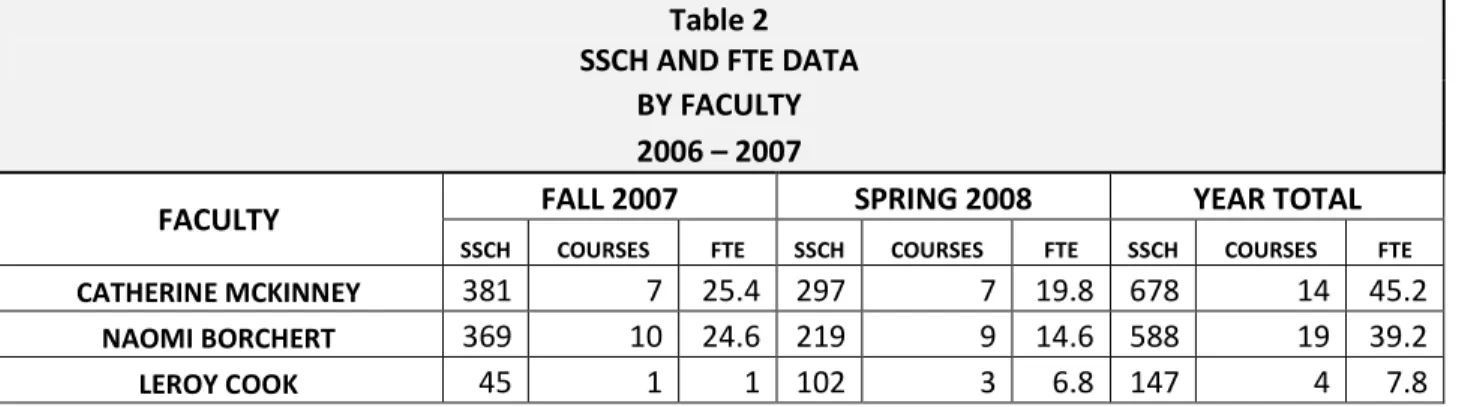
A summary of Behavioral Health faculty utilization, student semester credit hours generate and the full-time enrollment equivalency is outlined in Table 2.
Table 2 SSCH AND FTE DATA
BY FACULTY 2006 – 2007
FACULTY FALL 2007 SPRING 2008 YEAR TOTAL
SSCH COURSES FTE SSCH COURSES FTE SSCH COURSES FTE
CATHERINE MCKINNEY 381 7 25.4 297 7 19.8 678 14 45.2
NAOMI BORCHERT 369 10 24.6 219 9 14.6 588 19 39.2
LEROY COOK 45 1 1 102 3 6.8 147 4 7.8
CRITERION 3: Students are provided access to support services including academic advisement and placement assistance.
Response: Support services are accessible to new, returning, and transferring Behavioral Health students. The services are designed to promote and enhance academic, professional and personal growth. Support services include walk-in one on one and group advisement with the department dean, faculty, academic advisors and student success coordinators. Additionally, the institution provides services for financial aid, transfer guidance, student records, and job placement through practicum, public service and career planning. Behavioral Health students also have access to the campus libraries, computer labs, tutoring centers, testing centers, and the campus bookstore.
CRITERION 4: Prospective and current students are provided accurate and consistent information in the college catalog, recruitment brochures, advertisements, and student handbooks. Any admission, academic progress, graduation, grading, or grievance policies specific to the program should be included.
Response: The PCCUA college catalog is updated each school year. Admission information and requirements, student service information, grading system, rules for academic suspension
6
and appeal, checking grades online, and graduation requirements are all included in the Catalog. PCCUA maintains and frequently updates its website with extensive information and links. All students are also assigned a student email account at registration. The catalog, the website, and all advisors have degree checklists that are consistent and available to students to track progress in their pursuit of the AAS degree. The revised Behavioral Health brochure was recently published. The PCCUA Student Handbook, given to each student at the beginning of the academic year, also contains information on the college grading system, academic clemency policy, graduation requirements, and all student-specific policies.
CRITERION 5: Technical Certificate and AAS degree graduates will be well prepared for entry level positions in their field.
Response: The Behavioral Health Technology Program at PCCUA is designed to prepare social service and human service workers with broad skills necessary to perform many jobs in these career areas. Instruction produces career prepared students who can demonstrate the following behaviors.
Personal awareness
Trace the history and development of health care and delivery in the United states
Connect the role and function of human growth and development
Identify and understand abnormal behavior patterns
Identify a variety of methods of treatment and behavior
Develop strong intra and interpersonal skills
Understand problems related to substance abuse
Demonstrate the practical application of theory through working in a clinical setting of social service and human service occupations
Know the basic chronic and infectious diseases
Demonstrate knowledge and appropriate practice in case work
Identify domestic abuse, understand safety, security, and emergency procedures in the work place
Have written and oral skills
Demonstrate legal and ethical behaviors
Recognize the family as the primary institution
Understand community dynamics and cultural diversity.
Learning outcomes, methods of assessment and courses where the specific outcomes are taught are outlined in the Behavioral Health Technology Assessment Learning document (See
Appendix C). Additionally, the Behavioral Health Practicum provides students with direct experience in entry level positions. When surveyed, 100% of practicum supervisors indicated that BH students placed with their agencies was prepared for entry level positions in their field.
CRITERION 6:Technical Certificate and AAS degree graduates will find employment in their chosen field.
Response: Behavioral Health graduates are able to find employment in the field. Many graduates are employed in the Phillips County area after graduation. In Spring 2008, 3 of 5
7
students completing practicum placements were hired by their practicum supervisors.
Counseling Services of Eastern Arkansas (CSEA) employs several Behavioral Health graduates. The Director of Forensic Services at CSEA stated in a 2008 telephone survey, “any student who applies with the Behavioral Health degree from PCCUA is definitely weighted more favorably for employment.”
CRITERION 7: AA graduates will be able to transfer courses intended for transfer.
Response: N/A. PCCUA does not offer an AA degree in Behavioral Health.
CRITERION 8: AA and AAS degree graduates will exhibit effective reading and writing skills.
Response: Students who complete an AAS degree in Behavioral Health Technology are required to successfully complete Freshman English I (EH 113) and Freshman English II (EH 123). Additionally, students must complete the Reading sequence (DS 103 and DS 123) with a “C” or above, or test out of Reading by earning a score of 19 or above on the ACT, 43 or above on the ASSET Reading Skills test or 82 or above on the COMPASS Reading Skills Test.
Writing and reading opportunities are provided for students in a number of courses (PS 213, PSY 223, SY 213, SY 223) required in the BH Program. As a component of the Behavioral Health Practicum Seminar (BH 153), a final paper is required to provide students with an additional opportunity to exhibit their effective reading and writing skills. Finally, students must possess proficient reading and writing skills in their Behavioral Health Practicum (BH 143) placement. Some of the assignments include reading employee manuals, legal documents, and policy and procedure manuals. Writing requirements may include progress notes, case evaluations, and reports.
CRITERION 9: Technical certificate and associate degree graduates will have interpersonal skills needed to relate to others in a professional setting.
Response: As part of the Behavioral Health Practicum that is completed the semester before graduation, students contract a Learning Plan (See Appendix B) with their practicum supervisor. One of the six goals in the Learning Plan is that the student will “demonstrate effective
communication skills”. To accomplish this goal, specific objectives are also stated in the Learning Plan. The three objectives that specifically apply to interpersonal skills include:
The student will demonstrate professionalism;
The student will effectively use verbal and written communication;
The student will apply the principle of confidentiality and privacy.
The student and the practicum supervisor then list specific tasks and skills that the student will perform to meet these objectives. The supervisor uses this Learning Plan at the end of the practicum to evaluate the student’s progress in the placement. When surveyed, practicum supervisors expressed 94% satisfaction with students’ interpersonal skills in the professional setting of their agency.
8
CRITERION 10: The length of the program enables students to achieve program objectives and to acquire knowledge and skills necessary for employment in the field or successful transfer to a four year college.
The AAS degree in Behavioral Health Technology requires 64 semester credit hours. Full-time students who require no remediation can complete this program easily within four semesters.
CRITERION 11: The curriculum encompasses instructional materials, equipment, course and program content, and method and types of instructional delivery. The program
curriculum should reflect current practices in post-secondary education and the workforce. Response: The Behavioral Health Program does encompass various methods and types of instructional delivery. The Behavioral Health practicum is a course that provides field experience in a professional setting. The practicum requires 120 hours of students doing volunteer work at an agency that provides behavioral health services. Students are closely monitored and
supervised by a professional currently working in the field.
Current textbooks, current essays and articles, lectures, DVDs and videos, PowerPoint, guest speakers, and online video clips and exercises are utilized in instructional delivery.
SMARTBOARD equipped classrooms enable the instructors to access a wealth of current and pertinent information. Instructors are required to document updates in instruction on the course syllabi in the teaching section of the Faculty Portfolios. One Hundred percent (100%) of practicum supervisors, in a 2008 telephone survey, expressed satisfaction with BH Practicum students placed with their organization.
CRITERION 12: Courses must be offered frequently enough so that students can complete the program in a reasonable period of time.
Response: All course required for the AAS Degree in Behavioral Health are offered at least once per academic year on the Helena/West Helena Campus and the DeWitt Campus. Thus students in the program have at least two times per academic year to complete specialized courses in the program.
TABLE 3
Behavioral Health SPECIALIZED COURSES Rotation by Campus: Helena Campus DeWitt Campus
BH 103 Health Care & Del. Fall Fall
BY 103 Intro to Ant & Phys. Fall, Spring,Sum Fall, Spring,
OT 113 Medical Terminology Fall, Spring Fall, Spring
BH 113 Chronic & Inf. Dis. Spring Spring
BH 123 Theories & Treat. Of Spring Spring
Social Problems
BH 133 Beh. Health Issues Fall Spring
BH 143 Practicum in BH Fall, Spring, Sum Fall, Spring, Sum
BH 153 Practicum Seminar Fall, Spring, Sum Fall, Spring, Sum
9
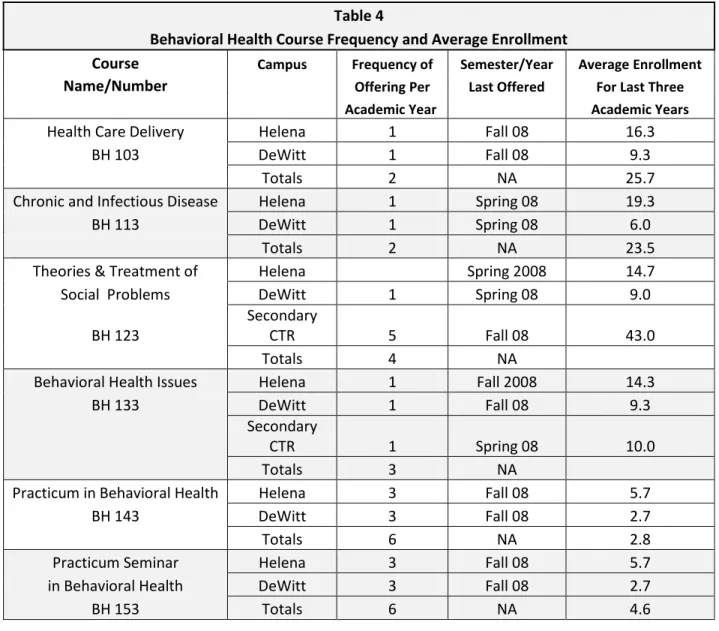
Table 4 (below) outlines the frequency of offering specialized courses in Behavioral Health, the campus and average enrollment for each campus site. Additionally, two courses in Behavioral Health are also offered as a part of the PCCUA Secondary Centers’ Medical Profession Program. Enrollment for the Secondary Centers is also included in this table.
Table 4
Behavioral Health Course Frequency and Average Enrollment
Course Campus Frequency of Semester/Year Average Enrollment
Name/Number Offering Per Last Offered For Last Three
Academic Year Academic Years
Health Care Delivery Helena 1 Fall 08 16.3
BH 103 DeWitt 1 Fall 08 9.3
Totals 2 NA 25.7
Chronic and Infectious Disease Helena 1 Spring 08 19.3
BH 113 DeWitt 1 Spring 08 6.0
Totals 2 NA 23.5
Theories & Treatment of Helena Spring 2008 14.7
Social Problems DeWitt 1 Spring 08 9.0
BH 123
Secondary
CTR 5 Fall 08 43.0
Totals 4 NA
Behavioral Health Issues Helena 1 Fall 2008 14.3
BH 133 DeWitt 1 Fall 08 9.3
Secondary
CTR 1 Spring 08 10.0
Totals 3 NA
Practicum in Behavioral Health Helena 3 Fall 08 5.7
BH 143 DeWitt 3 Fall 08 2.7
Totals 6 NA 2.8
Practicum Seminar Helena 3 Fall 08 5.7
in Behavioral Health DeWitt 3 Fall 08 2.7
BH 153 Totals 6 NA 4.6
CRITERION 13: The program’s current operating budget is adequate to assure program quality.
Response: Although funds are limited, as with most community colleges, our current operating budget is adequate to assure program quality based on a limited enrollment of students. During the spring semester, BH faculty and staff are asked to project budgetary need for the next academic year. The budget is reviewed and then submitted to the Vice Chancellor for
Instruction. Recently, the requested budgets have experienced some cuts, but needed supplies, equipment and professional development opportunities have been funded with the assistance of
10
funds from various grants (Carl Perkins, Title III, Student Support Services, and Achieving the Dream) and other instructional areas.
CRITERION 14: Physical facilities are adequate to sustain the program.
Response: Instructional space, classroom furniture and instructional technology are adequate to sustain the Behavioral Health program. Students also have access to break and vending areas, well lighted parking, and security patrol.
Helena Campus
Behavioral Health classes are generally scheduled in two main classrooms: L304 and L305. Each classroom is furnished with 15 long tables with two comfortable chairs per table. Both L304 and L305 are equipped with SMARTBOARDS, overhead projectors and a computer with internet access. Additionally there is a moveable television and VCR that is shared by the two
classrooms. Students have access to library services for both day and evening hours with 10 internet accessible computers and printers available for use. Copy machines are also available for students in the Lewis Library.
DeWitt Campus
The classroom used for Behavioral Health classes on the DeWitt Campus is equipped with comfortable tables and chairs, a TV/VCR combination, Internet access, and an overhead projector. The instructor has access to a laptop computer that is used for instruction in the classroom. Students on the Dewitt campus have access to the library and a computer lab.
CRITERION 15: Library resources appropriate to support the program are available and accessible to faculty and students.
Response: PCCUA libraries are open during all regular college operating hours which allow accessibility to Behavioral Health students and faculty during day, evening, night and limited weekends. Campus libraries in Helena/West Helena, DeWitt and Stuttgart offer the latest in technology, online catalog accessibility, inter-library loan with various regional universities, online access to a vast number of books, journals, magazines, relevant films and other databases. Library holdings consist of approximately 49,000 volumes found in PCCUA’s three libraries: Lewis Library (36,088); Dewitt (5357) and Stuttgart (7288). (See Appendix C) Included in these traditional holding are more than one thousand volume related to Nursing/Allied Health. Also included are current materials and books, such as, the International Classification of Diseases, Clinical Modification and the Diagnostic, and Statistical Manual of Mental Disorders;
professional health journals as well as a growing collection of electronic sources.
CRITERION 16: Student support and staff services are available.
Response: The Behavioral Health Program, as with all AA/AAS programs, has accessibility to student support and staff services. Some of the major student support services are (1)
11
admissions, (2) academic advisement, (3) career guidance counseling, (4) financial and other student-aid, (5) registration and records, (6) student activities, (7) placement, (8) the Achieving the Dream Initiative and (9) Career Pathways. Most Behavioral Health students are
non-traditional students who work full or part-time. To accommodate these students, a vast majority of the courses for this program are offered during the extended day, evening and weekend. Special efforts are made by the BH faculty, various service departments, division dean, advisors, and student success coordinators to insure that BH students have access to support and staff services afforded traditional students. Awareness is made to lessen or eliminate barriers to success and to help build characteristics of success by providing students with tutoring, early alert, assistance with time management and study skills. Referrals for community resources such as housing, counseling, childcare, and transportation are also provided.
Program Strengths
The Behavioral Health Technology program was created to meet a community need to train paraprofessionals working in the behavioral health field. As evidenced by the employment of our graduates, we are meeting that need. The program has strong support of the Dean of Arts and Sciences, the Vice Chancellor of Instruction and Chancellor of the College. The faculty is composed of master’s level and above instructors with experience in the field. The yearly rotation of specialized courses and the convenient time offering of the courses is designed for working students. The program has grown in the past several years (See Table 6, Appendix F). The number of graduates in the program over the past three years is 26 (See Tables 5 Below).
Table 5
Behavioral Health Technology Graduates Last Three Years
2006 2007 2008
4 11 11
Program Concerns
1. Declining population in the area 2. On-going professional development 3. Budget constraints
4. Supplying enough graduates to meet the community need for geriatric services, social services, and mental health services.
5. Transferability of Behavioral Health degree and certificate
Program Recommendation
1. Collaborate with other two-year and four-year colleges that can help advocate for a Behavioral Health bachelors degree with more transferable courses from the two-year colleges with Behavioral Health programs. An on-going review of the Arkansas Course
12
Transfer System that will benefit the PCCUA Behavioral Health Program and its students.
2. Increase the marketing efforts for the Behavioral Health program by indicating and highlighting that the social services will expand with the growing elderly population, who are more likely to need adult day care, and other services such as medical crises support, meal delivery, teen pregnancy, homelessness, and services for people with mental disabilities, substance abuse issues, etc.
3. Implement a yearly networking banquet for local and surrounding area behavioral health professionals and paraprofessionals.
4. Join one or more professional organizations or associations which will allow collaboration and professional sharing of academic and professional information.
13
Appendix A
14
BEHAVIORAL HEALTH PROGRAM Faculty Data Form
Name: Cathy McKinney Start date: 10/15/1998 Full-time ____X____Part-time _______
Current and Previous Classes Taught: What Year/Term(S) School/Setting BH 103 Health Care and Delivery Fall 1998-present PCCUA/Helena_ BH 113 Chronic and Infectious Disease Spring 1999-present PCCUA/Helena PSY 213 General Psychology Fall 2003-present PCCUA/Helena SY 213 Fundamentals of Sociology Fall 2007-present PCCUA/Helena BH 143 Behavioral Health Practicum Fall 1998- present PCCUA/Helena BH 153 Practicum Seminar Fall 1998-present PCCUA/Helena PSY 223 Human Growth and Development Spring 2004 PCCUA/Helena BH 123 Theories and Treatment of Social Problems Spring 1999-Spring 2007 PCCUA/Helena BH 133 Behavioral Health Issues Fall 1998-Fall 2006 PCCUA/Helena
List all non-teaching assignments, committees, advising, etc. in the past 3 years.
Behavioral Health Advisor
Student Activities Committee
Special Events Committee
Educational Background
Degree Date Degree Earned University MSSW 1998 University of Tennessee BSW 1993 Delta State University
(In the past three years) Conferences/Seminars/Presentations
National Institute on the Teaching of Psychology St. Petersburg, FL Jan 2008 National Institute on the Teaching of Psychology St. Petersburg, FL Jan 2006
15
BEHAVIORAL HEALTH PROGRAM REVIEW SHEET
Name: Naomi Borchert Start date: 08/17/05 Full-time ____X____Part-time _______
Current and Previous Classes Taught: What Year/Term(S) School/Setting BH 103 Health Care Delivery Systems Fall 08, 07, Spring 06 PCCUA/ Dewitt
BH113 Chronic & Infectious Disease Spring 08, 07, 06 PCCUA / DeWitt BH123 Theories & Treatment of Social Problems Spring 08, 07 PCCUA / DeWitt BH133 Behavioral Health Issues Fall 08, 07, 06, 05 PCCUA / DeWitt BH143 Practicum in Behavioral Health Fall 08, 07, 06 Spring 07 PCCUA / DeWitt BH153 Seminar in Behavioral Health Same as above PCCUA / DeWitt
PSY 213 General Psychology Fall & Spring 2005-present PCCUA/ Stuttgart & DeWitt
SY 213 Fundamental of Sociology Fall & Spring 2005-present PCCUA/Stuttgart & DeWitt ECD 1003 Child Development Fall 2005 to present PCCUA/Stuttgart
List all non-teaching assignments/positions on PCCUA Campus) Committee(S) Phi Theta Kappa Advisor
Distance Learning Committee
Faculty Senate 06-08; Elections Committee (currently)
Educational Background
Degree Date Degree Earned University MSW – Masters of Social Work 1975 University of Oklahoma
BS – Major: Sociology Minor: Psychology 1973 University of Central Arkansas Additional credits after degree/CEU (s)
MidSouth Treatment, Recovery, & Parenting – breaking the cycle 6 CEUs 12/14/07 Current Program Enrollment
(In the past three years)
Professional Organizations Publications Conferences/Seminars/Presentations NONE
16
BEHAVIORAL HEALTH PROGRAM REVIEW SHEET
Name: LeRoy Cook Start date: 10/01/05 Full-time ____X____Part-time _______
Current and Previous Classes Taught: What Year/Term(S) School/Setting
BH 133 Behavioral Health Issues Fall 06—Fall 08 PCCUA/Helena BH123 Theories & Treatment of Social Problems Spring 07—Spring 08 PCCUA/Helena PSY213 Psychology Spring 06—Spring 08 PCCUA/Helena SOS103 Freshman Seminar Spring 08—Fall 08 PCCUA/Helena
Substance Abuse Group Counseling 2005 St. Anthony Hospital, OKC, OK Parenting & Family Group Counseling 2005 P.O.M. Counseling Agency OKC, OK
List all non-teaching assignments/positions at PCCUA Committee(S)
Director of Title III Grant Activities Book Club
Retention Committee
Student Success Coordinator Student Activities
Committee
Early Alert Committee Educational Background
Degree Date Degree Earned University
M.S. – Masters of Rehabilitation Counseling 2005 Langston University
B.S.– Major: Organizational Leadership 2002 Southern Nazarene University
Additional credits after degree/CEU (s)
6 credit grad hours – Ethics & Human Growth Development Current Program Enrollment
(In the past three years)
Professional Organizations Publications Conferences/Seminars/Presentations
National Rehabilitation Association 2005 Arkansas Association of Two Year Colleges 2006-08 National Academic Advising Association 2007 Arkansas Tutor Association/National Tutor Association 2006-07 CASA-Court Appointed Special Advocate 2007-08
17
APPENDIX B
18
Behavioral Health Practicum
Learning Plan
Semester and Year___________
Student’s Name ________________________________________________ Agency Name__________________________________________________
Agency Supervisor’s Name________________________________________ Supervisor’s Phone Number________________________________________
The student will complete 120 hours of volunteer work at the agency. The following goals are used to guide placement for our Behavioral Health Students. The practicum student should be able to:
Understand the history, organizational structure, purpose, and eligibility requirements of the agency
Understand the network of resources used by the agency
Use a culturally sensitive approach with diverse and oppressed populations
Apply classroom learning to practice
Use critical thinking skills
Demonstrate effective communication skills
The student and the agency supervisor will complete the learning plan at the beginning of the semester. This identifies the individual learning needs and experiences of the student and the unique learning opportunities available at the agency. At the end of the semester, the supervisor will use the plan to evaluate the student’s progress. For each learning objective below, the supervisor and the student will list tasks that will accomplish that objective. Please try to list several tasks for each objective.
Learning Objectives
1. Demonstrate professionalism.
(Example: Student will adhere to provided dress code and arrive on time for work.)
19
3. Understand and explain agency services, both to clients and their families and to other agencies.
4. Effectively use verbal and written communication.
5. Demonstrate an understanding and utilization of linking clients to appropriate services.
6. Learn agency policies, procedures, and goals.
7. Demonstrate application of classroom learning (theories, facts, history, etc) to placement.
8. The student will initiate or participate in extra learning activities.
9. Apply the principle of confidentiality and privacy.
Methods used for evaluation student’s learning efforts: (check all that apply)
___ Written ____Observation ____Discussion ____Presentation ___Other (please describe)
Student’s Weekly Schedule:
M________ T________ W________ Th________ F________ S/S ________ Student’s Signature ______________________________ Date_____________ Supervisor’s Signature ____________________________ Date ____________
20
APPENDIX C
21
PHILLIPS COMMUNITY COLLEGE OF THE UNIVERSITY OF ARKANSAS BEHAVIORAL HEALTH TECHNOLOGY
ASSESSMENT AND LEARNING ASSESSMENT
The Behavioral Health Technology Program at PCCUA is designed to prepare social service and human service workers with broad skills necessary to perform many jobs in these career areas. Instruction produces career prepared students who can demonstrate the following behaviors.
Personal awareness
Trace the history and development of health care and delivery in the United states
Connect the role and function of human growth and development
Identify and understand abnormal behavior patterns
Identify a variety of methods of treatment and behavior
Develop strong intra and interpersonal skills
Understand problems related to substance abuse
Demonstrate the practical application of theory through working in a clinical setting of social service and human service occupations
Know the basic chronic and infectious diseases
Demonstrate knowledge and appropriate practice in case work
Identify domestic abuse, understand safety, security, and emergency procedures in the work place
Have written and oral skills
Demonstrate legal and ethical behaviors
Recognize the family as the primary institution
Understand community dynamics and cultural diversity.
Learning Outcomes, Assessing Learning Outcomes, Assessment Results 1. Oral, written, and computer occupational skills
All courses
2. Safety, security, and emergency procedures in the workplace
Health, Safety, and Nutrition, EN 163 Behavioral Health Issues, BH 133
3. Legal and ethical responsibilities in health care and social services occupations
Behavioral Health Issues, BH 133
Theories and Treatments of Social Problems, BH 123 Behavioral Health Issues BH 133
4. Community and institutional dynamics (family, agency, culture)
The Family SY 223
5. Practical Application of Theory through Working in a Clinical Setting
22
Practicum Seminar BH 153
6. Practical Application of Health and Social Service Delivery Practice
Health Care and delivery BH 103
7. Health Care Treatment and Therapies
Theories and Treatments of Social Problems BH 123 Behavioral Health Issues BH 133
Chronic and infectious Disease BH 113
8. Case Work Procedures
Practicum in Behavioral Health BH 143 Practicum Seminar BH 153
Criteria for Assessing Results
Tests, papers, discussion, participation Field observations
Professional Assessment of Goal Completion Student Evaluation
Job Placement
23 CONCEPTUAL FRAMEWORK
Behavioral
Health
Technology
Social
Services
Alcoholism
And
Substance
Abuse
Mental
Health
24
Competency Goal 1: Students will demonstrate proficiency in oral, written, and occupational skills. Nature of
Assessment Measure
Level of Assessment
Timing of Assessment Relative To Student Academic Progress
Competency Goal 2: Students will demonstrate knowledge and application of safety, security, and emergency procedures in the work place.
Nature of Assessment Measure
Level of Assessment
Timing of Assessment Relative To Student Academic Progress Prior to
Program
Within Course Semester
End of Program After Graduation Annually
Classroom Level Tests Assignments Syllabi Changes Course Evaluation Program Level Retention Rate Pass Rate Graduate Student Survey Annual Report Program Review Institution Level
Total Number of FTE’s Institutional
Program review
Prior to Program
Within Course Semester
End of Program After Graduation Annually
Classroom Level Tests Assignments Syllabi Changes Course Evaluation Program Level Retention Rate Pass Rate
Graduation Survey Annual Report Program Review Institution
Level
Total Number of FTE’s Institutional
25
Competency Goal 3: Students will display legal and ethical responsibilities in health care and social services occupations. Nature of Assessment Measure Level of Assessment
Timing of Assessment Relative To Student Academic Progress
Competency Goal 4: Students will display an understanding of community and institutional dynamics (family, agency, culture). Nature of Assessment Measure Level of Assessment
Timing of Assessment Relative To Student Academic Progress Prior to
Program
Within Course Semester
End of Program After Graduation Annually
Classroom Level Tests Assignments Syllabi Changes Course Evaluation Program Level Retention Rate Pass Rate
Graduation Survey Annual Report Program Review Institution
Level
Total Number of FTE’s Institutional
Program review
Prior to Program
Within Course Semester
End of Program After Graduation Annually
Classroom Level Tests Assignments Syllabi Changes Course Evaluation Program Level Retention Rate Pass Rate
Graduation Survey Annual Report Program Review Institution
Level
Total Number of FTE’s Institutional
26
Competency Goal 5: Students will demonstrate a practical application of theory by working in the workplace in a clinical setting.
Nature of Assessment Measure
Level of Assessment
Timing of Assessment Relative To Student Academic Progress
Competency Goal 6: Students will demonstrate the practical application of health and social service delivery practice in the clinical setting
Nature of Assessment Measure
Level of Assessment
Timing of Assessment Relative To Student Academic Progress Prior to
Program
Within Course Semester
End of Program After Graduation Annually
Classroom Level Tests Assignments Syllabi Changes Course Evaluation Program Level Retention Rate Pass Rate
Graduation Survey Annual Report Program Review Institution
Level
Total Number of FTE’s Institutional
Program review
Prior to Program
Within Course Semester
End of Program After Graduation Annually
Classroom Level Tests Assignments Syllabi Changes Course Evaluation Program Level Retention Rate Pass Rate
Graduation Survey Annual Report Program Review Institution
Level
Total Number of FTE’s Institutional
27
Competency Goal 7: Students will demonstrate a knowledge and application of health care treatments and therapies. Nature of Assessment Measure Level of Assessment
Timing of Assessment Relative To Student Academic Progress
Competency Goal 8: Students will apply case work procedures in the clinical and workplace setting. Nature of
Assessment Measure
Level of Assessment
Timing of Assessment Relative To Student Academic Progress Prior to
Program
Within Course Semester
End of Program After Graduation Annually
Classroom Level Tests Assignments Syllabi Changes Course Evaluation Program Level Retention Rate Pass Rate
Graduation Survey Annual Report Program Review Institution
Level
Total Number of FTE’s Institutional
Program review
Prior to Program
Within Course Semester
End of Program After Graduation Annually
Classroom Level Tests Assignments Syllabi Changes Course Evaluation Program Level Retention Rate Pass Rate
Graduation Survey Annual Report Program Review Institution
Level
Total Number of FTE’s Institutional
Program review
28
APPENDIX D
29
Library Electronic Resources
Database Titles from Ebsco Coverage Approximate Number of Titles
Academic Search Elite Academic areas of study More than 2000 journals – more than 1550 peer-reviewed titles
Business Source Elite Business Approximately 1100 business
publications – approximately 500 peer-reviewed titles
CINAHL with Full Text Nursing and Allied Health More than 600 journals, many full text
EBSCO Animals Animals
ERIC Education Links to more than 224,000 full-text
documents Funk & Wagnalls New World
Encyclopedia Various subjects
Over 25,000 encyclopedia entries Health Source:
Nursing/Academic Edition Various medical disciplines
Nearly 550 scholarly full-text journals – 1300 generic drug patient education sheets
Health Source: Consumer Edition
Consumer health information on various health topics
Nearly 80 full-text consumer health magazines
Legal Collection Information on current issues, studies, trends in legal world
More than 250 scholarly law journals MAS Ultra—School Edition Reference, biographies, images More than 500 full-text magazines MasterFILE Premier General interest subject areas Nearly 1750 general reference
publications and nearly 500 full-text reference books
Middle Search Plus Biographies, primary source documents, images
More than 140 popular middle school magazines
MLA Directory of Periodicals Listing of current information on periodicals
Includes over 7100 journals MLA International
Bibliography
Journal articles, books, dissertations More than 4400 journals and series – nearly 60 titles from J-STOR
Newspaper Source National and international newspapers, TV and radio transcripts
35 national and international newspapers; 375 regional US newspapers
Primary Search Elementary school research More than 70 magazines Professional Development
Collection
Education Nearly 520 journals – nearly 350 peer-reviewed titles
PsycINFO Behavioral science and mental health More than 2200 periodicals Psychology and Behavioral
Sciences Collection
Emotional and behavioral
characteristics, psychiatry & psychology, mental processes, anthropology, and observational/experimental methods
Nearly 600 journals
Regional Business News Regional business publications 75 business journals, newspapers, newswires
TOPICsearch International and regional newspapers, periodicals, biographies, public opinion polls, government information
30
Library Electronic Resources
Gale Group Database Titles
Opposing Viewpoints – approximately 750 titles
Literature Criticism Online – includes:
o Classical & Medieval Literature Criticism
o Contemporary Literature Criticism
o Literary Criticism from 1400-1800
o 19th Century Literature Criticism
o 20th Century Literature Criticism
Additional Electronic Resources
Britannica Online
SIRS Discoverer
SIRS Knowledge Source
WorldCat
Volume Count
An approximate count of the number of volumes we have in each of our campus libraries is provided below. These totals do not include videos, audio books, periodical subscriptions, or audiovisual equipment.
Lewis Library
36,088 volumes
480 nursing/allied health titles DeWitt
5,357 volumes
301 nursing /allied health titles Stuttgart
7,288 volumes
227 nursing/allied health titles
Jerrie Townsend, Library Director Phillips Community College UA 2807 Hwy 165 S, Box A Stuttgart, AR 72160 (870) 673-4201, x1818 (870) 673-8166 (FAX)
31
APPENDIX E
32
ASSOCIATE OF APPLIED SCIENCE:
Health & Behavioral Health Technology
Name___________________________ Phone #______________SS#________________ Address___________________________________________ Major_________________GROUP I: ENGLISH & FINE ARTS 9 Hours:
EH 113 Freshman English I _____ EH 123 Freshman English II _____
SP 243 Speech _____
GROUP II: SOCIAL SCIENCE 12 Hours:
SY 213 Fund. Sociology _____ SY 233 The Family(Su.) _____ PSY 213 Gen. Psychology _____ PSY 223 Human Gr. & Dev. _____
GROUP III: SCIENCES & MATH 3 Hours from the following:
MS 1023 or higher _____
GROUP IV: COMPUTER TECHNOLOGY 3 Hours:
Technology Elective _____ Combination of three 1 hour workshops
SPECIALIZED COURSE REQUIREMENTS: BH 103 Health Care & Del. (F) _____ BY 103 Intro to Ant & Phys. _____ OT 113 Medical Terminology _____ BH 113 Chronic & Inf. Dis. (Sp.) _____ BH 123 Theories & Treat. Of
Social Problems (Sp.) _____ BH 133 Beh. Health Issues (F) _____ BH 143 Practicum in BH _____ BH 153 Practicum Seminar _____ PE 223 Health & Safety _____ APPROVED ELECTIVES: 12 HRS _____ __________________ _____ _____ __________________ _____ _____ __________________ _____ _____ __________________ _____ Hours Completed at PCC _____ Hours Transferred _____ Total Hours _____
Grade Point Average (GPA) _____ DEFICIENCIES:
_____________________________ _____________________________ _____________________________
______________________________ ______________________________ Advisor Signature Vice Chancellor/Dean Signature (F) Fall
(S) Spring (SU) Summer
33
APPENDIX F
34
Table 6
Three-Year Behavioral Health Enrollment
Fall 2005 – Sum 2008Total Fall Spring Sum Fall Spring Sum Fall Spring Sum TOTAL Enrollment in Targeted 2005 2006 2006 2006 2007 2007 2007 2008 2008 Courses BH 103 8 10 0 20 0 0 34 0 0 72 BH 113 0 31 0 0 28 0 0 21 0 80 BH 123 0 13 0 0 85 0 37 43 0 178 BH 133 38 0 0 40 1 0 30 12 0 121 BH 143 3 1 0 3 7 0 4 0 0 18 BH 153 3 1 0 0 7 0 4 7 0 22
COLLEGE STUDENT Fall Spring Sum Fall Spring Sum Fall Spring Sum TOTAL Enrollment in Targeted 2005 2006 2006 2006 2007 2007 2007 2008 2008 Courses BH 103 7 9 0 20 0 0 34 0 0 70 BH 113 0 23 0 0 28 0 0 20 0 71 BH 123 0 11 0 0 38 0 0 27 0 76 BH 133 11 0 0 28 1 0 30 1 0 71 BH 143 3 1 0 3 7 0 4 0 0 18 BH 153 3 1 0 3 7 0 4 7 0 25
HIGH SCHOOL STUDENT Fall Spring Sum Fall Spring Sum Fall Spring Sum TOTAL Enrollment in Targeted 2005 2006 2006 2006 2007 2007 2007 2008 2008 Courses BH 103 1 1 0 0 0 0 0 0 0 2 BH 113 0 8 0 0 0 0 0 1 0 9 BH 123 0 2 0 0 47 0 37 16 0 102 BH 133 27 0 0 12 0 0 30 11 0 80 BH 143 0 0 0 0 0 0 4 0 0 4 BH 153 0 0 0 0 0 0 0 0 0 0