Impact Assessment in Practice
Experience from leading impact investors
Impact assessment is a key component of managing an impact investment portfolio, and many investors today are building methodologies that bring value beyond simply reporting outcomes.
For many investors, the impact goal is the common thread across a portfolio of various sector, geography and instrument types and this diversification can make choosing an impact assessment methodology challenging. As such, the process for developing a methodology is often an iterative one, refined with experience and data over time.
To help inform that iterative process, this research presents sixty-eight case studies from twenty-one leading impact investors that share best practice and debated viewpoints on impact assessment along the investment process. The report builds off prior work in A Portfolio Approach to Impact Investment, which we recommend for broader coverage of impact portfolio management.
Social Finance Yasemin Saltuk (44-20) 7742-6426 [email protected] Ali El Idrissi (44-20) 7134-6938 [email protected] J.P. Morgan Securities plc www.jpmorganmarkets.com
Yasemin Saltuk Global Social Finance
(44-20) 7742-6426 Impact Assessment in Practice [email protected] 04 May 2015
Table of Contents
Executive Summary ...3
Introduction and methodology ...7
Why assess impact? ...9
For understanding, accountability and value creation ...9
Set organizational goals ...11
Build an impact thesis ...11
Consider how the intended impact will be assessed ...12
It’s an iterative, dynamic process ...15
Staffing the methodology design ...15
Screen and due diligence opportunities ...17
Evaluate the organization and management ...17
Evaluate impact risk along with the return potential ...20
Balance initial due diligence versus ongoing monitoring ...21
Use public information when available...22
Staffing due diligence for impact ...22
Confirm terms and invest ...23
Set investment goals and develop the assessment process...23
Select metrics ...26
Set targets to benchmark performance ...28
Document impact assessment terms ...29
Data-driven investment management ...30
Collect data from investees ...30
Use impact data to manage existing commitments ...30
Make future allocations based on impact data ...31
Staffing impact performance review...33
Organization-level assessment ...35
Consider whether and how to assess attribution ...35
Consider whether and how to assess additionality ...36
Consider whether and how to aggregate across a portfolio ...38
Looking ahead ...40
Momentum beyond reporting towards value creation ...40
Appendices
Appendix I: Participants ...41
Appendix II: Impact assessment literature ...43
Executive Summary
Impact investment portfolios are generating a growing set of impact data and investors are increasingly looking to move from basic impact reporting frameworks to impact assessment that creates value for management. This report presents our findings from interviews with twenty-one leading impact investors and related desk research on current impact assessment practices. Critical to the report are sixty-eight case studies featuring real examples of how investors address specific question in their assessment methodologies. In the executive summary, we capture the high-level process that emerged from those conversations, and present the general overview of our findings. Readers can find case studies for each point below in the main report. Figure 1: Report structure follows investment process
Why assess impact?
In order to best understand what led the investors we interviewed to choose their current assessment frameworks, we asked them to explain why they make the assessment and how they plan to use the results.
To learn what works and inform investment management Most impact investors assess the impact of their portfolios to understand the effect of the organization’s work against the social and environmental goals they set, as a means of holding
themselves accountable towards those goals. Further,
interviewees increasingly want to utilize impact assessment data to drive value creation at the level of the investee, the investor and/or the broader market.
An investor’s perspective across three levels
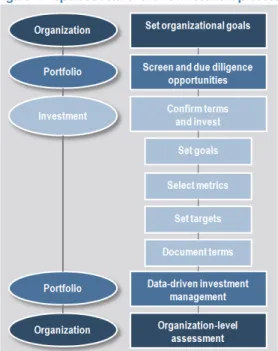
The report follows the structure of the investment process, as shown in Figure 4, and we use this structure to highlight
perspectives at each of the organization, portfolio and investment levels.
Source: J.P. Morgan.
Set organizational goals
Develop the impact thesis as a tool for screening opportunities
Impact investors allocate capital towards positive social and/or environmental change. Many investors articulate a specific “impact thesis” or “theory of change” they wish to support through their capital. Some investors utilize a single overarching impact thesis for their portfolio; while others operate across several impact theses, with different portfolios for each. For most, the impact thesis serves as the mission towards which the portfolio is driving.
Make the link from the theory of change to the relevant metrics upfront A theory of change is most useful when it can be linked to the specific outputs of the intended investments. Several investors make this link upfront, either at the time of articulating their theory of change or when considering investment opportunities.
Yasemin Saltuk Global Social Finance
(44-20) 7742-6426 Impact Assessment in Practice [email protected] 04 May 2015
Screen and due diligence opportunities
Assess management’s commitment to impact and the business model link Just as impact investors balance the dual purpose of social or environmental change with financial return, it is critical to align this balanced view with the management of the investee. This alignment becomes particularly important over time when
decisions arise that put the financial and impact goals in contrast to one another. Use scorecards to rank opportunities
Several investors use scorecards to quantify the evaluation of an opportunity based on the above factors. The scorecards can be impact-specific or cover a range of impact and financial considerations. As part of our own deal assessment, we use a scorecard to evaluate both the fund manager and the types of underlying companies that the manager intends to invest in. Figure 2 illustrates the thematic areas that we assess on a weighted basis. This assessment results in a spider graph like the one shown, which can then be compared between the pre-investment state and the current state over the life of the investment. Other examples are included in the main report. Figure 2: J.P. Morgan Social Finance impact assessment
The categories of assessment used in the scorecard for pre-investment and ongoing assessment for the J.P. Morgan Social Finance Principal Investment portfolio, which is a portfolio of impact investment funds.
Source: J.P. Morgan
Evaluate impact risk along with the return potential
Investors also assess opportunities for the risk that the impact intended may not be delivered to the degree expected or that the investment will result in a negative impact. Some investors use the due diligence report to identify risks to impact delivery and rank opportunities against different impact risk considerations to determine an impact risk score.
Confirm terms and invest
Ensure relevance to the business: Plan to learn from impact data and use it Most investors we interviewed agreed that the most successful impact assessment revolves around impact goals that relate back to the business success. Not only does the output information become more useful to the running of the business, but also management at the investee is more aligned to collecting the data because of the value beyond simply reporting back to their investors. Investors can also use well-designed impact data as a management tool and feed insight gained through the process back into the management of that company or others in the future. Consider what is in investee's control and what is not
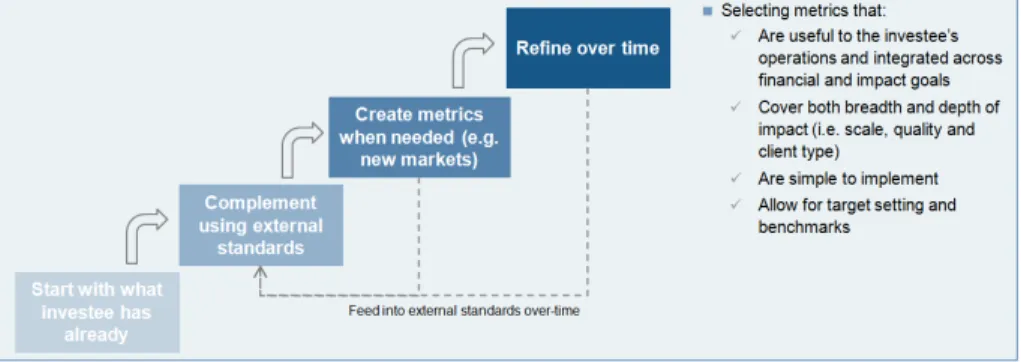
Several investors emphasized that assessment should focus on outputs or outcomes in the investee’s control. In other words, investors can ask their investees to monitor the immediate outputs of their work – like number of female borrowers – but should be more wary of committing investees to delivering or measuring more remote information – like whether those customers have increased levels of savings. Standardize core metrics, overlay individualized metrics for more detail Several investors referenced that at least some of the metrics they use are standard across all of the investments they make. Metrics that can apply across regions or sectors, though, are usually by nature higher-level or more generic measures. This does not necessarily make them less valuable, but it highlights the reason that several investors use some standard metrics across much of the portfolio, and add investment or sector-specific metrics to complement with more detail on individual deal or sector performance (Figure 3).
Figure 3: Metric selection is an iterative process
This can apply to both the investee metrics and the investor metrics
Source: J.P. Morgan.
Set targets to benchmark performance
Once metrics are selected, some investors and investees will then set numerical targets for what those metrics’ readout might be in the future. For example, investors might set the goal of one million low-income consumers reached or one thousand native-species trees planted. These numerical targets could then be used at a future time to judge whether the outputs had been achieved as planned or not.
Document impact assessment terms
While some investors prefer to keep impact targets out of legal documentation to allow more flexibility for the investee, others do utilize legal documentation of impact goals. Some confirm target outcomes in a side letter with the investee, others
Yasemin Saltuk Global Social Finance
(44-20) 7742-6426 Impact Assessment in Practice [email protected] 04 May 2015
draft covenants within the investment documents themselves that are linked directly to impact goals. Investors might also ask investees to become signatories in the UN’s Principles for Investors in Inclusive Finance or obtain a GIIRS rating, leveraging third-party tools to help cement investees’ commitment.
Data-driven investment management
Share learnings with investees, make it more than data collection
Many investors engage investees in the process of choosing the metrics by which their impact would be assessed. Further, giving investees access to the results of the assessment can align incentives along over the life of the investment and ensure that the investee sees value in thorough, efficient data collection.
Responding to poor performance
In the event of poor impact performance, investors initiate a conversation to explore the cause and gain insight into the current state of operations at the investee. Impact data can prompt this exploration, which can also reveal risks to the financial
performance. Ideally, an impact assessment results in information that informs future allocations and other market engagement strategies. Investors hope to use the outputs of their analyses in this way, though many are yet to implement this transfer of knowledge as their portfolios are still young and the information too little as yet.
Organization-level assessment
What and how an investor reports depends often on why they report. Investors that manage proprietary capital will have more discretion over their reporting, while investors that manage money on behalf of clients will need to consider the interests of their investors as well. While some investors might collect impact data on a monthly or quarterly basis, most of the investors we spoke to report the impact of their investments on an annual basis. Many of the investors featured in this report have produced public impact reports and we refer readers for examples.
Attribution
In representing impact at the level of the investor, some investors calculate the portion of their investees' impact that they feel is attributable to their portion of the funding. There were divergent views on the benefit of making such a calculation: some focus on checking that they made a contribution rather calculating the size of it, while others scale the impact they report by the proportion of capital they provided. Additionality
In social science, the term “additionality” is used to indicate that an intervention delivered an outcome that otherwise would not have occurred. Some of the most rigorous impact assessments analyze whether an intervention brought an additional result that would not otherwise have occurred. However, we found differing views on the value of assessing additionality at either the investment or the investor level. Several investors do not assess additionality, some due to cost while others are unconvinced of the value of such an assessment. Others do assess additionality to know that their capital is being used effectively, either qualitatively or quantitatively. Consider whether and how to aggregate across a portfolio
Across the investors we interviewed, few had a system in place today for aggregating the impact of a portfolio beyond simply reporting the total number of lives touched or total jobs created. Others did not see that aggregating impact data at the portfolio level would bring much value, and chose not to make the analysis.
“The more that impact measurement
makes it possible to link accurately progress in achieving social outcomes to financial returns, the more compelling impact investment will become.”
Social Impact Investment Taskforce
“Measurement should only be done if, and to the extent that it will actually influence decision-making, and the cost of measurement is not excessive compared to the significance of that decision.”
OECD
Introduction and methodology
Impact investment has gained much attention over the past few years on the promise of achieving both financial return and social impact. This simple yet powerful proposition has catalyzed a growing set of organizations and individuals across the public and private spheres. While the size of the impact investment market is still limited, both in terms of number of players and capital allocated, many encouraging trends have consistently supported its growth and positioned it for a scale-up phase over the coming few years.1
Assessment for value creation: a selection of case studies
As the industry matures, investment portfolios are generating a growing set of impact data. With this growing data set, investors are increasingly looking to move from basic impact reporting frameworks to impact assessment that creates value for management. This research is designed to help investors navigate the set of choices that define an impact assessment process by highlighting practical examples across the investment life cycle. To conduct this research, we interviewed and share the experience of twenty one practitioners of different types, from foundations to fund managers to institutional investors – bios for each organization are available in the Appendix. We also conducted a literature review and a review of investors’ published frameworks. This work resulted in sixty-eight case-studies across the different stages of the investment process, which we present here.
Figure 4: Report structure follows investment process
Source: J.P. Morgan.
An investor’s perspective across three levels
Throughout the report we will reference three levels of perspective at which impact assessment can be made and utilized by an investor: a whole organization, across a portfolio and individual investments. These can be mapped to the investment process, as shown in Figure 4, and we use this structure to organize our report. Some investors consider impact at all three levels, while others will focus on one or two more specifically.
While we present this structure as a general process that investors use, we also emphasize that investors today prioritize different parts of the process, as the case studies show. Further, this linear format does not capture the fluidity that occurs in practice across the investment process, and the iterations that investors make to their assessment frameworks based on their learning over time. Clearly impact assessment can be valuable to more stakeholders than just the investor – such as the investee or the broader marketplace – and where relevant we will specify those stakeholders. In general, though, this report considers impact assessment from the eyes of the investor.
1
For more on industry trends over recent years, see the annual J.P. Morgan/GIIN Impact Investor surveys since 2010, at www.jpmorganchase.com/socialfinance.
Yasemin Saltuk (44-20) 7742-6426 [email protected] A Portfolio Approach to Impact Investment (Oct 2012)
Global Social Finance Impact Assessment in Practice 04 May 2015
We reference assessment rather than measurement
Readers will note that we use the term “assessment” rather than measurement in much of the report. We use this term to capture the whole process of assessment, from setting goals and benchmark targets, to determining the degree of depth required from the information collected, to measuring impact against the
expectations defined at investment, to sharing the results of that measurement with stakeholders and informing future allocations.
Defining our terminology: Output vs. Outcomes vs. Impact
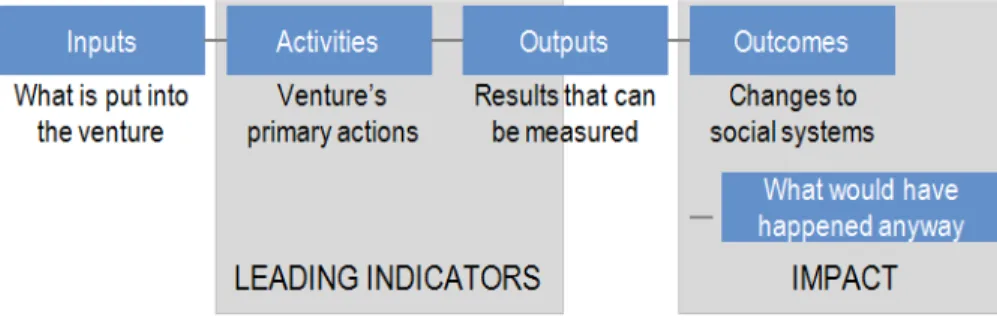
Throughout this report, we use the term "impact" to reference the environmental and social results of an investment. However, in social science, ‘impact’ has a specific definition: it describes outcomes that can be attributed to a particular intervention, as depicted in Figure 5. An academic impact evaluation, for example, might entail a multi-year study with a control group to understand what would have happened if the intervention had not taken place. This type of rigorous evaluation, including
Randomized Control Trial, would provide the greatest possible certainty that the social ‘impact’ intended had been delivered, which is powerful but also onerous and expensive in practice. Many impact investors therefore settle for measuring leading indicators like ‘activities’ or ‘outputs’ rather than running control groups to measure the ‘impact’. In this report, we do not prescribe that investors assess impact at any particular level of depth. Instead, our use of the term “impact” generally includes the leading indicators as well as the impact itself.
Figure 5: The impact value chain
Source: Rockefeller Foundation, J.P. Morgan.
Building off previous work
This report builds off of work published in A Portfolio Approach to Impact Investment (Oct 2012), which follows the path shown in Figure 6 to illustrate the practical steps impact investors take to build their portfolios. We refer readers to this complementary report for a broader approach to impact investment management. Figure 6: A Portfolio Approach to Impact Investment
Bridges Ventures: Impact assessment is part of our identity “It’s our organizing principle.
Sector focus and expertise are critical to success so a thesis-driven investor needs to measure, monitor and learn in order to be a better investor in the future: find the best deals, add value to the portfolio companies, and exit responsibly.”
Frontier Investments Group
Why assess impact?
Impact investors allocate capital with the intention to deliver a set of positive social or environmental outcomes alongside financial returns. Given the dual purpose, impact investors usually employ impact assessment as a part of their investment process. In determining their impact assessment process, investors are faced with a series of decisions including how much and what kind of data to collect, and how deep the analysis should go. In order to best understand what led the investors we interviewed to choose their current assessment frameworks, we asked them to explain why they make the assessment and how they plan to use the results.
For understanding, accountability and value creation
Determine outcomes and report to stakeholdersNaturally, most impact investors assess the impact of their portfolios to understand the effect of the organization’s work against the social and environmental goals they set, as a means of holding themselves accountable towards those goals. They may then share their findings with internal and/or external stakeholders including management, shareholders and employees of the investee or the investor. Some have commitments in place – contractual obligations or more informal agreements – to report the social or environmental outcomes in certain ways (e.g. audited by third-party evaluations) or with certain frequency.
Learn what works, and feed this back into portfolio management
Several interviewees referenced a further goal of utilizing impact assessment data to drive value creation at the level of the investee, the investor and/or the broader market. For longer-tenor investments, interim impact data can be used to refine business practices or inform strategic decision-making at the investee level. More broadly, investors can use impact data to inform future capital allocations based on which interventions have been more effective. Some investors referenced that they seek to contribute what they learned to public knowledge, and others that they utilize the evidence to support advocacy work.
Bridges Ventures views impact measurement as part of the essence of being an impact investor. In their view, an impact investor aims at contributing to solve a social and/or environmental challenge, while also ensuring that the business models it backs operate sustainably. This entails prospectively defining target outcomes as well as potential for positive and negative externalities, and then retrospectively measuring total performance.
Shell Foundation: Drive learning and resource allocation
Shell Foundation is accountable to their Board and develops yearly plans with 10 indicators to judge performance and success. Shell Foundation has a strategic approach to impact assessment and views it as a driver of resource allocation and learning for subsequent projects. Hence, the Foundation prefers to track and measure changes in performance against pre-defined milestones and impact targets – both developmental and financial – and believes that eventually, impact assessment will be a source of value creation for impact businesses.
J.P. Morgan: Build experience towards creating a client platform
Yasemin Saltuk Global Social Finance
(44-20) 7742-6426 Impact Assessment in Practice [email protected] 04 May 2015
The impact investment portfolio at J.P. Morgan, like our research, was established to explore the market and provide the firm with the experience to build the appropriate client engagement strategy. Allocating capital has built our experience of the investable set of opportunities in the market, and managing the portfolio has contributed invaluable lessons in balancing financial and impact goals side by side, and translating impact assessment into a management tool for value creation.
TIAA-CREF: Assess for transparency and learning
TIAA-CREF assesses the impact of their investments for several reasons: (i) To evaluate the program against the intentions with which the investment was made; (ii) To encourage transparency with their investees and pass this through to their own stakeholders; (iii) To evaluate efficacy and identify trends that could be used in determining future capital allocations; and (iv) To provide reporting to stakeholders.
IGNIA: Using impact assessment to confirm the vision to self and to investors IGNIA's mission and vision is to build a more equitable life for families at the base of the socio-economic pyramid by providing financial and strategic support to high growth enterprises with a social impact. IGNIA considers impact assessment as a necessary exercise to confirm this vision to itself and also to its investors and stakeholders.
Turning to the investment process and case studies
With the background of why investors make these assessments, we now turn to how they make the analysis. In the next section, we begin to present the case studies collected across different investors, at different points across the investment process. Throughout the document, we use symbols to highlight:
= General case studies,
=
Case studies on staffing various aspects of the work, and= Debated viewpoints.
These case studies color the analysis throughout the report. We now begin to present the impact assessment process along the path of the investment process.
Omidyar Network: Unlocking new business models “A well-founded institution with an
articulated mission that adopts best practices will lead to a better run, sustainably profitable, better investment.”
MicroVest
Set organizational goals
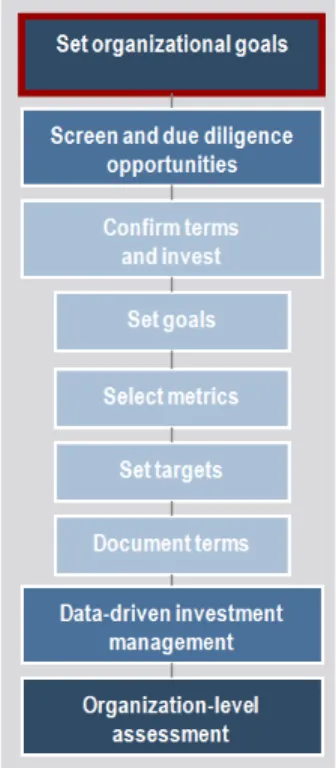
Once the rationale for assessment is clear, the process of developing a framework begins. We will remind the reader where we are in that process throughout the document by referencing the structural diagram at left. We start at the organizational level with setting organizational goals.
Build an impact thesis
Impact investors allocate capital towards positive social and/or environmental change. Many investors articulate a specific “impact thesis” or “theory of change” they wish to support through their capital. Sample impact theses include: “To empower underserved individuals at the Base of the Economic Pyramid, by selling innovative products that enable access to basic goods or services;” “To provide financial services to the urban and rural poor, building financial literacy and pride among women;” or “To address growing energy needs through scalable, sustainable energy solutions.” These statements help to unite the portfolio around a goal against which the portfolio outcomes can then be assessed and towards which the
investments can be managed.
Develop the impact thesis as a tool for screening opportunities
Some investors utilize a single overarching impact thesis for their portfolio; while others operate across several impact theses, with different portfolios for each. For most, the impact thesis serves as the mission towards which the portfolio is driving. Beyond being used as a first screen for opportunities, a theory of change can also help an investor decide between two models of impact within a given sector.
Omidyar Network has an organization-level theory of change focused on unlocking innovative business models that can scale positive impact. As explained in an article published jointly with Accion Venture Lab, Omidyar believes this scale can be delivered through both direct and indirect means, illustrated in Figure 7. As the figure shows, Omidyar assesses the systemic change that their investees inspire through such things as consequent funding rounds led by new investors or increased competitive behavior inspired by the investee’s work. Their assessment thus includes the broader systemic change that occurs beyond the individual investment.
Figure 7: Omidyar Network and Accion reference five pathways to impact at scale
Root Capital: Assess the impact of our lending, and the impact of our clients
Christian Super: Develop a thesis to help choose between business models
Ford Foundation: Use investments to enhance programmatic goals
Yasemin Saltuk Global Social Finance
(44-20) 7742-6426 Impact Assessment in Practice [email protected] 04 May 2015
Root Capital’s lending is directed towards “the missing middle” of developing-world finance, targeting businesses that are too big for microfinance and generally unable to secure credit from conventional commercial banks. Root Capital considers their impact on two levels: (i) the impacts of their lending and financial management training on clients; and (ii) the impacts of their clients on the incomes (and
environmental practices) of the small scale farmers who supply them. They believe their impact is greatest when they support clients that are growing rural prosperity and could not do so without access to finance and/or training from Root Capital.2
For Christian Super, a theory of change can help in choosing between two similar opportunities that implement different models. For example, an investor comparing an opportunity to invest in affordable private schools against an opportunity to invest in a student loan provider might choose the latter if financial inclusion is a part of their overall mission. If educational outcomes are key, then the control afforded by investing directly into schools might be more attractive. The overarching principle is that given an acceptable financial return, Christian Super chooses investments that can best leverage institutional funding to maximize impact, acknowledging that some opportunities are best suited for other types of funding.
The Ford Foundation has historically extended the majority of its investments to existing grantees or affiliates of grantees. With program alignment in place, and even some of the programmatic goals already defined, the impact assessment for their investments can build off established work. The Foundation has intentionally used PRI capital to scale up a program or catalyze something new, with the goal to leverage other capital, other partners or expand into new geographies for example.
Consider how the intended impact will be assessed
Make the link from the theory of change to the relevant metrics upfront A theory of change is most useful when it can be linked to the specific outputs of the intended investments. Several investors make this link upfront, either at the time of articulating their theory of change or when considering investment opportunities.
Moore Foundation: Using nested strategies across impact theses
The Moore Foundation operates across several theories of change and takes a nested approach to assessing their programs for each theory of change (Figure 8 and Figure 9). As illustrated below, one theory of change is that maintaining 70% forest cover in the Amazon basin will mitigate climate and hydrology impacts; another is that preserving the ecosystem for wild salmon in the Pacific Northwest will support the population of fish in the region.3 Then, within each program there are several strategies for operationally delivering against that theory of change – the figures below show one such strategy for each as an example. Finally, specific indicator metrics are defined for each theory of change and used to determine progress towards
2
http://www.rootcapital.org/our-impact-version-2.
3
Benchmarks referenced in their high-level targets such as the 70% forest cover referenced above are determined by scientific consensus that breaching that level will result in major repercussions on hydrology and climate.
the overarching goals. Once this framework is in place, the Moore Foundation then looks for investment opportunities that are measurable by those indicators so that impact can be assessed and linked back to the overarching theory of change. Figure 8: Moore’s Deforestation Figure 9: Moore’s Wild Salmon Ecosystem preservation
Strategy and metrics shown are just one example Strategy and metrics shown are just one example
Source: The Gordon and Betty Moore Foundation.
Figure 10: Big Society Capital Outcomes Matrix
See Appendix
Source: Big Society Capital. Available at
www.bigsocietycapital.com/outcomesmatrix
Source: The Gordon and Betty Moore Foundation.
Big Society Capital: Develop an outcomes matrix
The outcomes matrix, shown in Figure 10 and in Appendix, is a tool to help social investment financial intermediaries (SIFI’s) and social sector organisations to plan, measure and learn about their social impact. It aims to develop common ground and language for social investment and impact assessment in the social sector.
The outcomes matrix represents a map of need in the UK. It has been designed from a beneficiary perspective and includes nine outcome areas which reflect what a person needs to have a full and happy life. The outcomes and measures are not intended to be prescriptive or exhaustive but should provide a helpful starting point for organisations to consider their social impact. Each outcome area is split in to changes at the individual level and changes for community, sector and society. Use ratios to track relative performance over time
Implicit in the term "impact" is the idea that a comparison needs to be made between two states: things as they were at the start, and things as they evolve over time. Investors are increasingly incorporating relative comparison in their impact assessment in different ways. Some investors set targets on specific metrics with individual investees, as we explore below. Others track changes in ratios such as grant funding required per unit of impact to assess how, over time, their contribution brings early-stage organizations closer to financial sustainability.
Shell Foundation: Use ratios to check progress towards financial sustainability The Shell Foundation's goal is to catalyze the innovation and scale-up of disruptive new models and technologies that can ultimately transform the lives and livelihoods of many millions of people. The Foundation focuses on measuring its own
performance and its partners’ progress towards sustainability and large-scale impact, and this is measured by the change in subsidy required per impact delivered. Figure 11 illustrates the path that Shell Foundation would like to see for its grantees, with lower subsidy required for the enterprise as it grows towards operating at scale.
Yasemin Saltuk Global Social Finance
(44-20) 7742-6426 Impact Assessment in Practice [email protected] 04 May 2015
Figure 11: Shell Foundation’s metric for catalyzing scale: lower grant per impact over time
The Foundation’s goal for grantees is that subsidy required per impact reduces as scale increases.
Source: Shell Foundation.
From the outset, Shell Foundation supports partners in defining a few key metrics specific to their own enterprise. Wherever possible, they also draw upon independent monitoring and evaluation to validate reported data. Partners track and measure a wide variety of development outcomes including:
Low-income customers served, e.g. through product sales or bus ridership; Environmental benefit, e.g. reductions in emissions or water usage; Economic benefit, e.g. jobs created, earnings increase, money saved; Social benefit, e.g. improved health or time saving.
The Foundation also tracks progress to financial sustainability through monthly and quarterly financial reporting as well as performance ratios including subsidy per product sold. Regularly tracking performance against projected targets helps Shell Foundation to better understand the overall business, respond quickly to unexpected challenges and improve the effectiveness and efficiency of their support over time. Figure 12 shows the performance of one of Shell Foundation’s partners – Envirofit – with the cumulative sales increasing in line with decreasing subsidy per stove. Figure 12: Shell Foundation’s measure of Envirofit’s pathway to scale
Cumulative sales in millions vs. subsidy per stove required over time.
The Rockefeller Foundation: From ad hoc negotiations to a standard process
It’s an iterative, dynamic process
Many investors reflected that their impact assessment process is a live tool that will continue to be refined over time. Some investors maintain a broad impact thesis that allows them to be more opportunistic when reviewing investment opportunities. Others adopt from the beginning a specific impact thesis that narrows their scope and filters opportunities. Several investors we interviewed have shifted from the former approach to the latter as their portfolios (and the market) matured.
The Rockefeller Foundation has been making impact investments for more than three decades. The process of structuring the African Agricultural Capital Fund, however, was a turning point in terms of the Foundation’s social impact data collection. While negotiating that transaction, the Foundation was able to learn new methodologies from other socially minded co-investors regarding impact assessment at the time of investment.4 Since then, the Foundation has shifted from an ad hoc discussion with investees post-investment to a more standard process of agreeing metrics and targets as part of the deal terms.
Esmée Fairbairn: Become more specific, work with co-investors, consider risk Esmée Fairbairn Foundation's older deals can have target outcomes that are difficult to objectively measure, such as “A positive contribution to families.” Over the years, the foundation has shifted toward using more specific, evidence-based impact goals, working together as much as possible with their co-investors to define them.
Staffing the methodology design
With impact investors each defining an impact thesis for the portfolios they build, it follows that impact assessment methodologies need to be quite tailored to each organization. As we have seen there will be considerations as to what needs to be assessed at the deal, portfolio and organizational levels, as well as how to consider the different sectors, regions, instruments, business stages, deal sizes and impact goals pursued across the portfolio(s).
Building assessment capability into the investment team vs. dedicated resources Many investors assign the specific task of designing a methodology to an
individual(s) who engages with external stakeholders and works across the organization to ensure consistency. In some cases, this person is part of the core investment team, and this methodology design is one of their roles. In other cases, where there is more need, more resources, or a dedicated funding source, there can be a function focused exclusively on impact assessment.
Moore Foundation hires industry experts to ensure they have in-house a deep knowledge of the sectors they operate in and the outcomes they might affect. As such, they utilize these internal experts to build the strategy and tap external feedback to ensure they leverage the broader dialogue.
4
See Diverse Perspectives, Shared Objective: Collaborating to Form the African Agricultural Capital Fund, GIIN, June 2012.
Yasemin Saltuk Global Social Finance (44-20) 7742-6426 Impact Assessment in Practice [email protected] 04 May 2015
offices. The team develops the impact assessment methodologies, including the design of deal diligence templates that the investment teams use. The group provides both internal advice to colleagues on specific deal situations and also works directly with Acumen’s investees to help them measure and manage toward higher social impact performance. The team is also responsible for external engagement and thought leadership on the topic.
Packard Foundation: Use third-party evaluators to help assess an impact thesis
In some cases, the Packard Foundation has used external evaluation consultants for a deeper assessment of an impact hypothesis, such as whether positive reproductive health outcomes for women could be achievable through a microfinance investment.
Acumen: Build an impact “lab” to advise deal teams and investees
The Rockefeller Foundation: Evidence commitment to impact for PRIs
MicroVest: Score opportunities on both impact and credit
Screen and due diligence opportunities
Once the theory of change is in place, investors conduct a due diligence process to screen and assess opportunities against their criteria. In this section, we share the highlights of the processes used for deal review by the organizations we interviewed.Evaluate the organization and management
Assess management’s commitment to impact and the business model link Just as impact investors balance the dual purpose of social or environmental change with financial return, it is critical to align this balanced view with the management of the investee. This alignment becomes particularly important over time when
decisions arise that put the financial and impact goals in contrast to one another. Investors need to know that the management team will respond to such situations with the right motivation and commitment to the dual purpose with which they secured funding.
Program-related investments (PRIs) are a category of investments that references the US tax law for foundations. Essentially, US-based foundations need to distribute a minimum of 5% of their assets each year to charitable purposes in order to maintain charitable status. Although investments rather than grants, PRIs qualify as part of this distribution requirement if, amongst other things, clear social objectives and
charitability is evidenced. As such, due diligence involves verification of
management’s commitment to generating impact, as well as that the generation of impact is a material focus of the business.
Acumen: Use of evidence in the “lightning lit review”
For any new investment, Acumen works with its companies to develop an impact thesis based on a theory of change. The thesis assesses potential impact across three components: breadth, depth and poverty focus (the proportion of poor customers reached). As part of this process, Acumen employs what they call the “lightning lit review” to uncover external sources of evidence that help identify key assumptions underlying their thesis, what the counterfactual might be, as well as understand and plan to mitigate impact risk – those factors that might cause a product or service to have less impact than expected or cause negative impact.
Use scorecards to rank opportunities
Several investors use scorecards to quantify the evaluation of an opportunity based on the above factors. The scorecards can be impact-specific or cover a range of impact and financial considerations. Several tools are in the public domain, and we reference a few in appendix.
MicroVest utilizes a scorecard that ranks opportunities on 24 categories that feed up into 4 high-level indicators, which produces an impact score for each opportunity. The team then assesses the opportunity by both the impact and the credit score. The impact score informs MicroVest’s decision on Character, the most important factor for MicroVest’s 3C’s credit scoring methodology – Country, Character and Credit. For MicroVest, the due diligence conducted on impact is critical as the company
J.P. Morgan: Analyze both fund managers and portfolio companies
Big Society Capital: Use tests and thresholds Yasemin Saltuk
(44-20) 7742-6426
Figure 14: Big Society Capital Tests and Thresholds
Used to assess financial intermediaries that BSC will invest in
Source: Big Society Capital. Available at
www.bigsocietycapital.com/our-approach
Global Social Finance Impact Assessment in Practice 04 May 2015
relies more on this upfront assessment than on ongoing reporting given the relatively short tenor of its loans.
As part of our own deal assessment, we use a scorecard to evaluate both the fund manager and the types of underlying companies that the manager intends to invest in. Figure 13 illustrates the thematic areas that we assess on a weighted basis. This assessment results in a spider graph like the one shown, which can then be compared between the pre-investment state and the current state over the life of the investment. Figure 13: J.P. Morgan Social Finance impact assessment
The categories of assessment used in the scorecard for pre-investment and ongoing assessment for the J.P. Morgan Social Finance Principal Investment portfolio, which is a portfolio of impact investment funds.
Source: J.P. Morgan
Big Society Capital’s mission is to grow the social investment market. Central to this role is the delivery of greater social change and impact as a result of invested capital. In their role as a wholesale investor, they look to ensure that social value is delivered both at the intermediary level and at the underlying enterprise level, and that they can evidence that social value to increase the confidence and engagement of other investors in the social investment market. The table referenced in Figure 14 illustrates the full tests and thresholds that they use to assess the social impact performance of intermediaries and with which those intermediaries will assess the performance of the frontline organisations that receive Big Society Capital’s money.
Root Capital: Score all and dive deeper on some
IGNIA: Leverage development banks’ processes
Figure 15: Root Capital Due Diligence Scorecards
Social and Environmental scorecards are publicly available; Social scorecard is in appendix for reference as an example.
Source: Root Capital.
Available at www.rootcapital.org/our-impact-version-2
Root Capital lends and provides financial management training to agricultural businesses. These businesses typically support producer livelihoods and ecosystems in one or more of the following ways: i) Increasing prices to producers and wages to employers; ii) Increasing producer productivity, and; iii) Increasing stability of producer income. To the extent that a cycle of mutually beneficial relationships – as illustrated in Figure 16 – can be achieved in a smallholder-based value chain, that value chain will be more secure, resilient, and sustainable – and thus more
creditworthy. When making investments, Root Capital assesses all opportunities with the respective social and/or environmental scorecards shown in Figure 15. In cases where initial S&E due diligence indicates areas of concern, Root Capital also conducts further research on those areas before investing. Sometimes Root Capital will do this in-house, and sometimes they will hire an environmental consultant to do so. Once investments are made, Root Capital will then select 20-25% of the portfolio that will undergo a deeper assessment during the life of investment.
Figure 16: Root Capital's "Mutually Beneficial Cycle"
Source: Social and Environmental Due Diligence, Root Capital.
Align with co-investors’ or peers’ processes
The collaborative nature of the impact investment market brings investors to share pipeline opportunities and also process around diligence and impact measurement (as evidenced here). Some investors referenced that they have utilized other investors’ templates in designing their own.
IGNIA has a rigorous due diligence process for making investments, part of which centers on assessing the social and environmental impact of the business. Among the various documents used in its diligence are: (i) an overall checklist; (ii) a template for desk research; (iii) a template for a one-day review and (iv) an exclusion list. IGNIA also does field visits and builds a relationship with the business before investing. In designing the social impact assessment part of the due diligence process, they collaborated with both the International Finance Corporation and the Inter-American Development Bank to incorporate their requirements as investors.
Bridges Ventures: Assess impact return potential and risk
Yasemin Saltuk Global Social Finance
(44-20) 7742-6426 Impact Assessment in Practice [email protected] 04 May 2015
Evaluate impact risk along with the return potential
Investors also assess opportunities for the risk that the impact intended may not be delivered to the degree expected or that the investment will result in a negative impact. Some investors use the due diligence report to identify risks to impact delivery and rank opportunities against different impact risk considerations to determine an impact risk score.
As in financial analysis, understanding the impact risk of an investment is as important as understanding its potential for impact return. Bridges makes this assessment through their Impact Radar tool, shown in Figure 17. Impact risks can take various forms. For example, there may be a lack of evidence than an
intervention will lead to the desired outcome. Even if the intervention is successful, the investment could cause displacement of other good outcomes, leading to a reduced or no net benefit. Or, the investment may create positive change for its target beneficiary but a negative change for other stakeholders, which reduces or
undermines its impact.5 Figure 17: Bridges IMPACT Radar
Source: Bridges IMPACT Report: A Spotlight on our Methodology, Bridges Ventures, 2014. ESG = Environmental Social Governance. Root Capital: Check whether an intervention will displace something of value Root Capital also assesses the risk that the business they finance might displace current positive impacts in the area or the population affected. In one case, the team considered an opportunity to fund a Ugandan chili smallholder farmer aggregator business. While the social impacts were clear, the team needed to check whether there might be any negative environmental impacts before committing to the deal. They needed to confirm that the farming would not significantly displace habitat for native species or cause other disruption to the area.
5
Bridges Ventures: Impact assessment throughout the investment process
Balance initial due diligence versus ongoing monitoring
Several lenders referenced that short-term loans with tenors of six months or one year justify heavier reliance on pre-investment diligence than ongoing monitoring. Other investors referenced that they prefer to use a deep diligence assessment pre investment to determine the mission of the investee and ongoing monitoring mainly to ensure no drift away from mission identified and confirmed in diligence.Across all the funds managed by Bridges Ventures, they use the three-stage SET process, illustrated in Figure 18, which integrates impact analysis into the full investment cycle. This starts with selecting opportunities for impact, then over the life of the investment engaging the portfolio companies to optimize their positive footprint and tracking this performance.6
Figure 18: Bridges ‘SET’ Process
Source: Bridges IMPACT Report: A Spotlight on our Methodology, Bridges Ventures, 2014.
Root Capital: Use social and environmental diligence in credit evaluation As referenced above, Root Capital developed Social and Environmental Due Diligence Scorecards that are used by loan officers as part of the credit evaluation process for each client (see Appendix). For short-term trade credits with tenors of 6 12 months, Root will perform thorough due diligence without further monitoring during the life of the loan. Since most borrowers renew their loans the following year, Root Capital conducts another round of social and environmental due diligence at that time.
6
Yasemin Saltuk Global Social Finance
(44-20) 7742-6426 Impact Assessment in Practice [email protected] 04 May 2015
Table 1: Rating agencies and data providers
ESG-focused Eiris MSCI Oekom Sustainalytics Impact-focused GIIRS MicroRate Source: IRIS.
“If there is a problem with achieving impact, there is probably a problem with financials as well, so it doesn’t make sense to separate the impact monitoring”
The Rockefeller Foundation.
Use public information when available
Reference third-party or public information where available
Impact rating tools have developed across different providers over recent years. Today, there are several agencies that assess the environmental, social and
governance considerations and impact potential of companies or funds (see toolbox). Investors who use ratings generally use them as a first indicator of the quality of an opportunity. The increased research coverage of the impact investment marketplace has also resulted in a set of public information available on many private companies and funds available to investors.
MicroVest: Leverage third-party data for smaller or shorter-term loans Where available, MicroVest will consider third-party ratings as a part of their analysis of an opportunity. While they will always form an in-house view on opportunities with their own diligence and analysis, their analysis may rely on third-party data sources and desk research for larger institutions or in the case of shorter-term or small transactions such as placing deposits with a Mongolian bank.
Staffing due diligence for impact
Arm investment teams with impact diligence tools for an integrated approach Once the methodology is developed, most investment teams implement that methodology for deal diligence and performance review. Investors referenced two key reasons to ask investment teams to perform the deal-level diligence and performance monitoring rather than assigning it to a separate impact-focused member of staff. Firstly, investment teams are closest to the opportunities, and best placed to evaluate management’s motivation and commitment to impact through on-site due diligence. Secondly, asking the investment team to diligence both impact and financial potential ensures the use of an integrated lens to check that investees’ goals are aligned. Thirdly, investors might not have the resource for a separate full-time or even part-time professional.
At Root Capital, the responsibility for collecting diligence on impact questions for the borrower lies with the loan officer, who does so based on on-site due diligence and completes a scorecard based on his or her findings. Then, the officer reviews the scorecard together with the impact team and the credit committee.
Pearl Capital Partners’s African Agricultural Capital Fund is USD 25 million in size. The management fee earned on the fund is by consequence limited in covering deep impact assessment work. As such, the investors and manager agreed at the time of establishing the fund that two of the investors would fund some of the deeper assessment work, leaving the manager to focus on identifying, diligencing and managing the companies that they feel have financial and impact potential.
Root Capital: Loan officer diligences, impact team and credit committee review
LeapFrog: Develop an integrated framework
Confirm terms and invest
Having defined the process with which to screen opportunities for impact to match the organizational goals, we now turn to making investments and show how investors today are setting goals, selecting metrics, setting targets and documenting terms at the investment level.
Set investment goals and develop the assessment process
Ensure relevance to the business: Plan to learn from impact data and use it Most investors we interviewed agreed that the most successful impact assessment revolves around impact goals that relate back to the business success. Not only does the output information become more useful to the running of the business, but also management at the investee is more aligned to collecting the data because of the value beyond simply reporting back to their investors. Investors can also use well-designed impact data as a management tool and feed insight gained through the process back into the management of that company or others in the future. Consider what is in investee's control and what is notSeveral investors emphasized that assessment should focus on outputs or outcomes in the investee’s control. In other words, investors can ask their investees to monitor the immediate outputs of their work – like number of female borrowers – but should be more wary of committing investees to delivering or measuring more remote information – like whether those customers have increased levels of savings.
LeapFrog tracks and drives both profit and purpose performance through its in-house measurement framework, FIIRM, laid out in Figure 19. FIIRM – Financial, Impact, Innovation and Risk Management – is an integrated assessment tool tailored to financial services, developed by LeapFrog’s team of insurance and financial service professionals. The framework incorporates financial and operational key
performance indicators (KPIs) and governance indices benchmarked to global best practice standards.
Figure 19: Leapfrog’s FIIRM Profit with Purpose measurement framework
Bridges Ventures: Differentiate between commercial and social funds
Packard Foundation: Make impact assessment as rigorous as financial review
Yasemin Saltuk Global Social Finance
(44-20) 7742-6426 Impact Assessment in Practice [email protected] 04 May 2015
Frontier Investments: Take an Agile approach
Frontier utilizes a theory from the software development world: the Agile approach. Similar to software packages, impact measurement systems can be beta-tested and continually refined to learn what is effective, rather than attempting to develop a complete framework from day one. Frontier takes an Agile approach to impact assessment, which allows them to identify the minimum viable product (e.g. the core indicators they want to measure) and iterate. In this way, they find quick hit ways to establish a system that adds value for the portfolio company as well as the investors, and deepen it as they go.
For all Bridges’ funds, the team starts by identifying areas where a societal or environmental challenge creates an investable opportunity to deliver positive outcomes, across four common impact ‘themes’: health & well-being, education & skills, sustainable living and underserved markets. But the funds differ in the types of business model they back to deliver these outcomes and the level of risk-adjusted financial return they generate. Bridges Sustainable Growth Funds and Property Funds back for-profit business models where the team assesses that the potential to generate competitive financial returns is inextricably linked to the generation of positive social or environmental impact. In these cases, impact analysis supports commercial decisions. Bridges’ Social Sector Funds are dedicated to business models that may entail a below-market financial return for investors for the sake of impact, such as social impact bonds, mission-locked businesses or asset-locked models.7 In these cases, impact analysis can dictate commercial decisions in order to optimize impact.
Decide how deep to go, and how much of the portfolio to cover
Investors consider the depth of assessment they want to make in conjunction with consideration for the affiliated costs. One approach we found makes a deeper analysis of a new impact hypothesis before any individual deals are considered. Then once the hypothesis is supported by evidence, the investor can apply that finding to the assessment of deals with that goal. Another approach applies a deeper assessment to only some investments, which can then be extrapolated to others.
Packard Foundation relies on its program officers to be industry experts and “impact experts” for evaluating all new investments given those program staff’s deep knowledge of the nuances of their diverse fields, from climate change mitigation to sustainable seafood supply chains to reproductive health pharmaceuticals to early childhood education. This makes it less dependent on financial investing staff and external advisors for its impact assessment. In doing this, the Foundation is able to have a robust understanding of the impact of its work across its portfolios.
7
“Mission locked” businesses utilize legal structures to ensure outcomes and beneficiary groups are protected against mission drift through such things as having an executive for impact, or having a use of funds clause linked to the social purpose. “Asset locked” businesses restrict the distribution of financial value to investors (such as limiting dividend distribution) to ensure the intended beneficiaries and outcomes are protected. Each type of lock is relevant for different organizations in different circumstances.
Pearl Capital Partners: Set informed targets, and dive deep on a subset
Pearl Capital Partners, in discussion with the investors, established the African Agricultural Capital Fund’s (AACF) portfolio-level targets of improving the lives of at least 250,000 smallholder farmer households and helping them realize an increase of USD 80 in annual income within five years of investment. The assumptions originate from an evaluation of the social impact achieved by five investees of Pearl Capital Partners' first fund. In order to assess performance against these goals, the manager formally tracks progress annually and two investors plan to commission an external third-party impact assessment to examine a subset of AACF’s investments. They will use the data to learn about the potential investments targeting agricultural SMEs to improve the lives of smallholder farmers.8
LeapFrog: Drive outputs and outcomes
Leapfrog’s FIIRM framework drives businesses around quality Profit with Purpose outputs and outcomes such as underserved customer scale and the quality of the products that ensure customer understanding. Leapfrog sets impact targets for company outputs that align to stated Fund targets, then benchmarks success against what they set out to achieve. Customer outcomes can be analyzed using FIIRM KPIs and direct customer feedback. This is illustrated in Figure 20.
Figure 20: Leapfrog drives businesses around measureable outputs and outcomes
Source: Ernst & Young.
8
See Diverse Perspectives, Shared Objective: Collaborating to Form the African Agricultural Capital Fund, GIIN, June 2012.
IGNIA: Use 15 common metrics across whole portfolio, add when needed
Frontier: Use common categories across portfolio, then individualize metrics
Yasemin Saltuk Global Social Finance
(44-20) 7742-6426 Impact Assessment in Practice [email protected] 04 May 2015
“The best indicators have an impact on the business”
IGNIA
Select metrics
Standardize core metrics, overlay individualized metrics for more detail Several investors referenced that at least some of the metrics they use are standard across all of the investments they make. Metrics that can apply across regions or sectors, though, are usually by nature higher-level or more generic measures. This does not necessarily make them less valuable, but it highlights the reason that several investors use some standard metrics across much of the portfolio, and add investment or sector-specific metrics to complement with more detail on individual deal or sector performance.
Start with what investee proposes and iterate, working with co-investors When selecting metrics for a given deal, many investors take the lead from their investees as to which specific indicators to use and how to go about collecting the data, whether the investee is an operating company or a fund manager. Investors acknowledged the burden placed on investees and work to ensure that investees are supportive of and see value in the process being put in place.
Figure 21: Metric selection is an iterative process
This can apply to both the investee metrics and the investor metrics
Source: J.P. Morgan
IGNIA has identified 15 common metrics (based on IRIS) that the fund seeks to measure across its portfolio on an annual basis. These metrics are linked to corporate governance, policies & procedures, and products provided by investee companies. Examples include: employee wages, units sold, units produced, and health care coverage. As an organization managing money on behalf of others, their investors can also have a voice in their impact reporting. In select cases where their investors request more detail than the standard metrics provide, IGNIA prepares additional social impact reports.
Frontier has identified three key categories of indicators for each investee, laid out in Table 2. This assessment includes both qualitative and quantitative measures across three categories of impact: Access, Quality and Market. For each category, Frontier articulates the components and key performance indicators (KPIs) that comprise the assessment of performance within that category, a few examples of which are illustrated below. Frontier collects KPIs on a performance dashboard every month, including both the financial and the impact indicators.
MicroVest: Differentiate between debt and equity funds; consider size
Ford Foundation: Reference grant metrics, charitability covenants and leverage Table 2: Frontier indicator categories
Indicator category Sample Components Sample key performance indicators
Access
(Direct impact) Client base demographics Distribution mechanics Extent of outreach
Client profile
Number of points of sale by location Number of beneficiaries/lives touched Transaction volume and value Quality
(Direct impact)
Markets (Indirect impact)
Product diversity and fit Customer usage and treatment Affordability Governance Sector Innovation Talent Scale
Product breadth and transactions by type Pricing structure by product compared to market Frequency of product usage
Processing times and complaints ratio Independents on board
Evidence of financial sector deepening e.g. market pricing, competitor landscape
Additional capital attracted
Number of related and complementary innovations
Source: Frontier Investments Group.
Tailor reporting requested based on the amount or type of funding contributed When negotiating reporting requirements, several investors take the size and type of their investment capital into account. For smaller shorter-tenor loans, for example, impact assessment requests to investees are less onerous than might be justifiable for a larger, longer-term equity investment.
MicroVest manages both debt and equity funds. Recognizing that they will have less influence over investees as lenders than as equity investors, the debt funds mostly follow the investee's goals. By contrast, the equity fund managers will be more involved in setting the company strategy. They also acknowledge that larger investments enable them to have a louder voice in working with investees to set goals.
Ford Foundation uses program-related investments to advance the grant-making initiatives. Because of this program alignment, where relevant, Ford Foundation embeds the same metrics for a PRI as would be used to determine the programmatic success of a grant. Additional metrics for PRIs often relate to charitability or the ability to achieve leverage from other investors.
Table 3: Thematic metric sets for different sectors Leverage existing sector-specific metrics; create metrics if needed
B Impact Assessment (and GIIRS Rating) Aligned Metrics Community Banking Metrics
GRI G4 Sustainability Reporting Guidelines Harmonized Indicators for Private Sector Operations Health Metrics
Impact Employment Metrics Land Conservation Metrics
Metrics for Investments in Early-Stage Enterprises Microenterprise Metrics
Microinsurance Metrics
Small and Growing Business Metrics Social Performance Metrics for Microfinance Sustainable Agriculture Metrics
For some sectors, there is a more developed universe of metrics from which to choose, and investors leverage established frameworks where possible. Table 3 shows the metric sets featured on the IRIS website.
Packard and Moore Foundations: Creating conservation metrics In the conservation finance sector, the Packard Foundation and Moore Foundation recognized that there were very few metrics to measure conservation outcomes of investments in the field. The foundations partnered with metrics organization IRIS to develop a standard set of metrics for conservation outputs with input from a cohort of conservation investors and investees, which is now available to investors in the field.
Pearl Capital Partners: Set targets for KPIs at the time of investment
Ford Foundation: Use deal-specific context rather than third-party or other
Yasemin Saltuk Global Social Finance
(44-20) 7742-6426 Impact Assessment in Practice [email protected] 04 May 2015
“Establish utilization
benchmarks so that we know if demand hasn’t materialized as anticipated.”
Ford Foundation
Set targets to benchmark performance
Once metrics are selected, some investors and investees will then set numerical targets for what those metrics’ readout might be in the future. For example, investors might set the goal of one million low-income consumers reached or one thousand native-species trees planted. These numerical targets could then be used at a future time to judge whether the outputs had been achieved as planned or not.
Setting targets for key performance indicators at the time of investment helps to drive the investee towards set goals, and helps the stakeholders to contextualize the performance of their investment once the evaluation is made. Rather than assessing and reporting the number of consumers reached as an absolute figure, they will be able to make an assessment relative to a benchmark. Several investors reported using this type of approach, and mostly use the investee’s own targets in doing so. The need for data in setting informed targets means that this approach is still fairly new and under development even for those that use it.9
As referenced above, Pearl Capital Partners structured the African Agricultural Capital Fund together with the investors. The group articulated a common goal that the fund’s investments should improve the lives of at least 250,000 smallholder farmer households, and that within five years of the fund’s investment, each affected household should realize an increase of at least USD 80 in annual income. The investors and fund manager acknowledge that the targets are based on scientifically untested assumptions. However, they provide guidance to the fund manager as it evaluates potential investments and establish investment-level social performance goals that work toward the fund’s portfolio-level targets.
Ford Foundation assesses impact performance against targets set at the time of investment. For this assessment, Ford’s most meaningful targets are set in the context of the specific deal in consideration, rather than purely based on third-party statistics or even other investments. These targets help to judge impact performance.
9
Setting informed targets based on benchmark data can be challenging for some sectors, regions or impact goals, and in certain instances investors may prefer not to establish benchmarks because the lack of data would make them fairly arbitrary.
Packard: Document the impact metrics to be used in assessment
Esmée Fairbairn: Make follow-on funding dependent on impact reporting
“We work with our fund
managers to determine target outcomes and document these in a side letter.”
Christian Super
Document impact assessment terms
While some investors prefer t