Ogata, H. et al. (Eds.) (2015). Proceedings of the 23rd International Conference on Computers in Education. China: Asia-Pacific Society for Computers in Education
Data Sharing for Learning Analytics –
Questioning the Risks and Benefits
Tore HOELa* , Jon MASONb & Weiqin CHENa
aOslo and Akershus University College of Applied Sciences, Norway
bInternational Graduate Centre of Education, Charles Darwin University, Australia *[email protected]
Abstract: Moving learning analytics from the research labs to the classrooms and lecture halls requires data sharing. Data are not any longer gathered in controlled settings but have to be combined from different sources within the institution and maybe beyond. This scaling up of learning analytics raises a host of questions on behalf of the data subjects providing requirements for design of new solutions and practices. This paper analyses a corpus of more than 200 questions gathered by a European learning analytics support action and explores how these questions could be used to understand the problem space of data sharing and the solution space to be carved out by research and development within this emerging field of learning technologies. The paper concludes the discussion on data sharing and big data for education is still at an early stage, where conceptual issues dominate and there is a long way to go before one can move towards solving issues of technical development and implementation.
Keywords: learning analytics, interoperability, questioning
1.
Introduction
We are now living in an era in which data is proliferating at extraordinary volumes and potentially sourced from anything and anywhere, providing new opportunities for data sharing. Numerous digital devices can capture and render any activity or utterance into data, a situation that broadens the scope for data sharing beyond issues of systems interoperability. Data-intensive computing is described as the “4th paradigm” of science; and in recent parlance – it’s now a world of Big Data. Significantly within educational contexts, data has become a digital learning resource as much as the content it may be associated with. Once upon a time the boundaries between learning content and data were quite distinct and terms like metadata were not common in educational contexts. With the growth of learning analytics there is now a meshing of content and data – and metadata has become an embedded term of public discourse. This is delivering new resilience to monolithic systems and enterprise architectures, despite the increasingly cloud-enabled context which many have seen as signalling the death-knell of such systems. Whether learning analytics is locally installed or a cloud-based service a prominent example is the centerpiece of formal e-learning infrastructure – the learning management system – in which recent upgrades to functionality now include analytics dashboards. The trajectories of change are much more than this, however, as the digital revolution continues to be characterised by innovation and disruption of the systems that serve learning, education, and training.
From a privacy perspective it is also the case that we are living in an increasingly interconnected world in which the surveillance society has arrived by stealth; where IT systems have blurred privacy with security; and, in which the open agenda in the deployment of IT systems does not necessarily translate into wise action or social benefit.
As we try to make sense of the emergent patterns of order and disorder, and balance risk with functional gain in the systems we deploy, we need to ask questions. But which questions? How do we determine that we are asking the right questions about the designs of information technologies when we do this? What assumptions are we making? Can we assume that systems interoperability is necessarily a good thing if data shared is also data compromised? What consequences does data
sharing have for systems governance? What do we need to consider in the design and deployment of new technologies that are now developed in this era of data-driven learning, education and training?
Even if the arrival of the Big Data era in Education may be just beginning, there a few signs of early solutions being deployed in schools and universities on a large scale and there is a growing awareness of more change coming. On this topic there already exists a substantial body of questions in the public record. A practical step is to make use of these questions in order to specify requirements for design and create a roadmap for actions. This paper presents an analysis of this crucial moment in the history of learning technologies when design foundations for a new generation of tools and practices are laid. We are asking, and scrutinising what questions are asked. How are these questions framed in terms of what research domains are called for to address such questions? Are there relevant analytical frameworks available to support the development of the right questions?
1.1
Big Data and Small Data in Education
First, what is it about Big Data that is going to change education? Some of the clues come from elsewhere, as up until now the impact has not so much been in education but within other sectors being opened up for analytics. Observing this a European politician recently remarked: "If Big Data has revolutionised advertising, it can certainly help us improve education!" But the archetypal food chain with data on every item you buy is hardly a suitable prototype for introducing analytics to education! Thus the situation for educational institutions is more characterised by Small Data than Big Data, and there are certainly differences between selling soap and grafting knowledge, including many subtle aspects and contested notions about purpose, methods, and values.
Many applications of learning analytics are found to require data sharing to realise their potential. For example, large scale data is often a prerequisite for educational data mining techniques or multivariate statistics. Alternatively, it is often the case that the data required to undertake learning analytics resides in different software systems, and that data from a variety of different sources is vital. Although the data from an institutional learning platform or a MOOC may be considered large and varied, the scale and coverage of such datasets may be insufficient to allow the potential of learning analytics to be fully realised because of the great variety of learner and contextual attributes. For example, Verbert et al., (2011) demonstrated that the activity of learners on a single course is likely to be so diverse that a learning resource recommender system would be practically useless if only based on data at this scale. Thus, this challenge applies to both learning science research and to potential products and services built around data generated during learning activities. This situation motivates the idea that data sharing between organisations - potentially including public and private sector bodies - is an important enabler for effective learning analytics, while also maximising the benefit from data created. Data sharing is also indicated by Cloud Computing models of service and IT provision, where expertise or technology is provided by a separate organisation to the education provider.
A distinctive difference between the archetypal Big Data corporation and educational establishments is, therefore, the requirement for data sharing. Occupying the spaces between these archetypes are the government agencies currently pursuing the promise of open data in the deployment of online public services. It is found (Cooper & Hoel, 2015) that the extent to which the characterisation and ramifications of data sharing have not been worked on is striking. Although one has recorded a number of examples of data sharing, it is discovered that conversations about data sharing with various stakeholders often raise questions and sometimes exposed un-asked questions that should be addressed (Cooper & Hoel, 2015). There is, it seems, some work to do to properly characterise the problem-space, before determining the options in the solution-space.
To explore the questioning related to the introduction of big data to education under the heading of learning analytics (LA) this paper uses questions gathered by the European LACE project as its data, LACE being a support action intended to facilitate the professional discourse in this field as a community effort. The project has organised a number of workshops where questions have been solicited. In addition, the project has also carried out a survey among LA experts, asking them to come up with issues related to the challenges of accessing and sharing data for learning analytics.
The rest of the paper is organised as follows: First, related work is reviewed and a methodology developed. Next, in section 4, the data used in this study is described and the results of
the data analysis presented. The results are discussed in section 5, and section 6 concludes the paper and positions the findings in a broader perspective.
2.
Related Work
In everyday language ‘data’ has been the word associated with computers and ICT in phrases like ‘we have to learn how to use the data in the classroom’. Data as hardware has been more and more introduced to places of formal learning, but it is the mobile revolution changing how we socialise, communicate and also learn, now threatening to blur the boundaries between the spaces of formal and informal learning, this time with data as in metadata. Design of traditional learning spaces proceeds from the assumption that learning is largely confined to formal spaces like traditional classrooms and lecture halls (Thomas, 2012). "Current views on learning acknowledge that much, if not most, learning does not occur in formally designated learning spaces (Cross, 2007), but rather, in informal spaces not necessarily originally envisaged as learning spaces" (Thomas, 2012). Moving towards a more data-driven support for learning and education will make it essential to articulate where learning takes place in order to see what design requirements are implied by the use of data both in the sense of ICT devices and information.
Thomas (2012) argues that we have failed to recognise the primacy of 'physical situatedness' to our conceptions of learning itself, and that our difficulty in understanding and articulating the nature of learning is partly brought about by our inability to articulate where learning takes place. When understanding that the real and virtual places, as well as the bodies we inhabit, are essential to understand the nature of learning in our age, the concept of context is emerging as a key analytical construct. Mason (2004) highlighted this frontier in considering the potential of metadata to describe both the nouns and the verbs of learning, education, and training. More recently, Scoble and Israel (2013) describe the ‘Age of Context’, as the new era formed by forces like sensors, wearables, location, social, and data – all forces that also will impact the future of education.
2.1
Learning contexts and Contextual Integrity
When the learner's ‘situatedness’ in a stream of learner activity data is brought to their attention concerns about Privacy often arise. The public debate on privacy tends to swing between two positions, one focusing on allowing individuals to control their personal information, the other limiting the number of persons gaining access to personal information. Another perspective with focus on “contextual integrity” moves the debate beyond control and limitation, promoting respect for context as a benchmark for privacy online:
When we find people reacting with surprise, annoyance, indignation, and protest that their privacy has been compromised, we will find that informational norms have been contravened, that contextual integrity has been violated (Nissenbaum, 2014, p.25).
This perspective emphasises context as social domain, and warn against giving primacy to context as technology system or platform; or context as business model or business practice; or context as sector or industry.
By applying context integrity as a social phenomenon the negotiable aspects of privacy are foregrounded. From this perspective, the institution may not have violated the informational norm if the roles of the actors involved, (e.g., students, teachers, or administrators) are acknowledged; the agreed information types are used; and the agreed data flow terms and conditions are followed. Seeing privacy from the perspective of maintenance of contextual integrity have many implications for design, both of organisational and technical solutions. Underlining the social dimension of privacy aligns with an understanding of learning as conversational activity, see for example Diana Laurillard’s conversational framework for the effective use of learning technologies (Laurillard, 2013).
2.2
Questioning
When confronted with new tools and new ways of working most people are caught 'off balance' before they find their way with the new environment. If captured and used with the right approach this moment of delocation or de-situatedness could be useful for learning itself. I such moments we know that a lot of questions arise that could be the in situ learning material to be used. Our focus on
questions was inspired by the work of Rothstein and Santana (2011) in their exposition of the Question Formulation Technique (QFT) as a process to stimulate student inquiry and questioning skills. This technique follows a simple sequence of activities that begins with open brainstorming of all possible questions that are relevant to an agreed question focus. Rothstein and Santana argue that formulating one's own questions is "the single most essential skill for learning"--and one that should be taught to all students.
2.3
From Problem Space to Solution Space
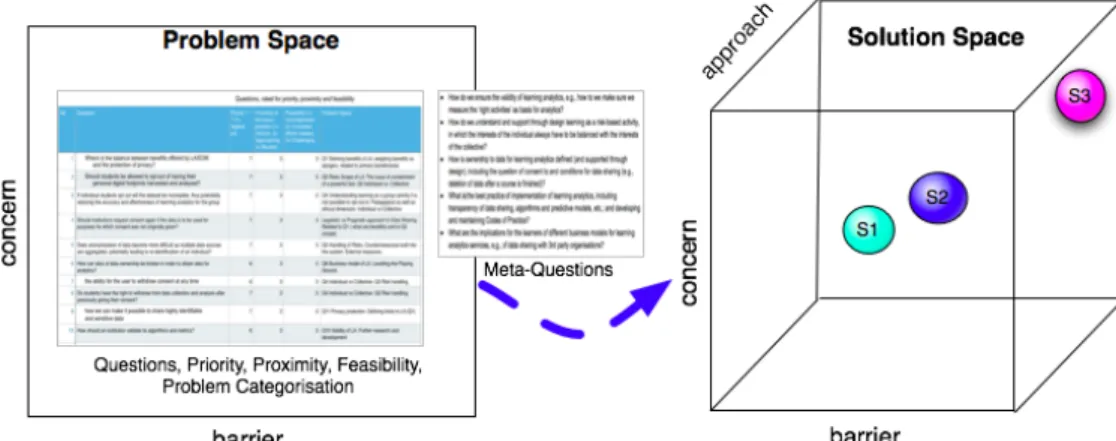
Questions may be seen as obvious ways to express concerns about issues and to identify barriers to achievement of organisational goals. Hoel and Chen (2014) introduced the notions of Problem Space and Solution Space as an analytical framework for moving from problem statements to design proposals. The Problem Space is two dimensional, where each problem is found in the intersection of a concern and a barrier. The Solution space adds another dimension, the proposed approach to solve the problem.
In moving from problems to solutions different approaches could be chosen to make sense of an amorphous set of issues scattered around the Problem Space. Enterprise Interoperability Analysis (Chen & Daclin, 2006) looks at Conceptual, Technological and Organisational barriers as the categories for barrier. The LACE report on Data Sharing Requirements (Cooper & Hoel, 2015) has made use of the European Interoperability Framework, which analyse interoperability according to Technical, Semantical, Organisational, and Legal aspects.
3.
Methodology
This paper explores how to move from identifying key questions to design requirements in a particular field of educational systems design (Hars & Zhong, 2001). It is essential to understand how questions are stated from a situated practitioner’s perspective, and that context is key in analysing responses to the questions - indeed, it is from questions that inquiry deepens and in some cases the most appropriate response to a question is not an answer but yet another question (Rothstein & Santana, 2011). In moving from the Problem Space to suggestions of how to organise the Solution Space regarding data sharing in Learning Analytics we apply a simple iterative procedure described in Figure 1. The questions are first prioritised according to an expert’s view on how important the issue is. Then the questions are ranked according to proximity of the problem and the feasibility of addressing the issues. The categories for these dimensions are taken from Cooper and Hoel (2015); proximity is either horizon, approaching, or blocker; and feasibility is either uncomplicated, concerted efforts needed, or challenging. When questions have been ranked for priority, proximity and feasibility a filtered set of the highest priority questions are selected for analysis. The authors have then analysed the questions extracting common topics of concern. The grouping of concerns is then used to construct a limited set of meta-questions that constitute the organised Problem Space, and which is brought forward as requirements for design of the Solution Space (Figure 1).
This paper follows a multi case study methodology (Yin, 2009), and uses qualitative methods for text analysis (Wodak & Meyer, 2009). This research fits in a Design Science tradition (Hevner, 2004; 2007) as it is positioned in the first Relevance Cycle (addressing requirements and field testing) of the three research cycles of Design Science. The purpose of the research is to come up with candidate concepts and processes that connect questions with solutions in the domain of learning analytics and learning technologies.
The next section presents the case studies that produce the data for the analysis. A snapshot of the filtered result of the analysis of the questions is shown. In the following section possible directions for solutions are discussed.
4.
Case studies – outcome of workshops on requirements for learning analytics
Three cases from related but separate activities have produced a large number of questions and concerns of bringing learning analytics to the mainstream of schools and universities.
4.1
LACE Workshops on Privacy and Ethics
The first case study is the outcome of a number of workshops and discussions organised by the LACE project in 2014 and 2015 as separate events and as part of conferences in Zagreb, Amsterdam, Bolton, Paris, Graz, Osaka, and Helsinki. During these events practitioners were asked to contribute their issues through filling out a Google form and in other ways. The resulting list of more than 60 questions highlights issues of privacy and ethics, data access, and transparency.
4.2
A Taxonomy of Ethical, Legal and Logistical IssuesBased on workshops to discuss the ethical and legal issues of learning analytics organised by Jisc, Apereo and the Lace Project, Sclater (2015) has developed a taxonomy of issues based on the experts’ input and comments. The issues are grouped in categories reflecting a lifecycle view on LA, starting with issues of ownership and control to seeking consent from students, ensuring transparency, maintaining privacy, ensuring validity in the data and the analytics, enabling student access to the data, carrying out interventions appropriately, minimising adverse impacts and stewarding the data. Sclater has grouped the issues related to ethics, legality and logistics; and he has ranked them according to importance. Finally, he has identified six stakeholder groups, whose responsibilities for taking action are identified. In total, the taxonomy classifies 85 questions.
4.3
Group Concept Mapping studyAs part of the work to explore issues related to data sharing for learning analytics a group concept mapping survey was initiated in April 2015 gathering statements on enablers and barriers for data sharing, and sorting and rating them according to importance and feasibility. In this study (Hoel et al., in press) 75 statements were gathered. The concerns fell into broad categories now known from the case studies above, consent, transparency, access, privacy and anonymity, codes of practice, control of data use, benefits and usefulness, data quality, data governance, ethical responsibility, and technical issues of software design.
4.4 Using 220 Questions as Data for Requirements Construction
The three case studies, in all, raise 220 questions articulated in discussions with stakeholders and the LA research and stakeholder community on how to advance learning analytics for the benefits of schools and universities. Despite the case studies referred to above proposing categories to group issues we have started with a clean slate by analysing each question through several cycles in order to understand more about the respondents' positioning in relation to the perceived benefits and risks of learning analytics.
After having rated each question according to priority in terms of relevance to the issue or concern raised, 120 questions received a score of 7 or 6 using a 1 - 7 scale, where 7 represented the highest priority. These 120 questions were analysed for proximity of the issue, using three categories:
1) Horizon: the issue will have impact but it could reasonably be addressed with low- level effort at present
2) Approaching: the issue will have impact in the mid-term and neglecting it could make matters worse in the future, for example by flawed technologies or practices coming into use. The issue deserves early attention.
3) Blocker: the issue is a blocker to meaningful progress.
Of the highest priority questions 23 were seen to address issues that these authors regarded as blocker of meaningful progress, while 46 were seen as addressing approaching issues, and 51 issues that were on the horizon for early solutions.
The next step was to rate the 120 questions in terms of feasibility level. The following categories were used, in decreasing feasibility:
1) Uncomplicated: projects/initiatives could be established with a high likelihood of achieving useful outcomes in a single cycle of action.
2) Concerted efforts needed: this would likely require several cycles of development, with the parameters for deciding what success looks like largely uncontentious and known, or could be determined early in any project.
3) Challenging: work is required to properly understand the issues in order to guide action and it may not yet be clear what is feasible. Action may be contentious or limited action would be possible without better problem definition, although this would probably involve an iterative process of: define, act, refine.
Of the highest priority questions 11 were seen to address issues that these authors regarded as challenging to solve, while 33 were seen to need concerted efforts, and 76 were judged to be uncomplicated to solve.
Interestingly, 8 questions that were considered to be a blocker of progress were rated as uncomplicated to solve, while 8 were considered to be less than challenging, possible to solve through several cycles of development and concerted efforts.
To construct the Problem Space after having sorted the 120 questions according to proximity and feasibility the questions were analysed for similarities related the concerns they addressed. Working through all questions a number of times resulted in seven broad issue categories, three of them being addressed in more than 80 percent of the questions. The most prevalent group of issues centred around Implementation, Transparency, and Codes of Practice. The other two big groups were Defining benefits and boundaries of LA, and Ownership of data. Less prevalent were the issue groups of ‘Individual vs. Collective (i.e., understanding learning as a group activity with pedagogical and ethical ramifications it may be difficult to opt out of); Risk aspects of LA; Business case of LA; and Validity of LA.
Re-analysing these issue groups with the situatedness of the questions still present resulted in five ‘meta-questions’ that would serve as a bridge between the Problem Space and the Solution Space:
• Validity: How do we ensure the validity of learning analytics, e.g., how to we make sure we
measure the ‘right activities’ as a basis for analytics?
• Risk-based: How do we understand and support through design learning as a risk-based
activity, in which the interests of the individual always have to be balanced with the interests of the collective?
• Ownership: How is ownership to data for learning analytics defined (and supported through
design), including the question of consent to and conditions for data sharing (e.g., deletion of data after a course is finished)?
• Implementation: What are best practices of implementation in the field of learning analytics,
including transparency of data sharing, algorithms and predictive models, etc.; and how are these best practices developed and maintained in Codes of Practice?
• Business case: What are the implications for the learners of different business models for
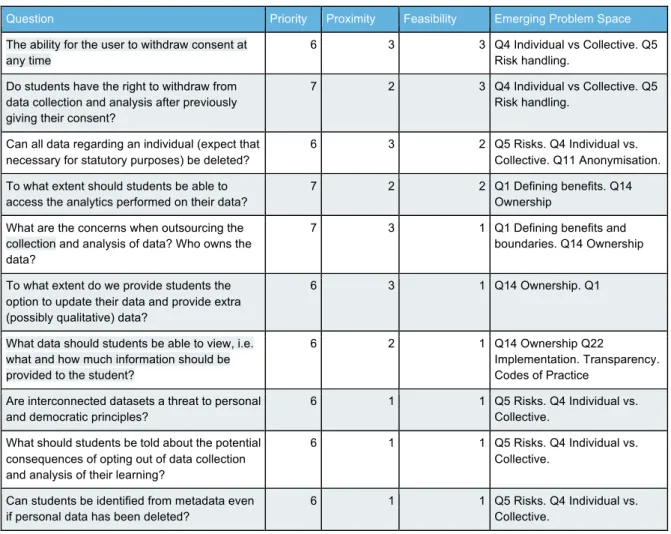
Table 1 shows an excerpt of the 120 ‘high priority questions’ with their proximity and feasibility scores, and with the classification of the questions according to Problem Space structure.
Table 1: 10 Questions on learning analytics concerns and barriers from three European Case studies, part of the corpus of 220 questions analysed in this paper.
Question Priority Proximity Feasibility Emerging Problem Space
The ability for the user to withdraw consent at any time
6 3 3 Q4 Individual vs Collective. Q5 Risk handling.
Do students have the right to withdraw from data collection and analysis after previously giving their consent?
7 2 3 Q4 Individual vs Collective. Q5 Risk handling.
Can all data regarding an individual (expect that necessary for statutory purposes) be deleted?
6 3 2 Q5 Risks. Q4 Individual vs. Collective. Q11 Anonymisation. To what extent should students be able to
access the analytics performed on their data?
7 2 2 Q1 Defining benefits. Q14 Ownership
What are the concerns when outsourcing the collection and analysis of data? Who owns the data?
7 3 1 Q1 Defining benefits and boundaries. Q14 Ownership To what extent do we provide students the
option to update their data and provide extra (possibly qualitative) data?
6 3 1 Q14 Ownership. Q1
What data should students be able to view, i.e. what and how much information should be provided to the student?
6 2 1 Q14 Ownership Q22
Implementation. Transparency. Codes of Practice
Are interconnected datasets a threat to personal and democratic principles?
6 1 1 Q5 Risks. Q4 Individual vs. Collective.
What should students be told about the potential consequences of opting out of data collection and analysis of their learning?
6 1 1 Q5 Risks. Q4 Individual vs. Collective.
Can students be identified from metadata even if personal data has been deleted?
6 1 1 Q5 Risks. Q4 Individual vs. Collective.
As a check of the completeness of the list of meta-questions the 100 questions not prioritised for full analysis were checked to see if there were issues not covered. Most of these questions were found to fall into the established categories. Furthermore, these questions of lesser priority would, it seems, be addressed by providing answers to the questions of implementation, best practices, transparency, and codes of practice.
5.
Discussion
Risks and benefits are two sides of the same coin. Concerns are easily expressed as questions; hopes, visions and benefits are often part of another discourse or serve as silent backdrop for questioning. Our study suggests that despite the hype it is still early days for LA, and there is a lot to be learnt about the benefits of LA. With a clearer understanding of what LA could do there would be no need to ask to what extent students should be able to access the analytics performed on their data. This question, however, goes to the core learning both as a pedagogical and ethical practice. It is not difficult to answer, but it needs some concerted work by a wider group of stakeholders who need to draw up visions, describe practices and establish rules. A great many of the questions in this study could be addressed by establishing what is termed best practices of implementation. What is asked for, at least at this moment in time, is not elaborate and technical instruction for how to crunch and visualise numbers and interpret dashboards. The authors of this paper have found what is asked for is best practices that position the learners, teachers and the other actors as individuals in a pedagogical, ethical and organisational context. What are the learning spaces where LA will be applied, and what
are the boundaries for its use? It is obvious that transparency plays an important role in this picture, but it will take time and effort to turn transparency into a hard requirement that is built into tools and practices as technical and process features.
When the European community exchange, which gave data to this study, was initiated nobody knew that ethics and privacy would be such a strong and cross-cutting theme in the discussions. It is clearly a challenging issue that could be a true blocker of progress if not solved. However, this issue is closely linked with defining the benefits of LA for learning. The key to solving it lies, in our opinion, in the context integrity perspective on privacy combined with an understanding of learning as a risk-based activity. The learner is part of a learning collective and has to learn to live with a certain level of risk; however, the learner should not accept any infringement of her integrity by violation of informational norms through unjustified sharing of data. To find solutions to this issue a wide range of development needs to be undertaken, covering both legal, organisational and technical domains.
The questions of ownership to data and consent to data sharing may seem easy to solve as the answers could be deduced from law. Legal clarification, however, is only part of the solution of this concern that is expressed in so many ways in this study. Ownership is often tightly bound to control, and as long as the learners, their parents, and the teachers are not provided with means of control it does not matter what the law states. User-managed access to data is a proposed idea that is supposed to give a user "a unified control point for authorizing who and what can get access to their online personal data, content and services, no matter where all those things live on the web"1. Research is need to see whether this is a viable idea for integration in LA solutions, and if not, which other technical solutions should be developed. The concerns about data ownership and consent are not met before there are both organisational and technical solutions, in addition to legal answers to these questions.
Only a few questions addressed the business cases of LA and then only as concerns about data sharing with 3rd party organisations. The business aspects of LA are, however, essential for development as innovation in this field is to a large extent driven by companies and not educational institutions. If this issue is not solved we could easily face what we could call a LA data sharing paradox: The stewardship of the data is in the hands of companies that see no interest in sharing with others; while data sharing is a precondition to get large enough datasets for efficient learning analytics (and for the companies to succeed). The solution to this problem is complex and would need a lot of new research and development. First, there is a need to support shared open architectures and common frameworks (Cooper & Hoel, 2015). Second, more emphasis on learner owned and controlled data will drive development of anonymisation technologies, which in turn will open up for more sharing of datasets. However, this is a very delicate avenue to explore as it is clear that anonymity is a moving target as soon as more datasets are added to the analysis and the threat of re-identification becomes more real (Cooper & Hoel, 2015; Thuraisingham, 2014). The result of this exploration of business models of learning analytics may be that educational institutions would see their interest in taking a more active role in development of basic infrastructures for LA. And the scope of LA may be adjusted to be a bit less grand as one realises that there are considerable barriers to data sharing that well informed learner, guardians and teachers are willing to accept; and therefore, one has to do with LA solutions that use a less broad set of data to do more targeted analysis.
6.
Conclusions
This study has completed an analysis based on questions gathered from three case studies
coming out of community exchange activities of a European support action for learning
analytics. The case studies aimed at mapping questions asked about learning analytics;
constructing a taxonomy of ethical, legal and logistical issues in order to prepare codes of
ethics (Slater, 2015); and mapping enablers and barriers to data sharing (Hoel et al., in press),
whereas this study set out to explore the problem space formed by questions raised in this
community and what implications this might have for moving towards a solution space. This
study touches upon the same categorisation of the issues as the case studies, e.g., privacy and
ethics, transparency, ownership and control, validity, etc. But the drive towards solutions
1
results in a five point list of meta-questions that is suggested as a bridge from questions as an
expressions of concerns to hard requirements for solving the problems.
A first test if these meta-questions are appropriate to guide the design of new
approaches as indicated in Figure 1 would be to see if all levels of interoperability as
described in the European Interoperability Framework (EIF)
2are reflected in the
meta-questions. Cooper and Hoel (2015) found that this framework emphasises a unified
view on interoperability and provides a useful structure to consider issues of data sharing.
EIF puts four levels of interoperability within a political context of cooperating partners with
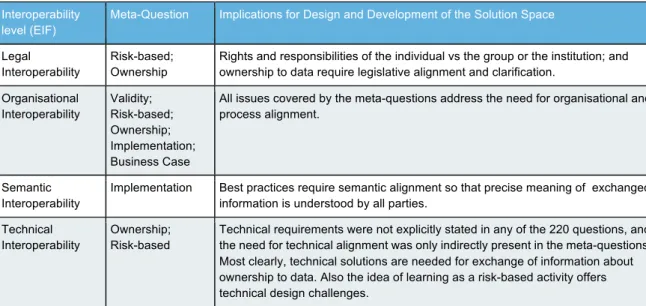
compatible visions, aligned priorities, and focused objectives, as shown in Table 2 that align
the meta-questions to interoperability level and raises questions of appropriateness for further
design.
Table 2: How the meta-questions align with different interoperability levels
Interoperabilitylevel (EIF)
Meta-Question Implications for Design and Development of the Solution Space Legal
Interoperability
Risk-based; Ownership
Rights and responsibilities of the individual vs the group or the institution; and ownership to data require legislative alignment and clarification.
Organisational Interoperability Validity; Risk-based; Ownership; Implementation; Business Case
All issues covered by the meta-questions address the need for organisational and process alignment.
Semantic Interoperability
Implementation Best practices require semantic alignment so that precise meaning of exchanged information is understood by all parties.
Technical Interoperability
Ownership; Risk-based
Technical requirements were not explicitly stated in any of the 220 questions, and the need for technical alignment was only indirectly present in the meta-questions. Most clearly, technical solutions are needed for exchange of information about ownership to data. Also the idea of learning as a risk-based activity offers technical design challenges.
Aligning the meta-questions with the different interoperability levels makes it clear that the
issues raised through questioning learning analytics are mostly on a conceptual level,
addressing contextual issues related to LA supported learning activities. It seems that the
participants that took part in questioning are not ready yet to discuss the technicalities of data
sharing, as there are so many issues of legal, organisational and semantic nature that are still
unanswered.
Taking a broader perspective, and looking back at the challenges that the experts have
been grappling with who has provided questions to this study, we see that the landscape of
learning technology development and interoperability has moved to a more complex state.
The advent of data-driven education, where data helps to understand the learning processes
better, but also is a learning resource in its own right, has shifted the focus from systems
interoperability, content repositories and learning objects to issues of governance and due
diligence of the data provided. This explains why the community still is struggling to define
the Problem Space and one still has to wait before the Solution Space is constructed with a
clear plan of action for further development.
2
This is formally known as “Annex 2 to the Communication from the Commission to the European Parliament, the Council, the European Economic and Social Committee and the Committee of Regions 'Towards interoperability for European public services’”, or informally as EIF v2. It is available from http://ec.europa.eu/isa/documents/isa_annex_ii_eif_en.pdf
References
Chen, D., & Daclin, N. (2006). Framework for enterprise interoperability. Proceedings of IFAC Workshop EI2N.
Cooper, A. & Hoel, T. (2015). Data Sharing Requirements and Roadmap. Public Deliverable D7.2 from the LACE project, online at www.laceproject.eu
Cross, J. (2007). Informal learning: rediscovering the natural pathways that inspire innovation and performance. San Francisco, CA: Pfeiffer.
Hars, A., & Zhong, J. (2001). Conversation Systems for Requirements Engineering. AMCIS 2001 Proceedings, 255, 1321-1326 http://aisel.aisnet.org/amcis2001/255
Hevner, A. (2007). A Three Cycle View of Design Science Research. Scandinavian Journal of Information Systems, 2007, 19(2):87-92, 1–6.
Hevner, A., March, S. T., Park, J., & Ram, S. (2004). Design science in information systems research. Mis Quarterly, 28(1), 75–105.
Hoel et al. (in press). Mapping enablers for and barriers to data sharing for learning analytics
Hoel, T. & Chen, W. (2014). Learning Analytics Interoperability – looking for Low-Hanging Fruits, in Liu, C.-C. et al. (Eds.) Proceedings of the 22nd International Conference on Computers in Education. Japan: Asia-Pacific Society for Computers in Education
Laurillard, D. (2013). Rethinking university teaching: A conversational framework for the effective use of learning technologies. Routledge.
Mason, J. (2004). Context and Metadata for Learning, Education, and Training, in Rory McGreal (Ed.) Online Education Using Learning Objects, pp. 168-182 London: RoutledgeFarmer.
Rothstein, D., & Santana, L. (2011). Make Just One Change: Teach Students to Ask Their Own Questions. Cambridge, MA: Harvard Education Press.
Sclater, N. (2015). A taxonomy of ethical, legal and logistical issues of learning analytics v1.0 Online at http://analytics.jiscinvolve.org/wp/2015/03/03/a-taxonomy-of-ethical-legal-and-logistical-issues-of-learnin g-analytics-v1-0/
Scoble, R. & Israel, S. (2013). Age of Context: Mobile, Sensors, Data and the Future of Privacy. CreateSpace Independent Publishing Platform.
Thomas, H. (2010). Learning spaces, learning environments and the dis'placement' of learning. British Journal of Educational Technology, 41(3), 502–511.
Thuraisingham, B. (2014). Big Data – Security with Privacy. Response to RFI for National Privacy Research Strategy. Summary of discussion at NSF Workshop, September, 2014. Retrieved from: http://csi.utdallas.edu/events/NSF/NSF%20workshop%202014.htm
Verbert, K., Drachsler, H., Manouselis, N., Wolpers, M., Vuorikari, R., & Duval, E. (2011). Dataset- driven research for improving recommender systems for learning. In Proceedings of the 1st International Conference on Learning Analytics and Knowledge (pp. 44–53). New York, New York, USA: ACM Press. doi:10.1145/2090116.2090122
Wodak, R., & Meyer, M. (Eds.). (2009). Methods for critical discourse analysis. Sage. Chicago