Counselor Education Master's Theses Counselor Education
Fall 2013
Perceptions of Middle School Students and Parents
on the Effectiveness of the Olweus Bullying
Prevention Program
John Brewer
The College at Brockport, [email protected]
Follow this and additional works at:http://digitalcommons.brockport.edu/edc_theses
Part of theCounselor Education Commons, and theStudent Counseling and Personnel Services Commons
This Thesis is brought to you for free and open access by the Counselor Education at Digital Commons @Brockport. It has been accepted for inclusion in Counselor Education Master's Theses by an authorized administrator of Digital Commons @Brockport. For more information, please contact
[email protected]. Repository Citation
Brewer, John, "Perceptions of Middle School Students and Parents on the Effectiveness of the Olweus Bullying Prevention Program" (2013).Counselor Education Master's Theses. 149.
Perceptions of Middle School Students and Parents on the Effectiveness of the Olweus Bullying Prevention Program
John Brewer
The College at Brockport, State University of New York
Table of Contents
Abstract ... 5
Introduction ... 6
Chapter 1: Review of Literature ... 7
Anti-Bullying Programs ... 8
KiVa ... 8
OBPP... 9
Perceptions of Bullying in Schools ... 11
Teachers and Administrators ... 11
School Counselors and School Psychologists... 12
Students ... 12
Parents ... 13
Implementation of OBPP ... 14
Role of Parents ... 14
Role of School Faculty... 15
Role of School-Wide Support ... 16
Role of Students ... 17 Barriers to Implementation ... 17 Evaluation of OBPP ... 18 Urban/Suburban Schools ... 19 Rural Schools ... 19 Chapter 2: Method ... 21
Setting and Participants... 21
Instrument ... 22
Chapter 3: Results ... 25
Frequency of Student Responses ... 25
Frequency of Parent Responses ... 26
Comparing Means ... 27 Correlations ... 29 Student ... 29 Parent ... 31 Summary of Results ... 33 Chapter 4: Discussion ... 34
Frequency of Student Response ... 34
Frequency of Parent Response ... 35
Comparison of Student and Parent Response Means ... 35
Significant Correlations between Survey Items ... 36
Students ... 36
Parents ... 36
Implications for the Education Field... 37
Limitations of this Study ... 37
Recommendations for Future Research ... 38
Conclusion ... 39 References ... 40 Appendix A ... 47 Appendix B ... 50 Appendix C ... 51 Appendix D ... 58
List of Tables
Table 1: After OBPP Training: Frequency of Student Responses for Perception Items ... 26
Table 2: After OBPP Training: Frequency of Parent Responses for Perception Items ... 27
Table 3: Comparing Student and Parent Means ... 28
Table 4: Student Perceptions Pearson Product Correlation Coefficients ... 30
Abstract
Bullying has been recognized as a significant problem in adolescents. The Olweus Bullying Prevention Program (OBPP) has been the most successful and widely used program in schools to reduce the incidence of bullying. This study aimed to investigate the perceptions of middle school students and parents on the effectiveness of OBPP. Online surveys for students and parents were developed using a Likert-type scale. The results indicate that students and parents believe OBPP is effective in increasing knowledge of bullying and how to effectively deal with it. Parents do not perceive that incidents of bullying have decreased since
implementation of OBPP. This parent perception is inconsistent with student belief that with OBPP bullying happens less. The results suggest that further research is needed on the perceptions of the effectiveness of OBPP.
Perceptions of Middle School Students and Parents on the Effectiveness of the Olweus Bullying Prevention Program
Bullying in schools has been problematic among adolescents. This is affecting many areas of their well-being, including school achievement and development of positive social skills (Kochenderfer & Ladd, 1996; Olweus, 1993a). Bullies and victims of bullying are at risk for emotional, social, and psychiatric problems that could continue into adulthood (Holt, Finkelhor & Kantor, 2007; Nansel et al., 2001; O’Connell, Pepler, & Craig, 1999). The National Crime Victimization Survey reported bullying in grade six at 39.4%, seven at 33.1 %, and eight at 31.7%, (U.S. Department of Justice, 2009). According to the National Center for Education Statistics (NCES), 28% of students ages 12 through 18 have reported being bullied at school. The statistics are even higher for rural schools where the reported percentage totals 30.5%. Possible reasons for higher rates of bullying in rural areas could be due to their geographic and social isolation. Students who are bullies may be more likely to adopt attitudes associated with archaic justice, which supports using violence to resolve conflicts (Dulmus, Sawers & Theriot, 2006; Schwaner and Keil, 2003).
Current literature on middle school bullying clearly indicates that it is a problem in schools; the purpose of this research is to shed light on the perceptions of middle school students and parents on the effectiveness of the Olweus Bullying Prevention Program (OBPP). This study is quantitative, using two separate Likert-type surveys, one for students and the other for parents. The questions are specifically designed to determine the perceptions of the participants regarding the effectiveness of OBPP. Specific information regarding the setting/population, instrument used and research design will be discussed in the method section. In order to adequately address this problem, a definition of the term bullying needs to be established.
Bullying isdefined as an act ofsomeone intentionally inflicting injury or discomfort to another individual that is considered to be aggressive behavior or if he/she is victimized or exposed to negative actions repeatedly over time (Olweus, 1993a). Obtaining information from students and parents that have participated in this program can be used to enhance the programs main objective of reducing bullying. There is a significant amount of research available that points to the effectiveness of reducing bullying in schools. This study is intended to provide information on participants perceptions which can benefit administrators and school personnel as well as the counseling profession.
Before this study can present the perceptions of middle school students and parents on the effectiveness of OBPP, current literature on bullying and OBPP must be presented. Specifically, research pertaining to the perceptions of bullying in schools will be examined, along with how OBPP has been implemented and the evaluation of the success of this program in reducing bullying.
Review of Literature
The purpose of this literature review is to present bullying as a problem in schools. In addition, literature will be presented to discuss OBPP in reducing bullying incidents. Researchers have found that individuals within the school community (e.g. teachers, administrators, parents, and students) recognize that bullying is a significant issue (Holt, Kantor & Finkelhor, 2009; Jacobsen & Baumen, 2007; Lund, Blake, Ewing & Banks, 2012;Maunder, Harrop & Tattersal, 2010; Wang, Iannoti & Nansel, 2009). This review of literature investigates previous findings on established anti-bullying programs (Karma, Voeten, Poskiparta & Salmivalli, 2010; Salmivalli, 2010). The majority of the research is on OBPP (Black & Jackson, 2007; Bowllan, 2001; Coyle,
2008; Olweus, 1991; Olweus, 1993a; Olweus 1997). Therefore, the focus of this review is on the implementation and effectiveness of OBPP in a variety of school communities (Bowllan, 2011; Edmondson & Hoover, 2008). The literature explores the role of each member of the school community in executing the anti-bullying program (Ahmed and Braithwait, 2004; Carlson & Christenson, 2005; Conner-Burrow, Johnson, Whiteside-Mansell, McKelvey, and Gargus, (2009); Kallestead & Olweus, 2003; Kuhut, 2007; Olweus, 1993; Reese, Vera, Simon & Ikeda, 2000). Potential barriers that may hinder the success of the program along with ways to
overcome them are examined (Coyle, 2008;Limber, Nation, Tracy, Melton & Flerx, 2004; Walter, Gouze and Limb, 2006). Researchers have shown OBPP to be effective in reducing the incidences of bullying (Limber, Nation, Tracy, Melton & Flerx, 2004; Schroeder et al., 2012; Stevens, Bourdeaudhuij & Van Oost, 2000; Whitney, Rivers, Smith & Sharp, 1994).
Anti-Bullying Programs
KiVa.
Prevention programs have been developed because of the pervasiveness of bullying in schools and its harmful effects on students. Two of the most widely researched anti-bullying programs are KiVa (an acronym for Kiusaamista Vastaan, “against bullying”; the Finnish adjective kiva means “nice”) and the Olweus Bullying Prevention Program (OBPP). The KiVa anti-bullying program was designed to increase anti-bullying attitudes in classrooms as well as promote student attitudes/behaviors to defend victims of bullying. Lessons involving activities such as classroom discussion and group work are implemented to make students more aware of bullying behaviors and encourage them to speak up for others who are being treated in an
it was found that after nine months of being exposed to the program the odds of being a bully or a victim of a bully were 1.3 times higher in the control group than a student who participated in the KiVa program (Salmivalli & Poskiparta, 2012). Karma, Voeten, Poskiparta, and Salmivalli, (2010) suggest the initial phase of evaluating the KiVa program has been successful in reducing bullying and victimization in schools. Researchers indicate that the KiVa anti-bullying program is effective in reducing incidents of aggression and victimization among students. Since KiVa is new and does not yet have a significant amount of evidence based research on its effectiveness, focus will be on OBPP which has been used widely in schools to date.
OBPP.
The first widespread bullying prevention program was developed and implemented in the 1980s by Dan Olweus (Olweus, 1993a). It is built on four key principles that have been heavily researched (Black & Jackson, 2007; Bowllan, 2001; Coyle, 2008; Edmondson & Hoover, 2008; Kalstead & Olweus 2003; & Olweus, 1993a) regarding development and modification of
aggressive behaviors. These four principles are in place to create a school environment described as 1) warm with positive interest and involvement from adults, 2) firm limits to unacceptable behavior, 3) non-hostile or physical sanctions are consistently applied when rules and limits are violated (principles 2 and 3 require a certain amount of monitoring and surveillance by the adults in charge), and 4) adults both in school and at home are to act as authorities (Olweus, 1993a).
A key component of the OBPP core program is awareness and involvement by adults. To determine the severity and awareness of bullying at a particular school, and the level of
involvement by adults, a bully/victim questionnaire is administered. The school administration encourages teachers to get involved in the dissemination and implementation of the anti-bullying
curriculum. This can be achieved by using information obtained by questionnaires, surveys, in service day training, increased supervision of students during recess and lunch time, along with facilitating student groups that address bullying. Students are an integral part in developing class rules against bullying and are encouraged to participate in regular student meetings.The students are instilled with the message that bullying is not tolerated in the schools.
Collaboration is essential between all of the stakeholders, (e.g. parents, students, and school staff) in regards to reinforcing zero tolerance of bullying. Honest and open discussions are necessary with staff and parents of involved students (Olweus, 1991; Olweus, 1993; Olweus, 1997). Each bullying incident is unique, requiring a candid discussion regarding both the bully and victim roles in the event. The program utilizes teachers and other school personnel, students and parents to play a major role in the restructuring of the school climate. Counselors,
psychologists, and social workers are “experts” who function as planners and coordinators, in counseling teachers and parents (Olweus, 1997). Parent perceptions indicate that bullying is a significant issue (Connors-Burrow, Johnson, Whiteside-Mansell, McKelvey & Gargus, 2009; Holt, Kantor & Finkelhor, 2009; Nordhagen, Nielsen, Stigum & Köhler, 2005).
OBPP has been effective in reducing incidents of bullying (Bauer, Lozano & Rivara 2007;Olweus & Limber, 2010). Edmondson and Hoover (2008) evaluated the effectiveness of OBPP by soliciting feedback using a pre and post-test (the Olweus bullying questionnaire) completed by teachers. The analysis indicated positive change in individual behavior after implementation of OBPP. Much of the research that has demonstrated the effectiveness of OBPP has been done by the creator of the program; this could lend bias to the results.
Perceptions of Bullying in Schools
Teachers and administrators.
Teachers and administrators recognize bullying occurs frequently in every area of the school throughout the day. School staff are aware that bullying occurs in all parts of a school: buses, hallways, bathrooms, lunchrooms, locker rooms, and classrooms. The revised 71-item version of the Olweus School Personnel Observation and Awareness of Bullying between Students at School Questionnaire was administered to school personnel (e.g. nurses, librarians, social workers, lunch room monitors, bus drivers, janitors, and counselors) from three rural schools. Ninety-three percent of teachers and administrators reported that in the past three months they had witnessed bullying between students. Teachers and administrators reported 64.1% of the time that they had witnessed bullying in the hallways and stairwells, while 57.7% witnessed it in the lunchroom, 56.4% saw it occur in the classroom, and 53.8 % on the
playground (B. Thomlison, R.J. Thomlison, Sowers, Thereiot & Dulmus, 2008). The bullying behaviors included name calling or teasing, being excluded by others, shoving, hitting, kicking, spreading false rumors and taking another student’s belongings or money (Thomlison, et al., 2008). Teachers and support staff define direct (i.e. pushing, kicking, or punching) and indirect (i.e. belittling, rumors, or teasing) behavior as bullying more than students do (Maunder, Harrop & Tattersal, 2010). Differences in perceptions between students and teachers may be due to students not completely understanding the definition of bullying. School counselors have been trained to recognize emotional and psychological aspects of student functioning; therefore, they have a unique skill set when addressing incidents of bullying (Jacobsen & Baumen, 2007).
School counselors and school psychologists.
Over 560 school counselors and school psychologists completed a web-based survey on bullying in their schools. Seventy percent of those surveyed acknowledged that bullying was a problem where they work, affecting 10 to 15 % of their student population (Lund, Blake, Ewing & Banks, 2012). School counselors that worked in a school that had a bullying prevention program were more likely to intervene in all types of bullying (e.g. relational, verbal, physical, and cyber) than counselors without a program (Jacobsen & Baumen, 2007).
Students.
Rao and Simkiss (2007) surveyed 50 ten to sixteen-year old participants about their bullying experience using a modified Olweus questionnaire. Thirty percent reported that they had been bullied. None of the 32 children who responded thought bullying others was fun; however, 15.6% admitted bullying other children. Wang, Iannotti and, Nansel’s, (2009) study in the United States of 7,508 adolescents collected from the 2005/2006 Health Behavior in School-aged Children (HBSC) found no difference in students perceptions of bullying behaviors between grades six, seven and eight. This suggests that the age of the middle school student is not significant in regards to their awareness of being bullied. The researchers also found that 20.8% of all students believe that they were bullied physically, 53.6% verbally, 51.4% socially, and 13.6% electronically. A group of 5,171 students from 37 schools were asked to complete the Olweus Bully/Victim questionnaire. Approximately 82% of the students reported being bullied for a month or longer (Solberg and Olweus, 2003). A self-report questionnaire was administered to 1,429 students between the ages of eight and 13 assessing peer victimization and bullying. Hunter, Boyle, and Warden (2007) discovered that 35.6% of participants experienced peer
aggression and victimization. These studies confirm that both faculty and students indicate there is a high percentage of bullying occurring in school. The impact of bullying extends beyond the school grounds into the home environment.
Parents.
Results suggest there is a discrepancy between parents awareness of their child’s
involvement and of what their children believe in regards to being bullied. It seems that parents believe that bullying is a problem, but much of the time are not aware of when or if their child is a victim of bullying while at school.Parents are an integral stakeholder in their child’s school community. In other words they have a vested interest or concern in regards to how the school environment affects their child. Therefore, it is important to investigate whether parents believe that bullying is an issue for their child prior to implementing any anti-bullying curriculum. It is extremely difficult for parents to determine whether an incident is an act of bullying (Mishna, 2004). Twenty parents whose children had reported being bullied completed in-depth interviews. Only half of the participants were previously aware that their child had been bullied (Sawyer, Mishna, Pepler & Wiener, 2011). Parents who were not aware that their child was bullied reported being surprised. Over half of the parents reported knowing that their child had
previously seen bullying among their peers. These parents were able to describe negative effects their child displayed because of being victimized (e.g. stomach aches and not wanting to go to school). Holt, Kantor, and Finkelhor, (2009) examined 205 fifth grade students and their parent’s attitudes towards bullying. Students completed self-report surveys about involvement, attitudes towards, and responses to bullying. Parents responded to a self-report questionnaire regarding their attitudes toward, and perceptions of their child’s involvement in bullying. Eighty-eight percent of the parents believed that teasing hurts kids and 81% said that schools should pay more
attention to bullying. Overall, 59% of children indicated that they had been teased or picked on at school versus 41% of parents thinking that their child was teased or picked on (Holt et al., 2009).
These findings shed light that various members within the school community perceive that bullying is a major problem. It is important to have cooperation and collaboration among parents, school faculty, and students in order to successfully implement OBPP.
Implementation of OBPP
Role of parents.
Olweus (1993a) explains the importance of involving parents in the prevention of bullying. Shetgiri, Lin, and Flores, (2012) examine factors and trends among perpetrators of bullying. Researchers assessed parental emotional anger with children by using a self-report measure that asked how the parents feel regarding their communication and relationship with their child. Parent frustration with their children seems to have a direct association to children having emotional, developmental and behavioral problems. Georgiou (2008) finds that
responsive mothers have positive effects on their children. A responsive mother is defined as a mother who is available to talk and help their child deal with daily problems. Specifically, children of responsive mothers adapt better socially to school and display higher achievement levels. These children are less likely to be aggressive and are more accepting of their peers. Non-responsive mothers’ children have a tendency to show signs of aggressive/bullying behavior (Georgiou, 2008). On the other hand, children are likely to be victimized and bullied when their parent becomes too overprotective. This suggests that children that have parents who are
involved in their lives are less likely to be involved in bullying. OBPP includes the parents of both bullies and victims by involving them in conversations whenever an incident occurs
(Olweus, 1993a). It is important that parents regularly communicate with school personnel (Ahmed & Braithwait, 2004; Carlson & Christenson, 2005; Kuhut, 2007; Reese, Vera, Simon & Ikeda, 2000). OBPP encourages teachers and parents to communicate and work as a team to combat bullying.
Role of school faculty.
School faculty, classroom teachers in particular, are important to the execution of OBPP. Teachers serve as a role model and provide refuge for students who encounter
unfamiliar/uncomfortable situations (Bowen, Bowen, Richman, & Brewster 1998). It is critical to successful implementation of OBPP for teachers to recognize what bullying is and how often it occurs. The majority of the curriculum/program is facilitated by teachers; therefore, a key factor in successfully implementing this program is teacher support.The level of bullying that teachers perceive in the classroom is an indication of teacher cooperation with the program. In other words, if a teacher does not recognize that bullying is an issue in one’s class, they are less likely to embrace the program (Kallestad & Olweus, 2003). Conner-Burrow, Johnson,
Whiteside-Mansell, McKelvey, and Gargus, (2009) report that teacher support for students who are being bullied is a key factor in reducing the symptom of depression which has been shown to occur in victims of bullying. Teachers that have a perceived responsibility for changing the culture of bullying in their classroom are more likely to be involved in anti-bullying efforts. Accomplishing this can be done by making the material seem straightforward, as well as
providing guidelines on how to deal with bullying related problems. This increases the likelihood that teachers will support the program (Kallestad & Olweus, 2003). All school staff, not just teachers, need to take part in establishing policies or guidelines regarding bullying situations and
how to effectively manage them.In addition to getting micro-level individual support, it is equally as important to receive school wide support.
Role of school-wide support.
A significant indicator of school wide support is open communication among the staff. The school climate influences bullying dynamics within the building. In other words, it is reasonable to anticipate students who attend schools where adults accept bullying behavior will participate in more of these behaviors (Baker, 1998). This finding points towards the importance of establishing a school environment that discourages bullying behaviors. Ma (2002) conducted a climate study with 92 middle schools examining school characteristics of victims and offenders of bullying. Schools have fewer incidents of bullying when they use positive disciplinary actions and have strong parental involvement, along with high academic expectations. Black,
Washington, Trent, Harner and Pollock, (2009) outlined specific steps on how a large urban school district implemented OBPP in their elementary and middle schools. Team building plays a significant role in effectively executing implementation of the program. Defining each person’s role in the program (i.e., administrators and, teachers) and fostering their input facilitated a collaborative approach. They also established a timeline when pieces of the program should be completed. This imparted accountability among the individuals who were responsible for
carrying out these steps (Black, et al., 2009). The success of the program will be increased when staff shares among themselves their methods for effective implementation of the program. “Positive orientation to change” (p.6) is also a strong predictor of successful implementation of OBPP (Kallestad & Olweus, 2003). If school faculty believe that change is necessary to improve the school culture, then gaining support will be a much easier undertaking. It is important for teachers to foster a safe environment for students to discuss bullying. Class meetings are times
set aside where teachers encourage students to discuss bullying and make suggestions on how to reduce/respond to bullying.
Role of students.
Although teachers facilitate the meeting, it is the students’ responsibility to contribute their ideas. They are involved in creating class rules against bullying. Students are more likely to experience an increased sense of responsibility to follow or enforce the rules if they are involved in creating them. During class meetings it is essential that students participate in the discussion (Olweus 1991; Olweus, 1993a; Olweus, 1997; Whitney, Rivers, Smith & Sharp, 1994). Without student input successful implementation of the program would be impossible.
Barriers to Implementation
The following barriers to implementation of OBPP have been identified by faculty members of a rural middle school (Coyle, 2008). The local community was resistant to change, diversity, and outsiders. In this particular study individuals were unwilling to work with someone from outside their community. It seemed as though the students were accepting of the individual introducing a new program; however, parents continued to be resistant.
Key factors were identified in order to foster support for OBPP from the community. One was to insure that the terminology was easily understood by the intended audience when the program was introduced. In addition, staff shared realistic expectations regarding the ongoing integration and expected outcome of the program (Coyle, 2008). In other words, it is important to adapt to the targeted audience. If it is apparent that the program is too drastic a change for the community, it could be implemented in steps to work towards the same goals.The school
responsible for instructing a large number of students which make it difficult to discuss intimate topics that may occur around the issue of bullying (Limber, Nation, Tracy, Melton & Flerx, 2004).Walter, Gouze, and Limb, (2006) find that teachers had a limited knowledge about behavior problems and their treatment in the classroom. Education and training of teachers to understand and manage behavior problems, including bullying, is essential. Although there has been significant research done to evaluate the success of OBPP, it is important to periodically examine the program at each particular site to determine if any adaptions or changes would increase its success.
Evaluation of OBPP
The effectiveness of OBPP has been evaluated in particular schools, including urban/suburban or rural communities.In 1983 Olweus implemented his first anti-bullying prevention program. Forty-two Norwegian schools were involved consisting of 2,500 boys and girls in grades four through seven. Approximately two years after the introduction of the program 50% of bully/victim problems were reduced (Olweus, 1993a).In 2000 the American Academy of Pediatrics stated that bullying is a significant problem in American schools and advocated for an anti-bullying program such as OBPP because of the positive results obtained in Norway (Glew, Rivara & Feudtner, 2000). Research in the United States and Europe shows OBPP is effective in reducing the incidences of bullying in schools (Limber, Nation, Tracy, Melton & Flerx, 2004; Schroeder, et al., 2012;Stevens, Bourdeaudhuij & Van Oost, 2000; Whitney et al., 1994). OBPP has been shown to be effective in both urban/suburban and rural school districts.
Urban/suburban schools.
In the United States, six public elementary and middle schools participated in four years of OBPP. Researchers investigated whether the program was effective in urban settings. Before the program was implemented, 65 bullying incidents were reported for every 100 student hours. After four years of using OBPP they observed a reduction to 36 incidents for every 100 student hours (Black & Jackson, 2007). The incidents of bullying were measured by using a checklist of bullying behaviors that consisted of physical, verbal, and emotional bullying. A staff member would note when they observed any of the previously mentioned behaviors. A small Catholic seventh and eighth grade middle school in the northeast section of the United States implemented OBPP. All 112 students resided in either an urban or suburban setting. The revised Olweus Bullying Victim Questionnaire was administered to the participants as a pre-test and post-test. Seventh grade females reported a 34.4% decrease in being excluded and a 31.1% decrease in being bullied one year after implementation of OBPP (Bowllan, 2011).These findings indicate that students report OBPP is effective in decreasing bullying/victim type behaviors. There was a 25% increase in reports of being bullied and a 35% decrease of being indirectly verbally bullied (Bowllan, 2011). This finding points towards an increased recognition of what bullying is upon putting into practice OBPP. This program has not only been shown to be effective in
urban/suburban settings but has also been successfully implemented in rural areas.
Rural schools.
There is also a need for rural schools to implement an anti-bullying curriculum. One hundred twelve sixth through twelfth grade students in a rural community participated in a survey to examine the frequency of bullying related incidents. Fifty-two percent of the
participants agreed that bullying gives students power over others. The majority of students surveyed agree that something needed to be done to combat bullying (Kulig, Hall & Kalischuk, 2008). Swain, Henry and Kelly (2006) report there is a high incidence of aggressive behavior among students living in rural communities. A Midwestern rural community implemented a program that was modeled after OBPP. Pretests and posttests were administered to students and teachers. By the end of the third year, 752 students had participated in the program. Twenty teachers and social workers from the school district were asked to report their perceptions of bullying. Over 65% of them reported that they saw a positive change in individual student behavior (Edmondson & Hoover, 2008). All of the studies indicate that OBPP produces positive results in terms of reducing acts of bullying. They also point to how this program works in a variety of settings (e.g. urban, suburban and rural). OBPP is shown to be effective in reducing bullying behavior using a variety of reporting measures. Examples consist of self-report
questionnaires or surveys done both by school staff and students, and/or observation or behavior checklists.
This literature review provides clear evidence that bullying negatively affects children. The research demonstrates that individuals within the school community agree that bullying is a major concern, one that needs to be addressed. OBPP is the most widely researched bullying prevention curriculum. When executing OBPP there are a number of barriers that need to be addressed. Successful implementation of this bullying program requires a collaborative effort from the entire school community. Current findings point towards OBPP being effective in reducing incidents of bullying in a wide variety of communities (i.e. urban, suburban and rural). Dan Olweus, the creator of OBPP, has either conducted the research himself or collaborated on many of the studies, which could have influenced much of the current research.
There hasn’t been an abundance of research without the program creator’s participation. The current study attempts to extend the literature on the effectiveness of OBPP by investigating the opinions of students and parents. This independent study examines student and parent
perceptions on the effectiveness of OBPP.
Method
Bullying incidents and behaviors are prevalent in middle school, where it occurs
frequently throughout the school day. OBPP has been used to help reduce incidents of bullying, along with providing strategies to effectively recognize and handle these situations. In order to understand if the students and parents perceive OBPP to be effective, a sample of middle school students and their parents must be utilized. The following section describes the setting and how the participants were selected for this study. An explanation is given on how and why
computerized surveys utilizing a Likert-type scale were selected in order to obtain data on middle school student and parent perceptions of OBPP.
Setting and Participants
This study took place in a rural middle school in Western New York. The school district (K-12) consists of students that are predominantly Caucasian (92%) and 22% of the student population is eligible for free or reduced lunch (NYStart: New York State Testing and Accountability Reporting Tool, 2012). The population for this research included all students currently enrolled in grade six (approximately 88 students), grade seven (approximately 62), and grade eight (approximately 69) totaling approximately 219 students and their parents.
Participants included students in the middle school (n = 12), and middle school parents (n = 36). There was no academic punishment or reward for completion of the survey. Overall, the response rate was approximately 5% of student population and 16% of the parent population.
Instrument
Students were asked to complete a thirteen item online survey titled (Survey for Students) “Effectiveness of Olweus Anti-Bullying Program.” The survey was designed to assess the
student’s perception of the effectiveness of OBPP. Item 1 was a statement of assent for students, explaining that their responses would remain anonymous and they had the right to discontinue the survey at any time. Item 2 represented directions on how to complete the survey. Item 3 represented whether the student had ever experienced bullying before startup of the program. Items 4-6 and 11 were designed to assess whether student knowledge of what bullying is and how to deal with it has changed since participation in OBPP. Items 7-9 represented student perception of incidence of bullying and whether there had been a change since OBPP was added to their curriculum. Item 10 signified student perceptions of teacher response since OBPP was started. Item 12 requested students to respond to the statement, “My fear of being bullied has decreased since the Olweus Anti-Bullying Program” was started. Item 13 assessed student perception on whether they continued to be bullied (see Appendix C for student survey in its entirety).
Parents were asked to complete a twelve item online survey with the same title, the only difference being (Survey for Parents/Guardians).The survey was designed to assess the parent’s perception of the effectiveness of OBPP. Item 1 was a statement of consent for parents,
the survey at any time. Item 2 represented the directions on how to complete the survey. Items 3-5 and 10 signified parent perception of their child’s knowledge of bullying and ability to handle it since participating in OBPP. Items 6-8 assessed parent perception on whether the incidence of bullying had changed since their child had participated in the program. Item 9 signified parent perception of teacher response since OBPP. Item 11 requested parent response to the statement, “My child’s fear of being bullied has decreased since the Olweus Anti-Bullying Program.” Item 12 assessed parent perception on whether their child continued to be bullied (see Appendix D for parent survey in its entirety).
Survey respondents rated each item using a modified Likert-type scale (1-strongly disagree, 2-disagree, 3-neutral, 4-agree, 5-strongly agree). An online survey was the most effective tool to administer the survey to the intended audience. This quantitative method was chosen, rather than an open ended or interview style survey, so the results of the items would represent numerical data that allow for statistical analysis. In addition, using the electronic method, Survey Monkey, to distribute the survey was selected as the most cost effective and timely method for the school district. Accessibility of the survey on the internet allowed the participants to answer the survey at their convenience, without disrupting instructional time. This study assessed both parents and students perceptions, which required different surveys to clearly delineate the perceptions between the two groups.
Research Design and Approach
Survey Monkey is a widely used internet program designed to create and disseminate surveys for an intended audience. This was chosen because the school already purchased a subscription to use Survey Monkey and utilizes this format frequently to gather information
throughout the school year. To promote student and parent completion of the survey, letters explaining the purpose and importance of the study were initially sent home with report cards. In order to increase the response rate a second attempt was made by disseminating the information to the students during an Olweus team meeting several months later. The information contained a cover letter explaining the purpose of the survey. There were directions for the parents,
explaining how to access the parent survey on the school district website. An informed consent form for the parents to sign and return was included so a link to the student survey could be emailed to them (See Appendix A for the cover letter and informed consent form). Once the permission slip was returned, the researcher sent an email to the address provided by the parent so the student could access the survey (See Appendix B). If the participants did not have access to the internet, they were given the opportunity to complete the survey on one of the computers at the school counseling center. After the link was sent there was no way for the researcher to determine if the survey was completed by a particular individual, which insured confidentiality and anonymity of the participant.
The data was quantitative, since Likert-type scales were used on the surveys. The
variables were the perception items on the surveys. These were: more likely to report bullying to an adult, less likely to participate in bullying, more knowledge of what bullying is, how harmful bullying is, how to effectively deal with it, fear of being bullied, and whether or not they
(parents) believe students are still are being bullied. Each of the variables examined a perception of how students and parents viewed bullying since the implementation of OBPP. The means of parent and student responses were compared, which provided valuable information on each group’s view of OBPP’s effectiveness.
Pearson Product Correlation Coefficients were run to analyze the relationships between the student variables and between the parent variables. The Pearson coefficients shed light on the two-way relationships of student perceptions about bullying and the two-way relationships of parent perceptions about bullying.
Results
The following results are presented to assist in answering the research question of student and parent perceptions on the effectiveness of OBPP. The items on the surveys that addressed perception asked for a belief or opinion on effectiveness of OBPP. The tables represent only the survey items that address perceptions of students and parents about the impact of OBPP (see Appendix C for Student Survey and Appendix D for Parent Survey in their entirety). Tables are provided for frequency of student and parent responses, comparing means, and using Pearson Product Correlation Coefficients for relationships among student perceptions and relationships among parent perceptions. The data is presented in these formats to illustrate how middle school students and parents perceive the effectiveness of OBPP.
Frequency of Student Responses
The majority of student responses on the posttest were agree or strongly agree to the first five items (see Table 1). This demonstrates that OBPP has educated the students on what
bullying is, its harmful effects, and how to effectively deal with it. On the other hand, more students disagreed or were neutral on item 6 regarding a decrease in their fear of being bullied since OBPP.
Table 1: After OBPP Training: Frequency of Student Responses for Perception Items
Survey Items Response Values*
1 2 3 4 5
1. More knowledge of what bullying is 1 1 1 6 3
2. More knowledge on dealing with bullying 0 3 2 4 3
3. Increased understanding of how harmful bullying is 2 2 1 4 3
4. Is less likely to participate in bullying 1 1 2 4 4
5. Is more likely to report bullying to an adult 0 0 3 6 3
6. Fear of being bullied has decreased 3 1 5 1 2
*Response Values: 1 = Strongly Disagree 5 = Strongly Agree Frequency of Parent Responses
Twenty-eight out of 64 parents did not complete the content areas of the survey. They only answered the first two items, which gave consent and explained the survey.These 28 responses were omitted from the data analysis. Based on the frequency of responses shown in Table 2 the majority of parent responses were neutral, agree, or strongly agree to the first four items. This demonstrates that in their perception OBPP has educated their children on what bullying is and how to effectively deal with it. Parents responded that their child’s fear of bullying had not diminished. Additionally, more parents responded to item 6 with strongly disagree, disagree, or neutral regarding their belief that bullying happens less since
Table 2: After OBPP Training: Frequency of Parent Responses for Perception Items
Survey Items Response Values*
1 2 3 4 5
1. Child has increased understanding of bullying 4 1 10 19 2
2. Child has more knowledge on dealing with bullying 3 5 9 17 2
3. Child is more aware of how harmful bullying is 2 2 9 16 5
4. Child is more likely to report bullying to an adult 3 4 5 14 4
5. Child’s fear of being bullied had decreased 3 7 8 10 2
6. I believe bullying happens less 4 9 11 5 1
*Response Values: 1 = Strongly Disagree 5 = Strongly Agree Comparing Means
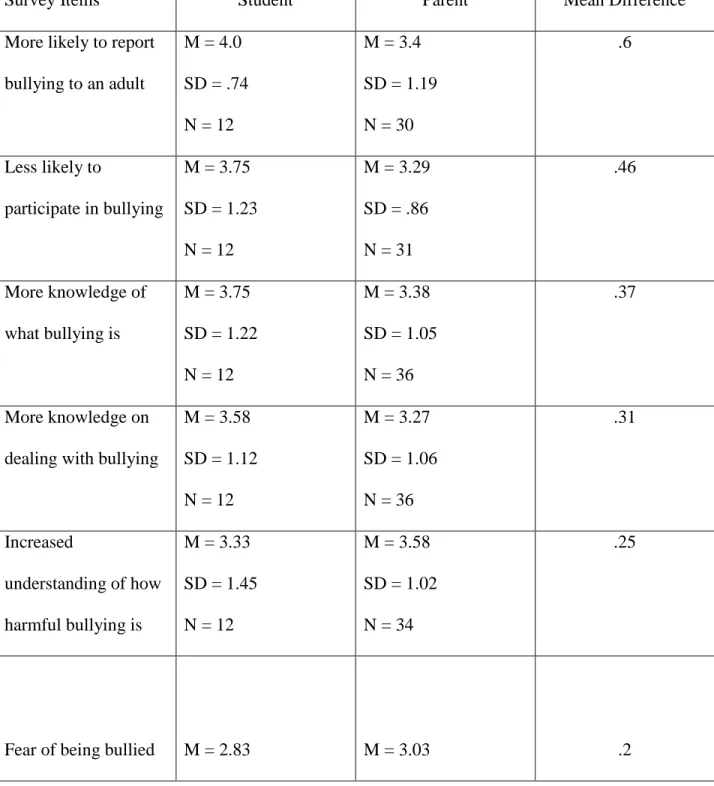
For the Likert scale comprised of strongly agree (5), agree (4), neutral (3), disagree (2), strongly disagree (1).The majority of the means fell closest to neutral (3). The means on five of the items show that students scored higher than their parents (see Table 3). Students had the greatest mean (4.0) on the item, more likely to report bullying to an adult. The perception item with the lowest student mean (2.83) was fear of being bullied has decreased. The lowest student mean (2.75) was for the item, still being bullied. This item represents an event rather than a perception, but was included due to its significance when comparing it with the parent item, I believe bullying happens less since OBPP implementation.
The parents’ greatest mean (3.58) was on the item, increased understanding of how harmful bullying is. The lowest mean parents reported was (2.66) on the item, I believe bullying happens less since OBPP implementation.The highest mean difference (.6) was on the item,
means (.09) represented whether students indicated they were still being bullied and parents perception on whether bullying happens less with OBPP. The significance is that students agree that they are being bullied less with OBPP, whereas parents disagree that bullying happens less. Table 3: Comparing Student and Parent Means
Survey Items Student Parent Mean Difference
More likely to report bullying to an adult M = 4.0 SD = .74 N = 12 M = 3.4 SD = 1.19 N = 30 .6 Less likely to participate in bullying M = 3.75 SD = 1.23 N = 12 M = 3.29 SD = .86 N = 31 .46 More knowledge of what bullying is M = 3.75 SD = 1.22 N = 12 M = 3.38 SD = 1.05 N = 36 .37 More knowledge on dealing with bullying
M = 3.58 SD = 1.12 N = 12 M = 3.27 SD = 1.06 N = 36 .31 Increased understanding of how harmful bullying is M = 3.33 SD = 1.45 N = 12 M = 3.58 SD = 1.02 N = 34 .25
has decreased SD = 1.40 N =12
SD = 1.13 N = 30 Still being bullied
(student)
I believe bullying happens less since OBPP implementation (parent) M = 2.75 SD = 1.28 N = 8 M = 2.66 SD = 1.03 N = 30 .09 Correlations
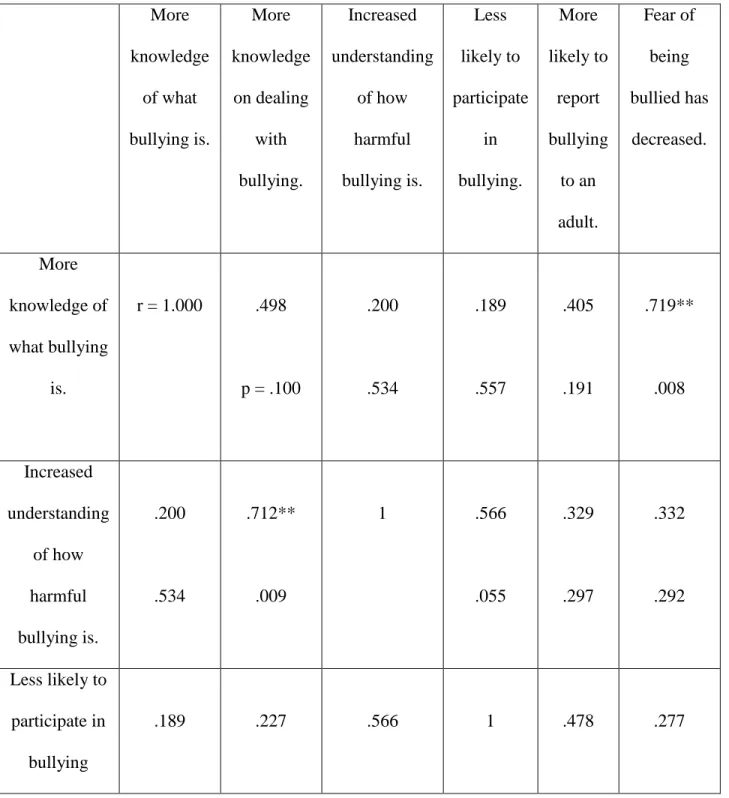
Calculating mean scores provided interesting and relevant results, however it is important to understand which items related to each other for students and parents. Pearson two-tailed correlations were run respectively for students and parents on all of the perception items that have been discussed in the previous tables. In the following narrative, only the meaning of the Pearson r-coefficients with p-values less than .01 (see Tables 4 and 5) and patterns will be discussed.
Student
There is a strong relationship between students that indicated they have more knowledge of what bullying is since OBPP and their fear of being bullied has decreased (see Table 4). This indicates that if students have knowledge of what bullying is, it is more likely that their fear of being bullied will decrease. There is also a strong relationship with students who indicated that they have more knowledge on how to deal with bullying and how harmful it is. This indicates that
increased knowledge of how to deal with bullying is associated with increased student awareness of how harmful it is.
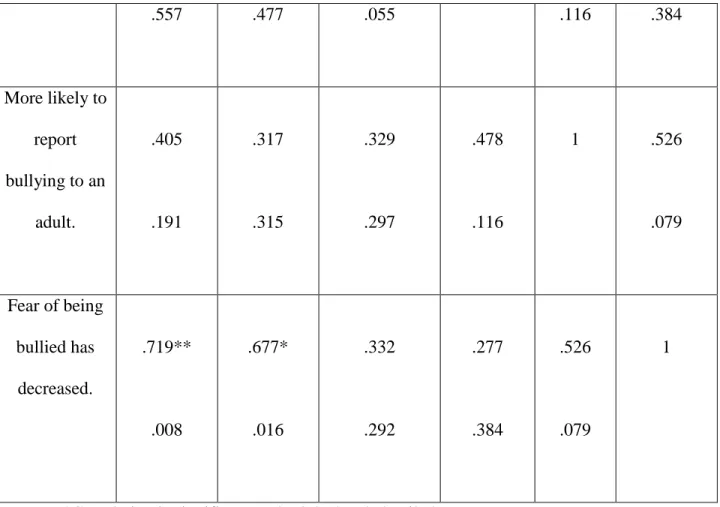
Table 4: Student Perceptions Pearson Product Correlation Coefficients (n = 12)
More knowledge of what bullying is. More knowledge on dealing with bullying. Increased understanding of how harmful bullying is. Less likely to participate in bullying. More likely to report bullying to an adult. Fear of being bullied has decreased. More knowledge of what bullying is. r = 1.000 .498 p = .100 .200 .534 .189 .557 .405 .191 .719** .008 Increased understanding of how harmful bullying is. .200 .534 .712** .009 1 .566 .055 .329 .297 .332 .292 Less likely to participate in bullying .189 .227 .566 1 .478 .277
.557 .477 .055 .116 .384 More likely to report bullying to an adult. .405 .191 .317 .315 .329 .297 .478 .116 1 .526 .079 Fear of being bullied has decreased. .719** .008 .677* .016 .332 .292 .277 .384 .526 .079 1
*Correlation is significant at the 0.05 level (2-tailed). **Correlation is significant at the 0.01 level (2-tailed).
Parent
There are strong relationships between parents perception that their child has more knowledge of what bullying is and these four items about their child: has more knowledge on dealing with bullying, has an increased understanding of how harmful bullying is, is more likely to report bullying to an adult, and fear of being bullied has decreased (see Table 5).
Table 5: Parent Perceptions Pearson Product Correlation Coefficients
Child has more Child has more Child has increased Child is more Child’s fear of
Bullying happens less than before
knowledge of what bullying is. knowledge on dealing with bullying. understanding of how harmful bullying is. likely to report bullying to an adult. being bullied has decreased implementation of OBPP.
Child has more knowledge of what bullying is. r = 1.000 36 .851** p = 0.000 36 .572** .000 34 .717** .000 30 .742** .000 30 .399* .029 30 Child has more
knowledge on dealing with bullying. .851** .000 36 1 36 .572** .000 34 .569** .001 30 .713** .000 30 .356 .053 30 Child has increased understanding of how harmful bullying is. .572** .000 34 .573** .000 34 1 34 .683** .000 30 .424* .019 30 .365* .047 30 Child is more likely to report .717** .569** .683** 1 .400* .394*
bullying to an adult. .000 30 .001 30 .000 30 30 .029 30 .031 30 Child’s fear of being bullied has decreased. .742** .000 30 .713** .000 30 .424* .019 30 .400* .029 30 1 30 .129 .498 30 Bullying happens less than before implementation of OBPP .399* .029 30 .356 .053 30 .365* .047 30 .394* .031 30 .129 .498 30 1 30 *Correlation is significant at the 0.05 level (2-tailed).
**Correlation is significant at the 0.01 level (2-tailed).
Summary of Results
These results indicate that both students and parents perceive that OBPP increases knowledge of bullying and how harmful it can be along with ways to effectively respond when bullying occurs. Student and parent responses are in disagreement that the implementation of OBPP has decreased incidents or fear of being bullying. The discussion section will elaborate on the significance of these findings and future areas that could be improved.
Discussion
The negative effect of bullying on students has created pressure on school districts to address this concern as part of the curriculum. This pressure has caused school administrations to review the school culture and how bullying effects it. Schools have implemented bullying
prevention programs, with OBPP being the most widely used to address this issue.
The purpose of this study was to assess the perceptions of middle school students and their parents on the effectiveness of OBPP. Many studies have collected data that indicates OBPP is effective in reducing the incidence of bullying in school. The surveys used in this study investigated what student and parent perceptions were on OBPP effectively addressing the issue of bullying. The results confirmed that the program is effective in educating the students on what bullying is, how to deal with it, and its harmful effects. However, students and parents did not perceive that OBPP reduced the fear of or number of incidents of bullying. The discussion of the results will address major findings on the perception items of the surveys, which include
frequency of student and parent responses, comparing student and parent means, correlations existing between items on student and parent surveys respectively, implications for the education field, limitations of this study, and recommendations for future research.
Frequency of Student Response
Results show that students surveyed believe OBPP has been effective in some areas more than others. The majority of students agreed that they have more knowledge of what bullying is, its harmful effects, and how to effectively deal with bullying since OBPP. However, their fear of being bullied has not decreased. These findings suggest students perceive that OBPP has
Frequency of Parent Response
Results represent parent’s belief that OBPP has effectively provided their child with more knowledge of what bullying is, how to deal with it, and the harm it can cause. They did not perceive that OBPP decreased their child’s fear of being bullied or the occurrence of incidents of bullying. This is contrary to the literature (Glew et al., 2000; Limber et al., 2004;Olweus, 1993a; Schroeder et al., 2012, Stevens et al., 2000; Whitney et al., 1994) that emphasized OBPP has been shown to be effective in reducing the number of incidents of bullying. Those research findings specifically addressed OBPP effectiveness in reducing actual incidence of bullying, while this study examines perceptions of students and parents on the effectiveness of OBPP.
Comparison of Student and Parent Response Means
When comparing the responses of student and parent means to the perception items it is clear that both groups closely agree with each other that OBPP has significantly impacted student knowledge of what bullying is. The most significant finding is that students believe they are being bullied less and parents perceive that incidents of bullying have not been reduced. It is possible that parents do not believe that bullying has decreased because their children are now more aware of what bullying is; therefore they talk about it or report it more. Although students disagree that they are still being bullied with OBPP, the mean number of 2.75 is close to a neutral response, which does not strongly support that they are not being bullied. This is somewhat contradictory to (Olweus 1993a) findings that after two years of OBPP implementation bullying incidents have decreased by 50%.
Another significant finding was the mean difference on the item asking whether they were more likely to report bullying to an adult. This was the highest mean differential, students
agreed (4.0) where parents were closer to neutral (3.4). This shows that students are more likely to report bullying to an adult than what their parent perceives. It is possible that students report bullying at school more than at home. This could speak to the effectiveness of the program in creating a safe, non-judgmental environment where students can disclose incidents.
Significant Correlations between Survey Items
Students
There were several perception items on the survey that had strong relationships with one another.Increased understanding of what bullying is had a strong relationship with decreased fear of being bullied. There was also a strong relationship between an increased understanding of how harmful bullying is and more knowledge on how to effectively deal with bullying. In other words, students who believe they gained more knowledge of what bullying is and its harmful effects, also perceived their fear of being bullied to be less, and indicated they had increased knowledge on how to deal with bullying. OBPP has shown to be effective in increasing student knowledge, which has positively impacted student belief that they are able to effectively deal with and be less fearful of bullying.
Parents
Findings between perception items on the parent surveys indicated strong relationships between multiple items. If their child had more knowledge of what bullying is, the child would tend to know how to respond effectively to bullying, comprehendits harmful effects, and have less fear of being bullied. These findings show the relationship between the belief that their child has more knowledge of what bullying is and their child’s ability to cope with bullying. The
significance of these findings in relation to OBPP is that having knowledge of bullying is associated with the child’s overall response to bullying.
Implications for the Education Field
The results of this study represent the perceptions of the effectiveness of OBPP, which in turn impacts the value of this program in the world of education. The study results indicate that there are specific areas of OBPP that are perceived to be effective. Students believe that having more knowledge reduces the fear of being bullied and empowers them on how to effectively deal with it. Parents believe that their child’s increased knowledge of bullying impacts other areas that bullying affects. This represents the importance of school personnel’s ability to deliver accurate information of what bullying is and its effects so that students are able to effectively deal with bullying when it occurs.
In terms of parent perception of OBPP reducing bullying, the findings do not support previous research that OBPP has reduced the incidence of bullying. Student results on whether they were still being bullied were also not as strong as previous literature indicates. This finding may suggest that the perception of the effectiveness of OBPP is significantly less than the actual data on lowering incidence rates. The influence this has on schools shows that further
communication regarding the decreased rates of bullying incidence needs to be shared with students and parents.
Limitations of this Study
Although this study yielded valuable results from the viewpoint of students and parents on the effectiveness of OBPP, several limitations were revealed. The sample population available was small, only 219 students and their parents/guardians. This is a significantly smaller sample
size than many of the previous studies. In spite of multiple attempts to encourage participation, the response rate was low, with only 5% middle school students and 16% of parents. There were a significant number of parents who only responded to the introductory questions and could not be included in the analysis of the results. This could be due to the parent survey being on the school district’s main webpage. Perhaps parents who had elementary or high school students clicked on the survey without realizing it was just for middle school parents, even though it was clearly stated on the link.
The design of the study did not allow for direct comparison of data between the student and her/his parent/guardian. The surveys were focused on anonymity and maximizing the response rate of both populations. It was not until after the data was analyzed, that it became apparent collecting paired responses would have been beneficial in comparing results using a t-test. When inputting the statistical data the student and parent items were not keyed into separate databases. Therefore, inferential statistics could not be obtained, which affects the
generalizability of the results. Recognizing the limitations of this study will benefit researchers who investigate perceptions of OBPP in the future.
Recommendations for Future Research
This study sheds light on the perceptions of middle school students and parents on the effectiveness of OBPP. Future research should focus on designing an instrument that allows pairing of student with her/his parent responses. Doing so will increase the value of the results by making it possible to generalize the findings. It will be important for future research to examine parents’ belief that OBPP has not decreased the number of incidents or their child’s fear of being
bullied. It is also recommended that further investigation be done regarding student belief that OBPP has not decreased their fear of being bullied.
The study contributes to literature on OBPP because unlike much of the current research, it is independent from the author of the program. The findings suggest that students have
experienced less bullying than before OBPP, although these results are not as strong as previous studies indicate. The results suggest that students and parents find several areas of OBPP to be effective, including increasing knowledge of bullying and how to deal with it. However, parents do not perceive the incidence of bullying has decreased with OBPP which is contrary to existing literature. Therefore, future research should address why parents perceive OBPP is not
decreasing bullying incidents.
Conclusion
This study has identified that students and parents perceive OBPP to be effective in several areas. The findings point toward student and parent belief that participating in OBPP effectively educates students on bullying and how to appropriately respond when it occurs. Additional research needs to be done on student and parent perceptions to determine why parents do not believe bullying has decreased with OBPP.Further communication regarding the
decreased rates of bullying incidence needs to be shared with students and parents. It is clear that middle school students and parents agree implementation of OBPP is an effective educational tool to address bullying.
References
Ahmed, E., & Braithwaite, V. (2004). Bullying and victimization: Cause for concern for both families and schools. Social Psychology of Education, 7(1), 49–51.
Baker, J. A. (1998). Are we missing the forest for the trees? Considering the social context of school violence. Journal of School Psychology, 36(1), 37–40.
Bauer, N. S., Lozano, P., & Rivara, F. P. (2007). The effectiveness of the Olweus Bullying Prevention Program in public middle schools: A controlled trial. Journal of Adolescent Health, 40(3), 266–274.
Black, S. A., & Jackson, E. (2007). Using bullying incident density to evaluate the Olweus Bullying Prevention Programme. School Psychology International, 28(5), 628.
Black, S., Washington, E., Trent, V., Harner, P., & Pollock, E. (2010). Translating the Olweus Bullying Prevention Program into real-world practice. Health Promotion Practice, 11(5), 739.
Bowen, G. L., Richman, J. M., Brewster, A., & Bowen, N. (1998). Sense of school coherence, perceptions of danger at school, and teacher support among youth at risk of school failure. Child & Adolescent Social Work Journal, 15(4), 281–282.
Bowllan, N. M. (2011). Implementation and evaluation of a comprehensive, school-wide bullying prevention program in an urban/suburban middle school. Journal of School Health, 81(4), 111, 170.
Carlson, C., & Christenson, S. L. (2005). Evidence-based parent and family interventions in school psychology: Overview and procedures. School Psychology Quarterly, 20(4), 348. Conners-Burrow, N. A. J. (2009). Adults matter: Protecting children from the negative impacts
Coyle, H. E. (2008). School culture benchmarks: Bridges and barriers to successful bullying prevention program implementation. Journal of School Violence, 7(2), 113–117.
Dulmus, C. N., Sowers, K. M., & Theriot, M. T. (2006). Prevalence and bullying experiences of victims and victims who become bullies (bully-victims) at rural schools. Victims & Offenders, 1(1), 15–31. doi:10.1080/15564880500498945. 18.
Edmondson, L., & Hoover, J. (2008). Process evaluation of a bullying prevention program: A public school-county health partnership. Reclaiming Children & Youth, 16(4), 30–33. Georgiou, S. N. (2008). Bullying and victimization at school: The role of mothers. British
Journal of Educational Psychology, 78(1), 121–122.
Glew, G., Rivara, F., & Feudtner, C. (2000). Bullying: Children hurting children. Pediatrics in Review / American Academy of Pediatrics, 21(6), 188–189.
Holt, M. K., Finkelhor, D., & Kantor, G. K. (2007). Hidden forms of victimization in elementary students involved in bullying. School Psychology Review, 36(3), 355–356.
Holt, M. K., Kaufman Kantor, G., & Finkelhor, D. (2009). Parent/child concordance about bullying involvement and family characteristics related to bullying and peer
victimization. Journal of School Violence, 8(1), 52–55.
Hunter, S. C., Boyle, J. M. E., & Warden, D. (2007). Perceptions and correlates of peer-victimization and bullying. British Journal of Educational Psychology, 77(4), 803. Jacobsen, K. E. & Bauman, S., (2007). Bullying in schools: School counselors’ responses to
three types of bullying incidents. Professional School Counseling, 11(1), 10-11, 14. Kallestad, J. H., & Olweus, D. (2003). Predicting teachers’ and schools’ implementation of the
Olweus Bullying Prevention Program: A multilevel study. Prevention & Treatment, 6(1), 10-18.
Karna, A., Voeten, M., Little, T. D., Poskiparta, E., Alanen, E., & Salmivalli, C. (2011). Going to scale: A nonrandomized nationwide trial of the KiVa Antibullying Program for grades 1-9. Journal of Consulting and Clinical Psychology, 79(6), 796–804.
Kochenderfer, B. J., & Ladd, G. W. (1996). Peer victimization: Cause or consequence of school maladjustment? Child Development, 67(4), 1315–1316.
Kohut, M.R. Creating bully-proof children and bully-busting in your home. (2007) (pp. 136– 139). Atlantic Publishing Company. Retrieved from
http://ezproxy2.drake.brockport.edu/login?url=http://search.ebscohost.com/login.aspx?dir ect=true&db=ehh&AN=48239303&site=ehost-live
Kulig, J. C., Hall, B. L., & Kalischuk, R. G. (2008). Bullying perspectives among rural youth: A mixed methods approach. Rural and Remote Health, 8(2), 8-10.
Limber, S. P., Nation, M., Tracy, A. J., Melton, G. B., & Flerx, V. (2004). Implementation of the Olweus Bullying Prevention Programme in the southeastern United States; Impetus for the intervention study, early stages of planning, and funding. In P. K. Smith, D. Pepler, & K. Rigby (Eds.), Bullying in schools: How successful can interventions be? (pp. 55–70). New York, NY US: Cambridge University Press. Retrieved from
http://ezproxy2.drake.brockport.edu/login?url=http://search.ebscohost.com/login.aspx?dir ect=true&db=psyh&AN=2004-22320-004&site=ehost-live
Lund, E. M., Blake, J. J., Ewing, H. K., & Banks, C. S. (2012). School counselors’ and school psychologists’ bullying prevention and intervention strategies: A look into real-world practices. Journal of School Violence, 11(3), 253–254.
Ma, X. (2002). Bullying in middle school: Individual and school characteristics of victims and offenders. School Effectiveness and School Improvement, 13(1), 81–82.
Maunder, R. E., Harrop, A., & Tattersall, A. J. (2010). Pupil and staff perceptions of bullying in secondary schools: Comparing behavioural definitions and their perceived seriousness.
Educational Research, 52(3), 277.
Mishna, F. (2004). A qualitative study of bullying from multiple perspectives. Children & Schools, 26(4), 240.
Nansel, T. R., Overpeck, M., Pilla, R. S., Ruan, W. J., Simons-Morton, B., & Scheidt, P. (2001). Bullying behaviors among US youth: Prevalence and association with psychosocial adjustment. JAMA: Journal of the American Medical Association, 285(16), 2097–2099. New York State Testing and Accountability Reporting Tool (2012). Retrieved September 21,
2013, from: https://reportcards.nysed.gov/files/2011-12/RC-2012-240201040000. Nordhagen, R., Nielsen, A., & Stigum, L. (2005). Parental reported bullying among Nordic
children: A population-based study. Child: Care, Health & Development, 31(6), 693– 698.
O’Connell, P., Pepler, D., & Craig, W. (1999). Peer involvement in bullying: Insights and challenges for intervention. Journal of Adolescence, 22(4), 445–448.
Olweus, D. (1991). Bully/victim problems among schoolchildren: Basic facts and effects of a school based intervention program. In D. J. Pepler & K. H. Rubin (Eds.), The
development and treatment of childhood aggression. (pp. 411–448). Hillsdale, NJ England: Lawrence Erlbaum Associates, Inc. Retrieved from
http://ezproxy2.drake.brockport.edu/login?url=http://search.ebscohost.com/login.aspx?dir ect=true&db=psyh&AN=1991-97362-016&site=ehost-live. 413, 443-445.
Olweus, D. (1993a). Bullying at school: What we know and what we can do. Malden: Blackwell Publishing. Retrieved from
http://ezproxy2.drake.brockport.edu/login?url=http://search.ebscohost.com/login.aspx?dir ect=true&db=psyh&AN=1994-97361-000&site=ehost-live. Intro., 81,100,113
Olweus, D. (1997). Bully/victim problems in school: Knowledge base and an effective intervention program. The Irish Journal of Psychology, 18(2), 180–184.
Olweus, D., & Limber, S. P. (2010). Bullying in school: Evaluation and dissemination of the Olweus Bullying Prevention Program. American Journal of Orthopsychiatry, 80(1), 126– 132.
Rao, V., & Simkiss, D. (2007). Bullying in schools: A survey of the experience of looked after children. Adoption & Fostering, 31(3), 51–53.
Reese, L. E., Vera, E. M., Simon, T. R., & Ikeda, R. M. (2000). The role of families and care givers as risk and protective factors in preventing youth violence. Clinical Child and Family Psychology Review, 3(1), 74–75.
Salmivalli, C., Kärnä, A., & Poskiparta, E. (2010). From peer putdowns to peer support: A theoretical model and how it translated into a national anti-bullying program. In S. R. Jimerson, S. M. Swearer, & D. L. Espelage (Eds.), Handbook of bullying in schools: An international perspective. (pp. 452–453). New York, NY US: Routledge/Taylor & Francis Group. Retrieved from
http://ezproxy2.drake.brockport.edu/login?url=http://search.ebscohost.com/login.aspx?dir ect=true&db=psyh&AN=2010-06797-031&site=ehost-live
Salmivalli, C., & Poskiparta, E. (2012). Making bullying prevention a priority in Finnish schools: The KiVa Antibullying Program. New Directions for Youth Development,
2012(133), 42.
perspectives of bullying. Children & Youth Services Review, 33(10), 1798.
Schroeder, B. A., Messina, A., Schroeder, D., Good, K., Barto, S., Saylor, J., & Masiello, M. (2012). The implementation of a statewide bullying prevention program: Preliminary findings from the field and the importance of coalitions. Health Promotion Practice,
13(4), 492–495.
Schwaner, S. L., & Keil, T. J. (2003). Internal colonization, folk justice, and murder in Appalachia: The case of Kentucky. Journal of Criminal Justice, 31(3), 282.
Shetgiri, R., Lin, H., & Flores, G. (2013). Trends in risk and protective factors for child bullying perpetration in the United States. Child Psychiatry and Human Development, 44(1), 96– 98. doi:10.1007/s10578-012-0312-3
Solberg, M. E., & Olweus, D. (2003). Prevalence estimation of school bullying with the Olweus Bully/Victim Questionnaire. Aggressive Behavior, 29(3), 252–253.
Stevens, V., De Bourdeaudhuij, I., & Van Oost, P. (2000). Bullying in Flemish schools: An evaluation of anti-bullying intervention in primary and secondary schools. British Journal of Educational Psychology, 70(2), 206–208.
Swaim, R. C., Henry, K. L., & Kelly, K. (2006). Predictors of aggressive behaviors among rural middle school youth. The Journal of Primary Prevention, 27(3), 235–237.
Thomlison, R. J., Thomlison, B., Sowers, K. M., Theriot, M. T., & Dulmus, C. N. (2004). School personnel’s observations of bullying and victimization among rural elementary and middle school children. Journal of Evidence-Based Social Work, 1(2/3), 31-33, 39. U. S. Department of Justice, Bureau of Justice Statistics. School Crime Supplement (SCS) to the
National Crime Victimization Survey (NCVS), 2009; Special Tabulation using Data Appended from the US Department of Education, National Center for Education