A Configurational Analysis of Network and Knowledge Variables Explaining Born Globals’ and Late Internationalizing SMEs’ International Performance
Mathew Hughes Loughborough University
School of Business and Economics, Loughborough LE11 3TU, United Kingdom E-mail: [email protected]; tel.: +44 1509 223263
Beate Cesinger* New Design University
Mariazeller Strasse 97a, 3100 St. Pölten, Austria E-mail: [email protected]; tel.: +43 2742 890 2428
* Corresponding author
Cheng-Feng Cheng, Asia University
500, Lioufeng Road, Wufeng, Taichung 41354, Taiwan E-mail: [email protected]
Felix Schuessler, University of Liechtenstein
Fürst-Franz-Josef-Strasse, 9490 Vaduz, Principality of Liechtenstein E-mail: [email protected]
Sascha Kraus, University of Liechtenstein
Fürst-Franz-Josef-Strasse, 9490 Vaduz, Principality of Liechtenstein e-mail: [email protected]
Author Bios
Mathew (Mat) Hughes is Professor of Entrepreneurship and Innovation at Loughborough University School of Business and Economics, United Kingdom. His research interests and knowledge lie at the nexus of entrepreneurship and strategy and include entrepreneurial orientation, innovation and ambidexterity, social capital, absorptive capacity, corporate entrepreneurship and strategy, and internationalization, among traditional businesses and family firms. His work has been published in such journals as Strategic Entrepreneurship Journal, Journal of Product Innovation Management, Journal of World Business, British Journal of Management, and Industrial Marketing Management. Mat is a member of the editorial boards of Journal of Management Studies, Journal of Business Venturing, and International Journal of Entrepreneurial Venturing.
Beate Cesinger is Professor of Entrepreneurship and Innovation and Head of Research at New Design University, Austria. Her research focuses on international entrepreneurship and psychology in entrepreneurship. Her work has been published in Journal of World Business, Journal of Business Research, Work Employment and Society, and Journal of Cleaner Production, among other journals. Beate is Editor-in-Chief of the Zeitschrift für KMU und Entrepreneurship (ZfKE), the leading and oldest German academic journal on SMEs and entrepreneurship.
Cheng-Feng Cheng is Associate Professor/Chair of Department of International Business and Associate Professor of Department of Business Administration in Asia University, Taiwan. He received his Ph.D. degree in Management from National Cheng Kung University, Taiwan. His research interests are strategic management, marketing management, and consumer behavior. He regularly participates in international conferences and has published papers in Technovation, Journal of Business Research, Industrial Marketing Management, British Journal of Management, Asia Pacific Business Review, Applied Economics Letters, Journal of Computer Information Systems, and elsewhere.
Felix Schuessler is the owner of a business consultant company in the Principality of Liechtenstein. His research interests lie at international management and entrepreneurship with the focus on the specific internationalization strategies of Born Globals. He received his Ph.D. degree in management and entrepreneurship from the University of Liechtenstein. Prior to this, he completed his M.Sc. in Entrepreneurship at the University of Liechtenstein and his B.A. in Banking and Finance at the Baden-Wuerttemberg Cooperative State University (DHBW).
Sascha Kraus is Full Professor and Chairholder in Strategic Management and Entrepreneurship at the University of Liechtenstein. Next to that, he was a Visiting Professor at Copenhagen Business School, Denmark in 2015 and at the University of St. Gallen, Switzerland in the two years before. He holds a doctorate in Social and Economic Sciences from Klagenfurt University, Austria, a Ph.D. degree in Industrial Engineering and Management from Helsinki University of Technology and a Habilitation (Venia Docendi) from Laapeenranta University of Technology, both in Finland.
A Configurational Analysis of Network and Knowledge Variables Explaining Born Globals’ and Late Internationalizing SMEs’ International Performance
Abstract
Network-based and knowledge-based conditions are widely regarded as important antecedents to international performance among new venture Born Globals (BGs) and their counterpart late internationalizing small and medium-sized enterprises (SMEs). Yet, while studies have examined the single effects of these ingredients on BGs’ and late internationalizing SMEs’ international activity, a configurational approach is still missing. How do network-based and knowledge-based factors matter for international performance and do they share the same importance for both types of firms? To address these questions, we apply for the first time a fuzzy set qualitative comparative analysis (fsQCA) on data from managers and founders of 365 international German, Austrian, Swiss, and Liechtensteinian companies, mapping configurational paths that lead to high international performance. The results demonstrate that late internationalizers do not share the same paths as BGs for high international performance, except in one instance. We find four causal configurations for BGs and three for late internationalizing SMEs. Results show that while both groups of firms rely on network size, BGs rely much more on collaboration intensity as well as international market knowledge and education.
Highlights
• Late internationalizing SMEs and Born Globals (BGs) do not share the same configuration of antecedents for high international performance.
• Late internationalizing SMEs have three configurational recipes for high international performance, BGs have four.
• For both BGs and late internationalizing SMEs network size is an essential antecedent for high international performance.
• One configurational path is consistent among BGs and late internationalizing SMEs. • BGs rely much more on collaboration intensity as well as international market
knowledge and education
Keywords: born global, network, international performance, fsQCA, international market knowledge
1. INTRODUCTION
An increasing number of start-up firms, often Business-to-Business ventures (Laanti, Gabrielsson, & Gabrielsson, 2007; Sepulveda & Gabrielsson, 2013), initiate their international activities very soon after founding (Jones, Coviello, & Tang, 2011). These Born Globals (BGs) represent over 18% of European new ventures (Mandl & Celikel-Esser, 2012) and have become a focal point for research over the past twenty years (Jones et al., 2011; Keupp & Gassmann, 2009; Rialp, Rialp, & Knight, 2005a). Firm age at the point of internationalization can materially affect international performance (Sapienza, Autio, George, & Zahra, 2006; Zahra, 2005) because it varies the severity of a firm’s liabilities of foreignness. This places the entrant firm at a disadvantage compared to local competitors (Schwens & Kabst, 2009). BGs, further possessing significant international market knowledge shortages described as liabilities of newness, would be expected to be at even greater disadvantage (Zucchella, Palamara, & Denicolai, 2007). For these reasons, networks can be powerful means for the development, growth, and performance of BGs (Sepulveda & Gabrielsson, 2013) at start-up (Coviello & Cox, 2006) and beyond (Hoang & Antonicic, 2003). Networks represent connections developed between a set of actors (either as individuals or firms) (Brass, 1984; Coviello & Cox, 2006). Managers must act purposefully to determine and coordinate the flow of knowledge from network relationships in a way that does not leave it to chance or happenstance (Håkansson & Ford, 2002). To do this, the BG firm must bring together network-based and knowledge-based factors. What is not known, is the contributions of network-based and knowledge-based factors into configurations of high international performance among BGs in comparison to late internationalizers. Configurations are combinations of factors influencing an outcome of interest. The study of configurations accepts that an equifinal number of combinations may create the outcome of interest, and those configurations will be different for different types of firms.
BGs are characterized by the speed of their internationalization (Jones et al., 2011). No precise definition of the time between founding and first international activity has been agreed on (Cesinger, Fink, Madsen, & Kraus, 2012; Welch, Rumyantseva, & Hewerdine, 2016). We adopt a strict definition of a BG as a new venture that started its international activities within the first year of founding (see for example, Moen, Sørheim, & Erikson, 2008; Oviatt & McDougall, 1995; Rialp, Rialp, Urbano, & Vaillant, 2005b; Schwens & Kabst, 2009). This definition stays true to the defining feature of BGs compared to their late internationalizing SME counterparts1: the rapidness of their internationalization after foundation. We define the late internationalizing SME counterpart as having internationalized later than three years
after inception.
Against this backdrop, BGs are an anomaly for traditional models of internationalization (Presutti, Boari, & Fratocchi, 2007; Rialp et al., 2005a) because BGs internationalize rapidly and must do so without owing all of its own resources. BGs “favor a hybrid structure… and make extensive use of their business and personal networks” (McDougall, Shane, & Oviatt, 1994, p. 478). Traditional models cannot explain how networks fuel BGs’ international performance, especially since start-ups are typically disadvantaged by lacking established networks with both customers and suppliers (Aaboen, Dubois, & Lind, 2013; La Rocca, Ford, & Snehota, 2013) and having lower internal knowledge stocks (Hughes, Morgan, Ireland, & Hughes, 2014). Partly in response to the success of BGs, traditional models of internationalization evolved to include networks. The revised Uppsala model of Johanson and Vahlne (2009) interprets network relationships as enablers of successful internationalization. Johanson and Vahlne (2009) theorize that ‘insidership’, the knowledge benefits from being inside networks, propels internationalization and increases international presence resulting in
1Recognizing the variety of possible categorizations of a BG and by extension ‘later’ internationalizing SMEs (e.g., BGs vs. average-time exporters vs. late starters by Moen and Servais (2002)), we refer to ‘late’ as a
greater international sales, employees, profits, and international market share versus its competitors (or what is collectively termed as international performance).
The empirical literature on the antecedents of internationalization and performance points clearly to the importance of network-based and knowledge-based factors. Previous research shows that international market knowledge (Filatotchev, Liu, Buck, & Wright, 2009) and international experience (Bloodgood, Sapienza, & Almeida, 1996) enhance internationalization and performance. Top management teams with limited international experience benefit the most from external international knowledge (Fernhaber, McDougall-Covin, & Shepherd, 2009), obtainable from networks. Forging networks can help BGs to acquire international market knowledge, accelerate its entrance into foreign markets, and be the decisive advantage over competitors (Acedo & Jones, 2007; Freeman, Edwards, & Schroder, 2006; Madsen & Servais, 1997; Moen, 2002; Oviatt & McDougall, 2005). But, while increasing network size and collaboration intensity may stimulate the flow of knowledge into the firm (Cesinger, Hughes, Mensching, Bouncken, Fredrich, & Kraus, 2016; Johanson & Vahlne, 2009), their contribution to firm performance cannot be divorced from knowledge-based factors inside the firm (Hughes et al., 2014). The configurations of knowledge-based and network based factors must therefore be vital, yet this remains theoretically and empirically untreated.
Prior studies focus on the single effects of network-based and knowledge-based factors. Little regard is given to how these single factors may arrange into configurations of conditions that could substitute for one another as routes to high international performance. This is compounded by insufficient comparison between BGs and late internationalizing SMEs. First, in entrepreneurship research, studies of networks tend to stop at firm inception and overlook the context of the BG (Sepulveda & Gabrielsson, 2013). Only a very small number of studies investigate how the networks of domestic start-ups (Hite & Hesterly, 2001)
and BGs (Coviello, 2006; Zhou, Wu, & Luo, 2007) might change after start-up. Second, while the literature on BGs acknowledges that networks are fundamental to BGs’ internationalization (Laanti et al., 2007; Sepulveda & Gabrielsson, 2013), a comparison to their late counterparts is missing. In contrast, much of the research into networks and international performance is concentrated on the established firm (Araujo, Dubois, & Gadde, 2003; Håkansson & Snethota, 1995; Sousa, Martínez-López, & Coelho, 2008). It is highly unlikely that BGs and late internationalizers benefit from the same factors, or the same configuration of factors, given that the liabilities and circumstances the two groups of firms face are different. What is missing is a theoretical treatment and empirical analysis of how network-based and knowledge-based conditions form configurations that contribute to high international performance of BGs in comparison to late internationalizing SMEs. The purpose of this study is to identify these configurations. In doing so, we sharpen knowledge about how network conditions help BGs, as seemingly high-risk new ventures, to accomplish high international performance instead of costly failure.
We apply a fuzzy set qualitative comparative analysis (fsQCA) to develop configurations of the BG’s network attributes, and the education, international business experience, and international market knowledge of the senior manager or lead entrepreneur. Configurations in fsQCA are groups of single factors (or single variables) representing combinations of these single factors that create the outcome of interest. fsQCA therefore finds combinations of causal measures that lead to the outcome and thus allows us to go beyond single-factor explanations that dominate the literature to date. Instead, we map configurations of network-based and knowledge-network-based factors that characterize high international performance among BGs and late internationalizers. This allows us to detect simultaneously whether BGs and late internationalizing SMEs require different combinations of factors (configurations) for high international performance. In doing so, we respond to calls in this special issue to increase our
understanding of the role of networks and knowledge in the international performance of BGs. We reveal new forms of substitutions and the acuteness of the dangers of being outside networks to both BGs and their late counterparts.
The paper proceeds as follows. Section 2 discusses network theory, the role of knowledge, and networks for BGs and late internationalizing SMEs. Based on this theoretical background, we develop assumptions about configurations relevant for late internationalizing SMEs and BGs in achieving high international performance. Section 3 describes our method, testing procedures and analyses. Therein, we provide detail about fsQCA as a novel approach compared to traditional quantitative and qualitative methods. Section 4 presents the results. The paper closes with a discussion of the findings and suggestions for further research.
2. THEORETICAL FOUNDATION AND POSSIBLE CONFIGURATIONS
2.1. Network theory and related research
The general proposition of network theory (Burt, 1992; Nahapiet & Ghoshal, 1998) is that networks provide access to knowledge, which in turn may influence firm performance. Extant literature on entrepreneurship (for a review, see Hoang & Antoncic, 2003) and internationalization (Johanson & Vahlne, 2009; Prashantham & Dhanraj, 2010) confirms this. Entrepreneurs of both young ventures and established SMEs rely on networks for novel ideas and business opportunities (e.g., Johannisson et al., 1994), which in turn enhance a venture’s chances of success and of achieving high performance (Venkataraman & Van de Ven, 1998). This also applies to the internationalization context. Building networks and growing knowledge are strategically important to resource-constrained firms. Networks aid in identifying and screening international opportunities, acquiring international market knowledge, and reducing the liabilities of newness and foreignness (Musteen, Francis, & Datta, 2010).
Two views about networks exist: the structural view and the relational view. In the structural view, network size represents the number of direct links between a firm and others (Hoang & Antoncic, 2003). This overall pattern of network reach held by an actor represents the amount of knowledge resources he/she can access. A larger network size also increases the exposure of the firm to idiosyncratic pockets of non-redundant information (Burt, 1992; Granovetter, 1973). In the relational view, the intensity of collaboration matters as it reveals the degree of interaction and trust that take hold in ties among actors (Nahapiet & Ghoshal, 1998). Thus, both the relational and structural components of networks may influence firm outcomes. The number of network connections (network size, a structural component) and the actor’s collaboration intensity (a relational component) facilitate important outcomes to emerge because the exposure to new knowledge is matched by the trust and interaction needed to transfer that knowledge with fewer transmission errors (Hughes et al., 2014).
In a purely structural view, an actor’s set of network ties is said to provide “both necessary and sufficient conditions for transferring information and resources that may aid in a venture’s likelihood of success” (Smith & Lohrke, 2008, p. 316). But under a relational view, this is not enough. More knowledge with fewer transmission errors is transferred when collaboration intensity is high because collaborating frequently, closely, formally, and informally with network partners affects the trustful conditions surrounding knowledge transfer (Hughes et al., 2014). Both structural and relational views therefore have a role to play, because different network configurations result in dissimilar relations, disparities in how firms access information, and distinctions in the quality of information being transmitted. The configuration of structural and relational network dimensions would then be expected to yield different outcomes (Ostgaard & Birley 1994).
We propose that the interplay between gaining knowledge, network size, and collaboration intensity is central to how BGs and late internationalizing SMEs achieve high international
performance. But, we further propose that this interplay may differ between BGs and late internationalizing SMEs. In the following two sections, we discuss the role of knowledge and the role of networks, respectively, for the international performance of BGs and late internationalizing SMEs.
2.2. The role of knowledge for BGs compared to late internationalizing SMEs
BGs prioritize international activities that omit the incremental approach exhibited by late internationalizing SMEs. BGs forfeit the idea of first creating a solid competitive position in the domestic market. This is against the general principles and expectations set in the original Uppsala internationalization model (Johanson & Vahlne, 1977). An assumption of this theory is that firms do not have any (or only very limited) knowledge of international markets at the beginning of the internationalization process. Learning—a central component of the Uppsala model—enables firms to start its internationalization, passing through single phases from a purely domestic base to a global presence, committing more resources as the firm gradually learns. The process continues as long as performance prospects are favorable. These theoretical assumptions hold for late internationalizing SMEs (e.g., Gabrielsson, Gabrielsson, & Seppälä, 2012). But BGs have a global view of their markets from the beginning and approach them proactively and quickly after foundation (Jones et al., 2011). They have no time to engage in a methodical learning process and defy these original theoretical expectations.
The most persistent theoretical lens used to study BGs has been the knowledge-based view of the firm (Jones et al., 2011). Within this view, the accumulation and renewal of knowledge within the firm determines how the firm evolves. When applied to BGs, the knowledge either
possessed or accessed by the chief acting individual (i.e., the manager or entrepreneur) explains their rapid international expansion (Autio, Sapienza, & Almeida, 2000). Prominent knowledge-based factors identified among existing studies to explain BGs’ successful
internationalization against their slower counterparts are: international market knowledge (Knight & Cavusgil, 2004), international experience (Harveston, Kedia, & Davis, 2000), and the level of education (Zucchella et al., 2007).
But it is unlikely that the possession of internal knowledge alone differentiates late internationalizing SMEs from BGs. Rather, what is far more likely is that BGs and late internationalizing SMEs bear different configurations of international market knowledge, international experience, and education capable of advancing its internationalization and international performance.
2.3. The role of networks for BGs compared to late internationalizing SMEs
The international market knowledge, experience, and education of the entrepreneur or senior manager are unlikely to be enough for BGs such that networks are used to overcome an otherwise gradual process of learning commonly expected among late internationalizing SMEs. BGs do not have the “time and patience to base their foreign investments on experience from their own current activities” (Forsgren, 2002, p. 275). Therefore, where knowledge originates from likely differs between BGs and late internationalizing SMEs.
The revised Uppsala model of Johanson and Vahlne (2009) stresses network relationships as enablers of successful internationalization for any type of enterprise. Beyond the original model, it explains how networks facilitate access to critical resources and knowledge to enable, assist, and expedite internationalization. Networks carry a structural and relational dimension, to which we investigate network size as a structural component of networks, and collaboration intensity as a relational component representing the depth of ties. A failure to create networks of sufficient size and depth exposes the firm to ‘liabilities of outsidership’ (Johanson and Vahlne, 2009). A new venture typically lacks relationships at start-up and so exhibits much higher liabilities of outsidership unless they act to build a large network size with sufficient depth of ties. For the BG then, their mortality rate is likely to be higher as
liabilities of outsidership exacerbate liabilities of newness. BGs must learn from the experience of others. Networks enable BGs to learn from the experience of others quickly and substitute for a more traditional process of learning. Building network size and depth can then explain why BGs internationalize much faster than late internationalizing SMEs (Acedo & Jones, 2007; Freeman et al., 2006; Madsen & Servais, 1997; Moen, 2002; Oviatt & McDougall, 2005) and can outperform their competitors in doing so. Networks can accelerate the entrance of new ventures into foreign markets by bringing together unique firm-specific resources and hybrid structures (e.g., partner outsourcing). This can explain how BGs overcome their liabilities of newness, smallness, and foreignness to reach potential markets quickly and successfully (Jones et al., 2011). Networks furthermore enhance BGs’ competitive power by bringing in knowledge and resources that routinely accelerate their international transactions and market entry (Autio, 2005; Moen, 2002).
A larger network size provides the firm with many opportunities to access knowledge, and non-redundant knowledge in particular. New ventures suffer from liabilities of newness and smallness beyond just the lack of international market knowledge encapsulated in liabilities of foreignness. To close knowledge gaps and facilitate rapid and successful internationalization, the BG would be expected—from a structural network perspective—to develop a wide network size. In comparison, late internationalizing SMEs establish a solid domestic market position before internationalizing. The learning benefits reaped from doing so suggest a large network is less important for these firms.
A larger network size is advantageous because it presents many opportunities to access
knowledge. Collaboration intensity is advantageous because it encourages the transfer of knowledge. Thus, the extent to which a firm converts the opportunities to learn presented by its network size depends on the extent of its collaboration intensity (Hughes, Ireland, & Morgan, 2007). Resource constraints encourage BGs and late internationalizing SMEs to turn
to trusted network members for knowledge, and that trust comes from increased collaboration intensity. Doing so can mitigate some of the costs and risks associated with early internationalization (Musteen et al., 2010). Collaboration intensity also generates better quality interaction and trust to transfer higher quality knowledge needed for successful rapid internationalization. We would therefore expect this relational dimension of network behavior to be more important for the international performance of BGs than for late internationalizers. Madsen and Servais (1997) observed that BGs especially “seek partners who complement their own competences; this is necessary because of their limited resources” (p. 564). BGs would therefore be expected to configure both its network size and its collaboration intensity to build legitimacy and trust to accumulate a large amount of high-quality knowledge quickly. These actions shape the BG’s networks in ways that impact the breadth of knowledge about international markets and opportunities therein (Musteen et al., 2010). The best performing BGs would then be expected to form larger network with greater collaboration intensity than their late internationalizing counterparts.
2.4. Expectations about configurations of network-based and knowledge-based factors for BGs’ and late internationalizing SMEs’ international performance
Early and rapid internationalization can destabilize the firm (Chetty & Campbell-Hunt, 2003; Mandl & Celikel-Esser, 2012). Accounts of the performance differences between BGs and late internationalizers have been mixed. For example, overall evidence (Aspelund, Madsen, & Moen, 2007) suggests a positive relationship between rapid international involvement and performance; early internationalization can enhance firm growth (in terms of international sales share, growth in international sales, total sales) (Autio et al., 2000; Zahra, Ireland, & Hitt, 2000), and profits (Bloodgood et al., 1996); and BGs tend to outperform their slower counterparts (Autio et al., 2000; Kuivalainen, Sundqvist, & Servais, 2007). However, Aspelund and Moen (2005) find no differences in employment growth, return on investments,
or equity (see also McDougall & Oviatt, 1996); Bloodgood (2006) shows that early internationalization did not affect sales growth or financial performance in the period after internationalization, observing an S-curve between internationalization and performance; and Chiao, Yang, and Yu (2006) find an inverted U-shaped curvilinear relationship between internationalization and performance for BGs. As Keupp and Gassmann (2009, p. 619) put it, “there are gaps in our understanding of how, if at all, internationalization creates value and leads to superior firm performance” among BGs. Anchoring this debate in the significance attached to knowledge resources and network reasoning, we suggest that BGs and late internationalizers rely on different mixtures of these conditions as a driver of their international performance.
Senior managers or entrepreneurs of BGs are in an advantageous position if they possess superior amounts of international market knowledge (Filatotchev et al., 2009), international experience (Bloodgood et al., 1996), or education (as human capital) (e.g., Onkelinx, Manolova, & Edelman, 2015). The education (Contractor, Hsu, & Kundu, 2005) and international experience (Bloodgood, 2006; Gleason, Madura, & Wiggenhorn, 2006) of key actors and decision-makers influence the perception of growth opportunities and the achievement of growth. Bloodgood (2006) theorized that BGs’ rapid and early internationalization allows them to use that experience to develop new routines that cause the firm to automatically continue to look for and initiate new internationalization opportunities. This causes the BG to evolve quite differently to a late SME internationalizer. However, the performance of BGs is explained by the ability of the firm to acquire and manage international market knowledge (Julien & Ramangalahy, 2003), which calls for network considerations.
The importance of network-based factors for performance has been highlighted for late internationalizers (e.g., Naudé, Zaefarian, Tavani, Neghabi, & Zaefarian, 2014) and BGs (e.g.,
Prashantham & Dhanaraj, 2010). A wider international network size and intense collaborations therein can provide access to resources, tacit and strategic knowledge, and experience capable of accelerating the advantageous entrance of the firm into international markets (Acedo & Jones, 2007; Madsen & Servais, 1997; Oviatt & McDougall, 1995). The BG must bring together knowledge resources through an international network of individuals and firms to reap international performance rewards.
It takes time for networks to generate such value for firms, whether they are young (Hughes et al., 2014) or established (Hughes & Perrons, 2011). BGs cannot afford that time to be unduly long, and BGs must therefore develop networking activity that rapidly accumulates resources and knowledge. BGs are likely to differ from late internationalizing firms in the composition of their network activities then. To get more versatile and helpful information, they may thus profit from a larger network with high collaboration intensity. Late internationalizing SMEs may also have large networks but not necessarily the depth of collaboration intensity to go with it because the urgency to network does not exist. Late internationalizers will have accumulated more international market knowledge themselves.
The dangers of a small network and poor collaboration intensity appear to be more pronounced for BGs than their late internationalizing counterparts, a danger Johanson and Vahlne (2009) described as the liability of outsidership. This liability acknowledges that international knowledge accrues from the firm’s own activities and those of its partners (or its network ties). These relationships allow any firm to scale its knowledge base faster than were it isolated and alone. Three important considerations are needed to understand this liability. First, individual knowledge-based factors should be more important for the international performance of BGs because the experience and education of their senior managers or lead entrepreneur(s) provides the foremost body of knowledge to be leveraged for internationalization. Late internationalizing SMEs on the other hand build a solid domestic
base. This diminishes the importance of such individual knowledge-based factors as they prioritize an organizational knowledge acquisition process. Second, the characteristics of the networks used by BGs and late SME internationalizers must differ because the urgency by which knowledge is needed and must be accessed, transferred, and used is far greater in BGs. They must generate productive networks quickly, indicating that BGs make use of more intensive relations and have a larger network. Third, we expect individual knowledge factors and network characteristics to be more critical in BGs than among late internationalizers in terms of their absolute need and importance for international performance, in part because the late internationalizer has more time to accumulate international market knowledge.
3. METHOD
3.1. The fsQCA method
3.1.1. What is fsQCA compared to traditional quantitative and qualitative analysis methods?
fsQCA is a mixed qualitative-quantitative technique for investigating complex configurations of constructs. It performs a systematic cross-case analysis that models relations among variables in terms of set membership and identifies configurations that reflect the necessary and sufficient conditions for an outcome of interest. Thus, configurational comparative methods formalize qualitative case-oriented analysis (Ragin, 2008). fsQCA can then be applied either to traditional qualitative data or traditional quantitative data collected by way of surveys, as a mixed qualitative-quantitative technique for analyzing complex configurations.
Multiple regression analysis and structural equation modeling adopt symmetric thinking typical of net effects estimation approaches. Such approaches assume that high values of causal statements are necessary and sufficient for high values of a dependent variable to occur, and that low values of a dependent variable occur with low values of the causal statement (Woodside, 2013a). However, several scholars have questioned the usefulness of
the symmetric approach for management research and its sub-disciplines, believing they are less informative and inadequate for contextualization and theory development compared to emerging asymmetric approaches (McClelland, 1998; Woodside, 2013a, 2013b, 2014).
As social science theories are formulated in terms of sets or set relations, the use of methods for asymmetrical or set-theoretic relationship analysis, such as fsQCA, are now receiving significant attention from academics and practitioners (e.g., Bell, Filatotchev, & Aguilera, 2014; Chang & Cheng, 2014; Fiss, 2011; Ragin, 2009a; Tóth, Thiesbrummel, Henneberg, & Naudé, 2015; Woodside, 2015). An asymmetric relationship indicates that high values of a causal statement are sufficient but not necessarily essential for high values of a dependent variable to occur (Woodside, 2013a). Unlike typical quantitative methods that are based on correlation, “fsQCA seeks to establish logical connections between combinations of causal conditions and an outcome, the result being rules that summarize the sufficiency between subsets of all of the possible combinations of the causal conditions (or their complements) and the outcome” (Mendel & Korjani, 2012, p. 1).
fsQCA has a variety of merits compared to symmetric approaches such as multiple regression analysis and structural equation modeling. Specifically, it focuses on identifying combinations of explanatory factors that elicit the particular outcome of interest (Bell et al., 2014). In turn, an fsQCA yields a deeper empirical and theoretical exploration into the effectiveness of combinations of factors for a particular dependent variable (Bell et al., 2014). This is valuable for organization, strategy and industrial marketing research because it does not treat configurations as separate types of cases (Fiss, 2011). Importantly then, fsQCA can identify several (not just one) equifinal combinations of factors that are sufficient to produce a given outcome of interest (Chang & Cheng, 2014), revealing parsimonious patterns among factors for a particular outcome to occur.
Users of fsQCA mostly focus on categorizing relevant antecedents into causal recipes for achieving a high value of the outcome variable. For example, Bell et al. (2014) investigated the configurations of contextual conditions, country of origin conditions, governance conditions, CEO stock, and venture capital for achieving high perceived value for foreign IPO listing in the US; Fiss (2011) explored combinations of structure (size, formalization, centralization, and complexity), strategy (differentiation and low cost), and environment (rate of change and uncertainty) for achieving high performance.
Given the unresolved question about which causal conditions contribute to higher international performance among BGs and late internationalizing SMEs, and the arguments concerning the value of fsQCA as a methodological approach, this study combines theoretically-relevant antecedents to explore the configurations which are the most promising for BGs’ and late internationalizers’ international performance.
3.1.2. Performing the fsQCA method
To justify using fsQCA over typical (symmetric) quantitative data analysis methods, contrarian case analysis is performed. This analysis confirms whether a substantial numbers of cases display relationships that are contrary to the main effect of an antecedent on an outcome variable (Woodside, 2014). If so, an asymmetrical relationship is revealed, which calls for fsQCA.
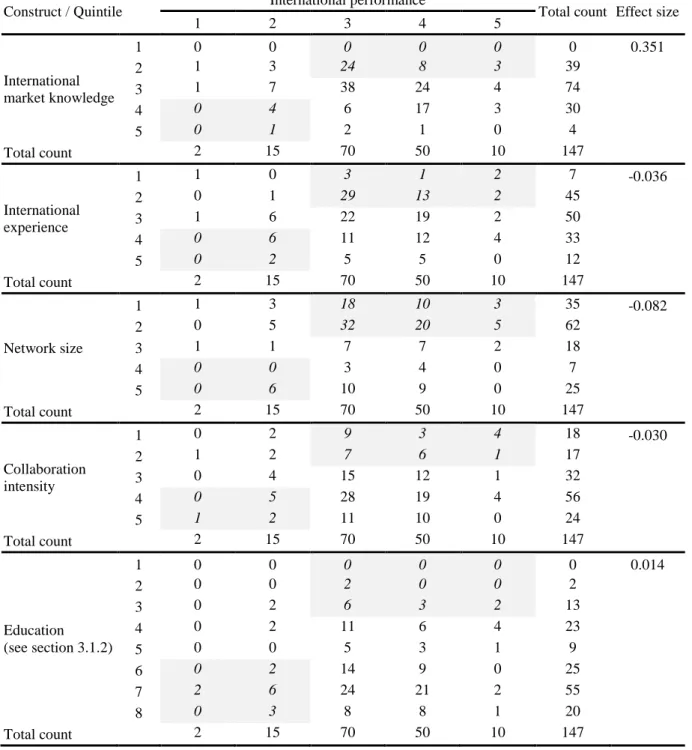
Table 1 and Table 2 display the results of our contrarian case analysis related to the relationships between the antecedents and the outcome. To perform the contrarian case analysis, cases are divided from the lowest to highest quintile for each construct based on their values (apart from the education level because this was already measured with eight categories, while the other constructs were measured on five-point Likert scale). For information, the factor scores of each construct are the mean of the relevant items and not an integral. We then rounded off these factor scores and obtained five levels for each construct.
Afterwards, cases were classified into several groups based on these scores. Grey zones in Table 1 and Table 2 show contrarian cases running counter to the main effect. A percentage of contrarian cases higher than one-fourth of total cases indicate an asymmetrical relationship (Woodside, 2014).
For BGs, Table 1 indicates that 27.21% (i.e., (0+0+0+24+8+3+0+4+0+1)/147) of cases have low international market knowledge (i.e., less than 3) along with high international performance (i.e., not less than 3) or high international market knowledge along with low international performance, running counter to the main positive relationship. The percentage of contrarian cases is 39.46% for the relationship between international experience and BGs’ international performance; 63.95% for the relationship between network size and their international performance; 25.85% for the relationship between collaboration intensity and their international performance; and 17.69% for the relationship between education and their international performance. Similarly, Table 2 shows that the contrarian cases occupy 25.23%, 36.24%, 57.80%, 29.36%, and 22.48% for the relationship between each condition and international performance for late internationalizing SMEs. Therefore, approximately 34.52% (as the mean of these percentages) (i.e., 34.52% = (27.21% + 39.46% + 63.95% + 25.85% + 17.69% + 25.23% + 36.24% + 57.80% + 29.36% + 22.48%) /10) of the total cases are contrarian cases, indicating asymmetrical relationships exist. Table 1 and Table 2 also disclose the effect size for the relationship between each condition and international performance for BGs and late internationalizing SMEs, respectively. These values of effect size are quite small. Many contrarian cases and small effect sizes indicate the necessity for examining asymmetrical relationships and therefore warrant the use of fsQCA.
--- Insert Table 1 and Table 2 about here ---
fsQCA has three steps (e.g., Hervas-Oliver, Sempere-Ripoll, & Arribas, 2015), and the website fsQCA.com provides a software program and user guide. First, ordinary data including values of causal conditions and the outcome variables are transformed into fuzzy membership scores ranging from 0.00 to 1.00. This is achieved by using the calibrating function. The process of transforming variables into sets requires the specification of full membership (95%), cross-over anchors (50%), and full non-membership (5%). We set the values at the 95th, 50th, and 5th percentile from ordinary data to correspond to these memberships. Second, a ‘truth table’ algorithm is constructed to recognize configurations that are sufficient to the outcome from those that are not. This is achieved by specifying the minimum recommended consistency cutoff value of .75 (Cheng, Chang, & Li, 2013; Fiss, 2011; Misangyi & Acharya, 2014). The third step is to indicate which configurations exhibit high scores to the respective outcome.
While both specific and standard analyses can be applied within fsQCA, most research applies standard analysis to explore the configurations for achieving high values of the outcome of interest (in our case, international performance). Within a standard analysis, a complex solution, parsimonious solution, or intermediate solution can be produced for each standard analysis. These differ based on the number of ‘logical remainders’ or ‘zero cases’ remaining in the solution. Logical remainders are simply all the other combinations of the antecedent variables that are possible but are not supported by (or have no cases/instances of) among the firms in the dataset (Ragin, 2008).
By way of explanation, no logical remainders are used in a complex solution, while all logical remainders (regardless of their plausibility) may be used in a parsimonious solution (Cheng et al., 2013; Hervas-Oliver et al., 2015). Intermediate solutions (in which only the logical remainders that make sense are incorporated into the solution) are superior to both the complex and the parsimonious solutions (Cheng et al., 2013; Hervas-Oliver et al., 2015;
Ragin, 2009b). Thus, we apply the intermediate solution to explore the configurations of international market knowledge, international experience, education, network size, and collaboration intensity of BGs’ and late internationalizing SMEs’ international performance.
3.2. Sample
We invited business executives and founders of companies established in Germany, Austria, Switzerland, and Liechtenstein to participate in a survey. The selected target countries have one of the highest rates of international activities in Europe, and international trade is important for their national economies (Eurostat, 2015). Addressing founders and business executives ensures that key informants who are responsible for making strategic and international business decisions were part of our sample (Nielsen & Nielsen, 2011). We randomly selected a cross-sectional sample of 10,000 firms from Germany, Europe’s largest economy, and the three other smaller German-speaking countries from the Schober Business TargetBase. Because this database did not isolate whether firms were international or not, the initial question of the survey asked whether the responding firms had any kind of international business activity. If not, the questionnaire ended. Firms were not preselected according to their size. The data for this study is a subset focused exclusively on BGs and late SMEs from the original, larger dataset.
Data was generated through a standardized online questionnaire. After the initial invitation to participate, we sent another two reminders. This resulted in 5,213 initial weblink consultations from which 104 cases did not answer the initial question. From the remaining 5,109 cases, 3,800 did not have international operations and were therefore excluded from the dataset. This resulted in 1,309 cases with international activities. We then screened this sample for SMEs following the definition of the European Commission (2014) and for large enterprises. We identified 545 invalid cases (not providing the total number of employees to determine size), 48 large enterprises and 716 SMEs (businesses with less than 250
employees). Filtering the dataset to include only those enterprises that provided information on their founding year, total revenue, and international revenue at the time of data collection reduced the dataset to 589. Following our strict definition of a BG (internationalization within the first year of operation) and the definition of late internationalizers (internationalization later than three years after inception) resulted in 176 BGs and 315 late internationalizers. Empirically, there was no need to exclusively sample young ventures, only that the sample appropriately captured firms matching our definitions (Cesinger et al., 2012).
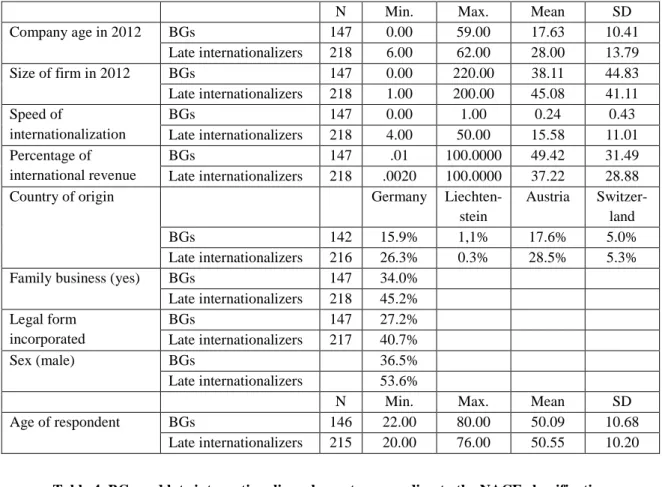
We then screened the subsample for outliers with regard to their founding year. If companies, BGs or late internationalizers, were founded before 1950, they were excluded from the dataset. The disruption, legal limitations of business activities in Europe because of World War II, and significant changes economically afterwards explain this choice. The revised dataset then included 167 BGs and 248 late internationalizers. Screening for missing data on the predictors resulted in a final sample of 147 BGs and 218 late internationalizers. This amounts to 59.7% late internationalizers and 40.3% BGs in the final sample dataset. Tables 3, 4 and 5 present detailed information on the descriptive statistics of the sample regarding company characteristics and characteristics of the respondents.
--- Insert Tables 3, 4 and 5 about here ---
The BGs are on average 17.6 years old (SD = 10.4), internationalized after 0.2 years (SD = 0.4), their international revenue accounted for 49.4% (SD = 31.5), and they employ on average 38 people (SD = 44.8) whereas late internationalizers are on average 28.0 years old (SD = 13.8), internationalized after 15.6 years (SD = 11.1), create 37.2% (SD = 28.9) of their revenue from international markets, and have 45 employees (SD = 41.1).
Almost 80% (79.2%) of all enterprises are family businesses. This equals 75.7% of all late internationalizers and 84.4 % of the BGs. Around 67.9% of all enterprises are incorporated (68.2% of the late internationalizers and 67.3% of the BGs). The majority of BGs and late internationalizers are active in three sectors: manufacturing (BGs: 34.0%, late internationalizers: 33.9%), wholesale and retail trade (BGs: 15.6%, late internationalizers: 22.9%), and professional, scientific, and technical activities (BGs: 17.7%, late internationalizers: 16.1%).
The large majority of our respondents are male (BGs: 90.4%, late internationalizers: 89.8%) and are on average 50 years of age (BGs: 50.1; SD = 10.7; late internationalizers: 50.6; SD = 10.2). Founders and managers of both groups are highly educated holding a degree from a university of applied sciences (BGs: 17.0%, late internationalizers: 16.1%) or a university (BGs: 37.4%, late internationalizers: 36.2%).
3.3. Operationalization of predictor conditions
We measure three knowledge-based antecedents (education, international business experience, and international market knowledge), two network-based antecedents (network size and collaboration intensity), and international performance. All items can be found in the appendix.
Education was measured by the highest educational attainment of the respondent on an eight-step scale, from “no diploma” to “PhD”.
International business experience was measured by asking the respondent about how many years of experience they had gained in international operations before the initial internationalization decision.
Johanson and Vahlne (1977) differentiate international market knowledge into objective knowledge and experiential knowledge, stating the latter to be the essential component in internationalization. Eriksson, Johanson, Majkgård, and Sharma (1997) further differentiate
experiential international market knowledge into internationalization knowledge, foreign institutional knowledge, and foreign business knowledge. “[F]oreign business knowledge… is… experiential knowledge of clients, the market, and competitors. Foreign institutional knowledge refers to experiential knowledge of government, institutional framework, rules, norms and values” (p. 343), and internationalization knowledge to the “accumulated internationalization experience gained by a firm in its international operations” (p. 349). Accordingly, international market knowledge was operationalized as a higher-order construct made up of foreign institutional knowledge, foreign business knowledge, and internationalization knowledge with ten items (α = .893) from Zhou (2007) and Hadley and Wilson (2003). The items specifically referred to the time before the initial internationalization decision.
Collaboration intensity refers to the strength and frequency of relational interaction via personal meetings, cultivation of close relationships, and informal communication (Lin & Germain, 1998). We assessed collaboration intensity following Kotabe, Martin, and Domoto (2003), Paulraj (2011), and Chen, Tzeng, Ou, and Chang (2007) with three items (frequency, closeness and informality of interactions) (α = .905) measured on a five-point Likert scale referring to the time before the firm’s first internationalization.
The structural dimension of networks includes network size, which “is the number of links a focal actor has” (Hoang & Antoncic, 2003, p. 171). Measuring network size with the number of network relationship has been commonly applied in international entrepreneurship (e.g., Presutti et al., 2007; Reuber & Fischer, 1997). We measured network size by asking repondents to select between one of five options for the number of international partners they had before starting the internationalization process.
Measuring international performance is a contested issue (Lages & Lages, 2004; Madsen, 1998), made worse by the inherent difficulty in obtaining objective data about privately-held
firms. For these reasons, authors have suggested perceptual measures as an alternative (Dess & Robinson, 1984; Glaister & Buckley, 1998). Aspelund et al. (2007) support this strategy for research on BGs where objective data is frequently unavailable or unreliable. Accordingly, international performance was measured as a subjective, perceptual, and composite index made up of four items: Compared to our direct and indirect competitors we realized higher growth of (i) international revenue, (ii) international profit, (iii) international employees, (iv) international market share. All items were measured on a five-point Likert scale (α = .793).
We tested for common method bias. Based on Podsakoff, MacKenzie, and Podsakoff (2012), we examined a one-factor solution (i.e., where all items were loaded onto one latent construct) against a six-factor confirmatory factor analysis (CFA). In terms of the group of BGs, results of the CFA indicate that the fitness of the six-factor model (Chi-square = 220.668, CMIN/DF = 1.481, RMSEA = 0.057, and CFI = 0.950) is significantly better than that of the one-factor model (Chi-square = 875.631, CMIN/DF = 5.151, RMSEA = 0.169, and CFI = 0.503). For the group of late internationalizers, we found the same outcome between one-factor (Chi-square = 985.477, CMIN/DF = 5.797, RMSEA = 0.149, and CFI = 0.576) and six-factor models (Chi-square = 202.981, CMIN/DF = 1.335, RMSEA = 0.039, and CFI = 0.973). This significantly favors the model with six latent factors. We also followed Podsakoff, MacKenzie, and Lee’s (2003) suggestion to examine the common method bias by ascertaining that the explained variance of each factor are below 20%. Therefore, neither a single factor will emerge from the factor analysis nor one general factor will account for the majority of the covariance among the measures. Consequently, common method bias was not an issue in this study.
4. RESEARCH FINDINGS
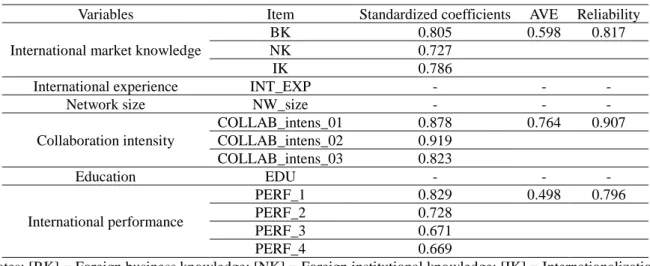
To verify validity, we used confirmatory factor analysis (CFA) to evaluate the average variance extracted (AVE) and construct reliability (CR). Table 6 shows that all of the
standardized coefficients are greater than 0.6, the values of AVE are above or very close to 0.5, and the construct reliabilities are higher than 0.7. Accordingly, both the validity and reliability of the measures are satisfactory.
Table 7 summarizes the intermediate solutions for BGs and late internationalizers. In fsQCA, two central measures provide parameters of fit: consistency and coverage (Ragin, 2008). Consistency measures the degree to which a relation of necessity or sufficiency between a causal condition and an outcome is met within a given dataset; coverage provides a measure of empirical relevance (analogous to R2 in regression) (Ragin, 2006).
The consistency indices have similar significance metrics and their high consistency indicates that a subset relation exists, which in turn supports an argument of sufficiency (Cheng et al., 2013; Fiss, 2011; Misangyi & Acharya, 2014; Ragin, 2009b). For example, Table 7 shows that all consistency values of configurations and solutions exceed 0.84 in the group of BGs, and all consistency values of configurations and solutions exceed 0.85 in the group of late internationalizers. These results indicate that these configurations are sufficient conditions for high international performance among BGs and late internationalizers.
As a second fit parameter, coverage, measures the extent to which the configurations account for the outcome (Fiss, 2007). Raw and solution coverage values are higher than 0.3 for these two groups. Accordingly, the configurations explain a large proportion of the international performance of BGs and late internationalizers.
--- Insert Table 6 and Table 7 about here ---
Table 7 further indicates four causal configurations (1a, 2a, 3a, and 4a) found to be sufficient for high international performance among BGs and three others (1b, 2b, and 3b) sufficient to explain late internationalizing SMEs’ international performance (see also Figure
1 and Figure 2). These paths reflect one of fsQCA’s principles and merits compared to symmetric quantitative approaches: equifinality. Equifinality assumes that multiple paths to a desired outcome may coexist and not the one and only model (Fiss, 2007). Thus, these seven causal configurations (four for BGs and three for late internationalizing SMEs) are combinations of factors that lead to high international performance among BGs and late internationalizing SMEs.A firm would exhibit only one path but could transition to another.
Configuration 1a (or path 1a) signals that the combination of high levels of international market knowledge, international experience, and network size combined with low levels of collaboration intensity contribute to high international performance among BGs. Path 2a indicates that BGs can achieve a high level of international performance when the level of international market knowledge is low, combined with high levels of network size, collaboration intensity, and education.
Path 3a shows another sufficient condition for high international performance of BGs: the combination of high levels of international market knowledge, international experience, network size, and education. Path 4a demonstrates that high levels of international experience, network size, collaboration intensity, and education result in a high level of international performance. Comparing path 3a and 4a, international market knowledge and collaboration intensity are substitutes.
Comparatively, in terms of late internationalizing SMEs, path 1b shows that the configuration of international market knowledge, international experience, and network size is seen among those exhibiting a high level of international performance. Path 2b indicates that the absence of high levels of international market knowledge, collaboration intensity, and education, but the presence of a large network size can enhance international performance. Path 3b in contrast shows that high levels of international experience, network size, collaboration intensity, and education contributes to high levels of international performance.
Therefore, in path 1b and 3b international market knowledge and the combination of collaboration intensity and education can be interpreted as substitutes.
--- Insert Figure 1 and Figure 2 about here ---
5. DISCUSSION AND CONCLUSION
5.1. Contribution to the literature
Motivated by the focus of existing studies on the single effects that network-based and knowledge-based factors have on the international performance of BGs compared to their late internationalizing SME counterparts, we asked: how, as a configuration, do network-based and knowledge-based factors contribute to the international performance of these two very different groups of firms? We make two primary contributions.
Our first contribution sheds light on how network-based and knowledge-based factors configure to contribute to high international performance among BGs and their late counterparts. Existing literature asserts that forging networks can provide internationalizing firms, particularly BGs, with a decisive advantage over competitors (Acedo & Jones, 2007; Freeman et al., 2006; Madsen & Servais, 1997; Moen, 2002; Oviatt & McDougall, 2005). Reviews of network research in international entrepreneurship literature largely conclude that ‘BGs are well-networked’ (see Jones et al., 2011). Social relationships are important for BGs and late internationalizing SMEs because networks often replace the ownership of resources with access to resources instead. Networks can then help SMEs to learn new capabilities and provide access to knowledge that resolve on-going weaknesses the firm has. However, research to date does not answer what a functional, performance-contributing network looks like or whether that varies across types of firms.
A fine-grained look at the configurations and causal paths supports our assertion that BGs and late internationalizers exhibit different routes to high international performance. Only on one single occasion do they exhibit the same configuration (paths 4a and 3b). International experience, network size, collaboration intensity, and education were all simultaneously present. We further find configurational paths that are otherwise unique to BGs and unique to late internationalizers. BGs can achieve a high level of international performance when the level of international market knowledge is low, combined with high levels of network size, collaboration intensity, and education (path 2a). A path unique to late internationalizing SMEs is path 2b. Network size alone is enough for the late internationalizing SME to generate high international performance. Late internationalizing SMEs can thus rely on the ‘brutal power’ of a large network alone as a route to a high international performance. This is never the case for BGs.
Our results also demonstrate that there are forms of substitutability at play, which extant theory has yet to account for and we put forward here. First, the configurations themselves are substitutable, each offering a plausible path to high international performance among BGs and late internationalizing SMEs. Second, our results indicate that there are several paths in which
single factors are substitutes. In path 3a and 4a, international market knowledge and collaboration intensity are substitutes. In path 1b and 3b international market knowledge and the combination of collaboration intensity and education can be interpreted as substitutes. This presence of several combinations of network-based and knowledge-based dimensions indicates some substitutability among their distinct mix in terms of unlocking high international performance for both types of firms. Thus, the precise network-based and knowledge-based dimensions themselves are partially substitutable under specific configurations.
These results are important because even though theory and empirical studies have associated network-based and knowledge-based factors with both BGs and late internationalizers individually, their value for each type of firm when placed into configurations varies. We show how they are relevant and in what combination.
Our second contribution sheds light on which single network-based and knowledge-based factors are more or less important for the BG versus its late counterpart. Small internationalizing businesses (late and BGs) have niche competencies in areas where they have advantages over competitors. Our manufacturing firms likely operate in global industries in which value chains and production networks are globally dispersed. The focus of network research in the internationalization literature has been on access to international market knowledge (Cesinger et al., 2016; Johnanson and Vahlne, 2009; Jones et al., 2011). BGs and late internationalizing SMEs exhibit varying degrees of resource and knowledge limitations. Our results indeed reveal that international market knowledge is not the one and only prerequisite among BGs and late internationalizing SMEs that traditional internationalization models (e.g., Johanson and Vahlne, 1977) would have us predict. Rather networks permit BGs and late internationalizing SMEs to compete successfully in international markets without having accumulated knowledge about these markets themselves. For both groups of firms, network size appears to be more important than international market knowledge. Through networks, firms can access additional resources and contacts beyond international market knowledge alone.
Our results unexpectedly suggest that network size, the structural component of networks, is of imperative importance for BGs and late internationalizing SMEs. It is present in all
configurations. A larger network size exposes the firm to greater amounts of resources and knowledge. It also allows firms to develop entrepreneurially in a network because we would expect them to be challenged continuously in their business models and business practices.
New perspectives (in an almost infinite number of combinations across network relationships) challenge both BGs and late internationalizing SMEs alike to create business solutions that align better to international markets. New internal knowledge should then be generated within the firms themselves, indicating the power of networks beyond being simple or convenient mechanisms to acquire (or draw) knowledge from other partners alone. These results speak to an emerging view in the literature that networks should not be left to form haphazardly and left to self-organize (Håkansson & Ford, 2002). Instead, entrepreneurial firms must use calculative network management (Sepulveda & Gabrielsson, 2013) and carefully consider their network behavior (Hughes et al., 2014). Our findings reaffirm these arguments for BGs and late internationalizers.
Collaboration intensity only features in paths 2a, 4a, and 3b. The lower occurrence of collaboration intensity compared to network size might be explained by the idea of conserving resources. Collaboration intensity requires effort to build and maintain strong ties. Given scarce resources (e.g., time), intense relations consume a disproportionate amount of resources (e.g., to reciprocate) and require greater maintenance (Hughes & Perrons, 2011). This matter has received relatively little attention in network research (Hughes & Perrons, 2011). Thus, a firm is likely to balance the structural (network size) and relational (collaboration intensity) aspects of its relationships in a way that makes the best use of its scarce resources in comparison to its needs. A large network size with fair or average collaboration intensity carries fewer set-up and maintenance costs (financially and in terms of time).
Collaboration intensityisfar more important to BGs because of the need to form powerful relationships to transfer the knowledge and resources. These are needed to quickly overcome their liabilities (Zucchella et al., 2007). The absence of collaboration intensity among late internationalizing SMEs largely makes sense because these firms internationalize slowly and
can build relationships while demand for knowledge and resources emerges. Still, while network size is always present in the configurations of successful BGs, collaboration intensity appears in only two of the four configurations. This suggests that generating a wider network of weak ties (Burt, 1992; Granovetter, 1973) is substitutable to creating strong collaboration intensity (Hughes et al., 2014; Nahapiet & Ghoshal, 1998). Nevertheless, network size alone is never enough for the BG to achieve high international performance (cf. Smith & Lorkhe, 2008).
For BGs, our results show that international experience and education are particularly important as well, being present in three of the four configurations. Together with international market knowledge, these are needed when the BG does not exhibit collaboration intensity to unlock high international performance. For late internationalizing SMEs, international experience is the only recurring knowledge-based factor. Because BGs do internationalize rapidly, they have to rely on individual knowledge-based factors (education and international business experience) and their network to achieve high international performance in three of their four configurations.
To conclude from this discussion, and in Johanson and Vahlne’s (2009) terms, the ‘liability of outsidership’ is more acute for BGs than for late internationalizing SMEs. Network theory needs to be revised in light of these findings to appreciate that the liabilities of being outside of networks differ across firms and can be resolved though different, but equifinal, pathways. Our configurations evidence this and reveal how and why network are by far more important to BGs in achieving high international performance compared to late internationalizers. The knowledge gained through networks expedites the learning process about markets, competitors, suppliers, and customers. It also carries opportunities to enhance legitimacy and reputation. These conditions support BGs to rapidly internationalize and overcome their specific limitations. Contrary to existing models, however, our results reveal that international
market knowledge (as an organizational asset) is not as important as traditional models predict. To achieve high international performance, network size is the primary prerequisite, not the accumulation of knowledge internally within the firm. We further show that network-based and knowledge-network-based conditions are complementary to each other in understanding equifinal, substitutive configurations of high international performance among BGs and late internationalizing firms. These insights could not have been revealed without an fsQCA. The predictive powers of network-based theories of internationalization are sensitive to the importance attached to network-based and knowledge-based conditions when viewed as configurations. This important knowledge contributes to moving forward efforts to revise traditional theories.
5.2. Managerial implications
Our results reveal causal paths that serve as strategic routes to international performance for managers, revealing what configurations of conditions are essential to achieve, as opposed to prioritizing all alleged antecedents at the same time. This issue is more acute for the founders and managers of BGs though. For high international performance, network size, education, and international experience recur across the majority of the configurations for BGs’ international performance. This overcomes the need to spend time for experiential learning or solely accumulating international market knowledge about their target markets.
Managers and founders of late internationalizing SMEs should also prioritize networking but only in terms of network size. Afterwards, substituting collaboration intensity with international market knowledge, experience, or education is equally plausible. Consistent across both types of firms is the ingredient of network size, and the sole factor present in all configurations regardless of the type of international firm. But BGs rely far more on education and collaboration intensity than late internationalizers in setting in place the right configuration for high international performance. Late internationalizing SMEs should devote
less time and resources to collaboration intensity in favor of accumulating greater experience and knowledge through their own actions.
Firms should expose their own knowledge and ideas to others in international networks. This can make firms more valuable as collaborators and increase their chances of accessing the knowledge of potential partners. Firms reluctant to share knowledge will likely miss out on this valuable input, which can endanger competitive international performance. Firms should opt for a diversified relationship portfolio to enlarge the resources and knowledge available, and encounter more partners that can assist the business and its practices without having to invest a lot of internal resources. The challenge is then for firms to manage coordinated action in business relationships simultaneously, often in complex and iterative processes, and increase collaboration intensity only in the network ties that bear the highest economic potential.
5.3. Limitations and recommendations for future research
There are some limitations to our work. First, fsQCA has its limitations. Although the underlying logic and methodological goals of regression or other multivariate analyses and fsQCA are completely different (Ragin & Rihoux, 2004), fsQCA findings are not generalizable (Fiss, 2011). Multivariate analysis techniques aim to isolate single factors and predict a certain outcome whereas fsQCA identifies combinations of conditions for the respective outcome. Second, our focus on German, Austrian, Swiss, and Liechtensteinian firms limits our findings to these economic and cultural contexts. For any context highly dissimilar to those of these four countries, the present study’s findings and implications can be carefully reflected on and then subjected to further research.
We applied a key informant approach and collected data among founders and CEOs of international firms. These individuals are the organization’s strategic decision-makers (Nielsen & Nielsen, 2011), but other actors such as members of the board or investors might