St. Petersburg University
Graduate School of Management
WORKING PAPER
K. V. Krotov, R.N. Germain
A CONTINGENCY PERSPECTIVE ON
CENTRALIZATION OF SUPPLY CHAIN DECISION
-MAKING AND ITS ROLE IN THE TRANSFORMATION
OF PROCESS R
&
D INTO FINANCIAL PERFORMANCE
# 4 (E)–2011
Saint Petersburg 2011
K.V. Krotov, R.N. Germain. A Contingency Perspective on Centralization of Supply Chain Decision-making and its Role in the Transformation of Process
R&D into Financial Performance. Working paper. #4 (E)–2011. Graduate School
of Management, St. Petersburg State University: SPb, 2011.
Keywords and phrases: centralization of supply chain, contingency perspective
Abstract: The research examines whether centralized supply chain decision-making within the firm plays a role in how the firm transforms investments in process research and development (R&D) into financial performance. This transformation includes the process investment – financial performance chain, which consists of process R&D funds, applied supply chain knowledge, supply chain process variance, and financial performance. In addition, the model includes production technology routineness, size, and integration. The results, based on a sample of 204 manufacturers operating in the United States, suggest that centralization cleaves the process investment – financial performance chain at the connection of supply chain process variance and financial performance. The net effect is that firm scale, production technology routineness, integration, and process R&D investment predict financial performance only when supply chain decision-making is decentralized within the firm. Firm scale, production continuity, integration, and process R&D investment confer no performance advantage in centralized firms.
Konstantin V. Krotov — Senior Lecturer, Graduate School of Management, St. Petersburg University
Richard N. Germain – PhD, Professor, Graduate School of Management, St. Petersburg University, EBS University for Economics and Law
e-mail :
5
Contents
Introduction ... 6
1. Theory ... 8
1.1. Decentralization ... 8
1.2. The process investment – financial performance chain and the role of centralization ... 9
1.3. Centralization and the process investment – financial performance chain ... 10
1.4. The role of production technology routineness, size, and integration ... 11
2. Method ... 13
2.1. Scaling ... 14
2.2. Grouping and validity analysis ... 15
3. Results ... 17
Conclusion ... 22
6
Introduction
Research and development (R&D) receives considerable attention from many sources. Consultants have announced that the spring 2011 net balance of firms expecting to increase their R&D budget was about 25% (KPMG 2011). Policy makers directly fund R&D and enact tax stimuli due to an impact on firm and national competitive advantage (Grueber and Studt 2009). Academic researchers have studied R&D expenditures and patents and their relationships with performance (DeCarolis and Deeds 1991). A large number of case studies have appeared on the management of R&D processes (e.g., Schiele 2010). Academicians from marketing (Calantone, Harmancioglu, and Dröge 2010), economics (Quatrao 2010), strategic management (Benner and Tushman (2002), and innovation (Enkel and Gassmann 2010) have all contributed insight, often with different tools and from different perspectives. With varying emphasis and depending upon the academic discipline, researchers have studied two broad types of investments and innovation: (1) process-based, which leads to efficiency and productivity gains and subsequently lower cost; and (2) product-based which associates with product performance and higher price (Evangelista and Vezzani (2010).
The purpose of our research is to provide insight into R&D from the supply chain perspective. We theorize the existence of and test what we label the process investment – financial performance chain that involves process investment or intensity (Cohen and Klepper 1996), supply chain knowledge (Hult, Ketchen, and Arrfelt 2007), process variance (Schmenner and Swink 1998), and financial performance (Miller 1991). We draw upon various theories and outlooks to support the effects hypothesized in Figure 1, including the theory of swift, even flow (Schmenner and Swink 1998), contingency theory (Woodward 1964; Miller et al. 1991) and knowledge management theory (Roth 1996). A critical contribution of the research involves the role of centralized decision-making over supply chain issues on the process investment – financial performance chain. Centralization, a dimension of formal structure, has been extensively studied in relation to other dimensions of structure (Walton 2005) and in relation to market orientation (Kirca, Jayachandran, and Beardon 2005), buying centers (Lewin and Donthu 2005), trust in channels of distribution (Greyskens, Steenkamp, and Kumar 1998), innovation adoption (Damanpour 1991), and production technology routineness (Miller et al. 1991). These meta-analysis typically summarize centralization main effects, however, very few studies model the interactive or moderating effect of centralization. Given the volume of
7
work on process and product R&D, it is surprising that no studies have modeled the moderating effect, let alone the direct effect, of supply chain centralization in relation to process investment. We propose that centralized supply chain decision-making weakens or cleaves the process investment – financial performance chain, thereby reducing the potency of process intensity in affecting performance. We include three additional variables: production technology routineness and size – context variables (Khandwalla 1974); and integration – a second dimension of formal structure (Germain and Iyer 2006). In addition to providing greater theoretical breadth, we propose that the moderation effect of supply chain centralized decision-making is not universal. The relationship of production technology routineness, size, and integration with one another and with the process investment – financial performance chain is not expected to be moderated by supply chain centralization. From a managerial perspective, the research is intended to identify a condition under which the effect of process investment may not be transmitted to financial performance. This would allow managers to better dictate directed steps for performance improvement.
Centralized supply chain decision-making the process investment – financial performance chain (H1-H4) Context: Production Technology Routineness Size Formal Structure: Integration (+) Process Knowledge Formation: Process Investment
Applied Supply Chain Process Knowledge
Process Knowledge Output: Supply Chain Process
Variance
Financial Performance Financial Performance Centralized supply chain decision-making does not moderate the effect of context and structure on the process investment – financial performance chain (H5-H7)
(+) (+)
(-)
(-)
The process investment – financial performance chain Production Technology Routineness only (-)
8
1. Theory
1.1. Decentralization
The pattern and distribution of activities within a firm are in measure reflected by its formal structure, three dimensions having received the most attention. First, centralization refers to the agglomeration of decision rights within upper levels of the firm. Second, formalization refers to rule specification along with the presence of written policies and procedures. Specialization, the third dimension, reflects task subdivision. It is closely linked to horizontal differentiation or the extent to which units, groups, or departments are formed. Due to administrative streamlining and limits on spans of control, units congregate around individuals performing similar specialized tasks. These elements of formal structure are interconnected into patterns. A meta-analysis showed that decentralization associates with vertical differentiation (or the number of layers), task specialization, and horizontal differentiation (Walton 2005). Formalization is not related to decentralization. In general, decentralization shows the weakest link to the remaining elements of formal structure. The work of Walton (2005) shows a persistent pattern across time: that is, newer studies of firms which are more likely to uncover lean, flat structures show no diminution of effects. Analysis of the task and activity patterns has been supplemented by the inclusion of integration, defined as horizontal communication (Miller 1991). Integration as a coordinative mechanism may offset centralization.
During the 1960s, researchers shifted from analyzing the Weber (1946) model of bureaucracy in isolation to analyzing formal structure antecedents such as uncertainty (Burns and Stalker 1961) and production technology (Woodward 1965) and outcomes, especially performance (Miller 1991). For example, a meta-analysis of production technology routineness (Miller et al. 1991) showed positive relationships with centralization (due to simplified coordination needs and fewer novel decisions), formalization (rule specification is simplified when fewer novel decisions are made), and specialization (due to task repetitiveness). Other meta-analyses showed that centralization inversely predicts organizational trust in channels of distribution (Greyskens, Steenkamp, and Kumar 1998) and innovation adoption (Damanpour 1991).
9
1.2. The process investment – financial performance chain and the role of centralization
As observed in Figure 1, the first step in the process investment – financial performance chain is process investment. The firm invests capital in process R&D to ultimately generate better cost or service positions. The second step in the chain is the application of knowledge. The research focuses on applied supply chain process knowledge and it is quite clear that not all process R&D is applied to supply chain processes. Other processes include those related to finance, marketing, quality, and core production processes (as opposed to the better management of inventory flows through production processes). Applied supply chain knowledge bridges the gap between capital investment and supply chain process outcomes. The latter may be thought of as measurable outcomes. Again, there are many different sets or types of measurable outcomes that could be affected by applied supply chain knowledge including supply chain functional cost, service levels, productivity, speed, and flexibility. We study one particular type of supply chain output – namely, supply chain process variation. Knowledge or understanding is synonymous with reduced variance or control: e.g., “process variance and knowledge related to any single capability co-varies with the others” (Kristal, Huang, and Schroeder 2010, p. 908). These sorts of statements are often made in reference to a narrow piece of knowledge and a single process. For example, the higher level of knowledge and its application about a product trait and how a machine and individuals influence them, the lower the measureable variance in the product trait. In the research, we extend this by suggesting that applied supply chain process knowledge at the supply chain level is connected to process variance at the supply chain level. Specifically, the higher the applied supply chain knowledge in demand pull systems, shared production planning with suppliers and customers, and cellular plant layout (all connected to just-in-time or JIT), the lower the expected variance in lead times and throughput rates. Finally, the theory of swift, even flow provides the basis for relating supply chain process variation to financial performance (Schmenner and Swink 1998). A process undertaken in a more timely fashion (swiftly) or in a more consistent fashion (evenly) will reduce cost. For example, lower lead time variance reduces inventory safety stock levels and a more consistent throughput rate reduces idle time and overtime hours. We model variance at the supply chain level and performance in terms of overall financial performance of the firm. As noted by Benner and Tushman (2002, p. 676), “the promise of process management is that focusing on variance reduction and increased process control will drive both speed and organizational
10
efficiency.” The research provides a more finely grained insight into process management in relation to the supply chain function: the process investment – financial performance chain starts with process investment and proceeds through applied supply chain knowledge, supply chain process variance, and finally to financial performance.
1.3. Centralization and the process investment – financial performance chain
A critical consideration in the centralization – decentralization debate is the need to balance control against adaptation (Alonos, Dessien, and Matouschek 2008). In the decentralized firm, local decisions are made by managers possessing relevant information. However, local decisions need to be supplemented by lateral communication to ensure that functional and/or divisional managers are aware of decisions made by others. Decisions made by functional managers interact with and may possess unseen consequences for other functions. In the centralized firm, communication is vertical as information is passed from those who have relevant information to those with decision-making rights. But information when passed upward in the hierarchy will be subject to distortion and hoarding. Information hoarding and distortion occur because of the “unwillingness of individuals…to share information for fear of making themselves redundant” (Teece 2000, p.39). Mid- and lower-level managers are not empowered in a centralized firm, reducing local adaptation and possible response times, especially important factors when uncertainty is prevalent (Burns and Stalker 1961). Furthermore, centralization may over burden senior executives especially when complex decisions require extensive information. If centralization is not accompanied by lateral collaboration and communication, then pockets of knowledge and information emerge that are unable to learn from one another. In general, the decentralized mode is preferred as the managerial cost of information distortion is outweighed by control loss, especially in dynamic environments.
One exception to the observation that centralization has not been studied in the R&D domain is found in the work of Argyres and Silverman (2004). In a multi-divisional firm, the central consolidation of R&D into a single unit has several benefits: R&D (1) has greater long term impact; (2) crosses a larger number of scientific areas; and (3) leads to more internalization of innovation developed outside the firm. Centralized
11
decision-making at headquarters over the R&D budget, however, interacts with the central consolidation of the R&D function in accentuating some benefits. This research did not examine the centralization of functions other than R&D that are affected by process investment and that would eventually be responsible for translating process investment in performance improvement.
Centralized supply chain decision-making reduces local adaptation by mid-level supply chain managers. This singular feature disrupts connectivity in the process investment – financial performance chain. When supply chain knowledge is applied at the directive of senior managers, mid-level managers may be unable to adapt the knowledge to their local situation. For example, the specific details of shared production planning (e.g., timing, information) with suppliers varies significantly across manufacturing facilities operated by the same buyer, even when the same supplier is involved. In a centralized firm, specific supply chain process variances may be targeted for reduction by senior managers. But the reduction may not influence financial performance because the wrong processes were targeted due to information distortion. In a decentralized firm, local adaptation increase the likelihood that empowered managers select the appropriate processes for variance reduction in terms of their impact on financial performance. Accordingly, the following hypotheses are offered.
H1: The positive effect of process investment on applied supply chain process knowledge is stronger when supply chain-decision making is decentralized as opposed to centralized.
H2: The inverse effect of applied supply chain process knowledge on supply chain process variance is stronger when supply chain decision-making is decentralized as opposed to centralized.
H3: The inverse effect of supply chain process variance on financial performance is stronger when supply chain decision-making is decentralized as opposed to centralized
1.4. The role of production technology routineness, size, and integration
The research models production technology routineness, size, and integration to provide a more complete understanding of contingency effects and to illustrate that centralized supply chain decision-making does not moderate the effect of context (i.e., production technology routineness and size) and integration on the process investment – financial
12
performance chain. Modeling integration is important as it may counter the presumed negative effects of centralization and is a necessary coordination mechanism in a decentralized firm. Supply chain researchers have become particularly interested in integration, have extended the concept to include lateral communication up and downstream in a supply chain, and demonstrated connections to performance (Germain and Iyer 2006; Vickery et al. 2003). Production technology routineness refers to the extent to which the manufacturing technology of the firm involves unvarying or regular procedures. Production continuity increases from custom production of one unit at a time to continuous production technology, with small and large batch and mass assembly as intermediate types. Production technology routineness should associate with integration due to simplified coordination needs. Both production technology routineness and integration should predict process investment. The more repetitive a set of processes and the more that the work flow is integrated, the greater the ability to spread an improved process over a larger number of repetitions of an activity. The investment is spread over a larger scale, thereby creating a scale effect. Production routineness should directly affect supply chain process variance: “repetition through routines reduces not only the time to carry out the activity, but also reduces the variance in performance of the routine” (Benner and Tushman 2002, p. 680). Integration should associate with process investment and applied supply chain process knowledge. Cross-functional coordination eliminates disparate pockets of knowledge and creates a more unified understanding of objectives, capabilities, and functional plans and knowledge. Integrative cohesiveness and linked functional knowledge should enhance awareness that process investment and knowledge application have firm-wide as well as functional implications. Larger firms are typically more formalized, decentralized, integrated, and specialized (Miller 1991). In the research, H4 through H9, which express these sentiments, are universal in that centralized supply chain decision-making is not expected to moderate the relationships.
H4: Production technology routineness and integration associate positively.
H5: Production technology routineness and process investment associate positively.
H6: Production technology routineness and supply chain process variance associate positively
H7: Size and integration associate positively.
H8: Integration and process investment associate positively.
H9: Integration and applied supply chain process knowledge associate positively.
13
2. Method
A random selection of 402 members from the Institute of Supply Management manufacturers “executive list,” which consisted of 1264 contacts, resulted in 210 returned surveys, of which 204 were usable. Potential respondents were contacted by telephone to secure participation and verify key informant status. In 78 cases, a second respondent was identified by referral and 17 completed surveys were obtained. The response rate for firms is thus 52%=210/402. The mean for all items was taken across the 17 instances where two respondents were obtained per firm. Two two-digit SIC industry distribution is provided in Table 1 under the” total” column. The “other” category was created for the purpose of conducting a χ2
test explained in a later section. As seen there, the most common industrial group is chemicals (16.2%), followed by fabricated metal products (10.3%). The most common respondent title level was director (66%), followed by manager (16%), and vice-president (14%) and the most common respondent functional area was purchasing (72%), followed by materials management (10%). Average annual sales was $1.406 billion (range of $1.25 million and $42 billion) and the average number of employees was 4,573 (ranging from 15 to 122,000). Tests of late versus early respondents were conducted and indicated no difficulties. All sampled firms operated in the United States.
Table 1: Industry Distributions by Centralization Group
n (percentage of total or within group) Industry (2-digit SIC) Sample Centralized
Group Decentralized Group 20: Food 17 (8.3) 8 (7.9) 9 (8.7) 28: Chemicals 33 (16.2) 17 (16.8) 16 (15.4) 30: Rubber and plastics 17 (8.3) 11 (10.9) 6 (5.8) 34: Fabricated metal products 21
(10.3)
12 (11.9) 9 (8.7) 35: Industrial machinery 17 (8.3) 6 (5.9) 11 (10.6) 36: Electronics and electrical
equipment
14 (6.9) 5 (5.0) 9 (8.7)
39: Miscellaneous 12 (5.9) 5 (5.0) 7 (6.7)
Other 2-digit SIC categories 73 (35.8)
36 (35.6) 37 (35.6)
Total 204 100 104
χ2
14
2.1. Scaling
The scales for centralization, integration, and production technology routineness came from established sources. Decentralization of the logistics function was measured using a slightly modified version of the Miller and Dröge (1986) scale. The scale endpoints were “1=the board of directors” and “7=operatives at the shop level.” Intermediate scale points were labeled with specific organizational levels: e.g., “4=divisional or functional manager.” The specific items were developed for the research to reflect supply chain decisions. A total of nine items were in the scale including decisions over: distribution service levels; the selection of suppliers; production scheduling; inventory planning; and factory / warehouse location planning. The scale displayed satisfactory reliability (α=.783). Production technology routineness was measured using the scale developed by Khandwalla (1974). Low values represent job shop production methods while higher values successively represent small batch, large batch, mass production, and continuous process technologies. Integration and financial performance were measured by the Miller (1991) scales. For integration, 7-point scales anchored by “1=rarely used” and “7=frequently used” were used to assess interdepartmental committees, cross-functional teams, and cross-functional liaison personnel. Financial performance was measured on 7-point scales (1=”well below industry average”; 7=”well above industry average”) for average ROI, average profit, and profit growth over the prior three year period. For process investment, we asked respondents on an open-ended scale the percent of revenue spent on process R&D. This is similar to the common scale for measuring new product R&D intensity (DeCarolis and Deeds 1999) and the scale has the advantage of normalizing for business size. The applied supply chain process knowledge scale was developed for the research. On the survey, knowledge was defined as “understanding a phenomenon” and respondents were asked to rate the level of knowledge applied in five areas: demand-pull systems; cellular plant layout; Kanban support systems; information from customers on their future production plans; and information provided to suppliers to enable integration of their plans with those of the respondent firm. The items reflect internal processes (e.g., demand-pull support) that are often treated as elements of JIT. We specifically omitted applied product and quality knowledge processes that would reflect a total quality management approach (TQM). While TQM and JIT are often treated as a comprehensive strategic thrust developed regardless of competitive priorities (Roth 1996; Sakakibara et al. 1997), we focus on JIT-related applied process knowledge it is conceptually linked to
15
supply chain process variance (i.e., JIT as a variance reduction strategy). The final scale, supply chain process variance, is also original to the research. Four items were measured on 7-point scales with endpoints of “1=always the same, very consistent, low variance” and “7=rarely the same, very inconsistent, high variance” (Germain, Claycomb, and Dröge 2008). The items consisted of lead time to customers, lead time from suppliers, internal factory machine speeds, and daily production output rate.
2.2. Grouping and validity analysis
The sample was grouped on the median split of the nine centralization items (median = 3.95) with 100 and 104 firms in the centralized and decentralized group, respectively. A χ2 test revealed that the industry distributions are similar across groups (see Table 1). The mean decentralization in the centralized group equals 3.52 and in the decentralized group equals 4.43. This suggests that decisions in the decentralized group are made on average below the level of the divisional or functional manager while decisions in centralized group are made above the level of divisional or functional manager.
Given our modeling choice of two-group SEM (Jöreskog and Sörbom 1993), the next step is to examine various confirmatory factor analysis (CFA) models to assess metric invariance (Hair et al. 2006), the results of which are provided in Table 2. In the baseline CFA, factor loadings, error variances, and the correlation between latent variables were estimated freely in each group (χ2=299.640; df=234). In the subsequent model, the error variances were constrained to equality across groups (χ2=325.129; df=249). However, fixing the error variances to equality across groups led to a significant loss of model fit (Δχ2=25.489; Δdf=15; p<.01). We then fixed each error variance one-at-a-time and determined that the problem existed with the first financial performance item. When the test of error variance equivalency was repeated while allowing the error variance of this item to remain free across groups, the Δχ2 test revealed error variance equivalency across groups. The freeing of this one error variance across groups is the only empirical caveat in the two-group SEM modeling process. In the next CFA, factor loadings and error variances were declared invariant across groups. The non-significance of the Δχ2=24.210 (Δdf=32;
16
Table 2: Testing Error Variance and Loading Equivalence Across Groups
CFA Model (and constraints) χ2(df) Δχ2
(Δdf) Baseline model: Error variance and loadings free across
groups
299.640 (234) Error variances constrained equal across groups 325.129
(249)
25.489a (15) Error variances constrained equal across groups: Except
performance item 1
310.925 (248)
11.285 (14) Final CFA: Error variances (except performance item 1) and
loadings equal across groups
323.850 (266)
24.210 (32) a, p<.01
Table 3: CFA Model Results
Latent variable Items λ ρ
Production technology routineness
Weighted production technology scale .983 n.a.
Size Natural logarithm of number of employees .982 n.a. Integration Interdepartmental committees set up to allow
departments to engage in joint decision-making
.777 .811 Temporary cross-functional teams set up to
facilitate interdepartmental collaboration on specific projects
.835
Liaison personnel whose job it is to coordinate the efforts of several departments for the purposes of a specific project
.711
Process investment Percent of revenue spent on process R&D .997 n.a. Applied supply
chain process knowledge
Kanban support systems .667 .775
Demand-pull support systems .687
Methods for reducing machine set-up times .670
Cellular plant layout .617
Total preventative maintenance methods .561 Supply chain
process variance
Lead time from suppliers .573 .702
Lead time to customers .539
Individual factory machine speeds .617
Daily production output rate .692
Financial performance
Average ROI over the past 3 years .931 .962 Average profit over the past 3 years .960 Profit growth over the past 3 years .915 CFA model fit statistics: χ2=323.850; df=266; p=.009; RMSEA=.051; CFI=.943;
17
NNFI=.934
λ= Common metric completely standardized loading ρ = scale composite reliability
n.a. = not applicable
All loadings are significant at p<.01
The final CFA was then used to assess reliability and validity (Table 3) The overall model fit well (χ2=328.180; df=272; p=.011; RMSEA=.049; CFI=.940; NNFI=.933), all of the factor loadings exceeded .400, and all of the scale composite reliabilities exceed .700. As a test of discriminant validity, we fixed the non-causal correlation between pairs of latent variables to equality one-at-a-time both within each group and then as a single parameter across groups. As desired, all of the tests were significant.
3. Results
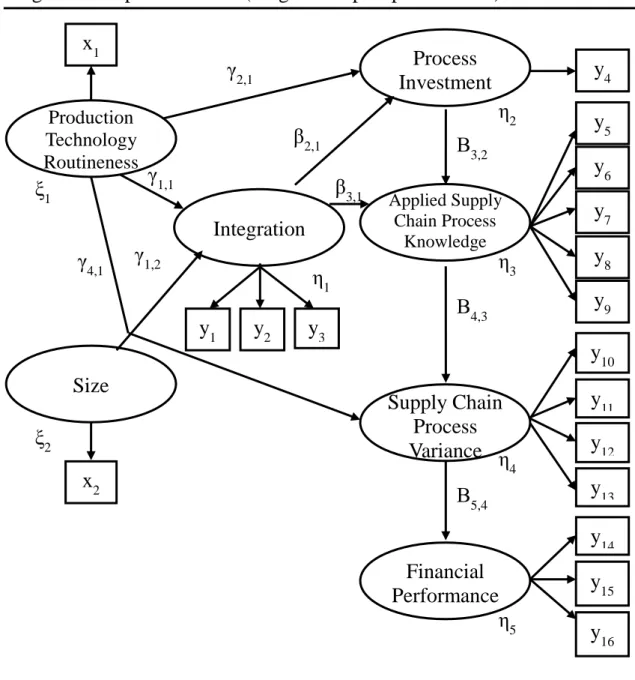
The one-group representation of the two-group SEM is provided in Figure 2. A multi-step process was utilized for both evaluating the hypotheses and for providing a clear managerial understanding of the model results. In the initial model, all paths were estimated freely in each group (metric invariance with the one exception was maintained in all subsequent models).1 Modification indices provided no indication that additional paths were required. Each path was then constrained to equality across groups. This provides a specific test for each hypothesis. We subsequently created a parsimonious model based on the results of the initial SEM. If a path in the initial SEM could be constrained to equality without overall loss of model fit and if it was significant, then it was estimated in the parsimonious model and fixed equal across groups. If a path could not be constrained to equality across groups without loss of fit and the path was significant in both groups, then the path was estimated freely in each group. Otherwise, non-significant paths were fixed to zero in
1 The entire set of two-group structural models was analyzed with the error variance of
all items declared invariant across both groups. Two issues arose. First, the overall fit statistics were somewhat dampened from the baseline (χ2=354.747; df=290; p=.006;
RMSEA=.052; CFI=.939; NNFI=.936) and parsimonious models (χ2
=376.461; df=292; p<.001; RMSEA=.059; CFI=.919; NNFI=.915). RMSEA, CFI, and NNFI values continue to meet acceptable cutoff values. Second, all tests of path equivalency across groups resulted in identical conclusions. Analyzing the model with all error variances invariant across groups dampened overall fit statistics, but had no impact on the substantive results.
18
the parsimonious model. The covariance matrices were used as inputs in all models.
Figure 2: Empirical Model (Single Group Representation)
y1 y4 y3 y2 y6 γ2,1 x1 y7 y8 y10 y11 ξ1 Production Technology Routineness Integration Process Investment Applied Supply Chain Process Knowledge Supply Chain Process Variance Financial Performance η2 η1 y9 y5 η3 η4 η5 Β3,2 y12 y13 Β4,3 y14 y15 y16 Β5,4 β2,1 γ1,1 β 3,1 Size x2 ξ2 γ1,2 γ4,1
19
Table 4: Two-Group SEM Results Baseline Model: Structural Paths Estimated Freely in each Group
Parameter estimate (t-value) Part A: Hypothesis & Path Centralized
Group Decentralized Group Δχ2 (Δdf=1) H1 (β3,2): Process investment →
applied supply chain process knowledge
.177 (1.638) .287 (2.457a)
0.405 H2 (β4,3): Applied supply chain
process knowledge → supply chain process variance
-.179 (-1.256) -.427 (-2.614a)
0.856 H3 (β5,4): Supply chain process
variance→ financial performance
-.140 (-1.096) -.449 (-3.364a) 3.296c H4 (γ1,1): Production technology routineness → integration .351 (3.029a) .119 (.995) 0.361 H5 (γ2,1): Production technology routineness → process investment .192 (1.677b) .123 (1.094) 0.352 H6 (γ4,1): Production technology
routineness → supply chain process variance
-.011 (-.082) -.286 (-2.104b)
2.785c H7 (γ1,2): Size → integration .090 (.792) .428 (3.491a) 3.054c H8 (β2,1): Integration → process investment .244 (1.925b) -.285 (-2.384a) 14.561a H9 (β3,1): Integration → applied process knowledge .637 (4.352a) .677 (4.569a) 0.280 Baseline model fit statistics: χ2
=338.535; df=289; p=.024; RMSEA=.045; CFI=.947; NNFI=.944
Δχ2
(Δdf=1) is the test of structural path equality across groups one path at a time
Part B: Parsimonious Model Centralized Group
Decentralized Group
H1 (β3,2): Process investment → applied supply chain process knowledge
.220 (2.846a)
H2 (β4,3): Applied supply chain process knowledge → supply chain process variance
-.279(-2.535a) H3 (β5,4): Supply chain process
variance→ financial performance
fixed to zero -.444 (-3.252a) H4 (γ1,1): Production technology
routineness → integration
20 H5 (γ2,1): Production technology routineness → process investment .170 (2.096b) H6 (γ4,1): Production technology routineness → supply chain process variance
fixed to zero -.315 (-2.314b)
H7 (γ1,2): Size → integration fixed to zero .400 (3.362a) 8 (β2,1): Integration → process investment .254 (2.049b) -.288 (-2.493a) H9 (β3,1): Integration → applied process knowledge .642 (5.476a) Parsimonious model fit statistics: χ2
=344.135; df=297; p=.031; RMSEA=.044; CFI=.948; NNFI=.946
a, p<.01; b, p<.05; c, p<.10
Parameter estimates are common metric completely standardized estimates Δχ2
=3.213 (Δdf=3) between baseline and parsimonious models is not significant
The initial (baseline) SEM displayed satisfactory fit statistics:
χ2
=338.535; df=289; p=.024; RMSEA=.045; CFI=.947; NNFI=.944. Even though the χ2
test revealed a significant difference between the observed and recreated covariance matrices, the RMSEA, CFI, and NNFI indicators are more than adequate. The results of the baseline and parsimonious models are provided in Table 4.
H1 stated that the inverse effect of process investment on applied supply chain process knowledge is stronger for decentralized versus centralized firms. This hypothesis is not supported. The path is not significant in centralized firms (β3,2=.177; t=1.638), but is in decentralized firms (β3,2=.287; t=2.457; p<.01). The right hand column in the upper panel of Table 4 shows the results of Δχ2
(Δdf=1) tests. The test assesses whether the overall model fit is affected when a path is constrained to equality across groups. β3,2 may be set equal without loss of model fit (Δχ2=.405;
p>.10). As seen in the lower panel of Table 4 where the results of the parsimonious model are shown, the pooled estimate is significant (β3,2=.220; t=2.846; p<.01).
H2 stated that the positive effect of applied supply chain process knowledge on supply chain process variance is stronger for decentralized firms. The path is not significant in the centralized group (β4,3=-.179;
t=-1.256), but significant in the decentralized group (β4,3=.427; t=-2.614;
p<.01). Setting the path equal across groups resulted in no loss of fit (Δχ2=.856). In the parsimonious model, the pooled estimate is significant (β4,3=-.279; t=-2.535; p<.01). H2 is supported.
21
H3 stated that the inverse effect of supply chain process variance on financial performance is stronger for decentralized firms. The path is significant only in the decentralized group (β5,4=.449; t=-3.364; p<.01) and the path cannot be fixed equal without significant loss of model fit (Δχ2=3.296; p<.05). In the parsimonious model the path was fixed to zero in the centralized group and estimated in the decentralized group (β5,4=.444;
t=-3.252; p<.01). The hypothesis is supported.
H4 stated that production technology routineness and integration would associate positively. The path is significant in the centralized group (γ1,1=.351; t=3.029; p<.01), but not in the decentralized group (γ1,1=.119;
t=.995). However, the path may be set equal across groups without loss of model fit (Δχ2=.361) and is significant in the parsimonious model (γ1,1=.276; t=3.370; p<.01). H4 is supported.
H5 stated that production technology routineness predicts process investment. The path is significant in the centralized group (γ2,1=.192;
t=1.677; p<.05), not significant in the decentralized group (γ2,1=.123;
t=1.093), and may be set equal across groups with loss of model fit (Δχ2=.352). The pooled estimate is significant in the final model (γ2,1=.170;
t=2.096; p<.05). H5 is supported.
A negative effect of production technology routineness on supply chain process variance was stated in H6. The path is significant only among decentralized firms (γ4,2=-.286; t=-2.140; p<.05). The paths are not equal (Δχ2=2.785, p<.10). The path IS significant in the final model (
γ4,2=-.315; t=-2.314; p<.05).
A positive association between size and integration was expressed in H7. The relationship is significant only for decentralized firms (γ1,2=.428;
t=3.491; p<.01). Fixing the path equal across groups resulted in a loss of fit (Δχ2=3.054; p<.10). In the parsimonious model, the path was fixed to zero for centralized firms and estimated for decentralized firms (γ1,2=.400;
t=3.362; p<.01). H7 is not supported.
H8 stated that integration and process investment associate positively. The path in the centralized group is positive and significant (β2,1=.244; t=1.925; p<.05), but inverse in the decentralized group (
β2,1=-.285; t=-2.384; p<.01). The path cannot be set equal with loss of fit (Δχ2=14.561; p<.01). In the parsimonious model, the path was estimated freely in each group. The difference in directionality across groups is not a matter of suppression, or sign reversal, as the simple correlation between integration and process investment equals .238 (p<.05) in the centralized group and -.228 (p<.05) in the decentralized group. H3 is not supported. The inverse effect of integration on process investment was unexpected. It might be that in decentralized firms, authority over the process R&D
22
budget may also be decentralized and process R&D units may be dispersed through divisions or functions. This combination may lead to confusion in the ranks and a loss of control by senior staff. Integration may exacerbate the situation by introducing lateral infighting.
H9, the final hypothesis, stated that integration and applied supply chain process knowledge associate positively. The path is significant in both the centralized (β3,1=.637; t=4.352; p<.01) and decentralized group (β3,1=.677; t=4.569; p<.01). Equalizing the path across groups did not significantly affect model fit (Δχ2=.280). The path is significant in the parsimonious model (β3,1=.642; t=5.476; p<.01). H9 is therefore supported.
The parsimonious model fit relatively well: χ2=344.135; df=297;
p=.031; RMSEA=.044; CFI=.948; NNFI=.946. The difference between the baseline and parsimonious model was not significant (Δχ2 =5.600; Δdf=8;
p>.10). From the parsimonious model, the standardized total effect of production technology routineness (.156; t=7.331), size (.027; t=2.450), integration (.072; t=2.455), and process investment (.026; t=2.013) on financial performance are significant at p<.01. This holds only for organizations that have decentralized supply chain decision-making. The model shows that centralization over the logistics function cleaves the “causal” knowledge chain: centralized firms apply a higher level of supply chain process knowledge resultant from process investment, however, they are unable to translate or leverage applied process knowledge into meaningful supply chain process variance reductions. Nor are they able to leverage reductions in supply chain process variance into financial performance gains.
Conclusion
The research proposed a chain of events that translates process investment into financial performance. The chain involves process investment, applied supply chain process knowledge, supply chain process variance, and financial performance. The research also identified a critical and overlooked variable that disrupts the chain: namely, centralized supply chain decision-making. Prior research has studied centralization of the firm’s process and product R&D function and reported positive outcomes related to patents and resultant citation trails (Argyres and Silverman 2004). In our case, we examined centralization of a function other than R&D that is in part responsible for the conversion of process R&D funds into improved performance. We found that centralized supply chain decision-making penetrates and severs the process investment – financial performance chain and renders it null. The key explanatory factor is that
23
centralization interferes with local adaptation by supply chin managers who are critical to the conversion process. This constitutes the crucial finding that managers can utilize to better understand centralization’s role within the firm.
We also theorized that centralization would not moderate the relationships of size, production technology routineness, and integration with one another or with the process investment – financial performance chain. While we met with less success in this regard, our results are no less informative. First, size predicts integration only when the supply chain function is decentralized. In other words, as a decentralized supply chain firms become larger, it becomes more integrated. This is vital as integration should be used to ensure non-contradictory local adaptation by supply chain managers in the face of loss of control by senior most executives. In contrast, the centralized supply chain firm does not utilize lateral integration as size increases possibly because senior level managers are themselves ensuring, or are supposed to ensure, that their decisions are effective from the local perspective. However, it appears that the result may not be such. The process investment – performance chain is cleaved when decision-making is centralized. Furthermore, large scale confers superior financial performance, but centralized supply chain firms are not the recipient of the benefit. Large scale confers superior performance to the decentralized supply chain firm precisely because they integrate at a higher rate. This has a subsequent effect on process investment and on applied supply chain knowledge.
Production technology routineness also confers superior financial performance, but again the benefit is provided only to decentralized supply chain firms. This is not a case of the “fit” of production technology routineness with integration or with process investment (the effects are equal in centralized and decentralized firms). Managers in both centralized and decentralized firms appreciate the need to integrate and invest in innovative processes as manufacturing continuity increases. Neither, in the end, does the interference of integration with process investment among decentralized supply chain firms function discordantly. The inverse effect of integration with process investment among decentralized firms, while a potential source of confusion and infighting as well as collaboration, does not abate the financial performance benefit derived from production technology continuity. Two factors are critical: (1) the decentralized supply chain firm is able to directly reduce supply chain process variance from production continuity; and (2) the decentralized supply chain firm is able to translate reduced process variance into financial performance. In contrast, the centralized firm, even if integration is used to trigger the
24
allocation of capital to create innovative processes, does not obtain superior financial performance from production continuity or from firm scale.
Classic contingency theory focuses on how the “fit” of formal structure and of strategy with environment affects performance. The Fisher (1997) model, which consists of flexibility versus efficiency strategic choice in dynamic versus stable environments, is the classic supply chain example. We adopted a very different contingency approach and studied how centralization, one dimensions of formal structure, moderates (or does not moderate), the relationships among context (production technology, size), integration and the process investment – financial performance chain. There are a number of departure points for further research suggested by the study, some of which involve limitations. First, new processes and products exist along an incremental – radical continuum. Benner and Tushman (2002) portrayed exploitation as involving existing and incrementally new processes and products that reduce process variance. They discussed exploration as requiring more radical departures from the extant knowledge base as creating variance. The firm must therefore balance variance reduction driven by an incremental, lower risk approach against variance creation driven by radical, higher risk departures and balance research investments that are expected to yield short and long term returns. Further research is required to elaborate how the firm manages variance reduction and variance creation from a supply chain perspective. We can ask how the process investment – financial performance chain along is affected by policies that promote variance creation.
Second, the proportion of a firm’s R&D budget spent on process innovation relative to product innovation is highly dependent on industry: e.g., the proportion in the petroleum industry is much higher than in the pharmaceutical industry (Cohen and Klepper 1996). Returns to innovation are partly determined by exogenous industry factors that are naturally favorable to process or product innovation. This explains the importance of the equality of the industry distributions of the centralized versus decentralized firms in the sample. However, we lacked sufficient sample size to conduct tests within specific industries of centralized versus decentralized firms. What we gain in external validity (a multi-industry study), we lose in internal validity (controlling for industry effects). Further research should assess whether our findings hold at the industry level.
Third, many R&D studies focus on patents and related indicators of R&D value. Patents are particularly useful for studying product
25
innovations. Indeed, companies openly promote new products in the furtherance of marketing objectives. Process improvements are much more difficult to capture in patents. Many firms do not announce process improvements and patents are not taken out as they are difficult to enforce. Secrecy is the operative mechanism along with non-disclosure agreements. Furthermore, secrecy may apply more to innovative production processes than to supply chain processes. Many new supply chain processes require adoption by vendors and customers to create desired scale effects. A classic example is collaborative planning, forecasting, and replenishment. After proofing the process, Wal-Mart freely distributed it in the furtherance of a common industry platform. It is an open issue as to whether patents and citation trails are subject to differences based on functional centralization other than within the R&D function and whether such differences apply to supply chain versus production processes.
26
References
1. Alonos, Ricardo, Wouter Dessien, and Niko Matouschek (2008), “When Does Coordination Require Centralization?” American Economic Review, 98 (1), 145-179.
2. Argyres, Nicholas S. and Brian S. Silverman (2004), “R&D Organization Structure and the Development of Corporate Technological Knowledge,” Strategic Management Journal, 25 (8/9), 929-958.
3. Benner, M.J. and Michael Tushman (2002), “Process Management and Technological Innovation: A Longitudinal Study of the Photography and Paint Industries,” Administrative Science Quarterly, 47 (4), 676-706.
4. Burns, Tom, and G.M. Stalker (1961), The Management of Innovation, London: Tavistock.
5. Roger J. Calantone, Nukhet Harmancioglu, and Cornelia Dröge (2010), “Inconclusive Innovative “Returns”: A Meta-Analysis of Research on Innovation in New Product Development, Journal of Product Innovation Management, 27 (7), 1065-1076.
6. Cohen, Wesley M., and Steven Klepper (1996), “Firm Size and the Nature of Innovation within Industries: The Case of Process and Product R&D,” The Review of Economics and Statistics, 78 (2), 232-243.
7. Damanpour, Faribouz (1991), “Organizational Innovation: A Meta-Analysis of Effects of Determinants and Moderators,” Academy of Management Journal, 34 (3), 555-590.
8. DeCarolis, Donna M. and David L. Deeds (1991), “The Impact of Stocks and Flows of Organizational Knowledge on Firm Performance: An Empirical Investigation of the Biotechnology Industry,” Strategic Management Journal, 20 (1), 953-968.
9. Enkel, Ellen, and Oliver Gassmann (2010), “Creative Imitation: Exploring Case of Cross-industry Innovation,” R&D Management, 40 (3), 256-270.
10. Evangelista, Rinaldo and Antonio Vezzani (2010), “The
Economic Impact of Technological and Organizational Innovations,”
Research Policy, 39 (10), 1253-1263.
11. Fisher, Marshall L. (1997), “What is the Right Supply Chain for Your Product?” Harvard Business Review, 75 (2), 105–117.
12. Germain, Richard, Cindy Claycomb, and Cornelia Dröge
(2008), “Supply Chain Variability, Organizational Structure, and Performance: The Moderating Effect of Demand Unpredictability,”
27
13. Germain, Richard and Karthik Iyer (2006), “The Interaction of Internal and Downstream Integration and its Association with Performance,” Journal of Business Logistics, 27 (2), 29-52.
14. Greyskens, Inge, Jan-Benedict Steenkamp, and Nirmalya
Kumar (1998), “Generalizations about Trust in Marketing Channel Relationships using Meta-Analysis,” International Journal of Research in Marketing, 15 (3), 223-248.
15. Grueber, Martin and Tim Studt (2009), “2010 Global R&D Funding Forecast: An Overview,” R&D Magazine, December, 22:
At:
http://www.rdmag.com/Featured-Articles/2009/12/Policy-and-Industry-2010-Global-R-D-Funding-Forecast-An-Overview/.
16. Hair, Joseph F., William C. Black, Barry J. Babin, Rolph E. Anderson, and Ronald L. Tatham (2006), Multivariate Data Analysis, 6th Edition, Pearson Prentice Hall, Upper Saddle River, NJ. 17. Hult G. Thomas M., David J. Ketchen, and Mathias Arrfelt
(2007), “Strategic Supply Chain Management: Improving Performance Through a Culture of Competitiveness and Knowledge Development,” Strategic Management Journal, 28 (10), 1035-1052.
18. Jöreskog, Karl G. and Dag Sörbom (1993), LISREL 8: User’s
Reference Guide, Scientific Software International, Chicago, IL. 19. Khandwalla, Pradip N. (1974), “Mass Output Orientation of
Operations Technology and Organizational Structure,”
Administrative Science Quarterly, 19 (1), 74-97.
20. Kirca, Ahmet H., Satish Jayachandran and William O. Beardon
(2005), “Market Orientation: A Meta-Analytic Review and Assessment of Its Antecedents and Impact on Performance,” Journal of Marketing, 69 (2), 24-41.
21. KPMG (2011),
http://www.kpmg.com/global/en/whatwedo/special- interests/business-outlook-survey/spring-2011/global-indicators-manufacturing/pages/rd.aspx.
22. Kristal, Mehmet M., Xiaowen Huang, and Roger G. Schroeder
(2010), “The Effect of Quality Management on Mass Customization Capability,” International Journal of Operations & Production Management, 30 (9), 900-922.
23. Lewin, Jeffrey E. and Naveen Donthu (2005), “The Influence
of Purchase Situation on Buying Center Structure and Involvement: A Select Meta-analysis of Organizational Buying Behavior Research,” Journal of Business Research, 58 (10), 1381-1409.
24. Miller, C. Chet, William H. Glick, Yau-De Wang, and George
28
Relationships: Theory Development and Meta-Analytic Theory Testing,” Academy of Management Journal, 34 (2) 370-399.
25. Miller, Danny (1991), “Stale in the Saddle: CE Tenure and the
Match between Organization and Environment,” Management
Science, 37 (1), 34-52.
26. Miller, Danny and Cornelia Dröge (1986), “Psychological and
Traditional Determinants of Structure,” Administrative Science Quarterly, 31 (4) 539-560.
27. Quataro, Francesco (2010), “Knowledge Coherence, Variety and Economic Growth: Manufacturing Evidence from Italian Regions,” Research Policy, 39 (10), 1289-1302.
28. Roth, Aleda V. (1996), “Achieving Strategic Agility through Economies of Knowledge,” Strategy and Leadership, 24 (2), 30-37.
29. Schmenner, Roger W. and Morgan L. Swink (1998), “On
Theory in Operations Management,” Journal of Operations
Management, 17 (1), 97–113.
30. Sakakibara, Sadao, Barbara B. Flynn, Roger G. Schroeder, and William T. Morris (1997), “The Impact of Just-in-time
Manufacturing and its Infrastructure on Manufacturing
Performance,” Management Science, 43 (9), 1246-1257.
31. Schiele, Holger (2010), “Early Supplier Integration: The Dual
Role of Purchasing in New Product Development” R&D
Management, 40 (2), 138-153.
32. Teece, David J. (2000), “ Strategies for Managing Knowledge
Assets: The Role of Firm Structure and Industrial Context,” Long Range Planning, 33 (1), 35-54.
33. Vickery, Shawnee, Jay Jayaram, Cornelia Dröge, Roger
Calantone (2003), “The Effects of an Integrative Supply Chain Strategy on Customer Service and Financial Performance: An Analysis of Direct versus Indirect Relationships, Journal of Operations Management, 21 (5), 523-539.
34. Walton, Eric J. (2005), “The Persistence of Bureaucracy: A Meta-analysis of Weber’s Model of Bureaucratic Control,”
Organization Studies, 26 (4), 569-600.
35. Weber, Max (1946) From Max Weber: Essays in Sociology. Hans H. Gerth and C. Wright Mills (eds). New York: Oxford University Press.
36. Woodward, Joan (1965), Industrial Organization: Theory and Practice, London: Tavistock.
Опубликованные
научные
доклады
№ 1(R)–2005 А. В. Бухвалов Д. Л. Волков Фундаментальнаякапитала: использованиеценностьвуправлениисобственного компанией № 2(R)–2005 В. М. Полтерович О. Ю. Старков СозданиепроблемамассовойтрансплантацииипотекивРоссии:№1(E)–2006 I. S. Merkuryeva The Structure and Determinants of Informal
Employment in Russia: Evidence From NOBUS Data № 2(R)–2006 Т. Е. Андреева В. А. Чайка Динамическиеспособностифирмы: что необходимо, чтобыонибыли динамическими? № 3(R)–2006 Д. Л. Волков И. В. Березинец Управлениеоснованныхценностьюнабухгалтерских: анализпоказателях моделейоценки № 4(R)–2006 С. А. Вавилов К. Ю. Ермоленко Управлениеинвестиционнымпортфелем нафинансовыхрынкахврамкахподхода, альтернативногостратегии самофинансирования № 5(R)–2006 Г. В. Широкова Стратегиироссийскихкомпанийнаразных стадияхжизненногоцикла: попытка эмпирическогоанализа № 6(R)–2006 Д. В. Овсянко В. А. Чайка Особенностинепрерывногоорганизацииулучшениякачествапроцессав российскихкомпанияхиегосвязь с процессамистратегическогоповедения № 7(R)–2006 А. Н. Козырев Экономикаинтеллектуальногокапитала № 8(R)–2006 Н. А. Зенкевич, Л. А. Петросян Проблемавременнойсостоятельности кооперативныхрешений № 9(R)–2006 Е. А. Дорофеев, О. А. Лапшина Облигацииспеременнымкупоном: принципыценообразования № 10(E)–2006 T. E. Andreeva V. A. Chaika
Dynamic Capabilities: what they need to be dynamic?
№11(E)–2006 G. V. Shirokova Strategies of Russian Companies at Different
Stages of Organizational Life Cycle: an Attempt of Empirical Analysis
№12(R)–2006 А. Е. Лукьянова, Т. Г. Тумарова Хеджевыеснижениярисковфондыикакростаинструментыценности компании №13(R)–2006 Л. Н. Богомолова Применениеэтнографических методовдля изученияпроцессовпринятия потребительскихрешений
№14(R)–2006 Е. К. Завьялова Особенностипрофессионально -личностногопотенциалаи развития карьерылинейныхменеджеров отечественныхпроизводственных предприятий №15(R)–2006 С. В. Кошелева Удовлетворенностьтрудомкак комплексныйдиагностическийпоказатель организационныхпроблемвуправлении персоналом №16(R)–2006 А. А. Румянцев, Ю. В. Федотов Экономикорезультатов-статистическийинновационнойанализдеятельности впромышленностиСанкт-Петербурга №17(R)–2006 Е. К. Завьялова Взаимосвязьорганизационнойкультурыи системмотивацииистимулирования персонала №18(R)–2006 А. Д. Чанько Алгебраи гармония HR-менеджмента. Эффективностьобученияперсоналаи диагностикаорганизационнойкультуры
№19(E)–2006 T. Е. Andreeva Organizational change in Russian companies:
findings from research project
№20(E)–2006 N. Е. Zenkevich,
L. А. Petrosjan
Time-consistency of Cooperative Solutions
№21(R)–2006 Т. Е. Андреева Организационныеизмененияв российских компаниях: результатыэмпирического исследования №22(R)–2006 Д. Л. Волков, Т. А. Гаранина Оцениваниероссийскихкомпанийинтеллектуальногокапитала №23(R)–2006 А. В. Бухвалов, Ю. Б. Ильина, О. В. Бандалюк Электронноекорпоративноеуправлениеи проблемыраскрытияинформации: сравнительноепилотноеисследование №24(R)–2006 С. В. Кошелева Особенностикомандно-ролевого взаимодействияменеджеровсреднегои высшегозвена международнойи российскихкомпаний №25(R)–2006 Ю. В. Федотов, Н. В. Хованов Методыэффективностипостроениядеятельностисводныхоценоксложных производственныхсистем #26(E)–2006 S. Kouchtch, M. Smirnova, K. Krotov, A. Starkov
Managing Relationships in Russian
Companies: Results of an Empirical Study
№27(R)–2006 А. Н. Андреева Портфельныйподходкуправлению
люксовымибрендамивфэшн-бизнесе:
возможныесценарии №28(R)–2006 Н. В. Хованов, Ю. В. Федотов Моделиучета неопределенностипри построениисводныхпоказателей эффективностидеятельностисложных производственныхсистем №29(R)–2006 Е. В. Соколова, Ю. В. Федотов, Н. В. Хованов. Построениесводнойоценки эффективностикомплексов мероприятий поповышениюнадежности функционированияобъектов электроэнергетики
#30(E)–2006 M. Smirnova Managing Buyer-Seller Relationships in
Industrial Markets: A Value Creation Perspective №31(R)–2006 С. П. Кущ, М. М. Смирнова Управлениевзаимоотношениямив российскихкомпаниях: разработка концептуальноймоделиисследования №32(R)–2006 М. О. Латуха, В. А. Чайка, А. И. Шаталов Влияние «жестких» и «мягких» факторов науспешностьвнедрения системы менеджментакачества: опытроссийских компаний №33(R)–2006 А. К. Казанцев, Л. С. Серова, Е. Г. Серова, Е. А. Руденко Индикаторымониторинга информационно-технологическихресурсов регионовРоссии №34(R)–2006 Т. Е. Андреева, Е. Е. Юртайкин, Т. А. Солтицкая Практикиразвитияперсоналакак инструментпривлечения, мотивациии удержанияинтеллектуальных работников #35(Е)–2006 T. Andreeva, E. Yurtaikin, T. Soltitskaya
Human resources development practices as a key tool to attract, motivate and retain
knowledge workers №36(R)–2006 А. В. Бухвалов, В. Л. Окулов. Классическиекапитальныеактивымоделииценообразованияроссийский на финансовыйрынок. Часть 1. Эмпирическая проверкамодели CAPM. Часть 2. Возмож -ностьприменениявариантовмодели CAPM №37(R)–2006 Е. Л. Шекова Развитиекорпоративнойсоциальной ответственностивРоссии: позиция бизнеса (напримереблаготворительной деятельностикомпанийСеверо-Западного региона) №38(R)–2006 Н. А. Зенкевич, Л. А. Петросян Дифференциальныеигры вменеджменте
№39(R)–2006 В. Г. Беляков, О. Р. Верховская, В. К. Дерманов, М. Н. Румянцева Глобальныймониторинг предпринимательскойактивностиРоссия: итоги 2006 года №40(R)–2006 В. А. Чайка, А. В. Куликов Динамическиевведениевпроблемуспособностикомпании: №41(R)–2006 Ю. Е. Благов Институционализацияменеджмента заинтересованныхсторонвроссийских компаниях: проблемыиперспективы использованиямодели «Арктурус» №42(R)–2006 И. С. Меркурьева, Е. Н. Парамонова, Ю. М. Битина, В. Л. Гильченок Экономическийанализнаоснове связанныхданных позанятыми работодателям: методологиясбораи использованияданных #43(E)–2006 I. Merkuryeva, E. Paramonova, J. Bitina, V. Gilchenok
Economic Analysis Based on Matched Employer-Employee Data: Methodology of Data Collection and Research
№44(R)–2006 Н. П. Дроздова Российская «артельность» — мифологема илиреальность' (Артельныеформы хозяйствавРоссиив XIX — началеХХв.: историко-институциональныйанализ) №1(R)–2007 Е. В. Соколова Бенчмаркингвинфраструктурных отраслях: анализметодологиии практики применения (напримере электроэнергетики) №2(R)–2007 С. П. Кущ, М. М. Смирнова Управлениепоставкамивроссийских компаниях: стратегияилитактика №3(R)–2007 Т. М. Скляр Проблемаленивоймонополиив российскомздравоохранении №4(R)–2007 Т. Е. Андреева Индивидуальныепредпочтения работниковк созданиюиобмену знаниями: первыерезультаты исследования №5(R)–2007 А. А. Голубева Оценкапорталоворганов государственногоуправлениянаоснове концепцииобщественнойценности №6(R)–2007 С. П. Кущ, М. М. Смирнова Механизмуправлениякоординациивзаимоотношениямипроцессовкомпании спартнерами #7(E)–2007 D. Volkov, I. Berezinets
Accounting-based valuations and market prices of equity: case of Russian market